
PUBLISHER: MarketsandMarkets | PRODUCT CODE: 2055588
PUBLISHER: MarketsandMarkets | PRODUCT CODE: 2055588
Phototherapy Equipment Market by Product (Conventional Phototherapy Equipment, Fiber-Optic Phototherapy Equipment), Application (Neonatal Jaundice, Skin Diseases (Psoriasis, Vitiligo)), End User (Hospitals, Homecare Settings) - Global Forecast to 2031
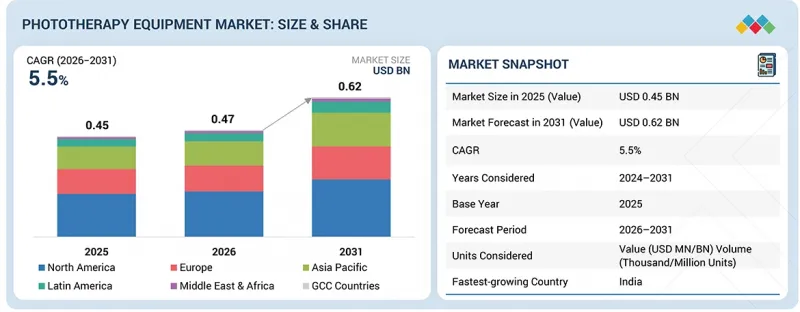
The phototherapy equipment market is projected to reach USD 0.62 billion by 2031, up from USD 0.47 billion in 2026, at a CAGR of 5.5%.
| Scope of the Report | |
|---|---|
| Years Considered for the Study | 2026-2031 |
| Base Year | 2025 |
| Forecast Period | 2026-2031 |
| Units Considered | Value (USD billion) |
| Segments | Product, Application, End user, and Region |
| Regions covered | North America, Europe, Asia Pacific, Latin America, Middle East & Africa, and GCC Countries |
Continuous technological innovation, particularly the transition from conventional fluorescent and halogen light sources to LED-based phototherapy systems, is significantly driving market growth. LED phototherapy devices offer multiple advantages, including higher energy efficiency, longer operational lifespan, reduced heat emission, and precise wavelength targeting, which enhances treatment effectiveness while minimizing risks. These systems also provide uniform light distribution, improving clinical outcomes in both neonatal and dermatological applications. Additionally, advancements in device design have led to the development of compact, user-friendly, and low-maintenance systems, making them more accessible to healthcare facilities with varying resource levels. Manufacturers are also integrating smart features such as digital displays, intensity controls, and automated timers, which improve usability and treatment accuracy. The growing preference for technologically advanced solutions among healthcare providers is accelerating the replacement of older equipment with modern LED-based systems. This ongoing innovation cycle not only improves patient outcomes but also creates a steady global demand for upgraded phototherapy equipment.
Based on product: One of the most significant drivers of the dominance of conventional phototherapy equipment is its cost advantage over advanced alternatives, such as LED-based and fiber-optic systems. Conventional units typically have lower upfront acquisition costs, making them highly attractive for hospitals operating under tight budget constraints. In addition to capital expenditure, these systems also incur lower maintenance and servicing costs due to their simpler design and readily available components. This affordability becomes particularly crucial in price-sensitive markets, where healthcare providers must balance quality care with financial limitations. Public hospitals, small clinics, and rural healthcare centers often prioritize cost-effective solutions that can deliver acceptable clinical outcomes without significant investment. Moreover, large-scale procurement programs, especially in government-funded healthcare systems, tend to favor conventional equipment due to its economic viability. This strong cost-benefit equation ensures that conventional phototherapy remains widely accessible and continues to dominate market demand despite the availability of technologically advanced alternatives.
Based on application: Phototherapy is universally recognized as the first-line treatment for neonatal hyperbilirubinemia due to its proven safety, efficacy, and non-invasive nature. It works by converting bilirubin into water-soluble isomers that can be excreted without requiring liver conjugation. Clinical guidelines across major health organizations strongly recommend phototherapy as the initial intervention before considering more invasive procedures such as exchange transfusion. This strong clinical endorsement ensures that phototherapy devices are routinely used in hospitals, particularly in NICUs and maternity centers. The treatment is easy to administer, requires minimal training, and has a low risk of adverse effects, making it suitable for widespread use even in resource-limited settings. Additionally, advancements such as LED-based phototherapy systems have further improved treatment efficiency and reduced operational costs, reinforcing its position as the preferred treatment modality. As a result, healthcare providers consistently rely on phototherapy equipment, which drives its dominant share in the neonatal jaundice segment.
North America's well-developed healthcare infrastructure plays a crucial role in supporting the widespread adoption of phototherapy equipment. The region boasts an extensive network of hospitals, specialty clinics, and advanced neonatal care facilities, all equipped to diagnose and treat neonatal and dermatological conditions efficiently. Healthcare systems in the US and Canada are characterized by strong clinical protocols, modern medical technologies, and highly trained professionals, enabling seamless integration of phototherapy solutions into routine care. Additionally, the availability of well-equipped neonatal intensive care units ensures that even high-risk infants receive immediate treatment. This infrastructure not only facilitates access to phototherapy but also encourages healthcare providers to invest in technologically advanced systems such as LED-based devices. Furthermore, regular upgrades and maintenance of medical equipment, driven by stringent quality standards, contribute to sustained demand. The presence of such a robust healthcare ecosystem ensures consistent utilization and adoption of phototherapy devices across multiple care settings.
A breakdown of the primary participants (supply-side) for the phototherapy equipment market referred to in this report is provided below:
- By Company Type: Tier 1:34%, Tier 2: 38%, and Tier 3: 28%
- By Designation: C-level: 26%, Director Level: 35%, and Others: 39%
- By Region: North America: 17%, Europe: 39%, Asia Pacific: 28%, Latin America: 8%, Middle East & Africa: 3%, GCC Countries: 5%
Prominent players in the phototherapy equipment market are market Dragerwerk AG & Co. KGaA (Germany), GE HealthCare (US), Natus Medical (US), Atom Medical (Japan), Bistos (South Korea), Ningbo David (China), Phothera (US), STRATA Skin Sciences (US), Xuzhou Kernel Medical (China), Shanghai SIGMA High-tech (China), Ultralite Enterprises, Inc. (US), Hoenle Medical GmbH (Germany), Weyer (Germany), Neolight (US), Fanem (Brazil), Phoenix Medical Systems (India), among others.
Research Coverage
The report evaluates the phototherapy equipment market and estimates the market size and future growth potential of this market based on various segments, including product, application, end user, and region. The report also includes a competitive analysis of the major players in this market, along with company profiles, product offerings, recent developments, and key market strategies.
Reasons to Buy the Report
The report will assist the market leader and new entrants with data on the nearest approximations of revenue for the overall market, the phototherapy equipment market, and its subsegments. The report will assist stakeholders in understanding the competitive landscape and in gaining further insights to better position their businesses and develop appropriate go-to-market strategies. The report assists the stakeholders in understanding the market pulse and gives them data on influential drivers, hindrances, obstacles, and opportunities in the market.
This report provides insights into the following points:
- Analysis of key drivers (rising incidence of neonatal jaundice, rising number of preterm and low-weight births, rising prevalence of skin diseases, launch of technologically advanced phototherapy equipment, rising adoption of LED-based phototherapy equipment), restraints (high use of alternative modes of treatment, stringent FDA regulatory policies for the approval of new devices), opportunities (development of low-cost phototherapy equipment, rising adoption of home phototherapy for the treatment of skin diseases), and challenges (rising trend of purchasing refurbished phototherapy equipment in emerging markets, limited adoption of phototherapy equipment in developing nations)
- Product Enhancement/Innovation: Comprehensive details about product launches and anticipated trends in the global phototherapy equipment market
- Market Development: Thorough knowledge and analysis of the profitable rising markets by product, application, end user, and region.
- Market Diversification: Comprehensive information about newly launched products, expanding markets, current advancements, and investments in the global phototherapy equipment market
- Competitive Assessment: Thorough evaluation of the market shares, growth plans, offerings, and capacities of the major competitors in the global phototherapy equipment market
TABLE OF CONTENTS
1 INTRODUCTION
- 1.1 STUDY OBJECTIVES
- 1.2 MARKET DEFINITION
- 1.3 STUDY SCOPE
- 1.3.1 MARKETS COVERED
- 1.3.2 INCLUSIONS & EXCLUSIONS
- 1.3.3 YEARS CONSIDERED
- 1.3.4 CURRENCY CONSIDERED
- 1.4 STAKEHOLDERS
- 1.5 SUMMARY OF CHANGES
2 EXECUTIVE SUMMARY
- 2.1 KEY INSIGHTS AND MARKET HIGHLIGHTS
- 2.2 KEY MARKET PARTICIPANTS: SHARE INSIGHTS AND START DEVELOPMENTS
- 2.3 DISRUPTIVE TRENDS SHAPING MARKET
- 2.4 HIGH-GROWTH SEGMENTS & EMERGING FRONTIERS
- 2.5 SNAPSHOT: GLOBAL MARKET SIZE, GROWTH RATE, AND FORECAST
3 PREMIUM INSIGHTS
- 3.1 PHOTOTHERAPY EQUIPMENTS MARKET OVERVIEW
- 3.2 ASIA PACIFIC: PHOTOTHERAPY EQUIPMENT MARKET, BY END USER
- 3.3 PHOTOTHERAPY EQUIPMENT MARKET: GEOGRAPHIC GROWTH OPPORTUNITIES
- 3.4 PHOTOTHERAPY EQUIPMENT MARKET: REGIONAL MIX
- 3.5 PHOTOTHERAPY EQUIPMENT MARKET: DEVELOPED COUNTRIES VS. EMERGING ECONOMIES
4 MARKET OVERVIEW
- 4.1 INTRODUCTION
- 4.2 MARKET DYNAMICS
- 4.2.1 DRIVERS
- 4.2.1.1 Rising incidence of neonatal jaundice
- 4.2.1.2 Growing number of preterm and low-weight births
- 4.2.1.3 Rising prevalence of skin diseases
- 4.2.1.4 Launch of technologically advanced phototherapy equipment
- 4.2.1.5 Rising adoption of LED-based phototherapy equipment
- 4.2.2 RESTRAINTS
- 4.2.2.1 High use of alternative modes of treatment
- 4.2.2.2 Stringent regulatory policies for new device approval
- 4.2.3 OPPORTUNITIES
- 4.2.3.1 Development of low-cost phototherapy equipment
- 4.2.3.2 Rising adoption of home phototherapy for treating skin diseases
- 4.2.4 CHALLENGES
- 4.2.4.1 Rising trend of purchasing refurbished equipment in emerging markets
- 4.2.4.2 Limited adoption of phototherapy equipment in developing nations
- 4.2.1 DRIVERS
- 4.3 UNMET NEEDS AND WHITE SPACES
- 4.3.1 UNMET NEEDS IN PHOTOTHERAPY EQUIPMENT MARKET
- 4.3.2 WHITE SPACE OPPORTUNITIES
- 4.4 INTERCONNECTED MARKETS AND CROSS-SECTOR OPPORTUNITIES
- 4.4.1 INTERCONNECTED MARKETS
- 4.4.2 CROSS-SECTOR OPPORTUNITIES
- 4.5 STRATEGIC MOVES BY TIER-1/2/3 PLAYERS
5 INDUSTRY TRENDS
- 5.1 PORTER'S FIVE FORCES ANALYSIS
- 5.1.1 THREAT OF NEW ENTRANTS
- 5.1.2 THREAT OF SUBSTITUTES
- 5.1.3 BARGAINING POWER OF BUYERS
- 5.1.4 BARGAINING POWER OF SUPPLIERS
- 5.1.5 INTENSITY OF COMPETITIVE RIVALRY
- 5.2 MACROECONOMIC OUTLOOK
- 5.2.1 INTRODUCTION
- 5.2.2 GDP TRENDS AND FORECAST
- 5.2.3 TRENDS IN GLOBAL NEONATAL & DERMATOLOGY CARE INDUSTRY
- 5.3 SUPPLY CHAIN ANALYSIS
- 5.4 VALUE CHAIN ANALYSIS
- 5.5 ECOSYSTEM ANALYSIS
- 5.6 PRICING ANALYSIS
- 5.6.1 AVERAGE SELLING PRICE TREND, BY KEY PLAYER (2025)
- 5.6.2 AVERAGE SELLING PRICE TREND, BY REGION (2024-2026)
- 5.7 TRADE ANALYSIS
- 5.7.1 IMPORT SCENARIO (HS CODE 9018090)
- 5.7.2 EXPORT SCENARIO (HS CODE 9018090)
- 5.8 KEY CONFERENCES AND EVENTS, 2026-2027
- 5.9 TRENDS/DISRUPTIONS IMPACTING CUSTOMERS' BUSINESSES
- 5.10 INVESTMENT & FUNDING SCENARIO
- 5.11 CASE STUDY ANALYSIS
- 5.11.1 CASE STUDY 1: SMART NICU UPGRADE AT BOSTON CHILDREN'S HOSPITAL
- 5.11.2 CASE STUDY 2: AFFORDABLE PHOTOTHERAPY EXPANSION IN RURAL INDIA
- 5.11.3 CASE STUDY 3: PREDICTIVE NEONATAL MONITORING AT MOUNT SINAI HOSPITAL, CANADA
- 5.12 IMPACT OF US TARIFFS-PHOTOTHERAPY EQUIPMENT MARKET
- 5.12.1 INTRODUCTION
- 5.12.2 KEY TARIFF RATES
- 5.12.3 PRICE IMPACT ANALYSIS
- 5.12.4 IMPACT ON COUNTRIES/REGIONS
- 5.12.4.1 North America
- 5.12.4.2 Europe
- 5.12.4.3 Asia Pacific
- 5.12.5 END-USE INDUSTRY IMPACT
6 TECHNOLOGICAL ADVANCEMENTS, AI-DRIVEN IMPACT, PATENTS, INNOVATIONS, AND FUTURE APPLICATIONS
- 6.1 KEY EMERGING TECHNOLOGIES
- 6.1.1 ADVANCED LED PHOTOTHERAPY SYSTEMS
- 6.1.2 FIBER-OPTIC & WEARABLE PHOTOTHERAPY TECHNOLOGIES
- 6.2 COMPLEMENTARY TECHNOLOGIES
- 6.2.1 BIOSENSOR & CHEMICAL SENSOR TECHNOLOGIES
- 6.2.2 POINT-OF-CARE & HOME CARE TREATMENT PLATFORMS
- 6.3 TECHNOLOGY/PRODUCT ROADMAP
- 6.3.1 SHORT-TERM (2025-2027) | FOUNDATION & EARLY COMMERCIALIZATION
- 6.3.2 MID-TERM (2027-2030) | EXPANSION & STANDARDIZATION
- 6.3.3 LONG-TERM (2030-2035+) | MASS COMMERCIALIZATION & DISRUPTION
- 6.4 PATENT ANALYSIS
- 6.4.1 INSIGHTS: JURISDICTION AND TOP APPLICANT ANALYSIS
- 6.5 FUTURE APPLICATIONS
- 6.5.1 AI-ENABLED SMART PHOTOTHERAPY & CONNECTED CARE SYSTEMS
- 6.5.2 NON-INVASIVE MEDICAL BREATH DIAGNOSTICS
- 6.5.3 NEXT-GENERATION LED & PRECISION PHOTOTHERAPY TECHNOLOGIES
- 6.6 IMPACT OF AI/GEN AI ON PHOTOTHERAPY EQUIPMENT MARKET
- 6.6.1 TOP USE CASES AND MARKET POTENTIAL
- 6.6.2 BEST PRACTICES FOLLOWED BY MANUFACTURERS/OEMS IN PHOTOTHERAPY EQUIPMENT MARKET
- 6.6.3 CASE STUDIES OF AI IMPLEMENTATION IN PHOTOTHERAPY EQUIPMENT
- 6.6.4 INTERCONNECTED ADJACENT ECOSYSTEMS AND IMPACT ON MARKET PLAYERS
- 6.6.5 CLIENTS' READINESS TO ADOPT GENERATIVE AI IN PHOTOTHERAPY EQUIPMENT MARKET
7 CUSTOMER LANDSCAPE & BUYER BEHAVIOR
- 7.1 DECISION-MAKING PROCESS
- 7.2 KEY STAKEHOLDERS INVOLVED IN BUYING PROCESS AND THEIR EVALUATION CRITERIA
- 7.2.1 KEY STAKEHOLDERS IN BUYING PROCESS
- 7.2.2 KEY BUYING CRITERIA
- 7.3 ADOPTION BARRIERS & INTERNAL CHALLENGES
- 7.4 UNMET NEEDS OF VARIOUS END-USE INDUSTRIES
- 7.5 MARKET PROFITABILITY
- 7.5.1 REVENUE POTENTIAL
- 7.5.2 COST DYNAMICS
- 7.5.3 MARGIN OPPORTUNITIES IN KEY APPLICATIONS
8 REGULATORY LANDSCAPE
- 8.1 REGIONAL REGULATIONS AND COMPLIANCE
- 8.1.1 REGULATORY BODIES, GOVERNMENT AGENCIES, AND OTHER ORGANIZATIONS
- 8.1.2 INDUSTRY STANDARDS
9 PHOTOTHERAPY EQUIPMENT MARKET, BY PRODUCT
- 9.1 INTRODUCTION
- 9.2 CONVENTIONAL PHOTOTHERAPY
- 9.2.1 AFFORDABILITY AND ACCESSIBILITY DRIVING CONTINUED USE OF CONVENTIONAL PHOTOTHERAPY EQUIPMENT
- 9.3 FIBER-OPTIC PHOTOTHERAPY
- 9.3.1 PARENT-FRIENDLY DESIGN AND HOME-BASED CARE DEMAND ACCELERATE GROWTH IN FIBER-OPTIC PHOTOTHERAPY
10 PHOTOTHERAPY EQUIPMENT MARKET, BY APPLICATION
- 10.1 INTRODUCTION
- 10.2 NEONATAL JAUNDICE
- 10.2.1 INCREASING NUMBER OF PRETERM AND LOW-WEIGHT BIRTHS TO DRIVE MARKET GROWTH
- 10.3 SKIN DISEASES
- 10.3.1 PSORIASIS
- 10.3.1.1 Rising demand for non-invasive therapies and technological advancements to drive market
- 10.3.2 VITILIGO
- 10.3.2.1 High effectiveness in managing vitiligo drives market growth
- 10.3.3 ECZEMA
- 10.3.3.1 Growing burden of pediatric eczema to support demand for phototherapy
- 10.3.1 PSORIASIS
11 PHOTOTHERAPY EQUIPMENT MARKET, BY END USER
- 11.1 INTRODUCTION
- 11.2 HOSPITALS
- 11.2.1 RISING PATIENT ADMISSIONS AND ADVANCED TREATMENT INFRASTRUCTURE SUPPORT DOMINANCE OF HOSPITALS
- 11.3 HOME CARE SETTINGS
- 11.3.1 INCREASING ADOPTION OF PORTABLE AND HOME-USE DEVICES TO DRIVE MARKET GROWTH
12 PHOTOTHERAPY EQUIPMENT MARKET, BY REGION
- 12.1 INTRODUCTION
- 12.2 NORTH AMERICA
- 12.2.1 US
- 12.2.1.1 Government initiatives and technological advancements supporting market growth
- 12.2.2 CANADA
- 12.2.2.1 Expansion of neonatal care services and home-based phototherapy adoption driving market growth
- 12.2.1 US
- 12.3 EUROPE
- 12.3.1 GERMANY
- 12.3.1.1 Advanced healthcare infrastructure and innovation leadership driving market growth
- 12.3.2 UK
- 12.3.2.1 NHS modernization and increasing dermatology treatment demand supporting market growth
- 12.3.3 FRANCE
- 12.3.3.1 Public healthcare investments and rising neonatal care demand driving market growth
- 12.3.4 ITALY
- 12.3.4.1 Healthcare modernization and rising awareness of skin disease treatments supporting market growth
- 12.3.5 SPAIN
- 12.3.5.1 Rising neonatal healthcare investments and dermatology treatment adoption are driving growth
- 12.3.6 REST OF EUROPE
- 12.3.1 GERMANY
- 12.4 ASIA PACIFIC
- 12.4.1 CHINA
- 12.4.1.1 Healthcare expansion and domestic medical device manufacturing driving market growth
- 12.4.2 JAPAN
- 12.4.2.1 Aging population and advanced healthcare technologies supporting market growth
- 12.4.3 INDIA
- 12.4.3.1 Rising neonatal healthcare demand and government healthcare initiatives driving market growth
- 12.4.4 AUSTRALIA
- 12.4.4.1 Expansion of neonatal healthcare programs and dermatology services supporting market growth
- 12.4.5 SOUTH KOREA
- 12.4.5.1 Technological innovation and expanding dermatology care driving market growth
- 12.4.6 REST OF ASIA PACIFIC
- 12.4.1 CHINA
- 12.5 LATIN AMERICA
- 12.5.1 BRAZIL
- 12.5.1.1 Expanding neonatal healthcare services and growing dermatology market supporting growth
- 12.5.2 MEXICO
- 12.5.2.1 Healthcare modernization and increasing neonatal care awareness driving market growth
- 12.5.3 REST OF LATIN AMERICA
- 12.5.1 BRAZIL
- 12.6 MIDDLE EAST & AFRICA
- 12.7 GCC COUNTRIES
13 COMPETITIVE LANDSCAPE
- 13.1 OVERVIEW
- 13.2 KEY PLAYER STRATEGIES/RIGHT TO WIN
- 13.3 REVENUE ANALYSIS
- 13.4 MARKET SHARE ANALYSIS
- 13.5 COMPANY EVALUATION MATRIX: KEY PLAYERS, 2025
- 13.5.1 STARS
- 13.5.2 EMERGING LEADERS
- 13.5.3 PERVASIVE PLAYERS
- 13.5.4 PARTICIPANTS
- 13.5.5 COMPANY FOOTPRINT: KEY PLAYERS, 2025
- 13.5.5.1 Company footprint
- 13.5.5.2 Region footprint
- 13.5.5.3 Product footprint
- 13.5.5.4 Application footprint
- 13.5.5.5 End-user footprint
- 13.6 COMPETITIVE EVALUATION MATRIX: STARTUPS/SMES, 2025
- 13.6.1 PROGRESSIVE COMPANIES
- 13.6.2 RESPONSIVE COMPANIES
- 13.6.3 DYNAMIC COMPANIES
- 13.6.4 STARTING BLOCKS
- 13.6.5 COMPETITIVE BENCHMARKING: STARTUPS/SMES, 2025
- 13.6.5.1 Detailed list of key startups/SMEs
- 13.6.5.2 Competitive benchmarking of startups/SMEs
- 13.7 COMPANY VALUATION AND FINANCIAL METRICS
- 13.7.1 FINANCIAL METRICS
- 13.7.2 COMPANY VALUATION
- 13.8 BRAND COMPARISON
- 13.9 COMPETITIVE SCENARIO
- 13.9.1 PRODUCT LAUNCHES & APPROVALS
- 13.9.2 DEALS
14 COMPANY PROFILES
- 14.1 KEY PLAYERS
- 14.1.1 GE HEALTHCARE
- 14.1.1.1 Business overview
- 14.1.1.2 Products offered
- 14.1.1.3 MnM view
- 14.1.1.3.1 Right to win
- 14.1.1.3.2 Strategic choices
- 14.1.1.3.3 Weaknesses and competitive threats
- 14.1.2 DRAGERWERK AG & CO. KGAA
- 14.1.2.1 Business overview
- 14.1.2.2 Products offered
- 14.1.2.3 Recent developments
- 14.1.2.3.1 Product launches
- 14.1.2.4 MnM view
- 14.1.2.4.1 Right to win
- 14.1.2.4.2 Strategic choices
- 14.1.2.4.3 Weaknesses and competitive threats
- 14.1.3 NATUS SENSORY
- 14.1.3.1 Business overview
- 14.1.3.2 Products offered
- 14.1.3.3 Recent developments
- 14.1.3.3.1 Deals
- 14.1.3.4 MnM view
- 14.1.3.4.1 Key strengths/Right to win
- 14.1.3.4.2 Strategic choices made
- 14.1.3.4.3 Weaknesses and competitive threats
- 14.1.4 PHOTHERA
- 14.1.4.1 Business overview
- 14.1.4.2 Products offered
- 14.1.4.3 Recent developments
- 14.1.4.3.1 Product launches
- 14.1.4.4 MnM view
- 14.1.4.4.1 Key strengths/Right to win
- 14.1.4.4.2 Strategic choices made
- 14.1.4.4.3 Weaknesses and competitive threats
- 14.1.5 SHANGHAI SIGMA HIGH-TECH CO., LTD.
- 14.1.5.1 Business overview
- 14.1.5.2 Products offered
- 14.1.5.3 Recent developments
- 14.1.5.3.1 Product launches
- 14.1.5.4 MnM view
- 14.1.5.4.1 Right to win
- 14.1.5.4.2 Strategic choices
- 14.1.5.4.3 Weaknesses and competitive threats
- 14.1.6 ATOM MEDICAL CORP
- 14.1.6.1 Business overview
- 14.1.6.2 Products offered
- 14.1.7 PHOENIX MEDICAL SYSTEMS
- 14.1.7.1 Business overview
- 14.1.7.2 Products offered
- 14.1.8 NEOLIGHT LLC
- 14.1.8.1 Business overview
- 14.1.8.2 Products offered
- 14.1.8.3 Recent developments
- 14.1.8.3.1 Deals
- 14.1.9 FANEM
- 14.1.9.1 Business overview
- 14.1.9.2 Products offered
- 14.1.10 BISTOS CO., LTD.
- 14.1.10.1 Business overview
- 14.1.10.2 Products offered
- 14.1.1 GE HEALTHCARE
- 14.2 OTHER PLAYERS
- 14.2.1 NINGBO DAVID MEDICAL DEVICE CO., LTD.
- 14.2.2 STRATA SKIN SCIENCES
- 14.2.3 XUZHOU KERNEL MEDICAL EQUIPMENT CO., LTD.
- 14.2.4 ULTRALITE ENTERPRISES, INC.
- 14.2.5 HOENLE MEDICAL GMBH
- 14.2.6 WEYER GMBH
- 14.2.7 SHENZHEN COMEN MEDICAL INSTRUMENTS CO., LTD.
- 14.2.8 THERALIGHT, LLC
- 14.2.9 ATHRODAX LTD
- 14.2.10 CURELIGHT
- 14.2.11 PHOTO THERAPEUTICS LTD
- 14.2.12 TINY HEARTS TECHNOLOGY
- 14.2.13 LIFETRONS INNO EQUIPMENTS PVT LTD
- 14.2.14 IBIS MEDICAL EQUIPMENT AND SYSTEMS PVT LTD
- 14.2.15 SCI HEALTH
15 RESEARCH METHODOLOGY
- 15.1 RESEARCH DATA
- 15.1.1 SECONDARY DATA
- 15.1.1.1 Key data from secondary sources
- 15.1.2 PRIMARY DATA
- 15.1.2.1 Key data from primary sources
- 15.1.2.2 Key industry insights
- 15.1.1 SECONDARY DATA
- 15.2 MARKET SIZE ESTIMATION
- 15.3 MARKET BREAKDOWN AND DATA TRIANGULATION
- 15.4 MARKET SHARE ESTIMATION
- 15.5 STUDY ASSUMPTIONS
- 15.6 METHODOLOGY-RELATED LIMITATIONS
- 15.7 RISK ASSESSMENT
- 15.8 RESEARCH LIMITATIONS
16 APPENDIX
- 16.1 DISCUSSION GUIDE
- 16.2 KNOWLEDGESTORE: MARKETSANDMARKETS' SUBSCRIPTION PORTAL
- 16.3 CUSTOMIZATION OPTIONS
- 16.4 RELATED REPORTS
- 16.5 AUTHOR DETAILS
List of Tables
- TABLE 1 STANDARD CURRENCY CONVERSION RATES TO USD
- TABLE 2 PHOTOTHERAPY EQUIPMENT MARKET: PORTER'S FIVE FORCES ANALYSIS
- TABLE 3 GDP PERCENTAGE CHANGE, BY KEY COUNTRY, 2021-2030
- TABLE 4 AVERAGE SELLING PRICE TREND OF PHOTOTHERAPY PRODUCTS, BY KEY PLAYER 2025 (USD)
- TABLE 5 AVERAGE PRICING TREND OF PHOTOTHERAPY PRODUCTS, BY REGION, 2024-2026 (USD)
- TABLE 6 IMPORT DATA FOR PHOTOTHERAPY EQUIPMENT PRODUCTS UNDER HS CODE 9018090, BY COUNTRY, 2021-2025 (USD THOUSAND)
- TABLE 7 EXPORT DATA FOR PHOTOTHERAPY EQUIPMENT UNDER HS CODE 903180, BY COUNTRY, 2020-2024 (USD THOUSAND)
- TABLE 8 PHOTOTHERAPY EQUIPMENT MARKET: DETAILED LIST OF KEY CONFERENCES AND EVENTS (2026-2027)
- TABLE 9 US-ADJUSTED RECIPROCAL TARIFF RATES
- TABLE 10 KEY PRODUCT-RELATED TARIFF EFFECTIVE FOR PHOTOTHERAPY EQUIPMENT
- TABLE 11 TOP USE CASES AND MARKET POTENTIAL
- TABLE 12 PHOTOTHERAPY EQUIPMENT MARKET: CASE STUDIES RELATED TO AI IMPLEMENTATION
- TABLE 13 INTERCONNECTED ADJACENT ECOSYSTEMS AND IMPACT ON MARKET PLAYERS
- TABLE 14 INFLUENCE OF KEY STAKEHOLDERS ON BUYING PROCESS OF PHOTOTHERAPY EQUIPMENT
- TABLE 15 KEY BUYING CRITERIA FOR PHOTOTHERAPY EQUIPMENT
- TABLE 16 PHOTOTHERAPY EQUIPMENT MARKET: UNMET NEEDS/END-USER EXPECTATIONS
- TABLE 17 NORTH AMERICA: REGULATORY BODIES, GOVERNMENT AGENCIES, AND OTHER ORGANIZATIONS
- TABLE 18 EUROPE: REGULATORY BODIES, GOVERNMENT AGENCIES, AND OTHER ORGANIZATIONS
- TABLE 19 ASIA PACIFIC: REGULATORY BODIES, GOVERNMENT AGENCIES, AND OTHER ORGANIZATIONS
- TABLE 20 LATIN AMERICA: REGULATORY BODIES, GOVERNMENT AGENCIES, AND OTHER ORGANIZATIONS
- TABLE 21 MIDDLE EAST & AFRICA AND GCC COUNTRIES: REGULATORY BODIES, GOVERNMENT AGENCIES, AND OTHER ORGANIZATIONS
- TABLE 22 GLOBAL STANDARDS IN PHOTOTHERAPY EQUIPMENT MARKET
- TABLE 23 PHOTOTHERAPY EQUIPMENT MARKET, BY PRODUCT, 2024-2031 (USD MILLION)
- TABLE 24 CONVENTIONAL PHOTOTHERAPY EQUIPMENT MARKET, BY COUNTRY, 2024-2031 (USD MILLION)
- TABLE 25 CONVENTIONAL PHOTOTHERAPY EQUIPMENT MARKET VOLUME, BY REGION, 2024-2031 (UNITS)
- TABLE 26 FIBER-OPTIC PHOTOTHERAPY EQUIPMENT MARKET, BY COUNTRY, 2024-2031 (USD MILLION)
- TABLE 27 FIBER-OPTIC PHOTOTHERAPY EQUIPMENT MARKET VOLUME, BY REGION, 2024-2031 (UNITS)
- TABLE 28 PHOTOTHERAPY EQUIPMENT MARKET, BY APPLICATION, 2024-2031 (USD MILLION)
- TABLE 29 PHOTOTHERAPY EQUIPMENT MARKET FOR NEONATAL JAUNDICE, BY COUNTRY, 2024-2031 (USD MILLION)
- TABLE 30 PHOTOTHERAPY EQUIPMENT MARKET FOR SKIN DISEASES, BY TYPE, 2024-2031 (USD MILLION)
- TABLE 31 PHOTOTHERAPY EQUIPMENT MARKET FOR SKIN DISEASES, BY COUNTRY, 2024-2031 (USD MILLION)
- TABLE 32 PHOTOTHERAPY EQUIPMENT MARKET FOR PSORIASIS, BY COUNTRY, 2024-2031 (USD MILLION)
- TABLE 33 PHOTOTHERAPY EQUIPMENT MARKET FOR VITILIGO, BY COUNTRY, 2024-2031 (USD MILLION)
- TABLE 34 PHOTOTHERAPY EQUIPMENT MARKET FOR ECZEMA, BY COUNTRY, 2024-2031 (USD MILLION)
- TABLE 35 PHOTOTHERAPY EQUIPMENT MARKET BY END USER, 2024-2031 (USD MILLION)
- TABLE 36 PHOTOTHERAPY EQUIPMENT MARKET FOR HOSPITALS, BY COUNTRY, 2024-2031 (USD MILLION)
- TABLE 37 PHOTOTHERAPY EQUIPMENT MARKET FOR HOME CARE SETTINGS, BY COUNTRY, 2024-2031 (USD MILLION)
- TABLE 38 PHOTOTHERAPY EQUIPMENT MARKET, BY REGION, 2024-2031 (USD MILLION)
- TABLE 39 NORTH AMERICA: PHOTOTHERAPY EQUIPMENT MARKET, BY COUNTRY, 2024-2031 (USD MILLION)
- TABLE 40 NORTH AMERICA: PHOTOTHERAPY EQUIPMENT MARKET, BY PRODUCT, 2024-2031 (USD MILLION)
- TABLE 41 NORTH AMERICA: PHOTOTHERAPY EQUIPMENT MARKET, BY APPLICATION, 2024-2031 (USD MILLION)
- TABLE 42 NORTH AMERICA: PHOTOTHERAPY EQUIPMENT MARKET FOR SKIN DISEASES, BY TYPE, 2024-2031 (USD MILLION)
- TABLE 43 NORTH AMERICA: PHOTOTHERAPY EQUIPMENT MARKET, BY END USER, 2024-2031 (USD MILLION)
- TABLE 44 US: PHOTOTHERAPY EQUIPMENT MARKET, BY PRODUCT, 2024-2031 (USD MILLION)
- TABLE 45 US: PHOTOTHERAPY EQUIPMENT MARKET, BY APPLICATION, 2024-2031 (USD MILLION)
- TABLE 46 US: PHOTOTHERAPY EQUIPMENT MARKET FOR SKIN DISEASES, BY TYPE, 2024-2031 (USD MILLION)
- TABLE 47 US: PHOTOTHERAPY EQUIPMENT MARKET, BY END USER, 2024-2031 (USD MILLION)
- TABLE 48 CANADA: PHOTOTHERAPY EQUIPMENT MARKET, BY PRODUCT, 2024-2031 (USD MILLION)
- TABLE 49 CANADA: PHOTOTHERAPY EQUIPMENT MARKET, BY APPLICATION, 2024-2031 (USD MILLION)
- TABLE 50 CANADA: PHOTOTHERAPY EQUIPMENT MARKET FOR SKIN DISEASES, BY TYPE, 2024-2031 (USD MILLION)
- TABLE 51 CANADA: PHOTOTHERAPY EQUIPMENT MARKET, BY END USER, 2024-2031 (USD MILLION)
- TABLE 52 EUROPE: PHOTOTHERAPY EQUIPMENT MARKET, BY COUNTRY, 2024-2031 (USD MILLION)
- TABLE 53 EUROPE: PHOTOTHERAPY EQUIPMENT MARKET, BY PRODUCT, 2024-2031 (USD MILLION)
- TABLE 54 EUROPE: PHOTOTHERAPY EQUIPMENT MARKET, BY APPLICATION, 2024-2031 (USD MILLION)
- TABLE 55 EUROPE: PHOTOTHERAPY EQUIPMENT MARKET FOR SKIN DISEASES, BY TYPE, 2024-2031 (USD MILLION)
- TABLE 56 EUROPE: PHOTOTHERAPY EQUIPMENT MARKET, BY END USER, 2024-2031 (USD MILLION)
- TABLE 57 GERMANY: PHOTOTHERAPY EQUIPMENT MARKET, BY PRODUCT, 2024-2031 (USD MILLION)
- TABLE 58 GERMANY: PHOTOTHERAPY EQUIPMENT MARKET, BY APPLICATION, 2024-2031 (USD MILLION)
- TABLE 59 GERMANY: PHOTOTHERAPY EQUIPMENT MARKET FOR SKIN DISEASES, BY TYPE, 2024-2031 (USD MILLION)
- TABLE 60 GERMANY: PHOTOTHERAPY EQUIPMENT MARKET, BY END USER, 2024-2031 (USD MILLION)
- TABLE 61 UK: PHOTOTHERAPY EQUIPMENT MARKET, BY PRODUCT, 2024-2031 (USD MILLION)
- TABLE 62 UK: PHOTOTHERAPY EQUIPMENT MARKET, BY APPLICATION, 2024-2031 (USD MILLION)
- TABLE 63 UK: PHOTOTHERAPY EQUIPMENT MARKET FOR SKIN DISEASES, BY TYPE, 2024-2031 (USD MILLION)
- TABLE 64 UK: PHOTOTHERAPY EQUIPMENT MARKET, BY END USER, 2024-2031 (USD MILLION)
- TABLE 65 FRANCE: PHOTOTHERAPY EQUIPMENT MARKET, BY PRODUCT, 2024-2031 (USD MILLION)
- TABLE 66 FRANCE: PHOTOTHERAPY EQUIPMENT MARKET, BY APPLICATION, 2024-2031 (USD MILLION)
- TABLE 67 FRANCE: PHOTOTHERAPY EQUIPMENT MARKET FOR SKIN DISEASES, BY TYPE, 2024-2031 (USD MILLION)
- TABLE 68 FRANCE: PHOTOTHERAPY EQUIPMENT MARKET, BY END USER, 2024-2031 (USD MILLION)
- TABLE 69 ITALY: PHOTOTHERAPY EQUIPMENT MARKET, BY PRODUCT, 2024-2031 (USD MILLION)
- TABLE 70 ITALY: PHOTOTHERAPY EQUIPMENT MARKET, BY APPLICATION, 2024-2031 (USD MILLION)
- TABLE 71 ITALY: PHOTOTHERAPY EQUIPMENT MARKET FOR SKIN DISEASES, BY TYPE, 2024-2031 (USD MILLION)
- TABLE 72 ITALY: PHOTOTHERAPY EQUIPMENT MARKET, BY END USER, 2024-2031 (USD MILLION)
- TABLE 73 SPAIN: PHOTOTHERAPY EQUIPMENT MARKET, BY PRODUCT, 2024-2031 (USD MILLION)
- TABLE 74 SPAIN: PHOTOTHERAPY EQUIPMENT MARKET, BY APPLICATION, 2024-2031 (USD MILLION)
- TABLE 75 SPAIN: PHOTOTHERAPY EQUIPMENT MARKET FOR SKIN DISEASES, BY TYPE, 2024-2031 (USD MILLION)
- TABLE 76 SPAIN: PHOTOTHERAPY EQUIPMENT MARKET, BY END USER, 2024-2031 (USD MILLION)
- TABLE 77 REST OF EUROPE: PHOTOTHERAPY EQUIPMENT MARKET, BY PRODUCT, 2024-2031 (USD MILLION)
- TABLE 78 REST OF EUROPE: PHOTOTHERAPY EQUIPMENT MARKET, BY APPLICATION, 2024-2031 (USD MILLION)
- TABLE 79 REST OF EUROPE: PHOTOTHERAPY EQUIPMENT MARKET FOR SKIN DISEASES, BY TYPE, 2024-2031 (USD MILLION)
- TABLE 80 REST OF EUROPE: PHOTOTHERAPY EQUIPMENT MARKET, BY END USER, 2024-2031 (USD MILLION)
- TABLE 81 ASIA PACIFIC: PHOTOTHERAPY EQUIPMENT MARKET, BY COUNTRY, 2024-2031 (USD MILLION)
- TABLE 82 ASIA PACIFIC: PHOTOTHERAPY EQUIPMENT MARKET, BY PRODUCT, 2024-2031 (USD MILLION)
- TABLE 83 ASIA PACIFIC: PHOTOTHERAPY EQUIPMENT MARKET, BY APPLICATION, 2024-2031 (USD MILLION)
- TABLE 84 ASIA PACIFIC: PHOTOTHERAPY EQUIPMENT MARKET FOR SKIN DISEASES, BY TYPE, 2024-2031 (USD MILLION)
- TABLE 85 ASIA PACIFIC: PHOTOTHERAPY EQUIPMENT MARKET, BY END USER, 2024-2031 (USD MILLION)
- TABLE 86 CHINA: PHOTOTHERAPY EQUIPMENT MARKET, BY PRODUCT, 2024-2031 (USD MILLION)
- TABLE 87 CHINA: PHOTOTHERAPY EQUIPMENT MARKET, BY APPLICATION, 2024-2031 (USD MILLION)
- TABLE 88 CHINA: PHOTOTHERAPY EQUIPMENT MARKET FOR SKIN DISEASES, BY TYPE, 2024-2031 (USD MILLION)
- TABLE 89 CHINA: PHOTOTHERAPY EQUIPMENT MARKET, BY END USER, 2024-2031 (USD MILLION)
- TABLE 90 JAPAN: PHOTOTHERAPY EQUIPMENT MARKET, BY PRODUCT, 2024-2031 (USD MILLION)
- TABLE 91 JAPAN: PHOTOTHERAPY EQUIPMENT MARKET, BY APPLICATION, 2024-2031 (USD MILLION)
- TABLE 92 JAPAN: PHOTOTHERAPY EQUIPMENT MARKET FOR SKIN DISEASES, BY TYPE, 2024-2031 (USD MILLION)
- TABLE 93 JAPAN: PHOTOTHERAPY EQUIPMENT MARKET, BY END USER, 2024-2031 (USD MILLION)
- TABLE 94 INDIA: PHOTOTHERAPY EQUIPMENT MARKET, BY PRODUCT, 2024-2031 (USD MILLION)
- TABLE 95 INDIA: PHOTOTHERAPY EQUIPMENT MARKET, BY APPLICATION, 2024-2031 (USD MILLION)
- TABLE 96 INDIA: PHOTOTHERAPY EQUIPMENT MARKET FOR SKIN DISEASES, BY TYPE, 2024-2031 (USD MILLION)
- TABLE 97 INDIA: PHOTOTHERAPY EQUIPMENT MARKET, BY END USER, 2024-2031 (USD MILLION)
- TABLE 98 AUSTRALIA: PHOTOTHERAPY EQUIPMENT MARKET, BY PRODUCT, 2024-2031 (USD MILLION)
- TABLE 99 AUSTRALIA: PHOTOTHERAPY EQUIPMENT MARKET, BY APPLICATION, 2024-2031 (USD MILLION)
- TABLE 100 AUSTRALIA: PHOTOTHERAPY EQUIPMENT MARKET FOR SKIN DISEASES, BY TYPE, 2024-2031 (USD MILLION)
- TABLE 101 AUSTRALIA: PHOTOTHERAPY EQUIPMENT MARKET, BY END USER, 2024-2031 (USD MILLION)
- TABLE 102 SOUTH KOREA: PHOTOTHERAPY EQUIPMENT MARKET, BY PRODUCT, 2024-2031 (USD MILLION)
- TABLE 103 SOUTH KOREA: PHOTOTHERAPY EQUIPMENT MARKET, BY APPLICATION, 2024-2031 (USD MILLION)
- TABLE 104 SOUTH KOREA: PHOTOTHERAPY EQUIPMENT MARKET FOR SKIN DISEASES, BY TYPE, 2024-2031 (USD MILLION)
- TABLE 105 SOUTH KOREA: PHOTOTHERAPY EQUIPMENT MARKET, BY END USER, 2024-2031 (USD MILLION)
- TABLE 106 REST OF ASIA PACIFIC: PHOTOTHERAPY EQUIPMENT MARKET, BY PRODUCT, 2024-2031 (USD MILLION)
- TABLE 107 REST OF ASIA PACIFIC: PHOTOTHERAPY EQUIPMENT MARKET, BY APPLICATION, 2024-2031 (USD MILLION)
- TABLE 108 REST OF ASIA PACIFIC: PHOTOTHERAPY EQUIPMENT MARKET FOR SKIN DISEASES, BY TYPE, 2024-2031 (USD MILLION)
- TABLE 109 REST OF ASIA PACIFIC: PHOTOTHERAPY EQUIPMENT MARKET, BY END USER, 2024-2031 (USD MILLION)
- TABLE 110 LATIN AMERICA: PHOTOTHERAPY EQUIPMENT MARKET, BY COUNTRY, 2024-2031 (USD MILLION)
- TABLE 111 LATIN AMERICA: PHOTOTHERAPY EQUIPMENT MARKET, BY PRODUCT, 2024-2031 (USD MILLION)
- TABLE 112 LATIN AMERICA: PHOTOTHERAPY EQUIPMENT MARKET, BY APPLICATION, 2024-2031 (USD MILLION)
- TABLE 113 LATIN AMERICA: PHOTOTHERAPY EQUIPMENT MARKET FOR SKIN DISEASES, BY TYPE, 2024-2031 (USD MILLION)
- TABLE 114 LATIN AMERICA: PHOTOTHERAPY EQUIPMENT MARKET, BY END USER, 2024-2031 (USD MILLION)
- TABLE 115 BRAZIL: PHOTOTHERAPY EQUIPMENT MARKET, BY PRODUCT, 2024-2031 (USD MILLION)
- TABLE 116 BRAZIL: PHOTOTHERAPY EQUIPMENT MARKET, BY APPLICATION, 2024-2031 (USD MILLION)
- TABLE 117 BRAZIL: PHOTOTHERAPY EQUIPMENT MARKET FOR SKIN DISEASES, BY TYPE, 2024-2031 (USD MILLION)
- TABLE 118 BRAZIL: PHOTOTHERAPY EQUIPMENT MARKET, BY END USER, 2024-2031 (USD MILLION)
- TABLE 119 MEXICO: PHOTOTHERAPY EQUIPMENT MARKET, BY PRODUCT, 2024-2031 (USD MILLION)
- TABLE 120 MEXICO: PHOTOTHERAPY EQUIPMENT MARKET, BY APPLICATION, 2024-2031 (USD MILLION)
- TABLE 121 MEXICO: PHOTOTHERAPY EQUIPMENT MARKET FOR SKIN DISEASES, BY TYPE, 2024-2031 (USD MILLION)
- TABLE 122 MEXICO: PHOTOTHERAPY EQUIPMENT MARKET, BY END USER, 2024-2031 (USD MILLION)
- TABLE 123 REST OF LATIN AMERICA: PHOTOTHERAPY EQUIPMENT MARKET, BY PRODUCT, 2024-2031 (USD MILLION)
- TABLE 124 REST OF LATIN AMERICA: PHOTOTHERAPY EQUIPMENT MARKET, BY APPLICATION, 2024-2031 (USD MILLION)
- TABLE 125 REST OF LATIN AMERICA: PHOTOTHERAPY EQUIPMENT MARKET FOR SKIN DISEASES, BY TYPE, 2024-2031 (USD MILLION)
- TABLE 126 REST OF LATIN AMERICA: PHOTOTHERAPY EQUIPMENT MARKET, BY END USER, 2024-2031 (USD MILLION)
- TABLE 127 MIDDLE EAST & AFRICA: PHOTOTHERAPY EQUIPMENT MARKET, BY PRODUCT, 2024-2031 (USD MILLION)
- TABLE 128 MIDDLE EAST & AFRICA: PHOTOTHERAPY EQUIPMENT MARKET, BY APPLICATION, 2024-2031 (USD MILLION)
- TABLE 129 MIDDLE EAST & AFRICA: PHOTOTHERAPY EQUIPMENT MARKET FOR SKIN DISEASES, BY TYPE, 2024-2031 (USD MILLION)
- TABLE 130 MIDDLE EAST & AFRICA: PHOTOTHERAPY EQUIPMENT MARKET, BY END USER, 2024-2031 (USD MILLION)
- TABLE 131 GCC COUNTRIES: PHOTOTHERAPY EQUIPMENT MARKET, BY PRODUCT, 2024-2031 (USD MILLION)
- TABLE 132 GCC COUNTRIES: PHOTOTHERAPY EQUIPMENT MARKET, BY APPLICATION, 2024-2031 (USD MILLION)
- TABLE 133 GCC COUNTRIES: PHOTOTHERAPY EQUIPMENT MARKET FOR SKIN DISEASES, BY TYPE, 2024-2031 (USD MILLION)
- TABLE 134 GCC COUNTRIES: PHOTOTHERAPY EQUIPMENT MARKET, BY END USER, 2024-2031 (USD MILLION)
- TABLE 135 KEY DEVELOPMENTS IN PHOTOTHERAPY EQUIPMENT MARKET, JANUARY 2021-MAY 2026
- TABLE 136 PHOTOTHERAPY EQUIPMENT MARKET: DEGREE OF COMPETITION
- TABLE 137 PHOTOTHERAPY EQUIPMENT MARKET: REGION FOOTPRINT
- TABLE 138 PHOTOTHERAPY EQUIPMENT MARKET: PRODUCT FOOTPRINT
- TABLE 139 PHOTOTHERAPY EQUIPMENT MARKET: APPLICATION FOOTPRINT
- TABLE 140 PHOTOTHERAPY EQUIPMENT MARKET: END-USER FOOTPRINT
- TABLE 141 PHOTOTHERAPY EQUIPMENT MARKET: DETAILED LIST OF KEY STARTUPS/SMES
- TABLE 142 PHOTOTHERAPY EQUIPMENT MARKET: COMPETITIVE BENCHMARKING OF STARTUPS/SMES
- TABLE 143 PHOTOTHERAPY EQUIPMENT MARKET: PRODUCT LAUNCHES & APPROVALS, JANUARY 2021-JANUARY 2026
- TABLE 144 PHOTOTHERAPY EQUIPMENT MARKET: DEALS, JANUARY 2021-JANUARY 2026
- TABLE 145 GE HEALTHCARE: COMPANY OVERVIEW
- TABLE 146 GE HEALTHCARE: PRODUCTS OFFERED
- TABLE 147 DRAGERWERK AG & CO. KGAA: COMPANY OVERVIEW
- TABLE 148 DRAGERWERK AG & CO. KGAA: PRODUCTS OFFERED
- TABLE 149 DRAGERWERK AG & CO. KGAA: PRODUCT LAUNCHES, JANUARY 2021-MAY 2026
- TABLE 150 NATUS SENSORY: COMPANY OVERVIEW
- TABLE 151 NATUS SENSORY: PRODUCTS OFFERED
- TABLE 152 NATUS SENSORY: DEALS, JANUARY 2021-MAY 2026
- TABLE 153 PHOTHERA: COMPANY OVERVIEW
- TABLE 154 PHOTHERA: PRODUCTS OFFERED
- TABLE 155 PHOTHERA: PRODUCT LAUNCHES, JANUARY 2021-MAY 2026
- TABLE 156 SHANGHAI SIGMA HIGH-TECH CO., LTD.: COMPANY OVERVIEW
- TABLE 157 SHANGHAI SIGMA HIGH-TECH CO., LTD.: PRODUCTS OFFERED
- TABLE 158 SHANGHAI SIGMA HIGH-TECH CO., LTD.: PRODUCT LAUNCHES, JANUARY 2021-MAY 2026
- TABLE 159 ATOM MEDICAL CORP: COMPANY OVERVIEW
- TABLE 160 ATOM MEDICAL CORP: PRODUCTS OFFERED
- TABLE 161 PHOENIX MEDICAL SYSTEMS: COMPANY OVERVIEW
- TABLE 162 PHOENIX MEDICAL SYSTEMS: PRODUCTS OFFERED
- TABLE 163 NEOLIGHT LLC: COMPANY OVERVIEW
- TABLE 164 NEOLIGHT LLC: PRODUCTS OFFERED
- TABLE 165 NEOLIGHT LLC: DEALS, JANUARY 2021-MAY 2026
- TABLE 166 FANEM: COMPANY OVERVIEW
- TABLE 167 FANEM: PRODUCTS OFFERED
- TABLE 168 BISTOS CO., LTD.: COMPANY OVERVIEW
- TABLE 169 BISTOS CO., LTD.: PRODUCTS OFFERED
- TABLE 170 NINGBO DAVID MEDICAL DEVICE CO., LTD.: COMPANY OVERVIEW
- TABLE 171 STRATA SKIN SCIENCES: COMPANY OVERVIEW
- TABLE 172 XUZHOU KERNEL MEDICAL EQUIPMENT CO., LTD.: COMPANY OVERVIEW
- TABLE 173 ULTRALITE ENTERPRISES, INC.: COMPANY OVERVIEW
- TABLE 174 HOENLE MEDICAL GMBH COMPANY OVERVIEW
- TABLE 175 WEYER GMBH: COMPANY OVERVIEW
- TABLE 176 SHENZHEN COMEN MEDICAL INSTRUMENTS CO., LTD.: COMPANY OVERVIEW
- TABLE 177 THERALIGHT, LLC: COMPANY OVERVIEW
- TABLE 178 ATHRODAX LTD: COMPANY OVERVIEW
- TABLE 179 CURELIGHT: COMPANY OVERVIEW
- TABLE 180 PHOTO THERAPEUTICS LTD: COMPANY OVERVIEW
- TABLE 181 TINY HEARTS TECHNOLOGY: COMPANY OVERVIEW
- TABLE 182 LIFETRONS INNO EQUIPMENTS PVT LTD: COMPANY OVERVIEW
- TABLE 183 IBIS MEDICAL EQUIPMENT AND SYSTEMS PVT LTD: COMPANY OVERVIEW
- TABLE 184 SCI HEALTH: COMPANY OVERVIEW
- TABLE 185 RISK ASSESSMENT: PHOTOTHERAPY EQUIPMENT
List of Figures
- FIGURE 1 PHOTOTHERAPY EQUIPMENT MARKET SEGMENTATION
- FIGURE 2 KEY INSIGHTS AND MARKET HIGHLIGHTS
- FIGURE 3 PHOTOTHERAPY EQUIPMENT MARKET, 2026-2031
- FIGURE 4 MAJOR STRATEGIES ADOPTED BY KEY PLAYERS IN PHOTOTHERAPY EQUIPMENT MARKET
- FIGURE 5 DISRUPTIVE TRENDS IMPACTING GROWTH OF PHOTOTHERAPY EQUIPMENT MARKET
- FIGURE 6 HIGH-GROWTH SEGMENTS AND EMERGING FRONTIERS IN PHOTOTHERAPY EQUIPMENT MARKET, 2025
- FIGURE 7 ASIA PACIFIC TO REGISTER HIGHEST GROWTH DURING FORECAST PERIOD
- FIGURE 8 INCREASING ADOPTION OF ENERGY-EFFICIENT LED PHOTOTHERAPY SYSTEMS AND EXPANSION OF HOME-BASED TREATMENT SOLUTIONS TO DRIVE MARKET
- FIGURE 9 CHINA AND CONVENTIONAL PHOTOTHERAPY EQUIPMENT ACCOUNTED FOR LARGEST MARKET SHARE IN 2025
- FIGURE 10 INDIA TO REGISTER HIGHEST CAGR DURING FORECAST PERIOD
- FIGURE 11 NORTH AMERICA ACCOUNTED FOR LARGEST MARKET SHARE IN 2025
- FIGURE 12 EMERGING ECONOMIES TO REGISTER HIGHER GROWTH RATES DURING FORECAST PERIOD
- FIGURE 13 PHOTOTHERAPY EQUIPMENT MARKET: DRIVERS, RESTRAINTS, OPPORTUNITIES, AND CHALLENGES
- FIGURE 14 PHOTOTHERAPY EQUIPMENT MARKET: PORTER'S FIVE FORCES ANALYSIS
- FIGURE 15 PHOTOTHERAPY EQUIPMENTS MARKET: SUPPLY CHAIN ANALYSIS
- FIGURE 16 VALUE CHAIN ANALYSIS: MAJOR VALUE ADDED DURING MANUFACTURING AND ASSEMBLY PHASES
- FIGURE 17 PHOTOTHERAPY EQUIPMENT MARKET: ECOSYSTEM ANALYSIS
- FIGURE 18 TRENDS/DISRUPTIONS INFLUENCING CUSTOMERS' BUSINESSES IN PHOTOTHERAPY EQUIPMENT MARKET
- FIGURE 19 PHOTOTHERAPY EQUIPMENT MARKET: INVESTMENT & FUNDING SCENARIO
- FIGURE 20 NUMBER OF PATENTS PUBLISHED (JANUARY 2016-MAY 2026)
- FIGURE 21 TOP APPLICANT COUNTRIES/REGIONS FOR PHOTOTHERAPY EQUIPMENT (JANUARY 2016- MAY 2026)
- FIGURE 22 INFLUENCE OF KEY STAKEHOLDERS ON BUYING PROCESS OF PHOTOTHERAPY EQUIPMENT
- FIGURE 23 KEY BUYING CRITERIA FOR PHOTOTHERAPY EQUIPMENT
- FIGURE 24 NORTH AMERICA: PHOTOTHERAPY EQUIPMENT MARKET SNAPSHOT
- FIGURE 25 ASIA PACIFIC: PHOTOTHERAPY EQUIPMENT MARKET SNAPSHOT
- FIGURE 26 REVENUE ANALYSIS OF TOP PLAYERS IN PHOTOTHERAPY EQUIPMENT MARKET, 2021-2025 (USD MILLION)
- FIGURE 27 MARKET SHARE ANALYSIS OF KEY PLAYERS, 2025
- FIGURE 28 PHOTOTHERAPY EQUIPMENTS MARKET: COMPANY EVALUATION MATRIX (KEY PLAYERS), 2025
- FIGURE 29 PHOTOTHERAPY EQUIPMENT MARKET: COMPANY FOOTPRINT
- FIGURE 30 PHOTOTHERAPY EQUIPMENT MARKET: COMPANY EVALUATION MATRIX (STARTUPS/SMES), 2025
- FIGURE 31 EV/EBITDA OF KEY VENDORS
- FIGURE 32 YEAR-TO-DATE (YTD) PRICE TOTAL RETURN AND 5-YEAR STOCK BETA OF KEY VENDORS
- FIGURE 33 PHOTOTHERAPY EQUIPMENT MARKET: BRAND COMPARISON
- FIGURE 34 GE HEALTHCARE: COMPANY SNAPSHOT
- FIGURE 35 DRAGERWERK AG & CO. KGAA: COMPANY SNAPSHOT
- FIGURE 36 RESEARCH DESIGN
- FIGURE 37 PRIMARY SOURCES
- FIGURE 38 BREAKDOWN OF PRIMARY INTERVIEWS: SUPPLY/DEMAND-SIDE PARTICIPANTS
- FIGURE 39 BREAKDOWN OF PRIMARY INTERVIEWS: SUPPLY-SIDE PARTICIPANTS, BY COMPANY TYPE, DESIGNATION, AND REGION
- FIGURE 40 BREAKDOWN OF PRIMARY INTERVIEWS (DEMAND SIDE): BY END USER, DESIGNATION, AND REGION
- FIGURE 41 REVENUE SHARE ANALYSIS ILLUSTRATION: GE HEALTHCARE
- FIGURE 42 SUPPLY-SIDE ANALYSIS OF TOP COMPANIES (2025)
- FIGURE 43 PHOTOTHERAPY EQUIPMENT MARKET: CAGR PROJECTIONS OF DRIVERS, RESTRAINTS, OPPORTUNITIES, AND CHALLENGES (2024-2031)
- FIGURE 44 CAGR PROJECTIONS: SUPPLY-SIDE ANALYSIS
- FIGURE 45 DATA TRIANGULATION METHODOLOGY

