PUBLISHER: MarketsandMarkets | PRODUCT CODE: 2059963

PUBLISHER: MarketsandMarkets | PRODUCT CODE: 2059963
Remote Patient Monitoring (RPM) Market by Offering, Function (Cardiac, Glucose, Multiparameter), Application (Diabetes, Cardio, Neuro), End User (Hospital, ASC, Pharma & Biotech) - Global Forecast to 2031
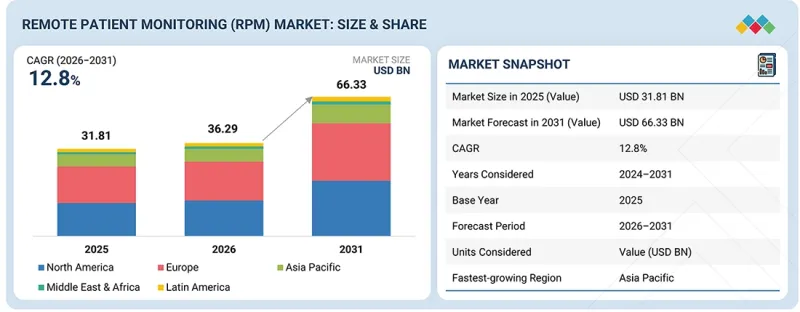
The remote patient monitoring market is projected to reach USD 66.33 billion by 2031 from USD 36.29 billion in 2026, at a high CAGR of 12.8% during the forecast period. The remote patient monitoring (RPM) market is experiencing rapid technological advancements driven by the integration of artificial intelligence (AI), wearable biosensors, cloud computing, the Internet of Things (IoT), and predictive analytics.
| Scope of the Report | |
|---|---|
| Years Considered for the Study | 2026-2031 |
| Base Year | 2025 |
| Forecast Period | 2026-2031 |
| Units Considered | Value (USD billion) |
| Segments | Component, Indication, and End-user |
| Regions covered | North America, Europe, Asia Pacific, Latin America, and the Middle East & Africa. |
Companies and research institutions are increasingly developing AI-enabled RPM platforms capable of continuous real-time health tracking, early risk detection, and personalized disease management. Additionally, on November 25, researchers developed a multimodal AI RPM framework using the HALO-X platform that achieved 83.9% accuracy in predicting adverse clinical events among cancer patients by integrating wearable sensor data, clinical records, and patient-reported outcomes (Source: arXiv). Such initiatives highlight the growth of the global remote patient monitoring market.
"Cloud-based deployment is the fastest-growing segment in the remote patient monitoring software by deployment."
Cloud-based deployment is expected to be the fastest-growing segment in the remote patient monitoring market, mainly because this model has several advantages, such as easy integration of data from multiple cloud sources, unlimited access by users from remote locations, low maintenance costs, high security and privacy, easy access, no need to buy hardware up front, and excellent flexibility in the use of capacity and resources. A plethora of applications made accessible through the cloud-based model, with core functionalities including accounting, performance management, and webmail and instant messaging, are proving helpful in fueling this particular portion.
"North America dominated the remote patient monitoring market in 25."
The remote patient monitoring market is segmented into five major regions: North America, Europe, Asia Pacific, Latin America, and the Middle East and Africa. The North American region dominated the remote patient monitoring market due to several factors, including high adoption rates of healthcare technologies, a robust, well-established healthcare infrastructure, and sustained growth in healthcare spending that supports this progress. Additionally, North America is home to several leading digital health and wearable technology innovators. Companies such as BioIntelliSense are expanding continuous remote monitoring solutions using wearable biosensor platforms for acute and post-acute care. Similarly, Oura Health is expanding smart ring-based cardiovascular and wellness monitoring capabilities across the US market.
The breakdown of primary participants is as mentioned below:
- By Company Type - Tier 1: 40%, Tier 2: 35%, and Tier 3: 25%
- By Designation - C-level: 35%, Director-level: 40%, and Others: 25%
- By Region - North America: 45%, Europe: 30%, Asia Pacific: 20%, Latin America: 3%, and Middle East & Africa: 2%.
Koninklijke Philips N.V. (Netherlands), Medtronic (Ireland), OMRON Healthcare, Inc. (Japan), GE Healthcare (US), Oracle (US), Boston Scientific Corporation (US), Abbott (US), NIHON KOHDEN CORPORATION (Japan), Siemens Healthineers AG (Germany), Baxter (US), Biobeat (Israel), Biotronik (Germany), VitalConnect (US), and others are the key players in the remote patient monitoring market.
- The study includes an in-depth competitive analysis of these key players in the remote patient monitoring market, with their company profiles, recent developments, and key market strategies.
Research Coverage
The report analyzes the remote patient monitoring market. It aims to estimate the market size and future growth potential of various market segments based on indication, component, end user, and region. The report also provides a competitive analysis of the key players in this market, along with their company profiles, offerings, recent developments, and key market strategies.
Reasons to buy this report
The report will help the market leaders/new entrants in this market with information on the closest approximations of the revenue numbers for the remote patient monitoring market and the subsegments. This report will help stakeholders understand the competitive landscape and gain more insights to position their businesses better and to plan suitable go-to-market strategies. The report also helps stakeholders understand the pulse of the market and provides them with information on key market drivers, restraints, challenges, and opportunities.
The report provides insights into the following pointers:
- Analysis of key drivers (transformation of patient care through digital innovation, Expansion of telehealth in remote patient monitoring), restraints (high investments and lack of IT expertise, behavioral barriers and healthcare affordability challenges in remote patient monitoring) opportunities (emergence of AI & ML, growing shift toward outpatient care environments, gradual shift toward outpatient care environments), and challenges (concerns associated with data security, data accessibility issues) influencing the growth of the remote patient monitoring market
- Product Development/Innovation: Detailed insights on upcoming technologies, research & development activities, and product launches in the remote patient monitoring market
- Market Development: Comprehensive information about lucrative markets-the report analyzes the remote patient monitoring market across varied regions.
- Market Diversification: Exhaustive information about new products & services, untapped geographies, recent developments, and investments in the remote patient monitoring market
- Competitive Assessment: In-depth assessment of market shares, growth strategies and service offerings of leading players such as Koninklijke Philips N.V. (Netherlands), Medtronic (Ireland), OMRON Corporation (Japan), GE Healthcare (US), Boston Scientific Corporation (US), Abbott (US), NIHON KOHDEN CORPORATION (Japan), and Siemens Healthineers (AG); among others in the remote patient monitoring market
TABLE OF CONTENTS
1 INTRODUCTION
- 1.1 STUDY OBJECTIVES
- 1.2 MARKET DEFINITION
- 1.3 MARKET SCOPE
- 1.3.1 MARKET SEGMENTATION
- 1.3.2 INCLUSIONS & EXCLUSIONS
- 1.3.3 YEARS CONSIDERED
- 1.3.4 CURRENCY CONSIDERED
- 1.4 LIMITATIONS
- 1.5 STAKEHOLDERS
- 1.6 SUMMARY OF CHANGES
2 EXECUTIVE SUMMARY
- 2.1 KEY INSIGHTS AND MARKET HIGHLIGHTS
- 2.2 KEY MARKET PARTICIPANTS: SHARE INSIGHTS AND STRATEGIC DEVELOPMENTS
- 2.3 DISRUPTIVE TRENDS SHAPING THE MARKET
- 2.4 HIGH-GROWTH SEGMENTS & EMERGING FRONTIERS
- 2.5 SNAPSHOT: GLOBAL MARKET SIZE, GROWTH RATE, AND FORECAST
3 PREMIUM INSIGHTS
- 3.1 REMOTE PATIENT MONITORING MARKET OVERVIEW
- 3.2 REMOTE PATIENT MONITORING MARKET, BY COMPONENT & REGION
- 3.3 REMOTE PATIENT MONITORING MARKET: REGIONAL SNAPSHOT
4 MARKET OVERVIEW
- 4.1 INTRODUCTION
- 4.1.1 DRIVERS
- 4.1.1.1 Transformation of patient care through digital innovation
- 4.1.1.2 Expansion of telehealth in remote patient monitoring
- 4.1.1.3 Rising prevalence of chronic diseases
- 4.1.1.4 Increasing geriatric population and rising uptake of RPM services
- 4.1.1.5 Growing need for cost-containment across healthcare facilities
- 4.1.1.6 Technological innovation in wearables, mHealth apps, and connected devices
- 4.1.2 RESTRAINTS
- 4.1.2.1 High investments and lack of IT expertise
- 4.1.2.2 Behavioral barriers and healthcare affordability challenges in remote patient monitoring
- 4.1.2.3 Challenges associated with CMS regulations
- 4.1.3 OPPORTUNITIES
- 4.1.3.1 Emergence of AI & ML
- 4.1.3.2 Gradual shift toward outpatient care environments
- 4.1.3.3 Increasing utilization for infectious disease diagnostics
- 4.1.3.4 Rising initiatives for hospital-at-home programs
- 4.1.4 CHALLENGES
- 4.1.4.1 Concerns associated with data security
- 4.1.4.2 Data accessibility issues
- 4.1.4.3 Incorporation of SDOH factors into RPM programs
- 4.1.1 DRIVERS
- 4.2 UNMET NEEDS AND WHITE SPACES
- 4.3 INTERCONNECTED MARKETS AND CROSS-SECTOR OPPORTUNITIES
- 4.4 STRATEGIC MOVES BY TIER 1/2/3
5 INDUSTRY TRENDS
- 5.1 PORTER'S FIVE FORCES ANALYSIS
- 5.1.1 THREAT OF NEW ENTRANTS
- 5.1.2 THREAT OF SUBSTITUTES
- 5.1.3 BARGAINING POWER OF SUPPLIERS
- 5.1.4 BARGAINING POWER OF BUYERS
- 5.1.5 INTENSITY OF COMPETITIVE RIVALRY
- 5.1.6 GRADUAL SHIFT TO VALUE-BASED & PATIENT-CENTRIC CARE
- 5.2 MACROECONOMIC INDICATORS
- 5.2.1 INTRODUCTION
- 5.2.2 GDP TRENDS AND FORECAST
- 5.2.3 TRENDS IN GLOBAL HEALTHCARE
- 5.3 ECOSYSTEM ANALYSIS
- 5.4 VALUE CHAIN ANALYSIS
- 5.5 PRICING ANALYSIS
- 5.5.1 INDICATIVE PRICING FOR REMOTE PATIENT MONITORING DEVICES, BY KEY PLAYER (2025)
- 5.5.2 INDICATIVE PRICE FOR REMOTE PATIENT MONITORING BY REGION (2025)
- 5.6 TARIFF & REGULATORY ANALYSIS
- 5.6.1 TARIFF DATA (HS CODE 9018)
- 5.6.2 TARIFF DATA (HS CODE 9021)
- 5.6.3 TARIFF DATA (HS CODE 9022)
- 5.7 TRADE ANALYSIS
- 5.7.1 TRADE ANALYSIS FOR REMOTE PATIENT MONITORING DEVICES (HSN CODE: 90189099)
- 5.7.2 TRADE ANALYSIS FOR REMOTE PATIENT MONITORING DEVICES (HSN CODE: 9021)
- 5.7.3 TRADE ANALYSIS FOR REMOTE PATIENT MONITORING DEVICES (HSN CODE: 9022)
- 5.8 KEY CONFERENCES AND EVENTS, 2026-2027
- 5.8.1 REMOTE PATIENT MONITORING MARKET: DETAILED LIST OF CONFERENCES & EVENTS, 2026-2027
- 5.9 TRENDS/DISRUPTIONS IMPACTING CUSTOMER BUSINESS
- 5.10 CASE STUDY ANALYSIS
- 5.10.1 REMOTE PATIENT MONITORING PORTAL AUTOMATION
- 5.10.1.1 Case 1: Cost savings and performance boost through automation
- 5.10.2 PATIENT MONITORING PORTAL AUTOMATION
- 5.10.2.1 Case 2: RPM drives engagement and generates substantial returns
- 5.10.1 REMOTE PATIENT MONITORING PORTAL AUTOMATION
- 5.11 IMPACT OF 2025 US TARIFF - REMOTE PATIENT MONITORING MARKET
- 5.11.1 INTRODUCTION
- 5.11.2 KEY TARIFF RATES
- 5.11.3 PRICE IMPACT ANALYSIS
- 5.11.4 IMPACT ON COUNTRY/REGION
- 5.11.4.1 US
- 5.11.4.2 Europe
- 5.11.4.3 Asia-Pacific
- 5.11.5 IMPACT ON END USERS
- 5.11.5.1 Healthcare Providers
- 5.11.5.2 Healthcare Payers
- 5.11.5.3 Patients
- 5.11.5.4 Pharmaceutical & Biotechnological Companies
- 5.11.5.5 Medtech Companies
- 5.11.5.6 Other End Users
- 5.12 TECHNOLOGY ANALYSIS
- 5.12.1 KEY EMERGING TECHNOLOGIES
- 5.12.1.1 Miniature wearable devices
- 5.12.1.2 Artificial intelligence & machine learning
- 5.12.1.3 Cloud computing
- 5.12.1.4 Patient engagement tools
- 5.12.1.5 EHR integration
- 5.12.1.6 Voice assistant integration
- 5.12.2 COMPLEMENTARY TECHNOLOGIES
- 5.12.2.1 5G connectivity
- 5.12.2.2 mHealth apps
- 5.12.2.3 Digital therapeutics
- 5.12.2.4 Telehealth platforms
- 5.12.3 ADJACENT TECHNOLOGIES
- 5.12.3.1 POC diagnostics
- 5.12.3.2 Smart home health devices
- 5.12.1 KEY EMERGING TECHNOLOGIES
- 5.13 TECHNOLOGY/PRODUCT ROADMAP
- 5.14 PATENT ANALYSIS
- 5.14.1 PATENT PUBLICATION TRENDS FOR REMOTE PATIENT MONITORING
- 5.14.2 JURISDICTION AND TOP APPLICANT COUNTRIES FOR REMOTE PATIENT MONITORING
- 5.14.3 LEADING PATENTS IN REMOTE PATIENT MONITORING MARKET
- 5.15 FUTURE APPLICATIONS
- 5.16 IMPACT OF GENERATIVE AI/AI ON REMOTE PATIENT MONITORING MARKET
- 5.16.1 KEY USE CASES
- 5.16.2 CASE STUDIES FOR GENERATIVE AI/AI IMPLEMENTATION
- 5.16.2.1 Case study 1: Enhancing remote patient monitoring for cancer treatment with NLP and HIPAA-compliant annotation
- 5.16.2.2 Case study 2: Leveraging AI for proactive infection prevention in hospitals
- 5.16.2.3 Telehealth & telemedicine
- 5.16.2.4 Wearable devices
- 5.16.2.5 Digital healthcare
- 5.16.2.6 Home healthcare
- 5.16.3 USER READINESS & IMPACT ASSESSMENT
- 5.16.3.1 User readiness
- 5.16.3.1.1 User A: Hospitals
- 5.16.3.1.2 User B: Ambulatory surgery centers
- 5.16.3.2 Impact assessment
- 5.16.3.2.1 User A: Hospitals
- 5.16.3.2.2 User B: Ambulatory surgery centers
- 5.16.3.1 User readiness
- 5.16.4 REGULATORY BODIES, GOVERNMENT AGENCIES, & OTHER ORGANIZATIONS
- 5.16.5 REGULATORY ANALYSIS
6 CUSTOMER LANDSCAPE & BUYER BEHAVIOR
- 6.1 INTRODUCTION
- 6.2 DECISION-MAKING PROCESS
- 6.3 KEY STAKEHOLDERS AND BUYING CRITERIA
- 6.3.1 KEY STAKEHOLDERS IN BUYING PROCESS
- 6.3.2 BUYING CRITERIA
- 6.4 END USER ANALYSIS
- 6.4.1 UNMET NEEDS
- 6.4.2 END USER EXPECTATIONS
- 6.5 ADOPTION BARRIERS & INTERNAL CHALLENGES
- 6.6 MARKET PROFITABILITY
7 REMOTE PATIENT MONITORING MARKET, BY COMPONENT
- 7.1 INTRODUCTION
- 7.2 DEVICES
- 7.2.1 BY FUNCTION
- 7.2.1.1 Cardiac monitoring devices
- 7.2.1.1.1 Increasing uptake of ECG monitors and rising cases of hypertension to fuel market
- 7.2.1.2 Neurological monitoring devices
- 7.2.1.2.1 Growing demand for clinical-grade wearable devices for routine monitoring to drive market
- 7.2.1.3 Respiratory monitoring devices
- 7.2.1.3.1 Rising demand for peak flow meters and sleep apnea monitors to fuel market
- 7.2.1.4 Blood glucose monitoring devices
- 7.2.1.4.1 Increasing prevalence of diabetes to support market growth
- 7.2.1.5 Fetal & neonatal monitoring devices
- 7.2.1.5.1 Growing focus on vital health monitoring in preterm births to drive market
- 7.2.1.6 Weight monitoring devices
- 7.2.1.6.1 High incidence of obesity and growing advancements in smart weighing scales to fuel market
- 7.2.1.7 Multiparameter monitoring devices
- 7.2.1.7.1 Measurement of spO2, blood sugar, and respiratory activity to fuel uptake
- 7.2.1.8 Pulse oximeter devices
- 7.2.1.8.1 Rising demand in preoperative & home care settings to support market growth
- 7.2.1.9 Thermometers
- 7.2.1.9.1 Growing focus on home healthcare to fuel market
- 7.2.1.10 Other monitoring devices
- 7.2.1.1 Cardiac monitoring devices
- 7.2.2 BY TYPE
- 7.2.2.1 Wearable devices
- 7.2.2.1.1 Ability to provide real-time insights to drive market
- 7.2.2.2 Implantable devices
- 7.2.2.2.1 Advancements in wireless communication technologies to boost demand
- 7.2.2.3 Handheld & portable devices
- 7.2.2.3.1 Growing focus on device miniaturization to fuel market
- 7.2.2.4 Other devices
- 7.2.2.1 Wearable devices
- 7.2.1 BY FUNCTION
- 7.3 SOFTWARE
- 7.3.1 SOFTWARE, BY DEPLOYMENT MODEL
- 7.3.1.1 On-premises
- 7.3.1.1.1 Enhanced control, data security, and customization benefits to fuel market
- 7.3.1.2 Cloud-based models
- 7.3.1.2.1 Real-time data sharing and high-security features to boost demand
- 7.3.1.1 On-premises
- 7.3.2 SOFTWARE, BY TRANSMISSION TYPE
- 7.3.2.1 Synchronous transmission
- 7.3.2.1.1 Growing availability of real-time data analytics to boost demand
- 7.3.2.2 Asynchronous transmission
- 7.3.2.2.1 Increasing need for low-resource flexible solutions to support market growth
- 7.3.2.1 Synchronous transmission
- 7.3.1 SOFTWARE, BY DEPLOYMENT MODEL
- 7.4 SERVICES
- 7.4.1 EXPANSION OF TELEMEDICINE PLATFORMS AND INTEGRATION OF SERVICE MODELS TO SUPPORT MARKET GROWTH
8 REMOTE PATIENT MONITORING MARKET, BY INDICATION
- 8.1 INTRODUCTION
- 8.2 ONCOLOGY
- 8.2.1 GROWING FOCUS ON EARLY DISEASE DETECTION TO DRIVE MARKET
- 8.3 CARDIOLOGY
- 8.3.1 HIGH INCIDENCE OF CVD TO PROPEL MARKET
- 8.4 NEUROLOGY
- 8.4.1 INCREASING PREVALENCE OF NEUROLOGICAL CONDITIONS TO FUEL MARKET
- 8.5 DIABETES
- 8.5.1 GROWING FOCUS ON TELEHEALTH CONSULTATIONS FOR DIABETES MANAGEMENT TO BOOST DEMAND
- 8.6 SLEEP DISORDERS
- 8.6.1 INCREASING INCIDENCE OF SLEEP APNEA TO SUPPORT MARKET GROWTH
- 8.7 RESPIRATORY DISEASES
- 8.7.1 RISING CASES OF COPD AND ASTHMA TO FUEL MARKET
- 8.8 WELLNESS IMPROVEMENT
- 8.8.1 UTILIZATION OF WEIGHT MANAGEMENT & PERSONAL HEALTH APPS TO SUPPORT MARKET GROWTH
- 8.9 MENTAL HEALTH
- 8.9.1 GROWING FOCUS ON DEVELOPMENT OF PREDICTIVE HEALTH MODELS FOR COGNITIVE THERAPY TO PROPEL MARKET
- 8.10 OTHER INDICATIONS
9 REMOTE PATIENT MONITORING MARKET, BY END USER
- 9.1 INTRODUCTION
- 9.2 HEALTHCARE PROVIDERS
- 9.2.1 HOSPITALS
- 9.2.1.1 Ability to purchase technologically advanced telehealth devices to fuel market
- 9.2.2 ASCS, ACCS, AND OTHER OUTPATIENT SETTINGS
- 9.2.2.1 Increasing demand for cost-effective perioperative devices to fuel market
- 9.2.3 LONG-TERM CARE & ASSISTED LIVING FACILITIES
- 9.2.3.1 Expanding geriatric population and growing focus on chronic disease management to fuel market
- 9.2.4 HOME HEALTHCARE
- 9.2.4.1 Growing preference for remote care to drive market
- 9.2.5 OTHER HEALTHCARE PROVIDERS
- 9.2.1 HOSPITALS
- 9.3 HEALTHCARE PAYERS
- 9.3.1 LOW COSTS AND IMPROVED HEALTHCARE FACILITIES TO DRIVE MARKET
- 9.4 PATIENTS
- 9.4.1 INCREASING FOCUS ON AI INTEGRATION INTO WEARABLE DEVICES TO BOOST DEMAND
- 9.5 PHARMACEUTICAL & BIOTECHNOLOGY COMPANIES
- 9.5.1 RISING NEED FOR ENHANCED CLINICAL TRIAL OUTCOMES TO SUPPORT MARKET GROWTH
- 9.6 MEDTECH COMPANIES
- 9.6.1 INTEGRATION OF RPM WITH MEDTECH SOLUTIONS FOR DIAGNOSTIC ACCURACY TO FUEL MARKET
- 9.7 OTHER END USERS
10 REMOTE PATIENT MONITORING MARKET, BY REGION
- 10.1 INTRODUCTION
- 10.2 NORTH AMERICA
- 10.2.1 MACROECONOMIC OUTLOOK FOR NORTH AMERICA
- 10.2.2 US
- 10.2.2.1 Supportive regulatory frameworks for AI implementation to boost demand
- 10.2.3 CANADA
- 10.2.3.1 Growing need to curtail healthcare costs to drive market
- 10.3 EUROPE
- 10.3.1 MACROECONOMIC OUTLOOK FOR EUROPE
- 10.3.2 GERMANY
- 10.3.2.1 Favorable reimbursements for technological innovation to propel market
- 10.3.3 UK
- 10.3.3.1 Government support for AI implementation to boost demand
- 10.3.4 FRANCE
- 10.3.4.1 Implementation of ETAPES program to fuel market
- 10.3.5 ITALY
- 10.3.5.1 Growing focus on digital transformation for value-centric patient care to drive market
- 10.3.6 SPAIN
- 10.3.6.1 Rising funding investments for digital health plans to boost market
- 10.3.7 REST OF EUROPE
- 10.4 ASIA PACIFIC
- 10.4.1 MACROECONOMIC OUTLOOK FOR ASIA PACIFIC
- 10.4.2 CHINA
- 10.4.2.1 Shortage of physicians and growing focus on RPM solutions to support market growth
- 10.4.3 JAPAN
- 10.4.3.1 Rising geriatric population and subsequent rise in preventive care to drive market
- 10.4.4 INDIA
- 10.4.4.1 Expanding target patient population to drive market
- 10.4.5 AUSTRALIA
- 10.4.5.1 Growing government support and telehealth expansion to drive market
- 10.4.6 SOUTH KOREA
- 10.4.6.1 Strategic partnerships and AI innovations accelerate RPM adoption
- 10.4.7 REST OF ASIA PACIFIC
- 10.5 LATIN AMERICA
- 10.5.1 MACROECONOMIC OUTLOOK FOR LATIN AMERICA
- 10.5.2 BRAZIL
- 10.5.2.1 Growing focus on telehealth consultations to drive market
- 10.5.3 MEXICO
- 10.5.3.1 Improvements in healthcare infrastructure to boost demand
- 10.5.4 REST OF LATIN AMERICA
- 10.6 MIDDLE EAST & AFRICA
- 10.6.1 MACROECONOMIC OUTLOOK FOR MIDDLE EAST & AFRICA
- 10.6.2 GCC
- 10.6.2.1 Government initiatives for investments in RPM solutions to support market growth
- 10.6.3 SAUDI ARABIA
- 10.6.3.1 Expansion of connected healthcare ecosystem
- 10.6.4 UAE
- 10.6.4.1 Strengthening of connected healthcare ecosystem with AI-enabled RPM solutions to boost market
- 10.6.5 REST OF GCC
- 10.6.5.1 Market propelled by digital health transformation
- 10.6.6 SOUTH AFRICA
- 10.6.6.1 Increasing adoption of telehealth infrastructure to drive market
- 10.6.7 REST OF MIDDLE EAST & AFRICA
11 COMPETITIVE LANDSCAPE
- 11.1 OVERVIEW
- 11.2 KEY PLAYER STRATEGIES/RIGHT TO WIN
- 11.2.1 OVERVIEW OF STRATEGIES ADOPTED BY KEY PLAYERS IN REMOTE PATIENT MONITORING MARKET
- 11.3 REVENUE ANALYSIS, 2021-2025
- 11.4 MARKET SHARE ANALYSIS, 2025
- 11.5 COMPANY EVALUATION MATRIX: KEY PLAYERS, 2025
- 11.5.1 STARS
- 11.5.2 EMERGING LEADERS
- 11.5.3 PERVASIVE PLAYERS
- 11.5.4 PARTICIPANTS
- 11.5.5 COMPANY FOOTPRINT: KEY PLAYERS, 2025
- 11.5.5.1 Company footprint
- 11.5.5.2 Region footprint
- 11.5.5.3 Component footprint
- 11.5.5.4 Indication footprint
- 11.5.5.5 End user footprint
- 11.6 COMPANY EVALUATION MATRIX: STARTUPS/SMES, 2025
- 11.6.1 PROGRESSIVE COMPANIES
- 11.6.2 RESPONSIVE COMPANIES
- 11.6.3 DYNAMIC COMPANIES
- 11.6.4 STARTING BLOCKS
- 11.6.5 COMPETITIVE BENCHMARKING: STARTUPS/SMES, 2025
- 11.6.5.1 Detailed list of key startups/SMEs
- 11.6.5.2 Competitive benchmarking of startups/SMEs
- 11.7 COMPANY VALUATION & FINANCIAL METRICS
- 11.7.1 FINANCIAL METRICS
- 11.7.2 COMPANY VALUATION
- 11.8 BRAND/SOFTWARE COMPARISON
- 11.9 COMPETITIVE SCENARIO
- 11.9.1 PRODUCT/SERVICE LAUNCHES & APPROVALS
- 11.9.2 DEALS
- 11.9.3 EXPANSIONS
- 11.9.4 OTHER DEVELOPMENTS
12 COMPANY PROFILES
- 12.1 KEY PLAYERS
- 12.1.1 KONINKLIJKE PHILIPS N.V.
- 12.1.1.1 Business overview
- 12.1.1.2 Products/Services offered
- 12.1.1.3 Recent developments
- 12.1.1.3.1 Product/Service launches & approvals
- 12.1.1.3.2 Deals
- 12.1.1.4 MnM view
- 12.1.1.4.1 Key strengths
- 12.1.1.4.2 Strategic choices
- 12.1.1.4.3 Weaknesses & competitive threats
- 12.1.2 OMRON HEALTHCARE, INC. (SUBSIDIARY OF OMRON CORPORATION)
- 12.1.2.1 Business overview
- 12.1.2.2 Products/Services offered
- 12.1.2.3 Recent developments
- 12.1.2.3.1 Product/Service launches & approvals
- 12.1.2.3.2 Deals
- 12.1.2.3.3 Other developments
- 12.1.2.4 MnM view
- 12.1.2.4.1 Key strengths
- 12.1.2.4.2 Strategic choices
- 12.1.2.4.3 Weaknesses & competitive threats
- 12.1.3 MEDTRONIC
- 12.1.3.1 Business overview
- 12.1.3.2 Products/Services offered
- 12.1.3.3 Recent developments
- 12.1.3.3.1 Product/Service launches & approvals
- 12.1.3.3.2 Deals
- 12.1.3.3.3 Other developments
- 12.1.3.4 MnM view
- 12.1.3.4.1 Key strengths
- 12.1.3.4.2 Strategic choices
- 12.1.3.4.3 Weaknesses & competitive threats
- 12.1.4 GE HEALTHCARE
- 12.1.4.1 Business overview
- 12.1.4.2 Products/Services offered
- 12.1.4.3 Recent developments
- 12.1.4.3.1 Product/Service launches & approvals
- 12.1.4.3.2 Deals
- 12.1.4.4 MnM view
- 12.1.4.4.1 Key strengths
- 12.1.4.4.2 Strategic choices
- 12.1.4.4.3 Weaknesses & competitive threats
- 12.1.5 ABBOTT
- 12.1.5.1 Business overview
- 12.1.5.2 Products/Services offered
- 12.1.5.3 Recent developments
- 12.1.5.3.1 Product/Service launches & approvals
- 12.1.5.3.2 Expansions
- 12.1.5.3.3 Other developments
- 12.1.5.4 MnM view
- 12.1.5.4.1 Key strengths
- 12.1.5.4.2 Strategic choices
- 12.1.5.4.3 Weaknesses & competitive threats
- 12.1.6 ORACLE
- 12.1.6.1 Business overview
- 12.1.6.2 Products/Services offered
- 12.1.6.3 Recent developments
- 12.1.6.3.1 Product/Service launches & approvals
- 12.1.6.3.2 Deals
- 12.1.7 BOSTON SCIENTIFIC CORPORATION
- 12.1.7.1 Business overview
- 12.1.7.2 Products/Services offered
- 12.1.7.3 Recent developments
- 12.1.7.3.1 Product/Service launches & approvals
- 12.1.7.3.2 Deals
- 12.1.7.3.3 Other developments
- 12.1.8 NIHON KOHDEN CORPORATION
- 12.1.8.1 Business overview
- 12.1.8.2 Products/Services offered
- 12.1.8.3 Recent developments
- 12.1.8.3.1 Product/Service launches & approvals
- 12.1.8.3.2 Deals
- 12.1.9 SIEMENS HEALTHINEERS AG
- 12.1.9.1 Business overview
- 12.1.9.2 Products/Services offered
- 12.1.9.3 Recent developments
- 12.1.9.3.1 Product/Service launches & approvals
- 12.1.9.3.2 Deals
- 12.1.10 BAXTER
- 12.1.10.1 Business overview
- 12.1.10.2 Products/Services offered
- 12.1.10.3 Recent developments
- 12.1.10.3.1 Product/Service launches & approvals
- 12.1.10.3.2 Deals
- 12.1.11 BIOBEAT
- 12.1.11.1 Business overview
- 12.1.11.2 Products/Services offered
- 12.1.11.3 Recent developments
- 12.1.11.3.1 Product/Service launches & approvals
- 12.1.11.3.2 Deals
- 12.1.12 BIOTRONIK
- 12.1.12.1 Business overview
- 12.1.12.2 Products/Services offered
- 12.1.12.3 Recent developments
- 12.1.12.3.1 Product/Service launches & approvals
- 12.1.12.3.2 Deals
- 12.1.13 VITALCONNECT
- 12.1.13.1 Business overview
- 12.1.13.2 Products/Services offered
- 12.1.13.3 Recent developments
- 12.1.13.3.1 Deals
- 12.1.13.3.2 Other developments
- 12.1.14 VIVALNK, INC.
- 12.1.14.1 Business overview
- 12.1.14.2 Products/Services offered
- 12.1.14.3 Recent developments
- 12.1.14.3.1 Product/Service launches & approvals
- 12.1.14.3.2 Deals
- 12.1.15 CLEARARCH, INC.
- 12.1.15.1 Business overview
- 12.1.15.2 Products/Services offered
- 12.1.15.3 Recent developments
- 12.1.15.3.1 Product/Service launches & approvals
- 12.1.15.3.2 Deals
- 12.1.16 OPTUM, INC. (VIVIFY HEALTH - PART OF OPTUM)
- 12.1.16.1 Business overview
- 12.1.16.2 Products/Services offered
- 12.1.17 BLUE SPARK TECHNOLOGIES, INC.
- 12.1.17.1 Business overview
- 12.1.17.2 Products/Services offered
- 12.1.17.3 Recent developments
- 12.1.17.3.1 Product/Service launches & approvals
- 12.1.18 LIGHTBEAM
- 12.1.18.1 Business overview
- 12.1.18.2 Products/Services offered
- 12.1.18.3 Recent developments
- 12.1.18.3.1 Deals
- 12.1.19 CLOUD DIAGNOSTICS CANADA ULC
- 12.1.19.1 Business overview
- 12.1.19.2 Products/Services offered
- 12.1.19.3 Recent developments
- 12.1.19.3.1 Product/Service launches & approvals
- 12.1.19.3.2 Deals
- 12.1.20 TELADOC HEALTH, INC.
- 12.1.20.1 Business overview
- 12.1.20.2 Products/Services offered
- 12.1.20.3 Recent developments
- 12.1.20.3.1 Product/Service launches & approvals
- 12.1.20.3.2 Deals
- 12.1.21 GUANGDONG TRANSTEK MEDICAL ELECTRONICS CO., LTD.
- 12.1.21.1 Business overview
- 12.1.21.2 Products/Services offered
- 12.1.21.3 Recent developments
- 12.1.21.3.1 Other developments
- 12.1.1 KONINKLIJKE PHILIPS N.V.
- 12.2 OTHER PLAYERS
- 12.2.1 CARESIMPLE INC.
- 12.2.2 TIMEDOC, INC.
- 12.2.3 COACHCARE
- 12.2.4 DOZEE (TURTLE SHELL TECHNOLOGIES PVT LTD)
- 12.2.5 HEALTH RECOVERY SOLUTIONS
13 RESEARCH METHODOLOGY
- 13.1 RESEARCH DATA
- 13.1.1 SECONDARY DATA
- 13.1.1.1 Key data from secondary sources
- 13.1.2 PRIMARY DATA
- 13.1.2.1 Key data from primary sources
- 13.1.2.2 Breakdown of primary sources
- 13.1.1 SECONDARY DATA
- 13.2 MARKET SIZE ESTIMATION
- 13.2.1 SUPPLY-SIDE ANALYSIS
- 13.2.2 BOTTOM-UP APPROACH: END USER ADOPTION
- 13.2.3 TOP-DOWN OF PARENT MARKET ASSESSMENT
- 13.2.4 COMPANY PRESENTATIONS AND PRIMARY INTERVIEWS
- 13.3 MARKET BREAKDOWN AND DATA TRIANGULATION
- 13.4 RESEARCH ASSUMPTIONS
- 13.4.1 MARKET SIZING ASSUMPTIONS
- 13.4.2 OVERALL STUDY ASSUMPTIONS
- 13.5 RISK ASSESSMENT
- 13.6 RESEARCH LIMITATIONS
- 13.6.1 METHODOLOGY-RELATED LIMITATIONS
- 13.6.2 SCOPE-RELATED LIMITATIONS
14 APPENDIX
- 14.1 DISCUSSION GUIDE
- 14.2 KNOWLEDGESTORE: MARKETSANDMARKETS' SUBSCRIPTION PORTAL
- 14.3 CUSTOMIZATION OPTIONS
- 14.4 RELATED REPORTS
- 14.5 AUTHOR DETAILS
List of Tables
- TABLE 1 USD EXCHANGE RATES
- TABLE 2 RECENT DEVELOPMENTS OF AI IN REMOTE PATIENT MONITORING MARKET, JANUARY 2022-DECEMBER 2024
- TABLE 3 TOP FIVE HEALTHCARE ORGANIZATIONS IMPACTED BY SECURITY BREACHES
- TABLE 4 REMOTE PATIENT MONITORING MARKET: PORTER'S FIVE FORCES ANALYSIS
- TABLE 5 INDICATIVE PRICE FOR REMOTE PATIENT MONITORING DEVICES, BY KEY PLAYER (2025)
- TABLE 6 INDICATIVE PRICE OF REMOTE PATIENT MONITORING DEVICES, BY REGION, 2025 (USD)
- TABLE 7 US ADJUSTED RECIPROCAL TARIFF RATES
- TABLE 8 JURISDICTION ANALYSIS OF TOP APPLICANT COUNTRIES FOR REMOTE PATIENT MONITORING
- TABLE 9 NORTH AMERICA: REGULATORY BODIES, GOVERNMENT AGENCIES, AND OTHER ORGANIZATIONS
- TABLE 10 EUROPE: REGULATORY BODIES, GOVERNMENT AGENCIES, AND OTHER ORGANIZATIONS
- TABLE 11 ASIA PACIFIC: REGULATORY BODIES, GOVERNMENT AGENCIES, AND OTHER ORGANIZATIONS
- TABLE 12 LATIN AMERICA: REGULATORY BODIES, GOVERNMENT AGENCIES, AND OTHER ORGANIZATIONS
- TABLE 13 MIDDLE EAST & AFRICA: REGULATORY BODIES, GOVERNMENT AGENCIES, AND OTHER ORGANIZATIONS
- TABLE 14 NORTH AMERICA: REGULATORY ANALYSIS
- TABLE 15 EUROPE: REGULATORY ANALYSIS
- TABLE 16 ASIA PACIFIC: REGULATORY ANALYSIS
- TABLE 17 MIDDLE EAST & AFRICA: REGULATORY ANALYSIS
- TABLE 18 LATIN AMERICA: REGULATORY ANALYSIS
- TABLE 19 INFLUENCE OF STAKEHOLDERS ON BUYING PROCESS FOR REMOTE PATIENT MONITORING, BY END USER
- TABLE 20 KEY BUYING CRITERIA FOR REMOTE PATIENT MONITORING
- TABLE 21 UNMET NEEDS IN REMOTE PATIENT MONITORING MARKET
- TABLE 22 END USER EXPECTATIONS IN REMOTE PATIENT MONITORING MARKET
- TABLE 23 REMOTE PATIENT MONITORING MARKET, BY COMPONENT, 2024-2031 (USD MILLION)
- TABLE 24 REMOTE PATIENT MONITORING MARKET FOR DEVICES, BY REGION, 2024-2031 (USD MILLION)
- TABLE 25 REMOTE PATIENT MONITORING MARKET FOR DEVICES, BY FUNCTION, 2024-2031 (USD MILLION)
- TABLE 26 CARDIAC MONITORING DEVICES: REMOTE PATIENT MONITORING MARKET, BY REGION, 2024-2031 (USD MILLION)
- TABLE 27 NEUROLOGICAL MONITORING DEVICES: REMOTE PATIENT MONITORING MARKET, BY REGION, 2024-2031 (USD MILLION)
- TABLE 28 RESPIRATORY MONITORING DEVICES: REMOTE PATIENT MONITORING MARKET, BY REGION, 2024-2031 (USD MILLION)
- TABLE 29 BLOOD GLUCOSE MONITORING DEVICES: REMOTE PATIENT MONITORING MARKET, BY REGION, 2024-2031 (USD MILLION)
- TABLE 30 FETAL & NEONATAL MONITORING DEVICES: REMOTE PATIENT MONITORING MARKET, BY REGION, 2024-2031 (USD MILLION)
- TABLE 31 WEIGHT MONITORING DEVICES: REMOTE PATIENT MONITORING MARKET, BY REGION, 2024-2031 (USD MILLION)
- TABLE 32 MULTIPARAMETER MONITORING DEVICES: REMOTE PATIENT MONITORING MARKET, BY REGION, 2024-2031 (USD MILLION)
- TABLE 33 PULSE OXIMETER DEVICES: REMOTE PATIENT MONITORING MARKET, BY REGION, 2024-2031 (USD MILLION)
- TABLE 34 THERMOMETERS: REMOTE PATIENT MONITORING MARKET, BY REGION, 2024-2031 (USD MILLION)
- TABLE 35 OTHER MONITORING DEVICES: REMOTE PATIENT MONITORING MARKET, BY REGION, 2024-2031 (USD MILLION)
- TABLE 36 REMOTE PATIENT MONITORING MARKET FOR DEVICES, BY TYPE, 2024-2031 (USD MILLION)
- TABLE 37 WEARABLE DEVICES: REMOTE PATIENT MONITORING MARKET, BY REGION, 2024-2031 (USD MILLION)
- TABLE 38 IMPLANTABLE DEVICES: REMOTE PATIENT MONITORING MARKET, BY REGION, 2024-2031 (USD MILLION)
- TABLE 39 HANDHELD & PORTABLE DEVICES: REMOTE PATIENT MONITORING MARKET, BY REGION, 2024-2031 (USD MILLION)
- TABLE 40 OTHER DEVICES: REMOTE PATIENT MONITORING MARKET, BY REGION, 2024-2031 (USD MILLION)
- TABLE 41 REMOTE PATIENT MONITORING MARKET FOR SOFTWARE, BY REGION, 2024-2031 (USD MILLION)
- TABLE 42 REMOTE PATIENT MONITORING MARKET FOR SOFTWARE, BY DEPLOYMENT MODEL, 2024-2031 (USD MILLION)
- TABLE 43 ON-PREMISE MODELS: REMOTE PATIENT MONITORING MARKET, BY REGION, 2024-2031 (USD MILLION)
- TABLE 44 CLOUD-BASED MODELS: REMOTE PATIENT MONITORING MARKET, BY REGION, 2024-2031 (USD MILLION)
- TABLE 45 REMOTE PATIENT MONITORING MARKET FOR SOFTWARE, BY TRANSMISSION TYPE, 2024-2031 (USD MILLION)
- TABLE 46 SYNCHRONOUS TRANSMISSION: REMOTE PATIENT MONITORING MARKET, BY REGION, 2024-2031 (USD MILLION)
- TABLE 47 ASYNCHRONOUS TRANSMISSION: REMOTE PATIENT MONITORING MARKET, BY REGION, 2024-2031 (USD MILLION)
- TABLE 48 REMOTE PATIENT MONITORING MARKET FOR SERVICES, BY REGION, 2024-2031 (USD MILLION)
- TABLE 49 REMOTE PATIENT MONITORING MARKET, BY INDICATION, 2024-2031 (USD MILLION)
- TABLE 50 REMOTE PATIENT MONITORING MARKET FOR ONCOLOGY, BY REGION, 2024-2031 (USD MILLION)
- TABLE 51 REMOTE PATIENT MONITORING MARKET FOR CARDIOLOGY, BY REGION, 2024-2031 (USD MILLION)
- TABLE 52 REMOTE PATIENT MONITORING MARKET FOR NEUROLOGY, BY REGION, 2024-2031 (USD MILLION)
- TABLE 53 REMOTE PATIENT MONITORING MARKET FOR DIABETES, BY REGION, 2024-2031 (USD MILLION)
- TABLE 54 REMOTE PATIENT MONITORING MARKET FOR SLEEP DISORDERS, BY REGION, 2024-2031 (USD MILLION)
- TABLE 55 REMOTE PATIENT MONITORING MARKET FOR RESPIRATORY DISEASES, BY REGION, 2024-2031 (USD MILLION)
- TABLE 56 REMOTE PATIENT MONITORING MARKET FOR WELLNESS IMPROVEMENT, BY REGION, 2024-2031 (USD MILLION)
- TABLE 57 REMOTE PATIENT MONITORING MARKET FOR MENTAL HEALTH, BY REGION, 2024-2031 (USD MILLION)
- TABLE 58 REMOTE PATIENT MONITORING MARKET FOR OTHER INDICATIONS, BY REGION, 2024-2031 (USD MILLION)
- TABLE 59 REMOTE PATIENT MONITORING MARKET, BY END USER, 2024-2031 (USD MILLION)
- TABLE 60 REMOTE PATIENT MONITORING MARKET FOR HEALTHCARE PROVIDERS, BY TYPE, 2024-2031 (USD MILLION)
- TABLE 61 REMOTE PATIENT MONITORING MARKET FOR HEALTHCARE PROVIDERS, BY REGION, 2024-2031 (USD MILLION)
- TABLE 62 REMOTE PATIENT MONITORING MARKET FOR HOSPITALS, BY REGION, 2024-2031 (USD MILLION)
- TABLE 63 REMOTE PATIENT MONITORING MARKET FOR ASCS, ACCS, AND OTHER OUTPATIENT SETTINGS, BY REGION, 2024-2031 (USD MILLION)
- TABLE 64 REMOTE PATIENT MONITORING MARKET FOR LONG-TERM CARE & ASSISTED LIVING FACILITIES, BY REGION, 2024-2031 (USD MILLION)
- TABLE 65 REMOTE PATIENT MONITORING MARKET FOR HOME HEALTHCARE, BY REGION, 2024-2031 (USD MILLION)
- TABLE 66 REMOTE PATIENT MONITORING MARKET FOR OTHER HEALTHCARE PROVIDERS, BY REGION, 2024-2031 (USD MILLION)
- TABLE 67 REMOTE PATIENT MONITORING MARKET FOR HEALTHCARE PAYERS, BY REGION, 2024-2031 (USD MILLION)
- TABLE 68 REMOTE PATIENT MONITORING MARKET FOR PATIENTS, BY REGION, 2024-2031 (USD MILLION)
- TABLE 69 REMOTE PATIENT MONITORING MARKET FOR PHARMACEUTICAL & BIOTECHNOLOGY COMPANIES, BY REGION, 2024-2031 (USD MILLION)
- TABLE 70 REMOTE PATIENT MONITORING MARKET FOR MEDTECH COMPANIES, BY REGION, 2024-2031 (USD MILLION)
- TABLE 71 REMOTE PATIENT MONITORING MARKET FOR OTHER END USERS, BY REGION, 2024-2031 (USD MILLION)
- TABLE 72 REMOTE PATIENT MONITORING MARKET, BY REGION, 2024-2031 (USD MILLION)
- TABLE 73 NORTH AMERICA: REMOTE PATIENT MONITORING MARKET, BY COMPONENT, 2024-2031 (USD MILLION)
- TABLE 74 NORTH AMERICA: REMOTE PATIENT MONITORING MARKET FOR DEVICES, BY FUNCTION, 2024-2031 (USD MILLION)
- TABLE 75 NORTH AMERICA: REMOTE PATIENT MONITORING MARKET FOR DEVICES, BY TYPE, 2024-2031 (USD MILLION)
- TABLE 76 NORTH AMERICA: REMOTE PATIENT MONITORING MARKET FOR SOFTWARE, BY TRANSMISSION TYPE, 2024-2031 (USD MILLION)
- TABLE 77 NORTH AMERICA: REMOTE PATIENT MONITORING MARKET FOR SOFTWARE, BY DEPLOYMENT TYPE, 2024-2031 (USD MILLION)
- TABLE 78 NORTH AMERICA: REMOTE PATIENT MONITORING MARKET, BY INDICATION, 2024-2031 (USD MILLION)
- TABLE 79 NORTH AMERICA: REMOTE PATIENT MONITORING MARKET, BY END USER, 2024-2031 (USD MILLION)
- TABLE 80 NORTH AMERICA: REMOTE PATIENT MONITORING MARKET FOR HEALTHCARE PROVIDERS, BY TYPE, 2024-2031 (USD MILLION)
- TABLE 81 US: REMOTE PATIENT MONITORING MARKET, BY COMPONENT, 2024-2031 (USD MILLION)
- TABLE 82 US: REMOTE PATIENT MONITORING MARKET FOR DEVICES, BY FUNCTION, 2024-2031 (USD MILLION)
- TABLE 83 US: REMOTE PATIENT MONITORING MARKET FOR DEVICES, BY TYPE, 2024-2031 (USD MILLION)
- TABLE 84 US: REMOTE PATIENT MONITORING MARKET FOR SOFTWARE, BY TRANSMISSION TYPE, 2024-2031 (USD MILLION)
- TABLE 85 US: REMOTE PATIENT MONITORING MARKET FOR SOFTWARE, BY DEPLOYMENT TYPE,
- TABLE 86 US: REMOTE PATIENT MONITORING MARKET, BY INDICATION, 2024-2031 (USD MILLION)
- TABLE 87 US: REMOTE PATIENT MONITORING MARKET, BY END USER, 2024-2031 (USD MILLION)
- TABLE 88 US: REMOTE PATIENT MONITORING MARKET FOR HEALTHCARE PROVIDERS, BY TYPE, 2024-2031 (USD MILLION)
- TABLE 89 CANADA: REMOTE PATIENT MONITORING MARKET, BY COMPONENT, 2024-2031 (USD MILLION)
- TABLE 90 CANADA: REMOTE PATIENT MONITORING MARKET FOR DEVICES, BY FUNCTION, 2024-2031 (USD MILLION)
- TABLE 91 CANADA: REMOTE PATIENT MONITORING MARKET FOR DEVICES, BY TYPE, 2024-2031 (USD MILLION)
- TABLE 92 CANADA: REMOTE PATIENT MONITORING MARKET FOR SOFTWARE, BY TRANSMISSION TYPE, 2024-2031 (USD MILLION)
- TABLE 93 CANADA: REMOTE PATIENT MONITORING MARKET FOR SOFTWARE, BY DEPLOYMENT TYPE, 2024-2031 (USD MILLION)
- TABLE 94 CANADA: REMOTE PATIENT MONITORING MARKET, BY INDICATION, 2024-2031 (USD MILLION)
- TABLE 95 CANADA: REMOTE PATIENT MONITORING MARKET, BY END USER, 2024-2031 (USD MILLION)
- TABLE 96 CANADA: REMOTE PATIENT MONITORING MARKET FOR HEALTHCARE PROVIDERS, BY TYPE, 2024-2031 (USD MILLION)
- TABLE 97 EUROPE: REMOTE PATIENT MONITORING MARKET, BY COUNTRY, 2024-2031 (USD MILLION)
- TABLE 98 EUROPE: REMOTE PATIENT MONITORING MARKET, BY COMPONENT, 2024-2031 (USD MILLION)
- TABLE 99 EUROPE: REMOTE PATIENT MONITORING MARKET FOR DEVICES, BY FUNCTION, 2024-2031 (USD MILLION)
- TABLE 100 EUROPE: REMOTE PATIENT MONITORING MARKET FOR DEVICES, BY TYPE, 2024-2031 (USD MILLION)
- TABLE 101 EUROPE: REMOTE PATIENT MONITORING MARKET FOR SOFTWARE, BY TRANSMISSION TYPE, 2024-2031 (USD MILLION)
- TABLE 102 EUROPE: REMOTE PATIENT MONITORING MARKET FOR SOFTWARE, BY DEPLOYMENT TYPE, 2024-2031 (USD MILLION)
- TABLE 103 EUROPE: REMOTE PATIENT MONITORING MARKET, BY INDICATION, 2024-2031 (USD MILLION)
- TABLE 104 EUROPE: REMOTE PATIENT MONITORING MARKET, BY END USER, 2024-2031 (USD MILLION)
- TABLE 105 EUROPE: REMOTE PATIENT MONITORING MARKET FOR HEALTHCARE PROVIDERS, BY TYPE, 2024-2031 (USD MILLION)
- TABLE 106 GERMANY: REMOTE PATIENT MONITORING MARKET, BY COMPONENT, 2024-2031 (USD MILLION)
- TABLE 107 GERMANY: REMOTE PATIENT MONITORING MARKET FOR DEVICES, BY FUNCTION, 2024-2031 (USD MILLION)
- TABLE 108 GERMANY: REMOTE PATIENT MONITORING MARKET FOR DEVICES, BY TYPE, 2024-2031 (USD MILLION)
- TABLE 109 GERMANY: REMOTE PATIENT MONITORING MARKET FOR SOFTWARE, BY TRANSMISSION TYPE, 2024-2031 (USD MILLION)
- TABLE 110 GERMANY: REMOTE PATIENT MONITORING MARKET FOR SOFTWARE, BY DEPLOYMENT TYPE, 2024-2031 (USD MILLION)
- TABLE 111 GERMANY: REMOTE PATIENT MONITORING MARKET, BY INDICATION, 2024-2031 (USD MILLION)
- TABLE 112 GERMANY: REMOTE PATIENT MONITORING MARKET, BY END USER, 2024-2031 (USD MILLION)
- TABLE 113 GERMANY: REMOTE PATIENT MONITORING MARKET FOR HEALTHCARE PROVIDERS, BY TYPE, 2024-2031 (USD MILLION)
- TABLE 114 UK: REMOTE PATIENT MONITORING MARKET, BY COMPONENT, 2024-2031 (USD MILLION)
- TABLE 115 UK: REMOTE PATIENT MONITORING MARKET FOR DEVICES, BY FUNCTION, 2024-2031 (USD MILLION)
- TABLE 116 UK: REMOTE PATIENT MONITORING MARKET FOR DEVICES, BY TYPE, 2024-2031 (USD MILLION)
- TABLE 117 UK: REMOTE PATIENT MONITORING MARKET FOR SOFTWARE, BY TRANSMISSION TYPE, 2024-2031 (USD MILLION)
- TABLE 118 UK: REMOTE PATIENT MONITORING MARKET FOR SOFTWARE, BY DEPLOYMENT TYPE, 2024-2031 (USD MILLION)
- TABLE 119 UK: REMOTE PATIENT MONITORING MARKET, BY INDICATION, 2024-2031 (USD MILLION)
- TABLE 120 UK: REMOTE PATIENT MONITORING MARKET, BY END USER, 2024-2031 (USD MILLION)
- TABLE 121 UK: REMOTE PATIENT MONITORING MARKET FOR HEALTHCARE PROVIDERS, BY TYPE, 2024-2031 (USD MILLION)
- TABLE 122 FRANCE: REMOTE PATIENT MONITORING MARKET, BY COMPONENT, 2024-2031 (USD MILLION)
- TABLE 123 FRANCE: REMOTE PATIENT MONITORING MARKET FOR DEVICES, BY FUNCTION, 2024-2031 (USD MILLION)
- TABLE 124 FRANCE: REMOTE PATIENT MONITORING MARKET FOR DEVICES, BY TYPE, 2024-2031 (USD MILLION)
- TABLE 125 FRANCE: REMOTE PATIENT MONITORING MARKET FOR SOFTWARE, BY TRANSMISSION TYPE, 2024-2031 (USD MILLION)
- TABLE 126 FRANCE: REMOTE PATIENT MONITORING MARKET FOR SOFTWARE, BY DEPLOYMENT TYPE, 2024-2031 (USD MILLION)
- TABLE 127 FRANCE: REMOTE PATIENT MONITORING MARKET, BY INDICATION, 2024-2031 (USD MILLION)
- TABLE 128 FRANCE: REMOTE PATIENT MONITORING MARKET, BY END USER, 2024-2031 (USD MILLION)
- TABLE 129 FRANCE: REMOTE PATIENT MONITORING MARKET FOR HEALTHCARE PROVIDERS, BY TYPE, 2024-2031 (USD MILLION)
- TABLE 130 ITALY: REMOTE PATIENT MONITORING MARKET, BY COMPONENT, 2024-2031 (USD MILLION)
- TABLE 131 ITALY: REMOTE PATIENT MONITORING MARKET FOR DEVICES, BY FUNCTION, 2024-2031 (USD MILLION)
- TABLE 132 ITALY: REMOTE PATIENT MONITORING MARKET FOR DEVICES, BY TYPE, 2024-2031 (USD MILLION)
- TABLE 133 ITALY: REMOTE PATIENT MONITORING MARKET FOR SOFTWARE, BY TRANSMISSION TYPE, 2024-2031 (USD MILLION)
- TABLE 134 ITALY: REMOTE PATIENT MONITORING MARKET FOR SOFTWARE, BY DEPLOYMENT TYPE, 2024-2031 (USD MILLION)
- TABLE 135 ITALY: REMOTE PATIENT MONITORING MARKET, BY INDICATION, 2024-2031 (USD MILLION)
- TABLE 136 ITALY: REMOTE PATIENT MONITORING MARKET, BY END USER, 2024-2031 (USD MILLION)
- TABLE 137 ITALY: REMOTE PATIENT MONITORING MARKET FOR HEALTHCARE PROVIDERS, BY TYPE, 2024-2031 (USD MILLION)
- TABLE 138 SPAIN: REMOTE PATIENT MONITORING MARKET, BY COMPONENT, 2024-2031 (USD MILLION)
- TABLE 139 SPAIN: REMOTE PATIENT MONITORING MARKET FOR DEVICES, BY FUNCTION, 2024-2031 (USD MILLION)
- TABLE 140 SPAIN: REMOTE PATIENT MONITORING MARKET FOR DEVICES, BY TYPE, 2024-2031 (USD MILLION)
- TABLE 141 SPAIN: REMOTE PATIENT MONITORING MARKET FOR SOFTWARE, BY TRANSMISSION TYPE, 2024-2031 (USD MILLION)
- TABLE 142 SPAIN: REMOTE PATIENT MONITORING MARKET FOR SOFTWARE, BY DEPLOYMENT TYPE, 2024-2031 (USD MILLION)
- TABLE 143 SPAIN: REMOTE PATIENT MONITORING MARKET, BY INDICATION, 2024-2031 (USD MILLION)
- TABLE 144 SPAIN: REMOTE PATIENT MONITORING MARKET, BY END USER, 2024-2031 (USD MILLION)
- TABLE 145 SPAIN: REMOTE PATIENT MONITORING MARKET FOR HEALTHCARE PROVIDERS, BY TYPE, 2024-2031 (USD MILLION)
- TABLE 146 REST OF EUROPE: REMOTE PATIENT MONITORING MARKET, BY COMPONENT, 2024-2031 (USD MILLION)
- TABLE 147 REST OF EUROPE: REMOTE PATIENT MONITORING MARKET FOR DEVICES, BY FUNCTION, 2024-2031 (USD MILLION)
- TABLE 148 REST OF EUROPE: REMOTE PATIENT MONITORING MARKET FOR DEVICES, BY TYPE, 2024-2031 (USD MILLION)
- TABLE 149 REST OF EUROPE: REMOTE PATIENT MONITORING MARKET FOR SOFTWARE, BY TRANSMISSION TYPE, 2024-2031 (USD MILLION)
- TABLE 150 REST OF EUROPE: REMOTE PATIENT MONITORING MARKET FOR SOFTWARE, BY DEPLOYMENT TYPE, 2024-2031 (USD MILLION)
- TABLE 151 REST OF EUROPE: REMOTE PATIENT MONITORING MARKET, BY INDICATION, 2024-2031 (USD MILLION)
- TABLE 152 REST OF EUROPE: REMOTE PATIENT MONITORING MARKET, BY END USER, 2024-2031 (USD MILLION)
- TABLE 153 REST OF EUROPE: REMOTE PATIENT MONITORING MARKET FOR HEALTHCARE PROVIDERS, BY TYPE, 2024-2031 (USD MILLION)
- TABLE 154 ASIA PACIFIC: REMOTE PATIENT MONITORING MARKET, BY COUNTRY, 2024-2031 (USD MILLION)
- TABLE 155 ASIA PACIFIC: REMOTE PATIENT MONITORING MARKET, BY COMPONENT, 2024-2031 (USD MILLION)
- TABLE 156 ASIA PACIFIC: REMOTE PATIENT MONITORING MARKET FOR DEVICES, BY FUNCTION, 2024-2031 (USD MILLION)
- TABLE 157 ASIA PACIFIC: REMOTE PATIENT MONITORING MARKET FOR DEVICES, BY TYPE, 2024-2031 (USD MILLION)
- TABLE 158 ASIA PACIFIC: REMOTE PATIENT MONITORING MARKET FOR SOFTWARE, BY TRANSMISSION TYPE, 2024-2031 (USD MILLION)
- TABLE 159 ASIA PACIFIC: REMOTE PATIENT MONITORING MARKET FOR SOFTWARE, BY DEPLOYMENT TYPE, 2024-2031 (USD MILLION)
- TABLE 160 ASIA PACIFIC: REMOTE PATIENT MONITORING MARKET, BY INDICATION, 2024-2031 (USD MILLION)
- TABLE 161 ASIA PACIFIC: REMOTE PATIENT MONITORING MARKET, BY END USER, 2024-2031 (USD MILLION)
- TABLE 162 ASIA PACIFIC: REMOTE PATIENT MONITORING MARKET FOR HEALTHCARE PROVIDERS, BY TYPE, 2024-2031 (USD MILLION)
- TABLE 163 CHINA: REMOTE PATIENT MONITORING MARKET, BY COMPONENT, 2024-2031 (USD MILLION)
- TABLE 164 CHINA: REMOTE PATIENT MONITORING MARKET FOR DEVICES, BY FUNCTION, 2024-2031 (USD MILLION)
- TABLE 165 CHINA: REMOTE PATIENT MONITORING MARKET FOR DEVICES, BY TYPE, 2024-2031 (USD MILLION)
- TABLE 166 CHINA: REMOTE PATIENT MONITORING MARKET FOR SOFTWARE, BY TRANSMISSION TYPE, 2024-2031 (USD MILLION)
- TABLE 167 CHINA: REMOTE PATIENT MONITORING MARKET FOR SOFTWARE, BY DEPLOYMENT TYPE, 2024-2031 (USD MILLION)
- TABLE 168 CHINA: REMOTE PATIENT MONITORING MARKET, BY INDICATION, 2024-2031 (USD MILLION)
- TABLE 169 CHINA: REMOTE PATIENT MONITORING MARKET, BY END USER, 2024-2031 (USD MILLION)
- TABLE 170 CHINA: REMOTE PATIENT MONITORING MARKET FOR HEALTHCARE PROVIDERS, BY TYPE, 2024-2031 (USD MILLION)
- TABLE 171 JAPAN: REMOTE PATIENT MONITORING MARKET, BY COMPONENT, 2024-2031 (USD MILLION)
- TABLE 172 JAPAN: REMOTE PATIENT MONITORING MARKET FOR DEVICES, BY FUNCTION, 2024-2031 (USD MILLION)
- TABLE 173 JAPAN: REMOTE PATIENT MONITORING MARKET FOR DEVICES, BY TYPE, 2024-2031 (USD MILLION)
- TABLE 174 JAPAN: REMOTE PATIENT MONITORING MARKET FOR SOFTWARE, BY TRANSMISSION TYPE, 2024-2031 (USD MILLION)
- TABLE 175 JAPAN: REMOTE PATIENT MONITORING MARKET FOR SOFTWARE, BY DEPLOYMENT TYPE, 2024-2031 (USD MILLION)
- TABLE 176 JAPAN: REMOTE PATIENT MONITORING MARKET, BY INDICATION, 2024-2031 (USD MILLION)
- TABLE 177 JAPAN: REMOTE PATIENT MONITORING MARKET, BY END USER, 2024-2031 (USD MILLION)
- TABLE 178 JAPAN: REMOTE PATIENT MONITORING MARKET FOR HEALTHCARE PROVIDERS, BY TYPE, 2024-2031 (USD MILLION)
- TABLE 179 INDIA: REMOTE PATIENT MONITORING MARKET, BY COMPONENT, 2024-2031 (USD MILLION)
- TABLE 180 INDIA: REMOTE PATIENT MONITORING MARKET FOR DEVICES, BY FUNCTION, 2024-2031 (USD MILLION)
- TABLE 181 INDIA: REMOTE PATIENT MONITORING MARKET FOR DEVICES, BY TYPE, 2024-2031 (USD MILLION)
- TABLE 182 INDIA: REMOTE PATIENT MONITORING MARKET FOR SOFTWARE, BY TRANSMISSION TYPE, 2024-2031 (USD MILLION)
- TABLE 183 INDIA: REMOTE PATIENT MONITORING MARKET FOR SOFTWARE, BY DEPLOYMENT TYPE, 2024-2031 (USD MILLION)
- TABLE 184 INDIA: REMOTE PATIENT MONITORING MARKET, BY INDICATION, 2024-2031 (USD MILLION)
- TABLE 185 INDIA: REMOTE PATIENT MONITORING MARKET, BY END USER, 2024-2031 (USD MILLION)
- TABLE 186 INDIA: REMOTE PATIENT MONITORING MARKET FOR HEALTHCARE PROVIDERS, BY TYPE, 2024-2031 (USD MILLION)
- TABLE 187 AUSTRALIA: REMOTE PATIENT MONITORING MARKET, BY COMPONENT, 2024-2031 (USD MILLION)
- TABLE 188 AUSTRALIA: REMOTE PATIENT MONITORING MARKET FOR DEVICES, BY FUNCTION, 2024-2031 (USD MILLION)
- TABLE 189 AUSTRALIA: REMOTE PATIENT MONITORING MARKET FOR DEVICES, BY TYPE, 2024-2031 (USD MILLION)
- TABLE 190 AUSTRALIA: REMOTE PATIENT MONITORING MARKET FOR SOFTWARE, BY TRANSMISSION TYPE, 2024-2031 (USD MILLION)
- TABLE 191 AUSTRALIA: REMOTE PATIENT MONITORING MARKET FOR SOFTWARE, BY DEPLOYMENT TYPE, 2024-2031 (USD MILLION)
- TABLE 192 AUSTRALIA: REMOTE PATIENT MONITORING MARKET, BY INDICATION, 2024-2031 (USD MILLION)
- TABLE 193 AUSTRALIA: REMOTE PATIENT MONITORING MARKET, BY END USER, 2024-2031 (USD MILLION)
- TABLE 194 AUSTRALIA: REMOTE PATIENT MONITORING MARKET FOR HEALTHCARE PROVIDERS, BY TYPE, 2024-2031 (USD MILLION)
- TABLE 195 SOUTH KOREA: REMOTE PATIENT MONITORING MARKET, BY COMPONENT, 2024-2031 (USD MILLION)
- TABLE 196 SOUTH KOREA: REMOTE PATIENT MONITORING MARKET FOR DEVICES, BY FUNCTION, 2024-2031 (USD MILLION)
- TABLE 197 SOUTH KOREA: REMOTE PATIENT MONITORING MARKET FOR DEVICES, BY TYPE, 2024-2031 (USD MILLION)
- TABLE 198 SOUTH KOREA: REMOTE PATIENT MONITORING MARKET FOR SOFTWARE, BY TRANSMISSION TYPE, 2024-2031 (USD MILLION)
- TABLE 199 SOUTH KOREA: REMOTE PATIENT MONITORING MARKET FOR SOFTWARE, BY DEPLOYMENT TYPE, 2024-2031 (USD MILLION)
- TABLE 200 SOUTH KOREA: REMOTE PATIENT MONITORING MARKET, BY INDICATION, 2024-2031 (USD MILLION)
- TABLE 201 SOUTH KOREA: REMOTE PATIENT MONITORING MARKET, BY END USER, 2024-2031 (USD MILLION)
- TABLE 202 SOUTH KOREA: REMOTE PATIENT MONITORING MARKET FOR HEALTHCARE PROVIDERS, BY TYPE, 2024-2031 (USD MILLION)
- TABLE 203 REST OF ASIA PACIFIC: REMOTE PATIENT MONITORING MARKET, BY COMPONENT, 2024-2031 (USD MILLION)
- TABLE 204 REST OF ASIA PACIFIC: REMOTE PATIENT MONITORING MARKET FOR DEVICES, BY FUNCTION, 2024-2031 (USD MILLION)
- TABLE 205 REST OF ASIA PACIFIC: REMOTE PATIENT MONITORING MARKET FOR DEVICES, BY TYPE, 2024-2031 (USD MILLION)
- TABLE 206 REST OF ASIA PACIFIC: REMOTE PATIENT MONITORING MARKET FOR SOFTWARE, BY TRANSMISSION TYPE, 2024-2031 (USD MILLION)
- TABLE 207 REST OF ASIA PACIFIC: REMOTE PATIENT MONITORING MARKET FOR SOFTWARE, BY DEPLOYMENT TYPE, 2024-2031 (USD MILLION)
- TABLE 208 REST OF ASIA PACIFIC: REMOTE PATIENT MONITORING MARKET, BY INDICATION, 2024-2031 (USD MILLION)
- TABLE 209 REST OF ASIA PACIFIC: REMOTE PATIENT MONITORING MARKET, BY END USER, 2024-2031 (USD MILLION)
- TABLE 210 REST OF ASIA PACIFIC: REMOTE PATIENT MONITORING MARKET FOR HEALTHCARE PROVIDERS, BY TYPE, 2024-2031 (USD MILLION)
- TABLE 211 LATIN AMERICA: REMOTE PATIENT MONITORING MARKET, BY COUNTRY, 2024-2031 (USD MILLION)
- TABLE 212 LATIN AMERICA: REMOTE PATIENT MONITORING MARKET, BY COMPONENT, 2024-2031 (USD MILLION)
- TABLE 213 LATIN AMERICA: REMOTE PATIENT MONITORING MARKET FOR DEVICES, BY FUNCTION, 2024-2031 (USD MILLION)
- TABLE 214 LATIN AMERICA: REMOTE PATIENT MONITORING MARKET FOR DEVICES, BY TYPE, 2024-2031 (USD MILLION)
- TABLE 215 LATIN AMERICA: REMOTE PATIENT MONITORING MARKET FOR SOFTWARE, BY TRANSMISSION TYPE, 2024-2031 (USD MILLION)
- TABLE 216 LATIN AMERICA: REMOTE PATIENT MONITORING MARKET FOR SOFTWARE, BY DEPLOYMENT TYPE, 2024-2031 (USD MILLION)
- TABLE 217 LATIN AMERICA: REMOTE PATIENT MONITORING MARKET, BY INDICATION, 2024-2031 (USD MILLION)
- TABLE 218 LATIN AMERICA: REMOTE PATIENT MONITORING MARKET, BY END USER, 2024-2031 (USD MILLION)
- TABLE 219 LATIN AMERICA: REMOTE PATIENT MONITORING MARKET FOR HEALTHCARE PROVIDERS, BY TYPE, 2024-2031 (USD MILLION)
- TABLE 220 BRAZIL: REMOTE PATIENT MONITORING MARKET, BY COMPONENT, 2024-2031 (USD MILLION)
- TABLE 221 BRAZIL: REMOTE PATIENT MONITORING MARKET FOR DEVICES, BY FUNCTION, 2024-2031 (USD MILLION)
- TABLE 222 BRAZIL: REMOTE PATIENT MONITORING MARKET FOR DEVICES, BY TYPE, 2024-2031 (USD MILLION)
- TABLE 223 BRAZIL: REMOTE PATIENT MONITORING MARKET FOR SOFTWARE, BY TRANSMISSION TYPE, 2024-2031 (USD MILLION)
- TABLE 224 BRAZIL: REMOTE PATIENT MONITORING MARKET FOR SOFTWARE, BY DEPLOYMENT TYPE, 2024-2031 (USD MILLION)
- TABLE 225 BRAZIL: REMOTE PATIENT MONITORING MARKET, BY INDICATION, 2024-2031 (USD MILLION)
- TABLE 226 BRAZIL: REMOTE PATIENT MONITORING MARKET, BY END USER, 2024-2031 (USD MILLION)
- TABLE 227 BRAZIL: REMOTE PATIENT MONITORING MARKET FOR HEALTHCARE PROVIDERS, BY TYPE, 2024-2031 (USD MILLION)
- TABLE 228 MEXICO: REMOTE PATIENT MONITORING MARKET, BY COMPONENT, 2024-2031 (USD MILLION)
- TABLE 229 MEXICO: REMOTE PATIENT MONITORING MARKET FOR DEVICES, BY FUNCTION, 2024-2031 (USD MILLION)
- TABLE 230 MEXICO: REMOTE PATIENT MONITORING MARKET FOR DEVICES, BY TYPE, 2024-2031 (USD MILLION)
- TABLE 231 MEXICO: REMOTE PATIENT MONITORING MARKET FOR SOFTWARE, BY TRANSMISSION TYPE, 2024-2031 (USD MILLION)
- TABLE 232 MEXICO: REMOTE PATIENT MONITORING MARKET FOR SOFTWARE, BY DEPLOYMENT TYPE, 2024-2031 (USD MILLION)
- TABLE 233 MEXICO: REMOTE PATIENT MONITORING MARKET, BY INDICATION, 2024-2031 (USD MILLION)
- TABLE 234 MEXICO: REMOTE PATIENT MONITORING MARKET, BY END USER, 2024-2031 (USD MILLION)
- TABLE 235 MEXICO: REMOTE PATIENT MONITORING MARKET FOR HEALTHCARE PROVIDERS, BY TYPE, 2024-2031 (USD MILLION)
- TABLE 236 REST OF LATIN AMERICA: REMOTE PATIENT MONITORING MARKET, BY COMPONENT, 2024-2031 (USD MILLION)
- TABLE 237 REST OF LATIN AMERICA: REMOTE PATIENT MONITORING MARKET FOR DEVICES, BY FUNCTION, 2024-2031 (USD MILLION)
- TABLE 238 REST OF LATIN AMERICA: REMOTE PATIENT MONITORING MARKET FOR DEVICES, BY TYPE, 2024-2031 (USD MILLION)
- TABLE 239 REST OF LATIN AMERICA: REMOTE PATIENT MONITORING MARKET FOR SOFTWARE, BY TRANSMISSION TYPE, 2024-2031 (USD MILLION)
- TABLE 240 REST OF LATIN AMERICA: REMOTE PATIENT MONITORING MARKET FOR SOFTWARE, BY DEPLOYMENT TYPE, 2024-2031 (USD MILLION)
- TABLE 241 REST OF LATIN AMERICA: REMOTE PATIENT MONITORING MARKET, BY INDICATION, 2024-2031 (USD MILLION)
- TABLE 242 REST OF LATIN AMERICA: REMOTE PATIENT MONITORING MARKET, BY END USER, 2024-2031 (USD MILLION)
- TABLE 243 REST OF LATIN AMERICA: REMOTE PATIENT MONITORING MARKET FOR HEALTHCARE PROVIDERS, BY TYPE, 2024-2031 (USD MILLION)
- TABLE 244 MIDDLE EAST & AFRICA: REMOTE PATIENT MONITORING MARKET, BY REGION, 2024-2031 (USD MILLION)
- TABLE 245 MIDDLE EAST & AFRICA: REMOTE PATIENT MONITORING MARKET, BY COMPONENT, 2024-2031 (USD MILLION)
- TABLE 246 MIDDLE EAST & AFRICA: REMOTE PATIENT MONITORING MARKET FOR DEVICES, BY FUNCTION, 2024-2031 (USD MILLION)
- TABLE 247 MIDDLE EAST & AFRICA: REMOTE PATIENT MONITORING MARKET FOR DEVICES, BY TYPE, 2024-2031 (USD MILLION)
- TABLE 248 MIDDLE EAST & AFRICA: REMOTE PATIENT MONITORING MARKET FOR SOFTWARE, BY TRANSMISSION TYPE, 2024-2031 (USD MILLION)
- TABLE 249 MIDDLE EAST & AFRICA: REMOTE PATIENT MONITORING MARKET FOR SOFTWARE, BY DEPLOYMENT TYPE, 2024-2031 (USD MILLION)
- TABLE 250 MIDDLE EAST & AFRICA: REMOTE PATIENT MONITORING MARKET, BY INDICATION, 2024-2031 (USD MILLION)
- TABLE 251 MIDDLE EAST & AFRICA: REMOTE PATIENT MONITORING MARKET, BY END USER, 2024-2031 (USD MILLION)
- TABLE 252 MIDDLE EAST & AFRICA: REMOTE PATIENT MONITORING MARKET FOR HEALTHCARE PROVIDERS, BY TYPE, 2024-2031 (USD MILLION)
- TABLE 253 GCC: REMOTE PATIENT MONITORING MARKET, BY COUNTRY, 2024-2031 (USD MILLION)
- TABLE 254 GCC: REMOTE PATIENT MONITORING MARKET, BY COMPONENT, 2024-2031 (USD MILLION)
- TABLE 255 GCC: REMOTE PATIENT MONITORING MARKET FOR DEVICES, BY FUNCTION, 2024-2031 (USD MILLION)
- TABLE 256 GCC: REMOTE PATIENT MONITORING MARKET FOR DEVICES, BY TYPE, 2024-2031 (USD MILLION)
- TABLE 257 GCC: REMOTE PATIENT MONITORING MARKET FOR SOFTWARE, BY TRANSMISSION TYPE, 2024-2031 (USD MILLION)
- TABLE 258 GCC: REMOTE PATIENT MONITORING MARKET FOR SOFTWARE, BY DEPLOYMENT TYPE, 2024-2031 (USD MILLION)
- TABLE 259 GCC: REMOTE PATIENT MONITORING MARKET, BY INDICATION, 2024-2031 (USD MILLION)
- TABLE 260 GCC: REMOTE PATIENT MONITORING MARKET, BY END USER, 2024-2031 (USD MILLION)
- TABLE 261 GCC: REMOTE PATIENT MONITORING MARKET FOR HEALTHCARE PROVIDERS, BY TYPE, 2024-2031 (USD MILLION)
- TABLE 262 SAUDI ARABIA: REMOTE PATIENT MONITORING MARKET, BY COMPONENT, 2024-2031 (USD MILLION)
- TABLE 263 SAUDI ARABIA: REMOTE PATIENT MONITORING MARKET FOR DEVICES, BY FUNCTION, 2024-2031 (USD MILLION)
- TABLE 264 SAUDI ARABIA: REMOTE PATIENT MONITORING MARKET FOR DEVICES, BY TYPE, 2024-2031 (USD MILLION)
- TABLE 265 SAUDI ARABIA: REMOTE PATIENT MONITORING MARKET FOR SOFTWARE, BY TRANSMISSION TYPE, 2024-2031 (USD MILLION)
- TABLE 266 SAUDI ARABIA: REMOTE PATIENT MONITORING MARKET FOR SOFTWARE, BY DEPLOYMENT TYPE, 2024-2031 (USD MILLION)
- TABLE 267 SAUDI ARABIA: REMOTE PATIENT MONITORING MARKET, BY INDICATION, 2024-2031 (USD MILLION)
- TABLE 268 SAUDI ARABIA: REMOTE PATIENT MONITORING MARKET, BY END USER, 2024-2031 (USD MILLION)
- TABLE 269 SAUDI ARABIA: REMOTE PATIENT MONITORING MARKET FOR HEALTHCARE PROVIDERS, BY TYPE, 2024-2031 (USD MILLION)
- TABLE 270 UAE: REMOTE PATIENT MONITORING MARKET, BY COMPONENT, 2024-2031 (USD MILLION)
- TABLE 271 UAE: REMOTE PATIENT MONITORING MARKET FOR DEVICES, BY FUNCTION, 2024-2031 (USD MILLION)
- TABLE 272 UAE: REMOTE PATIENT MONITORING MARKET FOR DEVICES, BY TYPE, 2024-2031 (USD MILLION)
- TABLE 273 UAE: REMOTE PATIENT MONITORING MARKET FOR SOFTWARE, BY TRANSMISSION TYPE, 2024-2031 (USD MILLION)
- TABLE 274 UAE: REMOTE PATIENT MONITORING MARKET FOR SOFTWARE, BY DEPLOYMENT TYPE, 2024-2031 (USD MILLION)
- TABLE 275 UAE: REMOTE PATIENT MONITORING MARKET, BY INDICATION, 2024-2031 (USD MILLION)
- TABLE 276 UAE: REMOTE PATIENT MONITORING MARKET, BY END USER, 2024-2031 (USD MILLION)
- TABLE 277 UAE: REMOTE PATIENT MONITORING MARKET FOR HEALTHCARE PROVIDERS, BY TYPE, 2024-2031 (USD MILLION)
- TABLE 278 REST OF GCC: REMOTE PATIENT MONITORING MARKET, BY COMPONENT, 2024-2031 (USD MILLION)
- TABLE 279 REST OF GCC: REMOTE PATIENT MONITORING MARKET FOR DEVICES, BY FUNCTION, 2024-2031 (USD MILLION)
- TABLE 280 REST OF GCC: REMOTE PATIENT MONITORING MARKET FOR DEVICES, BY TYPE, 2024-2031 (USD MILLION)
- TABLE 281 REST OF GCC: REMOTE PATIENT MONITORING MARKET FOR SOFTWARE, BY TRANSMISSION TYPE, 2024-2031 (USD MILLION)
- TABLE 282 REST OF GCC: REMOTE PATIENT MONITORING MARKET FOR SOFTWARE, BY DEPLOYMENT TYPE, 2024-2031 (USD MILLION)
- TABLE 283 REST OF GCC: REMOTE PATIENT MONITORING MARKET, BY INDICATION, 2024-2031 (USD MILLION)
- TABLE 284 REST OF GCC: REMOTE PATIENT MONITORING MARKET, BY END USER, 2024-2031 (USD MILLION)
- TABLE 285 REST OF GCC: REMOTE PATIENT MONITORING MARKET FOR HEALTHCARE PROVIDERS, BY TYPE, 2024-2031 (USD MILLION)
- TABLE 286 SOUTH AFRICA: REMOTE PATIENT MONITORING MARKET, BY COMPONENT, 2024-2031 (USD MILLION)
- TABLE 287 SOUTH AFRICA: REMOTE PATIENT MONITORING MARKET FOR DEVICES, BY FUNCTION, 2024-2031 (USD MILLION)
- TABLE 288 SOUTH AFRICA: REMOTE PATIENT MONITORING MARKET FOR DEVICES, BY TYPE, 2024-2031 (USD MILLION)
- TABLE 289 SOUTH AFRICA: REMOTE PATIENT MONITORING MARKET FOR SOFTWARE, BY TRANSMISSION TYPE, 2024-2031 (USD MILLION)
- TABLE 290 SOUTH AFRICA: REMOTE PATIENT MONITORING MARKET FOR SOFTWARE, BY DEPLOYMENT TYPE, 2024-2031 (USD MILLION)
- TABLE 291 SOUTH AFRICA: REMOTE PATIENT MONITORING MARKET, BY INDICATION, 2024-2031 (USD MILLION)
- TABLE 292 SOUTH AFRICA: REMOTE PATIENT MONITORING MARKET, BY END USER, 2024-2031 (USD MILLION)
- TABLE 293 SOUTH AFRICA: REMOTE PATIENT MONITORING MARKET FOR HEALTHCARE PROVIDERS, BY TYPE, 2024-2031 (USD MILLION)
- TABLE 294 REST OF MIDDLE EAST & AFRICA: REMOTE PATIENT MONITORING MARKET, BY COMPONENT, 2024-2031 (USD MILLION)
- TABLE 295 REST OF MIDDLE EAST & AFRICA: REMOTE PATIENT MONITORING MARKET FOR DEVICES, BY FUNCTION, 2024-2031 (USD MILLION)
- TABLE 296 REST OF MIDDLE EAST & AFRICA: REMOTE PATIENT MONITORING MARKET FOR DEVICES, BY TYPE, 2024-2031 (USD MILLION)
- TABLE 297 REST OF MIDDLE EAST & AFRICA: REMOTE PATIENT MONITORING MARKET FOR SOFTWARE, BY TRANSMISSION TYPE, 2024-2031 (USD MILLION)
- TABLE 298 REST OF MIDDLE EAST & AFRICA: REMOTE PATIENT MONITORING MARKET FOR SOFTWARE, BY DEPLOYMENT TYPE, 2024-2031 (USD MILLION)
- TABLE 299 REST OF MIDDLE EAST & AFRICA: REMOTE PATIENT MONITORING MARKET, BY INDICATION, 2024-2031 (USD MILLION)
- TABLE 300 REST OF MIDDLE EAST & AFRICA: REMOTE PATIENT MONITORING MARKET, BY END USER, 2024-2031 (USD MILLION)
- TABLE 301 REST OF MIDDLE EAST & AFRICA: REMOTE PATIENT MONITORING MARKET FOR HEALTHCARE PROVIDERS, BY TYPE, 2024-2031 (USD MILLION)
- TABLE 302 OVERVIEW OF STRATEGIES ADOPTED BY KEY PLAYERS IN REMOTE PATIENT MONITORING MARKET, JANUARY 2023-APRIL 2026
- TABLE 303 REMOTE PATIENT MONITORING MARKET: DEGREE OF COMPETITION
- TABLE 304 REMOTE PATIENT MONITORING MARKET: REGION FOOTPRINT
- TABLE 305 REMOTE PATIENT MONITORING MARKET: COMPONENT FOOTPRINT
- TABLE 306 REMOTE PATIENT MONITORING MARKET: INDICATION FOOTPRINT
- TABLE 307 REMOTE PATIENT MONITORING MARKET: END USER FOOTPRINT
- TABLE 308 REMOTE PATIENT MONITORING MARKET: DETAILED LIST OF KEY STARTUP/SME PLAYERS
- TABLE 309 REMOTE PATIENT MONITORING MARKET: COMPETITIVE BENCHMARKING OF KEY EMERGING PLAYERS/STARTUPS, BY REGION
- TABLE 310 REMOTE PATIENT MONITORING MARKET: PRODUCT/SERVICE LAUNCHES & APPROVALS, JANUARY 2023-APRIL 2026
- TABLE 311 REMOTE PATIENT MONITORING MARKET: DEALS, JANUARY 2023-APRIL 2026
- TABLE 312 REMOTE PATIENT MONITORING MARKET: EXPANSIONS, JANUARY 2023-APRIL 2026
- TABLE 313 REMOTE PATIENT MONITORING MARKET: OTHER DEVELOPMENTS, JANUARY 2023-APRIL 2026
- TABLE 314 KONINKLIJKE PHILIPS N.V.: COMPANY OVERVIEW
- TABLE 315 KONINKLIJKE PHILIPS N.V.: PRODUCTS/SERVICES OFFERED
- TABLE 316 KONINKLIJKE PHILIPS N.V.: PRODUCT/SERVICE LAUNCHES & APPROVALS, JANUARY 2023-APRIL 2026
- TABLE 317 KONINKLIJKE PHILIPS N.V.: DEALS, JANUARY 2023-APRIL 2026
- TABLE 318 OMRON CORPORATION: COMPANY OVERVIEW
- TABLE 319 OMRON HEALTHCARE, INC.: PRODUCTS/SERVICES OFFERED
- TABLE 320 OMRON HEALTHCARE, INC.: PRODUCT/SERVICE LAUNCHES & APPROVALS, JANUARY 2023-APRIL 2026
- TABLE 321 OMRON HEALTHCARE, INC.: DEALS, JANUARY 2023-APRIL 2026
- TABLE 322 OMRON HEALTHCARE, INC.: OTHER DEVELOPMENTS, JANUARY 2023-APRIL 2026
- TABLE 323 MEDTRONIC: COMPANY OVERVIEW
- TABLE 324 MEDTRONIC: PRODUCTS/SERVICES OFFERED
- TABLE 325 MEDTRONIC: PRODUCT/SERVICE LAUNCHES & APPROVALS, JANUARY 2023-APRIL 2026
- TABLE 326 MEDTRONIC: DEALS, JANUARY 2023-APRIL 2026
- TABLE 327 MEDTRONIC: OTHER DEVELOPMENTS, JANUARY 2023-APRIL 2026
- TABLE 328 GE HEALTHCARE: COMPANY OVERVIEW
- TABLE 329 GE HEALTHCARE: PRODUCTS/SERVICES OFFERED
- TABLE 330 GE HEALTHCARE: PRODUCT/SERVICE LAUNCHES & APPROVALS, JANUARY 2023-APRIL 2026
- TABLE 331 GE HEALTHCARE: DEALS, JANUARY 2023-APRIL 2026
- TABLE 332 ABBOTT: COMPANY OVERVIEW
- TABLE 333 ABBOTT: PRODUCTS/SERVICES OFFERED
- TABLE 334 ABBOTT: PRODUCT/SERVICE LAUNCHES & APPROVALS, JANUARY 2023-APRIL 2026
- TABLE 335 ABBOTT: EXPANSIONS, JANUARY 2023-APRIL 2026
- TABLE 336 ABBOTT: OTHER DEVELOPMENTS, JANUARY 2023-APRIL 2026
- TABLE 337 ORACLE: COMPANY OVERVIEW
- TABLE 338 ORACLE: PRODUCTS/SERVICES OFFERED
- TABLE 339 ORACLE: PRODUCT/SERVICE LAUNCHES & APPROVALS, JANUARY 2023-APRIL 2026
- TABLE 340 ORACLE: DEALS, JANUARY 2023-APRIL 2026
- TABLE 341 BOSTON SCIENTIFIC CORPORATION: COMPANY OVERVIEW
- TABLE 342 BOSTON SCIENTIFIC CORPORATION: PRODUCTS/SERVICES OFFERED
- TABLE 343 BOSTON SCIENTIFIC CORPORATION: PRODUCT/SERVICE LAUNCHES & APPROVALS, JANUARY 2023-APRIL 2026
- TABLE 344 BOSTON SCIENTIFIC CORPORATION: DEALS, JANUARY 2023-APRIL 2026
- TABLE 345 BOSTON SCIENTIFIC CORPORATION: OTHER DEVELOPMENTS, JANUARY 2023-APRIL 2026
- TABLE 346 NIHON KOHDEN CORPORATION: COMPANY OVERVIEW
- TABLE 347 NIHON KOHDEN CORPORATION: PRODUCTS/SERVICES OFFERED
- TABLE 348 NIHON KOHDEN CORPORATION: PRODUCT/SERVICE LAUNCHES & APPROVALS, JANUARY 2023-APRIL 2026
- TABLE 349 NIHON KOHDEN CORPORATION: DEALS, JANUARY 2023-APRIL 2026
- TABLE 350 SIEMENS HEALTHINEERS AG: COMPANY OVERVIEW
- TABLE 351 SIEMENS HEALTHINEERS AG: PRODUCTS/SERVICES OFFERED
- TABLE 352 SIEMENS HEALTHINEERS AG: PRODUCT/SERVICE LAUNCHES & APPROVALS, JANUARY 2023-APRIL 2026
- TABLE 353 SIEMENS HEALTHINEERS AG: DEALS, JANUARY 2023-APRIL 2026
- TABLE 354 BAXTER: COMPANY OVERVIEW
- TABLE 355 BAXTER: PRODUCTS/SERVICES OFFERED
- TABLE 356 BAXTER: PRODUCT/SERVICE LAUNCHES & APPROVALS, JANUARY 2023-APRIL 2026
- TABLE 357 BAXTER: DEALS, JANUARY 2023-APRIL 2026
- TABLE 358 BIOBEAT: COMPANY OVERVIEW
- TABLE 359 BIOBEAT: PRODUCTS/SERVICES OFFERED
- TABLE 360 BIOBEAT: PRODUCT/SERVICE LAUNCHES & APPROVALS, JANUARY 2023-APRIL 2026
- TABLE 361 BIOBEAT: DEALS, JANUARY 2023-APRIL 2026
- TABLE 362 BIOTRONIK: COMPANY OVERVIEW
- TABLE 363 BIOTRONIK: PRODUCTS/SERVICES OFFERED
- TABLE 364 BIOTRONIK: PRODUCT/SERVICE LAUNCHES & APPROVALS, JANUARY 2023-APRIL 2026
- TABLE 365 BIOTRONIK: DEALS, JANUARY 2023-APRIL 2026
- TABLE 366 VITALCONNECT: COMPANY OVERVIEW
- TABLE 367 VITALCONNECT: PRODUCTS/SERVICES OFFERED
- TABLE 368 VITALCONNECT: DEALS, JANUARY 2023-APRIL 2026
- TABLE 369 VITALCONNECT: OTHER DEVELOPMENTS, JANUARY 2023-APRIL 2026
- TABLE 370 VIVALNK, INC.: COMPANY OVERVIEW
- TABLE 371 VIVALNK, INC.: PRODUCTS/SERVICES OFFERED
- TABLE 372 VIVALNK, INC.: PRODUCT/SERVICE LAUNCHES & APPROVALS, JANUARY 2023-APRIL 2026
- TABLE 373 VIVALNK, INC.: DEALS, JANUARY 2023-APRIL 2026
- TABLE 374 CLEARARCH, INC.: COMPANY OVERVIEW
- TABLE 375 CLEARARCH, INC.: PRODUCTS/SERVICES OFFERED
- TABLE 376 CLEARARCH, INC.: PRODUCT/SERVICE LAUNCHES & APPROVALS, JANUARY 2023-APRIL 2026
- TABLE 377 CLEARARCH, INC.: DEALS, JANUARY 2023-APRIL 2026
- TABLE 378 OPTUM, INC.: COMPANY OVERVIEW
- TABLE 379 OPTUM, INC.: PRODUCTS/SERVICES OFFERED
- TABLE 380 BLUE SPARK TECHNOLOGIES, INC.: COMPANY OVERVIEW
- TABLE 381 BLUE SPARK TECHNOLOGIES, INC.: PRODUCTS/SERVICES OFFERED
- TABLE 382 BLUE SPARK TECHNOLOGIES, INC.: PRODUCT/SERVICE LAUNCHES & APPROVALS, JANUARY 2023-APRIL 2026
- TABLE 383 LIGHTBEAM: COMPANY OVERVIEW
- TABLE 384 LIGHTBEAM: PRODUCTS/SERVICES OFFERED
- TABLE 385 LIGHTBEAM: DEALS, JANUARY 2023-APRIL 2026
- TABLE 386 CLOUD DIAGNOSTICS CANADA ULC: COMPANY OVERVIEW
- TABLE 387 CLOUD DIAGNOSTICS CANADA ULC: PRODUCTS/SERVICES OFFERED
- TABLE 388 CLOUD DIAGNOSTICS CANADA ULC: PRODUCT/SERVICE LAUNCHES & APPROVALS, JANUARY 2023-APRIL 2026
- TABLE 389 CLOUD DIAGNOSTICS CANADA ULC: DEALS, JANUARY 2023-APRIL 2026
- TABLE 390 TELADOC HEALTH, INC.: COMPANY OVERVIEW
- TABLE 391 TELADOC HEALTH, INC.: PRODUCTS/SERVICES OFFERED
- TABLE 392 TELADOC HEALTH, INC.: PRODUCT/SERVICE LAUNCHES & APPROVALS, JANUARY 2023-APRIL 2026
- TABLE 393 TELADOC HEALTH, INC.: DEALS, JANUARY 2023-APRIL 2026
- TABLE 394 GUANGDONG TRANSTEK MEDICAL ELECTRONICS CO., LTD.: COMPANY OVERVIEW
- TABLE 395 GUANGDONG TRANSTEK MEDICAL ELECTRONICS CO., LTD.: PRODUCTS/SERVICES OFFERED
- TABLE 396 GUANGDONG TRANSTEK MEDICAL ELECTRONICS CO., LTD.: OTHER DEVELOPMENTS, JANUARY 2023-APRIL 2026
- TABLE 397 FACTOR ANALYSIS
- TABLE 398 RISK ASSESSMENT: REMOTE PATIENT MONITORING MARKET
List of Figures
- FIGURE 1 REMOTE PATIENT MONITORING MARKET SEGMENTATION
- FIGURE 2 MARKET SCENARIO
- FIGURE 3 GLOBAL REMOTE PATIENT MONITORING MARKET, 2024-2031
- FIGURE 4 MAJOR STRATEGIES ADOPTED BY KEY PLAYERS IN REMOTE PATIENT MONITORING MARKET, 2022-2026
- FIGURE 5 DISRUPTIONS INFLUENCING GROWTH OF REMOTE PATIENT MONITORING MARKET
- FIGURE 6 HIGH-GROWTH SEGMENTS IN REMOTE PATIENT MONITORING MARKET, 2026-2031
- FIGURE 7 ASIA PACIFIC TO REGISTER HIGHEST CAGR IN REMOTE PATIENT MONITORING MARKET DURING FORECAST PERIOD
- FIGURE 8 GROWING ADOPTION OF TELEHEALTH AND REMOTE CARE TO DRIVE MARKET
- FIGURE 9 DEVICES ACCOUNTED FOR LARGEST MARKET SHARE IN NORTH AMERICA IN 2025
- FIGURE 10 CHINA TO REGISTER HIGHEST GROWTH RATE DURING FORECAST PERIOD
- FIGURE 11 REMOTE PATIENT MONITORING MARKET: DRIVERS, RESTRAINTS, OPPORTUNITIES, AND CHALLENGES
- FIGURE 12 US: MEDICARE-CERTIFIED ASCS, BY STATE (AS OF SEPTEMBER 2024)
- FIGURE 13 HEALTHCARE SECURITY BREACHES OF 500 + RECORDS, 2009-2024
- FIGURE 14 REMOTE PATIENT MONITORING MARKET: PORTER'S FIVE FORCES ANALYSIS
- FIGURE 15 REMOTE PATIENT MONITORING MARKET: ECOSYSTEM ANALYSIS
- FIGURE 16 REMOTE PATIENT MONITORING MARKET: VALUE CHAIN ANALYSIS
- FIGURE 17 IMPORT OF PRODUCTS UNDER HSN CODE: 90189099, BY COUNTRY, 2025 (USD THOUSAND)
- FIGURE 18 EXPORTS OF PRODUCTS UNDER HSN CODE: 90189099, BY COUNTRY, 2025 (USD THOUSAND)
- FIGURE 19 IMPORT OF PRODUCTS UNDER HSN CODE: 9021, BY COUNTRY, 2025 (USD THOUSAND)
- FIGURE 20 EXPORTS OF PRODUCTS UNDER HSN CODE: 9021, BY COUNTRY, 2025 (USD THOUSAND)
- FIGURE 21 IMPORT OF PRODUCTS UNDER HSN CODE: 9022, BY COUNTRY, 2025 (USD THOUSAND)
- FIGURE 22 EXPORTS OF PRODUCTS UNDER HSN CODE: 9022, BY COUNTRY, 2025 (USD THOUSAND)
- FIGURE 23 JURISDICTION ANALYSIS: TOP APPLICANT COUNTRIES FOR REMOTE PATIENT MONITORING PATENTS (JANUARY 2015-DECEMBER 2025)
- FIGURE 24 LEADING PATENTS IN REMOTE PATIENT MONITORING MARKET (JANUARY 2015-DECEMBER 2025)
- FIGURE 25 POTENTIAL OF GENERATIVE AI/AI IN REMOTE PATIENT MONITORING ACROSS INDUSTRIES
- FIGURE 26 IMPACT OF AI/GEN AI ON INTERCONNECTED & ADJACENT ECOSYSTEMS
- FIGURE 27 INFLUENCE OF STAKEHOLDERS ON BUYING PROCESS FOR REMOTE PATIENT MONITORING, BY END USER
- FIGURE 28 KEY BUYING CRITERIA FOR REMOTE PATIENT MONITORING, BY COMPONENT
- FIGURE 29 NORTH AMERICA: REMOTE PATIENT MONITORING MARKET SNAPSHOT
- FIGURE 30 ASIA PACIFIC: REMOTE PATIENT MONITORING MARKET SNAPSHOT
- FIGURE 31 REVENUE ANALYSIS OF KEY PLAYERS IN REMOTE PATIENT MONITORING MARKET, 2021-2025 (USD MILLION)
- FIGURE 32 REMOTE PATIENT MONITORING MARKET SHARE ANALYSIS OF KEY PLAYERS IN (2025)
- FIGURE 33 REMOTE PATIENT MONITORING MARKET: COMPANY EVALUATION MATRIX (KEY PLAYERS), 2025
- FIGURE 34 REMOTE PATIENT MONITORING MARKET: COMPANY FOOTPRINT
- FIGURE 35 REMOTE PATIENT MONITORING MARKET: COMPANY EVALUATION MATRIX (STARTUPS/SMES), 2025
- FIGURE 36 EV/EBITDA OF KEY VENDORS
- FIGURE 37 YEAR-TO-DATE (YTD) PRICE TOTAL RETURN AND 5-YEAR STOCK BETA OF KEY VENDORS
- FIGURE 38 REMOTE PATIENT MONITORING MARKET: BRAND/SOFTWARE COMPARATIVE ANALYSIS
- FIGURE 39 KONINKLIJKE PHILIPS N.V.: COMPANY SNAPSHOT (2025)
- FIGURE 40 OMRON CORPORATION: COMPANY SNAPSHOT (2023)
- FIGURE 41 MEDTRONIC: COMPANY SNAPSHOT (2024)
- FIGURE 42 GE HEALTHCARE: COMPANY SNAPSHOT (2025)
- FIGURE 43 ABBOTT: COMPANY SNAPSHOT (2025)
- FIGURE 44 ORACLE: COMPANY SNAPSHOT (2025)
- FIGURE 45 BOSTON SCIENTIFIC CORPORATION: COMPANY SNAPSHOT (2025)
- FIGURE 46 NIHON KOHDEN CORPORATION: COMPANY SNAPSHOT (2024)
- FIGURE 47 SIEMENS HEALTHINEERS AG: COMPANY SNAPSHOT (2025)
- FIGURE 48 BAXTER: COMPANY SNAPSHOT (2025)
- FIGURE 49 TELADOC HEALTH, INC.: COMPANY SNAPSHOT (2025)
- FIGURE 50 RESEARCH DESIGN
- FIGURE 51 PRIMARY SOURCES
- FIGURE 52 INSIGHTS FROM INDUSTRY EXPERTS
- FIGURE 53 BREAKDOWN OF PRIMARY INTERVIEWS: BY COMPANY TYPE, DESIGNATION, AND REGION
- FIGURE 54 RESEARCH METHODOLOGY: HYPOTHESIS BUILDING
- FIGURE 55 SUPPLY-SIDE MARKET ESTIMATION
- FIGURE 56 REMOTE PATIENT MONITORING MARKET: REVENUE ESTIMATION APPROACH
- FIGURE 57 BOTTOM-UP APPROACH: END USER SPENDING ON REMOTE PATIENT MONITORING
- FIGURE 58 CAGR PROJECTIONS FROM ANALYSIS OF DRIVERS, RESTRAINTS, OPPORTUNITIES, AND CHALLENGES (2024-2031)
- FIGURE 59 CAGR PROJECTIONS: SUPPLY-SIDE ANALYSIS
- FIGURE 60 TOP-DOWN APPROACH
- FIGURE 61 DATA TRIANGULATION METHODOLOGY

