PUBLISHER: MarketsandMarkets | PRODUCT CODE: 2064085
PUBLISHER: MarketsandMarkets | PRODUCT CODE: 2064085
Artificial Intelligence (AI) Market by Offering [Hardware (AI Chips, Memory, Storage), Software, Services], Technology (ML, NLP, Generative AI, Neurosymbolic AI), Business Function (Operations & Supply Chain, Sales & Marketing) - Global Forecast to 2033
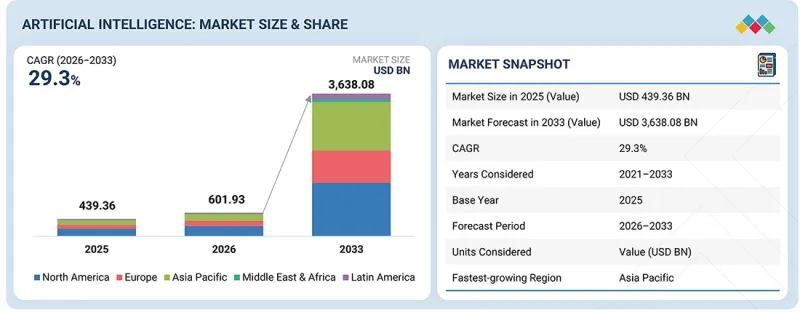
The global Artificial Intelligence (AI) market is projected to grow from USD 601.93 billion in 2026 to USD 3,638.08 billion by 2033, at a CAGR of 29.3% during the forecast period. Growth is being fueled by rising enterprise adoption of generative AI, increasing investments in AI infrastructure, and expanding use of AI across business functions such as operations, customer engagement, software development, and decision-making.
| Scope of the Report | |
|---|---|
| Years Considered for the Study | 2021-2033 |
| Base Year | 2025 |
| Forecast Period | 2026-2033 |
| Units Considered | Value (USD Billion) |
| Segments | Offering, Technology, Business Function, Deployment Model, Vertical Use Case, End User, and Region |
| Regions covered | North America, Europe, Asia Pacific, Middle East & Africa, and Latin America |
Organizations are increasingly embedding AI into existing workflows to improve productivity, automate repetitive tasks, and generate actionable insights from growing volumes of enterprise data. However, challenges related to infrastructure availability, energy consumption, data governance, regulatory compliance, and shortages of specialized AI talent continue to influence deployment timelines and implementation strategies across industries.
"Software to be the fastest-growing segment through 2033, supported by rising enterprise demand for AI platforms and intelligent applications."
By offering, the software is expected to register the highest growth during the forecast period. Organizations are increasingly prioritizing AI software investments as they move from experimentation toward production-scale deployments. Demand is expanding across foundation models, AI and machine learning development platforms, AI orchestration tools, AI productivity applications, governance platforms, and industry-specific AI solutions. Unlike infrastructure investments that are often concentrated among hyperscalers and large enterprises, AI software adoption spans organizations of all sizes and industries. Enterprises are focusing on software capabilities that can accelerate deployment, improve user productivity, automate workflows, and generate measurable business outcomes. The growing availability of cloud-based AI services and pre-trained models is further lowering adoption barriers and enabling broader commercialization of AI technologies across the global economy.
"Operations & supply chain remains the largest segment in 2026 as enterprises prioritize efficiency, resilience, and data-driven decision-making."
By business function, the operations & supply chain segment represents the largest share in 2026. Organizations increasingly rely on AI to improve forecasting accuracy, optimize inventory management, automate procurement processes, strengthen logistics planning, and improve operational visibility across complex value chains. AI technologies help enterprises process large volumes of operational data, identify inefficiencies, predict disruptions, and support real-time decision-making. The segment has benefited from growing pressure on organizations to improve productivity, reduce operating costs, and strengthen supply chain resilience following years of economic and geopolitical uncertainty. As enterprises continue investing in digital transformation initiatives, operations and supply chain functions remain among the most mature and commercially significant areas of AI deployment.
"North America maintains leadership in the artificial intelligence market, while Asia Pacific emerges as the fastest-growing regional market driven by accelerating digital transformation and AI investments."
North America is expected to account for the largest share of the global artificial intelligence market in 2026. The region benefits from the presence of leading AI companies, advanced cloud infrastructure, strong research capabilities, and substantial investments in digital transformation initiatives. Organizations across healthcare, financial services, manufacturing, retail, telecommunications, and government sectors continue to increase spending on AI technologies to improve productivity, enhance decision-making, and accelerate innovation. The US remains the primary growth engine within the region, supported by ongoing investments in AI infrastructure, semiconductor development, foundation models, and enterprise AI platforms. Strong venture capital activity and a mature technology ecosystem further reinforce North America's position as the largest regional market.
Asia Pacific is expected to register the highest growth rate during the forecast period. Governments and enterprises across China, India, Japan, South Korea, Singapore, and Australia are increasing investments in AI infrastructure, cloud computing, digital services, and industry modernization programs. The region's large digital population, expanding technology ecosystem, and growing adoption of AI across manufacturing, healthcare, retail, financial services, and public sector applications are creating substantial opportunities for market expansion. Organizations are increasingly using AI to improve operational efficiency, automate business processes, and support data-driven decision-making. As AI adoption broadens across both developed and emerging economies, Asia Pacific is expected to become one of the most dynamic regions for future AI investment and deployment.
Breakdown of Primaries
In-depth interviews were conducted with chief executive officers (CEOs), innovation and technology directors, system integrators, and executives from various key organizations operating in the Artificial intelligence market.
- By Company: Tier I - 35%, Tier II - 22%, and Tier III - 43%
- By Designation: Directors - 27%, Managers - 53%, and others - 20%
- By Region: North America - 38%, Europe - 22%, Asia Pacific - 28%, Middle East & Africa - 5%, and Latin America - 7%
NVIDIA (US), Microsoft (US), Amazon Web Services (US), Google (US), IBM (US), AMD (US), Oracle (US), Intel (US), OpenAI (US), Baidu (China), Qualcomm (US), HPE (US), Alibaba (China), Huawei (China), Salesforce (US), Meta (US), SAP (Germany), Cisco (US), SAS Institute (US), Siemens (Germany), C3.ai (US), Appier (Taiwan), Centific (US), TELUS International (Canada), Innodata (US), Sama (US), Cogito Tech (India), Fractal Analytics (US), Tiger Analytics (US), Quantiphi (US), Databricks (US), CoreWeave (US), xAI (US), Appen (Australia), Cognition Labs (US), Hippocratic AI (US), Harvey (US), Hebbia (US), Typeface (US), Sierra AI (US), Modal Labs (US), Mistral AI (France), MiniMax (China), Sarvam AI (India), Abridge (US), Artisan AI (US), Decagon (US), Neysa (India), Higgsfield AI (US), ElevenLabs (UK), Cyera (US), Legora (Sweden), Suno (US), Perplexity (US), Sakana AI (Japan), Augment Code (US), DeepSeek AI (China), Fireworks AI (US), Replit (US), Nabla Bio (US), Rogo (US), Together AI (US), Cohere (Canada), AI21 Labs (Israel), Inflection AI (US), Anyscale (US), Cerebras Systems (US), Graphcore (UK), Character.AI (US), Jasper AI (US), Writesonic (US), H2O.ai (US), Labelbox (US), Snorkel AI (US), Adept AI (US), and Synthesia (UK) are some of the key players in the artificial intelligence market.
The study includes an in-depth competitive analysis of these key players in the artificial intelligence market, with their company profiles, recent developments, and key market strategies.
Research Coverage
This research report categorizes the artificial intelligence market by Offering (Hardware, Software, and Services), Technology (Classical Machine Learning, Deep Learning, Generative AI, Natural Language Processing, Vision AI, Speech & Audio AI Technology, and Symbolic AI & Knowledge Representation), Deployment Model (Cloud, Hybrid, On-premises, Edge AI), Business Function (Marketing & Sales, Human Resources, Finance & Accounting, Operations & Supply Chain, Cybersecurity, and Others), Vertical Use Cases (BFSI, Retail & E-Commerce, Healthcare & Life Sciences, Software & Technology Providers, Telecommunications, Government & Defense, Agriculture, Manufacturing, Media & Entertainment, Transportation & Logistics, Energy & Utilities, and Other End Users), End User (Consumers, and Enterprise AI), and Region (North America, Europe, Asia Pacific, Middle East & Africa, and Latin America).
The scope of the report covers detailed information regarding the major factors, such as drivers, restraints, challenges, and opportunities, influencing the growth of the artificial intelligence market. A detailed analysis of the key industry players has been done to provide insights into their business overview, solutions, and services; key strategies; contracts, partnerships, and agreements. new product & service launches, mergers and acquisitions, and recent developments associated with the artificial intelligence market. Competitive analysis of upcoming startups in the artificial intelligence market ecosystem is covered in this report.
Reasons to Buy This Report
The report will provide market leaders and new entrants with information on the closest approximations of the revenue numbers for the overall artificial intelligence market and its subsegments. It would help stakeholders understand the competitive landscape and gain more insights to position their business better and plan suitable go-to-market strategies. It also helps stakeholders understand the pulse of the market and provides them with information on key market drivers, restraints, challenges, and opportunities.
The report provides insights into the following pointers:
- Analysis of key drivers (Agentic AI is transitioning enterprise deployment from isolated tools to autonomous workflow execution, sovereign AI hardware investment is creating structural long-term demand across all geographies, open-source model proliferation is democratizing access and compressing AI deployment costs, proprietary enterprise data is emerging as the defining competitive moat in the AI economy), restraints (Energy infrastructure constraints are creating a structural bottleneck on AI compute expansion, fragmented global regulatory landscape is increasing enterprise compliance overhead and slowing deployment in regulated sectors), opportunities (AI-enabled healthcare transformation is unlocking one of the largest and most durable vertical market opportunities, AI governance and safety hardware is emerging as a distinct and fast-growing commercial segment, Small language models and edge AI are enabling deployment in cost, latency, and privacy-constrained environments), and challenges (Pilot-to-production gap is constraining enterprise AI value realization at scale, AI talent concentration is creating structural inequality in capability development)
- Product Development/Innovation: Detailed insights into upcoming technologies, research & development activities, and new product & service launches in the artificial intelligence market
- Market Development: Comprehensive information about lucrative markets across varied regions
- Market Diversification: Exhaustive information about new products & services, untapped geographies, recent developments, and investments in the artificial intelligence market
- Competitive Assessment: In-depth assessment of market shares, growth strategies and service offerings of NVIDIA (US), AWS (Amazon) (US), Microsoft (US), OpenAI (US), Google (Alphabet) (US), Oracle (US), HPE (US), Alibaba (China), AMD (US), Databricks (US), among others, in the artificial intelligence market
TABLE OF CONTENTS
1 INTRODUCTION
- 1.1 STUDY OBJECTIVES
- 1.2 MARKET DEFINITION
- 1.2.1 INCLUSIONS AND EXCLUSIONS
- 1.3 MARKET SCOPE
- 1.3.1 MARKET SEGMENTATION
- 1.3.2 YEARS CONSIDERED
- 1.4 CURRENCY CONSIDERED
- 1.5 STAKEHOLDERS
- 1.6 SUMMARY OF CHANGES
2 EXECUTIVE SUMMARY
- 2.1 MARKET HIGHLIGHTS AND KEY INSIGHTS
- 2.2 KEY MARKET PARTICIPANTS: MAPPING OF STRATEGIC DEVELOPMENTS
- 2.3 DISRUPTIVE TRENDS IN ARTIFICIAL INTELLIGENCE MARKET
- 2.4 HIGH-GROWTH SEGMENTS
- 2.5 REGIONAL SNAPSHOT: MARKET SIZE, GROWTH RATE, AND FORECAST
3 PREMIUM INSIGHTS
- 3.1 ATTRACTIVE OPPORTUNITIES IN ARTIFICIAL INTELLIGENCE MARKET
- 3.2 ARTIFICIAL INTELLIGENCE MARKET, BY REGION
- 3.3 ARTIFICIAL INTELLIGENCE MARKET: TOP THREE AI SOFTWARE TYPES
- 3.4 NORTH AMERICA: ARTIFICIAL INTELLIGENCE MARKET, BY OFFERING AND DEPLOYMENT MODE
- 3.5 ARTIFICIAL INTELLIGENCE MARKET, BY REGION
4 MARKET OVERVIEW
- 4.1 INTRODUCTION
- 4.2 MARKET DYNAMICS
- 4.2.1 DRIVERS
- 4.2.1.1 Agentic AI transitioning enterprise deployment from isolated tools to autonomous workflow execution
- 4.2.1.2 Sovereign AI infrastructure investment creating structural long-term demand across all geographies
- 4.2.1.3 Open-source model proliferation is democratizing access and compressing AI deployment costs
- 4.2.1.4 Proprietary enterprise data emerging as defining competitive moat in AI economy
- 4.2.2 RESTRAINTS
- 4.2.2.1 Energy infrastructure constraints creating structural bottleneck on AI compute expansion
- 4.2.2.2 Fragmented global regulatory landscape increasing enterprise compliance overhead and slowing deployment in regulated sectors
- 4.2.3 OPPORTUNITIES
- 4.2.3.1 Physical AI and robotics represent next frontier of value creation beyond digital economy
- 4.2.3.2 AI-enabled healthcare transformation unlocking one of largest and most durable vertical market opportunities
- 4.2.3.3 AI governance and safety infrastructure emerging as distinct and fast-growing commercial segment
- 4.2.3.4 Small language models and edge AI enabling deployment in cost, latency, and privacy-constrained environments
- 4.2.4 CHALLENGES
- 4.2.4.1 Pilot-to-production gap constraining enterprise AI value realization at scale
- 4.2.4.2 AI talent concentration creating structural inequality in capability distribution across geographies and organization sizes
- 4.2.1 DRIVERS
- 4.3 UNMET NEEDS AND WHITE SPACES
- 4.3.1 UNMET NEEDS IN ARTIFICIAL INTELLIGENCE MARKET
- 4.3.2 WHITE SPACE OPPORTUNITIES
- 4.4 INTERCONNECTED MARKETS AND CROSS-SECTOR OPPORTUNITIES
- 4.4.1 INTERCONNECTED MARKETS
- 4.4.2 CROSS-SECTOR OPPORTUNITIES
- 4.5 STRATEGIC MOVES BY TIER-1/2/3 PLAYERS
- 4.5.1 STRATEGIC MOVES BY TIER-1/2/3 PLAYERS
5 INDUSTRY TRENDS
- 5.1 EVOLUTION OF ARTIFICIAL INTELLIGENCE
- 5.2 PORTER'S FIVE FORCES ANALYSIS
- 5.2.1 THREAT OF NEW ENTRANTS
- 5.2.2 THREAT OF SUBSTITUTES
- 5.2.3 BARGAINING POWER OF SUPPLIERS
- 5.2.4 BARGAINING POWER OF BUYERS
- 5.2.5 INTENSITY OF COMPETITIVE RIVALRY
- 5.3 SUPPLY CHAIN ANALYSIS
- 5.4 ECOSYSTEM ANALYSIS
- 5.4.1 AI HARDWARE PROVIDERS
- 5.4.2 AI SOFTWARE PROVIDERS
- 5.4.3 AI SERVICE PROVIDERS
- 5.5 PRICING ANALYSIS
- 5.5.1 AVERAGE SELLING PRICE TREND, BY REGION, 2022-2026
- 5.5.2 INDICATIVE PRICING ANALYSIS, BY AI SOFTWARE, 2026
- 5.6 TRADE ANALYSIS
- 5.6.1 EXPORT SCENARIO OF COMPUTER PROCESSING UNITS (HSN: 847150)
- 5.6.2 IMPORT SCENARIO OF COMPUTER PROCESSING UNITS (HSN: 847150)
- 5.7 KEY CONFERENCES AND EVENTS, 2026-2027
- 5.8 TRENDS/DISRUPTIONS IMPACTING CUSTOMER BUSINESS
- 5.9 INVESTMENT AND FUNDING SCENARIO
- 5.9.1 GLOBAL VC & AI FUNDING TRENDS
- 5.9.2 REGIONAL & GEOGRAPHIC ANALYSIS
- 5.9.3 AI FUNDING BY CATEGORY & SECTOR
- 5.9.4 TOP AI UNICORNS
- 5.10 CASE STUDY ANALYSIS
- 5.10.1 BRADESCO ENABLED SCALABLE ARTIFICIAL INTELLIGENCE FOR CUSTOMER EXPERIENCE TRANSFORMATION
- 5.10.2 HEINEKEN ENABLED SCALABLE ARTIFICIAL INTELLIGENCE WITH MICROSOFT COPILOT STUDIO
- 5.10.3 PATTERN ENABLED SCALABLE GENERATIVE AI FOR ECOMMERCE OPTIMIZATION WITH AWS NOVA
- 5.10.4 US AIR FORCE ENABLED AI-DRIVEN PREDICTIVE MAINTENANCE WITH C3.AI PLATFORM
- 5.10.5 FEDEX ENABLED AI-DRIVEN CUSTOMER ENGAGEMENT WITH SALESFORCE DATA CLOUD
- 5.10.6 SUNOH ENABLED AI-DRIVEN MEDICAL DOCUMENTATION AUTOMATION WITH AMBIENT AI SCRIBE
- 5.10.7 HEARST TELEVISION ENABLED AI-DRIVEN CONTENT REVENUE OPTIMIZATION WITH SYMPHONYAI REVEDIA
- 5.10.8 SINGTEL ENABLED AI-POWERED 5G ENTERPRISE SERVICES WITH NVIDIA AI ENTERPRISE
- 5.10.9 IBM ENABLED COST-EFFICIENT ENTERPRISE AI SCALING WITH INTEL GAUDI 3
- 5.10.10 AES ENABLED AI-DRIVEN ENERGY OPTIMIZATION AND PREDICTIVE MAINTENANCE WITH H2O AI CLOUD
- 5.11 IMPACT OF 2025 US TARIFF - ARTIFICIAL INTELLIGENCE MARKET
- 5.11.1 INTRODUCTION
- 5.11.1.1 Tariff/Trade Policy Updates (Jan-May 2026)
- 5.11.2 KEY TARIFF RATES
- 5.11.3 PRICE IMPACT ANALYSIS
- 5.11.3.1 Strategic shifts and emerging trends
- 5.11.4 IMPACT ON COUNTRY/REGION
- 5.11.4.1 US
- 5.11.4.2 China
- 5.11.4.3 Europe
- 5.11.4.4 Asia Pacific (excluding China)
- 5.11.5 IMPACT ON END-USE INDUSTRIES
- 5.11.5.1 BFSI
- 5.11.5.2 Retail & E-commerce
- 5.11.5.3 Healthcare & life sciences
- 5.11.5.4 Telecommunications
- 5.11.5.5 Software & Technology Providers
- 5.11.5.6 Government & Public Sector
- 5.11.5.7 Media & Entertainment
- 5.11.5.8 Other Verticals
- 5.11.1 INTRODUCTION
6 TECHNOLOGICAL ADVANCEMENTS, PATENTS, INNOVATIONS, AND FUTURE APPLICATIONS
- 6.1 KEY EMERGING TECHNOLOGIES
- 6.1.1 LARGE LANGUAGE MODELS (LLMS) & FOUNDATION MODELS
- 6.1.2 MACHINE LEARNING & DEEP LEARNING
- 6.1.3 NATURAL LANGUAGE PROCESSING (NLP)
- 6.1.4 COMPUTER VISION & MULTIMODAL AI
- 6.1.5 GENERATIVE AI
- 6.1.6 AI AGENTS & MULTI-AGENT SYSTEMS
- 6.2 COMPLEMENTARY TECHNOLOGIES
- 6.2.1 AI ACCELERATOR CHIPS
- 6.2.2 CLOUD COMPUTING & HIGH-PERFORMANCE COMPUTING
- 6.2.3 MLOPS, LLMOPS & AGENTOPS PLATFORMS
- 6.2.4 DATA LAKEHOUSE PLATFORMS & DATA PIPELINES
- 6.2.5 VECTOR DATABASES & KNOWLEDGE GRAPHS
- 6.2.6 AI GOVERNANCE, OBSERVABILITY & SECURITY PLATFORMS
- 6.3 ADJACENT TECHNOLOGIES
- 6.3.1 ROBOTIC PROCESS AUTOMATION (RPA)
- 6.3.2 INTERNET OF THINGS (IOT) & EDGE COMPUTING
- 6.3.3 CYBERSECURITY
- 6.3.4 DIGITAL TWINS
- 6.3.5 AUTONOMOUS SYSTEMS & ROBOTICS
- 6.3.6 BUSINESS INTELLIGENCE, ERP & CRM SYSTEMS
- 6.4 TECHNOLOGY ROADMAP
- 6.4.1 PHASE 1: AI AUGMENTATION (2025-2027)
- 6.4.2 PHASE 2: OPERATIONAL DEPLOYMENT (2027-2030)
- 6.4.3 PHASE 3: AI-LED TRANSFORMATION (2030-2035)
- 6.5 PATENT ANALYSIS
- 6.5.1 METHODOLOGY
- 6.5.2 PATENTS FILED, BY DOCUMENT TYPE, 2016-2026
- 6.5.3 INNOVATION AND PATENT APPLICATIONS
- 6.6 FUTURE APPLICATIONS
- 6.6.1 AUTONOMOUS ENTERPRISE AI AGENTS
- 6.6.2 PHYSICAL AI AND AUTONOMOUS ROBOTICS
- 6.6.3 AI DIGITAL TWIN DECISION SYSTEMS
- 6.6.4 SCIENTIFIC AND ENGINEERING AI DISCOVERY PLATFORMS
- 6.6.5 AMBIENT MULTIMODAL AI ASSISTANTS
7 TARIFF ANALYSIS AND REGULATORY LANDSCAPE
- 7.1 TARIFF RELATED TO COMPUTER PROCESSING UNITS
- 7.1.1 TARIFF RELATED TO COMPUTER PROCESSING UNITS (HSN: 847150)
- 7.2 REGIONAL REGULATIONS AND COMPLIANCE
- 7.2.1 REGULATORY BODIES, GOVERNMENT AGENCIES, AND OTHER ORGANIZATIONS
- 7.2.2 KEY REGULATIONS
- 7.2.2.1 North America
- 7.2.2.1.1 Executive Order 14179 - Removing Barriers to American Leadership in Artificial Intelligence (US)
- 7.2.2.1.2 NIST Artificial Intelligence Risk Management Framework (US)
- 7.2.2.1.3 State AI Law Patchwork - Colorado, Texas, California, Illinois (US)
- 7.2.2.1.4 Directive on Automated Decision-Making (Canada - Federal)
- 7.2.2.2 Europe
- 7.2.2.2.1 EU AI Act (Regulation EU 2024/1689) (European Union)
- 7.2.2.2.2 General Data Protection Regulation - Article 22 on Automated Decision-Making (GDPR) (European Union)
- 7.2.2.2.3 Pro-Innovation AI Regulatory Approach - AI Opportunities Action Plan (United Kingdom)
- 7.2.2.2.4 National AI Strategy (Nationale KI-Strategie) and Federal Data Protection Act (BDSG) (Germany)
- 7.2.2.2.5 CNIL Generative AI and Automated Decision-Making Framework (France)
- 7.2.2.2.6 Garante AI Regulatory Framework - Generative AI and Personal Data (Italy)
- 7.2.2.2.7 National AI Strategy (ENIA) and AESIA - Spanish AI Supervisory Authority (Spain)
- 7.2.2.2.8 National AI Development Strategy (Decree No. 490) and Federal Law on AI Experiment in Moscow (No. 123-FZ) (Russia)
- 7.2.2.2.9 Netherlands Algorithmic Register (Algoritmeregister) and Belgian AI 4 Belgium Strategy (Benelux)
- 7.2.2.2.10 Nordic National AI Strategies - AI Sweden, Denmark National Strategy for AI, Finland AI Program, Norway National AI Strategy (Nordics)
- 7.2.2.3 Asia Pacific
- 7.2.2.3.1 Interim Measures for the Management of Generative Artificial Intelligence Services and AI-Generated Content Identification Measures (China)
- 7.2.2.3.2 Digital Personal Data Protection Act 2023 (DPDPA) and India AI Governance Guidelines (MeitY, 2025) (India)
- 7.2.2.3.3 Act on Promotion of Research and Development and Proper Use of Artificial Intelligence (AI Promotion Act) (Japan)
- 7.2.2.3.4 Framework Act on Artificial Intelligence Development and Establishment of a Foundation for Trustworthiness (South Korea)
- 7.2.2.3.5 Singapore Model AI Governance Framework (2nd Edition) and ASEAN Guide on AI Governance and Ethics (ASEAN)
- 7.2.2.3.6 Australia Voluntary AI Safety Standard and New Zealand Algorithm Charter for Aotearoa (Australia and New Zealand)
- 7.2.2.3.7 Taiwan Personal Data Protection Act (PDPA) and HKMA Guidance on Use of AI in Financial Services (Rest of Asia Pacific)
- 7.2.2.4 Middle East & Africa
- 7.2.2.4.1 UAE Personal Data Protection Law (Decree-Law No. 45/2021) and CBUAE AI/ML Governance Guidance (United Arab Emirates)
- 7.2.2.4.2 Saudi Personal Data Protection Law (PDPL) and SDAIA AI Ethics Principles and Generative AI Guidelines (Saudi Arabia)
- 7.2.2.4.3 Kuwait National Digital Agenda 2035 and Central Bank Digital Banking Framework (Kuwait)
- 7.2.2.4.4 Qatar Central Bank AI Guidelines and Personal Data Protection Law (Law No. 13/2016) (Qatar)
- 7.2.2.4.5 National Artificial Intelligence Policy Framework and Protection of Personal Information Act (POPIA) (South Africa)
- 7.2.2.4.6 Personal Data Protection Law (KVKK) and National AI Strategy 2021-2025 (Turkey)
- 7.2.2.4.7 Personal Data Protection Law (Law No. 151/2020) and Egypt National AI Strategy (Egypt)
- 7.2.2.4.8 Israel National AI Plan and Bahrain AI Regulation Law (Draft) (Rest of Middle East & Africa)
- 7.2.2.5 Latin America
- 7.2.2.5.1 Lei Geral de Protecao de Dados (LGPD) and AI Bill PL 2338/2023 (Brazil)
- 7.2.2.5.2 Regimen de Incentivo a las Grandes Inversiones (RIGI) and Responsible AI Guidelines (Argentina)
- 7.2.2.5.3 Federal Law on Protection of Personal Data in the Private Sector (LFPDPPP) and Mexico Digital Strategy (Mexico)
- 7.2.2.5.4 National Artificial Intelligence Policy (2021, updated 2024) and Personal Data Protection Law Reform (Chile)
- 7.2.2.1 North America
- 7.2.3 INDUSTRY STANDARDS
8 CUSTOMER LANDSCAPE & BUYER BEHAVIOR
- 8.1 DECISION-MAKING PROCESS
- 8.2 BUYER STAKEHOLDERS AND BUYING EVALUATION CRITERIA
- 8.2.1 BUYING CRITERIA
- 8.3 ADOPTION BARRIERS & INTERNAL CHALLENGES
- 8.4 UNMET NEEDS FROM VARIOUS VERTICALS
9 ARTIFICIAL INTELLIGENCE MARKET, BY OFFERING
- 9.1 INTRODUCTION
- 9.1.1 DRIVERS: ARTIFICIAL INTELLIGENCE MARKET, BY OFFERING
- 9.2 HARDWARE
- 9.2.1 AI HARDWARE DEMAND ACCELERATING AS COMPUTE BECOMES BACKBONE OF LARGE-SCALE AI DEPLOYMENTS
- 9.3 SOFTWARE
- 9.3.1 SOFTWARE ANCHORING AI MONETIZATION AS ENTERPRISES SCALE PLATFORMS, MODELS, ORCHESTRATION, AND EMBEDDED INTELLIGENCE
- 9.4 SERVICES
- 9.4.1 SERVICES BECOMING INDISPENSABLE AS ENTERPRISES MOVE FROM AI EXPERIMENTATION TO OPERATIONAL EXECUTION
10 ARTIFICIAL INTELLIGENCE MARKET, BY HARDWARE
- 10.1 INTRODUCTION
- 10.1.1 DRIVERS: ARTIFICIAL INTELLIGENCE MARKET, BY HARDWARE
- 10.2 AI ACCELERATOR CHIPS
- 10.2.1 AI ACCELERATOR CHIPS DRIVEN BY RELENTLESS DEMAND FOR HIGH-THROUGHPUT MODEL TRAINING AND INFERENCE COMPUTE
- 10.2.2 GRAPHICS PROCESSING UNIT (GPU)
- 10.2.3 AI ASICS & TPU
- 10.2.4 FIELD-PROGRAMMABLE GATE ARRAYS (FPGA)
- 10.2.5 CENTRAL PROCESSING UNITS (CPUS)
- 10.2.6 EDGE AI PROCESSORS
- 10.2.6.1 Neural Processing Units (NPUs)
- 10.2.6.2 System on Chip (SoC)
- 10.3 AI MEMORY
- 10.3.1 AI MEMORY IS EMERGING AS STRATEGIC AI HARDWARE LAYER TO HANDLE INTENSE BANDWIDTH AND LATENCY REQUIREMENTS
- 10.3.2 HIGH BANDWIDTH MEMORY (HBM)
- 10.3.3 GRAPHICS DOUBLE DATA RATE (GDDR) MEMORY
- 10.3.4 LOW POWER DOUBLE DATA RATE (LPDDR) MEMORY
- 10.3.5 PROCESSING-IN-MEMORY (PIM)
- 10.4 AI STORAGE
- 10.4.1 AI STORAGE SUPPORTS DATA-INTENSIVE TRAINING, RETRIEVAL, CHECKPOINTING, AND INFERENCE OPERATIONS
- 10.4.2 NON-VOLATILE MEMORY EXPRESS (NVME) SSD
- 10.4.3 ALL-FLASH STORAGE ARRAYS
- 10.4.4 PARALLEL/DISTRIBUTED FILE SYSTEM STORAGE
- 10.4.5 AI DATA LAKE OBJECT STORAGE
- 10.5 AI NETWORKING
- 10.5.1 AI NETWORKING ENABLING HIGH-BANDWIDTH CONNECTIVITY ACROSS INCREASINGLY COMPLEX COMPUTE ENVIRONMENTS
- 10.5.2 INFINIBAND HCA & SWITCHES
- 10.5.3 HIGH SPEED ETHERNET NIC
11 ARTIFICIAL INTELLIGENCE MARKET, BY SOFTWARE
- 11.1 INTRODUCTION
- 11.1.1 DRIVERS: ARTIFICIAL INTELLIGENCE MARKET, BY SOFTWARE
- 11.2 AI/ML DEVELOPMENT & TRAINING PLATFORMS
- 11.2.1 AI/ML DEVELOPMENT & TRAINING PLATFORMS BECOMING CORE ENTERPRISE WORKBENCH FOR BUILDING, FINE-TUNING, TESTING, AND DEPLOYING PRODUCTION-READY AI MODELS
- 11.2.2 END-TO-END ML PLATFORMS
- 11.2.3 AUTOML PLATFORMS
- 11.2.4 FOUNDATION MODEL TRAINING PLATFORMS
- 11.2.5 FINE-TUNING PLATFORMS
- 11.3 MLOPS & LLMOPS PLATFORMS
- 11.3.1 MLOPS & LLMOPS PLATFORMS ENABLING LIFECYCLE CONTROL, OBSERVABILITY, EVALUATION, AND PRODUCTION GOVERNANCE
- 11.3.2 MODEL SERVING & INFERENCE SERVING PLATFORMS
- 11.3.3 MODEL MONITORING & DRIFT DETECTION
- 11.3.4 MODEL REGISTRY & VERSIONING
- 11.3.5 FEATURE STORES
- 11.3.6 INFERENCE OPTIMIZATION PLATFORMS
- 11.3.7 PROMPT LIFECYCLE MANAGEMENT
- 11.3.8 LLM QUALITY & OUTPUT MONITORING
- 11.4 FOUNDATION MODELS & LLMS
- 11.4.1 FOUNDATION MODELS & LLMS POWERING GENERATIVE, MULTIMODAL, REASONING, AND DOMAIN-SPECIFIC AI APPLICATIONS
- 11.4.2 GENERAL-PURPOSE LLMS
- 11.4.3 MULTIMODAL FOUNDATION MODELS
- 11.4.4 OPEN-WEIGHT FOUNDATION MODELS
- 11.4.5 DOMAIN-SPECIFIC FOUNDATION MODELS
- 11.4.6 SMALL LANGUAGE MODELS
- 11.4.7 EMBEDDING MODELS & VECTOR REPRESENTATION API
- 11.4.8 SPEECH RECOGNITION MODELS
- 11.4.9 TEXT-TO-SPEECH & VOICE SYNTHESIS MODELS
- 11.4.10 VISION AI MODELS
- 11.4.11 DOCUMENT INTELLIGENCE & OCR MODELS
- 11.4.12 GENERATIVE IMAGE & VIDEO MODELS
- 11.5 AI AGENT ORCHESTRATION & RAG PLATFORMS
- 11.5.1 AI AGENT ORCHESTRATION & RAG PLATFORMS CONNECTING MODELS WITH WORKFLOWS, TOOLS, ENTERPRISE DATA, AND GOVERNED ACTIONS
- 11.5.2 LLM ORCHESTRATION & CHAINING
- 11.5.3 VECTOR DATABASES & SEMANTIC SEARCH ENGINES
- 11.5.4 RAG PIPELINE PLATFORMS
- 11.5.5 ENTERPRISE KNOWLEDGE GROUNDING & SEARCH ORCHESTRATION
- 11.5.6 SINGLE-AGENT DEVELOPMENT PLATFORMS
- 11.5.7 MULTI-AGENT ORCHESTRATION PLATFORMS
- 11.5.8 TOOL-CALLING & API INTEGRATION PLATFORMS
- 11.5.9 AI COPILOT DEVELOPMENT PLATFORMS
- 11.6 AI DATA PLATFORMS
- 11.6.1 AI DATA PLATFORMS GAINING STRATEGIC IMPORTANCE AS ENTERPRISES PRIORITIZE AI-READY DATA PIPELINES
- 11.6.2 DATA LAKEHOUSE PLATFORMS
- 11.6.3 AI DATA FABRIC & UNIFIED DATA MANAGEMENT PLATFORMS
- 11.6.4 STREAMING & DATA INGESTION PLATFORMS
- 11.6.5 KNOWLEDGE GRAPH PLATFORMS
- 11.6.6 DATA LABELING & ANNOTATION PLATFORMS
- 11.7 AI SGRC PLATFORMS
- 11.7.1 AI SGRC PLATFORMS BECOMING ESSENTIAL TO FORMALIZE SECURITY, GOVERNANCE, RISK, AND AUDIT REQUIREMENTS
- 11.7.2 AI MODEL SECURITY PLATFORMS
- 11.7.3 AI DATA SECURITY PLATFORMS
- 11.7.4 AI GOVERNANCE & POLICY PLATFORMS
- 11.7.5 RESPONSIBLE AI PLATFORMS
- 11.7.6 AI FOR CYBERSECURITY PLATFORMS
- 11.8 AI PRODUCTIVITY TOOLS
- 11.8.1 AI PRODUCTIVITY TOOLS ACCELERATING MASS-MARKET SOFTWARE ADOPTION BY EMBEDDING AI INTO EVERYDAY KNOWLEDGE WORK
- 11.8.2 AI WRITING & CONTENT ASSISTANTS
- 11.8.3 AI CODING ASSISTANTS & DEVELOPER TOOLS
- 11.8.4 AI MEETING TRANSCRIPTION & SUMMARY TOOLS
- 11.8.5 AI SOFTWARE TESTING & CODE REVIEW TOOLS
- 11.8.6 AI ENTERPRISE SEARCH & KNOWLEDGE ASSISTANTS
- 11.8.7 AI PRESENTATION & DOCUMENT GENERATION TOOLS
12 ARTIFICIAL INTELLIGENCE MARKET, BY SERVICE
- 12.1 INTRODUCTION
- 12.1.1 DRIVERS: ARTIFICIAL INTELLIGENCE MARKET, BY SERVICE
- 12.2 AI STRATEGY & CONSULTING SERVICES
- 12.2.1 AI STRATEGY & CONSULTING SERVICES SHAPING ENTERPRISE AI ADOPTION BY CONVERTING EXPERIMENTATION INTO STRUCTURED ROADMAPS AND ROI-LED TRANSFORMATION PROGRAMS
- 12.2.2 AI STRATEGY & ROADMAP ADVISORY
- 12.2.3 AI USE-CASE IDENTIFICATION
- 12.2.4 AI OPERATING MODEL & ORGANIZATIONAL DESIGN
- 12.2.5 RESPONSIBLE AI & ETHICS ADVISORY
- 12.2.6 AI REGULATORY COMPLIANCE ADVISORY
- 12.3 AI IMPLEMENTATION & SYSTEM INTEGRATION
- 12.3.1 AI IMPLEMENTATION & SYSTEM INTEGRATION SERVICES CONNECTING MODELS, DATA, AND WORKFLOWS AT SCALE
- 12.3.2 AI DATA ENGINEERING & READINESS
- 12.3.3 CUSTOM AI/ML MODEL DEVELOPMENT
- 12.3.4 AI SOLUTION ARCHITECTURE & SYSTEM DESIGN
- 12.3.5 LLM FINE-TUNING & RAG IMPLEMENTATION
- 12.3.6 AUTONOMOUS AGENT WORKFLOW IMPLEMENTATION
- 12.3.7 AI API INTEGRATION & WORKFLOW INTEGRATION
- 12.3.8 AI INFRASTRUCTURE DEPLOYMENT
- 12.4 MANAGED AI SERVICES
- 12.4.1 MANAGED AI SERVICES HELPING ENTERPRISES SUSTAIN MODEL PERFORMANCE AND PRODUCTION RELIABILITY.
- 12.4.2 MANAGED AI SECURITY & COMPLIANCE SERVICES
- 12.4.3 MANAGED AI INFRASTRUCTURE & GPUAAS
- 12.4.4 MANAGED MLOPS & AIOPS
- 12.4.5 MANAGED AI APPLICATION SERVICES
- 12.4.6 MANAGED KNOWLEDGE-BASE & RAG SERVICES
- 12.4.7 AI HELP DESK & SUPPORT SERVICES
- 12.5 DATA LABELING & ANNOTATION SERVICES
- 12.5.1 DATA LABELING & ANNOTATION SERVICES REMAIN ESSENTIAL TO AI DATASET PREPARATION FOR RELIABLE MODEL PERFORMANCE
- 12.6 AI TRAINING & ENABLEMENT SERVICES
- 12.6.1 AI TRAINING & ENABLEMENT SERVICES ACCELERATING ORGANIZATIONAL READINESS BY EQUIPPING BUSINESSES TO ADOPT AI RESPONSIBLY AND EFFECTIVELY
13 ARTIFICIAL INTELLIGENCE MARKET, BY TECHNOLOGY
- 13.1 INTRODUCTION
- 13.1.1 DRIVERS: ARTIFICIAL INTELLIGENCE MARKET, BY TECHNOLOGY
- 13.2 CLASSICAL MACHINE LEARNING
- 13.2.1 CLASSICAL MACHINE LEARNING REMAINS OPTIMIZATION BACKBONE OF ENTERPRISE AI, CONVERTING STRUCTURED DATA ASSETS INTO DECISION-READY INTELLIGENCE
- 13.2.2 SUPERVISED LEARNING
- 13.2.3 UNSUPERVISED LEARNING
- 13.2.4 REINFORCEMENT LEARNING
- 13.2.5 FEDERATED LEARNING
- 13.3 DEEP LEARNING
- 13.3.1 DEEP LEARNING EXPANDING FRONTIER OF AI BY EXTRACTING HIGH-DIMENSIONAL PATTERNS FROM LANGUAGE, VISION, SPEECH, SENSOR, AND MULTIMODAL DATA
- 13.3.2 CONVOLUTIONAL NEURAL NETWORKS (CNNS)
- 13.3.3 TRANSFORMER-BASED MODELS
- 13.3.4 DIFFUSION MODELS
- 13.3.5 GENERATIVE ADVERSARIAL NETWORKS (GANS)
- 13.3.6 GRAPH NEURAL NETWORKS (GNNS)
- 13.3.7 RECURRENT NEURAL NETWORKS
- 13.4 GENERATIVE AI
- 13.4.1 GENERATIVE AI RESHAPING AI DEMAND BY TURNING MODELS INTO ENTERPRISE INTERFACES FOR CREATION, KNOWLEDGE WORK, CODE, AND WORKFLOW ACCELERATION
- 13.4.2 TEXT GENERATION
- 13.4.3 CODE GENERATION
- 13.4.4 IMAGE & VIDEO GENERATION
- 13.4.5 MULTIMODAL GENERATION
- 13.4.6 SYNTHETIC DATA GENERATION
- 13.5 NATURAL LANGUAGE PROCESSING (NLP)
- 13.5.1 NLP TURNING ENTERPRISE LANGUAGE ASSETS INTO SEARCHABLE, ACTIONABLE, AND AUTOMATABLE INTELLIGENCE
- 13.5.2 STATISTICAL NLP
- 13.5.3 TRANSFORMER-BASED NLP
- 13.5.4 MULTILINGUAL & CROSS-LINGUAL AI MODELS
- 13.6 VISION AI
- 13.6.1 VISION AI ENABLING ENTERPRISES TO INSPECT AND AUTOMATE WHAT CAMERAS AND SENSORS CAN CAPTURE
- 13.6.2 IMAGE CLASSIFICATION & OBJECT DETECTION
- 13.6.3 VIDEO ANALYTICS & ACTION RECOGNITION
- 13.6.4 OPTICAL CHARACTER RECOGNITION (OCR) & INTELLIGENT DOCUMENT PROCESSING (IDP)
- 13.6.5 3D VISION & POINT CLOUD PROCESSING
- 13.7 SPEECH & AUDIO AI
- 13.7.1 SPEECH AND AUDIO AI MAKING VOICE, SOUND, AND ACOUSTIC SIGNALS ACTIONABLE ACROSS CUSTOMER ENGAGEMENT
- 13.7.2 AUTOMATIC SPEECH RECOGNITION (ASR)
- 13.7.3 TEXT-TO-SPEECH & VOICE SYNTHESIS
- 13.7.4 SPEAKER IDENTIFICATION & VOICE BIOMETRICS
- 13.7.5 AUDIO ANALYTICS & SOUND EVENT DETECTION
- 13.8 SYMBOLIC AI & KNOWLEDGE REPRESENTATION
- 13.8.1 SYMBOLIC AI AND KNOWLEDGE REPRESENTATION RE-ENTERING AI AGENDA AS ENTERPRISES DEMAND EXPLAINABILITY AROUND PROBABILISTIC MODELS
- 13.8.2 KNOWLEDGE GRAPHS & ONTOLOGY-BASED REASONING
- 13.8.3 RULE-BASED AI & EXPERT SYSTEMS
- 13.8.4 NEUROSYMBOLIC AI
14 ARTIFICIAL INTELLIGENCE MARKET, BY DEPLOYMENT MODEL
- 14.1 INTRODUCTION
- 14.1.1 DRIVERS: ARTIFICIAL INTELLIGENCE MARKET, BY DEPLOYMENT MODEL
- 14.2 CLOUD
- 14.2.1 CLOUD DEPLOYMENT CONTINUES TO ANCHOR ENTERPRISE AI ADOPTION THROUGH SPEED, SCALE, AND ECOSYSTEM CONSOLIDATION
- 14.3 ON-PREMISES
- 14.3.1 ON-PREMISES DEPLOYMENT BECOMING STRATEGIC CHOICE FOR ENTERPRISES PRIORITIZING CONTROL AND REGULATORY ASSURANCE
- 14.4 HYBRID
- 14.4.1 HYBRID DEPLOYMENT BECOMING ENTERPRISE PREFERENCE TO BALANCE INNOVATION VELOCITY WITH GOVERNANCE CONTROL
- 14.5 EDGE AI
- 14.5.1 EDGE AI EXPANDING RAPIDLY AS REAL-TIME DECISION-MAKING SHIFTS AI EXECUTION CLOSER TO DATA GENERATION POINTS
15 ARTIFICIAL INTELLIGENCE MARKET, BY BUSINESS FUNCTION
- 15.1 INTRODUCTION
- 15.1.1 DRIVERS: ARTIFICIAL INTELLIGENCE MARKET, BY BUSINESS FUNCTION
- 15.2 MARKETING & SALES
- 15.2.1 AI RESHAPING HOW ORGANIZATIONS ATTRACT, ENGAGE, AND CONVERT CUSTOMERS ACROSS REVENUE FUNNEL
- 15.2.2 SENTIMENT ANALYSIS
- 15.2.3 PREDICTIVE FORECASTING
- 15.2.4 CONTENT GENERATION & MARKETING
- 15.2.5 AUDIENCE SEGMENTATION & PERSONALIZATION
- 15.2.6 CUSTOMER EXPERIENCE MANAGEMENT
- 15.2.7 OTHER MARKETING & SALES FUNCTIONS
- 15.3 HUMAN RESOURCES
- 15.3.1 AI REDEFINES TALENT ACQUISITION, EMPLOYEE DEVELOPMENT, AND WORKFORCE INTELLIGENCE ACROSS HR FUNCTION
- 15.3.2 ONBOARDING AUTOMATION
- 15.3.3 CANDIDATE SCREENING & RECRUITMENT
- 15.3.4 PERFORMANCE MANAGEMENT
- 15.3.5 WORKFORCE MANAGEMENT
- 15.3.6 EMPLOYEE FEEDBACK ANALYSIS
- 15.3.7 OTHER HR FUNCTIONS
- 15.4 FINANCE & ACCOUNTING
- 15.4.1 AI DRIVES ACCURACY, EFFICIENCY, AND STRATEGIC INSIGHT ACROSS FINANCE AND ACCOUNTING OPERATIONS
- 15.4.2 FINANCIAL PLANNING & FORECASTING
- 15.4.3 AUTOMATED BOOKKEEPING & RECONCILIATION
- 15.4.4 PROCUREMENT & SUPPLY CHAIN FINANCE
- 15.4.5 REVENUE CYCLE MANAGEMENT
- 15.4.6 FINANCIAL COMPLIANCE & REGULATORY REPORTING
- 15.4.7 OTHER FINANCE & ACCOUNTING FUNCTIONS
- 15.5 OPERATIONS & SUPPLY CHAIN
- 15.5.1 AI UNLOCKS OPERATIONAL RESILIENCE AND SUPPLY CHAIN AGILITY ACROSS PLANNING, PROCUREMENT, AND PRODUCTION
- 15.5.2 AIOPS
- 15.5.3 IT SERVICE MANAGEMENT
- 15.5.4 DEMAND PLANNING & FORECASTING
- 15.5.5 PROCUREMENT & SOURCING
- 15.5.6 WAREHOUSE & INVENTORY MANAGEMENT
- 15.5.7 PRODUCTION PLANNING & SCHEDULING
- 15.5.8 OTHER OPERATIONS & SUPPLY CHAIN FUNCTIONS
- 15.6 CYBERSECURITY
- 15.6.1 AI STRENGTHENS ENTERPRISE DEFENSE BY ENABLING FASTER DETECTION, RESPONSE, AND RISK GOVERNANCE AT SCALE
- 15.6.2 IDENTITY & ACCESS MANAGEMENT
- 15.6.3 THREAT DETECTION & RESPONSE
- 15.6.4 SECURITY OPERATIONS AUTOMATION
- 15.6.5 DATA SECURITY
- 15.6.6 RISK & COMPLIANCE MANAGEMENT
- 15.6.7 FRAUD DETECTION & PREVENTION
- 15.6.8 VULNERABILITY & EXPOSURE MANAGEMENT
- 15.6.9 OTHER CYBERSECURITY FUNCTIONS
- 15.7 OTHER BUSINESS FUNCTIONS
16 ARTIFICIAL INTELLIGENCE MARKET, BY VERTICAL USE CASE
- 16.1 INTRODUCTION
- 16.1.1 DRIVERS: ARTIFICIAL INTELLIGENCE MARKET, BY VERTICAL USE CASE
- 16.2 BFSI
- 16.2.1 FRAUD DETECTION REMAINS LARGEST AI MONETIZATION ENGINE IN BFSI AS FINANCIAL INSTITUTIONS PRIORITIZE REAL-TIME RISK PREVENTION AND TRANSACTION INTELLIGENCE
- 16.2.2 FRAUD DETECTION & PREVENTION
- 16.2.3 RISK ASSESSMENT & MANAGEMENT
- 16.2.4 ALGORITHMIC TRADING
- 16.2.5 CREDIT SCORING & UNDERWRITING
- 16.2.6 CUSTOMER SERVICE AUTOMATION
- 16.2.7 PERSONALIZED FINANCIAL RECOMMENDATIONS
- 16.2.8 INVESTMENT PORTFOLIO MANAGEMENT
- 16.2.9 REGULATORY COMPLIANCE MONITORING
- 16.2.10 OTHER BFSI USE CASES
- 16.3 RETAIL & E-COMMERCE
- 16.3.1 PERSONALIZED PRODUCT RECOMMENDATION LEADS RETAIL AI ADOPTION AS MERCHANTS SCALE HYPER-PERSONALIZED COMMERCE AND CONVERSION OPTIMIZATION
- 16.3.2 PERSONALIZED PRODUCT RECOMMENDATION
- 16.3.3 CUSTOMER RELATIONSHIP MANAGEMENT
- 16.3.4 VISUAL SEARCH
- 16.3.5 VIRTUAL CUSTOMER ASSISTANT
- 16.3.6 PRICE OPTIMIZATION
- 16.3.7 SUPPLY CHAIN MANAGEMENT AND DEMAND PLANNING
- 16.3.8 VIRTUAL STORES
- 16.3.9 OTHER RETAIL & E-COMMERCE USE CASES
- 16.4 MANUFACTURING
- 16.4.1 QUALITY CONTROL EMERGES AS LARGEST MANUFACTURING AI USE CASE AS FACTORIES PRIORITIZE DEFECT REDUCTION, PRECISION INSPECTION, AND PRODUCTION CONSISTENCY
- 16.4.2 PREDICTIVE MAINTENANCE & MACHINERY INSPECTION
- 16.4.3 MATERIAL MOVEMENT MANAGEMENT
- 16.4.4 PRODUCTION PLANNING
- 16.4.5 RECYCLABLE MATERIAL RECLAMATION
- 16.4.6 QUALITY CONTROL
- 16.4.7 PRODUCTION LINE OPTIMIZATION
- 16.4.8 INTELLIGENT INVENTORY MANAGEMENT
- 16.4.9 OTHER MANUFACTURING USE CASES
- 16.5 GOVERNMENT & DEFENSE
- 16.5.1 SURVEILLANCE AND SITUATIONAL AWARENESS ANCHOR AI SPENDING IN GOVERNMENT AND DEFENSE AS AGENCIES STRENGTHEN INTELLIGENCE VISIBILITY AND OPERATIONAL READINESS
- 16.5.2 SURVEILLANCE & SITUATIONAL AWARENESS
- 16.5.3 LAW ENFORCEMENT
- 16.5.4 INTELLIGENCE ANALYSIS & DATA PROCESSING
- 16.5.5 SIMULATION & TRAINING
- 16.5.6 COMMAND & CONTROL
- 16.5.7 DISASTER RESPONSE & RECOVERY ASSISTANCE
- 16.5.8 E-GOVERNANCE & DIGITAL CITY SERVICES
- 16.5.9 OTHER GOVERNMENT & DEFENSE USE CASES
- 16.6 HEALTHCARE & LIFE SCIENCES
- 16.6.1 MEDICAL IMAGING AND DIAGNOSTICS CURRENTLY DOMINATE HEALTHCARE AI ADOPTION AS PROVIDERS SCALE FASTER, DATA-DRIVEN CLINICAL DECISION SUPPORT
- 16.6.2 PATIENT DATA & RISK ANALYSIS
- 16.6.3 LIFESTYLE MANAGEMENT AND MONITORING
- 16.6.4 PRECISION MEDICINE
- 16.6.5 INPATIENT CARE AND HOSPITAL MANAGEMENT
- 16.6.6 MEDICAL IMAGING AND DIAGNOSTICS
- 16.6.7 DRUG DISCOVERY
- 16.6.8 AI-ASSISTED MEDICAL SERVICES
- 16.6.9 MEDICAL RESEARCH
- 16.6.10 OTHERS HEALTHCARE & LIFE SCIENCES USE CASES
- 16.7 TELECOMMUNICATIONS
- 16.7.1 NETWORK OPTIMIZATION REMAINS LARGEST TELECOM AI USE CASE AS OPERATORS FOCUS ON PERFORMANCE EFFICIENCY, RESILIENCE, AND SERVICE QUALITY
- 16.7.2 NETWORK OPTIMIZATION
- 16.7.3 NETWORK SECURITY
- 16.7.4 CUSTOMER SERVICE AND SUPPORT
- 16.7.5 NETWORK ANALYTICS
- 16.7.6 INTELLIGENT CALL ROUTING
- 16.7.7 NETWORK FAULT PREDICTION
- 16.7.8 VIRTUAL NETWORK ASSISTANTS
- 16.7.9 VOICE AND SPEECH RECOGNITION
- 16.7.10 OTHER TELECOMMUNICATIONS USE CASES
- 16.8 ENERGY & UTILITIES
- 16.8.1 ENERGY DEMAND FORECASTING LEADS AI ADOPTION IN UTILITIES AS PROVIDERS IMPROVE LOAD PLANNING, CONSUMPTION INTELLIGENCE, AND GRID RELIABILITY
- 16.8.2 ENERGY DEMAND FORECASTING
- 16.8.3 GRID OPTIMIZATION & MANAGEMENT
- 16.8.4 ENERGY CONSUMPTION ANALYTICS
- 16.8.5 SMART METERING & ENERGY DATA MANAGEMENT
- 16.8.6 ENERGY STORAGE OPTIMIZATION
- 16.8.7 REAL-TIME ENERGY MONITORING & CONTROL
- 16.8.8 POWER QUALITY MONITORING & MANAGEMENT
- 16.8.9 ENERGY TRADING & MARKET FORECASTING
- 16.8.10 INTELLIGENT ENERGY MANAGEMENT SYSTEMS
- 16.8.11 OTHER ENERGY & UTILITIES USE CASES
- 16.9 TRANSPORTATION & LOGISTICS
- 16.9.1 SMART LOGISTICS AND WAREHOUSING REPRESENT LARGEST TRANSPORTATION AI OPPORTUNITY AS SUPPLY CHAINS PRIORITIZE AUTOMATION, THROUGHPUT, AND OPERATIONAL EFFICIENCY
- 16.9.2 SUPPLY CHAIN VISIBILITY & TRACKING
- 16.9.3 ROUTE OPTIMIZATION
- 16.9.4 INTELLIGENT TRAFFIC MANAGEMENT
- 16.9.5 DRIVER ASSISTANCE SYSTEMS
- 16.9.6 SMART LOGISTICS & WAREHOUSING
- 16.9.7 SEMI-AUTONOMOUS & AUTONOMOUS VEHICLES
- 16.9.8 FLEET MANAGEMENT
- 16.9.9 VEHICLE DIAGNOSTICS & TELEMATICS
- 16.9.10 OTHER TRANSPORTATION & LOGISTICS USE CASES
- 16.10 AGRICULTURE
- 16.10.1 CROP MONITORING AND YIELD PREDICTION REMAIN PRIMARY AI GROWTH ENGINE IN AGRICULTURE AS FARMS INCREASINGLY ADOPT DATA-DRIVEN PRODUCTIVITY OPTIMIZATION
- 16.10.2 CROP MONITORING & YIELD PREDICTION
- 16.10.3 PRECISION FARMING
- 16.10.4 SOIL ANALYSIS & NUTRIENT MANAGEMENT
- 16.10.5 PEST & DISEASE DETECTION
- 16.10.6 IRRIGATION OPTIMIZATION & WATER MANAGEMENT
- 16.10.7 AUTOMATED HARVESTING & SORTING
- 16.10.8 WEED DETECTION & MANAGEMENT
- 16.10.9 WEATHER & CLIMATE MONITORING
- 16.10.10 LIVESTOCK MONITORING & HEALTH MANAGEMENT
- 16.10.11 OTHER AGRICULTURAL USE CASES
- 16.11 SOFTWARE & TECHNOLOGY PROVIDERS
- 16.11.1 CODE GENERATION AND AUTO-COMPLETION DOMINATE AI SPENDING AMONG SOFTWARE PROVIDERS AS AI RESHAPES SOFTWARE DEVELOPMENT LIFECYCLE
- 16.11.2 CODE GENERATION & AUTO-COMPLETION
- 16.11.3 BUG DETECTION & FIXING
- 16.11.4 AUTOMATED SOFTWARE TESTING & QA
- 16.11.5 AI-POWERED CYBERSECURITY & THREAT DETECTION
- 16.11.6 AUTOMATED DEVOPS & CI/CD OPTIMIZATION
- 16.11.7 OTHER SOFTWARE & TECHNOLOGY PROVIDER USE CASES
- 16.12 MEDIA & ENTERTAINMENT
- 16.12.1 CONTENT CREATION AND GENERATION BECOMING LARGEST AI MONETIZATION DRIVER IN MEDIA AS GENERATIVE AI TRANSFORMS DIGITAL PRODUCTION ECONOMICS
- 16.12.2 CONTENT RECOMMENDATION SYSTEMS
- 16.12.3 CONTENT CREATION & GENERATION
- 16.12.4 CONTENT COPYRIGHT PROTECTION
- 16.12.5 AUDIENCE ANALYTICS & SEGMENTATION
- 16.12.6 PERSONALIZED ADVERTISING
- 16.12.7 OTHER MEDIA & ENTERTAINMENT USE CASES
17 ARTIFICIAL INTELLIGENCE MARKET, BY END USER
- 17.1 INTRODUCTION
- 17.1.1 DRIVERS: ARTIFICIAL INTELLIGENCE MARKET, BY END USER
- 17.2 CONSUMERS
- 17.2.1 ARTIFICIAL INTELLIGENCE BECOMING NATIVE LAYER WITHIN DIGITAL CONSUMER PLATFORMS AND APPLICATIONS
- 17.3 ENTERPRISES
- 17.3.1 ENTERPRISES TRANSFORMING ARTIFICIAL INTELLIGENCE FROM ISOLATED EXPERIMENTATION INTO SCALED OPERATIONAL CAPABILITY
- 17.3.2 BFSI
- 17.3.2.1 Banking
- 17.3.2.2 Financial Services
- 17.3.2.3 Insurance
- 17.3.3 RETAIL & E-COMMERCE
- 17.3.4 MANUFACTURING
- 17.3.4.1 Discrete Manufacturing
- 17.3.4.2 Process Manufacturing
- 17.3.5 GOVERNMENT & DEFENSE
- 17.3.5.1 Federal Government
- 17.3.5.2 State & Local Government
- 17.3.5.3 Military & Defense
- 17.3.5.4 Public Service Agencies
- 17.3.6 HEALTHCARE & LIFE SCIENCES
- 17.3.6.1 Healthcare Providers
- 17.3.6.2 Pharmaceuticals & Biotechnology
- 17.3.6.3 Medical Technology (MedTech)
- 17.3.7 TELECOMMUNICATIONS
- 17.3.8 ENERGY & UTILITIES
- 17.3.8.1 Electrical Utilities & Power Generation
- 17.3.8.2 Renewable Energy
- 17.3.8.3 Oil & Gas
- 17.3.8.4 Water Utilities
- 17.3.8.5 Waste Management Utilities
- 17.3.8.6 Other energy & utilities
- 17.3.9 TRANSPORTATION & LOGISTICS
- 17.3.10 AGRICULTURE
- 17.3.11 SOFTWARE & TECHNOLOGY PROVIDERS
- 17.3.12 MEDIA & ENTERTAINMENT
- 17.3.13 OTHER ENTERPRISES
18 ARTIFICIAL INTELLIGENCE MARKET, BY REGION
- 18.1 INTRODUCTION
- 18.2 NORTH AMERICA
- 18.2.1 NORTH AMERICA: ARTIFICIAL INTELLIGENCE MARKET DRIVERS
- 18.2.2 US
- 18.2.2.1 US leads global AI market through unmatched strength in innovation, infrastructure, and enterprise adoption
- 18.2.3 CANADA
- 18.2.3.1 Canada expanding its AI market through research excellence, policy support, and growing enterprise adoption
- 18.3 EUROPE
- 18.3.1 EUROPE: ARTIFICIAL INTELLIGENCE MARKET DRIVERS
- 18.3.2 UK
- 18.3.2.1 UK accelerating AI growth through strong commercialization, startup activity, and enterprise adoption
- 18.3.3 GERMANY
- 18.3.3.1 Germany advancing AI adoption through industrial automation, manufacturing intelligence, and enterprise digitalization
- 18.3.4 FRANCE
- 18.3.4.1 France strengthening its AI market through sovereign AI investment and enterprise digital transformation
- 18.3.5 ITALY
- 18.3.5.1 Italy expanding AI adoption through industrial modernization and growing enterprise automation demand
- 18.3.6 SPAIN
- 18.3.6.1 Spain emerging as growing AI market through digital transformation and enterprise AI adoption
- 18.3.7 RUSSIA
- 18.3.7.1 Russia advancing domestic AI capabilities through industrial and public-sector technology investments
- 18.3.8 BENELUX
- 18.3.8.1 Benelux strengthening AI adoption through enterprise innovation and data-driven automation
- 18.3.9 NORDICS
- 18.3.9.1 Nordics advancing AI adoption through digital maturity, innovation, and public-sector modernization
- 18.3.10 REST OF EUROPE
- 18.4 ASIA PACIFIC
- 18.4.1 ASIA PACIFIC: ARTIFICIAL INTELLIGENCE MARKET DRIVERS
- 18.4.2 CHINA
- 18.4.2.1 China leads AI scale through compute depth, platform maturity, and aggressive sovereign AI expansion
- 18.4.3 INDIA
- 18.4.3.1 India accelerating AI adoption through digital scale, enterprise modernization, and rapidly expanding innovation ecosystem
- 18.4.4 JAPAN
- 18.4.4.1 Japan advancing AI through industrial automation, robotics integration, and enterprise productivity transformation
- 18.4.5 SOUTH KOREA
- 18.4.5.1 South Korea strengthening AI competitiveness through semiconductor leadership and advanced digital infrastructure
- 18.4.6 AUSTRALIA & NEW ZEALAND
- 18.4.6.1 ANZ scaling enterprise AI adoption through mature cloud ecosystems, regulated innovation, and productivity-led deployments
- 18.4.7 ASEAN
- 18.4.7.1 ASEAN emerging as high-growth AI adoption cluster driven by digital commerce, fintech expansion, and cloud acceleration
- 18.4.8 REST OF ASIA PACIFIC
- 18.5 MIDDLE EAST & AFRICA
- 18.5.1 MIDDLE EAST & AFRICA: ARTIFICIAL INTELLIGENCE MARKET DRIVERS
- 18.5.2 SAUDI ARABIA
- 18.5.2.1 Saudi Arabia accelerating AI investment through Vision-led digital transformation and sovereign technology ambitions
- 18.5.3 UAE
- 18.5.3.1 UAE positioning itself as regional AI hub through infrastructure investment, public sector adoption, and innovation-led commercialization
- 18.5.4 QATAR
- 18.5.4.1 Qatar strengthening AI deployment through smart infrastructure investment and public sector digital modernization initiatives
- 18.5.5 SOUTH AFRICA
- 18.5.5.1 South Africa advancing AI adoption through enterprise digitization, financial innovation, and growing analytics maturity
- 18.5.6 TURKEY
- 18.5.6.1 Turkey expanding AI adoption through industrial modernization, digital enterprise transformation, and regional technology competitiveness
- 18.5.7 EGYPT
- 18.5.7.1 Egypt building AI momentum through public digital transformation, startup ecosystem growth, and expanding enterprise technology adoption
- 18.5.8 REST OF MIDDLE EAST & AFRICA
- 18.6 LATIN AMERICA
- 18.6.1 LATIN AMERICA: ARTIFICIAL INTELLIGENCE MARKET DRIVERS
- 18.6.2 BRAZIL
- 18.6.2.1 Brazil leads AI adoption in Latin America through enterprise digitization, fintech innovation, and large-scale digital commerce growth
- 18.6.3 MEXICO
- 18.6.3.1 Mexico accelerating AI adoption through manufacturing modernization, enterprise automation, and expanding digital business ecosystems
- 18.6.4 ARGENTINA
- 18.6.4.1 Argentina leveraging AI adoption to drive enterprise efficiency, digital innovation, and technology-led business transformation
- 18.6.5 CHILE
- 18.6.5.1 Chile emerging as focused AI growth market through digital maturity, enterprise modernization, and innovation-friendly policy momentum
- 18.6.6 REST OF LATIN AMERICA
19 COMPETITIVE LANDSCAPE
- 19.1 OVERVIEW
- 19.2 KEY PLAYER STRATEGIES, 2021-2026
- 19.3 REVENUE ANALYSIS, 2021-2025
- 19.4 MARKET SHARE ANALYSIS,
- 19.4.1 MARKET RANKING ANALYSIS,
- 19.5 PRODUCT COMPARATIVE ANALYSIS
- 19.5.1 PRODUCT COMPARATIVE ANALYSIS OF AI ACCELERATORS
- 19.5.2 PRODUCT COMPARATIVE ANALYSIS OF ENTERPRISE AI SOFTWARE PLATFORMS
- 19.6 COMPANY EVALUATION MATRIX: KEY PLAYERS (HARDWARE VENDORS)
- 19.6.1 STARS
- 19.6.2 EMERGING LEADERS
- 19.6.3 PERVASIVE PLAYERS
- 19.6.4 PARTICIPANTS
- 19.6.5 COMPANY FOOTPRINT: KEY PLAYERS (HARDWARE VENDORS),
- 19.6.5.1 Company Footprint (Hardware Vendors)
- 19.6.5.2 Regional Footprint (Hardware Vendors)
- 19.6.5.3 Offering Footprint (Hardware Vendors)
- 19.6.5.4 Business Function Footprint (Hardware Vendors)
- 19.6.5.5 End User Footprint (Hardware Vendors)
- 19.7 COMPANY EVALUATION MATRIX: KEY PLAYERS (SOFTWARE VENDORS)
- 19.7.1 STARS
- 19.7.2 EMERGING LEADERS
- 19.7.3 PERVASIVE PLAYERS
- 19.7.4 PARTICIPANTS
- 19.7.5 COMPANY FOOTPRINT: KEY PLAYERS (SOFTWARE VENDORS),
- 19.7.5.1 Company Footprint (Software Vendors)
- 19.7.5.2 Regional Footprint (Software Vendors)
- 19.7.5.3 Offering Footprint (Software Vendors)
- 19.7.5.4 Business function footprint (Software Vendors)
- 19.7.5.5 End User Footprint (Software Vendors)
- 19.8 COMPANY EVALUATION MATRIX: KEY PLAYERS (SERVICE VENDORS)
- 19.8.1 STARS
- 19.8.2 EMERGING LEADERS
- 19.8.3 PERVASIVE PLAYERS
- 19.8.4 PARTICIPANTS
- 19.8.5 COMPANY FOOTPRINT: KEY PLAYERS (SERVICE VENDORS),
- 19.8.5.1 Company footprint (Service Vendors)
- 19.8.5.2 Regional footprint (Service Vendors)
- 19.8.5.3 Offering footprint (Service Vendors)
- 19.8.5.4 Business function footprint (Service Vendors)
- 19.8.5.5 End user footprint (Service Vendors)
- 19.9 COMPANY EVALUATION MATRIX: STARTUPS/SMES (HARDWARE VENDORS)
- 19.9.1 PROGRESSIVE COMPANIES
- 19.9.2 RESPONSIVE COMPANIES
- 19.9.3 DYNAMIC COMPANIES
- 19.9.4 STARTING BLOCKS
- 19.10 COMPANY EVALUATION MATRIX: STARTUPS/SMES (SOFTWARE VENDORS)
- 19.10.1 PROGRESSIVE COMPANIES
- 19.10.2 RESPONSIVE COMPANIES
- 19.10.3 DYNAMIC COMPANIES
- 19.10.4 STARTING BLOCKS
- 19.11 COMPANY EVALUATION MATRIX: STARTUPS/SMES (SERVICE PROVIDERS)
- 19.11.1 PROGRESSIVE COMPANIES
- 19.11.2 RESPONSIVE COMPANIES
- 19.11.3 DYNAMIC COMPANIES
- 19.11.4 STARTING BLOCKS
- 19.11.5 COMPETITIVE BENCHMARKING: STARTUPS/SMES,
- 19.11.5.1 Detailed list of key startups/SMEs
- 19.11.5.2 Competitive benchmarking of key startups/SMEs
- 19.12 COMPANY VALUATION AND FINANCIAL METRICS
- 19.13 COMPETITIVE SCENARIO
- 19.13.1 PRODUCT LAUNCHES AND ENHANCEMENTS
- 19.13.2 DEALS
20 COMPANY PROFILES 1038
- 20.1 INTRODUCTION
- 20.2 KEY PLAYERS
- 20.2.1 NVIDIA
- 20.2.1.1 Business overview
- 20.2.1.2 Products/Solutions/Services offered
- 20.2.1.3 Recent developments
- 20.2.1.3.1 Product launches & enhancements
- 20.2.1.3.2 Deals
- 20.2.1.4 MnM view
- 20.2.1.4.1 Key strengths
- 20.2.1.4.2 Strategic choices
- 20.2.1.4.3 Weaknesses and competitive threats
- 20.2.2 MICROSOFT
- 20.2.2.1 Business overview
- 20.2.2.2 Products/Solutions/Services offered
- 20.2.2.3 Recent developments
- 20.2.2.3.1 Product launches & enhancements
- 20.2.2.3.2 Deals
- 20.2.2.4 MnM view
- 20.2.2.4.1 Key strengths
- 20.2.2.4.2 Strategic choices
- 20.2.2.4.3 Weaknesses and competitive threats
- 20.2.3 AWS
- 20.2.3.1 Business overview
- 20.2.3.2 Products/Solutions/Services offered
- 20.2.3.3 Recent developments
- 20.2.3.3.1 Product launches & enhancements
- 20.2.3.3.2 Deals
- 20.2.3.4 MnM view
- 20.2.3.4.1 Key strengths
- 20.2.3.4.2 Strategic choices
- 20.2.3.4.3 Weaknesses and competitive threats
- 20.2.4 GOOGLE
- 20.2.4.1 Business overview
- 20.2.4.2 Products/Solutions/Services offered
- 20.2.4.3 Recent developments
- 20.2.4.3.1 Product launches & enhancements
- 20.2.4.3.2 Deals
- 20.2.4.4 MnM view
- 20.2.4.4.1 Key strengths
- 20.2.4.4.2 Strategic choices
- 20.2.4.4.3 Weaknesses and competitive threats
- 20.2.5 IBM
- 20.2.5.1 Business overview
- 20.2.5.2 Products/Solutions/Services offered
- 20.2.5.3 Recent developments
- 20.2.5.3.1 Product launches & enhancements
- 20.2.5.3.2 Deals
- 20.2.5.4 MnM view
- 20.2.5.4.1 Key strengths
- 20.2.5.4.2 Strategic choices
- 20.2.5.4.3 Weaknesses and competitive threats
- 20.2.6 AMD
- 20.2.6.1 Business overview
- 20.2.6.2 Products/Solutions/Services offered
- 20.2.6.3 Recent developments
- 20.2.6.3.1 Product launches & enhancements
- 20.2.6.3.2 Deals
- 20.2.6.4 MnM view
- 20.2.6.4.1 Key strengths
- 20.2.6.4.2 Strategic choices
- 20.2.6.4.3 Weaknesses and competitive threats
- 20.2.7 ORACLE
- 20.2.7.1 Business overview
- 20.2.7.2 Products/Solutions/Services offered
- 20.2.7.3 Recent developments
- 20.2.7.3.1 Product launches & enhancements
- 20.2.7.3.2 Deals
- 20.2.7.4 MnM view
- 20.2.7.4.1 Key strengths
- 20.2.7.4.2 Strategic choices
- 20.2.7.4.3 Weaknesses and competitive threats
- 20.2.8 INTEL
- 20.2.8.1 Business overview
- 20.2.8.2 Products/Solutions/Services offered
- 20.2.8.3 Recent developments
- 20.2.8.3.1 Product launches & enhancements
- 20.2.8.3.2 Deals
- 20.2.8.4 MnM view
- 20.2.8.4.1 Key strengths
- 20.2.8.4.2 Strategic choices
- 20.2.8.4.3 Weaknesses and competitive threats
- 20.2.9 OPENAI
- 20.2.9.1 Business overview
- 20.2.9.2 Products/Solutions/Services offered
- 20.2.9.3 Recent developments
- 20.2.9.3.1 Product launches & enhancements
- 20.2.9.3.2 Deals
- 20.2.9.4 MnM view
- 20.2.9.4.1 Key strengths
- 20.2.9.4.2 Strategic choices
- 20.2.9.4.3 Weaknesses and competitive threats
- 20.2.10 BAIDU
- 20.2.10.1 Business overview
- 20.2.10.2 Products/Solutions/Services offered
- 20.2.10.3 Recent developments
- 20.2.10.3.1 Product launches & enhancements
- 20.2.10.3.2 Deals
- 20.2.10.4 MnM view
- 20.2.10.4.1 Key strengths
- 20.2.10.4.2 Strategic choices
- 20.2.10.4.3 Weaknesses and competitive threats
- 20.2.11 QUALCOMM
- 20.2.11.1 Business overview
- 20.2.11.2 Products/Solutions/Services offered
- 20.2.11.3 Recent developments
- 20.2.11.3.1 Product launches & enhancements
- 20.2.11.3.2 Deals
- 20.2.11.4 MnM view
- 20.2.11.4.1 Key strengths
- 20.2.11.4.2 Strategic choices
- 20.2.11.4.3 Weaknesses and competitive threats
- 20.2.12 HPE
- 20.2.12.1 Business overview
- 20.2.12.2 Products/Solutions/Services offered
- 20.2.12.3 Recent developments
- 20.2.12.3.1 Product launches & enhancements
- 20.2.12.3.2 Deals
- 20.2.13 ALIBABA
- 20.2.13.1 Business overview
- 20.2.13.2 Products/Solutions/Services offered
- 20.2.13.3 Recent developments
- 20.2.13.3.1 Product launches & enhancements
- 20.2.13.3.2 Deals
- 20.2.14 HUAWEI
- 20.2.14.1 Business overview
- 20.2.14.2 Products/Solutions/Services offered
- 20.2.14.3 Recent developments
- 20.2.14.3.1 Product launches & enhancements
- 20.2.14.3.2 Deals
- 20.2.15 SALESFORCE
- 20.2.15.1 Business overview
- 20.2.15.2 Products/Solutions/Services offered
- 20.2.15.3 Recent developments
- 20.2.15.3.1 Product launches & enhancements
- 20.2.15.3.2 Deals
- 20.2.16 META
- 20.2.16.1 Business overview
- 20.2.16.2 Products/Solutions/Services offered
- 20.2.16.3 Recent developments
- 20.2.16.3.1 Product launches & enhancements
- 20.2.16.3.2 Deals
- 20.2.17 SAP
- 20.2.17.1 Business overview
- 20.2.17.2 Products/Solutions/Services offered
- 20.2.17.3 Recent developments
- 20.2.17.3.1 Product launches & enhancements
- 20.2.17.3.2 Deals
- 20.2.18 CISCO
- 20.2.18.1 Business overview
- 20.2.18.2 Products/Solutions/Services offered
- 20.2.18.3 Recent developments
- 20.2.18.3.1 Product launches & enhancements
- 20.2.18.3.2 Deals
- 20.2.19 SAS INSTITUTE
- 20.2.19.1 Business overview
- 20.2.19.2 Products/Solutions/Services offered
- 20.2.19.3 Recent developments
- 20.2.19.3.1 Product launches & enhancements
- 20.2.19.3.2 Deals
- 20.2.20 SIEMENS
- 20.2.20.1 Business overview
- 20.2.20.2 Products/Solutions/Services offered
- 20.2.20.3 Recent developments
- 20.2.20.3.1 Product launches & enhancements
- 20.2.20.3.2 Deals
- 20.2.21 C3 AI
- 20.2.21.1 Business overview
- 20.2.21.2 Products/Solutions/Services offered
- 20.2.21.3 Recent developments
- 20.2.21.3.1 Product launches & enhancements
- 20.2.21.3.2 Deals
- 20.2.22 APPIER
- 20.2.22.1 Business overview
- 20.2.22.2 Products/Solutions/Services offered
- 20.2.22.3 Recent developments
- 20.2.22.3.1 Product launches & enhancements
- 20.2.22.3.2 Deals
- 20.2.23 CENTIFIC
- 20.2.23.1 Business overview
- 20.2.23.2 Products/Solutions/Services offered
- 20.2.23.2.1 Deals
- 20.2.24 TELUS INTERNATIONAL
- 20.2.24.1 Business overview
- 20.2.24.2 Products/Solutions/Services offered
- 20.2.24.3 Recent developments
- 20.2.24.3.1 Product launches & enhancements
- 20.2.25 INNODATA
- 20.2.25.1 Business overview
- 20.2.25.2 Products/Solutions/Services offered
- 20.2.25.3 Recent developments
- 20.2.25.3.1 Product launches & enhancements
- 20.2.25.3.2 Deals
- 20.2.26 SAMA
- 20.2.26.1 Business overview
- 20.2.26.2 Products/Solutions/Services offered
- 20.2.27 COGITO TECH
- 20.2.27.1 Business overview
- 20.2.27.2 Products/Solutions/Services offered
- 20.2.28 FRACTAL ANALYTICS
- 20.2.29 TIGER ANALYTICS
- 20.2.30 QUANTIPHI
- 20.2.31 DATABRICKS
- 20.2.32 COREWEAVE
- 20.2.33 XAI
- 20.2.34 APPEN
- 20.2.1 NVIDIA
- 20.3 STARTUP/SME PROFILES
- 20.3.1 COGNITION LABS
- 20.3.2 HIPPOCRATIC AI
- 20.3.3 HARVEY
- 20.3.4 HEBBIA
- 20.3.5 TYPEFACE
- 20.3.6 SIERRA
- 20.3.7 MODAL LABS
- 20.3.8 MISTRAL AI
- 20.3.9 MINIMAX
- 20.3.10 SARVAM AI
- 20.3.11 ABRIDGE
- 20.3.12 ARTISAN AI
- 20.3.13 DECAGON
- 20.3.14 NEYSA
- 20.3.15 HIGGSFIELD AI
- 20.3.16 ELEVEN LABS
- 20.3.17 CYERA
- 20.3.18 LEGORA
- 20.3.19 SUNO
- 20.3.20 PERPLEXITY
- 20.3.21 SAKANA AI
- 20.3.22 AUGMENT CODE
- 20.3.23 DEEPSEEK AI
- 20.3.24 FIREWORKS AI
- 20.3.25 REPLIT
- 20.3.26 NABLA BIO
- 20.3.27 ROGO
- 20.3.28 TOGETHER AI
- 20.3.29 COHERE
- 20.3.30 AI21 LABS
- 20.3.31 INFLECTION AI
- 20.3.32 ANYSCALE
- 20.3.33 CEREBRAS
- 20.3.34 GRAPHCORE
- 20.3.35 CHARACTER.AI
- 20.3.36 JASPER AI
- 20.3.37 WRITESONIC
- 20.3.38 H2O.AI
- 20.3.39 LABELBOX
- 20.3.40 SNORKEL AI
- 20.3.41 ADEPT AI
- 20.3.42 SYNTHESIA
21 RESEARCH METHODOLOGY 1256
- 21.1 RESEARCH DATA
- 21.1.1 SECONDARY DATA
- 21.1.2 PRIMARY DATA
- 21.1.2.1 Breakup of primary profiles
- 21.1.2.2 Key industry insights
- 21.2 MARKET SIZE ESTIMATION
- 21.2.1 TOP-DOWN APPROACH
- 21.2.2 BOTTOM-UP APPROACH
- 21.3 MARKET BREAKUP AND DATA TRIANGULATION
- 21.4 MARKET FORECAST
- 21.5 RESEARCH ASSUMPTIONS
- 21.6 STUDY LIMITATIONS
22 ADJACENT AND RELATED MARKETS 1270
- 22.1 INTRODUCTION
- 22.2 GENERATIVE AI MARKET - GLOBAL FORECAST TO 2032
- 22.2.1 MARKET DEFINITION
- 22.2.2 MARKET OVERVIEW
- 22.2.2.1 Generative AI market, by offering
- 22.2.2.2 Generative AI market, by application
- 22.2.2.3 Generative AI market, by data modality
- 22.2.2.4 Generative AI market, by end user
- 22.2.2.5 Generative AI market, by region
- 22.3 AI ORCHESTRATION MARKET - GLOBAL FORECAST TO 2030
- 22.3.1 MARKET DEFINITION
- 22.3.2 MARKET OVERVIEW
- 22.3.2.1 AI orchestration market, by offering
- 22.3.2.2 AI orchestration market, by orchestration architecture
- 22.3.2.3 AI Orchestration market, by application
- 22.3.2.4 AI orchestration market, by end user
- 22.3.2.5 AI orchestration market, by region
23 APPENDIX 1284
- 23.1 DISCUSSION GUIDE
- 23.2 KNOWLEDGESTORE: MARKETSANDMARKETS' SUBSCRIPTION PORTAL
- 23.3 CUSTOMIZATION OPTIONS
- 23.4 RELATED REPORTS
- 23.5 AUTHOR DETAILS
List of Tables
- TABLE 1 ARTIFICIAL INTELLIGENCE MARKET DETAILED SEGMENTATION
- TABLE 2 UNITED STATES DOLLAR EXCHANGE RATE, 2021-2025
- TABLE 3 IMPACT OF PORTER'S FIVE FORCES ON ARTIFICIAL INTELLIGENCE MARKET
- TABLE 4 ARTIFICIAL INTELLIGENCE MARKET: ROLE OF COMPANIES IN ECOSYSTEM
- TABLE 5 INDICATIVE PRICING ANALYSIS, BY AI SOFTWARE, 2026
- TABLE 6 ARTIFICIAL INTELLIGENCE MARKET: LIST OF CONFERENCES AND EVENTS, 2026-2027
- TABLE 7 TARIFF/TRADE POLICY UPDATES (JAN-MAY 2026)
- TABLE 8 US ADJUSTED RECIPROCAL TARIFF RATES
- TABLE 9 PATENTS FILED, 2016-2026
- TABLE 10 LIST OF TOP PATENTS IN ARTIFICIAL INTELLIGENCE MARKET, 2026
- TABLE 11 TARIFF RELATED TO STANDALONE COMPUTER PROCESSING UNITS (HSN: 847150), 2026
- TABLE 12 NORTH AMERICA: LIST OF REGULATORY BODIES, GOVERNMENT AGENCIES, AND OTHER ORGANIZATIONS
- TABLE 13 EUROPE: LIST OF REGULATORY BODIES, GOVERNMENT AGENCIES, AND OTHER ORGANIZATIONS
- TABLE 14 ASIA PACIFIC: LIST OF REGULATORY BODIES, GOVERNMENT AGENCIES, AND OTHER ORGANIZATIONS
- TABLE 15 MIDDLE EAST & AFRICA: LIST OF REGULATORY BODIES, GOVERNMENT AGENCIES, AND OTHER ORGANIZATIONS
- TABLE 16 LATIN AMERICA: LIST OF REGULATORY BODIES, GOVERNMENT AGENCIES, AND OTHER ORGANIZATIONS
- TABLE 17 GLOBAL INDUSTRY STANDARDS FOR AI GOVERNANCE, RISK & MANAGEMENT
- TABLE 18 GLOBAL INDUSTRY STANDARDS FOR AI/ML MODEL QUALITY & TESTING
- TABLE 19 GLOBAL INDUSTRY STANDARDS FOR AI DATA QUALITY, SECURITY & GOVERNANCE
- TABLE 20 GLOBAL INDUSTRY STANDARDS FOR AI TRANSPARENCY, EXPLAINABILITY & FAIRNESS
- TABLE 21 GLOBAL INDUSTRY STANDARDS FOR PHYSICAL AI, AUTONOMOUS SYSTEMS & SAFETY
- TABLE 22 INFLUENCE OF STAKEHOLDERS ON BUYING PROCESS FOR TOP THREE VERTICALS
- TABLE 23 KEY BUYING CRITERIA FOR TOP THREE VERTICALS
- TABLE 24 UNMET NEEDS IN ARTIFICIAL INTELLIGENCE MARKET BY VERTICALS
- TABLE 25 ARTIFICIAL INTELLIGENCE MARKET, BY OFFERING, 2021-2025 (USD BILLION)
- TABLE 26 ARTIFICIAL INTELLIGENCE MARKET, BY OFFERING, 2026-2033 (USD BILLION)
- TABLE 27 HARDWARE: ARTIFICIAL INTELLIGENCE MARKET, BY REGION, 2021-2025 (USD BILLION)
- TABLE 28 HARDWARE: ARTIFICIAL INTELLIGENCE MARKET, BY REGION, 2026-2033 (USD BILLION)
- TABLE 29 AI SOFTWARE: ARTIFICIAL INTELLIGENCE MARKET, BY REGION, 2021-2025 (USD BILLION)
- TABLE 30 AI SOFTWARE: ARTIFICIAL INTELLIGENCE MARKET, BY REGION, 2026-2033 (USD BILLION)
- TABLE 31 AI SERVICES: ARTIFICIAL INTELLIGENCE MARKET, BY REGION, 2021-2025 (USD BILLION)
- TABLE 32 AI SERVICES: ARTIFICIAL INTELLIGENCE MARKET, BY REGION, 2026-2033 (USD BILLION)
- TABLE 33 ARTIFICIAL INTELLIGENCE MARKET, BY HARDWARE, 2021-2025 (USD BILLION)
- TABLE 34 ARTIFICIAL INTELLIGENCE MARKET, BY HARDWARE, 2026-2033 (USD BILLION)
- TABLE 35 ARTIFICIAL INTELLIGENCE MARKET, BY AI ACCELERATOR CHIP, 2021-2025 (USD BILLION)
- TABLE 36 ARTIFICIAL INTELLIGENCE MARKET, BY AI ACCELERATOR CHIP, 2026-2033 (USD BILLION)
- TABLE 37 AI ACCELERATOR CHIPS: ARTIFICIAL INTELLIGENCE MARKET, BY REGION, 2021-2025 (USD BILLION)
- TABLE 38 AI ACCELERATOR CHIPS: ARTIFICIAL INTELLIGENCE MARKET, BY REGION, 2026-2033 (USD BILLION)
- TABLE 39 GRAPHICS PROCESSING UNITS: ARTIFICIAL INTELLIGENCE MARKET, BY REGION, 2021-2025 (USD BILLION)
- TABLE 40 GRAPHICS PROCESSING UNITS: ARTIFICIAL INTELLIGENCE MARKET, BY REGION, 2026-2033 (USD BILLION)
- TABLE 41 AI ASICS & TPU: ARTIFICIAL INTELLIGENCE MARKET, BY REGION, 2021-2025 (USD MILLION)
- TABLE 42 AI ASICS & TPU: ARTIFICIAL INTELLIGENCE MARKET, BY REGION, 2026-2033 (USD MILLION)
- TABLE 43 FPGA: ARTIFICIAL INTELLIGENCE MARKET, BY REGION, 2021-2025 (USD MILLION)
- TABLE 44 FPGA: ARTIFICIAL INTELLIGENCE MARKET, BY REGION, 2026-2033 (USD MILLION)
- TABLE 45 CENTRAL PROCESSING UNITS: ARTIFICIAL INTELLIGENCE MARKET, BY REGION, 2021-2025 (USD MILLION)
- TABLE 46 CENTRAL PROCESSING UNITS: ARTIFICIAL INTELLIGENCE MARKET, BY REGION, 2026-2033 (USD MILLION)
- TABLE 47 ARTIFICIAL INTELLIGENCE MARKET, BY EDGE AI PROCESSOR, 2021-2025 (USD MILLION)
- TABLE 48 ARTIFICIAL INTELLIGENCE MARKET, BY EDGE AI PROCESSOR, 2026-2033 (USD MILLION)
- TABLE 49 EDGE AI PROCESSORS: ARTIFICIAL INTELLIGENCE MARKET, BY REGION, 2021-2025 (USD MILLION)
- TABLE 50 EDGE AI PROCESSORS: ARTIFICIAL INTELLIGENCE MARKET, BY REGION, 2026-2033 (USD MILLION)
- TABLE 51 NEURAL PROCESSING UNITS: ARTIFICIAL INTELLIGENCE MARKET, BY REGION, 2021-2025 (USD MILLION)
- TABLE 52 NEURAL PROCESSING UNITS: ARTIFICIAL INTELLIGENCE MARKET, BY REGION, 2026-2033 (USD MILLION)
- TABLE 53 SYSTEM ON CHIP: ARTIFICIAL INTELLIGENCE MARKET, BY REGION, 2021-2025 (USD MILLION)
- TABLE 54 SYSTEM ON CHIP: ARTIFICIAL INTELLIGENCE MARKET, BY REGION, 2026-2033 (USD MILLION)
- TABLE 55 ARTIFICIAL INTELLIGENCE MARKET, BY AI MEMORY, 2021-2025 (USD BILLION)
- TABLE 56 ARTIFICIAL INTELLIGENCE MARKET, BY AI MEMORY, 2026-2033 (USD BILLION)
- TABLE 57 AI MEMORY: ARTIFICIAL INTELLIGENCE MARKET, BY REGION, 2021-2025 (USD BILLION)
- TABLE 58 AI MEMORY: ARTIFICIAL INTELLIGENCE MARKET, BY REGION, 2026-2033 (USD BILLION)
- TABLE 59 HIGH BANDWIDTH MEMORY: ARTIFICIAL INTELLIGENCE MARKET, BY REGION, 2021-2025 (USD MILLION)
- TABLE 60 HIGH BANDWIDTH MEMORY: ARTIFICIAL INTELLIGENCE MARKET, BY REGION, 2026-2033 (USD MILLION)
- TABLE 61 GDDR MEMORY: ARTIFICIAL INTELLIGENCE MARKET, BY REGION, 2021-2025 (USD MILLION)
- TABLE 62 GDDR MEMORY: ARTIFICIAL INTELLIGENCE MARKET, BY REGION, 2026-2033 (USD MILLION)
- TABLE 63 LPDDR MEMORY: ARTIFICIAL INTELLIGENCE MARKET, BY REGION, 2021-2025 (USD MILLION)
- TABLE 64 LPDDR MEMORY: ARTIFICIAL INTELLIGENCE MARKET, BY REGION, 2026-2033 (USD MILLION)
- TABLE 65 PROCESSING-IN-MEMORY (PIM): ARTIFICIAL INTELLIGENCE MARKET, BY REGION, 2021-2025 (USD MILLION)
- TABLE 66 PROCESSING-IN-MEMORY (PIM): ARTIFICIAL INTELLIGENCE MARKET, BY REGION, 2026-2033 (USD MILLION)
- TABLE 67 ARTIFICIAL INTELLIGENCE MARKET, BY AI STORAGE, 2021-2025 (USD BILLION)
- TABLE 68 ARTIFICIAL INTELLIGENCE MARKET, BY AI STORAGE, 2026-2033 (USD BILLION)
- TABLE 69 AI STORAGE: ARTIFICIAL INTELLIGENCE MARKET, BY REGION, 2021-2025 (USD MILLION)
- TABLE 70 AI STORAGE: ARTIFICIAL INTELLIGENCE MARKET, BY REGION, 2026-2033 (USD MILLION)
- TABLE 71 NVME SSD: ARTIFICIAL INTELLIGENCE MARKET, BY REGION, 2021-2025 (USD MILLION)
- TABLE 72 NVME SSD: ARTIFICIAL INTELLIGENCE MARKET, BY REGION, 2026-2033 (USD MILLION)
- TABLE 73 ALL-FLASH STORAGE ARRAYS: ARTIFICIAL INTELLIGENCE MARKET, BY REGION, 2021-2025 (USD MILLION)
- TABLE 74 ALL-FLASH STORAGE ARRAYS: ARTIFICIAL INTELLIGENCE MARKET, BY REGION, 2026-2033 (USD MILLION)
- TABLE 75 PARALLEL/DISTRIBUTED FILE SYSTEM STORAGE: ARTIFICIAL INTELLIGENCE MARKET, BY REGION, 2021-2025 (USD MILLION)
- TABLE 76 PARALLEL/DISTRIBUTED FILE SYSTEM STORAGE: ARTIFICIAL INTELLIGENCE MARKET, BY REGION, 2026-2033 (USD MILLION)
- TABLE 77 AI DATA LAKE OBJECT STORAGE: ARTIFICIAL INTELLIGENCE MARKET, BY REGION, 2021-2025 (USD MILLION)
- TABLE 78 AI DATA LAKE OBJECT STORAGE: ARTIFICIAL INTELLIGENCE MARKET, BY REGION, 2026-2033 (USD MILLION)
- TABLE 79 ARTIFICIAL INTELLIGENCE MARKET, BY AI NETWORKING, 2021-2025 (USD BILLION)
- TABLE 80 ARTIFICIAL INTELLIGENCE MARKET, BY AI NETWORKING, 2026-2033 (USD BILLION)
- TABLE 81 AI NETWORKING: ARTIFICIAL INTELLIGENCE MARKET, BY REGION, 2021-2025 (USD MILLION)
- TABLE 82 AI NETWORKING: ARTIFICIAL INTELLIGENCE MARKET, BY REGION, 2026-2033 (USD MILLION)
- TABLE 83 INFINIBAND HCA & SWITCHES: ARTIFICIAL INTELLIGENCE MARKET, BY REGION, 2021-2025 (USD MILLION)
- TABLE 84 INFINIBAND HCA & SWITCHES: ARTIFICIAL INTELLIGENCE MARKET, BY REGION, 2026-2033 (USD MILLION)
- TABLE 85 HIGH SPEED ETHERNET NIC: ARTIFICIAL INTELLIGENCE MARKET, BY REGION, 2021-2025 (USD MILLION)
- TABLE 86 HIGH SPEED ETHERNET NIC: ARTIFICIAL INTELLIGENCE MARKET, BY REGION, 2026-2033 (USD MILLION)
- TABLE 87 ARTIFICIAL INTELLIGENCE MARKET, BY SOFTWARE, 2021-2025 (USD BILLION)
- TABLE 88 ARTIFICIAL INTELLIGENCE MARKET, BY SOFTWARE, 2026-2033 (USD BILLION)
- TABLE 89 SOFTWARE: ARTIFICIAL INTELLIGENCE MARKET, BY REGION, 2021-2025 (USD BILLION)
- TABLE 90 SOFTWARE: ARTIFICIAL INTELLIGENCE MARKET, BY REGION, 2026-2033 (USD BILLION)
- TABLE 91 ARTIFICIAL INTELLIGENCE MARKET, BY AI/ML DEVELOPMENT & TRAINING PLATFORM, 2021-2025 (USD BILLION)
- TABLE 92 ARTIFICIAL INTELLIGENCE MARKET, BY AI/ML DEVELOPMENT & TRAINING PLATFORM, 2026-2033 (USD BILLION)
- TABLE 93 AI/ML DEVELOPMENT & TRAINING PLATFORMS: ARTIFICIAL INTELLIGENCE MARKET, BY REGION, 2021-2025 (USD MILLION)
- TABLE 94 AI/ML DEVELOPMENT & TRAINING PLATFORMS: ARTIFICIAL INTELLIGENCE MARKET, BY REGION, 2026-2033 (USD MILLION)
- TABLE 95 END-TO-END ML PLATFORMS: ARTIFICIAL INTELLIGENCE MARKET, BY REGION, 2021-2025 (USD MILLION)
- TABLE 96 END-TO-END ML PLATFORMS: ARTIFICIAL INTELLIGENCE MARKET, BY REGION, 2026-2033 (USD MILLION)
- TABLE 97 AUTOML PLATFORMS: ARTIFICIAL INTELLIGENCE MARKET, BY REGION, 2021-2025 (USD MILLION)
- TABLE 98 AUTOML PLATFORMS: ARTIFICIAL INTELLIGENCE MARKET, BY REGION, 2026-2033 (USD MILLION)
- TABLE 99 FOUNDATION MODEL TRAINING PLATFORMS: ARTIFICIAL INTELLIGENCE MARKET, BY REGION, 2021-2025 (USD MILLION)
- TABLE 100 FOUNDATION MODEL TRAINING PLATFORMS: ARTIFICIAL INTELLIGENCE MARKET, BY REGION, 2026-2033 (USD MILLION)
- TABLE 101 FINE-TUNING PLATFORMS: ARTIFICIAL INTELLIGENCE MARKET, BY REGION, 2021-2025 (USD MILLION)
- TABLE 102 FINE-TUNING PLATFORMS: ARTIFICIAL INTELLIGENCE MARKET, BY REGION, 2026-2033 (USD MILLION)
- TABLE 103 ARTIFICIAL INTELLIGENCE MARKET, BY MLOPS & LLMOPS PLATFORM, 2021-2025 (USD MILLION)
- TABLE 104 ARTIFICIAL INTELLIGENCE MARKET, BY MLOPS & LLMOPS PLATFORM, 2026-2033 (USD MILLION)
- TABLE 105 MLOPS & LLMOPS PLATFORMS: ARTIFICIAL INTELLIGENCE MARKET, BY REGION, 2021-2025 (USD MILLION)
- TABLE 106 MLOPS & LLMOPS PLATFORMS: ARTIFICIAL INTELLIGENCE MARKET, BY REGION, 2026-2033 (USD MILLION)
- TABLE 107 MODEL SERVING & INFERENCE SERVING PLATFORMS: ARTIFICIAL INTELLIGENCE MARKET, BY REGION, 2021-2025 (USD MILLION)
- TABLE 108 MODEL SERVING & INFERENCE SERVING PLATFORMS: ARTIFICIAL INTELLIGENCE MARKET, BY REGION, 2026-2033 (USD MILLION)
- TABLE 109 MODEL MONITORING & DRIFT DETECTION: ARTIFICIAL INTELLIGENCE MARKET, BY REGION, 2021-2025 (USD MILLION)
- TABLE 110 MODEL MONITORING & DRIFT DETECTION: ARTIFICIAL INTELLIGENCE MARKET, BY REGION, 2026-2033 (USD MILLION)
- TABLE 111 MODEL REGISTRY & VERSIONING: ARTIFICIAL INTELLIGENCE MARKET, BY REGION, 2021-2025 (USD MILLION)
- TABLE 112 MODEL REGISTRY & VERSIONING: ARTIFICIAL INTELLIGENCE MARKET, BY REGION, 2026-2033 (USD MILLION)
- TABLE 113 FEATURE STORES: ARTIFICIAL INTELLIGENCE MARKET, BY REGION, 2021-2025 (USD MILLION)
- TABLE 114 FEATURE STORES: ARTIFICIAL INTELLIGENCE MARKET, BY REGION, 2026-2033 (USD MILLION)
- TABLE 115 INFERENCE OPTIMIZATION PLATFORMS: ARTIFICIAL INTELLIGENCE MARKET, BY REGION, 2021-2025 (USD MILLION)
- TABLE 116 INFERENCE OPTIMIZATION PLATFORMS: ARTIFICIAL INTELLIGENCE MARKET, BY REGION, 2026-2033 (USD MILLION)
- TABLE 117 PROMPT LIFECYCLE MANAGEMENT: ARTIFICIAL INTELLIGENCE MARKET, BY REGION, 2021-2025 (USD MILLION)
- TABLE 118 PROMPT LIFECYCLE MANAGEMENT: ARTIFICIAL INTELLIGENCE MARKET, BY REGION, 2026-2033 (USD MILLION)
- TABLE 119 LLM QUALITY & OUTPUT MONITORING: ARTIFICIAL INTELLIGENCE MARKET, BY REGION, 2021-2025 (USD MILLION)
- TABLE 120 LLM QUALITY & OUTPUT MONITORING: ARTIFICIAL INTELLIGENCE MARKET, BY REGION, 2026-2033 (USD MILLION)
- TABLE 121 ARTIFICIAL INTELLIGENCE MARKET, BY FOUNDATION MODEL & LLM, 2021-2025 (USD MILLION)
- TABLE 122 ARTIFICIAL INTELLIGENCE MARKET, BY FOUNDATION MODEL & LLM, 2026-2033 (USD MILLION)
- TABLE 123 FOUNDATION MODELS & LLMS: ARTIFICIAL INTELLIGENCE MARKET, BY REGION, 2021-2025 (USD MILLION)
- TABLE 124 FOUNDATION MODELS & LLMS: ARTIFICIAL INTELLIGENCE MARKET, BY REGION, 2026-2033 (USD MILLION)
- TABLE 125 GENERAL-PURPOSE LLMS: ARTIFICIAL INTELLIGENCE MARKET, BY REGION, 2021-2025 (USD MILLION)
- TABLE 126 GENERAL-PURPOSE LLMS: ARTIFICIAL INTELLIGENCE MARKET, BY REGION, 2026-2033 (USD MILLION)
- TABLE 127 MULTIMODAL FOUNDATION MODELS: ARTIFICIAL INTELLIGENCE MARKET, BY REGION, 2021-2025 (USD MILLION)
- TABLE 128 MULTIMODAL FOUNDATION MODELS: ARTIFICIAL INTELLIGENCE MARKET, BY REGION, 2026-2033 (USD MILLION)
- TABLE 129 OPEN-WEIGHT FOUNDATION MODELS: ARTIFICIAL INTELLIGENCE MARKET, BY REGION, 2021-2025 (USD MILLION)
- TABLE 130 OPEN-WEIGHT FOUNDATION MODELS: ARTIFICIAL INTELLIGENCE MARKET, BY REGION, 2026-2033 (USD MILLION)
- TABLE 131 DOMAIN-SPECIFIC FOUNDATION MODELS: ARTIFICIAL INTELLIGENCE MARKET, BY REGION, 2021-2025 (USD MILLION)
- TABLE 132 DOMAIN-SPECIFIC FOUNDATION MODELS: ARTIFICIAL INTELLIGENCE MARKET, BY REGION, 2026-2033 (USD MILLION)
- TABLE 133 SMALL LANGUAGE MODELS: ARTIFICIAL INTELLIGENCE MARKET, BY REGION, 2021-2025 (USD MILLION)
- TABLE 134 SMALL LANGUAGE MODELS: ARTIFICIAL INTELLIGENCE MARKET, BY REGION, 2026-2033 (USD MILLION)
- TABLE 135 EMBEDDING MODELS & VECTOR REPRESENTATION API: ARTIFICIAL INTELLIGENCE MARKET, BY REGION, 2021-2025 (USD MILLION)
- TABLE 136 EMBEDDING MODELS & VECTOR REPRESENTATION API: ARTIFICIAL INTELLIGENCE MARKET, BY REGION, 2026-2033 (USD MILLION)
- TABLE 137 SPEECH RECOGNITION MODELS: ARTIFICIAL INTELLIGENCE MARKET, BY REGION, 2021-2025 (USD MILLION)
- TABLE 138 SPEECH RECOGNITION MODELS: ARTIFICIAL INTELLIGENCE MARKET, BY REGION, 2026-2033 (USD MILLION)
- TABLE 139 TEXT-TO-SPEECH & VOICE SYNTHESIS MODELS: ARTIFICIAL INTELLIGENCE MARKET, BY REGION, 2021-2025 (USD MILLION)
- TABLE 140 TEXT-TO-SPEECH & VOICE SYNTHESIS MODELS: ARTIFICIAL INTELLIGENCE MARKET, BY REGION, 2026-2033 (USD MILLION)
- TABLE 141 VISION AI MODELS: ARTIFICIAL INTELLIGENCE MARKET, BY REGION, 2021-2025 (USD MILLION)
- TABLE 142 VISION AI MODELS: ARTIFICIAL INTELLIGENCE MARKET, BY REGION, 2026-2033 (USD MILLION)
- TABLE 143 DOCUMENT INTELLIGENCE & OCR MODELS: ARTIFICIAL INTELLIGENCE MARKET, BY REGION, 2021-2025 (USD MILLION)
- TABLE 144 DOCUMENT INTELLIGENCE & OCR MODELS: ARTIFICIAL INTELLIGENCE MARKET, BY REGION, 2026-2033 (USD MILLION)
- TABLE 145 GENERATIVE IMAGE & VIDEO MODELS: ARTIFICIAL INTELLIGENCE MARKET, BY REGION, 2021-2025 (USD MILLION)
- TABLE 146 GENERATIVE IMAGE & VIDEO MODELS: ARTIFICIAL INTELLIGENCE MARKET, BY REGION, 2026-2033 (USD MILLION)
- TABLE 147 ARTIFICIAL INTELLIGENCE MARKET, BY AI AGENT ORCHESTRATION & RAG PLATFORM, 2021-2025 (USD MILLION)
- TABLE 148 ARTIFICIAL INTELLIGENCE MARKET, BY AI AGENT ORCHESTRATION & RAG PLATFORM, 2026-2033 (USD MILLION)
- TABLE 149 AI AGENT ORCHESTRATION & RAG PLATFORMS: ARTIFICIAL INTELLIGENCE MARKET, BY REGION, 2021-2025 (USD MILLION)
- TABLE 150 AI AGENT ORCHESTRATION & RAG PLATFORMS: ARTIFICIAL INTELLIGENCE MARKET, BY REGION, 2026-2033 (USD MILLION)
- TABLE 151 LLM ORCHESTRATION & CHAINING: ARTIFICIAL INTELLIGENCE MARKET, BY REGION, 2021-2025 (USD MILLION)
- TABLE 152 LLM ORCHESTRATION & CHAINING: ARTIFICIAL INTELLIGENCE MARKET, BY REGION, 2026-2033 (USD MILLION)
- TABLE 153 VECTOR DATABASES & SEMANTIC SEARCH ENGINES: ARTIFICIAL INTELLIGENCE MARKET, BY REGION, 2021-2025 (USD MILLION)
- TABLE 154 VECTOR DATABASES & SEMANTIC SEARCH ENGINES: ARTIFICIAL INTELLIGENCE MARKET, BY REGION, 2026-2033 (USD MILLION)
- TABLE 155 RAG PIPELINE PLATFORMS: ARTIFICIAL INTELLIGENCE MARKET, BY REGION, 2021-2025 (USD MILLION)
- TABLE 156 RAG PIPELINE PLATFORMS: ARTIFICIAL INTELLIGENCE MARKET, BY REGION, 2026-2033 (USD MILLION)
- TABLE 157 ENTERPRISE KNOWLEDGE GROUNDING & SEARCH ORCHESTRATION: ARTIFICIAL INTELLIGENCE MARKET, BY REGION, 2021-2025 (USD MILLION)
- TABLE 158 ENTERPRISE KNOWLEDGE GROUNDING & SEARCH ORCHESTRATION: ARTIFICIAL INTELLIGENCE MARKET, BY REGION, 2026-2033 (USD MILLION)
- TABLE 159 SINGLE-AGENT DEVELOPMENT PLATFORMS: ARTIFICIAL INTELLIGENCE MARKET, BY REGION, 2021-2025 (USD MILLION)
- TABLE 160 SINGLE-AGENT DEVELOPMENT PLATFORMS: ARTIFICIAL INTELLIGENCE MARKET, BY REGION, 2026-2033 (USD MILLION)
- TABLE 161 MULTI-AGENT ORCHESTRATION PLATFORMS: ARTIFICIAL INTELLIGENCE MARKET, BY REGION, 2021-2025 (USD MILLION)
- TABLE 162 MULTI-AGENT ORCHESTRATION PLATFORMS: ARTIFICIAL INTELLIGENCE MARKET, BY REGION, 2026-2033 (USD MILLION)
- TABLE 163 TOOL-CALLING & API INTEGRATION PLATFORMS: ARTIFICIAL INTELLIGENCE MARKET, BY REGION, 2021-2025 (USD MILLION)
- TABLE 164 TOOL-CALLING & API INTEGRATION PLATFORMS: ARTIFICIAL INTELLIGENCE MARKET, BY REGION, 2026-2033 (USD MILLION)
- TABLE 165 AI COPILOT DEVELOPMENT PLATFORMS: ARTIFICIAL INTELLIGENCE MARKET, BY REGION, 2021-2025 (USD MILLION)
- TABLE 166 AI COPILOT DEVELOPMENT PLATFORMS: ARTIFICIAL INTELLIGENCE MARKET, BY REGION, 2026-2033 (USD MILLION)
- TABLE 167 ARTIFICIAL INTELLIGENCE MARKET, BY AI DATA PLATFORM, 2021-2025 (USD BILLION)
- TABLE 168 ARTIFICIAL INTELLIGENCE MARKET, BY AI DATA PLATFORM, 2026-2033 (USD BILLION)
- TABLE 169 AI DATA PLATFORMS: ARTIFICIAL INTELLIGENCE MARKET, BY REGION, 2021-2025 (USD MILLION)
- TABLE 170 AI DATA PLATFORMS: ARTIFICIAL INTELLIGENCE MARKET, BY REGION, 2026-2033 (USD MILLION)
- TABLE 171 DATA LAKEHOUSE PLATFORMS: ARTIFICIAL INTELLIGENCE MARKET, BY REGION, 2021-2025 (USD MILLION)
- TABLE 172 DATA LAKEHOUSE PLATFORMS: ARTIFICIAL INTELLIGENCE MARKET, BY REGION, 2026-2033 (USD MILLION)
- TABLE 173 AI DATA FABRIC & UNIFIED DATA MANAGEMENT PLATFORMS: ARTIFICIAL INTELLIGENCE MARKET, BY REGION, 2021-2025 (USD MILLION)
- TABLE 174 AI DATA FABRIC & UNIFIED DATA MANAGEMENT PLATFORMS: ARTIFICIAL INTELLIGENCE MARKET, BY REGION, 2026-2033 (USD MILLION)
- TABLE 175 STREAMING & DATA INGESTION PLATFORMS: ARTIFICIAL INTELLIGENCE MARKET, BY REGION, 2021-2025 (USD MILLION)
- TABLE 176 STREAMING & DATA INGESTION PLATFORMS: ARTIFICIAL INTELLIGENCE MARKET, BY REGION, 2026-2033 (USD MILLION)
- TABLE 177 KNOWLEDGE GRAPH PLATFORMS: ARTIFICIAL INTELLIGENCE MARKET, BY REGION, 2021-2025 (USD MILLION)
- TABLE 178 KNOWLEDGE GRAPH PLATFORMS: ARTIFICIAL INTELLIGENCE MARKET, BY REGION, 2026-2033 (USD MILLION)
- TABLE 179 DATA LABELING & ANNOTATION PLATFORMS: ARTIFICIAL INTELLIGENCE MARKET, BY REGION, 2021-2025 (USD MILLION)
- TABLE 180 DATA LABELING & ANNOTATION PLATFORMS: ARTIFICIAL INTELLIGENCE MARKET, BY REGION, 2026-2033 (USD MILLION)
- TABLE 181 ARTIFICIAL INTELLIGENCE MARKET, BY AI SGRC PLATFORM, 2021-2025 (USD MILLION)
- TABLE 182 ARTIFICIAL INTELLIGENCE MARKET, BY AI SGRC PLATFORM, 2026-2033 (USD MILLION)
- TABLE 183 AI SGRC PLATFORMS: ARTIFICIAL INTELLIGENCE MARKET, BY REGION, 2021-2025 (USD MILLION)
- TABLE 184 AI SGRC PLATFORMS: ARTIFICIAL INTELLIGENCE MARKET, BY REGION, 2026-2033 (USD MILLION)
- TABLE 185 AI MODEL SECURITY PLATFORMS: ARTIFICIAL INTELLIGENCE MARKET, BY REGION, 2021-2025 (USD MILLION)
- TABLE 186 AI MODEL SECURITY PLATFORMS: ARTIFICIAL INTELLIGENCE MARKET, BY REGION, 2026-2033 (USD MILLION)
- TABLE 187 AI DATA SECURITY PLATFORMS: ARTIFICIAL INTELLIGENCE MARKET, BY REGION, 2021-2025 (USD MILLION)
- TABLE 188 AI DATA SECURITY PLATFORMS: ARTIFICIAL INTELLIGENCE MARKET, BY REGION, 2026-2033 (USD MILLION)
- TABLE 189 AI GOVERNANCE & POLICY PLATFORMS: ARTIFICIAL INTELLIGENCE MARKET, BY REGION, 2021-2025 (USD MILLION)
- TABLE 190 AI GOVERNANCE & POLICY PLATFORMS: ARTIFICIAL INTELLIGENCE MARKET, BY REGION, 2026-2033 (USD MILLION)
- TABLE 191 RESPONSIBLE AI PLATFORMS: ARTIFICIAL INTELLIGENCE MARKET, BY REGION, 2021-2025 (USD MILLION)
- TABLE 192 RESPONSIBLE AI PLATFORMS: ARTIFICIAL INTELLIGENCE MARKET, BY REGION, 2026-2033 (USD MILLION)
- TABLE 193 AI FOR CYBERSECURITY PLATFORMS: ARTIFICIAL INTELLIGENCE MARKET, BY REGION, 2021-2025 (USD MILLION)
- TABLE 194 AI FOR CYBERSECURITY PLATFORMS: ARTIFICIAL INTELLIGENCE MARKET, BY REGION, 2026-2033 (USD MILLION)
- TABLE 195 ARTIFICIAL INTELLIGENCE MARKET, BY AI PRODUCTIVITY TOOL, 2021-2025 (USD MILLION)
- TABLE 196 ARTIFICIAL INTELLIGENCE MARKET, BY AI PRODUCTIVITY TOOL, 2026-2033 (USD MILLION)
- TABLE 197 AI PRODUCTIVITY TOOLS: ARTIFICIAL INTELLIGENCE MARKET, BY REGION, 2021-2025 (USD MILLION)
- TABLE 198 AI PRODUCTIVITY TOOLS: ARTIFICIAL INTELLIGENCE MARKET, BY REGION, 2026-2033 (USD MILLION)
- TABLE 199 AI WRITING & CONTENT ASSISTANTS: ARTIFICIAL INTELLIGENCE MARKET, BY REGION, 2021-2025 (USD MILLION)
- TABLE 200 AI WRITING & CONTENT ASSISTANTS: ARTIFICIAL INTELLIGENCE MARKET, BY REGION, 2026-2033 (USD MILLION)
- TABLE 201 AI CODING ASSISTANTS & DEVELOPER TOOLS: ARTIFICIAL INTELLIGENCE MARKET, BY REGION, 2021-2025 (USD MILLION)
- TABLE 202 AI CODING ASSISTANTS & DEVELOPER TOOLS: ARTIFICIAL INTELLIGENCE MARKET, BY REGION, 2026-2033 (USD MILLION)
- TABLE 203 AI MEETING TRANSCRIPTION & SUMMARY TOOLS: ARTIFICIAL INTELLIGENCE MARKET, BY REGION, 2021-2025 (USD MILLION)
- TABLE 204 AI MEETING TRANSCRIPTION & SUMMARY TOOLS: ARTIFICIAL INTELLIGENCE MARKET, BY REGION, 2026-2033 (USD MILLION)
- TABLE 205 AI SOFTWARE TESTING & CODE REVIEW TOOLS: ARTIFICIAL INTELLIGENCE MARKET, BY REGION, 2021-2025 (USD MILLION)
- TABLE 206 AI SOFTWARE TESTING & CODE REVIEW TOOLS: ARTIFICIAL INTELLIGENCE MARKET, BY REGION, 2026-2033 (USD MILLION)
- TABLE 207 AI ENTERPRISE SEARCH & KNOWLEDGE ASSISTANTS: ARTIFICIAL INTELLIGENCE MARKET, BY REGION, 2021-2025 (USD MILLION)
- TABLE 208 AI ENTERPRISE SEARCH & KNOWLEDGE ASSISTANTS: ARTIFICIAL INTELLIGENCE MARKET, BY REGION, 2026-2033 (USD MILLION)
- TABLE 209 AI PRESENTATION & DOCUMENT GENERATION TOOLS: ARTIFICIAL INTELLIGENCE MARKET, BY REGION, 2021-2025 (USD MILLION)
- TABLE 210 AI PRESENTATION & DOCUMENT GENERATION TOOLS: ARTIFICIAL INTELLIGENCE MARKET, BY REGION, 2026-2033 (USD MILLION)
- TABLE 211 ARTIFICIAL INTELLIGENCE MARKET, BY SERVICE, 2021-2025 (USD BILLION)
- TABLE 212 ARTIFICIAL INTELLIGENCE MARKET, BY SERVICE, 2026-2033 (USD BILLION)
- TABLE 213 SERVICES: ARTIFICIAL INTELLIGENCE MARKET, BY REGION, 2021-2025 (USD BILLION)
- TABLE 214 SERVICES: ARTIFICIAL INTELLIGENCE MARKET, BY REGION, 2026-2033 (USD BILLION)
- TABLE 215 ARTIFICIAL INTELLIGENCE MARKET, BY AI STRATEGY & CONSULTING SERVICE, 2021-2025 (USD MILLION)
- TABLE 216 ARTIFICIAL INTELLIGENCE MARKET, BY AI STRATEGY & CONSULTING SERVICE, 2026-2033 (USD MILLION)
- TABLE 217 AI STRATEGY & CONSULTING SERVICES: ARTIFICIAL INTELLIGENCE MARKET, BY REGION, 2021-2025 (USD MILLION)
- TABLE 218 AI STRATEGY & CONSULTING SERVICES: ARTIFICIAL INTELLIGENCE MARKET, BY REGION, 2026-2033 (USD MILLION)
- TABLE 219 AI STRATEGY & ROADMAP ADVISORY: ARTIFICIAL INTELLIGENCE MARKET, BY REGION, 2021-2025 (USD MILLION)
- TABLE 220 AI STRATEGY & ROADMAP ADVISORY: ARTIFICIAL INTELLIGENCE MARKET, BY REGION, 2026-2033 (USD MILLION)
- TABLE 221 AI USE-CASE IDENTIFICATION: ARTIFICIAL INTELLIGENCE MARKET, BY REGION, 2021-2025 (USD MILLION)
- TABLE 222 AI USE-CASE IDENTIFICATION: ARTIFICIAL INTELLIGENCE MARKET, BY REGION, 2026-2033 (USD MILLION)
- TABLE 223 AI OPERATING MODEL & ORGANIZATIONAL DESIGN: ARTIFICIAL INTELLIGENCE MARKET, BY REGION, 2021-2025 (USD MILLION)
- TABLE 224 AI OPERATING MODEL & ORGANIZATIONAL DESIGN: ARTIFICIAL INTELLIGENCE MARKET, BY REGION, 2026-2033 (USD MILLION)
- TABLE 225 RESPONSIBLE AI & ETHICS ADVISORY: ARTIFICIAL INTELLIGENCE MARKET, BY REGION, 2021-2025 (USD MILLION)
- TABLE 226 RESPONSIBLE AI & ETHICS ADVISORY: ARTIFICIAL INTELLIGENCE MARKET, BY REGION, 2026-2033 (USD MILLION)
- TABLE 227 AI REGULATORY COMPLIANCE ADVISORY: ARTIFICIAL INTELLIGENCE MARKET, BY REGION, 2021-2025 (USD MILLION)
- TABLE 228 AI REGULATORY COMPLIANCE ADVISORY: ARTIFICIAL INTELLIGENCE MARKET, BY REGION, 2026-2033 (USD MILLION)
- TABLE 229 ARTIFICIAL INTELLIGENCE MARKET, BY AI IMPLEMENTATION & SYSTEM INTEGRATION, 2021-2025 (USD MILLION)
- TABLE 230 ARTIFICIAL INTELLIGENCE MARKET, BY AI IMPLEMENTATION & SYSTEM INTEGRATION, 2026-2033 (USD MILLION)
- TABLE 231 AI IMPLEMENTATION & SYSTEM INTEGRATION: ARTIFICIAL INTELLIGENCE MARKET, BY REGION, 2021-2025 (USD MILLION)
- TABLE 232 AI IMPLEMENTATION & SYSTEM INTEGRATION: ARTIFICIAL INTELLIGENCE MARKET, BY REGION, 2026-2033 (USD MILLION)
- TABLE 233 AI DATA ENGINEERING & READINESS: ARTIFICIAL INTELLIGENCE MARKET, BY REGION, 2021-2025 (USD MILLION)
- TABLE 234 AI DATA ENGINEERING & READINESS: ARTIFICIAL INTELLIGENCE MARKET, BY REGION, 2026-2033 (USD MILLION)
- TABLE 235 CUSTOM AI/ML MODEL DEVELOPMENT: ARTIFICIAL INTELLIGENCE MARKET, BY REGION, 2021-2025 (USD MILLION)
- TABLE 236 CUSTOM AI/ML MODEL DEVELOPMENT: ARTIFICIAL INTELLIGENCE MARKET, BY REGION, 2026-2033 (USD MILLION)
- TABLE 237 AI SOLUTION ARCHITECTURE & SYSTEM DESIGN: ARTIFICIAL INTELLIGENCE MARKET, BY REGION, 2021-2025 (USD MILLION)
- TABLE 238 AI SOLUTION ARCHITECTURE & SYSTEM DESIGN: ARTIFICIAL INTELLIGENCE MARKET, BY REGION, 2026-2033 (USD MILLION)
- TABLE 239 LLM FINE-TUNING & RAG IMPLEMENTATION: ARTIFICIAL INTELLIGENCE MARKET, BY REGION, 2021-2025 (USD MILLION)
- TABLE 240 LLM FINE-TUNING & RAG IMPLEMENTATION: ARTIFICIAL INTELLIGENCE MARKET, BY REGION, 2026-2033 (USD MILLION)
- TABLE 241 AUTONOMOUS AGENT WORKFLOW IMPLEMENTATION: ARTIFICIAL INTELLIGENCE MARKET, BY REGION, 2021-2025 (USD MILLION)
- TABLE 242 AUTONOMOUS AGENT WORKFLOW IMPLEMENTATION: ARTIFICIAL INTELLIGENCE MARKET, BY REGION, 2026-2033 (USD MILLION)
- TABLE 243 AI API INTEGRATION & WORKFLOW INTEGRATION: ARTIFICIAL INTELLIGENCE MARKET, BY REGION, 2021-2025 (USD MILLION)
- TABLE 244 AI API INTEGRATION & WORKFLOW INTEGRATION: ARTIFICIAL INTELLIGENCE MARKET, BY REGION, 2026-2033 (USD MILLION)
- TABLE 245 AI INFRASTRUCTURE DEPLOYMENT: ARTIFICIAL INTELLIGENCE MARKET, BY REGION, 2021-2025 (USD MILLION)
- TABLE 246 AI INFRASTRUCTURE DEPLOYMENT: ARTIFICIAL INTELLIGENCE MARKET, BY REGION, 2026-2033 (USD MILLION)
- TABLE 247 ARTIFICIAL INTELLIGENCE MARKET, BY MANAGED AI SERVICE, 2021-2025 (USD MILLION)
- TABLE 248 ARTIFICIAL INTELLIGENCE MARKET, BY MANAGED AI SERVICE, 2026-2033 (USD MILLION)
- TABLE 249 MANAGED AI SERVICES: ARTIFICIAL INTELLIGENCE MARKET, BY REGION, 2021-2025 (USD MILLION)
- TABLE 250 MANAGED AI SERVICES: ARTIFICIAL INTELLIGENCE MARKET, BY REGION, 2026-2033 (USD MILLION)
- TABLE 251 MANAGED AI SECURITY & COMPLIANCE SERVICES: ARTIFICIAL INTELLIGENCE MARKET, BY REGION, 2021-2025 (USD MILLION)
- TABLE 252 MANAGED AI SECURITY & COMPLIANCE SERVICES: ARTIFICIAL INTELLIGENCE MARKET, BY REGION, 2026-2033 (USD MILLION)
- TABLE 253 MANAGED AI INFRASTRUCTURE & GPUAAS: ARTIFICIAL INTELLIGENCE MARKET, BY REGION, 2021-2025 (USD MILLION)
- TABLE 254 MANAGED AI INFRASTRUCTURE & GPUAAS: ARTIFICIAL INTELLIGENCE MARKET, BY REGION, 2026-2033 (USD MILLION)
- TABLE 255 MANAGED MLOPS & AIOPS: ARTIFICIAL INTELLIGENCE MARKET, BY REGION, 2021-2025 (USD MILLION)
- TABLE 256 MANAGED MLOPS & AIOPS: ARTIFICIAL INTELLIGENCE MARKET, BY REGION, 2026-2033 (USD MILLION)
- TABLE 257 MANAGED AI APPLICATION SERVICES: ARTIFICIAL INTELLIGENCE MARKET, BY REGION, 2021-2025 (USD MILLION)
- TABLE 258 MANAGED AI APPLICATION SERVICES: ARTIFICIAL INTELLIGENCE MARKET, BY REGION, 2026-2033 (USD MILLION)
- TABLE 259 MANAGED KNOWLEDGE-BASE & RAG SERVICES: ARTIFICIAL INTELLIGENCE MARKET, BY REGION, 2021-2025 (USD MILLION)
- TABLE 260 MANAGED KNOWLEDGE-BASE & RAG SERVICES: ARTIFICIAL INTELLIGENCE MARKET, BY REGION, 2026-2033 (USD MILLION)
- TABLE 261 AI HELP DESK & SUPPORT SERVICES: ARTIFICIAL INTELLIGENCE MARKET, BY REGION, 2021-2025 (USD MILLION)
- TABLE 262 AI HELP DESK & SUPPORT SERVICES: ARTIFICIAL INTELLIGENCE MARKET, BY REGION, 2026-2033 (USD MILLION)
- TABLE 263 DATA LABELING & ANNOTATION SERVICES: ARTIFICIAL INTELLIGENCE MARKET, BY REGION, 2021-2025 (USD MILLION)
- TABLE 264 DATA LABELING & ANNOTATION SERVICES: ARTIFICIAL INTELLIGENCE MARKET, BY REGION, 2026-2033 (USD MILLION)
- TABLE 265 AI TRAINING & ENABLEMENT SERVICES: ARTIFICIAL INTELLIGENCE MARKET, BY REGION, 2021-2025 (USD MILLION)
- TABLE 266 AI TRAINING & ENABLEMENT SERVICES: ARTIFICIAL INTELLIGENCE MARKET, BY REGION, 2026-2033 (USD MILLION)
- TABLE 267 ARTIFICIAL INTELLIGENCE MARKET, BY TECHNOLOGY, 2021-2025 (USD BILLION)
- TABLE 268 ARTIFICIAL INTELLIGENCE MARKET, BY TECHNOLOGY, 2026-2033 (USD BILLION)
- TABLE 269 ARTIFICIAL INTELLIGENCE MARKET, BY CLASSICAL MACHINE LEARNING, 2021-2025 (USD BILLION)
- TABLE 270 ARTIFICIAL INTELLIGENCE MARKET, BY CLASSICAL MACHINE LEARNING, 2026-2033 (USD BILLION)
- TABLE 271 CLASSICAL MACHINE LEARNING: ARTIFICIAL INTELLIGENCE MARKET, BY REGION, 2021-2025 (USD BILLION)
- TABLE 272 CLASSICAL MACHINE LEARNING: ARTIFICIAL INTELLIGENCE MARKET, BY REGION, 2026-2033 (USD BILLION)
- TABLE 273 SUPERVISED LEARNING: ARTIFICIAL INTELLIGENCE MARKET, BY REGION, 2021-2025 (USD BILLION)
- TABLE 274 SUPERVISED LEARNING: ARTIFICIAL INTELLIGENCE MARKET, BY REGION, 2026-2033 (USD BILLION)
- TABLE 275 UNSUPERVISED LEARNING: ARTIFICIAL INTELLIGENCE MARKET, BY REGION, 2021-2025 (USD BILLION)
- TABLE 276 UNSUPERVISED LEARNING: ARTIFICIAL INTELLIGENCE MARKET, BY REGION, 2026-2033 (USD BILLION)
- TABLE 277 REINFORCEMENT LEARNING: ARTIFICIAL INTELLIGENCE MARKET, BY REGION, 2021-2025 (USD BILLION)
- TABLE 278 REINFORCEMENT LEARNING: ARTIFICIAL INTELLIGENCE MARKET, BY REGION, 2026-2033 (USD BILLION)
- TABLE 279 FEDERATED LEARNING: ARTIFICIAL INTELLIGENCE MARKET, BY REGION, 2021-2025 (USD BILLION)
- TABLE 280 FEDERATED LEARNING: ARTIFICIAL INTELLIGENCE MARKET, BY REGION, 2026-2033 (USD BILLION)
- TABLE 281 ARTIFICIAL INTELLIGENCE MARKET, BY DEEP LEARNING, 2021-2025 (USD BILLION)
- TABLE 282 ARTIFICIAL INTELLIGENCE MARKET, BY DEEP LEARNING, 2026-2033 (USD BILLION)
- TABLE 283 DEEP LEARNING: ARTIFICIAL INTELLIGENCE MARKET, BY REGION, 2021-2025 (USD BILLION)
- TABLE 284 DEEP LEARNING: ARTIFICIAL INTELLIGENCE MARKET, BY REGION, 2026-2033 (USD BILLION)
- TABLE 285 CONVOLUTIONAL NEURAL NETWORKS: ARTIFICIAL INTELLIGENCE MARKET, BY REGION, 2021-2025 (USD BILLION)
- TABLE 286 CONVOLUTIONAL NEURAL NETWORKS: ARTIFICIAL INTELLIGENCE MARKET, BY REGION, 2026-2033 (USD BILLION)
- TABLE 287 TRANSFORMER-BASED MODELS: ARTIFICIAL INTELLIGENCE MARKET, BY REGION, 2021-2025 (USD BILLION)
- TABLE 288 TRANSFORMER-BASED MODELS: ARTIFICIAL INTELLIGENCE MARKET, BY REGION, 2026-2033 (USD BILLION)
- TABLE 289 DIFFUSION MODELS: ARTIFICIAL INTELLIGENCE MARKET, BY REGION, 2021-2025 (USD BILLION)
- TABLE 290 DIFFUSION MODELS: ARTIFICIAL INTELLIGENCE MARKET, BY REGION, 2026-2033 (USD BILLION)
- TABLE 291 GENERATIVE ADVERSARIAL NETWORKS: ARTIFICIAL INTELLIGENCE MARKET, BY REGION, 2021-2025 (USD BILLION)
- TABLE 292 GENERATIVE ADVERSARIAL NETWORKS: ARTIFICIAL INTELLIGENCE MARKET, BY REGION, 2026-2033 (USD BILLION)
- TABLE 293 GRAPH NEURAL NETWORKS: ARTIFICIAL INTELLIGENCE MARKET, BY REGION, 2021-2025 (USD BILLION)
- TABLE 294 GRAPH NEURAL NETWORKS: ARTIFICIAL INTELLIGENCE MARKET, BY REGION, 2026-2033 (USD BILLION)
- TABLE 295 RECURRENT NEURAL NETWORKS: ARTIFICIAL INTELLIGENCE MARKET, BY REGION, 2021-2025 (USD BILLION)
- TABLE 296 RECURRENT NEURAL NETWORKS: ARTIFICIAL INTELLIGENCE MARKET, BY REGION, 2026-2033 (USD BILLION)
- TABLE 297 ARTIFICIAL INTELLIGENCE MARKET, BY GENERATIVE AI, 2021-2025 (USD BILLION)
- TABLE 298 ARTIFICIAL INTELLIGENCE MARKET, BY GENERATIVE AI, 2026-2033 (USD BILLION)
- TABLE 299 GENERATIVE AI: ARTIFICIAL INTELLIGENCE MARKET, BY REGION, 2021-2025 (USD BILLION)
- TABLE 300 GENERATIVE AI: ARTIFICIAL INTELLIGENCE MARKET, BY REGION, 2026-2033 (USD BILLION)
- TABLE 301 TEXT GENERATION: ARTIFICIAL INTELLIGENCE MARKET, BY REGION, 2021-2025 (USD BILLION)
- TABLE 302 TEXT GENERATION: ARTIFICIAL INTELLIGENCE MARKET, BY REGION, 2026-2033 (USD BILLION)
- TABLE 303 CODE GENERATION: ARTIFICIAL INTELLIGENCE MARKET, BY REGION, 2021-2025 (USD BILLION)
- TABLE 304 CODE GENERATION: ARTIFICIAL INTELLIGENCE MARKET, BY REGION, 2026-2033 (USD BILLION)
- TABLE 305 IMAGE & VIDEO GENERATION: ARTIFICIAL INTELLIGENCE MARKET, BY REGION, 2021-2025 (USD BILLION)
- TABLE 306 IMAGE & VIDEO GENERATION: ARTIFICIAL INTELLIGENCE MARKET, BY REGION, 2026-2033 (USD BILLION)
- TABLE 307 MULTIMODAL GENERATION: ARTIFICIAL INTELLIGENCE MARKET, BY REGION, 2021-2025 (USD MILLION)
- TABLE 308 MULTIMODAL GENERATION: ARTIFICIAL INTELLIGENCE MARKET, BY REGION, 2026-2033 (USD MILLION)
- TABLE 309 SYNTHETIC DATA GENERATION: ARTIFICIAL INTELLIGENCE MARKET, BY REGION, 2021-2025 (USD BILLION)
- TABLE 310 SYNTHETIC DATA GENERATION: ARTIFICIAL INTELLIGENCE MARKET, BY REGION, 2026-2033 (USD BILLION)
- TABLE 311 ARTIFICIAL INTELLIGENCE MARKET, BY NATURAL LANGUAGE PROCESSING, 2021-2025 (USD BILLION)
- TABLE 312 ARTIFICIAL INTELLIGENCE MARKET, BY NATURAL LANGUAGE PROCESSING, 2026-2033 (USD BILLION)
- TABLE 313 NATURAL LANGUAGE PROCESSING: ARTIFICIAL INTELLIGENCE MARKET, BY REGION, 2021-2025 (USD BILLION)
- TABLE 314 NATURAL LANGUAGE PROCESSING: ARTIFICIAL INTELLIGENCE MARKET, BY REGION, 2026-2033 (USD BILLION)
- TABLE 315 STATISTICAL NLP: ARTIFICIAL INTELLIGENCE MARKET, BY REGION, 2021-2025 (USD BILLION)
- TABLE 316 STATISTICAL NLP: ARTIFICIAL INTELLIGENCE MARKET, BY REGION, 2026-2033 (USD BILLION)
- TABLE 317 TRANSFORMER-BASED NLP: ARTIFICIAL INTELLIGENCE MARKET, BY REGION, 2021-2025 (USD BILLION)
- TABLE 318 TRANSFORMER-BASED NLP: ARTIFICIAL INTELLIGENCE MARKET, BY REGION, 2026-2033 (USD BILLION)
- TABLE 319 MULTILINGUAL & CROSS-LINGUAL AI MODELS: ARTIFICIAL INTELLIGENCE MARKET, BY REGION, 2021-2025 (USD BILLION)
- TABLE 320 MULTILINGUAL & CROSS-LINGUAL AI MODELS: ARTIFICIAL INTELLIGENCE MARKET, BY REGION, 2026-2033 (USD BILLION)
- TABLE 321 ARTIFICIAL INTELLIGENCE MARKET, BY VISION AI, 2021-2025 (USD BILLION)
- TABLE 322 ARTIFICIAL INTELLIGENCE MARKET, BY VISION AI, 2026-2033 (USD BILLION)
- TABLE 323 VISION AI: ARTIFICIAL INTELLIGENCE MARKET, BY REGION, 2021-2025 (USD BILLION)
- TABLE 324 VISION AI: ARTIFICIAL INTELLIGENCE MARKET, BY REGION, 2026-2033 (USD BILLION)
- TABLE 325 IMAGE CLASSIFICATION & OBJECT DETECTION: ARTIFICIAL INTELLIGENCE MARKET, BY REGION, 2021-2025 (USD BILLION)
- TABLE 326 IMAGE CLASSIFICATION & OBJECT DETECTION: ARTIFICIAL INTELLIGENCE MARKET, BY REGION, 2026-2033 (USD BILLION)
- TABLE 327 VIDEO ANALYTICS & ACTION RECOGNITION: ARTIFICIAL INTELLIGENCE MARKET, BY REGION, 2021-2025 (USD BILLION)
- TABLE 328 VIDEO ANALYTICS & ACTION RECOGNITION: ARTIFICIAL INTELLIGENCE MARKET, BY REGION, 2026-2033 (USD BILLION)
- TABLE 329 OCR & IDP: ARTIFICIAL INTELLIGENCE MARKET, BY REGION, 2021-2025 (USD BILLION)
- TABLE 330 OCR & IDP: ARTIFICIAL INTELLIGENCE MARKET, BY REGION, 2026-2033 (USD BILLION)
- TABLE 331 3D VISION & POINT CLOUD PROCESSING: ARTIFICIAL INTELLIGENCE MARKET, BY REGION, 2021-2025 (USD BILLION)
- TABLE 332 3D VISION & POINT CLOUD PROCESSING: ARTIFICIAL INTELLIGENCE MARKET, BY REGION, 2026-2033 (USD BILLION)
- TABLE 333 ARTIFICIAL INTELLIGENCE MARKET, BY SPEECH & AUDIO AI, 2021-2025 (USD BILLION)
- TABLE 334 ARTIFICIAL INTELLIGENCE MARKET, BY SPEECH & AUDIO AI, 2026-2033 (USD BILLION)
- TABLE 335 SPEECH & AUDIO AI: ARTIFICIAL INTELLIGENCE MARKET, BY REGION, 2021-2025 (USD BILLION)
- TABLE 336 SPEECH & AUDIO AI: ARTIFICIAL INTELLIGENCE MARKET, BY REGION, 2026-2033 (USD BILLION)
- TABLE 337 AUTOMATIC SPEECH RECOGNITION: ARTIFICIAL INTELLIGENCE MARKET, BY REGION, 2021-2025 (USD BILLION)
- TABLE 338 AUTOMATIC SPEECH RECOGNITION: ARTIFICIAL INTELLIGENCE MARKET, BY REGION, 2026-2033 (USD BILLION)
- TABLE 339 TEXT-TO-SPEECH & VOICE SYNTHESIS: ARTIFICIAL INTELLIGENCE MARKET, BY REGION, 2021-2025 (USD BILLION)
- TABLE 340 TEXT-TO-SPEECH & VOICE SYNTHESIS: ARTIFICIAL INTELLIGENCE MARKET, BY REGION, 2026-2033 (USD BILLION)
- TABLE 341 SPEAKER IDENTIFICATION & VOICE BIOMETRICS: ARTIFICIAL INTELLIGENCE MARKET, BY REGION, 2021-2025 (USD BILLION)
- TABLE 342 SPEAKER IDENTIFICATION & VOICE BIOMETRICS: ARTIFICIAL INTELLIGENCE MARKET, BY REGION, 2026-2033 (USD BILLION)
- TABLE 343 AUDIO ANALYTICS & SOUND EVENT DETECTION: ARTIFICIAL INTELLIGENCE MARKET, BY REGION, 2021-2025 (USD BILLION)
- TABLE 344 AUDIO ANALYTICS & SOUND EVENT DETECTION: ARTIFICIAL INTELLIGENCE MARKET, BY REGION, 2026-2033 (USD BILLION)
- TABLE 345 ARTIFICIAL INTELLIGENCE MARKET, BY SYMBOLIC AI & KNOWLEDGE REPRESENTATION, 2021-2025 (USD BILLION)
- TABLE 346 ARTIFICIAL INTELLIGENCE MARKET, BY SYMBOLIC AI & KNOWLEDGE REPRESENTATION, 2026-2033 (USD BILLION)
- TABLE 347 SYMBOLIC AI & KNOWLEDGE REPRESENTATION: ARTIFICIAL INTELLIGENCE MARKET, BY REGION, 2021-2025 (USD BILLION)
- TABLE 348 SYMBOLIC AI & KNOWLEDGE REPRESENTATION: ARTIFICIAL INTELLIGENCE MARKET, BY REGION, 2026-2033 (USD BILLION)
- TABLE 349 KNOWLEDGE GRAPHS & ONTOLOGY-BASED REASONING: ARTIFICIAL INTELLIGENCE MARKET, BY REGION, 2021-2025 (USD BILLION)
- TABLE 350 KNOWLEDGE GRAPHS & ONTOLOGY-BASED REASONING: ARTIFICIAL INTELLIGENCE MARKET, BY REGION, 2026-2033 (USD BILLION)
- TABLE 351 RULE-BASED AI & EXPERT SYSTEMS: ARTIFICIAL INTELLIGENCE MARKET, BY REGION, 2021-2025 (USD BILLION)
- TABLE 352 RULE-BASED AI & EXPERT SYSTEMS: ARTIFICIAL INTELLIGENCE MARKET, BY REGION, 2026-2033 (USD BILLION)
- TABLE 353 NEUROSYMBOLIC AI: ARTIFICIAL INTELLIGENCE MARKET, BY REGION, 2021-2025 (USD MILLION)
- TABLE 354 NEUROSYMBOLIC AI: ARTIFICIAL INTELLIGENCE MARKET, BY REGION, 2026-2033 (USD MILLION)
- TABLE 355 ARTIFICIAL INTELLIGENCE MARKET, BY DEPLOYMENT MODE, 2021-2025 (USD BILLION)
- TABLE 356 ARTIFICIAL INTELLIGENCE MARKET, BY DEPLOYMENT MODE, 2026-2033 (USD BILLION)
- TABLE 357 CLOUD: ARTIFICIAL INTELLIGENCE MARKET, BY REGION, 2021-2025 (USD BILLION)
- TABLE 358 CLOUD: ARTIFICIAL INTELLIGENCE MARKET, BY REGION, 2026-2033 (USD BILLION)
- TABLE 359 ON-PREMISES: ARTIFICIAL INTELLIGENCE MARKET, BY REGION, 2021-2025 (USD BILLION)
- TABLE 360 ON-PREMISES: ARTIFICIAL INTELLIGENCE MARKET, BY REGION, 2026-2033 (USD BILLION)
- TABLE 361 HYBRID: ARTIFICIAL INTELLIGENCE MARKET, BY REGION, 2021-2025 (USD BILLION)
- TABLE 362 HYBRID: ARTIFICIAL INTELLIGENCE MARKET, BY REGION, 2026-2033 (USD BILLION)
- TABLE 363 EDGE AI: ARTIFICIAL INTELLIGENCE MARKET, BY REGION, 2021-2025 (USD BILLION)
- TABLE 364 EDGE AI: ARTIFICIAL INTELLIGENCE MARKET, BY REGION, 2026-2033 (USD BILLION)
- TABLE 365 ARTIFICIAL INTELLIGENCE MARKET, BY BUSINESS FUNCTION, 2021-2025 (USD BILLION)
- TABLE 366 ARTIFICIAL INTELLIGENCE MARKET, BY BUSINESS FUNCTION, 2026-2033 (USD BILLION)
- TABLE 367 ARTIFICIAL INTELLIGENCE MARKET, BY MARKETING & SALES, 2021-2025 (USD BILLION)
- TABLE 368 ARTIFICIAL INTELLIGENCE MARKET, BY MARKETING & SALES, 2026-2033 (USD BILLION)
- TABLE 369 MARKETING & SALES: ARTIFICIAL INTELLIGENCE MARKET, BY REGION, 2021-2025 (USD BILLION)
- TABLE 370 MARKETING & SALES: ARTIFICIAL INTELLIGENCE MARKET, BY REGION, 2026-2033 (USD BILLION)
- TABLE 371 SENTIMENT ANALYSIS: ARTIFICIAL INTELLIGENCE MARKET, BY REGION, 2021-2025 (USD BILLION)
- TABLE 372 SENTIMENT ANALYSIS: ARTIFICIAL INTELLIGENCE MARKET, BY REGION, 2026-2033 (USD BILLION)
- TABLE 373 PREDICTIVE FORECASTING: ARTIFICIAL INTELLIGENCE MARKET, BY REGION, 2021-2025 (USD BILLION)
- TABLE 374 PREDICTIVE FORECASTING: ARTIFICIAL INTELLIGENCE MARKET, BY REGION, 2026-2033 (USD BILLION)
- TABLE 375 CONTENT GENERATION & MARKETING: ARTIFICIAL INTELLIGENCE MARKET, BY REGION, 2021-2025 (USD BILLION)
- TABLE 376 CONTENT GENERATION & MARKETING: ARTIFICIAL INTELLIGENCE MARKET, BY REGION, 2026-2033 (USD BILLION)
- TABLE 377 AUDIENCE SEGMENTATION & PERSONALIZATION: ARTIFICIAL INTELLIGENCE MARKET, BY REGION, 2021-2025 (USD BILLION)
- TABLE 378 AUDIENCE SEGMENTATION & PERSONALIZATION: ARTIFICIAL INTELLIGENCE MARKET, BY REGION, 2026-2033 (USD BILLION)
- TABLE 379 CUSTOMER EXPERIENCE MANAGEMENT: ARTIFICIAL INTELLIGENCE MARKET, BY REGION, 2021-2025 (USD BILLION)
- TABLE 380 CUSTOMER EXPERIENCE MANAGEMENT: ARTIFICIAL INTELLIGENCE MARKET, BY REGION, 2026-2033 (USD BILLION)
- TABLE 381 OTHER MARKETING & SALES FUNCTIONS: ARTIFICIAL INTELLIGENCE MARKET, BY REGION, 2021-2025 (USD BILLION)
- TABLE 382 OTHER MARKETING & SALES FUNCTIONS: ARTIFICIAL INTELLIGENCE MARKET, BY REGION, 2026-2033 (USD BILLION)
- TABLE 383 ARTIFICIAL INTELLIGENCE MARKET, BY HUMAN RESOURCES, 2021-2025 (USD BILLION)
- TABLE 384 ARTIFICIAL INTELLIGENCE MARKET, BY HUMAN RESOURCES, 2026-2033 (USD BILLION)
- TABLE 385 HUMAN RESOURCES: ARTIFICIAL INTELLIGENCE MARKET, BY REGION, 2021-2025 (USD BILLION)
- TABLE 386 HUMAN RESOURCES: ARTIFICIAL INTELLIGENCE MARKET, BY REGION, 2026-2033 (USD BILLION)
- TABLE 387 ONBOARDING AUTOMATION: ARTIFICIAL INTELLIGENCE MARKET, BY REGION, 2021-2025 (USD BILLION)
- TABLE 388 ONBOARDING AUTOMATION: ARTIFICIAL INTELLIGENCE MARKET, BY REGION, 2026-2033 (USD BILLION)
- TABLE 389 CANDIDATE SCREENING & RECRUITMENT: ARTIFICIAL INTELLIGENCE MARKET, BY REGION, 2021-2025 (USD BILLION)
- TABLE 390 CANDIDATE SCREENING & RECRUITMENT: ARTIFICIAL INTELLIGENCE MARKET, BY REGION, 2026-2033 (USD BILLION)
- TABLE 391 PERFORMANCE MANAGEMENT: ARTIFICIAL INTELLIGENCE MARKET, BY REGION, 2021-2025 (USD BILLION)
- TABLE 392 PERFORMANCE MANAGEMENT: ARTIFICIAL INTELLIGENCE MARKET, BY REGION, 2026-2033 (USD BILLION)
- TABLE 393 WORKFORCE MANAGEMENT: ARTIFICIAL INTELLIGENCE MARKET, BY REGION, 2021-2025 (USD BILLION)
- TABLE 394 WORKFORCE MANAGEMENT: ARTIFICIAL INTELLIGENCE MARKET, BY REGION, 2026-2033 (USD BILLION)
- TABLE 395 EMPLOYEE FEEDBACK ANALYSIS: ARTIFICIAL INTELLIGENCE MARKET, BY REGION, 2021-2025 (USD BILLION)
- TABLE 396 EMPLOYEE FEEDBACK ANALYSIS: ARTIFICIAL INTELLIGENCE MARKET, BY REGION, 2026-2033 (USD BILLION)
- TABLE 397 OTHER HR FUNCTIONS: ARTIFICIAL INTELLIGENCE MARKET, BY REGION, 2021-2025 (USD BILLION)
- TABLE 398 OTHER HR FUNCTIONS: ARTIFICIAL INTELLIGENCE MARKET, BY REGION, 2026-2033 (USD BILLION)
- TABLE 399 ARTIFICIAL INTELLIGENCE MARKET, BY FINANCE & ACCOUNTING, 2021-2025 (USD BILLION)
- TABLE 400 ARTIFICIAL INTELLIGENCE MARKET, BY FINANCE & ACCOUNTING, 2026-2033 (USD BILLION)
- TABLE 401 FINANCE & ACCOUNTING: ARTIFICIAL INTELLIGENCE MARKET, BY REGION, 2021-2025 (USD BILLION)
- TABLE 402 FINANCE & ACCOUNTING: ARTIFICIAL INTELLIGENCE MARKET, BY REGION, 2026-2033 (USD BILLION)
- TABLE 403 FINANCIAL PLANNING & FORECASTING: ARTIFICIAL INTELLIGENCE MARKET, BY REGION, 2021-2025 (USD BILLION)
- TABLE 404 FINANCIAL PLANNING & FORECASTING: ARTIFICIAL INTELLIGENCE MARKET, BY REGION, 2026-2033 (USD BILLION)
- TABLE 405 AUTOMATED BOOKKEEPING & RECONCILIATION: ARTIFICIAL INTELLIGENCE MARKET, BY REGION, 2021-2025 (USD BILLION)
- TABLE 406 AUTOMATED BOOKKEEPING & RECONCILIATION: ARTIFICIAL INTELLIGENCE MARKET, BY REGION, 2026-2033 (USD BILLION)
- TABLE 407 PROCUREMENT & SUPPLY CHAIN FINANCE: ARTIFICIAL INTELLIGENCE MARKET, BY REGION, 2021-2025 (USD BILLION)
- TABLE 408 PROCUREMENT & SUPPLY CHAIN FINANCE: ARTIFICIAL INTELLIGENCE MARKET, BY REGION, 2026-2033 (USD BILLION)
- TABLE 409 REVENUE CYCLE MANAGEMENT: ARTIFICIAL INTELLIGENCE MARKET, BY REGION, 2021-2025 (USD BILLION)
- TABLE 410 REVENUE CYCLE MANAGEMENT: ARTIFICIAL INTELLIGENCE MARKET, BY REGION, 2026-2033 (USD BILLION)
- TABLE 411 FINANCIAL COMPLIANCE & REGULATORY REPORTING: ARTIFICIAL INTELLIGENCE MARKET, BY REGION, 2021-2025 (USD BILLION)
- TABLE 412 FINANCIAL COMPLIANCE & REGULATORY REPORTING: ARTIFICIAL INTELLIGENCE MARKET, BY REGION, 2026-2033 (USD BILLION)
- TABLE 413 OTHER FINANCE & ACCOUNTING FUNCTIONS: ARTIFICIAL INTELLIGENCE MARKET, BY REGION, 2021-2025 (USD BILLION)
- TABLE 414 OTHER FINANCE & ACCOUNTING FUNCTIONS: ARTIFICIAL INTELLIGENCE MARKET, BY REGION, 2026-2033 (USD BILLION)
- TABLE 415 ARTIFICIAL INTELLIGENCE MARKET, BY OPERATIONS & SUPPLY CHAIN, 2021-2025 (USD BILLION)
- TABLE 416 ARTIFICIAL INTELLIGENCE MARKET, BY OPERATIONS & SUPPLY CHAIN, 2026-2033 (USD BILLION)
- TABLE 417 OPERATIONS & SUPPLY CHAIN: ARTIFICIAL INTELLIGENCE MARKET, BY REGION, 2021-2025 (USD BILLION)
- TABLE 418 OPERATIONS & SUPPLY CHAIN: ARTIFICIAL INTELLIGENCE MARKET, BY REGION, 2026-2033 (USD BILLION)
- TABLE 419 AIOPS: ARTIFICIAL INTELLIGENCE MARKET, BY REGION, 2021-2025 (USD BILLION)
- TABLE 420 AIOPS: ARTIFICIAL INTELLIGENCE MARKET, BY REGION, 2026-2033 (USD BILLION)
- TABLE 421 IT SERVICE MANAGEMENT: ARTIFICIAL INTELLIGENCE MARKET, BY REGION, 2021-2025 (USD BILLION)
- TABLE 422 IT SERVICE MANAGEMENT: ARTIFICIAL INTELLIGENCE MARKET, BY REGION, 2026-2033 (USD BILLION)
- TABLE 423 DEMAND PLANNING & FORECASTING: ARTIFICIAL INTELLIGENCE MARKET, BY REGION, 2021-2025 (USD BILLION)
- TABLE 424 DEMAND PLANNING & FORECASTING: ARTIFICIAL INTELLIGENCE MARKET, BY REGION, 2026-2033 (USD BILLION)
- TABLE 425 PROCUREMENT & SOURCING: ARTIFICIAL INTELLIGENCE MARKET, BY REGION, 2021-2025 (USD BILLION)
- TABLE 426 PROCUREMENT & SOURCING: ARTIFICIAL INTELLIGENCE MARKET, BY REGION, 2026-2033 (USD BILLION)
- TABLE 427 WAREHOUSE & INVENTORY MANAGEMENT: ARTIFICIAL INTELLIGENCE MARKET, BY REGION, 2021-2025 (USD BILLION)
- TABLE 428 WAREHOUSE & INVENTORY MANAGEMENT: ARTIFICIAL INTELLIGENCE MARKET, BY REGION, 2026-2033 (USD BILLION)
- TABLE 429 PRODUCTION PLANNING & SCHEDULING: ARTIFICIAL INTELLIGENCE MARKET, BY REGION, 2021-2025 (USD BILLION)
- TABLE 430 PRODUCTION PLANNING & SCHEDULING: ARTIFICIAL INTELLIGENCE MARKET, BY REGION, 2026-2033 (USD BILLION)
- TABLE 431 OTHER OPERATIONS & SUPPLY CHAIN FUNCTIONS: ARTIFICIAL INTELLIGENCE MARKET, BY REGION, 2021-2025 (USD BILLION)
- TABLE 432 OTHER OPERATIONS & SUPPLY CHAIN FUNCTIONS: ARTIFICIAL INTELLIGENCE MARKET, BY REGION, 2026-2033 (USD BILLION)
- TABLE 433 ARTIFICIAL INTELLIGENCE MARKET, BY CYBERSECURITY, 2021-2025 (USD BILLION)
- TABLE 434 ARTIFICIAL INTELLIGENCE MARKET, BY CYBERSECURITY, 2026-2033 (USD BILLION)
- TABLE 435 CYBERSECURITY: ARTIFICIAL INTELLIGENCE MARKET, BY REGION, 2021-2025 (USD BILLION)
- TABLE 436 CYBERSECURITY: ARTIFICIAL INTELLIGENCE MARKET, BY REGION, 2026-2033 (USD BILLION)
- TABLE 437 IDENTITY & ACCESS MANAGEMENT: ARTIFICIAL INTELLIGENCE MARKET, BY REGION, 2021-2025 (USD BILLION)
- TABLE 438 IDENTITY & ACCESS MANAGEMENT: ARTIFICIAL INTELLIGENCE MARKET, BY REGION, 2026-2033 (USD BILLION)
- TABLE 439 THREAT DETECTION & RESPONSE: ARTIFICIAL INTELLIGENCE MARKET, BY REGION, 2021-2025 (USD BILLION)
- TABLE 440 THREAT DETECTION & RESPONSE: ARTIFICIAL INTELLIGENCE MARKET, BY REGION, 2026-2033 (USD BILLION)
- TABLE 441 SECURITY OPERATIONS AUTOMATION: ARTIFICIAL INTELLIGENCE MARKET, BY REGION, 2021-2025 (USD BILLION)
- TABLE 442 SECURITY OPERATIONS AUTOMATION: ARTIFICIAL INTELLIGENCE MARKET, BY REGION, 2026-2033 (USD BILLION)
- TABLE 443 DATA SECURITY: ARTIFICIAL INTELLIGENCE MARKET, BY REGION, 2021-2025 (USD BILLION)
- TABLE 444 DATA SECURITY: ARTIFICIAL INTELLIGENCE MARKET, BY REGION, 2026-2033 (USD BILLION)
- TABLE 445 RISK & COMPLIANCE MANAGEMENT: ARTIFICIAL INTELLIGENCE MARKET, BY REGION, 2021-2025 (USD BILLION)
- TABLE 446 RISK & COMPLIANCE MANAGEMENT: ARTIFICIAL INTELLIGENCE MARKET, BY REGION, 2026-2033 (USD BILLION)
- TABLE 447 FRAUD DETECTION & PREVENTION: ARTIFICIAL INTELLIGENCE MARKET, BY REGION, 2021-2025 (USD BILLION)
- TABLE 448 FRAUD DETECTION & PREVENTION: ARTIFICIAL INTELLIGENCE MARKET, BY REGION, 2026-2033 (USD BILLION)
- TABLE 449 VULNERABILITY & EXPOSURE MANAGEMENT: ARTIFICIAL INTELLIGENCE MARKET, BY REGION, 2021-2025 (USD BILLION)
- TABLE 450 VULNERABILITY & EXPOSURE MANAGEMENT: ARTIFICIAL INTELLIGENCE MARKET, BY REGION, 2026-2033 (USD BILLION)
- TABLE 451 OTHER CYBERSECURITY FUNCTIONS: ARTIFICIAL INTELLIGENCE MARKET, BY REGION, 2021-2025 (USD BILLION)
- TABLE 452 OTHER CYBERSECURITY FUNCTIONS: ARTIFICIAL INTELLIGENCE MARKET, BY REGION, 2026-2033 (USD BILLION)
- TABLE 453 OTHER BUSINESS FUNCTIONS: ARTIFICIAL INTELLIGENCE MARKET, BY REGION, 2021-2025 (USD BILLION)
- TABLE 454 OTHER BUSINESS FUNCTIONS: ARTIFICIAL INTELLIGENCE MARKET, BY REGION, 2026-2033 (USD BILLION)
- TABLE 455 ARTIFICIAL INTELLIGENCE MARKET, BY VERTICAL, 2021-2025 (USD BILLION)
- TABLE 456 ARTIFICIAL INTELLIGENCE MARKET, BY VERTICAL, 2026-2033 (USD BILLION)
- TABLE 457 ARTIFICIAL INTELLIGENCE MARKET, BY BFSI USE CASE, 2021-2025 (USD BILLION)
- TABLE 458 ARTIFICIAL INTELLIGENCE MARKET, BY BFSI USE CASE, 2026-2033 (USD BILLION)
- TABLE 459 ARTIFICIAL INTELLIGENCE MARKET, BY RETAIL & E-COMMERCE USE CASE, 2021-2025 (USD BILLION)
- TABLE 460 ARTIFICIAL INTELLIGENCE MARKET, BY RETAIL & E-COMMERCE USE CASE, 2026-2033 (USD BILLION)
- TABLE 461 ARTIFICIAL INTELLIGENCE MARKET, BY MANUFACTURING USE CASE, 2021-2025 (USD BILLION)
- TABLE 462 ARTIFICIAL INTELLIGENCE MARKET, BY MANUFACTURING USE CASE, 2026-2033 (USD BILLION)
- TABLE 463 ARTIFICIAL INTELLIGENCE MARKET, BY GOVERNMENT & DEFENSE USE CASE, 2021-2025 (USD BILLION)
- TABLE 464 ARTIFICIAL INTELLIGENCE MARKET, BY GOVERNMENT & DEFENSE USE CASE, 2026-2033 (USD BILLION)
- TABLE 465 ARTIFICIAL INTELLIGENCE MARKET, BY HEALTHCARE & LIFE SCIENCES USE CASE, 2021-2025 (USD BILLION)
- TABLE 466 ARTIFICIAL INTELLIGENCE MARKET, BY HEALTHCARE & LIFE SCIENCES USE CASE, 2026-2033 (USD BILLION)
- TABLE 467 ARTIFICIAL INTELLIGENCE MARKET, BY TELECOMMUNICATIONS USE CASE, 2021-2025 (USD BILLION)
- TABLE 468 ARTIFICIAL INTELLIGENCE MARKET, BY TELECOMMUNICATIONS USE CASE, 2026-2033 (USD BILLION)
- TABLE 469 ARTIFICIAL INTELLIGENCE MARKET, BY ENERGY & UTILITIES USE CASE, 2021-2025 (USD BILLION)
- TABLE 470 ARTIFICIAL INTELLIGENCE MARKET, BY ENERGY & UTILITIES USE CASE, 2026-2033 (USD BILLION)
- TABLE 471 ARTIFICIAL INTELLIGENCE MARKET, BY TRANSPORTATION & LOGISTICS USE CASE, 2021-2025 (USD BILLION)
- TABLE 472 ARTIFICIAL INTELLIGENCE MARKET, BY TRANSPORTATION & LOGISTICS USE CASE, 2026-2033 (USD BILLION)
- TABLE 473 ARTIFICIAL INTELLIGENCE MARKET, BY AGRICULTURE USE CASE, 2021-2025 (USD BILLION)
- TABLE 474 ARTIFICIAL INTELLIGENCE MARKET, BY AGRICULTURE USE CASE, 2026-2033 (USD BILLION)
- TABLE 475 ARTIFICIAL INTELLIGENCE MARKET, BY SOFTWARE & TECHNOLOGY PROVIDERS USE CASE, 2021-2025 (USD BILLION)
- TABLE 476 ARTIFICIAL INTELLIGENCE MARKET, BY SOFTWARE & TECHNOLOGY PROVIDERS USE CASE, 2026-2033 (USD BILLION)
- TABLE 477 ARTIFICIAL INTELLIGENCE MARKET, BY MEDIA & ENTERTAINMENT USE CASE, 2021-2025 (USD BILLION)
- TABLE 478 ARTIFICIAL INTELLIGENCE MARKET, BY MEDIA & ENTERTAINMENT USE CASE, 2026-2033 (USD BILLION)
- TABLE 479 ARTIFICIAL INTELLIGENCE MARKET, BY END USER, 2021-2025 (USD BILLION)
- TABLE 480 ARTIFICIAL INTELLIGENCE MARKET, BY END USER, 2026-2033 (USD BILLION)
- TABLE 481 CONSUMERS: ARTIFICIAL INTELLIGENCE MARKET, BY REGION, 2021-2025 (USD BILLION)
- TABLE 482 CONSUMERS: ARTIFICIAL INTELLIGENCE MARKET, BY REGION, 2026-2033 (USD BILLION)
- TABLE 483 ARTIFICIAL INTELLIGENCE MARKET, BY ENTERPRISE, 2021-2025 (USD BILLION)
- TABLE 484 ARTIFICIAL INTELLIGENCE MARKET, BY ENTERPRISE, 2026-2033 (USD BILLION)
- TABLE 485 ENTERPRISES: ARTIFICIAL INTELLIGENCE MARKET, BY REGION, 2021-2025 (USD BILLION)
- TABLE 486 ENTERPRISES: ARTIFICIAL INTELLIGENCE MARKET, BY REGION, 2026-2033 (USD BILLION)
- TABLE 487 ARTIFICIAL INTELLIGENCE MARKET, BY BFSI, 2021-2025 (USD BILLION)
- TABLE 488 ARTIFICIAL INTELLIGENCE MARKET, BY BFSI, 2026-2033 (USD BILLION)
- TABLE 489 BFSI: ARTIFICIAL INTELLIGENCE MARKET, BY REGION, 2021-2025 (USD BILLION)
- TABLE 490 BFSI: ARTIFICIAL INTELLIGENCE MARKET, BY REGION, 2026-2033 (USD BILLION)
- TABLE 491 BANKING: ARTIFICIAL INTELLIGENCE MARKET, BY REGION, 2021-2025 (USD BILLION)
- TABLE 492 BANKING: ARTIFICIAL INTELLIGENCE MARKET, BY REGION, 2026-2033 (USD BILLION)
- TABLE 493 FINANCIAL SERVICES: ARTIFICIAL INTELLIGENCE MARKET, BY REGION, 2021-2025 (USD BILLION)
- TABLE 494 FINANCIAL SERVICES: ARTIFICIAL INTELLIGENCE MARKET, BY REGION, 2026-2033 (USD BILLION)
- TABLE 495 INSURANCE: ARTIFICIAL INTELLIGENCE MARKET, BY REGION, 2021-2025 (USD BILLION)
- TABLE 496 INSURANCE: ARTIFICIAL INTELLIGENCE MARKET, BY REGION, 2026-2033 (USD BILLION)
- TABLE 497 RETAIL & E-COMMERCE: ARTIFICIAL INTELLIGENCE MARKET, BY REGION, 2021-2025 (USD BILLION)
- TABLE 498 RETAIL & E-COMMERCE: ARTIFICIAL INTELLIGENCE MARKET, BY REGION, 2026-2033 (USD BILLION)
- TABLE 499 ARTIFICIAL INTELLIGENCE MARKET, BY MANUFACTURING, 2021-2025 (USD BILLION)
- TABLE 500 ARTIFICIAL INTELLIGENCE MARKET, BY MANUFACTURING, 2026-2033 (USD BILLION)
- TABLE 501 MANUFACTURING: ARTIFICIAL INTELLIGENCE MARKET, BY REGION, 2021-2025 (USD BILLION)
- TABLE 502 MANUFACTURING: ARTIFICIAL INTELLIGENCE MARKET, BY REGION, 2026-2033 (USD BILLION)
- TABLE 503 DISCRETE MANUFACTURING: ARTIFICIAL INTELLIGENCE MARKET, BY REGION, 2021-2025 (USD BILLION)
- TABLE 504 DISCRETE MANUFACTURING: ARTIFICIAL INTELLIGENCE MARKET, BY REGION, 2026-2033 (USD BILLION)
- TABLE 505 PROCESS MANUFACTURING: ARTIFICIAL INTELLIGENCE MARKET, BY REGION, 2021-2025 (USD BILLION)
- TABLE 506 PROCESS MANUFACTURING: ARTIFICIAL INTELLIGENCE MARKET, BY REGION, 2026-2033 (USD BILLION)
- TABLE 507 ARTIFICIAL INTELLIGENCE MARKET, BY GOVERNMENT & DEFENSE, 2021-2025 (USD BILLION)
- TABLE 508 ARTIFICIAL INTELLIGENCE MARKET, BY GOVERNMENT & DEFENSE, 2026-2033 (USD BILLION)
- TABLE 509 GOVERNMENT & DEFENSE: ARTIFICIAL INTELLIGENCE MARKET, BY REGION, 2021-2025 (USD BILLION)
- TABLE 510 GOVERNMENT & DEFENSE: ARTIFICIAL INTELLIGENCE MARKET, BY REGION, 2026-2033 (USD BILLION)
- TABLE 511 FEDERAL GOVERNMENT: ARTIFICIAL INTELLIGENCE MARKET, BY REGION, 2021-2025 (USD BILLION)
- TABLE 512 FEDERAL GOVERNMENT: ARTIFICIAL INTELLIGENCE MARKET, BY REGION, 2026-2033 (USD BILLION)
- TABLE 513 STATE & LOCAL GOVERNMENT: ARTIFICIAL INTELLIGENCE MARKET, BY REGION, 2021-2025 (USD BILLION)
- TABLE 514 STATE & LOCAL GOVERNMENT: ARTIFICIAL INTELLIGENCE MARKET, BY REGION, 2026-2033 (USD BILLION)
- TABLE 515 MILITARY & DEFENSE: ARTIFICIAL INTELLIGENCE MARKET, BY REGION, 2021-2025 (USD BILLION)
- TABLE 516 MILITARY & DEFENSE: ARTIFICIAL INTELLIGENCE MARKET, BY REGION, 2026-2033 (USD BILLION)
- TABLE 517 PUBLIC SERVICE AGENCIES: ARTIFICIAL INTELLIGENCE MARKET, BY REGION, 2021-2025 (USD BILLION)
- TABLE 518 PUBLIC SERVICE AGENCIES: ARTIFICIAL INTELLIGENCE MARKET, BY REGION, 2026-2033 (USD BILLION)
- TABLE 519 ARTIFICIAL INTELLIGENCE MARKET, BY HEALTHCARE & LIFE SCIENCES, 2021-2025 (USD MILLION)
- TABLE 520 ARTIFICIAL INTELLIGENCE MARKET, BY HEALTHCARE & LIFE SCIENCES, 2026-2033 (USD MILLION)
- TABLE 521 HEALTHCARE & LIFE SCIENCES: ARTIFICIAL INTELLIGENCE MARKET, BY REGION, 2021-2025 (USD BILLION)
- TABLE 522 HEALTHCARE & LIFE SCIENCES: ARTIFICIAL INTELLIGENCE MARKET, BY REGION, 2026-2033 (USD BILLION)
- TABLE 523 HEALTHCARE PROVIDERS: ARTIFICIAL INTELLIGENCE MARKET, BY REGION, 2021-2025 (USD BILLION)
- TABLE 524 HEALTHCARE PROVIDERS: ARTIFICIAL INTELLIGENCE MARKET, BY REGION, 2026-2033 (USD BILLION)
- TABLE 525 PHARMACEUTICALS & BIOTECHNOLOGY: ARTIFICIAL INTELLIGENCE MARKET, BY REGION, 2021-2025 (USD BILLION)
- TABLE 526 PHARMACEUTICALS & BIOTECHNOLOGY: ARTIFICIAL INTELLIGENCE MARKET, BY REGION, 2026-2033 (USD BILLION)
- TABLE 527 MEDTECH: ARTIFICIAL INTELLIGENCE MARKET, BY REGION, 2021-2025 (USD BILLION)
- TABLE 528 MEDTECH: ARTIFICIAL INTELLIGENCE MARKET, BY REGION, 2026-2033 (USD BILLION)
- TABLE 529 TELECOMMUNICATIONS: ARTIFICIAL INTELLIGENCE MARKET, BY REGION, 2021-2025 (USD BILLION)
- TABLE 530 TELECOMMUNICATIONS: ARTIFICIAL INTELLIGENCE MARKET, BY REGION, 2026-2033 (USD BILLION)
- TABLE 531 ARTIFICIAL INTELLIGENCE MARKET, BY ENERGY & UTILITIES, 2021-2025 (USD BILLION)
- TABLE 532 ARTIFICIAL INTELLIGENCE MARKET, BY ENERGY & UTILITIES, 2026-2033 (USD BILLION)
- TABLE 533 ENERGY & UTILITIES: ARTIFICIAL INTELLIGENCE MARKET, BY REGION, 2021-2025 (USD BILLION)
- TABLE 534 ENERGY & UTILITIES: ARTIFICIAL INTELLIGENCE MARKET, BY REGION, 2026-2033 (USD BILLION)
- TABLE 535 ELECTRICAL UTILITIES & POWER GENERATION: ARTIFICIAL INTELLIGENCE MARKET, BY REGION, 2021-2025 (USD BILLION)
- TABLE 536 ELECTRICAL UTILITIES & POWER GENERATION: ARTIFICIAL INTELLIGENCE MARKET, BY REGION, 2026-2033 (USD BILLION)
- TABLE 537 RENEWABLE ENERGY: ARTIFICIAL INTELLIGENCE MARKET, BY REGION, 2021-2025 (USD BILLION)
- TABLE 538 RENEWABLE ENERGY: ARTIFICIAL INTELLIGENCE MARKET, BY REGION, 2026-2033 (USD BILLION)
- TABLE 539 OIL & GAS: ARTIFICIAL INTELLIGENCE MARKET, BY REGION, 2021-2025 (USD BILLION)
- TABLE 540 OIL & GAS: ARTIFICIAL INTELLIGENCE MARKET, BY REGION, 2026-2033 (USD BILLION)
- TABLE 541 WATER UTILITIES: ARTIFICIAL INTELLIGENCE MARKET, BY REGION, 2021-2025 (USD BILLION)
- TABLE 542 WATER UTILITIES: ARTIFICIAL INTELLIGENCE MARKET, BY REGION, 2026-2033 (USD BILLION)
- TABLE 543 WASTE MANAGEMENT UTILITIES: ARTIFICIAL INTELLIGENCE MARKET, BY REGION, 2021-2025 (USD BILLION)
- TABLE 544 WASTE MANAGEMENT UTILITIES: ARTIFICIAL INTELLIGENCE MARKET, BY REGION, 2026-2033 (USD BILLION)
- TABLE 545 OTHER ENERGY & UTILITIES: ARTIFICIAL INTELLIGENCE MARKET, BY REGION, 2021-2025 (USD BILLION)
- TABLE 546 OTHER ENERGY & UTILITIES: ARTIFICIAL INTELLIGENCE MARKET, BY REGION, 2026-2033 (USD BILLION)
- TABLE 547 TRANSPORTATION & LOGISTICS: ARTIFICIAL INTELLIGENCE MARKET, BY REGION, 2021-2025 (USD BILLION)
- TABLE 548 TRANSPORTATION & LOGISTICS: ARTIFICIAL INTELLIGENCE MARKET, BY REGION, 2026-2033 (USD BILLION)
- TABLE 549 AGRICULTURE: ARTIFICIAL INTELLIGENCE MARKET, BY REGION, 2021-2025 (USD BILLION)
- TABLE 550 AGRICULTURE: ARTIFICIAL INTELLIGENCE MARKET, BY REGION, 2026-2033 (USD BILLION)
- TABLE 551 SOFTWARE & TECHNOLOGY PROVIDERS: ARTIFICIAL INTELLIGENCE MARKET, BY REGION, 2021-2025 (USD BILLION)
- TABLE 552 SOFTWARE & TECHNOLOGY PROVIDERS: ARTIFICIAL INTELLIGENCE MARKET, BY REGION, 2026-2033 (USD BILLION)
- TABLE 553 MEDIA & ENTERTAINMENT: ARTIFICIAL INTELLIGENCE MARKET, BY REGION, 2021-2025 (USD BILLION)
- TABLE 554 MEDIA & ENTERTAINMENT: ARTIFICIAL INTELLIGENCE MARKET, BY REGION, 2026-2033 (USD BILLION)
- TABLE 555 OTHER ENTERPRISES: ARTIFICIAL INTELLIGENCE MARKET, BY REGION, 2021-2025 (USD BILLION)
- TABLE 556 OTHER ENTERPRISES: ARTIFICIAL INTELLIGENCE MARKET, BY REGION, 2026-2033 (USD BILLION)
- TABLE 557 ARTIFICIAL INTELLIGENCE MARKET, BY REGION, 2021-2025 (USD BILLION)
- TABLE 558 ARTIFICIAL INTELLIGENCE MARKET, BY REGION, 2026-2033 (USD BILLION)
- TABLE 559 NORTH AMERICA: ARTIFICIAL INTELLIGENCE MARKET, BY OFFERING, 2021-2025 (USD BILLION)
- TABLE 560 NORTH AMERICA: ARTIFICIAL INTELLIGENCE MARKET, BY OFFERING, 2026-2033 (USD BILLION)
- TABLE 561 NORTH AMERICA: ARTIFICIAL INTELLIGENCE MARKET, BY HARDWARE, 2021-2025 (USD BILLION)
- TABLE 562 NORTH AMERICA: ARTIFICIAL INTELLIGENCE MARKET, BY HARDWARE, 2026-2033 (USD BILLION)
- TABLE 563 NORTH AMERICA: ARTIFICIAL INTELLIGENCE MARKET, BY AI ACCELERATOR CHIP, 2021-2025 (USD BILLION)
- TABLE 564 NORTH AMERICA: ARTIFICIAL INTELLIGENCE MARKET, BY AI ACCELERATOR CHIP, 2026-2033 (USD BILLION)
- TABLE 565 NORTH AMERICA: ARTIFICIAL INTELLIGENCE MARKET, BY EDGE AI PROCESSOR, 2021-2025 (USD BILLION)
- TABLE 566 NORTH AMERICA: ARTIFICIAL INTELLIGENCE MARKET, BY EDGE AI PROCESSOR, 2026-2033 (USD BILLION)
- TABLE 567 NORTH AMERICA: ARTIFICIAL INTELLIGENCE MARKET, BY AI MEMORY, 2021-2025 (USD BILLION)
- TABLE 568 NORTH AMERICA: ARTIFICIAL INTELLIGENCE MARKET, BY AI MEMORY, 2026-2033 (USD BILLION)
- TABLE 569 NORTH AMERICA: ARTIFICIAL INTELLIGENCE MARKET, BY AI STORAGE, 2021-2025 (USD BILLION)
- TABLE 570 NORTH AMERICA: ARTIFICIAL INTELLIGENCE MARKET, BY AI STORAGE, 2026-2033 (USD BILLION)
- TABLE 571 NORTH AMERICA: ARTIFICIAL INTELLIGENCE MARKET, BY AI NETWORKING, 2021-2025 (USD BILLION)
- TABLE 572 NORTH AMERICA: ARTIFICIAL INTELLIGENCE MARKET, BY AI NETWORKING, 2026-2033 (USD BILLION)
- TABLE 573 NORTH AMERICA: ARTIFICIAL INTELLIGENCE MARKET, BY SOFTWARE, 2021-2025 (USD BILLION)
- TABLE 574 NORTH AMERICA: ARTIFICIAL INTELLIGENCE MARKET, BY SOFTWARE, 2026-2033 (USD BILLION)
- TABLE 575 NORTH AMERICA: ARTIFICIAL INTELLIGENCE MARKET, BY AI/ML DEVELOPMENT & TRAINING PLATFORM, 2021-2025 (USD BILLION)
- TABLE 576 NORTH AMERICA: ARTIFICIAL INTELLIGENCE MARKET, BY AI/ML DEVELOPMENT & TRAINING PLATFORM, 2026-2033 (USD BILLION)
- TABLE 577 NORTH AMERICA: ARTIFICIAL INTELLIGENCE MARKET, BY MLOPS & LLMOPS PLATFORM, 2021-2025 (USD MILLION)
- TABLE 578 NORTH AMERICA: ARTIFICIAL INTELLIGENCE MARKET, BY MLOPS & LLMOPS PLATFORM, 2026-2033 (USD MILLION)
- TABLE 579 NORTH AMERICA: ARTIFICIAL INTELLIGENCE MARKET, BY FOUNDATION MODELS & LLM, 2021-2025 (USD MILLION)
- TABLE 580 NORTH AMERICA: ARTIFICIAL INTELLIGENCE MARKET, BY FOUNDATION MODELS & LLM, 2026-2033 (USD MILLION)
- TABLE 581 NORTH AMERICA: ARTIFICIAL INTELLIGENCE MARKET, BY AI AGENT ORCHESTRATION & RAG PLATFORM, 2021-2025 (USD MILLION)
- TABLE 582 NORTH AMERICA: ARTIFICIAL INTELLIGENCE MARKET, BY AI AGENT ORCHESTRATION & RAG PLATFORM, 2026-2033 (USD MILLION)
- TABLE 583 NORTH AMERICA: ARTIFICIAL INTELLIGENCE MARKET, BY AI DATA PLATFORM, 2021-2025 (USD MILLION)
- TABLE 584 NORTH AMERICA: ARTIFICIAL INTELLIGENCE MARKET, BY AI DATA PLATFORM, 2026-2033 (USD MILLION)
- TABLE 585 NORTH AMERICA: ARTIFICIAL INTELLIGENCE MARKET, BY AI SGRC PLATFORM, 2021-2025 (USD MILLION)
- TABLE 586 NORTH AMERICA: ARTIFICIAL INTELLIGENCE MARKET, BY AI SGRC PLATFORM, 2026-2033 (USD MILLION)
- TABLE 587 NORTH AMERICA: ARTIFICIAL INTELLIGENCE MARKET, BY AI PRODUCTIVITY TOOL, 2021-2025 (USD MILLION)
- TABLE 588 NORTH AMERICA: ARTIFICIAL INTELLIGENCE MARKET, BY AI PRODUCTIVITY TOOL, 2026-2033 (USD MILLION)
- TABLE 589 NORTH AMERICA: ARTIFICIAL INTELLIGENCE MARKET, BY SERVICE, 2021-2025 (USD BILLION)
- TABLE 590 NORTH AMERICA: ARTIFICIAL INTELLIGENCE MARKET, BY SERVICE, 2026-2033 (USD MILLION)
- TABLE 591 NORTH AMERICA: ARTIFICIAL INTELLIGENCE MARKET, BY AI STRATEGY & CONSULTING SERVICE, 2021-2025 (USD MILLION)
- TABLE 592 NORTH AMERICA: ARTIFICIAL INTELLIGENCE MARKET, BY AI STRATEGY & CONSULTING SERVICE, 2026-2033 (USD MILLION)
- TABLE 593 NORTH AMERICA: ARTIFICIAL INTELLIGENCE MARKET, BY AI IMPLEMENTATION & SYSTEM INTEGRATION SERVICE, 2021-2025 (USD BILLION)
- TABLE 594 NORTH AMERICA: ARTIFICIAL INTELLIGENCE MARKET, BY AI IMPLEMENTATION & SYSTEM INTEGRATION SERVICE, 2026-2033 (USD MILLION)
- TABLE 595 NORTH AMERICA: ARTIFICIAL INTELLIGENCE MARKET, BY MANAGED AI SERVICE, 2021-2025 (USD MILLION)
- TABLE 596 NORTH AMERICA: ARTIFICIAL INTELLIGENCE MARKET, BY MANAGED AI SERVICE, 2026-2033 (USD MILLION)
- TABLE 597 NORTH AMERICA: ARTIFICIAL INTELLIGENCE MARKET, BY TECHNOLOGY, 2021-2025 (USD BILLION)
- TABLE 598 NORTH AMERICA: ARTIFICIAL INTELLIGENCE MARKET, BY TECHNOLOGY, 2026-2033 (USD BILLION)
- TABLE 599 NORTH AMERICA: ARTIFICIAL INTELLIGENCE MARKET, BY CLASSICAL MACHINE LEARNING, 2021-2025 (USD BILLION)
- TABLE 600 NORTH AMERICA: ARTIFICIAL INTELLIGENCE MARKET, BY CLASSICAL MACHINE LEARNING, 2026-2033 (USD BILLION)
- TABLE 601 NORTH AMERICA: ARTIFICIAL INTELLIGENCE MARKET, BY DEEP LEARNING, 2021-2025 (USD BILLION)
- TABLE 602 NORTH AMERICA: ARTIFICIAL INTELLIGENCE MARKET, BY DEEP LEARNING, 2026-2033 (USD BILLION)
- TABLE 603 NORTH AMERICA: ARTIFICIAL INTELLIGENCE MARKET, BY GENERATIVE AI, 2021-2025 (USD BILLION)
- TABLE 604 NORTH AMERICA: ARTIFICIAL INTELLIGENCE MARKET, BY GENERATIVE AI, 2026-2033 (USD BILLION)
- TABLE 605 NORTH AMERICA: ARTIFICIAL INTELLIGENCE MARKET, BY NATURAL LANGUAGE PROCESSING, 2021-2025 (USD BILLION)
- TABLE 606 NORTH AMERICA: ARTIFICIAL INTELLIGENCE MARKET, BY NATURAL LANGUAGE PROCESSING, 2026-2033 (USD BILLION)
- TABLE 607 NORTH AMERICA: ARTIFICIAL INTELLIGENCE MARKET, BY VISION AI, 2021-2025 (USD BILLION)
- TABLE 608 NORTH AMERICA: ARTIFICIAL INTELLIGENCE MARKET, BY VISION AI, 2026-2033 (USD BILLION)
- TABLE 609 NORTH AMERICA: ARTIFICIAL INTELLIGENCE MARKET, BY SPEECH & AUDIO AI, 2021-2025 (USD BILLION)
- TABLE 610 NORTH AMERICA: ARTIFICIAL INTELLIGENCE MARKET, BY SPEECH & AUDIO AI, 2026-2033 (USD BILLION)
- TABLE 611 NORTH AMERICA: ARTIFICIAL INTELLIGENCE MARKET, BY SYMBOLIC AI & KNOWLEDGE REPRESENTATION, 2021-2025 (USD MILLION)
- TABLE 612 NORTH AMERICA: ARTIFICIAL INTELLIGENCE MARKET, BY SYMBOLIC AI & KNOWLEDGE REPRESENTATION, 2026-2033 (USD MILLION)
- TABLE 613 NORTH AMERICA: ARTIFICIAL INTELLIGENCE MARKET, BY DEPLOYMENT MODEL, 2021-2025 (USD BILLION)
- TABLE 614 NORTH AMERICA: ARTIFICIAL INTELLIGENCE MARKET, BY DEPLOYMENT MODEL, 2026-2033 (USD BILLION)
- TABLE 615 NORTH AMERICA: ARTIFICIAL INTELLIGENCE MARKET, BY BUSINESS FUNCTION, 2021-2025 (USD BILLION)
- TABLE 616 NORTH AMERICA: ARTIFICIAL INTELLIGENCE MARKET, BY BUSINESS FUNCTION, 2026-2033 (USD BILLION)
- TABLE 617 NORTH AMERICA: ARTIFICIAL INTELLIGENCE MARKET, BY MARKETING & SALES, 2021-2025 (USD BILLION)
- TABLE 618 NORTH AMERICA: ARTIFICIAL INTELLIGENCE MARKET, BY MARKETING & SALES, 2026-2033 (USD BILLION)
- TABLE 619 NORTH AMERICA: ARTIFICIAL INTELLIGENCE MARKET, BY HUMAN RESOURCES, 2021-2025 (USD BILLION)
- TABLE 620 NORTH AMERICA: ARTIFICIAL INTELLIGENCE MARKET, BY HUMAN RESOURCES, 2026-2033 (USD BILLION)
- TABLE 621 NORTH AMERICA: ARTIFICIAL INTELLIGENCE MARKET, BY FINANCE & ACCOUNTING, 2021-2025 (USD BILLION)
- TABLE 622 NORTH AMERICA: ARTIFICIAL INTELLIGENCE MARKET, BY FINANCE & ACCOUNTING, 2026-2033 (USD BILLION)
- TABLE 623 NORTH AMERICA: ARTIFICIAL INTELLIGENCE MARKET, BY OPERATIONS & SUPPLY CHAIN, 2021-2025 (USD BILLION)
- TABLE 624 NORTH AMERICA: ARTIFICIAL INTELLIGENCE MARKET, BY OPERATIONS & SUPPLY CHAIN, 2026-2033 (USD BILLION)
- TABLE 625 NORTH AMERICA: ARTIFICIAL INTELLIGENCE MARKET, BY CYBERSECURITY, 2021-2025 (USD BILLION)
- TABLE 626 NORTH AMERICA: ARTIFICIAL INTELLIGENCE MARKET, BY CYBERSECURITY, 2026-2033 (USD BILLION)
- TABLE 627 NORTH AMERICA: ARTIFICIAL INTELLIGENCE MARKET, BY BFSI USE CASE, 2021-2025 (USD MILLION)
- TABLE 628 NORTH AMERICA: ARTIFICIAL INTELLIGENCE MARKET, BY BFSI USE CASE, 2026-2033 (USD MILLION)
- TABLE 629 NORTH AMERICA: ARTIFICIAL INTELLIGENCE MARKET, BY RETAIL & ECOMMERCE USE CASE, 2021-2025 (USD MILLION)
- TABLE 630 NORTH AMERICA: ARTIFICIAL INTELLIGENCE MARKET, BY RETAIL & ECOMMERCE USE CASE, 2026-2033 (USD MILLION)
- TABLE 631 NORTH AMERICA: ARTIFICIAL INTELLIGENCE MARKET, BY MANUFACTURING USE CASE, 2021-2025 (USD MILLION)
- TABLE 632 NORTH AMERICA: ARTIFICIAL INTELLIGENCE MARKET, BY MANUFACTURING USE CASE, 2026-2033 (USD MILLION)
- TABLE 633 NORTH AMERICA: ARTIFICIAL INTELLIGENCE MARKET, BY GOVERNMENT & DEFENSE USE CASE, 2021-2025 (USD MILLION)
- TABLE 634 NORTH AMERICA: ARTIFICIAL INTELLIGENCE MARKET, BY GOVERNMENT & DEFENSE USE CASE, 2026-2033 (USD MILLION)
- TABLE 635 NORTH AMERICA: ARTIFICIAL INTELLIGENCE MARKET, BY HEALTHCARE & LIFE SCIENCES USE CASE, 2021-2025 (USD MILLION)
- TABLE 636 NORTH AMERICA: ARTIFICIAL INTELLIGENCE MARKET, BY HEALTHCARE & LIFE SCIENCES USE CASE, 2026-2033 (USD MILLION)
- TABLE 637 NORTH AMERICA: ARTIFICIAL INTELLIGENCE MARKET, BY TELECOMMUNICATIONS USE CASE, 2021-2025 (USD MILLION)
- TABLE 638 NORTH AMERICA: ARTIFICIAL INTELLIGENCE MARKET, BY TELECOMMUNICATIONS USE CASE, 2026-2033 (USD MILLION)
- TABLE 639 NORTH AMERICA: ARTIFICIAL INTELLIGENCE MARKET, BY ENERGY & UTILITIES USE CASE, 2021-2025 (USD MILLION)
- TABLE 640 NORTH AMERICA: ARTIFICIAL INTELLIGENCE MARKET, BY ENERGY & UTILITIES USE CASE, 2026-2033 (USD MILLION)
- TABLE 641 NORTH AMERICA: ARTIFICIAL INTELLIGENCE MARKET, BY TRANSPORTATION & LOGISTICS USE CASE, 2021-2025 (USD MILLION)
- TABLE 642 NORTH AMERICA: ARTIFICIAL INTELLIGENCE MARKET, BY TRANSPORTATION & LOGISTICS USE CASE, 2026-2033 (USD MILLION)
- TABLE 643 NORTH AMERICA: ARTIFICIAL INTELLIGENCE MARKET, BY AGRICULTURE USE CASE, 2021-2025 (USD MILLION)
- TABLE 644 NORTH AMERICA: ARTIFICIAL INTELLIGENCE MARKET, BY AGRICULTURE USE CASE, 2026-2033 (USD MILLION)
- TABLE 645 NORTH AMERICA: ARTIFICIAL INTELLIGENCE MARKET, BY SOFTWARE & TECHNOLOGY PROVIDERS USE CASE, 2021-2025 (USD BILLION)
- TABLE 646 NORTH AMERICA: ARTIFICIAL INTELLIGENCE MARKET, BY SOFTWARE & TECHNOLOGY PROVIDERS USE CASE, 2026-2033 (USD BILLION)
- TABLE 647 NORTH AMERICA: ARTIFICIAL INTELLIGENCE MARKET, BY MEDIA & ENTERTAINMENT USE CASE, 2021-2025 (USD MILLION)
- TABLE 648 NORTH AMERICA: ARTIFICIAL INTELLIGENCE MARKET, BY MEDIA & ENTERTAINMENT USE CASE, 2026-2033 (USD MILLION)
- TABLE 649 NORTH AMERICA: ARTIFICIAL INTELLIGENCE MARKET, BY END USER, 2021-2025 (USD BILLION)
- TABLE 650 NORTH AMERICA: ARTIFICIAL INTELLIGENCE MARKET, BY END USER, 2026-2033 (USD BILLION)
- TABLE 651 NORTH AMERICA: ARTIFICIAL INTELLIGENCE MARKET, BY ENTERPRISE AI, 2021-2025 (USD BILLION)
- TABLE 652 NORTH AMERICA: ARTIFICIAL INTELLIGENCE MARKET, BY ENTERPRISE AI, 2026-2033 (USD BILLION)
- TABLE 653 NORTH AMERICA: ARTIFICIAL INTELLIGENCE MARKET, BY BFSI END USER, 2021-2025 (USD BILLION)
- TABLE 654 NORTH AMERICA: ARTIFICIAL INTELLIGENCE MARKET, BY BFSI END USER, 2026-2033 (USD BILLION)
- TABLE 655 NORTH AMERICA: ARTIFICIAL INTELLIGENCE MARKET, BY MANUFACTURING END USER, 2021-2025 (USD BILLION)
- TABLE 656 NORTH AMERICA: ARTIFICIAL INTELLIGENCE MARKET, BY MANUFACTURING END USER, 2026-2033 (USD BILLION)
- TABLE 657 NORTH AMERICA: ARTIFICIAL INTELLIGENCE MARKET, BY GOVERNMENT & DEFENSE END USER, 2021-2025 (USD BILLION)
- TABLE 658 NORTH AMERICA: ARTIFICIAL INTELLIGENCE MARKET, BY GOVERNMENT & DEFENSE END USER, 2026-2033 (USD BILLION)
- TABLE 659 NORTH AMERICA: ARTIFICIAL INTELLIGENCE MARKET, BY HEALTHCARE & LIFE SCIENCES END USER, 2021-2025 (USD BILLION)
- TABLE 660 NORTH AMERICA: ARTIFICIAL INTELLIGENCE MARKET, BY HEALTHCARE & LIFE SCIENCES END USER, 2026-2033 (USD BILLION)
- TABLE 661 NORTH AMERICA: ARTIFICIAL INTELLIGENCE MARKET, BY ENERGY & UTILITIES END USER, 2021-2025 (USD BILLION)
- TABLE 662 NORTH AMERICA: ARTIFICIAL INTELLIGENCE MARKET, BY ENERGY & UTILITIES END USER, 2026-2033 (USD BILLION)
- TABLE 663 NORTH AMERICA: ARTIFICIAL INTELLIGENCE MARKET, BY COUNTRY, 2021-2025 (USD BILLION)
- TABLE 664 NORTH AMERICA: ARTIFICIAL INTELLIGENCE MARKET, BY COUNTRY, 2026-2033 (USD BILLION)
- TABLE 665 US: COMPETITIVE DIFFERENTIATORS & STRUCTURAL RISKS
- TABLE 666 US: ARTIFICIAL INTELLIGENCE MARKET, BY OFFERING, 2021-2025 (USD BILLION)
- TABLE 667 US: ARTIFICIAL INTELLIGENCE MARKET, BY OFFERING, 2026-2033 (USD BILLION)
- TABLE 668 US: ARTIFICIAL INTELLIGENCE MARKET, BY HARDWARE, 2021-2025 (USD BILLION)
- TABLE 669 US: ARTIFICIAL INTELLIGENCE MARKET, BY HARDWARE, 2026-2033 (USD BILLION)
- TABLE 670 US: ARTIFICIAL INTELLIGENCE MARKET, BY AI ACCELERATOR CHIP, 2021-2025 (USD BILLION)
- TABLE 671 US: ARTIFICIAL INTELLIGENCE MARKET, BY AI ACCELERATOR CHIP, 2026-2033 (USD BILLION)
- TABLE 672 US: ARTIFICIAL INTELLIGENCE MARKET, BY EDGE AI PROCESSOR, 2021-2025 (USD BILLION)
- TABLE 673 US: ARTIFICIAL INTELLIGENCE MARKET, BY EDGE AI PROCESSOR, 2026-2033 (USD BILLION)
- TABLE 674 US: ARTIFICIAL INTELLIGENCE MARKET, BY AI MEMORY, 2021-2025 (USD BILLION)
- TABLE 675 US: ARTIFICIAL INTELLIGENCE MARKET, BY AI MEMORY, 2026-2033 (USD BILLION)
- TABLE 676 US: ARTIFICIAL INTELLIGENCE MARKET, BY AI STORAGE, 2021-2025 (USD BILLION)
- TABLE 677 US: ARTIFICIAL INTELLIGENCE MARKET, BY AI STORAGE, 2026-2033 (USD BILLION)
- TABLE 678 US: ARTIFICIAL INTELLIGENCE MARKET, BY AI NETWORKING, 2021-2025 (USD BILLION)
- TABLE 679 US: ARTIFICIAL INTELLIGENCE MARKET, BY AI NETWORKING, 2026-2033 (USD BILLION)
- TABLE 680 US: ARTIFICIAL INTELLIGENCE MARKET, BY SOFTWARE, 2021-2025 (USD BILLION)
- TABLE 681 US: ARTIFICIAL INTELLIGENCE MARKET, BY SOFTWARE, 2026-2033 (USD BILLION)
- TABLE 682 US: ARTIFICIAL INTELLIGENCE MARKET, BY AI/ML DEVELOPMENT & TRAINING PLATFORM, 2021-2025 (USD BILLION)
- TABLE 683 US: ARTIFICIAL INTELLIGENCE MARKET, BY AI/ML DEVELOPMENT & TRAINING PLATFORM, 2026-2033 (USD BILLION)
- TABLE 684 US: ARTIFICIAL INTELLIGENCE MARKET, BY MLOPS & LLMOPS PLATFORM, 2021-2025 (USD MILLION)
- TABLE 685 US: ARTIFICIAL INTELLIGENCE MARKET, BY MLOPS & LLMOPS PLATFORM, 2026-2033 (USD MILLION)
- TABLE 686 US: ARTIFICIAL INTELLIGENCE MARKET, BY FOUNDATION MODELS & LLM, 2021-2025 (USD MILLION)
- TABLE 687 US: ARTIFICIAL INTELLIGENCE MARKET, BY FOUNDATION MODELS & LLM, 2026-2033 (USD MILLION)
- TABLE 688 US: ARTIFICIAL INTELLIGENCE MARKET, BY AI AGENT ORCHESTRATION & RAG PLATFORM, 2021-2025 (USD MILLION)
- TABLE 689 US: ARTIFICIAL INTELLIGENCE MARKET, BY AI AGENT ORCHESTRATION & RAG PLATFORM, 2026-2033 (USD MILLION)
- TABLE 690 US: ARTIFICIAL INTELLIGENCE MARKET, BY AI DATA PLATFORM, 2021-2025 (USD MILLION)
- TABLE 691 US: ARTIFICIAL INTELLIGENCE MARKET, BY AI DATA PLATFORM, 2026-2033 (USD MILLION)
- TABLE 692 US: ARTIFICIAL INTELLIGENCE MARKET, BY AI SGRC PLATFORM, 2021-2025 (USD MILLION)
- TABLE 693 US: ARTIFICIAL INTELLIGENCE MARKET, BY AI SGRC PLATFORM, 2026-2033 (USD MILLION)
- TABLE 694 US: ARTIFICIAL INTELLIGENCE MARKET, BY AI PRODUCTIVITY TOOL, 2021-2025 (USD MILLION)
- TABLE 695 US: ARTIFICIAL INTELLIGENCE MARKET, BY AI PRODUCTIVITY TOOL, 2026-2033 (USD MILLION)
- TABLE 696 US: ARTIFICIAL INTELLIGENCE MARKET, BY SERVICE, 2021-2025 (USD BILLION)
- TABLE 697 US: ARTIFICIAL INTELLIGENCE MARKET, BY SERVICE, 2026-2033 (USD MILLION)
- TABLE 698 US: ARTIFICIAL INTELLIGENCE MARKET, BY AI STRATEGY & CONSULTING SERVICE, 2021-2025 (USD MILLION)
- TABLE 699 US: ARTIFICIAL INTELLIGENCE MARKET, BY AI STRATEGY & CONSULTING SERVICE, 2026-2033 (USD MILLION)
- TABLE 700 US: ARTIFICIAL INTELLIGENCE MARKET, BY AI IMPLEMENTATION & SYSTEM INTEGRATION SERVICE, 2021-2025 (USD BILLION)
- TABLE 701 US: ARTIFICIAL INTELLIGENCE MARKET, BY AI IMPLEMENTATION & SYSTEM INTEGRATION SERVICE, 2026-2033 (USD MILLION)
- TABLE 702 US: ARTIFICIAL INTELLIGENCE MARKET, BY MANAGED AI SERVICE, 2021-2025 (USD MILLION)
- TABLE 703 US: ARTIFICIAL INTELLIGENCE MARKET, BY MANAGED AI SERVICE, 2026-2033 (USD MILLION)
- TABLE 704 US: ARTIFICIAL INTELLIGENCE MARKET, BY TECHNOLOGY, 2021-2025 (USD BILLION)
- TABLE 705 US: ARTIFICIAL INTELLIGENCE MARKET, BY TECHNOLOGY, 2026-2033 (USD BILLION)
- TABLE 706 US: ARTIFICIAL INTELLIGENCE MARKET, BY CLASSICAL MACHINE LEARNING, 2021-2025 (USD BILLION)
- TABLE 707 US: ARTIFICIAL INTELLIGENCE MARKET, BY CLASSICAL MACHINE LEARNING, 2026-2033 (USD BILLION)
- TABLE 708 US: ARTIFICIAL INTELLIGENCE MARKET, BY DEEP LEARNING, 2021-2025 (USD BILLION)
- TABLE 709 US: ARTIFICIAL INTELLIGENCE MARKET, BY DEEP LEARNING, 2026-2033 (USD BILLION)
- TABLE 710 US: ARTIFICIAL INTELLIGENCE MARKET, BY GENERATIVE AI, 2021-2025 (USD BILLION)
- TABLE 711 US: ARTIFICIAL INTELLIGENCE MARKET, BY GENERATIVE AI, 2026-2033 (USD BILLION)
- TABLE 712 US: ARTIFICIAL INTELLIGENCE MARKET, BY NATURAL LANGUAGE PROCESSING, 2021-2025 (USD BILLION)
- TABLE 713 US: ARTIFICIAL INTELLIGENCE MARKET, BY NATURAL LANGUAGE PROCESSING, 2026-2033 (USD BILLION)
- TABLE 714 US: ARTIFICIAL INTELLIGENCE MARKET, BY VISION AI, 2021-2025 (USD BILLION)
- TABLE 715 US: ARTIFICIAL INTELLIGENCE MARKET, BY VISION AI, 2026-2033 (USD BILLION)
- TABLE 716 US: ARTIFICIAL INTELLIGENCE MARKET, BY SPEECH & AUDIO AI, 2021-2025 (USD BILLION)
- TABLE 717 US: ARTIFICIAL INTELLIGENCE MARKET, BY SPEECH & AUDIO AI, 2026-2033 (USD BILLION)
- TABLE 718 US: ARTIFICIAL INTELLIGENCE MARKET, BY SYMBOLIC AI & KNOWLEDGE REPRESENTATION, 2021-2025 (USD MILLION)
- TABLE 719 US: ARTIFICIAL INTELLIGENCE MARKET, BY SYMBOLIC AI & KNOWLEDGE REPRESENTATION, 2026-2033 (USD MILLION)
- TABLE 720 US: ARTIFICIAL INTELLIGENCE MARKET, BY DEPLOYMENT MODEL, 2021-2025 (USD BILLION)
- TABLE 721 US: ARTIFICIAL INTELLIGENCE MARKET, BY DEPLOYMENT MODEL, 2026-2033 (USD BILLION)
- TABLE 722 US: ARTIFICIAL INTELLIGENCE MARKET, BY BUSINESS FUNCTION, 2021-2025 (USD BILLION)
- TABLE 723 US: ARTIFICIAL INTELLIGENCE MARKET, BY BUSINESS FUNCTION, 2026-2033 (USD BILLION)
- TABLE 724 US: ARTIFICIAL INTELLIGENCE MARKET, BY MARKETING & SALES, 2021-2025 (USD BILLION)
- TABLE 725 US: ARTIFICIAL INTELLIGENCE MARKET, BY MARKETING & SALES, 2026-2033 (USD BILLION)
- TABLE 726 US: ARTIFICIAL INTELLIGENCE MARKET, BY HUMAN RESOURCES, 2021-2025 (USD BILLION)
- TABLE 727 US: ARTIFICIAL INTELLIGENCE MARKET, BY HUMAN RESOURCES, 2026-2033 (USD BILLION)
- TABLE 728 US: ARTIFICIAL INTELLIGENCE MARKET, BY FINANCE & ACCOUNTING, 2021-2025 (USD BILLION)
- TABLE 729 US: ARTIFICIAL INTELLIGENCE MARKET, BY FINANCE & ACCOUNTING, 2026-2033 (USD BILLION)
- TABLE 730 US: ARTIFICIAL INTELLIGENCE MARKET, BY OPERATIONS & SUPPLY CHAIN, 2021-2025 (USD BILLION)
- TABLE 731 US: ARTIFICIAL INTELLIGENCE MARKET, BY OPERATIONS & SUPPLY CHAIN, 2026-2033 (USD BILLION)
- TABLE 732 US: ARTIFICIAL INTELLIGENCE MARKET, BY CYBERSECURITY, 2021-2025 (USD BILLION)
- TABLE 733 US: ARTIFICIAL INTELLIGENCE MARKET, BY CYBERSECURITY, 2026-2033 (USD BILLION)
- TABLE 734 US: ARTIFICIAL INTELLIGENCE MARKET, BY BFSI USE CASE, 2021-2025 (USD MILLION)
- TABLE 735 US: ARTIFICIAL INTELLIGENCE MARKET, BY BFSI USE CASE, 2026-2033 (USD MILLION)
- TABLE 736 US: ARTIFICIAL INTELLIGENCE MARKET, BY RETAIL & ECOMMERCE USE CASE, 2021-2025 (USD MILLION)
- TABLE 737 US: ARTIFICIAL INTELLIGENCE MARKET, BY RETAIL & ECOMMERCE USE CASE, 2026-2033 (USD MILLION)
- TABLE 738 US: ARTIFICIAL INTELLIGENCE MARKET, BY MANUFACTURING USE CASE, 2021-2025 (USD MILLION)
- TABLE 739 US: ARTIFICIAL INTELLIGENCE MARKET, BY MANUFACTURING USE CASE, 2026-2033 (USD MILLION)
- TABLE 740 US: ARTIFICIAL INTELLIGENCE MARKET, BY GOVERNMENT & DEFENSE USE CASE, 2021-2025 (USD MILLION)
- TABLE 741 US: ARTIFICIAL INTELLIGENCE MARKET, BY GOVERNMENT & DEFENSE USE CASE, 2026-2033 (USD MILLION)
- TABLE 742 US: ARTIFICIAL INTELLIGENCE MARKET, BY HEALTHCARE & LIFE SCIENCES USE CASE, 2021-2025 (USD MILLION)
- TABLE 743 US: ARTIFICIAL INTELLIGENCE MARKET, BY HEALTHCARE & LIFE SCIENCES USE CASE, 2026-2033 (USD MILLION)
- TABLE 744 US: ARTIFICIAL INTELLIGENCE MARKET, BY TELECOMMUNICATIONS USE CASE, 2021-2025 (USD MILLION)
- TABLE 745 US: ARTIFICIAL INTELLIGENCE MARKET, BY TELECOMMUNICATIONS USE CASE, 2026-2033 (USD MILLION)
- TABLE 746 US: ARTIFICIAL INTELLIGENCE MARKET, BY ENERGY & UTILITIES USE CASE, 2021-2025 (USD MILLION)
- TABLE 747 US: ARTIFICIAL INTELLIGENCE MARKET, BY ENERGY & UTILITIES USE CASE, 2026-2033 (USD MILLION)
- TABLE 748 US: ARTIFICIAL INTELLIGENCE MARKET, BY TRANSPORTATION & LOGISTICS USE CASE, 2021-2025 (USD MILLION)
- TABLE 749 US: ARTIFICIAL INTELLIGENCE MARKET, BY TRANSPORTATION & LOGISTICS USE CASE, 2026-2033 (USD MILLION)
- TABLE 750 US: ARTIFICIAL INTELLIGENCE MARKET, BY AGRICULTURE USE CASE, 2021-2025 (USD MILLION)
- TABLE 751 US: ARTIFICIAL INTELLIGENCE MARKET, BY AGRICULTURE USE CASE, 2026-2033 (USD MILLION)
- TABLE 752 US: ARTIFICIAL INTELLIGENCE MARKET, BY SOFTWARE & TECHNOLOGY PROVIDERS USE CASE, 2021-2025 (USD BILLION)
- TABLE 753 US: ARTIFICIAL INTELLIGENCE MARKET, BY SOFTWARE & TECHNOLOGY PROVIDERS USE CASE, 2026-2033 (USD BILLION)
- TABLE 754 US: ARTIFICIAL INTELLIGENCE MARKET, BY MEDIA & ENTERTAINMENT USE CASE, 2021-2025 (USD MILLION)
- TABLE 755 US: ARTIFICIAL INTELLIGENCE MARKET, BY MEDIA & ENTERTAINMENT USE CASE, 2026-2033 (USD MILLION)
- TABLE 756 US: ARTIFICIAL INTELLIGENCE MARKET, BY END USER, 2021-2025 (USD BILLION)
- TABLE 757 US: ARTIFICIAL INTELLIGENCE MARKET, BY END USER, 2026-2033 (USD BILLION)
- TABLE 758 US: ARTIFICIAL INTELLIGENCE MARKET, BY ENTERPRISE AI, 2021-2025 (USD BILLION)
- TABLE 759 US: ARTIFICIAL INTELLIGENCE MARKET, BY ENTERPRISE AI, 2026-2033 (USD BILLION)
- TABLE 760 US: ARTIFICIAL INTELLIGENCE MARKET, BY BFSI END USER, 2021-2025 (USD BILLION)
- TABLE 761 US: ARTIFICIAL INTELLIGENCE MARKET, BY BFSI END USER, 2026-2033 (USD BILLION)
- TABLE 762 US: ARTIFICIAL INTELLIGENCE MARKET, BY MANUFACTURING END USER, 2021-2025 (USD BILLION)
- TABLE 763 US: ARTIFICIAL INTELLIGENCE MARKET, BY MANUFACTURING END USER, 2026-2033 (USD BILLION)
- TABLE 764 US: ARTIFICIAL INTELLIGENCE MARKET, BY GOVERNMENT & DEFENSE END USER, 2021-2025 (USD BILLION)
- TABLE 765 US: ARTIFICIAL INTELLIGENCE MARKET, BY GOVERNMENT & DEFENSE END USER, 2026-2033 (USD BILLION)
- TABLE 766 US: ARTIFICIAL INTELLIGENCE MARKET, BY HEALTHCARE & LIFE SCIENCES END USER, 2021-2025 (USD BILLION)
- TABLE 767 US: ARTIFICIAL INTELLIGENCE MARKET, BY HEALTHCARE & LIFE SCIENCES END USER, 2026-2033 (USD BILLION)
- TABLE 768 US: ARTIFICIAL INTELLIGENCE MARKET, BY ENERGY & UTILITIES END USER, 2021-2025 (USD BILLION)
- TABLE 769 US: ARTIFICIAL INTELLIGENCE MARKET, BY ENERGY & UTILITIES END USER, 2026-2033 (USD BILLION)
- TABLE 770 CANADA: COMPETITIVE DIFFERENTIATORS & STRUCTURAL RISKS
- TABLE 771 CANADA: ARTIFICIAL INTELLIGENCE MARKET, BY OFFERING, 2021-2025 (USD BILLION)
- TABLE 772 CANADA: ARTIFICIAL INTELLIGENCE MARKET, BY OFFERING, 2026-2033 (USD BILLION)
- TABLE 773 EUROPE: ARTIFICIAL INTELLIGENCE MARKET, BY OFFERING, 2021-2025 (USD BILLION)
- TABLE 774 EUROPE: ARTIFICIAL INTELLIGENCE MARKET, BY OFFERING, 2026-2033 (USD BILLION)
- TABLE 775 EUROPE: ARTIFICIAL INTELLIGENCE MARKET, BY HARDWARE, 2021-2025 (USD BILLION)
- TABLE 776 EUROPE: ARTIFICIAL INTELLIGENCE MARKET, BY HARDWARE, 2026-2033 (USD BILLION)
- TABLE 777 EUROPE: ARTIFICIAL INTELLIGENCE MARKET, BY AI ACCELERATOR CHIP, 2021-2025 (USD BILLION)
- TABLE 778 EUROPE: ARTIFICIAL INTELLIGENCE MARKET, BY AI ACCELERATOR CHIP, 2026-2033 (USD BILLION)
- TABLE 779 EUROPE: ARTIFICIAL INTELLIGENCE MARKET, BY EDGE AI PROCESSOR, 2021-2025 (USD MILLION)
- TABLE 780 EUROPE: ARTIFICIAL INTELLIGENCE MARKET, BY EDGE AI PROCESSOR, 2026-2033 (USD MILLION)
- TABLE 781 EUROPE: ARTIFICIAL INTELLIGENCE MARKET, BY AI MEMORY, 2021-2025 (USD BILLION)
- TABLE 782 EUROPE: ARTIFICIAL INTELLIGENCE MARKET, BY AI MEMORY, 2026-2033 (USD BILLION)
- TABLE 783 EUROPE: ARTIFICIAL INTELLIGENCE MARKET, BY AI STORAGE, 2021-2025 (USD BILLION)
- TABLE 784 EUROPE: ARTIFICIAL INTELLIGENCE MARKET, BY AI STORAGE, 2026-2033 (USD BILLION)
- TABLE 785 EUROPE: ARTIFICIAL INTELLIGENCE MARKET, BY AI NETWORKING, 2021-2025 (USD MILLION)
- TABLE 786 EUROPE: ARTIFICIAL INTELLIGENCE MARKET, BY AI NETWORKING, 2026-2033 (USD MILLION)
- TABLE 787 EUROPE: ARTIFICIAL INTELLIGENCE MARKET, BY SOFTWARE, 2021-2025 (USD BILLION)
- TABLE 788 EUROPE: ARTIFICIAL INTELLIGENCE MARKET, BY SOFTWARE, 2026-2033 (USD BILLION)
- TABLE 789 EUROPE: ARTIFICIAL INTELLIGENCE MARKET, BY AI/ML DEVELOPMENT & TRAINING PLATFORM, 2021-2025 (USD BILLION)
- TABLE 790 EUROPE: ARTIFICIAL INTELLIGENCE MARKET, BY AI/ML DEVELOPMENT & TRAINING PLATFORM, 2026-2033 (USD BILLION)
- TABLE 791 EUROPE: ARTIFICIAL INTELLIGENCE MARKET, BY MLOPS & LLMOPS PLATFORM, 2021-2025 (USD MILLION)
- TABLE 792 EUROPE: ARTIFICIAL INTELLIGENCE MARKET, BY MLOPS & LLMOPS PLATFORM, 2026-2033 (USD MILLION)
- TABLE 793 EUROPE: ARTIFICIAL INTELLIGENCE MARKET, BY FOUNDATION MODELS & LLM, 2021-2025 (USD MILLION)
- TABLE 794 EUROPE: ARTIFICIAL INTELLIGENCE MARKET, BY FOUNDATION MODELS & LLM, 2026-2033 (USD MILLION)
- TABLE 795 EUROPE: ARTIFICIAL INTELLIGENCE MARKET, BY AI AGENT ORCHESTRATION & RAG PLATFORM, 2021-2025 (USD MILLION)
- TABLE 796 EUROPE: ARTIFICIAL INTELLIGENCE MARKET, BY AI AGENT ORCHESTRATION & RAG PLATFORM, 2026-2033 (USD MILLION)
- TABLE 797 EUROPE: ARTIFICIAL INTELLIGENCE MARKET, BY AI DATA PLATFORM, 2021-2025 (USD MILLION)
- TABLE 798 EUROPE: ARTIFICIAL INTELLIGENCE MARKET, BY AI DATA PLATFORM, 2026-2033 (USD MILLION)
- TABLE 799 EUROPE: ARTIFICIAL INTELLIGENCE MARKET, BY AI SGRC PLATFORM, 2021-2025 (USD MILLION)
- TABLE 800 EUROPE: ARTIFICIAL INTELLIGENCE MARKET, BY AI SGRC PLATFORM, 2026-2033 (USD MILLION)
- TABLE 801 EUROPE: ARTIFICIAL INTELLIGENCE MARKET, BY AI PRODUCTIVITY TOOL, 2021-2025 (USD MILLION)
- TABLE 802 EUROPE: ARTIFICIAL INTELLIGENCE MARKET, BY AI PRODUCTIVITY TOOL, 2026-2033 (USD MILLION)
- TABLE 803 EUROPE: ARTIFICIAL INTELLIGENCE MARKET, BY SERVICE, 2021-2025 (USD BILLION)
- TABLE 804 EUROPE: ARTIFICIAL INTELLIGENCE MARKET, BY SERVICE, 2026-2033 (USD MILLION)
- TABLE 805 EUROPE: ARTIFICIAL INTELLIGENCE MARKET, BY AI STRATEGY & CONSULTING SERVICE, 2021-2025 (USD MILLION)
- TABLE 806 EUROPE: ARTIFICIAL INTELLIGENCE MARKET, BY AI STRATEGY & CONSULTING SERVICE, 2026-2033 (USD MILLION)
- TABLE 807 EUROPE: ARTIFICIAL INTELLIGENCE MARKET, BY AI IMPLEMENTATION & SYSTEM INTEGRATION SERVICE, 2021-2025 (USD BILLION)
- TABLE 808 EUROPE: ARTIFICIAL INTELLIGENCE MARKET, BY AI IMPLEMENTATION & SYSTEM INTEGRATION SERVICE, 2026-2033 (USD MILLION)
- TABLE 809 EUROPE: ARTIFICIAL INTELLIGENCE MARKET, BY MANAGED AI SERVICE, 2021-2025 (USD MILLION)
- TABLE 810 EUROPE: ARTIFICIAL INTELLIGENCE MARKET, BY MANAGED AI SERVICE, 2026-2033 (USD MILLION)
- TABLE 811 EUROPE: ARTIFICIAL INTELLIGENCE MARKET, BY TECHNOLOGY, 2021-2025 (USD BILLION)
- TABLE 812 EUROPE: ARTIFICIAL INTELLIGENCE MARKET, BY TECHNOLOGY, 2026-2033 (USD BILLION)
- TABLE 813 EUROPE: ARTIFICIAL INTELLIGENCE MARKET, BY CLASSICAL MACHINE LEARNING, 2021-2025 (USD BILLION)
- TABLE 814 EUROPE: ARTIFICIAL INTELLIGENCE MARKET, BY CLASSICAL MACHINE LEARNING, 2026-2033 (USD BILLION)
- TABLE 815 EUROPE: ARTIFICIAL INTELLIGENCE MARKET, BY DEEP LEARNING, 2021-2025 (USD BILLION)
- TABLE 816 EUROPE: ARTIFICIAL INTELLIGENCE MARKET, BY DEEP LEARNING, 2026-2033 (USD BILLION)
- TABLE 817 EUROPE: ARTIFICIAL INTELLIGENCE MARKET, BY GENERATIVE AI, 2021-2025 (USD BILLION)
- TABLE 818 EUROPE: ARTIFICIAL INTELLIGENCE MARKET, BY GENERATIVE AI, 2026-2033 (USD BILLION)
- TABLE 819 EUROPE: ARTIFICIAL INTELLIGENCE MARKET, BY NATURAL LANGUAGE PROCESSING, 2021-2025 (USD BILLION)
- TABLE 820 EUROPE: ARTIFICIAL INTELLIGENCE MARKET, BY NATURAL LANGUAGE PROCESSING, 2026-2033 (USD BILLION)
- TABLE 821 EUROPE: ARTIFICIAL INTELLIGENCE MARKET, BY VISION AI, 2021-2025 (USD BILLION)
- TABLE 822 EUROPE: ARTIFICIAL INTELLIGENCE MARKET, BY VISION AI, 2026-2033 (USD BILLION)
- TABLE 823 EUROPE: ARTIFICIAL INTELLIGENCE MARKET, BY SPEECH & AUDIO AI, 2021-2025 (USD BILLION)
- TABLE 824 EUROPE: ARTIFICIAL INTELLIGENCE MARKET, BY SPEECH & AUDIO AI, 2026-2033 (USD BILLION)
- TABLE 825 EUROPE: ARTIFICIAL INTELLIGENCE MARKET, BY SYMBOLIC AI & KNOWLEDGE REPRESENTATION, 2021-2025 (USD MILLION)
- TABLE 826 EUROPE: ARTIFICIAL INTELLIGENCE MARKET, BY SYMBOLIC AI & KNOWLEDGE REPRESENTATION, 2026-2033 (USD MILLION)
- TABLE 827 EUROPE: ARTIFICIAL INTELLIGENCE MARKET, BY DEPLOYMENT MODEL, 2021-2025 (USD BILLION)
- TABLE 828 EUROPE: ARTIFICIAL INTELLIGENCE MARKET, BY DEPLOYMENT MODEL, 2026-2033 (USD BILLION)
- TABLE 829 EUROPE: ARTIFICIAL INTELLIGENCE MARKET, BY BUSINESS FUNCTION, 2021-2025 (USD BILLION)
- TABLE 830 EUROPE: ARTIFICIAL INTELLIGENCE MARKET, BY BUSINESS FUNCTION, 2026-2033 (USD BILLION)
- TABLE 831 EUROPE: ARTIFICIAL INTELLIGENCE MARKET, BY MARKETING & SALES, 2021-2025 (USD BILLION)
- TABLE 832 EUROPE: ARTIFICIAL INTELLIGENCE MARKET, BY MARKETING & SALES, 2026-2033 (USD BILLION)
- TABLE 833 EUROPE: ARTIFICIAL INTELLIGENCE MARKET, BY HUMAN RESOURCES, 2021-2025 (USD BILLION)
- TABLE 834 EUROPE: ARTIFICIAL INTELLIGENCE MARKET, BY HUMAN RESOURCES, 2026-2033 (USD BILLION)
- TABLE 835 EUROPE: ARTIFICIAL INTELLIGENCE MARKET, BY FINANCE & ACCOUNTING, 2021-2025 (USD BILLION)
- TABLE 836 EUROPE: ARTIFICIAL INTELLIGENCE MARKET, BY FINANCE & ACCOUNTING, 2026-2033 (USD BILLION)
- TABLE 837 EUROPE: ARTIFICIAL INTELLIGENCE MARKET, BY OPERATIONS & SUPPLY CHAIN, 2021-2025 (USD BILLION)
- TABLE 838 EUROPE: ARTIFICIAL INTELLIGENCE MARKET, BY OPERATIONS & SUPPLY CHAIN, 2026-2033 (USD BILLION)
- TABLE 839 EUROPE: ARTIFICIAL INTELLIGENCE MARKET, BY CYBERSECURITY, 2021-2025 (USD BILLION)
- TABLE 840 EUROPE: ARTIFICIAL INTELLIGENCE MARKET, BY CYBERSECURITY, 2026-2033 (USD BILLION)
- TABLE 841 EUROPE: ARTIFICIAL INTELLIGENCE MARKET, BY BFSI USE CASE, 2021-2025 (USD MILLION)
- TABLE 842 EUROPE: ARTIFICIAL INTELLIGENCE MARKET, BY BFSI USE CASE, 2026-2033 (USD MILLION)
- TABLE 843 EUROPE: ARTIFICIAL INTELLIGENCE MARKET, BY RETAIL & ECOMMERCE USE CASE, 2021-2025 (USD MILLION)
- TABLE 844 EUROPE: ARTIFICIAL INTELLIGENCE MARKET, BY RETAIL & ECOMMERCE USE CASE, 2026-2033 (USD MILLION)
- TABLE 845 EUROPE: ARTIFICIAL INTELLIGENCE MARKET, BY MANUFACTURING USE CASE, 2021-2025 (USD MILLION)
- TABLE 846 EUROPE: ARTIFICIAL INTELLIGENCE MARKET, BY MANUFACTURING USE CASE, 2026-2033 (USD MILLION)
- TABLE 847 EUROPE: ARTIFICIAL INTELLIGENCE MARKET, BY GOVERNMENT & DEFENSE USE CASE, 2021-2025 (USD MILLION)
- TABLE 848 EUROPE: ARTIFICIAL INTELLIGENCE MARKET, BY GOVERNMENT & DEFENSE USE CASE, 2026-2033 (USD MILLION)
- TABLE 849 EUROPE: ARTIFICIAL INTELLIGENCE MARKET, BY HEALTHCARE & LIFE SCIENCES USE CASE, 2021-2025 (USD MILLION)
- TABLE 850 EUROPE: ARTIFICIAL INTELLIGENCE MARKET, BY HEALTHCARE & LIFE SCIENCES USE CASE, 2026-2033 (USD MILLION)
- TABLE 851 EUROPE: ARTIFICIAL INTELLIGENCE MARKET, BY TELECOMMUNICATIONS USE CASE, 2021-2025 (USD MILLION)
- TABLE 852 EUROPE: ARTIFICIAL INTELLIGENCE MARKET, BY TELECOMMUNICATIONS USE CASE, 2026-2033 (USD MILLION)
- TABLE 853 EUROPE: ARTIFICIAL INTELLIGENCE MARKET, BY ENERGY & UTILITIES USE CASE, 2021-2025 (USD MILLION)
- TABLE 854 EUROPE: ARTIFICIAL INTELLIGENCE MARKET, BY ENERGY & UTILITIES USE CASE, 2026-2033 (USD MILLION)
- TABLE 855 EUROPE: ARTIFICIAL INTELLIGENCE MARKET, BY TRANSPORTATION & LOGISTICS USE CASE, 2021-2025 (USD MILLION)
- TABLE 856 EUROPE: ARTIFICIAL INTELLIGENCE MARKET, BY TRANSPORTATION & LOGISTICS USE CASE, 2026-2033 (USD MILLION)
- TABLE 857 EUROPE: ARTIFICIAL INTELLIGENCE MARKET, BY AGRICULTURE USE CASE, 2021-2025 (USD MILLION)
- TABLE 858 EUROPE: ARTIFICIAL INTELLIGENCE MARKET, BY AGRICULTURE USE CASE, 2026-2033 (USD MILLION)
- TABLE 859 EUROPE: ARTIFICIAL INTELLIGENCE MARKET, BY SOFTWARE & TECHNOLOGY PROVIDERS USE CASE, 2021-2025 (USD BILLION)
- TABLE 860 EUROPE: ARTIFICIAL INTELLIGENCE MARKET, BY SOFTWARE & TECHNOLOGY PROVIDERS USE CASE, 2026-2033 (USD BILLION)
- TABLE 861 EUROPE: ARTIFICIAL INTELLIGENCE MARKET, BY MEDIA & ENTERTAINMENT USE CASE, 2021-2025 (USD MILLION)
- TABLE 862 EUROPE: ARTIFICIAL INTELLIGENCE MARKET, BY MEDIA & ENTERTAINMENT USE CASE, 2026-2033 (USD MILLION)
- TABLE 863 EUROPE: ARTIFICIAL INTELLIGENCE MARKET, BY END USER, 2021-2025 (USD BILLION)
- TABLE 864 EUROPE: ARTIFICIAL INTELLIGENCE MARKET, BY END USER, 2026-2033 (USD BILLION)
- TABLE 865 EUROPE: ARTIFICIAL INTELLIGENCE MARKET, BY ENTERPRISE AI, 2021-2025 (USD BILLION)
- TABLE 866 EUROPE: ARTIFICIAL INTELLIGENCE MARKET, BY ENTERPRISE AI, 2026-2033 (USD BILLION)
- TABLE 867 EUROPE: ARTIFICIAL INTELLIGENCE MARKET, BY BFSI END USER, 2021-2025 (USD BILLION)
- TABLE 868 EUROPE: ARTIFICIAL INTELLIGENCE MARKET, BY BFSI END USER, 2026-2033 (USD BILLION)
- TABLE 869 EUROPE: ARTIFICIAL INTELLIGENCE MARKET, BY MANUFACTURING END USER, 2021-2025 (USD BILLION)
- TABLE 870 EUROPE: ARTIFICIAL INTELLIGENCE MARKET, BY MANUFACTURING END USER, 2026-2033 (USD BILLION)
- TABLE 871 EUROPE: ARTIFICIAL INTELLIGENCE MARKET, BY GOVERNMENT & DEFENSE END USER, 2021-2025 (USD BILLION)
- TABLE 872 EUROPE: ARTIFICIAL INTELLIGENCE MARKET, BY GOVERNMENT & DEFENSE END USER, 2026-2033 (USD BILLION)
- TABLE 873 EUROPE: ARTIFICIAL INTELLIGENCE MARKET, BY HEALTHCARE & LIFE SCIENCES END USER, 2021-2025 (USD BILLION)
- TABLE 874 EUROPE: ARTIFICIAL INTELLIGENCE MARKET, BY HEALTHCARE & LIFE SCIENCES END USER, 2026-2033 (USD BILLION)
- TABLE 875 EUROPE: ARTIFICIAL INTELLIGENCE MARKET, BY ENERGY & UTILITIES END USER, 2021-2025 (USD BILLION)
- TABLE 876 EUROPE: ARTIFICIAL INTELLIGENCE MARKET, BY ENERGY & UTILITIES END USER, 2026-2033 (USD BILLION)
- TABLE 877 UK: COMPETITIVE DIFFERENTIATORS & STRUCTURAL RISKS
- TABLE 878 UK: ARTIFICIAL INTELLIGENCE MARKET, BY OFFERING, 2021-2025 (USD BILLION)
- TABLE 879 UK: ARTIFICIAL INTELLIGENCE MARKET, BY OFFERING, 2026-2033 (USD BILLION)
- TABLE 880 GERMANY: COMPETITIVE DIFFERENTIATORS & STRUCTURAL RISKS
- TABLE 881 GERMANY: ARTIFICIAL INTELLIGENCE MARKET, BY OFFERING, 2021-2025 (USD BILLION)
- TABLE 882 GERMANY: ARTIFICIAL INTELLIGENCE MARKET, BY OFFERING, 2026-2033 (USD BILLION)
- TABLE 883 FRANCE: COMPETITIVE DIFFERENTIATORS & STRUCTURAL RISKS
- TABLE 884 FRANCE: ARTIFICIAL INTELLIGENCE MARKET, BY OFFERING, 2021-2025 (USD BILLION)
- TABLE 885 FRANCE: ARTIFICIAL INTELLIGENCE MARKET, BY OFFERING, 2026-2033 (USD BILLION)
- TABLE 886 ITALY: COMPETITIVE DIFFERENTIATORS & STRUCTURAL RISKS
- TABLE 887 ITALY: ARTIFICIAL INTELLIGENCE MARKET, BY OFFERING, 2021-2025 (USD BILLION)
- TABLE 888 ITALY: ARTIFICIAL INTELLIGENCE MARKET, BY OFFERING, 2026-2033 (USD BILLION)
- TABLE 889 SPAIN: COMPETITIVE DIFFERENTIATORS & STRUCTURAL RISKS
- TABLE 890 SPAIN: ARTIFICIAL INTELLIGENCE MARKET, BY OFFERING, 2021-2025 (USD BILLION)
- TABLE 891 SPAIN: ARTIFICIAL INTELLIGENCE MARKET, BY OFFERING, 2026-2033 (USD BILLION)
- TABLE 892 RUSSIA: COMPETITIVE DIFFERENTIATORS & STRUCTURAL RISKS
- TABLE 893 RUSSIA: ARTIFICIAL INTELLIGENCE MARKET, BY OFFERING, 2021-2025 (USD BILLION)
- TABLE 894 RUSSIA: ARTIFICIAL INTELLIGENCE MARKET, BY OFFERING, 2026-2033 (USD BILLION)
- TABLE 895 BENELUX: COMPETITIVE DIFFERENTIATORS & STRUCTURAL RISKS
- TABLE 896 BENELUX: ARTIFICIAL INTELLIGENCE MARKET, BY OFFERING, 2021-2025 (USD BILLION)
- TABLE 897 BENELUX: ARTIFICIAL INTELLIGENCE MARKET, BY OFFERING, 2026-2033 (USD BILLION)
- TABLE 898 NORDICS: COMPETITIVE DIFFERENTIATORS & STRUCTURAL RISKS
- TABLE 899 NORDICS: ARTIFICIAL INTELLIGENCE MARKET, BY OFFERING, 2021-2025 (USD BILLION)
- TABLE 900 NORDICS: ARTIFICIAL INTELLIGENCE MARKET, BY OFFERING, 2026-2033 (USD BILLION)
- TABLE 901 REST OF EUROPE: COMPETITIVE DIFFERENTIATORS & STRUCTURAL RISKS
- TABLE 902 REST OF EUROPE: ARTIFICIAL INTELLIGENCE MARKET, BY OFFERING, 2021-2025 (USD BILLION)
- TABLE 903 REST OF EUROPE: ARTIFICIAL INTELLIGENCE MARKET, BY OFFERING, 2026-2033 (USD BILLION)
- TABLE 904 ASIA PACIFIC: ARTIFICIAL INTELLIGENCE MARKET, BY OFFERING, 2021-2025 (USD BILLION)
- TABLE 905 ASIA PACIFIC: ARTIFICIAL INTELLIGENCE MARKET, BY OFFERING, 2026-2033 (USD BILLION)
- TABLE 906 ASIA PACIFIC: ARTIFICIAL INTELLIGENCE MARKET, BY HARDWARE, 2021-2025 (USD BILLION)
- TABLE 907 ASIA PACIFIC: ARTIFICIAL INTELLIGENCE MARKET, BY HARDWARE, 2026-2033 (USD BILLION)
- TABLE 908 ASIA PACIFIC: ARTIFICIAL INTELLIGENCE MARKET, BY AI ACCELERATOR CHIP, 2021-2025 (USD BILLION)
- TABLE 909 ASIA PACIFIC: ARTIFICIAL INTELLIGENCE MARKET, BY AI ACCELERATOR CHIP, 2026-2033 (USD BILLION)
- TABLE 910 ASIA PACIFIC: ARTIFICIAL INTELLIGENCE MARKET, BY EDGE AI PROCESSOR, 2021-2025 (USD MILLION)
- TABLE 911 ASIA PACIFIC: ARTIFICIAL INTELLIGENCE MARKET, BY EDGE AI PROCESSOR, 2026-2033 (USD MILLION)
- TABLE 912 ASIA PACIFIC: ARTIFICIAL INTELLIGENCE MARKET, BY AI MEMORY, 2021-2025 (USD MILLION)
- TABLE 913 ASIA PACIFIC: ARTIFICIAL INTELLIGENCE MARKET, BY AI MEMORY, 2026-2033 (USD MILLION)
- TABLE 914 ASIA PACIFIC: ARTIFICIAL INTELLIGENCE MARKET, BY AI STORAGE, 2021-2025 (USD MILLION)
- TABLE 915 ASIA PACIFIC: ARTIFICIAL INTELLIGENCE MARKET, BY AI STORAGE, 2026-2033 (USD MILLION)
- TABLE 916 ASIA PACIFIC: ARTIFICIAL INTELLIGENCE MARKET, BY AI NETWORKING, 2021-2025 (USD MILLION)
- TABLE 917 ASIA PACIFIC: ARTIFICIAL INTELLIGENCE MARKET, BY AI NETWORKING, 2026-2033 (USD MILLION)
- TABLE 918 ASIA PACIFIC: ARTIFICIAL INTELLIGENCE MARKET, BY SOFTWARE, 2021-2025 (USD BILLION)
- TABLE 919 ASIA PACIFIC: ARTIFICIAL INTELLIGENCE MARKET, BY SOFTWARE, 2026-2033 (USD BILLION)
- TABLE 920 ASIA PACIFIC: ARTIFICIAL INTELLIGENCE MARKET, BY AI/ML DEVELOPMENT & TRAINING PLATFORM, 2021-2025 (USD BILLION)
- TABLE 921 ASIA PACIFIC: ARTIFICIAL INTELLIGENCE MARKET, BY AI/ML DEVELOPMENT & TRAINING PLATFORM, 2026-2033 (USD BILLION)
- TABLE 922 ASIA PACIFIC: ARTIFICIAL INTELLIGENCE MARKET, BY MLOPS & LLMOPS PLATFORM, 2021-2025 (USD MILLION)
- TABLE 923 ASIA PACIFIC: ARTIFICIAL INTELLIGENCE MARKET, BY MLOPS & LLMOPS PLATFORM, 2026-2033 (USD MILLION)
- TABLE 924 ASIA PACIFIC: ARTIFICIAL INTELLIGENCE MARKET, BY FOUNDATION MODELS & LLM, 2021-2025 (USD MILLION)
- TABLE 925 ASIA PACIFIC: ARTIFICIAL INTELLIGENCE MARKET, BY FOUNDATION MODELS & LLM, 2026-2033 (USD MILLION)
- TABLE 926 ASIA PACIFIC: ARTIFICIAL INTELLIGENCE MARKET, BY AI AGENT ORCHESTRATION & RAG PLATFORM, 2021-2025 (USD MILLION)
- TABLE 927 ASIA PACIFIC: ARTIFICIAL INTELLIGENCE MARKET, BY AI AGENT ORCHESTRATION & RAG PLATFORM, 2026-2033 (USD MILLION)
- TABLE 928 ASIA PACIFIC: ARTIFICIAL INTELLIGENCE MARKET, BY AI DATA PLATFORM, 2021-2025 (USD MILLION)
- TABLE 929 ASIA PACIFIC: ARTIFICIAL INTELLIGENCE MARKET, BY AI DATA PLATFORM, 2026-2033 (USD MILLION)
- TABLE 930 ASIA PACIFIC: ARTIFICIAL INTELLIGENCE MARKET, BY AI SGRC PLATFORM, 2021-2025 (USD MILLION)
- TABLE 931 ASIA PACIFIC: ARTIFICIAL INTELLIGENCE MARKET, BY AI SGRC PLATFORM, 2026-2033 (USD MILLION)
- TABLE 932 ASIA PACIFIC: ARTIFICIAL INTELLIGENCE MARKET, BY AI PRODUCTIVITY TOOL, 2021-2025 (USD MILLION)
- TABLE 933 ASIA PACIFIC: ARTIFICIAL INTELLIGENCE MARKET, BY AI PRODUCTIVITY TOOL, 2026-2033 (USD MILLION)
- TABLE 934 ASIA PACIFIC: ARTIFICIAL INTELLIGENCE MARKET, BY SERVICE, 2021-2025 (USD BILLION)
- TABLE 935 ASIA PACIFIC: ARTIFICIAL INTELLIGENCE MARKET, BY SERVICE, 2026-2033 (USD MILLION)
- TABLE 936 ASIA PACIFIC: ARTIFICIAL INTELLIGENCE MARKET, BY AI STRATEGY & CONSULTING SERVICE, 2021-2025 (USD BILLION)
- TABLE 937 ASIA PACIFIC: ARTIFICIAL INTELLIGENCE MARKET, BY AI STRATEGY & CONSULTING SERVICE, 2026-2033 (USD BILLION)
- TABLE 938 ASIA PACIFIC: ARTIFICIAL INTELLIGENCE MARKET, BY AI IMPLEMENTATION & SYSTEM INTEGRATION SERVICE, 2021-2025 (USD MILLION)
- TABLE 939 ASIA PACIFIC: ARTIFICIAL INTELLIGENCE MARKET, BY AI IMPLEMENTATION & SYSTEM INTEGRATION SERVICE, 2026-2033 (USD MILLION)
- TABLE 940 ASIA PACIFIC: ARTIFICIAL INTELLIGENCE MARKET, BY MANAGED AI SERVICE, 2021-2025 (USD MILLION)
- TABLE 941 ASIA PACIFIC: ARTIFICIAL INTELLIGENCE MARKET, BY MANAGED AI SERVICE, 2026-2033 (USD MILLION)
- TABLE 942 SIA PACIFIC: ARTIFICIAL INTELLIGENCE MARKET, BY TECHNOLOGY, 2021-2025 (USD BILLION)
- TABLE 943 ASIA PACIFIC: ARTIFICIAL INTELLIGENCE MARKET, BY TECHNOLOGY, 2026-2033 (USD BILLION)
- TABLE 944 ASIA PACIFIC: ARTIFICIAL INTELLIGENCE MARKET, BY CLASSICAL MACHINE LEARNING, 2021-2025 (USD BILLION)
- TABLE 945 ASIA PACIFIC: ARTIFICIAL INTELLIGENCE MARKET, BY CLASSICAL MACHINE LEARNING, 2026-2033 (USD BILLION)
- TABLE 946 ASIA PACIFIC: ARTIFICIAL INTELLIGENCE MARKET, BY DEEP LEARNING, 2021-2025 (USD BILLION)
- TABLE 947 ASIA PACIFIC: ARTIFICIAL INTELLIGENCE MARKET, BY DEEP LEARNING, 2026-2033 (USD BILLION)
- TABLE 948 ASIA PACIFIC: ARTIFICIAL INTELLIGENCE MARKET, BY GENERATIVE AI, 2021-2025 (USD BILLION)
- TABLE 949 ASIA PACIFIC: ARTIFICIAL INTELLIGENCE MARKET, BY GENERATIVE AI, 2026-2033 (USD BILLION)
- TABLE 950 ASIA PACIFIC: ARTIFICIAL INTELLIGENCE MARKET, BY NATURAL LANGUAGE PROCESSING, 2021-2025 (USD BILLION)
- TABLE 951 ASIA PACIFIC: ARTIFICIAL INTELLIGENCE MARKET, BY NATURAL LANGUAGE PROCESSING, 2026-2033 (USD BILLION)
- TABLE 952 ASIA PACIFIC: ARTIFICIAL INTELLIGENCE MARKET, BY VISION AI, 2021-2025 (USD MILLION)
- TABLE 953 ASIA PACIFIC: ARTIFICIAL INTELLIGENCE MARKET, BY VISION AI, 2026-2033 (USD MILLION)
- TABLE 954 ASIA PACIFIC: ARTIFICIAL INTELLIGENCE MARKET, BY SPEECH & AUDIO AI, 2021-2025 (USD MILLION)
- TABLE 955 ASIA PACIFIC: ARTIFICIAL INTELLIGENCE MARKET, BY SPEECH & AUDIO AI, 2026-2033 (USD MILLION)
- TABLE 956 ASIA PACIFIC: ARTIFICIAL INTELLIGENCE MARKET, BY SYMBOLIC AI & KNOWLEDGE REPRESENTATION, 2021-2025 (USD MILLION)
- TABLE 957 ASIA PACIFIC: ARTIFICIAL INTELLIGENCE MARKET, BY SYMBOLIC AI & KNOWLEDGE REPRESENTATION, 2026-2033 (USD MILLION)
- TABLE 958 ASIA PACIFIC: ARTIFICIAL INTELLIGENCE MARKET, BY DEPLOYMENT MODEL, 2021-2025 (USD BILLION)
- TABLE 959 ASIA PACIFIC: ARTIFICIAL INTELLIGENCE MARKET, BY DEPLOYMENT MODEL, 2026-2033 (USD BILLION)
- TABLE 960 ASIA PACIFIC: ARTIFICIAL INTELLIGENCE MARKET, BY BUSINESS FUNCTION, 2021-2025 (USD BILLION)
- TABLE 961 ASIA PACIFIC: ARTIFICIAL INTELLIGENCE MARKET, BY BUSINESS FUNCTION, 2026-2033 (USD BILLION)
- TABLE 962 ASIA PACIFIC: ARTIFICIAL INTELLIGENCE MARKET, BY MARKETING & SALES, 2021-2025 (USD BILLION)
- TABLE 963 ASIA PACIFIC: ARTIFICIAL INTELLIGENCE MARKET, BY MARKETING & SALES, 2026-2033 (USD BILLION)
- TABLE 964 ASIA PACIFIC: ARTIFICIAL INTELLIGENCE MARKET, BY HUMAN RESOURCES, 2021-2025 (USD BILLION)
- TABLE 965 ASIA PACIFIC: ARTIFICIAL INTELLIGENCE MARKET, BY HUMAN RESOURCES, 2026-2033 (USD BILLION)
- TABLE 966 ASIA PACIFIC: ARTIFICIAL INTELLIGENCE MARKET, BY FINANCE & ACCOUNTING, 2021-2025 (USD BILLION)
- TABLE 967 ASIA PACIFIC: ARTIFICIAL INTELLIGENCE MARKET, BY FINANCE & ACCOUNTING, 2026-2033 (USD BILLION)
- TABLE 968 ASIA PACIFIC: ARTIFICIAL INTELLIGENCE MARKET, BY OPERATIONS & SUPPLY CHAIN, 2021-2025 (USD BILLION)
- TABLE 969 ASIA PACIFIC: ARTIFICIAL INTELLIGENCE MARKET, BY OPERATIONS & SUPPLY CHAIN, 2026-2033 (USD BILLION)
- TABLE 970 ASIA PACIFIC: ARTIFICIAL INTELLIGENCE MARKET, BY CYBERSECURITY, 2021-2025 (USD BILLION)
- TABLE 971 ASIA PACIFIC: ARTIFICIAL INTELLIGENCE MARKET, BY CYBERSECURITY, 2026-2033 (USD BILLION)
- TABLE 972 ASIA PACIFIC: ARTIFICIAL INTELLIGENCE MARKET, BY BFSI USE CASE, 2021-2025 (USD MILLION)
- TABLE 973 ASIA PACIFIC: ARTIFICIAL INTELLIGENCE MARKET, BY BFSI USE CASE, 2026-2033 (USD MILLION)
- TABLE 974 ASIA PACIFIC: ARTIFICIAL INTELLIGENCE MARKET, BY RETAIL & ECOMMERCE USE CASE, 2021-2025 (USD MILLION)
- TABLE 975 ASIA PACIFIC: ARTIFICIAL INTELLIGENCE MARKET, BY RETAIL & ECOMMERCE USE CASE, 2026-2033 (USD MILLION)
- TABLE 976 ASIA PACIFIC: ARTIFICIAL INTELLIGENCE MARKET, BY MANUFACTURING USE CASE, 2021-2025 (USD MILLION)
- TABLE 977 ASIA PACIFIC: ARTIFICIAL INTELLIGENCE MARKET, BY MANUFACTURING USE CASE, 2026-2033 (USD MILLION)
- TABLE 978 ASIA PACIFIC: ARTIFICIAL INTELLIGENCE MARKET, BY GOVERNMENT & DEFENSE USE CASE, 2021-2025 (USD MILLION)
- TABLE 979 ASIA PACIFIC: ARTIFICIAL INTELLIGENCE MARKET, BY GOVERNMENT & DEFENSE USE CASE, 2026-2033 (USD MILLION)
- TABLE 980 ASIA PACIFIC: ARTIFICIAL INTELLIGENCE MARKET, BY HEALTHCARE & LIFE SCIENCES USE CASE, 2021-2025 (USD MILLION)
- TABLE 981 ASIA PACIFIC: ARTIFICIAL INTELLIGENCE MARKET, BY HEALTHCARE & LIFE SCIENCE USE CASE, 2026-2033 (USD MILLION)
- TABLE 982 ASIA PACIFIC: ARTIFICIAL INTELLIGENCE MARKET, BY TELECOMMUNICATIONS USE CASE, 2021-2025 (USD MILLION)
- TABLE 983 ASIA PACIFIC: ARTIFICIAL INTELLIGENCE MARKET, BY TELECOMMUNICATIONS USE CASE, 2026-2033 (USD MILLION)
- TABLE 984 ASIA PACIFIC: ARTIFICIAL INTELLIGENCE MARKET, BY ENERGY & UTILITIES USE CASE, 2021-2025 (USD MILLION)
- TABLE 985 ASIA PACIFIC: ARTIFICIAL INTELLIGENCE MARKET, BY ENERGY & UTILITIES USE CASE, 2026-2033 (USD MILLION)
- TABLE 986 ASIA PACIFIC: ARTIFICIAL INTELLIGENCE MARKET, BY TRANSPORTATION & LOGISTICS USE CASE, 2021-2025 (USD MILLION)
- TABLE 987 ASIA PACIFIC: ARTIFICIAL INTELLIGENCE MARKET, BY TRANSPORTATION & LOGISTICS USE CASE, 2026-2033 (USD MILLION)
- TABLE 988 ASIA PACIFIC: ARTIFICIAL INTELLIGENCE MARKET, BY AGRICULTURE USE CASE, 2021-2025 (USD MILLION)
- TABLE 989 ASIA PACIFIC: ARTIFICIAL INTELLIGENCE MARKET, BY AGRICULTURE USE CASE, 2026-2033 (USD MILLION)
- TABLE 990 ASIA PACIFIC: ARTIFICIAL INTELLIGENCE MARKET, BY SOFTWARE & TECHNOLOGY PROVIDERS USE CASE, 2021-2025 (USD BILLION)
- TABLE 991 ASIA PACIFIC: ARTIFICIAL INTELLIGENCE MARKET, BY SOFTWARE & TECHNOLOGY PROVIDERS USE CASE, 2026-2033 (USD BILLION)
- TABLE 992 ASIA PACIFIC: ARTIFICIAL INTELLIGENCE MARKET, BY MEDIA & ENTERTAINMENT USE CASE, 2021-2025 (USD MILLION)
- TABLE 993 ASIA PACIFIC: ARTIFICIAL INTELLIGENCE MARKET, BY MEDIA & ENTERTAINMENT USE CASE, 2026-2033 (USD MILLION)
- TABLE 994 ASIA PACIFIC: ARTIFICIAL INTELLIGENCE MARKET, BY END USER, 2021-2025 (USD BILLION)
- TABLE 995 ASIA PACIFIC: ARTIFICIAL INTELLIGENCE MARKET, BY END USER, 2026-2033 (USD BILLION)
- TABLE 996 ASIA PACIFIC: ARTIFICIAL INTELLIGENCE MARKET, BY ENTERPRISE AI, 2021-2025 (USD BILLION)
- TABLE 997 ASIA PACIFIC: ARTIFICIAL INTELLIGENCE MARKET, BY ENTERPRISE AI, 2026-2033 (USD BILLION)
- TABLE 998 ASIA PACIFIC: ARTIFICIAL INTELLIGENCE MARKET, BY BFSI END USER, 2021-2025 (USD BILLION)
- TABLE 999 ASIA PACIFIC: ARTIFICIAL INTELLIGENCE MARKET, BY BFSI END USER, 2026-2033 (USD BILLION)
- TABLE 1000 ASIA PACIFIC: ARTIFICIAL INTELLIGENCE MARKET, BY MANUFACTURING END USER, 2021-2025 (USD BILLION)
- TABLE 1001 ASIA PACIFIC: ARTIFICIAL INTELLIGENCE MARKET, BY MANUFACTURING END USER, 2026-2033 (USD BILLION)
- TABLE 1002 ASIA PACIFIC: ARTIFICIAL INTELLIGENCE MARKET, BY GOVERNMENT & DEFENSE END USER, 2021-2025 (USD BILLION)
- TABLE 1003 ASIA PACIFIC: ARTIFICIAL INTELLIGENCE MARKET, BY GOVERNMENT & DEFENSE END USER, 2026-2033 (USD BILLION)
- TABLE 1004 ASIA PACIFIC: ARTIFICIAL INTELLIGENCE MARKET, BY HEALTHCARE & LIFE SCIENCES END USER, 2021-2025 (USD BILLION)
- TABLE 1005 ASIA PACIFIC: ARTIFICIAL INTELLIGENCE MARKET, BY HEALTHCARE & LIFE SCIENCES END USER, 2026-2033 (USD BILLION)
- TABLE 1006 ASIA PACIFIC: ARTIFICIAL INTELLIGENCE MARKET, BY ENERGY & UTILITIES END USER, 2021-2025 (USD BILLION)
- TABLE 1007 ASIA PACIFIC: ARTIFICIAL INTELLIGENCE MARKET, BY ENERGY & UTILITIES END USER, 2026-2033 (USD BILLION)
- TABLE 1008 ASIA PACIFIC: ARTIFICIAL INTELLIGENCE MARKET, BY COUNTRY, 2021-2025 (USD BILLION)
- TABLE 1009 ASIA PACIFIC: ARTIFICIAL INTELLIGENCE MARKET, BY COUNTRY, 2026-2033 (USD BILLION)
- TABLE 1010 CHINA: COMPETITIVE DIFFERENTIATORS & STRUCTURAL RISKS
- TABLE 1011 CHINA: ARTIFICIAL INTELLIGENCE MARKET, BY OFFERING, 2021-2025 (USD BILLION)
- TABLE 1012 CHINA: ARTIFICIAL INTELLIGENCE MARKET, BY OFFERING, 2026-2033 (USD BILLION)
- TABLE 1013 INDIA: COMPETITIVE DIFFERENTIATORS & STRUCTURAL RISKS
- TABLE 1014 INDIA: ARTIFICIAL INTELLIGENCE MARKET, BY OFFERING, 2021-2025 (USD BILLION)
- TABLE 1015 INDIA: ARTIFICIAL INTELLIGENCE MARKET, BY OFFERING, 2026-2033 (USD BILLION)
- TABLE 1016 JAPAN: COMPETITIVE DIFFERENTIATORS & STRUCTURAL RISKS
- TABLE 1017 JAPAN: ARTIFICIAL INTELLIGENCE MARKET, BY OFFERING, 2021-2025 (USD BILLION)
- TABLE 1018 JAPAN: ARTIFICIAL INTELLIGENCE MARKET, BY OFFERING, 2026-2033 (USD BILLION)
- TABLE 1019 SOUTH KOREA: COMPETITIVE DIFFERENTIATORS & STRUCTURAL RISKS
- TABLE 1020 SOUTH KOREA: ARTIFICIAL INTELLIGENCE MARKET, BY OFFERING, 2021-2025 (USD BILLION)
- TABLE 1021 SOUTH KOREA: ARTIFICIAL INTELLIGENCE MARKET, BY OFFERING, 2026-2033 (USD BILLION)
- TABLE 1022 AUSTRALIA & NEW ZEALAND: COMPETITIVE DIFFERENTIATORS & STRUCTURAL RISKS
- TABLE 1023 AUSTRALIA & NEW ZEALAND: ARTIFICIAL INTELLIGENCE MARKET, BY OFFERING, 2021-2025 (USD BILLION)
- TABLE 1024 AUSTRALIA & NEW ZEALAND: ARTIFICIAL INTELLIGENCE MARKET, BY OFFERING, 2026-2033 (USD BILLION)
- TABLE 1025 ASEAN: COMPETITIVE DIFFERENTIATORS & STRUCTURAL RISKS
- TABLE 1026 ASEAN: ARTIFICIAL INTELLIGENCE MARKET, BY OFFERING, 2021-2025 (USD BILLION)
- TABLE 1027 ASEAN: ARTIFICIAL INTELLIGENCE MARKET, BY OFFERING, 2026-2033 (USD BILLION)
- TABLE 1028 REST OF ASIA PACIFIC: COMPETITIVE DIFFERENTIATORS & STRUCTURAL RISKS
- TABLE 1029 REST OF ASIA PACIFIC: ARTIFICIAL INTELLIGENCE MARKET, BY OFFERING, 2021-2025 (USD BILLION)
- TABLE 1030 REST OF ASIA PACIFIC: ARTIFICIAL INTELLIGENCE MARKET, BY OFFERING, 2026-2033 (USD BILLION)
- TABLE 1031 MIDDLE EAST & AFRICA: ARTIFICIAL INTELLIGENCE MARKET, BY OFFERING, 2021-2025 (USD MILLION)
- TABLE 1032 MIDDLE EAST & AFRICA: ARTIFICIAL INTELLIGENCE MARKET, BY OFFERING, 2026-2033 (USD MILLION)
- TABLE 1033 MIDDLE EAST & AFRICA: ARTIFICIAL INTELLIGENCE MARKET, BY HARDWARE, 2021-2025 (USD MILLION)
- TABLE 1034 MIDDLE EAST & AFRICA: ARTIFICIAL INTELLIGENCE MARKET, BY HARDWARE, 2026-2033 (USD MILLION)
- TABLE 1035 MIDDLE EAST & AFRICA: ARTIFICIAL INTELLIGENCE MARKET, BY AI ACCELERATOR CHIP, 2021-2025 (USD MILLION)
- TABLE 1036 MIDDLE EAST & AFRICA: ARTIFICIAL INTELLIGENCE MARKET, BY AI ACCELERATOR CHIP, 2026-2033 (USD MILLION)
- TABLE 1037 MIDDLE EAST & AFRICA: ARTIFICIAL INTELLIGENCE MARKET, BY EDGE AI PROCESSOR, 2021-2025 (USD MILLION)
- TABLE 1038 MIDDLE EAST & AFRICA: ARTIFICIAL INTELLIGENCE MARKET, BY EDGE AI PROCESSOR, 2026-2033 (USD MILLION)
- TABLE 1039 MIDDLE EAST & AFRICA: ARTIFICIAL INTELLIGENCE MARKET, BY AI MEMORY, 2021-2025 (USD MILLION)
- TABLE 1040 MIDDLE EAST & AFRICA: ARTIFICIAL INTELLIGENCE MARKET, BY AI MEMORY, 2026-2033 (USD MILLION)
- TABLE 1041 MIDDLE EAST & AFRICA: ARTIFICIAL INTELLIGENCE MARKET, BY AI STORAGE, 2021-2025 (USD MILLION)
- TABLE 1042 MIDDLE EAST & AFRICA: ARTIFICIAL INTELLIGENCE MARKET, BY AI STORAGE, 2026-2033 (USD MILLION)
- TABLE 1043 MIDDLE EAST & AFRICA: ARTIFICIAL INTELLIGENCE MARKET, BY AI NETWORKING, 2021-2025 (USD MILLION)
- TABLE 1044 MIDDLE EAST & AFRICA: ARTIFICIAL INTELLIGENCE MARKET, BY AI NETWORKING, 2026-2033 (USD MILLION)
- TABLE 1045 MIDDLE EAST & AFRICA: ARTIFICIAL INTELLIGENCE MARKET, BY SOFTWARE, 2021-2025 (USD MILLION)
- TABLE 1046 MIDDLE EAST & AFRICA: ARTIFICIAL INTELLIGENCE MARKET, BY SOFTWARE, 2026-2033 (USD MILLION)
- TABLE 1047 MIDDLE EAST & AFRICA: ARTIFICIAL INTELLIGENCE MARKET, BY AI/ML DEVELOPMENT & TRAINING PLATFORM, 2021-2025 (USD MILLION)
- TABLE 1048 MIDDLE EAST & AFRICA: ARTIFICIAL INTELLIGENCE MARKET, BY AI/ML DEVELOPMENT & TRAINING PLATFORM, 2026-2033 (USD MILLION)
- TABLE 1049 MIDDLE EAST & AFRICA: ARTIFICIAL INTELLIGENCE MARKET, BY MLOPS & LLMOPS PLATFORM, 2021-2025 (USD MILLION)
- TABLE 1050 MIDDLE EAST & AFRICA: ARTIFICIAL INTELLIGENCE MARKET, BY MLOPS & LLMOPS PLATFORM, 2026-2033 (USD MILLION)
- TABLE 1051 MIDDLE EAST & AFRICA: ARTIFICIAL INTELLIGENCE MARKET, BY FOUNDATION MODELS & LLM, 2021-2025 (USD MILLION)
- TABLE 1052 MIDDLE EAST & AFRICA: ARTIFICIAL INTELLIGENCE MARKET, BY FOUNDATION MODELS & LLM, 2026-2033 (USD MILLION)
- TABLE 1053 IDDLE EAST & AFRICA: ARTIFICIAL INTELLIGENCE MARKET, BY AI AGENT ORCHESTRATION & RAG PLATFORM, 2021-2025 (USD MILLION)
- TABLE 1054 MIDDLE EAST & AFRICA: ARTIFICIAL INTELLIGENCE MARKET, BY AI AGENT ORCHESTRATION & RAG PLATFORM, 2026-2033 (USD MILLION)
- TABLE 1055 MIDDLE EAST & AFRICA: ARTIFICIAL INTELLIGENCE MARKET, BY AI DATA PLATFORM, 2021-2025 (USD MILLION)
- TABLE 1056 MIDDLE EAST & AFRICA: ARTIFICIAL INTELLIGENCE MARKET, BY AI DATA PLATFORM, 2026-2033 (USD MILLION)
- TABLE 1057 MIDDLE EAST & AFRICA: ARTIFICIAL INTELLIGENCE MARKET, BY AI SGRC PLATFORM, 2021-2025 (USD MILLION)
- TABLE 1058 MIDDLE EAST & AFRICA: ARTIFICIAL INTELLIGENCE MARKET, BY AI SGRC PLATFORM, 2026-2033 (USD MILLION)
- TABLE 1059 MIDDLE EAST & AFRICA: ARTIFICIAL INTELLIGENCE MARKET, BY AI PRODUCTIVITY TOOL, 2021-2025 (USD MILLION)
- TABLE 1060 MIDDLE EAST & AFRICA: ARTIFICIAL INTELLIGENCE MARKET, BY AI PRODUCTIVITY TOOL, 2026-2033 (USD MILLION)
- TABLE 1061 MIDDLE EAST & AFRICA: ARTIFICIAL INTELLIGENCE MARKET, BY SERVICE, 2021-2025 (USD MILLION)
- TABLE 1062 MIDDLE EAST & AFRICA: ARTIFICIAL INTELLIGENCE MARKET, BY SERVICE, 2026-2033 (USD MILLION)
- TABLE 1063 MIDDLE EAST & AFRICA: ARTIFICIAL INTELLIGENCE MARKET, BY AI STRATEGY & CONSULTING SERVICE, 2021-2025 (USD MILLION)
- TABLE 1064 MIDDLE EAST & AFRICA: ARTIFICIAL INTELLIGENCE MARKET, BY AI STRATEGY & CONSULTING SERVICE, 2026-2033 (USD MILLION)
- TABLE 1065 MIDDLE EAST & AFRICA: ARTIFICIAL INTELLIGENCE MARKET, BY AI IMPLEMENTATION & SYSTEM INTEGRATION SERVICE, 2021-2025 (USD MILLION)
- TABLE 1066 MIDDLE EAST & AFRICA: ARTIFICIAL INTELLIGENCE MARKET, BY AI IMPLEMENTATION & SYSTEM INTEGRATION SERVICE, 2026-2033 (USD MILLION)
- TABLE 1067 MIDDLE EAST & AFRICA: ARTIFICIAL INTELLIGENCE MARKET, BY MANAGED AI SERVICE, 2021-2025 (USD MILLION)
- TABLE 1068 MIDDLE EAST & AFRICA: ARTIFICIAL INTELLIGENCE MARKET, BY MANAGED AI SERVICE, 2026-2033 (USD MILLION)
- TABLE 1069 MIDDLE EAST & AFRICA: ARTIFICIAL INTELLIGENCE MARKET, BY TECHNOLOGY, 2021-2025 (USD MILLION)
- TABLE 1070 MIDDLE EAST & AFRICA: ARTIFICIAL INTELLIGENCE MARKET, BY TECHNOLOGY, 2026-2033 (USD MILLION)
- TABLE 1071 MIDDLE EAST & AFRICA: ARTIFICIAL INTELLIGENCE MARKET, BY CLASSICAL MACHINE LEARNING, 2021-2025 (USD MILLION)
- TABLE 1072 MIDDLE EAST & AFRICA: ARTIFICIAL INTELLIGENCE MARKET, BY CLASSICAL MACHINE LEARNING, 2026-2033 (USD MILLION)
- TABLE 1073 MIDDLE EAST & AFRICA: ARTIFICIAL INTELLIGENCE MARKET, BY DEEP LEARNING, 2021-2025 (USD MILLION)
- TABLE 1074 MIDDLE EAST & AFRICA: ARTIFICIAL INTELLIGENCE MARKET, BY DEEP LEARNING, 2026-2033 (USD MILLION)
- TABLE 1075 MIDDLE EAST & AFRICA: ARTIFICIAL INTELLIGENCE MARKET, BY GENERATIVE AI, 2021-2025 (USD MILLION)
- TABLE 1076 MIDDLE EAST & AFRICA: ARTIFICIAL INTELLIGENCE MARKET, BY GENERATIVE AI, 2026-2033 (USD MILLION)
- TABLE 1077 MIDDLE EAST & AFRICA: ARTIFICIAL INTELLIGENCE MARKET, BY NATURAL LANGUAGE PROCESSING, 2021-2025 (USD MILLION)
- TABLE 1078 MIDDLE EAST & AFRICA: ARTIFICIAL INTELLIGENCE MARKET, BY NATURAL LANGUAGE PROCESSING, 2026-2033 (USD MILLION)
- TABLE 1079 MIDDLE EAST & AFRICA: ARTIFICIAL INTELLIGENCE MARKET, BY VISION AI, 2021-2025 (USD MILLION)
- TABLE 1080 MIDDLE EAST & AFRICA: ARTIFICIAL INTELLIGENCE MARKET, BY VISION AI, 2026-2033 (USD MILLION)
- TABLE 1081 MIDDLE EAST & AFRICA: ARTIFICIAL INTELLIGENCE MARKET, BY SPEECH & AUDIO AI, 2021-2025 (USD MILLION)
- TABLE 1082 MIDDLE EAST & AFRICA: ARTIFICIAL INTELLIGENCE MARKET, BY SPEECH & AUDIO AI, 2026-2033 (USD MILLION)
- TABLE 1083 MIDDLE EAST & AFRICA: ARTIFICIAL INTELLIGENCE MARKET, BY SYMBOLIC AI & KNOWLEDGE REPRESENTATION, 2021-2025 (USD MILLION)
- TABLE 1084 MIDDLE EAST & AFRICA: ARTIFICIAL INTELLIGENCE MARKET, BY SYMBOLIC AI & KNOWLEDGE REPRESENTATION, 2026-2033 (USD MILLION)
- TABLE 1085 MIDDLE EAST & AFRICA: ARTIFICIAL INTELLIGENCE MARKET, BY DEPLOYMENT MODEL, 2021-2025 (USD MILLION)
- TABLE 1086 MIDDLE EAST & AFRICA: ARTIFICIAL INTELLIGENCE MARKET, BY DEPLOYMENT MODEL, 2026-2033 (USD MILLION)
- TABLE 1087 MIDDLE EAST & AFRICA: ARTIFICIAL INTELLIGENCE MARKET, BY BUSINESS FUNCTION, 2021-2025 (USD MILLION)
- TABLE 1088 MIDDLE EAST & AFRICA: ARTIFICIAL INTELLIGENCE MARKET, BY BUSINESS FUNCTION, 2026-2033 (USD MILLION)
- TABLE 1089 MIDDLE EAST & AFRICA: ARTIFICIAL INTELLIGENCE MARKET, BY MARKETING & SALES, 2021-2025 (USD MILLION)
- TABLE 1090 MIDDLE EAST & AFRICA: ARTIFICIAL INTELLIGENCE MARKET, BY MARKETING & SALES, 2026-2033 (USD MILLION)
- TABLE 1091 MIDDLE EAST & AFRICA: ARTIFICIAL INTELLIGENCE MARKET, BY HUMAN RESOURCES, 2021-2025 (USD MILLION)
- TABLE 1092 MIDDLE EAST & AFRICA: ARTIFICIAL INTELLIGENCE MARKET, BY HUMAN RESOURCES, 2026-2033 (USD MILLION)
- TABLE 1093 MIDDLE EAST & AFRICA: ARTIFICIAL INTELLIGENCE MARKET, BY FINANCE & ACCOUNTING, 2021-2025 (USD MILLION)
- TABLE 1094 MIDDLE EAST & AFRICA: ARTIFICIAL INTELLIGENCE MARKET, BY FINANCE & ACCOUNTING, 2026-2033 (USD MILLION)
- TABLE 1095 MIDDLE EAST & AFRICA: ARTIFICIAL INTELLIGENCE MARKET, BY OPERATIONS & SUPPLY CHAIN, 2021-2025 (USD MILLION)
- TABLE 1096 MIDDLE EAST & AFRICA: ARTIFICIAL INTELLIGENCE MARKET, BY OPERATIONS & SUPPLY CHAIN, 2026-2033 (USD MILLION)
- TABLE 1097 MIDDLE EAST & AFRICA: ARTIFICIAL INTELLIGENCE MARKET, BY CYBERSECURITY, 2021-2025 (USD MILLION)
- TABLE 1098 MIDDLE EAST & AFRICA: ARTIFICIAL INTELLIGENCE MARKET, BY CYBERSECURITY, 2026-2033 (USD MILLION)
- TABLE 1099 MIDDLE EAST & AFRICA: ARTIFICIAL INTELLIGENCE MARKET, BY BFSI USE CASE, 2021-2025 (USD MILLION)
- TABLE 1100 MIDDLE EAST & AFRICA: ARTIFICIAL INTELLIGENCE MARKET, BY BFSI USE CASE, 2026-2033 (USD MILLION)
- TABLE 1101 MIDDLE EAST & AFRICA: ARTIFICIAL INTELLIGENCE MARKET, BY RETAIL & ECOMMERCE USE CASE, 2021-2025 (USD MILLION)
- TABLE 1102 MIDDLE EAST & AFRICA: ARTIFICIAL INTELLIGENCE MARKET, BY RETAIL & ECOMMERCE USE CASE, 2026-2033 (USD MILLION)
- TABLE 1103 MIDDLE EAST & AFRICA: ARTIFICIAL INTELLIGENCE MARKET, BY MANUFACTURING USE CASE, 2021-2025 (USD MILLION)
- TABLE 1104 MIDDLE EAST & AFRICA: ARTIFICIAL INTELLIGENCE MARKET, BY MANUFACTURING USE CASE, 2026-2033 (USD MILLION)
- TABLE 1105 MIDDLE EAST & AFRICA: ARTIFICIAL INTELLIGENCE MARKET, BY GOVERNMENT & DEFENSE USE CASE, 2021-2025 (USD MILLION)
- TABLE 1106 MIDDLE EAST & AFRICA: ARTIFICIAL INTELLIGENCE MARKET, BY GOVERNMENT & DEFENSE USE CASE, 2026-2033 (USD MILLION)
- TABLE 1107 MIDDLE EAST & AFRICA: ARTIFICIAL INTELLIGENCE MARKET, BY HEALTHCARE & LIFE SCIENCES USE CASE, 2021-2025 (USD MILLION)
- TABLE 1108 MIDDLE EAST & AFRICA: ARTIFICIAL INTELLIGENCE MARKET, BY HEALTHCARE & LIFE SCIENCES USE CASE, 2026-2033 (USD MILLION)
- TABLE 1109 MIDDLE EAST & AFRICA: ARTIFICIAL INTELLIGENCE MARKET, BY TELECOMMUNICATIONS USE CASE, 2021-2025 (USD MILLION)
- TABLE 1110 MIDDLE EAST & AFRICA: ARTIFICIAL INTELLIGENCE MARKET, BY TELECOMMUNICATIONS USE CASE, 2026-2033 (USD MILLION)
- TABLE 1111 MIDDLE EAST & AFRICA: ARTIFICIAL INTELLIGENCE MARKET, BY ENERGY & UTILITIES USE CASE, 2021-2025 (USD MILLION)
- TABLE 1112 MIDDLE EAST & AFRICA: ARTIFICIAL INTELLIGENCE MARKET, BY ENERGY & UTILITIES USE CASE, 2026-2033 (USD MILLION)
- TABLE 1113 MIDDLE EAST & AFRICA: ARTIFICIAL INTELLIGENCE MARKET, BY TRANSPORTATION & LOGISTICS USE CASE, 2021-2025 (USD MILLION)
- TABLE 1114 MIDDLE EAST & AFRICA: ARTIFICIAL INTELLIGENCE MARKET, BY TRANSPORTATION & LOGISTICS USE CASE, 2026-2033 (USD MILLION)
- TABLE 1115 MIDDLE EAST & AFRICA: ARTIFICIAL INTELLIGENCE MARKET, BY AGRICULTURE USE CASE, 2021-2025 (USD MILLION)
- TABLE 1116 MIDDLE EAST & AFRICA: ARTIFICIAL INTELLIGENCE MARKET, BY AGRICULTURE USE CASE, 2026-2033 (USD MILLION)
- TABLE 1117 MIDDLE EAST & AFRICA: ARTIFICIAL INTELLIGENCE MARKET, BY SOFTWARE & TECHNOLOGY PROVIDERS USE CASE, 2021-2025 (USD MILLION)
- TABLE 1118 MIDDLE EAST & AFRICA: ARTIFICIAL INTELLIGENCE MARKET, BY SOFTWARE & TECHNOLOGY PROVIDERS USE CASE, 2026-2033 (USD MILLION)
- TABLE 1119 MIDDLE EAST & AFRICA: ARTIFICIAL INTELLIGENCE MARKET, BY MEDIA & ENTERTAINMENT USE CASE, 2021-2025 (USD MILLION)
- TABLE 1120 MIDDLE EAST & AFRICA: ARTIFICIAL INTELLIGENCE MARKET, BY MEDIA & ENTERTAINMENT USE CASE, 2026-2033 (USD MILLION)
- TABLE 1121 MIDDLE EAST & AFRICA: ARTIFICIAL INTELLIGENCE MARKET, BY END USER, 2021-2025 (USD MILLION)
- TABLE 1122 MIDDLE EAST & AFRICA: ARTIFICIAL INTELLIGENCE MARKET, BY END USER, 2026-2033 (USD MILLION)
- TABLE 1123 MIDDLE EAST & AFRICA: ARTIFICIAL INTELLIGENCE MARKET, BY ENTERPRISE AI, 2021-2025 (USD MILLION)
- TABLE 1124 MIDDLE EAST & AFRICA: ARTIFICIAL INTELLIGENCE MARKET, BY ENTERPRISE AI, 2026-2033 (USD MILLION)
- TABLE 1125 MIDDLE EAST & AFRICA: ARTIFICIAL INTELLIGENCE MARKET, BY BFSI END USER, 2021-2025 (USD MILLION)
- TABLE 1126 MIDDLE EAST & AFRICA: ARTIFICIAL INTELLIGENCE MARKET, BY BFSI END USER, 2026-2033 (USD MILLION)
- TABLE 1127 MIDDLE EAST & AFRICA: ARTIFICIAL INTELLIGENCE MARKET, BY MANUFACTURING END USER, 2021-2025 (USD MILLION)
- TABLE 1128 MIDDLE EAST & AFRICA: ARTIFICIAL INTELLIGENCE MARKET, BY MANUFACTURING END USER, 2026-2033 (USD MILLION)
- TABLE 1129 MIDDLE EAST & AFRICA: ARTIFICIAL INTELLIGENCE MARKET, BY GOVERNMENT & DEFENSE END USER, 2021-2025 (USD MILLION)
- TABLE 1130 MIDDLE EAST & AFRICA: ARTIFICIAL INTELLIGENCE MARKET, BY GOVERNMENT & DEFENSE END USER, 2026-2033 (USD MILLION)
- TABLE 1131 MIDDLE EAST & AFRICA: ARTIFICIAL INTELLIGENCE MARKET, BY HEALTHCARE & LIFE SCIENCES END USER, 2021-2025 (USD MILLION)
- TABLE 1132 MIDDLE EAST & AFRICA: ARTIFICIAL INTELLIGENCE MARKET, BY HEALTHCARE & LIFE SCIENCES END USER, 2026-2033 (USD MILLION)
- TABLE 1133 MIDDLE EAST & AFRICA: ARTIFICIAL INTELLIGENCE MARKET, BY ENERGY & UTILITIES END USER, 2021-2025 (USD MILLION)
- TABLE 1134 MIDDLE EAST & AFRICA: ARTIFICIAL INTELLIGENCE MARKET, BY ENERGY & UTILITIES END USER, 2026-2033 (USD MILLION)
- TABLE 1135 MIDDLE EAST & AFRICA: ARTIFICIAL INTELLIGENCE MARKET, BY COUNTRY, 2021-2025 (USD MILLION)
- TABLE 1136 MIDDLE EAST & AFRICA: ARTIFICIAL INTELLIGENCE MARKET, BY COUNTRY, 2026-2033 (USD MILLION)
- TABLE 1137 SAUDI ARABIA: COMPETITIVE DIFFERENTIATORS & STRUCTURAL RISKS
- TABLE 1138 SAUDI ARABIA: ARTIFICIAL INTELLIGENCE MARKET, BY OFFERING, 2021-2025 (USD MILLION)
- TABLE 1139 SAUDI ARABIA: ARTIFICIAL INTELLIGENCE MARKET, BY OFFERING, 2026-2033 (USD MILLION)
- TABLE 1140 UAE: COMPETITIVE DIFFERENTIATORS & STRUCTURAL RISKS
- TABLE 1141 UAE: ARTIFICIAL INTELLIGENCE MARKET, BY OFFERING, 2021-2025 (USD MILLION)
- TABLE 1142 UAE: ARTIFICIAL INTELLIGENCE MARKET, BY OFFERING, 2026-2033 (USD MILLION)
- TABLE 1143 QATAR: COMPETITIVE DIFFERENTIATORS & STRUCTURAL RISKS
- TABLE 1144 QATAR: ARTIFICIAL INTELLIGENCE MARKET, BY OFFERING, 2021-2025 (USD MILLION)
- TABLE 1145 QATAR: ARTIFICIAL INTELLIGENCE MARKET, BY OFFERING, 2026-2033 (USD MILLION)
- TABLE 1146 SOUTH AFRICA: COMPETITIVE DIFFERENTIATORS & STRUCTURAL RISKS
- TABLE 1147 SOUTH AFRICA: ARTIFICIAL INTELLIGENCE MARKET, BY OFFERING, 2021-2025 (USD MILLION)
- TABLE 1148 SOUTH AFRICA: ARTIFICIAL INTELLIGENCE MARKET, BY OFFERING, 2026-2033 (USD MILLION)
- TABLE 1149 TURKEY: COMPETITIVE DIFFERENTIATORS & STRUCTURAL RISKS
- TABLE 1150 TURKEY: ARTIFICIAL INTELLIGENCE MARKET, BY OFFERING, 2021-2025 (USD MILLION)
- TABLE 1151 TURKEY: ARTIFICIAL INTELLIGENCE MARKET, BY OFFERING, 2026-2033 (USD MILLION)
- TABLE 1152 EGYPT: COMPETITIVE DIFFERENTIATORS & STRUCTURAL RISKS
- TABLE 1153 EGYPT: ARTIFICIAL INTELLIGENCE MARKET, BY OFFERING, 2021-2025 (USD MILLION)
- TABLE 1154 EGYPT: ARTIFICIAL INTELLIGENCE MARKET, BY OFFERING, 2026-2033 (USD MILLION)
- TABLE 1155 REST OF MIDDLE EAST & AFRICA: COMPETITIVE DIFFERENTIATORS & STRUCTURAL RISKS
- TABLE 1156 REST OF MIDDLE EAST & AFRICA: ARTIFICIAL INTELLIGENCE MARKET, BY OFFERING, 2021-2025 (USD MILLION)
- TABLE 1157 REST OF MIDDLE EAST & AFRICA: ARTIFICIAL INTELLIGENCE MARKET, BY OFFERING, 2026-2033 (USD MILLION)
- TABLE 1158 LATIN AMERICA: ARTIFICIAL INTELLIGENCE MARKET, BY OFFERING, 2021-2025 (USD MILLION)
- TABLE 1159 LATIN AMERICA: ARTIFICIAL INTELLIGENCE MARKET, BY OFFERING, 2026-2033 (USD MILLION)
- TABLE 1160 LATIN AMERICA: ARTIFICIAL INTELLIGENCE MARKET, BY HARDWARE, 2021-2025 (USD MILLION)
- TABLE 1161 LATIN AMERICA: ARTIFICIAL INTELLIGENCE MARKET, BY HARDWARE, 2026-2033 (USD MILLION)
- TABLE 1162 LATIN AMERICA: ARTIFICIAL INTELLIGENCE MARKET, BY AI ACCELERATOR CHIP, 2021-2025 (USD MILLION)
- TABLE 1163 LATIN AMERICA: ARTIFICIAL INTELLIGENCE MARKET, BY AI ACCELERATOR CHIP, 2026-2033 (USD MILLION)
- TABLE 1164 LATIN AMERICA: ARTIFICIAL INTELLIGENCE MARKET, BY EDGE AI PROCESSOR, 2021-2025 (USD MILLION)
- TABLE 1165 LATIN AMERICA: ARTIFICIAL INTELLIGENCE MARKET, BY EDGE AI PROCESSOR, 2026-2033 (USD MILLION)
- TABLE 1166 LATIN AMERICA: ARTIFICIAL INTELLIGENCE MARKET, BY AI MEMORY, 2021-2025 (USD MILLION)
- TABLE 1167 LATIN AMERICA: ARTIFICIAL INTELLIGENCE MARKET, BY AI MEMORY, 2026-2033 (USD MILLION)
- TABLE 1168 LATIN AMERICA: ARTIFICIAL INTELLIGENCE MARKET, BY AI STORAGE, 2021-2025 (USD MILLION)
- TABLE 1169 LATIN AMERICA: ARTIFICIAL INTELLIGENCE MARKET, BY AI STORAGE, 2026-2033 (USD MILLION)
- TABLE 1170 LATIN AMERICA: ARTIFICIAL INTELLIGENCE MARKET, BY AI NETWORKING, 2021-2025 (USD MILLION)
- TABLE 1171 LATIN AMERICA: ARTIFICIAL INTELLIGENCE MARKET, BY AI NETWORKING, 2026-2033 (USD MILLION)
- TABLE 1172 LATIN AMERICA: ARTIFICIAL INTELLIGENCE MARKET, BY SOFTWARE, 2021-2025 (USD MILLION)
- TABLE 1173 LATIN AMERICA: ARTIFICIAL INTELLIGENCE MARKET, BY SOFTWARE, 2026-2033 (USD MILLION)
- TABLE 1174 LATIN AMERICA: ARTIFICIAL INTELLIGENCE MARKET, BY AI/ML DEVELOPMENT & TRAINING PLATFORM, 2021-2025 (USD MILLION)
- TABLE 1175 LATIN AMERICA: ARTIFICIAL INTELLIGENCE MARKET, BY AI/ML DEVELOPMENT & TRAINING PLATFORM, 2026-2033 (USD MILLION)
- TABLE 1176 LATIN AMERICA: ARTIFICIAL INTELLIGENCE MARKET, BY MLOPS & LLMOPS PLATFORM, 2021-2025 (USD MILLION)
- TABLE 1177 LATIN AMERICA: ARTIFICIAL INTELLIGENCE MARKET, BY MLOPS & LLMOPS PLATFORM, 2026-2033 (USD MILLION)
- TABLE 1178 LATIN AMERICA: ARTIFICIAL INTELLIGENCE MARKET, BY FOUNDATION MODELS & LLM, 2021-2025 (USD MILLION)
- TABLE 1179 LATIN AMERICA: ARTIFICIAL INTELLIGENCE MARKET, BY FOUNDATION MODELS & LLM, 2026-2033 (USD MILLION)
- TABLE 1180 LATIN AMERICA: ARTIFICIAL INTELLIGENCE MARKET, BY AI AGENT ORCHESTRATION & RAG PLATFORM, 2021-2025 (USD MILLION)
- TABLE 1181 LATIN AMERICA: ARTIFICIAL INTELLIGENCE MARKET, BY AI AGENT ORCHESTRATION & RAG PLATFORM, 2026-2033 (USD MILLION)
- TABLE 1182 LATIN AMERICA: ARTIFICIAL INTELLIGENCE MARKET, BY AI DATA PLATFORM, 2021-2025 (USD MILLION)
- TABLE 1183 LATIN AMERICA: ARTIFICIAL INTELLIGENCE MARKET, BY AI DATA PLATFORM, 2026-2033 (USD MILLION)
- TABLE 1184 LATIN AMERICA: ARTIFICIAL INTELLIGENCE MARKET, BY AI SGRC PLATFORM, 2021-2025 (USD MILLION)
- TABLE 1185 LATIN AMERICA: ARTIFICIAL INTELLIGENCE MARKET, BY AI SGRC PLATFORM, 2026-2033 (USD MILLION)
- TABLE 1186 LATIN AMERICA: ARTIFICIAL INTELLIGENCE MARKET, BY AI PRODUCTIVITY TOOL, 2021-2025 (USD MILLION)
- TABLE 1187 LATIN AMERICA: ARTIFICIAL INTELLIGENCE MARKET, BY AI PRODUCTIVITY TOOL, 2026-2033 (USD MILLION)
- TABLE 1188 LATIN AMERICA: ARTIFICIAL INTELLIGENCE MARKET, BY SERVICE, 2021-2025 (USD MILLION)
- TABLE 1189 LATIN AMERICA: ARTIFICIAL INTELLIGENCE MARKET, BY SERVICE, 2026-2033 (USD MILLION)
- TABLE 1190 LATIN AMERICA: ARTIFICIAL INTELLIGENCE MARKET, BY AI STRATEGY & CONSULTING SERVICE, 2021-2025 (USD MILLION)
- TABLE 1191 LATIN AMERICA: ARTIFICIAL INTELLIGENCE MARKET, BY AI STRATEGY & CONSULTING SERVICE, 2026-2033 (USD MILLION)
- TABLE 1192 LATIN AMERICA: ARTIFICIAL INTELLIGENCE MARKET, BY AI IMPLEMENTATION & SYSTEM INTEGRATION SERVICE, 2021-2025 (USD MILLION)
- TABLE 1193 LATIN AMERICA: ARTIFICIAL INTELLIGENCE MARKET, BY AI IMPLEMENTATION & SYSTEM INTEGRATION SERVICE, 2026-2033 (USD MILLION)
- TABLE 1194 LATIN AMERICA: ARTIFICIAL INTELLIGENCE MARKET, BY MANAGED AI SERVICE, 2021-2025 (USD MILLION)
- TABLE 1195 LATIN AMERICA: ARTIFICIAL INTELLIGENCE MARKET, BY MANAGED AI SERVICE, 2026-2033 (USD MILLION)
- TABLE 1196 LATIN AMERICA: ARTIFICIAL INTELLIGENCE MARKET, BY TECHNOLOGY, 2021-2025 (USD MILLION)
- TABLE 1197 LATIN AMERICA: ARTIFICIAL INTELLIGENCE MARKET, BY TECHNOLOGY, 2026-2033 (USD MILLION)
- TABLE 1198 LATIN AMERICA: ARTIFICIAL INTELLIGENCE MARKET, BY CLASSICAL MACHINE LEARNING, 2021-2025 (USD MILLION)
- TABLE 1199 LATIN AMERICA: ARTIFICIAL INTELLIGENCE MARKET, BY CLASSICAL MACHINE LEARNING, 2026-2033 (USD MILLION)
- TABLE 1200 LATIN AMERICA: ARTIFICIAL INTELLIGENCE MARKET, BY DEEP LEARNING, 2021-2025 (USD MILLION)
- TABLE 1201 LATIN AMERICA: ARTIFICIAL INTELLIGENCE MARKET, BY DEEP LEARNING, 2026-2033 (USD MILLION)
- TABLE 1202 LATIN AMERICA: ARTIFICIAL INTELLIGENCE MARKET, BY GENERATIVE AI, 2021-2025 (USD MILLION)
- TABLE 1203 LATIN AMERICA: ARTIFICIAL INTELLIGENCE MARKET, BY GENERATIVE AI, 2026-2033 (USD MILLION)
- TABLE 1204 LATIN AMERICA: ARTIFICIAL INTELLIGENCE MARKET, BY NATURAL LANGUAGE PROCESSING, 2021-2025 (USD MILLION)
- TABLE 1205 LATIN AMERICA: ARTIFICIAL INTELLIGENCE MARKET, BY NATURAL LANGUAGE PROCESSING, 2026-2033 (USD MILLION)
- TABLE 1206 LATIN AMERICA: ARTIFICIAL INTELLIGENCE MARKET, BY VISION AI, 2021-2025 (USD MILLION)
- TABLE 1207 LATIN AMERICA: ARTIFICIAL INTELLIGENCE MARKET, BY VISION AI, 2026-2033 (USD MILLION)
- TABLE 1208 LATIN AMERICA: ARTIFICIAL INTELLIGENCE MARKET, BY SPEECH & AUDIO AI, 2021-2025 (USD MILLION)
- TABLE 1209 LATIN AMERICA: ARTIFICIAL INTELLIGENCE MARKET, BY SPEECH & AUDIO AI, 2026-2033 (USD MILLION)
- TABLE 1210 LATIN AMERICA: ARTIFICIAL INTELLIGENCE MARKET, BY SYMBOLIC AI & KNOWLEDGE REPRESENTATION, 2021-2025 (USD MILLION)
- TABLE 1211 LATIN AMERICA: ARTIFICIAL INTELLIGENCE MARKET, BY SYMBOLIC AI & KNOWLEDGE REPRESENTATION, 2026-2033 (USD MILLION)
- TABLE 1212 LATIN AMERICA: ARTIFICIAL INTELLIGENCE MARKET, BY DEPLOYMENT MODEL, 2021-2025 (USD MILLION)
- TABLE 1213 LATIN AMERICA: ARTIFICIAL INTELLIGENCE MARKET, BY DEPLOYMENT MODEL, 2026-2033 (USD MILLION)
- TABLE 1214 LATIN AMERICA: ARTIFICIAL INTELLIGENCE MARKET, BY BUSINESS FUNCTION, 2021-2025 (USD MILLION)
- TABLE 1215 LATIN AMERICA: ARTIFICIAL INTELLIGENCE MARKET, BY BUSINESS FUNCTION, 2026-2033 (USD MILLION)
- TABLE 1216 LATIN AMERICA: ARTIFICIAL INTELLIGENCE MARKET, BY MARKETING & SALES, 2021-2025 (USD MILLION)
- TABLE 1217 LATIN AMERICA: ARTIFICIAL INTELLIGENCE MARKET, BY MARKETING & SALES, 2026-2033 (USD MILLION)
- TABLE 1218 LATIN AMERICA: ARTIFICIAL INTELLIGENCE MARKET, BY HUMAN RESOURCES, 2021-2025 (USD MILLION)
- TABLE 1219 LATIN AMERICA: ARTIFICIAL INTELLIGENCE MARKET, BY HUMAN RESOURCES, 2026-2033 (USD MILLION)
- TABLE 1220 LATIN AMERICA: ARTIFICIAL INTELLIGENCE MARKET, BY FINANCE & ACCOUNTING, 2021-2025 (USD MILLION)
- TABLE 1221 LATIN AMERICA: ARTIFICIAL INTELLIGENCE MARKET, BY FINANCE & ACCOUNTING, 2026-2033 (USD MILLION)
- TABLE 1222 LATIN AMERICA: ARTIFICIAL INTELLIGENCE MARKET, BY OPERATIONS & SUPPLY CHAIN, 2021-2025 (USD MILLION)
- TABLE 1223 LATIN AMERICA: ARTIFICIAL INTELLIGENCE MARKET, BY OPERATIONS & SUPPLY CHAIN, 2026-2033 (USD MILLION)
- TABLE 1224 LATIN AMERICA: ARTIFICIAL INTELLIGENCE MARKET, BY CYBERSECURITY, 2021-2025 (USD MILLION)
- TABLE 1225 LATIN AMERICA: ARTIFICIAL INTELLIGENCE MARKET, BY CYBERSECURITY, 2026-2033 (USD MILLION)
- TABLE 1226 LATIN AMERICA: ARTIFICIAL INTELLIGENCE MARKET, BY BFSI USE CASE, 2021-2025 (USD MILLION)
- TABLE 1227 LATIN AMERICA: ARTIFICIAL INTELLIGENCE MARKET, BY BFSI USE CASE, 2026-2033 (USD MILLION)
- TABLE 1228 LATIN AMERICA: ARTIFICIAL INTELLIGENCE MARKET, BY RETAIL & ECOMMERCE USE CASE, 2021-2025 (USD MILLION)
- TABLE 1229 LATIN AMERICA: ARTIFICIAL INTELLIGENCE MARKET, BY RETAIL & ECOMMERCE USE CASE, 2026-2033 (USD MILLION)
- TABLE 1230 LATIN AMERICA: ARTIFICIAL INTELLIGENCE MARKET, BY MANUFACTURING USE CASE, 2021-2025 (USD MILLION)
- TABLE 1231 LATIN AMERICA: ARTIFICIAL INTELLIGENCE MARKET, BY MANUFACTURING USE CASE, 2026-2033 (USD MILLION)
- TABLE 1232 LATIN AMERICA: ARTIFICIAL INTELLIGENCE MARKET, BY GOVERNMENT & DEFENSE USE CASE, 2021-2025 (USD MILLION)
- TABLE 1233 LATIN AMERICA: ARTIFICIAL INTELLIGENCE MARKET, BY GOVERNMENT & DEFENSE USE CASE, 2026-2033 (USD MILLION)
- TABLE 1234 LATIN AMERICA: ARTIFICIAL INTELLIGENCE MARKET, BY HEALTHCARE & LIFE SCIENCES USE CASE, 2021-2025 (USD MILLION)
- TABLE 1235 LATIN AMERICA: ARTIFICIAL INTELLIGENCE MARKET, BY HEALTHCARE & LIFE SCIENCES USE CASE, 2026-2033 (USD MILLION)
- TABLE 1236 LATIN AMERICA: ARTIFICIAL INTELLIGENCE MARKET, BY TELECOMMUNICATIONS USE CASE, 2021-2025 (USD MILLION)
- TABLE 1237 LATIN AMERICA: ARTIFICIAL INTELLIGENCE MARKET, BY TELECOMMUNICATIONS USE CASE, 2026-2033 (USD MILLION)
- TABLE 1238 LATIN AMERICA: ARTIFICIAL INTELLIGENCE MARKET, BY ENERGY & UTILITIES USE CASE, 2021-2025 (USD MILLION)
- TABLE 1239 LATIN AMERICA: ARTIFICIAL INTELLIGENCE MARKET, BY ENERGY & UTILITIES USE CASE, 2026-2033 (USD MILLION)
- TABLE 1240 LATIN AMERICA: ARTIFICIAL INTELLIGENCE MARKET, BY TRANSPORTATION & LOGISTICS USE CASE, 2021-2025 (USD MILLION)
- TABLE 1241 LATIN AMERICA: ARTIFICIAL INTELLIGENCE MARKET, BY TRANSPORTATION & LOGISTICS USE CASE, 2026-2033 (USD MILLION)
- TABLE 1242 LATIN AMERICA: ARTIFICIAL INTELLIGENCE MARKET, BY AGRICULTURE USE CASE, 2021-2025 (USD MILLION)
- TABLE 1243 LATIN AMERICA: ARTIFICIAL INTELLIGENCE MARKET, BY AGRICULTURE USE CASE, 2026-2033 (USD MILLION)
- TABLE 1244 LATIN AMERICA: ARTIFICIAL INTELLIGENCE MARKET, BY SOFTWARE & TECHNOLOGY PROVIDERS USE CASE, 2021-2025 (USD MILLION)
- TABLE 1245 LATIN AMERICA: ARTIFICIAL INTELLIGENCE MARKET, BY SOFTWARE & TECHNOLOGY PROVIDERS USE CASE, 2026-2033 (USD MILLION)
- TABLE 1246 LATIN AMERICA: ARTIFICIAL INTELLIGENCE MARKET, BY MEDIA & ENTERTAINMENT USE CASE, 2021-2025 (USD MILLION)
- TABLE 1247 LATIN AMERICA: ARTIFICIAL INTELLIGENCE MARKET, BY MEDIA & ENTERTAINMENT USE CASE, 2026-2033 (USD MILLION)
- TABLE 1248 LATIN AMERICA: ARTIFICIAL INTELLIGENCE MARKET, BY END USER, 2021-2025 (USD MILLION)
- TABLE 1249 LATIN AMERICA: ARTIFICIAL INTELLIGENCE MARKET, BY END USER, 2026-2033 (USD MILLION)
- TABLE 1250 LATIN AMERICA: ARTIFICIAL INTELLIGENCE MARKET, BY ENTERPRISE AI, 2021-2025 (USD MILLION)
- TABLE 1251 LATIN AMERICA: ARTIFICIAL INTELLIGENCE MARKET, BY ENTERPRISE AI, 2026-2033 (USD MILLION)
- TABLE 1252 LATIN AMERICA: ARTIFICIAL INTELLIGENCE MARKET, BY BFSI END USER, 2021-2025 (USD MILLION)
- TABLE 1253 LATIN AMERICA: ARTIFICIAL INTELLIGENCE MARKET, BY BFSI END USER, 2026-2033 (USD MILLION)
- TABLE 1254 LATIN AMERICA: ARTIFICIAL INTELLIGENCE MARKET, BY MANUFACTURING END USER, 2021-2025 (USD MILLION)
- TABLE 1255 LATIN AMERICA: ARTIFICIAL INTELLIGENCE MARKET, BY MANUFACTURING END USER, 2026-2033 (USD MILLION)
- TABLE 1256 LATIN AMERICA: ARTIFICIAL INTELLIGENCE MARKET, BY GOVERNMENT & DEFENSE END USER, 2021-2025 (USD MILLION)
- TABLE 1257 LATIN AMERICA: ARTIFICIAL INTELLIGENCE MARKET, BY GOVERNMENT & DEFENSE END USER, 2026-2033 (USD MILLION)
- TABLE 1258 LATIN AMERICA: ARTIFICIAL INTELLIGENCE MARKET, BY HEALTHCARE & LIFE SCIENCES END USER, 2021-2025 (USD MILLION)
- TABLE 1259 LATIN AMERICA: ARTIFICIAL INTELLIGENCE MARKET, BY HEALTHCARE & LIFE SCIENCES END USER, 2026-2033 (USD MILLION)
- TABLE 1260 LATIN AMERICA: ARTIFICIAL INTELLIGENCE MARKET, BY ENERGY & UTILITIES END USER, 2021-2025 (USD MILLION)
- TABLE 1261 LATIN AMERICA: ARTIFICIAL INTELLIGENCE MARKET, BY ENERGY & UTILITIES END USER, 2026-2033 (USD MILLION)
- TABLE 1262 LATIN AMERICA: ARTIFICIAL INTELLIGENCE MARKET, BY COUNTRY, 2021-2025 (USD MILLION)
- TABLE 1263 LATIN AMERICA: ARTIFICIAL INTELLIGENCE MARKET, BY COUNTRY, 2026-2033 (USD MILLION)
- TABLE 1264 BRAZIL: COMPETITIVE DIFFERENTIATORS & STRUCTURAL RISKS
- TABLE 1265 BRAZIL: ARTIFICIAL INTELLIGENCE MARKET, BY OFFERING, 2021-2025 (USD MILLION)
- TABLE 1266 BRAZIL: ARTIFICIAL INTELLIGENCE MARKET, BY OFFERING, 2026-2033 (USD MILLION)
- TABLE 1267 MEXICO: COMPETITIVE DIFFERENTIATORS & STRUCTURAL RISKS
- TABLE 1268 MEXICO: ARTIFICIAL INTELLIGENCE MARKET, BY OFFERING, 2021-2025 (USD MILLION)
- TABLE 1269 MEXICO: ARTIFICIAL INTELLIGENCE MARKET, BY OFFERING, 2026-2033 (USD MILLION)
- TABLE 1270 ARGENTINA: COMPETITIVE DIFFERENTIATORS & STRUCTURAL RISKS
- TABLE 1271 ARGENTINA: ARTIFICIAL INTELLIGENCE MARKET, BY OFFERING, 2021-2025 (USD MILLION)
- TABLE 1272 ARGENTINA: ARTIFICIAL INTELLIGENCE MARKET, BY OFFERING, 2026-2033 (USD MILLION)
- TABLE 1273 CHILE: COMPETITIVE DIFFERENTIATORS & STRUCTURAL RISKS
- TABLE 1274 CHILE: ARTIFICIAL INTELLIGENCE MARKET, BY OFFERING, 2021-2025 (USD MILLION)
- TABLE 1275 CHILE: ARTIFICIAL INTELLIGENCE MARKET, BY OFFERING, 2026-2033 (USD MILLION)
- TABLE 1276 REST OF LATIN AMERICA: COMPETITIVE DIFFERENTIATORS & STRUCTURAL RISKS
- TABLE 1277 REST OF LATIN AMERICA: ARTIFICIAL INTELLIGENCE MARKET, BY OFFERING, 2021-2025 (USD MILLION)
- TABLE 1278 REST OF LATIN AMERICA: ARTIFICIAL INTELLIGENCE MARKET, BY OFFERING, 2026-2033 (USD MILLION)
- TABLE 1279 OVERVIEW OF STRATEGIES ADOPTED BY KEY ARTIFICIAL INTELLIGENCE VENDORS, 2021-2026
- TABLE 1280 ARTIFICIAL INTELLIGENCE MARKET: DEGREE OF COMPETITION
- TABLE 1281 ARTIFICIAL INTELLIGENCE MARKET: REGIONAL FOOTPRINT (12 PLAYERS)
- TABLE 1282 ARTIFICIAL INTELLIGENCE MARKET: OFFERING FOOTPRINT (12 PLAYERS)
- TABLE 1283 ARTIFICIAL INTELLIGENCE MARKET: BUSINESS FUNCTION FOOTPRINT (12 PLAYERS)
- TABLE 1284 ARTIFICIAL INTELLIGENCE MARKET: END USER FOOTPRINT (12 PLAYERS)
- TABLE 1285 ARTIFICIAL INTELLIGENCE MARKET: REGIONAL FOOTPRINT (21 PLAYERS)
- TABLE 1286 ARTIFICIAL INTELLIGENCE MARKET: OFFERING FOOTPRINT (21 PLAYERS)
- TABLE 1287 ARTIFICIAL INTELLIGENCE MARKET: BUSINESS FUNCTION FOOTPRINT (21 PLAYERS)
- TABLE 1288 ARTIFICIAL INTELLIGENCE MARKET: END USER FOOTPRINT (21 PLAYERS)
- TABLE 1289 ARTIFICIAL INTELLIGENCE MARKET: REGIONAL FOOTPRINT (21 PLAYERS)
- TABLE 1290 ARTIFICIAL INTELLIGENCE MARKET: OFFERING FOOTPRINT (21 PLAYERS)
- TABLE 1291 ARTIFICIAL INTELLIGENCE MARKET: BUSINESS FUNCTION FOOTPRINT (21 PLAYERS)
- TABLE 1292 ARTIFICIAL INTELLIGENCE MARKET: END USER FOOTPRINT (21 PLAYERS)
- TABLE 1293 ARTIFICIAL INTELLIGENCE MARKET: KEY STARTUPS/SMES, 2025
- TABLE 1294 ARTIFICIAL INTELLIGENCE MARKET: COMPETITIVE BENCHMARKING OF KEY STARTUPS/SMES
- TABLE 1295 ARTIFICIAL INTELLIGENCE MARKET: PRODUCT LAUNCHES AND ENHANCEMENTS, JANUARY 2022- MAY 2026
- TABLE 1296 ARTIFICIAL INTELLIGENCE MARKET: DEALS, JANUARY 2022-MAY 2026
- TABLE 1297 NVIDIA: COMPANY OVERVIEW
- TABLE 1297 NVIDIA: COMPANY OVERVIEW
- TABLE 1298 NVIDIA: PRODUCTS/SOLUTIONS/SERVICES OFFERED
- TABLE 1299 NVIDIA: PRODUCT LAUNCHES & ENHANCEMENTS
- TABLE 1300 NVIDIA: DEALS
- TABLE 1301 MICROSOFT: COMPANY OVERVIEW
- TABLE 1302 MICROSOFT: PRODUCTS/SOLUTIONS/SERVICES OFFERED
- TABLE 1303 MICROSOFT: PRODUCT LAUNCHES & ENHANCEMENTS
- TABLE 1304 MICROSOFT: DEALS
- TABLE 1305 AWS: COMPANY OVERVIEW
- TABLE 1306 AWS: PRODUCTS/SOLUTIONS/SERVICES OFFERED
- TABLE 1307 AWS: PRODUCT LAUNCHES & ENHANCEMENTS
- TABLE 1308 AWS: DEALS
- TABLE 1309 GOOGLE: COMPANY OVERVIEW
- TABLE 1310 GOOGLE: PRODUCTS/SOLUTIONS/SERVICES OFFERED
- TABLE 1311 GOOGLE: PRODUCT LAUNCHES & ENHANCEMENTS
- TABLE 1312 GOOGLE: DEALS
- TABLE 1313 IBM: COMPANY OVERVIEW
- TABLE 1314 IBM: PRODUCTS/SOLUTIONS/SERVICES OFFERED
- TABLE 1315 IBM: PRODUCT LAUNCHES & ENHANCEMENTS
- TABLE 1316 IBM: DEALS
- TABLE 1317 AMD: COMPANY OVERVIEW
- TABLE 1318 AMD: PRODUCTS/SOLUTIONS/SERVICES OFFERED
- TABLE 1319 AMD: PRODUCT LAUNCHES & ENHANCEMENTS
- TABLE 1320 AMD: DEALS
- TABLE 1321 ORACLE: COMPANY OVERVIEW
- TABLE 1322 ORACLE: PRODUCTS/SOLUTIONS/SERVICES OFFERED
- TABLE 1323 ORACLE: PRODUCT LAUNCHES & ENHANCEMENTS
- TABLE 1324 ORACLE: DEALS
- TABLE 1325 INTEL: COMPANY OVERVIEW
- TABLE 1326 INTEL: PRODUCTS/SOLUTIONS/SERVICES OFFERED
- TABLE 1327 INTEL: PRODUCT LAUNCHES & ENHANCEMENTS
- TABLE 1328 INTEL: DEALS
- TABLE 1329 OPENAI: COMPANY OVERVIEW
- TABLE 1330 OPENAI: PRODUCTS/SOLUTIONS/SERVICES OFFERED
- TABLE 1331 OPENAI: PRODUCT LAUNCHES & ENHANCEMENTS
- TABLE 1332 OPENAI: DEALS
- TABLE 1333 BAIDU: COMPANY OVERVIEW
- TABLE 1334 BAIDU: PRODUCTS/SOLUTIONS/SERVICES OFFERED
- TABLE 1335 BAIDU: PRODUCT LAUNCHES & ENHANCEMENTS
- TABLE 1336 BAIDU: DEALS
- TABLE 1337 QUALCOMM: COMPANY OVERVIEW
- TABLE 1338 QUALCOMM: PRODUCTS/SOLUTIONS/SERVICES OFFERED
- TABLE 1339 QUALCOMM: PRODUCT LAUNCHES & ENHANCEMENTS
- TABLE 1340 QUALCOMM: DEALS
- TABLE 1341 HPE: COMPANY OVERVIEW
- TABLE 1342 HPE: PRODUCTS/SOLUTIONS/SERVICES OFFERED
- TABLE 1343 HPE: PRODUCT LAUNCHES & ENHANCEMENTS
- TABLE 1344 HPE: DEALS
- TABLE 1345 ALIBABA: COMPANY OVERVIEW
- TABLE 1346 ALIBABA: PRODUCTS/SOLUTIONS/SERVICES OFFERED
- TABLE 1347 ALIBABA: PRODUCT LAUNCHES & ENHANCEMENTS
- TABLE 1348 ALIBABA: DEALS
- TABLE 1349 HUAWEI: COMPANY OVERVIEW
- TABLE 1350 HUAWEI: PRODUCTS/SOLUTIONS/SERVICES OFFERED
- TABLE 1351 HUAWEI: PRODUCT LAUNCHES & ENHANCEMENTS
- TABLE 1352 HUAWEI: DEALS
- TABLE 1353 SALESFORCE: COMPANY OVERVIEW
- TABLE 1354 SALESFORCE: PRODUCTS/SOLUTIONS/SERVICES OFFERED
- TABLE 1355 SALESFORCE: PRODUCT LAUNCHES & ENHANCEMENTS
- TABLE 1356 SALESFORCE: DEALS
- TABLE 1357 META: COMPANY OVERVIEW
- TABLE 1358 META: PRODUCTS/SOLUTIONS/SERVICES OFFERED
- TABLE 1359 META: PRODUCT LAUNCHES & ENHANCEMENTS
- TABLE 1360 META: DEALS
- TABLE 1361 SAP: COMPANY OVERVIEW
- TABLE 1362 SAP: PRODUCTS/SOLUTIONS/SERVICES OFFERED
- TABLE 1363 SAP: PRODUCT LAUNCHES & ENHANCEMENTS
- TABLE 1364 SAP: DEALS
- TABLE 1365 CISCO: COMPANY OVERVIEW
- TABLE 1366 CISCO: PRODUCTS/SOLUTIONS/SERVICES OFFERED
- TABLE 1367 CISCO: PRODUCT LAUNCHES & ENHANCEMENTS
- TABLE 1368 CISCO: DEALS
- TABLE 1369 SAS INSTITUTE: COMPANY OVERVIEW
- TABLE 1370 SAS INSTITUTE: PRODUCTS/SOLUTIONS/SERVICES OFFERED
- TABLE 1371 SAS INSTITUTE: PRODUCT LAUNCHES & ENHANCEMENTS
- TABLE 1372 SAS INSTITUTE: DEALS
- TABLE 1373 SIEMENS: COMPANY OVERVIEW
- TABLE 1374 SIEMENS: PRODUCTS/SOLUTIONS/SERVICES OFFERED
- TABLE 1375 SIEMENS: PRODUCT LAUNCHES & ENHANCEMENTS
- TABLE 1376 SIEMENS: DEALS
- TABLE 1377 C3 AI: COMPANY OVERVIEW
- TABLE 1378 C3 AI: PRODUCTS/SOLUTIONS/SERVICES OFFERED
- TABLE 1379 C3 AI: PRODUCT LAUNCHES & ENHANCEMENTS
- TABLE 1380 C3 AI: DEALS
- TABLE 1381 APPIER: COMPANY OVERVIEW
- TABLE 1382 APPIER: PRODUCTS/SOLUTIONS/SERVICES OFFERED
- TABLE 1383 APPIER: PRODUCT LAUNCHES & ENHANCEMENTS
- TABLE 1384 APPIER: DEALS
- TABLE 1385 CENTIFIC: COMPANY OVERVIEW
- TABLE 1386 CENTIFIC: PRODUCTS/SOLUTIONS/SERVICES OFFERED
- TABLE 1387 CENTIFIC: DEALS
- TABLE 1388 TELUS: COMPANY OVERVIEW
- TABLE 1389 TELUS: PRODUCTS/SOLUTIONS/SERVICES OFFERED
- TABLE 1390 TELUS: PRODUCT LAUNCHES & ENHANCEMENTS
- TABLE 1391 INNODATA: COMPANY OVERVIEW
- TABLE 1392 INNODATA: PRODUCTS/SOLUTIONS/SERVICES OFFERED
- TABLE 1393 INNODATA: PRODUCT LAUNCHES & ENHANCEMENTS
- TABLE 1394 INNODATA: DEALS
- TABLE 1395 SAMA: COMPANY OVERVIEW
- TABLE 1396 SAMA: PRODUCTS/SOLUTIONS/SERVICES OFFERED
- TABLE 1397 COGITO TECH: COMPANY OVERVIEW
- TABLE 1398 COGITO TECH: PRODUCTS/SOLUTIONS/SERVICES OFFERED
- TABLE 1399 PRIMARY INTERVIEWS
- TABLE 1400 FACTOR ANALYSIS
- TABLE 1401 GENERATIVE AI MARKET, BY OFFERING, 2020-2024 (USD MILLION)
- TABLE 1402 GENERATIVE AI MARKET, BY OFFERING, 2025-2032 (USD MILLION)
- TABLE 1403 GENERATIVE AI MARKET, BY APPLICATION, 2020-2024 (USD MILLION)
- TABLE 1404 GENERATIVE AI MARKET, BY APPLICATION, 2025-2032 (USD MILLION)
- TABLE 1405 GENERATIVE AI MARKET, BY DATA MODALITY, 2020-2024 (USD MILLION)
- TABLE 1406 GENERATIVE AI MARKET, BY DATA MODALITY, 2025-2032 (USD MILLION)
- TABLE 1407 GENERATIVE AI MARKET, BY ENTERPRISE, 2020-2024 (USD MILLION)
- TABLE 1408 GENERATIVE AI MARKET, BY ENTERPRISE, 2025-2032 (USD MILLION)
- TABLE 1409 GENERATIVE AI MARKET, BY REGION, 2020-2024 (USD MILLION)
- TABLE 1410 GENERATIVE AI MARKET, BY REGION, 2025-2032 (USD MILLION)
- TABLE 1411 AI ORCHESTRATION MARKET, BY OFFERING, 2020-2024 (USD MILLION)
- TABLE 1412 AI ORCHESTRATION MARKET, BY OFFERING, 2025-2030 (USD MILLION)
- TABLE 1413 AI ORCHESTRATION MARKET, BY ORCHESTRATION ARCHITECTURE, 2020-2024 (USD MILLION)
- TABLE 1414 AI ORCHESTRATION MARKET, BY ORCHESTRATION ARCHITECTURE, 2025-2030 (USD MILLION)
- TABLE 1415 AI ORCHESTRATION MARKET, BY APPLICATION, 2020-2024 (USD MILLION)
- TABLE 1416 AI ORCHESTRATION MARKET, BY APPLICATION, 2025-2030 (USD MILLION)
- TABLE 1417 AI ORCHESTRATION MARKET, BY END USER, 2020-2024 (USD MILLION)
- TABLE 1418 AI ORCHESTRATION MARKET, BY END USER, 2025-2030 (USD MILLION)
- TABLE 1419 AI ORCHESTRATION MARKET, BY REGION, 2020-2024 (USD MILLION)
- TABLE 1420 AI ORCHESTRATION MARKET, BY REGION, 2025-2030 (USD MILLION)
List of Figures
- FIGURE 1 MARKET SCENARIO
- FIGURE 2 GLOBAL ARTIFICIAL INTELLIGENCE MARKET, 2021 - 2033
- FIGURE 3 MAJOR STRATEGIES ADOPTED BY KEY PLAYERS IN ARTIFICIAL INTELLIGENCE MARKET, 2022-2026
- FIGURE 4 DISRUPTIONS INFLUENCING GROWTH OF ARTIFICIAL INTELLIGENCE MARKET
- FIGURE 5 HIGH-GROWTH SEGMENTS IN ARTIFICIAL INTELLIGENCE MARKET, 2026-2033
- FIGURE 6 ASIA PACIFIC TO REGISTER HIGHEST CAGR IN ARTIFICIAL INTELLIGENCE MARKET DURING FORECAST PERIOD
- FIGURE 7 ENTERPRISES INCREASINGLY ADOPTING GOVERNED AI SYSTEMS WHERE EXPLAINABILITY AND MEASURABLE ROI ARE CRITICAL BUYING FACTORS
- FIGURE 8 ASIA PACIFIC TO DEPICT HIGHEST CAGR IN ARTIFICIAL INTELLIGENCE MARKET DURING FORECAST PERIOD
- FIGURE 9 AI AGENT ORCHESTRATION & RAG PLATFORMS TO ACCOUNT FOR HIGHEST GROWTH RATE DURING FORECAST PERIOD
- FIGURE 10 AI HARDWARE AND CLOUD DEPLOYMENT SEGMENTS TO BE LARGEST SHAREHOLDERS IN NORTH AMERICA MARKET IN 2026
- FIGURE 11 NORTH AMERICA TO HOLD LARGEST MARKET SHARE IN 2026
- FIGURE 12 ARTIFICIAL INTELLIGENCE MARKET: DRIVERS, RESTRAINTS, OPPORTUNITIES, AND CHALLENGES
- FIGURE 13 EVOLUTION OF ARTIFICIAL INTELLIGENCE
- FIGURE 14 ARTIFICIAL INTELLIGENCE MARKET: PORTER'S FIVE FORCES ANALYSIS
- FIGURE 15 ARTIFICIAL INTELLIGENCE MARKET: SUPPLY CHAIN ANALYSIS
- FIGURE 16 ARTIFICIAL INTELLIGENCE MARKET: ECOSYSTEM ANALYSIS
- FIGURE 17 AVERAGE SELLING PRICE TREND OF AI GPU ACCELERATORS, BY REGION, 2022-2026
- FIGURE 18 AVERAGE SELLING PRICE TREND OF AI STORAGE, BY REGION, 2022-2026
- FIGURE 19 AVERAGE SELLING PRICE TREND OF AI MEMORY, BY REGION, 2022-2026
- FIGURE 20 COMPUTER PROCESSING UNITS EXPORT, BY KEY COUNTRY, 2018-2025 (USD BILLION)
- FIGURE 21 COMPUTER PROCESSING UNITS IMPORT, BY KEY COUNTRY, 2018-2025 (USD BILLION)
- FIGURE 22 TRENDS/DISRUPTIONS INFLUENCING CUSTOMER BUSINESS
- FIGURE 23 GLOBAL VC VERSUS AI VC FUNDING, 2019-2025
- FIGURE 24 AI FUNDING BY REGION & COUNTRY, 2023-2025
- FIGURE 25 AI FUNDING BY CATEGORY & SECTOR, 2023-2025
- FIGURE 26 TOP 10 AI UNICORNS, BY FUNDING (2025-2026)
- FIGURE 27 ARTIFICIAL INTELLIGENCE TECHNOLOGY ROADMAP, 2025-2035
- FIGURE 28 NUMBER OF PATENTS GRANTED, 2016-2026
- FIGURE 29 REGIONAL ANALYSIS OF PATENTS GRANTED, 2016-2026
- FIGURE 30 FUTURE APPLICATIONS: ARTIFICIAL INTELLIGENCE
- FIGURE 31 ARTIFICIAL INTELLIGENCE MARKET DECISION-MAKING FACTORS
- FIGURE 32 INFLUENCE OF STAKEHOLDERS ON BUYING PROCESS FOR TOP THREE VERTICALS
- FIGURE 33 KEY BUYING CRITERIA FOR TOP THREE VERTICALS
- FIGURE 34 ADOPTION BARRIERS & INTERNAL CHALLENGES: ARTIFICIAL INTELLIGENCE MARKET
- FIGURE 35 HARDWARE SEGMENT TO ACCOUNT FOR LARGEST SHARE OF ARTIFICIAL INTELLIGENCE MARKET IN 2026
- FIGURE 36 AI MEMORY SEGMENT TO REGISTER HIGHEST CAGR DURING FORECAST PERIOD
- FIGURE 37 FOUNDATION MODELS & LLMS SEGMENT TO ACCOUNT FOR LARGEST SHARE OF AI MARKET IN 2026
- FIGURE 38 MANAGED AI SERVICES SEGMENT TO ACCOUNT FOR LARGEST SHARE OF AI MARKET IN 2033
- FIGURE 39 GENERATIVE AI SEGMENT TO REGISTER HIGHEST CAGR DURING FORECAST PERIOD
- FIGURE 40 CLOUD DEPLOYMENT SEGMENT TO CONTINUE DOMINATING MARKET FROM 2026 TO 2033
- FIGURE 41 CYBERSECURITY SEGMENT TO REGISTER HIGHEST CAGR DURING FORECAST PERIOD
- FIGURE 42 SOFTWARE & TECHNOLOGY PROVIDERS TO ACCOUNT FOR LARGEST SHARE OF ARTIFICIAL INTELLIGENCE MARKET IN 2026
- FIGURE 43 ENTERPRISE SEGMENT TO ACCOUNT FOR LARGER SHARE OF ARTIFICIAL INTELLIGENCE MARKET IN 2026
- FIGURE 44 HEALTHCARE & LIFE SCIENCES SEGMENT TO REGISTER FASTEST GROWTH WITHIN ENTERPRISE AI DURING FORECAST PERIOD
- FIGURE 45 ASIA PACIFIC TO LEAD MARKET GROWTH
- FIGURE 46 INDIA TO WITNESS FASTEST GROWTH DURING FORECAST PERIOD
- FIGURE 47 NORTH AMERICA: ARTIFICIAL INTELLIGENCE MARKET SNAPSHOT
- FIGURE 48 ASIA PACIFIC: ARTIFICIAL INTELLIGENCE MARKET SNAPSHOT
- FIGURE 49 TOP PUBLIC PLAYERS DOMINATED MARKET OVER LAST FIVE YEARS
- FIGURE 50 SHARE OF LEADING COMPANIES IN ARTIFICIAL INTELLIGENCE MARKET, 2025
- FIGURE 51 PRODUCT COMPARATIVE ANALYSIS OF AI ACCELERATORS
- FIGURE 52 PRODUCT COMPARATIVE ANALYSIS OF ENTERPRISE AI SOFTWARE PLATFORMS
- FIGURE 53 ARTIFICIAL INTELLIGENCE MARKET: COMPANY EVALUATION MATRIX (KEY PLAYERS - HARDWARE VENDORS), 2025
- FIGURE 54 ARTIFICIAL INTELLIGENCE MARKET: COMPANY FOOTPRINT (11 PLAYERS)
- FIGURE 55 ARTIFICIAL INTELLIGENCE MARKET: COMPANY EVALUATION MATRIX (KEY PLAYERS - SOFTWARE VENDORS), 2025
- FIGURE 56 ARTIFICIAL INTELLIGENCE MARKET: COMPANY FOOTPRINT (21 PLAYERS)
- FIGURE 57 ARTIFICIAL INTELLIGENCE MARKET: COMPANY EVALUATION MATRIX (KEY PLAYERS - SERVICE VENDORS), 2025
- FIGURE 58 ARTIFICIAL INTELLIGENCE MARKET: COMPANY FOOTPRINT (21 PLAYERS)
- FIGURE 59 ARTIFICIAL INTELLIGENCE MARKET: COMPANY EVALUATION MATRIX (STARTUPS/SMES - HARDWARE PROVIDERS), 2025
- FIGURE 60 ARTIFICIAL INTELLIGENCE MARKET: COMPANY EVALUATION MATRIX (STARTUPS/SMES - SOFTWARE PROVIDERS), 2025
- FIGURE 61 ARTIFICIAL INTELLIGENCE MARKET: COMPANY EVALUATION MATRIX (STARTUPS/SMES - SERVICE PROVIDERS), 2025
- FIGURE 62 FINANCIAL METRICS OF KEY VENDORS
- FIGURE 63 YEAR-TO-DATE (YTD) PRICE TOTAL RETURN AND 5-YEAR STOCK BETA OF KEY VENDORS
- FIGURE 64 NVIDIA: COMPANY SNAPSHOT
- FIGURE 65 MICROSOFT: COMPANY SNAPSHOT
- FIGURE 66 AWS: COMPANY SNAPSHOT
- FIGURE 67 GOOGLE: COMPANY SNAPSHOT
- FIGURE 68 IBM: COMPANY SNAPSHOT
- FIGURE 69 AMD: COMPANY SNAPSHOT
- FIGURE 70 ORACLE: COMPANY SNAPSHOT
- FIGURE 71 INTEL: COMPANY SNAPSHOT
- FIGURE 72 BAIDU: COMPANY SNAPSHOT
- FIGURE 73 QUALCOMM: COMPANY SNAPSHOT
- FIGURE 74 HPE: COMPANY SNAPSHOT
- FIGURE 75 ALIBABA: COMPANY SNAPSHOT
- FIGURE 76 SALESFORCE: COMPANY SNAPSHOT
- FIGURE 77 META: COMPANY SNAPSHOT
- FIGURE 78 SAP: COMPANY SNAPSHOT
- FIGURE 79 CISCO: COMPANY SNAPSHOT
- FIGURE 80 SIEMENS: COMPANY SNAPSHOT
- FIGURE 81 C3 AI: COMPANY SNAPSHOT
- FIGURE 82 APPIER: COMPANY SNAPSHOT
- FIGURE 83 TELUS: COMPANY SNAPSHOT
- FIGURE 84 INNODATA: COMPANY SNAPSHOT
- FIGURE 85 ARTIFICIAL INTELLIGENCE MARKET: RESEARCH DESIGN
- FIGURE 86 ARTIFICIAL INTELLIGENCE MARKET: TOP-DOWN AND BOTTOM-UP APPROACHES
- FIGURE 87 MARKET SIZE ESTIMATION METHODOLOGY - APPROACH 1, BOTTOM-UP (SUPPLY-SIDE): REVENUE FROM SOFTWARE/HARDWARE/SERVICES OF ARTIFICIAL INTELLIGENCE MARKET
- FIGURE 88 MARKET SIZE ESTIMATION METHODOLOGY- APPROACH 2, BOTTOM-UP (SUPPLY-SIDE): COLLECTIVE REVENUE FROM ALL SOFTWARE/HARDWARE/ SERVICES OF ARTIFICIAL INTELLIGENCE MARKET
- FIGURE 89 MARKET SIZE ESTIMATION METHODOLOGY-APPROACH 3, BOTTOM-UP (SUPPLY-SIDE): COLLECTIVE REVENUE FROM ALL SOFTWARE/HARDWARE/ SERVICES OF ARTIFICIAL INTELLIGENCE MARKET
- FIGURE 90 MARKET SIZE ESTIMATION METHODOLOGY - APPROACH 4, BOTTOM-UP (DEMAND-SIDE): SHARE OF ARTIFICIAL INTELLIGENCE THROUGH OVERALL IT SPENDING
- FIGURE 91 DATA TRIANGULATION

