PUBLISHER: MarketsandMarkets | PRODUCT CODE: 2066270

PUBLISHER: MarketsandMarkets | PRODUCT CODE: 2066270
E-nose Market by Application (Quality Control, Quality Assurance), Inspection Type (Inline, Laboratory), Sensor Type (MOS Sensors, Polymer Sensors, Optical Sensors, QCM Sensors, SQW Sensors), and End Use Industry - Global Forecast to 2032
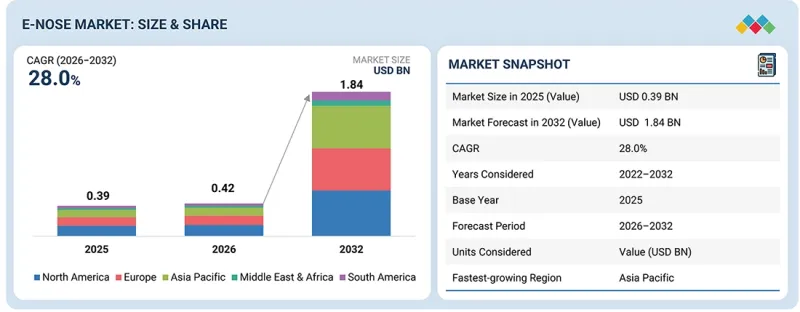
The E-nose market is estimated to be valued at USD 0.42 billion in 2026 and is projected to reach USD 1.84 billion by 2032, registering a CAGR of 28.0% during the forecast period.
| Scope of the Report | |
|---|---|
| Years Considered for the Study | 2021-2032 |
| Base Year | 2025 |
| Forecast Period | 2026-2032 |
| Units Considered | Value (USD Billion) |
| Segments | By Sensor Type, Application, End User and Region |
| Regions covered | North America, Europe, APAC, RoW |
"Growing shift toward preventive monitoring and real-time decision-making to drive growth in the E-nose market."
The growing shift toward preventive monitoring and real-time decision-making is accelerating growth in the E-nose market. Industries are increasingly moving from reactive testing approaches toward continuous odor analytics and early anomaly detection to improve operational reliability and reduce quality failures. E-nose systems enable rapid identification of VOC changes and process deviations without requiring time-intensive laboratory analysis, making them valuable across food production, pharmaceuticals, industrial operations, and healthcare diagnostics. Additionally, increasing emphasis on reducing waste, minimizing downtime, and improving traceability is driving the adoption of intelligent odor monitoring solutions integrated with AI and connected analytics platforms. This transition toward proactive and data-driven monitoring is expected to create sustained long-term demand for digital scent technologies globally.
"The food industry segment is expected to register the highest CAGR during the forecast period."
By end-use industry, the food industry segment is expected to register the highest CAGR during the forecast period in the E-nose market, driven by the increasing need for automated quality assurance, food authenticity verification, and real-time freshness monitoring across global food supply chains. E-nose systems are increasingly being adopted to analyze aroma profiles, detect spoilage, identify contamination, and maintain consistency across processed foods, dairy, beverages, meat, and packaged products. Growing consumer demand for safe, premium-quality, and traceable food products, combined with stricter food safety regulations, is accelerating investment in AI-enabled odor inspection technologies. Continuous advancements in sensor performance, predictive analytics, and smart factory integration are further improving production efficiency and reducing dependence on traditional laboratory testing. These technological and regulatory shifts are expected to sustain strong growth momentum for the food industry segment throughout the forecast period.
"The Surface Acoustic Wave (SAW) sensors segment is expected to register the highest CAGR during the forecast period."
By sensor type, the Surface Acoustic Wave (SAW) sensors segment is expected to register the highest CAGR during the forecast period in the E-nose market, driven by the increasing demand for highly sensitive, rapid-response, and low-concentration VOC detection capabilities across advanced sensing applications. SAW sensors are gaining traction due to their superior detection accuracy, fast signal processing, and ability to identify complex odor signatures in healthcare diagnostics, food quality monitoring, industrial safety, and environmental analysis. Their compatibility with miniaturized device architectures and real-time monitoring platforms makes them increasingly attractive for next-generation digital scent systems. Continuous advancements in sensor materials, wireless connectivity, and AI-enabled signal interpretation are further enhancing performance and expanding commercial adoption. These technological advantages are expected to accelerate the deployment of SAW-based E-nose solutions throughout the forecast period.
"North America to dominate the pharmaceutical E-nose market in 2026."
North America is projected to account for the largest market share of the pharmaceutical E-nose market in 2026, driven by increasing adoption of advanced analytical technologies for pharmaceutical quality control, manufacturing optimization, and laboratory automation. The region benefits from a strong pharmaceutical and biotechnology industry base, significant R&D spending, and growing use of VOC analysis for raw material verification, process monitoring, and contamination assessment. In addition, stringent regulatory expectations around product quality and manufacturing consistency are encouraging pharmaceutical companies to adopt faster and more data-driven analytical approaches. Continuous investments in digital laboratories, analytical instrumentation, and AI-enabled sensing technologies are expected to support North America's leadership position in the pharmaceutical E-nose market.
Breakdown of Primaries
Various executives from key organizations operating in the E-nose market were interviewed in-depth, including CEOs, marketing directors, and innovation and technology directors.
- By Company Type: Tier 1 - 40%, Tier 2 - 30%, and Tier 3 - 30%
- By Designation: Directors - 20%, Managers - 10%, and Others - 70%
- By Region: Asia Pacific - 45%, Europe - 22%, North America - 22%, and Rest of the World - 11%
The E-nose market is dominated by SmartNanotubes Technologies GmbH (Germany), NOZE (Canada), Alpha MOS (France), The eNose Company (Netherlands), AIRSENSE Analytics GmbH (Germany), Aryballe Technologies (France), Owlstone Medical Ltd (UK), Scentroid (Canada), Sensigent LLC (US), and RoboScientific (UK).
Study Coverage
The report segments the E-nose market and forecasts its application, inspection type, sensor type, end-use industry, and region. The report also discusses the drivers, restraints, opportunities, and challenges pertaining to the market. It provides a detailed view of the market across five main regions-North America, Europe, Asia Pacific, South America, and the Middle East & Africa. The report includes a value chain analysis of the key players and their competitive analysis of the E-nose ecosystem.
Key Benefits of Buying the Report
- Analysis of key drivers (VOC-based digital olfaction for automated sensory profiling and spoilage detection in cold chain logistics, microbiome and VOC signature detection in preventive healthcare), restraints (Sensor drift and recalibration requirements), opportunities (Breath-based disease diagnostics in preventive healthcare), and challenges (Performance decline with sensor wear and age, lack of standardized VOC detection regulations), influencing the growth of the E-nose market
- Products/Solutions/Innovation: Detailed insights into upcoming products, research, and development activities in the E-nose market
- Market Development: Comprehensive information about lucrative markets across varied regions
- Market Diversification: Exhaustive information about new E-nose in untapped geographies, recent developments, and investments in the E-nose market
- Competitive Assessment: In-depth assessment of market shares and growth strategies, and offerings of leading players offering components of the E-nose market
TABLE OF CONTENTS
1 INTRODUCTION
- 1.1 STUDY OBJECTIVES
- 1.2 MARKET DEFINITION
- 1.3 MARKET SCOPE
- 1.3.1 MARKET SEGMENTATION AND REGIONAL SCOPE
- 1.3.2 INCLUSIONS AND EXCLUSIONS
- 1.3.3 YEARS CONSIDERED
- 1.4 UNIT CONSIDERED
- 1.5 STAKEHOLDERS
2 EXECUTIVE SUMMARY
- 2.1 MARKET HIGHLIGHTS AND KEY INSIGHTS
- 2.2 KEY MARKET PARTICIPANTS: MAPPING OF STRATEGIC DEVELOPMENTS
- 2.3 DISRUPTIVE TRENDS IN E-NOSE MARKET
- 2.4 HIGH-GROWTH SEGMENTS
- 2.5 REGIONAL SNAPSHOT: MARKET SIZE, GROWTH RATE, AND FORECAST
3 PREMIUM INSIGHTS
4 MARKET OVERVIEW
- 4.1 INTRODUCTION
- 4.2 MARKET DYNAMICS
- 4.2.1 DRIVERS
- 4.2.2 RESTRAINTS
- 4.2.3 OPPORTUNITIES
- 4.2.4 CHALLENGES
- 4.3 UNMET NEEDS AND WHITE SPACES
- 4.4 INTERCONNECTED MARKETS AND CROSS-SECTOR OPPORTUNITIES
- 4.5 STRATEGIC MOVES BY TIER-1/2/3 PLAYERS
5 INDUSTRY TRENDS
- 5.1 PORTER'S FIVE FORCES ANALYSIS
- 5.1.1 INTENSITY OF COMPETITIVE RIVALRY
- 5.1.2 THREAT OF NEW ENTRANTS
- 5.1.3 THREAT OF SUBSTITUTES
- 5.1.4 BARGAINING POWER OF SUPPLIERS
- 5.1.5 BARGAINING POWER OF BUYERS
- 5.2 MACROECONOMIC OUTLOOK
- 5.3 VALUE CHAIN ANALYSIS
- 5.4 ECOSYSTEM ANALYSIS
- 5.5 PRICING ANALYSIS
- 5.6 TRADE ANALYSIS
- 5.7 KEY CONFERENCES & EVENTS IN 2026-2027
- 5.8 TRENDS/DISRUPTIONS IMPACTING CUSTOMER BUSINESS
- 5.9 INVESTMENT AND FUNDING SCENARIO
- 5.10 CASE STUDY ANALYSIS
- 5.11 IMPACT OF 2025 US TARIFF - E-NOSE MARKET
- 5.11.1 INTRODUCTION
- 5.11.2 KEY TARIFF RATES
- 5.11.3 PRICE IMPACT ANALYSIS
- 5.11.4 IMPACT ON COUNTRY/REGION
- 5.11.5 IMPACT ON END-USE INDUSTRIES
6 TECHNOLOGICAL ADVANCEMENTS, AI-DRIVE IMPACT, PATENTS, INNOVATIONS, AND FUTURE APPLICATIONS
- 6.1 KEY TECHNOLOGIES
- 6.2 COMPLEMENTARY TECHNOLOGIES
- 6.3 ADJACENT TECHNOLOGIES
- 6.4 PATENT ANALYSIS
- 6.4.1 LIST OF MAJOR PATENTS PERTAINING TO MARKET
- 6.5 FUTURE APPLICATIONS
- 6.6 IMPACT OF GEN AI ON E-NOSE INDUSTRY
- 6.6.1 INTRODUCTION
- 6.6.2 USE OF GEN AI IN E-NOSE INDUSTRY
- 6.6.3 CASE STUDY ANALYSIS
- 6.6.4 IMPACT ON E-NOSE MARKET
- 6.6.5 ADJACENT ECOSYSTEM WORKING ON GEN AI
- 6.7 SUCCESS STORIES AND REAL-WORLD APPLICATIONS
7 REGULATORY AND SUSTAINABILITY INITIATIVES
- 7.1 REGIONAL REGULATIONS
- 7.2 SUSTAINABILITY INITIATIVES
- 7.3 CERTIFICATIONS, LABELING, & ECO-STANDARDS
8 CUSTOMER LANDSCAPE & BUYER BEHAVIOR
- 8.1 DECISION-MAKING PROCESS
- 8.2 BUYER STAKEHOLDERS AND BUYING EVALUATION CRITERIA
- 8.3 ADOPTION BARRIERS & INTERNAL CHALLENGES
- 8.4 UNMET NEEDS FROM VARIOUS END-USE INDUSTRIES
- 8.5 MARKET PROFITABILITY
9 E-NOSE MARKET, BY INSPECTION TYPE (MARKET SIZE & FORECAST TO 2031 - USD MILLION)
- 9.1 INTRODUCTION
- 9.2 INLINE INSPECTION SYSTEMS
- 9.3 LABORATORY INSPECTION SYSTEMS
10 E-NOSE MARKET, BY SENSOR TYPE (MARKET SIZE & FORECAST TO 2031 - USD MILLION)
- 10.1 INTRODUCTION
- 10.2 METAL OXIDE SEMICONDUCTOR (MOS) SENSORS
- 10.3 POLYMER SENSORS
- 10.4 QUARTZ CRYSTAL MICROBALANCE (QCM) SENSORS
- 10.5 SURFACE ACOUSTIC WAVE (SAW) SENSORS
- 10.6 OPTICAL SENSORS
- 10.7 OTHER ADVANCED SENSORS
11 E-NOSE MARKET, BY APPLICATION (MARKET SIZE & FORECAST TO 2031 - USD MILLION)
- 11.1 INTRODUCTION
- 11.2 QUALITY CONTROL (QUALITY MANAGEMENT)
- 11.3 QUALITY ASSURANCE
12 E-NOSE MARKET, BY END USE INDUSTRY (MARKET SIZE & FORECAST TO 2031 - USD MILLION)
- 12.1 INTRODUCTION
- 12.2 FOOD INDUSTRY
- 12.2.1 MEAT
- 12.2.2 POULTRY
- 12.2.3 SEAFOOD
- 12.2.4 DAIRY
- 12.2.5 BAKERY
- 12.2.6 CONFECTIONERY
- 12.2.7 CATERING
- 12.2.8 READY-TO-EAT MEALS
- 12.2.9 OTHERS
- 12.3 PHARMACEUTICALS INDUSTRY
- 12.4 CHEMICALS INDUSTRY
12.4.1COSMETICS
- 12.4.2 CHEMICALS
13 E-NOSE MARKET, BY REGION (MARKET SIZE & FORECAST TO 2031 - USD MILLION) ASSESSING MARKET POTENTIAL AND GROWTH PATTERNS ACROSS KEY GEOGRAPHIES AND COUNTRIES
- 13.1 NORTH AMERICA
- 13.1.1 US
- 13.1.2 CANADA
- 13.1.3 MEXICO
- 13.2 EUROPE
- 13.2.1 GERMANY
- 13.2.2 UK
- 13.2.3 FRANCE
- 13.2.4 SPAIN
- 13.2.5 ITALY
- 13.2.7 REST OF EUROPE
- 13.3 ASIA PACIFIC
- 13.3.1 CHINA
- 13.3.2 JAPAN
- 13.3.3 INDIA
- 13.3.4 AUSTRALIA & NEW ZEALAND
- 13.3.5 REST OF ASIA PACIFIC
- 13.4 SOUTH AMERICA
- 13.4.1 BRAZIL
- 13.4.2 ARGENTINA
- 13.4.3 REST OF SOUTH AMERICA
- 13.5 REST OF THE WORLD
- 13.5.1 MIDDLE EAST
- 13.5.2 AFRICA
14 COMPETITIVE LANDSCAPE STRATEGIC ASSESSMENT OF LEADING PLAYERS, MARKET SHARE, REVENUE ANALYSIS, COMPANY POSITIONING, AND COMPETITIVE BENCHMARKS INFLUENCING MARKET POTENTIAL
- 14.1 OVERVIEW
- 14.2 KEY PLAYERS STRATEGIES/RIGHT TO WIN, 2022-2025
- 14.4 MARKET SHARE ANALYSIS, 2025
- 14.5 BRAND/PRODUCT COMPARISON
- 14.7 COMPANY EVALUATION MATRIX: KEY PLAYERS, 2025
- 14.7.1 STARS
- 14.7.2 EMERGING LEADERS
- 14.7.3 PERVASIVE PLAYERS
- 14.7.4 PARTICIPANTS
- 14.7.5 COMPANY FOOTPRINT: KEY PLAYERS, 2025
15 COMPANY PROFILES IN-DEPTH REVIEW OF COMPANIES, PRODUCTS, RECENT INITIATIVES, AND POSITIONING STRATEGIES IN THE E-NOSE MARKET LANDSCAPE
- 15.1 KEY PLAYERS
- 15.1.1 ALPHA MOS
- 15.1.2 ARYBALLE
- 15.1.3 AIRSENSE ANALYTICS GMBH
- 15.1.4 SENSIGENT LLC
- 15.1.5 SMARTNANOTUBES
- 15.1.6 SCENTROID
- 15.1.7 OLORAMA TECHNOLOGY
- 15.1.8 ROBOSCIENTIFIC
- 15.1.9 COMON INVENT B.V.
- 15.1.10 PLASMION
16 RESEARCH METHODOLOGY
- 16.1 RESEARCH DATA
- 16.1.1 SECONDARY DATA
- 16.1.1.1 Key data from secondary sources
- 16.1.2 PRIMARY DATA
- 16.1.2.1 Key data from primary sources
- 16.1.2.2 Key industry insights
- 16.1.2.3 Breakdown of primaries
- 16.1.1 SECONDARY DATA
- 16.2 MARKET SIZE ESTIMATION
- 16.2.1 BOTTOM-UP APPROACH
- 16.2.1.1 Approach for capturing market share by bottom-up analysis
- 16.2.2 TOP-DOWN APPROACH
- 16.2.2.2 Approach for capturing market share by top-up analysis
- 16.2.1 BOTTOM-UP APPROACH
- 16.3 MARKET BREAKDOWN AND DATA TRIANGULATION
- 16.4 RESEARCH ASSUMPTIONS
- 16.5 RISK ASSESSMENT
- 16.6 LIMITATIONS
18 APPENDIX

