PUBLISHER: MarketsandMarkets | PRODUCT CODE: 2070353
PUBLISHER: MarketsandMarkets | PRODUCT CODE: 2070353
Traffic Management Market by Solution, Areas of Application, End User - Global Forecast to 2032
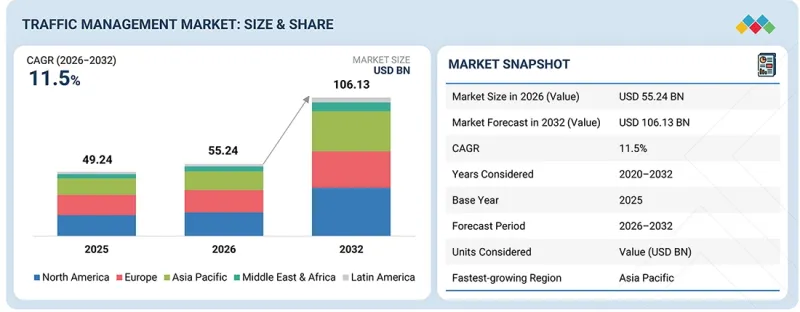
The traffic management market is estimated to grow from USD 55.24 billion in 2026 to USD 106.13 billion by 2032, at a CAGR of 11.5% from 2026 to 2032. The traffic management market is experiencing steady growth as transportation authorities seek to improve mobility, reduce congestion, and enhance operational efficiency across road networks.
| Scope of the Report | |
|---|---|
| Years Considered for the Study | 2020-2032 |
| Base Year | 2025 |
| Forecast Period | 2026-2032 |
| Units Considered | Value (USD Billion) |
| Segments | By Offering, Area of Application, End User |
| Regions covered | North America, Europe, Asia Pacific, Middle East & Africa, Latin America |
The market is benefiting from increasing investments in intelligent transportation systems (ITS), traffic monitoring technologies, and integrated traffic control platforms that enable real-time traffic management. Modern traffic management solutions combine traffic surveillance, analytics, incident detection, and centralized control capabilities to help operators make informed decisions and respond rapidly to changing traffic conditions. The growing need to maximize existing transportation infrastructure while supporting increasing traffic volumes is encouraging public agencies to deploy advanced traffic management technologies across urban and highway networks. As transportation systems become more connected and data-driven, traffic management solutions are playing a critical role in supporting safer, more efficient, and more resilient mobility ecosystems.
"During the forecast period, the urban traffic management application segment is expected to account for the largest share of the traffic management market."
Urban traffic management solutions are widely deployed by municipalities and transportation agencies to address congestion, improve traffic flow, and enhance roadway safety in densely populated areas. These solutions enable real-time traffic monitoring, adaptive signal coordination, incident management, and traffic optimization across complex urban road networks. Growing urbanization and increasing vehicle density are driving demand for technologies that improve transportation efficiency without requiring significant roadway expansion. In addition, cities are integrating traffic management platforms with public transportation systems, traveler information services, and smart city initiatives to improve overall mobility outcomes. The continued focus on reducing congestion and improving commuter experiences is expected to support the dominance of the urban traffic management segment throughout the forecast period.
"The adaptive traffic control system (ATCS) segment is projected to register the highest growth rate during the forecast period."
Adaptive traffic control systems dynamically adjust traffic signal timings based on real-time traffic conditions, helping transportation agencies improve intersection performance and reduce traffic delays. These solutions utilize data collected from sensors, cameras, and traffic detectors to optimize signal operations and respond to changing traffic patterns throughout the day. Compared with conventional traffic signal systems, adaptive traffic control technologies improve traffic flow, reduce vehicle stoppages, and enhance roadway efficiency. Increasing investments in intelligent transportation infrastructure and growing demand for real-time traffic optimization are encouraging municipalities to deploy adaptive traffic control solutions across urban and suburban transportation networks. As cities continue to pursue smarter and more responsive traffic operations, adoption of adaptive traffic control systems is expected to accelerate significantly.
"Asia Pacific is expected to register the highest growth rate during the forecast period."
Asia Pacific is projected to emerge as the fastest-growing regional market due to rapid urbanization, expanding transportation infrastructure, and increasing government investments in smart mobility initiatives. Countries such as China, India, Japan, South Korea, Australia, and Singapore are actively deploying intelligent transportation technologies to address congestion challenges and improve transportation efficiency. Large-scale smart city projects, roadway modernization programs, and investments in digital transportation infrastructure are creating substantial opportunities for traffic management solution providers across the region. Additionally, increasing vehicle ownership and rising demand for efficient urban mobility are encouraging transportation authorities to adopt advanced traffic monitoring, traffic control, and mobility management solutions. These factors are expected to drive strong market growth across Asia Pacific throughout the forecast period.
Breakdown of primaries
The study contains insights from various industry experts, from solution vendors to Tier 1 companies. The break-up of the primaries is as follows:
- By Company Type: Tier 1 - 25%, Tier 2 - 40%, and Tier 3 - 35%
- By Designation: C-level - 47%, D-level - 32%, and Managers - 21%
- By Region: North America - 40%, Europe - 35%, Asia Pacific - 20%, and RoW-5%
The major players in the traffic management market are Cisco (US), Mundys SpA (Italy), SWARCO (Austria), Siemens (Germany), IBM (US), Kapsch TrafficCom (Austria), Q-Free (Norway), Umovity (Germany), Teledyne FLIR Systems Inc. (US), Cubic Corporation (US), Almaviva SpA. (Italy), TOMTOM (Netherlands), Huawei (China), ST Engineering (Singapore), and Indra Sistemas (Spain). These players have adopted various growth strategies, such as partnerships, agreements and collaborations, product launches, product enhancements, and acquisitions to expand their footprint in the traffic management market.
Research Coverage
The market study covers the traffic management market size across different segments. It aims to estimate the market size and the growth potential across different segments, including components (hardware, solutions, and services), areas of application, end users, and regions. The study includes an in-depth competitive analysis of the leading market players, their company profiles, key observations related to product and business offerings, recent developments, and market strategies.
Key Benefits of Buying the Report
The report will help market leaders and new entrants with information on the closest approximations of the global traffic management market's revenue numbers and subsegments. It will also help stakeholders understand the competitive landscape and gain more insights to better position their businesses and plan suitable go-to-market strategies. Moreover, the report will provide insights for stakeholders to understand the market's pulse and provide them with information on key market drivers, restraints, challenges, and opportunities.
The report provides insights on the following pointers:
- Analysis of key drivers (rising demand for real-time traffic information to drivers and passengers, an increasingly urban population, rising number of vehicles, inadequate infrastructure), restraints (labor shortage limiting new projects, slow growth in the infrastructure sector, lack of standardized and uniform technologies to streamline legacy infrastructure), opportunities (changing pricing dynamics in the traffic management industry, increasing concerns about protecting environment with eco-friendly automobile technology, growth of analytics software), and challenges (data management and big data issues, multiple sensors and touchpoints pose data fusion challenges, security threats and hacking challenges) influencing the growth of the traffic management market.
- Product Development/Innovation: Detailed insights on upcoming technologies, research & development activities, and new product & service launches in the traffic management market.
- Market Development: Comprehensive information about lucrative markets - the report analyses the traffic management market across various regions.
- Market Diversification: Exhaustive information about new products & services, untapped geographies, recent developments, and investments in the traffic management market.
- Competitive Assessment: In-depth assessment of market shares, growth strategies, and service offerings of leading players like Cisco (US), Mundys SpA (Italy), SWARCO (Austria), Siemens (Germany), IBM (US), Kapsch TrafficCom (Austria), Q-Free (Norway), Umovity (Germany), Teledyne FLIR Systems Inc. (US), Cubic Corporation (US), Almaviva SpA. (Italy), TOMTOM (Netherlands), Huawei (China), ST Engineering (Singapore), and Indra Sistemas (Spain).
TABLE OF CONTENTS
1 INTRODUCTION
- 1.1 STUDY OBJECTIVES
- 1.2 MARKET DEFINITION
- 1.3 MARKET SCOPE
- 1.3.1 MARKET SEGMENTATION AND REGIONAL SCOPE
- 1.3.2 INCLUSIONS AND EXCLUSIONS
- 1.3.3 YEARS CONSIDERED
- 1.4 CURRENCY CONSIDERED
- 1.5 STAKEHOLDERS
- 1.6 SUMMARY OF CHANGES
2 EXECUTIVE SUMMARY
- 2.1 MARKET HIGHLIGHTS AND KEY INSIGHTS
- 2.2 KEY MARKET PARTICIPANTS: MAPPING OF STRATEGIC DEVELOPMENTS
- 2.3 DISRUPTIVE TRENDS IN TRAFFIC MANAGEMENT MARKET
- 2.4 REGIONAL SNAPSHOT: MARKET SIZE, GROWTH RATE, AND FORECAST
3 PREMIUM INSIGHTS
- 3.1 ATTRACTIVE OPPORTUNITIES FOR PLAYERS IN TRAFFIC MANAGEMENT MARKET
- 3.2 TRAFFIC MANAGEMENT MARKET, BY OFFERING
- 3.3 TRAFFIC MANAGEMENT MARKET, BY SOLUTION
- 3.4 TRAFFIC MANAGEMENT MARKET, BY AREA OF APPLICATION
- 3.5 TRAFFIC MANAGEMENT MARKET, BY END USER
- 3.6 NORTH AMERICA: TRAFFIC MANAGEMENT MARKET: TOP THREE SOLUTIONS AND END USER
4 MARKET OVERVIEW
- 4.1 INTRODUCTION
- 4.2 MARKET DYNAMICS
- 4.2.1 DRIVERS
- 4.2.1.1 Increased traffic congestion and need for road safety measures
- 4.2.1.2 Increasing adoption of AI-driven traffic optimization and predictive mobility management
- 4.2.1.3 Expansion of connected vehicle and V2X ecosystems
- 4.2.2 RESTRAINTS
- 4.2.2.1 High capital investment and lengthy procurement cycles
- 4.2.2.2 Budget constraints among municipalities and transportation agencies
- 4.2.3 OPPORTUNITIES
- 4.2.3.1 Sustainable mobility and emissions reduction initiatives
- 4.2.3.2 Expansion of connected and autonomous vehicle ecosystems
- 4.2.3.3 Modernization of highway and smart corridor infrastructure
- 4.2.3.4 5G-enabled intelligent transportation systems
- 4.2.4 CHALLENGES
- 4.2.4.1 Data management and big data complexity
- 4.2.4.2 Cybersecurity threats to transportation networks
- 4.2.4.3 Integration of multi-source transportation data
- 4.2.1 DRIVERS
- 4.3 INTERCONNECTED MARKETS AND CROSS-SECTOR OPPORTUNITIES
- 4.3.1 CROSS-SECTOR OPPORTUNITIES
- 4.4 STRATEGIC MOVES BY TIER-1/2/3 PLAYERS
5 INDUSTRY TRENDS
- 5.1 PORTER'S FIVE FORCES ANALYSIS
- 5.1.1 THREAT OF NEW ENTRANTS
- 5.1.2 THREAT OF SUBSTITUTES
- 5.1.3 BARGAINING POWER OF SUPPLIERS
- 5.1.4 BARGAINING POWER OF BUYERS
- 5.1.5 INTENSITY OF COMPETITIVE RIVALRY
- 5.2 MACROECONOMIC OUTLOOK
- 5.2.1 INTRODUCTION
- 5.2.2 GDP TRENDS AND FORECAST
- 5.2.3 TRENDS IN TRAFFIC MANAGEMENT MARKET
- 5.3 SUPPLY CHAIN ANALYSIS
- 5.4 ECOSYSTEM ANALYSIS
- 5.5 PRICING ANALYSIS
- 5.5.1 AVERAGE SELLING PRICE OF KEY PLAYERS, BY SOLUTION
- 5.5.2 INDICATIVE PRICING ANALYSIS OF KEY PLAYERS
- 5.6 TRADE ANALYSIS
- 5.6.1 EXPORT SCENARIO FOR HS CODE: 8530
- 5.6.2 IMPORT SCENARIO FOR HS CODE: 8530
- 5.7 KEY CONFERENCES AND EVENTS, 2026
- 5.8 TRENDS/DISRUPTIONS IMPACTING CUSTOMER BUSINESS
- 5.9 INVESTMENT AND FUNDING SCENARIO
- 5.10 CASE STUDY ANALYSIS
- 5.10.1 CASE STUDY 1: BUENOS AIRES DEPLOYED SGIM SOFTWARE IN CONJUNCTION WITH KAPSCH'S ECOTRAFIX PLATFORM TO UNIFY EXISTING UTC SYSTEMS
- 5.10.2 CASE STUDY 2: HUAWEI HELPED LAHORE CITY DEVELOP NEW TRAFFIC MANAGEMENT SYSTEM TO MANAGE CONGESTION
- 5.10.3 CASE STUDY 3: ROMANIAN CITY OF TIMISOARA DEPLOYED SWARCO'S INTEGRATED TRAFFIC CONTROL AND VIDEO SURVEILLANCE SYSTEM TO SMOOTHEN TRAFFIC FLOW
- 5.10.4 CASE STUDY 4: DATA COLLECTION LIMITED ENHANCED ROAD INFRASTRUCTURE MANAGEMENT WITH TELEDYNE FLIR IMAGING SOLUTIONS
- 5.10.5 CASE STUDY 5: THTC & TOMTOM SUCCESSFULLY MANAGED TRAFFIC AT 2023 AFC ASIAN CUP QATAR
- 5.11 IMPACT OF 2025 US TARIFF - TRAFFIC MANAGEMENT MARKET
- 5.11.1 INTRODUCTION
- 5.11.2 KEY TARIFF RATES
- 5.11.3 PRICE IMPACT ANALYSIS
- 5.11.3.1 Strategic shifts and emerging trends
- 5.11.4 IMPACT ON COUNTRIES/REGIONS
- 5.11.4.1 US
- 5.11.4.2 China
- 5.11.4.3 Europe
- 5.11.4.4 Asia Pacific (excluding China)
- 5.11.5 IMPACT ON END-USER INDUSTRIES
- 5.11.5.1 Government & Transportation Authorities
- 5.11.5.2 Smart Cities & Municipalities
- 5.11.5.3 Highways & Toll Operators
- 5.11.5.4 Public Transit Operators
- 5.11.5.5 Airports & Transportation Hubs
- 5.11.5.6 Commercial & Industrial Facilities
6 TECHNOLOGICAL ADVANCEMENTS, AI-DRIVEN IMPACT, PATENTS, INNOVATIONS, AND FUTURE APPLICATIONS
- 6.1 KEY TECHNOLOGIES
- 6.1.1 ARTIFICIAL INTELLIGENCE (AI)
- 6.1.2 INTERNET OF THINGS (IOT)
- 6.1.3 GEOGRAPHIC INFORMATION SYSTEMS (GIS)
- 6.1.4 AUTOMATIC NUMBER PLATE RECOGNITION (ANPR)
- 6.1.5 VEHICLE-TO-INFRASTRUCTURE (V2I) AND VEHICLE-TO-EVERYTHING (V2X)
- 6.2 COMPLEMENTARY TECHNOLOGIES
- 6.2.1 BIG DATA AND ANALYTICS
- 6.2.2 EDGE COMPUTING
- 6.2.3 5G
- 6.3 TECHNOLOGY ROADMAP
- 6.3.1 SHORT-TERM ROADMAP (2026-2027)
- 6.3.2 MID-TERM ROADMAP (2028-2027)
- 6.3.3 LONG-TERM ROADMAP (2029-2030+)
- 6.4 PATENT ANALYSIS
- 6.4.1 LIST OF MAJOR PATENTS (2018-2026)
- 6.5 IMPACT OF AI/GEN AI ON TRAFFIC MANAGEMENT MARKET
- 6.5.1 TOP USE CASES AND MARKET POTENTIAL
- 6.5.2 CASE STUDIES OF AI IMPLEMENTATION IN TRAFFIC MANAGEMENT MARKET
- 6.5.3 INTERCONNECTED ADJACENT ECOSYSTEM AND IMPACT ON MARKET PLAYERS
- 6.5.4 CLIENTS' READINESS TO ADOPT GENERATIVE AI IN TRAFFIC MANAGEMENT MARKET
7 REGULATORY LANDSCAPE AND SUSTAINABILITY INITIATIVES
- 7.1 REGIONAL REGULATIONS AND COMPLIANCE
- 7.1.1 REGULATORY BODIES, GOVERNMENT AGENCIES, AND OTHER ORGANIZATIONS
- 7.1.2 KEY REGULATIONS
- 7.1.2.1 North America
- 7.1.2.1.1 Manual on Traffic Control Devices for Streets and Highways
- 7.1.2.1.2 National Highway Traffic Safety Administration (NHTSA)
- 7.1.2.1.3 Federal Motor Carrier Safety Administration
- 7.1.2.1.4 Federal Highway Administration
- 7.1.2.2 Europe
- 7.1.2.2.1 General Data Protection Regulation
- 7.1.2.2.2 General Safety Regulation (GSR)
- 7.1.2.3 Asia Pacific
- 7.1.2.3.1 General Safety Regulation (GSR)
- 7.1.2.3.2 Road Traffic Safety Law of the People's Republic of China
- 7.1.2.3.3 Road Traffic Act
- 7.1.2.3.4 Road Transport Vehicle Act
- 7.1.2.4 Rest of the World
- 7.1.2.4.1 Manual on Traffic Control Devices for Streets and Highways
- 7.1.2.4.2 National Road Traffic Act, 1996
- 7.1.2.4.3 Mexico's National Law of Mobility and Road Safety
- 7.1.2.1 North America
- 7.1.3 INDUSTRY STANDARDS
- 7.2 SUSTAINABILITY INITIATIVES
- 7.2.1 SUSTAINABLE MOBILITY AND INTELLIGENT TRAFFIC OPERATIONS
- 7.2.2 ECO-APPLICATIONS AND SUSTAINABILITY USE CASES
- 7.3 CERTIFICATIONS, LABELING, ECO-STANDARDS
8 CUSTOMER LANDSCAPE AND BUYER BEHAVIOR
- 8.1 DECISION-MAKING PROCESS
- 8.2 KEY STAKEHOLDERS INVOLVED IN BUYING PROCESS AND THEIR EVALUATION CRITERIA
- 8.2.1 KEY STAKEHOLDERS IN BUYING PROCESS
- 8.2.2 BUYING CRITERIA
- 8.3 ADOPTION BARRIERS AND INTERNAL CHALLENGES
- 8.4 UNMET NEEDS OF VARIOUS END-USE INDUSTRIES
9 TRAFFIC MANAGEMENT MARKET, BY OFFERING
- 9.1 INTRODUCTION
- 9.1.1 OFFERING: TRAFFIC MANAGEMENT MARKET DRIVERS
- 9.2 SOLUTIONS
- 9.2.1 TRAFFIC MONITORING & ANALYTICS
- 9.2.1.1 Enabling data-driven visibility across transportation networks
- 9.2.2 ADAPTIVE TRAFFIC CONTROL
- 9.2.2.1 Optimizing signal operations through dynamic traffic management
- 9.2.3 TRAFFIC ENFORCEMENT MANAGEMENT
- 9.2.3.1 Strengthening roadway compliance and traffic safety outcomes
- 9.2.4 INCIDENT DETECTION & MANAGEMENT
- 9.2.4.1 Accelerating incident response through real-time situational awareness
- 9.2.5 ELECTRONIC TOLL MANAGEMENT
- 9.2.5.1 Advancing seamless toll collection and roadway monetization
- 9.2.6 OTHER SOLUTIONS
- 9.2.1 TRAFFIC MONITORING & ANALYTICS
- 9.3 SERVICES
- 9.3.1 CONSULTING
- 9.3.1.1 Optimizing traffic management and infrastructure
- 9.3.2 IMPLEMENTATION
- 9.3.2.1 Streamlining business applications by integrating various modules of day-to-day operations
- 9.3.3 SUPPORT & MAINTENANCE
- 9.3.3.1 Ensuring smooth functioning of traffic management solutions
- 9.3.1 CONSULTING
10 TRAFFIC MANAGEMENT MARKET, BY AREA OF APPLICATION
- 10.1 INTRODUCTION
- 10.1.1 AREA OF APPLICATION: TRAFFIC MANAGEMENT MARKET DRIVERS
- 10.2 URBAN
- 10.2.1 SUPPORTING EFFICIENT MOBILITY IN INCREASINGLY COMPLEX URBAN TRANSPORTATION NETWORKS
- 10.3 INTER-URBAN
- 10.3.1 ENHANCING CONNECTIVITY AND OPERATIONAL EFFICIENCY ACROSS REGIONAL TRANSPORTATION CORRIDORS
- 10.4 RURAL
- 10.4.1 IMPROVING ROADWAY SAFETY AND TRANSPORTATION ACCESSIBILITY ACROSS RURAL NETWORKS
11 TRAFFIC MANAGEMENT MARKET, BY END USER
- 11.1 INTRODUCTION
- 11.1.1 END USER: TRAFFIC MANAGEMENT MARKET DRIVERS
- 11.2 GOVERNMENT
- 11.2.1 ADVANCING TRANSPORTATION EFFICIENCY AND PUBLIC SAFETY THROUGH INTELLIGENT TRAFFIC MANAGEMENT
- 11.3 PRIVATE
- 11.3.1 IMPROVING OPERATIONAL EFFICIENCY AND MOBILITY SERVICES THROUGH INTELLIGENT TRANSPORTATION SOLUTIONS
12 TRAFFIC MANAGEMENT MARKET, BY REGION
- 12.1 INTRODUCTION
- 12.2 NORTH AMERICA
- 12.2.1 US
- 12.2.1.1 Government initiatives to revamp, expand, and modernize existing traffic management infrastructure to drive market
- 12.2.2 CANADA
- 12.2.2.1 Development of smart cities to drive market
- 12.2.1 US
- 12.3 EUROPE
- 12.3.1 UK
- 12.3.1.1 Government initiatives to standardize transport interfaces supported by collaborations and partnerships to drive market
- 12.3.2 ITALY
- 12.3.2.1 Government investment in road safety, traffic flow, and congestion alleviation to drive market
- 12.3.3 GERMANY
- 12.3.3.1 2030 Federal Transport Infrastructure Plan to drive market
- 12.3.4 FRANCE
- 12.3.4.1 Advancements in robotics and IoT, especially in public transportation, to drive market
- 12.3.5 SPAIN
- 12.3.5.1 Focus on bolstering public transportation to drive market
- 12.3.6 REST OF EUROPE
- 12.3.1 UK
- 12.4 ASIA PACIFIC
- 12.4.1 CHINA
- 12.4.1.1 Investment in AI-powered traffic management systems and Internet of Vehicle Technologies (IoVT) to drive market
- 12.4.2 INDIA
- 12.4.2.1 Government focus on AI adoption for enhanced road safety to drive market
- 12.4.3 JAPAN
- 12.4.3.1 Establishment of Digital Agency for Society 5.0 to drive market
- 12.4.4 AUSTRALIA & NEW ZEALAND
- 12.4.4.1 Implementation of smart city projects to accelerate market growth
- 12.4.5 REST OF ASIA PACIFIC
- 12.4.1 CHINA
- 12.5 MIDDLE EAST & AFRICA
- 12.5.1 KSA
- 12.5.1.1 Initiatives toward comprehensive transport planning analysis and performance reporting to drive market
- 12.5.2 UAE
- 12.5.2.1 Collaborations with prominent players for building smart traffic systems to drive market
- 12.5.3 SOUTH AFRICA
- 12.5.3.1 Rising urban congestion and safety concerns to drive market
- 12.5.4 REST OF MIDDLE EAST & AFRICA
- 12.5.1 KSA
- 12.6 LATIN AMERICA
- 12.6.1 BRAZIL
- 12.6.1.1 Increasing focus on vehicle monitoring and incident management to drive market
- 12.6.2 MEXICO
- 12.6.2.1 Rising demand for improved transport infrastructure to drive market
- 12.6.3 REST OF LATIN AMERICA
- 12.6.1 BRAZIL
13 COMPETITIVE LANDSCAPE
- 13.1 INTRODUCTION
- 13.2 KEY PLAYER STRATEGIES/RIGHT TO WIN, 2024-2025
- 13.3 REVENUE ANALYSIS, 2022-2024
- 13.4 MARKET SHARE ANALYSIS, 2025
- 13.5 BRAND/PRODUCT COMPARISON
- 13.6 COMPANY EVALUATION MATRIX: KEY PLAYERS, 2025
- 13.6.1 STARS
- 13.6.2 EMERGING LEADERS
- 13.6.3 PERVASIVE PLAYERS
- 13.6.4 PARTICIPANTS
- 13.6.5 COMPANY FOOTPRINT: KEY PLAYERS, 2025
- 13.6.5.1 Company footprint
- 13.6.5.2 Region footprint
- 13.6.5.3 Offering footprint
- 13.6.5.4 Area of application footprint
- 13.6.5.5 End user footprint
- 13.7 COMPANY EVALUATION MATRIX: STARTUPS/SMES, 2025
- 13.7.1 PROGRESSIVE COMPANIES
- 13.7.2 RESPONSIVE COMPANIES
- 13.7.3 DYNAMIC COMPANIES
- 13.7.4 STARTING BLOCKS
- 13.7.5 COMPETITIVE BENCHMARKING: STARTUPS/SMES, 2025
- 13.7.5.1 Detailed list of key startups/SMEs
- 13.7.5.2 Competitive benchmarking of key startups/SMEs
- 13.8 COMPETITIVE SCENARIO
- 13.8.1 PRODUCT LAUNCHES
- 13.8.2 DEALS
- 13.9 TRAFFIC MANAGEMENT PRODUCT BENCHMARKING
- 13.9.1 PROMINENT TRAFFIC MANAGEMENT SOLUTIONS
- 13.9.1.1 IBM intelligent transportation solution
- 13.9.1.2 Huawei intelligent traffic management system (ITMS)
- 13.9.1.3 Kapsch TrafficCom intelligent transportation system (ITS)
- 13.9.1.4 SWARCO cooperative intelligent transport system (SWARCO C-ITS)
- 13.9.1 PROMINENT TRAFFIC MANAGEMENT SOLUTIONS
- 13.10 COMPANY VALUATION AND FINANCIAL METRICS
14 COMPANY PROFILES
- 14.1 MAJOR PLAYERS
- 14.1.1 HUAWEI
- 14.1.1.1 Business overview
- 14.1.1.2 Products/Solutions/Services offered
- 14.1.1.3 Recent developments
- 14.1.1.3.1 Products launches
- 14.1.1.3.2 Deals
- 14.1.1.4 MnM view
- 14.1.1.4.1 Right to win
- 14.1.1.4.2 Strategic choices
- 14.1.1.4.3 Weaknesses and competitive threats
- 14.1.2 MUNDYS SPA
- 14.1.2.1 Business overview
- 14.1.2.2 Products/Solutions/Services offered
- 14.1.2.3 Recent developments
- 14.1.2.3.1 Products launches
- 14.1.2.3.2 Deals
- 14.1.2.4 MnM view
- 14.1.2.4.1 Right to win
- 14.1.2.4.2 Strategic choices
- 14.1.2.4.3 Weaknesses and competitive threats
- 14.1.3 KAPSCH TRAFFICCOM
- 14.1.3.1 Business overview
- 14.1.3.2 Products/Solutions/Services offered
- 14.1.3.3 Recent developments
- 14.1.3.3.1 Product launches & enhancements
- 14.1.3.3.2 Deals
- 14.1.3.4 MnM View
- 14.1.3.4.1 Right to Win
- 14.1.3.4.2 Strategic Choices
- 14.1.3.4.3 Weaknesses and Competitive Threats
- 14.1.4 SWARCO
- 14.1.4.1 Business overview
- 14.1.4.2 Products/Solutions/Services offered
- 14.1.4.3 Recent developments
- 14.1.4.3.1 Product launches & enhancements
- 14.1.4.3.2 Deals
- 14.1.4.4 MnM view
- 14.1.4.4.1 Right to win
- 14.1.4.4.2 Strategic choices
- 14.1.4.4.3 Weaknesses and competitive threats
- 14.1.5 ST ENGINEERING
- 14.1.5.1 Business overview
- 14.1.5.2 Products/Solutions/Services offered
- 14.1.5.3 Recent developments
- 14.1.5.3.1 Product launches & enhancements
- 14.1.5.3.2 Deals
- 14.1.5.4 MnM View
- 14.1.5.4.1 Right to Win
- 14.1.5.4.2 Strategic Choices
- 14.1.5.4.3 Weaknesses and Competitive Threats
- 14.1.6 INDRA
- 14.1.6.1 Business overview
- 14.1.6.2 Products/Solutions/Services offered
- 14.1.6.3 Recent developments
- 14.1.6.3.1 Deals
- 14.1.6.4 MnM View
- 14.1.6.4.1 Right to Win
- 14.1.6.4.2 Strategic Choices
- 14.1.6.4.3 Weaknesses and Competitive Threats
- 14.1.7 UMOVITY
- 14.1.7.1 Business overview
- 14.1.7.2 Products/Solutions/Services offered
- 14.1.7.3 Recent developments
- 14.1.7.3.1 Product launches & enhancements
- 14.1.7.3.2 Deals
- 14.1.8 Q-FREE
- 14.1.8.1 Business overview
- 14.1.8.2 Products/Solutions/Services offered
- 14.1.8.3 Recent developments
- 14.1.8.3.1 Product launches & enhancements
- 14.1.8.3.2 Deals
- 14.1.9 ALMAVIVA SPA
- 14.1.9.1 Business overview
- 14.1.9.2 Products/Solutions/Services offered
- 14.1.9.3 Recent developments
- 14.1.9.3.1 Product launches & enhancements
- 14.1.9.3.2 Deals
- 14.1.10 TOMTOM
- 14.1.10.1 Business overview
- 14.1.10.2 Products/Solutions/Services offered
- 14.1.10.3 Recent developments
- 14.1.10.3.1 Product launches & enhancements
- 14.1.10.3.2 Deals
- 14.1.11 JENOPTIK
- 14.1.12 TELEDYNE FLIR
- 14.1.13 SIEMENS
- 14.1.14 CISCO
- 14.1.15 IBM
- 14.1.16 CUBIC CORPORATION
- 14.1.1 HUAWEI
- 14.2 STARTUPS/SMES
- 14.2.1 INRIX
- 14.2.2 NOTRAFFIC
- 14.2.3 TAGMASTER
- 14.2.4 BERCMAN TECHNOLOGIES
- 14.2.5 VALERANN
- 14.2.6 MIOVISION
- 14.2.7 BLUESIGNAL
- 14.2.8 TELEGRA
- 14.2.9 ORIUX
- 14.2.10 INVARION
- 14.2.11 REKOR
15 RESEARCH METHODOLOGY
- 15.1 RESEARCH DATA
- 15.1.1 SECONDARY DATA
- 15.1.1.1 Key data from secondary sources
- 15.1.1.2 List of secondary sources
- 15.1.2 PRIMARY DATA
- 15.1.2.1 Breakup of primary profiles
- 15.1.2.2 Key insights from industry experts
- 15.1.2.3 Key data from primary sources
- 15.1.1 SECONDARY DATA
- 15.2 MARKET SIZE ESTIMATION
- 15.3 DATA TRIANGULATION
- 15.4 MARKET FORECAST APPROACH
- 15.5 RESEARCH ASSUMPTIONS
- 15.6 RESEARCH LIMITATIONS
16 APPENDIX
- 16.1 DISCUSSION GUIDE
- 16.2 KNOWLEDGESTORE: MARKETSANDMARKETS' SUBSCRIPTION PORTAL
- 16.3 CUSTOMIZATION OPTIONS
- 16.4 RELATED REPORTS
- 16.5 AUTHOR DETAILS
List of Tables
- TABLE 1 REPORT INCLUSIONS AND EXCLUSIONS
- TABLE 2 USD EXCHANGE RATES, 2021-2025
- TABLE 3 PREVIOUS REPORT VERSION VS. LATEST REPORT VERSION
- TABLE 4 INTERCONNECTED MARKETS
- TABLE 5 STRATEGIC MOVES BY TIER-1/2/3 PLAYERS
- TABLE 6 IMPACT OF PORTER'S FIVE FORCES ON TRAFFIC MANAGEMENT MARKET
- TABLE 7 GDP PERCENTAGE CHANGE, BY KEY COUNTRY, 2021-2029
- TABLE 8 ROLE OF PLAYERS IN MARKET ECOSYSTEM
- TABLE 9 AVERAGE SELLING PRICE OF KEY PLAYERS, BY SOLUTION
- TABLE 10 INDICATIVE PRICING ANALYSIS OF KEY TRAFFIC MANAGEMENT MARKET PLAYERS
- TABLE 11 CAPTIVE PORTAL MARKET: DETAILED LIST OF CONFERENCES AND EVENTS, 2026
- TABLE 13 TOP USE CASES AND MARKET POTENTIAL
- TABLE 14 TRAFFIC MANAGEMENT MARKET: CASE STUDIES RELATED TO GEN AI IMPLEMENTATION
- TABLE 15 INTERCONNECTED ADJACENT ECOSYSTEM AND IMPACT ON MARKET PLAYERS
- TABLE 16 NORTH AMERICA: REGULATORY BODIES, GOVERNMENT AGENCIES, AND OTHER ORGANIZATIONS
- TABLE 17 EUROPE: REGULATORY BODIES, GOVERNMENT AGENCIES, AND OTHER ORGANIZATIONS
- TABLE 18 ASIA PACIFIC: REGULATORY BODIES, GOVERNMENT AGENCIES, AND OTHER ORGANIZATIONS
- TABLE 19 REST OF THE WORLD: REGULATORY BODIES, GOVERNMENT AGENCIES, AND OTHER ORGANIZATIONS
- TABLE 20 GLOBAL INDUSTRY STANDARDS IN TRAFFIC MANAGEMENT MARKET
- TABLE 21 KEY STANDARDS AND CERTIFICATIONS RELEVANT TO TRAFFIC MANAGEMENT
- TABLE 22 INFLUENCE OF STAKEHOLDERS ON BUYING PROCESS FOR KEY AREAS OF APPLICATION
- TABLE 23 KEY BUYING CRITERIA FOR KEY AREAS OF APPLICATION
- TABLE 24 UNMET NEEDS IN TRAFFIC MANAGEMENT MARKET, BY END-USE INDUSTRY
- TABLE 25 TRAFFIC MANAGEMENT MARKET, BY OFFERING, 2020-2025 (USD MILLION)
- TABLE 26 TRAFFIC MANAGEMENT MARKET, BY OFFERING, 2026-2032 (USD MILLION)
- TABLE 27 TRAFFIC MANAGEMENT MARKET, BY SOLUTION, 2020-2025 (USD MILLION)
- TABLE 28 TRAFFIC MANAGEMENT MARKET, BY SOLUTION, 2026-2032 (USD MILLION)
- TABLE 29 SOLUTIONS: TRAFFIC MANAGEMENT MARKET, BY REGION, 2020-2025 (USD MILLION)
- TABLE 30 SOLUTIONS: TRAFFIC MANAGEMENT MARKET, BY REGION, 2026-2032 (USD MILLION)
- TABLE 31 TRAFFIC MONITORING & ANALYTICS: TRAFFIC MANAGEMENT MARKET, BY REGION, 2020-2025 (USD MILLION)
- TABLE 32 TRAFFIC MONITORING & ANALYTICS: TRAFFIC MANAGEMENT MARKET, BY REGION, 2026-2032 (USD MILLION)
- TABLE 33 ADAPTIVE TRAFFIC CONTROL: TRAFFIC MANAGEMENT MARKET, BY REGION, 2020-2025 (USD MILLION)
- TABLE 34 ADAPTIVE TRAFFIC CONTROL: TRAFFIC MANAGEMENT MARKET, BY REGION, 2026-2032 (USD MILLION)
- TABLE 35 TRAFFIC ENFORCEMENT MANAGEMENT: TRAFFIC MANAGEMENT MARKET, BY REGION, 2020-2025 (USD MILLION)
- TABLE 36 TRAFFIC ENFORCEMENT MANAGEMENT: TRAFFIC MANAGEMENT MARKET, BY REGION, 2026-2032 (USD MILLION)
- TABLE 37 INCIDENT DETECTION & MANAGEMENT: TRAFFIC MANAGEMENT MARKET, BY REGION, 2020-2025 (USD MILLION)
- TABLE 38 INCIDENT DETECTION & MANAGEMENT: TRAFFIC MANAGEMENT MARKET, BY REGION, 2026-2032 (USD MILLION)
- TABLE 39 ELECTRONIC TOLL MANAGEMENT: TRAFFIC MANAGEMENT MARKET, BY REGION, 2020-2025 (USD MILLION)
- TABLE 40 ELECTRONIC TOLL MANAGEMENT: TRAFFIC MANAGEMENT MARKET, BY REGION, 2026-2032 (USD MILLION)
- TABLE 41 OTHER SOLUTIONS: TRAFFIC MANAGEMENT MARKET, BY REGION, 2020-2025 (USD MILLION)
- TABLE 42 OTHER SOLUTIONS: TRAFFIC MANAGEMENT MARKET, BY REGION, 2026-2032 (USD MILLION)
- TABLE 43 TRAFFIC MANAGEMENT MARKET, BY SERVICE, 2020-2025 (USD MILLION)
- TABLE 44 TRAFFIC MANAGEMENT MARKET, BY SERVICE, 2026-2032 (USD MILLION)
- TABLE 45 SERVICES: TRAFFIC MANAGEMENT MARKET, BY REGION, 2020-2025 (USD MILLION)
- TABLE 46 SERVICES: TRAFFIC MANAGEMENT MARKET, BY REGION, 2026-2032 (USD MILLION)
- TABLE 47 CONSULTING: TRAFFIC MANAGEMENT MARKET, BY REGION, 2020-2025 (USD MILLION)
- TABLE 48 CONSULTING: TRAFFIC MANAGEMENT MARKET, BY REGION, 2026-2032 (USD MILLION)
- TABLE 49 IMPLEMENTATION: TRAFFIC MANAGEMENT MARKET, BY REGION, 2020-2025 (USD MILLION)
- TABLE 50 IMPLEMENTATION: TRAFFIC MANAGEMENT MARKET, BY REGION, 2026-2032 (USD MILLION)
- TABLE 51 SUPPORT & MAINTENANCE: TRAFFIC MANAGEMENT MARKET, BY REGION, 2020-2025 (USD MILLION)
- TABLE 52 SUPPORT & MAINTENANCE: TRAFFIC MANAGEMENT MARKET, BY REGION, 2026-2032 (USD MILLION)
- TABLE 53 TRAFFIC MANAGEMENT MARKET, BY AREA OF APPLICATION, 2020-2025 (USD MILLION)
- TABLE 54 TRAFFIC MANAGEMENT MARKET, BY AREA OF APPLICATION, 2026-2032 (USD MILLION)
- TABLE 55 URBAN: TRAFFIC MANAGEMENT MARKET, BY REGION, 2020-2025 (USD MILLION)
- TABLE 56 URBAN: TRAFFIC MANAGEMENT MARKET, BY REGION, 2026-2032 (USD MILLION)
- TABLE 57 INTER-URBAN: TRAFFIC MANAGEMENT MARKET, BY REGION, 2020-2025 (USD MILLION)
- TABLE 58 INTER-URBAN: TRAFFIC MANAGEMENT MARKET, BY REGION, 2026-2032 (USD MILLION)
- TABLE 59 RURAL: TRAFFIC MANAGEMENT MARKET, BY REGION, 2020-2025 (USD MILLION)
- TABLE 60 RURAL: TRAFFIC MANAGEMENT MARKET, BY REGION, 2026-2032 (USD MILLION)
- TABLE 61 TRAFFIC MANAGEMENT MARKET, BY END USER, 2020-2025 (USD MILLION)
- TABLE 62 TRAFFIC MANAGEMENT MARKET, BY END USER, 2026-2032 (USD MILLION)
- TABLE 63 GOVERNMENT: TRAFFIC MANAGEMENT MARKET, BY REGION, 2020-2025 (USD MILLION)
- TABLE 64 GOVERNMENT: TRAFFIC MANAGEMENT MARKET, BY REGION, 2026-2032 (USD MILLION)
- TABLE 65 PRIVATE: TRAFFIC MANAGEMENT MARKET, BY REGION, 2020-2025 (USD MILLION)
- TABLE 66 PRIVATE: TRAFFIC MANAGEMENT MARKET, BY REGION, 2026-2032 (USD MILLION)
- TABLE 67 TRAFFIC MANAGEMENT MARKET, BY REGION, 2020-2025 (USD MILLION)
- TABLE 68 TRAFFIC MANAGEMENT MARKET, BY REGION, 2026-2032 (USD MILLION)
- TABLE 69 NORTH AMERICA: TRAFFIC MANAGEMENT MARKET, BY OFFERING, 2020-2025 (USD MILLION)
- TABLE 70 NORTH AMERICA: TRAFFIC MANAGEMENT MARKET, BY OFFERING, 2026-2032 (USD MILLION)
- TABLE 71 NORTH AMERICA: TRAFFIC MANAGEMENT MARKET, BY SOLUTION, 2020-2025 (USD MILLION)
- TABLE 72 NORTH AMERICA: TRAFFIC MANAGEMENT MARKET, BY SOLUTION, 2026-2032 (USD MILLION)
- TABLE 73 NORTH AMERICA: TRAFFIC MANAGEMENT MARKET, BY SERVICE, 2020-2025 (USD MILLION)
- TABLE 74 NORTH AMERICA: TRAFFIC MANAGEMENT MARKET, BY SERVICE, 2026-2032 (USD MILLION)
- TABLE 75 NORTH AMERICA: TRAFFIC MANAGEMENT MARKET, BY AREA OF APPLICATION, 2020-2025 (USD MILLION)
- TABLE 76 NORTH AMERICA: TRAFFIC MANAGEMENT MARKET, BY AREA OF APPLICATION, 2026-2032 (USD MILLION)
- TABLE 77 NORTH AMERICA: TRAFFIC MANAGEMENT MARKET, BY END USER, 2020-2025 (USD MILLION)
- TABLE 78 NORTH AMERICA: TRAFFIC MANAGEMENT MARKET, BY END USER, 2026-2032 (USD MILLION)
- TABLE 79 NORTH AMERICA: TRAFFIC MANAGEMENT MARKET, BY COUNTRY, 2020-2025 (USD MILLION)
- TABLE 80 NORTH AMERICA: TRAFFIC MANAGEMENT MARKET, BY COUNTRY, 2026-2032 (USD MILLION)
- TABLE 81 US: TRAFFIC MANAGEMENT MARKET, BY OFFERING, 2020-2025 (USD MILLION)
- TABLE 82 US: TRAFFIC MANAGEMENT MARKET, BY OFFERING, 2026-2032 (USD MILLION)
- TABLE 83 US: TRAFFIC MANAGEMENT MARKET, BY SOLUTION, 2020-2025 (USD MILLION)
- TABLE 84 US: TRAFFIC MANAGEMENT MARKET, BY SOLUTION, 2026-2032 (USD MILLION)
- TABLE 85 US: TRAFFIC MANAGEMENT MARKET, BY SERVICE, 2020-2025 (USD MILLION)
- TABLE 86 US: TRAFFIC MANAGEMENT MARKET, BY SERVICE, 2026-2032 (USD MILLION)
- TABLE 87 US: TRAFFIC MANAGEMENT MARKET, BY AREA OF APPLICATION, 2020-2025 (USD MILLION)
- TABLE 88 US: TRAFFIC MANAGEMENT MARKET, BY AREA OF APPLICATION, 2026-2032 (USD MILLION)
- TABLE 89 US: TRAFFIC MANAGEMENT MARKET, BY END USER, 2020-2025 (USD MILLION)
- TABLE 90 US: TRAFFIC MANAGEMENT MARKET, BY END USER, 2026-2032 (USD MILLION)
- TABLE 91 CANADA: TRAFFIC MANAGEMENT MARKET, BY OFFERING, 2020-2025 (USD MILLION)
- TABLE 92 CANADA: TRAFFIC MANAGEMENT MARKET, BY OFFERING, 2026-2032 (USD MILLION)
- TABLE 93 CANADA: TRAFFIC MANAGEMENT MARKET, BY SOLUTION, 2020-2025 (USD MILLION)
- TABLE 94 CANADA: TRAFFIC MANAGEMENT MARKET, BY SOLUTION, 2026-2032 (USD MILLION)
- TABLE 95 CANADA: TRAFFIC MANAGEMENT MARKET, BY SERVICE, 2020-2025 (USD MILLION)
- TABLE 96 CANADA: TRAFFIC MANAGEMENT MARKET, BY SERVICE, 2026-2032 (USD MILLION)
- TABLE 97 CANADA: TRAFFIC MANAGEMENT MARKET, BY AREA OF APPLICATION, 2020-2025 (USD MILLION)
- TABLE 98 CANADA: TRAFFIC MANAGEMENT MARKET, BY AREA OF APPLICATION, 2026-2032 (USD MILLION)
- TABLE 99 CANADA: TRAFFIC MANAGEMENT MARKET, BY END USER, 2020-2025 (USD MILLION)
- TABLE 100 CANADA: TRAFFIC MANAGEMENT MARKET, BY END USER, 2026-2032 (USD MILLION)
- TABLE 101 EUROPE: TRAFFIC MANAGEMENT MARKET, BY OFFERING, 2020-2025 (USD MILLION)
- TABLE 102 EUROPE: TRAFFIC MANAGEMENT MARKET, BY OFFERING, 2026-2032 (USD MILLION)
- TABLE 103 EUROPE: TRAFFIC MANAGEMENT MARKET, BY SOLUTION, 2020-2025 (USD MILLION)
- TABLE 104 EUROPE: TRAFFIC MANAGEMENT MARKET, BY SOLUTION, 2026-2032 (USD MILLION)
- TABLE 105 EUROPE: TRAFFIC MANAGEMENT MARKET, BY SERVICE, 2020-2025 (USD MILLION)
- TABLE 106 EUROPE: TRAFFIC MANAGEMENT MARKET, BY SERVICE, 2026-2032 (USD MILLION)
- TABLE 107 EUROPE: TRAFFIC MANAGEMENT MARKET, BY AREA OF APPLICATION, 2020-2025 (USD MILLION)
- TABLE 108 EUROPE: TRAFFIC MANAGEMENT MARKET, BY AREA OF APPLICATION, 2026-2032 (USD MILLION)
- TABLE 109 EUROPE: TRAFFIC MANAGEMENT MARKET, BY END USER, 2020-2025 (USD MILLION)
- TABLE 110 EUROPE: TRAFFIC MANAGEMENT MARKET, BY END USER, 2026-2032 (USD MILLION)
- TABLE 111 EUROPE: TRAFFIC MANAGEMENT MARKET, BY COUNTRY, 2020-2025 (USD MILLION)
- TABLE 112 EUROPE: TRAFFIC MANAGEMENT MARKET, BY COUNTRY, 2026-2032 (USD MILLION)
- TABLE 113 UK: TRAFFIC MANAGEMENT MARKET, BY OFFERING, 2020-2025 (USD MILLION)
- TABLE 114 UK: TRAFFIC MANAGEMENT MARKET, BY OFFERING, 2026-2032 (USD MILLION)
- TABLE 115 UK: TRAFFIC MANAGEMENT MARKET, BY SOLUTION, 2020-2025 (USD MILLION)
- TABLE 116 UK: TRAFFIC MANAGEMENT MARKET, BY SOLUTION, 2026-2032 (USD MILLION)
- TABLE 117 UK: TRAFFIC MANAGEMENT MARKET, BY SERVICE, 2020-2025 (USD MILLION)
- TABLE 118 UK: TRAFFIC MANAGEMENT MARKET, BY SERVICE, 2026-2032 (USD MILLION)
- TABLE 119 UK: TRAFFIC MANAGEMENT MARKET, BY AREA OF APPLICATION, 2020-2025 (USD MILLION)
- TABLE 120 UK: TRAFFIC MANAGEMENT MARKET, BY AREA OF APPLICATION, 2026-2032 (USD MILLION)
- TABLE 121 UK: TRAFFIC MANAGEMENT MARKET, BY END USER, 2020-2025 (USD MILLION)
- TABLE 122 UK: TRAFFIC MANAGEMENT MARKET, BY END USER, 2026-2032 (USD MILLION)
- TABLE 123 ASIA PACIFIC: TRAFFIC MANAGEMENT MARKET, BY OFFERING, 2020-2025 (USD MILLION)
- TABLE 124 ASIA PACIFIC: TRAFFIC MANAGEMENT MARKET, BY OFFERING, 2026-2032 (USD MILLION)
- TABLE 125 ASIA PACIFIC: TRAFFIC MANAGEMENT MARKET, BY SOLUTION, 2020-2025 (USD MILLION)
- TABLE 126 ASIA PACIFIC: TRAFFIC MANAGEMENT MARKET, BY SOLUTION, 2026-2032 (USD MILLION)
- TABLE 127 ASIA PACIFIC: TRAFFIC MANAGEMENT MARKET, BY SERVICE, 2020-2025 (USD MILLION)
- TABLE 128 ASIA PACIFIC: TRAFFIC MANAGEMENT MARKET, BY SERVICE, 2026-2032 (USD MILLION)
- TABLE 129 ASIA PACIFIC: TRAFFIC MANAGEMENT MARKET, BY AREA OF APPLICATION, 2020-2025 (USD MILLION)
- TABLE 130 ASIA PACIFIC: TRAFFIC MANAGEMENT MARKET, BY AREA OF APPLICATION, 2026-2032 (USD MILLION)
- TABLE 131 ASIA PACIFIC: TRAFFIC MANAGEMENT MARKET, BY END USER, 2020-2025 (USD MILLION)
- TABLE 132 ASIA PACIFIC: TRAFFIC MANAGEMENT MARKET, BY END USER, 2026-2032 (USD MILLION)
- TABLE 133 ASIA PACIFIC: TRAFFIC MANAGEMENT MARKET, BY COUNTRY, 2020-2025 (USD MILLION)
- TABLE 134 ASIA PACIFIC: TRAFFIC MANAGEMENT MARKET, BY COUNTRY, 2026-2032 (USD MILLION)
- TABLE 135 CHINA: TRAFFIC MANAGEMENT MARKET, BY OFFERING, 2020-2025 (USD MILLION)
- TABLE 136 CHINA: TRAFFIC MANAGEMENT MARKET, BY OFFERING, 2026-2032 (USD MILLION)
- TABLE 137 CHINA: TRAFFIC MANAGEMENT MARKET, BY SOLUTION, 2020-2025 (USD MILLION)
- TABLE 138 CHINA: TRAFFIC MANAGEMENT MARKET, BY SOLUTION, 2026-2032 (USD MILLION)
- TABLE 139 CHINA: TRAFFIC MANAGEMENT MARKET, BY SERVICE, 2020-2025 (USD MILLION)
- TABLE 140 CHINA: TRAFFIC MANAGEMENT MARKET, BY SERVICE, 2026-2032 (USD MILLION)
- TABLE 141 CHINA: TRAFFIC MANAGEMENT MARKET, BY AREA OF APPLICATION, 2020-2025 (USD MILLION)
- TABLE 142 CHINA: TRAFFIC MANAGEMENT MARKET, BY AREA OF APPLICATION, 2026-2032 (USD MILLION)
- TABLE 143 CHINA: TRAFFIC MANAGEMENT MARKET, BY END USER, 2020-2025 (USD MILLION)
- TABLE 144 CHINA: TRAFFIC MANAGEMENT MARKET, BY END USER, 2026-2032 (USD MILLION)
- TABLE 145 MIDDLE EAST & AFRICA: TRAFFIC MANAGEMENT MARKET, BY OFFERING, 2020-2025 (USD MILLION)
- TABLE 146 MIDDLE EAST & AFRICA: TRAFFIC MANAGEMENT MARKET, BY OFFERING, 2026-2032 (USD MILLION)
- TABLE 147 MIDDLE EAST & AFRICA: TRAFFIC MANAGEMENT MARKET, BY SOLUTION, 2020-2025 (USD MILLION)
- TABLE 148 MIDDLE EAST & AFRICA: TRAFFIC MANAGEMENT MARKET, BY SOLUTION, 2026-2032 (USD MILLION)
- TABLE 149 MIDDLE EAST & AFRICA: TRAFFIC MANAGEMENT MARKET, BY SERVICE, 2020-2025 (USD MILLION)
- TABLE 150 MIDDLE EAST & AFRICA: TRAFFIC MANAGEMENT MARKET, BY SERVICE, 2026-2032 (USD MILLION)
- TABLE 151 MIDDLE EAST & AFRICA: TRAFFIC MANAGEMENT MARKET, BY AREA OF APPLICATION, 2020-2025 (USD MILLION)
- TABLE 152 MIDDLE EAST & AFRICA: TRAFFIC MANAGEMENT MARKET, BY AREA OF APPLICATION, 2026-2032 (USD MILLION)
- TABLE 153 MIDDLE EAST & AFRICA: TRAFFIC MANAGEMENT MARKET, BY END USER, 2020-2025 (USD MILLION)
- TABLE 154 MIDDLE EAST & AFRICA: TRAFFIC MANAGEMENT MARKET, BY END USER, 2026-2032 (USD MILLION)
- TABLE 155 MIDDLE EAST & AFRICA: TRAFFIC MANAGEMENT MARKET, BY COUNTRY, 2020-2025 (USD MILLION)
- TABLE 156 MIDDLE EAST & AFRICA: TRAFFIC MANAGEMENT MARKET, BY COUNTRY, 2026-2032 (USD MILLION)
- TABLE 157 KSA: TRAFFIC MANAGEMENT MARKET, BY OFFERING, 2020-2025 (USD MILLION)
- TABLE 158 KSA: TRAFFIC MANAGEMENT MARKET, BY OFFERING, 2026-2032 (USD MILLION)
- TABLE 159 KSA: TRAFFIC MANAGEMENT MARKET, BY SOLUTION, 2020-2025 (USD MILLION)
- TABLE 160 KSA: TRAFFIC MANAGEMENT MARKET, BY SOLUTION, 2026-2032 (USD MILLION)
- TABLE 161 KSA: TRAFFIC MANAGEMENT MARKET, BY SERVICE, 2020-2025 (USD MILLION)
- TABLE 162 KSA: TRAFFIC MANAGEMENT MARKET, BY SERVICE, 2026-2032 (USD MILLION)
- TABLE 163 KSA: TRAFFIC MANAGEMENT MARKET, BY AREA OF APPLICATION, 2020-2025 (USD MILLION)
- TABLE 164 KSA: TRAFFIC MANAGEMENT MARKET, BY AREA OF APPLICATION, 2026-2032 (USD MILLION)
- TABLE 165 KSA: TRAFFIC MANAGEMENT MARKET, BY END USER, 2020-2025 (USD MILLION)
- TABLE 166 KSA: TRAFFIC MANAGEMENT MARKET, BY END USER, 2026-2032 (USD MILLION)
- TABLE 167 LATIN AMERICA: TRAFFIC MANAGEMENT MARKET, BY OFFERING, 2020-2025 (USD MILLION)
- TABLE 168 LATIN AMERICA: TRAFFIC MANAGEMENT MARKET, BY OFFERING, 2026-2032 (USD MILLION)
- TABLE 169 LATIN AMERICA: TRAFFIC MANAGEMENT MARKET, BY SOLUTION, 2020-2025 (USD MILLION)
- TABLE 170 LATIN AMERICA: TRAFFIC MANAGEMENT MARKET, BY SOLUTION, 2026-2032 (USD MILLION)
- TABLE 171 LATIN AMERICA: TRAFFIC MANAGEMENT MARKET, BY SERVICE, 2020-2025 (USD MILLION)
- TABLE 172 LATIN AMERICA: TRAFFIC MANAGEMENT MARKET, BY SERVICE, 2026-2032 (USD MILLION)
- TABLE 173 LATIN AMERICA: TRAFFIC MANAGEMENT MARKET, BY AREA OF APPLICATION, 2020-2025 (USD MILLION)
- TABLE 174 LATIN AMERICA: TRAFFIC MANAGEMENT MARKET, BY AREA OF APPLICATION, 2026-2032 (USD MILLION)
- TABLE 175 LATIN AMERICA: TRAFFIC MANAGEMENT MARKET, BY END USER, 2020-2025 (USD MILLION)
- TABLE 176 LATIN AMERICA: TRAFFIC MANAGEMENT MARKET, BY END USER, 2026-2032 (USD MILLION)
- TABLE 177 LATIN AMERICA: TRAFFIC MANAGEMENT MARKET, BY COUNTRY, 2020-2025 (USD MILLION)
- TABLE 178 LATIN AMERICA: TRAFFIC MANAGEMENT MARKET, BY COUNTRY, 2026-2032 (USD MILLION)
- TABLE 179 BRAZIL: TRAFFIC MANAGEMENT MARKET, BY OFFERING, 2020-2025 (USD MILLION)
- TABLE 180 BRAZIL: TRAFFIC MANAGEMENT MARKET, BY OFFERING, 2026-2032 (USD MILLION)
- TABLE 181 BRAZIL: TRAFFIC MANAGEMENT MARKET, BY SOLUTION, 2020-2025 (USD MILLION)
- TABLE 182 BRAZIL: TRAFFIC MANAGEMENT MARKET, BY SOLUTION, 2026-2032 (USD MILLION)
- TABLE 183 BRAZIL: TRAFFIC MANAGEMENT MARKET, BY SERVICE, 2020-2025 (USD MILLION)
- TABLE 184 BRAZIL: TRAFFIC MANAGEMENT MARKET, BY SERVICE, 2026-2032 (USD MILLION)
- TABLE 185 BRAZIL: TRAFFIC MANAGEMENT MARKET, BY AREA OF APPLICATION, 2020-2025 (USD MILLION)
- TABLE 186 BRAZIL: TRAFFIC MANAGEMENT MARKET, BY AREA OF APPLICATION, 2026-2032 (USD MILLION)
- TABLE 187 BRAZIL: TRAFFIC MANAGEMENT MARKET, BY END USER, 2020-2025 (USD MILLION)
- TABLE 188 BRAZIL: TRAFFIC MANAGEMENT MARKET, BY END USER, 2026-2032 (USD MILLION)
- TABLE 189 TRAFFIC MANAGEMENT MARKET: OVERVIEW OF STRATEGIES ADOPTED BY KEY VENDORS, 2024-2025
- TABLE 190 TRAFFIC MANAGEMENT MARKET: DEGREE OF COMPETITION
- TABLE 191 TRAFFIC MANAGEMENT MARKET: REGION FOOTPRINT
- TABLE 192 TRAFFIC MANAGEMENT MARKET: OFFERING FOOTPRINT
- TABLE 193 TRAFFIC MANAGEMENT MARKET: AREA OF APPLICATION FOOTPRINT
- TABLE 194 TRAFFIC MANAGEMENT MARKET: END USER FOOTPRINT
- TABLE 195 TRAFFIC MANAGEMENT MARKET: DETAILED LIST OF KEY STARTUPS/SMES
- TABLE 196 TRAFFIC MANAGEMENT MARKET: COMPETITIVE BENCHMARKING OF KEY STARTUPS/SMES
- TABLE 197 TRAFFIC MANAGEMENT MARKET: PRODUCT LAUNCHES, MAY 2023-MAY 2026
- TABLE 198 TRAFFIC MANAGEMENT MARKET: DEALS, OCTOBER 2023-MAY 2026
- TABLE 199 COMPARATIVE ANALYSIS OF PROMINENT TRAFFIC MANAGEMENT SOLUTIONS
- TABLE 200 HUAWEI: COMPANY OVERVIEW
- TABLE 201 HUAWEI: PRODUCTS/SOLUTIONS/SERVICES OFFERED
- TABLE 202 HUAWEI: PRODUCT LAUNCHES & ENHANCEMENTS
- TABLE 203 HUAWEI: DEALS
- TABLE 204 MUNDYS SPA: COMPANY OVERVIEW
- TABLE 205 MUNDYS SPA: PRODUCTS/SOLUTIONS/SERVICES OFFERED
- TABLE 206 MUNDYS SPA: PRODUCT LAUNCHES & ENHANCEMENTS
- TABLE 207 MUNDYS SPA: DEALS
- TABLE 208 KAPSCH TRAFFICCOM: COMPANY OVERVIEW
- TABLE 209 KAPSCH TRAFFICCOM: PRODUCTS/SOLUTIONS/SERVICES OFFERED
- TABLE 210 KAPSCH TRAFFICCOM: PRODUCT LAUNCHES & ENHANCEMENTS
- TABLE 211 KAPSCH TRAFFICCOM: DEALS
- TABLE 212 SWARCO: COMPANY OVERVIEW
- TABLE 213 SWARCO: PRODUCTS/SOLUTIONS/SERVICES OFFERED
- TABLE 214 SWARCO: PRODUCT LAUNCHES & ENHANCEMENTS
- TABLE 215 SWARCO: DEALS
- TABLE 216 ST ENGINEERING: COMPANY OVERVIEW
- TABLE 217 ST ENGINEERING: PRODUCTS/SOLUTIONS/SERVICES OFFERED
- TABLE 218 ST ENGINEERING: PRODUCT LAUNCHES & ENHANCEMENTS
- TABLE 219 ST ENGINEERING: DEALS
- TABLE 220 INDRA: COMPANY OVERVIEW
- TABLE 221 INDRA: PRODUCTS/SOLUTIONS/SERVICES OFFERED
- TABLE 222 INDRA: DEALS
- TABLE 223 UMOVITY: COMPANY OVERVIEW
- TABLE 224 UMOVITY: PRODUCTS/SOLUTIONS/SERVICES OFFERED
- TABLE 225 UMOVITY: PRODUCT LAUNCHES & ENHANCEMENTS
- TABLE 226 UMOVITY: DEALS
- TABLE 227 Q-FREE: COMPANY OVERVIEW
- TABLE 228 Q-FREE: PRODUCTS/SOLUTIONS/SERVICES OFFERED
- TABLE 229 Q-FREE: PRODUCT LAUNCHES & ENHANCEMENTS
- TABLE 230 Q-FREE: DEALS
- TABLE 231 ALMAVIVA SPA: COMPANY OVERVIEW
- TABLE 232 ALMAVIVA SPA: PRODUCTS/SOLUTIONS/SERVICES OFFERED
- TABLE 233 ALMAVIVA SPA: PRODUCT LAUNCHES & ENHANCEMENTS
- TABLE 234 ALMAVIVA SPA: DEALS
- TABLE 235 TOMTOM: COMPANY OVERVIEW
- TABLE 236 TOMTOM: PRODUCTS/SOLUTIONS/SERVICES OFFERED
- TABLE 237 TOMTOM: PRODUCT LAUNCHES & ENHANCEMENTS
- TABLE 238 TOMTOM: DEALS
- TABLE 239 LIST OF KEY SECONDARY SOURCES
- TABLE 240 FACTOR ANALYSIS
List of Figures
- FIGURE 1 MARKETS COVERED AND REGIONAL SCOPE
- FIGURE 2 YEARS COVERED
- FIGURE 3 MARKET SCENARIO
- FIGURE 4 GLOBAL TRAFFIC MANAGEMENT MARKET, 2020-2032
- FIGURE 5 MAJOR STRATEGIES ADOPTED BY KEY PLAYERS IN TRAFFIC MANAGEMENT MARKET, 2020-2025
- FIGURE 6 DISRUPTIONS INFLUENCING GROWTH OF TRAFFIC MANAGEMENT MARKET
- FIGURE 7 ASIA PACIFIC TO REGISTER HIGHEST CAGR IN TRAFFIC MANAGEMENT MARKET, IN TERMS OF VALUE, DURING FORECAST PERIOD
- FIGURE 8 RISING DEPLOYMENT OF AI-POWERED TRAFFIC ANALYTICS TO DRIVE TRAFFIC MANAGEMENT MARKET GROWTH
- FIGURE 9 SOLUTIONS SEGMENT TO ACCOUNT FOR LARGER MARKET SHARE IN 2026
- FIGURE 10 TRAFFIC MONITORING & ANALYTICS SEGMENT TO DOMINATE IN 2026
- FIGURE 11 URBAN SEGMENT TO HOLD LARGEST MARKET SHARE IN 2026
- FIGURE 12 GOVERNMENT SEGMENT TO ACCOUNT FOR MAJOR SHARE IN 2026
- FIGURE 13 TRAFFIC MONITORING & ANALYTICS AND GOVERNMENT - DOMINANT SEGMENTS IN 2026
- FIGURE 14 TRAFFIC MANAGEMENT MARKET: DRIVERS, RESTRAINTS, OPPORTUNITIES, AND CHALLENGES
- FIGURE 15 TRAFFIC MANAGEMENT MARKET: PORTER'S FIVE FORCES ANALYSIS
- FIGURE 16 TRAFFIC MANAGEMENT MARKET: SUPPLY CHAIN ANALYSIS
- FIGURE 17 TRAFFIC MANAGEMENT MARKET: ECOSYSTEM ANALYSIS
- FIGURE 18 AVERAGE SELLING PRICE OF KEY PLAYERS, BY SOLUTION
- FIGURE 19 EXPORT VALUE OF ELECTRICAL SIGNALING, SAFETY, OR TRAFFIC CONTROL EQUIPMENT, BY KEY COUNTRY, 2021-2025 (USD MILLION)
- FIGURE 20 IMPORT VALUE OF ELECTRICAL SIGNALING, SAFETY, OR TRAFFIC CONTROL EQUIPMENT, BY KEY COUNTRY, 2021-2025 (USD MILLION)
- FIGURE 21 TRENDS/DISRUPTIONS INFLUENCING CUSTOMER BUSINESS
- FIGURE 22 TRAFFIC MANAGEMENT MARKET: INVESTMENT LANDSCAPE AND FUNDING SCENARIO (USD MILLION AND NUMBER OF FUNDING ROUNDS)
- FIGURE 23 LIST OF MAJOR PATENTS APPLIED AND GRANTED (2017-2026)
- FIGURE 24 TRAFFIC MANAGEMENT MARKET DECISION-MAKING FACTORS
- FIGURE 25 INFLUENCE OF STAKEHOLDERS ON BUYING PROCESS FOR KEY AREAS OF APPLICATION
- FIGURE 26 KEY BUYING CRITERIA FOR KEY AREAS OF APPLICATION
- FIGURE 27 ADOPTION BARRIERS AND INTERNAL CHALLENGES
- FIGURE 28 SERVICES SEGMENT TO REGISTER HIGHER CAGR DURING FORECAST PERIOD
- FIGURE 29 ADAPTIVE TRAFFIC CONTROL SEGMENT TO REGISTER HIGHEST CAGR DURING FORECAST PERIOD
- FIGURE 30 IMPLEMENTATION SEGMENT TO LEAD MARKET DURING FORECAST PERIOD
- FIGURE 31 INTER-URBAN SEGMENT TO LEAD MARKET DURING FORECAST PERIOD
- FIGURE 32 GOVERNMENT SEGMENT TO DOMINATE MARKET DURING FORECAST PERIOD
- FIGURE 33 NORTH AMERICA: TRAFFIC MANAGEMENT MARKET SNAPSHOT
- FIGURE 34 ASIA PACIFIC: TRAFFIC MANAGEMENT MARKET SNAPSHOT
- FIGURE 35 TRAFFIC MANAGEMENT MARKET: REVENUE ANALYSIS OF FOUR KEY PLAYERS (2022-2024)
- FIGURE 36 SHARE ANALYSIS OF TRAFFIC MANAGEMENT MARKET, 2025
- FIGURE 37 TRAFFIC MANAGEMENT: BRAND/PRODUCT COMPARISON
- FIGURE 38 TRAFFIC MANAGEMENT MARKET: COMPANY EVALUATION MATRIX (KEY PLAYERS), 2025
- FIGURE 39 TRAFFIC MANAGEMENT MARKET: COMPANY FOOTPRINT
- FIGURE 40 TRAFFIC MANAGEMENT MARKET: COMPANY EVALUATION MATRIX (STARTUPS/SMES), 2025
- FIGURE 41 COMPANY VALUATION
- FIGURE 42 FINANCIAL METRICS
- FIGURE 43 HUAWEI: COMPANY SNAPSHOT
- FIGURE 44 MUNDYS SPA: COMPANY SNAPSHOT
- FIGURE 45 KAPSCH TRAFFICCOM: COMPANY SNAPSHOT
- FIGURE 46 ST ENGINEERING: COMPANY SNAPSHOT
- FIGURE 47 INDRA: COMPANY SNAPSHOT
- FIGURE 48 TOMTOM: COMPANY SNAPSHOT
- FIGURE 49 TRAFFIC MANAGEMENT MARKET: RESEARCH DESIGN
- FIGURE 50 DATA OBTAINED FROM SECONDARY SOURCES
- FIGURE 51 PRIMARY INTERVIEW PARTICIPANT DETAILS: BY COMPANY TYPE, DESIGNATION, AND REGION
- FIGURE 52 CORE INSIGHTS FROM EXPERTS
- FIGURE 53 DATA OBTAINED FROM PRIMARY SOURCES
- FIGURE 54 TRAFFIC MANAGEMENT MARKET: BOTTOM-UP APPROACH
- FIGURE 55 MARKET SIZE ESTIMATION METHODOLOGY, BOTTOM-UP (DEMAND-SIDE): COLLECTIVE REVENUE FROM ALL SOLUTIONS/SERVICES IN TRAFFIC MANAGEMENT MARKET
- FIGURE 56 MARKET SIZE ESTIMATION METHODOLOGY, BOTTOM-UP (SUPPLY-SIDE): COLLECTIVE REVENUE GENERATED FROM SALES OF ALL TRAFFIC MANAGEMENT PLATFORMS AND SERVICES
- FIGURE 57 TRAFFIC MANAGEMENT MARKET: TOP-DOWN APPROACH
- FIGURE 58 MARKET SIZE ESTIMATION METHODOLOGY: APPROACH 1 (SUPPLY-SIDE) - REVENUE GENERATED THROUGH SALES OF OFFERINGS IN TRAFFIC MANAGEMENT MARKET
- FIGURE 59 MARKET SIZE ESTIMATION METHODOLOGY: APPROACH 2 (DEMAND-SIDE): TRAFFIC MANAGEMENT MARKET
- FIGURE 60 TRAFFIC MANAGEMENT MARKET: DATA TRIANGULATION

