PUBLISHER: MarketsandMarkets | PRODUCT CODE: 2076875

PUBLISHER: MarketsandMarkets | PRODUCT CODE: 2076875
Zonal Autonomous Control Market by Grid Automation Systems, Edge Intelligence & Edge Control Systems, Data Management & Control Platforms, Generation, Transmission, Distribution, Oil & Gas, Data Center, Defense, Metal & Mining - Global Forecast to 2032
The global zonal autonomous control market is estimated to reach USD 10.29 billion by 2032 from USD 3.84 billion in 2026, registering a CAGR of 17.8%.
| Scope of the Report | |
|---|---|
| Years Considered for the Study | 2021-2032 |
| Base Year | 2025 |
| Forecast Period | 2026-2032 |
| Units Considered | Value (USD Billion) |
| Segments | By Solution Type, Application and Region |
| Regions covered | North America, Europe, APAC, RoW |
The increasing modernization of aging power infrastructure, combined with rising concerns over grid reliability, climate-related disruptions, and renewable energy integration, is significantly driving the adoption of zonal autonomous control (ZAC) systems. Utilities are increasingly investing in intelligent grid automation technologies to improve operational continuity, enable self-healing capabilities, manage distributed energy resources, and support real-time decentralized decision-making. In addition, the growing demand for resilient and flexible grid operations amid electrification, extreme weather events, and rising power consumption is accelerating the deployment of autonomous control platforms across transmission, distribution, and industrial energy networks.
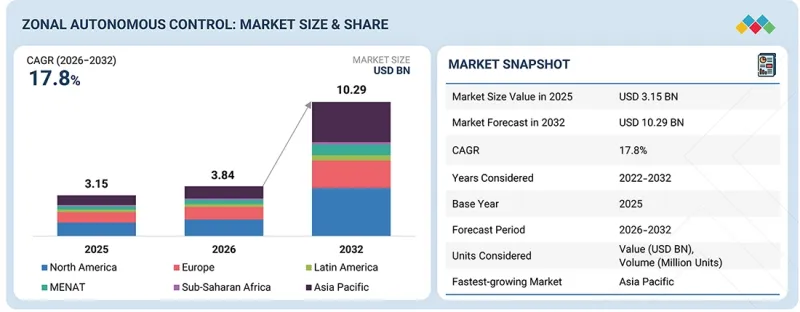
"Renewable end use of the generation segment projected to grow at the highest CAGR during the forecast period"
The renewable end-use of generation segment is projected to grow at the highest CAGR during the forecast period, primarily due to the accelerating global transition toward clean and decentralized energy systems. Increasing integration of solar, wind, and other distributed energy resources (DERs) is driving the need for advanced zonal autonomous control solutions to manage grid variability, intermittency, and bidirectional power flows. Governments and regulators worldwide are implementing stringent decarbonization targets and renewable energy mandates, further boosting investments in grid modernization and intelligent control systems. Additionally, the rising deployment of microgrids, energy storage systems, and prosumer-based energy models is increasing the complexity of grid operations, thereby necessitating real-time, localized, and autonomous control at the zonal level. As a result, utilities are increasingly adopting ZAC solutions to enhance grid flexibility, stability, and efficiency, making renewable energy integration the fastest-growing application segment.
"Data center end use of industries segment projected to hold the largest market share by 2032"
The data center end-use segment is projected to hold the largest market share by 2032 due to the rapid expansion of digital infrastructure driven by cloud computing, AI workloads, and hyperscale data processing requirements. Data centers demand highly reliable, uninterrupted, and efficient power supply, making them early adopters of advanced zonal autonomous control solutions for real-time monitoring, fault isolation, and energy optimization at the grid edge. The increasing deployment of renewable energy sources and on-site generation (such as microgrids and energy storage systems) within data centers further necessitates intelligent control systems to manage complex power flows and ensure grid stability. Additionally, stringent requirements for uptime, resilience, and energy efficiency, coupled with rising investments by hyperscale operators, are accelerating the adoption of automated, decentralized grid control technologies. As a result, the data center segment continues to dominate demand for ZAC solutions, securing the largest market share over the forecast period.
"North America held the largest market share in 2025"
North America held the largest market share in the zonal autonomous control (ZAC) market in 2025 due to its advanced grid infrastructure, early adoption of smart grid technologies, and strong presence of leading technology providers. The region has witnessed significant investments in grid modernization, digitalization, and integration of distributed energy resources (DERs), driven by supportive government policies and regulatory frameworks. Additionally, the rapid growth of renewable energy projects, data centers, and electrification initiatives has increased the need for intelligent, decentralized grid control solutions. Utilities across the US and Canada are actively deploying AI-driven grid management systems, DERMS, and edge control technologies to enhance grid reliability, resilience, and operational efficiency. These factors collectively position North America as the leading contributor to the global ZAC market in 2025.
The breakdown of the profile of primary participants in the home automation system market is as follows:
- By Company Type: Tier 1 - 52%, Tier 2 - 28%, Tier 3 - 20%
- By Designation: C-level Executives - 24%, Directors - 33%, Others - 43%
- By Region: Asia Pacific - 38%, Europe - 27%, North America - 22%, MENAT - 5%, Latin America - 4%, and Sub-Saharan Africa - 4%
Note: Other designations include sales, marketing, and product managers.
The three tiers of the companies are based on their total revenues as of 2024: Tier 1: >USD 1 billion, Tier 2: USD 500 million-1 billion, and Tier 3: USD 500 million.
The zonal autonomous control market is dominated by a few globally established players such as GE Vernova, Schneider Electric, Siemens, Hitachi Energy Ltd, Landis+Gyr, ABB, S&C Electric Company, Honeywell International Inc, Smarter Grid Solutions, Inc., Itron Inc., gridX, Oracle, and Eaton. The study includes an in-depth competitive analysis of these key players in the home automation system market, with their company profiles, recent developments, and key market strategies.
Research Coverage
The report segments the zonal autonomous control market and forecasts its size by solution type, application, end use, and region. It also provides a comprehensive review of drivers, restraints, opportunities, and challenges influencing market growth. The report covers both qualitative and quantitative aspects of the market.
Reasons to Buy the Report:
The report will help leaders/new entrants in this market by providing approximate revenue figures for the overall zonal autonomous control market and related segments. This report will help stakeholders understand the competitive landscape and gain deeper insights to strengthen their market position and plan effective go-to-market strategies. The report will also help stakeholders understand the market pulse and provide information on key drivers, restraints, opportunities, and challenges.
The report provides insights into the following pointers:
- Analysis of key drivers (rising electrification & EV infrastructure expansion); restraints (legacy infrastructure incompatibility); opportunities (AI-driven edge intelligence & autonomous decision-making convergence); challenges (cybersecurity vulnerabilities & autonomous control governance risks)
- Product Development/Innovation: Detailed insights into upcoming technologies, research & development activities, and product launches in the zonal autonomous control market
- Market Development: Comprehensive information about lucrative markets by analyzing the zonal autonomous control market across varied regions
- Market Diversification: Exhaustive information about new products, untapped geographies, recent developments, and investments in the zonal autonomous control market
- Competitive Assessment: In-depth assessment of market shares, growth strategies, and service offerings of leading players like GE Vernova, Schneider Electric, Siemens, Hitachi Energy Ltd, Landis+Gyr, ABB, S&C Electric Company, Honeywell International Inc, Smarter Grid Solutions, Inc., Itron Inc., gridX, Oracle, and Eaton are some of the key players in the zonal autonomous control market
TABLE OF CONTENTS
1 INTRODUCTION
- 1.1 OBJECTIVE
- 1.2 MARKET DEFINITION
- 1.3 STUDY SCOPE
- 1.4 INCLUSION AND EXCLUSION
2 EXECUTIVE SUMMARY AND PREMIUM INSIGHTS
3 MARKET OVERVIEW AND DYNAMICS
- 3.1 INTRODUCTION
- 3.2 MARKET DYNAMICS
- 3.2.1 DRIVERS
- 3.2.2 RESTRAINTS
- 3.2.3 OPPORTUNITIES
- 3.2.4 CHALLENGES
- 3.3 VALUE CHAIN ANALYSIS
- 3.4 ECOSYSTEM ANALYSIS
- 3.5 CASE STUDY ANALYSIS
- 3.6 REGULATORY LANDSCAPE
4 MARKET ASSESSMENT
- 4.1 ZONAL AUTONOMOUS CONTROL MARKET, BY SOLUTION TYPE
- 4.1.1 INTRODUCTION
- 4.1.2 GRID AUTOMATION SYSTEMS
- 4.1.3 EDGE INTELLIGENCE & CONTROL SYSTEMS
- 4.1.4 DATA MANAGEMENT & CONTROL PLATFORMS
- 4.2 ZONAL AUTONOMOUS CONTROL MARKET, BY APPLICATION
- 4.2.1 INTRODUCTION
- 4.2.2 SUBSTATION MONITORING & OPERATIONS
- 4.2.3 ASSET MANAGEMENT
- 4.2.4 EDGE MANAGEMENT
- 4.2.5 CYBERSECURITY & THREAT DETECTION
- 4.3 ZONAL AUTONOMOUS CONTROL MARKET, BY END USE
- 4.3.1 INTRODUCTION
- 4.3.2 GENERATION
- 4.3.2.1 Conventional
- 4.3.2.2 Renewable
- 4.3.3 TRANSMISSION
- 4.3.4 DISTRIBUTION
- 4.3.5 INDUSTRIES
- 4.3.5.1 Oil & Gas
- 4.3.5.2 Data Centers
- 4.3.5.3 Defense
- 4.3.5.4 Manufacturing
- 4.3.5.5 Metals & Mining
- 4.3.5.6 Other Industries
5 ZONAL AUTONOMOUS CONTROL MARKET, BY REGION
- 5.1 INTRODUCTION
- 5.2 NORTH AMERICA
- 5.2.1.1 US
- 5.2.1.2 Canada
- 5.2.1.3 Mexico
- 5.2.2 EUROPE
- 5.2.2.1 Germany
- 5.2.2.2 UK
- 5.2.2.3 France
- 5.2.2.4 Italy
- 5.2.2.5 Spain
- 5.2.2.6 Rest of Europe
- 5.2.3 LATIN AMERICA
- 5.2.3.1 Brazil
- 5.2.3.2 Argentina
- 5.2.3.3 Chile
- 5.2.3.4 Rest of LATAM
- 5.2.4 MIDDLE EAST, NORTH AFRICA & TURKEY
- 5.2.4.1 GCC Countries
- 5.2.4.1.1 Saudi Arabia
- 5.2.4.1.2 UAE
- 5.2.4.1.3 Rest of GCC Countries
- 5.2.4.2 Turkey
- 5.2.4.3 North Africa
- 5.2.4.4 Rest of Middle East, North Africa & Turkey
- 5.2.4.1 GCC Countries
- 5.2.5 SUB-SAHARAN AFRICA
- 5.2.5.1 South Africa
- 5.2.5.2 Nigeria
- 5.2.5.3 Rest of Sub-Saharan Africa
- 5.2.6 ASIA PACIFIC
- 5.2.6.1 India
- 5.2.6.2 China
- 5.2.6.3 Oceania
- 5.2.6.3.1 Australia
- 5.2.6.3.2 New Zealand
- 5.2.6.4 Rest of Asia Pacific
6 COMPETITIVE LANDSCAPE
- 6.1 OVERVIEW
- 6.2 REVENUE ANALYSIS
- 6.3 MARKET SHARE ANALYSIS
- 6.4 CAPABILITY BENCHMARKING OF PLAYERS: BASED ON PRODUCT FOOTPRINT AND BUSINESS STRATEGY
- 6.4.1 STARS
- 6.4.2 EMERGING LEADERS
- 6.4.3 PERVASIVE PLAYERS
- 6.4.4 PARTICIPANTS
- 6.4.5 COMPANY FOOTPRINT
- 6.4.5.1 Solution Type Footprint
- 6.4.5.2 Application Footprint
- 6.4.5.3 End Use Footprint
- 6.4.5.4 Region Footprint
- 6.4.6 COMPETITIVE SCENARIO
- 6.4.7 PRODUCT LAUNCHES
- 6.4.7.1 Deals
7 COMPANY PROFILES
- 7.1 INTRODUCTION
- 7.2 KEY PLAYERS
- 7.2.1 GE VERNOVA
- 7.2.2 SCHNEIDER ELECTRIC
- 7.2.3 SIEMENS
- 7.2.4 HITACHI ENERGY LTD
- 7.2.5 LANDIS+GYR
- 7.2.6 ABB
- 7.2.7 S&C ELECTRIC COMPANY
- 7.2.8 MITSUBISHI CORPORATION
- 7.2.9 ITRON INC.
- 7.2.10 HONEYWELL INTERNATIONAL INC.
- 7.3 OTHER PLAYERS
- 7.3.1 ORACLE
- 7.3.2 EATON CORPORATION PLC
- 7.3.3 SCHWEITZER ENGINEERING LABORATORIES, INC.
- 7.3.4 SURVALENT TECHNOLOGY CORPORATION
- 7.3.5 GRIDX GMBH
- 7.3.6 G&W ELECTRIC
- 7.3.7 PSI SOFTWARE SE
- 7.3.8 EMERSON ELECTRIC CO.
8 RESEARCH METHODOLOGY
9 APPENDIX

