PUBLISHER: MarketsandMarkets | PRODUCT CODE: 2079664
PUBLISHER: MarketsandMarkets | PRODUCT CODE: 2079664
Natural Language Processing (NLP) Market by Offering (NLP Platforms, NLP APIs, Integrated NLP Solutions), Capability (NLU, NLG, Machine Translation), Application (Customer Experience & Support, Document Process Automation) - Global Forecast to 2031
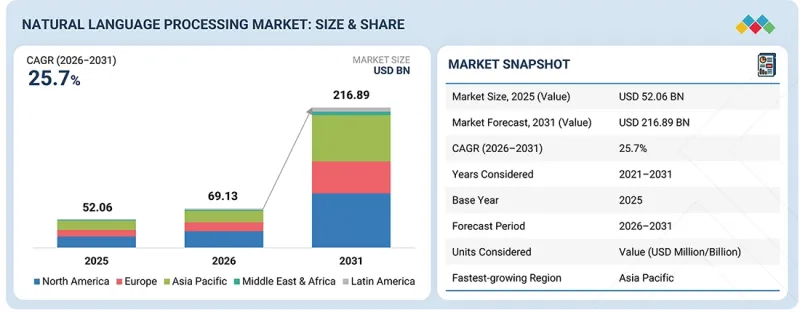
The global natural language processing (NLP) market is projected to grow from USD 69.13 billion in 2026 to USD 216.89 billion by 2031, at a CAGR of 25.7% during the forecast period. Growth is being driven by rising enterprise demand to convert unstructured text, speech, documents, emails, tickets, chats, contracts, and knowledge repositories into usable business intelligence.
| Scope of the Report | |
|---|---|
| Years Considered for the Study | 2021-2031 |
| Base Year | 2025 |
| Forecast Period | 2026-2031 |
| Units Considered | Value (USD Million/Billion) |
| Segments | Offering, Technology, Capability, Application, Vertical, and Region |
| Regions covered | North America, Europe, Asia Pacific, Middle East & Africa, and Latin America |
The rapid adoption of generative AI, RAG, enterprise copilots, conversational interfaces, and document intelligence is expanding NLP from analytics-led use cases to workflow automation and knowledge access. Increasing deployment across customer support, BFSI, healthcare, retail, legal, and enterprise productivity workflows is further strengthening market growth. However, high implementation cost, integration complexity, shortage of clean domain-specific data, hallucination risk, bias, privacy concerns, and weak traceability continue to restrain adoption, especially in regulated and large-scale enterprise environments.
"RAG-enabled NLP is becoming the fastest-growing technology layer for trusted enterprise knowledge access"
By technology, RAG-enabled NLP is expected to be the fastest-growing market as enterprises shift from generic model outputs to grounded, source-backed responses linked to internal data and approved knowledge repositories. Businesses are increasingly using retrieval-augmented generation to connect language models with contracts, policies, product manuals, service records, financial documents, technical documentation, and customer knowledge bases. This allows organizations to improve answer relevance, reduce unsupported responses, and make enterprise information more accessible to employees and customers. The high-growth opportunity for vendors lies in building RAG-ready platforms with vector search, enterprise connectors, access controls, metadata filtering, workflow integration, and citation support. As organizations move from AI pilots to production deployments, RAG-enabled NLP is becoming central to knowledge assistants, customer support automation, legal review, compliance workflows, field service support, and enterprise search modernization.
"Natural language understanding remains the largest capability segment in 2026 due to its deep enterprise workflow penetration"
By capability, natural language understanding is expected to hold the largest market share in 2026 because it forms the foundation for many mature NLP deployments across industries. Enterprises use NLU to classify text, detect intent, extract entities, identify sentiment, route tickets, analyze documents, understand customer queries, and interpret business context from unstructured data. Its larger share is supported by widespread adoption in customer service, BFSI, healthcare, retail, HR, legal, and enterprise knowledge workflows, where organizations need to convert large volumes of language data into structured, usable information. While generative capabilities are growing rapidly, NLU remains deeply embedded in operational systems such as chatbots, contact centers, claims processing, compliance monitoring, document analytics, and voice-of-customer platforms. Vendors can strengthen their position in this segment by improving domain accuracy, multilingual support, integration with enterprise systems, and explainability for regulated use cases.
"North America remains the largest NLP market due to strong enterprise AI adoption and vendor concentration, while Asia Pacific is the fastest-growing NLP market as multilingual NLP adoption expands"
North America is expected to hold the largest share of the natural language processing market in 2026, led by the US. The region benefits from high cloud adoption, strong enterprise digital maturity, and the presence of leading NLP and AI vendors such as Microsoft, Google, AWS, OpenAI, Anthropic, Salesforce, IBM, Oracle, and Databricks. Enterprises in the region are actively deploying NLP across customer support automation, healthcare documentation, BFSI compliance, enterprise search, productivity copilots, legal workflows, and document intelligence. Large-scale adoption is also supported by mature data infrastructure, stronger AI budgets, and greater readiness to move NLP from pilots into production-grade deployments.
Asia Pacific is expected to be the fastest-growing region in the natural language processing market, supported by rapid digital transformation, rising cloud adoption, expanding enterprise automation, and strong multilingual communication needs. Countries such as China, India, Japan, South Korea, Singapore, and Australia are seeing increased demand for NLP across customer engagement, translation, speech analytics, BFSI, healthcare, e-commerce, telecom, and government services. Regional growth is also supported by government-backed AI programs, large digital user bases, and increasing investment in local-language AI models. Vendors can tap this opportunity through regional language support, flexible pricing, cloud partnerships, and verticalized NLP solutions.
Breakdown of Primaries
In-depth interviews were conducted with chief executive officers (CEOs), innovation and technology directors, system integrators, and executives from various key organizations operating in the Natural language processing market.
- By Company: Tier 1 - 25%, Tier 2 - 41%, and Tier 3 - 34%
- By Designation: Directors - 31%, Managers - 46%, and Others - 23%
- By Region: North America - 39%, Europe - 22%, Asia Pacific - 28%, Middle East & Africa - 4%, and Latin America - 7%
IBM (US), Microsoft (US), AWS (US), Google (US), Oracle (US), OpenAI (US), Baidu (China), SAP (Germany), Salesforce (US), SAS (US), Alibaba Cloud (China), Tencent Cloud (China), Anthropic (US), Databricks (US), iFLYTEK (China), Qualtrics (US), Medallia (US), Elastic (US), ABBYY (US), Nuance Communications (US), Cohere (Canada), DataRobot (US), Kore.ai (US), Cerence AI (US), DeepL (Germany), Mistral AI (France), Hugging Face (US), AI21 Labs (Israel), Explosion (Germany), Expert.ai (Italy), Deepgram (US), AssemblyAI (US), Speechmatics (UK), ElevenLabs (US), Gladia (France), Unbabel (Portugal), Smartling (US), Rasa (US), Cognigy (Germany), Parloa (Germany), PolyAI (UK), Ada (Canada), Hyro (US), Algolia (US), Instabase (US), Hyperscience (US), John Snow Labs (US), Writer (US), SoundHound AI (US), Symbl.ai (US), Rossum (UK), Lexalytics (US), LlamaIndex (US), and Glean (US) are some of the key players in the natural language processing market.
The study includes an in-depth competitive analysis of these key players in the natural language processing market, with their company profiles, recent developments, and key market strategies.
Research Coverage
This research report categorizes the natural language processing market by offering (software and services), by technology (rule-based & symbolic NLP, statistical & classical machine learning NLP, deep learning & neural NLP, transformer-based & generative NLP, RAG-enabled NLP, and other technologies), by capability (natural language understanding, natural language generation, machine translation & multilingual processing, and speech & spoken language processing), by application (customer experience & support, marketing & brand intelligence, knowledge management & discovery, compliance, legal & risk intelligence, research & information intelligence, workforce productivity & automation, translation & localization, document process automation, and other applications), by vertical (BFSI, healthcare & life sciences, retail & e-commerce, software & technology, media & entertainment, telecommunications, government & defense, manufacturing, logistics & transportation, education & ed-tech, and other verticals), and region (North America, Europe, Asia Pacific, Middle East & Africa, and Latin America). The scope of the report covers detailed information regarding the major factors, such as drivers, restraints, challenges, and opportunities, influencing the growth of the natural language processing market. A detailed analysis of the key industry players has been done to provide insights into their business overview, solutions, and services; key strategies; contracts, partnerships, agreements; new product & service launches; mergers and acquisitions; and recent developments associated with the natural language processing market. Competitive analysis of upcoming startups in the natural language processing market ecosystem is covered in this report.
Reasons to Buy This Report
The report will provide market leaders and new entrants with information on the closest approximations of the revenue numbers for the overall natural language processing market and its subsegments. It would help stakeholders understand the competitive landscape and gain more insights to position their business better and plan suitable go-to-market strategies. It also helps stakeholders understand the pulse of the market and provides them with information on key market drivers, restraints, challenges, and opportunities.
The report provides insights into the following pointers:
- Analysis of key drivers (growing enterprise spending on unstructured data intelligence is driving NLP adoption; generative AI is expanding NLP from analytics to content and knowledge workflows; customer support and employee productivity use cases are accelerating deployment; multilingual and voice-led engagement is widening the addressable market), restraints (enterprise NLP deployments remain costly and integration-heavy; shortage of clean, labeled, domain-specific data limits model performance), opportunities (RAG-enabled NLP is emerging as the enterprise layer for trusted knowledge access; vertical-specific NLP is opening high-value regulated workflows; document intelligence offers one of the clearest monetization paths for NLP), and challenges (hallucination, bias, and weak traceability continue to limit trust; scaling NLP across languages, formats, and enterprise systems remains difficult)
- Product Development/Innovation: Detailed insights into upcoming technologies, research & development activities, and new product & service launches in the natural language processing market
- Market Development: Comprehensive information about lucrative markets - analysis of the natural language processing market across varied regions
- Market Diversification: Exhaustive information about new products & services, untapped geographies, recent developments, and investments in the natural language processing market
- Competitive Assessment: In-depth assessment of market shares, growth strategies and service offerings of Microsoft (US), Google (US), AWS (US), OpenAI (US), Anthropic (US), Salesforce (US), IBM (US), iFLYTEK (China), Oracle (US), and Nuance Communications (US), among others, in the natural language processing market
TABLE OF CONTENTS
1 INTRODUCTION
- 1.1 STUDY OBJECTIVES
- 1.2 MARKET DEFINITION
- 1.2.1 INCLUSIONS AND EXCLUSIONS
- 1.3 MARKET SCOPE
- 1.3.1 MARKET SEGMENTATION
- 1.3.2 YEARS CONSIDERED
- 1.4 CURRENCY CONSIDERED
- 1.5 STAKEHOLDERS
- 1.6 SUMMARY OF CHANGES
2 EXECUTIVE SUMMARY
- 2.1 MARKET HIGHLIGHTS AND KEY INSIGHTS
- 2.2 KEY MARKET PARTICIPANTS: MAPPING OF STRATEGIC DEVELOPMENTS
- 2.3 DISRUPTIVE TRENDS IN NATURAL LANGUAGE PROCESSING MARKET
- 2.4 HIGH-GROWTH SEGMENTS
- 2.5 REGIONAL SNAPSHOT: MARKET SIZE, GROWTH RATE, AND FORECAST
3 PREMIUM INSIGHTS
- 3.1 ATTRACTIVE OPPORTUNITIES IN NATURAL LANGUAGE PROCESSING MARKET
- 3.2 NATURAL LANGUAGE PROCESSING MARKET, BY REGION
- 3.3 NATURAL LANGUAGE PROCESSING MARKET: TOP THREE NLP SOFTWARE
- 3.4 NORTH AMERICA: NATURAL LANGUAGE PROCESSING MARKET, BY OFFERING AND CAPABILITY
- 3.5 NATURAL LANGUAGE PROCESSING MARKET, BY REGION
4 MARKET OVERVIEW
- 4.1 INTRODUCTION
- 4.2 MARKET DYNAMICS
- 4.2.1 DRIVERS
- 4.2.1.1 Growing enterprise spending on unstructured data intelligence is driving NLP adoption
- 4.2.1.2 Generative AI is expanding NLP from analytics to content and knowledge workflows
- 4.2.1.3 Customer support and employee productivity use cases are accelerating deployment
- 4.2.1.4 Multilingual and voice-led engagement is widening the addressable market
- 4.2.2 RESTRAINTS
- 4.2.2.1 Enterprise NLP deployments remain costly and integration-heavy
- 4.2.2.2 Shortage of clean, labeled, domain-specific data limits model performance
- 4.2.3 OPPORTUNITIES
- 4.2.3.1 RAG-enabled NLP is emerging as the enterprise layer for trusted knowledge access
- 4.2.3.2 Vertical-specific NLP is opening high-value regulated workflows
- 4.2.3.3 Document intelligence offers one of the clearest monetization paths for NLP
- 4.2.4 CHALLENGES
- 4.2.4.1 Hallucination, bias, and weak traceability continue to limit trust
- 4.2.4.2 Scaling NLP across languages, formats, and enterprise systems remains difficult
- 4.2.1 DRIVERS
- 4.3 UNMET NEEDS AND WHITE SPACES
- 4.3.1 UNMET NEEDS IN NATURAL LANGUAGE PROCESSING MARKET
- 4.3.2 WHITE SPACE OPPORTUNITIES
- 4.4 INTERCONNECTED MARKETS AND CROSS-SECTOR OPPORTUNITIES
- 4.4.1 INTERCONNECTED MARKETS
- 4.4.2 CROSS-SECTOR OPPORTUNITIES
- 4.5 STRATEGIC MOVES BY TIER-1/2/3 PLAYERS
5 INDUSTRY TRENDS
- 5.1 EVOLUTION OF NLP
- 5.2 PORTER'S FIVE FORCES ANALYSIS
- 5.2.1 INTENSITY OF COMPETITIVE RIVALRY
- 5.2.2 BARGAINING POWER OF SUPPLIERS
- 5.2.3 BARGAINING POWER OF BUYERS
- 5.2.4 THREAT OF SUBSTITUTES
- 5.2.5 THREAT OF NEW ENTRANTS
- 5.3 MACROECONOMIC OUTLOOK
- 5.3.1 INTRODUCTION
- 5.3.2 GDP TRENDS AND FORECAST
- 5.3.3 TRENDS IN THE CONVERSATIONAL AI INDUSTRY
- 5.3.4 TRENDS IN THE GENERATIVE AI INDUSTRY
- 5.4 SUPPLY CHAIN ANALYSIS
- 5.5 ECOSYSTEM ANALYSIS
- 5.5.1 NLP SOLUTION PROVIDERS
- 5.5.1.1 NLP Platform Providers
- 5.5.1.2 NLP API Providers
- 5.5.1.3 Language Model Platform Providers
- 5.5.1.4 NLP Development Tool Providers
- 5.5.1.5 Integrated NLP Solution Providers
- 5.5.2 NLP SERVICE PROVIDERS
- 5.5.2.1 Professional Service Providers
- 5.5.2.2 Managed Service Providers
- 5.5.1 NLP SOLUTION PROVIDERS
- 5.6 PRICING ANALYSIS
- 5.6.1 AVERAGE SELLING PRICE OF OFFERINGS, BY KEY PLAYER, 2026
- 5.6.2 AVERAGE SELLING PRICE OF APPLICATIONS, 2026
- 5.7 KEY CONFERENCES AND EVENTS, 2026-2027
- 5.8 TRENDS/DISRUPTIONS IMPACTING CUSTOMER BUSINESS
- 5.9 INVESTMENT AND FUNDING SCENARIO
- 5.10 CASE STUDY ANALYSIS
- 5.10.1 ERAJAYA ENHANCED E-COMMERCE SEARCH AND CUSTOMER SERVICE WITH GENERATIVE NLP
- 5.10.2 KLARNA DEPLOYED MULTILINGUAL AI ASSISTANT TO AUTOMATE CUSTOMER SERVICE AT SCALE
- 5.10.3 VOLVO GROUP STREAMLINED INVOICE AND CLAIMS PROCESSING WITH AI DOCUMENT INTELLIGENCE
- 5.10.4 MAYO CLINIC AND GOOGLE CLOUD ADVANCED GENERATIVE SEARCH FOR CLINICAL KNOWLEDGE DISCOVERY
- 5.10.5 BHASHINI EXPANDED MULTILINGUAL NLP ACCESS FOR DIGITAL PUBLIC SERVICES
- 5.10.6 VODAFONE ENHANCED TELECOM CUSTOMER SUPPORT THROUGH TOBI'S GENERATIVE CONVERSATIONAL AI
- 5.10.7 THOMSON REUTERS STRENGTHENED LEGAL RESEARCH AND DRAFTING WITH COCOUNSEL LEGAL
- 5.10.8 SERVICENOW SCALED NOW ASSIST ACROSS IT, HR, CUSTOMER SERVICE, AND KNOWLEDGE WORKFLOWS
- 5.11 IMPACT OF 2025 US TARIFF - NATURAL LANGUAGE PROCESSING MARKET
- 5.11.1 INTRODUCTION
- 5.11.1.1 Tariff/Trade Policy Updates (January-June 2026)
- 5.11.2 KEY TARIFF RATES
- 5.11.3 PRICE IMPACT ANALYSIS
- 5.11.3.1 Strategic shifts and emerging trends
- 5.11.4 IMPACT ON COUNTRY/REGION
- 5.11.4.1 US
- 5.11.4.2 Europe
- 5.11.4.3 China
- 5.11.4.4 Asia Pacific (excluding China)
- 5.11.5 IMPACT ON END-USE INDUSTRIES
- 5.11.5.1 BFSI
- 5.11.5.2 Retail & E-commerce
- 5.11.5.3 Healthcare & Life Sciences
- 5.11.5.4 Software & Technology
- 5.11.5.5 Media & Entertainment
- 5.11.5.6 Telecommunications
- 5.11.5.7 Government & Defense
- 5.11.5.8 Manufacturing
- 5.11.5.9 Logistics & Transportation
- 5.11.5.10 Education & Ed-Tech
- 5.11.1 INTRODUCTION
6 TECHNOLOGICAL ADVANCEMENTS, PATENTS, INNOVATIONS, AND FUTURE APPLICATIONS
- 6.1 KEY EMERGING TECHNOLOGIES
- 6.1.1 TRANSFORMER ARCHITECTURE
- 6.1.2 ATTENTION MECHANISMS
- 6.1.3 WORD EMBEDDINGS & CONTEXTUAL EMBEDDINGS
- 6.1.4 SEQUENCE-TO-SEQUENCE MODELING
- 6.1.5 NAMED ENTITY RECOGNITION & INFORMATION EXTRACTION
- 6.2 COMPLEMENTARY TECHNOLOGIES
- 6.2.1 REINFORCEMENT LEARNING FROM HUMAN FEEDBACK (RHLF)
- 6.2.2 FEDERATED LEARNING
- 6.2.3 DIFFERENTIAL PRIVACY
- 6.2.4 EXPLAINABLE AI
- 6.2.5 SYNTHETIC DATA GENERATION
- 6.3 ADJACENT TECHNOLOGIES
- 6.3.1 AUTOMATIC SPEECH RECOGNITION
- 6.3.2 OPTICAL CHARACTER RECOGNITION
- 6.3.3 KNOWLEDGE GRAPHS
- 6.3.4 SEMANTIC SEARCH
- 6.3.5 MULTIMODAL AI
- 6.4 PATENT ANALYSIS
- 6.4.1 METHODOLOGY
- 6.4.2 PATENTS FILED, BY DOCUMENT TYPE, 2016-2026
- 6.4.3 INNOVATION AND PATENT APPLICATIONS
- 6.5 FUTURE APPLICATIONS
- 6.5.1 ENTERPRISE KNOWLEDGE AGENTS
- 6.5.2 CLINICAL LANGUAGE COPILOTS
- 6.5.3 REGULATORY INTELLIGENCE SYSTEMS
- 6.5.4 MULTILINGUAL CITIZEN SERVICES
- 6.5.5 AUTONOMOUS DOCUMENT WORKFLOWS
7 REGULATORY LANDSCAPE
- 7.1 REGIONAL REGULATIONS AND COMPLIANCE
- 7.1.1 REGULATORY BODIES, GOVERNMENT AGENCIES, AND OTHER ORGANIZATIONS
- 7.1.2 KEY REGULATIONS
- 7.1.2.1 North America
- 7.1.2.1.1 Executive Order 14179 - Removing Barriers to American Leadership in NLP (US)
- 7.1.2.1.2 Federal Trade Commission Act, Section 5 (US)
- 7.1.2.1.3 NIST AI Risk Management Framework 1.0 (US)
- 7.1.2.1.4 Personal Information Protection and Electronic Documents Act (Canada)
- 7.1.2.2 Europe
- 7.1.2.2.1 Artificial Intelligence Act, Regulation (EU) 2024/1689 (EU)
- 7.1.2.2.2 General Data Protection Regulation (EU)
- 7.1.2.2.3 Digital Services Act (EU)
- 7.1.2.2.4 Federal Data Protection Act (Germany)
- 7.1.2.2.5 Data Protection Act (France)
- 7.1.2.2.6 Personal Data Protection Code (Italy)
- 7.1.2.2.7 Organic Law 3/2018 on Data Protection and Guarantee of Digital Rights (Spain)
- 7.1.2.2.8 UK General Data Protection Regulation and Data Protection Act 2018 (UK)
- 7.1.2.3 Asia Pacific
- 7.1.2.3.1 Act on the Protection of Personal Information (Japan)
- 7.1.2.3.2 Interim Measures for the Management of Generative Artificial Intelligence Services (China)
- 7.1.2.3.3 Personal Information Protection Law (China)
- 7.1.2.3.4 Digital Personal Data Protection Act, 2023 (India)
- 7.1.2.3.5 ASEAN Guide on AI Governance and Ethics (Southeast Asia)
- 7.1.2.3.6 Act on the Development of Artificial Intelligence and Establishment of Trust (South Korea)
- 7.1.2.3.7 Privacy Act 1988 (Australia)
- 7.1.2.4 Latin America
- 7.1.2.4.1 General Personal Data Protection Law (Brazil)
- 7.1.2.4.2 Federal Law on the Protection of Personal Data Held by Private Parties (Mexico)
- 7.1.2.4.3 Personal Data Protection Act, Law No. 25.326 (Argentina)
- 7.1.2.5 Middle East & Africa
- 7.1.2.5.1 Federal Decree-Law No. 45 of 2021 on Personal Data Protection (UAE)
- 7.1.2.5.2 Personal Data Protection Law (Saudi Arabia)
- 7.1.2.5.3 Protection of Personal Information Act (South Africa)
- 7.1.2.1 North America
- 7.1.3 INDUSTRY STANDARDS
8 CUSTOMER LANDSCAPE & BUYER BEHAVIOR
- 8.1 DECISION-MAKING PROCESS
- 8.2 BUYER STAKEHOLDERS AND BUYING EVALUATION CRITERIA
- 8.2.1 BUYING CRITERIA
- 8.3 ADOPTION BARRIERS & INTERNAL CHALLENGES
- 8.4 UNMET NEEDS FROM VARIOUS VERTICALS
9 NATURAL LANGUAGE PROCESSING MARKET, BY OFFERING
- 9.1 INTRODUCTION
- 9.1.1 DRIVERS: NATURAL LANGUAGE PROCESSING MARKET, BY OFFERING
- 9.2 SOFTWARE
- 9.2.1 NLP PLATFORMS
- 9.2.1.1 NLP platforms evolving from single-task tools to unified orchestration environments covering full NLP lifecycles
- 9.2.1.2 Text Analytics Platforms
- 9.2.1.3 Text Mining Platforms
- 9.2.1.4 Knowledge Extraction Platforms
- 9.2.1.5 Domain-specific NLP Platforms
- 9.2.2 NLP APIS
- 9.2.2.1 NLP APIs become default delivery mechanism for language capability
- 9.2.2.2 Text Analytics APIs
- 9.2.2.3 Sentiment Analysis APIs
- 9.2.2.4 Entity Recognition APIs
- 9.2.2.5 Language Detection APIs
- 9.2.2.6 PII Detection APIs
- 9.2.3 LANGUAGE MODEL PLATFORMS
- 9.2.3.1 Language model platforms consolidating into tiered market where domain custodians occupy distinct commercial positions
- 9.2.3.2 Pre-trained Language Models
- 9.2.3.3 Fine-tuned Language Models
- 9.2.3.4 Domain-specific Language Models
- 9.2.3.5 Multilingual Language Models
- 9.2.4 NLP DEVELOPMENT TOOLS
- 9.2.4.1 NLP development tools shifting from low-level library toolkits to managed evaluation and orchestration environments
- 9.2.4.2 NLP Frameworks
- 9.2.4.3 NLP SDKs
- 9.2.4.4 Annotation Tools
- 9.2.4.5 Model Evaluation Tools
- 9.2.4.6 Prompt Engineering Tools
- 9.2.5 INTEGRATED NLP SOFTWARE
- 9.2.5.1 Integrated NLP software gaining prominence as language capability embeds into core SaaS applications
- 9.2.5.2 Customer Interaction NLP Software
- 9.2.5.3 Enterprise Workflow NLP Software
- 9.2.5.4 Document Processing NLP Software
- 9.2.5.5 Productivity NLP Software
- 9.2.5.6 Knowledge Management NLP Software
- 9.2.1 NLP PLATFORMS
- 9.3 SERVICES
- 9.3.1 PROFESSIONAL SERVICES
- 9.3.1.1 Professional services expanding as enterprise NLP deployments require regulatory alignment and multi-system integration
- 9.3.1.2 Consulting Services
- 9.3.1.3 System Integration Services
- 9.3.1.4 Custom Model Development Services
- 9.3.1.5 Model Fine-tuning Services
- 9.3.2 MANAGED SERVICES
- 9.3.2.1 Managed NLP services growing as production model operations complexity exceeds internal engineering capacity of enterprises
- 9.3.2.2 Model Monitoring Services
- 9.3.2.3 Data Annotation Services
- 9.3.2.4 Support & Maintenance Services
- 9.3.1 PROFESSIONAL SERVICES
10 LANGUAGE PROCESSING MARKET, BY TECHNOLOGY
- 10.1 INTRODUCTION
- 10.1.1 DRIVERS: NATURAL LANGUAGE PROCESSING MARKET, BY TECHNOLOGY
- 10.2 RULE-BASED & SYMBOLIC NLP
- 10.2.1 RULE-BASED & SYMBOLIC NLP RETAINS COMMERCIAL RELEVANCE IN RESOURCE-CONSTRAINED DEPLOYMENTS
- 10.3 STATISTICAL & CLASSICAL MACHINE LEARNING NLP
- 10.3.1 STATISTICAL & CLASSICAL ML NLP MAINTAINS COMMERCIAL NICHE IN HIGH-VOLUME, LOW-LATENCY APPLICATIONS
- 10.4 DEEP LEARNING & NEURAL NLP
- 10.4.1 DEEP LEARNING & NEURAL NLP DELIVER PROVEN ACCURACY AT MANAGEABLE INFERENCE COST
- 10.5 TRANSFORMER-BASED & GENERATIVE NLP
- 10.5.1 TRANSFORMER-BASED & GENERATIVE NLP ENABLE GENERAL-PURPOSE LANGUAGE PROCESSING AT COMMERCIALLY VIABLE COST
- 10.6 RAG-ENABLED NLP
- 10.6.1 RAG-ENABLED NLP RESOLVES KNOWLEDGE CURRENCY AND HALLUCINATION LIMITATIONS OF STATIC LANGUAGE MODELS
11 NATURAL LANGUAGE PROCESSING MARKET, BY CAPABILITY
- 11.1 INTRODUCTION
- 11.1.1 DRIVERS: NATURAL LANGUAGE PROCESSING MARKET, BY CAPABILITY
- 11.2 NATURAL LANGUAGE UNDERSTANDING (NLU)
- 11.2.1 NLU FORMS SEMANTIC FOUNDATION OF ENTERPRISE NLP PIPELINES THAT POWER DOWNSTREAM DECISION-MAKING
- 11.2.2 TEXT CLASSIFICATION & CATEGORIZATION
- 11.2.3 INFORMATION EXTRACTION
- 11.2.4 SENTIMENT, EMOTION & INTENT ANALYTICS
- 11.2.5 SEMANTIC & CONTEXTUAL UNDERSTANDING
- 11.3 NATURAL LANGUAGE GENERATION (NLG)
- 11.3.1 NLG TRANSITIONING FROM TEMPLATED REPORT PRODUCTION TO GENERATIVE, CONTEXT-AWARE TEXT CREATION
- 11.3.2 TEXT GENERATION
- 11.3.3 SUMMARIZATION
- 11.3.4 AUTOMATED NARRATIVE GENERATION
- 11.3.5 TEXT REWRITING & TRANSFORMATION
- 11.4 MACHINE TRANSLATION & MULTILINGUAL PROCESSING
- 11.4.1 MACHINE TRANSLATION & MULTILINGUAL PROCESSING GAINING STRATEGIC RELEVANCE IN CROSS-BORDER DIGITAL COMMERCE
- 11.4.2 MACHINE TRANSLATION
- 11.4.3 LOCALIZATION & LANGUAGE ADAPTATION
- 11.4.4 CROSS-LINGUAL INTELLIGENCE
- 11.5 SPEECH & SPOKEN LANGUAGE PROCESSING
- 11.5.1 SPEECH & SPOKEN LANGUAGE PROCESSING TURNING INTO COMPLETE INTELLIGENCE LAYER FOR ENTERPRISE AUDIO
- 11.5.2 SPEECH-TO-TEXT & TRANSCRIPTION
- 11.5.3 SPOKEN LANGUAGE UNDERSTANDING
- 11.5.4 VOICE & CONVERSATION ANALYTICS
12 NATURAL LANGUAGE PROCESSING MARKET, BY APPLICATION
- 12.1 INTRODUCTION
- 12.1.1 DRIVERS: NATURAL LANGUAGE PROCESSING MARKET, BY APPLICATION
- 12.2 CUSTOMER EXPERIENCE & SUPPORT
- 12.2.1 CUSTOMER EXPERIENCE & SUPPORT LEADING NLP ADOPTION THROUGH AUTOMATED CUSTOMER INTERACTIONS
- 12.3 MARKETING & BRAND INTELLIGENCE
- 12.3.1 MARKETING & BRAND INTELLIGENCE TURNING CUSTOMER LANGUAGE SIGNALS INTO DECISION-READY INSIGHTS
- 12.4 KNOWLEDGE MANAGEMENT & DISCOVERY
- 12.4.1 KNOWLEDGE MANAGEMENT & DISCOVERY BECOMING BACKBONE OF ENTERPRISE KNOWLEDGE ACCESS
- 12.5 COMPLIANCE, LEGAL & RISK INTELLIGENCE
- 12.5.1 COMPLIANCE, LEGAL & RISK INTELLIGENCE STRENGTHENING GOVERNANCE IN LANGUAGE-HEAVY PROCESSES
- 12.6 RESEARCH & INFORMATION INTELLIGENCE
- 12.6.1 RESEARCH & INFORMATION INTELLIGENCE ACCELERATING INSIGHT EXTRACTION FROM UNSTRUCTURED CONTENT
- 12.7 WORKFORCE PRODUCTIVITY & AUTOMATION
- 12.7.1 WORKFORCE PRODUCTIVITY & AUTOMATION SCALING AS NLP ENTERS DAILY ENTERPRISE WORK
- 12.8 TRANSLATION & LOCALIZATION
- 12.8.1 TRANSLATION & LOCALIZATION SUPPORTING MULTILINGUAL ENGAGEMENT ACROSS GLOBAL OPERATIONS
- 12.9 DOCUMENT PROCESS AUTOMATION
- 12.9.1 DOCUMENT PROCESS AUTOMATION CONVERTING ENTERPRISE DOCUMENTS INTO STRUCTURED WORKFLOWS
- 12.10 OTHER APPLICATIONS
13 NATURAL LANGUAGE PROCESSING MARKET, BY VERTICAL
- 13.1 INTRODUCTION
- 13.1.1 DRIVERS: NATURAL LANGUAGE PROCESSING MARKET, BY VERTICAL
- 13.2 BFSI
- 13.2.1 BFSI STRENGTHENING RISK, COMPLIANCE, AND CUSTOMER INTELLIGENCE THROUGH NLP
- 13.3 RETAIL & E-COMMERCE
- 13.3.1 RETAIL & E-COMMERCE SCALING PERSONALIZED DISCOVERY AND CUSTOMER ENGAGEMENT WITH NLP
- 13.4 HEALTHCARE & LIFE SCIENCES
- 13.4.1 HEALTHCARE & LIFE SCIENCES ACCELERATING CLINICAL DOCUMENTATION AND RESEARCH INTELLIGENCE WITH NLP
- 13.5 SOFTWARE & TECHNOLOGY
- 13.5.1 SOFTWARE & TECHNOLOGY EMBEDDING NLP ACROSS DEVELOPER, SUPPORT, AND PRODUCT WORKFLOWS
- 13.6 MEDIA & ENTERTAINMENT
- 13.6.1 MEDIA & ENTERTAINMENT EXPANDING CONTENT INTELLIGENCE, LOCALIZATION, AND AUDIENCE ANALYTICS THROUGH NLP
- 13.7 TELECOMMUNICATIONS
- 13.7.1 TELECOMMUNICATIONS ENHANCING CUSTOMER OPERATIONS AND NETWORK SUPPORT INTELLIGENCE WITH NLP
- 13.8 GOVERNMENT & DEFENSE
- 13.8.1 GOVERNMENT & DEFENSE ADVANCING MULTILINGUAL SERVICES, INTELLIGENCE ANALYSIS, AND DOCUMENT AUTOMATION WITH NLP
- 13.9 MANUFACTURING
- 13.9.1 MANUFACTURING UNLOCKING OPERATIONAL INSIGHTS FROM SERVICE RECORDS, MANUALS, AND QUALITY DOCUMENTS
- 13.10 LOGISTICS & TRANSPORTATION
- 13.10.1 LOGISTICS & TRANSPORTATION IMPROVING EXCEPTION MANAGEMENT AND SHIPMENT INTELLIGENCE WITH NLP
- 13.11 EDUCATION & ED-TECH
- 13.11.1 EDUCATION & ED-TECH PERSONALIZING LEARNING, ASSESSMENT, AND STUDENT SUPPORT THROUGH NLP
- 13.12 OTHER VERTICALS
14 NATURAL LANGUAGE PROCESSING MARKET, BY REGION
- 14.1 INTRODUCTION
- 14.2 NORTH AMERICA
- 14.2.1 NORTH AMERICA: NATURAL LANGUAGE PROCESSING MARKET DRIVERS
- 14.2.2 US
- 14.2.2.1 United States setting global pace for NLP through frontier models, federal procurement, and enterprise automation
- 14.2.2.2 Key developments:
- 14.2.3 CANADA
- 14.2.3.1 Canada translating NLP research strength into enterprise adoption through compute access and applied AI programs
- 14.2.4 KEY DEVELOPMENTS:
- 14.3 EUROPE
- 14.3.1 EUROPE: NATURAL LANGUAGE PROCESSING MARKET DRIVERS
- 14.3.2 UK
- 14.3.2.1 United Kingdom accelerating NLP adoption through public sector AI, financial services demand, and flexible regulation
- 14.3.3 KEY DEVELOPMENTS
- 14.3.4 GERMANY
- 14.3.4.1 Germany strengthening NLP adoption through manufacturing workflows, compliance needs, and domestic AI infrastructure
- 14.3.5 KEY DEVELOPMENTS:
- 14.3.6 FRANCE
- 14.3.6.1 France building European NLP sovereignty through Mistral AI, low-carbon compute, and national AI infrastructure
- 14.3.7 KEY DEVELOPMENTS:
- 14.3.8 ITALY
- 14.3.8.1 Italy expanding NLP adoption through document intelligence and public administration modernization
- 14.3.9 KEY DEVELOPMENTS:
- 14.3.10 SPAIN
- 14.3.10.1 Spain scaling NLP through financial services maturity while working to improve SME adoption
- 14.3.11 KEY DEVELOPMENTS:
- 14.3.12 NETHERLANDS
- 14.3.12.1 Netherlands to advance production NLP through digital maturity, vector infrastructure, and responsible AI programs
- 14.3.13 KEY DEVELOPMENTS:
- 14.3.14 REST OF EUROPE
- 14.4 ASIA PACIFIC
- 14.4.1 ASIA PACIFIC: NATURAL LANGUAGE PROCESSING MARKET DRIVERS
- 14.4.2 CHINA
- 14.4.2.1 China to expand NLP influence through domestic LLMs, platform ecosystems, and AI content governance
- 14.4.3 INDIA
- 14.4.3.1 India to scale multilingual NLP through BHASHINI, IndiaAI compute access, and public digital infrastructure
- 14.4.4 JAPAN
- 14.4.4.1 Japan to promote Japanese-language NLP through national AI legislation and enterprise modernization
- 14.4.5 SOUTH KOREA
- 14.4.5.1 South Korea to accelerate sovereign NLP through national AI planning and semiconductor-backed infrastructure
- 14.4.6 ASEAN
- 14.4.6.1 ASEAN to build regional NLP sovereignty through SEA-LION, national LLMs, and mobile-first language demand
- 14.4.7 AUSTRALIA & NEW ZEALAND
- 14.4.7.1 Australia & New Zealand to expand NLP adoption through government AI enablement and enterprise productivity use cases
- 14.4.8 REST OF ASIA PACIFIC
- 14.5 MIDDLE EAST & AFRICA
- 14.5.1 MIDDLE EAST & AFRICA: NATURAL LANGUAGE PROCESSING MARKET DRIVERS
- 14.5.2 SAUDI ARABIA
- 14.5.2.1 Saudi Arabia to build Arabic NLP capability through HUMAIN, national AI programs, and sovereign compute
- 14.5.3 UAE
- 14.5.3.1 UAE to mainstream Arabic NLP through Stargate UAE, national AI access, and sovereign platforms
- 14.5.4 SOUTH AFRICA
- 14.5.4.1 South Africa to expand enterprise NLP readiness through cloud infrastructure, BFSI adoption, and AI skilling
- 14.5.5 TURKEY
- 14.5.5.1 Turkey to grow Turkish-language NLP through public digital services, banking adoption, and local technology capacity
- 14.5.6 QATAR
- 14.5.6.1 Qatar to advance Arabic NLP through national AI programs, digital government, and language resource development
- 14.5.7 REST OF MIDDLE EAST & AFRICA
- 14.6 LATIN AMERICA
- 14.6.1 LATIN AMERICA: AI TEST AUTOMATION MARKET DRIVERS
- 14.6.2 BRAZIL
- 14.6.2.1 1 Brazil to lead Latin American NLP through Portuguese-language demand, public AI policy, and data center expansion
- 14.6.3 MEXICO
- 14.6.3.1 Mexico to scale bilingual NLP through nearshoring, manufacturing documentation, and customer service automation
- 14.6.4 ARGENTINA
- 14.6.4.1 Argentina to position NLP growth around Spanish-language talent and planned AI infrastructure, despite execution risks
- 14.6.5 REST OF LATIN AMERICA
15 COMPETITIVE LANDSCAPE
- 15.1 OVERVIEW
- 15.2 KEY PLAYER STRATEGIES, 2021-2026
- 15.3 REVENUE ANALYSIS, 2021-2025
- 15.4 MARKET SHARE ANALYSIS, 2025
- 15.4.1 MARKET RANKING ANALYSIS, 2025
- 15.5 PRODUCT COMPARATIVE ANALYSIS
- 15.5.1 PRODUCT COMPARATIVE ANALYSIS OF NLP PLATFORMS
- 15.5.1.1 Watson Natural Language Understanding/watsonx (IBM)
- 15.5.1.2 Visual Text Analytics (SAS)
- 15.5.1.3 Expert.ai Platform (expert.ai)
- 15.5.1.4 Healthcare NLP (John Snow Labs)
- 15.5.2 PRODUCT COMPARATIVE ANALYSIS OF INTEGRATED NLP SOFTWARE
- 15.5.2.1 Microsoft 365 Copilot (Microsoft)
- 15.5.2.2 Einstein/Agentforce (Salesforce)
- 15.5.2.3 Fusion AI (Oracle)
- 15.5.2.4 Joule (SAP)
- 15.5.1 PRODUCT COMPARATIVE ANALYSIS OF NLP PLATFORMS
- 15.6 COMPANY EVALUATION MATRIX: KEY PLAYERS, 2025
- 15.6.1 STARS
- 15.6.2 EMERGING LEADERS
- 15.6.3 PERVASIVE PLAYERS
- 15.6.4 PARTICIPANTS
- 15.6.5 COMPANY FOOTPRINT: KEY PLAYERS, 2025
- 15.6.5.1 Company Footprint
- 15.6.5.2 Regional Footprint
- 15.6.5.3 Offering Footprint
- 15.6.5.4 Application Footprint
- 15.6.5.5 Vertical Footprint
- 15.7 COMPANY EVALUATION MATRIX: STARTUPS/SMES, 2025
- 15.7.1 PROGRESSIVE COMPANIES
- 15.7.2 RESPONSIVE COMPANIES
- 15.7.3 DYNAMIC COMPANIES
- 15.7.4 STARTING BLOCKS
- 15.7.5 COMPETITIVE BENCHMARKING: STARTUPS/SMES, 2025
- 15.7.5.1 Detailed list of key startups/SMEs
- 15.7.5.2 Competitive benchmarking of key startups/SMEs
- 15.8 COMPANY VALUATION AND FINANCIAL METRICS
- 15.9 COMPETITIVE SCENARIO
- 15.9.1 PRODUCT LAUNCHES AND ENHANCEMENTS
- 15.9.2 DEALS
16 COMPANY PROFILES
- 16.1 INTRODUCTION
- 16.2 KEY PLAYERS
- 16.2.1 IBM
- 16.2.1.1 Business overview
- 16.2.1.2 Products/Solutions/Services offered
- 16.2.1.3 Recent developments
- 16.2.1.3.1 Product launches & enhancements
- 16.2.1.3.2 Deals
- 16.2.1.4 MnM view
- 16.2.1.4.1 Key strengths
- 16.2.1.4.2 Strategic choices
- 16.2.1.4.3 Weaknesses and competitive threats
- 16.2.2 MICROSOFT
- 16.2.2.1 Business overview
- 16.2.2.2 Products/Solutions/Services offered
- 16.2.2.3 Recent developments
- 16.2.2.3.1 Product launches & enhancements
- 16.2.2.3.2 Deals
- 16.2.2.4 MnM view
- 16.2.2.4.1 Key strengths
- 16.2.2.4.2 Strategic choices
- 16.2.2.4.3 Weaknesses and competitive threats
- 16.2.3 AWS
- 16.2.3.1 Business overview
- 16.2.3.2 Products/Solutions/Services offered
- 16.2.3.3 Recent developments
- 16.2.3.3.1 Product launches & enhancements
- 16.2.3.3.2 Deals
- 16.2.3.4 MnM view
- 16.2.3.4.1 Key strengths
- 16.2.3.4.2 Strategic choices
- 16.2.3.4.3 Weaknesses and competitive threats
- 16.2.4 GOOGLE
- 16.2.4.1 Business overview
- 16.2.4.2 Products/Solutions/Services offered
- 16.2.4.3 Recent developments
- 16.2.4.3.1 Product launches & enhancements
- 16.2.4.3.2 Deals
- 16.2.4.4 MnM view
- 16.2.4.4.1 Key strengths
- 16.2.4.4.2 Strategic choices
- 16.2.4.4.3 Weaknesses and competitive threats
- 16.2.5 ORACLE
- 16.2.5.1 Business overview
- 16.2.5.2 Products/Solutions/Services offered
- 16.2.5.3 Recent developments
- 16.2.5.3.1 Product launches & enhancements
- 16.2.5.3.2 Deals
- 16.2.5.4 MnM view
- 16.2.5.4.1 Key strengths
- 16.2.5.4.2 Strategic choices
- 16.2.5.4.3 Weaknesses and competitive threats
- 16.2.6 OPENAI
- 16.2.6.1 Business overview
- 16.2.6.2 Products/Solutions/Services offered
- 16.2.6.3 Recent developments
- 16.2.6.3.1 Product launches & enhancements
- 16.2.6.3.2 Deals
- 16.2.7 BAIDU
- 16.2.7.1 Business overview
- 16.2.7.2 Products/Solutions/Services offered
- 16.2.7.3 Recent developments
- 16.2.7.3.1 Product launches and enhancements
- 16.2.7.3.2 Deals
- 16.2.8 SAP
- 16.2.8.1 Business overview
- 16.2.8.2 Products/Solutions/Services offered
- 16.2.8.3 Recent developments
- 16.2.8.3.1 Product launches & enhancements
- 16.2.8.3.2 Deals
- 16.2.9 SALESFORCE
- 16.2.9.1 Business overview
- 16.2.9.2 Products/Solutions/Services offered
- 16.2.9.3 Recent developments
- 16.2.9.3.1 Product launches and enhancements
- 16.2.9.3.2 Deals
- 16.2.10 SAS INSTITUTE
- 16.2.10.1 Business overview
- 16.2.10.2 Products/Solutions/Services offered
- 16.2.10.3 Recent developments
- 16.2.10.3.1 Product launches and enhancements
- 16.2.10.3.2 Deals
- 16.2.11 ALIBABA CLOUD
- 16.2.12 TENCENT CLOUD
- 16.2.13 ANTHROPIC
- 16.2.14 DATABRICKS
- 16.2.15 IFLYTEK
- 16.2.16 QUALTRICS
- 16.2.17 MEDALLIA
- 16.2.18 ELASTIC
- 16.2.19 ABBYY
- 16.2.20 NUANCE COMMUNICATIONS
- 16.2.21 COHERE
- 16.2.22 DATAROBOT
- 16.2.23 KORE.AI
- 16.2.24 CERENCE AI
- 16.2.25 DEEPL
- 16.2.1 IBM
- 16.3 STARTUP/SME PROFILES
- 16.3.1 MISTRAL AI
- 16.3.2 HUGGING FACE
- 16.3.3 AI21 LABS
- 16.3.4 EXPLOSION
- 16.3.5 EXPERT.AI
- 16.3.6 DEEPGRAM
- 16.3.7 ASSEMBLYAI
- 16.3.8 SPEECHMATICS
- 16.3.9 ELEVENLABS
- 16.3.10 GLADIA
- 16.3.11 UNBABEL
- 16.3.12 SMARTLING
- 16.3.13 RASA
- 16.3.14 NICE COGNIGY
- 16.3.15 PARLOA
- 16.3.16 POLYAI
- 16.3.17 ADA
- 16.3.18 HYRO
- 16.3.19 ALGOLIA
- 16.3.20 INSTABASE
- 16.3.21 HYPERSCIENCE
- 16.3.22 JOHN SNOW LABS
- 16.3.23 WRITER
- 16.3.24 SOUNDHOUND AI
- 16.3.25 SYMBL.AI
- 16.3.26 ROSSUM
- 16.3.27 LEXALYTICS
- 16.3.28 LLAMAINDEX
- 16.3.29 GLEAN
17 RESEARCH METHODOLOGY
- 17.1 RESEARCH DATA
- 17.1.1 SECONDARY DATA
- 17.1.2 PRIMARY DATA
- 17.1.2.1 Breakup of primary profiles
- 17.1.2.2 Key industry insights
- 17.2 MARKET BREAKUP AND DATA TRIANGULATION
- 17.3 MARKET SIZE ESTIMATION
- 17.3.1 TOP-DOWN APPROACH
- 17.3.2 BOTTOM-UP APPROACH
- 17.4 MARKET FORECAST
- 17.5 RESEARCH ASSUMPTIONS
- 17.6 STUDY LIMITATIONS
18 ADJACENT AND RELATED MARKETS
- 18.1 INTRODUCTION
- 18.2 CONVERSATIONAL AI MARKET - GLOBAL FORECAST TO 2031
- 18.2.1 MARKET DEFINITION
- 18.2.2 MARKET OVERVIEW
- 18.2.2.1 Conversational AI Market, By Offering
- 18.2.2.2 Conversational AI Market, By Product Type
- 18.2.2.3 Conversational AI Market, By Business Function
- 18.2.2.4 Conversational AI Market, By End User
- 18.2.2.5 Conversational AI Market, By Region
- 18.3 DOCUMENT AI MARKET - GLOBAL FORECAST TO 2030
- 18.3.1 MARKET DEFINITION
- 18.3.2 MARKET OVERVIEW
- 18.3.2.1 Document AI Market, By Offering
- 18.3.2.2 Document AI Market, By Deployment Mode
- 18.3.2.3 Document AI Market, By Document Type
- 18.3.2.4 Document AI Market, By Vertical
- 18.3.2.5 Document AI Market, By Region
19 APPENDIX
- 19.1 DISCUSSION GUIDE
- 19.2 KNOWLEDGESTORE: MARKETSANDMARKETS' SUBSCRIPTION PORTAL
- 19.3 CUSTOMIZATION OPTIONS
- 19.4 RELATED REPORTS
- 19.5 AUTHOR DETAILS
List of Tables
- TABLE 1 UNITED STATES DOLLAR EXCHANGE RATE, 2021-2025
- TABLE 2 STRATEGIC MOVES BY TIER-1/2/3 PLAYERS
- TABLE 3 IMPACT OF PORTER'S FIVE FORCES ON NATURAL LANGUAGE PROCESSING MARKET
- TABLE 4 GDP PERCENTAGE CHANGE, BY KEY COUNTRY, 2022-2031
- TABLE 5 NATURAL LANGUAGE PROCESSING MARKET: ROLE OF COMPANIES IN ECOSYSTEM
- TABLE 6 AVERAGE SELLING PRICE OF OFFERINGS, BY KEY PLAYER, 2026
- TABLE 7 AVERAGE SELLING PRICE OF APPLICATIONS, 2026
- TABLE 8 NATURAL LANGUAGE PROCESSING MARKET: LIST OF CONFERENCES AND EVENTS, 2026-2027
- TABLE 9 TARIFF/TRADE POLICY UPDATES (JANUARY-JUNE 2026)
- TABLE 10 US ADJUSTED RECIPROCAL TARIFF RATES
- TABLE 11 PATENTS FILED, 2016-2026
- TABLE 12 LIST OF TOP PATENTS IN NATURAL LANGUAGE PROCESSING MARKET, 2026
- TABLE 13 NORTH AMERICA: LIST OF REGULATORY BODIES, GOVERNMENT AGENCIES, AND OTHER ORGANIZATIONS
- TABLE 14 EUROPE: LIST OF REGULATORY BODIES, GOVERNMENT AGENCIES, AND OTHER ORGANIZATIONS
- TABLE 15 ASIA PACIFIC: LIST OF REGULATORY BODIES, GOVERNMENT AGENCIES, AND OTHER ORGANIZATIONS
- TABLE 16 MIDDLE EAST & AFRICA: LIST OF REGULATORY BODIES, GOVERNMENT AGENCIES, AND OTHER ORGANIZATIONS
- TABLE 17 LATIN AMERICA: LIST OF REGULATORY BODIES, GOVERNMENT AGENCIES, AND OTHER ORGANIZATIONS
- TABLE 18 GLOBAL INDUSTRY STANDARDS FOR NATURAL LANGUAGE PROCESSING
- TABLE 19 INFLUENCE OF STAKEHOLDERS ON BUYING PROCESS FOR TOP THREE VERTICALS
- TABLE 20 KEY BUYING CRITERIA FOR TOP THREE VERTICALS
- TABLE 21 UNMET NEEDS IN NATURAL LANGUAGE PROCESSING MARKET, BY VERTICAL
- TABLE 22 NATURAL LANGUAGE PROCESSING MARKET, BY OFFERING, 2021-2025 (USD MILLION)
- TABLE 23 NATURAL LANGUAGE PROCESSING MARKET, BY OFFERING, 2026-2031 (USD MILLION)
- TABLE 24 NATURAL LANGUAGE PROCESSING MARKET, BY SOFTWARE, 2021-2025 (USD MILLION)
- TABLE 25 NATURAL LANGUAGE PROCESSING MARKET, BY SOFTWARE, 2026-2031 (USD MILLION)
- TABLE 26 SOFTWARE: NATURAL LANGUAGE PROCESSING MARKET, BY REGION, 2021-2025 (USD MILLION)
- TABLE 27 SOFTWARE: NATURAL LANGUAGE PROCESSING MARKET, BY REGION, 2026-2031 (USD MILLION)
- TABLE 28 NLP PLATFORMS: NATURAL LANGUAGE PROCESSING MARKET, BY REGION, 2021-2025 (USD MILLION)
- TABLE 29 NLP PLATFORMS: NATURAL LANGUAGE PROCESSING MARKET, BY REGION, 2026-2031 (USD MILLION)
- TABLE 30 NLP APIS: NATURAL LANGUAGE PROCESSING MARKET, BY REGION, 2021-2025 (USD MILLION)
- TABLE 31 NLP APIS: NATURAL LANGUAGE PROCESSING MARKET, BY REGION, 2026-2031 (USD MILLION)
- TABLE 32 LANGUAGE MODEL PLATFORMS: NATURAL LANGUAGE PROCESSING MARKET, BY REGION, 2021-2025 (USD MILLION)
- TABLE 33 LANGUAGE MODEL PLATFORMS: NATURAL LANGUAGE PROCESSING MARKET, BY REGION, 2026-2031 (USD MILLION)
- TABLE 34 NLP DEVELOPMENT TOOLS: NATURAL LANGUAGE PROCESSING MARKET, BY REGION, 2021-2025 (USD MILLION)
- TABLE 35 NLP DEVELOPMENT TOOLS: NATURAL LANGUAGE PROCESSING MARKET, BY REGION, 2026-2031 (USD MILLION)
- TABLE 36 INTEGRATED NLP SOFTWARE: NATURAL LANGUAGE PROCESSING MARKET, BY REGION, 2021-2025 (USD MILLION)
- TABLE 37 INTEGRATED NLP SOFTWARE: NATURAL LANGUAGE PROCESSING MARKET, BY REGION, 2026-2031 (USD MILLION)
- TABLE 38 NATURAL LANGUAGE PROCESSING MARKET, BY SERVICE, 2021-2025 (USD MILLION)
- TABLE 39 NATURAL LANGUAGE PROCESSING MARKET, BY SERVICE, 2026-2031 (USD MILLION)
- TABLE 40 SERVICES: NATURAL LANGUAGE PROCESSING MARKET, BY REGION, 2021-2025 (USD MILLION)
- TABLE 41 SERVICES: NATURAL LANGUAGE PROCESSING MARKET, BY REGION, 2026-2031 (USD MILLION)
- TABLE 42 NATURAL LANGUAGE PROCESSING MARKET, BY PROFESSIONAL SERVICE, 2021-2025 (USD MILLION)
- TABLE 43 NATURAL LANGUAGE PROCESSING MARKET, BY PROFESSIONAL SERVICE, 2026-2031 (USD MILLION)
- TABLE 44 PROFESSIONAL SERVICES: NATURAL LANGUAGE PROCESSING MARKET, BY REGION, 2021-2025 (USD MILLION)
- TABLE 45 PROFESSIONAL SERVICES: NATURAL LANGUAGE PROCESSING MARKET, BY REGION, 2026-2031 (USD MILLION)
- TABLE 46 CONSULTING SERVICES: NATURAL LANGUAGE PROCESSING MARKET, BY REGION, 2021-2025 (USD MILLION)
- TABLE 47 CONSULTING SERVICES: NATURAL LANGUAGE PROCESSING MARKET, BY REGION, 2026-2031 (USD MILLION)
- TABLE 48 SYSTEM INTEGRATION SERVICES: NATURAL LANGUAGE PROCESSING MARKET, BY REGION, 2021-2025 (USD MILLION)
- TABLE 49 SYSTEM INTEGRATION SERVICES: NATURAL LANGUAGE PROCESSING MARKET, BY REGION, 2026-2031 (USD MILLION)
- TABLE 50 CUSTOM MODEL DEVELOPMENT SERVICES: NATURAL LANGUAGE PROCESSING MARKET, BY REGION, 2021-2025 (USD MILLION)
- TABLE 51 CUSTOM MODEL DEVELOPMENT SERVICES: NATURAL LANGUAGE PROCESSING MARKET, BY REGION, 2026-2031 (USD MILLION)
- TABLE 52 MODEL FINE-TUNING SERVICES: NATURAL LANGUAGE PROCESSING MARKET, BY REGION, 2021-2025 (USD MILLION)
- TABLE 53 MODEL FINE-TUNING SERVICES: NATURAL LANGUAGE PROCESSING MARKET, BY REGION, 2026-2031 (USD MILLION)
- TABLE 54 NATURAL LANGUAGE PROCESSING MARKET, BY MANAGED SERVICE, 2021-2025 (USD MILLION)
- TABLE 55 NATURAL LANGUAGE PROCESSING MARKET, BY MANAGED SERVICE, 2026-2031 (USD MILLION)
- TABLE 56 MANAGED SERVICES: NATURAL LANGUAGE PROCESSING MARKET, BY REGION, 2021-2025 (USD MILLION)
- TABLE 57 MANAGED SERVICES: NATURAL LANGUAGE PROCESSING MARKET, BY REGION, 2026-2031 (USD MILLION)
- TABLE 58 MODEL MONITORING SERVICES: NATURAL LANGUAGE PROCESSING MARKET, BY REGION, 2021-2025 (USD MILLION)
- TABLE 59 MODEL MONITORING SERVICES: NATURAL LANGUAGE PROCESSING MARKET, BY REGION, 2026-2031 (USD MILLION)
- TABLE 60 DATA ANNOTATION SERVICES: NATURAL LANGUAGE PROCESSING MARKET, BY REGION, 2021-2025 (USD MILLION)
- TABLE 61 DATA ANNOTATION SERVICES: NATURAL LANGUAGE PROCESSING MARKET, BY REGION, 2026-2031 (USD MILLION)
- TABLE 62 SUPPORT & MAINTENANCE SERVICES: NATURAL LANGUAGE PROCESSING MARKET, BY REGION, 2021-2025 (USD MILLION)
- TABLE 63 SUPPORT & MAINTENANCE SERVICES: NATURAL LANGUAGE PROCESSING MARKET, BY REGION, 2026-2031 (USD MILLION)
- TABLE 64 NATURAL LANGUAGE PROCESSING MARKET, BY TECHNOLOGY, 2021-2025 (USD MILLION)
- TABLE 65 NATURAL LANGUAGE PROCESSING MARKET, BY TECHNOLOGY, 2026-2031 (USD MILLION)
- TABLE 66 RULE-BASED & SYMBOLIC NLP: NATURAL LANGUAGE PROCESSING MARKET, BY REGION, 2021-2025 (USD MILLION)
- TABLE 67 RULE-BASED & SYMBOLIC NLP: NATURAL LANGUAGE PROCESSING MARKET, BY REGION, 2026-2031 (USD MILLION)
- TABLE 68 STATISTICAL & CLASSICAL ML NLP: NATURAL LANGUAGE PROCESSING MARKET, BY REGION, 2021-2025 (USD MILLION)
- TABLE 69 STATISTICAL & CLASSICAL ML NLP: NATURAL LANGUAGE PROCESSING MARKET, BY REGION, 2026-2031 (USD MILLION)
- TABLE 70 DEEP LEARNING & NEURAL NLP: NATURAL LANGUAGE PROCESSING MARKET, BY REGION, 2021-2025 (USD MILLION)
- TABLE 71 DEEP LEARNING & NEURAL NLP: NATURAL LANGUAGE PROCESSING MARKET, BY REGION, 2026-2031 (USD MILLION)
- TABLE 72 TRANSFORMER-BASED & GENERATIVE NLP: NATURAL LANGUAGE PROCESSING MARKET, BY REGION, 2021-2025 (USD MILLION)
- TABLE 73 TRANSFORMER-BASED & GENERATIVE NLP: NATURAL LANGUAGE PROCESSING MARKET, BY REGION, 2026-2031 (USD MILLION)
- TABLE 74 RAG-ENABLED NLP: NATURAL LANGUAGE PROCESSING MARKET, BY REGION, 2021-2025 (USD MILLION)
- TABLE 75 RAG-ENABLED NLP: NATURAL LANGUAGE PROCESSING MARKET, BY REGION, 2026-2031 (USD MILLION)
- TABLE 76 NATURAL LANGUAGE PROCESSING MARKET, BY CAPABILITY, 2021-2025 (USD MILLION)
- TABLE 77 NATURAL LANGUAGE PROCESSING MARKET, BY CAPABILITY, 2026-2031 (USD MILLION)
- TABLE 78 NATURAL LANGUAGE UNDERSTANDING: NATURAL LANGUAGE PROCESSING MARKET, BY REGION, 2021-2025 (USD MILLION)
- TABLE 79 NATURAL LANGUAGE UNDERSTANDING: NATURAL LANGUAGE PROCESSING MARKET, BY REGION, 2026-2031 (USD MILLION)
- TABLE 80 NATURAL LANGUAGE GENERATION: NATURAL LANGUAGE PROCESSING MARKET, BY REGION, 2021-2025 (USD MILLION)
- TABLE 81 NATURAL LANGUAGE GENERATION: NATURAL LANGUAGE PROCESSING MARKET, BY REGION, 2026-2031 (USD MILLION)
- TABLE 82 MACHINE TRANSLATION & MULTILINGUAL PROCESSING: NATURAL LANGUAGE PROCESSING MARKET, BY REGION, 2021-2025 (USD MILLION)
- TABLE 83 MACHINE TRANSLATION & MULTILINGUAL PROCESSING: NATURAL LANGUAGE PROCESSING MARKET, BY REGION, 2026-2031 (USD MILLION)
- TABLE 84 SPEECH & SPOKEN LANGUAGE PROCESSING: NATURAL LANGUAGE PROCESSING MARKET, BY REGION, 2021-2025 (USD MILLION)
- TABLE 85 SPEECH & SPOKEN LANGUAGE PROCESSING: NATURAL LANGUAGE PROCESSING MARKET, BY REGION, 2026-2031 (USD MILLION)
- TABLE 86 NATURAL LANGUAGE PROCESSING MARKET, BY APPLICATION, 2021-2025 (USD MILLION)
- TABLE 87 NATURAL LANGUAGE PROCESSING MARKET, BY APPLICATION, 2026-2031 (USD MILLION)
- TABLE 88 CUSTOMER EXPERIENCE & SUPPORT: NATURAL LANGUAGE PROCESSING MARKET, BY REGION, 2021-2025 (USD MILLION)
- TABLE 89 CUSTOMER EXPERIENCE & SUPPORT: NATURAL LANGUAGE PROCESSING MARKET, BY REGION, 2026-2031 (USD MILLION)
- TABLE 90 MARKETING & BRAND INTELLIGENCE: NATURAL LANGUAGE PROCESSING MARKET, BY REGION, 2021-2025 (USD MILLION)
- TABLE 91 MARKETING & BRAND INTELLIGENCE: NATURAL LANGUAGE PROCESSING MARKET, BY REGION, 2026-2031 (USD MILLION)
- TABLE 92 KNOWLEDGE MANAGEMENT & DISCOVERY: NATURAL LANGUAGE PROCESSING MARKET, BY REGION, 2021-2025 (USD MILLION)
- TABLE 93 KNOWLEDGE MANAGEMENT & DISCOVERY: NATURAL LANGUAGE PROCESSING MARKET, BY REGION, 2026-2031 (USD MILLION)
- TABLE 94 COMPLIANCE, LEGAL & RISK INTELLIGENCE: NATURAL LANGUAGE PROCESSING MARKET, BY REGION, 2021-2025 (USD MILLION)
- TABLE 95 COMPLIANCE, LEGAL & RISK INTELLIGENCE: NATURAL LANGUAGE PROCESSING MARKET, BY REGION, 2026-2031 (USD MILLION)
- TABLE 96 RESEARCH & INFORMATION INTELLIGENCE: NATURAL LANGUAGE PROCESSING MARKET, BY REGION, 2021-2025 (USD MILLION)
- TABLE 97 RESEARCH & INFORMATION INTELLIGENCE: NATURAL LANGUAGE PROCESSING MARKET, BY REGION, 2026-2031 (USD MILLION)
- TABLE 98 WORKFORCE PRODUCTIVITY & AUTOMATION: NATURAL LANGUAGE PROCESSING MARKET, BY REGION, 2021-2025 (USD MILLION)
- TABLE 99 WORKFORCE PRODUCTIVITY & AUTOMATION: NATURAL LANGUAGE PROCESSING MARKET, BY REGION, 2026-2031 (USD MILLION)
- TABLE 100 TRANSLATION & LOCALIZATION: NATURAL LANGUAGE PROCESSING MARKET, BY REGION, 2021-2025 (USD MILLION)
- TABLE 101 TRANSLATION & LOCALIZATION: NATURAL LANGUAGE PROCESSING MARKET, BY REGION, 2026-2031 (USD MILLION)
- TABLE 102 DOCUMENT PROCESS AUTOMATION: NATURAL LANGUAGE PROCESSING MARKET, BY REGION, 2021-2025 (USD MILLION)
- TABLE 103 DOCUMENT PROCESS AUTOMATION: NATURAL LANGUAGE PROCESSING MARKET, BY REGION, 2026-2031 (USD MILLION)
- TABLE 104 OTHER APPLICATIONS: NATURAL LANGUAGE PROCESSING MARKET, BY REGION, 2021-2025 (USD MILLION)
- TABLE 105 OTHER APPLICATIONS: NATURAL LANGUAGE PROCESSING MARKET, BY REGION, 2026-2031 (USD MILLION)
- TABLE 106 NATURAL LANGUAGE PROCESSING MARKET, BY VERTICAL, 2021-2025 (USD MILLION)
- TABLE 107 NATURAL LANGUAGE PROCESSING MARKET, BY VERTICAL, 2026-2031 (USD MILLION)
- TABLE 108 BFSI: NATURAL LANGUAGE PROCESSING MARKET, BY REGION, 2021-2025 (USD MILLION)
- TABLE 109 BFSI: NATURAL LANGUAGE PROCESSING MARKET, BY REGION, 2026-2031 (USD MILLION)
- TABLE 110 RETAIL & E-COMMERCE: NATURAL LANGUAGE PROCESSING MARKET, BY REGION, 2021-2025 (USD MILLION)
- TABLE 111 RETAIL & E-COMMERCE: NATURAL LANGUAGE PROCESSING MARKET, BY REGION, 2026-2031 (USD MILLION)
- TABLE 112 HEALTHCARE & LIFE SCIENCES: NATURAL LANGUAGE PROCESSING MARKET, BY REGION, 2021-2025 (USD MILLION)
- TABLE 113 HEALTHCARE & LIFE SCIENCES: NATURAL LANGUAGE PROCESSING MARKET, BY REGION, 2026-2031 (USD MILLION)
- TABLE 114 SOFTWARE & TECHNOLOGY: NATURAL LANGUAGE PROCESSING MARKET, BY REGION, 2021-2025 (USD MILLION)
- TABLE 115 SOFTWARE & TECHNOLOGY: NATURAL LANGUAGE PROCESSING MARKET, BY REGION, 2026-2031 (USD MILLION)
- TABLE 116 MEDIA & ENTERTAINMENT: NATURAL LANGUAGE PROCESSING MARKET, BY REGION, 2021-2025 (USD MILLION)
- TABLE 117 MEDIA & ENTERTAINMENT: NATURAL LANGUAGE PROCESSING MARKET, BY REGION, 2026-2031 (USD MILLION)
- TABLE 118 TELECOMMUNICATIONS: NATURAL LANGUAGE PROCESSING MARKET, BY REGION, 2021-2025 (USD MILLION)
- TABLE 119 TELECOMMUNICATIONS: NATURAL LANGUAGE PROCESSING MARKET, BY REGION, 2026-2031 (USD MILLION)
- TABLE 120 GOVERNMENT & DEFENSE: NATURAL LANGUAGE PROCESSING MARKET, BY REGION, 2021-2025 (USD MILLION)
- TABLE 121 GOVERNMENT & DEFENSE: NATURAL LANGUAGE PROCESSING MARKET, BY REGION, 2026-2031 (USD MILLION)
- TABLE 122 MANUFACTURING: NATURAL LANGUAGE PROCESSING MARKET, BY REGION, 2021-2025 (USD MILLION)
- TABLE 123 MANUFACTURING: NATURAL LANGUAGE PROCESSING MARKET, BY REGION, 2026-2031 (USD MILLION)
- TABLE 124 LOGISTICS & TRANSPORTATION: NATURAL LANGUAGE PROCESSING MARKET, BY REGION, 2021-2025 (USD MILLION)
- TABLE 125 LOGISTICS & TRANSPORTATION: NATURAL LANGUAGE PROCESSING MARKET, BY REGION, 2026-2031 (USD MILLION)
- TABLE 126 EDUCATION & ED-TECH: NATURAL LANGUAGE PROCESSING MARKET, BY REGION, 2021-2025 (USD MILLION)
- TABLE 127 EDUCATION & ED-TECH: NATURAL LANGUAGE PROCESSING MARKET, BY REGION, 2026-2031 (USD MILLION)
- TABLE 128 OTHER VERTICALS: NATURAL LANGUAGE PROCESSING MARKET, BY REGION, 2021-2025 (USD MILLION)
- TABLE 129 OTHER VERTICALS: NATURAL LANGUAGE PROCESSING MARKET, BY REGION, 2026-2031 (USD MILLION)
- TABLE 130 NATURAL LANGUAGE PROCESSING MARKET, BY REGION, 2021-2025 (USD MILLION)
- TABLE 131 NATURAL LANGUAGE PROCESSING MARKET, BY REGION, 2026-2031 (USD MILLION)
- TABLE 132 NORTH AMERICA: NATURAL LANGUAGE PROCESSING MARKET, BY OFFERING, 2021-2025 (USD MILLION)
- TABLE 133 NORTH AMERICA: NATURAL LANGUAGE PROCESSING MARKET, BY OFFERING, 2026-2031 (USD MILLION)
- TABLE 134 NORTH AMERICA: NATURAL LANGUAGE PROCESSING MARKET, BY SOFTWARE, 2021-2025 (USD MILLION)
- TABLE 135 NORTH AMERICA: NATURAL LANGUAGE PROCESSING MARKET, BY SOFTWARE, 2026-2031 (USD MILLION)
- TABLE 136 NORTH AMERICA: NATURAL LANGUAGE PROCESSING MARKET, BY SERVICE, 2021-2025 (USD MILLION)
- TABLE 137 NORTH AMERICA: NATURAL LANGUAGE PROCESSING MARKET, BY SERVICE, 2026-2031 (USD MILLION)
- TABLE 138 NORTH AMERICA: NATURAL LANGUAGE PROCESSING MARKET, BY PROFESSIONAL SERVICE, 2021-2025 (USD MILLION)
- TABLE 139 NORTH AMERICA: NATURAL LANGUAGE PROCESSING MARKET, BY PROFESSIONAL SERVICE, 2026-2031 (USD MILLION)
- TABLE 140 NORTH AMERICA: NATURAL LANGUAGE PROCESSING MARKET, BY MANAGED SERVICE, 2021-2025 (USD MILLION)
- TABLE 141 NORTH AMERICA: NATURAL LANGUAGE PROCESSING MARKET, BY MANAGED SERVICE, 2026-2031 (USD MILLION)
- TABLE 142 NORTH AMERICA: NATURAL LANGUAGE PROCESSING MARKET, BY TECHNOLOGY, 2021-2025 (USD MILLION)
- TABLE 143 NORTH AMERICA: NATURAL LANGUAGE PROCESSING MARKET, BY TECHNOLOGY, 2026-2031 (USD MILLION)
- TABLE 144 NORTH AMERICA: NATURAL LANGUAGE PROCESSING MARKET, BY CAPABILITY, 2021-2025 (USD MILLION)
- TABLE 145 NORTH AMERICA: NATURAL LANGUAGE PROCESSING MARKET, BY CAPABILITY, 2026-2031 (USD MILLION)
- TABLE 146 NORTH AMERICA: NATURAL LANGUAGE PROCESSING MARKET, BY APPLICATION, 2021-2025 (USD MILLION)
- TABLE 147 NORTH AMERICA: NATURAL LANGUAGE PROCESSING MARKET, BY APPLICATION, 2026-2031 (USD MILLION)
- TABLE 148 NORTH AMERICA: NATURAL LANGUAGE PROCESSING MARKET, BY VERTICAL, 2021-2025 (USD MILLION)
- TABLE 149 NORTH AMERICA: NATURAL LANGUAGE PROCESSING MARKET, BY VERTICAL, 2026-2031 (USD MILLION)
- TABLE 150 NORTH AMERICA: NATURAL LANGUAGE PROCESSING MARKET, BY COUNTRY, 2021-2025 (USD MILLION)
- TABLE 151 NORTH AMERICA: NATURAL LANGUAGE PROCESSING MARKET, BY COUNTRY, 2026-2031 (USD MILLION)
- TABLE 152 US: NATURAL LANGUAGE PROCESSING MARKET, BY OFFERING, 2021-2025 (USD MILLION)
- TABLE 153 US: NATURAL LANGUAGE PROCESSING MARKET, BY OFFERING, 2026-2031 (USD MILLION)
- TABLE 154 US: NATURAL LANGUAGE PROCESSING MARKET, BY SOFTWARE, 2021-2025 (USD MILLION)
- TABLE 155 US: NATURAL LANGUAGE PROCESSING MARKET, BY SOFTWARE, 2026-2031 (USD MILLION)
- TABLE 156 US: NATURAL LANGUAGE PROCESSING MARKET, BY SERVICE, 2021-2025 (USD MILLION)
- TABLE 157 US: NATURAL LANGUAGE PROCESSING MARKET, BY SERVICE, 2026-2031 (USD MILLION)
- TABLE 158 US: NATURAL LANGUAGE PROCESSING MARKET, BY PROFESSIONAL SERVICE, 2021-2025 (USD MILLION)
- TABLE 159 US: NATURAL LANGUAGE PROCESSING MARKET, BY PROFESSIONAL SERVICE, 2026-2031 (USD MILLION)
- TABLE 160 US: NATURAL LANGUAGE PROCESSING MARKET, BY MANAGED SERVICE, 2021-2025 (USD MILLION)
- TABLE 161 US: NATURAL LANGUAGE PROCESSING MARKET, BY MANAGED SERVICE, 2026-2031 (USD MILLION)
- TABLE 162 US: NATURAL LANGUAGE PROCESSING MARKET, BY TECHNOLOGY, 2021-2025 (USD MILLION)
- TABLE 163 US: NATURAL LANGUAGE PROCESSING MARKET, BY TECHNOLOGY, 2026-2031 (USD MILLION)
- TABLE 164 US: NATURAL LANGUAGE PROCESSING MARKET, BY CAPABILITY, 2021-2025 (USD MILLION)
- TABLE 165 US: NATURAL LANGUAGE PROCESSING MARKET, BY CAPABILITY, 2026-2031 (USD MILLION)
- TABLE 166 US: NATURAL LANGUAGE PROCESSING MARKET, BY APPLICATION, 2021-2025 (USD MILLION)
- TABLE 167 US: NATURAL LANGUAGE PROCESSING MARKET, BY APPLICATION, 2026-2031 (USD MILLION)
- TABLE 168 US: NATURAL LANGUAGE PROCESSING MARKET, BY VERTICAL, 2021-2025 (USD MILLION)
- TABLE 169 US: NATURAL LANGUAGE PROCESSING MARKET, BY VERTICAL, 2026-2031 (USD MILLION)
- TABLE 170 CANADA: NATURAL LANGUAGE PROCESSING MARKET, BY OFFERING, 2021-2025 (USD MILLION)
- TABLE 171 CANADA: NATURAL LANGUAGE PROCESSING MARKET, BY OFFERING, 2026-2031 (USD MILLION)
- TABLE 172 CANADA: NATURAL LANGUAGE PROCESSING MARKET, BY SOFTWARE, 2021-2025 (USD MILLION)
- TABLE 173 CANADA: NATURAL LANGUAGE PROCESSING MARKET, BY SOFTWARE, 2026-2031 (USD MILLION)
- TABLE 174 CANADA: NATURAL LANGUAGE PROCESSING MARKET, BY SERVICE, 2021-2025 (USD MILLION)
- TABLE 175 CANADA: NATURAL LANGUAGE PROCESSING MARKET, BY SERVICE, 2026-2031 (USD MILLION)
- TABLE 176 CANADA: NATURAL LANGUAGE PROCESSING MARKET, BY PROFESSIONAL SERVICE, 2021-2025 (USD MILLION)
- TABLE 177 CANADA: NATURAL LANGUAGE PROCESSING MARKET, BY PROFESSIONAL SERVICE, 2026-2031 (USD MILLION)
- TABLE 178 CANADA: NATURAL LANGUAGE PROCESSING MARKET, BY MANAGED SERVICE, 2021-2025 (USD MILLION)
- TABLE 179 CANADA: NATURAL LANGUAGE PROCESSING MARKET, BY MANAGED SERVICE, 2026-2031 (USD MILLION)
- TABLE 180 CANADA: NATURAL LANGUAGE PROCESSING MARKET, BY TECHNOLOGY, 2021-2025 (USD MILLION)
- TABLE 181 CANADA: NATURAL LANGUAGE PROCESSING MARKET, BY TECHNOLOGY, 2026-2031 (USD MILLION)
- TABLE 182 CANADA: NATURAL LANGUAGE PROCESSING MARKET, BY CAPABILITY, 2021-2025 (USD MILLION)
- TABLE 183 CANADA: NATURAL LANGUAGE PROCESSING MARKET, BY CAPABILITY, 2026-2031 (USD MILLION)
- TABLE 184 CANADA: NATURAL LANGUAGE PROCESSING MARKET, BY APPLICATION, 2021-2025 (USD MILLION)
- TABLE 185 CANADA: NATURAL LANGUAGE PROCESSING MARKET, BY APPLICATION, 2026-2031 (USD MILLION)
- TABLE 186 CANADA: NATURAL LANGUAGE PROCESSING MARKET, BY VERTICAL, 2021-2025 (USD MILLION)
- TABLE 187 CANADA: NATURAL LANGUAGE PROCESSING MARKET, BY VERTICAL, 2026-2031 (USD MILLION)
- TABLE 188 EUROPE: NATURAL LANGUAGE PROCESSING MARKET, BY OFFERING, 2021-2025 (USD MILLION)
- TABLE 189 EUROPE: NATURAL LANGUAGE PROCESSING MARKET, BY OFFERING, 2026-2031 (USD MILLION)
- TABLE 190 EUROPE: NATURAL LANGUAGE PROCESSING MARKET, BY SOFTWARE, 2021-2025 (USD MILLION)
- TABLE 191 EUROPE: NATURAL LANGUAGE PROCESSING MARKET, BY SOFTWARE, 2026-2031 (USD MILLION)
- TABLE 192 EUROPE: NATURAL LANGUAGE PROCESSING MARKET, BY SERVICE, 2021-2025 (USD MILLION)
- TABLE 193 EUROPE: NATURAL LANGUAGE PROCESSING MARKET, BY SERVICE, 2026-2031 (USD MILLION)
- TABLE 194 EUROPE: NATURAL LANGUAGE PROCESSING MARKET, BY PROFESSIONAL SERVICE, 2021-2025 (USD MILLION)
- TABLE 195 EUROPE: NATURAL LANGUAGE PROCESSING MARKET, BY PROFESSIONAL SERVICE, 2026-2031 (USD MILLION)
- TABLE 196 EUROPE: NATURAL LANGUAGE PROCESSING MARKET, BY MANAGED SERVICE, 2021-2025 (USD MILLION)
- TABLE 197 EUROPE: NATURAL LANGUAGE PROCESSING MARKET, BY MANAGED SERVICE, 2026-2031 (USD MILLION)
- TABLE 198 EUROPE: NATURAL LANGUAGE PROCESSING MARKET, BY TECHNOLOGY, 2021-2025 (USD MILLION)
- TABLE 199 EUROPE: NATURAL LANGUAGE PROCESSING MARKET, BY TECHNOLOGY, 2026-2031 (USD MILLION)
- TABLE 200 EUROPE: NATURAL LANGUAGE PROCESSING MARKET, BY CAPABILITY, 2021-2025 (USD MILLION)
- TABLE 201 EUROPE: NATURAL LANGUAGE PROCESSING MARKET, BY CAPABILITY, 2026-2031 (USD MILLION)
- TABLE 202 EUROPE: NATURAL LANGUAGE PROCESSING MARKET, BY APPLICATION, 2021-2025 (USD MILLION)
- TABLE 203 EUROPE: NATURAL LANGUAGE PROCESSING MARKET, BY APPLICATION, 2026-2031 (USD MILLION)
- TABLE 204 EUROPE: NATURAL LANGUAGE PROCESSING MARKET, BY VERTICAL, 2021-2025 (USD MILLION)
- TABLE 205 EUROPE: NATURAL LANGUAGE PROCESSING MARKET, BY VERTICAL, 2026-2031 (USD MILLION)
- TABLE 206 EUROPE: NATURAL LANGUAGE PROCESSING MARKET, BY COUNTRY, 2021-2025 (USD MILLION)
- TABLE 207 EUROPE: NATURAL LANGUAGE PROCESSING MARKET, BY COUNTRY, 2026-2031 (USD MILLION)
- TABLE 208 UK: NATURAL LANGUAGE PROCESSING MARKET, BY OFFERING, 2021-2025 (USD MILLION)
- TABLE 209 UK: NATURAL LANGUAGE PROCESSING MARKET, BY OFFERING, 2026-2031 (USD MILLION)
- TABLE 210 UK: NATURAL LANGUAGE PROCESSING MARKET, BY SOFTWARE, 2021-2025 (USD MILLION)
- TABLE 211 UK: NATURAL LANGUAGE PROCESSING MARKET, BY SOFTWARE, 2026-2031 (USD MILLION)
- TABLE 212 UK: NATURAL LANGUAGE PROCESSING MARKET, BY SERVICE, 2021-2025 (USD MILLION)
- TABLE 213 UK: NATURAL LANGUAGE PROCESSING MARKET, BY SERVICE, 2026-2031 (USD MILLION)
- TABLE 214 UK: NATURAL LANGUAGE PROCESSING MARKET, BY PROFESSIONAL SERVICE, 2021-2025 (USD MILLION)
- TABLE 215 UK: NATURAL LANGUAGE PROCESSING MARKET, BY PROFESSIONAL SERVICE, 2026-2031 (USD MILLION)
- TABLE 216 UK: NATURAL LANGUAGE PROCESSING MARKET, BY MANAGED SERVICE, 2021-2025 (USD MILLION)
- TABLE 217 UK: NATURAL LANGUAGE PROCESSING MARKET, BY MANAGED SERVICE, 2026-2031 (USD MILLION)
- TABLE 218 UK: NATURAL LANGUAGE PROCESSING MARKET, BY TECHNOLOGY, 2021-2025 (USD MILLION)
- TABLE 219 UK: NATURAL LANGUAGE PROCESSING MARKET, BY TECHNOLOGY, 2026-2031 (USD MILLION)
- TABLE 220 UK: NATURAL LANGUAGE PROCESSING MARKET, BY CAPABILITY, 2021-2025 (USD MILLION)
- TABLE 221 UK: NATURAL LANGUAGE PROCESSING MARKET, BY CAPABILITY, 2026-2031 (USD MILLION)
- TABLE 222 UK: NATURAL LANGUAGE PROCESSING MARKET, BY APPLICATION, 2021-2025 (USD MILLION)
- TABLE 223 UK: NATURAL LANGUAGE PROCESSING MARKET, BY APPLICATION, 2026-2031 (USD MILLION)
- TABLE 224 UK: NATURAL LANGUAGE PROCESSING MARKET, BY VERTICAL, 2021-2025 (USD MILLION)
- TABLE 225 UK: NATURAL LANGUAGE PROCESSING MARKET, BY VERTICAL, 2026-2031 (USD MILLION)
- TABLE 226 GERMANY: NATURAL LANGUAGE PROCESSING MARKET, BY OFFERING, 2021-2025 (USD MILLION)
- TABLE 227 GERMANY: NATURAL LANGUAGE PROCESSING MARKET, BY OFFERING, 2026-2031 (USD MILLION)
- TABLE 228 GERMANY: NATURAL LANGUAGE PROCESSING MARKET, BY SOFTWARE, 2021-2025 (USD MILLION)
- TABLE 229 GERMANY: NATURAL LANGUAGE PROCESSING MARKET, BY SOFTWARE, 2026-2031 (USD MILLION)
- TABLE 230 GERMANY: NATURAL LANGUAGE PROCESSING MARKET, BY SERVICE, 2021-2025 (USD MILLION)
- TABLE 231 GERMANY: NATURAL LANGUAGE PROCESSING MARKET, BY SERVICE, 2026-2031 (USD MILLION)
- TABLE 232 GERMANY: NATURAL LANGUAGE PROCESSING MARKET, BY PROFESSIONAL SERVICE, 2021-2025 (USD MILLION)
- TABLE 233 GERMANY: NATURAL LANGUAGE PROCESSING MARKET, BY PROFESSIONAL SERVICE, 2026-2031 (USD MILLION)
- TABLE 234 GERMANY: NATURAL LANGUAGE PROCESSING MARKET, BY MANAGED SERVICE, 2021-2025 (USD MILLION)
- TABLE 235 GERMANY: NATURAL LANGUAGE PROCESSING MARKET, BY MANAGED SERVICE, 2026-2031 (USD MILLION)
- TABLE 236 GERMANY: NATURAL LANGUAGE PROCESSING MARKET, BY TECHNOLOGY, 2021-2025 (USD MILLION)
- TABLE 237 GERMANY: NATURAL LANGUAGE PROCESSING MARKET, BY TECHNOLOGY, 2026-2031 (USD MILLION)
- TABLE 238 GERMANY: NATURAL LANGUAGE PROCESSING MARKET, BY CAPABILITY, 2021-2025 (USD MILLION)
- TABLE 239 GERMANY: NATURAL LANGUAGE PROCESSING MARKET, BY CAPABILITY, 2026-2031 (USD MILLION)
- TABLE 240 GERMANY: NATURAL LANGUAGE PROCESSING MARKET, BY APPLICATION, 2021-2025 (USD MILLION)
- TABLE 241 GERMANY: NATURAL LANGUAGE PROCESSING MARKET, BY APPLICATION, 2026-2031 (USD MILLION)
- TABLE 242 GERMANY: NATURAL LANGUAGE PROCESSING MARKET, BY VERTICAL, 2021-2025 (USD MILLION)
- TABLE 243 GERMANY: NATURAL LANGUAGE PROCESSING MARKET, BY VERTICAL, 2026-2031 (USD MILLION)
- TABLE 244 FRANCE: NATURAL LANGUAGE PROCESSING MARKET, BY OFFERING, 2021-2025 (USD MILLION)
- TABLE 245 FRANCE: NATURAL LANGUAGE PROCESSING MARKET, BY OFFERING, 2026-2031 (USD MILLION)
- TABLE 246 FRANCE: NATURAL LANGUAGE PROCESSING MARKET, BY SOFTWARE, 2021-2025 (USD MILLION)
- TABLE 247 FRANCE: NATURAL LANGUAGE PROCESSING MARKET, BY SOFTWARE, 2026-2031 (USD MILLION)
- TABLE 248 FRANCE: NATURAL LANGUAGE PROCESSING MARKET, BY SERVICE, 2021-2025 (USD MILLION)
- TABLE 249 FRANCE: NATURAL LANGUAGE PROCESSING MARKET, BY SERVICE, 2026-2031 (USD MILLION)
- TABLE 250 FRANCE: NATURAL LANGUAGE PROCESSING MARKET, BY PROFESSIONAL SERVICE, 2021-2025 (USD MILLION)
- TABLE 251 FRANCE: NATURAL LANGUAGE PROCESSING MARKET, BY PROFESSIONAL SERVICE, 2026-2031 (USD MILLION)
- TABLE 252 FRANCE: NATURAL LANGUAGE PROCESSING MARKET, BY MANAGED SERVICE, 2021-2025 (USD MILLION)
- TABLE 253 FRANCE: NATURAL LANGUAGE PROCESSING MARKET, BY MANAGED SERVICE, 2026-2031 (USD MILLION)
- TABLE 254 FRANCE: NATURAL LANGUAGE PROCESSING MARKET, BY TECHNOLOGY, 2021-2025 (USD MILLION)
- TABLE 255 FRANCE: NATURAL LANGUAGE PROCESSING MARKET, BY TECHNOLOGY, 2026-2031 (USD MILLION)
- TABLE 256 FRANCE: NATURAL LANGUAGE PROCESSING MARKET, BY CAPABILITY, 2021-2025 (USD MILLION)
- TABLE 257 FRANCE: NATURAL LANGUAGE PROCESSING MARKET, BY CAPABILITY, 2026-2031 (USD MILLION)
- TABLE 258 FRANCE: NATURAL LANGUAGE PROCESSING MARKET, BY APPLICATION, 2021-2025 (USD MILLION)
- TABLE 259 FRANCE: NATURAL LANGUAGE PROCESSING MARKET, BY APPLICATION, 2026-2031 (USD MILLION)
- TABLE 260 FRANCE: NATURAL LANGUAGE PROCESSING MARKET, BY VERTICAL, 2021-2025 (USD MILLION)
- TABLE 261 FRANCE: NATURAL LANGUAGE PROCESSING MARKET, BY VERTICAL, 2026-2031 (USD MILLION)
- TABLE 262 ITALY: NATURAL LANGUAGE PROCESSING MARKET, BY OFFERING, 2021-2025 (USD MILLION)
- TABLE 263 ITALY: NATURAL LANGUAGE PROCESSING MARKET, BY OFFERING, 2026-2031 (USD MILLION)
- TABLE 264 ITALY: NATURAL LANGUAGE PROCESSING MARKET, BY SOFTWARE, 2021-2025 (USD MILLION)
- TABLE 265 ITALY: NATURAL LANGUAGE PROCESSING MARKET, BY SOFTWARE, 2026-2031 (USD MILLION)
- TABLE 266 ITALY: NATURAL LANGUAGE PROCESSING MARKET, BY SERVICE, 2021-2025 (USD MILLION)
- TABLE 267 ITALY: NATURAL LANGUAGE PROCESSING MARKET, BY SERVICE, 2026-2031 (USD MILLION)
- TABLE 268 ITALY: NATURAL LANGUAGE PROCESSING MARKET, BY PROFESSIONAL SERVICE, 2021-2025 (USD MILLION)
- TABLE 269 ITALY: NATURAL LANGUAGE PROCESSING MARKET, BY PROFESSIONAL SERVICE, 2026-2031 (USD MILLION)
- TABLE 270 ITALY: NATURAL LANGUAGE PROCESSING MARKET, BY MANAGED SERVICE, 2021-2025 (USD MILLION)
- TABLE 271 ITALY: NATURAL LANGUAGE PROCESSING MARKET, BY MANAGED SERVICE, 2026-2031 (USD MILLION)
- TABLE 272 ITALY: NATURAL LANGUAGE PROCESSING MARKET, BY TECHNOLOGY, 2021-2025 (USD MILLION)
- TABLE 273 ITALY: NATURAL LANGUAGE PROCESSING MARKET, BY TECHNOLOGY, 2026-2031 (USD MILLION)
- TABLE 274 ITALY: NATURAL LANGUAGE PROCESSING MARKET, BY CAPABILITY, 2021-2025 (USD MILLION)
- TABLE 275 ITALY: NATURAL LANGUAGE PROCESSING MARKET, BY CAPABILITY, 2026-2031 (USD MILLION)
- TABLE 276 ITALY: NATURAL LANGUAGE PROCESSING MARKET, BY APPLICATION, 2021-2025 (USD MILLION)
- TABLE 277 ITALY: NATURAL LANGUAGE PROCESSING MARKET, BY APPLICATION, 2026-2031 (USD MILLION)
- TABLE 278 ITALY: NATURAL LANGUAGE PROCESSING MARKET, BY VERTICAL, 2021-2025 (USD MILLION)
- TABLE 279 ITALY: NATURAL LANGUAGE PROCESSING MARKET, BY VERTICAL, 2026-2031 (USD MILLION)
List of Figures
- FIGURE 1 MARKET SCENARIO
- FIGURE 2 GLOBAL NATURAL LANGUAGE PROCESSING MARKET, 2021 - 2031
- FIGURE 3 MAJOR STRATEGIES ADOPTED BY KEY PLAYERS IN NLP MARKET, 2022-2026
- FIGURE 4 DISRUPTIONS INFLUENCING GROWTH OF NATURAL LANGUAGE PROCESSING MARKET
- FIGURE 5 HIGH-GROWTH SEGMENTS IN NATURAL LANGUAGE PROCESSING MARKET, 2026-2033
- FIGURE 6 ASIA PACIFIC TO REGISTER HIGHEST GROWTH RATE IN NATURAL LANGUAGE PROCESSING MARKET DURING FORECAST PERIOD
- FIGURE 7 NLP IS EVOLVING FROM TEXT ANALYTICS AND CHATBOTS INTO LANGUAGE INTELLIGENCE LAYER POWERING ENTERPRISE AUTOMATION
- FIGURE 8 ASIA PACIFIC TO DEPICT HIGHEST CAGR IN NATURAL LANGUAGE PROCESSING MARKET DURING FORECAST PERIOD
- FIGURE 9 LANGUAGE MODEL PLATFORMS TO ACCOUNT FOR HIGHEST GROWTH RATE DURING FORECAST PERIOD
- FIGURE 10 NLP SOFTWARE, AND NATURAL LANGUAGE UNDERSTANDING SEGMENTS TO BE LARGEST SHAREHOLDERS IN NORTH AMERICA IN 2026
- FIGURE 11 NORTH AMERICA TO HOLD LARGEST MARKET SHARE IN 2026
- FIGURE 12 NATURAL LANGUAGE PROCESSING MARKET: DRIVERS, RESTRAINTS, OPPORTUNITIES, AND CHALLENGES
- FIGURE 13 EVOLUTION OF NLP
- FIGURE 14 NATURAL LANGUAGE PROCESSING MARKET: PORTER'S FIVE FORCES ANALYSIS
- FIGURE 15 NATURAL LANGUAGE PROCESSING MARKET: SUPPLY CHAIN ANALYSIS
- FIGURE 16 NATURAL LANGUAGE PROCESSING MARKET: ECOSYSTEM ANALYSIS
- FIGURE 17 TRENDS/DISRUPTIONS INFLUENCING CUSTOMER BUSINESS
- FIGURE 18 LEADING NLP STARTUPS, BY FUNDING VALUE (MILLION) AND FUNDING ROUND, UNTIL 2026
- FIGURE 19 NUMBER OF PATENTS GRANTED, 2016-2026
- FIGURE 20 REGIONAL ANALYSIS OF PATENTS GRANTED, 2016-2026
- FIGURE 21 FUTURE APPLICATIONS: NATURAL LANGUAGE PROCESSING
- FIGURE 22 NATURAL LANGUAGE PROCESSING MARKET DECISION-MAKING FACTORS
- FIGURE 23 INFLUENCE OF STAKEHOLDERS ON BUYING PROCESS FOR TOP THREE VERTICALS
- FIGURE 24 KEY BUYING CRITERIA FOR TOP THREE VERTICALS
- FIGURE 25 ADOPTION BARRIERS & INTERNAL CHALLENGES: NATURAL LANGUAGE PROCESSING MARKET
- FIGURE 26 SERVICES SEGMENT TO REGISTER HIGHER CAGR DURING FORECAST PERIOD
- FIGURE 27 NLP PLATFORMS SEGMENT TO ACCOUNT FOR LARGEST SHARE IN 2026
- FIGURE 28 PROFESSIONAL SERVICES SEGMENT TO ACCOUNT FOR LARGER SHARE IN 2026
- FIGURE 29 RAG-ENABLED NLP SEGMENT TO REGISTER HIGHEST CAGR DURING FORECAST PERIOD
- FIGURE 30 NATURAL LANGUAGE GENERATION SEGMENT TO REGISTER HIGHEST CAGR DURING FORECAST PERIOD
- FIGURE 31 CUSTOMER EXPERIENCE & SUPPORT SEGMENT TO ACCOUNT FOR LARGEST MARKET SHARE IN 2026
- FIGURE 32 HEALTHCARE & LIFE SCIENCES VERTICAL POISED TO REGISTER FASTEST GROWTH
- FIGURE 33 NORTH AMERICA TO LEAD IN TERMS OF MARKET SIZE
- FIGURE 34 INDIA TO WITNESS FASTEST GROWTH DURING FORECAST PERIOD
- FIGURE 35 NORTH AMERICA: NATURAL LANGUAGE PROCESSING MARKET SNAPSHOT
- FIGURE 36 ASIA PACIFIC: NATURAL LANGUAGE PROCESSING MARKET SNAPSHOT
- FIGURE 37 TOP PUBLIC PLAYERS DOMINATED MARKET OVER LAST FIVE YEARS
- FIGURE 38 SHARE OF LEADING COMPANIES IN NATURAL LANGUAGE PROCESSING MARKET, 2025
- FIGURE 39 PRODUCT COMPARATIVE ANALYSIS OF NLP PLATFORMS
- FIGURE 40 PRODUCT COMPARATIVE ANALYSIS OF INTEGRATED NLP SOFTWARE
- FIGURE 41 NATURAL LANGUAGE PROCESSING MARKET: COMPANY EVALUATION MATRIX (KEY PLAYERS), 2025
- FIGURE 42 NATURAL LANGUAGE PROCESSING MARKET: COMPANY FOOTPRINT (24 PLAYERS)
- FIGURE 43 NATURAL LANGUAGE PROCESSING MARKET: COMPANY EVALUATION MATRIX (STARTUPS/SMES), 2025
- FIGURE 44 FINANCIAL METRICS OF KEY VENDORS
- FIGURE 45 YEAR-TO-DATE (YTD) PRICE TOTAL RETURN AND 5-YEAR STOCK BETA OF KEY VENDORS
- FIGURE 46 IBM: COMPANY SNAPSHOT
- FIGURE 47 MICROSOFT: COMPANY SNAPSHOT
- FIGURE 48 AWS: COMPANY SNAPSHOT
- FIGURE 49 GOOGLE: COMPANY SNAPSHOT
- FIGURE 50 ORACLE: COMPANY SNAPSHOT
- FIGURE 51 BAIDU: COMPANY SNAPSHOT
- FIGURE 52 SAP: COMPANY SNAPSHOT
- FIGURE 53 SALESFORCE: COMPANY SNAPSHOT
- FIGURE 54 NATURAL LANGUAGE PROCESSING MARKET: RESEARCH DESIGN
- FIGURE 55 DATA TRIANGULATION
- FIGURE 56 NATURAL LANGUAGE PROCESSING MARKET: TOP-DOWN AND BOTTOM-UP APPROACHES
- FIGURE 57 MARKET SIZE ESTIMATION METHODOLOGY - APPROACH 1, BOTTOM-UP (SUPPLY-SIDE): REVENUE FROM SOFTWARE/SERVICES OF NATURAL LANGUAGE PROCESSING MARKET
- FIGURE 58 MARKET SIZE ESTIMATION METHODOLOGY - APPROACH 2, BOTTOM-UP (SUPPLY-SIDE): COLLECTIVE REVENUE FROM ALL SOFTWARE/SERVICES OF NATURAL LANGUAGE PROCESSING MARKET
- FIGURE 59 MARKET SIZE ESTIMATION METHODOLOGY - APPROACH 3, BOTTOM-UP (SUPPLY-SIDE): COLLECTIVE REVENUE FROM ALL SOFTWARE/SERVICES OF NATURAL LANGUAGE PROCESSING MARKET
- FIGURE 60 MARKET SIZE ESTIMATION METHODOLOGY - APPROACH 4, BOTTOM-UP (DEMAND-SIDE): SHARE OF NATURAL LANGUAGE PROCESSING THROUGH OVERALL ARTIFICIAL INTELLIGENCE SPENDING

