PUBLISHER: MarketsandMarkets | PRODUCT CODE: 2079667
PUBLISHER: MarketsandMarkets | PRODUCT CODE: 2079667
Endpoint Security Market by Type (EPP & EDR, UEM, Patch & Vulnerability Management, Asset Discovery & Management), Enforcement Point (Workstations, Mobile Devices, Servers, POS Terminals) - Global Forecast to 2031
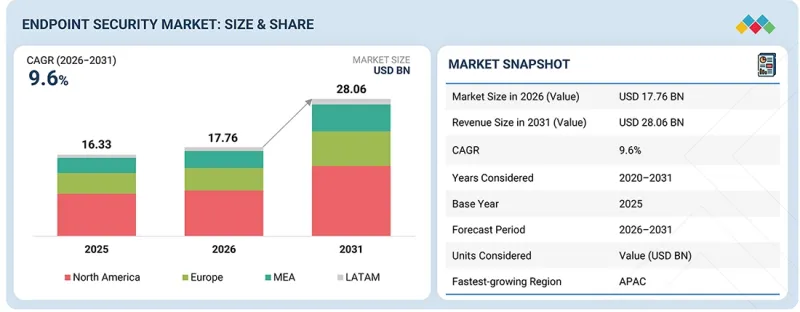
The global endpoint security market is projected to grow from USD 17.76 billion in 2026 to USD 28.06 billion by 2031, registering a CAGR of 9.6% during the forecast period.
| Scope of the Report | |
|---|---|
| Years Considered for the Study | 2020-2031 |
| Base Year | 2025 |
| Forecast Period | 2026-2031 |
| Units Considered | Value (USD Million/Billion) |
| Segments | Type, Enforcement Point, Deployment Mode, Organization Size, Vertical, and Region |
| Regions covered | North America, Europe, Asia Pacific, the Middle East & Africa, and Latin America |
The endpoint security market is experiencing strong growth, driven by the increasing sophistication of cyberattacks and the expanding endpoint attack surface resulting from hybrid work, BYOD, and the proliferation of connected devices. In response, organizations are increasingly adopting Zero Trust security frameworks and investing in cloud-native endpoint security platforms, Unified Endpoint Management (UEM), and AI-powered security capabilities to improve endpoint visibility, automate threat detection, and strengthen overall cyber resilience. Additionally, evolving cybersecurity and data privacy regulations continue to accelerate the adoption of endpoint security solutions. However, market growth is constrained by the shortage of skilled cybersecurity professionals and the complexity of integrating modern endpoint security solutions with legacy IT environments.
"By type, the EPP & EDR segment is anticipated to account for the largest market share."
Endpoint Protection Platforms (EPP) and Endpoint Detection and Response (EDR) collectively form the core of modern endpoint security by combining preventive controls with continuous monitoring, threat investigation, and response capabilities. EPP establishes the first line of defense through next-generation antivirus, anti-malware, host firewall, application control, device control, exploit prevention, and attack surface reduction, protecting enterprise endpoints against both known and emerging threats. EDR complements these capabilities by continuously collecting endpoint telemetry, analyzing behavioral indicators, reconstructing attack timelines, and enabling security teams to investigate, isolate, and remediate compromised devices from a centralized console. The integration of these technologies allows organizations to secure laptops, desktops, servers, virtual desktops, and remote workforce devices while supporting automated incident response and threat hunting workflows.
By enforcement point, the workstations segment is anticipated to account for the largest market share.
Workstations hold the largest market share in the endpoint security market due to their widespread use across enterprise environments and their role in accessing critical business applications and sensitive data. The growing adoption of hybrid work has further expanded the attack surface, making workstations a primary target for ransomware, phishing, credential theft, and other endpoint attacks. According to the Microsoft Digital Defense Report 2024, human-operated ransomware encounters increased by 2.75x between July 2023 and June 2024, while Microsoft now detects more than 600 million identity attacks daily. These evolving threats are driving organizations to adopt advanced workstation security capabilities such as behavioral analytics, attack surface reduction, endpoint isolation, and AI-assisted threat detection. Solutions from vendors such as Microsoft and CrowdStrike provide centralized protection, real-time monitoring, and rapid incident response across enterprise workstations.
"North America is anticipated to account for the largest market share.
North America holds the largest share of the endpoint security market, supported by its mature digital infrastructure, widespread cloud adoption, and increasing investments in cybersecurity. In February 2024, the US recorded approximately 331.1 million internet users, representing an internet penetration rate of 97.1%, contributing to a rapidly expanding endpoint landscape. Rising cyber incidents continue to drive demand for Endpoint Protection Platforms (EPP), Endpoint Detection and Response (EDR), and Zero Trust security solutions. High-profile breaches, including the RCMP cyber incident and the FCC's USD 31.5 million settlement with T-Mobile following multiple data breaches, have reinforced the need for stronger endpoint protection. Additionally, regulatory initiatives such as the SEC Cybersecurity Disclosure Rules and the adoption of the NIST Cybersecurity Framework 2.0 are accelerating enterprise investments in advanced endpoint security.
In-depth interviews were conducted with Chief Executive Officers (CEOs), marketing directors, other innovation and technology directors, and executives from various key organizations operating in the endpoint security market, and information was gathered from secondary research to determine and verify the market size of several segments.
- By Company Type: Tier 1 - 35%, Tier 2 - 45%, and Tier 3 - 20%
- By Designation: C-level - 40% and Managerial & Other Levels - 60%
- By Region: North America - 35%, Europe - 20%, Asia Pacific - 25%, MEA - 15%, and Latin America - 5%
The endpoint security market comprises major companies, such as Microsoft (US), CrowdStrike (US), SentinelOne (US), Palo Alto Networks (US), Check Point (Israel), Broadcom (US), Elastic (Netherlands), and TrendAI (Trend Micro) (Japan). The study includes an in-depth competitive analysis of these key players in the endpoint security market, with their company profiles, recent developments, and key market strategies.
Research Coverage
This report segments the market for endpoint security market on the basis of type, enforcement point, deployment mode, organization size, vertical, and region and provides estimations for the overall value of the market across various regions. A detailed analysis of key industry players has been conducted to provide insights into their business overviews, products & services, key strategies, and expansions associated with the endpoint security market.
Key benefits of buying this report
This research report is focused on various levels of analysis-industry analysis (industry trends), market ranking analysis of top players, and company profiles, which together provide an overall view of the competitive landscape; emerging and high-growth segments of the endpoint security market; high-growth regions; and market drivers, restraints, opportunities, and challenges.
The report provides insights into the following points:
- Analysis of Market: Drivers (Growing sophistication and frequency of cyberattacks, Increasing adoption of remote/hybrid work, BYOD, and IoT devices, Rising implementation of Zero Trust security frameworks), restraints (High deployment and operational costs, Complexity of integrating endpoint security with legacy IT environments), opportunities (Growing migration to cloud-based endpoint security and unified endpoint management (UEM), Integration of AI/ML and automation into endpoint security solutions), and challenges (Shortage of skilled cybersecurity professionals, Ensuring consistent security and visibility across distributed endpoint environments) influencing the growth of the endpoint security market
- Market Penetration: Comprehensive information on endpoint security services and solutions offered by top players in the market
- Product Development/Innovation: Detailed insights on upcoming technologies, product launches, expansions, and acquisitions in the endpoint security market
- Market Development: Comprehensive information about lucrative emerging markets; the report analyzes the markets for endpoint security across regions
- Competitive Assessment: In-depth assessment of market shares, strategies, products, and services of leading players in the endpoint security market
TABLE OF CONTENTS
1 INTRODUCTION
- 1.1 STUDY OBJECTIVES
- 1.2 MARKET DEFINITION
- 1.3 STUDY SCOPE AND SEGMENTATION
- 1.3.1 MARKET SEGMENTATION
- 1.3.2 INCLUSIONS AND EXCLUSIONS
- 1.3.3 YEARS CONSIDERED
- 1.4 CURRENCY CONSIDERED
- 1.5 STAKEHOLDERS
- 1.6 SUMMARY OF CHANGES
2 EXECUTIVE SUMMARY
- 2.1 MARKET HIGHLIGHTS AND KEY INSIGHTS
- 2.2 KEY MARKET PARTICIPANTS: MAPPING OF STRATEGIC DEVELOPMENTS
- 2.3 DISRUPTIVE TRENDS SHAPING MARKET
- 2.4 HIGH-GROWTH SEGMENTS AND EMERGING FRONTIERS
- 2.5 REGIONAL SNAPSHOT: MARKET SIZE, GROWTH RATE, AND FORECAST
3 PREMIUM INSIGHTS
- 3.1 ATTRACTIVE OPPORTUNITIES FOR PLAYERS IN ENDPOINT SECURITY MARKET
- 3.2 ENDPOINT SECURITY MARKET, BY TYPE
- 3.3 ENDPOINT SECURITY MARKET, BY ENFORCEMENT POINT
- 3.4 ENDPOINT SECURITY MARKET, BY DEPLOYMENT MODE
- 3.5 ENDPOINT SECURITY MARKET, BY ORGANIZATION SIZE
- 3.6 ENDPOINT SECURITY MARKET, BY VERTICAL
- 3.7 ENDPOINT SECURITY MARKET, BY REGION
4 MARKET OVERVIEW
- 4.1 INTRODUCTION
- 4.2 MARKET DYNAMICS
- 4.2.1 DRIVERS
- 4.2.1.1 Growing sophistication and frequency of cyberattacks
- 4.2.1.2 Increasing adoption of remote/hybrid work, BYOD, and IoT devices
- 4.2.1.3 Rising implementation of Zero Trust security frameworks
- 4.2.2 RESTRAINTS
- 4.2.2.1 High deployment and operational costs
- 4.2.2.2 Complexity of integrating endpoint security with legacy IT environments
- 4.2.3 OPPORTUNITIES
- 4.2.3.1 Growing migration to cloud-based endpoint security and unified endpoint management (UEM)
- 4.2.3.2 Integration of AI/ML and automation into endpoint security solutions
- 4.2.4 CHALLENGES
- 4.2.4.1 Shortage of skilled cybersecurity professionals
- 4.2.4.2 Ensuring consistent security and visibility across distributed endpoint environments
- 4.2.1 DRIVERS
- 4.3 UNMET NEEDS AND WHITE SPACES
- 4.4 INTERCONNECTED MARKETS AND CROSS-SECTOR OPPORTUNITIES
- 4.4.1 INTERCONNECTED MARKETS
- 4.4.2 CROSS-SECTOR OPPORTUNITIES
- 4.5 STRATEGIC MOVES BY TIER -1/2/3 PLAYERS
- 4.5.1 CROSS-TIER STRATEGIC PATTERNS
- 4.5.2 STRATEGIC TRENDS
- 4.5.2.1 Integration of AI-driven threat detection and autonomous response
- 4.5.2.2 Convergence of endpoint security with unified security platforms
- 4.5.2.3 Expansion of cloud-native endpoint security and Unified Endpoint Management (UEM)
- 4.5.2.4 Growing adoption of risk-based exposure management
- 4.5.2.5 Strengthening Zero Trust and identity-centric endpoint protection
5 INDUSTRY TRENDS
- 5.1 PORTER'S FIVE FORCES ANALYSIS
- 5.1.1 THREAT OF NEW ENTRANTS
- 5.1.2 THREAT OF SUBSTITUTES
- 5.1.3 BARGAINING POWER OF SUPPLIERS
- 5.1.4 BARGAINING POWER OF BUYERS
- 5.1.5 INTENSITY OF COMPETITIVE RIVALRY
- 5.2 MACROECONOMIC INDICATORS
- 5.2.1 INTRODUCTION
- 5.2.2 GDP TRENDS AND FORECAST
- 5.2.3 TRENDS IN GLOBAL ICT INDUSTRY
- 5.2.4 TRENDS IN GLOBAL CYBERSECURITY INDUSTRY
- 5.3 VALUE CHAIN ANALYSIS
- 5.3.1 RESEARCH AND DEVELOPMENT
- 5.3.2 PLANNING AND DESIGNING
- 5.3.3 SOLUTION AND SERVICE PROVIDERS
- 5.3.4 SYSTEM INTEGRATORS
- 5.3.5 DISTRIBUTORS/RESELLERS/VARS
- 5.3.6 VERTICALS
- 5.4 ECOSYSTEM ANALYSIS
- 5.5 PRICING ANALYSIS
- 5.5.1 AVERAGE SELLING PRICE OF KEY PLAYERS, BY DEPLOYMENT SIZE, 2026
- 5.5.2 INDICATIVE PRICING ANALYSIS, BY VENDOR, 2026
- 5.6 TRADE ANALYSIS
- 5.6.1 IMPORT SCENARIO (HS CODE 8523)
- 5.6.2 EXPORT SCENARIO (HS CODE 8523)
- 5.7 KEY CONFERENCES AND EVENTS IN 2026-2027
- 5.8 TRENDS/DISRUPTIONS IMPACTING CUSTOMER BUSINESS
- 5.9 INVESTMENT AND FUNDING SCENARIO
- 5.10 CASE STUDY ANALYSIS
- 5.10.1 EUROPE ENERGY PROTECTS CUSTOMER DATA AND MULTIMILLION-EURO TRADING TRANSACTIONS WITH CROWDSTRIKE SOLUTIONS
- 5.10.2 AUSTRALIAN MEDIA LEADER STRENGTHENS CLOUD PUBLISHING SECURITY WITH PALO ALTO NETWORKS PLATFORM
- 5.10.3 UNIVERSITY BOOSTS ENDPOINT SECURITY WITH SYMANTEC MANAGEMENT SUITE
- 5.10.4 SOPHOS INSPIRES HEALTHCARE PROVIDER TO TAKE SECURITY TO ADVANCED LEVEL OF ENDPOINT AND NETWORK PROTECTION
- 5.10.5 STRENGTHENING CYBERSECURITY AT BOLSHOI THEATRE WITH KASPERSKY'S MANAGED DETECTION AND RESPONSE SOLUTION
- 5.11 IMPACT OF 2025 US TARIFF - ENDPOINT SECURITY MARKET
- 5.11.1 INTRODUCTION
- 5.11.2 KEY TARIFF RATES
- 5.11.3 PRICE IMPACT ANALYSIS
- 5.11.4 IMPACT ON REGIONS
- 5.11.4.1 North America
- 5.11.4.2 Europe
- 5.11.4.3 Asia Pacific
- 5.11.5 IMPACT ON END-USE INDUSTRIES
6 TECHNOLOGICAL ADVANCEMENTS, AI-DRIVEN IMPACT, PATENTS, INNOVATIONS, AND FUTURE APPLICATIONS
- 6.1 TECHNOLOGY ANALYSIS
- 6.1.1 KEY EMERGING TECHNOLOGIES
- 6.1.1.1 AI/ML and behavioral analytics
- 6.1.1.2 Endpoint detection and response (EDR) and automated remediation
- 6.1.1.3 Cloud-native endpoint security and unified endpoint management (UEM)
- 6.1.1.4 Exposure, vulnerability, and security posture management
- 6.1.1.5 Security automation and autonomous response
- 6.1.2 COMPLEMENTARY TECHNOLOGIES
- 6.1.2.1 Cloud analytics and telemetry correlation
- 6.1.2.2 Threat intelligence
- 6.1.3 ADJACENT TECHNOLOGIES
- 6.1.3.1 Zero Trust architecture (ZTA)
- 6.1.3.2 Public key infrastructure (PKI)
- 6.1.1 KEY EMERGING TECHNOLOGIES
- 6.2 TECHNOLOGY ROADMAP
- 6.2.1 SHORT-TERM (2026-2027) | AI-NATIVE ENDPOINT PROTECTION & CLOUD MANAGEMENT
- 6.2.2 MID-TERM (2027-2030) | AUTONOMOUS ENDPOINT OPERATIONS & PLATFORM CONVERGENCE
- 6.2.3 LONG-TERM (2030-2035+) | AUTONOMOUS, PREDICTIVE, & SELF-ADAPTING ENDPOINT SECURITY
- 6.3 PATENT ANALYSIS
- 6.4 FUTURE APPLICATIONS
- 6.4.1 AI-DRIVEN AUTONOMOUS ENDPOINT PROTECTION & SELF-HEALING OPERATIONS
- 6.4.2 CONTINUOUS ENDPOINT EXPOSURE MANAGEMENT & PREDICTIVE RISK REDUCTION
- 6.4.3 IDENTITY-AWARE ADAPTIVE ENDPOINT SECURITY (ZERO TRUST ENDPOINT ACCESS)
- 6.4.4 AUTONOMOUS ENDPOINT OPERATIONS & POLICY ORCHESTRATION
- 6.4.5 EDGE, IOT, & AUTONOMOUS DEVICE PROTECTION
- 6.5 IMPACT OF AI/GEN AI ON ENDPOINT SECURITY MARKET
- 6.5.1 TOP USE CASES AND MARKET POTENTIAL
- 6.5.2 BEST PRACTICES IN ENDPOINT SECURITY MARKET
- 6.5.3 CASE STUDIES RELATED TO AI IMPLEMENTATION IN ENDPOINT SECURITY MARKET
- 6.5.4 INTERCONNECTED ADJACENT ECOSYSTEM AND IMPACT ON MARKET PLAYERS
- 6.5.5 CLIENTS' READINESS TO ADOPT GENERATIVE AI IN ENDPOINT SECURITY MARKET
- 6.6 SUCCESS STORIES AND REAL-WORLD APPLICATIONS
- 6.6.1 SENTINELONE - AUTONOMOUS ENDPOINT PROTECTION FOR THOUGHTWORKS
- 6.6.2 CROWDSTRIKE - CLOUD-NATIVE ENDPOINT PROTECTION FOR CONCENTRIX
7 REGULATORY LANDSCAPE
- 7.1 REGIONAL REGULATIONS AND COMPLIANCE
- 7.1.1 REGULATORY BODIES, GOVERNMENT AGENCIES, AND OTHER ORGANIZATIONS
- 7.1.2 INDUSTRY STANDARDS
8 CONSUMER LANDSCAPE AND BUYER BEHAVIOR
- 8.1 DECISION-MAKING PROCESS
- 8.2 KEY STAKEHOLDERS INVOLVED IN BUYING PROCESS AND THEIR EVALUATION CRITERIA
- 8.2.1 KEY STAKEHOLDERS IN BUYING PROCESS
- 8.2.2 BUYING CRITERIA
- 8.3 ADOPTION BARRIERS AND INTERNAL CHALLENGES
- 8.4 UNMET NEEDS IN VARIOUS END-USE INDUSTRIES
9 ENDPOINT SECURITY MARKET, BY TYPE
- 9.1 INTRODUCTION
- 9.1.1 TYPE: MARKET DRIVERS
- 9.2 ENDPOINT PROTECTION PLATFORM (EPP) & ENDPOINT DETECTION AND RESPONSE (EDR)
- 9.2.1 BEHAVIOR-BASED DETECTION ACCELERATES ADOPTION OF INTEGRATED EPP AND EDR SOLUTIONS
- 9.3 PATCH & VULNERABILITY MANAGEMENT
- 9.3.1 CONTINUOUS EXPOSURE MANAGEMENT DRIVES MARKET GROWTH
- 9.4 UNIFIED ENDPOINT MANAGEMENT (UEM)
- 9.4.1 WORKPLACE MOBILITY TRENDS PROPEL UNIFIED ENDPOINT MANAGEMENT DEPLOYMENTS
- 9.5 ASSET DISCOVERY & MANAGEMENT
- 9.5.1 GROWING DEMAND FOR CONTINUOUS ASSET VISIBILITY ACCELERATES MARKET GROWTH
- 9.6 OTHER TYPES
10 ENDPOINT SECURITY MARKET, BY ENFORCEMENT POINT
- 10.1 INTRODUCTION
- 10.1.1 ENFORCEMENT POINT: MARKET DRIVERS
- 10.2 WORKSTATIONS
- 10.2.1 HYBRID WORK EXPANSION ACCELERATES DEMAND FOR ADVANCED ENDPOINT SECURITY
- 10.3 MOBILE DEVICES
- 10.3.1 RISING MOBILE WORKFORCE EXPANDS DEMAND FOR ENTERPRISE MOBILE ENDPOINT SECURITY
- 10.4 SERVERS
- 10.4.1 INCREASING ATTACKS ON CRITICAL SERVER WORKLOADS FUEL ENDPOINT SECURITY ADOPTION
- 10.5 POS TERMINALS
- 10.5.1 RISING DIGITAL PAYMENT ADOPTION DRIVES DEMAND FOR SECURE POS ENDPOINT PROTECTION
- 10.6 OTHER ENFORCEMENT POINTS
11 ENDPOINT SECURITY MARKET, BY DEPLOYMENT MODE
- 11.1 INTRODUCTION
- 11.1.1 DEPLOYMENT MODE: MARKET DRIVERS
- 11.2 ON-PREMISES
- 11.2.1 DATA SOVEREIGNTY REQUIREMENTS SUSTAIN DEMAND FOR ON-PREMISES ENDPOINT SECURITY
- 11.3 CLOUD
- 11.3.1 SCALABILITY AND EFFICIENCY DRIVE CLOUD-BASED ENDPOINT SECURITY ADOPTION
12 ENDPOINT SECURITY MARKET, BY ORGANIZATION SIZE
- 12.1 INTRODUCTION
- 12.1.1 ORGANIZATION SIZE: MARKET DRIVERS
- 12.2 LARGE ENTERPRISES
- 12.2.1 GROWING IT COMPLEXITY AND SECURITY OPERATIONS DRIVE ENDPOINT SECURITY ADOPTION IN LARGE ENTERPRISES
- 12.3 SMES
- 12.3.1 GROWING CYBERSECURITY AWARENESS AND BUDGET CONSTRAINTS DRIVE ENDPOINT SECURITY ADOPTION AMONG SMES
13 ENDPOINT SECURITY MARKET, BY VERTICAL
- 13.1 INTRODUCTION
- 13.1.1 VERTICAL: MARKET DRIVERS
- 13.2 GOVERNMENT
- 13.2.1 EXPANDING DIGITAL GOVERNMENT SERVICES DRIVE DEMAND FOR ENDPOINT SECURITY
- 13.3 BFSI
- 13.3.1 INCREASING CYBERATTACKS DRIVE NEED FOR INTEGRATED SOLUTIONS
- 13.4 IT & ITES
- 13.4.1 GROWING DIGITAL SERVICE DELIVERY DRIVES ENDPOINT SECURITY ADOPTION
- 13.5 HEALTHCARE & LIFE SCIENCES
- 13.5.1 GROWING DIGITAL HEALTHCARE ECOSYSTEMS DRIVE ENDPOINT SECURITY ADOPTION
- 13.6 AEROSPACE & DEFENSE
- 13.6.1 PROTECTION OF MISSION-CRITICAL AEROSPACE AND DEFENSE SYSTEMS DRIVES ENDPOINT SECURITY ADOPTION
- 13.7 RETAIL & E-COMMERCE
- 13.7.1 EXPANSION OF OMNICHANNEL RETAIL AND DIGITAL PAYMENTS DRIVES ENDPOINT SECURITY ADOPTION
- 13.8 MANUFACTURING
- 13.8.1 ENHANCING MANUFACTURING SECURITY WITH ADVANCED ENDPOINT SECURITY
- 13.9 ENERGY & UTILITIES
- 13.9.1 ADOPTION OF ADVANCED TECHNOLOGIES AND MEETING REGULATORY COMPLIANCE
- 13.10 TELECOMMUNICATIONS
- 13.10.1 LEVERAGING ENDPOINT SECURITY SOLUTIONS TO ENSURE UNINTERRUPTED SERVICE
- 13.11 TRANSPORTATION & LOGISTICS
- 13.11.1 GROWING DIGITAL SUPPLY CHAINS AND CONNECTED LOGISTICS NETWORKS DRIVE ENDPOINT SECURITY DEMAND
- 13.12 MEDIA & ENTERTAINMENT
- 13.12.1 GROWING DIGITAL CONTENT PLATFORMS AND ONLINE ENTERTAINMENT SERVICES DRIVE ENDPOINT SECURITY ADOPTION
- 13.13 EDUCATION
- 13.13.1 SAFEGUARDING EDUCATIONAL INSTITUTIONS WITH ADVANCED ENDPOINT SECURITY
- 13.14 OTHER VERTICALS
14 ENDPOINT SECURITY MARKET, BY REGION
- 14.1 INTRODUCTION
- 14.2 NORTH AMERICA
- 14.2.1 NORTH AMERICA: MARKET DRIVERS
- 14.2.2 US
- 14.2.2.1 Government initiatives and strategic partnerships to strengthen endpoint security adoption
- 14.2.3 CANADA
- 14.2.3.1 Strategic partnerships and enterprise deployments to accelerate endpoint security modernization
- 14.3 EUROPE
- 14.3.1 EUROPE: MARKET DRIVERS
- 14.3.2 UK
- 14.3.2.1 Rising cyber threats and government initiatives to strengthen endpoint security adoption
- 14.3.3 GERMANY
- 14.3.3.1 Cybersecurity innovations to drive demand for endpoint security across critical infrastructure
- 14.3.4 FRANCE
- 14.3.4.1 Rising cyber threats in critical sectors to drive demand for endpoint protection
- 14.3.5 ITALY
- 14.3.5.1 National cybersecurity initiatives to accelerate endpoint security modernization
- 14.3.6 REST OF EUROPE
- 14.4 ASIA PACIFIC
- 14.4.1 ASIA PACIFIC: MARKET DRIVERS
- 14.4.2 CHINA
- 14.4.2.1 Rising cyber espionage to strengthen demand for endpoint security solutions
- 14.4.3 JAPAN
- 14.4.3.1 Strategic partnerships and national cybersecurity initiatives to drive market
- 14.4.4 INDIA
- 14.4.4.1 Rapid digital transformation to accelerate endpoint security adoption
- 14.4.5 REST OF ASIA PACIFIC
- 14.5 MIDDLE EAST & AFRICA
- 14.5.1 MIDDLE EAST & AFRICA: MARKET DRIVERS
- 14.5.2 GULF COOPERATION COUNCIL (GCC) COUNTRIES
- 14.5.2.1 UAE
- 14.5.2.1.1 Cybersecurity initiatives to propel demand for endpoint security
- 14.5.2.2 KSA
- 14.5.2.2.1 Transformative cybersecurity initiatives to drive endpoint security demand
- 14.5.2.3 Rest of GCC countries
- 14.5.2.1 UAE
- 14.5.3 SOUTH AFRICA
- 14.5.3.1 Rising cyber threats and focus on strengthening cyber defense posture to drive market
- 14.5.4 REST OF MIDDLE EAST & AFRICA
- 14.6 LATIN AMERICA
- 14.6.1 LATIN AMERICA: MARKET DRIVERS
- 14.6.2 BRAZIL
- 14.6.2.1 Cybersecurity investments and infrastructure expansion to increase endpoint security demand
- 14.6.3 MEXICO
- 14.6.3.1 AWS's strategic investment to create opportunity for endpoint security advancements
- 14.6.4 REST OF LATIN AMERICA
15 COMPETITIVE LANDSCAPE
- 15.1 KEY PLAYER STRATEGIES/RIGHT TO WIN, 2024-2026
- 15.2 REVENUE ANALYSIS, 2020-2025
- 15.3 MARKET SHARE ANALYSIS, 2025
- 15.4 BRAND COMPARISON
- 15.4.1 MICROSOFT
- 15.4.2 CROWDSTRIKE
- 15.4.3 PALO ALTO NETWORKS
- 15.4.4 TRENDAI (TREND MICRO)
- 15.4.5 BROADCOM
- 15.5 COMPANY VALUATION AND FINANCIAL METRICS
- 15.5.1 COMPANY VALUATION, 2026
- 15.5.2 FINANCIAL METRICS USING EV/EBIDTA, 2026
- 15.6 COMPANY EVALUATION MATRIX: KEY PLAYERS, 2025
- 15.6.1 STARS
- 15.6.2 EMERGING LEADERS
- 15.6.3 PERVASIVE PLAYERS
- 15.6.4 PARTICIPANTS
- 15.6.5 COMPANY FOOTPRINT: KEY PLAYERS, 2025
- 15.6.5.1 Company footprint
- 15.6.5.2 Region footprint
- 15.6.5.3 Type footprint
- 15.6.5.4 Vertical footprint
- 15.7 COMPANY EVALUATION MATRIX: STARTUPS/SMES, 2025
- 15.7.1 PROGRESSIVE COMPANIES
- 15.7.2 RESPONSIVE COMPANIES
- 15.7.3 DYNAMIC COMPANIES
- 15.7.4 STARTING BLOCKS
- 15.7.5 COMPETITIVE BENCHMARKING: STARTUPS/SMES, 2026
- 15.7.5.1 Detailed list of key startups/SMEs
- 15.7.6 COMPETITIVE BENCHMARKING OF KEY STARTUPS/SMES
- 15.7.6.1 Region footprint
- 15.7.6.2 Type footprint
- 15.7.6.3 Deployment mode footprint
- 15.7.6.4 Vertical footprint
- 15.8 COMPETITIVE SCENARIO
- 15.8.1 PRODUCT LAUNCHES & ENHANCEMENTS
- 15.8.2 DEALS
- 15.8.3 EXPANSIONS
- 15.8.4 OTHER DEVELOPMENTS
16 COMPANY PROFILES
- 16.1 KEY PLAYERS
- 16.1.1 MICROSOFT
- 16.1.1.1 Business overview
- 16.1.1.2 Products/Solutions/Services offered
- 16.1.1.3 Recent developments
- 16.1.1.3.1 Product launches and enhancements
- 16.1.1.3.2 Deals
- 16.1.1.4 MnM view
- 16.1.1.4.1 Key strengths
- 16.1.1.4.2 Strategic choices
- 16.1.1.4.3 Weaknesses and competitive threats
- 16.1.2 BROADCOM
- 16.1.2.1 Business overview
- 16.1.2.2 Products/Solutions/Services offered
- 16.1.2.3 Recent developments
- 16.1.2.3.1 Product launches and enhancements
- 16.1.2.4 MnM view
- 16.1.2.4.1 Key strengths
- 16.1.2.4.2 Strategic choices
- 16.1.2.4.3 Weaknesses and competitive threats
- 16.1.3 PALO ALTO NETWORKS
- 16.1.3.1 Business overview
- 16.1.3.2 Products/Solutions/Services offered
- 16.1.3.3 Recent developments
- 16.1.3.3.1 Product launches and enhancements
- 16.1.3.3.2 Deals
- 16.1.3.4 MnM view
- 16.1.3.4.1 Key strengths
- 16.1.3.4.2 Strategic choices
- 16.1.3.4.3 Weaknesses and competitive threats
- 16.1.4 CROWDSTRIKE
- 16.1.4.1 Business overview
- 16.1.4.2 Products/Solutions/Services offered
- 16.1.4.3 Recent developments
- 16.1.4.3.1 Deals
- 16.1.4.4 MnM view
- 16.1.4.4.1 Key strengths
- 16.1.4.4.2 Strategic choices
- 16.1.4.4.3 Weaknesses and competitive threats
- 16.1.5 TRENDAI (TREND MICRO)
- 16.1.5.1 Business overview
- 16.1.5.2 Products/Solutions/Services offered
- 16.1.5.3 Recent developments
- 16.1.5.3.1 Product launches and enhancements
- 16.1.5.3.2 Deals
- 16.1.5.4 MnM view
- 16.1.5.4.1 Key strengths
- 16.1.5.4.2 Strategic choices
- 16.1.5.4.3 Weaknesses and competitive threats
- 16.1.6 FORTINET
- 16.1.6.1 Business overview
- 16.1.6.2 Products/Solutions/Services offered
- 16.1.6.3 Recent developments
- 16.1.6.3.1 Product launches and enhancements
- 16.1.6.3.2 Deals
- 16.1.7 TRELLIX
- 16.1.7.1 Business overview
- 16.1.7.2 Products/Solutions/Services offered
- 16.1.7.3 Recent developments
- 16.1.7.3.1 Deals
- 16.1.8 KASPERSKY
- 16.1.8.1 Business overview
- 16.1.8.2 Products/Solutions/Services offered
- 16.1.8.3 Recent developments
- 16.1.8.3.1 Product launches and enhancements
- 16.1.8.3.2 Deals
- 16.1.8.3.3 Expansions
- 16.1.9 ST ENGINEERING
- 16.1.9.1 Business overview
- 16.1.9.2 Products/Solutions/Services offered
- 16.1.9.3 Recent developments
- 16.1.9.3.1 Deals
- 16.1.10 SOPHOS
- 16.1.10.1 Business overview
- 16.1.10.2 Products/Solutions/Services offered
- 16.1.10.3 Recent developments
- 16.1.10.3.1 Product launches and enhancements
- 16.1.10.3.2 Deals
- 16.1.10.3.3 Other developments
- 16.1.11 CHECK POINT
- 16.1.11.1 Business overview
- 16.1.11.2 Products/Solutions/Services offered
- 16.1.11.3 Recent developments
- 16.1.11.3.1 Product launches and enhancements
- 16.1.11.3.2 Deals
- 16.1.11.3.3 Expansions
- 16.1.12 ESET
- 16.1.12.1 Business overview
- 16.1.12.2 Products/Solutions/Services offered
- 16.1.12.3 Recent developments
- 16.1.12.3.1 Product launches and enhancements
- 16.1.12.3.2 Deals
- 16.1.13 IBM
- 16.1.13.1 Business overview
- 16.1.13.2 Products/Solutions/Services offered
- 16.1.13.3 Recent developments
- 16.1.13.3.1 Deals
- 16.1.14 SENTINELONE
- 16.1.14.1 Business overview
- 16.1.14.2 Products/Solutions/Services offered
- 16.1.14.3 Recent developments
- 16.1.14.3.1 Product launches and enhancements
- 16.1.14.3.2 Deals
- 16.1.15 CISCO
- 16.1.15.1 Business overview
- 16.1.15.2 Products/Solutions/Services offered
- 16.1.15.3 Recent developments
- 16.1.15.3.1 Deals
- 16.1.16 BLACKBERRY
- 16.1.16.1 Business overview
- 16.1.16.2 Products/Solutions/Services offered
- 16.1.16.3 Recent developments
- 16.1.16.3.1 Deals
- 16.1.17 ELASTIC
- 16.1.18 OPTIV
- 16.1.19 OMNISSA
- 16.1.1 MICROSOFT
- 16.2 OTHER KEY PLAYERS
- 16.2.1 CORO
- 16.2.2 ACRONIS
- 16.2.3 VIPRE SECURITY GROUP
- 16.2.4 MORPHISEC
- 16.2.5 XCITIUM
- 16.2.6 SECURDEN
- 16.2.7 DEEP INSTINCT
- 16.2.8 CYBEREASON
- 16.2.9 TANIUM
- 16.2.10 42GEARS
- 16.2.11 ADAPTIVA
- 16.2.12 X-PHY INC.
- 16.2.13 FIDELIS SECURITY
17 RESEARCH METHODOLOGY
- 17.1 RESEARCH DATA
- 17.1.1 SECONDARY DATA
- 17.1.2 PRIMARY DATA
- 17.1.2.1 Breakup of primary profiles
- 17.1.2.2 Key insights from industry experts
- 17.2 DATA TRIANGULATION
- 17.3 MARKET SIZE ESTIMATION
- 17.3.1 TOP-DOWN APPROACH
- 17.3.2 BOTTOM-UP APPROACH
- 17.4 MARKET FORECAST
- 17.5 RESEARCH ASSUMPTIONS
- 17.6 RESEARCH LIMITATIONS
18 APPENDIX
- 18.1 DISCUSSION GUIDE
- 18.2 KNOWLEDGESTORE: MARKETSANDMARKETS' SUBSCRIPTION PORTAL
- 18.3 CUSTOMIZATION OPTIONS
- 18.4 RELATED REPORTS
- 18.5 AUTHOR DETAILS
List of Tables
- TABLE 1 USD EXCHANGE RATES, 2020-2025
- TABLE 2 UNMET NEEDS AND WHITE SPACES IN ENDPOINT SECURITY MARKET
- TABLE 3 STRATEGIC MOVES BY PLAYERS IN ENDPOINT SECURITY MARKET
- TABLE 4 CROSS-TIER STRATEGIC PATTERNS OF VENDORS
- TABLE 5 IMPACT OF PORTER'S FIVE FORCES ON ENDPOINT SECURITY MARKET
- TABLE 6 GDP PERCENTAGE CHANGE, BY KEY COUNTRY, 2021-2030
- TABLE 7 ROLE OF COMPANIES IN ECOSYSTEM
- TABLE 8 AVERAGE SELLING PRICE OF KEY PLAYERS, BY DEPLOYMENT SIZE, 2026 (USD)
- TABLE 9 INDICATIVE PRICING ANALYSIS OF KEY ENDPOINT SECURITY VENDORS, BY PRODUCT, 2026 (USD)
- TABLE 10 IMPORT DATA FOR HS CODE: 8523, BY COUNTRY, 2021-2025 (USD MILLION)
- TABLE 11 EXPORT DATA FOR HS CODE: 8523, BY COUNTRY, 2021-2025 (USD MILLION)
- TABLE 12 ENDPOINT SECURITY MARKET: LIST OF KEY CONFERENCES AND EVENTS, 2026-2027
- TABLE 13 KEY TARIFF RATES
- TABLE 14 LIST OF TOP PATENTS IN ENDPOINT SECURITY MARKET, 2024-2026
- TABLE 15 TOP USE CASES AND MARKET POTENTIAL
- TABLE 16 BEST PRACTICES: COMPANIES IMPLEMENTING USE CASES
- TABLE 17 ENDPOINT SECURITY MARKET: CASE STUDIES RELATED TO GEN AI IMPLEMENTATION
- TABLE 18 INTERCONNECTED ADJACENT ECOSYSTEM AND IMPACT ON MARKET PLAYERS
- TABLE 19 NORTH AMERICA: LIST OF REGULATORY BODIES, GOVERNMENT AGENCIES, AND OTHER ORGANIZATIONS
- TABLE 20 EUROPE: LIST OF REGULATORY BODIES, GOVERNMENT AGENCIES, AND OTHER ORGANIZATIONS
- TABLE 21 ASIA PACIFIC: LIST OF REGULATORY BODIES, GOVERNMENT AGENCIES, AND OTHER ORGANIZATIONS
- TABLE 22 REST OF THE WORD: LIST OF REGULATORY BODIES, GOVERNMENT AGENCIES, AND OTHER ORGANIZATIONS
- TABLE 23 GLOBAL INDUSTRY STANDARDS IN ENDPOINT SECURITY MARKET
- TABLE 24 INFLUENCE OF STAKEHOLDERS ON BUYING PROCESS FOR TOP THREE VERTICALS (%)
- TABLE 25 KEY BUYING CRITERIA FOR TOP THREE VERTICALS
- TABLE 26 UNMET NEEDS IN ENDPOINT SECURITY MARKET, BY END-USE INDUSTRY
- TABLE 27 ENDPOINT SECURITY MARKET, BY TYPE, 2020-2025 (USD MILLION)
- TABLE 28 ENDPOINT SECURITY MARKET, BY TYPE, 2026-2031 (USD MILLION)
- TABLE 29 EPP & EDR: ENDPOINT SECURITY MARKET, BY REGION, 2020-2025 (USD MILLION)
- TABLE 30 EPP & EDR: ENDPOINT SECURITY MARKET, BY REGION, 2026-2031 (USD MILLION)
- TABLE 31 PATCH & VULNERABILITY MANAGEMENT: ENDPOINT SECURITY MARKET, BY REGION, 2020-2025 (USD MILLION)
- TABLE 32 PATCH & VULNERABILITY MANAGEMENT: ENDPOINT SECURITY MARKET, BY REGION, 2026-2031 (USD MILLION)
- TABLE 33 UNIFIED ENDPOINT MANAGEMENT (UEM): ENDPOINT SECURITY MARKET, BY REGION, 2020-2025 (USD MILLION)
- TABLE 34 UNIFIED ENDPOINT MANAGEMENT (UEM): ENDPOINT SECURITY MARKET, BY REGION, 2026-2031 (USD MILLION)
- TABLE 35 ASSET DISCOVERY & MANAGEMENT: ENDPOINT SECURITY MARKET, BY REGION, 2020-2025 (USD MILLION)
- TABLE 36 ASSET DISCOVERY & MANAGEMENT: ENDPOINT SECURITY MARKET, BY REGION, 2026-2031 (USD MILLION)
- TABLE 37 OTHER TYPES: ENDPOINT SECURITY MARKET, BY REGION, 2020-2025 (USD MILLION)
- TABLE 38 OTHER TYPES: ENDPOINT SECURITY MARKET, BY REGION, 2026-2031 (USD MILLION)
- TABLE 39 ENDPOINT SECURITY MARKET, BY ENFORCEMENT POINT, 2020-2025 (USD MILLION)
- TABLE 40 ENDPOINT SECURITY MARKET, BY ENFORCEMENT POINT, 2026-2031 (USD MILLION)
- TABLE 41 WORKSTATIONS: ENDPOINT SECURITY MARKET, BY REGION, 2020-2025 (USD MILLION)
- TABLE 42 WORKSTATIONS: ENDPOINT SECURITY MARKET, BY REGION, 2026-2031 (USD MILLION)
- TABLE 43 MOBILE DEVICES: ENDPOINT SECURITY MARKET, BY REGION, 2020-2025 (USD MILLION)
- TABLE 44 MOBILE DEVICES: ENDPOINT SECURITY MARKET, BY REGION, 2026-2031 (USD MILLION)
- TABLE 45 SERVERS: ENDPOINT SECURITY MARKET, BY REGION, 2020-2025 (USD MILLION)
- TABLE 46 SERVERS: ENDPOINT SECURITY MARKET, BY REGION, 2026-2031 (USD MILLION)
- TABLE 47 POS TERMINALS: ENDPOINT SECURITY MARKET, BY REGION, 2020-2025 (USD MILLION)
- TABLE 48 POS TERMINALS: ENDPOINT SECURITY MARKET, BY REGION, 2026-2031 (USD MILLION)
- TABLE 49 OTHER ENFORCEMENT POINTS: ENDPOINT SECURITY MARKET, BY REGION, 2020-2025 (USD MILLION)
- TABLE 50 OTHER ENFORCEMENT POINTS: ENDPOINT SECURITY MARKET, BY REGION, 2026-2031 (USD MILLION)
- TABLE 51 ENDPOINT SECURITY MARKET, BY DEPLOYMENT MODE, 2020-2025 (USD MILLION)
- TABLE 52 ENDPOINT SECURITY MARKET, BY DEPLOYMENT MODE, 2026-2031 (USD MILLION)
- TABLE 53 ON-PREMISES: ENDPOINT SECURITY MARKET, BY REGION, 2020-2025 (USD MILLION)
- TABLE 54 ON-PREMISES: ENDPOINT SECURITY MARKET, BY REGION, 2026-2031 (USD MILLION)
- TABLE 55 CLOUD: ENDPOINT SECURITY MARKET, BY REGION, 2020-2025 (USD MILLION)
- TABLE 56 CLOUD: ENDPOINT SECURITY MARKET, BY REGION, 2026-2031 (USD MILLION)
- TABLE 57 ENDPOINT SECURITY MARKET, BY ORGANIZATION SIZE, 2020-2025 (USD MILLION)
- TABLE 58 ENDPOINT SECURITY MARKET, BY ORGANIZATION SIZE, 2026-2031 (USD MILLION)
- TABLE 59 LARGE ENTERPRISES: ENDPOINT SECURITY MARKET, BY REGION, 2020-2025 (USD MILLION)
- TABLE 60 LARGE ENTERPRISES: ENDPOINT SECURITY MARKET, BY REGION, 2026-2031 (USD MILLION)
- TABLE 61 SMES: ENDPOINT SECURITY MARKET, BY REGION, 2020-2025 (USD MILLION)
- TABLE 62 SMES: ENDPOINT SECURITY MARKET, BY REGION, 2026-2031 (USD MILLION)
- TABLE 63 ENDPOINT SECURITY MARKET, BY VERTICAL, 2020-2025 (USD MILLION)
- TABLE 64 ENDPOINT SECURITY MARKET, BY VERTICAL, 2026-2031 (USD MILLION)
- TABLE 65 GOVERNMENT: ENDPOINT SECURITY MARKET, BY REGION, 2020-2025 (USD MILLION)
- TABLE 66 GOVERNMENT: ENDPOINT SECURITY MARKET, BY REGION, 2026-2031 (USD MILLION)
- TABLE 67 BFSI: ENDPOINT SECURITY MARKET, BY REGION, 2020-2025 (USD MILLION)
- TABLE 68 BFSI: ENDPOINT SECURITY MARKET, BY REGION, 2026-2031 (USD MILLION)
- TABLE 69 IT & ITES: ENDPOINT SECURITY MARKET, BY REGION, 2020-2025 (USD MILLION)
- TABLE 70 IT & ITES: ENDPOINT SECURITY MARKET, BY REGION, 2026-2031 (USD MILLION)
- TABLE 71 HEALTHCARE & LIFE SCIENCES: ENDPOINT SECURITY MARKET, BY REGION, 2020-2025 (USD MILLION)
- TABLE 72 HEALTHCARE & LIFE SCIENCES: ENDPOINT SECURITY MARKET, BY REGION, 2026-2031 (USD MILLION)
- TABLE 73 AEROSPACE & DEFENSE: ENDPOINT SECURITY MARKET, BY REGION, 2020-2025 (USD MILLION)
- TABLE 74 AEROSPACE & DEFENSE: ENDPOINT SECURITY MARKET, BY REGION, 2026-2031 (USD MILLION)
- TABLE 75 RETAIL & E-COMMERCE: ENDPOINT SECURITY MARKET, BY REGION, 2020-2025 (USD MILLION)
- TABLE 76 RETAIL & E-COMMERCE: ENDPOINT SECURITY MARKET, BY REGION, 2026-2031 (USD MILLION)
- TABLE 77 MANUFACTURING: ENDPOINT SECURITY MARKET, BY REGION, 2020-2025 (USD MILLION)
- TABLE 78 MANUFACTURING: ENDPOINT SECURITY MARKET, BY REGION, 2026-2031 (USD MILLION)
- TABLE 79 ENERGY & UTILITIES: ENDPOINT SECURITY MARKET, BY REGION, 2020-2025 (USD MILLION)
- TABLE 80 ENERGY & UTILITIES: ENDPOINT SECURITY MARKET, BY REGION, 2026-2031 (USD MILLION)
- TABLE 81 TELECOMMUNICATIONS: ENDPOINT SECURITY MARKET, BY REGION, 2020-2025 (USD MILLION)
- TABLE 82 TELECOMMUNICATIONS: ENDPOINT SECURITY MARKET, BY REGION, 2026-2031 (USD MILLION)
- TABLE 83 TRANSPORTATION & LOGISTICS: ENDPOINT SECURITY MARKET, BY REGION, 2020-2025 (USD MILLION)
- TABLE 84 TRANSPORTATION & LOGISTICS: ENDPOINT SECURITY MARKET, BY REGION, 2026-2031 (USD MILLION)
- TABLE 85 MEDIA & ENTERTAINMENT: ENDPOINT SECURITY MARKET, BY REGION, 2020-2025 (USD MILLION)
- TABLE 86 MEDIA & ENTERTAINMENT: ENDPOINT SECURITY MARKET, BY REGION, 2026-2031 (USD MILLION)
- TABLE 87 EDUCATION: ENDPOINT SECURITY MARKET, BY REGION, 2020-2025 (USD MILLION)
- TABLE 88 EDUCATION: ENDPOINT SECURITY MARKET, BY REGION, 2026-2031 (USD MILLION)
- TABLE 89 OTHER VERTICALS: ENDPOINT SECURITY MARKET, BY REGION, 2020-2025 (USD MILLION)
- TABLE 90 OTHER VERTICALS: ENDPOINT SECURITY MARKET, BY REGION, 2026-2031 (USD MILLION)
- TABLE 91 ENDPOINT SECURITY MARKET, BY REGION, 2020-2025 (USD MILLION)
- TABLE 92 ENDPOINT SECURITY MARKET, BY REGION, 2026-2031 (USD MILLION)
- TABLE 93 NORTH AMERICA: ENDPOINT SECURITY MARKET, BY TYPE, 2020-2025 (USD MILLION)
- TABLE 94 NORTH AMERICA: ENDPOINT SECURITY MARKET, BY TYPE, 2026-2031 (USD MILLION)
- TABLE 95 NORTH AMERICA: ENDPOINT SECURITY MARKET, BY ENFORCEMENT POINT, 2020-2025 (USD MILLION)
- TABLE 96 NORTH AMERICA: ENDPOINT SECURITY MARKET, BY ENFORCEMENT POINT, 2026-2031 (USD MILLION)
- TABLE 97 NORTH AMERICA: ENDPOINT SECURITY MARKET, BY DEPLOYMENT MODE, 2020-2025 (USD MILLION)
- TABLE 98 NORTH AMERICA: ENDPOINT SECURITY MARKET, BY DEPLOYMENT MODE, 2026-2031 (USD MILLION)
- TABLE 99 NORTH AMERICA: ENDPOINT SECURITY MARKET, BY ORGANIZATION SIZE, 2020-2025 (USD MILLION)
- TABLE 100 NORTH AMERICA: ENDPOINT SECURITY MARKET, BY ORGANIZATION SIZE, 2026-2031 (USD MILLION)
- TABLE 101 NORTH AMERICA: ENDPOINT SECURITY MARKET, BY VERTICAL, 2020-2025 (USD MILLION)
- TABLE 102 NORTH AMERICA: ENDPOINT SECURITY MARKET, BY VERTICAL, 2026-2031 (USD MILLION)
- TABLE 103 NORTH AMERICA: ENDPOINT SECURITY MARKET, BY COUNTRY, 2020-2025 (USD MILLION)
- TABLE 104 NORTH AMERICA: ENDPOINT SECURITY MARKET, BY COUNTRY, 2026-2031 (USD MILLION)
- TABLE 105 US: ENDPOINT SECURITY MARKET, BY TYPE, 2020-2025 (USD MILLION)
- TABLE 106 US: ENDPOINT SECURITY MARKET, BY TYPE, 2026-2031 (USD MILLION)
- TABLE 107 US: ENDPOINT SECURITY MARKET, BY ENFORCEMENT POINT, 2020-2025 (USD MILLION)
- TABLE 108 US: ENDPOINT SECURITY MARKET, BY ENFORCEMENT POINT, 2026-2031 (USD MILLION)
- TABLE 109 US: ENDPOINT SECURITY MARKET, BY DEPLOYMENT MODE, 2020-2025 (USD MILLION)
- TABLE 110 US: ENDPOINT SECURITY MARKET, BY DEPLOYMENT MODE, 2026-2031 (USD MILLION)
- TABLE 111 US: ENDPOINT SECURITY MARKET, BY ORGANIZATION SIZE, 2020-2025 (USD MILLION)
- TABLE 112 US: ENDPOINT SECURITY MARKET, BY ORGANIZATION SIZE, 2026-2031 (USD MILLION)
- TABLE 113 US: ENDPOINT SECURITY MARKET, BY VERTICAL, 2020-2025 (USD MILLION)
- TABLE 114 US: ENDPOINT SECURITY MARKET, BY VERTICAL, 2026-2031 (USD MILLION)
- TABLE 115 CANADA: ENDPOINT SECURITY MARKET, BY TYPE, 2020-2025 (USD MILLION)
- TABLE 116 CANADA: ENDPOINT SECURITY MARKET, BY TYPE, 2026-2031 (USD MILLION)
- TABLE 117 CANADA: ENDPOINT SECURITY MARKET, BY ENFORCEMENT POINT, 2020-2025 (USD MILLION)
- TABLE 118 CANADA: ENDPOINT SECURITY MARKET, BY ENFORCEMENT POINT, 2026-2031 (USD MILLION)
- TABLE 119 CANADA: ENDPOINT SECURITY MARKET, BY DEPLOYMENT MODE, 2020-2025 (USD MILLION)
- TABLE 120 CANADA: ENDPOINT SECURITY MARKET, BY DEPLOYMENT MODE, 2026-2031 (USD MILLION)
- TABLE 121 CANADA: ENDPOINT SECURITY MARKET, BY ORGANIZATION SIZE, 2020-2025 (USD MILLION)
- TABLE 122 CANADA: ENDPOINT SECURITY MARKET, BY ORGANIZATION SIZE, 2026-2031 (USD MILLION)
- TABLE 123 CANADA: ENDPOINT SECURITY MARKET, BY VERTICAL, 2020-2025 (USD MILLION)
- TABLE 124 CANADA: ENDPOINT SECURITY MARKET, BY VERTICAL, 2026-2031 (USD MILLION)
- TABLE 125 EUROPE: ENDPOINT SECURITY MARKET, BY TYPE, 2020-2025 (USD MILLION)
- TABLE 126 EUROPE: ENDPOINT SECURITY MARKET, BY TYPE, 2026-2031 (USD MILLION)
- TABLE 127 EUROPE: ENDPOINT SECURITY MARKET, BY ENFORCEMENT POINT, 2020-2025 (USD MILLION)
- TABLE 128 EUROPE: ENDPOINT SECURITY MARKET, BY ENFORCEMENT POINT, 2026-2031 (USD MILLION)
- TABLE 129 EUROPE: ENDPOINT SECURITY MARKET, BY DEPLOYMENT MODE, 2020-2025 (USD MILLION)
- TABLE 130 EUROPE: ENDPOINT SECURITY MARKET, BY DEPLOYMENT MODE, 2026-2031 (USD MILLION)
- TABLE 131 EUROPE: ENDPOINT SECURITY MARKET, BY ORGANIZATION SIZE, 2020-2025 (USD MILLION)
- TABLE 132 EUROPE: ENDPOINT SECURITY MARKET, BY ORGANIZATION SIZE, 2026-2031 (USD MILLION)
- TABLE 133 EUROPE: ENDPOINT SECURITY MARKET, BY VERTICAL, 2020-2025 (USD MILLION)
- TABLE 134 EUROPE: ENDPOINT SECURITY MARKET, BY VERTICAL, 2026-2031 (USD MILLION)
- TABLE 135 EUROPE: ENDPOINT SECURITY MARKET, BY COUNTRY, 2020-2025 (USD MILLION)
- TABLE 136 EUROPE: ENDPOINT SECURITY MARKET, BY COUNTRY, 2026-2031 (USD MILLION)
- TABLE 137 UK: ENDPOINT SECURITY MARKET, BY TYPE, 2020-2025 (USD MILLION)
- TABLE 138 UK: ENDPOINT SECURITY MARKET, BY TYPE, 2026-2031 (USD MILLION)
- TABLE 139 UK: ENDPOINT SECURITY MARKET, BY ENFORCEMENT POINT, 2020-2025 (USD MILLION)
- TABLE 140 UK: ENDPOINT SECURITY MARKET, BY ENFORCEMENT POINT, 2026-2031 (USD MILLION)
- TABLE 141 UK: ENDPOINT SECURITY MARKET, BY DEPLOYMENT MODE, 2020-2025 (USD MILLION)
- TABLE 142 UK: ENDPOINT SECURITY MARKET, BY DEPLOYMENT MODE, 2026-2031 (USD MILLION)
- TABLE 143 UK: ENDPOINT SECURITY MARKET, BY ORGANIZATION SIZE, 2020-2025 (USD MILLION)
- TABLE 144 UK: ENDPOINT SECURITY MARKET, BY ORGANIZATION SIZE, 2026-2031 (USD MILLION)
- TABLE 145 UK: ENDPOINT SECURITY MARKET, BY VERTICAL, 2020-2025 (USD MILLION)
- TABLE 146 UK: ENDPOINT SECURITY MARKET, BY VERTICAL, 2026-2031 (USD MILLION)
- TABLE 147 GERMANY: ENDPOINT SECURITY MARKET, BY TYPE, 2020-2025 (USD MILLION)
- TABLE 148 GERMANY: ENDPOINT SECURITY MARKET, BY TYPE, 2026-2031 (USD MILLION)
- TABLE 149 GERMANY: ENDPOINT SECURITY MARKET, BY ENFORCEMENT POINT, 2020-2025 (USD MILLION)
- TABLE 150 GERMANY: ENDPOINT SECURITY MARKET, BY ENFORCEMENT POINT, 2026-2031 (USD MILLION)
- TABLE 151 GERMANY: ENDPOINT SECURITY MARKET, BY DEPLOYMENT MODE, 2020-2025 (USD MILLION)
- TABLE 152 GERMANY: ENDPOINT SECURITY MARKET, BY DEPLOYMENT MODE, 2026-2031 (USD MILLION)
- TABLE 153 GERMANY: ENDPOINT SECURITY MARKET, BY ORGANIZATION SIZE, 2020-2025 (USD MILLION)
- TABLE 154 GERMANY: ENDPOINT SECURITY MARKET, BY ORGANIZATION SIZE, 2026-2031 (USD MILLION)
- TABLE 155 GERMANY: ENDPOINT SECURITY MARKET, BY VERTICAL, 2020-2025 (USD MILLION)
- TABLE 156 GERMANY: ENDPOINT SECURITY MARKET, BY VERTICAL, 2026-2031 (USD MILLION)
- TABLE 157 FRANCE: ENDPOINT SECURITY MARKET, BY TYPE, 2020-2025 (USD MILLION)
- TABLE 158 FRANCE: ENDPOINT SECURITY MARKET, BY TYPE, 2026-2031 (USD MILLION)
- TABLE 159 FRANCE: ENDPOINT SECURITY MARKET, BY ENFORCEMENT POINT, 2020-2025 (USD MILLION)
- TABLE 160 FRANCE: ENDPOINT SECURITY MARKET, BY ENFORCEMENT POINT, 2026-2031 (USD MILLION)
- TABLE 161 FRANCE: ENDPOINT SECURITY MARKET, BY DEPLOYMENT MODE, 2020-2025 (USD MILLION)
- TABLE 162 FRANCE: ENDPOINT SECURITY MARKET, BY DEPLOYMENT MODE, 2026-2031 (USD MILLION)
- TABLE 163 FRANCE: ENDPOINT SECURITY MARKET, BY ORGANIZATION SIZE, 2020-2025 (USD MILLION)
- TABLE 164 FRANCE: ENDPOINT SECURITY MARKET, BY ORGANIZATION SIZE, 2026-2031 (USD MILLION)
- TABLE 165 FRANCE: ENDPOINT SECURITY MARKET, BY VERTICAL, 2020-2025 (USD MILLION)
- TABLE 166 FRANCE: ENDPOINT SECURITY MARKET, BY VERTICAL, 2026-2031 (USD MILLION)
- TABLE 167 ITALY: ENDPOINT SECURITY MARKET, BY TYPE, 2020-2025 (USD MILLION)
- TABLE 168 ITALY: ENDPOINT SECURITY MARKET, BY TYPE, 2026-2031 (USD MILLION)
- TABLE 169 ITALY: ENDPOINT SECURITY MARKET, BY ENFORCEMENT POINT, 2020-2025 (USD MILLION)
- TABLE 170 ITALY: ENDPOINT SECURITY MARKET, BY ENFORCEMENT POINT, 2026-2031 (USD MILLION)
- TABLE 171 ITALY: ENDPOINT SECURITY MARKET, BY DEPLOYMENT MODE, 2020-2025 (USD MILLION)
- TABLE 172 ITALY: ENDPOINT SECURITY MARKET, BY DEPLOYMENT MODE, 2026-2031 (USD MILLION)
- TABLE 173 ITALY: ENDPOINT SECURITY MARKET, BY ORGANIZATION SIZE, 2020-2025 (USD MILLION)
- TABLE 174 ITALY: ENDPOINT SECURITY MARKET, BY ORGANIZATION SIZE, 2026-2031 (USD MILLION)
- TABLE 175 ITALY: ENDPOINT SECURITY MARKET, BY VERTICAL, 2020-2025 (USD MILLION)
- TABLE 176 ITALY: ENDPOINT SECURITY MARKET, BY VERTICAL, 2026-2031 (USD MILLION)
- TABLE 177 REST OF EUROPE: ENDPOINT SECURITY MARKET, BY TYPE, 2020-2025 (USD MILLION)
- TABLE 178 REST OF EUROPE: ENDPOINT SECURITY MARKET, BY TYPE, 2026-2031 (USD MILLION)
- TABLE 179 REST OF EUROPE: ENDPOINT SECURITY MARKET, BY ENFORCEMENT POINT, 2020-2025 (USD MILLION)
- TABLE 180 REST OF EUROPE: ENDPOINT SECURITY MARKET, BY ENFORCEMENT POINT, 2026-2031 (USD MILLION)
- TABLE 181 REST OF EUROPE: ENDPOINT SECURITY MARKET, BY DEPLOYMENT MODE, 2020-2025 (USD MILLION)
- TABLE 182 REST OF EUROPE: ENDPOINT SECURITY MARKET, BY DEPLOYMENT MODE, 2026-2031 (USD MILLION)
- TABLE 183 REST OF EUROPE: ENDPOINT SECURITY MARKET, BY ORGANIZATION SIZE, 2020-2025 (USD MILLION)
- TABLE 184 REST OF EUROPE: ENDPOINT SECURITY MARKET, BY ORGANIZATION SIZE, 2026-2031 (USD MILLION)
- TABLE 185 REST OF EUROPE: ENDPOINT SECURITY MARKET, BY VERTICAL, 2020-2025 (USD MILLION)
- TABLE 186 REST OF EUROPE: ENDPOINT SECURITY MARKET, BY VERTICAL, 2026-2031 (USD MILLION)
- TABLE 187 ASIA PACIFIC: ENDPOINT SECURITY MARKET, BY TYPE, 2020-2025 (USD MILLION)
- TABLE 188 ASIA PACIFIC: ENDPOINT SECURITY MARKET, BY TYPE, 2026-2031 (USD MILLION)
- TABLE 189 ASIA PACIFIC: ENDPOINT SECURITY MARKET, BY ENFORCEMENT POINT, 2020-2025 (USD MILLION)
- TABLE 190 ASIA PACIFIC: ENDPOINT SECURITY MARKET, BY ENFORCEMENT POINT, 2026-2031 (USD MILLION)
- TABLE 191 ASIA PACIFIC: ENDPOINT SECURITY MARKET, BY DEPLOYMENT MODE, 2020-2025 (USD MILLION)
- TABLE 192 ASIA PACIFIC: ENDPOINT SECURITY MARKET, BY DEPLOYMENT MODE, 2026-2031 (USD MILLION)
- TABLE 193 ASIA PACIFIC: ENDPOINT SECURITY MARKET, BY ORGANIZATION SIZE, 2020-2025 (USD MILLION)
- TABLE 194 ASIA PACIFIC: ENDPOINT SECURITY MARKET, BY ORGANIZATION SIZE, 2026-2031 (USD MILLION)
- TABLE 195 ASIA PACIFIC: ENDPOINT SECURITY MARKET, BY VERTICAL, 2020-2025 (USD MILLION)
- TABLE 196 ASIA PACIFIC: ENDPOINT SECURITY MARKET, BY VERTICAL, 2026-2031 (USD MILLION)
- TABLE 197 ASIA PACIFIC: ENDPOINT SECURITY MARKET, BY COUNTRY, 2020-2025 (USD MILLION)
- TABLE 198 ASIA PACIFIC: ENDPOINT SECURITY MARKET, BY COUNTRY, 2026-2031 (USD MILLION)
- TABLE 199 CHINA: ENDPOINT SECURITY MARKET, BY TYPE, 2020-2025 (USD MILLION)
- TABLE 200 CHINA: ENDPOINT SECURITY MARKET, BY TYPE, 2026-2031 (USD MILLION)
- TABLE 201 CHINA: ENDPOINT SECURITY MARKET, BY ENFORCEMENT POINT, 2020-2025 (USD MILLION)
- TABLE 202 CHINA: ENDPOINT SECURITY MARKET, BY ENFORCEMENT POINT, 2026-2031 (USD MILLION)
- TABLE 203 CHINA: ENDPOINT SECURITY MARKET, BY DEPLOYMENT MODE, 2020-2025 (USD MILLION)
- TABLE 204 CHINA: ENDPOINT SECURITY MARKET, BY DEPLOYMENT MODE, 2026-2031 (USD MILLION)
- TABLE 205 CHINA: ENDPOINT SECURITY MARKET, BY ORGANIZATION SIZE, 2020-2025 (USD MILLION)
- TABLE 206 CHINA: ENDPOINT SECURITY MARKET, BY ORGANIZATION SIZE, 2026-2031 (USD MILLION)
- TABLE 207 CHINA: ENDPOINT SECURITY MARKET, BY VERTICAL, 2020-2025 (USD MILLION)
- TABLE 208 CHINA: ENDPOINT SECURITY MARKET, BY VERTICAL, 2026-2031 (USD MILLION)
- TABLE 209 JAPAN: ENDPOINT SECURITY MARKET, BY TYPE, 2020-2025 (USD MILLION)
- TABLE 210 JAPAN: ENDPOINT SECURITY MARKET, BY TYPE, 2026-2031 (USD MILLION)
- TABLE 211 JAPAN: ENDPOINT SECURITY MARKET, BY ENFORCEMENT POINT, 2020-2025 (USD MILLION)
- TABLE 212 JAPAN: ENDPOINT SECURITY MARKET, BY ENFORCEMENT POINT, 2026-2031 (USD MILLION)
- TABLE 213 JAPAN: ENDPOINT SECURITY MARKET, BY DEPLOYMENT MODE, 2020-2025 (USD MILLION)
- TABLE 214 JAPAN: ENDPOINT SECURITY MARKET, BY DEPLOYMENT MODE, 2026-2031 (USD MILLION)
- TABLE 215 JAPAN: ENDPOINT SECURITY MARKET, BY ORGANIZATION SIZE, 2020-2025 (USD MILLION)
- TABLE 216 JAPAN: ENDPOINT SECURITY MARKET, BY ORGANIZATION SIZE, 2026-2031 (USD MILLION)
- TABLE 217 JAPAN: ENDPOINT SECURITY MARKET, BY VERTICAL, 2020-2025 (USD MILLION)
- TABLE 218 JAPAN: ENDPOINT SECURITY MARKET, BY VERTICAL, 2026-2031 (USD MILLION)
- TABLE 219 INDIA: ENDPOINT SECURITY MARKET, BY TYPE, 2020-2025 (USD MILLION)
- TABLE 220 INDIA: ENDPOINT SECURITY MARKET, BY TYPE, 2026-2031 (USD MILLION)
- TABLE 221 INDIA: ENDPOINT SECURITY MARKET, BY ENFORCEMENT POINT, 2020-2025 (USD MILLION)
- TABLE 222 INDIA: ENDPOINT SECURITY MARKET, BY ENFORCEMENT POINT, 2026-2031 (USD MILLION)
- TABLE 223 INDIA: ENDPOINT SECURITY MARKET, BY DEPLOYMENT MODE, 2020-2025 (USD MILLION)
- TABLE 224 INDIA: ENDPOINT SECURITY MARKET, BY DEPLOYMENT MODE, 2026-2031 (USD MILLION)
- TABLE 225 INDIA: ENDPOINT SECURITY MARKET, BY ORGANIZATION SIZE, 2020-2025 (USD MILLION)
- TABLE 226 INDIA: ENDPOINT SECURITY MARKET, BY ORGANIZATION SIZE, 2026-2031 (USD MILLION)
- TABLE 227 INDIA: ENDPOINT SECURITY MARKET, BY VERTICAL, 2020-2025 (USD MILLION)
- TABLE 228 INDIA: ENDPOINT SECURITY MARKET, BY VERTICAL, 2026-2031 (USD MILLION)
- TABLE 229 REST OF ASIA PACIFIC: ENDPOINT SECURITY MARKET, BY TYPE, 2020-2025 (USD MILLION)
- TABLE 230 REST OF ASIA PACIFIC: ENDPOINT SECURITY MARKET, BY TYPE, 2026-2031 (USD MILLION)
- TABLE 231 REST OF ASIA PACIFIC: ENDPOINT SECURITY MARKET, BY ENFORCEMENT POINT, 2020-2025 (USD MILLION)
- TABLE 232 REST OF ASIA PACIFIC: ENDPOINT SECURITY MARKET, BY ENFORCEMENT POINT, 2026-2031 (USD MILLION)
- TABLE 233 REST OF ASIA PACIFIC: ENDPOINT SECURITY MARKET, BY DEPLOYMENT MODE, 2020-2025 (USD MILLION)
- TABLE 234 REST OF ASIA PACIFIC: ENDPOINT SECURITY MARKET, BY DEPLOYMENT MODE, 2026-2031 (USD MILLION)
- TABLE 235 REST OF ASIA PACIFIC: ENDPOINT SECURITY MARKET, BY ORGANIZATION SIZE, 2020-2025 (USD MILLION)
- TABLE 236 REST OF ASIA PACIFIC: ENDPOINT SECURITY MARKET, BY ORGANIZATION SIZE, 2026-2031 (USD MILLION)
- TABLE 237 REST OF ASIA PACIFIC: ENDPOINT SECURITY MARKET, BY VERTICAL, 2020-2025 (USD MILLION)
- TABLE 238 REST OF ASIA PACIFIC: ENDPOINT SECURITY MARKET, BY VERTICAL, 2026-2031 (USD MILLION)
- TABLE 239 MIDDLE EAST & AFRICA: ENDPOINT SECURITY MARKET, BY TYPE, 2020-2025 (USD MILLION)
- TABLE 240 MIDDLE EAST & AFRICA: ENDPOINT SECURITY MARKET, BY TYPE, 2026-2031 (USD MILLION)
- TABLE 241 MIDDLE EAST & AFRICA: ENDPOINT SECURITY MARKET, BY ENFORCEMENT POINT, 2020-2025 (USD MILLION)
- TABLE 242 MIDDLE EAST & AFRICA: ENDPOINT SECURITY MARKET, BY ENFORCEMENT POINT, 2026-2031 (USD MILLION)
- TABLE 243 MIDDLE EAST & AFRICA: ENDPOINT SECURITY MARKET, BY DEPLOYMENT MODE, 2020-2025 (USD MILLION)
- TABLE 244 MIDDLE EAST & AFRICA: ENDPOINT SECURITY MARKET, BY DEPLOYMENT MODE, 2026-2031 (USD MILLION)
- TABLE 245 MIDDLE EAST & AFRICA: ENDPOINT SECURITY MARKET, BY ORGANIZATION SIZE, 2020-2025 (USD MILLION)
- TABLE 246 MIDDLE EAST & AFRICA: ENDPOINT SECURITY MARKET, BY ORGANIZATION SIZE, 2026-2031 (USD MILLION)
- TABLE 247 MIDDLE EAST & AFRICA: ENDPOINT SECURITY MARKET, BY VERTICAL, 2020-2025 (USD MILLION)
- TABLE 248 MIDDLE EAST & AFRICA: ENDPOINT SECURITY MARKET, BY VERTICAL, 2026-2031 (USD MILLION)
- TABLE 249 MIDDLE EAST & AFRICA: ENDPOINT SECURITY MARKET, BY COUNTRY, 2020-2025 (USD MILLION)
- TABLE 250 MIDDLE EAST & AFRICA: ENDPOINT SECURITY MARKET, BY COUNTRY, 2026-2031 (USD MILLION)
- TABLE 251 GCC COUNTRIES: ENDPOINT SECURITY MARKET, BY TYPE, 2020-2025 (USD MILLION)
- TABLE 252 GCC COUNTRIES: ENDPOINT SECURITY MARKET, BY TYPE, 2026-2031 (USD MILLION)
- TABLE 253 GCC COUNTRIES: ENDPOINT SECURITY MARKET, BY ENFORCEMENT POINT, 2020-2025 (USD MILLION)
- TABLE 254 GCC COUNTRIES: ENDPOINT SECURITY MARKET, BY ENFORCEMENT POINT, 2026-2031 (USD MILLION)
- TABLE 255 GCC COUNTRIES: ENDPOINT SECURITY MARKET, BY DEPLOYMENT MODE, 2020-2025 (USD MILLION)
- TABLE 256 GCC COUNTRIES: ENDPOINT SECURITY MARKET, BY DEPLOYMENT MODE, 2026-2031 (USD MILLION)
- TABLE 257 GCC COUNTRIES: ENDPOINT SECURITY MARKET, BY ORGANIZATION SIZE, 2020-2025 (USD MILLION)
- TABLE 258 GCC COUNTRIES: ENDPOINT SECURITY MARKET, BY ORGANIZATION SIZE, 2026-2031 (USD MILLION)
- TABLE 259 GCC COUNTRIES: ENDPOINT SECURITY MARKET, BY VERTICAL, 2020-2025 (USD MILLION)
- TABLE 260 GCC COUNTRIES: ENDPOINT SECURITY MARKET, BY VERTICAL, 2026-2031 (USD MILLION)
- TABLE 261 GCC COUNTRIES: ENDPOINT SECURITY MARKET, BY COUNTRY, 2020-2025 (USD MILLION)
- TABLE 262 GCC COUNTRIES: ENDPOINT SECURITY MARKET, BY COUNTRY, 2026-2031 (USD MILLION)
- TABLE 263 UAE: ENDPOINT SECURITY MARKET, BY TYPE, 2020-2025 (USD MILLION)
- TABLE 264 UAE: ENDPOINT SECURITY MARKET, BY TYPE, 2026-2031 (USD MILLION)
- TABLE 265 UAE: ENDPOINT SECURITY MARKET, BY ENFORCEMENT POINT, 2020-2025 (USD MILLION)
- TABLE 266 UAE: ENDPOINT SECURITY MARKET, BY ENFORCEMENT POINT, 2026-2031 (USD MILLION)
- TABLE 267 UAE: ENDPOINT SECURITY MARKET, BY DEPLOYMENT MODE, 2020-2025 (USD MILLION)
- TABLE 268 UAE: ENDPOINT SECURITY MARKET, BY DEPLOYMENT MODE, 2026-2031 (USD MILLION)
- TABLE 269 UAE: ENDPOINT SECURITY MARKET, BY ORGANIZATION SIZE, 2020-2025 (USD MILLION)
- TABLE 270 UAE: ENDPOINT SECURITY MARKET, BY ORGANIZATION SIZE, 2026-2031 (USD MILLION)
- TABLE 271 UAE: ENDPOINT SECURITY MARKET, BY VERTICAL, 2020-2025 (USD MILLION)
- TABLE 272 UAE: ENDPOINT SECURITY MARKET, BY VERTICAL, 2026-2031 (USD MILLION)
- TABLE 273 KSA: ENDPOINT SECURITY MARKET, BY TYPE, 2020-2025 (USD MILLION)
- TABLE 274 KSA: ENDPOINT SECURITY MARKET, BY TYPE, 2026-2031 (USD MILLION)
- TABLE 275 KSA: ENDPOINT SECURITY MARKET, BY ENFORCEMENT POINT, 2020-2025 (USD MILLION)
- TABLE 276 KSA: ENDPOINT SECURITY MARKET, BY ENFORCEMENT POINT, 2026-2031 (USD MILLION)
- TABLE 277 KSA: ENDPOINT SECURITY MARKET, BY DEPLOYMENT MODE, 2020-2025 (USD MILLION)
- TABLE 278 KSA: ENDPOINT SECURITY MARKET, BY DEPLOYMENT MODE, 2026-2031 (USD MILLION)
- TABLE 279 KSA: ENDPOINT SECURITY MARKET, BY ORGANIZATION SIZE, 2020-2025 (USD MILLION)
- TABLE 280 KSA: ENDPOINT SECURITY MARKET, BY ORGANIZATION SIZE, 2026-2031 (USD MILLION)
- TABLE 281 KSA: ENDPOINT SECURITY MARKET, BY VERTICAL, 2020-2025 (USD MILLION)
- TABLE 282 KSA: ENDPOINT SECURITY MARKET, BY VERTICAL, 2026-2031 (USD MILLION)
- TABLE 283 REST OF GCC COUNTRIES: ENDPOINT SECURITY MARKET, BY TYPE, 2020-2025 (USD MILLION)
- TABLE 284 REST OF GCC COUNTRIES: ENDPOINT SECURITY MARKET, BY TYPE, 2026-2031 (USD MILLION)
- TABLE 285 REST OF GCC COUNTRIES: ENDPOINT SECURITY MARKET, BY ENFORCEMENT POINT, 2020-2025 (USD MILLION)
- TABLE 286 REST OF GCC COUNTRIES: ENDPOINT SECURITY MARKET, BY ENFORCEMENT POINT, 2026-2031 (USD MILLION)
- TABLE 287 REST OF GCC COUNTRIES: ENDPOINT SECURITY MARKET, BY DEPLOYMENT MODE, 2020-2025 (USD MILLION)
- TABLE 288 REST OF GCC COUNTRIES: ENDPOINT SECURITY MARKET, BY DEPLOYMENT MODE, 2026-2031 (USD MILLION)
- TABLE 289 REST OF GCC COUNTRIES: ENDPOINT SECURITY MARKET, BY ORGANIZATION SIZE, 2020-2025 (USD MILLION)
- TABLE 290 REST OF GCC COUNTRIES: ENDPOINT SECURITY MARKET, BY ORGANIZATION SIZE, 2026-2031 (USD MILLION)
- TABLE 291 REST OF GCC COUNTRIES: ENDPOINT SECURITY MARKET, BY VERTICAL, 2020-2025 (USD MILLION)
- TABLE 292 REST OF GCC COUNTRIES: ENDPOINT SECURITY MARKET, BY VERTICAL, 2026-2031 (USD MILLION)
- TABLE 293 SOUTH AFRICA: ENDPOINT SECURITY MARKET, BY TYPE, 2020-2025 (USD MILLION)
- TABLE 294 SOUTH AFRICA: ENDPOINT SECURITY MARKET, BY TYPE, 2026-2031 (USD MILLION)
- TABLE 295 SOUTH AFRICA: ENDPOINT SECURITY MARKET, BY ENFORCEMENT POINT, 2020-2025 (USD MILLION)
- TABLE 296 SOUTH AFRICA: ENDPOINT SECURITY MARKET, BY ENFORCEMENT POINT, 2026-2031 (USD MILLION)
- TABLE 297 SOUTH AFRICA: ENDPOINT SECURITY MARKET, BY DEPLOYMENT MODE, 2020-2025 (USD MILLION)
- TABLE 298 SOUTH AFRICA: ENDPOINT SECURITY MARKET, BY DEPLOYMENT MODE, 2026-2031 (USD MILLION)
- TABLE 299 SOUTH AFRICA: ENDPOINT SECURITY MARKET, BY ORGANIZATION SIZE, 2020-2025 (USD MILLION)
- TABLE 300 SOUTH AFRICA: ENDPOINT SECURITY MARKET, BY ORGANIZATION SIZE, 2026-2031 (USD MILLION)
- TABLE 301 SOUTH AFRICA: ENDPOINT SECURITY MARKET, BY VERTICAL, 2020-2025 (USD MILLION)
- TABLE 302 SOUTH AFRICA: ENDPOINT SECURITY MARKET, BY VERTICAL, 2026-2031 (USD MILLION)
- TABLE 303 REST OF MIDDLE EAST & AFRICA: ENDPOINT SECURITY MARKET, BY TYPE, 2020-2025 (USD MILLION)
- TABLE 304 REST OF MIDDLE EAST & AFRICA: ENDPOINT SECURITY MARKET, BY TYPE, 2026-2031 (USD MILLION)
- TABLE 305 REST OF MIDDLE EAST & AFRICA: ENDPOINT SECURITY MARKET, BY ENFORCEMENT POINT, 2020-2025 (USD MILLION)
- TABLE 306 REST OF MIDDLE EAST & AFRICA: ENDPOINT SECURITY MARKET, BY ENFORCEMENT POINT, 2026-2031 (USD MILLION)
- TABLE 307 REST OF MIDDLE EAST & AFRICA: ENDPOINT SECURITY MARKET, BY DEPLOYMENT MODE, 2020-2025 (USD MILLION)
- TABLE 308 REST OF MIDDLE EAST & AFRICA: ENDPOINT SECURITY MARKET, BY DEPLOYMENT MODE, 2026-2031 (USD MILLION)
- TABLE 309 REST OF MIDDLE EAST & AFRICA: ENDPOINT SECURITY MARKET, BY ORGANIZATION SIZE, 2020-2025 (USD MILLION)
- TABLE 310 REST OF MIDDLE EAST & AFRICA: ENDPOINT SECURITY MARKET, BY ORGANIZATION SIZE, 2026-2031 (USD MILLION)
- TABLE 311 REST OF MIDDLE EAST & AFRICA: ENDPOINT SECURITY MARKET, BY VERTICAL, 2020-2025 (USD MILLION)
- TABLE 312 REST OF MIDDLE EAST & AFRICA: ENDPOINT SECURITY MARKET, BY VERTICAL, 2026-2031 (USD MILLION)
- TABLE 313 LATIN AMERICA: ENDPOINT SECURITY MARKET, BY TYPE, 2020-2025 (USD MILLION)
- TABLE 314 LATIN AMERICA: ENDPOINT SECURITY MARKET, BY TYPE, 2026-2031 (USD MILLION)
- TABLE 315 LATIN AMERICA: ENDPOINT SECURITY MARKET, BY ENFORCEMENT POINT, 2020-2025 (USD MILLION)
- TABLE 316 LATIN AMERICA: ENDPOINT SECURITY MARKET, BY ENFORCEMENT POINT, 2026-2031 (USD MILLION)
- TABLE 317 LATIN AMERICA: ENDPOINT SECURITY MARKET, BY DEPLOYMENT MODE, 2020-2025 (USD MILLION)
- TABLE 318 LATIN AMERICA: ENDPOINT SECURITY MARKET, BY DEPLOYMENT MODE, 2026-2031 (USD MILLION)
- TABLE 319 LATIN AMERICA: ENDPOINT SECURITY MARKET, BY ORGANIZATION SIZE, 2020-2025 (USD MILLION)
- TABLE 320 LATIN AMERICA: ENDPOINT SECURITY MARKET, BY ORGANIZATION SIZE, 2026-2031 (USD MILLION)
- TABLE 321 LATIN AMERICA: ENDPOINT SECURITY MARKET, BY VERTICAL, 2020-2025 (USD MILLION)
- TABLE 322 LATIN AMERICA: ENDPOINT SECURITY MARKET, BY VERTICAL, 2026-2031 (USD MILLION)
- TABLE 323 LATIN AMERICA: ENDPOINT SECURITY MARKET, BY COUNTRY, 2020-2025 (USD MILLION)
- TABLE 324 LATIN AMERICA: ENDPOINT SECURITY MARKET, BY COUNTRY, 2026-2031 (USD MILLION)
- TABLE 325 BRAZIL: ENDPOINT SECURITY MARKET, BY TYPE, 2020-2025 (USD MILLION)
- TABLE 326 BRAZIL: ENDPOINT SECURITY MARKET, BY TYPE, 2026-2031 (USD MILLION)
- TABLE 327 BRAZIL: ENDPOINT SECURITY MARKET, BY ENFORCEMENT POINT, 2020-2025 (USD MILLION)
- TABLE 328 BRAZIL: ENDPOINT SECURITY MARKET, BY ENFORCEMENT POINT, 2026-2031 (USD MILLION)
- TABLE 329 BRAZIL: ENDPOINT SECURITY MARKET, BY DEPLOYMENT MODE, 2020-2025 (USD MILLION)
- TABLE 330 BRAZIL: ENDPOINT SECURITY MARKET, BY DEPLOYMENT MODE, 2026-2031 (USD MILLION)
- TABLE 331 BRAZIL: ENDPOINT SECURITY MARKET, BY ORGANIZATION SIZE, 2020-2025 (USD MILLION)
- TABLE 332 BRAZIL: ENDPOINT SECURITY MARKET, BY ORGANIZATION SIZE, 2026-2031 (USD MILLION)
- TABLE 333 BRAZIL: ENDPOINT SECURITY MARKET, BY VERTICAL, 2020-2025 (USD MILLION)
- TABLE 334 BRAZIL: ENDPOINT SECURITY MARKET, BY VERTICAL, 2026-2031 (USD MILLION)
- TABLE 335 MEXICO: ENDPOINT SECURITY MARKET, BY TYPE, 2020-2025 (USD MILLION)
- TABLE 336 MEXICO: ENDPOINT SECURITY MARKET, BY TYPE, 2026-2031 (USD MILLION)
- TABLE 337 MEXICO: ENDPOINT SECURITY MARKET, BY ENFORCEMENT POINT, 2020-2025 (USD MILLION)
- TABLE 338 MEXICO: ENDPOINT SECURITY MARKET, BY ENFORCEMENT POINT, 2026-2031 (USD MILLION)
- TABLE 339 MEXICO: ENDPOINT SECURITY MARKET, BY DEPLOYMENT MODE, 2020-2025 (USD MILLION)
- TABLE 340 MEXICO: ENDPOINT SECURITY MARKET, BY DEPLOYMENT MODE, 2026-2031 (USD MILLION)
- TABLE 341 MEXICO: ENDPOINT SECURITY MARKET, BY ORGANIZATION SIZE, 2020-2025 (USD MILLION)
- TABLE 342 MEXICO: ENDPOINT SECURITY MARKET, BY ORGANIZATION SIZE, 2026-2031 (USD MILLION)
- TABLE 343 MEXICO: ENDPOINT SECURITY MARKET, BY VERTICAL, 2020-2025 (USD MILLION)
- TABLE 344 MEXICO: ENDPOINT SECURITY MARKET, BY VERTICAL, 2026-2031 (USD MILLION)
- TABLE 345 REST OF LATIN AMERICA: ENDPOINT SECURITY MARKET, BY TYPE, 2020-2025 (USD MILLION)
- TABLE 346 REST OF LATIN AMERICA: ENDPOINT SECURITY MARKET, BY TYPE, 2026-2031 (USD MILLION)
- TABLE 347 REST OF LATIN AMERICA: ENDPOINT SECURITY MARKET, BY ENFORCEMENT POINT, 2020-2025 (USD MILLION)
- TABLE 348 REST OF LATIN AMERICA: ENDPOINT SECURITY MARKET, BY ENFORCEMENT POINT, 2026-2031 (USD MILLION)
- TABLE 349 REST OF LATIN AMERICA: ENDPOINT SECURITY MARKET, BY DEPLOYMENT MODE, 2020-2025 (USD MILLION)
- TABLE 350 REST OF LATIN AMERICA: ENDPOINT SECURITY MARKET, BY DEPLOYMENT MODE, 2026-2031 (USD MILLION)
- TABLE 351 REST OF LATIN AMERICA: ENDPOINT SECURITY MARKET, BY ORGANIZATION SIZE, 2020-2025 (USD MILLION)
- TABLE 352 REST OF LATIN AMERICA: ENDPOINT SECURITY MARKET, BY ORGANIZATION SIZE, 2026-2031 (USD MILLION)
- TABLE 353 REST OF LATIN AMERICA: ENDPOINT SECURITY MARKET, BY VERTICAL, 2020-2025 (USD MILLION)
- TABLE 354 REST OF LATIN AMERICA: ENDPOINT SECURITY MARKET, BY VERTICAL, 2026-2031 (USD MILLION)
- TABLE 355 OVERVIEW OF STRATEGIES ADOPTED BY KEY ENDPOINT SECURITY VENDORS, 2024-2026
- TABLE 356 ENDPOINT SECURITY MARKET: DEGREE OF COMPETITION
- TABLE 357 ENDPOINT SECURITY MARKET: REGION FOOTPRINT
- TABLE 358 ENDPOINT SECURITY MARKET: TYPE FOOTPRINT
- TABLE 359 ENDPOINT SECURITY MARKET: DEPLOYMENT MODE FOOTPRINT
- TABLE 360 ENDPOINT SECURITY MARKET: VERTICAL FOOTPRINT
- TABLE 361 ENDPOINT SECURITY MARKET: KEY STARTUPS/SMES
- TABLE 362 ENDPOINT SECURITY MARKET: REGION FOOTPRINT OF KEY STARTUPS/SMES, 2025
- TABLE 363 ENDPOINT SECURITY MARKET: TYPE FOOTPRINT OF KEY STARTUPS/SMES, 2025
- TABLE 364 ENDPOINT SECURITY MARKET: DEPLOYMENT MODE FOOTPRINT OF KEY STARTUPS/SMES, 2025
- TABLE 365 ENDPOINT SECURITY MARKET: VERTICAL FOOTPRINT OF KEY STARTUPS/SMES, 2025
- TABLE 366 ENDPOINT SECURITY MARKET: PRODUCT LAUNCHES & ENHANCEMENTS, JANUARY 2024-JUNE 2026
- TABLE 367 ENDPOINT SECURITY MARKET: DEALS, JANUARY 2024-JUNE 2026
- TABLE 368 ENDPOINT SECURITY MARKET: EXPANSIONS, JANUARY 2024-JUNE 2026
- TABLE 369 ENDPOINT SECURITY MARKET: OTHER DEVELOPMENTS, JANUARY 2024-JUNE 2026
- TABLE 370 MICROSOFT: COMPANY OVERVIEW
- TABLE 371 MICROSOFT: PRODUCTS/SOLUTIONS/SERVICES OFFERED
- TABLE 372 MICROSOFT: PRODUCT LAUNCHES AND ENHANCEMENTS
- TABLE 373 MICROSOFT: DEALS
- TABLE 374 BROADCOM: COMPANY OVERVIEW
- TABLE 375 BROADCOM: PRODUCTS/SOLUTIONS/SERVICES OFFERED
- TABLE 376 BROADCOM: PRODUCT LAUNCHES AND ENHANCEMENTS
- TABLE 377 PALO ALTO NETWORKS: COMPANY OVERVIEW
- TABLE 378 PALO ALTO NETWORKS: PRODUCTS/SOLUTIONS/SERVICES OFFERED
- TABLE 379 PALO ALTO NETWORKS: PRODUCT LAUNCHES AND ENHANCEMENTS
- TABLE 380 PALO ALTO: DEALS
- TABLE 381 CROWDSTRIKE: COMPANY OVERVIEW
- TABLE 382 CROWDSTRIKE: PRODUCTS/SOLUTIONS/SERVICES OFFERED
- TABLE 383 CROWDSTRIKE: DEALS
- TABLE 384 TRENDAI (TREND MICRO): COMPANY OVERVIEW
- TABLE 385 TRENDAI (TREND MICRO): PRODUCTS/SOLUTIONS/SERVICES OFFERED
- TABLE 386 TRENDAI (TREND MICRO): PRODUCT LAUNCHES AND ENHANCEMENTS
- TABLE 387 TRENDAI (TREND MICRO): DEALS
- TABLE 388 FORTINET: COMPANY OVERVIEW
- TABLE 389 FORTINET: PRODUCTS/SOLUTIONS/SERVICES OFFERED
- TABLE 390 FORTINET: PRODUCT LAUNCHES AND ENHANCEMENTS
- TABLE 391 FORTINET: DEALS
- TABLE 392 TRELLIX: COMPANY OVERVIEW
- TABLE 393 TRELLIX: PRODUCTS/SOLUTIONS/SERVICES OFFERED
- TABLE 394 TRELLIX: DEALS
- TABLE 395 KASPERSKY: COMPANY OVERVIEW
- TABLE 396 KASPERSKY: PRODUCTS/SOLUTIONS/SERVICES OFFERED
- TABLE 397 KASPERSKY: PRODUCT LAUNCHES AND ENHANCEMENTS
- TABLE 398 KASPERSKY: DEALS
- TABLE 399 KASPERSKY: EXPANSIONS
- TABLE 400 ST ENGINEERING: COMPANY OVERVIEW
- TABLE 401 ST ENGINEERING: PRODUCTS/SOLUTIONS/SERVICES OFFERED
- TABLE 402 ST ENGINEERING: DEALS
- TABLE 403 SOPHOS: COMPANY OVERVIEW
- TABLE 404 SOPHOS: PRODUCTS/SOLUTIONS/SERVICES OFFERED
- TABLE 405 SOPHOS: PRODUCT LAUNCHES AND ENHANCEMENTS
- TABLE 406 SOPHOS: DEALS
- TABLE 407 SOPHOS: OTHER DEVELOPMENTS
- TABLE 408 CHECK POINT: COMPANY OVERVIEW
- TABLE 409 CHECK POINT: PRODUCTS/SOLUTIONS/SERVICES OFFERED
- TABLE 410 CHECK POINT: PRODUCT LAUNCHES AND ENHANCEMENTS
- TABLE 411 CHECK POINT: DEALS
- TABLE 412 CHECK POINT: EXPANSIONS
- TABLE 413 ESET: COMPANY OVERVIEW
- TABLE 414 ESET: PRODUCTS/SOLUTIONS/SERVICES OFFERED
- TABLE 415 ESET: PRODUCT LAUNCHES AND ENHANCEMENTS
- TABLE 416 ESET: DEALS
- TABLE 417 IBM: COMPANY OVERVIEW
- TABLE 418 IBM: PRODUCTS/SOLUTIONS/SERVICES OFFERED
- TABLE 419 IBM: DEALS
- TABLE 420 SENTINELONE: COMPANY OVERVIEW
- TABLE 421 SENTINELONE: PRODUCTS/SOLUTIONS/SERVICES OFFERED
- TABLE 422 SENTINELONE: PRODUCT LAUNCHES AND ENHANCEMENTS
- TABLE 423 SENTINELONE: DEALS
- TABLE 424 CISCO: COMPANY OVERVIEW
- TABLE 425 CISCO: PRODUCTS/SOLUTIONS/SERVICES OFFERED
- TABLE 426 CISCO: DEALS
- TABLE 427 BLACKBERRY: COMPANY OVERVIEW
- TABLE 428 BLACKBERRY: PRODUCTS/SOLUTIONS/SERVICES OFFERED
- TABLE 429 BLACKBERRY: DEALS
- TABLE 430 FACTOR ANALYSIS
List of Figures
- FIGURE 1 MARKET SCENARIO
- FIGURE 2 ENDPOINT SECURITY MARKET, 2020-2031
- FIGURE 3 MAJOR STRATEGIES ADOPTED BY KEY PLAYERS IN ENDPOINT SECURITY MARKET, 2022-2026
- FIGURE 4 DISRUPTIVE TRENDS IMPACTING GROWTH OF ENDPOINT SECURITY MARKET
- FIGURE 5 HIGH-GROWTH SEGMENTS AND EMERGING FRONTIERS IN ENDPOINT SECURITY MARKET, 2026
- FIGURE 6 ASIA PACIFIC TO REGISTER HIGHEST CAGR DURING FORECAST PERIOD
- FIGURE 7 RAPID ADOPTION OF CLOUD, AI-DRIVEN SECURITY, AND REMOTE WORK TO DRIVE MARKET
- FIGURE 8 EPP & EDR SEGMENT TO ACCOUNT FOR LARGEST MARKET SHARE DURING FORECAST PERIOD
- FIGURE 9 WORKSTATIONS SEGMENT TO ACCOUNT FOR LARGEST MARKET SHARE IN 2026
- FIGURE 10 ON-PREMISES SEGMENT TO ACCOUNT FOR LARGER MARKET SHARE DURING FORECAST PERIOD
- FIGURE 11 LARGE ENTERPRISES SEGMENT TO ACCOUNT FOR LARGER MARKET SHARE DURING FORECAST PERIOD
- FIGURE 12 BFSI SEGMENT TO ACCOUNT FOR LARGEST MARKET SHARE DURING FORECAST PERIOD
- FIGURE 13 ASIA PACIFIC TO EMERGE AS BEST MARKET FOR INVESTMENT IN NEXT FIVE YEARS
- FIGURE 14 ENDPOINT SECURITY MARKET: DRIVERS, RESTRAINTS, OPPORTUNITIES, AND CHALLENGES
- FIGURE 15 ENDPOINT SECURITY MARKET: PORTER'S FIVE FORCES ANALYSIS
- FIGURE 16 ENDPOINT SECURITY MARKET: VALUE CHAIN ANALYSIS
- FIGURE 17 ENDPOINT SECURITY MARKET: ECOSYSTEM ANALYSIS
- FIGURE 18 AVERAGE SELLING PRICE OF KEY PLAYERS, BY DEPLOYMENT SIZE, 2026 (USD)
- FIGURE 19 IMPORT DATA FOR HS CODE: 8523, BY KEY COUNTRY, 2021-2025 (USD MILLION)
- FIGURE 20 EXPORT DATA FOR HS CODE 8523, BY KEY COUNTRY, 2021-2025 (USD MILLION)
- FIGURE 21 TRENDS/DISRUPTIONS IMPACTING CUSTOMER BUSINESS
- FIGURE 22 LEADING ENDPOINT SECURITY STARTUPS AND SMES, BY NUMBER OF INVESTORS AND FUNDING, 2021-2025
- FIGURE 23 PATENTS APPLIED AND GRANTED, 2016-2026
- FIGURE 24 REGIONAL ANALYSIS OF PATENTS GRANTED, 2026
- FIGURE 25 FUTURE APPLICATIONS OF ENDPOINT SECURITY
- FIGURE 26 ENDPOINT SECURITY MARKET: DECISION-MAKING FACTORS
- FIGURE 27 INFLUENCE OF STAKEHOLDERS ON BUYING PROCESS FOR TOP THREE VERTICALS
- FIGURE 28 KEY BUYING CRITERIA FOR TOP THREE VERTICALS
- FIGURE 29 ADOPTION BARRIERS AND INTERNAL CHALLENGES
- FIGURE 30 EPP & EDR SEGMENT TO LEAD MARKET DURING FORECAST PERIOD
- FIGURE 31 POS TERMINALS SEGMENT TO EXHIBIT HIGHEST CAGR DURING FORECAST PERIOD
- FIGURE 32 CLOUD SEGMENT TO RECORD HIGHER GROWTH RATE DURING FORECAST PERIOD
- FIGURE 33 SMES SEGMENT TO RECORD HIGHER GROWTH RATE DURING FORECAST PERIOD
- FIGURE 34 HEALTHCARE & LIFE SCIENCES SEGMENT TO RECORD HIGHEST GROWTH RATE DURING FORECAST PERIOD
- FIGURE 35 ASIA PACIFIC TO REGISTER HIGHEST CAGR DURING FORECAST PERIOD
- FIGURE 36 NORTH AMERICA: MARKET SNAPSHOT
- FIGURE 37 ASIA PACIFIC: MARKET SNAPSHOT
- FIGURE 38 SEGMENTAL REVENUE ANALYSIS OF TOP FIVE MARKET PLAYERS, 2020-2025 (USD MILLION)
- FIGURE 39 SHARE OF LEADING COMPANIES IN ENDPOINT SECURITY MARKET, 2025
- FIGURE 40 ENDPOINT SECURITY MARKET: COMPARATIVE ANALYSIS OF VENDOR BRANDS
- FIGURE 41 COMPANY VALUATION OF KEY VENDORS, 2026 (USD BILLION)
- FIGURE 42 EV/EBIDTA, 2026
- FIGURE 43 ENDPOINT SECURITY MARKET: COMPANY EVALUATION MATRIX (KEY PLAYERS), 2025
- FIGURE 44 ENDPOINT SECURITY MARKET: COMPANY FOOTPRINT
- FIGURE 45 ENDPOINT SECURITY MARKET: COMPANY EVALUATION MATRIX (STARTUPS/SMES), 2025
- FIGURE 46 MICROSOFT: COMPANY SNAPSHOT
- FIGURE 47 BROADCOM: COMPANY SNAPSHOT
- FIGURE 48 PALO ALTO NETWORKS: COMPANY SNAPSHOT
- FIGURE 49 CROWDSTRIKE: COMPANY SNAPSHOT
- FIGURE 50 TRENDAI (TREND MICRO): COMPANY SNAPSHOT
- FIGURE 51 FORTINET: COMPANY SNAPSHOT
- FIGURE 52 ST ENGINEERING: COMPANY SNAPSHOT
- FIGURE 53 CHECK POINT: COMPANY SNAPSHOT
- FIGURE 54 IBM: COMPANY SNAPSHOT
- FIGURE 55 SENTINELONE: COMPANY SNAPSHOT
- FIGURE 56 CISCO: COMPANY SNAPSHOT
- FIGURE 57 BLACKBERRY: COMPANY SNAPSHOT
- FIGURE 58 ENDPOINT SECURITY MARKET: RESEARCH DESIGN
- FIGURE 59 DATA TRIANGULATION
- FIGURE 60 ENDPOINT SECURITY MARKET ESTIMATION: RESEARCH FLOW
- FIGURE 61 APPROACH 1 (SUPPLY SIDE): REVENUE FROM SOLUTIONS/SERVICES OF ENDPOINT SECURITY VENDORS
- FIGURE 62 APPROACH 2 (SUPPLY-SIDE ANALYSIS)
- FIGURE 63 APPROACH 2: BOTTOM-UP (DEMAND SIDE): PLATFORMS/SOLUTIONS /SERVICES

