PUBLISHER: MarketsandMarkets | PRODUCT CODE: 2092403
PUBLISHER: MarketsandMarkets | PRODUCT CODE: 2092403
EV Assembly Market by Manufacturing Strategy (Gigacasting, Smart Factory), Platform Type (Dedicated, Modular, Integrated), EV Component, Integration Type (In-house, Outsourced, Contract Manufacturing), OEM Analysis, and Region - Global Forecast to 2035
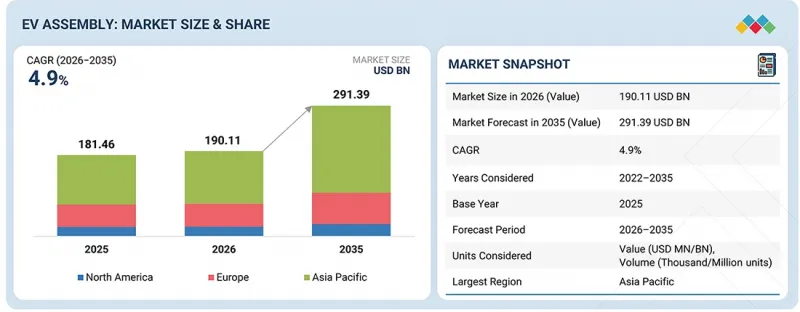
The EV assembly market is projected to grow from USD 190.11 billion in 2026 to USD 291.39 billion by 2035, at a CAGR of 4.9%.
| Scope of the Report | |
|---|---|
| Years Considered for the Study | 2026-2035 |
| Base Year | 2025 |
| Forecast Period | 2026-2035 |
| Units Considered | USD billion |
| Segments | EV Assembly Market by Manufacturing Strategy, Platform Type, EV Component, Integration Type, OEM Analysis, and Region - Global Forecast to 2035 |
| Regions covered | Asia Pacific, Europe, North America |
Automakers are increasingly adopting gigacasting to simplify vehicle structures and reduce assembly complexity by consolidating multiple stamped and welded components into single large cast parts. Tesla's gigacasting process at Gigafactory Texas replaced 70 individual components with a single rear body casting and reduced casting cycle times from about 120 minutes to 80-90 seconds, enabling production rates of 40-45 castings per hour. Similarly, Volvo plans to replace about 100 stamped components with a single megacast structure for the EX60's rear chassis section, while achieving a 15-20% weight reduction and approximately 95% material utilization through in-house recycling of casting scrap. These advancements reduce part counts, shorten production cycles, minimize material waste, and lower tooling and assembly requirements, improving manufacturing efficiency and supporting cost-effective, high-volume EV production.
The commercial vehicle segment is projected to hold a significant share of the EV assembly market during the forecast period.
The commercial vehicle segment is projected to account for a significant share of the EV assembly market. The electrification of logistics fleets, public transportation networks, and last-mile delivery operations is driving large-volume procurement contracts for commercial vehicles, enabling OEMs to improve production utilization and establish dedicated assembly lines. Similarly, manufacturers are investing in purpose-built commercial EV platforms, creating new opportunities for tooling, platform development, and assembly operations. Commercial vehicle manufacturers are increasingly adopting dedicated EV platforms, such as Yutong's YEA architecture and Daimler Truck's eActros platform, enabling component standardization across multiple vehicle models. This platform-based approach improves manufacturing efficiency, reduces development costs, and supports large-scale production of electric buses and trucks, further strengthening the commercial vehicle segment's contribution to the EV assembly market. Government initiatives promoting local production of electric buses and trucks are further encouraging investments in regional manufacturing facilities and supply chains. The integration of advanced telematics, fleet management systems, high-voltage architectures, and connected vehicle technologies also increases the overall assembly value of commercial EVs. In addition, leading manufacturers such as Daimler Truck, Volvo Trucks, BYD, Yutong, Scania, and Tata Motors continue to expand dedicated commercial EV production capacity, supporting the segment's strong contribution to the growth of the EV assembly market.
Plug-in hybrid electric vehicles (PHEVs) are expected to account for a significant share of the EV assembly market during the forecast period.
The plug-in hybrid electric vehicle (PHEV) segment is estimated to hold a significant share of the EV assembly market because of its higher manufacturing content and assembly value compared with conventional vehicles. By integrating both an internal combustion engine and an electric powertrain, PHEVs require additional components such as battery packs, electric motors, inverters, fuel systems, and advanced control units. This dual-powertrain architecture increases assembly complexity, component count, and manufacturing value per vehicle. Many automakers use flexible multi-energy platforms such as Volkswagen's MQB, BMW's CLAR, and Geely's CMA, enabling ICE, HEV, PHEV, and BEV models to be produced on the same assembly lines, improving plant utilization and production efficiency. Strong demand for PHEVs and extended-range electric vehicles (EREVs) in China, led by manufacturers such as BYD, Li Auto, Geely, and Changan, along with continued adoption across Europe, supports high production volumes and assembly activity. PHEVs also enable OEMs to leverage existing engine plants, supply chains, and manufacturing facilities while gradually expanding electrified vehicle production. For instance, Volkswagen's MQB platform supports more than 40 vehicle models across multiple powertrain configurations, allowing manufacturers to use common production assets and reduce the need for dedicated assembly infrastructure. This approach helps lower transition risks and capital investment requirements while supporting flexible production planning. Manufacturers are also investing in dedicated hybrid technologies such as BYD's DM-i, Geely's Thor Hybrid, and Changan's Blue Core Hybrid systems, which require specialized assembly processes and component integration.
"Europe is expected to have a significant market share in the EV assembly market during the forecast period."
Europe is expected to account for a significant share of the EV assembly market, supported by its well-established automotive manufacturing ecosystem and ongoing transition to electrified vehicle production. The region is home to leading OEMs such as Volkswagen Group, Mercedes-Benz, BMW, Stellantis, Renault Group, and Volvo, which collectively operate extensive vehicle assembly plants, powertrain facilities, and battery manufacturing investments across Europe. European automakers are increasingly standardizing production on dedicated EV platforms, including Volkswagen's MEB and upcoming SSP architectures, BMW's Neue Klasse, Mercedes-Benz's MMA and MB.EA platforms, Stellantis' STLA architectures, Renault's AmpR platforms, and Volvo's SPA2 architecture. This platform-based approach enables multiple vehicle models to share common battery systems, electrical architectures, software stacks, and manufacturing processes, improving production efficiency and reducing development costs. Similarly, OEMs are investing heavily to convert conventional vehicle plants into EV-focused production facilities while expanding automation, smart factory technologies, and digital manufacturing capabilities. The region is also strengthening battery localization by establishing regional battery supply chains and integrating battery pack assembly closer to vehicle production sites, improving supply chain resilience and manufacturing efficiency. Taken together, these factors position Europe as a key hub for large-scale EV assembly, supported by advanced manufacturing capabilities and platform standardization.
In-depth interviews were conducted with CEOs, marketing directors, other innovation and technology directors, and executives from various key organizations operating in this market.
- By Company Type: OEMs - 38%, Tier I - 42%, Tier II & III - 20%
- By Designation: Directors - 35%, Managers - 45%, and Others - 20%
- By Region: North America - 25%, Europe - 30%, and Asia Pacific - 45%
The EV assembly market is dominated by major players, including Tesla (US), BYD Company Ltd. (China), VOLKSWAGEN AG (Germany), Geely Auto (China), and Hyundai Motor Company (South Korea). These companies leverage scalable EV platforms, advanced manufacturing technologies, vertically integrated supply chains, and highly automated production facilities to improve assembly efficiency, reduce manufacturing costs, and accelerate the commercialization of electric vehicles in global markets.
Research Coverage:
The report covers the EV assembly market, by vehicle type (PC, CV), propulsion (BEV, PHEV), and region.
The report provides a comprehensive analysis of the EV assembly market's competitive landscape and profiles leading vehicle manufacturers and contract assembly providers. It includes an in-depth assessment of key market participants, highlighting their manufacturing capabilities, assembly facilities, EV platform strategies, production footprints, partnerships, investments, and business strategies shaping the global EV assembly ecosystem.
Key Benefits of Buying the Report:
- The report provides reliable estimates of the global EV assembly market size and its key segments, helping market participants assess current and future revenue opportunities.
- The report enables OEMs, contract manufacturers, component suppliers, investors, and other stakeholders to understand the competitive landscape and develop effective growth and market-entry strategies.
- The report offers detailed insights into the EV assembly ecosystem, including key market drivers, restraints, challenges, opportunities, manufacturing trends, and regional production dynamics.
- The report helps stakeholders evaluate current and future developments in EV manufacturing technologies, assembly processes, platform strategies, production capacities, and localization initiatives across major automotive markets.
- The report provides benchmarking of leading EV manufacturers based on production footprint, assembly capabilities, platform adoption, strategic partnerships, and expansion plans.
The report provides insight into the following pointers:
- Analysis of key drivers (OEM transition to dedicated EV platforms and software-defined vehicle architectures, Localization of EV supply chains and battery manufacturing ecosystems), restraints (Battery and power electronics localization bottlenecks, High capital investment and EV capacity utilization risks), opportunities (Expansion of battery recycling and closed-loop manufacturing, Rise of AI-enabled smart factories and digital manufacturing technologies, Growing adoption of EV platform-based contract manufacturing), and challenges (Balancing manufacturing flexibility across diverse EV platforms and vehicle segments).
- Platform Development/Innovation: Detailed insights on upcoming technologies and research & development activities in the EV assembly market
- Market Development: Comprehensive information about lucrative markets - the report analyzes the EV assembly market across varied regions
- Market Diversification: Exhaustive information about untapped geographies, recent developments, and investments in the EV assembly market
- Competitive Assessment: In-depth assessment of market share, EV manufacturing strategies, and platform offerings of leading players such as Tesla (US), BYD Company Ltd. (China), Volkswagen AG (Germany), Geely Auto (China), and Hyundai Motor Company (South Korea)
TABLE OF CONTENTS
1 INTRODUCTION
- 1.1 STUDY OBJECTIVES
- 1.2 MARKET DEFINITION
- 1.3 STUDY SCOPE
- 1.3.1 MARKET SEGMENTATION
- 1.3.2 INCLUSIONS & EXCLUSIONS
- 1.4 YEARS CONSIDERED
- 1.5 CURRENCY CONSIDERED
- 1.6 UNIT CONSIDERED
- 1.7 STAKEHOLDERS
- 1.8 SUMMARY OF CHANGES
2 EXECUTIVE SUMMARY
- 2.1 KEY INSIGHTS & MARKET HIGHLIGHTS
- 2.2 KEY MARKET PARTICIPANTS: MAPPING OF STRATEGIC DEVELOPMENTS
- 2.3 DISRUPTIVE TRENDS SHAPING EV ASSEMBLY MARKET
- 2.4 SNAPSHOT: GLOBAL MARKET SIZE, GROWTH RATE, AND FORECAST
3 PREMIUM INSIGHTS
- 3.1 ATTRACTIVE OPPORTUNITIES FOR PLAYERS IN EV ASSEMBLY MARKET
- 3.2 EV MARKET, BY PROPULSION
- 3.3 EV MARKET, BY VEHICLE TYPE
- 3.4 EV ASSEMBLY MARKET, BY REGION
4 MARKET OVERVIEW
- 4.1 INTRODUCTION
- 4.2 MARKET DYNAMICS
- 4.2.1 DRIVERS
- 4.2.1.1 OEM transition to dedicated EV platforms and software-defined vehicle (SDV) architectures
- 4.2.1.2 Localization of EV supply chains and battery manufacturing ecosystems
- 4.2.2 RESTRAINTS
- 4.2.2.1 Battery and power electronics localization bottlenecks
- 4.2.2.2 High capital investment and EV capacity utilization risks
- 4.2.3 OPPORTUNITIES
- 4.2.3.1 Expansion of battery recycling and closed-loop manufacturing
- 4.2.3.2 Rise of AI-enabled smart factories and digital manufacturing technologies
- 4.2.3.3 Growing adoption of EV platform-based contract manufacturing
- 4.2.4 CHALLENGES
- 4.2.4.1 Balancing manufacturing flexibility across diverse EV platforms and vehicle segments
- 4.2.1 DRIVERS
5 INDUSTRY TRENDS
- 5.1 TRENDS & DISRUPTIONS IMPACTING CUSTOMER BUSINESS
- 5.2 MANUFACTURING COST BREAKDOWN OF EV PASSENGER CAR
- 5.2.1 OVERVIEW
- 5.2.2 COST BREAKDOWN BY MANUFACTURING PROCESS
- 5.2.2.1 Battery cell manufacturing
- 5.2.2.2 Battery module & pack assembly
- 5.2.2.3 Battery management & thermal management
- 5.2.2.4 Electric motor manufacturing
- 5.2.2.5 Inverter & power electronics
- 5.2.2.6 Reduction gearbox/transmission
- 5.2.2.7 Body-in-white manufacturing
- 5.2.2.8 Chassis & suspension manufacturing
- 5.2.2.9 Interior systems manufacturing
- 5.2.2.10 Electrical & electronic systems
- 5.2.2.11 Final vehicle assembly labor
- 5.2.2.12 Factory overhead
- 5.2.2.13 Logistics & supply chain
- 5.3 ECOSYSTEM ANALYSIS
- 5.3.1 MANUFACTURING EQUIPMENT & AUTOMATION PROVIDERS
- 5.3.2 ENGINEERING, DESIGN & DIGITAL MANUFACTURING PROVIDERS
- 5.3.3 SEMICONDUCTOR & ELECTRONICS SUPPLIERS
- 5.3.4 INFRASTRUCTURE & ENERGY PARTNERS
- 5.3.5 CONTRACT MANUFACTURERS
- 5.3.6 EV MANUFACTURERS
- 5.4 SUPPLY CHAIN ANALYSIS
- 5.5 CASE STUDY ANALYSIS
- 5.5.1 VOLKSWAGEN LAUNCHED INDUSTRIAL CLOUD-BASED MANUFACTURING STRATEGY TO IMPROVE PRODUCTION EFFICIENCY
- 5.5.2 INTRALOX ELIMINATED EV BATTERY PACK DAMAGE AND REDUCES MAINTENANCE THROUGH ADVANCED CONVEYOR AUTOMATION
- 5.5.3 TESLA'S UNBOXED MANUFACTURING CONCEPT: MODULAR APPROACH TO EV MANUFACTURING
- 5.5.4 BMW IFACTORY ENABLED AI-DRIVEN AND VIRTUAL EV MANUFACTURING ACROSS GLOBAL PRODUCTION NETWORK
- 5.5.5 HYUNDAI MOTOR GROUP METAPLANT AMERICA (HMGMA) ESTABLISHED AI-POWERED SMART FACTORY FOR LARGE-SCALE EV MANUFACTURING
- 5.6 INVESTMENT AND FUNDING SCENARIO
- 5.7 KEY CONFERENCES & EVENTS, 2026-2027
- 5.8 BILL OF MATERIALS (BOM) FOR MANUFACTURING OF ICE AND ELECTRIC VEHICLES, 2025 VS. 2030
- 5.8.1 BATTERY ELECTRIC VEHICLE BOM (PERCENTAGE OF MANUFACTURING COST), 2025 VS. 2030
- 5.8.2 ICE VEHICLE BOM (PERCENTAGE OF MANUFACTURING COST), 2025 VS. 2030
- 5.8.3 EV VS. ICE MAJOR SYSTEM SHARE COMPARISON, 2025 VS. 2030
- 5.9 KEY INVESTMENT AND DEVELOPMENT TARGETS FOR ZERO-EMISSION VEHICLES
- 5.9.1 GLOBAL INVESTMENT PRIORITIES
- 5.9.2 MAJOR INVESTMENT ANNOUNCEMENTS
- 5.10 IMPACT OF GEOPOLITICAL CONFLICT ON EV MANUFACTURING & ASSEMBLY
- 5.10.1 EUROPE-INDIA TRADE DEALS: IMPACT ANALYSIS
- 5.10.2 IMPACT OF ISRAEL-IRAN WAR ON EV MANUFACTURING INDUSTRY
6 BATTERY PROCUREMENT STRATEGIES OF ELECTRIC VEHICLE OEMS
- 6.1 OEM BATTERY PROCUREMENT STRATEGIES
- 6.1.1 TESLA
- 6.1.2 BYD COMPANY LTD.
- 6.1.3 BMW AG
- 6.1.4 GENERAL MOTORS
- 6.1.5 MERCEDES-BENZ
- 6.1.6 STELLANTIS
- 6.1.7 TOYOTA MOTOR CORPORATION
- 6.1.8 VOLKSWAGEN AG
- 6.1.9 RENAULT GROUP
- 6.1.10 FORD MOTOR COMPANY
- 6.1.11 NISSAN MOTOR CO., LTD.
- 6.1.12 HYUNDAI/KIA
- 6.1.13 HONDA MOTOR CO., LTD.
- 6.2 PRODUCTION CAPACITY TRENDS OF MAJOR EV BATTERY MANUFACTURERS, 2022-2025
- 6.3 PRODUCTION SITES AND CAPACITY EXPANSION OF MAJOR BATTERY MANUFACTURERS
- 6.3.1 PLANNED PRODUCTION CAPACITY OF MAJOR BATTERY MANUFACTURERS
- 6.3.2 MANUFACTURING FOOTPRINT AND CAPACITY ANALYSIS
- 6.3.2.1 Contemporary Amperex Technology Co., Limited
- 6.3.2.2 LG Energy Solutions
- 6.3.2.3 EVE Energy Co., Ltd.
- 6.3.2.4 Gotion Inc.
- 6.3.2.5 SK ON Co., Ltd.
- 6.3.2.6 SAMSUNG SDI
- 6.3.2.7 CALB
- 6.3.2.8 Toshiba Corporation
- 6.3.2.9 Panasonic Energy
- 6.3.2.10 Toyota Battery Co., Ltd.
- 6.3.2.11 Sunwoda Electronics Co., Ltd.
- 6.3.2.12 Toyota Industries Corporation
- 6.3.2.13 Verkor SA
- 6.3.2.14 Automotive Cells Company
- 6.3.2.15 Prime Planet Energy & Solutions, Inc.
- 6.3.2.16 AESC
- 6.3.2.17 Vehicle Energy Japan Inc.
- 6.3.2.18 Blue Energy Co., Ltd.
- 6.3.2.19 GS Yuasa International Ltd.
7 INSIGHTS INTO CHINA'S EXPANDING EV SUPPLY CHAIN DOMINANCE
- 7.1 MARKET SHARE OF TOP EV BATTERY MANUFACTURERS IN CHINA, 2025
- 7.1.1 MARKET SHARE OF TOP TERNARY BATTERY MANUFACTURERS IN CHINA, 2025
- 7.1.2 MARKET SHARE OF TOP LFP BATTERY MANUFACTURERS IN CHINA, 2025
- 7.2 CHINA: MONTHLY POWER BATTERY INSTALLATION TREND, 2023-2025
- 7.2.1 CHINA: TERNARY VS. LFP BATTERY INSTALLATION TREND, 2025
- 7.3 CHINA: MONTHLY BATTERY PRODUCTION TREND, 2023-2025
- 7.3.1 CHINA TERNARY VS. LFP BATTERY PRODUCTION TREND, 2025
- 7.4 MARKET SHARE OF TOP BATTERY MANAGEMENT SYSTEM PROVIDERS IN CHINA, 2025
- 7.5 MARKET SHARE OF TOP ELECTRIC DRIVE MOTOR SUPPLIERS IN CHINA, 2025
- 7.6 MARKET SHARE OF TOP ELECTRIC MOTOR CONTROLLER SUPPLIERS IN CHINA, 2025
- 7.7 MARKET SHARE OF TOP SUPPLIERS OF POWER SEMICONDUCTOR DEVICE (DEDICATED TO E-DRIVE) IN CHINA, 2025
- 7.8 MARKET SHARE OF TOP SUPPLIERS OF MULTI-IN-ONE MAIN DRIVE SYSTEM (DEDICATED TO BEVS) IN CHINA, 2025
- 7.9 SDV READINESS AND NEXT-GENERATION VEHICLE ARCHITECTURES, BY KEY OEM
- 7.9.1 BYD
- 7.9.1.1 Current platforms
- 7.9.1.2 Manufacturing model
- 7.9.1.3 Future plans
- 7.9.1.4 SDV strategy
- 7.9.2 ARCFOX
- 7.9.2.1 Current platforms
- 7.9.2.2 Manufacturing model
- 7.9.2.3 Future plans
- 7.9.2.4 SDV strategy
- 7.9.3 CHANGAN
- 7.9.3.1 Current platforms
- 7.9.3.2 Manufacturing model
- 7.9.3.3 Future plans
- 7.9.3.4 SDV strategy
- 7.9.4 LI AUTO
- 7.9.4.1 Current platforms
- 7.9.4.2 Manufacturing model
- 7.9.4.3 Future plans
- 7.9.4.4 SDV strategy
- 7.9.5 XIAOMI
- 7.9.5.1 Current platform
- 7.9.5.2 Manufacturing model
- 7.9.5.3 Future plans
- 7.9.5.4 SDV strategy
- 7.9.6 GEELY AUTO
- 7.9.6.1 Current platform
- 7.9.6.2 Manufacturing model
- 7.9.6.3 Future plans
- 7.9.6.4 SDV strategy
- 7.9.7 ZEEKR
- 7.9.7.1 Current platform
- 7.9.7.2 Manufacturing model
- 7.9.7.3 Future plans
- 7.9.7.4 SDV strategy
- 7.9.8 XPENG
- 7.9.8.1 Current platform
- 7.9.8.2 Manufacturing model
- 7.9.8.3 Future plans
- 7.9.8.4 SDV strategy
- 7.9.9 GREAT WALL MOTOR
- 7.9.9.1 Current platforms
- 7.9.9.2 Manufacturing model
- 7.9.9.3 Future plans
- 7.9.9.4 SDV strategy
- 7.9.10 SAIC MOTOR
- 7.9.10.1 Current platforms
- 7.9.10.2 Manufacturing model
- 7.9.10.3 Future plans
- 7.9.10.4 SDV strategy
- 7.9.11 CHERY AUTO
- 7.9.11.1 Current platforms
- 7.9.11.2 Manufacturing model
- 7.9.11.3 Future plans
- 7.9.11.4 SDV strategy
- 7.9.12 GAC AION
- 7.9.12.1 Current platforms
- 7.9.12.2 Manufacturing model
- 7.9.12.3 Future plans
- 7.9.12.4 SDV strategy
- 7.9.13 NIO INC.
- 7.9.13.1 Current platform
- 7.9.13.2 Manufacturing model
- 7.9.13.3 Future plans
- 7.9.13.4 SDV strategy
- 7.9.14 AVATR TECHNOLOGY (CHONGQING) CO., LTD
- 7.9.14.1 Current platform
- 7.9.14.2 Manufacturing model
- 7.9.14.3 Future plans
- 7.9.14.4 SDV strategy
- 7.9.15 DONGFENG MOTOR GROUP
- 7.9.15.1 Current platforms
- 7.9.15.2 Manufacturing model
- 7.9.15.3 Future plans
- 7.9.15.4 SDV strategy
- 7.9.1 BYD
- 7.10 PRODUCTION FOOTPRINT OF CHINA'S LEADING EV MANUFACTURERS
- 7.11 TECHNOLOGY LANDSCAPE OF EV MANUFACTURING IN CHINA
- 7.12 SUPPLY CHAIN INTEGRATION DRIVING CHINA'S EV MANUFACTURING LEADERSHIP
8 EV DRIVE MOTORS: CURRENT AND FUTURE TRENDS
- 8.1 DRIVE MOTOR TECHNOLOGY TRENDS
- 8.1.1 MOTOR TYPE
- 8.1.2 WINDING METHOD
- 8.1.3 COOLING METHOD
- 8.2 IN-HOUSE MANUFACTURING OF DRIVE MOTORS BY KEY OEMS
- 8.3 STRATEGIES OF MAJOR DRIVE MOTOR SUPPLIERS
- 8.4 EV DRIVE MOTOR MANUFACTURING SUPPLY CHAIN ANALYSIS
- 8.4.1 RAW MATERIAL SOURCING
- 8.4.2 STATOR MANUFACTURING
- 8.4.3 ROTOR MANUFACTURING
- 8.4.4 MOTOR ASSEMBLY AND E-AXLE INTEGRATION
- 8.4.5 THERMAL TREATMENT AND INSULATION
- 8.4.6 END-OF-LINE TESTING
- 8.5 EV DRIVE MOTOR MANUFACTURING PROCESS FLOW
- 8.6 EVOLUTION TOWARD INTEGRATED E-AXLE MANUFACTURING AND HAIRPIN STATOR TECHNOLOGY
- 8.7 COMMERCIALIZATION OF AXIAL-FLUX MOTOR MANUFACTURING
- 8.8 SMART AUTOMATION IN EV MOTOR MANUFACTURING
- 8.9 USE CASES OF INTEGRATED EV POWERTRAIN MANUFACTURING
9 ASSESSMENT OF GIGACASTING ADOPTION BY LEADING OEMS
- 9.1 OEMS
- 9.1.1 TESLA
- 9.1.2 BYD
- 9.1.3 VOLKSWAGEN AG
- 9.1.4 GEELY/ZEEKR
- 9.1.5 HYUNDAI MOTOR GROUP
- 9.1.6 FORD MOTOR COMPANY
- 9.1.7 GENERAL MOTORS
- 9.1.8 TOYOTA MOTOR CORPORATION
- 9.1.9 HONDA MOTOR CO., LTD.
- 9.1.10 VOLVO CARS
- 9.1.11 RIVIAN
- 9.1.12 XPENG INC.
- 9.1.13 NIO INC.
- 9.1.14 LI AUTO
- 9.1.15 LEAPMOTOR
- 9.2 GIGACASTING ADOPTION TIMELINES, 2020-2035
10 STRATEGIC INSIGHTS INTO GLOBAL EV GIGAFACTORY EXPANSION
- 10.1 GIGAFACTORY BY KEY OEMS
- 10.1.1 TESLA
- 10.1.2 BYD COMPANY LTD.
- 10.1.3 GEELY AUTO
- 10.1.4 GENERAL MOTORS
- 10.1.5 STELLANTIS N.V.
- 10.1.6 VOLKSWAGEN AG
- 10.1.7 MERCEDES-BENZ GROUP
- 10.1.8 DAIMLER TRUCK
- 10.1.9 BMW GROUP
- 10.1.10 RENAULT GROUP
- 10.1.11 VOLVO
- 10.1.12 DONGFENG
- 10.1.13 BAIC
- 10.1.14 GAC GROUP
- 10.1.15 GREAT WALL MOTORS
- 10.1.16 JAC MOTORS
- 10.1.17 LEAPMOTOR
- 10.1.18 TOYOTA MOTOR CORPORATION
- 10.2 UPCOMING GIGAFACTORIES, BY REGION
- 10.2.1 NORTH AMERICA
- 10.2.2 EUROPE
- 10.2.3 ASIA PACIFIC
11 GLOBAL ECONOMY AND INDUSTRY OUTLOOK FOR EV MANUFACTURING
- 11.1 MACROECONOMIC INDICATORS
- 11.1.1 GDP TRENDS AND FORECAST
- 11.1.2 TRENDS IN GLOBAL ELECTRIC VEHICLE INDUSTRY
- 11.2 PROPULSION
- 11.2.1 BEV
- 11.2.2 PHEV
- 11.3 VEHICLE TYPE
- 11.3.1 PASSENGER CAR
- 11.3.2 COMMERCIAL VEHICLE
12 EV PLATFORM EVOLUTION AND MANUFACTURING STRATEGIES
- 12.1 EV PLATFORM EVOLUTION, BY KEY OEM
- 12.1.1 BYD
- 12.1.1.1 BYD: Future strategy
- 12.1.2 TESLA
- 12.1.2.1 Tesla: Future strategy
- 12.1.3 VOLKSWAGEN AG
- 12.1.3.1 Volkswagen AG: Future strategy
- 12.1.4 GEELY
- 12.1.4.1 Geely: Future strategy
- 12.1.5 STELLANTIS
- 12.1.5.1 Stellantis: Future strategy
- 12.1.6 BMW
- 12.1.6.1 BMW: Future strategy
- 12.1.7 HYUNDAI
- 12.1.7.1 Hyundai: Future strategy
- 12.1.8 TOYOTA
- 12.1.8.1 Toyota: Future strategy
- 12.1.1 BYD
- 12.2 COMPARATIVE ANALYSIS OF ICE AND EV PLATFORMS
- 12.3 EV CONTRACT MANUFACTURING BUSINESS MODELS
- 12.3.1 FULL VEHICLE CONTRACT MANUFACTURING
- 12.3.2 SHARED MANUFACTURING CAPACITY AND JOINT VENTURE MODELS
- 12.3.3 EV PLATFORM LICENSING AND SKATEBOARD SHARING
13 SUPPLIER AND MATERIAL ANALYSIS
- 13.1 SUPPLIER ANALYSIS
- 13.1.1 BATTERY
- 13.1.1.1 Contemporary Amperex Technology Co., Limited
- 13.1.1.2 CALB
- 13.1.1.3 Gotion, Inc.
- 13.1.1.4 SK Innovation Co. Ltd.
- 13.1.1.5 EVE Energy Co., Ltd.
- 13.1.1.6 SAMSUNG SDI
- 13.1.2 TRACTION MOTOR
- 13.1.3 MOTOR CORE
- 13.1.4 BATTERY MANAGEMENT SYSTEM
- 13.1.1 BATTERY
- 13.2 EMERGING TRENDS IN MATERIALS AND RESOURCES USED IN EV MANUFACTURING
- 13.2.1 COBALT
- 13.2.2 LITHIUM
- 13.2.3 NICKEL
- 13.2.4 GRAPHITE
- 13.2.5 RARE EARTH ELEMENTS
- 13.2.6 COPPER
- 13.2.7 ALUMINUM
- 13.2.8 STEEL AND ADVANCED HIGH-STRENGTH STEEL (AHSS)
- 13.3 RECYCLED BATTERY MATERIALS
14 TECHNOLOGICAL ADVANCEMENTS
- 14.1 PATENT ANALYSIS
- 14.2 TECHNOLOGY ANALYSIS
- 14.2.1 INTRODUCTION
- 14.2.2 KEY TECHNOLOGIES
- 14.2.2.1 Structural battery manufacturing and cell-to-body architecture
- 14.2.2.2 Next-generation 800V and 1000V EV production platforms
- 14.2.3 COMPLEMENTARY TECHNOLOGIES
- 14.2.3.1 AI-driven closed-loop manufacturing systems
- 14.2.3.2 Vehicle platform consolidation and modular manufacturing ecosystems
- 14.2.4 ADJACENT TECHNOLOGIES
- 14.2.4.1 Gigacasting and unboxed manufacturing
- 14.2.4.2 Battery manufacturing and vehicle production convergence
- 14.2.5 TECHNOLOGY/PRODUCT ROADMAP
- 14.2.6 TECHNOLOGY IMPACT ASSESSMENT
- 14.2.7 OEM TECHNOLOGY ADOPTION MAPPING
15 REGULATORY LANDSCAPE
- 15.1 REGIONAL REGULATIONS AND STANDARDS
- 15.1.1 KEY REGIONAL REGULATIONS
- 15.1.1.1 Europe
- 15.1.1.2 North America
- 15.1.1.3 Asia Pacific
- 15.1.2 GLOBAL STANDARDS SUPPORTING EV MANUFACTURING & PLATFORM COMPLIANCE
- 15.1.1 KEY REGIONAL REGULATIONS
16 EV ASSEMBLY MARKET, BY REGION
- 16.1 INTRODUCTION
- 16.2 ASIA PACIFIC
- 16.2.1 CHINA
- 16.2.2 INDIA
- 16.2.3 JAPAN
- 16.2.4 SOUTH KOREA
- 16.3 EUROPE
- 16.3.1 GERMANY
- 16.3.2 FRANCE
- 16.3.3 ITALY
- 16.3.4 UK
- 16.3.5 SPAIN
- 16.4 NORTH AMERICA
- 16.4.1 US
- 16.4.2 CANADA
- 16.4.3 MEXICO
17 COMPETITIVE LANDSCAPE
- 17.1 INTRODUCTION
- 17.2 KEY PLAYER STRATEGIES/RIGHT TO WIN
- 17.3 MARKET SHARE ANALYSIS, 2025
- 17.4 REVENUE ANALYSIS
- 17.5 COMPANY VALUATION AND FINANCIAL METRICS
- 17.6 BRAND/PRODUCT COMPARISON
- 17.7 COMPANY EVALUATION MATRIX: KEY PLAYERS, 2025
- 17.7.1 STARS
- 17.7.2 EMERGING LEADERS
- 17.7.3 PERVASIVE PLAYERS
- 17.7.4 PARTICIPANTS
- 17.7.5 COMPETITIVE BENCHMARKING
- 17.7.5.1 List of startups/SMEs
- 17.7.5.2 Competitive benchmarking of startups/SMEs
- 17.8 COMPETITIVE SCENARIO
- 17.8.1 PLATFORM LAUNCHES/DEVELOPMENTS
- 17.8.2 DEALS
- 17.8.3 EXPANSIONS
18 COMPANY PROFILES
- 18.1 TESLA
- 18.1.1 COMPANY OVERVIEW
- 18.1.2 DESIGN PROCESSES
- 18.1.3 PROTOTYPING
- 18.1.4 ASSEMBLY
- 18.1.4.1 Manufacturing & assembly plants
- 18.1.5 EV PLATFORMIZATION STRATEGY
- 18.1.5.1 Platform evolution and future roadmap
- 18.1.5.2 Platform investments
- 18.1.5.3 Architecture
- 18.1.5.3.1 Battery
- 18.1.5.3.2 Motor
- 18.1.6 CIRCULAR ECONOMY STRATEGY
- 18.1.6.1 Recycled materials/components
- 18.1.7 FUTURE PLANS FOR EV PRODUCTION
- 18.1.7.1 Digitization/Smart manufacturing factory
- 18.2 BYD COMPANY LTD.
- 18.2.1 COMPANY OVERVIEW
- 18.2.2 DESIGN PROCESSES
- 18.2.3 PROTOTYPING
- 18.2.4 ASSEMBLY
- 18.2.4.1 Manufacturing & assembly plants
- 18.2.5 EV PLATFORMIZATION STRATEGY
- 18.2.5.1 Platform evolution and future roadmap
- 18.2.5.2 Platform investments
- 18.2.5.3 Architecture
- 18.2.5.3.1 Battery
- 18.2.5.3.2 Motor
- 18.2.6 CIRCULAR ECONOMY STRATEGY
- 18.2.7 FUTURE PLANS FOR EV PRODUCTION
- 18.2.7.1 Digitization/Smart manufacturing factory
- 18.3 VOLKSWAGEN AG
- 18.3.1 COMPANY OVERVIEW
- 18.3.2 DESIGN PROCESSES
- 18.3.3 PROTOTYPING
- 18.3.4 ASSEMBLY
- 18.3.4.1 Manufacturing & assembly plants
- 18.3.5 EV PLATFORMIZATION STRATEGY
- 18.3.5.1 Platform evolution and future roadmap
- 18.3.5.2 Platform investments
- 18.3.5.3 Architecture
- 18.3.5.3.1 Battery
- 18.3.5.3.2 Motor
- 18.3.6 CIRCULAR ECONOMY STRATEGY
- 18.3.6.1 Recycled materials/components
- 18.3.7 FUTURE PLANS FOR EV PRODUCTION
- 18.3.7.1 Digitization/Smart manufacturing factory
- 18.4 GEELY AUTO
- 18.4.1 COMPANY OVERVIEW
- 18.4.2 DESIGN PROCESSES
- 18.4.3 PROTOTYPING
- 18.4.4 ASSEMBLY
- 18.4.4.1 Manufacturing & assembly plants
- 18.4.5 EV PLATFORMIZATION STRATEGY
- 18.4.5.1 Platform evolution and future roadmap
- 18.4.5.2 Platform investments
- 18.4.5.3 Architecture
- 18.4.5.3.1 Battery
- 18.4.5.3.2 Motor
- 18.4.6 CIRCULAR ECONOMY STRATEGY
- 18.4.6.1 Recycled materials/components
- 18.4.7 FUTURE PLANS FOR EV PRODUCTION
- 18.4.7.1 Digitization/Smart manufacturing factory
- 18.5 HYUNDAI MOTOR COMPANY
- 18.5.1 COMPANY OVERVIEW
- 18.5.2 DESIGN PROCESSES
- 18.5.3 PROTOTYPING
- 18.5.4 ASSEMBLY
- 18.5.4.1 Manufacturing & assembly plants
- 18.5.5 EV PLATFORMIZATION STRATEGY
- 18.5.5.1 Platform evolution and future roadmap
- 18.5.5.2 Platform investments
- 18.5.5.3 Architecture
- 18.5.5.3.1 Battery
- 18.5.5.3.2 Motor
- 18.5.6 CIRCULAR ECONOMY STRATEGY
- 18.5.6.1 Recycled materials/components
- 18.5.7 FUTURE PLANS FOR EV PRODUCTION
- 18.5.7.1 Digitization/Smart manufacturing factory
- 18.6 STELLANTIS NV
- 18.6.1 COMPANY OVERVIEW
- 18.6.2 DESIGN PROCESSES
- 18.6.3 PROTOTYPING
- 18.6.4 ASSEMBLY
- 18.6.4.1 Manufacturing & assembly plants
- 18.6.5 EV PLATFORMIZATION STRATEGY
- 18.6.5.1 Platform evolution and future roadmap
- 18.6.5.2 Platform investments
- 18.6.5.3 Architecture
- 18.6.5.3.1 Battery
- 18.6.5.3.2 Motor
- 18.6.6 CIRCULAR ECONOMY STRATEGY
- 18.6.6.1 Recycled materials/components
- 18.6.7 FUTURE PLANS FOR EV PRODUCTION
- 18.6.7.1 Digitization/Smart manufacturing factory
- 18.7 SAIC MOTOR CORPORATION LIMITED
- 18.7.1 COMPANY OVERVIEW
- 18.7.2 DESIGN PROCESSES
- 18.7.3 PROTOTYPING
- 18.7.4 ASSEMBLY
- 18.7.4.1 Manufacturing & assembly plants
- 18.7.5 EV PLATFORMIZATION STRATEGY
- 18.7.5.1 Platform evolution and future roadmap
- 18.7.5.2 Platform investments
- 18.7.5.3 Architecture
- 18.7.5.3.1 Battery
- 18.7.5.3.2 Motor
- 18.7.6 CIRCULAR ECONOMY STRATEGY
- 18.7.6.1 Recycled materials/components
- 18.7.7 FUTURE PLANS FOR EV PRODUCTION
- 18.7.7.1 Digitization/Smart manufacturing factory
- 18.8 BMW GROUP
- 18.8.1 COMPANY OVERVIEW
- 18.8.2 DESIGN PROCESSES
- 18.8.3 PROTOTYPING
- 18.8.4 ASSEMBLY
- 18.8.4.1 Manufacturing & assembly plants
- 18.8.5 EV PLATFORMIZATION STRATEGY
- 18.8.5.1 Platform evolution and future roadmap
- 18.8.5.2 Platform investments
- 18.8.5.3 Architecture
- 18.8.5.3.1 Battery
- 18.8.5.3.2 Motor
- 18.8.6 CIRCULAR ECONOMY STRATEGY
- 18.8.6.1 Recycled materials/components
- 18.8.7 FUTURE PLANS FOR EV PRODUCTION
- 18.8.7.1 Digitization/Smart manufacturing factory
- 18.9 GENERAL MOTORS
- 18.9.1 COMPANY OVERVIEW
- 18.9.2 DESIGN PROCESSES
- 18.9.3 PROTOTYPING
- 18.9.4 ASSEMBLY
- 18.9.4.1 Manufacturing & assembly plants
- 18.9.5 EV PLATFORMIZATION STRATEGY
- 18.9.5.1 Platform evolution and future roadmap
- 18.9.5.2 Platform investments
- 18.9.5.3 Architecture
- 18.9.5.3.1 Battery
- 18.9.5.3.2 Motor
- 18.9.6 CIRCULAR ECONOMY STRATEGY
- 18.9.6.1 Recycled materials/components
- 18.9.7 FUTURE PLANS FOR EV PRODUCTION
- 18.9.7.1 Digitization/Smart manufacturing factory
- 18.10 TOYOTA MOTOR CORPORATION
- 18.10.1 COMPANY OVERVIEW
- 18.10.2 DESIGN PROCESSES
- 18.10.3 PROTOTYPING
- 18.10.4 ASSEMBLY
- 18.10.5 EV PLATFORMIZATION STRATEGY
- 18.10.5.1 Platform evolution and future roadmap
- 18.10.5.2 Investments
- 18.10.5.3 Architecture
- 18.10.5.3.1 Battery
- 18.10.5.3.2 Motor
- 18.10.6 CIRCULAR ECONOMY STRATEGY
- 18.10.6.1 Recycled materials/components
- 18.10.7 FUTURE PLANS FOR EV PRODUCTION
- 18.10.7.1 Digitization/Smart manufacturing factory
- 18.11 FORD MOTOR COMPANY
- 18.11.1 COMPANY OVERVIEW
- 18.11.2 MANUFACTURING & ASSEMBLY PLANTS
- 18.11.3 ARCHITECTURE: CURRENT VS. NEXT-GEN
- 18.11.4 FUTURE PLANS FOR EV PRODUCTION
- 18.11.5 PLATFORMS USED IN EV MODELS
- 18.11.6 CURRENT AND UPCOMING MODELS, BY EV PLATFORM
- 18.12 RENAULT GROUP
- 18.12.1 COMPANY OVERVIEW
- 18.12.2 MANUFACTURING & ASSEMBLY PLANTS
- 18.12.3 ARCHITECTURE: CURRENT VS. NEXT-GEN
- 18.12.4 FUTURE PLANS FOR EV PRODUCTION
- 18.12.5 PLATFORMS USED IN EV MODELS
- 18.12.6 CURRENT AND UPCOMING MODELS, BY EV PLATFORMS
- 18.13 OTHER PLAYERS
- 18.13.1 MERCEDES-BENZ GROUP AG
- 18.13.2 RIVIAN
- 18.13.3 NIO
- 18.13.4 XPENG INC.
- 18.13.5 CHANGAN
- 18.13.6 LEAPMOTOR INTERNATIONAL B.V.
- 18.13.7 XIAOMI AUTO TECHNOLOGY CO., LTD.
- 18.13.8 GAC GROUP
- 18.13.9 CHERY
- 18.13.10 FAW GROUP
- 18.13.11 BEIJING AUTOMOTIVE GROUP CO., LTD. (BAIC GROUP)
- 18.13.12 DONGFENG MOTOR COMPANY
- 18.13.13 TATA MOTORS LIMITED
- 18.13.14 MAHINDRA&MAHINDRA LTD.
- 18.13.15 HON HAI PRECISION INDUSTRY CO., LTD. (FOXCONN)
- 18.13.16 WATT ELECTRIC VEHICLES
- 18.13.17 VALMET AUTOMOTIVE
- 18.13.18 VDL NEDCAR
19 RESEARCH METHODOLOGY
- 19.1 RESEARCH DATA
- 19.1.1 SECONDARY DATA
- 19.1.1.1 Key secondary sources
- 19.1.1.2 Key data from secondary sources
- 19.1.2 PRIMARY DATA
- 19.1.2.1 Primary interviewees from demand and supply sides
- 19.1.2.2 Key industry insights and breakdown of primary interviews
- 19.1.2.3 Breakdown of primary interviews
- 19.1.2.4 List of primary interview participants
- 19.1.1 SECONDARY DATA
- 19.2 MARKET SIZE ESTIMATION
- 19.2.1 BOTTOM-UP APPROACH
- 19.3 DATA TRIANGULATION
- 19.4 FACTOR ANALYSIS
- 19.5 RESEARCH ASSUMPTIONS & CONSIDERATIONS
- 19.6 RESEARCH LIMITATIONS
- 19.7 RISK ASSESSMENT
20 APPENDIX
- 20.1 DISCUSSION GUIDE
- 20.2 KNOWLEDGESTORE: MARKETSANDMARKETS' SUBSCRIPTION PORTAL
- 20.3 CUSTOMIZATION OPTIONS
- 20.3.1 EV ASSEMBLY MARKET, BY PROPULSION TYPE (COUNTRY LEVEL)
- 20.3.2 EV ASSEMBLY MARKET, BY VEHICLE TYPE
- 20.3.3 COMPANY INFORMATION
- 20.3.3.1 Profiling of additional market players (up to five)
- 20.4 RELATED REPORTS
- 20.6 AUTHOR DETAILS
List of Tables
- TABLE 1 KEY MANUFACTURING CONCEPTS IN EV ASSEMBLY MARKET
- TABLE 2 INCLUSIONS & EXCLUSIONS
- TABLE 3 USD EXCHANGE RATES, 2022-2025
- TABLE 4 ICE VEHICLE VS. ELECTRIC VEHICLE MANUFACTURING PROCESS FLOW
- TABLE 5 IMPACT OF MARKET DYNAMICS ON EV ASSEMBLY MARKET
- TABLE 6 EV PASSENGER CAR MANUFACTURING COST BREAKDOWN
- TABLE 7 EV PASSENGER CAR MANUFACTURING KEY COST DRIVERS (RANGE CONTRIBUTION)
- TABLE 8 ROLE OF PLAYERS IN ECOSYSTEM
- TABLE 9 FUNDING, BY USE CASE, APRIL 2025-MAY 2026
- TABLE 10 KEY CONFERENCES & EVENTS, 2026-2027
- TABLE 11 BATTERY ELECTRIC VEHICLE BOM (PERCENTAGE OF MANUFACTURING COST), 2025 VS. 2030
- TABLE 12 ICE VEHICLE BOM (PERCENTAGE OF MANUFACTURING COST), 2025 VS. 2030
- TABLE 13 EV VS. ICE MAJOR SYSTEM SHARE COMPARISON, 2025 VS. 2030
- TABLE 14 GLOBAL INVESTMENT PRIORITIES
- TABLE 15 MAJOR INVESTMENT ANNOUNCEMENTS (JANUARY 2024-APRIL 2026)
- TABLE 16 EUROPE-INDIA TRADE DEALS: STRATEGIC IMPACT ON EV MANUFACTURING & ASSEMBLY
- TABLE 17 IMPACT OF ISRAEL-IRAN WAR ON EV MANUFACTURING INDUSTRY
- TABLE 18 TESLA: CELL PRODUCTION/PROCUREMENT MATRIX
- TABLE 19 BMW AG: CELL PRODUCTION/PROCUREMENT MATRIX
- TABLE 20 GENERAL MOTORS: CELL PRODUCTION/PROCUREMENT MATRIX
- TABLE 21 MERCEDES-BENZ: CELL PRODUCTION/PROCUREMENT MATRIX
- TABLE 22 STELLANTIS: CELL PRODUCTION/PROCUREMENT MATRIX
- TABLE 23 TOYOTA MOTOR CORPORATION: CELL PRODUCTION/PROCUREMENT MATRIX
- TABLE 24 VOLKSWAGEN AG: CELL PRODUCTION/PROCUREMENT MATRIX
- TABLE 25 RENAULT GROUP: CELL PRODUCTION/PROCUREMENT MATRIX
- TABLE 26 FORD MOTOR COMPANY: CELL PRODUCTION/PROCUREMENT MATRIX
- TABLE 27 NISSAN MOTOR CO., LTD.: CELL PRODUCTION/PROCUREMENT MATRIX
- TABLE 28 HYUNDAI/KIA: CELL PRODUCTION/PROCUREMENT MATRIX
- TABLE 29 HONDA MOTOR CO., LTD.: CELL PRODUCTION/PROCUREMENT MATRIX
- TABLE 30 PLANNED PRODUCTION CAPACITY OF MAJOR BATTERY MANUFACTURERS
- TABLE 31 CONTEMPORARY AMPEREX TECHNOLOGY CO., LIMITED: PRODUCTION SITES AND CAPACITIES
- TABLE 32 LG ENERGY SOLUTIONS: PRODUCTION SITES AND CAPACITIES
- TABLE 33 EVE ENERGY CO., LTD.: PRODUCTION SITES AND CAPACITIES
- TABLE 34 GOTION INC.: PRODUCTION SITES AND CAPACITIES
- TABLE 35 SK ON CO., LTD.: PRODUCTION SITES AND CAPACITIES
- TABLE 36 SAMSUNG SDI: PRODUCTION SITES AND CAPACITIES
- TABLE 37 CALB: PRODUCTION SITES AND CAPACITIES
- TABLE 38 TOSHIBA CORPORATION: PRODUCTION SITES AND CAPACITIES
- TABLE 39 PANASONIC ENERGY: PRODUCTION SITES AND CAPACITIES
- TABLE 40 TOYOTA BATTERY CO., LTD.: PRODUCTION SITES AND CAPACITIES
- TABLE 41 SUNWODA ELECTRONICS CO., LTD.: PRODUCTION SITES AND CAPACITIES
- TABLE 42 TOYOTA INDUSTRIES CORPORATION: PRODUCTION SITES AND CAPACITIES
- TABLE 43 VERKOR SA: PRODUCTION SITES AND CAPACITIES
- TABLE 44 AUTOMOTIVE CELLS COMPANY: PRODUCTION SITES AND CAPACITIES
- TABLE 45 PRIME PLANET ENERGY & SOLUTIONS, INC.: PRODUCTION SITES AND CAPACITIES
- TABLE 46 AESC: PRODUCTION SITES AND CAPACITIES
- TABLE 47 VEHICLE ENERGY JAPAN INC.: PRODUCTION SITES AND CAPACITIES
- TABLE 48 BLUE ENERGY CO., LTD.: PRODUCTION SITES AND CAPACITIES
- TABLE 49 GS YUASA INTERNATIONAL LTD.: PRODUCTION SITES AND CAPACITIES
- TABLE 50 BYD: SDV ARCHITECTURE AND PLATFORM EVOLUTION
- TABLE 51 ARCFOX: SDV ARCHITECTURE AND PLATFORM EVOLUTION
- TABLE 52 CHANGAN: SDV ARCHITECTURE AND PLATFORM EVOLUTION
- TABLE 53 LI AUTO: SDV ARCHITECTURE AND PLATFORM EVOLUTION
- TABLE 54 XIAOMI: SDV ARCHITECTURE AND PLATFORM EVOLUTION
- TABLE 55 GEELY AUTO: SDV ARCHITECTURE AND PLATFORM EVOLUTION
- TABLE 56 ZEEKR: SDV ARCHITECTURE AND PLATFORM EVOLUTION
- TABLE 57 XPENG: SDV ARCHITECTURE AND PLATFORM EVOLUTION
- TABLE 58 GAC AION: SDV ARCHITECTURE AND PLATFORM EVOLUTION
- TABLE 59 NIO INC.: SDV ARCHITECTURE AND PLATFORM EVOLUTION
- TABLE 60 AVATR TECHNOLOGY (CHONGQING) CO., LTD: SDV ARCHITECTURE AND PLATFORM EVOLUTION
- TABLE 61 COMPARATIVE ANALYSIS OF EV PLATFORM STRATEGIES, BY OEM
- TABLE 62 CHINA'S EV MANUFACTURING FOOTPRINT: MAJOR PRODUCTION FACILITIES AND CAPACITIES
- TABLE 63 KEY MANUFACTURING TECHNOLOGIES ADOPTED ACROSS CHINA'S EV PRODUCTION ECOSYSTEM
- TABLE 64 IMPACT OF TECHNOLOGY TREND ON DRIVE MOTOR MANUFACTURING
- TABLE 65 EVALUATION OF KEY MOTOR ARCHITECTURES
- TABLE 66 MOTOR TYPE INSTALLED, BY KEY OEMS
- TABLE 67 VEHICLE EQUIPPED WITH DIFFERENT MOTOR WINDING METHODS
- TABLE 68 EVALUATION OF KEY MOTOR WINDING TECHNOLOGIES
- TABLE 69 VEHICLES EQUIPPED WITH DIFFERENT COOLING METHODS
- TABLE 70 EVALUATION OF KEY MOTOR COOLING METHODS
- TABLE 71 IN-HOUSE MANUFACTURING OF DRIVE MOTORS BY KEY OEMS
- TABLE 72 STRATEGIES OF MAJOR DRIVE MOTOR SUPPLIERS
- TABLE 73 EV DRIVE MOTOR MANUFACTURING PROCESS FLOW AND KEY PRODUCTION STAGES
- TABLE 74 INDUSTRY USE CASES OF INTEGRATED EV POWERTRAIN MANUFACTURING
- TABLE 75 GIGACASTING ADOPTION BY LEADING OEMS
- TABLE 76 TESLA: GIGAFACTORY
- TABLE 77 BYD COMPANY LTD.: GIGAFACTORY
- TABLE 78 GEELY AUTO: GIGAFACTORY
- TABLE 79 GENERAL MOTORS: GIGAFACTORY
- TABLE 80 STELLANTIS N.V.: GIGAFACTORY
- TABLE 81 VOLKSWAGEN AG: GIGAFACTORY
- TABLE 82 MERCEDES-BENZ GROUP: GIGAFACTORY
- TABLE 83 DAIMLER TRUCK: GIGAFACTORY
- TABLE 84 BMW GROUP: GIGAFACTORY
- TABLE 85 RENAULT GROUP: GIGAFACTORY
- TABLE 86 VOLVO: GIGAFACTORY
- TABLE 87 DONGFENG: GIGAFACTORY
- TABLE 88 BAIC: GIGAFACTORY
- TABLE 89 GAC GROUP: GIGAFACTORY
- TABLE 90 GREAT WALL MOTORS: GIGAFACTORY
- TABLE 91 JAC MOTORS: GIGAFACTORY
- TABLE 92 LEAPMOTOR: GIGAFACTORY
- TABLE 93 TOYOTA MOTOR CORPORATION: GIGAFACTORY
- TABLE 94 NORTH AMERICA: UPCOMING GIGAFACTORY BY OEMS
- TABLE 95 EUROPE: UPCOMING GIGAFACTORY BY OEMS
- TABLE 96 ASIA PACIFIC: UPCOMING GIGAFACTORY BY OEMS
- TABLE 97 GDP PERCENTAGE CHANGE, BY COUNTRY, 2021-2030
- TABLE 98 EV MARKET, BY PROPULSION, 2022-2025 (MILLION UNITS)
- TABLE 99 EV MARKET, BY PROPULSION, 2026-2030 (MILLION UNITS)
- TABLE 100 EV MARKET, BY PROPULSION, 2031-2035 (MILLION UNITS)
- TABLE 101 EV MARKET, BY VEHICLE TYPE, 2022-2025 (MILLION UNITS)
- TABLE 102 EV MARKET, BY VEHICLE TYPE, 2026-2030 (MILLION UNITS)
- TABLE 103 EV MARKET, BY VEHICLE TYPE, 2031-2035 (MILLION UNITS)
- TABLE 104 ICE VS. EV PLATFORMS: KEY STRUCTURAL AND TECHNOLOGY DIFFERENCES
- TABLE 105 AT-A-GLANCE PLATFORM METRICS COMPARISON
- TABLE 106 OEMS PARTNERSHIP FOR VEHICLE CONTRACT MANUFACTURING
- TABLE 107 MAJOR EV SHARED MANUFACTURING AND JOINT VENTURES
- TABLE 108 EV PLATFORM LICENSING AND SKATEBOARD SHARING
- TABLE 109 CONTEMPORARY AMPEREX TECHNOLOGY CO., LIMITED: SUPPLIER ANALYSIS
- TABLE 110 CALB: SUPPLIER ANALYSIS
- TABLE 111 GOTION, INC.: SUPPLIER ANALYSIS
- TABLE 112 SK INNOVATION CO. LTD.: SUPPLIER ANALYSIS
- TABLE 113 EVE ENERGY CO., LTD.: SUPPLIER ANALYSIS
- TABLE 114 SAMSUNG SDI: SUPPLIER ANALYSIS
- TABLE 115 TRACTION MOTOR: SUPPLIER ANALYSIS
- TABLE 116 MOTOR CORE: SUPPLIER ANALYSIS
- TABLE 117 BATTERY MANAGEMENT SYSTEM: SUPPLIER ANALYSIS
- TABLE 118 MATERIAL COMPARATIVE ANALYSIS
- TABLE 119 PATENTS GRANTED, MARCH 2022-DECEMBER 2025
- TABLE 120 TECHNOLOGY EVOLUTION IN EV MANUFACTURING FACILITIES (2024-2035)
- TABLE 121 TECHNOLOGY IMPACT ASSESSMENT
- TABLE 122 OEM TECHNOLOGY ADOPTION MAPPING
- TABLE 123 EUROPE: KEY REGULATIONS IMPACTING EV MANUFACTURING, ASSEMBLY, AND PLATFORM DEVELOPMENT
- TABLE 124 NORTH AMERICA: KEY REGULATIONS IMPACTING EV MANUFACTURING, ASSEMBLY, AND PLATFORM DEVELOPMENT
- TABLE 125 ASIA PACIFIC: KEY REGULATIONS IMPACTING EV MANUFACTURING, ASSEMBLY, AND PLATFORM DEVELOPMENT
- TABLE 126 GLOBAL STANDARDS SUPPORTING EV MANUFACTURING QUALITY, SAFETY & PLATFORM COMPLIANCE
- TABLE 127 EV ASSEMBLY MARKET, BY REGION, 2026-2030 (USD BILLION)
- TABLE 128 EV ASSEMBLY MARKET, BY REGION, 2031-2035 (USD BILLION)
- TABLE 129 ASIA PACIFIC: EV ASSEMBLY MARKET, BY COUNTRY, 2026-2030 (USD MILLION)
- TABLE 130 ASIA PACIFIC: EV ASSEMBLY MARKET, BY COUNTRY, 2031-2035 (USD MILLION)
- TABLE 131 EUROPE: EV ASSEMBLY MARKET, BY COUNTRY, 2026-2030 (USD BILLION)
- TABLE 132 EUROPE: EV ASSEMBLY MARKET, BY COUNTRY, 2031-2035 (USD BILLION)
- TABLE 133 NORTH AMERICA: EV ASSEMBLY MARKET, BY COUNTRY, 2026-2030 (USD MILLION)
- TABLE 134 NORTH AMERICA: EV ASSEMBLY MARKET, BY COUNTRY, 2031-2035 (USD MILLION)
- TABLE 135 KEY PLAYER STRATEGIES/RIGHT TO WIN, JANUARY 2022-JUNE 2026
- TABLE 136 EV ASSEMBLY MARKET SHARE ANALYSIS, 2025
- TABLE 137 EV ASSEMBLY MARKET: LIST OF STARTUPS/SMES
- TABLE 138 EV ASSEMBLY MARKET: COMPETITIVE BENCHMARKING OF STARTUPS/SMES
- TABLE 139 EV ASSEMBLY MARKET: PRODUCT LAUNCHES/DEVELOPMENTS, JANUARY 2022-JUNE 2026
- TABLE 140 EV ASSEMBLY MARKET: DEALS, JANUARY 2022-JUNE 2026
- TABLE 141 EV ASSEMBLY MARKET: EXPANSIONS, JANUARY 2022- JUNE 2026
- TABLE 142 TESLA: COMPANY OVERVIEW
- TABLE 143 TESLA: MANUFACTURING & ASSEMBLY PLANTS
- TABLE 144 TESLA: ARCHITECTURE: CURRENT VS. NEXT-GEN
- TABLE 145 TESLA: PLATFORMS USED IN EV MODELS
- TABLE 146 TESLA: FUTURE PLANS FOR EV PRODUCTION
- TABLE 147 BYD COMPANY LTD.: COMPANY OVERVIEW
- TABLE 148 BYD COMPANY LTD.: MANUFACTURING & ASSEMBLY PLANTS
- TABLE 149 BYD COMPANY LTD.: E-PLATFORM 3.0 VS. SUPER E-PLATFORM
- TABLE 150 BYD COMPANY LTD.: ARCHITECTURE: CURRENT VS. NEXT-GEN
- TABLE 151 BYD COMPANY LTD.: PLATFORM EVOLUTION
- TABLE 152 BYD COMPANY LTD.: FUTURE PLANS FOR EV PRODUCTION
- TABLE 153 VOLKSWAGEN AG: COMPANY OVERVIEW
- TABLE 154 VOLKSWAGEN AG: MANUFACTURING & ASSEMBLY PLANTS
- TABLE 155 VOLKSWAGEN AG: ARCHITECTURE: CURRENT VS. NEXT-GEN
- TABLE 156 VOLKSWAGEN AG: CURRENT VS. NEXT-GEN BATTERIES
- TABLE 157 VOLKSWAGEN AG: CURRENT VS. NEXT-GEN MOTORS
- TABLE 158 VOLKSWAGEN AG: PLATFORM EVOLUTION
- TABLE 159 VOLKSWAGEN AG: FUTURE PLANS FOR EV PRODUCTION
- TABLE 160 GEELY AUTO: COMPANY OVERVIEW
- TABLE 161 GEELY AUTO: MANUFACTURING & ASSEMBLY PLANTS
- TABLE 162 GEELY AUTO: ARCHITECTURE COMPARISON
- TABLE 163 GEELY AUTO: PLATFORM EVOLUTION
- TABLE 164 GEELY AUTO: FUTURE PLANS FOR EV PRODUCTION
- TABLE 165 HYUNDAI MOTOR COMPANY: COMPANY OVERVIEW
- TABLE 166 HYUNDAI-KIA: MANUFACTURING & ASSEMBLY PLANTS
- TABLE 167 HYUNDAI MOTOR COMPANY: PLATFORMS USED IN EV MODELS
- TABLE 168 HYUNDAI MOTOR COMPANY: CURRENT AND UPCOMING MODELS, BY EV PLATFORM
- TABLE 169 HYUNDAI MOTOR COMPANY: FUTURE PLANS FOR EV PRODUCTION
- TABLE 170 STELLANTIS NV: COMPANY OVERVIEW
- TABLE 171 STELLANTIS NV: MANUFACTURING & ASSEMBLY PLANTS
- TABLE 172 STELLANTIS NV: ARCHITECTURE: CURRENT VS. NEXT-GEN
- TABLE 173 STELLANTIS NV: PLATFORMS USED IN EV MODELS
- TABLE 174 STELLANTIS NV: FUTURE PLANS FOR EV PRODUCTION
- TABLE 175 SAIC MOTOR CORPORATION LIMITED: COMPANY OVERVIEW
- TABLE 176 SAIC MOTOR CORPORATION LIMITED: MANUFACTURING & ASSEMBLY PLANTS
- TABLE 177 SAIC MOTOR CORPORATION LIMITED: ARCHITECTURE COMPARISON
- TABLE 178 SAIC MOTOR CORPORATION LIMITED: PLATFORM EVOLUTION
- TABLE 179 SAIC MOTOR CORPORATION LIMITED: FUTURE PLANS FOR EV PRODUCTION
- TABLE 180 BMW GROUP: COMPANY OVERVIEW
- TABLE 181 BMW GROUP: MANUFACTURING & ASSEMBLY PLANTS
- TABLE 182 BMW GROUP: ARCHITECTURE: CURRENT VS. NEXT-GEN
- TABLE 183 BMW GROUP: HIGH-VOLTAGE BATTERY COMPARATIVE ANALYSIS
- TABLE 184 BMW GROUP: ELECTRIC MOTOR AND INVERTER COMPARATIVE ANALYSIS
- TABLE 185 BMW GROUP: PLATFORMS USED IN EV MODELS
- TABLE 186 BMW GROUP: RESOURCE EFFICIENCY
- TABLE 187 BMW GROUP: FUTURE PLANS FOR EV PRODUCTION
- TABLE 188 GENERAL MOTORS: COMPANY OVERVIEW
- TABLE 189 GENERAL MOTORS: MANUFACTURING & ASSEMBLY PLANTS
- TABLE 190 GENERAL MOTORS: ARCHITECTURE: CURRENT VS. NEXT-GEN
- TABLE 191 GENERAL MOTORS: ULTIUM BATTERY CELL TECHNOLOGIES AND PACK CHARACTERISTICS
- TABLE 192 GENERAL MOTORS: MOTOR TECHNOLOGIES
- TABLE 193 GENERAL MOTORS: PLATFORMS USED IN EV MODELS
- TABLE 194 GENERAL MOTORS: CURRENT AND UPCOMING MODELS, BY EV PLATFORM
- TABLE 195 GENERAL MOTORS: FUTURE PLANS FOR EV PRODUCTION
- TABLE 196 TOYOTA MOTOR CORPORATION: COMPANY OVERVIEW
- TABLE 197 TOYOTA MOTOR CORPORATION: ARCHITECTURE: CURRENT VS. NEXT-GEN
- TABLE 198 TOYOTA MOTOR CORPORATION: CURRENT VS. NEXT-GENERATION BATTERY COMPARATIVE ANALYSIS
- TABLE 199 TOYOTA MOTOR CORPORATION: CURRENT VS. NEXT-GENERATION MOTOR COMPARATIVE ANALYSIS
- TABLE 200 TOYOTA MOTOR CORPORATION: PLATFORMS USED IN EV MODELS
- TABLE 201 TOYOTA MOTOR CORPORATION: CURRENT AND UPCOMING MODELS, BY EV PLATFORM
- TABLE 202 TOYOTA MOTOR CORPORATION: FUTURE PLANS FOR EV PRODUCTION
- TABLE 203 FORD MOTOR COMPANY: COMPANY OVERVIEW
- TABLE 204 FORD MOTOR COMPANY: MANUFACTURING & ASSEMBLY PLANTS
- TABLE 205 FORD MOTOR COMPANY: ARCHITECTURE: CURRENT VS. NEXT-GEN
- TABLE 206 FORD MOTOR COMPANY: FUTURE PLANS FOR EV PRODUCTION
- TABLE 207 FORD MOTOR COMPANY: PLATFORMS USED IN EV MODELS
- TABLE 208 FORD MOTOR COMPANY: CURRENT AND UPCOMING MODELS, BY EV PLATFORM
- TABLE 209 RENAULT GROUP: COMPANY OVERVIEW
- TABLE 210 RENAULT GROUP: MANUFACTURING & ASSEMBLY PLANTS
- TABLE 211 RENAULT GROUP: ARCHITECTURE: CURRENT VS. NEXT-GEN
- TABLE 212 RENAULT GROUP: FUTURE PLANS FOR EV PRODUCTION
- TABLE 213 RENAULT GROUP: PLATFORMS USED IN EV MODELS
- TABLE 214 RENAULT GROUP: CURRENT AND UPCOMING MODELS, BY EV PLATFORMS
- TABLE 215 MERCEDES-BENZ GROUP AG: COMPANY OVERVIEW
- TABLE 216 RIVIAN: COMPANY OVERVIEW
- TABLE 217 NIO: COMPANY OVERVIEW
- TABLE 218 XPENG INC.: COMPANY OVERVIEW
- TABLE 219 CHANGAN: COMPANY OVERVIEW
- TABLE 220 LEAPMOTOR INTERNATIONAL B.V.: COMPANY OVERVIEW
- TABLE 221 XIAOMI AUTO TECHNOLOGY CO., LTD.: COMPANY OVERVIEW
- TABLE 222 GAC GROUP: COMPANY OVERVIEW
- TABLE 223 CHERY: COMPANY OVERVIEW
- TABLE 224 FAW GROUP: COMPANY OVERVIEW
- TABLE 225 BEIJING AUTOMOTIVE GROUP CO., LTD. (BAIC GROUP): COMPANY OVERVIEW
- TABLE 226 DONGFENG MOTOR COMPANY: COMPANY OVERVIEW
- TABLE 227 TATA MOTORS LIMITED: COMPANY OVERVIEW
- TABLE 228 MAHINDRA&MAHINDRA LTD.: COMPANY OVERVIEW
- TABLE 229 HON HAI PRECISION INDUSTRY CO., LTD. (FOXCONN): COMPANY OVERVIEW
- TABLE 230 WATT ELECTRIC VEHICLES: COMPANY OVERVIEW
- TABLE 231 VALMET AUTOMOTIVE: COMPANY OVERVIEW
- TABLE 232 VDL NEDCAR: COMPANY OVERVIEW
List of Figures
- FIGURE 1 MARKET SCENARIO
- FIGURE 2 EV ASSEMBLY MARKET, 2025-2035
- FIGURE 3 MAJOR STRATEGIES ADOPTED BY KEY PLAYERS IN EV ASSEMBLY MARKET, 2022-2026
- FIGURE 4 DISRUPTIONS INFLUENCING GROWTH OF EV ASSEMBLY MARKET
- FIGURE 5 ASIA PACIFIC TO LEAD EV ASSEMBLY MARKET DURING FORECAST PERIOD
- FIGURE 6 RISING ADOPTION OF GIGACASTING TECHNOLOGY AND ADOPTION OF MANUFACTURING AUTOMATION TO DRIVE MARKET
- FIGURE 7 BEV SEGMENT TO ACCOUNT FOR LARGEST SHARE BY 2035
- FIGURE 8 PASSENGER CAR SEGMENT TO LEAD MARKET DURING FORECAST PERIOD
- FIGURE 9 ASIA PACIFIC TO BE LARGEST MARKET IN 2026
- FIGURE 10 EV ASSEMBLY MARKET: DRIVERS, RESTRAINTS, OPPORTUNITIES, AND CHALLENGES
- FIGURE 11 NUMBER OF MODELS OFFERING ZONAL ARCHITECTURE AND NEAR-FULL OTA UPDATE CAPABILITY, 2020-2027
- FIGURE 12 TRENDS & DISRUPTIONS IMPACTING CUSTOMER BUSINESS
- FIGURE 13 COST BREAKDOWN BY MANUFACTURING PROCESS
- FIGURE 14 ECOSYSTEM ANALYSIS
- FIGURE 15 EV ASSEMBLY MARKET: SUPPLY CHAIN ANALYSIS
- FIGURE 16 INVESTMENT AND FUNDING SCENARIO, 2022-2026 (USD BILLION)
- FIGURE 17 PRODUCTION CAPACITY TREND OF MAJOR EV BATTERY MANUFACTURERS, 2022-2025 (IN GWH)
- FIGURE 18 MARKET SHARE OF TOP EV BATTERY MANUFACTURERS IN CHINA, 2025
- FIGURE 19 MARKET SHARE OF TOP TERNARY BATTERY MANUFACTURERS IN CHINA, 2025
- FIGURE 20 MARKET SHARE OF TOP LFP BATTERY MANUFACTURERS IN CHINA, 2025
- FIGURE 21 CHINA: MONTHLY POWER BATTERY INSTALLATION TREND, 2023-2025
- FIGURE 22 CHINA: TERNARY VS. LFP BATTERY INSTALLATION TREND, 2025
- FIGURE 23 CHINA: MONTHLY BATTERY PRODUCTION TREND, 2023-2025
- FIGURE 24 CHINA: TERNARY VS. LFP BATTERY PRODUCTION TREND, 2025
- FIGURE 25 MARKET SHARE OF TOP BATTERY MANAGEMENT SYSTEM PROVIDERS IN CHINA, 2025
- FIGURE 26 MARKET SHARE OF TOP ELECTRIC DRIVE MOTOR SUPPLIERS IN CHINA, 2025
- FIGURE 27 MARKET SHARE OF TOP ELECTRIC MOTOR CONTROLLER SUPPLIERS IN CHINA, 2025
- FIGURE 28 MARKET SHARE OF TOP SUPPLIERS OF POWER SEMICONDUCTOR DEVICE (DEDICATED TO E-DRIVE) IN CHINA, 2025
- FIGURE 29 MARKET SHARE OF TOP SUPPLIERS OF MULTI-IN-ONE MAIN DRIVE SYSTEM (DEDICATED TO BEVS) IN CHINA, 2025
- FIGURE 30 GAPS BETWEEN GIGACASTING MACHINE ORDERS AND INSTALLED BASE, BY REGION
- FIGURE 31 GIGACASTING ADOPTION TIMELINES, 2020-2035
- FIGURE 32 BEV SEGMENT TO LEAD MARKET IN 2035
- FIGURE 33 PASSENGER CAR SEGMENT TO LEAD MARKET DURING FORECAST PERIOD
- FIGURE 34 BYD COMPANY LIMITED: EV PLATFORM ANALYSIS
- FIGURE 35 TESLA: EV PLATFORM ANALYSIS
- FIGURE 36 VOLKSWAGEN AG: EV PLATFORM ANALYSIS
- FIGURE 37 GEELY: EV PLATFORM ANALYSIS
- FIGURE 38 STELLANTIS: EV PLATFORM ANALYSIS
- FIGURE 39 BMW: EV PLATFORM ANALYSIS
- FIGURE 40 HYUNDAI: EV PLATFORM ANALYSIS
- FIGURE 41 TOYOTA: EV PLATFORM ANALYSIS
- FIGURE 42 COBALT PRODUCTION AND RESERVE SHARE, BY COUNTRY, 2025
- FIGURE 43 LITHIUM PRODUCTION AND RESERVE SHARE, BY COUNTRY, 2025
- FIGURE 44 NICKEL PRODUCTION AND RESERVE SHARE, BY COUNTRY, 2025
- FIGURE 45 GRAPHITE PRODUCTION AND RESERVE SHARE, BY COUNTRY, 2025
- FIGURE 46 RARE EARTH ELEMENTS PRODUCTION AND RESERVE SHARE, BY COUNTRY, 2025
- FIGURE 47 COPPER PRODUCTION AND RESERVE SHARE, BY COUNTRY, 2025
- FIGURE 48 ALUMINUM SMELTER PRODUCTION AND YEAR-END CAPACITY SHARE, BY COUNTRY, 2025
- FIGURE 49 PATENT ANALYSIS, 2016-2025
- FIGURE 50 LEGAL STATUS OF PATENTS, 2016-2025
- FIGURE 51 EV ASSEMBLY MARKET, BY REGION, 2026 VS. 2035 (USD BILLION)
- FIGURE 52 ASIA PACIFIC: EV ASSEMBLY MARKET SNAPSHOT
- FIGURE 53 EUROPE: EV ASSEMBLY MARKET, BY COUNTRY, 2026 VS. 2035 (USD BILLION)
- FIGURE 54 NORTH AMERICA: EV ASSEMBLY MARKET SNAPSHOT
- FIGURE 55 EV ASSEMBLY MARKET SHARE ANALYSIS, 2025
- FIGURE 56 REVENUE ANALYSIS OF TOP 5 MARKET PLAYERS, 2021-2025
- FIGURE 57 COMPANY VALUATION OF KEY PLAYERS
- FIGURE 58 FINANCIAL METRICS OF KEY PLAYERS
- FIGURE 59 BRAND/PRODUCT COMPARISON
- FIGURE 60 EV ASSEMBLY MARKET: COMPANY EVALUATION MATRIX (KEY PLAYERS), 2025
- FIGURE 61 TESLA: MANUFACTURING LOCATION
- FIGURE 62 RESEARCH DESIGN
- FIGURE 63 RESEARCH DESIGN MODEL
- FIGURE 64 KEY INSIGHTS FROM INDUSTRY EXPERTS
- FIGURE 65 RESEARCH METHODOLOGY: HYPOTHESIS BUILDING
- FIGURE 66 BOTTOM-UP APPROACH
- FIGURE 67 DATA TRIANGULATION
- FIGURE 68 GROWTH PROJECTIONS FROM DEMAND-SIDE DRIVERS
- FIGURE 69 DEMAND- AND SUPPLY-SIDE FACTORS IMPACTING OVERALL MARKET

