PUBLISHER: MarketsandMarkets | PRODUCT CODE: 2107271
PUBLISHER: MarketsandMarkets | PRODUCT CODE: 2107271
Polymer Foam Market by Resin Type (PU, PS, PO, Phenolic), Foam Type (Rigid, Flexible), End Use Industry (Building & Construction, Packaging, Automotive, Furniture & Bedding, Footwear, Sports & Recreational) and Region-Global Forecast to 2031
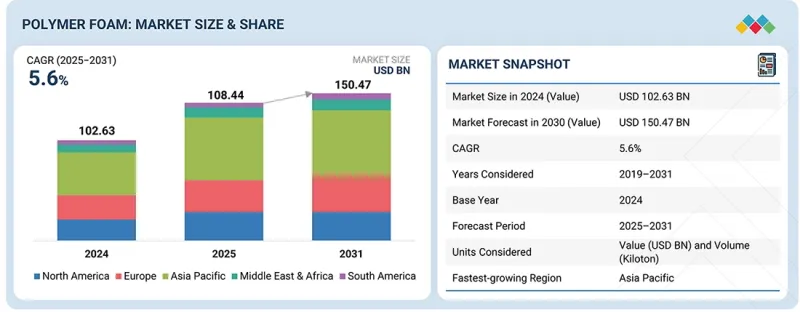
The polymer foam market is projected to grow from USD 108.44 billion in 2025 to USD 150.47 billion by 2031, at a CAGR of 5.6% during the forecast period. The polymer foam market experiences growth because structural factors, economic factors, and technological factors together increase its industrial applications.
| Scope of the Report | |
|---|---|
| Years Considered for the Study | 2019-2031 |
| Base Year | 2024 |
| Forecast Period | 2025-2031 |
| Units Considered | Value (USD Million/Billion) and Volume (Kiloton) |
| Segments | Resin Type, Foam Type, End-Use Industry, and Region |
| Regions covered | Asia Pacific, Europe, North America, the Middle East & Africa, and South America |
The primary market driver exists because industries need materials that are lightweight and energy-efficient, which applies especially to the construction and automotive industries. In construction, polymer foams are extensively used for thermal and acoustic insulation, helping reduce energy consumption and meet increasingly stringent building efficiency regulations. The automotive industry adopts lightweight foam materials for seating, interiors and insulation because of the accelerating trend towards fuel efficiency and electric vehicles.
"By resin type, the polyurethane segment is expected to be the largest market, in terms of value, during the forecast period."
The polyurethane segment is expected to be the largest segment during the forecast period due to its exceptional performance attributes. Polyurethane foams exist as flexible and rigid products, which provide an excellent combination of thermal insulation and cushioning, durability and lightweight structure that makes them ideal for use in construction and furniture, bedding and automotive and appliance applications. The segment's value dominance is largely attributed to its widespread adoption in premium and performance-driven applications. Rigid polyurethane foams for insulation systems, which construction professionals use, create energy efficiency improvements that lead to lower operational costs for extended periods of time, thus providing higher value for their work. Flexible polyurethane foams, which include memory foam and high-resilience variants, find their primary application in high-end mattresses and seating products for furniture and bedding purposes. The automotive industry expands its value creation through polyurethane foam applications, which improve vehicle interior components by providing better comfort and safety and fuel efficiency.
"By end-use industry, the building & construction segment is expected to be the fastest-growing market during the forecast period."
The building & construction segment is expected to be the fastest-growing market during the forecast period because of the rising demand for energy-efficient construction materials that support sustainability. The insulation of residential, commercial, and industrial buildings relies heavily on polymer foams, which include rigid foams made of polyurethane and polystyrene for thermal insulation, soundproofing and structural applications. These materials provide exceptional value because they possess multiple beneficial features, which include minimal heat transfer capacity, lightweight composition, water protection ability and long-lasting strength. The segment maintains its dominant market position because urbanization and population increases, and infrastructure projects drive new construction work in emerging markets. The implementation of energy-efficient building regulations, which include strict energy efficiency standards and carbon emission reduction requirements, accelerates the use of advanced insulation materials, which include polymer foams, in developed regions. The rise of green building practices, together with sustainable construction methods, creates a demand for environmentally friendly foam materials that can be recycled.
"Asia Pacific is expected to be the largest market, in terms of value, during the forecast period."
Asia Pacific is expected to be the largest market during the forecast period because of strong economic development, fast urban growth, and major industry expansions in key sectors. Four major economies, namely China, India, Japan, and South Korea, lead the market because of their extensive infrastructure projects and their growing financial support for residential and commercial building development. The building sector requires energy-efficient insulation materials, which increases the market value of polymer foams throughout the region.
Asia Pacific serves as a worldwide production center for the automotive, electronics, and consumer goods sectors, which utilize polymer foams to create lightweight components and thermal insulation and protective packaging materials. The market value of the region increases because it possesses global and local manufacturers who operate at low production costs and can easily obtain raw materials. The combination of rising disposable incomes and better living standards drives customers to purchase high-quality furniture, bedding and appliances which use advanced foam materials.
Profile break-up of primary participants for the report:
- By Company Type: Tier 1 - 45%, Tier 2 - 22%, and Tier 3 - 33%
- By Designation: C-Level Executives- 50%, Directors- 10%, and Others - 40%
- By Region: Asia Pacific - 17%, Europe - 33%, North America - 17%, Middle East & Africa - 25%, and South America - 8%
Leading players operating in the polymer foam market include ARMACELL (Luxembourg), Sheela Foam Limited (India), Kingspan Insulation, LLC (Ireland), Owens Corning (US), Saint-Gobain (France), Dura Foam Industries Pvt, Ltd. (India), FXI (US), Aeroflex USA, Inc. (US), Duroflex Foam (India) and Zotefoams plc (UK) and others. These key players are significant contributors to the polymer foam market. They have adopted various strategies, including agreements, joint ventures, and expansions, to increase their market share and business revenue.
Research Coverage:
The report defines segments and projects the size of the polymer foam market based on resin type, foam type, end-use industry, and region. It strategically profiles the key players and comprehensively analyzes their market share and core competencies. It also tracks and analyzes competitive developments, such as expansions, partnerships, and acquisitions undertaken by them in the market.
Reasons to Buy the Report:
The report is expected to help market leaders/new entrants by providing them with the closest approximations of revenue numbers for the polymer foam market and its segments. This report is also expected to help stakeholders gain a deeper understanding of the market's competitive landscape, acquire valuable insights to enhance their business positions, and develop effective go-to-market strategies. It also enables stakeholders to understand the market's pulse and provides information on key market drivers, restraints, challenges, and opportunities.
The report provides insights into the following pointers:
- Analysis of drivers (Rapid urbanization and construction growth, expanding automotive manufacturing base, booming e-commerce and packaging demand), restraints (Environmental restrictions on single-use plastics, inconsistent building codes and standards), opportunities (Shift toward EV manufacturing, growth of cold-chain logistics, high-volume infrastructure investments), and challenges (Technological gaps in advanced foam processing, environmental backlash against foam waste) are influencing the growth of the polymer foam market
- Product Development/Innovation: Detailed insights into upcoming technologies, research & development activities in the polymer foam market
- Market Development: Comprehensive information about lucrative markets across varied regions
- Market Diversification: Exhaustive information about new products, various types, untapped geographies, recent developments, and investments in the ultra-high-purity graphite market
- Competitive Assessment: In-depth assessment of market share, growth strategies, and product offerings of leading players, such as ARMACELL (Luxembourg), Sheela Foam Limited (India), Kingspan Insulation, LLC (Ireland), Owens Corning (US), Saint-Gobain (France), Dura Foam Industries Pvt, Ltd. (India), FXI (US), Aeroflex USA, Inc. (US), Duroflex Foam (India) and Zotefoams plc (UK) are the key players in polymer foam market.
TABLE OF CONTENTS
1 INTRODUCTION
- 1.1 STUDY OBJECTIVES
- 1.2 MARKET DEFINITION
- 1.3 STUDY SCOPE
- 1.3.1 MARKETS COVERED AND REGIONAL SCOPE
- 1.3.2 INCLUSIONS AND EXCLUSIONS
- 1.3.3 YEARS CONSIDERED
- 1.4 CURRENCY CONSIDERED
- 1.5 UNITS CONSIDERED
- 1.6 STAKEHOLDERS
- 1.7 SUMMARY OF CHANGES
2 EXECUTIVE SUMMARY
- 2.1 KEY INSIGHTS AND MARKET HIGHLIGHTS
- 2.2 KEY MARKET PARTICIPANTS: SHARE INSIGHTS AND STRATEGIC DEVELOPMENTS
- 2.3 DISRUPTIVE TRENDS IN POLYMER FOAM MARKET
- 2.4 HIGH-GROWTH SEGMENTS
- 2.5 REGIONAL SNAPSHOT: MARKET SIZE, GROWTH RATE, AND FORECAST
3 PREMIUM INSIGHTS
- 3.1 ATTRACTIVE OPPORTUNITIES FOR PLAYERS IN POLYMER FOAM MARKET
- 3.2 POLYMER FOAM MARKET, BY REGION
- 3.3 POLYMER FOAM MARKET, BY RESIN TYPE
- 3.4 POLYMER FOAM MARKET, BY COUNTRY
4 MARKET OVERVIEW
- 4.1 INTRODUCTION
- 4.2 MARKET DYNAMICS
- 4.2.1 DRIVERS
- 4.2.1.1 Growth of major end-use industries of polymer foams
- 4.2.1.2 High demand for polymer foams in Asia Pacific
- 4.2.1.3 Global focus on energy sustainability and energy conservation
- 4.2.2 RESTRAINTS
- 4.2.2.1 Volatility in raw material prices
- 4.2.3 OPPORTUNITIES
- 4.2.3.1 Growing demand for bio-based polyols
- 4.2.3.2 Rising demand for CO2-based polyols
- 4.2.4 CHALLENGES
- 4.2.4.1 High pricing pressure to cause fluctuations in crude oil prices
- 4.2.4.2 Stringent regulations
- 4.2.1 DRIVERS
- 4.3 UNMET NEEDS AND WHITE SPACES
- 4.3.1 UNMET NEEDS IN POLYMER FOAM MARKET
- 4.3.2 WHITE SPACE OPPORTUNITIES
- 4.4 INTERCONNECTED MARKETS AND CROSS-SECTOR OPPORTUNITIES
- 4.4.1 INTERCONNECTED MARKETS
- 4.4.2 CROSS-SECTOR OPPORTUNITIES
- 4.5 EMERGING BUSINESS MODELS AND ECOSYSTEM SHIFTS
- 4.5.1 EMERGING BUSINESS MODELS
- 4.5.2 ECOSYSTEM SHIFTS
- 4.6 STRATEGIC MOVES BY TIER-1/2/3 PLAYERS
5 INDUSTRY TRENDS
- 5.1 PORTER'S FIVE FORCES ANALYSIS
- 5.1.1 THREAT OF NEW ENTRANTS
- 5.1.2 THREAT OF SUBSTITUTES
- 5.1.3 BARGAINING POWER OF BUYERS
- 5.1.4 BARGAINING POWER OF SUPPLIERS
- 5.1.5 INTENSITY OF COMPETITIVE RIVALRY
- 5.2 MACROECONOMIC OUTLOOK
- 5.2.1 GDP TRENDS AND FORECAST
- 5.2.2 TRENDS IN GLOBAL POLYMER FOAM INDUSTRY
- 5.3 SUPPLY CHAIN ANALYSIS
- 5.3.1 RAW MATERIAL SUPPLIERS
- 5.3.2 MANUFACTURERS
- 5.3.3 DISTRIBUTION NETWORK
- 5.3.4 END-USE INDUSTRIES
- 5.4 ECOSYSTEM ANALYSIS
- 5.5 PRICING ANALYSIS
- 5.5.1 AVERAGE SELLING PRICE TREND, BY REGION
- 5.5.2 AVERAGE SELLING PRICE OF POLYMER FOAM, BY KEY PLAYERS
- 5.6 TRADE DATA
- 5.6.1 IMPORT SCENARIO (HS CODE 390210)
- 5.6.2 EXPORT SCENARIO (HS CODE 390210)
- 5.7 KEY CONFERENCES AND EVENTS, 2026-2027
- 5.8 TRENDS/DISRUPTIONS INFLUENCING CUSTOMER BUSINESS
- 5.9 INVESTMENT AND FUNDING SCENARIO
- 5.10 CASE STUDY ANALYSIS
- 5.10.1 CASE STUDY 1: KINGSPAN INTRODUCED HEMKOR RANGE, FEATURING ITS INAUGURAL BIO-BASED INSULATION PRODUCT
- 5.10.2 CASE STUDY 2: OWENS CORNING INTRODUCED FOAMULAR NEXT-GENERATION EXTRUDED (NGX) AS A BUILDING MATERIAL
- 5.10.3 CASE STUDY 3: KINGSPAN GROUP LAUNCHED ALPHACORE, AN ADVANCED INSULATION PRODUCT FOR BUILDINGS
- 5.11 IMPACT OF 2025 US TARIFF ON POLYMER FOAM MARKET
- 5.11.1 KEY TARIFF RATES
- 5.11.2 PRICE IMPACT ANALYSIS
- 5.11.3 IMPACT ON COUNTRIES/REGIONS
- 5.11.3.1 US
- 5.11.3.2 Europe
- 5.11.3.3 Asia Pacific
- 5.11.4 IMPACT ON END-USE INDUSTRIES
6 TECHNOLOGICAL ADVANCEMENTS, AI-DRIVEN IMPACT, PATENTS, INNOVATIONS, AND FUTURE APPLICATIONS
- 6.1 KEY TECHNOLOGIES
- 6.1.1 EXTRUSION FOAMING
- 6.1.2 INJECTION FOAMING
- 6.1.3 COMPRESSION FOAMING
- 6.2 COMPLEMENTARY TECHNOLOGIES
- 6.2.1 BIO-BASED FOAMS
- 6.2.2 NANOTECHNOLOGY
- 6.3 TECHNOLOGY ROADMAP
- 6.3.1 SHORT-TERM (2025-2027): SUSTAINABLE MATERIALS AND ADVANCED FOAM PROCESSING
- 6.3.2 MID-TERM (2027-2030): SMART MANUFACTURING AND CIRCULAR POLYMER FOAMS
- 6.3.3 LONG-TERM (2030-2035+): NEXT GENERATION CIRCULAR AND HIGH PERFORMANCE POLYMER FOAMS
- 6.4 PATENT ANALYSIS
- 6.5 FUTURE APPLICATIONS
- 6.5.1 SMART & MULTIFUNCTIONAL POLYMER FOAMS
- 6.5.2 SUSTAINABLE & CIRCULAR POLYMER FOAM SYSTEMS
- 6.5.3 ULTRA-LIGHTWEIGHT HIGH-PERFORMANCE STRUCTURAL FOAMS
- 6.5.4 DIGITALLY ENGINEERED & ADDITIVELY MANUFACTURED POLYMER FOAMS
- 6.6 IMPACT OF AI/GEN AI ON POLYMER FOAM MARKET
7 REGULATORY LANDSCAPE AND SUSTAINABILITY INITIATIVES
- 7.1 REGIONAL REGULATIONS AND COMPLIANCE
- 7.1.1 REGULATORY BODIES, GOVERNMENT AGENCIES, AND OTHER ORGANIZATIONS
- 7.1.2 INDUSTRY STANDARDS
- 7.2 SUSTAINABILITY INITIATIVES
- 7.2.1 CARBON IMPACT REDUCTION
- 7.2.2 ECO-APPLICATIONS
- 7.3 SUSTAINABILITY IMPACT AND REGULATORY POLICY INITIATIVES
- 7.4 CERTIFICATIONS, LABELING, AND ECO-STANDARDS
8 CUSTOMER LANDSCAPE AND BUYER BEHAVIOR
- 8.1 DECISION-MAKING PROCESS
- 8.2 KEY STAKEHOLDERS AND BUYING CRITERIA
- 8.2.1 KEY STAKEHOLDERS IN BUYING PROCESS
- 8.2.2 BUYING CRITERIA
- 8.3 ADOPTION BARRIERS AND INTERNAL CHALLENGES
- 8.4 UNMET NEEDS FROM END-USE INDUSTRIES
- 8.5 MARKET PROFITABILITY
- 8.5.1 REVENUE POTENTIAL
- 8.5.2 COST DYNAMICS
- 8.5.3 MARGIN OPPORTUNITIES IN KEY APPLICATIONS
9 POLYMER FOAM MARKET, BY FOAM TYPE
- 9.1 INTRODUCTION
- 9.2 FLEXIBLE FOAMS
- 9.2.1 TYPES OF FLEXIBLE FOAMS
- 9.2.1.1 Flexible polyurethane foam
- 9.2.1.2 Flexible polyethylene foam
- 9.2.1.3 Flexible polypropylene foam
- 9.2.2 GROWTH OF FLEXIBLE FOAM SEGMENT
- 9.2.3 MANUFACTURING PROCESS
- 9.2.4 PHYSICAL AND MECHANICAL PROPERTIES
- 9.2.5 KEY APPLICATIONS OF FLEXIBLE FOAMS
- 9.2.5.1 Cushioning
- 9.2.5.2 Apparel padding
- 9.2.5.3 Filtration
- 9.2.5.4 Other applications
- 9.2.1 TYPES OF FLEXIBLE FOAMS
- 9.3 RIGID FOAMS
- 9.3.1 TYPES OF RIGID FOAMS
- 9.3.1.1 Rigid polyurethane foam
- 9.3.1.2 Rigid polystyrene foam
- 9.3.1.3 Rigid polypropylene foam
- 9.3.1.4 Rigid polyethylene foam
- 9.3.2 SURGING DEMAND FOR INSULATION IN RESIDENTIAL AND COMMERCIAL BUILDINGS
- 9.3.3 MANUFACTURING PROCESS
- 9.3.4 PHYSICAL AND CHEMICAL PROPERTIES OF RIGID FOAM
- 9.3.5 KEY APPLICATIONS OF RIGID FOAMS
- 9.3.5.1 Building and transport insulation
- 9.3.5.2 Appliances insulation (refrigerators and freezers)
- 9.3.5.3 Buoyancy and in-fill
- 9.3.1 TYPES OF RIGID FOAMS
10 POLYMER FOAM MARKET, BY RESIN TYPE
- 10.1 INTRODUCTION
- 10.2 POLYURETHANE
- 10.2.1 WIDE USE IN BEDDING AND UPHOLSTERY TO DRIVE MARKET
- 10.2.2 RAW MATERIALS OF POLYURETHANE FOAM
- 10.2.2.1 Methylene diphenyl diisocyanate
- 10.2.2.2 Toluene diisocyanate
- 10.2.2.3 Polyol
- 10.2.3 POLYURETHANE FOAM CELL STRUCTURE
- 10.2.3.1 Introduction
- 10.2.3.2 Microcellular polyurethane foam
- 10.2.3.3 Nanocellular polyurethane foam
- 10.2.4 DENSITY COMPOSITION OF POLYURETHANE FOAM
- 10.2.4.1 Introduction
- 10.2.4.2 Low-density polyurethane foam
- 10.2.4.2.1 Reticulated polyurethane foam
- 10.2.4.2.2 Polyester foam
- 10.2.4.2.3 Polyether foam
- 10.2.4.3 Medium-density polyurethane foam
- 10.2.4.4 High-density polyurethane foam
- 10.3 POLYSTYRENE
- 10.3.1 INCREASING DEMAND FOR ECO-FRIENDLY BUILDING STRUCTURES TO DRIVE MARKET
- 10.3.2 TYPES OF POLYSTYRENE (PS) FOAM
- 10.3.2.1 Expanded polystyrene
- 10.3.2.2 EPS manufacturing process
- 10.3.2.2.1 Pre-expansion
- 10.3.2.2.2 Intermediate maturing and stabilization
- 10.3.2.2.3 Expansion and final molding
- 10.3.2.3 White expanded polystyrene
- 10.3.2.4 Grey expanded polystyrene
- 10.3.2.4.1 Silver expanded polystyrene
- 10.3.2.5 Black expanded polystyrene
- 10.3.2.6 Extruded polystyrene foam
- 10.4 POLYOLEFIN
- 10.4.1 HIGH DEMAND IN AUTOMOTIVE INDUSTRY TO FUEL MARKET GROWTH
- 10.4.2 POLYPROPYLENE FOAM
- 10.4.3 POLYETHYLENE FOAM
- 10.4.4 EVA FOAM
- 10.5 PHENOLIC
- 10.5.1 INCREASING DEMAND FROM HIGH-END APPLICATIONS TO DRIVE MARKET
- 10.6 OTHER RESIN TYPES
- 10.6.1 PVC FOAM
- 10.6.2 MELAMINE FOAM
- 10.6.3 SILICONE FOAM
- 10.6.4 PVDF FOAM
- 10.6.5 RUBBER
11 POLYMER FOAM MARKET, BY END-USE INDUSTRY
- 11.1 INTRODUCTION
- 11.2 BUILDING & CONSTRUCTION
- 11.2.1 STRINGENT REGULATIONS REGARDING ENERGY SAVINGS TO FUEL DEMAND
- 11.2.2 POLYMER FOAM FOR BUILDING & CONSTRUCTION
- 11.2.2.1 Thermal insulation
- 11.2.2.2 Air sealing
- 11.3 BEDDING & FURNITURE
- 11.3.1 GROWING DEMAND IN UPHOLSTERY APPLICATIONS TO DRIVE MARKET
- 11.3.2 POLYURETHANE FOAM FOR BEDDING & FURNITURE
- 11.3.2.1 Mattress & pillows
- 11.3.2.2 Medical
- 11.3.2.3 Carpet cushioning
- 11.3.2.4 Seating
- 11.3.2.5 Office furniture
- 11.4 PACKAGING
- 11.4.1 INCREASING DEMAND FOR POLYURETHANE FOAMS IN ELECTRONIC PRODUCTS TO DRIVE MARKET
- 11.4.2 POLYURETHANE FOAM FOR PACKAGING
- 11.4.2.1 Foam packaging
- 11.4.2.2 Composite packaging
- 11.5 AUTOMOTIVE
- 11.5.1 GROWING AUTOMOTIVE PRODUCTION AND LIGHTWEIGHT VEHICLE TRENDS TO BOOST MARKET
- 11.5.2 POLYURETHANE FOAM FOR AUTOMOTIVE INDUSTRY
- 11.5.2.1 Cushion overlays
- 11.5.2.2 Seat foams
- 11.5.2.3 Door panels
- 11.5.2.4 Energy absorbers
- 11.5.2.5 Sound absorption and vibration dampening
- 11.5.2.6 Others
- 11.6 FOOTWEAR, SPORTS & RECREATIONAL
- 11.6.1 RISING DEMAND FOR POLYMER FOAMS AS ADHESIVES IN FOOTWEAR TO DRIVE MARKET
- 11.6.2 POLYMER FOAM FOR FOOTWEAR
- 11.6.2.1 Shoe midsoles
- 11.6.2.2 Shoe bottoms
- 11.6.2.3 Shoe upper materials
- 11.7 OTHER END-USE INDUSTRIES
- 11.7.1 AVIATION & AEROSPACE
- 11.7.2 WIND ENERGY
- 11.7.3 MARINE
- 11.7.4 MEDICAL
- 11.7.5 REFRIGERATION
12 POLYMER FOAM MARKET, BY REGION
- 12.1 INTRODUCTION
- 12.2 ASIA PACIFIC
- 12.2.1 CHINA
- 12.2.1.1 Expanding automotive sector and need for improved public infrastructure to boost demand
- 12.2.2 JAPAN
- 12.2.2.1 Presence of well-established building & construction industry to boost demand
- 12.2.3 INDIA
- 12.2.3.1 Availability of resources and urbanization to drive market
- 12.2.4 SOUTH KOREA
- 12.2.4.1 Growth in automotive industry to fuel market growth
- 12.2.5 INDONESIA
- 12.2.5.1 High growth in building & construction and automotive industries to drive market
- 12.2.6 THAILAND
- 12.2.6.1 Strong local supply chain and automobile production to drive market
- 12.2.7 MALAYSIA
- 12.2.7.1 Increase in demand for polyurethane foam to drive market
- 12.2.8 REST OF ASIA PACIFIC
- 12.2.1 CHINA
- 12.3 EUROPE
- 12.3.1 ITALY
- 12.3.1.1 Increasing investments by foreign investors to drive market
- 12.3.2 SPAIN
- 12.3.2.1 Growth of construction industry to boost demand
- 12.3.3 GERMANY
- 12.3.3.1 Presence of major automobile companies and production facilities to boost demand
- 12.3.4 FRANCE
- 12.3.4.1 Growing demand for auto parts and packaging materials to drive market
- 12.3.5 UK
- 12.3.5.1 Rising consumption of polyolefin foams in automotive industry to drive market
- 12.3.6 TURKEY
- 12.3.6.1 Presence of key automotive players to drive market
- 12.3.7 RUSSIA
- 12.3.7.1 Government investments for modernizing and expanding infrastructure to boost demand
- 12.3.8 REST OF EUROPE
- 12.3.1 ITALY
- 12.4 NORTH AMERICA
- 12.4.1 US
- 12.4.1.1 Growth of housing projects to drive market expansion
- 12.4.2 MEXICO
- 12.4.2.1 Expanding construction sector to drive support market growth
- 12.4.3 CANADA
- 12.4.3.1 State-of-the-art manufacturing facilities and excellent infrastructure to provide growth opportunities
- 12.4.1 US
- 12.5 MIDDLE EAST & AFRICA
- 12.5.1 GCC
- 12.5.1.1 Saudi Arabia
- 12.5.1.1.1 Increased local car sales to drive demand for polymer foams
- 12.5.1.2 UAE
- 12.5.1.2.1 Building of new resorts, shopping malls, and other ongoing projects to boost market
- 12.5.1.3 Rest of GCC
- 12.5.1.1 Saudi Arabia
- 12.5.2 SOUTH AFRICA
- 12.5.2.1 Growth of various manufacturing industries to drive market
- 12.5.3 REST OF MIDDLE EAST & AFRICA
- 12.5.1 GCC
- 12.6 SOUTH AMERICA
- 12.6.1 BRAZIL
- 12.6.1.1 Expansion of production capacity and proximity to major South American countries to drive market
- 12.6.2 ARGENTINA
- 12.6.2.1 Growing automobile sector to boost demand
- 12.6.3 CHILE
- 12.6.3.1 Government investment in end-use industries to drive demand
- 12.6.4 REST OF SOUTH AMERICA
- 12.6.1 BRAZIL
13 COMPETITIVE LANDSCAPE
- 13.1 INTRODUCTION
- 13.2 KEY PLAYERS' STRATEGIES/RIGHT TO WIN
- 13.3 REVENUE ANALYSIS
- 13.4 MARKET SHARE ANALYSIS
- 13.5 COMPANY VALUATION AND FINANCIAL METRICS
- 13.6 BRAND/PRODUCT COMPARISON ANALYSIS
- 13.7 COMPANY EVALUATION MATRIX: KEY PLAYERS, 2025
- 13.7.1 STARS
- 13.7.2 EMERGING LEADERS
- 13.7.3 PERVASIVE PLAYERS
- 13.7.4 PARTICIPANTS
- 13.7.5 COMPANY FOOTPRINT: KEY PLAYERS
- 13.7.5.1 Company footprint
- 13.7.5.2 Region footprint
- 13.7.5.3 Resin type footprint
- 13.7.5.4 Foam type footprint
- 13.7.5.5 End-use industry footprint
- 13.8 COMPANY EVALUATION MATRIX: STARTUPS/SMES, 2025
- 13.8.1 PROGRESSIVE COMPANIES
- 13.8.2 RESPONSIVE COMPANIES
- 13.8.3 DYNAMIC COMPANIES
- 13.8.4 STARTING BLOCKS
- 13.8.5 COMPETITIVE BENCHMARKING: STARTUPS/SMES
- 13.8.5.1 Detailed list of key startups/SMEs
- 13.8.5.2 Competitive benchmarking of key startups/SMEs
- 13.9 COMPETITIVE SCENARIO AND TRENDS
- 13.9.1 PRODUCT LAUNCHES
- 13.9.2 DEALS
- 13.9.3 EXPANSIONS
14 COMPANY PROFILES
- 14.1 KEY PLAYERS
- 14.1.1 ARMACELL
- 14.1.1.1 Business overview
- 14.1.1.2 Products/Solutions/Services offered
- 14.1.1.3 Recent developments
- 14.1.1.3.1 Deals
- 14.1.1.3.2 Expansions
- 14.1.1.4 MnM view
- 14.1.1.4.1 Key strengths
- 14.1.1.4.2 Strategic choices
- 14.1.1.4.3 Weaknesses and competitive threats
- 14.1.2 SHEELA FOAM LIMITED
- 14.1.2.1 Business overview
- 14.1.2.2 Products/Solutions/Services offered
- 14.1.2.3 Recent developments
- 14.1.2.3.1 Deals
- 14.1.2.4 MnM view
- 14.1.2.4.1 Key strengths
- 14.1.2.4.2 Strategic choices
- 14.1.2.4.3 Weakness and competitive threats
- 14.1.3 KINGSPAN INSULATION, LLC
- 14.1.3.1 Business overview
- 14.1.3.2 Products/Solutions/Services offered
- 14.1.3.3 Recent developments
- 14.1.3.3.1 Product launches
- 14.1.3.3.2 Deals
- 14.1.3.4 MnM view
- 14.1.3.4.1 Key strengths
- 14.1.3.4.2 Strategic choices
- 14.1.3.4.3 Weaknesses and competitive threats
- 14.1.4 OWENS CORNING
- 14.1.4.1 Business overview
- 14.1.4.2 Products/Solutions/Services offered
- 14.1.4.3 Recent developments
- 14.1.4.3.1 Product launches
- 14.1.4.3.2 Deals
- 14.1.4.4 MnM view
- 14.1.4.4.1 Key strengths
- 14.1.4.4.2 Strategic choices
- 14.1.4.4.3 Weaknesses and competitive threats
- 14.1.5 SAINT-GOBAIN
- 14.1.5.1 Business overview
- 14.1.5.2 Products/Solutions/Services offered
- 14.1.5.3 Recent developments
- 14.1.5.3.1 Deals
- 14.1.5.4 MnM view
- 14.1.5.4.1 Key strengths
- 14.1.5.4.2 Strategic choices
- 14.1.5.4.3 Weaknesses and competitive threats
- 14.1.6 ZOTEFOAMS PLC
- 14.1.6.1 Business overview
- 14.1.6.2 Products/Solutions/Services offered
- 14.1.6.3 Recent developments
- 14.1.6.3.1 Deals
- 14.1.6.3.2 Expansions
- 14.1.7 FXI
- 14.1.7.1 Business overview
- 14.1.7.2 Products/Solutions/Services offered
- 14.1.8 AEROFLEX USA, INC.
- 14.1.8.1 Business overview
- 14.1.8.2 Products/Solutions/Services offered
- 14.1.8.3 Recent developments
- 14.1.8.3.1 Product launches
- 14.1.9 DUROFLEX FOAM
- 14.1.9.1 Business overview
- 14.1.9.2 Products/Solutions/Services offered
- 14.1.1 ARMACELL
- 14.2 OTHER PLAYERS
- 14.2.1 WOODBRIDGE
- 14.2.2 UFP TECHNOLOGIES, INC.
- 14.2.3 CARPENTER CO.
- 14.2.4 TORAY INDUSTRIES, INC.
- 14.2.5 BOYD
- 14.2.6 VITA (HOLDINGS) LIMITED
- 14.2.7 TROCELLEN
- 14.2.8 JOY FOAM
- 14.2.9 MEGAFLEX SCHAUMSTOFF GMBH
- 14.2.10 SAFAS
- 14.2.11 ORGANIKA S.A.
- 14.2.12 IKANO INDUSTRY
- 14.2.13 KING KOIL INDIA
- 14.2.14 NEVEON HOLDING GMBH
15 RESEARCH METHODOLOGY
- 15.1 RESEARCH DATA
- 15.1.1 SECONDARY DATA
- 15.1.1.1 List of key secondary sources
- 15.1.1.2 Key data from secondary sources
- 15.1.2 PRIMARY DATA
- 15.1.2.1 Key data from primary sources
- 15.1.2.2 List of primary interview participants
- 15.1.2.3 Key industry insights
- 15.1.2.4 Breakdown of primary interviews
- 15.1.1 SECONDARY DATA
- 15.2 DEMAND-SIDE ANALYSIS
- 15.3 MARKET SIZE ESTIMATION
- 15.3.1 BOTTOM-UP APPROACH
- 15.3.2 TOP-DOWN APPROACH
- 15.3.3 SUPPLY-SIDE ANALYSIS OF POLYMER FOAM MARKET
- 15.3.3.1 Calculations for supply-side analysis
- 15.4 GROWTH FORECAST
- 15.5 DATA TRIANGULATION
- 15.6 FACTOR ANALYSIS
- 15.7 RESEARCH ASSUMPTIONS
- 15.8 RESEARCH LIMITATIONS
- 15.9 RISK ASSESSMENT
16 APPENDIX
- 16.1 DISCUSSION GUIDE
- 16.2 KNOWLEDGESTORE: MARKETSANDMARKETS' SUBSCRIPTION PORTAL
- 16.3 CUSTOMIZATION OPTIONS
- 16.4 RELATED REPORTS
- 16.5 AUTHOR DETAILS
List of Tables
- TABLE 1 GLOBAL NEW CAR SALES SHARE, BY REGION, 2020-2024
- TABLE 2 CRUDE OIL PRICE TREND (2024-2027)
- TABLE 3 STRATEGIC MOVES BY TIER-1/2/3 PLAYERS
- TABLE 4 POLYMER FOAM MARKET: IMPACT OF PORTER'S FIVE FORCES
- TABLE 5 REAL GDP GROWTH (ANNUAL PERCENTAGE CHANGE), BY COUNTRY, 2022-2025 (%)
- TABLE 6 UNEMPLOYMENT RATE, BY COUNTRY, 2022-2025 (%)
- TABLE 7 INFLATION RATE, AVERAGE CONSUMER PRICES, BY COUNTRY, 2022-2025 (%)
- TABLE 8 FOREIGN DIRECT INVESTMENT, BY REGION, 2022-2024 (USD BILLION)
- TABLE 9 POLYMER FOAM MARKET: ROLE OF COMPANIES IN ECOSYSTEM
- TABLE 10 AVERAGE SELLING PRICE OF POLYMER FOAM, BY KEY PLAYERS, (USD/KG)
- TABLE 11 IMPORT DATA FOR HS CODE 390210-COMPLIANT PRODUCTS, BY KEY COUNTRIES, 2021-2025 (USD THOUSAND)
- TABLE 12 EXPORT DATA FOR HS CODE 390210-COMPLIANT PRODUCTS, BY KEY COUNTRIES, 2021-2025 (USD THOUSAND)
- TABLE 13 KEY CONFERENCES AND EVENTS, 2026-2027
- TABLE 14 POLYMER FOAM MARKET: LIST OF KEY PATENTS
- TABLE 15 NORTH AMERICA: REGULATORY BODIES, GOVERNMENT AGENCIES, AND OTHER ORGANIZATIONS
- TABLE 16 EUROPE: REGULATORY BODIES, GOVERNMENT AGENCIES, AND OTHER ORGANIZATIONS
- TABLE 17 ASIA PACIFIC: REGULATORY BODIES, GOVERNMENT AGENCIES, AND OTHER ORGANIZATIONS
- TABLE 18 MIDDLE EAST & AFRICA: REGULATORY BODIES, GOVERNMENT AGENCIES, AND OTHER ORGANIZATIONS
- TABLE 19 SOUTH AMERICA: REGULATORY BODIES, GOVERNMENT AGENCIES, AND OTHER ORGANIZATIONS
- TABLE 20 GLOBAL INDUSTRY STANDARDS
- TABLE 21 CERTIFICATIONS, LABELING, AND ECO-STANDARDS
- TABLE 22 IMPACT OF STAKEHOLDERS ON BUYING PROCESS FOR TOP THREE RESIN TYPES (%)
- TABLE 23 KEY BUYING CRITERIA FOR TOP THREE RESIN TYPES
- TABLE 24 UNMET NEEDS IN POLYMER FOAM MARKET, BY END-USE INDUSTRY
- TABLE 25 KEY PHYSICAL AND MECHANICAL PROPERTIES OF FLEXIBLE POLYMER FOAM
- TABLE 26 KEY PHYSICAL AND CHEMICAL PROPERTIES OF RIGID POLYMER FOAM
- TABLE 27 POLYMER FOAM MARKET, BY RESIN TYPE, 2022-2024 (USD MILLION)
- TABLE 28 POLYMER FOAM MARKET, BY RESIN TYPE, 2025-2031 (USD MILLION)
- TABLE 29 POLYMER FOAM MARKET, BY RESIN TYPE, 2022-2024 (KILOTON)
- TABLE 30 POLYMER FOAM MARKET, BY RESIN TYPE, 2025-2031 (KILOTON)
- TABLE 31 POLYURETHANE FOAM: POLYMER FOAM MARKET, BY REGION, 2022-2024 (USD MILLION)
- TABLE 32 POLYURETHANE FOAM: POLYMER FOAM MARKET, BY REGION, 2025-2031 (USD MILLION)
- TABLE 33 POLYURETHANE FOAM: POLYMER FOAM MARKET, BY REGION, 2022-2024 (KILOTON)
- TABLE 34 POLYURETHANE FOAM: POLYMER FOAM MARKET, BY REGION, 2025-2031 (KILOTON)
- TABLE 35 TYPES OF METHYLENE DIPHENYL DIISOCYANATE
- TABLE 36 TYPES OF TOLUENE DIISOCYANATE
- TABLE 37 POLYSTYRENE FOAM: POLYMER FOAM MARKET, BY REGION, 2022-2024 (USD MILLION)
- TABLE 38 POLYSTYRENE FOAM: POLYMER FOAM MARKET, BY REGION, 2025-2031 (USD MILLION)
- TABLE 39 POLYSTYRENE FOAM: POLYMER FOAM MARKET, BY REGION, 2022-2024 (KILOTON)
- TABLE 40 POLYSTYRENE FOAM: POLYMER FOAM MARKET, BY REGION, 2025-2031 (KILOTON)
- TABLE 41 POLYOLEFIN FOAM: POLYMER FOAM MARKET, BY REGION, 2022-2024 (USD MILLION)
- TABLE 42 POLYOLEFIN FOAM: POLYMER FOAM MARKET, BY REGION, 2025-2031 (USD MILLION)
- TABLE 43 POLYOLEFIN FOAM: POLYMER FOAM MARKET, BY REGION, 2022-2024 (KILOTON)
- TABLE 44 POLYOLEFIN FOAM: POLYMER FOAM MARKET, BY REGION, 2025-2031 (KILOTON)
- TABLE 45 PHENOLIC FOAM: POLYMER FOAM MARKET, BY REGION, 2022-2024 (USD MILLION)
- TABLE 46 PHENOLIC FOAM: POLYMER FOAM MARKET, BY REGION, 2025-2031 (USD MILLION)
- TABLE 47 PHENOLIC FOAM: POLYMER FOAM MARKET, BY REGION, 2022-2024 (KILOTON)
- TABLE 48 PHENOLIC FOAM: POLYMER FOAM MARKET, BY REGION, 2025-2031 (KILOTON)
- TABLE 49 OTHER RESIN TYPES: POLYMER FOAM MARKET, BY REGION, 2022-2024 (USD MILLION)
- TABLE 50 OTHER RESIN TYPES: POLYMER FOAM MARKET, BY REGION, 2025-2031 (USD MILLION)
- TABLE 51 OTHER RESIN TYPES: POLYMER FOAM MARKET, BY REGION, 2022-2024 (KILOTON)
- TABLE 52 OTHER RESIN TYPES: POLYMER FOAM MARKET, BY REGION, 2025-2031 (KILOTON)
- TABLE 53 POLYMER FOAM MARKET, BY END-USE INDUSTRY, 2022-2024 (USD MILLION)
- TABLE 54 POLYMER FOAM MARKET, BY END-USE INDUSTRY, 2025-2031 (USD MILLION)
- TABLE 55 BUILDING & CONSTRUCTION: POLYMER FOAM MARKET, BY REGION, 2022-2024 (USD MILLION)
- TABLE 56 BUILDING & CONSTRUCTION: POLYMER FOAM MARKET, BY REGION, 2025-2031 (USD MILLION)
- TABLE 57 BEDDING & FURNITURE: POLYMER FOAM MARKET, BY REGION, 2022-2024 (USD MILLION)
- TABLE 58 BEDDING & FURNITURE: POLYMER FOAM MARKET, BY REGION, 2025-2031 (USD MILLION)
- TABLE 59 PACKAGING: POLYMER FOAM MARKET, BY REGION, 2022-2024 (USD MILLION)
- TABLE 60 PACKAGING: POLYMER FOAM MARKET, BY REGION, 2025-2031 (USD MILLION)
- TABLE 61 AUTOMOTIVE: POLYMER FOAM MARKET, BY REGION, 2022-2024 (USD MILLION)
- TABLE 62 AUTOMOTIVE: POLYMER FOAM MARKET, BY REGION, 2025-2031 (USD MILLION)
- TABLE 63 FOOTWEAR, SPORTS & RECREATIONAL: POLYMER FOAM MARKET, BY REGION, 2022-2024 (USD MILLION)
- TABLE 64 FOOTWEAR, SPORTS & RECREATIONAL: POLYMER FOAM MARKET, BY REGION, 2025-2031 (USD MILLION)
- TABLE 65 OTHER END-USE INDUSTRIES: POLYMER FOAM MARKET, BY REGION, 2022-2024 (USD MILLION)
- TABLE 66 OTHER END-USE INDUSTRIES: POLYMER FOAM MARKET, BY REGION, 2025-2031 (USD MILLION)
- TABLE 67 POLYMER FOAM MARKET, BY REGION, 2022-2024 (USD MILLION)
- TABLE 68 POLYMER FOAM MARKET, BY REGION, 2025-2031 (USD MILLION)
- TABLE 69 POLYMER FOAM MARKET, BY REGION, 2022-2024 (KILOTON)
- TABLE 70 POLYMER FOAM MARKET, BY REGION, 2025-2031 (KILOTON)
- TABLE 71 ASIA PACIFIC: POLYMER FOAM MARKET, BY RESIN TYPE, 2022-2024 (USD MILLION)
- TABLE 72 ASIA PACIFIC: POLYMER FOAM MARKET, BY RESIN TYPE, 2025-2031 (USD MILLION)
- TABLE 73 ASIA PACIFIC: POLYMER FOAM MARKET, BY RESIN TYPE, 2022-2024 (KILOTON)
- TABLE 74 ASIA PACIFIC: POLYMER FOAM MARKET, BY RESIN TYPE, 2025-2031 (KILOTON)
- TABLE 75 ASIA PACIFIC: POLYMER FOAM MARKET, BY END-USE INDUSTRY, 2022-2024 (USD MILLION)
- TABLE 76 ASIA PACIFIC: POLYMER FOAM MARKET, BY END-USE INDUSTRY, 2025-2031 (USD MILLION)
- TABLE 77 ASIA PACIFIC: POLYMER FOAM MARKET, BY COUNTRY, 2022-2024 (USD MILLION)
- TABLE 78 ASIA PACIFIC: POLYMER FOAM MARKET, BY COUNTRY, 2025-2031 (USD MILLION)
- TABLE 79 CHINA: POLYMER FOAM MARKET, BY RESIN TYPE, 2022-2024 (USD MILLION)
- TABLE 80 CHINA: POLYMER FOAM MARKET, BY RESIN TYPE, 2025-2031 (USD MILLION)
- TABLE 81 JAPAN: POLYMER FOAM MARKET, BY RESIN TYPE, 2022-2024 (USD MILLION)
- TABLE 82 JAPAN: POLYMER FOAM MARKET, BY RESIN TYPE, 2025-2031 (USD MILLION)
- TABLE 83 INDIA: POLYMER FOAM MARKET, BY RESIN TYPE, 2022-2024 (USD MILLION)
- TABLE 84 INDIA: POLYMER FOAM MARKET, BY RESIN TYPE, 2025-2031 (USD MILLION)
- TABLE 85 SOUTH KOREA: POLYMER FOAM MARKET, BY RESIN TYPE, 2022-2024 (USD MILLION)
- TABLE 86 SOUTH KOREA: POLYMER FOAM MARKET, BY RESIN TYPE, 2025-2031 (USD MILLION)
- TABLE 87 INDONESIA: POLYMER FOAM MARKET, BY RESIN TYPE, 2022-2024 (USD MILLION)
- TABLE 88 INDONESIA: POLYMER FOAM MARKET, BY RESIN TYPE, 2025-2031 (USD MILLION)
- TABLE 89 THAILAND: POLYMER FOAM MARKET, BY RESIN TYPE, 2022-2024 (USD MILLION)
- TABLE 90 THAILAND: POLYMER FOAM MARKET, BY RESIN TYPE, 2025-2031 (USD MILLION)
- TABLE 91 MALAYSIA: POLYMER FOAM MARKET, BY RESIN TYPE, 2022-2024 (USD MILLION)
- TABLE 92 MALAYSIA: POLYMER FOAM MARKET, BY RESIN TYPE, 2025-2031 (USD MILLION)
- TABLE 93 REST OF ASIA PACIFIC: POLYMER FOAM MARKET, BY RESIN TYPE, 2022-2024 (USD MILLION)
- TABLE 94 REST OF ASIA PACIFIC: POLYMER FOAM MARKET, BY RESIN TYPE, 2025-2031 (USD MILLION)
- TABLE 95 EUROPE: POLYMER FOAM MARKET, BY RESIN TYPE, 2022-2024 (USD MILLION)
- TABLE 96 EUROPE: POLYMER FOAM MARKET, BY RESIN TYPE, 2025-2031 (USD MILLION)
- TABLE 97 EUROPE: POLYMER FOAM MARKET, BY RESIN TYPE, 2022-2024 (KILOTON)
- TABLE 98 EUROPE: POLYMER FOAM MARKET, BY RESIN TYPE, 2025-2031 (KILOTON)
- TABLE 99 EUROPE: POLYMER FOAM MARKET, BY END-USE INDUSTRY, 2022-2024 (USD MILLION)
- TABLE 100 EUROPE: POLYMER FOAM MARKET, BY END-USE INDUSTRY, 2025-2031 (USD MILLION)
- TABLE 101 EUROPE: POLYMER FOAM MARKET, BY COUNTRY, 2022-2024 (USD MILLION)
- TABLE 102 EUROPE: POLYMER FOAM MARKET, BY COUNTRY, 2025-2031 (USD MILLION)
- TABLE 103 ITALY: POLYMER FOAM MARKET, BY RESIN TYPE, 2022-2024 (USD MILLION)
- TABLE 104 ITALY: POLYMER FOAM MARKET, BY RESIN TYPE, 2025-2031 (USD MILLION)
- TABLE 105 SPAIN: POLYMER FOAM MARKET, BY RESIN TYPE, 2022-2024 (USD MILLION)
- TABLE 106 SPAIN: POLYMER FOAM MARKET, BY RESIN TYPE, 2025-2031 (USD MILLION)
- TABLE 107 GERMANY: POLYMER FOAM MARKET, BY RESIN TYPE, 2022-2024 (USD MILLION)
- TABLE 108 GERMANY: POLYMER FOAM MARKET, BY RESIN TYPE, 2025-2031 (USD MILLION)
- TABLE 109 FRANCE: POLYMER FOAM MARKET, BY RESIN TYPE, 2022-2024 (USD MILLION)
- TABLE 110 FRANCE: POLYMER FOAM MARKET, BY RESIN TYPE, 2025-2031 (USD MILLION)
- TABLE 111 UK: POLYMER FOAM MARKET, BY RESIN TYPE, 2022-2024 (USD MILLION)
- TABLE 112 UK: POLYMER FOAM MARKET, BY RESIN TYPE, 2025-2031 (USD MILLION)
- TABLE 113 TURKEY: POLYMER FOAM MARKET, BY RESIN TYPE, 2022-2024 (USD MILLION)
- TABLE 114 TURKEY: POLYMER FOAM MARKET, BY RESIN TYPE, 2025-2031 (USD MILLION)
- TABLE 115 RUSSIA: POLYMER FOAM MARKET, BY RESIN TYPE, 2022-2024 (USD MILLION)
- TABLE 116 RUSSIA: POLYMER FOAM MARKET, BY RESIN TYPE, 2025-2031 (USD MILLION)
- TABLE 117 REST OF EUROPE: POLYMER FOAM MARKET, BY RESIN TYPE, 2022-2024 (USD MILLION)
- TABLE 118 REST OF EUROPE: POLYMER FOAM MARKET, BY RESIN TYPE, 2025-2031 (USD MILLION)
- TABLE 119 NORTH AMERICA: POLYMER FOAM MARKET, BY RESIN TYPE, 2022-2024 (USD MILLION)
- TABLE 120 NORTH AMERICA: POLYMER FOAM MARKET, BY RESIN TYPE, 2025-2031 (USD MILLION)
- TABLE 121 NORTH AMERICA: POLYMER FOAM MARKET, BY RESIN TYPE, 2022-2024 (KILOTON)
- TABLE 122 NORTH AMERICA: POLYMER FOAM MARKET, BY RESIN TYPE, 2025-2031 (KILOTON)
- TABLE 123 NORTH AMERICA: POLYMER FOAM MARKET, BY END-USE INDUSTRY, 2022-2024 (USD MILLION)
- TABLE 124 NORTH AMERICA: POLYMER FOAM MARKET, BY END-USE INDUSTRY, 2025-2031 (USD MILLION)
- TABLE 125 NORTH AMERICA: POLYMER FOAM MARKET, BY COUNTRY, 2022-2024 (USD MILLION)
- TABLE 126 NORTH AMERICA: POLYMER FOAM MARKET, BY COUNTRY, 2025-2031 (USD MILLION)
- TABLE 127 US: POLYMER FOAM MARKET, BY RESIN TYPE, 2022-2024 (USD MILLION)
- TABLE 128 US: POLYMER FOAM MARKET, BY RESIN TYPE, 2025-2031 (USD MILLION)
- TABLE 129 MEXICO: POLYMER FOAM MARKET, BY RESIN TYPE, 2022-2024 (USD MILLION)
- TABLE 130 MEXICO: POLYMER FOAM MARKET, BY RESIN TYPE, 2025-2031 (USD MILLION)
- TABLE 131 CANADA: POLYMER FOAM MARKET, BY RESIN TYPE, 2022-2024 (USD MILLION)
- TABLE 132 CANADA: POLYMER FOAM MARKET, BY RESIN TYPE, 2025-2031 (USD MILLION)
- TABLE 133 MIDDLE EAST & AFRICA: POLYMER FOAM MARKET, BY RESIN TYPE, 2022-2024 (USD MILLION)
- TABLE 134 MIDDLE EAST & AFRICA: POLYMER FOAM MARKET, BY RESIN TYPE, 2025-2031 (USD MILLION)
- TABLE 135 MIDDLE EAST & AFRICA: POLYMER FOAM MARKET, BY RESIN TYPE, 2022-2024 (KILOTON)
- TABLE 136 MIDDLE EAST & AFRICA: POLYMER FOAM MARKET, BY RESIN TYPE, 2025-2031 (KILOTON)
- TABLE 137 MIDDLE EAST & AFRICA: POLYMER FOAM MARKET, BY END-USE INDUSTRY, 2022-2024 (USD MILLION)
- TABLE 138 MIDDLE EAST & AFRICA: POLYMER FOAM MARKET, BY END-USE INDUSTRY, 2025-2031 (USD MILLION)
- TABLE 139 MIDDLE EAST & AFRICA: POLYMER FOAM MARKET, BY COUNTRY, 2022-2024 (USD MILLION)
- TABLE 140 MIDDLE EAST & AFRICA: POLYMER FOAM MARKET, BY COUNTRY, 2025-2031 (USD MILLION)
- TABLE 141 SAUDI ARABIA: POLYMER FOAM MARKET, BY RESIN TYPE, 2022-2024 (USD MILLION)
- TABLE 142 SAUDI ARABIA: POLYMER FOAM MARKET, BY RESIN TYPE, 2025-2031 (USD MILLION)
- TABLE 143 UAE: POLYMER FOAM MARKET, BY RESIN TYPE, 2022-2024 (USD MILLION)
- TABLE 144 UAE: POLYMER FOAM MARKET, BY RESIN TYPE, 2025-2031 (USD MILLION)
- TABLE 145 REST OF GCC: POLYMER FOAM MARKET, BY RESIN TYPE, 2022-2024 (USD MILLION)
- TABLE 146 REST OF GCC: POLYMER FOAM MARKET, BY RESIN TYPE, 2025-2031 (USD MILLION)
- TABLE 147 SOUTH AFRICA: POLYMER FOAM MARKET, BY RESIN TYPE, 2022-2024 (USD MILLION)
- TABLE 148 SOUTH AFRICA: POLYMER FOAM MARKET, BY RESIN TYPE, 2025-2031 (USD MILLION)
- TABLE 149 REST OF MIDDLE EAST & AFRICA: POLYMER FOAM MARKET, BY RESIN TYPE, 2022-2024 (USD MILLION)
- TABLE 150 REST OF MIDDLE EAST & AFRICA: POLYMER FOAM MARKET, BY RESIN TYPE, 2025-2031 (USD MILLION)
- TABLE 151 SOUTH AMERICA: POLYMER FOAM MARKET, BY RESIN TYPE, 2022-2024 (USD MILLION)
- TABLE 152 SOUTH AMERICA: POLYMER FOAM MARKET, BY RESIN TYPE, 2025-2031 (USD MILLION)
- TABLE 153 SOUTH AMERICA: POLYMER FOAM MARKET, BY RESIN TYPE, 2022-2024 (KILOTON)
- TABLE 154 SOUTH AMERICA: POLYMER FOAM MARKET, BY RESIN TYPE, 2025-2031 (KILOTON)
- TABLE 155 SOUTH AMERICA: POLYMER FOAM MARKET, BY END-USE INDUSTRY, 2022-2024 (USD MILLION)
- TABLE 156 SOUTH AMERICA: POLYMER FOAM MARKET, BY END-USE INDUSTRY, 2025-2031 (USD MILLION)
- TABLE 157 SOUTH AMERICA: POLYMER FOAM MARKET, BY COUNTRY, 2022-2024 (USD MILLION)
- TABLE 158 SOUTH AMERICA: POLYMER FOAM MARKET, BY COUNTRY, 2025-2031 (USD MILLION)
- TABLE 159 BRAZIL: POLYMER FOAM MARKET, BY RESIN TYPE, 2022-2024 (USD MILLION)
- TABLE 160 BRAZIL: POLYMER FOAM MARKET, BY RESIN TYPE, 2025-2031 (USD MILLION)
- TABLE 161 ARGENTINA: POLYMER FOAM MARKET, BY RESIN TYPE, 2022-2024 (USD MILLION)
- TABLE 162 ARGENTINA: POLYMER FOAM MARKET, BY RESIN TYPE, 2025-2031 (USD MILLION)
- TABLE 163 CHILE: POLYMER FOAM MARKET, BY RESIN TYPE, 2022-2024 (USD MILLION)
- TABLE 164 CHILE: POLYMER FOAM MARKET, BY RESIN TYPE, 2025-2031 (USD MILLION)
- TABLE 165 REST OF SOUTH AMERICA: POLYMER FOAM MARKET, BY RESIN TYPE, 2022-2024 (USD MILLION)
- TABLE 166 REST OF SOUTH AMERICA: POLYMER FOAM MARKET, BY RESIN TYPE, 2025-2031 (USD MILLION)
- TABLE 167 OVERVIEW OF STRATEGIES ADOPTED BY KEY POLYMER FOAM MANUFACTURERS
- TABLE 168 POLYMER FOAM MARKET: DEGREE OF COMPETITION
- TABLE 169 POLYMER FOAM MARKET: REGION FOOTPRINT
- TABLE 170 POLYMER FOAM MARKET: RESIN TYPE FOOTPRINT
- TABLE 171 POLYMER FOAM MARKET: FOAM TYPE FOOTPRINT
- TABLE 172 POLYMER FOAM MARKET: END-USE INDUSTRY FOOTPRINT
- TABLE 173 POLYMER FOAM MARKET: DETAILED LIST OF KEY STARTUPS/SMES
- TABLE 174 POLYMER FOAM MARKET: COMPETITIVE BENCHMARKING OF KEY STARTUPS/SMES
- TABLE 175 POLYMER FOAM MARKET: PRODUCT LAUNCHES, JANUARY 2020-JULY 2026
- TABLE 176 POLYMER FOAM MARKET: DEALS, JANUARY 2020-JULY 2026
- TABLE 177 POLYMER FOAM MARKET: EXPANSIONS, JANUARY 2020-JULY 2026
- TABLE 178 ARMACELL: COMPANY OVERVIEW
- TABLE 179 ARMACELL: PRODUCTS/SOLUTIONS/SERVICES OFFERED
- TABLE 180 ARMACELL: DEALS
- TABLE 181 ARMACELL: EXPANSIONS
- TABLE 182 SHEELA FOAM LIMITED: COMPANY OVERVIEW
- TABLE 183 SHEELA FOAM LIMITED: PRODUCTS/SOLUTIONS/SERVICES OFFERED
- TABLE 184 SHEELA FOAM LIMITED: DEALS
- TABLE 185 KINGSPAN INSULATION, LLC: COMPANY OVERVIEW
- TABLE 186 KINGSPAN INSULATION, LLC: PRODUCTS/SOLUTIONS/SERVICES OFFERED
- TABLE 187 KINGSPAN INSULATION, LLC: PRODUCT LAUNCHES
- TABLE 188 KINGSPAN INSULATION, LLC: DEALS
- TABLE 189 OWENS CORNING: COMPANY OVERVIEW
- TABLE 190 OWENS CORNING: PRODUCTS/SOLUTIONS/SERVICES OFFERED
- TABLE 191 OWENS CORNING: PRODUCT LAUNCHES
- TABLE 192 OWENS CORNING: DEALS
- TABLE 193 SAINT-GOBAIN: COMPANY OVERVIEW
- TABLE 194 SAINT-GOBAIN: PRODUCTS/SOLUTIONS/SERVICES OFFERED
- TABLE 195 SAINT-GOBAIN: DEALS
- TABLE 196 ZOTEFOAMS PLC: COMPANY OVERVIEW
- TABLE 197 ZOTEFOAMS PLC: PRODUCTS/SOLUTIONS/SERVICES OFFERED
- TABLE 198 ZOTEFOAMS PLC: DEALS
- TABLE 199 ZOTEFOAMS PLC: EXPANSIONS
- TABLE 200 FXI: COMPANY OVERVIEW
- TABLE 201 FXI: PRODUCTS/SOLUTIONS/SERVICES OFFERED
- TABLE 202 AEROFLEX USA, INC.: COMPANY OVERVIEW
- TABLE 203 AEROFLEX USA, INC.: PRODUCTS/SOLUTIONS/SERVICES OFFERED
- TABLE 204 AEROFLEX USA, INC.: PRODUCT LAUNCHES
- TABLE 205 DUROFLEX FOAM: COMPANY OVERVIEW
- TABLE 206 DUROFLEX FOAM: PRODUCTS/SOLUTIONS/SERVICES OFFERED
- TABLE 207 WOODBRIDGE: COMPANY OVERVIEW
- TABLE 208 UFP TECHNOLOGIES, INC.: COMPANY OVERVIEW
- TABLE 209 CARPENTER CO.: COMPANY OVERVIEW
- TABLE 210 TORAY INDUSTRIES, INC.: COMPANY OVERVIEW
- TABLE 211 BOYD: COMPANY OVERVIEW
- TABLE 212 VITA (HOLDINGS) LIMITED: COMPANY OVERVIEW
- TABLE 213 TROCELLEN: COMPANY OVERVIEW
- TABLE 214 JOY FOAM: COMPANY OVERVIEW
- TABLE 215 MEGAFLEX SCHAUMSTOFF GMBH: COMPANY OVERVIEW
- TABLE 216 SAFAS: COMPANY OVERVIEW
- TABLE 217 ORGANIKA S.A.: COMPANY OVERVIEW
- TABLE 218 IKANO INDUSTRY: COMPANY OVERVIEW
- TABLE 219 KING KOIL INDIA: COMPANY OVERVIEW
- TABLE 220 NEVEON HOLDING GMBH: COMPANY OVERVIEW
List of Figures
- FIGURE 1 POLYMER FOAM MARKET SEGMENTATION & REGIONS COVERED
- FIGURE 2 KEY INSIGHTS AND MARKET HIGHLIGHTS
- FIGURE 3 GLOBAL POLYMER FOAM MARKET, 2022-2031
- FIGURE 4 MAJOR STRATEGIES ADOPTED BY KEY PLAYERS IN POLYMER FOAM MARKET (2021-2026)
- FIGURE 5 DISRUPTIVE TRENDS IMPACTING GROWTH OF POLYMER FOAM MARKET
- FIGURE 6 HIGH-GROWTH SEGMENTS IN POLYMER FOAM MARKET
- FIGURE 7 ASIA PACIFIC TO EXHIBIT FASTEST GROWTH DURING FORECAST PERIOD
- FIGURE 8 GROWING DEMAND FOR BIO-BASED POLYOLS TO DRIVE MARKET GROWTH
- FIGURE 9 ASIA PACIFIC TO REGISTER HIGHEST CAGR DURING FORECAST PERIOD
- FIGURE 10 POLYURETHANE TO ACCOUNT FOR LARGEST MARKET SHARE DURING FORECAST PERIOD
- FIGURE 11 INDIA TO BE FASTEST-GROWING MARKET DURING FORECAST PERIOD
- FIGURE 12 POLYMER FOAM MARKET: DRIVERS, RESTRAINTS, OPPORTUNITIES, AND CHALLENGES
- FIGURE 13 POLYMER FOAM MARKET: PORTER'S FIVE FORCES ANALYSIS
- FIGURE 14 POLYMER FOAM MARKET: SUPPLY CHAIN ANALYSIS
- FIGURE 15 POLYMER FOAM MARKET: ECOSYSTEM ANALYSIS
- FIGURE 16 AVERAGE SELLING PRICE TREND OF POLYMER FOAM, BY REGION
- FIGURE 17 IMPORT SCENARIO FOR HS CODE 390210-COMPLIANT PRODUCTS, BY KEY COUNTRIES, 2021-2025
- FIGURE 18 EXPORT SCENARIO FOR HS CODE 390210-COMPLIANT PRODUCTS, BY KEY COUNTRIES, 2021-2025
- FIGURE 19 TRENDS/DISRUPTIONS INFLUENCING CUSTOMER BUSINESS
- FIGURE 20 INVESTMENT AND FUNDING SCENARIO, 2021-2024
- FIGURE 21 POLYMER FOAM MARKET: PATENT ANALYSIS
- FIGURE 22 FUTURE APPLICATIONS OF POLYMER FOAM MARKET
- FIGURE 23 POLYMER FOAM MARKET: DECISION-MAKING FACTORS
- FIGURE 24 INFLUENCE OF STAKEHOLDERS ON BUYING PROCESS FOR TOP THREE RESIN TYPES
- FIGURE 25 KEY BUYING CRITERIA FOR TOP THREE RESIN TYPES
- FIGURE 26 ADOPTION BARRIERS AND INTERNAL CHALLENGES
- FIGURE 27 POLYURETHANE TO DOMINATE POLYMER FOAM MARKET DURING FORECAST PERIOD
- FIGURE 28 EPS MANUFACTURING PROCESS
- FIGURE 29 BUILDING & CONSTRUCTION TO ACCOUNT FOR LARGEST MARKET SHARE DURING FORECAST PERIOD
- FIGURE 30 ASIA PACIFIC TO LEAD POLYMER FOAM MARKET DURING FORECAST PERIOD
- FIGURE 31 ASIA PACIFIC: POLYMER FOAM MARKET SNAPSHOT
- FIGURE 32 EUROPE: POLYMER FOAM MARKET SNAPSHOT
- FIGURE 33 NORTH AMERICA: POLYMER FOAM MARKET SNAPSHOT
- FIGURE 34 POLYMER FOAM MARKET: REVENUE ANALYSIS OF KEY COMPANIES (2021-2025)
- FIGURE 35 MARKET SHARE ANALYSIS OF KEY PLAYERS, 2025
- FIGURE 36 POLYMER FOAM MARKET: EV/EBITDA
- FIGURE 37 POLYMER FOAM MARKET: EV/REVENUE
- FIGURE 38 POLYMER FOAM MARKET: YEAR-TO-DATE (YTD) PRICE TOTAL RETURN AND SEVEN-YEAR STOCK BETA OF KEY MANUFACTURERS
- FIGURE 39 POLYMER FOAM MARKET: BRAND/PRODUCT COMPARISON
- FIGURE 40 POLYMER FOAM MARKET: COMPANY EVALUATION MATRIX (KEY PLAYERS), 2025
- FIGURE 41 POLYMER FOAM MARKET: COMPANY OVERALL FOOTPRINT
- FIGURE 42 POLYMER FOAM MARKET: COMPANY EVALUATION MATRIX (STARTUPS/SMES), 2025
- FIGURE 43 ARMACELL: COMPANY SNAPSHOT
- FIGURE 44 SHEELA FOAM LIMITED: COMPANY SNAPSHOT
- FIGURE 45 KINGSPAN INSULATION, LLC: COMPANY SNAPSHOT
- FIGURE 46 OWENS CORNING: COMPANY SNAPSHOT
- FIGURE 47 ZOTEFOAMS PLC: COMPANY SNAPSHOT
- FIGURE 48 POLYMER FOAM MARKET: RESEARCH DESIGN
- FIGURE 49 MATRIX CONSIDERED TO ASSESS DEMAND FOR POLYMER FOAMS
- FIGURE 50 MARKET SIZE ESTIMATION METHODOLOGY: BOTTOM-UP APPROACH
- FIGURE 51 MARKET SIZE ESTIMATION METHODOLOGY: TOP-DOWN APPROACH
- FIGURE 52 METHODOLOGY USED FOR SUPPLY-SIDE SIZING OF POLYMER FOAM MARKET
- FIGURE 53 POLYMER FOAM MARKET: DATA TRIANGULATION

