PUBLISHER: MarketsandMarkets | PRODUCT CODE: 2119930
PUBLISHER: MarketsandMarkets | PRODUCT CODE: 2119930
Fixed Fire & Gas Detection Systems Market by Product (Fire Detection Systems, Fixed Gas Detection Systems, Fire & Gas Control Systems, Fire Alarm & Notification Systems), Detection Technology, Hazard Type, End User, and Region - Global Forecast to 2031
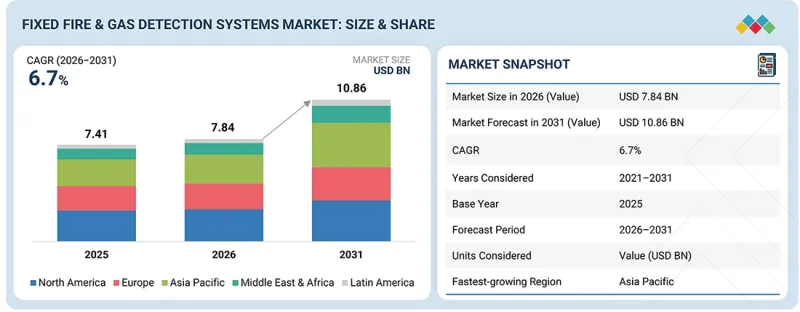
The global fixed fire & gas detection systems market is projected to grow from USD 7.84 billion in 2026 to USD 10.86 billion by 2031, registering a CAGR of 6.7% during the forecast period. Market growth is driven by increasing investments in industrial safety, modernization of aging facilities, expansion of hazardous process industries, and stricter occupational safety regulations. Rising investments in LNG infrastructure, hydrogen production, carbon capture and storage (CCS), battery manufacturing, semiconductor fabrication, and large-scale data centers are creating sustained demand for advanced fire and gas detection systems.
| Scope of the Report | |
|---|---|
| Years Considered for the Study | 2021-2031 |
| Base Year | 2025 |
| Forecast Period | 2026-2031 |
| Units Considered | Value (USD Billion) |
| Segments | Product, Technology, Hazard Type, and End User |
| Regions covered | North America, Europe, Asia Pacific, Middle East & Africa, and Latin America |
The integration of AI-enabled analytics, Industrial Internet of Things (IIoT), cloud connectivity, wireless communication, and predictive diagnostics is enabling faster hazard detection, reduced false alarms, and improved operational reliability. However, high installation costs, complex integration with legacy industrial systems, and ongoing calibration and maintenance requirements continue to present challenges for market adoption, particularly in brownfield facilities.
"Ultrasonic gas leak detection systems are expected to register the highest growth during the forecast period."
Ultrasonic gas leak detection systems are projected to be the fastest-growing segment during the forecast period owing to their ability to detect the acoustic signature of pressurized gas leaks almost instantly, without relying on gas accumulation around the sensor. This capability enables faster leak identification in open, well-ventilated, and high-airflow environments where conventional point gas detectors may experience delayed detection. The technology is increasingly being deployed across offshore platforms, LNG terminals, hydrogen production and storage facilities, gas compressor stations, refineries, petrochemical plants, and pipeline infrastructure where rapid leak detection is essential for preventing explosions, fires, and unplanned shutdowns. Growing investments in hydrogen, LNG, carbon capture and storage (CCS), and natural gas infrastructure are further supporting adoption. Manufacturers are also integrating ultrasonic detectors with Industrial Internet of Things (IIoT) platforms, predictive diagnostics, wireless communication, cybersecurity features, and safety instrumented systems (SIS), enabling continuous monitoring, remote asset management, and improved operational reliability. These technological advancements are expected to create significant opportunities for vendors throughout the forecast period.
"Fire & flame detection continues to account for the largest share of the hazard type segment."
Among hazard types, fire & flame detection is expected to account for the largest share of the global fixed fire & gas detection systems market throughout the forecast period due to its critical role in protecting personnel, industrial assets, and business operations across hazardous environments. Flame detection systems are extensively deployed in oil & gas facilities, chemical and petrochemical plants, power generation stations, mining operations, marine and offshore platforms, manufacturing facilities, transportation infrastructure, and emerging hydrogen projects where early fire detection is essential to minimize safety risks and operational losses. Continuous advancements in ultraviolet (UV), infrared (IR), UV/IR, and multi-spectrum IR3 flame detection technologies have significantly enhanced detection speed, increased immunity to false alarms, and improved performance under harsh environmental conditions. The growing adoption of integrated fire and gas safety systems, combined with increasing investments in industrial automation, digital safety platforms, and regulatory compliance, continues to strengthen demand for advanced fire and flame detection solutions. These factors are expected to help the segment maintain its dominant market position throughout the forecast period.
"North America is expected to dominate the fixed fire & gas detection systems market during the forecast period."
North America is expected to remain the largest regional market for fixed fire & gas detection systems throughout the forecast period, supported by stringent industrial safety regulations, mature oil & gas infrastructure, advanced manufacturing capabilities, and widespread adoption of industrial automation technologies. The region continues to witness investments in LNG export terminals, hydrogen production facilities, chemical processing plants, data centers, and critical infrastructure modernization, driving demand for intelligent fire and gas detection systems. The strong presence of leading manufacturers such as Honeywell, MSA Safety, Emerson, Teledyne Technologies, Carrier Global, and Johnson Controls further supports continuous product innovation and technology adoption. Meanwhile, Asia Pacific is projected to register the fastest growth due to rapid industrialization, expanding refining and petrochemical capacity, increasing investments in clean energy, hydrogen, semiconductor manufacturing, and infrastructure development across China, India, South Korea, Japan, and Southeast Asia. Strengthening workplace safety regulations, rising awareness of industrial risk management, and growing investments in smart manufacturing and digital industrial infrastructure are expected to accelerate deployment of advanced fixed fire & gas detection systems across the region during the forecast period.
Breakdown of Primaries
In-depth interviews were conducted with chief executive officers (CEOs), vice presidents, product managers, safety engineers, system integrators, distributors, and executives from leading organizations operating in the fixed fire & gas detection systems market.
- By Company: Tier 1 -30%, Tier 2 - 45%, and Tier 3 - 25%
- By Designation: C-Level - 50%, Director/Manager Level - 35%, and Others - 15%
- By Region: North America - 50%, Europe - 30%, Asia Pacific - 15%, and the Rest of the World - 5%
The report profiles leading companies offering fixed fire & gas detection systems and provides detailed analysis of their business strategies, product portfolios, recent developments, and competitive positioning. Key companies profiled include Honeywell (US), Siemens (Germany), MSA Safety (US), Drager (Germany), Emerson (US), ABB (Switzerland), Schneider Electric (France), Johnson Controls (Ireland), Carrier Global (US), Bosch Building Technologies (Germany), Yokogawa Electric (Japan), Teledyne Technologies (US), Halma plc (UK), GfG Instrumentation (Germany), ESP Safety (US), International Gas Detectors (UK), Autronica Fire & Security (Norway), New Cosmos Electric (Japan), Nohmi Bosai (Japan), Hochiki Corporation (Japan), Kentec Electronics (UK), Riken Keiki (Japan), NevadaNano (US), Macurco Gas Detection (US), Hanwei Electronics (China), and Beijing AiSense Technology (China). These companies are actively focused on expanding their product portfolios through technological innovation, strategic partnerships, product launches, and acquisitions to strengthen their presence in the global fixed fire & gas detection systems market.
Research Coverage
The report segments the fixed fire & gas detection systems market by product (fire detection systems, fixed gas detection systems, fire & gas control systems, fire alarm & notification systems), technology (electrochemical, catalytic bead, infrared (NDIR), tunable diode laser absorption spectroscopy (TDLAS), photoionization detection (PID), acoustic detection, and others), hazard type (flammable & explosive gas detection, toxic gas detection, oxygen monitoring, fire & flame detection), end user (oil & gas, chemicals & petrochemicals, power generation & energy infrastructure, mining & metals, marine & offshore, manufacturing, water & wastewater treatment, pharmaceuticals & life sciences, transportation, food & beverage, data centers, and others), and region (North America, Europe, Asia Pacific, Middle East & Africa, and Latin America). The report provides detailed analysis of market dynamics, competitive landscape, technology trends, regulatory developments, recent product launches, partnerships, mergers & acquisitions, and strategic initiatives shaping the global fixed fire & gas detection systems market.
Reasons to buy this Report
The report helps technology providers, equipment manufacturers, system integrators, distributors, investors, and end users understand the competitive landscape and identify high-growth opportunities across the fixed fire & gas detection systems market. It provides market sizing and forecasts across multiple segments and regions, detailed company profiles, competitive benchmarking, technology analysis, and strategic insights into key market drivers, restraints, opportunities, and challenges. The study also supports decision-making by highlighting emerging technologies, evolving regulatory requirements, and growth opportunities across industrial safety applications.
The report provides insights on the following pointers:
- Analysis of key drivers (stringent industrial safety regulations and fire protection standards, increasing investments in oil & gas, petrochemicals, and LNG infrastructure, rising focus on worker safety and asset protection across high-risk industries, increasing industrial automation and adoption of integrated safety systems), restraints (high initial installation and system integration costs, complexity of installation in brownfield industrial facilities), opportunities (growing investments in hydrogen and clean energy infrastructure, expansion of hyperscale data centers requiring advanced fire detection), and challenges (growing investments in hydrogen and clean energy infrastructure, expansion of hyperscale data centers requiring advanced fire detection).
- Product Development/Innovation: Provides comprehensive insights into emerging technologies, research & development initiatives, new product launches, and advancements in fixed fire & gas detection systems, including flame detection, gas detection, fire alarm & notification, and integrated safety control solutions.
- Market Development: Delivers detailed analysis of high-growth market segments, key end-use industries, and regional opportunities across North America, Europe, Asia Pacific, the Middle East & Africa, and Latin America, enabling stakeholders to identify attractive investment areas.
- Market Diversification: Offers insights into new product innovations, evolving application areas, untapped regional markets, strategic partnerships, mergers & acquisitions, and investments that are shaping the competitive landscape of the fixed fire & gas detection systems market.
- Competitive Assessment: Provides an in-depth analysis of market positioning, product portfolios, recent developments, and growth strategies of leading companies including Honeywell (US), Siemens (Germany), MSA Safety (US), Drager (Germany), Emerson (US), ABB (Switzerland), Schneider Electric (France), Johnson Controls (Ireland), Carrier Global (US), Bosch Building Technologies (Germany), Yokogawa Electric (Japan), Teledyne Technologies (US), Halma plc (UK), GfG Instrumentation (Germany), ESP Safety (US), International Gas Detectors (UK), Autronica Fire & Security (Norway), New Cosmos Electric (Japan), Nohmi Bosai (Japan), Hochiki Corporation (Japan), Kentec Electronics (UK), Riken Keiki (Japan), NevadaNano (US), Macurco Gas Detection (US), Hanwei Electronics (China), and Beijing AiSense Technology (China). The report also provides detailed insights into key market drivers, restraints, opportunities, challenges, and the competitive dynamics influencing the global fixed fire & gas detection systems market.
TABLE OF CONTENTS
1 INTRODUCTION
- 1.1 STUDY OBJECTIVES
- 1.2 MARKET DEFINITION
- 1.3 MARKET SCOPE
- 1.3.1 MARKET SEGMENTATION AND REGIONAL SCOPE
- 1.3.2 INCLUSIONS AND EXCLUSIONS
- 1.3.3 YEARS CONSIDERED
- 1.4 CURRENCY CONSIDERED
- 1.5 LIMITATIONS
- 1.6 STAKEHOLDERS
2 EXECUTIVE SUMMARY
- 2.1 MARKET HIGHLIGHTS AND KEY INSIGHTS
- 2.2 KEY MARKET PARTICIPANTS: MAPPING OF STRATEGIC DEVELOPMENTS
- 2.3 DISRUPTIVE TRENDS IN FIXED FIRE & GAS DETECTION SYSTEM MARKET
- 2.4 HIGH-GROWTH SEGMENTS
- 2.5 REGIONAL SNAPSHOT: MARKET SIZE, GROWTH RATE, AND FORECAST
3 PREMIUM INSIGHTS
- 3.1 ATTRACTIVE OPPORTUNITIES FOR PLAYERS IN FIXED FIRE & GAS DETECTION SYSTEM MARKET
- 3.2 FIXED FIRE & GAS DETECTION SYSTEM MARKET, BY PRODUCT
- 3.3 FIXED FIRE & GAS DETECTION SYSTEM MARKET, BY TECHNOLOGY TYPE
- 3.4 FIXED FIRE & GAS DETECTION SYSTEM MARKET, BY END USER
- 3.5 FIXED FIRE & GAS DETECTION SYSTEM MARKET, BY REGION
4 MARKET OVERVIEW
- 4.1 INTRODUCTION
- 4.2 MARKET DYNAMICS
- 4.2.1 DRIVERS
- 4.2.1.1 Stringent industrial safety regulations and fire protection standards
- 4.2.1.2 Increasing investments in oil & gas, petrochemicals, and LNG infrastructure
- 4.2.1.3 Rising focus on worker safety and asset protection across high-risk industries
- 4.2.1.4 Increasing industrial automation and adoption of integrated safety systems
- 4.2.2 RESTRAINTS
- 4.2.2.1 High initial installation and system integration costs
- 4.2.2.2 Installation complexity in brownfield industrial facilities
- 4.2.3 OPPORTUNITIES
- 4.2.3.1 Growing investments in hydrogen and clean energy infrastructure
- 4.2.3.2 Expansion of hyperscale data centers requiring advanced fire detection
- 4.2.4 CHALLENGES
- 4.2.4.1 Minimizing false alarms while maintaining high detection accuracy
- 4.2.4.2 Ensuring reliable performance in harsh operating environments
- 4.2.1 DRIVERS
- 4.3 UNMET NEEDS AND WHITE SPACES
- 4.3.1 UNMET NEEDS IN FIXED FIRE & GAS DETECTION SYSTEM MARKET
- 4.3.2 WHITE SPACE OPPORTUNITIES
- 4.4 INTERCONNECTED MARKETS AND CROSS-SECTOR OPPORTUNITIES
- 4.4.1 INTERCONNECTED MARKETS
- 4.4.2 CROSS-SECTOR OPPORTUNITIES
- 4.5 STRATEGIC MOVES BY TIER-1/2/3 PLAYERS
- 4.5.1 KEY MOVES AND STRATEGIC FOCUS
5 INDUSTRY TRENDS
- 5.1 PORTER'S FIVE FORCES ANALYSIS
- 5.1.1 THREAT OF NEW ENTRANTS
- 5.1.2 THREAT OF SUBSTITUTES
- 5.1.3 BARGAINING POWER OF BUYERS
- 5.1.4 BARGAINING POWER OF SUPPLIERS
- 5.1.5 INTENSITY OF COMPETITIVE RIVALRY
- 5.2 MACROECONOMIC INDICATORS
- 5.2.1 INTRODUCTION
- 5.2.2 GDP TRENDS & FORECASTS
- 5.2.3 TRENDS IN GLOBAL FIRE DETECTION INDUSTRY
- 5.2.4 TRENDS IN GLOBAL GAS DETECTION INDUSTRY
- 5.3 SUPPLY CHAIN ANALYSIS
- 5.3.1 RAW MATERIAL & COMPONENT SUPPLIERS
- 5.3.2 SENSOR & TECHNOLOGY PROVIDERS
- 5.3.3 FIRE & GAS DETECTION SYSTEM OEMS
- 5.3.4 DISTRIBUTORS/CHANNEL PARTNERS
- 5.3.5 SYSTEM INTEGRATORS & EPC CONTRACTORS
- 5.3.6 INDUSTRIAL END USERS
- 5.3.7 AFTERMARKET SERVICES, CALIBRATION & MAINTENANCE PROVIDERS
- 5.4 ECOSYSTEM ANALYSIS
- 5.5 PRICING ANALYSIS
- 5.5.1 AVERAGE SELLING PRICE, BY PRODUCT, 2026
- 5.5.2 INDICATIVE PRICING ANALYSIS OF FIXED FIRE DETECTION SYSTEMS, BY VENDOR, 2026
- 5.6 KEY CONFERENCES AND EVENTS, 2026-2027
- 5.7 TRENDS/DISRUPTIONS IMPACTING CUSTOMER BUSINESS
- 5.8 INVESTMENT AND FUNDING SCENARIO
- 5.9 CASE STUDY ANALYSIS
- 5.9.1 CASE STUDY 1: LANXESS ENHANCES PLANT SAFETY WITH HONEYWELL'S INTEGRATED FIRE & GAS DETECTION SYSTEM
- 5.9.2 CASE STUDY 2: MAJOR LNG TERMINAL IN GUJARAT ENHANCES GAS DETECTION WITH MSA SAFETY'S SENSCIENT ELDS SOLUTION
- 5.9.3 CASE STUDY 3: SCOTTISH WATER IMPROVES CHLORINE SAFETY WITH CROWCON'S FIXED GAS DETECTION SOLUTION
- 5.9.4 CASE STUDY 4: AAR MRO SERVICES STRENGTHENS AIRCRAFT HANGAR FIRE PROTECTION WITH DET-TRONICS FLAME DETECTION SOLUTION
- 5.10 IMPACT OF 2025 US TARIFF - FIXED FIRE & GAS DETECTION SYSTEM MARKET
- 5.10.1 INTRODUCTION
- 5.10.2 KEY TARIFF RATES
- 5.10.3 PRICE IMPACT ANALYSIS
- 5.10.4 IMPACT ON COUNTRIES/REGIONS
- 5.10.4.1 US
- 5.10.4.2 Europe
- 5.10.4.3 Asia Pacific
- 5.10.5 IMPACT ON VERTICALS
- 5.10.5.1 Oil & gas
- 5.10.5.2 Chemical & petrochemical
- 5.10.5.3 Power generation & energy infrastructure
6 TECHNOLOGICAL ADVANCEMENTS, AI-DRIVEN IMPACT, PATENTS, INNOVATIONS, AND FUTURE APPLICATIONS
- 6.1 TECHNOLOGY ANALYSIS
- 6.1.1 KEY EMERGING TECHNOLOGIES
- 6.1.1.1 Infrared (IR) & non-dispersive infrared (NDIR) gas detection
- 6.1.1.2 Electrochemical gas detection
- 6.1.1.3 Catalytic bead (pellistor) gas detection
- 6.1.1.4 UV/IR & multi-spectrum infrared (MSIR) flame detection
- 6.1.1.5 Ultrasonic & open path gas leak detection (TDLAS/IR)
- 6.1.2 COMPLEMENTARY TECHNOLOGIES
- 6.1.2.1 Industrial Internet of Things (IIoT) connectivity
- 6.1.2.2 SCADA & distributed control system (DCS) integration
- 6.1.2.3 AI-based alarm analytics & predictive maintenance
- 6.1.2.4 Edge computing & cloud-based remote monitoring
- 6.1.3 ADJACENT TECHNOLOGIES
- 6.1.3.1 Safety instrumented systems (SIS)
- 6.1.3.2 Process automation systems
- 6.1.3.3 Building management systems (BMS)
- 6.1.3.4 Industrial video surveillance & thermal imaging
- 6.1.1 KEY EMERGING TECHNOLOGIES
- 6.2 TECHNOLOGY/PRODUCT ROADMAP
- 6.2.1 SHORT-TERM (2026-2028) | SMART DETECTION & DIGITAL SAFETY INTEGRATION
- 6.2.2 MID-TERM (2028-2031) | AUTONOMOUS SAFETY MONITORING & INTELLIGENT INDUSTRIAL PROTECTION
- 6.2.3 LONG-TERM (2031-2036+) | AUTONOMOUS, AI-DRIVEN, & PREDICTIVE SAFETY ECOSYSTEMS
- 6.3 PATENT ANALYSIS
- 6.4 FUTURE APPLICATIONS
- 6.4.1 AI-DRIVEN PREDICTIVE FIRE & GAS RISK MANAGEMENT
- 6.4.2 AUTONOMOUS INDUSTRIAL SAFETY & EMERGENCY RESPONSE
- 6.4.3 HYDROGEN, CARBON CAPTURE, & CLEAN ENERGY SAFETY SYSTEMS
- 6.4.4 DIGITAL TWIN-ENABLED INDUSTRIAL SAFETY MANAGEMENT
- 6.4.5 REMOTE & AUTONOMOUS ASSET PROTECTION FOR CRITICAL INFRASTRUCTURE
- 6.5 IMPACT OF AI/GENERATIVE AI ON FIXED FIRE & GAS DETECTION SYSTEM MARKET
- 6.5.1 TOP USE CASES AND MARKET POTENTIAL
- 6.5.2 BEST PRACTICES IN FIXED FIRE & GAS DETECTION SYSTEM MARKET
- 6.5.3 CASE STUDY OF AI IMPLEMENTATION IN FIXED FIRE & GAS DETECTION SYSTEM MARKET
- 6.5.4 INTERCONNECTED ADJACENT ECOSYSTEM AND IMPACT ON MARKET PLAYERS
- 6.5.5 CLIENTS' READINESS TO ADOPT GENERATIVE AI IN FIXED FIRE & GAS DETECTION SYSTEM MARKET
7 REGULATORY LANDSCAPE
- 7.1 REGULATORY LANDSCAPE
- 7.1.1 REGULATORY BODIES, GOVERNMENT AGENCIES, AND OTHER ORGANIZATIONS
- 7.1.2 INDUSTRY STANDARDS, BY REGION
- 7.1.2.1 North America
- 7.1.2.2 Europe
- 7.1.2.3 Asia Pacific
- 7.1.2.4 Middle East & Africa
- 7.1.2.5 Latin America
8 CUSTOMER LANDSCAPE AND BUYER BEHAVIOR
- 8.1 DECISION-MAKING PROCESS
- 8.2 KEY STAKEHOLDERS INVOLVED IN BUYING PROCESS AND THEIR EVALUATION CRITERIA
- 8.2.1 KEY STAKEHOLDERS IN BUYING PROCESS
- 8.2.2 BUYING CRITERIA
- 8.3 ADOPTION BARRIERS AND INTERNAL CHALLENGES
- 8.4 UNMET NEEDS IN VARIOUS END-USER INDUSTRIES
- 8.5 MARKET PROFITABILITY
- 8.5.1 REVENUE POTENTIAL
- 8.5.2 COST DYNAMICS
- 8.5.3 MARGIN OPPORTUNITIES IN KEY APPLICATIONS
9 FIXED FIRE & GAS DETECTION SYSTEM MARKET, BY PRODUCT
- 9.1 INTRODUCTION
- 9.1.1 BY PRODUCT: FIXED FIRE & GAS DETECTION SYSTEM MARKET DRIVERS
- 9.2 FIRE DETECTION SYSTEMS
- 9.2.1 FIXED FIRE DETECTION SYSTEMS ENABLE EARLY FIRE IDENTIFICATION ACROSS CRITICAL INFRASTRUCTURE
- 9.2.2 FLAME DETECTION SYSTEMS
- 9.2.2.1 UV flame detectors
- 9.2.2.2 IR flame detectors
- 9.2.2.3 UV/IR flame detectors
- 9.2.2.4 Multi-spectrum IR flame detectors
- 9.2.3 SMOKE DETECTION SYSTEMS
- 9.2.3.1 Aspirating smoke detection (ASD) systems
- 9.2.3.2 Point smoke detectors
- 9.2.4 HEAT DETECTION SYSTEMS
- 9.2.5 VIDEO FIRE DETECTION SYSTEMS
- 9.3 FIXED GAS DETECTION SYSTEMS
- 9.3.1 GROWING INVESTMENTS IN PROCESS SAFETY SUPPORT DEMAND FOR FIXED GAS DETECTION SYSTEMS
- 9.3.2 COMBUSTIBLE GAS DETECTION SYSTEMS
- 9.3.3 TOXIC GAS DETECTION SYSTEMS
- 9.3.4 OXYGEN DETECTION SYSTEMS
- 9.3.5 OPEN-PATH GAS DETECTION SYSTEMS
- 9.3.6 ULTRASONIC GAS LEAK DETECTION SYSTEMS
- 9.4 FIRE & GAS CONTROL SYSTEMS
- 9.4.1 INTEGRATED SAFETY ARCHITECTURES DRIVE ADOPTION OF ADVANCED FIRE & GAS CONTROL SYSTEMS
- 9.4.2 FIRE & GAS CONTROLLERS
- 9.4.3 SAFETY LOGIC SOLVERS
- 9.4.4 HUMAN MACHINE INTERFACES (HMIS)
- 9.5 FIRE ALARM & NOTIFICATION SYSTEMS
- 9.5.1 MODERNIZATION OF EMERGENCY COMMUNICATION INFRASTRUCTURE SUPPORTS DEMAND FOR FIRE ALARM & NOTIFICATION SYSTEMS
- 9.5.2 FIRE ALARM PANELS
- 9.5.3 SOUNDERS
- 9.5.4 BEACONS/STROBES
- 9.5.5 NOTIFICATION DEVICES
10 FIXED FIRE & GAS DETECTION SYSTEM MARKET, BY TECHNOLOGY TYPE
- 10.1 INTRODUCTION
- 10.1.1 TECHNOLOGY TYPE: FIXED FIRE & GAS DETECTION SYSTEM MARKET DRIVERS
- 10.2 ELECTROCHEMICAL DETECTION
- 10.2.1 HIGH-PRECISION TOXIC GAS MONITORING THROUGH ELECTROCHEMICAL SENSING
- 10.3 CATALYTIC BEAD DETECTION
- 10.3.1 RELIABLE COMBUSTIBLE GAS DETECTION FOR EXPLOSION PREVENTION
- 10.4 TUNABLE DIODE LASER ABSORPTION SPECTROSCOPY (TDLAS)
- 10.4.1 LONG-RANGE OPEN-PATH GAS MONITORING WITH LASER-BASED PRECISION
- 10.5 PHOTOIONIZATION DETECTION (PID)
- 10.5.1 SENSITIVE DETECTION OF VOLATILE ORGANIC COMPOUNDS AND HAZARDOUS VAPORS
- 10.6 ACOUSTIC DETECTION
- 10.6.1 EARLY IDENTIFICATION OF PRESSURIZED GAS LEAKS THROUGH ULTRASONIC SENSING
- 10.7 OTHER TECHNOLOGIES
11 FIXED FIRE & GAS DETECTION SYSTEM MARKET, BY HAZARD TYPE
- 11.1 INTRODUCTION
- 11.1.1 HAZARD TYPE: FIXED FIRE & GAS DETECTION SYSTEM MARKET DRIVERS
- 11.2 FLAMMABLE & EXPLOSIVE GAS DETECTION
- 11.2.1 PREVENTING IGNITION RISKS ACROSS HYDROCARBON PROCESSING FACILITIES
- 11.3 TOXIC GAS DETECTION
- 11.3.1 PROTECTING PERSONNEL FROM HAZARDOUS CHEMICAL EXPOSURE
- 11.4 FIRE & FLAME DETECTION
- 11.4.1 RAPID IDENTIFICATION OF FIRE EVENTS TO MINIMIZE ASSET DAMAGE
12 FIXED FIRE & GAS DETECTION SYSTEM MARKET, BY END USER
- 12.1 INTRODUCTION
- 12.1.1 END USER: FIXED FIRE & GAS DETECTION SYSTEM MARKET DRIVERS
- 12.2 OIL & GAS
- 12.2.1 LARGEST INSTALLED BASE FOR INDUSTRIAL FIRE & GAS DETECTION SYSTEMS
- 12.3 CHEMICALS & PETROCHEMICALS
- 12.3.1 MANAGING DIVERSE PROCESS HAZARDS IN CHEMICAL MANUFACTURING
- 12.4 POWER GENERATION & ENERGY INFRASTRUCTURE
- 12.4.1 STRENGTHENING SAFETY ACROSS CONVENTIONAL AND EMERGING ENERGY ASSETS
- 12.5 MINING & METALS
- 12.5.1 MITIGATING FIRE AND GAS RISKS ACROSS EXTRACTION AND PROCESSING OPERATIONS
- 12.6 MARINE & OFFSHORE
- 12.6.1 SUPPORTING SAFETY COMPLIANCE IN OFFSHORE AND MARITIME OPERATIONS
- 12.7 MANUFACTURING
- 12.7.1 IMPROVING INDUSTRIAL SAFETY ACROSS DIVERSE MANUFACTURING ENVIRONMENTS
- 12.8 WATER & WASTEWATER TREATMENT
- 12.8.1 PROTECTING CRITICAL INFRASTRUCTURE FROM TOXIC GAS EXPOSURE
- 12.9 PHARMACEUTICALS & LIFE SCIENCES
- 12.9.1 MAINTAINING PROCESS INTEGRITY IN HIGHLY REGULATED PRODUCTION FACILITIES
- 12.10 TRANSPORTATION
- 12.10.1 ENHANCING SAFETY ACROSS TRANSPORTATION AND TRANSIT INFRASTRUCTURE
- 12.11 FOOD & BEVERAGES
- 12.11.1 SUPPORTING SAFE PRODUCTION AND REFRIGERATION OPERATIONS
- 12.12 DATA CENTERS
- 12.12.1 SAFEGUARDING MISSION-CRITICAL DIGITAL INFRASTRUCTURE
- 12.13 OTHERS
13 FIXED FIRE & GAS DETECTION SYSTEM MARKET, BY REGION
- 13.1 INTRODUCTION
- 13.2 NORTH AMERICA
- 13.2.1 US
- 13.2.1.1 Large installed industrial base and safety system upgrades to sustain market
- 13.2.2 CANADA
- 13.2.2.1 Mining expansion and resource processing investments to increase fixed fire & gas detection requirements
- 13.2.1 US
- 13.3 EUROPE
- 13.3.1 UK
- 13.3.1.1 Established offshore and process industries alongside new hydrogen projects to maintain fixed fire & gas detection demand
- 13.3.2 GERMANY
- 13.3.2.1 Large chemical industry base and hydrogen network buildout to create new fixed fire & gas detection requirements
- 13.3.3 FRANCE
- 13.3.3.1 Large nuclear power base and industrial safety upgrades to maintain fixed fire & gas detection demand
- 13.3.4 ITALY
- 13.3.4.1 Refining and gas infrastructure upgrades to maintain demand as hydrogen projects add new detection requirements
- 13.3.5 REST OF EUROPE
- 13.3.1 UK
- 13.4 ASIA PACIFIC
- 13.4.1 CHINA
- 13.4.1.1 Expanding petrochemical capacity and stronger hazardous chemical safety requirements to increase fixed detection system demand
- 13.4.2 JAPAN
- 13.4.2.1 Aging industrial facilities and new hydrogen applications to support fixed fire & gas detection systems upgrades
- 13.4.3 INDIA
- 13.4.3.1 Rapid refining and petrochemical capacity addition to result in new fixed fire & gas detection installations
- 13.4.4 REST OF ASIA PACIFIC
- 13.4.1 CHINA
- 13.5 MIDDLE EAST & AFRICA
- 13.5.1 GCC
- 13.5.1.1 Saudi Arabia
- 13.5.1.1.1 Gas production growth and new petrochemical capacity to increase fixed fire & gas detection installations
- 13.5.1.2 UAE
- 13.5.1.2.1 Expansion of chemical production and gas processing facilities to increase fixed fire & gas detection requirements
- 13.5.1.3 Rest of GCC
- 13.5.1.1 Saudi Arabia
- 13.5.2 SOUTH AFRICA
- 13.5.2.1 Oil & gas developments and mineral processing projects to increase fixed fire & gas detection requirements
- 13.5.3 REST OF MIDDLE EAST & AFRICA
- 13.5.1 GCC
- 13.6 LATIN AMERICA
- 13.6.1 BRAZIL
- 13.6.1.1 Offshore oil production and refinery investments to increase fixed fire & gas detection requirements
- 13.6.2 MEXICO
- 13.6.2.1 Refinery modernization and petrochemical recovery to increase fixed fire & gas detection requirements
- 13.6.3 REST OF LATIN AMERICA
- 13.6.1 BRAZIL
14 COMPETITIVE LANDSCAPE
- 14.1 INTRODUCTION
- 14.2 KEY PLAYER COMPETITIVE STRATEGIES/RIGHT TO WIN, 2022-2026
- 14.3 REVENUE ANALYSIS, 2021-2025
- 14.4 MARKET SHARE ANALYSIS, 2025
- 14.5 BRAND/PRODUCT COMPARISON
- 14.6 COMPANY EVALUATION MATRIX: KEY PLAYERS, 2025
- 14.6.1 STARS
- 14.6.2 EMERGING LEADERS
- 14.6.3 PERVASIVE PLAYERS
- 14.6.4 PARTICIPANTS
- 14.6.5 COMPANY FOOTPRINT: KEY PLAYERS, 2025
- 14.6.5.1 Company footprint
- 14.6.5.2 Region footprint
- 14.6.5.3 Product footprint
- 14.7 COMPANY EVALUATION MATRIX: STARTUPS/SMES, 2025
- 14.7.1 PROGRESSIVE COMPANIES
- 14.7.2 RESPONSIVE COMPANIES
- 14.7.3 DYNAMIC COMPANIES
- 14.7.4 STARTING BLOCKS
- 14.7.5 COMPETITIVE BENCHMARKING: STARTUPS/SMES, 2025
- 14.7.5.1 Detailed list of key startups/SMEs
- 14.7.5.2 Competitive benchmarking of startups/SMEs
- 14.8 COMPANY VALUATION AND FINANCIAL METRICS OF KEY VENDORS
- 14.8.1 COMPANY VALUATION OF KEY VENDORS
- 14.8.2 FINANCIAL METRICS OF KEY VENDORS
- 14.9 COMPETITIVE SCENARIO
- 14.9.1 PRODUCT LAUNCHES
- 14.9.2 DEALS
15 COMPANY PROFILES
- 15.1 INTRODUCTION
- 15.2 MAJOR PLAYERS
- 15.2.1 HONEYWELL
- 15.2.1.1 Business overview
- 15.2.1.2 Products/Solutions/Services offered
- 15.2.1.3 Recent developments
- 15.2.1.3.1 Product launches & enhancements
- 15.2.1.3.2 Deals
- 15.2.1.4 MnM View
- 15.2.1.4.1 Right to win
- 15.2.1.4.2 Strategic choices
- 15.2.1.4.3 Weaknesses and competitive threats
- 15.2.2 SIEMENS
- 15.2.2.1 Business overview
- 15.2.2.2 Products/Solutions/Services offered
- 15.2.2.3 Recent developments
- 15.2.2.3.1 Product launches & enhancements
- 15.2.2.3.2 Deals
- 15.2.2.4 MnM View
- 15.2.2.4.1 Right to win
- 15.2.2.4.2 Strategic choices
- 15.2.2.4.3 Weaknesses and competitive threats
- 15.2.3 JOHNSON CONTROLS
- 15.2.3.1 Business overview
- 15.2.3.2 Products/Solutions/Services offered
- 15.2.3.3 Recent developments
- 15.2.3.3.1 Product launches & enhancements
- 15.2.3.3.2 Deals
- 15.2.3.4 MnM View
- 15.2.3.4.1 Right to win
- 15.2.3.4.2 Strategic choices
- 15.2.3.4.3 Weaknesses and competitive threats
- 15.2.4 EMERSON
- 15.2.4.1 Business overview
- 15.2.4.2 Products/Solutions/Services offered
- 15.2.4.3 Recent developments
- 15.2.4.3.1 Product launches & enhancements
- 15.2.4.3.2 Deals
- 15.2.4.3.3 Expansions
- 15.2.4.4 MnM View
- 15.2.4.4.1 Right to win
- 15.2.4.4.2 Strategic choices
- 15.2.4.4.3 Weaknesses and competitive threats
- 15.2.5 MSA SAFETY INCORPORATED
- 15.2.5.1 Business overview
- 15.2.5.2 Products/Solutions/Services offered
- 15.2.5.3 Recent developments
- 15.2.5.3.1 Product launches & enhancements
- 15.2.5.3.2 Deals
- 15.2.5.4 MnM View
- 15.2.5.4.1 Right to win
- 15.2.5.4.2 Strategic choices
- 15.2.5.4.3 Weaknesses and competitive threats
- 15.2.6 DRAGER
- 15.2.6.1 Business overview
- 15.2.6.2 Products/Solutions/Services offered
- 15.2.6.3 Recent developments
- 15.2.6.3.1 Product launches & enhancements
- 15.2.6.3.2 Deals
- 15.2.7 TELEDYNE TECHNOLOGIES
- 15.2.7.1 Business overview
- 15.2.7.2 Products/Solutions/Services offered
- 15.2.7.3 Recent developments
- 15.2.7.3.1 Product launches & enhancements
- 15.2.7.3.2 Deals
- 15.2.8 SCHNEIDER ELECTRIC
- 15.2.8.1 Business overview
- 15.2.8.2 Products/Solutions/Services offered
- 15.2.8.3 Recent developments
- 15.2.8.3.1 Product launches & enhancements
- 15.2.8.3.2 Deals
- 15.2.9 ABB
- 15.2.9.1 Business overview
- 15.2.9.2 Products/Solutions/Services offered
- 15.2.9.3 Recent developments
- 15.2.9.3.1 Product launches & enhancements
- 15.2.10 CROWCON
- 15.2.10.1 Business overview
- 15.2.10.2 Products/Solutions/Services offered
- 15.2.10.3 Recent developments
- 15.2.10.3.1 Product launches & enhancements
- 15.2.10.3.2 Deals
- 15.2.11 YOKOGAWA
- 15.2.11.1 Business overview
- 15.2.11.2 Products/Solutions/Services offered
- 15.2.11.3 Recent developments
- 15.2.11.3.1 Deals
- 15.2.11.3.2 Other developments
- 15.2.12 ROCKWELL AUTOMATION
- 15.2.12.1 Business overview
- 15.2.12.2 Products/Solutions/Services offered
- 15.2.12.3 Recent developments
- 15.2.12.3.1 Product launches & enhancements
- 15.2.12.3.2 Deals
- 15.2.13 BOSCH BUILDING TECHNOLOGIES
- 15.2.13.1 Business overview
- 15.2.13.2 Products/Solutions/Services offered
- 15.2.13.3 Recent developments
- 15.2.13.3.1 Product launches & enhancements
- 15.2.13.3.2 Deals
- 15.2.13.3.3 Expansions
- 15.2.14 DET-TRONICS
- 15.2.14.1 Business overview
- 15.2.14.2 Products/Solutions/Services offered
- 15.2.14.3 Recent developments
- 15.2.14.3.1 Product launches & enhancements
- 15.2.14.3.2 Deals
- 15.2.1 HONEYWELL
- 15.3 OTHER PLAYERS
- 15.3.1 GFG SAFETY
- 15.3.2 ESP SAFETY
- 15.3.3 INTERNATIONAL GAS DETECTORS (IGD)
- 15.3.4 NOHMI BOSAI LTD.
- 15.3.5 RIKEN KEIKI
- 15.3.6 HANWEI ELECTRONICS
- 15.3.7 GDS CORP.
- 15.3.8 HOCHIKI AMERICA CORPORATION
- 15.3.9 ADVANCED ELECTRONICS
- 15.3.10 HENAN OTYWELL ELECTRONIC TECHNOLOGY CO., LTD.
- 15.3.11 RESPO PRODUCTS
- 15.3.12 PENTAX ENGINEERING PVT. LTD.
- 15.3.13 WATCHGAS
16 RESEARCH METHODOLOGY
- 16.1 RESEARCH DATA
- 16.1.1 SECONDARY DATA
- 16.1.2 PRIMARY DATA
- 16.2 MARKET SIZE ESTIMATION
- 16.3 DATA TRIANGULATION
- 16.4 FACTOR ANALYSIS
17 APPENDIX
- 17.1 DISCUSSION GUIDE
- 17.2 KNOWLEDGESTORE: MARKETSANDMARKETS' SUBSCRIPTION PORTAL
- 17.3 CUSTOMIZATION OPTIONS
- 17.4 RELATED REPORTS
- 17.5 AUTHOR DETAILS
List of Tables
- TABLE 1 USD EXCHANGE RATES, 2020-2025
- TABLE 2 IMPACT OF PORTER'S FIVE FORCES ON FIXED FIRE & GAS DETECTION SYSTEM MARKET
- TABLE 3 GDP PERCENTAGE CHANGE, BY KEY COUNTRIES, 2021-2029
- TABLE 4 ROLES OF COMPANIES IN ECOSYSTEM
- TABLE 5 AVERAGE SELLING PRICE, BY PRODUCT, 2026
- TABLE 6 INDICATIVE PRICING ANALYSIS OF FIXED FIRE DETECTION SYSTEMS, BY VENDOR, 2026
- TABLE 7 INDICATIVE PRICING ANALYSIS OF FIXED GAS DETECTION SYSTEMS, BY VENDOR, 2026
- TABLE 8 INDICATIVE PRICING ANALYSIS OF FIRE & GAS CONTROL PANELS, BY VENDOR, 2026
- TABLE 9 FIXED FIRE & GAS DETECTION SYSTEM MARKET: LIST OF KEY CONFERENCES AND EVENTS, 2026-2027
- TABLE 10 FIXED FIRE & GAS DETECTION SYSTEM MARKET: INVESTMENT & FUNDING
- TABLE 11 US ADJUSTED RECIPROCAL TARIFF RATES
- TABLE 12 LIST OF GRANTED PATENTS IN FIXED FIRE & GAS DETECTION SYSTEM MARKET
- TABLE 13 TOP USE CASES AND MARKET POTENTIAL
- TABLE 14 BEST PRACTICES: COMPANIES IMPLEMENTING AI IN FIXED FIRE & GAS DETECTION SYSTEM
- TABLE 15 BOSCH IMPROVES FIRE SAFETY AT CIPLA THROUGH AI-ENABLED VIDEO FIRE DETECTION
- TABLE 16 INTERCONNECTED ADJACENT ECOSYSTEMS AND IMPLICATIONS FOR MARKET PLAYERS
- TABLE 17 NORTH AMERICA: LIST OF REGULATORY BODIES, GOVERNMENT AGENCIES, AND OTHER ORGANIZATIONS
- TABLE 18 EUROPE: LIST OF REGULATORY BODIES, GOVERNMENT AGENCIES, AND OTHER ORGANIZATIONS
- TABLE 19 ASIA PACIFIC: LIST OF REGULATORY BODIES, GOVERNMENT AGENCIES, AND OTHER ORGANIZATIONS
- TABLE 20 MIDDLE EAST & AFRICA: LIST OF REGULATORY BODIES, GOVERNMENT AGENCIES, AND OTHER ORGANIZATIONS
- TABLE 21 LATIN AMERICA: LIST OF REGULATORY BODIES, GOVERNMENT AGENCIES, AND OTHER ORGANIZATIONS
- TABLE 22 INFLUENCE OF STAKEHOLDERS ON BUYING PROCESS FOR TOP THREE END USERS (%)
- TABLE 23 KEY BUYING CRITERIA FOR THE TOP THREE END USERS
- TABLE 24 FIXED FIRE & GAS DETECTION SYSTEM MARKET: UNMET NEEDS IN KEY END-USER INDUSTRIES
- TABLE 25 FIXED FIRE & GAS DETECTION SYSTEM MARKET, BY PRODUCT, 2021-2025 (USD MILLION)
- TABLE 26 FIXED FIRE & GAS DETECTION SYSTEM MARKET, BY PRODUCT, 2026-2031 (USD MILLION)
- TABLE 27 FIRE DETECTION SYSTEMS MARKET, BY TYPE, 2021-2025 (USD MILLION)
- TABLE 28 FIRE DETECTION SYSTEMS MARKET, BY TYPE, 2026-2031 (USD MILLION)
- TABLE 29 FIRE DETECTION SYSTEMS MARKET, BY REGION, 2021-2025 (USD MILLION)
- TABLE 30 FIRE DETECTION SYSTEMS MARKET, BY REGION, 2026-2031 (USD MILLION)
- TABLE 31 FLAME DETECTION SYSTEMS MARKET, BY REGION, 2021-2025 (USD MILLION)
- TABLE 32 FLAME DETECTION SYSTEMS MARKET, BY REGION, 2026-2031 (USD MILLION)
- TABLE 33 SMOKE DETECTION SYSTEMS MARKET, BY REGION, 2021-2025 (USD MILLION)
- TABLE 34 SMOKE DETECTION SYSTEMS MARKET, BY REGION, 2026-2031 (USD MILLION)
- TABLE 35 HEAT DETECTION SYSTEMS MARKET, BY REGION, 2021-2025 (USD MILLION)
- TABLE 36 HEAT DETECTION SYSTEMS MARKET, BY REGION, 2026-2031 (USD MILLION)
- TABLE 37 VIDEO FIRE DETECTION SYSTEMS MARKET, BY REGION, 2021-2025 (USD MILLION)
- TABLE 38 VIDEO FIRE DETECTION SYSTEMS MARKET, BY REGION, 2026-2031 (USD MILLION)
- TABLE 39 FIXED GAS DETECTION SYSTEMS MARKET, BY TYPE, 2021-2025 (USD MILLION)
- TABLE 40 FIXED GAS DETECTION SYSTEMS MARKET, BY TYPE, 2026-2031 (USD MILLION)
- TABLE 41 FIXED GAS DETECTION SYSTEMS MARKET, BY REGION, 2021-2025 (USD MILLION)
- TABLE 42 FIXED GAS DETECTION SYSTEMS MARKET, BY REGION, 2026-2031 (USD MILLION)
- TABLE 43 COMBUSTIBLE GAS DETECTION SYSTEMS MARKET, BY REGION, 2021-2025 (USD MILLION)
- TABLE 44 COMBUSTIBLE GAS DETECTION SYSTEMS MARKET, BY REGION, 2026-2031 (USD MILLION)
- TABLE 45 TOXIC GAS DETECTION SYSTEMS MARKET, BY REGION, 2021-2025 (USD MILLION)
- TABLE 46 TOXIC GAS DETECTION SYSTEMS MARKET, BY REGION, 2026-2031 (USD MILLION)
- TABLE 47 OXYGEN DETECTION SYSTEMS MARKET, BY REGION, 2021-2025 (USD MILLION)
- TABLE 48 OXYGEN DETECTION SYSTEMS MARKET, BY REGION, 2026-2031 (USD MILLION)
- TABLE 49 OPEN-PATH GAS DETECTION SYSTEMS MARKET, BY REGION, 2021-2025 (USD MILLION)
- TABLE 50 OPEN-PATH GAS DETECTION SYSTEMS MARKET, BY REGION, 2026-2031 (USD MILLION)
- TABLE 51 ULTRASONIC GAS LEAK DETECTION SYSTEMS MARKET, BY REGION, 2021-2025 (USD MILLION)
- TABLE 52 ULTRASONIC GAS LEAK DETECTION SYSTEMS MARKET, BY REGION, 2026-2031 (USD MILLION)
- TABLE 53 FIRE & GAS CONTROL SYSTEMS MARKET, BY TYPE, 2021-2025 (USD MILLION)
- TABLE 54 FIRE & GAS CONTROL SYSTEMS MARKET, BY TYPE, 2026-2031 (USD MILLION)
- TABLE 55 FIRE & GAS CONTROL SYSTEMS MARKET, BY REGION, 2021-2025 (USD MILLION)
- TABLE 56 FIRE & GAS CONTROL SYSTEMS MARKET, BY REGION, 2026-2031 (USD MILLION)
- TABLE 57 FIRE & GAS CONTROLLERS MARKET, BY REGION, 2021-2025 (USD MILLION)
- TABLE 58 FIRE & GAS CONTROLLERS MARKET, BY REGION, 2026-2031 (USD MILLION)
- TABLE 59 SAFETY LOGIC SOLVERS MARKET, BY REGION, 2021-2025 (USD MILLION)
- TABLE 60 SAFETY LOGIC SOLVERS MARKET, BY REGION, 2026-2031 (USD MILLION)
- TABLE 61 HUMAN MACHINE INTERFACES (HMIS) MARKET, BY REGION, 2021-2025 (USD MILLION)
- TABLE 62 HUMAN MACHINE INTERFACES (HMIS) MARKET, BY REGION, 2026-2031 (USD MILLION)
- TABLE 63 FIRE ALARM & NOTIFICATION SYSTEMS MARKET, BY TYPE, 2021-2025 (USD MILLION)
- TABLE 64 FIRE ALARM & NOTIFICATION SYSTEMS MARKET, BY TYPE, 2026-2031 (USD MILLION)
- TABLE 65 FIRE ALARM & NOTIFICATION SYSTEMS MARKET, BY REGION, 2021-2025 (USD MILLION)
- TABLE 66 FIRE ALARM & NOTIFICATION SYSTEMS MARKET, BY REGION, 2026-2031 (USD MILLION)
- TABLE 67 FIRE ALARM PANELS MARKET, BY REGION, 2021-2025 (USD MILLION)
- TABLE 68 FIRE ALARM PANELS MARKET, BY REGION, 2026-2031 (USD MILLION)
- TABLE 69 SOUNDERS MARKET, BY REGION, 2021-2025 (USD MILLION)
- TABLE 70 SOUNDERS MARKET, BY REGION, 2026-2031 (USD MILLION)
- TABLE 71 BEACONS/STROBES MARKET, BY REGION, 2021-2025 (USD MILLION)
- TABLE 72 BEACONS/STROBES MARKET, BY REGION, 2026-2031 (USD MILLION)
- TABLE 73 NOTIFICATION DEVICES MARKET, BY REGION, 2021-2025 (USD MILLION)
- TABLE 74 NOTIFICATION DEVICES MARKET, BY REGION, 2026-2031 (USD MILLION)
- TABLE 75 FIXED FIRE & GAS DETECTION SYSTEM MARKET, BY TECHNOLOGY TYPE, 2021-2025 (USD MILLION)
- TABLE 76 FIXED FIRE & GAS DETECTION SYSTEM MARKET, BY TECHNOLOGY TYPE, 2026-2031 (USD MILLION)
- TABLE 77 TECHNOLOGY TYPE: FIXED FIRE & GAS DETECTION SYSTEM MARKET, BY REGION, 2021-2025 (USD MILLION)
- TABLE 78 TECHNOLOGY TYPE: FIXED FIRE & GAS DETECTION SYSTEM MARKET, BY REGION, 2026-2031 (USD MILLION)
- TABLE 79 ELECTROCHEMICAL DETECTION MARKET, BY REGION, 2021-2025 (USD MILLION)
- TABLE 80 ELECTROCHEMICAL DETECTION MARKET, BY REGION, 2026-2031 (USD MILLION)
- TABLE 81 CATALYTIC BEAD DETECTION MARKET, BY REGION, 2021-2025 (USD MILLION)
- TABLE 82 CATALYTIC BEAD DETECTION MARKET, BY REGION, 2026-2031 (USD MILLION)
- TABLE 83 TUNABLE DIODE LASER ABSORPTION SPECTROSCOPY (TDLAS) MARKET, BY REGION, 2021-2025 (USD MILLION)
- TABLE 84 TUNABLE DIODE LASER ABSORPTION SPECTROSCOPY (TDLAS) MARKET, BY REGION, 2026-2031 (USD MILLION)
- TABLE 85 PHOTOIONIZATION DETECTION (PID) MARKET, BY REGION, 2021-2025 (USD MILLION)
- TABLE 86 PHOTOIONIZATION DETECTION (PID) MARKET, BY REGION, 2026-2031 (USD MILLION)
- TABLE 87 ACOUSTIC DETECTION MARKET, BY REGION, 2021-2025 (USD MILLION)
- TABLE 88 ACOUSTIC DETECTION MARKET, BY REGION, 2026-2031 (USD MILLION)
- TABLE 89 OTHER TECHNOLOGIES MARKET, BY REGION, 2021-2025 (USD MILLION)
- TABLE 90 OTHER TECHNOLOGIES MARKET, BY REGION, 2026-2031 (USD MILLION)
- TABLE 91 FIXED FIRE & GAS DETECTION SYSTEM MARKET, BY HAZARD TYPE, 2021-2025 (USD MILLION)
- TABLE 92 FIXED FIRE & GAS DETECTION SYSTEM MARKET, BY HAZARD TYPE, 2026-2031 (USD MILLION)
- TABLE 93 HAZARD TYPE: FIXED FIRE & GAS DETECTION SYSTEM MARKET, BY REGION, 2021-2025 (USD MILLION)
- TABLE 94 HAZARD TYPE: FIXED FIRE & GAS DETECTION SYSTEM MARKET, BY REGION, 2026-2031 (USD MILLION)
- TABLE 95 FLAMMABLE & EXPLOSIVE GAS DETECTION MARKET, BY REGION, 2021-2025 (USD MILLION)
- TABLE 96 FLAMMABLE & EXPLOSIVE GAS DETECTION MARKET, BY REGION, 2026-2031 (USD MILLION)
- TABLE 97 TOXIC GAS DETECTION MARKET, BY REGION, 2021-2025 (USD MILLION)
- TABLE 98 TOXIC GAS DETECTION MARKET, BY REGION, 2026-2031 (USD MILLION)
- TABLE 99 FIRE & FLAME DETECTION MARKET, BY REGION, 2021-2025 (USD MILLION)
- TABLE 100 FIRE & FLAME DETECTION MARKET, BY REGION, 2026-2031 (USD MILLION)
- TABLE 101 FIXED FIRE & GAS DETECTION SYSTEM MARKET, BY END USER, 2021-2025 (USD MILLION)
- TABLE 102 FIXED FIRE & GAS DETECTION SYSTEM MARKET, BY END USER, 2026-2031 (USD MILLION)
- TABLE 103 END USER: FIXED FIRE & GAS DETECTION SYSTEM MARKET, BY REGION, 2021-2025 (USD MILLION)
- TABLE 104 END USER: FIXED FIRE & GAS DETECTION SYSTEM MARKET, BY REGION, 2026-2031 (USD MILLION)
- TABLE 105 OIL & GAS: FIXED FIRE & GAS DETECTION SYSTEM MARKET, BY REGION, 2021-2025 (USD MILLION)
- TABLE 106 OIL & GAS: FIXED FIRE & GAS DETECTION SYSTEM MARKET, BY REGION, 2026-2031 (USD MILLION)
- TABLE 107 CHEMICALS & PETROCHEMICALS: FIXED FIRE & GAS DETECTION SYSTEM MARKET, BY REGION, 2021-2025 (USD MILLION)
- TABLE 108 CHEMICALS & PETROCHEMICALS: FIXED FIRE & GAS DETECTION SYSTEM MARKET, BY REGION, 2026-2031 (USD MILLION)
- TABLE 109 POWER GENERATION & ENERGY INFRASTRUCTURE: FIXED FIRE & GAS DETECTION SYSTEM MARKET, BY REGION, 2021-2025 (USD MILLION)
- TABLE 110 POWER GENERATION & ENERGY INFRASTRUCTURE: FIXED FIRE & GAS DETECTION SYSTEM MARKET, BY REGION, 2026-2031 (USD MILLION)
- TABLE 111 MINING & METALS: FIXED FIRE & GAS DETECTION SYSTEM MARKET, BY REGION, 2021-2025 (USD MILLION)
- TABLE 112 MINING & METALS: FIXED FIRE & GAS DETECTION SYSTEM MARKET, BY REGION, 2026-2031 (USD MILLION)
- TABLE 113 MARINE & OFFSHORE: FIXED FIRE & GAS DETECTION SYSTEM MARKET, BY REGION, 2021-2025 (USD MILLION)
- TABLE 114 MARINE & OFFSHORE: FIXED FIRE & GAS DETECTION SYSTEM MARKET, BY REGION, 2026-2031 (USD MILLION)
- TABLE 115 MANUFACTURING: FIXED FIRE & GAS DETECTION SYSTEM MARKET, BY REGION, 2021-2025 (USD MILLION)
- TABLE 116 MANUFACTURING: FIXED FIRE & GAS DETECTION SYSTEM MARKET, BY REGION, 2026-2031 (USD MILLION)
- TABLE 117 WATER & WASTEWATER TREATMENT: FIXED FIRE & GAS DETECTION SYSTEM MARKET, BY REGION, 2021-2025 (USD MILLION)
- TABLE 118 WATER & WASTEWATER TREATMENT: FIXED FIRE & GAS DETECTION SYSTEM MARKET, BY REGION, 2026-2031 (USD MILLION)
- TABLE 119 PHARMACEUTICALS & LIFE SCIENCES: FIXED FIRE & GAS DETECTION SYSTEM MARKET, BY REGION, 2021-2025 (USD MILLION)
- TABLE 120 PHARMACEUTICALS & LIFE SCIENCES: FIXED FIRE & GAS DETECTION SYSTEM MARKET, BY REGION, 2026-2031 (USD MILLION)
- TABLE 121 TRANSPORTATION: FIXED FIRE & GAS DETECTION SYSTEM MARKET, BY REGION, 2021-2025 (USD MILLION)
- TABLE 122 TRANSPORTATION: FIXED FIRE & GAS DETECTION SYSTEM MARKET, BY REGION, 2026-2031 (USD MILLION)
- TABLE 123 FOOD & BEVERAGES: FIXED FIRE & GAS DETECTION SYSTEM MARKET, BY REGION, 2021-2025 (USD MILLION)
- TABLE 124 FOOD & BEVERAGES: FIXED FIRE & GAS DETECTION SYSTEM MARKET, BY REGION, 2026-2031 (USD MILLION)
- TABLE 125 DATA CENTERS: FIXED FIRE & GAS DETECTION SYSTEM MARKET, BY REGION, 2021-2025 (USD MILLION)
- TABLE 126 DATA CENTERS: FIXED FIRE & GAS DETECTION SYSTEM MARKET, BY REGION, 2026-2031 (USD MILLION)
- TABLE 127 OTHERS: FIXED FIRE & GAS DETECTION SYSTEM MARKET, BY REGION, 2021-2025 (USD MILLION)
- TABLE 128 OTHERS: FIXED FIRE & GAS DETECTION SYSTEM MARKET, BY REGION, 2026-2031 (USD MILLION)
- TABLE 129 FIXED FIRE & GAS DETECTION SYSTEM MARKET, BY REGION, 2021-2025 (USD MILLION)
- TABLE 130 FIXED FIRE & GAS DETECTION SYSTEM MARKET, BY REGION, 2026-2031 (USD MILLION)
- TABLE 131 NORTH AMERICA: FIXED FIRE & GAS DETECTION SYSTEM MARKET, BY PRODUCT, 2021-2025 (USD MILLION)
- TABLE 132 NORTH AMERICA: FIXED FIRE & GAS DETECTION SYSTEM MARKET, BY PRODUCT, 2026-2031 (USD MILLION)
- TABLE 133 NORTH AMERICA: FIXED FIRE & GAS DETECTION SYSTEM MARKET, BY FIRE DETECTION SYSTEM, 2021-2025 (USD MILLION)
- TABLE 134 NORTH AMERICA: FIXED FIRE & GAS DETECTION SYSTEM MARKET, BY FIRE DETECTION SYSTEM, 2026-2031 (USD MILLION)
- TABLE 135 NORTH AMERICA: FIXED FIRE & GAS DETECTION SYSTEM MARKET, BY FIXED GAS DETECTION SYSTEM, 2021-2025 (USD MILLION)
- TABLE 136 NORTH AMERICA: FIXED FIRE & GAS DETECTION SYSTEM MARKET, BY FIXED GAS DETECTION SYSTEM, 2026-2031 (USD MILLION)
- TABLE 137 NORTH AMERICA: FIXED FIRE & GAS DETECTION SYSTEM MARKET, BY FIRE & GAS CONTROL SYSTEM, 2021-2025 (USD MILLION)
- TABLE 138 NORTH AMERICA: FIXED FIRE & GAS DETECTION SYSTEM MARKET, BY FIRE & GAS CONTROL SYSTEM, 2026-2031 (USD MILLION)
- TABLE 139 NORTH AMERICA: FIXED FIRE & GAS DETECTION SYSTEM MARKET, BY FIRE ALARM & NOTIFICATION SYSTEM, 2021-2025 (USD MILLION)
- TABLE 140 NORTH AMERICA: FIXED FIRE & GAS DETECTION SYSTEM MARKET, BY FIRE ALARM & NOTIFICATION SYSTEM, 2026-2031 (USD MILLION)
- TABLE 141 NORTH AMERICA: FIXED FIRE & GAS DETECTION SYSTEM MARKET, BY TECHNOLOGY TYPE, 2021-2025 (USD MILLION)
- TABLE 142 NORTH AMERICA: FIXED FIRE & GAS DETECTION SYSTEM MARKET, BY TECHNOLOGY TYPE, 2026-2031 (USD MILLION)
- TABLE 143 NORTH AMERICA: FIXED FIRE & GAS DETECTION SYSTEM MARKET, BY HAZARD TYPE, 2021-2025 (USD MILLION)
- TABLE 144 NORTH AMERICA: FIXED FIRE & GAS DETECTION SYSTEM MARKET, BY HAZARD TYPE, 2026-2031 (USD MILLION)
- TABLE 145 NORTH AMERICA: FIXED FIRE & GAS DETECTION SYSTEM MARKET, BY END USER, 2021-2025 (USD MILLION)
- TABLE 146 NORTH AMERICA: FIXED FIRE & GAS DETECTION SYSTEM MARKET, BY END USER, 2026-2031 (USD MILLION)
- TABLE 147 NORTH AMERICA: FIXED FIRE & GAS DETECTION SYSTEM MARKET, BY COUNTRY, 2021-2025 (USD MILLION)
- TABLE 148 NORTH AMERICA: FIXED FIRE & GAS DETECTION SYSTEM MARKET, BY COUNTRY, 2026-2031 (USD MILLION)
- TABLE 149 US: FIXED FIRE & GAS DETECTION SYSTEM MARKET, BY PRODUCT, 2021-2025 (USD MILLION)
- TABLE 150 US: FIXED FIRE & GAS DETECTION SYSTEM MARKET, BY PRODUCT, 2026-2031 (USD MILLION)
- TABLE 151 CANADA: FIXED FIRE & GAS DETECTION SYSTEM MARKET, BY PRODUCT, 2021-2025 (USD MILLION)
- TABLE 152 CANADA: FIXED FIRE & GAS DETECTION SYSTEM MARKET, BY PRODUCT, 2026-2031 (USD MILLION)
- TABLE 153 EUROPE: FIXED FIRE & GAS DETECTION SYSTEM MARKET, BY PRODUCT, 2021-2025 (USD MILLION)
- TABLE 154 EUROPE: FIXED FIRE & GAS DETECTION SYSTEM MARKET, BY PRODUCT, 2026-2031 (USD MILLION)
- TABLE 155 EUROPE: FIXED FIRE & GAS DETECTION SYSTEM MARKET, BY FIRE DETECTION SYSTEM, 2021-2025 (USD MILLION)
- TABLE 156 EUROPE: FIXED FIRE & GAS DETECTION SYSTEM MARKET, BY FIRE DETECTION SYSTEM, 2026-2031 (USD MILLION)
- TABLE 157 EUROPE: FIXED FIRE & GAS DETECTION SYSTEM MARKET, BY FIXED GAS DETECTION SYSTEM, 2021-2025 (USD MILLION)
- TABLE 158 EUROPE: FIXED FIRE & GAS DETECTION SYSTEM MARKET, BY FIXED GAS DETECTION SYSTEM, 2026-2031 (USD MILLION)
- TABLE 159 EUROPE: FIXED FIRE & GAS DETECTION SYSTEM MARKET, BY FIRE & GAS CONTROL SYSTEM, 2021-2025 (USD MILLION)
- TABLE 160 EUROPE: FIXED FIRE & GAS DETECTION SYSTEM MARKET, BY FIRE & GAS CONTROL SYSTEM, 2026-2031 (USD MILLION)
- TABLE 161 EUROPE: FIXED FIRE & GAS DETECTION SYSTEM MARKET, BY FIRE ALARM & NOTIFICATION SYSTEM, 2021-2025 (USD MILLION)
- TABLE 162 EUROPE: FIXED FIRE & GAS DETECTION SYSTEM MARKET, BY FIRE ALARM & NOTIFICATION SYSTEM, 2026-2031 (USD MILLION)
- TABLE 163 EUROPE: FIXED FIRE & GAS DETECTION SYSTEM MARKET, BY TECHNOLOGY TYPE, 2021-2025 (USD MILLION)
- TABLE 164 EUROPE: FIXED FIRE & GAS DETECTION SYSTEM MARKET, BY TECHNOLOGY TYPE, 2026-2031 (USD MILLION)
- TABLE 165 EUROPE: FIXED FIRE & GAS DETECTION SYSTEM MARKET, BY HAZARD TYPE, 2021-2025 (USD MILLION)
- TABLE 166 EUROPE: FIXED FIRE & GAS DETECTION SYSTEM MARKET, BY HAZARD TYPE, 2026-2031 (USD MILLION)
- TABLE 167 EUROPE: FIXED FIRE & GAS DETECTION SYSTEM MARKET, BY END USER, 2021-2025 (USD MILLION)
- TABLE 168 EUROPE: FIXED FIRE & GAS DETECTION SYSTEM MARKET, BY END USER, 2026-2031 (USD MILLION)
- TABLE 169 EUROPE: FIXED FIRE & GAS DETECTION SYSTEM MARKET, BY COUNTRY, 2021-2025 (USD MILLION)
- TABLE 170 EUROPE: FIXED FIRE & GAS DETECTION SYSTEM MARKET, BY COUNTRY, 2026-2031 (USD MILLION)
- TABLE 171 UK: FIXED FIRE & GAS DETECTION SYSTEM MARKET, BY PRODUCT, 2021-2025 (USD MILLION)
- TABLE 172 UK: FIXED FIRE & GAS DETECTION SYSTEM MARKET, BY PRODUCT, 2026-2031 (USD MILLION)
- TABLE 173 GERMANY: FIXED FIRE & GAS DETECTION SYSTEM MARKET, BY PRODUCT, 2021-2025 (USD MILLION)
- TABLE 174 GERMANY: FIXED FIRE & GAS DETECTION SYSTEM MARKET, BY PRODUCT, 2026-2031 (USD MILLION)
- TABLE 175 FRANCE: FIXED FIRE & GAS DETECTION SYSTEM MARKET, BY PRODUCT, 2021-2025 (USD MILLION)
- TABLE 176 FRANCE: FIXED FIRE & GAS DETECTION SYSTEM MARKET, BY PRODUCT, 2026-2031 (USD MILLION)
- TABLE 177 ITALY: FIXED FIRE & GAS DETECTION SYSTEM MARKET, BY PRODUCT, 2021-2025 (USD MILLION)
- TABLE 178 ITALY: FIXED FIRE & GAS DETECTION SYSTEM MARKET, BY PRODUCT, 2026-2031 (USD MILLION)
- TABLE 179 REST OF EUROPE: FIXED FIRE & GAS DETECTION SYSTEM MARKET, BY PRODUCT, 2021-2025 (USD MILLION)
- TABLE 180 REST OF EUROPE: FIXED FIRE & GAS DETECTION SYSTEM MARKET, BY PRODUCT, 2026-2031 (USD MILLION)
- TABLE 181 ASIA PACIFIC: FIXED FIRE & GAS DETECTION SYSTEM MARKET, BY PRODUCT, 2021-2025 (USD MILLION)
- TABLE 182 ASIA PACIFIC: FIXED FIRE & GAS DETECTION SYSTEM MARKET, BY PRODUCT, 2026-2031 (USD MILLION)
- TABLE 183 ASIA PACIFIC: FIXED FIRE & GAS DETECTION SYSTEM MARKET, BY FIRE DETECTION SYSTEM, 2021-2025 (USD MILLION)
- TABLE 184 ASIA PACIFIC: FIXED FIRE & GAS DETECTION SYSTEM MARKET, BY FIRE DETECTION SYSTEM, 2026-2031 (USD MILLION)
- TABLE 185 ASIA PACIFIC: FIXED FIRE & GAS DETECTION SYSTEM MARKET, BY FIXED GAS DETECTION SYSTEM, 2021-2025 (USD MILLION)
- TABLE 186 ASIA PACIFIC: FIXED FIRE & GAS DETECTION SYSTEM MARKET, BY FIXED GAS DETECTION SYSTEM, 2026-2031 (USD MILLION)
- TABLE 187 ASIA PACIFIC: FIXED FIRE & GAS DETECTION SYSTEM MARKET, BY FIRE & GAS CONTROL SYSTEM, 2021-2025 (USD MILLION)
- TABLE 188 ASIA PACIFIC: FIXED FIRE & GAS DETECTION SYSTEM MARKET, BY FIRE & GAS CONTROL SYSTEM, 2026-2031 (USD MILLION)
- TABLE 189 ASIA PACIFIC: FIXED FIRE & GAS DETECTION SYSTEM MARKET, BY FIRE ALARM & NOTIFICATION SYSTEM, 2021-2025 (USD MILLION)
- TABLE 190 ASIA PACIFIC: FIXED FIRE & GAS DETECTION SYSTEM MARKET, BY FIRE ALARM & NOTIFICATION SYSTEM, 2026-2031 (USD MILLION)
- TABLE 191 ASIA PACIFIC: FIXED FIRE & GAS DETECTION SYSTEM MARKET, BY TECHNOLOGY TYPE, 2021-2025 (USD MILLION)
- TABLE 192 ASIA PACIFIC: FIXED FIRE & GAS DETECTION SYSTEM MARKET, BY TECHNOLOGY TYPE, 2026-2031 (USD MILLION)
- TABLE 193 ASIA PACIFIC: FIXED FIRE & GAS DETECTION SYSTEM MARKET, BY HAZARD TYPE, 2021-2025 (USD MILLION)
- TABLE 194 ASIA PACIFIC: FIXED FIRE & GAS DETECTION SYSTEM MARKET, BY HAZARD TYPE, 2026-2031 (USD MILLION)
- TABLE 195 ASIA PACIFIC: FIXED FIRE & GAS DETECTION SYSTEM MARKET, BY END USER, 2021-2025 (USD MILLION)
- TABLE 196 ASIA PACIFIC: FIXED FIRE & GAS DETECTION SYSTEM MARKET, BY END USER, 2026-2031 (USD MILLION)
- TABLE 197 ASIA PACIFIC: FIXED FIRE & GAS DETECTION SYSTEM MARKET, BY COUNTRY, 2021-2025 (USD MILLION)
- TABLE 198 ASIA PACIFIC: FIXED FIRE & GAS DETECTION SYSTEM MARKET, BY COUNTRY, 2026-2031 (USD MILLION)
- TABLE 199 CHINA: FIXED FIRE & GAS DETECTION SYSTEM MARKET, BY PRODUCT, 2021-2025 (USD MILLION)
- TABLE 200 CHINA: FIXED FIRE & GAS DETECTION SYSTEM MARKET, BY PRODUCT, 2026-2031 (USD MILLION)
- TABLE 201 JAPAN: FIXED FIRE & GAS DETECTION SYSTEM MARKET, BY PRODUCT, 2021-2025 (USD MILLION)
- TABLE 202 JAPAN: FIXED FIRE & GAS DETECTION SYSTEM MARKET, BY PRODUCT, 2026-2031 (USD MILLION)
- TABLE 203 INDIA: FIXED FIRE & GAS DETECTION SYSTEM MARKET, BY PRODUCT, 2021-2025 (USD MILLION)
- TABLE 204 INDIA: FIXED FIRE & GAS DETECTION SYSTEM MARKET, BY PRODUCT, 2026-2031 (USD MILLION)
- TABLE 205 REST OF ASIA PACIFIC: FIXED FIRE & GAS DETECTION SYSTEM MARKET, BY PRODUCT, 2021-2025 (USD MILLION)
- TABLE 206 REST OF ASIA PACIFIC: FIXED FIRE & GAS DETECTION SYSTEM MARKET, BY PRODUCT, 2026-2031 (USD MILLION)
- TABLE 207 MIDDLE EAST & AFRICA: FIXED FIRE & GAS DETECTION SYSTEM MARKET, BY PRODUCT, 2021-2025 (USD MILLION)
- TABLE 208 MIDDLE EAST & AFRICA: FIXED FIRE & GAS DETECTION SYSTEM MARKET, BY PRODUCT, 2026-2031 (USD MILLION)
- TABLE 209 MIDDLE EAST & AFRICA: FIXED FIRE & GAS DETECTION SYSTEM MARKET, BY FIRE DETECTION SYSTEM, 2021-2025 (USD MILLION)
- TABLE 210 MIDDLE EAST & AFRICA: FIXED FIRE & GAS DETECTION SYSTEM MARKET, BY FIRE DETECTION SYSTEM, 2026-2031 (USD MILLION)
- TABLE 211 MIDDLE EAST & AFRICA: FIXED FIRE & GAS DETECTION SYSTEM MARKET, BY FIXED GAS DETECTION SYSTEM, 2021-2025 (USD MILLION)
- TABLE 212 MIDDLE EAST & AFRICA: FIXED FIRE & GAS DETECTION SYSTEM MARKET, BY FIXED GAS DETECTION SYSTEM, 2026-2031 (USD MILLION)
- TABLE 213 MIDDLE EAST & AFRICA: FIXED FIRE & GAS DETECTION SYSTEM MARKET, BY FIRE & GAS CONTROL SYSTEM, 2021-2025 (USD MILLION)
- TABLE 214 MIDDLE EAST & AFRICA: FIXED FIRE & GAS DETECTION SYSTEM MARKET, BY FIRE & GAS CONTROL SYSTEM, 2026-2031 (USD MILLION)
- TABLE 215 MIDDLE EAST & AFRICA: FIXED FIRE & GAS DETECTION SYSTEM MARKET, BY FIRE ALARM & NOTIFICATION SYSTEM, 2021-2025 (USD MILLION)
- TABLE 216 MIDDLE EAST & AFRICA: FIXED FIRE & GAS DETECTION SYSTEM MARKET, BY FIRE ALARM & NOTIFICATION SYSTEM, 2026-2031 (USD MILLION)
- TABLE 217 MIDDLE EAST & AFRICA: FIXED FIRE & GAS DETECTION SYSTEM MARKET, BY TECHNOLOGY TYPE, 2021-2025 (USD MILLION)
- TABLE 218 MIDDLE EAST & AFRICA: FIXED FIRE & GAS DETECTION SYSTEM MARKET, BY TECHNOLOGY TYPE, 2026-2031 (USD MILLION)
- TABLE 219 MIDDLE EAST & AFRICA: FIXED FIRE & GAS DETECTION SYSTEM MARKET, BY HAZARD TYPE, 2021-2025 (USD MILLION)
- TABLE 220 MIDDLE EAST & AFRICA: FIXED FIRE & GAS DETECTION SYSTEM MARKET, BY HAZARD TYPE, 2026-2031 (USD MILLION)
- TABLE 221 MIDDLE EAST & AFRICA: FIXED FIRE & GAS DETECTION SYSTEM MARKET, BY END USER, 2021-2025 (USD MILLION)
- TABLE 222 MIDDLE EAST & AFRICA: FIXED FIRE & GAS DETECTION SYSTEM MARKET, BY END USER, 2026-2031 (USD MILLION)
- TABLE 223 MIDDLE EAST & AFRICA: FIXED FIRE & GAS DETECTION SYSTEM MARKET, BY COUNTRY, 2021-2025 (USD MILLION)
- TABLE 224 MIDDLE EAST & AFRICA: FIXED FIRE & GAS DETECTION SYSTEM MARKET, BY COUNTRY, 2026-2031 (USD MILLION)
- TABLE 225 GCC: FIXED FIRE & GAS DETECTION SYSTEM MARKET, BY COUNTRY, 2021-2025 (USD MILLION)
- TABLE 226 GCC: FIXED FIRE & GAS DETECTION SYSTEM MARKET, BY COUNTRY, 2026-2031 (USD MILLION)
- TABLE 227 GCC: FIXED FIRE & GAS DETECTION SYSTEM MARKET, BY PRODUCT, 2021-2025 (USD MILLION)
- TABLE 228 GCC: FIXED FIRE & GAS DETECTION SYSTEM MARKET, BY PRODUCT, 2026-2031 (USD MILLION)
- TABLE 229 SAUDI ARABIA: FIXED FIRE & GAS DETECTION SYSTEM MARKET, BY PRODUCT, 2021-2025 (USD MILLION)
- TABLE 230 SAUDI ARABIA: FIXED FIRE & GAS DETECTION SYSTEM MARKET, BY PRODUCT, 2026-2031 (USD MILLION)
- TABLE 231 UAE: FIXED FIRE & GAS DETECTION SYSTEM MARKET, BY PRODUCT, 2021-2025 (USD MILLION)
- TABLE 232 UAE: FIXED FIRE & GAS DETECTION SYSTEM MARKET, BY PRODUCT, 2026-2031 (USD MILLION)
- TABLE 233 REST OF GCC: FIXED FIRE & GAS DETECTION SYSTEM MARKET, BY PRODUCT, 2021-2025 (USD MILLION)
- TABLE 234 REST OF GCC: FIXED FIRE & GAS DETECTION SYSTEM MARKET, BY PRODUCT, 2026-2031 (USD MILLION)
- TABLE 235 SOUTH AFRICA: FIXED FIRE & GAS DETECTION SYSTEM MARKET, BY PRODUCT, 2021-2025 (USD MILLION)
- TABLE 236 SOUTH AFRICA: FIXED FIRE & GAS DETECTION SYSTEM MARKET, BY PRODUCT, 2026-2031 (USD MILLION)
- TABLE 237 REST OF MIDDLE EAST & AFRICA: FIXED FIRE & GAS DETECTION SYSTEM MARKET, BY PRODUCT, 2021-2025 (USD MILLION)
- TABLE 238 REST OF MIDDLE EAST & AFRICA: FIXED FIRE & GAS DETECTION SYSTEM MARKET, BY PRODUCT, 2026-2031 (USD MILLION)
- TABLE 239 LATIN AMERICA: FIXED FIRE & GAS DETECTION SYSTEM MARKET, BY PRODUCT, 2021-2025 (USD MILLION)
- TABLE 240 LATIN AMERICA: FIXED FIRE & GAS DETECTION SYSTEM MARKET, BY PRODUCT, 2026-2031 (USD MILLION)
- TABLE 241 LATIN AMERICA: FIXED FIRE & GAS DETECTION SYSTEM MARKET, BY FIRE DETECTION SYSTEM, 2021-2025 (USD MILLION)
- TABLE 242 LATIN AMERICA: FIXED FIRE & GAS DETECTION SYSTEM MARKET, BY FIRE DETECTION SYSTEM, 2026-2031 (USD MILLION)
- TABLE 243 LATIN AMERICA: FIXED FIRE & GAS DETECTION SYSTEM MARKET, BY FIXED GAS DETECTION SYSTEM, 2021-2025 (USD MILLION)
- TABLE 244 LATIN AMERICA: FIXED FIRE & GAS DETECTION SYSTEM MARKET, BY FIXED GAS DETECTION SYSTEM, 2026-2031 (USD MILLION)
- TABLE 245 LATIN AMERICA: FIXED FIRE & GAS DETECTION SYSTEM MARKET, BY FIRE & GAS CONTROL SYSTEM, 2021-2025 (USD MILLION)
- TABLE 246 LATIN AMERICA: FIXED FIRE & GAS DETECTION SYSTEM MARKET, BY FIRE & GAS CONTROL SYSTEM, 2026-2031 (USD MILLION)
- TABLE 247 LATIN AMERICA: FIXED FIRE & GAS DETECTION SYSTEM MARKET, BY FIRE ALARM & NOTIFICATION SYSTEM, 2021-2025 (USD MILLION)
- TABLE 248 LATIN AMERICA: FIXED FIRE & GAS DETECTION SYSTEM MARKET, BY FIRE ALARM & NOTIFICATION SYSTEM, 2026-2031 (USD MILLION)
- TABLE 249 LATIN AMERICA: FIXED FIRE & GAS DETECTION SYSTEM MARKET, BY TECHNOLOGY TYPE, 2021-2025 (USD MILLION)
- TABLE 250 LATIN AMERICA: FIXED FIRE & GAS DETECTION SYSTEM MARKET, BY TECHNOLOGY TYPE, 2026-2031 (USD MILLION)
- TABLE 251 LATIN AMERICA: FIXED FIRE & GAS DETECTION SYSTEM MARKET, BY HAZARD TYPE, 2021-2025 (USD MILLION)
- TABLE 252 LATIN AMERICA: FIXED FIRE & GAS DETECTION SYSTEM MARKET, BY HAZARD TYPE, 2026-2031 (USD MILLION)
- TABLE 253 LATIN AMERICA: FIXED FIRE & GAS DETECTION SYSTEM MARKET, BY END USER, 2021-2025 (USD MILLION)
- TABLE 254 LATIN AMERICA: FIXED FIRE & GAS DETECTION SYSTEM MARKET, BY END USER, 2026-2031 (USD MILLION)
- TABLE 255 LATIN AMERICA: FIXED FIRE & GAS DETECTION SYSTEM MARKET, BY COUNTRY, 2021-2025 (USD MILLION)
- TABLE 256 LATIN AMERICA: FIXED FIRE & GAS DETECTION SYSTEM MARKET, BY COUNTRY, 2026-2031 (USD MILLION)
- TABLE 257 BRAZIL: FIXED FIRE & GAS DETECTION SYSTEM MARKET, BY PRODUCT, 2021-2025 (USD MILLION)
- TABLE 258 BRAZIL: FIXED FIRE & GAS DETECTION SYSTEM MARKET, BY PRODUCT, 2026-2031 (USD MILLION)
- TABLE 259 MEXICO: FIXED FIRE & GAS DETECTION SYSTEM MARKET, BY PRODUCT, 2021-2025 (USD MILLION)
- TABLE 260 MEXICO: FIXED FIRE & GAS DETECTION SYSTEM MARKET, BY PRODUCT, 2026-2031 (USD MILLION)
- TABLE 261 REST OF LATIN AMERICA: FIXED FIRE & GAS DETECTION SYSTEM MARKET, BY PRODUCT, 2021-2025 (USD MILLION)
- TABLE 262 REST OF LATIN AMERICA: FIXED FIRE & GAS DETECTION SYSTEM MARKET, BY PRODUCT, 2026-2031 (USD MILLION)
- TABLE 263 FIXED FIRE & GAS DETECTION SYSTEM MARKET: OVERVIEW OF STRATEGIES ADOPTED BY KEY PLAYERS, 2022-2026
- TABLE 264 DEGREE OF COMPETITION, 2025
- TABLE 265 FIXED FIRE & GAS DETECTION SYSTEM MARKET: REGION FOOTPRINT
- TABLE 266 FIXED FIRE & GAS DETECTION SYSTEM MARKET: PRODUCT FOOTPRINT
- TABLE 267 FIXED FIRE & GAS DETECTION SYSTEM MARKET: KEY STARTUPS/SMES
- TABLE 268 FIXED FIRE & GAS DETECTION SYSTEM MARKET: COMPETITIVE BENCHMARKING OF KEY STARTUPS/SMES
- TABLE 269 FIXED FIRE & GAS DETECTION SYSTEM MARKET: PRODUCT LAUNCHES, 2022-JULY 2026
- TABLE 270 FIXED FIRE & GAS DETECTION SYSTEM MARKET: DEALS, 2022-JULY 2026
- TABLE 271 HONEYWELL: COMPANY OVERVIEW
- TABLE 272 HONEYWELL: PRODUCTS/SOLUTIONS/SERVICES OFFERED
- TABLE 273 HONEYWELL: PRODUCT LAUNCHES & ENHANCEMENTS
- TABLE 274 HONEYWELL: DEALS
- TABLE 275 SIEMENS: COMPANY OVERVIEW
- TABLE 276 SIEMENS: PRODUCTS/SOLUTIONS/SERVICES OFFERED
- TABLE 277 SIEMENS: PRODUCT LAUNCHES & ENHANCEMENTS
- TABLE 278 SIEMENS: DEALS
- TABLE 279 JOHNSON CONTROLS: COMPANY OVERVIEW
- TABLE 280 JOHNSON CONTROLS: PRODUCTS/SOLUTIONS/SERVICES OFFERED
- TABLE 281 JOHNSON CONTROLS: PRODUCT LAUNCHES & ENHANCEMENTS
- TABLE 282 JOHNSON CONTROLS: DEALS
- TABLE 283 EMERSON: COMPANY OVERVIEW
- TABLE 284 EMERSON: PRODUCTS/SOLUTIONS/SERVICES OFFERED
- TABLE 285 EMERSON: PRODUCT LAUNCHES & ENHANCEMENTS
- TABLE 286 EMERSON: DEALS
- TABLE 287 EMERSON: EXPANSIONS
- TABLE 288 MSA SAFETY INCORPORATED: COMPANY OVERVIEW
- TABLE 289 MSA SAFETY INCORPORATED: PRODUCTS/SOLUTIONS/SERVICES OFFERED
- TABLE 290 MSA SAFETY INCORPORATED: PRODUCT LAUNCHES & ENHANCEMENTS
- TABLE 291 MSA SAFETY INCORPORATED: DEALS
- TABLE 292 DRAGER: COMPANY OVERVIEW
- TABLE 293 DRAGER: PRODUCTS/SOLUTIONS/SERVICES OFFERED
- TABLE 294 DRAGER: PRODUCT LAUNCHES & ENHANCEMENTS
- TABLE 295 DRAGER: DEALS
- TABLE 296 TELEDYNE TECHNOLOGIES: COMPANY OVERVIEW
- TABLE 297 TELEDYNE TECHNOLOGIES: PRODUCTS/SOLUTIONS/SERVICES OFFERED
- TABLE 298 TELEDYNE TECHNOLOGIES: PRODUCT LAUNCHES & ENHANCEMENTS
- TABLE 299 TELEDYNE TECHNOLOGIES: DEALS
- TABLE 300 SCHNEIDER ELECTRIC: COMPANY OVERVIEW
- TABLE 301 SCHNEIDER ELECTRIC: PRODUCTS/SOLUTIONS/SERVICES OFFERED
- TABLE 302 SCHNEIDER ELECTRIC: PRODUCT LAUNCHES & ENHANCEMENTS
- TABLE 303 SCHNEIDER ELECTRIC: DEALS
- TABLE 304 ABB: COMPANY OVERVIEW
- TABLE 305 ABB: PRODUCTS/SOLUTIONS/SERVICES OFFERED
- TABLE 306 ABB: PRODUCT LAUNCHES & ENHANCEMENTS
- TABLE 307 CROWCON: COMPANY OVERVIEW
- TABLE 308 CROWCON: PRODUCTS/SOLUTIONS/SERVICES OFFERED
- TABLE 309 CROWCON: PRODUCT LAUNCHES & ENHANCEMENTS
- TABLE 310 CROWCON: DEALS
- TABLE 311 YOKOGAWA: COMPANY OVERVIEW
- TABLE 312 YOKOGAWA: PRODUCTS/SOLUTIONS/SERVICES OFFERED
- TABLE 313 YOKOGAWA: DEALS
- TABLE 314 YOKOGAWA: OTHER DEVELOPMENTS
- TABLE 315 ROCKWELL AUTOMATION: COMPANY OVERVIEW
- TABLE 316 ROCKWELL AUTOMATION: PRODUCTS/SOLUTIONS/SERVICES OFFERED
- TABLE 317 ROCKWELL AUTOMATION: PRODUCT LAUNCHES & ENHANCEMENTS
- TABLE 318 ROCKWELL AUTOMATION: DEALS
- TABLE 319 BOSCH BUILDING TECHNOLOGIES: COMPANY OVERVIEW
- TABLE 320 BOSCH BUILDING TECHNOLOGIES: PRODUCTS/SOLUTIONS/SERVICES OFFERED
- TABLE 321 BOSCH BUILDING TECHNOLOGIES: PRODUCT LAUNCHES & ENHANCEMENTS
- TABLE 322 BOSCH BUILDING TECHNOLOGIES: DEALS
- TABLE 323 BOSCH BUILDING TECHNOLOGIES: EXPANSIONS
- TABLE 324 DET-TRONICS: COMPANY OVERVIEW
- TABLE 325 DET-TRONICS: PRODUCTS/SOLUTIONS/SERVICES OFFERED
- TABLE 326 DET-TRONICS: PRODUCT LAUNCHES & ENHANCEMENTS
- TABLE 327 DET TRONICS: DEALS
- TABLE 328 FACTOR ANALYSIS
List of Figures
- FIGURE 1 FIXED FIRE & GAS DETECTION SYSTEM MARKET SEGMENTATION AND REGIONAL SCOPE
- FIGURE 2 MARKET SCENARIO
- FIGURE 3 FIXED FIRE & GAS DETECTION SYSTEM MARKET, 2021-2031
- FIGURE 4 MAJOR STRATEGIES ADOPTED BY KEY PLAYERS IN FIXED FIRE & GAS DETECTION SYSTEM MARKET, 2023-2026
- FIGURE 5 DISRUPTIONS INFLUENCING GROWTH OF FIXED FIRE & GAS DETECTION SYSTEM MARKET
- FIGURE 6 HIGH-GROWTH SEGMENTS IN FIXED FIRE & GAS DETECTION SYSTEM MARKET, 2026-2031
- FIGURE 7 ASIA PACIFIC TO REGISTER HIGHEST CAGR DURING FORECAST PERIOD
- FIGURE 8 INCREASING FOCUS ON WORKER SAFETY AND ASSET PROTECTION TO ACCELERATE MARKET GROWTH
- FIGURE 9 FIRE DETECTION SYSTEMS SEGMENT TO ACCOUNT FOR LARGEST MARKET SHARE
- FIGURE 10 ELECTROCHEMICAL DETECTION SEGMENT TO HOLD LARGEST MARKET SHARE
- FIGURE 11 OIL & GAS SEGMENT TO ACCOUNT FOR LARGEST MARKET SHARE
- FIGURE 12 ASIA PACIFIC TO EMERGE AS MOST SIGNIFICANT MARKET IN NEXT FIVE YEARS
- FIGURE 13 FIXED FIRE & GAS DETECTION SYSTEM MARKET: DRIVERS, RESTRAINTS, OPPORTUNITIES, AND CHALLENGES
- FIGURE 14 FIXED FIRE & GAS DETECTION SYSTEM MARKET: PORTER'S FIVE FORCES ANALYSIS
- FIGURE 15 FIXED FIRE & GAS DETECTION SYSTEM MARKET: SUPPLY CHAIN ANALYSIS
- FIGURE 16 FIXED FIRE & GAS DETECTION SYSTEM MARKET: ECOSYSTEM ANALYSIS
- FIGURE 17 AVERAGE SELLING PRICE, BY PRODUCT, 2026
- FIGURE 18 TRENDS/DISRUPTIONS IMPACTING CUSTOMER BUSINESS
- FIGURE 19 PATENTS APPLIED AND GRANTED, 2015-2025
- FIGURE 20 FUTURE APPLICATIONS OF FIXED FIRE & GAS DETECTION SYSTEMS
- FIGURE 21 FIXED FIRE & GAS DETECTION SYSTEM MARKET: DECISION-MAKING FACTORS
- FIGURE 22 INFLUENCE OF STAKEHOLDERS ON BUYING PROCESS FOR TOP THREE END USERS
- FIGURE 23 KEY BUYING CRITERIA FOR TOP THREE END USERS
- FIGURE 24 ADOPTION BARRIERS AND INTERNAL CHALLENGES
- FIGURE 25 FIRE DETECTION SYSTEMS SEGMENT TO LEAD MARKET DURING FORECAST PERIOD
- FIGURE 26 ELECTROCHEMICAL DETECTION SEGMENT TO LEAD MARKET DURING FORECAST PERIOD
- FIGURE 27 FIRE & FLAME DETECTION SEGMENT TO LEAD MARKET DURING FORECAST PERIOD
- FIGURE 28 OIL & GAS SEGMENT TO LEAD MARKET DURING FORECAST PERIOD
- FIGURE 29 NORTH AMERICA TO LEAD MARKET DURING FORECAST PERIOD
- FIGURE 30 NORTH AMERICA: FIXED FIRE & GAS DETECTION SYSTEM MARKET SNAPSHOT
- FIGURE 31 ASIA PACIFIC: FIXED FIRE & GAS DETECTION SYSTEMS MARKET SNAPSHOT
- FIGURE 32 FIXED FIRE & GAS DETECTION SYSTEM MARKET: REVENUE ANALYSIS OF KEY VENDORS, 2021-2025
- FIGURE 33 SHARE ANALYSIS OF KEY PLAYERS IN FIXED FIRE & GAS DETECTION SYSTEM MARKET, 2025
- FIGURE 34 FIXED FIRE & GAS DETECTION SYSTEM MARKET: COMPARATIVE ANALYSIS OF VENDOR BRANDS/PRODUCTS
- FIGURE 35 FIXED FIRE & GAS DETECTION SOLUTIONS MARKET: COMPANY EVALUATION MATRIX (KEY PLAYERS), 2025
- FIGURE 36 FIXED FIRE & GAS DETECTION SYSTEM MARKET: PRODUCT FOOTPRINT
- FIGURE 37 FIXED FIRE & GAS DETECTION SYSTEM MARKET: COMPANY EVALUATION MATRIX (STARTUPS/SMES), 2025
- FIGURE 38 COMPANY VALUATION OF KEY VENDORS
- FIGURE 39 EV/EBITDA ANALYSIS OF KEY VENDORS
- FIGURE 40 YEAR-TO-DATE (YTD) PRICE TOTAL RETURN AND 5-YEAR STOCK BETA OF KEY VENDORS
- FIGURE 41 HONEYWELL: COMPANY SNAPSHOT
- FIGURE 42 SIEMENS: COMPANY SNAPSHOT
- FIGURE 43 JOHNSON CONTROLS: COMPANY SNAPSHOT
- FIGURE 44 EMERSON: COMPANY SNAPSHOT
- FIGURE 45 MSA SAFETY INCORPORATED: COMPANY SNAPSHOT
- FIGURE 46 DRAGER: COMPANY SNAPSHOT
- FIGURE 47 TELEDYNE TECHNOLOGIES: COMPANY SNAPSHOT
- FIGURE 48 SCHNEIDER ELECTRIC: COMPANY SNAPSHOT
- FIGURE 49 ABB: COMPANY SNAPSHOT
- FIGURE 50 YOKOGAWA: COMPANY SNAPSHOT
- FIGURE 51 ROCKWELL AUTOMATION: COMPANY SNAPSHOT
- FIGURE 52 BOSCH BUILDING TECHNOLOGIES: COMPANY SNAPSHOT
- FIGURE 53 FIXED FIRE & GAS DETECTION SYSTEM MARKET: RESEARCH DESIGN
- FIGURE 54 DATA & LIST OF KEY SECONDARY SOURCES
- FIGURE 55 BREAKDOWN OF PRIMARY INTERVIEWS
- FIGURE 56 FIXED FIRE & GAS DETECTION SYSTEM MARKET: TOP-DOWN AND BOTTOM-UP APPROACHES
- FIGURE 57 MARKET SIZE ESTIMATION METHODOLOGY: SUPPLY-SIDE ANALYSIS
- FIGURE 58 MARKET SIZE ESTIMATION METHODOLOGY - APPROACH 2 (DEMAND SIDE): REVENUE GENERATED FROM SERVICE OFFERINGS
- FIGURE 59 MARKET SIZE ESTIMATION METHODOLOGY - APPROACH 2 (DEMAND SIDE): FIXED FIRE & GAS DETECTION SYSTEM MARKET
- FIGURE 60 FIXED FIRE & GAS DETECTION SYSTEM MARKET: DATA TRIANGULATION
- FIGURE 61 RESEARCH ASSUMPTIONS

