PUBLISHER: MarketsandMarkets | PRODUCT CODE: 2125001

PUBLISHER: MarketsandMarkets | PRODUCT CODE: 2125001
Architectural Painting Robot Market, by Offering (Robot Platform, Software & Autonomy Layer, Services), Level of Autonomy (Semi-Autonomous, Autonomous), Application Type (Interior Painting, Exterior Painting) - Global Forecast to 2032
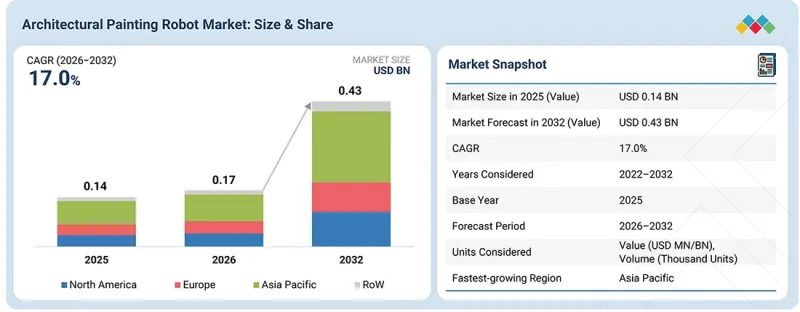
The global architectural painting robot market is estimated at USD 0.17 billion in 2026 and is projected to reach USD 0.43 billion by 2032, growing at a CAGR of 17.0% from 2026 to 2032. This market is expected to experience strong growth due to increasing demand for automation in painting, particularly for high walls, ceilings, and hard-to-reach interior surfaces.
| Scope of the Report | |
|---|---|
| Years Considered for the Study | 2021-2032 |
| Base Year | 2025 |
| Forecast Period | 2026-2032 |
| Units Considered | Value (USD Billion) |
| Segments | By Offering, Level of Autonomy, Application Type and Region |
| Regions covered | North America, Europe, APAC, RoW |
Construction contractors are increasingly adopting robotic systems capable of performing painting tasks at elevated heights. These robots offer controlled movement and spray application, which help minimize the need for repeated manual access. Additionally, their ability to work efficiently on large, vertically extensive surfaces with minimal site intervention makes them particularly suitable for multi-floor residential and commercial projects.
The rising demand for solutions that simplify high-reach painting operations and improve the utilization of construction equipment is further driving growth in the architectural painting robot market.
"Residential buildings are estimated to hold the largest market share in 2026."
Residential buildings constitute the largest segment in the architectural painting robot market. This dominance is driven by the high volume of housing construction and the extensive interior painting needs of apartments, multifamily housing units, and residential communities. The rise in large-scale residential projects is prompting contractors to adopt robotic painting solutions to automate repetitive wall and ceiling finishing tasks across multiple units and floors. Additionally, there is a growing demand to enhance labor productivity, achieve consistent finishing quality, and complete housing projects more quickly. This trend is further boosting the adoption of painting robots in residential construction, thereby reinforcing this segment's market leadership.
"The renovation, remodeling, and maintenance segment is estimated to record the highest CAGR during the forecast period."
The renovation, remodeling, and maintenance segment is predicted to experience the highest CAGR in the architectural painting robot market. This growth is driven by the increasing demand to upgrade and maintain existing buildings while minimizing disruption to ongoing operations. Building owners and contractors are increasingly seeking automated painting solutions for repetitive refurbishment tasks in occupied residential, commercial, and public buildings. Additionally, painting robots can ensure consistent application on previously painted surfaces and operate effectively within structured renovation schedules, making them well-suited for refurbishment projects. As there is a growing focus on extending building lifespans, modernizing existing spaces, and improving renovation efficiency, the adoption of architectural painting robots in this segment is expected to accelerate.
"North America is expected to hold the second-largest market share during the forecast period."
North America is projected to hold the second-largest share of the architectural painting robot market. This growth is driven by the region's advanced construction industry, high labor costs, and increasing demand for automation in building finishing activities. The continuous development of large residential and commercial projects is creating opportunities for robotic painting solutions that enhance workforce productivity and accelerate project completion. Additionally, the presence of companies specializing in construction robotics, early adoption of autonomous technologies, and rising investments in AI-enabled construction equipment are further supporting the adoption of architectural painting robots in the region.
Extensive primary interviews were conducted with key industry experts who offer architectural painting robot solutions to determine and verify the market size for various segments and subsegments, as gathered through secondary research. The breakdown of primary participants for the report is provided below:
The study contains insights from various industry experts, including component suppliers, Tier 1 companies, and OEMs. The breakdown of the primary participants is as follows:
- By Stakeholder: OEMs/Supply Side (64%), Demand Side (25%), and Industry Associations, Government Agencies, etc. (11%)
- By Designation: C-level Executives (30%), Directors (30%), and Others (40%)
- By Region: North America (40%), Europe (30%), Asia Pacific (25%), and RoW (5%)
The report profiles key players in the architectural painting robot market and analyzes their respective market rankings. The prominent companies featured in this report include Bright Dream Robotics (China), Okibo (US and Israel), MYRO International PTE (Singapore), DAFANG AI PTE. LTD. (Singapore), and ConBotics (Germany).
Additionally, other notable companies in the architectural painting robot market include Les Companions (France), Constrobot Robotics Private Ltd. (India), Shanghai Legend Intelligent Technology Co., Ltd. (China), Shanghai WEIBUILD Technology Co., Ltd. (China), and Beijing Fangshi Robotics Co., Ltd. (China).
Research Coverage:
This research report categorizes the architectural painting robot market into various segments, including offering, level of autonomy, application type, building type, construction phase, and region. It outlines the key drivers, restraints, challenges, and opportunities for architectural painting robots, along with forecasts through 2032. Additionally, the report features a leadership mapping analysis of all companies involved in the architectural painting robot market ecosystem.
Key Benefits of Buying the Report
The report is designed to assist market leaders and new entrants in the architectural painting robot market by providing accurate data on both the overall market and its subsegments. It aims to help stakeholders understand the competitive landscape and gain valuable insights to better position their businesses and formulate effective go-to-market strategies. Additionally, the report informs stakeholders about the current market dynamics, highlighting key drivers, restraints, challenges, and opportunities.
The report provides insights into the following pointers:
- Analysis of key drivers (growing construction activity, increasing emphasis on worker safety and reduction of hazardous manual painting tasks, increasing demand for faster project completion and reduced construction timelines, growing focus on improving paint utilization and reducing material waste, and advancements in AI, computer vision, and autonomous navigation technologies), restraints(high upfront capital investment and implementation costs and fragmented nature of construction industry), opportunities (growing adoption of robots in renovation and building upgrade projects, expansion of Robotics-as-a-Service (RaaS) business models, and expansion into emerging construction markets), and challenges (delivering consistent paint quality across different wall materials and surface, limited workforce readiness for robotic painting technologies, and high maintenance, calibration, and servicing requirements)
- Product Development/Innovation: Detailed insights into upcoming technologies, research & development activities, and new product & service launches in the architectural painting robot market
- Market Development: Comprehensive information about lucrative markets-the report analyzes the architectural painting robot market across varied regions.
- Market Diversification: Exhaustive information about new products & services, untapped geographies, recent developments, and investments in the architectural painting robot market
- Competitive Assessment: In-depth assessment of market shares, growth strategies, and service offerings of leading players, such as Bright Dream Robotics (China), Okibo (US; Israel), MYRO International PTE (Singapore), DAFANG AI PTE. LTD (Singapore), and ConBotics (Germany) in the architectural painting robot market.
TABLE OF CONTENTS
1 INTRODUCTION
- 1.1 DEFINITION AND OVERVIEW
- 1.2 STUDY OBJECTIVE & CURRENCY CONSIDERED
- 1.3 STUDY SCOPE
- 1.4 INCLUSIONS AND EXCLUSIONS, LIMITATIONS, AND STAKEHOLDERS
2 RESEARCH METHODOLOGY
- 2.1 MARKET SIZE ESTIMATION: TOP-DOWN ANALYSIS AND BOTTOM-UP ANALYSIS
- 2.2 PRIMARY SOURCES
- 2.3 RESEARCH ASSUMPTIONS
3 EXECUTIVE SUMMARY
4 PREMIUM INSIGHTS
5 MARKET OVERVIEW AND DYNAMICS
- 5.1 MARKET DYNAMICS
- 5.1.1 DRIVERS
- 5.1.2 RESTRAINTS
- 5.1.3 OPPORTUNITY
- 5.1.4 CHALLENGES
- 5.2 TRENDS & DISRUPTION
- 5.3 PRICING ANALYSIS
- 5.4 SUPPLY CHAIN ANALYSIS
- 5.5 ECOSYSTEM ANALYSIS
- 5.6 TECHNOLOGY ANALYSIS
- 5.7 PATENT ANALYSIS
- 5.8 TRADE ANALYSIS
- 5.9 KEY CONFERENCES
- 5.10 CASE STUDY ANALYSIS
- 5.11 INVESTMENT AND FUNDING SCENARIO AND TARIFF LANDSCAPE
- 5.12 PORTER'S FIVE FORCE ANALYSIS
- 5.13 KEY STAKEHOLDERS IN BUYING PROCESS AND BUYING CRITERIA
- 5.14 IMPACT OF AI/GEN AI AND IMPACT OF US TARIFF
6 MARKET ASSESSMENT, BY OFFERING
7 MARKET ASSESSMENT, BY LEVEL OF AUTONOMY
8 MARKET ASSESSMENT, BY APPLICATION
9 MARKET ASSESSMENT, BY BUILDING TYPE
10 MARKET ASSESSMENT, BY CONSTRUCTION PHASE
11 MARKET ASSESSMENT, BY REGION
12 COMPETITIVE LANDSCAPE
- 12.1 MARKET SHARE ANALYSIS
- 12.2 BRAND COMPARISON
- 12.3 COMPANY EVALUATION MATRIX
- 12.4 COMPANY FOOTPRINT
13 COMPANY PROFILES
- 13.1 KEY PLAYERS
- 13.1.1 BRIGHT DREAM ROBOTICS
- 13.1.2 OKIBO
- 13.1.3 MYRO INTERNATIONAL PTE
- 13.1.4 DAFANG AI PTE. LTD
- 13.1.5 CONBOTICS
- 13.1.6 LES COMPANIONS
- 13.1.7 CONSTROBOT ROBOTICS PRIVATE LTD.
- 13.1.8 SHANGHAI LEGEND INTELLIGENT TECHNOLOGY CO., LTD.
- 13.1.9 SHANGHAI WEIBUILD TECHNOLOGY CO., LTD.
- 13.1.10 BEIJING FANGSHI ROBOTICS CO., LTD
- 13.2 OTHER PLAYERS
- 13.2.1 ROBOSURF
- 13.2.2 FINISH ROBOTICS
- 13.2.3 BES
- 13.2.4 JANYU TECHNOLOGIES PVT. LTD.
- 13.2.5 JLG INDUSTRIES
- 13.2.6 DUCO ROBOTS CO., LTD.
- 13.2.7 ROBOPRINT INC.
- 13.2.8 AGUSTIN ELECTRIC TECHNOLOGY (HANGZHOU) CO., LTD.
- 13.2.9 PAINTIQ ROBOTICS
- 13.2.10 SOL ROBOTICS
- 13.2.11 PAINTJET
- 13.2.12 SMARTBUILD ROBOTICS
- 13.2.13 PROBUILD ROBOTICS
- 13.2.14 ZQ-AUTOMATION
- 13.2.15 WUHAN ONEW TECHNOLOGY CO., LTD.
14 APPENDIX
- 14.1 DISCUSSION GUIDE
- 14.2 RELATED REPORTS
- 14.3 AUTHOR DETAILS

