PUBLISHER: MarketsandMarkets | PRODUCT CODE: 2129344

PUBLISHER: MarketsandMarkets | PRODUCT CODE: 2129344
UAV Radar Market by Scanning, Onboard Radar, Offboard Radar, Frequency Band, UAV Class, End User and Region - Global Forecast to 2031
The use of radar for all-weather sensing, autonomous flight, persistent surveillance, and counter-UAS protection by defense forces, border agencies, critical infrastructure operators, and UAV manufacturers is driving growth in the UAV radar market.
| Scope of the Report | |
|---|---|
| Years Considered for the Study | 2021-2032 |
| Base Year | 2025 |
| Forecast Period | 2026-2032 |
| Units Considered | Value (USD Billion) |
| Segments | By Scanning, Frequency, End User and Region |
| Regions covered | North America, Europe, APAC, RoW |
Demand is rising due to a number of factors, including increased acquisition of unmanned systems, the need to detect low-observable and low-flying drones, the growing use of SAR/GMTI payloads, and the trend toward small electronically scanned radars that can be installed on smaller airframes.
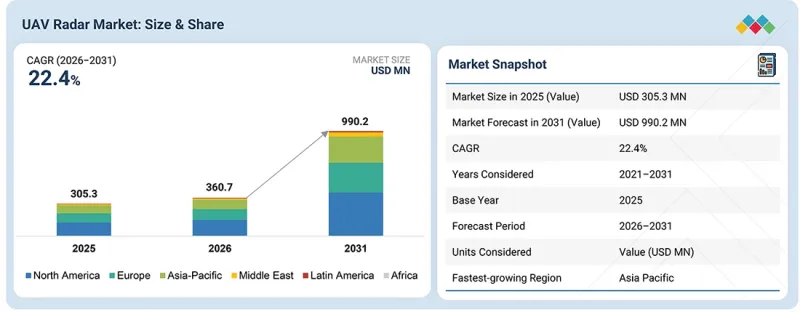
Based on the current procurement and integration pipeline, the UAV radar market is projected to reach USD 360.7 million in 2026 and USD 990.2 million by 2031, representing an estimated CAGR of 22.4% over the forecast period. While onboard radar demand is growing across ISR, maritime surveillance, detect-and-avoid, navigation, and mission-safety applications, offboard UAV-detection radar now constitutes the larger revenue stream. This growth is driven by wider radar installations on tactical and MALE platforms, increased military UAV deliveries, expedited counter-UAS acquisition, and expanding use of software-defined, AESA, MIMO, and low-SWaP radar architectures.
"By Scanning Type, Electronically Scanned Array Radar Segment to Hold the Largest Market Share During the Forecast Period"
As manufacturers and system integrators increasingly adopt compact, fast-steering architectures for both mission sensing and drone detection, electronic scanned array radar is expected to capture the largest share of the UAV radar market. By avoiding reliance on mechanical antenna movement, AESA and other electronically steered systems enable rapid beam management, multi-target tracking, fast update rates, and adaptable software-defined modes. Throughout the projection period, this segment is expected to be strengthened by their growing use in detect-and-avoid sensors, multi-function surveillance radars, SAR/GMTI payloads, and counter-UAS systems.
"Defense Segment to Record Significant Growth During the Forecast Period by End User"
Military organizations are expanding counter-drone coverage and incorporating radar payloads into ISR, maritime, tactical, and combat-oriented UAVs. The majority of the additional demand is anticipated to come from defense clients. To support both new-build installations and upgrade programs, procurement is also moving toward networked sensors that can provide persistent tracking, target classification, and cueing across layered air-defense architectures.
"North America to Register Substantial Share During the Forecast Period"
North America is expected to remain a major UAV radar market, supported by a mature radar industrial base, large defense budgets, active counter-UAS programs, and extensive radar integration on unmanned aircraft. The region also benefits from strong development activity in compact AESA, metamaterials, detect-and-avoid, and software-defined radar, along with recurring upgrades to existing unmanned and air-defense fleets.
The breakdown of profiles for primary participants in the UAV radar market is provided below:
- By Company Type: Tier 1 - 45%, Tier 2 - 30%, and Tier 3 - 25%
- By Designation: Directors - 25%, C-Level Executives - 15%, and Others (Managers and Other Non-C-Level Executives) - 60%
- By Region: North America - 35%, Europe - 25%, Asia Pacific - 20%, Middle East - 10%, Latin America - 5%, and Africa - 5%
RTX (US), Leonardo S.p.A (Italy), Saab AB (Sweden), HENSOLDT AG (Germany), and Israel Aerospace Industries (Israel) are among the key companies considered in the UAV radar market assessment.
Research Coverage:
This market study evaluates the UAV radar market across its principal segments and subsegments and assesses the potential of each market across major regions and countries. The study includes an in-depth assessment of key participants, product portfolios, company positioning, integration programs, contract activity, technological developments, procurement trends, and the strategies adopted to strengthen market presence.
Reasons to Buy This Report:
The report is intended to help market leaders, suppliers, integrators, and new entrants develop a grounded view of the UAV Radar revenue opportunity and its competitive environment. It supports portfolio planning, market-entry decisions, partner identification, and go-to-market prioritization by combining demand drivers, restraints, country-level procurement signals, technology shifts, and competitive activity into a single market view.
The report provides insights into the following pointers:
- Market drivers (growth in counter-UAS procurement, unmanned ISR fleets, and low-altitude air-defense modernization), restraints (integration complexity, spectrum/certification constraints, export restrictions, and the cost of advanced AESA hardware), opportunities (compact low-SWaP AESA/MIMO radar, autonomous detect-and-avoid, software-defined processing, and multi-sensor C-UAS integration), and challenges (small-target detection in clutter, rapid threat evolution, false-alarm management, and interoperability across platforms and command networks)
- Market Penetration: Comprehensive information on UAV radar systems and radar-enabled solutions offered by leading suppliers across onboard and offboard applications
- Product Development/Innovation: Detailed assessment of emerging radar architectures, signal-processing advances, low-SWaP design, AI-enabled classification, detect-and-avoid capabilities, and product-development activity across the market
- Market Development: Comprehensive information on high-potential markets across regions, including procurement programs, fleet modernization, counter-UAS deployment, and radar integration opportunities
- Market Diversification: Detailed coverage of new radar products, adjacent UAV applications, underpenetrated geographies, recent contracts, partnerships, investments, and new routes to market
- Competitive Assessment: In-depth evaluation of market share, growth strategies, product positioning, radar portfolios, integration strengths, manufacturing capabilities, and program exposure of leading companies
TABLE OF CONTENTS
1 INTRODUCTION
- 1.1 STUDY OBJECTIVES
- 1.2 MARKET DEFINITION
- 1.3 STUDY SCOPE
- 1.3.1 MARKET SEGMENTATION & REGIONAL SNAPSHOT
- 1.3.2 INCLUSIONS & EXCLUSIONS
- 1.4 YEARS CONSIDERED
- 1.5 CURRENCY CONSIDERED
- 1.5.1 USD EXCHANGE RATES, 2021-2025
- 1.6 STAKEHOLDERS
- 1.7 SUMMARY OF CHANGES
2 EXECUTIVE SUMMARY
- 2.1 KEY INSIGHTS & MARKET HIGHLIGHTS
- 2.2 KEY MARKET PARTICIPANTS: MAPPING OF STRATEGIC DEVELOPMENTS
- 2.3 DISRUPTIVE TRENDS IN UAV RADAR MARKET
- 2.4 HIGH GROWTH SEGMENTS
- 2.5 REGIONAL SNAPSHOT: MARKET SIZE, GROWTH RATE, AND FORECAST
3 PREMIUM INSIGHTS
- 3.1 ATTRACTIVE OPPORTUNITIES FOR PLAYERS IN UAV RADAR MARKET
- 3.2 UAV RADAR MARKET, BY SCANNING TYPE
- 3.3 UAV RADAR MARKET, BY ONBOARD RADAR TYPE
- 3.4 UAV RADAR MARKET, BY OFFBOARD RADAR TYPE
- 3.5 UAV RADAR MARKET, BY END-USER
4 MARKET OVERVIEW
- 4.1 INTRODUCTION
- 4.2 MARKET DYNAMICS
- 4.2.1 DRIVERS
- 4.2.1.1 Rising demand for counter-UAS detection and tracking
- 4.2.1.2 Expansion of radar missions on UAV platforms
- 4.2.1.3 Need for all-weather and low-visibility sensing
- 4.2.2 RESTRAINTS
- 4.2.2.1 Size, weight, power, and thermal limits on UAV platforms
- 4.2.2.2 High platform integration and qualification requirements
- 4.2.3 OPPORTUNITIES
- 4.2.3.1 Compact detect-and-avoid radar for BVLOS UAV operations
- 4.2.3.2 Distributed and networked counter-UAS radar systems
- 4.2.4 CHALLENGES
- 4.2.4.1 Detection and classification of small UAVs in cluttered environments
- 4.2.4.2 Interoperability between radar, C2, sensors, and effectors
- 4.2.1 DRIVERS
- 4.3 UNMET NEEDS AND WHITE SPACES IN UAV RADAR MARKET
- 4.4 INTER-CONNECTED MARKETS AND CROSS-SECTOR OPPORTUNITIES
- 4.5 STRATEGIC MOVES BY TIER 1/2/3 PLAYERS
- 4.5.1 STRATEGIC MOVES BY TIER 1, 2, AND 3 PLAYERS
5 INDUSTRY TRENDS
- 5.1 INTRODUCTION
- 5.2 MACROECONOMIC OUTLOOK
- 5.2.1 INTRODUCTION
- 5.2.2 GDP TRENDS AND FORECAST
- 5.2.3 TRENDS IN GLOBAL UAV RADAR INDUSTRY
- 5.2.4 TRENDS IN GLOBAL AESA RADAR IN UAVS
- 5.3 VALUE CHAIN ANALYSIS
- 5.4 ECOSYSTEM ANALYSIS
- 5.5 TRADE ANALYSIS
- 5.5.1 IMPORT SCENARIO (HS CODE 852610)
- 5.5.2 EXPORT SCENARIO (HS CODE 852610)
- 5.6 KEY CONFERENCES & EVENTS, 2026-2027
- 5.7 TRENDS & DISRUPTIONS IMPACTING CUSTOMER BUSINESS
- 5.8 INVESTMENT & FUNDING SCENARIO
- 5.9 PRICING ANALYSIS
- 5.9.1 AVERAGE SELLING PRICE OF UAV RADAR, BY ONBOARD RADAR HARDWARE MODULE TYPE
- 5.9.2 AVERAGE SELLING PRICE OF UAV RADAR, BY REGION
- 5.10 CASE STUDIES
- 5.10.1 CASE STUDY 1: GENERAL ATOMICS DEVELOPED EAGLEEYE RADAR FOR GRAY EAGLE UAVS
- 5.10.2 CASE STUDY 2: AATI USED ECHOFLIGHT RADAR FOR BVLOS UAV OPERATIONS
- 5.10.3 CASE STUDY 3: US ARMY INTEGRATED KURFS RADAR WITH LIDS FOR COUNTER-UAS OPERATIONS
- 5.11 TOTAL COST OF OWNERSHIP
- 5.11.1 INTEGRATION AND DEPLOYMENT COSTS
- 5.11.2 INTEGRATION AND DEPLOYMENT COSTS
- 5.11.3 ANNUAL OPERATIONS & MAINTENANCE COSTS
- 5.11.4 MID-LIFE UPGRADE AND TECHNOLOGY REFRESH COSTS
- 5.11.5 OTHER COSTS
- 5.12 BILL OF MATERIALS (BOM ANALYSIS)
- 5.12.1 ELECTRONICALLY SCANNED ARRAY RADARS
- 5.12.2 MECHANICALLY SCANNED RADARS
- 5.12.3 HYBRID MECHANICAL-ELECTRONIC SCANNING RADARS
- 5.12.4 FIXED APERTURE/NON-SCANNING RADARS
- 5.13 BUSINESS MODELS
- 5.13.1 DIRECT SALES & PROCUREMENT MODEL
- 5.13.2 OEM & PLATFORM INTEGRATION MODEL
- 5.13.3 SYSTEM INTEGRATION & PRIME CONTRACTING MODEL
- 5.13.4 RETROFIT, UPGRADES & LIFECYCLE SUPPORT MODEL
- 5.13.5 SOFTWARE & RADAR-DATA SUBSCRIPTION MODEL
- 5.13.6 MANAGED DEPLOYMENT & CAPABILITY-AS-A-SERVICE MODEL
6 TECHNOLOGICAL ADVANCEMENTS, AI-DRIVEN IMPACT, PATENTS, INNOVATIONS, AND FUTURE APPLICATIONS
- 6.1 KEY EMERGING TECHNOLOGIES
- 6.1.1 SWAP-C REDUCTION AND RADAR MINIATURIZATION
- 6.1.1.1 GaAs-to-GaN transition in high-power RF sections
- 6.1.1.2 Silicon RF, SIGE, SOI, CMOS, and highly integrated front ends
- 6.1.1.3 Analog, hybrid, and digital beamforming
- 6.1.1.4 Direct RF sampling and high-speed mixed-signal conversion
- 6.1.1.5 Software-defined and cognitive radar
- 6.1.1 SWAP-C REDUCTION AND RADAR MINIATURIZATION
- 6.2 COMPLEMENTARY TECHNOLOGIES
- 6.2.1 AI-ASSISTED DETECTION, CLASSIFICATION, AND CLUTTER SUPPRESSION
- 6.2.2 CONFORMAL, DISTRIBUTED, AND MULTI-PANEL APERTURES
- 6.2.3 MULTIFUNCTION RF AND INTEGRATED SENSING/COMMUNICATIONS
- 6.2.4 MIMO, MULTISTATIC, BISTATIC, AND SWARM-BASED RADAR
- 6.3 ADJACENT TECHNOLOGIES
- 6.3.1 OPEN ARCHITECTURE AND MODULAR PAYLOAD INTERFACES
- 6.3.2 THERMAL MANAGEMENT AND POWER ELECTRONICS TRENDS
- 6.3.3 CYBERSECURITY AND ELECTRONIC PROTECTION REQUIREMENTS
- 6.4 TECHNOLOGY ROADMAP
- 6.5 PATENT ANALYSIS
- 6.6 FUTURE APPLICATIONS
- 6.7 IMPACT OF AI/ GENERATIVE AI ON UAV RADAR MARKET
- 6.7.1 TOP USE CASES AND MARKET POTENTIAL
- 6.7.2 BEST PRACTICES IN UAV RADAR MARKET
- 6.7.3 INTERCONNECTED ADJACENT ECOSYSTEM AND IMPACT ON MARKET PLAYERS
- 6.7.4 CLIENTS' READINESS TO ADOPT GENERATIVE AI IN UAV RADAR MARKET
7 SUSTAINABILITY AND REGULATORY LANDSCAPE
- 7.1 REGIONAL REGULATIONS AND COMPLIANCE
- 7.1.1 REGULATORY BODIES, GOVERNMENT AGENCIES, AND OTHER ORGANIZATIONS
- 7.1.2 KEY REGULATIONS
- 7.1.3 INDUSTRY STANDARDS
- 7.2 SUSTAINABILITY INITIATIVES
- 7.2.1 LOWER-POWER RF ELECTRONICS AND IMPROVED THERMAL MANAGEMENT
- 7.2.2 SOFTWARE-DEFINED AND MODULAR RADAR ARCHITECTURES
- 7.2.3 REPAIR, UPGRADES, AND LIFECYCLE MANAGEMENT
- 7.3 IMPACT OF REGULATORY POLICIES ON SUSTAINABILITY INITIATIVES
- 7.3.1 ENERGY-EFFICIENT RF COMPONENTS AND THERMAL MANAGEMENT
- 7.3.2 MODULAR UPGRADES, REPAIR, AND LIFECYCLE EXTENSION
8 CUSTOMER LANDSCAPE & BUYER BEHAVIOR
- 8.1 DECISION-MAKING PROCESS
- 8.2 BUYERS, STAKEHOLDERS, AND BUYING EVALUATION CRITERIA
- 8.2.1 KEY STAKEHOLDERS IN BUYING PROCESS
- 8.2.2 BUYING CRITERIA
- 8.3 ADOPTION BARRIERS & INTERNAL CHALLENGES
9 UAV RADAR MARKET, BY SCANNING TYPE (MARKET SIZE & FORECAST TO 2031 - IN USD MILLION)
- 9.1 INTRODUCTION
- 9.2 ELECTRONICALLY SCANNED ARRAY RADARS
- 9.2.1 FASTER TARGET DETECTION, MULTI-TARGET TRACKING, AND FLEXIBLE INSTALLATION TO DRIVE GROWTH
- 9.2.2 ACTIVE ELECTRONICALLY SCANNED ARRAY (AESA)
- 9.2.2.1 Analog beamforming AESA
- 9.2.2.2 Hybrid beamforming AESA
- 9.2.2.3 Digital beamforming AESA
- 9.2.2.4 Distributed/Multifunction AESA
- 9.2.3 OTHER ELECTRONICALLY SCANNED ARRAYS
- 9.2.3.1 Passive electronically scanned array (PESA)
- 9.2.3.2 Metamaterial electronically scanned array (MESA)
- 9.2.3.3 Multi-input multiple-output (MIMO)
- 9.2.3.4 Digital array
- 9.3 MECHANICALLY SCANNED RADAR
- 9.3.1 WIDE-AREA COVERAGE, PROVEN RADAR DESIGNS, AND COST CONSIDERATIONS TO SUSTAIN DEMAND
- 9.3.1.1 Rotating antenna radar
- 9.3.1.2 Gimballed/Steered antenna radar
- 9.3.1.3 Mechanically swept sector-scanning radar
- 9.3.1 WIDE-AREA COVERAGE, PROVEN RADAR DESIGNS, AND COST CONSIDERATIONS TO SUSTAIN DEMAND
- 9.4 HYBRID MECHANICAL-ELECTRONIC SCANNING RADAR
- 9.4.1 COMBINED ELECTRONIC BEAM CONTROL AND MECHANICAL REPOSITIONING TO DRIVE HYBRID GROWTH
- 9.4.1.1 Mechanically rotated AESA
- 9.4.1.2 Mechanically positioned fixed-panel AESA
- 9.4.1.3 Electronic sector scan with mechanical repositioning
- 9.4.1 COMBINED ELECTRONIC BEAM CONTROL AND MECHANICAL REPOSITIONING TO DRIVE HYBRID GROWTH
- 9.5 FIXED BEAM/NON-SCANNING RADAR
- 9.5.1 WIDER SPATIAL COVERAGE AND MULTI-POSITION IMAGING TO SUPPORT GROWTH
- 9.5.1.1 Fixed side-looking radar
- 9.5.1.2 Fixed forward-looking radar
- 9.5.1.3 Fixed multi-aperture radar
- 9.5.1 WIDER SPATIAL COVERAGE AND MULTI-POSITION IMAGING TO SUPPORT GROWTH
10 UAV RADAR MARKET, BY RADAR TYPE (MARKET SIZE & FORECAST TO 2031 - IN USD MILLION)
- 10.1 INTRODUCTION
- 10.2 ONBOARD RADAR TYPE
- 10.2.1 BVLOS OPERATIONS AND COMPACT RADAR INTEGRATION TO DRIVE DEMAND
- 10.3 OFFBOARD RADAR TYPE
- 10.3.1 DISTRIBUTED COUNTER-UAS NETWORKS AND WIDER COVERAGE TO DRIVE DEMAND
11 UAV RADAR MARKET, BY ONBOARD RADAR TYPE (MARKET SIZE & FORECAST TO 2031 - IN USD MILLION)
- 11.1 INTRODUCTION
- 11.2 ISR & SURVEILLANCE RADAR
- 11.2.1 PERSISTENT ISR AND MARITIME SURVEILLANCE TO DRIVE DEMAND
- 11.2.1.1 Dedicated SAR imaging radar
- 11.2.1.2 Dedicated GMTI radar
- 11.2.1.3 Maritime surveillance radar
- 11.2.1.4 Air surveillance radar
- 11.2.1 PERSISTENT ISR AND MARITIME SURVEILLANCE TO DRIVE DEMAND
- 11.3 FIRE-CONTROL & TARGETING RADAR
- 11.3.1 ARMED UAV MISSIONS TO DRIVE FIRE-CONTROL AND TARGETING RADAR DEMAND
- 11.3.1.1 Target detection and acquisition radar
- 11.3.1.2 Target tracking radar
- 11.3.1.3 Weapon cueing and guidance-support radar
- 11.3.1.4 Interceptor guidance radar
- 11.3.1 ARMED UAV MISSIONS TO DRIVE FIRE-CONTROL AND TARGETING RADAR DEMAND
- 11.4 DETECT-AND-AVOID AND AIRSPACE-SAFETY RADAR
- 11.4.1 BVLOS OPERATIONS AND AIRSPACE INTEGRATION TO DRIVE GROWTH
- 11.4.1.1 Air-to-air radar for traffic surveillance
- 11.4.1.2 Integrated DAA radar subsystems
- 11.4.1 BVLOS OPERATIONS AND AIRSPACE INTEGRATION TO DRIVE GROWTH
- 11.5 NAVIGATION AND FLIGHT-SAFETY RADAR
- 11.5.1 AUTONOMOUS FLIGHT AND LOW-ALTITUDE OPERATIONS TO DRIVE DEMAND
- 11.5.1.1 Radar altimeters
- 11.5.1.2 Terrain and obstacle-avoidance radar
- 11.5.1.3 Landing and approach-support radar
- 11.5.1 AUTONOMOUS FLIGHT AND LOW-ALTITUDE OPERATIONS TO DRIVE DEMAND
- 11.6 WEATHER & ATMOSPHERIC RADAR
- 11.6.1 LONG-ENDURANCE UAV OPERATIONS TO SUPPORT WEATHER RADAR GROWTH
- 11.6.1.1 Weather detection radar
- 11.6.1.2 Precipitation/Atmospheric/Cloud radar
- 11.6.1 LONG-ENDURANCE UAV OPERATIONS TO SUPPORT WEATHER RADAR GROWTH
- 11.7 MULTIMODE AND SPECIALIZED RADAR
- 11.7.1 SPECIALIZED SENSING MISSIONS TO EXPAND RADAR APPLICATIONS IN UAV RADAR MARKET
- 11.7.1.1 SAR/GMTI multimode radar
- 11.7.1.2 Maritime multimode radar
- 11.7.1.3 Multimode combat radar
- 11.7.2 OTHER SPECIALIZED UAV RADAR
- 11.7.2.1 Ground-penetrating radar
- 11.7.2.2 Foliage-penetrating radar
- 11.7.2.3 Ice/Snow-sounding radar
- 11.7.2.4 Environmental & scientific radar
- 11.7.1 SPECIALIZED SENSING MISSIONS TO EXPAND RADAR APPLICATIONS IN UAV RADAR MARKET
12 UAV RADAR MARKET, BY OFFBOARD TYPE (MARKET SIZE & FORECAST TO 2031 - IN USD MILLION)
- 12.1 INTRODUCTION
- 12.2 SEARCH AND DETECTION RADAR
- 12.2.1 SMALL DRONE THREATS AND LAYERED C-UAS NETWORKS TO DRIVE DEMAND
- 12.3 PRECISION TRACKING AND CUEING RADAR
- 12.3.1 INTEGRATED C-UAS ARCHITECTURES TO DRIVE DEMAND
- 12.4 MULTI-FUNCTION COUNTER-UAS RADAR
- 12.4.1 EVOLVING DRONE THREATS AND MOBILE DEFENSE NEEDS TO DRIVE ADOPTION
- 12.5 FIRE-CONTROL AND ENGAGEMENT-SUPPORT RADAR
- 12.5.1 KINETIC COUNTER-UAS SYSTEMS TO DRIVE DEMAND
13 UAV RADAR MARKET, BY FREQUENCY BAND (MARKET SIZE & FORECAST TO 2031 - IN USD MILLION)
- 13.1 INTRODUCTION
- 13.2 L-BAND
- 13.2.1 WIDE-AREA SURVEILLANCE AND COUNTER-UAS DETECTION TO DRIVE GROWTH
- 13.3 S-BAND
- 13.3.1 LONG-RANGE UAV DETECTION AND LAYERED AIR DEFENSE TO DRIVE DEMAND
- 13.4 C-BAND
- 13.4.1 MOBILE AIR DEFENSE AND MULTI-MISSION SURVEILLANCE TO DRIVE GROWTH
- 13.5 X-BAND
- 13.5.1 HIGH-RESOLUTION SENSING AND PRECISION TRACKING TO DRIVE DEMAND
- 13.6 KU-BAND
- 13.6.1 COMPACT SAR PAYLOADS AND PRECISION COUNTER-UAS TRACKING TO DRIVE DEMAND
- 13.7 K-BAND
- 13.7.1 AUTONOMOUS FLIGHT AND RADAR ALTIMETRY TO DRIVE ADOPTION
- 13.8 KA-BAND
- 13.8.1 HIGH-RESOLUTION MAPPING AND PRECISION MEASUREMENT TO DRIVE DEMAND
- 13.9 V/W-BAND AND OTHER MILLIMETER_WAVE BANDS
- 13.9.1 SHORT-RANGE PRECISION SENSING AND AUTONOMOUS FLIGHT TO DRIVE GROWTH
- 13.10 MULTI-BAND
- 13.10.1 COMBINED WIDE-AREA SEARCH AND PRECISION TRACKING TO DRIVE ADOPTION
- 13.10.2 OTHER FREQUENCY BANDS
14 UAV RADAR MARKET, BY UAV CLASS (MARKET SIZE & FORECAST TO 2031 - IN USD MILLION)
- 14.1 INTRODUCTION
- 14.2 SMALL UAVS (<=25 KG)
- 14.2.1 COMPACT RADAR INTEGRATION AND AUTONOMOUS OPERATIONS TO DRIVE DEMAND
- 14.2.2 MICRO UAVS
- 14.2.3 MINI UAVS
- 14.2.4 SMALL TACTICAL UAVS
- 14.3 TACTICAL UAVS (>25-150 KG)
- 14.3.1 MULTI-SENSOR ISR AND LONGER-ENDURANCE MISSIONS TO DRIVE ADOPTION
- 14.4 MEDIUM UAVS (>150-600 KG)
- 14.4.1 MARITIME SURVEILLANCE AND WIDE-AREA ISR TO DRIVE DEMAND
- 14.5 LARGE UAVS (600 KG)
- 14.5.1 PERSISTENT SURVEILLANCE AND COMBAT MISSIONS TO DRIVE GROWTH
- 14.5.2 MEDIUM-ALTITUDE LONG-ENDURANCE (MALE) UAVS
- 14.5.3 HIGH-ALTITUDE LONG-ENDURANCE (HALE) UAVS
- 14.5.4 UNMANNED COMBAT AERIAL VEHICLES (UCAVS)
15 UAV RADAR MARKET, BY END USER (MARKET SIZE & FORECAST TO 2031 - IN USD MILLION)
- 15.1 INTRODUCTION
- 15.2 DEFENSE
- 15.2.1 PERSISTENT ISR AND DEFENSE MODERNIZATION TO DRIVE DEMAND
- 15.3 HOMELAND SECURITY & LAW ENFORCEMENT
- 15.3.1 BORDER SURVEILLANCE AND COUNTER-UAS OPERATIONS TO DRIVE DEMAND
- 15.4 CIVIL & COMMERCIAL
- 15.4.1 BVLOS OPERATIONS AND INFRASTRUCTURE MONITORING TO DRIVE ADOPTION
16 UAV RADAR MARKET, BY REGION (MARKET SIZE & FORECAST TO 2031 - IN USD MILLION)
- 16.1 INTRODUCTION
- 16.2 NORTH AMERICA
- 16.2.1 US
- 16.2.1.1 Counter-UAS programs to drive market
- 16.2.2 CANADA
- 16.2.2.1 Arctic surveillance, RPAS procurement, and counter-UAS investment to drive market
- 16.2.1 US
- 16.3 EUROPE
- 16.3.1 UK
- 16.3.1.1 Surveillance UAV modernization and counter-UAS funding to drive market
- 16.3.2 FRANCE
- 16.3.2.1 Radar-equipped tactical and naval UAV programs to expand market
- 16.3.3 GERMANY
- 16.3.3.1 Persistent unmanned ISR and mobile air-defense programs to strengthen radar adoption
- 16.3.4 ITALY
- 16.3.4.1 Naval UAV integration and counter-UAS deployment to drive demand for radar systems
- 16.3.5 SPAIN
- 16.3.5.1 SIRTAP development and mobile counter-UAS programs to support market growth
- 16.3.6 POLAND
- 16.3.6.1 Eastern-flank drone threats and counter-UAS procurement to accelerate radar deployment
- 16.3.7 SWEDEN
- 16.3.7.1 Distributed counter-UAS systems and common radar architecture to expand market opportunities
- 16.3.8 NORWAY
- 16.3.8.1 High North surveillance and military-base protection to drive UAV radar requirements
- 16.3.9 NETHERLANDS
- 16.3.9.1 Naval UAV deployment and domestic sensor localization to strengthen radar demand
- 16.3.10 REST OF EUROPE
- 16.3.1 UK
- 16.4 ASIA PACIFIC
- 16.4.1 CHINA
- 16.4.1.1 Expansion of low-altitude drone operations and defense modernization to drive market
- 16.4.2 INDIA
- 16.4.2.1 Border surveillance requirements and counter-UAS procurement to drive market
- 16.4.3 JAPAN
- 16.4.3.1 Maritime ISR and protection of military facilities to drive market
- 16.4.4 SOUTH KOREA
- 16.4.4.1 Indigenous radar-equipped UAV production and counter-drone programs to drive market
- 16.4.5 AUSTRALIA
- 16.4.5.1 Long-range maritime surveillance and LAND 156 deployments to drive market
- 16.4.6 SINGAPORE
- 16.4.6.1 Dense airspace safety and critical infrastructure protection to drive market
- 16.4.7 TAIWAN
- 16.4.7.1 Cross-strait ISR expansion and layered counter-UAS defense to drive Taiwan's UAV Radar Market
- 16.4.8 REST OF ASIA PACIFIC
- 16.4.1 CHINA
- 16.5 MIDDLE EAST
- 16.5.1 GCC
- 16.5.1.1 UAE
- 16.5.1.1.1 Expansion of radar-equipped UAV programs and critical infrastructure surveillance to drive market
- 16.5.1.2 Saudi Arabia
- 16.5.1.2.1 Defense localization and UAV sensor integration to drive market
- 16.5.1.1 UAE
- 16.5.2 ISRAEL
- 16.5.2.1 Established UAV-radar integration and persistent ISR requirements to drive market
- 16.5.3 TURKEY
- 16.5.3.1 Indigenous combat UAV Development and AESA radar integration to drive adoption
- 16.5.4 REST OF MIDDLE EAST
- 16.5.1 GCC
- 16.6 LATIN AMERICA
- 16.6.1 BRAZIL
- 16.6.1.1 Border surveillance, Amazon monitoring, and counter-UAS investment to drive market
- 16.6.2 MEXICO
- 16.6.2.1 Airspace protection, strategic RPAS procurement, and critical-infrastructure security to drive market
- 16.6.3 ARGENTINA
- 16.6.3.1 Domestic radar development and northern-border security programs to drive market
- 16.6.4 REST OF LATIN AMERICA
- 16.6.1 BRAZIL
- 16.7 AFRICA
- 16.7.1 SOUTHERN AFRICA
- 16.7.1.1 Border monitoring and counter-drone requirements to support market growth
- 16.7.2 NORTHERN AFRICA
- 16.7.2.1 Air-defense modernization and radar-enabled UAV operations to support market growth
- 16.7.1 SOUTHERN AFRICA
17 COMPETITIVE LANDSCAPE
- 17.1 INTRODUCTION
- 17.2 KEY PLAYER STRATEGIES/RIGHT TO WIN, 2021-2025
- 17.3 REVENUE ANALYSIS, 2021-2025
- 17.4 MARKET SHARE ANALYSIS, 2025
- 17.5 BRAND COMPARISON
- 17.6 COMPANY VALUATION AND FINANCIAL METRICS
- 17.7 ONBOARD COMPANY EVALUATION MATRIX: KEY PLAYERS, 2025
- 17.7.1 STARS
- 17.7.2 EMERGING LEADERS
- 17.7.3 PERVASIVE PLAYERS
- 17.7.4 PARTICIPANTS
- 17.8 OFFBOARD COMPANY EVALUATION MATRIX: KEY PLAYERS, 2025
- 17.8.1 STARS
- 17.8.2 EMERGING LEADERS
- 17.8.3 PERVASIVE PLAYERS
- 17.8.4 PARTICIPANTS
- 17.8.5 COMPANY FOOTPRINT
- 17.8.5.1 Company footprint
- 17.8.5.2 Region footprint
- 17.8.5.3 Onboard radar type footprint
- 17.8.5.4 Offboard radar type footprint
- 17.8.5.5 End user footprint
- 17.9 COMPANY EVALUATION MATRIX: STARTUPS/SMES, 2025
- 17.9.1 PROGRESSIVE COMPANIES
- 17.9.2 RESPONSIVE COMPANIES
- 17.9.3 DYNAMIC COMPANIES
- 17.9.4 STARTING BLOCKS
- 17.9.5 COMPETITIVE BENCHMARKING
- 17.9.5.1 List of startups/SMEs
- 17.9.5.2 Competitive benchmarking of startups/SMEs
- 17.10 COMPETITIVE SCENARIO
- 17.10.1 PRODUCT LAUNCHES/ENHANCEMENTS/DEVELOPMENTS
- 17.10.2 DEALS
- 17.10.3 OTHER DEVELOPMENTS
18 COMPANY PROFILES
- 18.1 KEY PLAYERS
- 18.1.1 RTX
- 18.1.1.1 Business overview
- 18.1.1.2 Products offered
- 18.1.1.3 Recent developments
- 18.1.1.3.1 Product developments
- 18.1.1.3.2 Other developments
- 18.1.1.4 MnM view
- 18.1.1.4.1 Right to win
- 18.1.1.4.2 Strategic choices
- 18.1.1.4.3 Weaknesses and competitive threats
- 18.1.2 THALES
- 18.1.2.1 Business overview
- 18.1.2.2 Products offered
- 18.1.2.3 Recent developments
- 18.1.2.3.1 Product launches
- 18.1.2.3.2 Deals
- 18.1.2.3.3 Other developments
- 18.1.2.4 MnM view
- 18.1.2.4.1 Right to win
- 18.1.2.4.2 Strategic choices
- 18.1.2.4.3 Weaknesses and competitive threats
- 18.1.3 HENSOLDT AG
- 18.1.3.1 Business overview
- 18.1.3.2 Products offered
- 18.1.3.3 Recent developments
- 18.1.3.3.1 Product launches & developments
- 18.1.3.3.2 Deals
- 18.1.3.3.3 Other developments
- 18.1.3.4 MnM view
- 18.1.3.4.1 Right to win
- 18.1.3.4.2 Strategic choices
- 18.1.3.4.3 Weaknesses and competitive threats
- 18.1.4 SAAB AB
- 18.1.4.1 Business overview
- 18.1.4.2 Products offered
- 18.1.4.3 Recent developments
- 18.1.4.3.1 Product launches
- 18.1.4.3.2 Deals
- 18.1.4.3.3 Other developments
- 18.1.4.4 MnM view
- 18.1.4.4.1 Right to win
- 18.1.4.4.2 Strategic choices
- 18.1.4.4.3 Weaknesses and competitive threats
- 18.1.5 LEONARDO S.P.A.
- 18.1.5.1 Business overview
- 18.1.5.2 Products offered
- 18.1.5.3 Recent developments
- 18.1.5.3.1 Product launches & enhancements
- 18.1.5.3.2 Deals
- 18.1.5.3.3 Other developments
- 18.1.5.4 MnM view
- 18.1.5.4.1 Right to win
- 18.1.5.4.2 Strategic choices
- 18.1.5.4.3 Weaknesses and competitive threats
- 18.1.6 GENERAL ATOMICS
- 18.1.6.1 Business overview
- 18.1.6.2 Products offered
- 18.1.6.3 Recent developments
- 18.1.6.3.1 Product launches & enhancements
- 18.1.6.3.2 Deals
- 18.1.6.3.3 Other developments
- 18.1.7 NORTHROP GRUMMAN
- 18.1.7.1 Business overview
- 18.1.7.2 Products offered
- 18.1.7.3 Recent developments
- 18.1.7.3.1 Product enhancements
- 18.1.7.3.2 Other developments
- 18.1.8 ASELSAN A.S.
- 18.1.8.1 Business overview
- 18.1.8.2 Products offered
- 18.1.8.3 Recent developments
- 18.1.8.3.1 Product launches & developments
- 18.1.8.3.2 Other developments
- 18.1.9 HANWHA SYSTEMS CO., LTD.
- 18.1.9.1 Business overview
- 18.1.9.2 Products offered
- 18.1.9.3 Recent developments
- 18.1.9.3.1 Product launches & developments
- 18.1.9.3.2 Deals
- 18.1.9.3.3 Other developments
- 18.1.10 HONEYWELL INTERNATIONAL INC.
- 18.1.10.1 Business overview
- 18.1.10.2 Products offered
- 18.1.10.3 Recent developments
- 18.1.10.3.1 Product launches & developments
- 18.1.10.3.2 Deals
- 18.1.10.3.3 Other developments
- 18.1.11 ECHODYNE CORP.
- 18.1.11.1 Business overview
- 18.1.11.2 Products offered
- 18.1.11.3 Recent developments
- 18.1.11.3.1 Product launches
- 18.1.11.3.2 Deals
- 18.1.11.3.3 Other developments
- 18.1.12 MITSUBISHI ELECTRIC CORPORATION
- 18.1.12.1 Business overview
- 18.1.12.2 Products offered
- 18.1.12.3 Recent developments
- 18.1.12.3.1 Product developments
- 18.1.12.3.2 Other developments
- 18.1.13 METEKSAN DEFENCE INDUSTRY INC.
- 18.1.13.1 Business overview
- 18.1.13.2 Products offered
- 18.1.13.3 Recent developments
- 18.1.13.3.1 Product launches & enhancements
- 18.1.13.3.2 Other developments
- 18.1.14 ISRAEL AEROSPACE INDUSTRIES
- 18.1.14.1 Business overview
- 18.1.14.2 Products offered
- 18.1.14.3 Recent developments
- 18.1.14.3.1 Product launches & developments
- 18.1.14.3.2 Deals
- 18.1.14.3.3 Other developments
- 18.1.15 IMSAR
- 18.1.15.1 Business overview
- 18.1.15.2 Products offered
- 18.1.15.3 Recent developments
- 18.1.15.3.1 Product upgrades
- 18.1.15.3.2 Deals
- 18.1.15.3.3 Other developments
- 18.1.16 LOCKHEED MARTIN CORPORATION
- 18.1.16.1 Business overview
- 18.1.16.2 Products offered
- 18.1.16.3 Recent developments
- 18.1.16.3.1 Deals
- 18.1.16.3.2 Other developments
- 18.1.17 TELEDYNE TECHNOLOGIES INCORPORATED
- 18.1.17.1 Business overview
- 18.1.17.2 Products offered
- 18.1.17.3 Recent developments
- 18.1.17.3.1 Product launches & enhancements
- 18.1.17.3.2 Deals
- 18.1.17.3.3 Other developments
- 18.1.18 ELBIT SYSTEMS LTD.
- 18.1.18.1 Business overview
- 18.1.18.2 Products offered
- 18.1.18.3 Recent developments
- 18.1.18.3.1 Product launches & developments
- 18.1.18.3.2 Deals
- 18.1.18.3.3 Other developments
- 18.1.19 BHARAT ELECTRONICS LIMITED (BEL)
- 18.1.19.1 Business overview
- 18.1.19.2 Products offered
- 18.1.19.3 Recent developments
- 18.1.19.3.1 Product launches & developments
- 18.1.19.3.2 Deals
- 18.1.19.3.3 Other developments
- 18.1.20 ROBIN RADAR SYSTEMS
- 18.1.20.1 Business overview
- 18.1.20.2 Products offered
- 18.1.20.3 Recent developments
- 18.1.20.3.1 Product launches & enhancements
- 18.1.20.3.2 Deals
- 18.1.20.3.3 Other developments
- 18.1.1 RTX
- 18.2 OTHER PLAYERS
- 18.2.1 ANALOG DEVICES, INC.
- 18.2.2 QORVO US, INC.
- 18.2.3 NXP SEMICONDUCTORS
- 18.2.4 INFINEON TECHNOLOGIES AG
- 18.2.5 MACOM
- 18.2.6 METASENSING SRL
- 18.2.7 AINSTEIN
- 18.2.8 SMARTMICRO
- 18.2.9 SPACEFOREST
19 RESEARCH METHODOLOGY
- 19.1 RESEARCH DATA
- 19.1.1 SECONDARY DATA
- 19.1.1.1 Key data from secondary sources
- 19.1.2 BREAKDOWN OF PRIMARY INTERVIEWS
- 19.1.3 PRIMARY DATA
- 19.1.1 SECONDARY DATA
- 19.2 FACTOR ANALYSIS
- 19.2.1 INTRODUCTION
- 19.3 STUDY SCOPE
- 19.3.1 SEGMENTS AND SUBSEGMENTS
- 19.3.1.1 UAV radar market, by frequency band
- 19.3.1.2 UAV radar market, by UAV class
- 19.3.1.3 UAV radar market, by end user
- 19.3.1.4 UAV radar market, by scanning type
- 19.3.1.5 UAV radar market, by onboard radar type
- 19.3.1.6 UAV radar market, by offboard radar type
- 19.3.1 SEGMENTS AND SUBSEGMENTS
- 19.4 RESEARCH APPROACH AND METHODOLOGY
- 19.4.1 MARKET SIZE ESTIMATION
- 19.4.1.1 Bottom-up approach
- 19.4.1.2 Top-down approach
- 19.4.1 MARKET SIZE ESTIMATION
- 19.5 DATA TRIANGULATION
- 19.6 RESEARCH ASSUMPTIONS
- 19.7 RISK ASSESSMENT
- 19.8 RESEARCH LIMITATIONS
20 APPENDIX
- 20.1 DISCUSSION GUIDE
- 20.2 KNOWLEDGESTORE: MARKETSANDMARKETS' SUBSCRIPTION PORTAL
- 20.3 CUSTOMIZATION OPTIONS
- 20.4 RELATED REPORTS
- 20.5 AUTHOR DETAILS
List of Tables
- TABLE 1 GDP PERCENTAGE CHANGE, BY COUNTRY, 2021-2030
- TABLE 2 ROLE OF MAJOR COMPANIES IN VALUE CHAIN
- TABLE 3 ROLE OF COMPANIES IN ECOSYSTEM
- TABLE 4 IMPORT DATA FOR HS CODE 852610 -COMPLIANT PRODUCTS, BY COUNTRY, 2021-2025 (USD THOUSAND)
- TABLE 5 EXPORT DATA FOR HS CODE 852610-COMPLIANT PRODUCTS, BY COUNTRY, 2021-2025 (USD THOUSAND)
- TABLE 6 KEY CONFERENCES & EVENTS, 2026-2027
- TABLE 7 AVERAGE SELLING PRICE OF UAV RADAR, BY ONBOARD RADAR HARDWARE MODULE TYPE, 2025
- TABLE 8 AVERAGE SELLING PRICE OF UAV RADAR, BY REGION, 2025
- TABLE 9 TOTAL COST OF OWNERSHIP FOR UAV RADAR MARKET
- TABLE 10 BILL OF MATERIALS FOR UAV RADAR TYPES
- TABLE 11 KEY PATENTS, 2016-2024
- TABLE 12 TOP USE CASES AND MARKET POTENTIAL
- TABLE 13 BEST PRACTICES: COMPANIES IMPLEMENTING USE CASES
- TABLE 14 INTERCONNECTED ADJACENT ECOSYSTEM AND IMPACT ON MARKET PLAYERS
- TABLE 15 NORTH AMERICA: REGULATORY BODIES, GOVERNMENT AGENCIES, AND OTHER ORGANIZATIONS
- TABLE 16 EUROPE: REGULATORY BODIES, GOVERNMENT AGENCIES, AND OTHER ORGANIZATIONS
- TABLE 17 ASIA PACIFIC: REGULATORY BODIES, GOVERNMENT AGENCIES, AND OTHER ORGANIZATIONS
- TABLE 18 MIDDLE EAST & AFRICA: REGULATORY BODIES, GOVERNMENT AGENCIES, AND OTHER ORGANIZATIONS
- TABLE 19 LATIN AMERICA: REGULATORY BODIES, GOVERNMENT AGENCIES, AND OTHER ORGANIZATIONS
- TABLE 20 MAJOR REGULATORY BODIES, GOVERNMENT AGENCIES, AND OTHER ORGANIZATIONS, BY COUNTRY/REGION
- TABLE 21 INDUSTRY STANDARDS IN WEATHER MONITORING SYSTEMS MARKET
- TABLE 22 INFLUENCE OF STAKEHOLDERS, BY END USER (%)
- TABLE 23 KEY BUYING CRITERIA FOR UAV RADAR MARKET, BY END USER
- TABLE 24 UAV RADAR MARKET, BY SCANNING TYPE, 2021-2025 (USD MILLION)
- TABLE 25 UAV RADAR MARKET, BY SCANNING TYPE, 2026-2031 (USD MILLION)
- TABLE 26 UAV RADAR MARKET, BY ELECTRONICALLY SCANNED ARRAY RADAR, 2021-2025 (USD MILLION)
- TABLE 27 UAV RADAR MARKET, BY ELECTRONICALLY SCANNED ARRAY RADAR, 2026-2031 (USD MILLION)
- TABLE 28 UAV RADAR MARKET, BY ACTIVE ELECTRONICALLY SCANNED ARRAY (AESA), 2021-2025 (USD MILLION)
- TABLE 29 UAV RADAR MARKET, BY ACTIVE ELECTRONICALLY SCANNED ARRAY (AESA) 2026-2031 (USD MILLION)
- TABLE 30 UAV RADAR MARKET, BY OTHER ELECTRONICALLY SCANNED ARRAYS, 2021-2025 (USD MILLION)
- TABLE 31 UAV RADAR MARKET, BY OTHER ELECTRONICALLY SCANNED ARRAYS 6-2031 (USD MILLION)
- TABLE 32 UAV RADAR MARKET, BY MECHANICALLY SCANNED RADAR, 2021-2025 (USD MILLION)
- TABLE 33 UAV RADAR MARKET, BY MECHANICALLY SCANNED RADAR, 2026-2031 (USD MILLION)
- TABLE 34 UAV RADAR MARKET, BY HYBRID MECHANICAL-ELECTRONIC SCANNING RADAR, 2021-2025 (USD MILLION)
- TABLE 35 UAV RADAR MARKET, BY HYBRID MECHANICAL-ELECTRONIC SCANNING RADAR, 2026-2031 (USD MILLION)
- TABLE 36 UAV RADAR MARKET, BY FIXED BEAM/NON-SCANNING RADAR, 2021-2025 (USD MILLION)
- TABLE 37 UAV RADAR MARKET, BY FIXED BEAM/NON-SCANNING RADAR, 2026-2031 (USD MILLION)
- TABLE 38 UAV RADAR MARKET, BY RADAR TYPE, 2021-2025 (USD MILLION)
- TABLE 39 UAV RADAR MARKET, BY RADAR TYPE, 2026-2031 (USD MILLION)
- TABLE 40 UAV RADAR MARKET, BY ONBOARD RADAR TYPE, 2021-2025 (USD MILLION)
- TABLE 41 UAV RADAR MARKET, BY ONBOARD RADAR TYPE, 2026-2031 (USD MILLION)
- TABLE 42 UAV RADAR MARKET, BY ISR & SURVEILLANCE RADAR, 2021-2025 (USD MILLION)
- TABLE 43 UAV RADAR MARKET, BY ISR & SURVEILLANCE RADAR, 2026-2031 (USD MILLION)
- TABLE 44 UAV RADAR MARKET, BY FIRE-CONTROL & TARGETING RADAR, 2021-2025 (USD MILLION)
- TABLE 45 UAV RADAR MARKET, BY FIRE-CONTROL & TARGETING RADAR, 2026-2031 (USD MILLION)
- TABLE 46 UAV RADAR MARKET, BY DETECT-AND-AVOID AND AIRSPACE-SAFETY RADAR, 2021-2025 (USD MILLION)
- TABLE 47 UAV RADAR MARKET, BY DETECT-AND-AVOID AND AIRSPACE-SAFETY RADAR, 2026-2031 (USD MILLION)
- TABLE 48 UAV RADAR MARKET, BY NAVIGATION & FLIGHT-SAFETY RADAR, 2021-2025 (USD MILLION)
- TABLE 49 UAV RADAR MARKET, BY NAVIGATION & FLIGHT-SAFETY RADAR, 2026-2031 (USD MILLION)
- TABLE 50 UAV RADAR MARKET, BY WEATHER & ATMOSPHERIC RADAR, 2021-2025 (USD MILLION)
- TABLE 51 UAV RADAR MARKET, BY WEATHER & ATMOSPHERIC RADAR, 2026-2031 (USD MILLION)
- TABLE 52 UAV RADAR MARKET, BY MULTIMODE RADAR, 2021-2025 (USD MILLION)
- TABLE 53 UAV RADAR MARKET, BY MULTIMODE RADAR, 2026-2031 (USD MILLION)
- TABLE 54 UAV RADAR MARKET, BY OTHER SPECIALIZED UAV RADAR, 2021-2025 (USD MILLION)
- TABLE 55 UAV RADAR MARKET, BY OTHER SPECIALIZED UAV RADAR, 2026-2031 (USD MILLION)
- TABLE 56 UAV RADAR MARKET, BY OFFBOARD RADAR TYPE, 2021-2025 (USD MILLION)
- TABLE 57 UAV RADAR MARKET, BY OFFBOARD RADAR TYPE, 2026-2031 (USD MILLION)
- TABLE 58 UAV RADAR MARKET, BY FREQUENCY BAND, 2021-2025 (USD MILLION)
- TABLE 59 UAV RADAR MARKET, BY FREQUENCY BAND, 2026-2031 (USD MILLION)
- TABLE 60 UAV RADAR MARKET, BY UAV CLASS, 2021-2025 (USD MILLION)
- TABLE 61 UAV RADAR MARKET, BY UAV CLASS, 2026-2031 (USD MILLION)
- TABLE 62 UAV RADAR MARKET, BY SMALL UAVS: <=25 KG, 2021-2025 (USD MILLION)
- TABLE 63 UAV RADAR MARKET, BY SMALL UAVS: <=25 KG, 2026-2031 (USD MILLION)
- TABLE 64 UAV RADAR MARKET, BY LARGE UAVS: >600 KG, 2021-2025 (USD MILLION)
- TABLE 65 UAV RADAR MARKET, BY LARGE UAVS: >600 KG, 2026-2031 (USD MILLION)
- TABLE 66 UAV RADAR MARKET, BY END USER, 2021-2025 (USD MILLION)
- TABLE 67 UAV RADAR MARKET, BY END USER, 2026-2031 (USD MILLION)
- TABLE 68 UAV RADAR MARKET, BY REGION, 2021-2025 (USD MILLION)
- TABLE 69 UAV RADAR MARKET, BY REGION, 2026-2031 (USD MILLION)
- TABLE 70 NORTH AMERICA: UAV RADAR MARKET, BY COUNTRY, 2021-2025 (USD MILLION)
- TABLE 71 NORTH AMERICA: UAV RADAR MARKET, BY COUNTRY, 2026-2031 (USD MILLION)
- TABLE 72 NORTH AMERICA: UAV RADAR MARKET, BY SCANNING TYPE, 2021-2025 (USD MILLION)
- TABLE 73 NORTH AMERICA: UAV RADAR MARKET, BY SCANNING TYPE, 2026-2031 (USD MILLION)
- TABLE 74 NORTH AMERICA: UAV RADAR MARKET, BY ELECTRONICALLY SCANNED ARRAY RADAR, 2021-2025 (USD MILLION)
- TABLE 75 NORTH AMERICA: UAV RADAR MARKET, BY ELECTRONICALLY SCANNED ARRAY RADAR, 2026-2031 (USD MILLION)
- TABLE 76 NORTH AMERICA: UAV RADAR MARKET, BY MECHANICALLY SCANNED RADAR, 2021-2025 (USD MILLION)
- TABLE 77 NORTH AMERICA: UAV RADAR MARKET, BY MECHANICALLY SCANNED RADAR, 2026-2031 (USD MILLION)
- TABLE 78 NORTH AMERICA: UAV RADAR MARKET, BY HYBRID MECHANICAL-ELECTRONIC SCANNING RADAR, 2021-2025 (USD MILLION)
- TABLE 79 NORTH AMERICA: UAV RADAR MARKET, BY HYBRID MECHANICAL-ELECTRONIC SCANNING RADAR, 2026-2031 (USD MILLION)
- TABLE 80 NORTH AMERICA: UAV RADAR MARKET, BY FIXED BEAM/NON-SCANNING RADAR, 2021-2025 (USD MILLION)
- TABLE 81 NORTH AMERICA: UAV RADAR MARKET, BY FIXED BEAM/NON-SCANNING RADAR, 2026-2031 (USD MILLION)
- TABLE 82 NORTH AMERICA: UAV RADAR MARKET, BY ONBOARD RADAR TYPE, 2021-2025 (USD MILLION)
- TABLE 83 NORTH AMERICA: UAV RADAR MARKET, BY ONBOARD RADAR TYPE, 2026-2031 (USD MILLION)
- TABLE 84 NORTH AMERICA: UAV RADAR MARKET, BY ISR & SURVEILLANCE RADAR, 2021-2025 (USD MILLION)
- TABLE 85 NORTH AMERICA: UAV RADAR MARKET, BY ISR & SURVEILLANCE RADAR, 2026-2031 (USD MILLION)
- TABLE 86 NORTH AMERICA: UAV RADAR MARKET, BY FIRE-CONTROL & TARGETING RADAR, 2021-2025 (USD MILLION)
- TABLE 87 NORTH AMERICA: UAV RADAR MARKET, BY FIRE-CONTROL & TARGETING RADAR, 2026-2031 (USD MILLION)
- TABLE 88 NORTH AMERICA: UAV RADAR MARKET, BY DETECT-AND-AVOID AND AIRSPACE-SAFETY RADAR, 2021-2025 (USD MILLION)
- TABLE 89 NORTH AMERICA: UAV RADAR MARKET, BY DETECT-AND-AVOID AND AIRSPACE-SAFETY RADAR, 2026-2031 (USD MILLION)
- TABLE 90 NORTH AMERICA: UAV RADAR MARKET, BY NAVIGATION & FLIGHT-SAFETY RADAR, 2021-2025 (USD MILLION)
- TABLE 91 NORTH AMERICA: UAV RADAR MARKET, BY NAVIGATION & FLIGHT-SAFETY RADAR, 2026-2031 (USD MILLION)
- TABLE 92 NORTH AMERICA: UAV RADAR MARKET, BY WEATHER & ATMOSPHERIC RADAR, 2021-2025 (USD MILLION)
- TABLE 93 NORTH AMERICA: UAV RADAR MARKET, BY WEATHER & ATMOSPHERIC RADAR, 2026-2031 (USD MILLION)
- TABLE 94 NORTH AMERICA: UAV RADAR MARKET, BY MULTIMODE RADAR, 2021-2025 (USD MILLION)
- TABLE 95 NORTH AMERICA: UAV RADAR MARKET, BY MULTIMODE RADAR, 2026-2031 (USD MILLION)
- TABLE 96 NORTH AMERICA: UAV RADAR MARKET, BY OTHER SPECIALIZED UAV RADAR, 2021-2025 (USD MILLION)
- TABLE 97 NORTH AMERICA: UAV RADAR MARKET, BY OTHER SPECIALIZED UAV RADAR, 2026-2031 (USD MILLION)
- TABLE 98 NORTH AMERICA: UAV RADAR MARKET, BY OFFBOARD RADAR TYPE, 2021-2025 (USD MILLION)
- TABLE 99 NORTH AMERICA: UAV RADAR MARKET, BY OFFBOARD RADAR TYPE, 2026-2031 (USD MILLION)
- TABLE 100 NORTH AMERICA: UAV RADAR MARKET, BY FREQUENCY BAND, 2021-2025 (USD MILLION)
- TABLE 101 NORTH AMERICA: UAV RADAR MARKET, BY FREQUENCY BAND, 2026-2031 (USD MILLION)
- TABLE 102 NORTH AMERICA: UAV RADAR MARKET, BY UAV CLASS, 2021-2025 (USD MILLION)
- TABLE 103 NORTH AMERICA: UAV RADAR MARKET, BY UAV CLASS, 2026-2031 (USD MILLION)
- TABLE 104 NORTH AMERICA: UAV RADAR MARKET, BY SMALL UAVS: <=25 KG, 2021-2025 (USD MILLION)
- TABLE 105 NORTH AMERICA: UAV RADAR MARKET, BY SMALL UAVS: <=25 KG, 2026-2031 (USD MILLION)
- TABLE 106 NORTH AMERICA: UAV RADAR MARKET, BY LARGE UAVS: >600 KG, 2021-2025 (USD MILLION)
- TABLE 107 NORTH AMERICA: UAV RADAR MARKET, BY LARGE UAVS: >600 KG, 2026-2031 (USD MILLION)
- TABLE 108 NORTH AMERICA: UAV RADAR MARKET, BY END USER, 2021-2025 (USD MILLION)
- TABLE 109 NORTH AMERICA: UAV RADAR MARKET, BY END USER, 2026-2031 (USD MILLION)
- TABLE 110 US: UAV RADAR MARKET, BY SCANNING TYPE, 2021-2025 (USD MILLION)
- TABLE 111 US: UAV RADAR MARKET, BY SCANNING TYPE, 2026-2031 (USD MILLION)
- TABLE 112 US: UAV RADAR MARKET, BY ONBOARD RADAR TYPE, 2021-2025 (USD MILLION)
- TABLE 113 US: UAV RADAR MARKET, BY ONBOARD RADAR TYPE, 2026-2031 (USD MILLION)
- TABLE 114 US: UAV RADAR MARKET, BY OFFBOARD RADAR TYPE, 2021-2025 (USD MILLION)
- TABLE 115 US: UAV RADAR MARKET, BY OFFBOARD RADAR TYPE, 2026-2031 (USD MILLION)
- TABLE 116 US: UAV RADAR MARKET, BY FREQUENCY BAND, 2021-2025 (USD MILLION)
- TABLE 117 US: UAV RADAR MARKET, BY FREQUENCY BAND, 2026-2031 (USD MILLION)
- TABLE 118 US: UAV RADAR MARKET, BY UAV CLASS, 2021-2025 (USD MILLION)
- TABLE 119 US: UAV RADAR MARKET, BY UAV CLASS, 2026-2031 (USD MILLION)
- TABLE 120 US: UAV RADAR MARKET, BY END USER, 2021-2025 (USD MILLION)
- TABLE 121 US: UAV RADAR MARKET, BY END USER, 2026-2031 (USD MILLION)
- TABLE 122 CANADA: UAV RADAR MARKET, BY SCANNING TYPE, 2021-2025 (USD MILLION)
- TABLE 123 CANADA: UAV RADAR MARKET, BY SCANNING TYPE, 2026-2031 (USD MILLION)
- TABLE 124 CANADA: UAV RADAR MARKET, BY ONBOARD RADAR TYPE, 2021-2025 (USD MILLION)
- TABLE 125 CANADA: UAV RADAR MARKET, BY ONBOARD RADAR TYPE, 2026-2031 (USD MILLION)
- TABLE 126 CANADA: UAV RADAR MARKET, BY OFFBOARD RADAR TYPE, 2021-2025 (USD MILLION)
- TABLE 127 CANADA: UAV RADAR MARKET, BY OFFBOARD RADAR TYPE, 2026-2031 (USD MILLION)
- TABLE 128 CANADA: UAV RADAR MARKET, BY FREQUENCY BAND, 2021-2025 (USD MILLION)
- TABLE 129 CANADA: UAV RADAR MARKET, BY FREQUENCY BAND, 2026-2031 (USD MILLION)
- TABLE 130 CANADA: UAV RADAR MARKET, BY UAV CLASS, 2021-2025 (USD MILLION)
- TABLE 131 CANADA: UAV RADAR MARKET, BY UAV CLASS, 2026-2031 (USD MILLION)
- TABLE 132 CANADA: UAV RADAR MARKET, BY END USER, 2021-2025 (USD MILLION)
- TABLE 133 CANADA: UAV RADAR MARKET, BY END USER, 2026-2031 (USD MILLION)
- TABLE 134 EUROPE: UAV RADAR MARKET, BY COUNTRY, 2021-2025 (USD MILLION)
- TABLE 135 EUROPE: UAV RADAR MARKET, BY COUNTRY, 2026-2031 (USD MILLION)
- TABLE 136 EUROPE: UAV RADAR MARKET, BY SCANNING TYPE, 2021-2025 (USD MILLION)
- TABLE 137 EUROPE: UAV RADAR MARKET, BY SCANNING TYPE, 2026-2031 (USD MILLION)
- TABLE 138 EUROPE: UAV RADAR MARKET, BY ELECTRONICALLY SCANNED ARRAY RADAR, 2021-2025 (USD MILLION)
- TABLE 139 EUROPE: UAV RADAR MARKET, BY ELECTRONICALLY SCANNED ARRAY RADAR, 2026-2031 (USD MILLION)
- TABLE 140 EUROPE: UAV RADAR MARKET, BY MECHANICALLY SCANNED RADAR, 2021-2025 (USD MILLION)
- TABLE 141 EUROPE: UAV RADAR MARKET, BY MECHANICALLY SCANNED RADAR, 2026-2031 (USD MILLION)
- TABLE 142 EUROPE: UAV RADAR MARKET, BY HYBRID MECHANICAL-ELECTRONIC SCANNING RADAR, 2021-2025 (USD MILLION)
- TABLE 143 EUROPE: UAV RADAR MARKET, BY HYBRID MECHANICAL-ELECTRONIC SCANNING RADAR, 2026-2031 (USD MILLION)
- TABLE 144 EUROPE: UAV RADAR MARKET, BY FIXED BEAM/NON-SCANNING RADAR, 2021-2025 (USD MILLION)
- TABLE 145 EUROPE: UAV RADAR MARKET, BY FIXED BEAM/NON-SCANNING RADAR, 2026-2031 (USD MILLION)
- TABLE 146 EUROPE: UAV RADAR MARKET, BY ONBOARD RADAR TYPE, 2021-2025 (USD MILLION)
- TABLE 147 EUROPE: UAV RADAR MARKET, BY ONBOARD RADAR TYPE, 2026-2031 (USD MILLION)
- TABLE 148 EUROPE: UAV RADAR MARKET, BY ISR & SURVEILLANCE RADAR, 2021-2025 (USD MILLION)
- TABLE 149 EUROPE: UAV RADAR MARKET, BY ISR & SURVEILLANCE RADAR, 2026-2031 (USD MILLION)
- TABLE 150 EUROPE: UAV RADAR MARKET, BY FIRE-CONTROL & TARGETING RADAR, 2021-2025 (USD MILLION)
- TABLE 151 EUROPE: UAV RADAR MARKET, BY FIRE-CONTROL & TARGETING RADAR, 2026-2031 (USD MILLION)
- TABLE 152 EUROPE: UAV RADAR MARKET, BY DETECT-AND-AVOID AND AIRSPACE-SAFETY RADAR, 2021-2025 (USD MILLION)
- TABLE 153 EUROPE: UAV RADAR MARKET, BY DETECT-AND-AVOID AND AIRSPACE-SAFETY RADAR, 2026-2031 (USD MILLION)
- TABLE 154 EUROPE: UAV RADAR MARKET, BY NAVIGATION & FLIGHT-SAFETY RADAR, 2021-2025 (USD MILLION)
- TABLE 155 EUROPE: UAV RADAR MARKET, BY NAVIGATION & FLIGHT-SAFETY RADAR, 2026-2031 (USD MILLION)
- TABLE 156 EUROPE: UAV RADAR MARKET, BY WEATHER & ATMOSPHERIC RADAR, 2021-2025 (USD MILLION)
- TABLE 157 EUROPE: UAV RADAR MARKET, BY WEATHER & ATMOSPHERIC RADAR, 2026-2031 (USD MILLION)
- TABLE 158 EUROPE: UAV RADAR MARKET, BY MULTIMODE RADAR, 2021-2025 (USD MILLION)
- TABLE 159 EUROPE: UAV RADAR MARKET, BY MULTIMODE RADAR, 2026-2031 (USD MILLION)
- TABLE 160 EUROPE: UAV RADAR MARKET, BY OTHER SPECIALIZED UAV RADAR, 2021-2025 (USD MILLION)
- TABLE 161 EUROPE: UAV RADAR MARKET, BY OTHER SPECIALIZED UAV RADAR, 2026-2031 (USD MILLION)
- TABLE 162 EUROPE: UAV RADAR MARKET, BY OFFBOARD RADAR TYPE, 2021-2025 (USD MILLION)
- TABLE 163 EUROPE: UAV RADAR MARKET, BY OFFBOARD RADAR TYPE, 2026-2031 (USD MILLION)
- TABLE 164 EUROPE: UAV RADAR MARKET, BY FREQUENCY BAND, 2021-2025 (USD MILLION)
- TABLE 165 EUROPE: UAV RADAR MARKET, BY FREQUENCY BAND, 2026-2031 (USD MILLION)
- TABLE 166 EUROPE: UAV RADAR MARKET, BY UAV CLASS, 2021-2025 (USD MILLION)
- TABLE 167 EUROPE: UAV RADAR MARKET, BY UAV CLASS, 2026-2031 (USD MILLION)
- TABLE 168 EUROPE: UAV RADAR MARKET, BY SMALL UAVS: <=25 KG, 2021-2025 (USD MILLION)
- TABLE 169 EUROPE: UAV RADAR MARKET, BY SMALL UAVS: <=25 KG, 2026-2031 (USD MILLION)
- TABLE 170 EUROPE: UAV RADAR MARKET, BY LARGE UAVS: >600 KG, 2021-2025 (USD MILLION)
- TABLE 171 EUROPE: UAV RADAR MARKET, BY LARGE UAVS: >600 KG, 2026-2031 (USD MILLION)
- TABLE 172 EUROPE: UAV RADAR MARKET, BY END USER, 2021-2025 (USD MILLION)
- TABLE 173 EUROPE: UAV RADAR MARKET, BY END USER, 2026-2031 (USD MILLION)
- TABLE 174 UK: UAV RADAR MARKET, BY SCANNING TYPE, 2021-2025 (USD MILLION)
- TABLE 175 UK: UAV RADAR MARKET, BY SCANNING TYPE, 2026-2031 (USD MILLION)
- TABLE 176 UK: UAV RADAR MARKET, BY ONBOARD RADAR TYPE, 2021-2025 (USD MILLION)
- TABLE 177 UK: UAV RADAR MARKET, BY ONBOARD RADAR TYPE, 2026-2031 (USD MILLION)
- TABLE 178 UK: UAV RADAR MARKET, BY OFFBOARD RADAR TYPE, 2021-2025 (USD MILLION)
- TABLE 179 UK: UAV RADAR MARKET, BY OFFBOARD RADAR TYPE, 2026-2031 (USD MILLION)
- TABLE 180 UK: UAV RADAR MARKET, BY FREQUENCY BAND, 2021-2025 (USD MILLION)
- TABLE 181 UK: UAV RADAR MARKET, BY FREQUENCY BAND, 2026-2031 (USD MILLION)
- TABLE 182 UK: UAV RADAR MARKET, BY UAV CLASS, 2021-2025 (USD MILLION)
- TABLE 183 UK: UAV RADAR MARKET, BY UAV CLASS, 2026-2031 (USD MILLION)
- TABLE 184 UK: UAV RADAR MARKET, BY END USER, 2021-2025 (USD MILLION)
- TABLE 185 UK: UAV RADAR MARKET, BY END USER, 2026-2031 (USD MILLION)
- TABLE 186 FRANCE: UAV RADAR MARKET, BY SCANNING TYPE, 2021-2025 (USD MILLION)
- TABLE 187 FRANCE: UAV RADAR MARKET, BY SCANNING TYPE, 2026-2031 (USD MILLION)
- TABLE 188 FRANCE: UAV RADAR MARKET, BY ONBOARD RADAR TYPE, 2021-2025 (USD MILLION)
- TABLE 189 FRANCE: UAV RADAR MARKET, BY ONBOARD RADAR TYPE, 2026-2031 (USD MILLION)
- TABLE 190 FRANCE: UAV RADAR MARKET, BY OFFBOARD RADAR TYPE, 2021-2025 (USD MILLION)
- TABLE 191 FRANCE: UAV RADAR MARKET, BY OFFBOARD RADAR TYPE, 2026-2031 (USD MILLION)
- TABLE 192 FRANCE: UAV RADAR MARKET, BY FREQUENCY BAND, 2021-2025 (USD MILLION)
- TABLE 193 FRANCE: UAV RADAR MARKET, BY FREQUENCY BAND, 2026-2031 (USD MILLION)
- TABLE 194 FRANCE: UAV RADAR MARKET, BY UAV CLASS, 2021-2025 (USD MILLION)
- TABLE 195 FRANCE: UAV RADAR MARKET, BY UAV CLASS, 2026-2031 (USD MILLION)
- TABLE 196 FRANCE: UAV RADAR MARKET, BY END USER, 2021-2025 (USD MILLION)
- TABLE 197 FRANCE: UAV RADAR MARKET, BY END USER, 2026-2031 (USD MILLION)
- TABLE 198 GERMANY: UAV RADAR MARKET, BY SCANNING TYPE, 2021-2025 (USD MILLION)
- TABLE 199 GERMANY: UAV RADAR MARKET, BY SCANNING TYPE, 2026-2031 (USD MILLION)
- TABLE 200 GERMANY: UAV RADAR MARKET, BY ONBOARD RADAR TYPE, 2021-2025 (USD MILLION)
- TABLE 201 GERMANY: UAV RADAR MARKET, BY ONBOARD RADAR TYPE, 2026-2031 (USD MILLION)
- TABLE 202 GERMANY: UAV RADAR MARKET, BY OFFBOARD RADAR TYPE, 2021-2025 (USD MILLION)
- TABLE 203 GERMANY: UAV RADAR MARKET, BY OFFBOARD RADAR TYPE, 2026-2031 (USD MILLION)
- TABLE 204 GERMANY: UAV RADAR MARKET, BY FREQUENCY BAND, 2021-2025 (USD MILLION)
- TABLE 205 GERMANY: UAV RADAR MARKET, BY FREQUENCY BAND, 2026-2031 (USD MILLION)
- TABLE 206 GERMANY: UAV RADAR MARKET, BY UAV CLASS, 2021-2025 (USD MILLION)
- TABLE 207 GERMANY: UAV RADAR MARKET, BY UAV CLASS, 2026-2031 (USD MILLION)
- TABLE 208 GERMANY: UAV RADAR MARKET, BY END USER, 2021-2025 (USD MILLION)
- TABLE 209 GERMANY: UAV RADAR MARKET, BY END USER, 2026-2031 (USD MILLION)
- TABLE 210 ITALY: UAV RADAR MARKET, BY SCANNING TYPE, 2021-2025 (USD MILLION)
- TABLE 211 ITALY: UAV RADAR MARKET, BY SCANNING TYPE, 2026-2031 (USD MILLION)
- TABLE 212 ITALY: UAV RADAR MARKET, BY ONBOARD RADAR TYPE, 2021-2025 (USD MILLION)
- TABLE 213 ITALY: UAV RADAR MARKET, BY ONBOARD RADAR TYPE, 2026-2031 (USD MILLION)
- TABLE 214 ITALY: UAV RADAR MARKET, BY OFFBOARD RADAR TYPE, 2021-2025 (USD MILLION)
- TABLE 215 ITALY: UAV RADAR MARKET, BY OFFBOARD RADAR TYPE, 2026-2031 (USD MILLION)
- TABLE 216 ITALY: UAV RADAR MARKET, BY FREQUENCY BAND, 2021-2025 (USD MILLION)
- TABLE 217 ITALY: UAV RADAR MARKET, BY FREQUENCY BAND, 2026-2031 (USD MILLION)
- TABLE 218 ITALY: UAV RADAR MARKET, BY UAV CLASS, 2021-2025 (USD MILLION)
- TABLE 219 ITALY: UAV RADAR MARKET, BY UAV CLASS, 2026-2031 (USD MILLION)
- TABLE 220 ITALY: UAV RADAR MARKET, BY END USER, 2021-2025 (USD MILLION)
- TABLE 221 ITALY: UAV RADAR MARKET, BY END USER, 2026-2031 (USD MILLION)
- TABLE 222 SPAIN: UAV RADAR MARKET, BY SCANNING TYPE, 2021-2025 (USD MILLION)
- TABLE 223 SPAIN: UAV RADAR MARKET, BY SCANNING TYPE, 2026-2031 (USD MILLION)
- TABLE 224 SPAIN: UAV RADAR MARKET, BY ONBOARD RADAR TYPE, 2021-2025 (USD MILLION)
- TABLE 225 SPAIN: UAV RADAR MARKET, BY ONBOARD RADAR TYPE, 2026-2031 (USD MILLION)
- TABLE 226 SPAIN: UAV RADAR MARKET, BY OFFBOARD RADAR TYPE, 2021-2025 (USD MILLION)
- TABLE 227 SPAIN: UAV RADAR MARKET, BY OFFBOARD RADAR TYPE, 2026-2031 (USD MILLION)
- TABLE 228 SPAIN: UAV RADAR MARKET, BY FREQUENCY BAND, 2021-2025 (USD MILLION)
- TABLE 229 SPAIN: UAV RADAR MARKET, BY FREQUENCY BAND, 2026-2031 (USD MILLION)
- TABLE 230 SPAIN: UAV RADAR MARKET, BY UAV CLASS, 2021-2025 (USD MILLION)
- TABLE 231 SPAIN: UAV RADAR MARKET, BY UAV CLASS, 2026-2031 (USD MILLION)
- TABLE 232 SPAIN: UAV RADAR MARKET, BY END USER, 2021-2025 (USD MILLION)
- TABLE 233 SPAIN: UAV RADAR MARKET, BY END USER, 2026-2031 (USD MILLION)
- TABLE 234 POLAND: UAV RADAR MARKET, BY SCANNING TYPE, 2021-2025 (USD MILLION)
- TABLE 235 POLAND: UAV RADAR MARKET, BY SCANNING TYPE, 2026-2031 (USD MILLION)
- TABLE 236 POLAND: UAV RADAR MARKET, BY ONBOARD RADAR TYPE, 2021-2025 (USD MILLION)
- TABLE 237 POLAND: UAV RADAR MARKET, BY ONBOARD RADAR TYPE, 2026-2031 (USD MILLION)
- TABLE 238 POLAND: UAV RADAR MARKET, BY OFFBOARD RADAR TYPE, 2021-2025 (USD MILLION)
- TABLE 239 POLAND: UAV RADAR MARKET, BY OFFBOARD RADAR TYPE, 2026-2031 (USD MILLION)
- TABLE 240 POLAND: UAV RADAR MARKET, BY FREQUENCY BAND, 2021-2025 (USD MILLION)
- TABLE 241 POLAND: UAV RADAR MARKET, BY FREQUENCY BAND, 2026-2031 (USD MILLION)
- TABLE 242 POLAND: UAV RADAR MARKET, BY UAV CLASS, 2021-2025 (USD MILLION)
- TABLE 243 POLAND: UAV RADAR MARKET, BY UAV CLASS, 2026-2031 (USD MILLION)
- TABLE 244 POLAND: UAV RADAR MARKET, BY END USER, 2021-2025 (USD MILLION)
- TABLE 245 POLAND: UAV RADAR MARKET, BY END USER, 2026-2031 (USD MILLION)
- TABLE 246 SWEDEN: UAV RADAR MARKET, BY SCANNING TYPE, 2021-2025 (USD MILLION)
- TABLE 247 SWEDEN: UAV RADAR MARKET, BY SCANNING TYPE, 2026-2031 (USD MILLION)
- TABLE 248 SWEDEN: UAV RADAR MARKET, BY ONBOARD RADAR TYPE, 2021-2025 (USD MILLION)
- TABLE 249 SWEDEN: UAV RADAR MARKET, BY ONBOARD RADAR TYPE, 2026-2031 (USD MILLION)
- TABLE 250 SWEDEN: UAV RADAR MARKET, BY OFFBOARD RADAR TYPE, 2021-2025 (USD MILLION)
- TABLE 251 SWEDEN: UAV RADAR MARKET, BY OFFBOARD RADAR TYPE, 2026-2031 (USD MILLION)
- TABLE 252 SWEDEN: UAV RADAR MARKET, BY FREQUENCY BAND, 2021-2025 (USD MILLION)
- TABLE 253 SWEDEN: UAV RADAR MARKET, BY FREQUENCY BAND, 2026-2031 (USD MILLION)
- TABLE 254 SWEDEN: UAV RADAR MARKET, BY UAV CLASS, 2021-2025 (USD MILLION)
- TABLE 255 SWEDEN: UAV RADAR MARKET, BY UAV CLASS, 2026-2031 (USD MILLION)
- TABLE 256 SWEDEN: UAV RADAR MARKET, BY END USER, 2021-2025 (USD MILLION)
- TABLE 257 SWEDEN: UAV RADAR MARKET, BY END USER, 2026-2031 (USD MILLION)
- TABLE 258 NORWAY: UAV RADAR MARKET, BY SCANNING TYPE, 2021-2025 (USD MILLION)
- TABLE 259 NORWAY: UAV RADAR MARKET, BY SCANNING TYPE, 2026-2031 (USD MILLION)
- TABLE 260 NORWAY: UAV RADAR MARKET, BY ONBOARD RADAR TYPE, 2021-2025 (USD MILLION)
- TABLE 261 NORWAY: UAV RADAR MARKET, BY ONBOARD RADAR TYPE, 2026-2031 (USD MILLION)
- TABLE 262 NORWAY: UAV RADAR MARKET, BY OFFBOARD RADAR TYPE, 2021-2025 (USD MILLION)
- TABLE 263 NORWAY: UAV RADAR MARKET, BY OFFBOARD RADAR TYPE, 2026-2031 (USD MILLION)
- TABLE 264 NORWAY: UAV RADAR MARKET, BY FREQUENCY BAND, 2021-2025 (USD MILLION)
- TABLE 265 NORWAY: UAV RADAR MARKET, BY FREQUENCY BAND, 2026-2031 (USD MILLION)
- TABLE 266 NORWAY: UAV RADAR MARKET, BY UAV CLASS, 2021-2025 (USD MILLION)
- TABLE 267 NORWAY: UAV RADAR MARKET, BY UAV CLASS, 2026-2031 (USD MILLION)
- TABLE 268 NORWAY: UAV RADAR MARKET, BY END USER, 2021-2025 (USD MILLION)
- TABLE 269 NORWAY: UAV RADAR MARKET, BY END USER, 2026-2031 (USD MILLION)
- TABLE 270 NETHERLANDS: UAV RADAR MARKET, BY SCANNING TYPE, 2021-2025 (USD MILLION)
- TABLE 271 NETHERLANDS: UAV RADAR MARKET, BY SCANNING TYPE, 2026-2031 (USD MILLION)
- TABLE 272 NETHERLANDS: UAV RADAR MARKET, BY ONBOARD RADAR TYPE, 2021-2025 (USD MILLION)
- TABLE 273 NETHERLANDS: UAV RADAR MARKET, BY ONBOARD RADAR TYPE, 2026-2031 (USD MILLION)
- TABLE 274 NETHERLANDS: UAV RADAR MARKET, BY OFFBOARD RADAR TYPE, 2021-2025 (USD MILLION)
- TABLE 275 NETHERLANDS: UAV RADAR MARKET, BY OFFBOARD RADAR TYPE, 2026-2031 (USD MILLION)
- TABLE 276 NETHERLANDS: UAV RADAR MARKET, BY FREQUENCY BAND, 2021-2025 (USD MILLION)
- TABLE 277 NETHERLANDS: UAV RADAR MARKET, BY FREQUENCY BAND, 2026-2031 (USD MILLION)
- TABLE 278 NETHERLANDS: UAV RADAR MARKET, BY UAV CLASS, 2021-2025 (USD MILLION)
- TABLE 279 NETHERLANDS: UAV RADAR MARKET, BY UAV CLASS, 2026-2031 (USD MILLION)
- TABLE 280 NETHERLANDS: UAV RADAR MARKET, BY END USER, 2021-2025 (USD MILLION)
- TABLE 281 NETHERLANDS: UAV RADAR MARKET, BY END USER, 2026-2031 (USD MILLION)
- TABLE 282 REST OF EUROPE: UAV RADAR MARKET, BY SCANNING TYPE, 2021-2025 (USD MILLION)
- TABLE 283 REST OF EUROPE: UAV RADAR MARKET, BY SCANNING TYPE, 2026-2031 (USD MILLION)
- TABLE 284 REST OF EUROPE: UAV RADAR MARKET, BY ONBOARD RADAR TYPE, 2021-2025 (USD MILLION)
- TABLE 285 REST OF EUROPE: UAV RADAR MARKET, BY ONBOARD RADAR TYPE, 2026-2031 (USD MILLION)
- TABLE 286 REST OF EUROPE: UAV RADAR MARKET, BY OFFBOARD RADAR TYPE, 2021-2025 (USD MILLION)
- TABLE 287 REST OF EUROPE: UAV RADAR MARKET, BY OFFBOARD RADAR TYPE, 2026-2031 (USD MILLION)
- TABLE 288 REST OF EUROPE: UAV RADAR MARKET, BY FREQUENCY BAND, 2021-2025 (USD MILLION)
- TABLE 289 REST OF EUROPE: UAV RADAR MARKET, BY FREQUENCY BAND, 2026-2031 (USD MILLION)
- TABLE 290 REST OF EUROPE: UAV RADAR MARKET, BY UAV CLASS, 2021-2025 (USD MILLION)
- TABLE 291 REST OF EUROPE: UAV RADAR MARKET, BY UAV CLASS, 2026-2031 (USD MILLION)
- TABLE 292 REST OF EUROPE: UAV RADAR MARKET, BY END USER, 2021-2025 (USD MILLION)
- TABLE 293 REST OF EUROPE: UAV RADAR MARKET, BY END USER, 2026-2031 (USD MILLION)
- TABLE 294 ASIA PACIFIC: UAV RADAR MARKET, BY COUNTRY, 2021-2025 (USD MILLION)
- TABLE 295 ASIA PACIFIC: UAV RADAR MARKET, BY COUNTRY, 2026-2031 (USD MILLION)
- TABLE 296 ASIA PACIFIC: UAV RADAR MARKET, BY SCANNING TYPE, 2021-2025 (USD MILLION)
- TABLE 297 ASIA PACIFIC: UAV RADAR MARKET, BY SCANNING TYPE, 2026-2031 (USD MILLION)
- TABLE 298 ASIA PACIFIC: UAV RADAR MARKET, BY ELECTRONICALLY SCANNED ARRAY RADAR 1-2025 (USD MILLION)
- TABLE 299 ASIA PACIFIC: UAV RADAR MARKET, BY ELECTRONICALLY SCANNED ARRAY RADAR, 2026-2031 (USD MILLION)
- TABLE 300 ASIA PACIFIC: UAV RADAR MARKET, BY MECHANICALLY SCANNED RADAR, 2021-2025 (USD MILLION)
- TABLE 301 ASIA PACIFIC: UAV RADAR MARKET, BY MECHANICALLY SCANNED RADAR, 2026-2031 (USD MILLION)
- TABLE 302 ASIA PACIFIC: UAV RADAR MARKET, BY HYBRID MECHANICAL-ELECTRONIC SCANNING RADAR, 2021-2025 (USD MILLION)
- TABLE 303 ASIA PACIFIC: UAV RADAR MARKET, BY HYBRID MECHANICAL-ELECTRONIC SCANNING RADAR, 2026-2031 (USD MILLION)
- TABLE 304 ASIA PACIFIC: UAV RADAR MARKET, BY FIXED BEAM/NON-SCANNING RADAR, 2021-2025 (USD MILLION)
- TABLE 305 ASIA PACIFIC: UAV RADAR MARKET, BY FIXED BEAM/NON-SCANNING RADAR, 2026-2031 (USD MILLION)
- TABLE 306 ASIA PACIFIC: UAV RADAR MARKET, BY ONBOARD RADAR TYPE, 2021-2025 (USD MILLION)
- TABLE 307 ASIA PACIFIC: UAV RADAR MARKET, BY ONBOARD RADAR TYPE, 2026-2031 (USD MILLION)
- TABLE 308 ASIA PACIFIC: UAV RADAR MARKET, BY ISR & SURVEILLANCE RADAR, 2021-2025 (USD MILLION)
- TABLE 309 ASIA PACIFIC: UAV RADAR MARKET, BY ISR & SURVEILLANCE RADAR, 2026-2031 (USD MILLION)
- TABLE 310 ASIA PACIFIC: UAV RADAR MARKET, BY FIRE-CONTROL & TARGETING RADAR, 2021-2025 (USD MILLION)
- TABLE 311 ASIA PACIFIC: UAV RADAR MARKET, BY FIRE-CONTROL & TARGETING RADAR, 2026-2031 (USD MILLION)
- TABLE 312 ASIA PACIFIC: UAV RADAR MARKET, BY DETECT-AND-AVOID AND AIRSPACE-SAFETY RADAR, 2021-2025 (USD MILLION)
- TABLE 313 ASIA PACIFIC: UAV RADAR MARKET, BY DETECT-AND-AVOID AND AIRSPACE-SAFETY RADAR, 2026-2031 (USD MILLION)
- TABLE 314 ASIA PACIFIC: UAV RADAR MARKET, BY NAVIGATION & FLIGHT-SAFETY RADAR, 2021-2025 (USD MILLION)
- TABLE 315 ASIA PACIFIC: UAV RADAR MARKET, BY NAVIGATION & FLIGHT-SAFETY RADAR, 2026-2031 (USD MILLION)
- TABLE 316 ASIA PACIFIC: UAV RADAR MARKET, BY WEATHER & ATMOSPHERIC RADAR, 2021-2025 (USD MILLION)
- TABLE 317 ASIA PACIFIC: UAV RADAR MARKET, BY WEATHER & ATMOSPHERIC RADAR, 2026-2031 (USD MILLION)
- TABLE 318 ASIA PACIFIC: UAV RADAR MARKET, BY MULTIMODE RADAR, 2021-2025 (USD MILLION)
- TABLE 319 ASIA PACIFIC: UAV RADAR MARKET, BY MULTIMODE RADAR, 2026-2031 (USD MILLION)
- TABLE 320 ASIA PACIFIC: UAV RADAR MARKET, BY OTHER SPECIALIZED UAV RADAR, 2021-2025 (USD MILLION)
- TABLE 321 ASIA PACIFIC: UAV RADAR MARKET, BY OTHER SPECIALIZED UAV RADAR, 2026-2031 (USD MILLION)
- TABLE 322 ASIA PACIFIC: UAV RADAR MARKET, BY OFFBOARD RADAR TYPE, 2021-2025 (USD MILLION)
- TABLE 323 ASIA PACIFIC: UAV RADAR MARKET, BY OFFBOARD RADAR TYPE, 2026-2031 (USD MILLION)
- TABLE 324 ASIA PACIFIC: UAV RADAR MARKET, BY FREQUENCY BAND, 2021-2025 (USD MILLION)
- TABLE 325 ASIA PACIFIC: UAV RADAR MARKET, BY FREQUENCY BAND, 2026-2031 (USD MILLION)
- TABLE 326 ASIA PACIFIC: UAV RADAR MARKET, BY UAV CLASS, 2021-2025 (USD MILLION)
- TABLE 327 ASIA PACIFIC: UAV RADAR MARKET, BY UAV CLASS, 2026-2031 (USD MILLION)
- TABLE 328 ASIA PACIFIC: UAV RADAR MARKET, BY SMALL UAVS: <=25 KG, 2021-2025 (USD MILLION)
- TABLE 329 ASIA PACIFIC: UAV RADAR MARKET, BY SMALL UAVS: <=25 KG, 2026-2031 (USD MILLION)
- TABLE 330 ASIA PACIFIC: UAV RADAR MARKET, BY LARGE UAVS: >600 KG, 2021-2025 (USD MILLION)
- TABLE 331 ASIA PACIFIC: UAV RADAR MARKET, BY LARGE UAVS: >600 KG, 2026-2031 (USD MILLION)
- TABLE 332 ASIA PACIFIC: UAV RADAR MARKET, BY END USER, 2021-2025 (USD MILLION)
- TABLE 333 ASIA PACIFIC: UAV RADAR MARKET, BY END USER, 2026-2031 (USD MILLION)
- TABLE 334 CHINA: UAV RADAR MARKET, BY SCANNING TYPE, 2021-2025 (USD MILLION)
- TABLE 335 CHINA: UAV RADAR MARKET, BY SCANNING TYPE, 2026-2031 (USD MILLION)
- TABLE 336 CHINA: UAV RADAR MARKET, BY ONBOARD RADAR TYPE, 2021-2025 (USD MILLION)
- TABLE 337 CHINA: UAV RADAR MARKET, BY ONBOARD RADAR TYPE, 2026-2031 (USD MILLION)
- TABLE 338 CHINA: UAV RADAR MARKET, BY OFFBOARD RADAR TYPE, 2021-2025 (USD MILLION)
- TABLE 339 CHINA: UAV RADAR MARKET, BY OFFBOARD RADAR TYPE, 2026-2031 (USD MILLION)
- TABLE 340 CHINA: UAV RADAR MARKET, BY FREQUENCY BAND, 2021-2025 (USD MILLION)
- TABLE 341 CHINA: UAV RADAR MARKET, BY FREQUENCY BAND, 2026-2031 (USD MILLION)
- TABLE 342 CHINA: UAV RADAR MARKET, BY UAV CLASS, 2021-2025 (USD MILLION)
- TABLE 343 CHINA: UAV RADAR MARKET, BY UAV CLASS, 2026-2031 (USD MILLION)
- TABLE 344 CHINA: UAV RADAR MARKET, BY END USER, 2021-2025 (USD MILLION)
- TABLE 345 CHINA: UAV RADAR MARKET, BY END USER, 2026-2031 (USD MILLION)
- TABLE 346 INDIA: UAV RADAR MARKET, BY SCANNING TYPE, 2021-2025 (USD MILLION)
- TABLE 347 INDIA: UAV RADAR MARKET, BY SCANNING TYPE, 2026-2031 (USD MILLION)
- TABLE 348 INDIA: UAV RADAR MARKET, BY ONBOARD RADAR TYPE, 2021-2025 (USD MILLION)
- TABLE 349 INDIA: UAV RADAR MARKET, BY ONBOARD RADAR TYPE, 2026-2031 (USD MILLION)
- TABLE 350 INDIA: UAV RADAR MARKET, BY OFFBOARD RADAR TYPE, 2021-2025 (USD MILLION)
- TABLE 351 INDIA: UAV RADAR MARKET, BY OFFBOARD RADAR TYPE, 2026-2031 (USD MILLION)
- TABLE 352 INDIA: UAV RADAR MARKET, BY FREQUENCY BAND, 2021-2025 (USD MILLION)
- TABLE 353 INDIA: UAV RADAR MARKET, BY FREQUENCY BAND, 2026-2031 (USD MILLION)
- TABLE 354 INDIA: UAV RADAR MARKET, BY UAV CLASS, 2021-2025 (USD MILLION)
- TABLE 355 INDIA: UAV RADAR MARKET, BY UAV CLASS, 2026-2031 (USD MILLION)
- TABLE 356 INDIA: UAV RADAR MARKET, BY END USER, 2021-2025 (USD MILLION)
- TABLE 357 INDIA: UAV RADAR MARKET, BY END USER, 2026-2031 (USD MILLION)
- TABLE 358 JAPAN: UAV RADAR MARKET, BY SCANNING TYPE, 2021-2025 (USD MILLION)
- TABLE 359 JAPAN: UAV RADAR MARKET, BY SCANNING TYPE, 2026-2031 (USD MILLION)
- TABLE 360 JAPAN: UAV RADAR MARKET, BY ONBOARD RADAR TYPE, 2021-2025 (USD MILLION)
- TABLE 361 JAPAN: UAV RADAR MARKET, BY ONBOARD RADAR TYPE, 2026-2031 (USD MILLION)
- TABLE 362 JAPAN: UAV RADAR MARKET, BY OFFBOARD RADAR TYPE, 2021-2025 (USD MILLION)
- TABLE 363 JAPAN: UAV RADAR MARKET, BY OFFBOARD RADAR TYPE, 2026-2031 (USD MILLION)
- TABLE 364 JAPAN: UAV RADAR MARKET, BY FREQUENCY BAND, 2021-2025 (USD MILLION)
- TABLE 365 JAPAN: UAV RADAR MARKET, BY FREQUENCY BAND, 2026-2031 (USD MILLION)
- TABLE 366 JAPAN: UAV RADAR MARKET, BY UAV CLASS, 2021-2025 (USD MILLION)
- TABLE 367 JAPAN: UAV RADAR MARKET, BY UAV CLASS, 2026-2031 (USD MILLION)
- TABLE 368 JAPAN: UAV RADAR MARKET, BY END USER, 2021-2025 (USD MILLION)
- TABLE 369 JAPAN: UAV RADAR MARKET, BY END USER, 2026-2031 (USD MILLION)
- TABLE 370 SOUTH KOREA: UAV RADAR MARKET, BY SCANNING TYPE, 2021-2025 (USD MILLION)
- TABLE 371 SOUTH KOREA: UAV RADAR MARKET, BY SCANNING TYPE, 2026-2031 (USD MILLION)
- TABLE 372 SOUTH KOREA: UAV RADAR MARKET, BY ONBOARD RADAR TYPE, 2021-2025 (USD MILLION)
- TABLE 373 SOUTH KOREA: UAV RADAR MARKET, BY ONBOARD RADAR TYPE, 2026-2031 (USD MILLION)
- TABLE 374 SOUTH KOREA: UAV RADAR MARKET, BY OFFBOARD RADAR TYPE, 2021-2025 (USD MILLION)
- TABLE 375 SOUTH KOREA: UAV RADAR MARKET, BY OFFBOARD RADAR TYPE, 2026-2031 (USD MILLION)
- TABLE 376 SOUTH KOREA: UAV RADAR MARKET, BY FREQUENCY BAND, 2021-2025 (USD MILLION)
- TABLE 377 SOUTH KOREA: UAV RADAR MARKET, BY FREQUENCY BAND, 2026-2031 (USD MILLION)
- TABLE 378 SOUTH KOREA: UAV RADAR MARKET, BY UAV CLASS, 2021-2025 (USD MILLION)
- TABLE 379 SOUTH KOREA: UAV RADAR MARKET, BY UAV CLASS, 2026-2031 (USD MILLION)
- TABLE 380 SOUTH KOREA: UAV RADAR MARKET, BY END USER, 2021-2025 (USD MILLION)
- TABLE 381 SOUTH KOREA: UAV RADAR MARKET, BY END USER, 2026-2031 (USD MILLION)
- TABLE 382 AUSTRALIA: UAV RADAR MARKET, BY SCANNING TYPE, 2021-2025 (USD MILLION)
- TABLE 383 AUSTRALIA: UAV RADAR MARKET, BY SCANNING TYPE, 2026-2031 (USD MILLION)
- TABLE 384 AUSTRALIA: UAV RADAR MARKET, BY ONBOARD RADAR TYPE, 2021-2025 (USD MILLION)
- TABLE 385 AUSTRALIA: UAV RADAR MARKET, BY ONBOARD RADAR TYPE, 2026-2031 (USD MILLION)
- TABLE 386 AUSTRALIA: UAV RADAR MARKET, BY OFFBOARD RADAR TYPE, 2021-2025 (USD MILLION)
- TABLE 387 AUSTRALIA: UAV RADAR MARKET, BY OFFBOARD RADAR TYPE, 2026-2031 (USD MILLION)
- TABLE 388 AUSTRALIA: UAV RADAR MARKET, BY FREQUENCY BAND, 2021-2025 (USD MILLION)
- TABLE 389 AUSTRALIA: UAV RADAR MARKET, BY FREQUENCY BAND, 2026-2031 (USD MILLION)
- TABLE 390 AUSTRALIA: UAV RADAR MARKET, BY UAV CLASS, 2021-2025 (USD MILLION)
- TABLE 391 AUSTRALIA: UAV RADAR MARKET, BY UAV CLASS, 2026-2031 (USD MILLION)
- TABLE 392 AUSTRALIA: UAV RADAR MARKET, BY END USER, 2021-2025 (USD MILLION)
- TABLE 393 AUSTRALIA: UAV RADAR MARKET, BY END USER, 2026-2031 (USD MILLION)
- TABLE 394 SINGAPORE: UAV RADAR MARKET, BY SCANNING TYPE, 2021-2025 (USD MILLION)
- TABLE 395 SINGAPORE: UAV RADAR MARKET, BY SCANNING TYPE, 2026-2031 (USD MILLION)
- TABLE 396 SINGAPORE: UAV RADAR MARKET, BY ONBOARD RADAR TYPE, 2021-2025 (USD MILLION)
- TABLE 397 SINGAPORE: UAV RADAR MARKET, BY ONBOARD RADAR TYPE, 2026-2031 (USD MILLION)
- TABLE 398 SINGAPORE: UAV RADAR MARKET, BY OFFBOARD RADAR TYPE, 2021-2025 (USD MILLION)
- TABLE 399 SINGAPORE: UAV RADAR MARKET, BY OFFBOARD RADAR TYPE, 2026-2031 (USD MILLION)
- TABLE 400 SINGAPORE: UAV RADAR MARKET, BY FREQUENCY BAND, 2021-2025 (USD MILLION)
- TABLE 401 SINGAPORE: UAV RADAR MARKET, BY FREQUENCY BAND, 2026-2031 (USD MILLION)
- TABLE 402 SINGAPORE: UAV RADAR MARKET, BY UAV CLASS, 2021-2025 (USD MILLION)
- TABLE 403 SINGAPORE: UAV RADAR MARKET, BY UAV CLASS, 2026-2031 (USD MILLION)
- TABLE 404 SINGAPORE: UAV RADAR MARKET, BY END USER, 2021-2025 (USD MILLION)
- TABLE 405 SINGAPORE: UAV RADAR MARKET, BY END USER, 2026-2031 (USD MILLION)
- TABLE 406 TAIWAN: UAV RADAR MARKET, BY SCANNING TYPE, 2021-2025 (USD MILLION)
- TABLE 407 TAIWAN: UAV RADAR MARKET, BY SCANNING TYPE, 2026-2031 (USD MILLION)
- TABLE 408 TAIWAN: UAV RADAR MARKET, BY ONBOARD RADAR TYPE, 2021-2025 (USD MILLION)
- TABLE 409 TAIWAN: UAV RADAR MARKET, BY ONBOARD RADAR TYPE, 2026-2031 (USD MILLION)
- TABLE 410 TAIWAN: UAV RADAR MARKET, BY OFFBOARD RADAR TYPE, 2021-2025 (USD MILLION)
- TABLE 411 TAIWAN: UAV RADAR MARKET, BY OFFBOARD RADAR TYPE, 2026-2031 (USD MILLION)
- TABLE 412 TAIWAN: UAV RADAR MARKET, BY FREQUENCY BAND, 2021-2025 (USD MILLION)
- TABLE 413 TAIWAN: UAV RADAR MARKET, BY FREQUENCY BAND, 2026-2031 (USD MILLION)
- TABLE 414 TAIWAN: UAV RADAR MARKET, BY UAV CLASS, 2021-2025 (USD MILLION)
- TABLE 415 TAIWAN: UAV RADAR MARKET, BY UAV CLASS, 2026-2031 (USD MILLION)
- TABLE 416 TAIWAN: UAV RADAR MARKET, BY END USER, 2021-2025 (USD MILLION)
- TABLE 417 TAIWAN: UAV RADAR MARKET, BY END USER, 2026-2031 (USD MILLION)
- TABLE 418 REST OF ASIA PACIFIC: UAV RADAR MARKET, BY SCANNING TYPE, 2021-2025 (USD MILLION)
- TABLE 419 REST OF ASIA PACIFIC: UAV RADAR MARKET, BY SCANNING TYPE, 2026-2031 (USD MILLION)
- TABLE 420 REST OF ASIA PACIFIC: UAV RADAR MARKET, BY ONBOARD RADAR TYPE, 2021-2025 (USD MILLION)
- TABLE 421 REST OF ASIA PACIFIC: UAV RADAR MARKET, BY ONBOARD RADAR TYPE, 2026-2031 (USD MILLION)
- TABLE 422 REST OF ASIA PACIFIC: UAV RADAR MARKET, BY OFFBOARD RADAR TYPE, 2021-2025 (USD MILLION)
- TABLE 423 REST OF ASIA PACIFIC: UAV RADAR MARKET, BY OFFBOARD RADAR TYPE, 2026-2031 (USD MILLION)
- TABLE 424 REST OF ASIA PACIFIC: UAV RADAR MARKET, BY FREQUENCY BAND, 2021-2025 (USD MILLION)
- TABLE 425 REST OF ASIA PACIFIC: UAV RADAR MARKET, BY FREQUENCY BAND, 2026-2031 (USD MILLION)
- TABLE 426 REST OF ASIA PACIFIC: UAV RADAR MARKET, BY UAV CLASS, 2021-2025 (USD MILLION)
- TABLE 427 REST OF ASIA PACIFIC: UAV RADAR MARKET, BY UAV CLASS, 2026-2031 (USD MILLION)
- TABLE 428 REST OF ASIA PACIFIC: UAV RADAR MARKET, BY END USER, 2021-2025 (USD MILLION)
- TABLE 429 REST OF ASIA PACIFIC: UAV RADAR MARKET, BY END USER, 2026-2031 (USD MILLION)
- TABLE 430 MIDDLE EAST: UAV RADAR MARKET, BY COUNTRY, 2021-2025 (USD MILLION)
- TABLE 431 MIDDLE EAST: UAV RADAR MARKET, BY COUNTRY, 2026-2031 (USD MILLION)
- TABLE 432 MIDDLE EAST: UAV RADAR MARKET, BY SCANNING TYPE, 2021-2025 (USD MILLION)
- TABLE 433 MIDDLE EAST: UAV RADAR MARKET, BY SCANNING TYPE, 2026-2031 (USD MILLION)
- TABLE 434 MIDDLE EAST: UAV RADAR MARKET, BY ELECTRONICALLY SCANNED ARRAY RADAR, 2021-2025 (USD MILLION)
- TABLE 435 MIDDLE EAST: UAV RADAR MARKET, BY ELECTRONICALLY SCANNED ARRAY RADAR, 2026-2031 (USD MILLION)
- TABLE 436 MIDDLE EAST: UAV RADAR MARKET, BY MECHANICALLY SCANNED RADAR, 2021-2025 (USD MILLION)
- TABLE 437 MIDDLE EAST: UAV RADAR MARKET, BY MECHANICALLY SCANNED RADAR, 2026-2031 (USD MILLION)
- TABLE 438 MIDDLE EAST: UAV RADAR MARKET, BY HYBRID MECHANICAL-ELECTRONIC SCANNING RADAR, 2021-2025 (USD MILLION)
- TABLE 439 MIDDLE EAST: UAV RADAR MARKET, BY HYBRID MECHANICAL-ELECTRONIC SCANNING RADAR, 2026-2031 (USD MILLION)
- TABLE 440 MIDDLE EAST: UAV RADAR MARKET, BY FIXED BEAM/NON-SCANNING RADAR, 2021-2025 (USD MILLION)
- TABLE 441 MIDDLE EAST: UAV RADAR MARKET, BY FIXED BEAM/NON-SCANNING RADAR, 2026-2031 (USD MILLION)
- TABLE 442 MIDDLE EAST: UAV RADAR MARKET, BY ONBOARD RADAR TYPE, 2021-2025 (USD MILLION)
- TABLE 443 MIDDLE EAST: UAV RADAR MARKET, BY ONBOARD RADAR TYPE, 2026-2031 (USD MILLION)
- TABLE 444 MIDDLE EAST: UAV RADAR MARKET, BY ISR & SURVEILLANCE RADAR, 2021-2025 (USD MILLION)
- TABLE 445 MIDDLE EAST: UAV RADAR MARKET, BY ISR & SURVEILLANCE RADAR, 2026-2031 (USD MILLION)
- TABLE 446 MIDDLE EAST: UAV RADAR MARKET, BY FIRE-CONTROL & TARGETING RADAR, 2021-2025 (USD MILLION)
- TABLE 447 MIDDLE EAST: UAV RADAR MARKET, BY FIRE-CONTROL & TARGETING RADAR, 2026-2031 (USD MILLION)
- TABLE 448 MIDDLE EAST: UAV RADAR MARKET, BY DETECT-AND-AVOID AND AIRSPACE-SAFETY RADAR, 2021-2025 (USD MILLION)
- TABLE 449 MIDDLE EAST: UAV RADAR MARKET, BY DETECT-AND-AVOID AND AIRSPACE-SAFETY RADAR, 2026-2031 (USD MILLION)
- TABLE 450 MIDDLE EAST: UAV RADAR MARKET, BY NAVIGATION & FLIGHT-SAFETY RADAR, 2021-2025 (USD MILLION)
- TABLE 451 MIDDLE EAST: UAV RADAR MARKET, BY NAVIGATION & FLIGHT-SAFETY RADAR, 2026-2031 (USD MILLION)
- TABLE 452 MIDDLE EAST: UAV RADAR MARKET, BY WEATHER & ATMOSPHERIC RADAR, 2021-2025 (USD MILLION)
- TABLE 453 MIDDLE EAST: UAV RADAR MARKET, BY WEATHER & ATMOSPHERIC RADAR, 2026-2031 (USD MILLION)
- TABLE 454 MIDDLE EAST: UAV RADAR MARKET, BY MULTIMODE RADAR, 2021-2025 (USD MILLION)
- TABLE 455 MIDDLE EAST: UAV RADAR MARKET, BY MULTIMODE RADAR, 2026-2031 (USD MILLION)
- TABLE 456 MIDDLE EAST: UAV RADAR MARKET, BY OTHER SPECIALIZED UAV RADAR, 2021-2025 (USD MILLION)
- TABLE 457 MIDDLE EAST: UAV RADAR MARKET, BY OTHER SPECIALIZED UAV RADAR, 2026-2031 (USD MILLION)
- TABLE 458 MIDDLE EAST: UAV RADAR MARKET, BY OFFBOARD RADAR TYPE, 2021-2025 (USD MILLION)
- TABLE 459 MIDDLE EAST: UAV RADAR MARKET, BY OFFBOARD RADAR TYPE, 2026-2031 (USD MILLION)
- TABLE 460 MIDDLE EAST: UAV RADAR MARKET, BY FREQUENCY BAND, 2021-2025 (USD MILLION)
- TABLE 461 MIDDLE EAST: UAV RADAR MARKET, BY FREQUENCY BAND, 2026-2031 (USD MILLION)
- TABLE 462 MIDDLE EAST: UAV RADAR MARKET, BY UAV CLASS, 2021-2025 (USD MILLION)
- TABLE 463 MIDDLE EAST: UAV RADAR MARKET, BY UAV CLASS, 2026-2031 (USD MILLION)
- TABLE 464 MIDDLE EAST: UAV RADAR MARKET, BY SMALL UAVS: <=25 KG, 2021-2025 (USD MILLION)
- TABLE 465 MIDDLE EAST: UAV RADAR MARKET, BY SMALL UAVS: <=25 KG, 2026-2031 (USD MILLION)
- TABLE 466 MIDDLE EAST: UAV RADAR MARKET, BY LARGE UAVS: >600 KG, 2021-2025 (USD MILLION)
- TABLE 467 MIDDLE EAST: UAV RADAR MARKET, BY LARGE UAVS: >600 KG, 2026-2031 (USD MILLION)
- TABLE 468 MIDDLE EAST: UAV RADAR MARKET, BY END USER, 2021-2025 (USD MILLION)
- TABLE 469 MIDDLE EAST: UAV RADAR MARKET, BY END USER, 2026-2031 (USD MILLION)
- TABLE 470 UAE: UAV RADAR MARKET, BY SCANNING TYPE, 2021-2025 (USD MILLION)
- TABLE 471 UAE: UAV RADAR MARKET, BY SCANNING TYPE, 2026-2031 (USD MILLION)
- TABLE 472 UAE: UAV RADAR MARKET, BY ONBOARD RADAR TYPE, 2021-2025 (USD MILLION)
- TABLE 473 UAE: UAV RADAR MARKET, BY ONBOARD RADAR TYPE, 2026-2031 (USD MILLION)
- TABLE 474 UAE: UAV RADAR MARKET, BY OFFBOARD RADAR TYPE, 2021-2025 (USD MILLION)
- TABLE 475 UAE: UAV RADAR MARKET, BY OFFBOARD RADAR TYPE, 2026-2031 (USD MILLION)
- TABLE 476 UAE: UAV RADAR MARKET, BY FREQUENCY BAND, 2021-2025 (USD MILLION)
- TABLE 477 UAE: UAV RADAR MARKET, BY FREQUENCY BAND, 2026-2031 (USD MILLION)
- TABLE 478 UAE: UAV RADAR MARKET, BY UAV CLASS, 2021-2025 (USD MILLION)
- TABLE 479 UAE: UAV RADAR MARKET, BY UAV CLASS, 2026-2031 (USD MILLION)
- TABLE 480 UAE: UAV RADAR MARKET, BY END USER, 2021-2025 (USD MILLION)
- TABLE 481 UAE: UAV RADAR MARKET, BY END USER, 2026-2031 (USD MILLION)
- TABLE 482 SAUDI ARABIA: UAV RADAR MARKET, BY SCANNING TYPE, 2021-2025 (USD MILLION)
- TABLE 483 SAUDI ARABIA: UAV RADAR MARKET, BY SCANNING TYPE, 2026-2031 (USD MILLION)
- TABLE 484 SAUDI ARABIA: UAV RADAR MARKET, BY ONBOARD RADAR TYPE, 2021-2025 (USD MILLION)
- TABLE 485 SAUDI ARABIA: UAV RADAR MARKET, BY ONBOARD RADAR TYPE, 2026-2031 (USD MILLION)
- TABLE 486 SAUDI ARABIA: UAV RADAR MARKET, BY OFFBOARD RADAR TYPE, 2021-2025 (USD MILLION)
- TABLE 487 SAUDI ARABIA: UAV RADAR MARKET, BY OFFBOARD RADAR TYPE, 2026-2031 (USD MILLION)
- TABLE 488 SAUDI ARABIA: UAV RADAR MARKET, BY FREQUENCY BAND, 2021-2025 (USD MILLION)
- TABLE 489 SAUDI ARABIA: UAV RADAR MARKET, BY FREQUENCY BAND, 2026-2031 (USD MILLION)
- TABLE 490 SAUDI ARABIA: UAV RADAR MARKET, BY UAV CLASS, 2021-2025 (USD MILLION)
- TABLE 491 SAUDI ARABIA: UAV RADAR MARKET, BY UAV CLASS, 2026-2031 (USD MILLION)
- TABLE 492 SAUDI ARABIA: UAV RADAR MARKET, BY END USER, 2021-2025 (USD MILLION)
- TABLE 493 SAUDI ARABIA: UAV RADAR MARKET, BY END USER, 2026-2031 (USD MILLION)
- TABLE 494 ISRAEL: UAV RADAR MARKET, BY SCANNING TYPE, 2021-2025 (USD MILLION)
- TABLE 495 ISRAEL: UAV RADAR MARKET, BY SCANNING TYPE, 2026-2031 (USD MILLION)
- TABLE 496 ISRAEL: UAV RADAR MARKET, BY ONBOARD RADAR TYPE, 2021-2025 (USD MILLION)
- TABLE 497 ISRAEL: UAV RADAR MARKET, BY ONBOARD RADAR TYPE, 2026-2031 (USD MILLION)
- TABLE 498 ISRAEL: UAV RADAR MARKET, BY OFFBOARD RADAR TYPE, 2021-2025 (USD MILLION)
- TABLE 499 ISRAEL: UAV RADAR MARKET, BY OFFBOARD RADAR TYPE, 2026-2031 (USD MILLION)
- TABLE 500 ISRAEL: UAV RADAR MARKET, BY FREQUENCY BAND, 2021-2025 (USD MILLION)
- TABLE 501 ISRAEL: UAV RADAR MARKET, BY FREQUENCY BAND, 2026-2031 (USD MILLION)
- TABLE 502 ISRAEL: UAV RADAR MARKET, BY UAV CLASS, 2021-2025 (USD MILLION)
- TABLE 503 ISRAEL: UAV RADAR MARKET, BY UAV CLASS, 2026-2031 (USD MILLION)
- TABLE 504 ISRAEL: UAV RADAR MARKET, BY END USER, 2021-2025 (USD MILLION)
- TABLE 505 ISRAEL: UAV RADAR MARKET, BY END USER, 2026-2031 (USD MILLION)
- TABLE 506 TURKEY: UAV RADAR MARKET, BY SCANNING TYPE, 2021-2025 (USD MILLION)
- TABLE 507 TURKEY: UAV RADAR MARKET, BY SCANNING TYPE, 2026-2031 (USD MILLION)
- TABLE 508 TURKEY: UAV RADAR MARKET, BY ONBOARD RADAR TYPE, 2021-2025 (USD MILLION)
- TABLE 509 TURKEY: UAV RADAR MARKET, BY ONBOARD RADAR TYPE, 2026-2031 (USD MILLION)
- TABLE 510 TURKEY: UAV RADAR MARKET, BY OFFBOARD RADAR TYPE, 2021-2025 (USD MILLION)
- TABLE 511 TURKEY: UAV RADAR MARKET, BY OFFBOARD RADAR TYPE, 2026-2031 (USD MILLION)
- TABLE 512 TURKEY: UAV RADAR MARKET, BY FREQUENCY BAND, 2021-2025 (USD MILLION)
- TABLE 513 TURKEY: UAV RADAR MARKET, BY FREQUENCY BAND, 2026-2031 (USD MILLION)
- TABLE 514 TURKEY: UAV RADAR MARKET, BY UAV CLASS, 2021-2025 (USD MILLION)
- TABLE 515 TURKEY: UAV RADAR MARKET, BY UAV CLASS, 2026-2031 (USD MILLION)
- TABLE 516 TURKEY: UAV RADAR MARKET, BY END USER, 2021-2025 (USD MILLION)
- TABLE 517 TURKEY: UAV RADAR MARKET, BY END USER, 2026-2031 (USD MILLION)
- TABLE 518 REST OF MIDDLE EAST: UAV RADAR MARKET, BY SCANNING TYPE, 2021-2025 (USD MILLION)
- TABLE 519 REST OF MIDDLE EAST: UAV RADAR MARKET, BY SCANNING TYPE, 2026-2031 (USD MILLION)
- TABLE 520 REST OF MIDDLE EAST: UAV RADAR MARKET, BY ONBOARD RADAR TYPE, 2021-2025 (USD MILLION)
- TABLE 521 REST OF MIDDLE EAST: UAV RADAR MARKET, BY ONBOARD RADAR TYPE, 2026-2031 (USD MILLION)
- TABLE 522 REST OF MIDDLE EAST: UAV RADAR MARKET, BY OFFBOARD RADAR TYPE, 2021-2025 (USD MILLION)
- TABLE 523 REST OF MIDDLE EAST: UAV RADAR MARKET, BY OFFBOARD RADAR TYPE, 2026-2031 (USD MILLION)
- TABLE 524 REST OF MIDDLE EAST: UAV RADAR MARKET, BY FREQUENCY BAND, 2021-2025 (USD MILLION)
- TABLE 525 REST OF MIDDLE EAST: UAV RADAR MARKET, BY FREQUENCY BAND, 2026-2031 (USD MILLION)
- TABLE 526 REST OF MIDDLE EAST: UAV RADAR MARKET, BY UAV CLASS, 2021-2025 (USD MILLION)
- TABLE 527 REST OF MIDDLE EAST: UAV RADAR MARKET, BY UAV CLASS, 2026-2031 (USD MILLION)
- TABLE 528 REST OF MIDDLE EAST: UAV RADAR MARKET, BY END USER, 2021-2025 (USD MILLION)
- TABLE 529 REST OF MIDDLE EAST: UAV RADAR MARKET, BY END USER, 2026-2031 (USD MILLION)
- TABLE 530 LATIN AMERICA: UAV RADAR MARKET, BY COUNTRY, 2021-2025 (USD MILLION)
- TABLE 531 LATIN AMERICA: UAV RADAR MARKET, BY COUNTRY, 2026-2031 (USD MILLION)
- TABLE 532 LATIN AMERICA: UAV RADAR MARKET, BY SCANNING TYPE, 2021-2025 (USD MILLION)
- TABLE 533 LATIN AMERICA: UAV RADAR MARKET, BY SCANNING TYPE, 2026-2031 (USD MILLION)
- TABLE 534 LATIN AMERICA: UAV RADAR MARKET, BY ELECTRONICALLY SCANNED ARRAY RADAR, 2021-2025 (USD MILLION)
- TABLE 535 LATIN AMERICA: UAV RADAR MARKET, BY ELECTRONICALLY SCANNED ARRAY RADAR, 2026-2031 (USD MILLION)
- TABLE 536 LATIN AMERICA: UAV RADAR MARKET, BY MECHANICALLY SCANNED RADAR, 2021-2025 (USD MILLION)
- TABLE 537 LATIN AMERICA: UAV RADAR MARKET, BY MECHANICALLY SCANNED RADAR, 2026-2031 (USD MILLION)
- TABLE 538 LATIN AMERICA: UAV RADAR MARKET, BY HYBRID MECHANICAL-ELECTRONIC SCANNING RADAR, 2021-2025 (USD MILLION)
- TABLE 539 LATIN AMERICA: UAV RADAR MARKET, BY HYBRID MECHANICAL-ELECTRONIC SCANNING RADAR, 2026-2031 (USD MILLION)
- TABLE 540 LATIN AMERICA: UAV RADAR MARKET, BY FIXED BEAM/NON-SCANNING RADAR, 2021-2025 (USD MILLION)
- TABLE 541 LATIN AMERICA: UAV RADAR MARKET, BY FIXED BEAM/NON-SCANNING RADAR, 2026-2031 (USD MILLION)
- TABLE 542 LATIN AMERICA: UAV RADAR MARKET, BY ONBOARD RADAR TYPE, 2021-2025 (USD MILLION)
- TABLE 543 LATIN AMERICA: UAV RADAR MARKET, BY ONBOARD RADAR TYPE, 2026-2031 (USD MILLION)
- TABLE 544 LATIN AMERICA: UAV RADAR MARKET, BY ISR & SURVEILLANCE RADAR, 2021-2025 (USD MILLION)
- TABLE 545 LATIN AMERICA: UAV RADAR MARKET, BY ISR & SURVEILLANCE RADAR, 2026-2031 (USD MILLION)
- TABLE 546 LATIN AMERICA: UAV RADAR MARKET, BY FIRE-CONTROL & TARGETING RADAR, 2021-2025 (USD MILLION)
- TABLE 547 LATIN AMERICA: UAV RADAR MARKET, BY FIRE-CONTROL & TARGETING RADAR, 2026-2031 (USD MILLION)
- TABLE 548 LATIN AMERICA: UAV RADAR MARKET, BY DETECT-AND-AVOID AND AIRSPACE-SAFETY RADAR, 2021-2025 (USD MILLION)
- TABLE 549 LATIN AMERICA: UAV RADAR MARKET, BY DETECT-AND-AVOID AND AIRSPACE-SAFETY RADAR, 2026-2031 (USD MILLION)
- TABLE 550 LATIN AMERICA: UAV RADAR MARKET, BY NAVIGATION & FLIGHT-SAFETY RADAR, 2021-2025 (USD MILLION)
- TABLE 551 LATIN AMERICA: UAV RADAR MARKET, BY NAVIGATION & FLIGHT-SAFETY RADAR, 2026-2031 (USD MILLION)
- TABLE 552 LATIN AMERICA: UAV RADAR MARKET, BY WEATHER & ATMOSPHERIC RADAR, 2021-2025 (USD MILLION)
- TABLE 553 LATIN AMERICA: UAV RADAR MARKET, BY WEATHER & ATMOSPHERIC RADAR, 2026-2031 (USD MILLION)
- TABLE 554 LATIN AMERICA: UAV RADAR MARKET, BY MULTIMODE RADAR, 2021-2025 (USD MILLION)
- TABLE 555 LATIN AMERICA: UAV RADAR MARKET, BY MULTIMODE RADAR, 2026-2031 (USD MILLION)
- TABLE 556 LATIN AMERICA: UAV RADAR MARKET, BY OTHER SPECIALIZED UAV RADAR, 2021-2025 (USD MILLION)
- TABLE 557 LATIN AMERICA: UAV RADAR MARKET, BY OTHER SPECIALIZED UAV RADAR, 2026-2031 (USD MILLION)
- TABLE 558 LATIN AMERICA: UAV RADAR MARKET, BY OFFBOARD RADAR TYPE, 2021-2025 (USD MILLION)
- TABLE 559 LATIN AMERICA: UAV RADAR MARKET, BY OFFBOARD RADAR TYPE, 2026-2031 (USD MILLION)
- TABLE 560 LATIN AMERICA: UAV RADAR MARKET, BY FREQUENCY BAND, 2021-2025 (USD MILLION)
- TABLE 561 LATIN AMERICA: UAV RADAR MARKET, BY FREQUENCY BAND, 2026-2031 (USD MILLION)
- TABLE 562 LATIN AMERICA: UAV RADAR MARKET, BY UAV CLASS, 2021-2025 (USD MILLION)
- TABLE 563 LATIN AMERICA: UAV RADAR MARKET, BY UAV CLASS, 2026-2031 (USD MILLION)
- TABLE 564 LATIN AMERICA: UAV RADAR MARKET, BY SMALL UAVS: <=25 KG, 2021-2025 (USD MILLION)
- TABLE 565 LATIN AMERICA: UAV RADAR MARKET, BY SMALL UAVS: <=25 KG, 2026-2031 (USD MILLION)
- TABLE 566 LATIN AMERICA: UAV RADAR MARKET, BY LARGE UAVS: >600 KG, 2021-2025 (USD MILLION)
- TABLE 567 LATIN AMERICA: UAV RADAR MARKET, BY LARGE UAVS: >600 KG, 2026-2031 (USD MILLION)
- TABLE 568 LATIN AMERICA: UAV RADAR MARKET, BY END USER, 2021-2025 (USD MILLION)
- TABLE 569 LATIN AMERICA: UAV RADAR MARKET, BY END USER, 2026-2031 (USD MILLION)
- TABLE 570 BRAZIL: UAV RADAR MARKET, BY SCANNING TYPE, 2021-2025 (USD MILLION)
- TABLE 571 BRAZIL: UAV RADAR MARKET, BY SCANNING TYPE, 2026-2031 (USD MILLION)
- TABLE 572 BRAZIL: UAV RADAR MARKET, BY ONBOARD RADAR TYPE, 2021-2025 (USD MILLION)
- TABLE 573 BRAZIL: UAV RADAR MARKET, BY ONBOARD RADAR TYPE, 2026-2031 (USD MILLION)
- TABLE 574 BRAZIL: UAV RADAR MARKET, BY OFFBOARD RADAR TYPE, 2021-2025 (USD MILLION)
- TABLE 575 BRAZIL: UAV RADAR MARKET, BY OFFBOARD RADAR TYPE, 2026-2031 (USD MILLION)
- TABLE 576 BRAZIL: UAV RADAR MARKET, BY FREQUENCY BAND, 2021-2025 (USD MILLION)
- TABLE 577 BRAZIL: UAV RADAR MARKET, BY FREQUENCY BAND, 2026-2031 (USD MILLION)
- TABLE 578 BRAZIL: UAV RADAR MARKET, BY UAV CLASS, 2021-2025 (USD MILLION)
- TABLE 579 BRAZIL: UAV RADAR MARKET, BY UAV CLASS, 2026-2031 (USD MILLION)
- TABLE 580 BRAZIL: UAV RADAR MARKET, BY END USER, 2021-2025 (USD MILLION)
- TABLE 581 BRAZIL: UAV RADAR MARKET, BY END USER, 2026-2031 (USD MILLION)
- TABLE 582 MEXICO: UAV RADAR MARKET, BY SCANNING TYPE, 2021-2025 (USD MILLION)
- TABLE 583 MEXICO: UAV RADAR MARKET, BY SCANNING TYPE, 2026-2031 (USD MILLION)
- TABLE 584 MEXICO: UAV RADAR MARKET, BY ONBOARD RADAR TYPE, 2021-2025 (USD MILLION)
- TABLE 585 MEXICO: UAV RADAR MARKET, BY ONBOARD RADAR TYPE, 2026-2031 (USD MILLION)
- TABLE 586 MEXICO: UAV RADAR MARKET, BY OFFBOARD RADAR TYPE, 2021-2025 (USD MILLION)
- TABLE 587 MEXICO: UAV RADAR MARKET, BY OFFBOARD RADAR TYPE, 2026-2031 (USD MILLION)
- TABLE 588 MEXICO: UAV RADAR MARKET, BY FREQUENCY BAND, 2021-2025 (USD MILLION)
- TABLE 589 MEXICO: UAV RADAR MARKET, BY FREQUENCY BAND, 2026-2031 (USD MILLION)
- TABLE 590 MEXICO: UAV RADAR MARKET, BY UAV CLASS, 2021-2025 (USD MILLION)
- TABLE 591 MEXICO: UAV RADAR MARKET, BY UAV CLASS, 2026-2031 (USD MILLION)
- TABLE 592 MEXICO: UAV RADAR MARKET, BY END USER, 2021-2025 (USD MILLION)
- TABLE 593 MEXICO: UAV RADAR MARKET, BY END USER, 2026-2031 (USD MILLION)
- TABLE 594 ARGENTINA: UAV RADAR MARKET, BY SCANNING TYPE, 2021-2025 (USD MILLION)
- TABLE 595 ARGENTINA: UAV RADAR MARKET, BY SCANNING TYPE, 2026-2031 (USD MILLION)
- TABLE 596 ARGENTINA: UAV RADAR MARKET, BY ONBOARD RADAR TYPE, 2021-2025 (USD MILLION)
- TABLE 597 ARGENTINA: UAV RADAR MARKET, BY ONBOARD RADAR TYPE, 2026-2031 (USD MILLION)
- TABLE 598 ARGENTINA: UAV RADAR MARKET, BY OFFBOARD RADAR TYPE, 2021-2025 (USD MILLION)
- TABLE 599 ARGENTINA: UAV RADAR MARKET, BY OFFBOARD RADAR TYPE, 2026-2031 (USD MILLION)
- TABLE 600 ARGENTINA: UAV RADAR MARKET, BY FREQUENCY BAND, 2021-2025 (USD MILLION)
- TABLE 601 ARGENTINA: UAV RADAR MARKET, BY FREQUENCY BAND, 2026-2031 (USD MILLION)
- TABLE 602 ARGENTINA: UAV RADAR MARKET, BY UAV CLASS, 2021-2025 (USD MILLION)
- TABLE 603 ARGENTINA: UAV RADAR MARKET, BY UAV CLASS, 2026-2031 (USD MILLION)
- TABLE 604 ARGENTINA: UAV RADAR MARKET, BY END USER, 2021-2025 (USD MILLION)
- TABLE 605 ARGENTINA: UAV RADAR MARKET, BY END USER, 2026-2031 (USD MILLION)
- TABLE 606 REST OF LATIN AMERICA: UAV RADAR MARKET, BY SCANNING TYPE, 2021-2025 (USD MILLION)
- TABLE 607 REST OF LATIN AMERICA: UAV RADAR MARKET, BY SCANNING TYPE, 2026-2031 (USD MILLION)
- TABLE 608 REST OF LATIN AMERICA: UAV RADAR MARKET, BY ONBOARD RADAR TYPE, 2021-2025 (USD MILLION)
- TABLE 609 REST OF LATIN AMERICA: UAV RADAR MARKET, BY ONBOARD RADAR TYPE, 2026-2031 (USD MILLION)
- TABLE 610 REST OF LATIN AMERICA: UAV RADAR MARKET, BY OFFBOARD RADAR TYPE, 2021-2025 (USD MILLION)
- TABLE 611 REST OF LATIN AMERICA: UAV RADAR MARKET, BY OFFBOARD RADAR TYPE, 2026-2031 (USD MILLION)
- TABLE 612 REST OF LATIN AMERICA: UAV RADAR MARKET, BY FREQUENCY BAND, 2021-2025 (USD MILLION)
- TABLE 613 REST OF LATIN AMERICA: UAV RADAR MARKET, BY FREQUENCY BAND, 2026-2031 (USD MILLION)
- TABLE 614 REST OF LATIN AMERICA: UAV RADAR MARKET, BY UAV CLASS, 2021-2025 (USD MILLION)
- TABLE 615 REST OF LATIN AMERICA: UAV RADAR MARKET, BY UAV CLASS, 2026-2031 (USD MILLION)
- TABLE 616 REST OF LATIN AMERICA: UAV RADAR MARKET, BY END USER, 2021-2025 (USD MILLION)
- TABLE 617 REST OF LATIN AMERICA: UAV RADAR MARKET, BY END USER, 2026-2031 (USD MILLION)
- TABLE 618 AFRICA: UAV RADAR MARKET, BY REGION, 2021-2025 (USD MILLION)
- TABLE 619 AFRICA: UAV RADAR MARKET, BY REGION, 2026-2031 (USD MILLION)
- TABLE 620 AFRICA: UAV RADAR MARKET, BY SCANNING TYPE, 2021-2025 (USD MILLION)
- TABLE 621 AFRICA: UAV RADAR MARKET, BY SCANNING TYPE, 2026-2031 (USD MILLION)
- TABLE 622 AFRICA: UAV RADAR MARKET, BY ELECTRONICALLY SCANNED ARRAY RADAR, 2021-2025 (USD MILLION)
- TABLE 623 AFRICA: UAV RADAR MARKET, BY ELECTRONICALLY SCANNED ARRAY RADAR, 2026-2031 (USD MILLION)
- TABLE 624 AFRICA: UAV RADAR MARKET, BY MECHANICALLY SCANNED RADAR, 2021-2025 (USD MILLION)
- TABLE 625 AFRICA: UAV RADAR MARKET, BY MECHANICALLY SCANNED RADAR, 2026-2031 (USD MILLION)
- TABLE 626 AFRICA: UAV RADAR MARKET, BY HYBRID MECHANICAL-ELECTRONIC SCANNING RADAR, 2021-2025 (USD MILLION)
- TABLE 627 AFRICA: UAV RADAR MARKET, BY HYBRID MECHANICAL-ELECTRONIC SCANNING RADAR, 2026-2031 (USD MILLION)
- TABLE 628 AFRICA: UAV RADAR MARKET, BY FIXED BEAM/NON-SCANNING RADAR, 2021-2025 (USD MILLION)
- TABLE 629 AFRICA: UAV RADAR MARKET, BY FIXED BEAM/NON-SCANNING RADAR, 2026-2031 (USD MILLION)
- TABLE 630 AFRICA: UAV RADAR MARKET, BY ONBOARD RADAR TYPE, 2021-2025 (USD MILLION)
- TABLE 631 AFRICA: UAV RADAR MARKET, BY ONBOARD RADAR TYPE, 2026-2031 (USD MILLION)
- TABLE 632 AFRICA: UAV RADAR MARKET, BY ISR & SURVEILLANCE RADAR, 2021-2025 (USD MILLION)
- TABLE 633 AFRICA: UAV RADAR MARKET, BY ISR & SURVEILLANCE RADAR, 2026-2031 (USD MILLION)
- TABLE 634 AFRICA: UAV RADAR MARKET, BY FIRE-CONTROL & TARGETING RADAR, 2021-2025 (USD MILLION)
- TABLE 635 AFRICA: UAV RADAR MARKET, BY FIRE-CONTROL & TARGETING RADAR, 2026-2031 (USD MILLION)
- TABLE 636 AFRICA: UAV RADAR MARKET, BY DETECT-AND-AVOID AND AIRSPACE-SAFETY RADAR, 2021-2025 (USD MILLION)
- TABLE 637 AFRICA: UAV RADAR MARKET, BY DETECT-AND-AVOID AND AIRSPACE-SAFETY RADAR, 2026-2031 (USD MILLION)
- TABLE 638 AFRICA: UAV RADAR MARKET, BY NAVIGATION & FLIGHT-SAFETY RADAR, 2021-2025 (USD MILLION)
- TABLE 639 AFRICA: UAV RADAR MARKET, BY NAVIGATION & FLIGHT-SAFETY RADAR, 2026-2031 (USD MILLION)
- TABLE 640 AFRICA: UAV RADAR MARKET, BY WEATHER & ATMOSPHERIC RADAR, 2021-2025 (USD MILLION)
- TABLE 641 AFRICA: UAV RADAR MARKET, BY WEATHER & ATMOSPHERIC RADAR, 2026-2031 (USD MILLION)
- TABLE 642 AFRICA: UAV RADAR MARKET, BY MULTIMODE RADAR, 2021-2025 (USD MILLION)
- TABLE 643 AFRICA: UAV RADAR MARKET, BY MULTIMODE RADAR, 2026-2031 (USD MILLION)
- TABLE 644 AFRICA: UAV RADAR MARKET, BY OTHER SPECIALIZED UAV RADAR, 2021-2025 (USD MILLION)
- TABLE 645 AFRICA: UAV RADAR MARKET, BY OTHER SPECIALIZED UAV RADAR, 2026-2031 (USD MILLION)
- TABLE 646 AFRICA: UAV RADAR MARKET, BY OFFBOARD RADAR TYPE, 2021-2025 (USD MILLION)
- TABLE 647 AFRICA: UAV RADAR MARKET, BY OFFBOARD RADAR TYPE, 2026-2031 (USD MILLION)
- TABLE 648 AFRICA: UAV RADAR MARKET, BY FREQUENCY BAND, 2021-2025 (USD MILLION)
- TABLE 649 AFRICA: UAV RADAR MARKET, BY FREQUENCY BAND, 2026-2031 (USD MILLION)
- TABLE 650 AFRICA: UAV RADAR MARKET, BY UAV CLASS, 2021-2025 (USD MILLION)
- TABLE 651 AFRICA: UAV RADAR MARKET, BY UAV CLASS, 2026-2031 (USD MILLION)
- TABLE 652 AFRICA: UAV RADAR MARKET, BY SMALL UAVS: <=25 KG, 2021-2025 (USD MILLION)
- TABLE 653 AFRICA: UAV RADAR MARKET, BY SMALL UAVS: <=25 KG, 2026-2031 (USD MILLION)
- TABLE 654 AFRICA: UAV RADAR MARKET, BY LARGE UAVS: >600 KG, 2021-2025 (USD MILLION)
- TABLE 655 AFRICA: UAV RADAR MARKET, BY LARGE UAVS: >600 KG, 2026-2031 (USD MILLION)
- TABLE 656 AFRICA: UAV RADAR MARKET, BY END USER, 2021-2025 (USD MILLION)
- TABLE 657 AFRICA: UAV RADAR MARKET, BY END USER, 2026-2031 (USD MILLION)
- TABLE 658 SOUTHERN AFRICA: UAV RADAR MARKET, BY SCANNING TYPE, 2021-2025 (USD MILLION)
- TABLE 659 SOUTHERN AFRICA: UAV RADAR MARKET, BY SCANNING TYPE, 2026-2031 (USD MILLION)
- TABLE 660 SOUTHERN AFRICA: UAV RADAR MARKET, BY ONBOARD RADAR TYPE, 2021-2025 (USD MILLION)
- TABLE 661 SOUTHERN AFRICA: UAV RADAR MARKET, BY ONBOARD RADAR TYPE, 2026-2031 (USD MILLION)
- TABLE 662 SOUTHERN AFRICA: UAV RADAR MARKET, BY OFFBOARD RADAR TYPE, 2021-2025 (USD MILLION)
- TABLE 663 SOUTHERN AFRICA: UAV RADAR MARKET, BY OFFBOARD RADAR TYPE, 2026-2031 (USD MILLION)
- TABLE 664 SOUTHERN AFRICA: UAV RADAR MARKET, BY FREQUENCY BAND, 2021-2025 (USD MILLION)
- TABLE 665 SOUTHERN AFRICA: UAV RADAR MARKET, BY FREQUENCY BAND, 2026-2031 (USD MILLION)
- TABLE 666 SOUTHERN AFRICA: UAV RADAR MARKET, BY UAV CLASS, 2021-2025 (USD MILLION)
- TABLE 667 SOUTHERN AFRICA: UAV RADAR MARKET, BY UAV CLASS, 2026-2031 (USD MILLION)
- TABLE 668 SOUTHERN AFRICA: UAV RADAR MARKET, BY END USER, 2021-2025 (USD MILLION)
- TABLE 669 SOUTHERN AFRICA: UAV RADAR MARKET, BY END USER, 2026-2031 (USD MILLION)
- TABLE 670 NORTHERN AFRICA: UAV RADAR MARKET, BY SCANNING TYPE, 2021-2025 (USD MILLION)
- TABLE 671 NORTHERN AFRICA: UAV RADAR MARKET, BY SCANNING TYPE, 2026-2031 (USD MILLION)
- TABLE 672 NORTHERN AFRICA: UAV RADAR MARKET, BY ONBOARD RADAR TYPE, 2021-2025 (USD MILLION)
- TABLE 673 NORTHERN AFRICA: UAV RADAR MARKET, BY ONBOARD RADAR TYPE, 2026-2031 (USD MILLION)
- TABLE 674 NORTHERN AFRICA: UAV RADAR MARKET, BY OFFBOARD RADAR TYPE, 2021-2025 (USD MILLION)
- TABLE 675 NORTHERN AFRICA: UAV RADAR MARKET, BY OFFBOARD RADAR TYPE, 2026-2031 (USD MILLION)
- TABLE 676 NORTHERN AFRICA: UAV RADAR MARKET, BY FREQUENCY BAND, 2021-2025 (USD MILLION)
- TABLE 677 NORTHERN AFRICA: UAV RADAR MARKET, BY FREQUENCY BAND, 2026-2031 (USD MILLION)
- TABLE 678 NORTHERN AFRICA: UAV RADAR MARKET, BY UAV CLASS, 2021-2025 (USD MILLION)
- TABLE 679 NORTHERN AFRICA: UAV RADAR MARKET, BY UAV CLASS, 2026-2031 (USD MILLION)
- TABLE 680 NORTHERN AFRICA: UAV RADAR MARKET, BY END USER, 2021-2025 (USD MILLION)
- TABLE 681 NORTHERN AFRICA: UAV RADAR MARKET, BY END USER, 2026-2031 (USD MILLION)
- TABLE 682 KEY PLAYER STRATEGIES/RIGHT TO WIN, 2021-2025
- TABLE 683 UAV RADAR MARKET: DEGREE OF COMPETITION
- TABLE 684 REGION FOOTPRINT
- TABLE 685 ONBOARD RADAR TYPE FOOTPRINT
- TABLE 686 OFFBOARD RADAR TYPE FOOTPRINT
- TABLE 687 END USER FOOTPRINT
- TABLE 688 LIST OF KEY STARTUPS/SMES
- TABLE 689 COMPETITIVE BENCHMARKING OF STARTUPS/SMES
- TABLE 690 UAV RADAR MARKET: PRODUCT LAUNCHES/ENHANCEMENTS/ DEVELOPMENTS, JANUARY 2021-AUGUST 2026
- TABLE 691 UAV RADAR MARKET: DEALS, JANUARY 2021- AUGUST 2026
- TABLE 692 UAV RADAR MARKET: OTHER DEVELOPMENTS, JANUARY 2021-AUGUST 2026
- TABLE 693 RTX: COMPANY OVERVIEW
- TABLE 694 RTX: PRODUCTS OFFERED
- TABLE 695 RTX: PRODUCT DEVELOPMENTS
- TABLE 696 RTX: OTHER DEVELOPMENTS
- TABLE 697 THALES: COMPANY OVERVIEW
- TABLE 698 THALES: PRODUCTS OFFERED
- TABLE 699 THALES: PRODUCT LAUNCHES
- TABLE 700 THALES: DEALS
- TABLE 701 THALES: OTHER DEVELOPMENTS
- TABLE 702 HENSOLDT AG: COMPANY OVERVIEW
- TABLE 703 HENSOLDT AG: PRODUCTS OFFERED
- TABLE 704 HENSOLDT AG: PRODUCT LAUNCHES & DEVELOPMENTS
- TABLE 705 HENSOLDT AG: DEALS
- TABLE 706 HENSOLDT AG: OTHER DEVELOPMENTS
- TABLE 707 SAAB AB: COMPANY OVERVIEW
- TABLE 708 SAAB AB: PRODUCTS OFFERED
- TABLE 709 SAAB AB: PRODUCT LAUNCHES
- TABLE 710 SAAB AB: DEALS
- TABLE 711 SAAB AB: OTHER DEVELOPMENTS
- TABLE 712 LEONARDO S.P.A.: COMPANY OVERVIEW
- TABLE 713 LEONARDO S.P.A.: PRODUCTS OFFERED
- TABLE 714 LEONARDO S.P.A: PRODUCT LAUNCHES & ENHANCEMENTS
- TABLE 715 LEONARDO S.P.A.: DEALS
- TABLE 716 LEONARDO S.P.A.: OTHER DEVELOPMENTS
- TABLE 717 GENERAL ATOMICS: COMPANY OVERVIEW
- TABLE 718 GENERAL ATOMICS: PRODUCTS OFFERED
- TABLE 719 GENERAL ATOMICS: PRODUCT LAUNCHES & ENHANCEMENTS
- TABLE 720 GENERAL ATOMICS: DEALS
- TABLE 721 GENERAL ATOMICS: OTHER DEVELOPMENTS
- TABLE 722 NORTHROP GRUMMAN: COMPANY OVERVIEW
- TABLE 723 NORTHROP GRUMMAN: PRODUCTS OFFERED
- TABLE 724 NORTHROP GRUMMAN: PRODUCT ENHANCEMENTS
- TABLE 725 NORTHROP GRUMMAN: OTHER DEVELOPMENTS
- TABLE 726 ASELSAN A.S.: COMPANY OVERVIEW
- TABLE 727 ASELSAN A.S.: PRODUCTS OFFERED
- TABLE 728 ASELSAN A.S.: PRODUCT LAUNCHES & DEVELOPMENTS
- TABLE 729 ASELSAN A.S.: OTHER DEVELOPMENTS
- TABLE 730 HANWHA SYSTEMS CO., LTD.: COMPANY OVERVIEW
- TABLE 731 HANWHA SYSTEMS CO., LTD.: PRODUCTS OFFERED
- TABLE 732 HANWHA SYSTEMS CO., LTD.: PRODUCT LAUNCHES & DEVELOPMENTS
- TABLE 733 HANWHA SYSTEMS CO., LTD: DEALS
- TABLE 734 HANWHA SYSTEMS CO., LTD.: OTHER DEVELOPMENTS
- TABLE 735 HONEYWELL INTERNATIONAL INC.: COMPANY OVERVIEW
- TABLE 736 HONEYWELL INTERNATIONAL INC.: PRODUCTS OFFERED
- TABLE 737 HONEYWELL INTERNATIONAL INC.: PRODUCT LAUNCHES & DEVELOPMENTS
- TABLE 738 HONEYWELL INTERNATIONAL INC.: DEALS
- TABLE 739 HONEYWELL INTERNATIONAL INC.: OTHER DEVELOPMENTS
- TABLE 740 ECHODYNE CORP.: COMPANY OVERVIEW
- TABLE 741 ECHODYNE CORP: PRODUCTS OFFERED
- TABLE 742 ECHODYNE CORP.: PRODUCT LAUNCHES
- TABLE 743 ECHODYNE CORP.: DEALS
- TABLE 744 ECHODYNE CORP: OTHER DEVELOPMENTS
- TABLE 745 MITSUBISHI ELECTRIC CORPORATION: COMPANY OVERVIEW
- TABLE 746 MITSUBISHI ELECTRIC CORPORATION: PRODUCTS OFFERED
- TABLE 747 MITSUBISHI ELECTRIC CORPORATION: PRODUCT DEVELOPMENTS
- TABLE 748 MITSUBISHI ELECTRIC CORPORATION: OTHER DEVELOPMENTS
- TABLE 749 METEKSAN DEFENCE INDUSTRY INC.: COMPANY OVERVIEW
- TABLE 750 METEKSAN DEFENCE INDUSTRY INC.: PRODUCTS OFFERED
- TABLE 751 METEKSAN DEFENCE INDUSTRY INC.: PRODUCT LAUNCHES & ENHANCEMENTS
- TABLE 752 METEKSAN DEFENCE INDUSTRY INC.: OTHER DEVELOPMENTS
- TABLE 753 ISRAEL AEROSPACE INDUSTRIES: COMPANY OVERVIEW
- TABLE 754 ISRAEL AEROSPACE INDUSTRIES: PRODUCTS OFFERED
- TABLE 755 ISRAEL AEROSPACE INDUSTRIES: PRODUCT LAUNCHES & DEVELOPMENTS
- TABLE 756 ISRAEL AEROSPACE INDUSTRIES: DEALS
- TABLE 757 ISRAEL AEROSPACE INDUSTRIES: OTHER DEVELOPMENTS
- TABLE 758 IMSAR: COMPANY OVERVIEW
- TABLE 759 IMSAR: PRODUCTS OFFERED
- TABLE 760 IMSAR: PRODUCT UPGRADES
- TABLE 761 IMSAR: DEALS
- TABLE 762 IMSAR: OTHER DEVELOPMENTS
- TABLE 763 LOCKHEED MARTIN CORPORATION: COMPANY OVERVIEW
- TABLE 764 LOCKHEED MARTIN CORPORATION: PRODUCTS OFFERED
- TABLE 765 LOCKHEED MARTIN CORPORATION: DEALS
- TABLE 766 LOCKHEED MARTIN CORPORATION: OTHER DEVELOPMENTS
- TABLE 767 TELEDYNE TECHNOLOGIES INCORPORATED: COMPANY OVERVIEW
- TABLE 768 TELEDYNE TECHNOLOGIES INCORPORATED: PRODUCTS OFFERED
- TABLE 769 TELEDYNE TECHNOLOGIES INCORPORATED: PRODUCT LAUNCHES & ENHANCEMENTS
- TABLE 770 TELEDYNE TECHNOLOGIES INCORPORATED: DEALS
- TABLE 771 TELEDYNE TECHNOLOGIES INCORPORATED: OTHER DEVELOPMENTS
- TABLE 772 ELBIT SYSTEMS LTD.: COMPANY OVERVIEW
- TABLE 773 ELBIT SYSTEMS LTD.: PRODUCTS OFFERED
- TABLE 774 ELBIT SYSTEMS LTD.: PRODUCT LAUNCHES & DEVELOPMENTS
- TABLE 775 ELBIT SYSTEMS LTD.: DEALS
- TABLE 776 ELBIT SYSTEMS LTD: OTHER DEVELOPMENTS
- TABLE 777 BHARAT ELECTRONICS LIMITED (BEL): COMPANY OVERVIEW
- TABLE 778 BHARAT ELECTRONICS LIMITED (BEL): PRODUCTS OFFERED
- TABLE 779 BHARAT ELECTRONICS LIMITED (BEL): PRODUCT LAUNCHES & DEVELOPMENTS
- TABLE 780 BHARAT ELECTRONICS LIMITED (BEL): DEALS
- TABLE 781 BHARAT ELECTRONICS LIMITED (BEL): OTHER DEVELOPMENTS
- TABLE 782 ROBIN RADAR SYSTEMS: COMPANY OVERVIEW
- TABLE 783 ROBIN RADAR SYSTEMS: PRODUCTS OFFERED
- TABLE 784 ROBIN RADAR SYSTEMS: PRODUCT LAUNCHES & ENHANCEMENTS
- TABLE 785 ROBIN RADAR SYSTEMS: DEALS
- TABLE 786 ROBIN RADAR SYSTEMS: OTHER DEVELOPMENTS
- TABLE 787 ANALOG DEVICES, INC.: COMPANY OVERVIEW
- TABLE 788 QORVO US, INC.: COMPANY OVERVIEW
- TABLE 789 NXP SEMICONDUCTORS: COMPANY OVERVIEW
- TABLE 790 INFINEON TECHNOLOGIES AG: COMPANY OVERVIEW
- TABLE 791 MACOM: COMPANY OVERVIEW
- TABLE 792 METASENSING SRL: COMPANY OVERVIEW
- TABLE 793 AINSTEIN: COMPANY OVERVIEW
- TABLE 794 SMARTMICRO: COMPANY OVERVIEW
- TABLE 795 SPACEFOREST: COMPANY OVERVIEW
List of Figures
- FIGURE 1 MARKET SCENARIO
- FIGURE 2 UAV RADAR MARKET, 2021-2031
- FIGURE 3 MAJOR STRATEGIES ADOPTED BY KEY PLAYERS IN UAV RADAR MARKET
- FIGURE 4 DISRUPTIONS INFLUENCING GROWTH OF UAV RADAR MARKET
- FIGURE 5 HIGH-GROWTH SEGMENTS IN UAV RADAR MARKET
- FIGURE 6 MIDDLE EAST TO BE FASTEST-GROWING MARKET DURING FORECAST PERIOD
- FIGURE 7 RISING DEPLOYMENT OF UAVS AND COUNTER-UAS SYSTEMS TO DRIVE UAV RADAR MARKET
- FIGURE 8 ELECTRONICALLY SCANNED ARRAY RADAR TO HAVE LARGEST MARKET SHARE DURING FORECAST PERIOD
- FIGURE 9 ISR & SURVEILLANCE RADAR TO BE LARGEST SEGMENT DURING FORECAST PERIOD
- FIGURE 10 MULTI-FUNCTION COUNTER-UAS RADAR TO BE LARGEST SEGMENT DURING FORECAST PERIOD
- FIGURE 11 DEFENCE SEGMENT TO BE THE LARGEST IN 2026
- FIGURE 12 UAV RADAR MARKET: DRIVERS, RESTRAINTS, OPPORTUNITIES, AND CHALLENGES
- FIGURE 13 VALUE CHAIN ANALYSIS
- FIGURE 14 ECOSYSTEM ANALYSIS
- FIGURE 15 IMPORT DATA FOR HS CODE 852610 -COMPLIANT PRODUCTS, BY COUNTRY, 2021-2025 (USD THOUSAND)
- FIGURE 16 EXPORT DATA FOR HS CODE 852610 -COMPLIANT PRODUCTS, BY COUNTRY, 2021-2025 (USD THOUSAND)
- FIGURE 17 TRENDS & DISRUPTIONS IMPACTING CUSTOMER BUSINESS
- FIGURE 18 INVESTMENT & FUNDING SCENARIO, 2021-2025 (USD MILLION)
- FIGURE 19 TECHNOLOGY ROADMAP, 2020-2035
- FIGURE 20 PATENT ANALYSIS, 2016-2026
- FIGURE 21 FUTURE APPLICATIONS
- FIGURE 22 UAV RADAR MARKET: IMPACT OF AI/GENERATIVE AI
- FIGURE 23 UAV RADAR MARKET: DECISION-MAKING FACTORS
- FIGURE 24 INFLUENCE OF STAKEHOLDERS ON BUYING PROCESS, BY END USER
- FIGURE 25 KEY BUYING CRITERIA, BY END USER
- FIGURE 26 ADOPTION BARRIERS & INTERNAL CHALLENGES
- FIGURE 27 UAV RADAR MARKET, BY SCANNING TYPE, 2026 VS. 2031 (USD MILLION)
- FIGURE 28 UAV RADAR MARKET, BY RADAR TYPE, 2026 VS. 2031 (USD MILLION)
- FIGURE 29 UAV RADAR MARKET, BY ONBOARD RADAR TYPE, 2026 VS. 2031 (USD MILLION)
- FIGURE 30 UAV RADAR MARKET, BY OFFBOARD RADAR TYPE, 2026 VS. 2031 (USD MILLION)
- FIGURE 31 UAV RADAR MARKET, BY FREQUENCY BAND, 2026 VS. 2031 (USD MILLION)
- FIGURE 32 UAV RADAR MARKET, BY UAV CLASS, 2026 VS. 2031 (USD MILLION)
- FIGURE 33 UAV RADAR MARKET, BY END USER, 2026 VS. 2031 (USD MILLION)
- FIGURE 34 MIDDLE EAST TO ACHIEVE HIGHEST GROWTH RATE DURING FORECAST PERIOD
- FIGURE 35 NORTH AMERICA: UAV RADAR MARKET SNAPSHOT
- FIGURE 36 EUROPE: UAV RADAR MARKET SNAPSHOT
- FIGURE 37 ASIA PACIFIC: UAV RADAR MARKET SNAPSHOT
- FIGURE 38 MIDDLE EAST: UAV RADAR MARKET SNAPSHOT
- FIGURE 39 LATIN AMERICA: UAV RADAR MARKET SNAPSHOT
- FIGURE 40 AFRICA: UAV RADAR MARKET SNAPSHOT
- FIGURE 41 REVENUE ANALYSIS OF TOP 5 PLAYERS, 2021-2025
- FIGURE 42 MARKET SHARE ANALYSIS OF KEY PLAYERS, 2025
- FIGURE 43 BRAND COMPARISON
- FIGURE 44 FINANCIAL METRICS (EV/EBITDA), 2026
- FIGURE 45 COMPANY VALUATION, 2026 (USD BILLION)
- FIGURE 46 ONBOARD UAV RADAR MARKET: COMPANY EVALUATION MATRIX (KEY PLAYERS), 2025
- FIGURE 47 OFFBOARD UAV RADAR MARKET: COMPANY EVALUATION MATRIX (KEY PLAYERS), 2025
- FIGURE 48 COMPANY FOOTPRINT
- FIGURE 49 UAV RADAR MARKET: COMPANY EVALUATION MATRIX (STARTUPS/SMES), 2025
- FIGURE 50 RTX: COMPANY SNAPSHOT
- FIGURE 51 THALES: COMPANY SNAPSHOT
- FIGURE 52 HENSOLDT AG: COMPANY SNAPSHOT
- FIGURE 53 SAAB AB: COMPANY SNAPSHOT
- FIGURE 54 LEONARDO S.P.A.: COMPANY SNAPSHOT
- FIGURE 55 NORTHROP GRUMMAN: COMPANY SNAPSHOT
- FIGURE 56 ASELSAN A.S.: COMPANY SNAPSHOT
- FIGURE 57 HANWHA SYSTEMS CO., LTD.: COMPANY SNAPSHOT
- FIGURE 58 HONEYWELL INTERNATIONAL INC.: COMPANY SNAPSHOT
- FIGURE 59 MITSUBISHI ELECTRIC CORPORATION: COMPANY SNAPSHOT
- FIGURE 60 ISRAEL AEROSPACE INDUSTRIES: COMPANY SNAPSHOT
- FIGURE 61 LOCKHEED MARTIN CORPORATION: COMPANY SNAPSHOT
- FIGURE 62 TELEDYNE TECHNOLOGIES INCORPORATED: COMPANY SNAPSHOT
- FIGURE 63 ELBIT SYSTEMS LTD.: COMPANY SNAPSHOT
- FIGURE 64 BHARAT ELECTRONICS LIMITED (BEL): COMPANY SNAPSHOT
- FIGURE 65 RESEARCH DESIGN MODEL
- FIGURE 66 RESEARCH DESIGN
- FIGURE 67 MARKET SIZE ESTIMATION METHODOLOGY: BOTTOM-UP APPROACH
- FIGURE 68 MARKET SIZE ESTIMATION METHODOLOGY: TOP-DOWN APPROACH
- FIGURE 69 DATA TRIANGULATION
- FIGURE 70 THE FOLLOWING ARE THE LIMITATIONS OF THIS RESEARCH STUDY ON THE UAV RADAR MARKET.

