PUBLISHER: MarketsandMarkets | PRODUCT CODE: 2129356
PUBLISHER: MarketsandMarkets | PRODUCT CODE: 2129356
Automotive Seats Market, ICE & EV, By Seat Type (Bucket, Split Bench), Trim Material (Synthetic Leather, Genuine Leather, Fabric), Vehicle Type (ICE, EV, OHV, ATV, LSV), Technology, Component, Material, Sales Channel and Region - Global Forecast to 2033
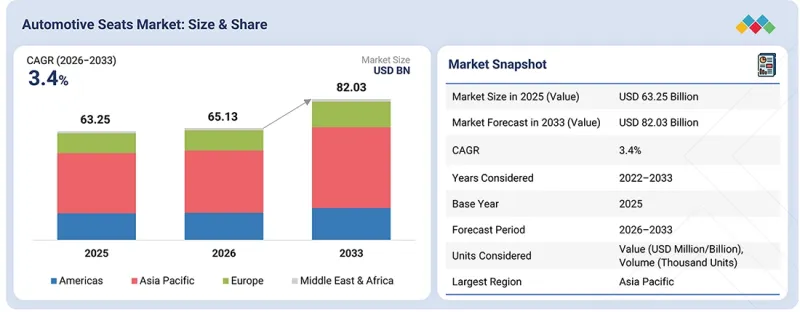
The automotive seats market is projected to reach USD 82.03 billion by 2033, from USD 65.13 billion in 2026, at a CAGR of 3.4%. Rising integration of powered & heated seats across mid-variant cars, ventilation, memory & massage seats in luxury vehicles, and seat-integrated safety functions is shaping the adoption of functional and electronic content in automotive seat technology. Furthermore, inclination toward electric & hybrid vehicles is encouraging seating suppliers to invest in lightweight seat structures and energy-efficient localized thermal management. Stricter occupant safety requirements are also increasing adoption of seat belt warning systems, occupant detection, and restraint integration.
| Scope of the Report | |
|---|---|
| Years Considered for the Study | 2026-2033 |
| Base Year | 2025 |
| Forecast Period | 2026-2033 |
| Units Considered | USD billion |
| Segments | ICE & EV, By Seat Type, Trim Material, Vehicle Type, Technology, Component, Material, Sales Channel and Region |
| Regions covered | Asia Pacific, Americas, Europe and Middle East & Africa |
"Powered seats to hold largest market share in the automotive seats market by technology in 2026."
Powered seats are expected to hold the largest share of the automotive seats market by technology in 2026, as electric adjustment provides the base architecture for several additional value features such as multi-axis positioning, lumbar adjustment, memory, heating, ventilation, and massage, among others. Adoption is increasing across passenger cars as OEMs have started offering 4- and 6-way powered seats in higher variants of economy-range car models across China, India, and other developing markets. Developed markets such as the US, Canada, Japan, South Korea, and Europe show comparatively higher penetration of 6-way and above powered seats, supported by OEMs' progressive approach toward enhanced in-cabin convenience and personalized experience. Further, powered seats along with heated and lumbar support are also gaining traction in mainstream models, while massage, power side bolsters, Rear seat heating, front & rear ventilated seats, memory, and relaxation seats remain largely concentrated in premium vehicles. In addition, the growing SUV segment is further supporting adoption due to greater emphasis on larger cabin spaces and front row & second row comfort. In LCVs, powered seats are mainly offered in premium pickups and luxury vans in North America and Europe, with adoption expected to increase across Asia and selected Latin American markets. Alternatively, some of the heavy & long-haul trucks offered by Volvo, Daimler, DAF, PACCAR, Freightliner, Kenworth, Mack, etc. are offering electrically adjustable driver seats in some models to address driver ergonomics and extended operating hours. Hence, rising adoption in mid-variant passenger cars, increasing vehicle premiumization, and integration of multiple comfort functions are expected to strengthen demand for powered seats across major vehicle segments in the coming years.
"BEVs are expected to be the largest and the fastest-growing segment in the automotive seats market during the forecast period."
BEVs are the largest segment within the total alternative fuel vehicle segment, with about a 40% share in 2026. China leads global BEV production, with high volumes concentrated in economy hatchbacks, SUVs, and small cars, where front bucket seats and rear bench seats with standard functionality remain widely used. However, demand from OEMs such as BYD, NIO, and XPENG is expanding premium BEV offerings across SUVs and other vehicle segments, supporting greater adoption of powered, heated, ventilated, and other advanced seat technologies. Europe has a stronger premium vehicle mix, resulting in higher demand for powered seats with functions such as heating, ventilation, and memory, while PHEVs and HEVs are generally positioned at higher price points and are more frequently equipped with advanced comfort and convenience features. The growing adoption of hybrid SUVs in the US and Canada is further supporting demand for heated seats and other technology-enabled seat functions. As BEVs and hybrid vehicles increasingly combine premium interiors, advanced comfort features, premium materials, optimized seat foams, and electronically controlled seat functions, OEMs are expected to expand the use of powered, heated, ventilated, memory, and other advanced seating technologies, supporting growth in automotive seat value across both BEV and hybrid vehicle segments.
"Americas to account for second largest market share in the automotive seats market in 2026."
Americas benefit from a strong presence of SUVs, pickups, LCVs, and full-size passenger vehicles, creating a higher requirement for durable, supportive, and feature-rich seating systems. Passenger cars and SUVs increasingly use powered front seats with lumbar support, while higher trims commonly combine powered adjustment with heating, ventilation, and memory functions. Premium SUVs and larger vehicles add massage and enhanced second-row functions. Pickups show a similar progression, with mid to premium grades moving toward powered plus heated, and higher grades toward powered, heated, ventilated, and memory seating, while rear seat heating is also expanding. LCVs and vans remain more focused on functional ergonomics, with powered adjustment and lumbar support gaining relevance in higher specification versions, while heavy trucks and buses favor suspension-based seats with adjustable lumbar support, heating, ventilation, and long-duration comfort functions. The region witnesses strong penetration of large vehicle platforms, where greater cabin space enables more substantial seat structures, multiple seating rows, captain seat configurations, and greater functionality per seating position. At the same time, BEV adoption is bringing energy-efficient thermal seating and electronically controlled functions into an expanding range of US and Canadian vehicle platforms. Overall, the Americas market is characterized by high seat content in larger vehicle segments, with the strongest future opportunity coming from deeper feature penetration across second row seating, commercial vehicle ergonomics, and electrified SUV and pickup platforms.
The breakdown of the profile of primary participants in the automotive seats market:
- By Company Type: OEMs - 20%, Automotive Seat Manufacturers - 55%, Automotive Seat Component Manufacturers - 25%
- By Designation: Director Level - 15%, C-Level - 20%, and Others - 65%
- By Region: North America - 30%, Europe - 20%, and Asia Pacific - 50%
The automotive seats market is dominated by established players such as Lear Corporation (US), Adient Plc (US), Forvia (France), Magna International (Canada), and Toyota Boshoku Corporation (Japan).
Research Coverage:
The market study covers the automotive seats market by technology type (heated seats; heated and powered seats; standard seats; powered seats; powered, heated and memory seats; powered, heated, and ventilated seats; powered, heated, ventilated, and memory seats; powered, heated, ventilated, massage and memory seats), by seat type (bucket and split bench), by component (armrests, pneumatic systems, seat belts, seat frames and structures, seat headrests, seat height adjusters, seat recliners, seat tracks, and side curtain airbags), by vehicle type (passenger cars, light commercial vehicles, heavy trucks, and buses), by material (steel, aluminum, and carbon-amide-metal), off-highway vehicle, by vehicle type (construction and mining equipment and agricultural tractors), by trim material (genuine leather, synthetic leather, polyurethan foam, and fabric), Electric vehicle seats market, by propulsion type (battery electric vehicle, fuel cell electric vehicle and plug-in hybrid electric vehicle), LSV seats market, by vehicle type (golf carts, commercial turf utility vehicles, industrial utility vehicles, and personal mobility vehicles), seat trim material by sales channel (OEM and aftermarket), ATV seats market, by seating capacity (one-seater and two-seater), and by region (Asia Pacific, Europe, Americas, and the Middle East & Africa).
The report comprehensively discusses key factors impacting the growth of the Automotive seats market, including drivers, constraints, challenges, and opportunities. It provides detailed analyses of major industry players, offering insights into their business profiles, solutions, services, key strategies, contracts, partnerships, agreements, new product and service launches, mergers and acquisitions, recession impacts, and recent developments. Additionally, the report includes a competitive analysis of key players within the automotive seats market ecosystem.
Reasons to buy this report:
This report offers comprehensive analyses of market share and supply chains and detailed information on component manufacturers. It is designed to aid market leaders and new entrants by providing precise revenue estimates for the overall automotive seats market. Additionally, the report helps stakeholders understand the market dynamics, highlighting key drivers, restraints, challenges, and opportunities.
The report provides insights on the following pointers:
- Analysis of key drivers (software-defined vehicle [SDV] architectures transforming seats into intelligent cabin platforms, interior premiumization increasing content value of automotive seating systems), restraints (increasing shift toward integrated interior modules reducing supplier value capture), opportunities (intelligent seating systems creating new revenue pools beyond traditional hardware, electrification and autonomous mobility driving demand for reconfigurable seating architectures) and challenges (balancing comfort, safety, weight, and cost within a single seat platform) influencing the growth of the automotive seats market
- Product Development/Innovation: Detailed insights on upcoming technologies, R&D activities, and product launches in the automotive seats market
- Market Development: Comprehensive information about lucrative markets - the report analyses the automotive seats market across various regions
- Market Diversification: Exhaustive information about new products, untapped geographies, recent developments, and investments in the automotive seats market
- Competitive Assessment: In-depth assessment of market shares, growth strategies, and service offerings of leading players like Lear Corporation (US), Adient Plc (US), Forvia (France), Magna International (Canada), and Toyota Boshoku Corporation (Japan) in the automotive seats market
TABLE OF CONTENTS
1 INTRODUCTION
- 1.1 STUDY OBJECTIVES
- 1.2 MARKET DEFINITION
- 1.3 MARKET SCOPE
- 1.3.1 MARKET SEGMENTATION AND REGIONAL SCOPE
- 1.3.2 INCLUSIONS AND EXCLUSIONS
- 1.3.3 YEARS CONSIDERED
- 1.4 CURRENCY CONSIDERED
- 1.5 UNIT CONSIDERED
- 1.6 STAKEHOLDERS
- 1.7 SUMMARY OF CHANGES
2 EXECUTIVE SUMMARY
- 2.1 MARKET HIGHLIGHTS AND KEY INSIGHTS
- 2.2 KEY MARKET PARTICIPANTS: MAPPING OF STRATEGIC DEVELOPMENTS
- 2.3 DISRUPTIVE TRENDS IN AUTOMOTIVE SEATS MARKET
- 2.4 HIGH-GROWTH SEGMENTS
- 2.5 REGIONAL SNAPSHOT: MARKET SIZE, GROWTH RATE, AND FORECAST
3 PREMIUM INSIGHTS
- 3.1 ATTRACTIVE OPPORTUNITIES FOR PLAYERS IN AUTOMOTIVE SEATS MARKET
- 3.2 AUTOMOTIVE SEATS MARKET, BY SEAT TYPE
- 3.3 AUTOMOTIVE SEATS MARKET, BY MATERIAL
- 3.4 AUTOMOTIVE SEATS MARKET, BY TRIM MATERIAL
- 3.5 AUTOMOTIVE SEATS MARKET, BY TECHNOLOGY
- 3.6 AUTOMOTIVE SEATS MARKET, BY COMPONENT
- 3.7 AUTOMOTIVE SEATS MARKET, BY VEHICLE TYPE
- 3.8 ELECTRIC VEHICLE SEATS MARKET, BY PROPULSION TYPE
- 3.9 ELECTRIC VEHICLE SEATS MARKET, BY SEAT TYPE
- 3.10 OFF-HIGHWAY SEATS MARKET, BY VEHICLE TYPE
- 3.11 ATV SEATS MARKET, BY SEATING CAPACITY
- 3.12 LSV SEATS MARKET, BY VEHICLE TYPE
- 3.13 AUTOMOTIVE SEAT TRIM MARKET, BY SALES CHANNEL
- 3.14 AUTOMOTIVE SEATS MARKET, BY REGION
4 MARKET OVERVIEW
- 4.1 INTRODUCTION
- 4.2 MARKET DYNAMICS
- 4.2.1 DRIVERS
- 4.2.1.1 Software-defined vehicle architectures transforming seats into intelligent cabin platforms
- 4.2.1.2 Interior premiumization to increase content value of automotive seating systems
- 4.2.2 RESTRAINTS
- 4.2.2.1 Increasing adoption of integrated interior modules reducing supplier value capture
- 4.2.3 OPPORTUNITIES
- 4.2.3.1 Intelligent seating systems creating new revenue pools beyond traditional hardware
- 4.2.3.2 Electrification and autonomous mobility driving demand for reconfigurable seating architectures
- 4.2.4 CHALLENGES
- 4.2.4.1 Balancing comfort, safety, weight, and cost within single-seat platforms
- 4.2.4.2 Rising development and integration costs for advanced seating
- 4.2.1 DRIVERS
- 4.3 UNMET NEEDS AND WHITE SPACES
- 4.4 INTERCONNECTED MARKETS AND CROSS-SECTOR OPPORTUNITIES
- 4.5 STRATEGIC MOVES BY TIER-1/2/3 SUPPLIERS
5 INDUSTRY TRENDS
- 5.1 MACROECONOMIC OUTLOOK
- 5.1.1 GDP TRENDS AND FORECAST
- 5.1.2 TRENDS IN AUTOMOTIVE SEATS MARKET
- 5.2 SUPPLY CHAIN ANALYSIS
- 5.3 ECOSYSTEM ANALYSIS
- 5.3.1 AUTOMOTIVE OEMS
- 5.3.2 SEAT SUPPLIERS
- 5.3.3 FOAM SUPPLIERS
- 5.3.4 TEXTILE SUPPLIERS
- 5.3.5 ELECTRONIC SUPPLIERS
- 5.3.6 SOFTWARE SUPPLIERS
- 5.3.7 SENSOR SUPPLIERS
- 5.3.8 TIER II SUPPLIERS
- 5.3.9 DIGITAL PLATFORM PROVIDERS
- 5.4 PRICING ANALYSIS
- 5.4.1 AVERAGE SELLING PRICE OF AUTOMOTIVE SEATS, BY SEAT TYPE, 2025
- 5.4.2 BUCKET SEATS
- 5.4.3 SPLIT BENCH SEATS
- 5.4.4 AVERAGE SELLING PRICE OF AUTOMOTIVE SEATS, BY TRIM MATERIAL, 2025
- 5.4.5 GENUINE LEATHER
- 5.4.6 SYNTHETIC LEATHER
- 5.4.7 FABRIC
- 5.5 AUTOMOTIVE SEAT EVOLUTION
- 5.5.1 SEAT CONTENT EVOLUTION
- 5.5.2 MECHANICAL VS. INTELLIGENT SEATS
- 5.5.3 LIGHTWEIGHT COST VS. SAVINGS
- 5.5.4 ELECTRONICS CONTRIBUTION
- 5.6 FUTURE REVENUE ANALYSIS
- 5.6.1 ELECTRONICS
- 5.6.2 SOFTWARE
- 5.6.3 SENSORS
- 5.6.4 ARTIFICIAL INTELLIGENCE
- 5.6.5 WELLNESS TECHNOLOGIES
- 5.6.6 PREMIUM MATERIALS
- 5.6.7 OVER-THE-AIR (OTA) UPDATES
- 5.6.8 DIGITAL SERVICES
- 5.6.9 FUTURE REVENUE POOLS IN AUTOMOTIVE SEATS, 2035
- 5.7 FUTURE CABIN ARCHITECTURE
- 5.8 FUTURE OF INTELLIGENT SEATING SYSTEMS
- 5.8.1 OCCUPANT MONITORING SYSTEMS (OMS)
- 5.8.2 BIOMETRIC SENSING
- 5.8.3 AI-BASED POSTURE DETECTION
- 5.8.4 WELLNESS MONITORING
- 5.8.5 ADAPTIVE COMFORT
- 5.8.6 HAPTIC FEEDBACK
- 5.8.7 SEAT MEMORY ECOSYSTEMS
- 5.8.8 DIGITAL SEAT CONTROLLERS
- 5.9 TRADE ANALYSIS
- 5.9.1 IMPORT SCENARIO (HS CODE 940120)
- 5.9.2 EXPORT SCENARIO (HS CODE 940120)
- 5.10 KEY CONFERENCES AND EVENTS, 2026-2027
- 5.11 TRENDS/DISRUPTIONS IMPACTING CUSTOMER BUSINESS
- 5.12 INVESTMENT SCENARIO
- 5.13 CASE STUDY ANALYSIS
- 5.13.1 ADIENT AND AUTOLIV ADDRESS SAFETY RISKS IN DEEPLY RECLINED AUTOMOTIVE SEATS
- 5.13.2 LEAR INTEGRATES THERMAL COMFORT FUNCTIONS INTO SEAT TRIM COVERS
- 5.13.3 FORVIA EXPANDS COMPACT LUMBAR SUPPORT TECHNOLOGY FOR GLOBAL VEHICLE PROGRAMS
- 5.13.4 MAGNA DEVELOPS BIO-BASED AUTOMOTIVE SEAT FOAM TO REDUCE SEATING CARBON IMPACT
- 5.13.5 TOYOTA BOSHOKU INTRODUCES MODULAR TBLOCKS SEATING IN THE NEW LEXUS ES
- 5.14 IMPACT ANALYSIS
- 5.14.1 IMPACT OF EU-INDIA FTA TRADE DEAL ON AUTOMOTIVE AND TRANSPORTATION INDUSTRY
- 5.14.2 IMPACT OF EU-INDIA FTA ON AUTOMOTIVE SEATS MARKET
- 5.14.3 IMPACT OF US-ISRAEL-IRAN CONFLICT ON AUTOMOTIVE AND TRANSPORTATION INDUSTRY
- 5.14.4 IMPACT OF US-ISRAEL-IRAN WAR ON AUTOMOTIVE SEATS MARKET
- 5.14.4.1 Regional impact
- 5.14.4.1.1 Middle East
- 5.14.4.1.2 Europe
- 5.14.4.1.3 India, Japan, and South Korea
- 5.14.4.1.4 China
- 5.14.4.1.5 North America
- 5.14.4.1 Regional impact
- 5.14.5 SDV & ZONAL ARCHITECTURE IMPACT ON SEATING ELECTRONICS
- 5.14.5.1 Centralized computing
- 5.14.5.2 Zonal architecture
- 5.14.5.3 Domain controllers
- 5.14.5.4 OTA-enabled seat ECUs
- 5.14.5.5 Software updates
- 5.14.5.6 Functional safety
6 TECHNOLOGICAL ADVANCEMENTS, AI-DRIVEN IMPACT, PATENTS, INNOVATIONS, AND FUTURE APPLICATIONS
- 6.1 KEY TECHNOLOGIES
- 6.1.1 SMART SEATING SYSTEMS
- 6.1.2 ADVANCED THERMAL COMFORT TECHNOLOGIES
- 6.2 COMPLEMENTARY TECHNOLOGIES
- 6.2.1 IN-CABIN CLIMATE MANAGEMENT SYSTEMS
- 6.2.2 OCCUPANT MONITORING SYSTEMS
- 6.3 ADJACENT TECHNOLOGIES
- 6.3.1 AUTOMOTIVE INTERIOR TRIM SYSTEMS
- 6.4 TECHNOLOGY/PRODUCT ROADMAP
- 6.4.1 SHORT-TERM ROADMAP
- 6.4.2 MID-TERM ROADMAP
- 6.4.3 LONG-TERM ROADMAP
- 6.4.4 LIGHTWEIGHT SEATING TECHNOLOGY ROADMAP
- 6.5 PATENT ANALYSIS
- 6.6 FUTURE APPLICATIONS
- 6.7 IMPACT OF AI/GEN AI ON AUTOMOTIVE SEATS MARKET
- 6.7.1 TOP USE CASES AND MARKET POTENTIAL
- 6.7.2 BEST PRACTICES
- 6.7.3 CASE STUDIES OF AI IMPLEMENTATION
- 6.7.4 INTERCONNECTED ECOSYSTEM AND IMPACT ON MARKET PLAYERS
- 6.7.5 CLIENTS' READINESS TO ADOPT AI/GEN AI IN AUTOMOTIVE SEATS MARKET
7 REGULATORY LANDSCAPE
- 7.1 REGULATORY BODIES, GOVERNMENT AGENCIES, AND OTHER ORGANIZATIONS
- 7.2 SAFETY REGULATIONS, BY COUNTRY/REGION
8 CUSTOMER LANDSCAPE AND BUYER BEHAVIOR
- 8.1 DECISION-MAKING PROCESS
- 8.2 KEY STAKEHOLDERS IN BUYING PROCESS AND THEIR EVALUATION CRITERIA
- 8.2.1 KEY STAKEHOLDERS IN BUYING PROCESS
- 8.2.2 BUYING CRITERIA
- 8.3 ADOPTION BARRIERS AND INTERNAL CHALLENGES
- 8.4 UNMET NEEDS FROM VARIOUS END-USE INDUSTRIES
- 8.5 MARKET PROFITABILITY
- 8.5.1 REVENUE POTENTIAL
- 8.5.2 COST DYNAMICS
- 8.5.3 MARGIN OPPORTUNITIES
9 AUTOMOTIVE SEATS MARKET, BY TECHNOLOGY
- 9.1 INTRODUCTION
- 9.2 STANDARD SEATS
- 9.2.1 WIDESPREAD ADOPTION IN LOW- AND MID-VARIANT CARS TO DRIVE GROWTH
- 9.3 POWERED SEATS
- 9.3.1 RISING INSTALLATION IN SUVS TO DRIVE GROWTH
- 9.4 HEATED AND POWERED SEATS
- 9.4.1 INCREASING DEMAND FOR COMFORT AND CONVENIENCE TO DRIVE GROWTH
- 9.5 HEATED SEATS
- 9.5.1 COLD WEATHER CONDITIONS IN AMERICAS AND EUROPE TO DRIVE GROWTH
- 9.6 POWERED, HEATED, AND MEMORY SEATS
- 9.6.1 LARGE-SCALE INTEGRATION IN PREMIUM VEHICLES TO DRIVE GROWTH
- 9.7 POWERED, HEATED, AND VENTILATED SEATS
- 9.7.1 EXPANDING INSTALLATION IN MID- AND HIGH-END PASSENGER CARS TO DRIVE GROWTH
- 9.8 POWERED, HEATED, VENTILATED, AND MEMORY SEATS
- 9.8.1 EXTENSIVE USE IN PREMIUM COUPES TO DRIVE GROWTH
- 9.9 POWERED, HEATED, VENTILATED, MASSAGE, AND MEMORY SEATS
- 9.9.1 RAPID DEPLOYMENT IN LUXURY VEHICLES TO DRIVE GROWTH
- 9.10 INDUSTRY INSIGHTS
10 AUTOMOTIVE SEATS MARKET, BY TRIM MATERIAL
- 10.1 INTRODUCTION
- 10.2 SYNTHETIC LEATHER
- 10.2.1 FLEXIBILITY AND BETTER AESTHETIC APPEAL TO DRIVE GROWTH
- 10.3 GENUINE LEATHER
- 10.3.1 INCREASING DEPLOYMENT IN PREMIUM AND HIGH-END VEHICLES TO DRIVE GROWTH
- 10.4 FABRIC
- 10.4.1 POLYESTER WOVEN FABRIC
- 10.4.1.1 Growing adoption of recycled polyester and engineered automotive textiles to drive market
- 10.4.2 WOVEN VELOUR FABRIC
- 10.4.2.1 Rising demand for premium comfort and refined interior feel to support market growth
- 10.4.3 PVC AND OTHERS
- 10.4.3.1 Demand for durable and easy-to-maintain seat surfaces to propel market
- 10.4.1 POLYESTER WOVEN FABRIC
- 10.5 POLYURETHANE FOAM
- 10.5.1 GROWING DEMAND FOR ERGONOMICALLY OPTIMIZED AND ADAPTABLE SEAT STRUCTURES TO DRIVE MARKET
- 10.6 INDUSTRY INSIGHTS
11 AUTOMOTIVE SEATS MARKET, BY COMPONENT
- 11.1 INTRODUCTION
- 11.2 ARMRESTS
- 11.2.1 RISING FOCUS ON OCCUPANT COMFORT AND ERGONOMIC SEATING TO DRIVE DEMAND
- 11.3 PNEUMATIC SYSTEMS
- 11.3.1 RISING FOCUS ON VIBRATION ISOLATION AND DRIVER COMFORT IN COMMERCIAL VEHICLES TO DRIVE DEMAND
- 11.4 SEAT BELTS
- 11.4.1 STRENGTHENING OCCUPANT PROTECTION REQUIREMENTS AND INTEGRATION WITH ADVANCED RESTRAINT SYSTEMS TO DRIVE THE DEMAND
- 11.5 SEAT FRAMES AND STRUCTURES
- 11.5.1 RISING EMPHASIS ON SEAT SAFETY, STRUCTURAL STRENGTH, AND CRASH PERFORMANCE TO DRIVE DEMAND
- 11.6 SEAT HEADRESTS
- 11.6.1 STRONGER FOCUS ON REAR IMPACT PROTECTION AND OCCUPANT HEAD POSITIONING TO DRIVE DEMAND
- 11.7 SEAT HEIGHT ADJUSTERS
- 11.7.1 GROWING NEED FOR INDIVIDUALIZED DRIVER POSITIONING AND VISIBILITY TO DRIVE DEMAND
- 11.8 SEAT RECLINERS
- 11.8.1 GROWING DEMAND FOR PERSONALIZED SEATING POSTURE AND FLEXIBLE CABIN USE TO DRIVE MARKET
- 11.9 SEAT TRACKS
- 11.9.1 INCREASING ADOPTION OF MULTI-POSITION AND RECONFIGURABLE SEATING LAYOUTS TO PROPEL MARKET
- 11.10 SIDE CURTAIN AIRBAGS
- 11.10.1 STRONGER FOCUS ON SIDE IMPACT PROTECTION AND OCCUPANT CONTAINMENT TO DRIVE MARKET
- 11.11 INDUSTRY INSIGHTS
12 AUTOMOTIVE SEATS MARKET, BY VEHICLE TYPE
- 12.1 INTRODUCTION
- 12.2 PASSENGER CARS
- 12.2.1 RISING ADOPTION OF SUVS AND LARGER PASSENGER VEHICLES TO DRIVE GROWTH
- 12.3 LIGHT COMMERCIAL VEHICLES
- 12.3.1 EXPANSION OF URBAN DELIVERY AND LAST-MILE LOGISTICS TO DRIVE GROWTH
- 12.4 HEAVY TRUCKS
- 12.4.1 RISING EMPHASIS ON DRIVER COMFORT AND FATIGUE REDUCTION TO DRIVE THE GROWTH
- 12.5 BUSES
- 12.5.1 INCREASING DEMAND FOR SPACE-EFFICIENT AND APPLICATION-SPECIFIC SEATING CONFIGURATIONS TO DRIVE GROWTH
- 12.6 INDUSTRY INSIGHTS
13 ELECTRIC VEHICLE SEATS MARKET, BY SEAT TYPE
- 13.1 INTRODUCTION
- 13.2 BUCKET
- 13.2.1 GROWING DEMAND FOR PERSONALIZED DRIVER POSITIONING AND ERGONOMIC SEATING TO DRIVE GROWTH
- 13.3 SPLIT BENCH
- 13.3.1 GROWING DEMAND FOR SUVS AND FLEXIBLE CABIN UTILIZATION TO DRIVE GROWTH
- 13.4 INDUSTRY INSIGHTS
14 ELECTRIC VEHICLE SEATS MARKET, BY PROPULSION TYPE
- 14.1 INTRODUCTION
- 14.2 BATTERY ELECTRIC VEHICLES
- 14.2.1 EXPANSION OF SOFTWARE-CONTROLLED SEATING AND OCCUPANT-FOCUSED FUNCTIONS TO DRIVE GROWTH
- 14.3 PLUG-IN HYBRID ELECTRIC VEHICLES
- 14.3.1 DUAL POWERTRAIN PACKAGING TO DRIVE DEMAND FOR APPLICATION-SPECIFIC SEAT ENGINEERING
- 14.4 FUEL CELL ELECTRIC VEHICLES
- 14.4.1 LIMITED PRODUCTION AND HIGHER DEMAND FOR PREMIUM SEATS TO PROPEL MARKET
- 14.5 INDUSTRY INSIGHTS
15 AUTOMOTIVE SEATS MARKET, BY SEAT TYPE
- 15.1 INTRODUCTION
- 15.2 BUCKET
- 15.2.1 GROWING DEMAND FOR PERSONALIZED DRIVER POSITIONING AND ERGONOMIC SEATING TO DRIVE GROWTH
- 15.3 SPLIT BENCH
- 15.3.1 GROWING DEMAND FOR SUVS TO DRIVE GROWTH
- 15.4 INDUSTRY INSIGHTS
16 AUTOMOTIVE SEATS MARKET, BY MATERIAL
- 16.1 INTRODUCTION
- 16.2 STEEL
- 16.2.1 STRICTER STRUCTURAL SAFETY REQUIREMENTS TO DRIVE GROWTH
- 16.3 ALUMINUM
- 16.3.1 INCREASING PREFERENCE FOR LIGHTWEIGHT MATERIALS TO DRIVE GROWTH
- 16.4 CARBON-AMIDE-METAL
- 16.4.1 LIGHTWEIGHT SEAT STRUCTURES WITH INTEGRATED FUNCTIONS TO DRIVE GROWTH
- 16.5 INDUSTRY INSIGHTS
17 OFF-HIGHWAY VEHICLE SEATS MARKET, BY VEHICLE TYPE
- 17.1 INTRODUCTION
- 17.2 CONSTRUCTION AND MINING EQUIPMENT
- 17.2.1 INCREASING FOCUS ON OPERATOR SAFETY, ERGONOMICS, AND VIBRATION CONTROL TO DRIVE DEMAND
- 17.3 AGRICULTURAL TRACTORS
- 17.3.1 RISING FOCUS ON WHOLE BODY VIBRATION CONTROL AND OPERATOR ERGONOMICS TO DRIVE DEMAND
- 17.4 INDUSTRY INSIGHTS
18 LSV SEATS MARKET, BY VEHICLE TYPE
- 18.1 INTRODUCTION
- 18.2 GOLF CARTS
- 18.2.1 NEED FOR OCCUPANT RETENTION AND SEATING STABILITY ON UNEVEN GOLF COURSE TERRAIN TO DRIVE GROWTH
- 18.3 COMMERCIAL TURF UTILITY VEHICLES
- 18.3.1 RISING DEMAND FOR OPERATOR-FOCUSED SEATING IN INTENSIVE TURF MAINTENANCE OPERATIONS TO DRIVE GROWTH
- 18.4 INDUSTRIAL UTILITY VEHICLES
- 18.4.1 HIGHER OPERATOR UTILIZATION REQUIREMENTS TO DRIVE GROWTH
- 18.5 PERSONAL MOBILITY VEHICLES
- 18.5.1 GROWING EMPHASIS ON OCCUPANT-SPECIFIC SEATING ERGONOMICS TO DRIVE GROWTH
- 18.6 INDUSTRY INSIGHTS
19 ATV SEATS MARKET, BY SEATING CAPACITY
- 19.1 INTRODUCTION
- 19.2 ONE-SEATER
- 19.2.1 RIDER-FOCUSED SEAT DESIGN TO DRIVE DEMAND
- 19.3 TWO-SEATER
- 19.3.1 PASSENGER SAFETY AND COMFORT TO DRIVE MARKET
- 19.4 INDUSTRY INSIGHTS
20 AUTOMOTIVE SEAT TRIM MARKET, BY SALES CHANNEL
- 20.1 INTRODUCTION
- 20.2 OEM
- 20.2.1 GROWING OEM DEMAND FOR ADVANCED SEAT MATERIALS TO DRIVE MARKET
- 20.3 AFTERMARKET
- 20.3.1 GROWING DEMAND FOR SEAT REPLACEMENT AND CUSTOMIZATION TO PROPEL GROWTH
- 20.4 INDUSTRY INSIGHTS
21 AUTOMOTIVE SEATS MARKET, BY REGION
- 21.1 INTRODUCTION
- 21.2 AMERICAS
- 21.2.1 US
- 21.2.1.1 Growing adoption of electrified and software-enabled vehicle interiors to drive growth
- 21.2.2 MEXICO
- 21.2.2.1 Expansion of electrified vehicle production and higher electrical content to drive growth
- 21.2.3 CANADA
- 21.2.3.1 Cold climate requirements to drive demand for electrically heated seating
- 21.2.4 BRAZIL
- 21.2.4.1 Premiumization of electrified SUVs and higher comfort content in locally available models to drive growth
- 21.2.5 ARGENTINA
- 21.2.5.1 Strong pickup and commercial vehicle orientation requiring robust, function-focused seating to drive growth
- 21.2.6 REST OF AMERICAS
- 21.2.1 US
- 21.3 ASIA PACIFIC
- 21.3.1 CHINA
- 21.3.1.1 Rapid shift toward personalized and lounge style seating to drive growth
- 21.3.2 INDIA
- 21.3.2.1 Rising demand for ventilated and comfort-focused seating to drive growth
- 21.3.3 INDONESIA
- 21.3.3.1 Expansion of family-oriented MPVs with multi-occupant seating requirements to drive growth
- 21.3.4 JAPAN
- 21.3.4.1 Aging driver population to increase demand for easy access and personalized power seating
- 21.3.5 SOUTH KOREA
- 21.3.5.1 Integration of wellness and relaxation functions to drive growth
- 21.3.6 THAILAND
- 21.3.6.1 Expansion of locally produced SUVs and higher specification passenger vehicles to drive growth
- 21.3.7 REST OF ASIA PACIFIC
- 21.3.1 CHINA
- 21.4 EUROPE
- 21.4.1 FRANCE
- 21.4.1.1 Integration of ergonomic and adaptive seating into mainstream French passenger cars to drive growth
- 21.4.2 GERMANY
- 21.4.2.1 Shift toward multi-function seat systems in premium vehicle platforms to drive growth
- 21.4.3 ITALY
- 21.4.3.1 Lightweight seat engineering for premium vehicles to drive growth
- 21.4.4 RUSSIA
- 21.4.4.1 Growing demand for localized occupant heating to support market growth
- 21.4.5 SPAIN
- 21.4.5.1 Increasing localization of electrified vehicle production to drive growth
- 21.4.6 TURKEY
- 21.4.6.1 Strong light commercial vehicle production to create demand for ergonomic driver seating
- 21.4.7 UK
- 21.4.7.1 Growth of premium SUVs and luxury vehicle production to drive growth
- 21.4.8 REST OF EUROPE
- 21.4.1 FRANCE
- 21.5 MIDDLE EAST & AFRICA
- 21.5.1 SAUDI ARABIA
- 21.5.1.1 High ambient temperatures to drive seat-level thermal comfort
- 21.5.2 SOUTH AFRICA
- 21.5.2.1 Export program requirements to raise seat specification and engineering content
- 21.5.3 REST OF MIDDLE EAST & AFRICA
- 21.5.1 SAUDI ARABIA
22 COMPETITIVE LANDSCAPE
- 22.1 OVERVIEW
- 22.2 KEY PLAYER COMPETITIVE STRATEGIES/RIGHT TO WIN, JANUARY 2022-JULY 2026
- 22.2.1 SUPPLIER ANALYSIS
- 22.3 REVENUE ANALYSIS, 2021-2025
- 22.4 MARKET SHARE ANALYSIS, 2025
- 22.5 BRAND COMPARISON
- 22.6 COMPANY EVALUATION MATRIX: AUTOMOTIVE SEAT MANUFACTURERS, 2025
- 22.6.1 STARS
- 22.6.2 EMERGING LEADERS
- 22.6.3 PERVASIVE PLAYERS
- 22.6.4 PARTICIPANTS
- 22.6.5 COMPANY FOOTPRINT: AUTOMOTIVE SEAT MANUFACTURERS, 2025
- 22.6.5.1 Company footprint
- 22.6.5.2 Region footprint
- 22.6.5.3 Seat type footprint
- 22.6.5.4 Vehicle type footprint
- 22.7 COMPANY EVALUATION MATRIX: AUTOMOTIVE SEAT COMPONENT MANUFACTURERS
- 22.7.1 PROGRESSIVE COMPANIES
- 22.7.2 RESPONSIVE COMPANIES
- 22.7.3 DYNAMIC COMPANIES
- 22.7.4 STARTING BLOCKS
- 22.7.5 COMPANY FOOTPRINT: AUTOMOTIVE SEAT COMPONENT MANUFACTURERS, 2025
- 22.7.5.1 Company footprint
- 22.7.5.2 Region footprint
- 22.7.5.3 Seat type footprint
- 22.7.5.4 Vehicle type footprint
- 22.8 COMPANY VALUATION AND FINANCIAL METRICS
- 22.9 COMPETITIVE SCENARIO
- 22.9.1 PRODUCT LAUNCHES
- 22.9.2 DEALS
- 22.9.3 EXPANSIONS
23 COMPANY PROFILES
- 23.1 KEY PLAYERS
- 23.1.1 LEAR CORPORATION
- 23.1.1.1 Business overview
- 23.1.1.2 Products offered
- 23.1.1.3 Recent developments
- 23.1.1.3.1 Product launches
- 23.1.1.3.2 Deals
- 23.1.1.3.3 Expansions
- 23.1.1.4 MnM view
- 23.1.1.4.1 Key strengths
- 23.1.1.4.2 Strategic choices
- 23.1.1.4.3 Weaknesses and competitive threats
- 23.1.2 ADIENT PLC
- 23.1.2.1 Business overview
- 23.1.2.2 Products offered
- 23.1.2.3 Recent developments
- 23.1.2.3.1 Product launches
- 23.1.2.3.2 Deals
- 23.1.2.3.3 Expansions
- 23.1.2.3.4 Other developments
- 23.1.2.4 MnM view
- 23.1.2.4.1 Key strengths
- 23.1.2.4.2 Strategic choices
- 23.1.2.4.3 Weaknesses and competitive threats
- 23.1.3 FORVIA
- 23.1.3.1 Business overview
- 23.1.3.2 Products offered
- 23.1.3.3 Recent developments
- 23.1.3.3.1 Product launches
- 23.1.3.3.2 Deals
- 23.1.3.3.3 Expansions
- 23.1.3.3.4 Other developments
- 23.1.3.4 MnM view
- 23.1.3.4.1 Key strengths
- 23.1.3.4.2 Strategic choices
- 23.1.3.4.3 Weaknesses and competitive threats
- 23.1.4 MAGNA INTERNATIONAL
- 23.1.4.1 Business overview
- 23.1.4.2 Products offered
- 23.1.4.3 Recent developments
- 23.1.4.3.1 Deals
- 23.1.4.3.2 Expansions
- 23.1.4.4 MnM view
- 23.1.4.4.1 Key strengths
- 23.1.4.4.2 Strategic choices
- 23.1.4.4.3 Weaknesses and competitive threats
- 23.1.5 TOYOTA BOSHOKU CORPORATION
- 23.1.5.1 Business overview
- 23.1.5.2 Products offered
- 23.1.5.3 Recent developments
- 23.1.5.3.1 Product launches
- 23.1.5.3.2 Deals
- 23.1.5.3.3 Expansions
- 23.1.5.4 MnM view
- 23.1.5.4.1 Key strengths
- 23.1.5.4.2 Strategic choices
- 23.1.5.4.3 Weaknesses and competitive threats
- 23.1.6 TS TECH CO., LTD.
- 23.1.6.1 Business overview
- 23.1.6.2 Products offered
- 23.1.6.3 Recent developments
- 23.1.7 AISIN CORPORATION
- 23.1.7.1 Business overview
- 23.1.7.2 Products offered
- 23.1.7.3 Recent developments
- 23.1.7.3.1 Deals
- 23.1.7.3.2 Expansions
- 23.1.8 NHK SPRING CO., LTD.
- 23.1.8.1 Business overview
- 23.1.8.2 Products offered
- 23.1.8.3 Recent developments
- 23.1.8.3.1 Expansions
- 23.1.9 TACHI-S CO., LTD.
- 23.1.9.1 Business overview
- 23.1.9.2 Products offered
- 23.1.9.3 Recent developments
- 23.1.9.3.1 Deals
- 23.1.9.3.2 Expansions
- 23.1.10 GENTHERM
- 23.1.10.1 Business overview
- 23.1.10.2 Products offered
- 23.1.1 LEAR CORPORATION
- 23.2 OTHER PLAYERS
- 23.2.1 BROSE FAHRZEUGTEILE SE & CO. KG
- 23.2.2 GRAMMER AG
- 23.2.3 YANFENG INTERNATIONAL AUTOMOTIVE TECHNOLOGY CO., LTD.
- 23.2.4 C.I.E.B. KAHOVEC
- 23.2.5 PHOENIX SEATING LIMITED
- 23.2.6 IG BAUERHIN GMBH
- 23.2.7 SABELT
- 23.2.8 GUELPH MANUFACTURING
- 23.2.9 CAMACO-AMVIAN
- 23.2.10 FREEDMAN SEATING COMPANY
- 23.2.11 DAE WON KANG UP
- 23.2.12 TATA AUTOCOMP SYSTEMS
- 23.2.13 SUMMIT AUTO SEATS
- 23.2.14 HARITA SEATING SYSTEMS LTD.
- 23.2.15 DELTA KOGYO CO. LTD.
- 23.2.16 BHARAT SEATS LIMITED (BSL)
- 23.3 PLAYERS FOR SEAT COMPONENT MANUFACTURERS
- 23.3.1 FISHER DYNAMICS
- 23.3.2 RCO ENGINEERING
- 23.3.3 TOYO SEAT
- 23.3.4 IMASEN ELECTRIC INDUSTRIAL
- 23.3.5 INOAC CORPORATION
- 23.3.6 AISIN SHIROKI CORPORATION
- 23.3.7 KWANG MYUNG INDUSTRY CO., LTD.
- 23.3.8 AUSTEM CO., LTD.
- 23.3.9 NINGBO JIFENG AUTO PARTS CO., LTD.
- 23.3.10 COMMERCIAL VEHICLE GROUP, INC.
24 RESEARCH METHODOLOGY
- 24.1 RESEARCH DATA
- 24.1.1 SECONDARY DATA
- 24.1.1.1 List of secondary sources
- 24.1.1.2 Key data from secondary sources
- 24.1.2 PRIMARY DATA
- 24.1.2.1 List of primary participants
- 24.1.3 SAMPLING TECHNIQUES AND DATA COLLECTION METHODS
- 24.1.1 SECONDARY DATA
- 24.2 MARKET SIZE ESTIMATION
- 24.2.1 BOTTOM-UP APPROACH
- 24.2.2 TOP-DOWN APPROACH
- 24.3 DATA TRIANGULATION
- 24.4 RESEARCH ASSUMPTIONS AND RISK ASSESSMENT
- 24.5 RESEARCH LIMITATIONS
25 APPENDIX
- 25.1 INSIGHTS FROM INDUSTRY EXPERTS
- 25.2 DISCUSSION GUIDE
- 25.3 KNOWLEDGESTORE: MARKETSANDMARKETS' SUBSCRIPTION PORTAL
- 25.4 CUSTOMIZATION OPTIONS
- 25.4.1 PASSENGER CARS SEATS MARKET, BY VEHICLE BODY TYPE
- 25.4.1.1 Sedans
- 25.4.1.2 SUVs
- 25.4.1.3 Hatchbacks
- 25.4.2 AUTOMOTIVE SEATS MARKET, BY SEATING CONFIGURATION
- 25.4.2.1 2 Seater
- 25.4.2.2 4 Seater
- 25.4.2.3 5 Seater
- 25.4.2.4 6 Seater
- 25.4.2.5 7 Seater
- 25.4.2.6 8+ Seater
- 25.4.3 AUTOMOTIVE SEATS MARKET, BY VEHICLE PRICE POSITIONING
- 25.4.3.1 Economy
- 25.4.3.2 Mid-Range
- 25.4.3.3 Premium
- 25.4.3.4 Luxury
- 25.4.1 PASSENGER CARS SEATS MARKET, BY VEHICLE BODY TYPE
- 25.5 RELATED REPORTS
- 25.6 AUTHOR DETAILS
List of Tables
- TABLE 1 CURRENCY EXCHANGE RATES
- TABLE 2 OVERVIEW OF SDV FEATURES AND IMPACT ON AUTOMOTIVE SEAT CONTENT
- TABLE 3 SDV-BASED INTELLIGENT SEATING, BY OEM
- TABLE 4 OVERVIEW OF INTERIOR PREMIUMIZATION AND ITS IMPACT ON AUTOMOTIVE SEAT CONTENT VALUE
- TABLE 5 OVERVIEW OF INTEGRATED INTERIOR SOLUTION PROVIDERS
- TABLE 6 OEM ADOPTION OF INTELLIGENT SEATING SYSTEMS
- TABLE 7 SEATING REQUIREMENTS IN ELECTRIC AND AUTONOMOUS VEHICLES
- TABLE 8 OVERVIEW OF DESIGN OBJECTIVES AND THEIR CHALLENGES
- TABLE 9 KEY COST DRIVERS AND THEIR IMPACT ON ADVANCED AUTOMOTIVE SEATING
- TABLE 10 STRATEGIC MOVES BY TIER-1/2/3 SUPPLIERS
- TABLE 11 OEM SEAT STRATEGY BY VEHICLE POSITIONING
- TABLE 12 GDP PERCENTAGE CHANGE, BY KEY COUNTRY, 2022-2031
- TABLE 13 ROLE OF COMPANIES IN ECOSYSTEM
- TABLE 14 BUCKET SEATS: AVERAGE SELLING PRICE, BY REGION, 2025 (USD)
- TABLE 15 SPLIT BENCH SEATS: AVERAGE SELLING PRICE, BY REGION, 2025 (USD)
- TABLE 16 GENUINE LEATHER: AVERAGE SELLING PRICE, BY REGION, 2025 (USD)
- TABLE 17 SYNTHETIC LEATHER: AVERAGE SELLING PRICE, BY REGION, 2025 (USD)
- TABLE 18 FABRIC: AVERAGE SELLING PRICE, BY REGION, 2025 (USD)
- TABLE 19 SEAT CONTENT EVOLUTION IN THE SDV ERA
- TABLE 20 SEAT CONTENT VALUE ANALYSIS BY VEHICLE SEGMENT
- TABLE 21 MECHANICAL VS. INTELLIGENT SEATS
- TABLE 22 LIGHTWEIGHT SEAT MATERIALS: COST VS. VEHICLE BENEFITS
- TABLE 23 ELECTRONICS-INTENSIVE SEATING, BY KEY PLAYER
- TABLE 24 FUTURE REVENUE POOLS IN AUTOMOTIVE SEATS, 2035
- TABLE 25 OEM STRATEGIES FOR CABIN DIFFERENTIATION
- TABLE 26 IMPORT DATA FOR HS CODE 940120-COMPLIANT PRODUCTS, BY COUNTRY, 2022-2025 (USD THOUSAND)
- TABLE 27 EXPORT DATA FOR HS CODE 940120-COMPLIANT PRODUCTS, BY COUNTRY, 2022-2025 (USD THOUSAND)
- TABLE 28 AUTOMOTIVE SEATS MARKET: LIST OF KEY CONFERENCES AND EVENTS, 2026-2027
- TABLE 29 TRANSITION TOWARDS FUTURE SDV ARCHITECTURE AND IMPACT ON SEAT SUPPLIERS
- TABLE 30 OVERVIEW OF SMART SEATING TECHNOLOGY
- TABLE 31 OVERVIEW OF ADVANCED THERMAL COMFORT TECHNOLOGIES & IMPACT ON AUTOMOTIVE SEATS
- TABLE 32 OEM OFFERING ADVANCED THERMAL COMFORT TECHNOLOGY
- TABLE 33 OVERVIEW OF IN-CABIN CLIMATE MANAGEMENT SYSTEMS & IMPACT ON AUTOMOTIVE SEATS
- TABLE 34 OMS AND IMPACT ON AUTOMOTIVE SEATS
- TABLE 35 MATERIAL COMPARISON FOR AUTOMOTIVE SEAT STRUCTURES
- TABLE 36 PATENT ANALYSIS, 2026
- TABLE 37 NORTH AMERICA: LIST OF REGULATORY BODIES, GOVERNMENT AGENCIES, AND OTHER ORGANIZATIONS
- TABLE 38 EUROPE: LIST OF REGULATORY BODIES, GOVERNMENT AGENCIES, AND OTHER ORGANIZATIONS
- TABLE 39 ASIA PACIFIC: LIST OF REGULATORY BODIES, GOVERNMENT AGENCIES, AND OTHER ORGANIZATIONS
- TABLE 40 SAFETY REGULATIONS, BY COUNTRY/REGION
- TABLE 41 INFLUENCE OF STAKEHOLDERS ON BUYING PROCESS, BY VEHICLE TYPE (%)
- TABLE 42 KEY BUYING CRITERIA, BY VEHICLE TYPE
- TABLE 43 UNMET NEEDS IN AUTOMOTIVE SEATS MARKET, BY END-USE INDUSTRY
- TABLE 44 AUTOMOTIVE SEATS MARKET: PROFITABILITY BY SEATING TECHNOLOGY
- TABLE 45 AUTOMOTIVE SEATS MARKET: PROFITABILITY BY VALUE CHAIN
- TABLE 46 AUTOMOTIVE SEATS MARKET: PROFITABILITY BY OEM SEGMENT
- TABLE 47 AUTOMOTIVE SEATS MARKET: REVENUE POTENTIAL, BY STREAM
- TABLE 48 AUTOMOTIVE SEATS MARKET: COST STRUCTURE AND PROFITABILITY TABLE 129 TABLE 49 AUTOMOTIVE SEATS MARKET, BY TECHNOLOGY, 2022-2025 (THOUSAND UNITS)
- TABLE 50 AUTOMOTIVE SEATS MARKET, BY TECHNOLOGY, 2026-2033 (THOUSAND UNITS)
- TABLE 51 STANDARD SEATS MARKET, BY REGION, 2022-2025 (THOUSAND UNITS)
- TABLE 52 STANDARD SEATS MARKET, BY REGION, 2026-2033 (THOUSAND UNITS)
- TABLE 53 SELECT MODELS WITH POWERED SEATS, 2026
- TABLE 54 POWERED SEATS MARKET, BY REGION, 2022-2025 (THOUSAND UNITS)
- TABLE 55 POWERED SEATS MARKET, BY REGION, 2026-2033 (THOUSAND UNITS)
- TABLE 56 SELECT MODELS WITH HEATED AND POWERED SEATS, 2026
- TABLE 57 HEATED AND POWERED SEATS MARKET, BY REGION, 2022-2025 (THOUSAND UNITS)
- TABLE 58 HEATED AND POWERED SEATS MARKET, BY REGION, 2026-2033 (THOUSAND UNITS)
- TABLE 59 SELECT MODELS WITH HEATED SEATS, 2026
- TABLE 60 HEATED SEATS MARKET, BY REGION, 2022-2025 (THOUSAND UNITS)
- TABLE 61 HEATED SEATS MARKET, BY REGION, 2026-2033 (THOUSAND UNITS)
- TABLE 62 SELECT MODELS WITH POWERED, HEATED, AND MEMORY SEATS, 2026
- TABLE 63 POWERED, HEATED, AND MEMORY SEATS MARKET, BY REGION, 2022-2025 (THOUSAND UNITS)
- TABLE 64 POWERED, HEATED, AND MEMORY SEATS MARKET, BY REGION, 2026-2033 (THOUSAND UNITS)
- TABLE 65 SELECT MODELS WITH POWERED, HEATED, AND VENTILATED SEATS, 2026
- TABLE 66 POWERED, HEATED, AND VENTILATED SEATS MARKET, BY REGION, 2022-2025 (THOUSAND UNITS)
- TABLE 67 POWERED, HEATED, AND VENTILATED SEATS MARKET, BY REGION, 2026-2033 (THOUSAND UNITS)
- TABLE 68 SELECT MODELS WITH POWERED, HEATED, VENTILATED, AND MEMORY SEATS, 2026
- TABLE 69 POWERED, HEATED, VENTILATED, AND MEMORY SEATS MARKET, BY REGION, 2022-2025 (THOUSAND UNITS)
- TABLE 70 POWERED, HEATED, VENTILATED, AND MEMORY SEATS MARKET, BY REGION, 2026-2033 (THOUSAND UNITS)
- TABLE 71 SELECT MODELS WITH POWERED, HEATED, VENTILATED, MASSAGE, AND MEMORY SEATS, 2026
- TABLE 72 POWERED, HEATED, VENTILATED, MASSAGE, AND MEMORY SEATS MARKET, BY REGION, 2022-2025 (THOUSAND UNITS)
- TABLE 73 POWERED, HEATED, VENTILATED, MASSAGE, AND MEMORY SEATS MARKET, BY REGION, 2026-2033 (THOUSAND UNITS)
- TABLE 74 AUTOMOTIVE SEATS MARKET, BY TRIM MATERIAL, 2022-2025 (THOUSAND SQUARE METERS)
- TABLE 75 AUTOMOTIVE SEATS MARKET, BY TRIM MATERIAL, 2026-2033 (THOUSAND SQUARE METERS)
- TABLE 76 AUTOMOTIVE SEATS MARKET, BY TRIM MATERIAL, 2022-2025 (USD MILLION)
- TABLE 77 AUTOMOTIVE SEATS MARKET, BY TRIM MATERIAL 2026-2033 (USD MILLION)
- TABLE 78 MODELS WITH SYNTHETIC LEATHER SEATS, 2026
- TABLE 79 SYNTHETIC LEATHER SEATS MARKET, BY REGION, 2022-2025 (THOUSAND SQUARE METERS)
- TABLE 80 SYNTHETIC LEATHER SEATS MARKET, BY REGION, 2026-2033 (THOUSAND SQUARE METERS)
- TABLE 81 SYNTHETIC LEATHER SEATS MARKET, BY REGION, 2022-2025 (USD MILLION)
- TABLE 82 SYNTHETIC LEATHER SEATS MARKET, BY REGION, 2026-2033 (USD MILLION)
- TABLE 83 MODELS WITH GENUINE LEATHER SEATS, 2026
- TABLE 84 GENUINE LEATHER SEATS MARKET, BY REGION, 2022-2025 (THOUSAND SQUARE METERS)
- TABLE 85 GENUINE LEATHER SEATS MARKET, BY REGION, 2026-2033 (THOUSAND SQUARE METERS)
- TABLE 86 GENUINE LEATHER SEATS MARKET, BY REGION, 2022-2025 (USD MILLION)
- TABLE 87 GENUINE LEATHER SEATS MARKET, BY REGION, 2026-2033 (USD MILLION)
- TABLE 88 MODELS WITH FABRIC SEATS, 2026
- TABLE 89 FABRIC SEATS MARKET, BY REGION, 2022-2025 (THOUSAND SQUARE METERS)
- TABLE 90 FABRIC SEATS MARKET, BY REGION, 2026-2033 (THOUSAND SQUARE METERS)
- TABLE 91 FABRIC SEATS MARKET, BY REGION, 2022-2025 (USD MILLION)
- TABLE 92 FABRIC SEATS MARKET, BY REGION, 2026-2033 (USD MILLION)
- TABLE 93 POLYESTER WOVEN FABRIC SEATS MARKET, BY REGION, 2022-2025 (THOUSAND SQUARE METERS)
- TABLE 94 POLYESTER WOVEN FABRIC SEATS MARKET, BY REGION, 2026-2033 (THOUSAND SQUARE METERS)
- TABLE 95 POLYESTER WOVEN FABRIC SEATS MARKET, BY REGION, 2022-2025 (USD MILLION)
- TABLE 96 POLYESTER WOVEN FABRIC SEATS MARKET, BY REGION, 2026-2033 (USD MILLION)
- TABLE 97 WOVEN VELOUR FABRIC SEATS MARKET, BY REGION, 2022-2025 (THOUSAND SQUARE METERS)
- TABLE 98 WOVEN VELOUR FABRIC SEATS MARKET, BY REGION, 2026-2033 (THOUSAND SQUARE METERS)
- TABLE 99 WOVEN VELOUR FABRIC SEATS MARKET, BY REGION, 2022-2025 (USD MILLION)
- TABLE 100 WOVEN VELOUR FABRIC SEATS MARKET, BY REGION, 2026-2033 (USD MILLION)
- TABLE 101 PVC AND OTHER SEATS MARKET, BY REGION, 2022-2025 (THOUSAND SQUARE METERS)
- TABLE 102 PVC AND OTHER SEATS MARKET, BY REGION, 2026-2033 (THOUSAND SQUARE METERS)
- TABLE 103 PVC AND OTHER SEATS MARKET, BY REGION, 2022-2025 (USD MILLION)
- TABLE 104 PVC AND OTHER SEATS MARKET, BY REGION, 2026-2033 (USD MILLION)
- TABLE 105 POLYURETHANE FOAM SEATS MARKET, BY REGION, 2022-2025 (THOUSAND KILOGRAMS)
- TABLE 106 POLYURETHANE FOAM SEATS MARKET, BY REGION, 2026-2033 (THOUSAND KILOGRAMS)
- TABLE 107 POLYURETHANE FOAM SEATS MARKET, BY REGION, 2022-2025 (USD MILLION)
- TABLE 108 POLYURETHANE FOAM SEATS MARKET, BY REGION, 2026-2033 (USD MILLION)
- TABLE 109 AUTOMOTIVE SEATS MARKET, BY COMPONENT, 2022-2025 (MILLION UNITS)
- TABLE 110 AUTOMOTIVE SEATS MARKET, BY COMPONENT, 2026-2033 (MILLION UNITS)
- TABLE 111 AUTOMOTIVE SEATS MARKET, BY COMPONENT, 2022-2025 (USD MILLION)
- TABLE 112 AUTOMOTIVE SEATS MARKET, BY COMPONENT, 2026-2033 (USD MILLION)
- TABLE 113 MODELS WITH ARMRESTS, 2026
- TABLE 114 ARMRESTS MARKET, BY REGION, 2022-2025 (MILLION UNITS)
- TABLE 115 ARMRESTS MARKET, BY REGION, 2026-2033 (MILLION UNITS)
- TABLE 116 ARMRESTS MARKET, BY REGION, 2022-2025 (USD MILLION)
- TABLE 117 ARMRESTS MARKET, BY REGION, 2026-2033 (USD MILLION)
- TABLE 118 PNEUMATIC SYSTEMS MARKET, BY REGION, 2022-2025 (MILLION UNITS)
- TABLE 119 PNEUMATIC SYSTEMS MARKET, BY REGION, 2026-2033 (MILLION UNITS)
- TABLE 120 PNEUMATIC SYSTEMS MARKET, BY REGION, 2022-2025 (USD MILLION)
- TABLE 121 PNEUMATIC SYSTEMS MARKET, BY REGION, 2026-2033 (USD MILLION)
- TABLE 122 SEAT BELT LAWS, BY COUNTRY
- TABLE 123 SEAT BELTS MARKET, BY REGION, 2022-2025 (MILLION UNITS)
- TABLE 124 SEAT BELTS MARKET, BY REGION, 2026-2033 (MILLION UNITS)
- TABLE 125 SEAT BELTS MARKET, BY REGION, 2022-2025 (USD MILLION)
- TABLE 126 SEAT BELTS MARKET, BY REGION, 2026-2033 (USD MILLION)
- TABLE 127 SEAT FRAMES AND STRUCTURES MARKET, BY REGION, 2022-2025 (MILLION UNITS)
- TABLE 128 SEAT FRAMES AND STRUCTURES MARKET, BY REGION, 2026-2033 (MILLION UNITS)
- TABLE 129 SEAT FRAMES AND STRUCTURES MARKET, BY REGION, 2022-2025 (USD MILLION)
- TABLE 130 SEAT FRAMES AND STRUCTURES MARKET, BY REGION, 2026-2033 (USD MILLION)
- TABLE 131 SEAT HEADRESTS MARKET, BY REGION, 2022-2025 (MILLION UNITS)
- TABLE 132 SEAT HEADRESTS MARKET, BY REGION, 2026-2033 (MILLION UNITS)
- TABLE 133 SEAT HEADRESTS MARKET, BY REGION, 2022-2025 (USD MILLION)
- TABLE 134 SEAT HEADRESTS MARKET, BY REGION, 2026-2033 (USD MILLION)
- TABLE 135 SEAT HEIGHT ADJUSTERS MARKET, BY REGION, 2022-2025 (MILLION UNITS)
- TABLE 136 SEAT HEIGHT ADJUSTERS MARKET, BY REGION, 2026-2033 (MILLION UNITS)
- TABLE 137 SEAT HEIGHT ADJUSTERS MARKET, BY REGION, 2022-2025 (USD MILLION)
- TABLE 138 SEAT HEIGHT ADJUSTERS MARKET, BY REGION, 2026-2033 (USD MILLION)
- TABLE 139 SEAT RECLINERS MARKET, BY REGION, 2022-2025 (MILLION UNITS)
- TABLE 140 SEAT RECLINERS MARKET, BY REGION, 2026-2033 (MILLION UNITS)
- TABLE 141 SEAT RECLINERS MARKET, BY REGION, 2022-2025 (USD MILLION)
- TABLE 142 SEAT RECLINERS MARKET, BY REGION, 2026-2033 (USD MILLION)
- TABLE 143 SEAT TRACKS MARKET, BY REGION, 2022-2025 (MILLION UNITS)
- TABLE 144 SEAT TRACKS MARKET, BY REGION, 2026-2033 (MILLION UNITS)
- TABLE 145 SEAT TRACKS MARKET, BY REGION, 2022-2025 (USD MILLION)
- TABLE 146 SEAT TRACKS MARKET, BY REGION, 2026-2033 (USD MILLION)
- TABLE 147 SIDE CURTAIN AIRBAGS MARKET, BY REGION, 2022-2025 (MILLION UNITS)
- TABLE 148 SIDE CURTAIN AIRBAGS MARKET, BY REGION, 2026-2033 (MILLION UNITS)
- TABLE 149 SIDE CURTAIN AIRBAGS MARKET, BY REGION, 2022-2025 (USD MILLION)
- TABLE 150 SIDE CURTAIN AIRBAGS MARKET, BY REGION, 2026-2033 (USD MILLION)
- TABLE 151 AUTOMOTIVE SEATS MARKET, BY VEHICLE TYPE, 2022-2025 (MILLION UNITS)
- TABLE 152 AUTOMOTIVE SEATS MARKET, BY VEHICLE TYPE, 2026-2033 (MILLION UNITS)
- TABLE 153 AUTOMOTIVE SEATS MARKET, BY VEHICLE TYPE, 2022-2025 (USD MILLION)
- TABLE 154 AUTOMOTIVE SEATS MARKET, BY VEHICLE TYPE, 2026-2033 (USD MILLION)
- TABLE 155 PASSENGER CAR SEATS MARKET, BY REGION, 2022-2025 (MILLION UNITS)
- TABLE 156 PASSENGER CAR SEATS MARKET, BY REGION, 2026-2033 (MILLION UNITS)
- TABLE 157 PASSENGER CAR SEATS MARKET, BY REGION, 2022-2025 (USD MILLION)
- TABLE 158 PASSENGER CAR SEATS MARKET, BY REGION, 2026-2033 (USD MILLION)
- TABLE 159 LIGHT COMMERCIAL VEHICLE SEATS MARKET, BY REGION, 2022-2025 (MILLION UNITS)
- TABLE 160 LIGHT COMMERCIAL VEHICLE SEATS MARKET, BY REGION, 2026-2033 (MILLION UNITS)
- TABLE 161 LIGHT COMMERCIAL VEHICLE SEATS MARKET, BY REGION, 2022-2025 (USD MILLION)
- TABLE 162 LIGHT COMMERCIAL VEHICLE SEATS MARKET, BY REGION, 2026-2033 (USD MILLION)
- TABLE 163 HEAVY TRUCK SEATS MARKET, BY REGION, 2022-2025 (MILLION UNITS)
- TABLE 164 HEAVY TRUCK SEATS MARKET, BY REGION, 2026-2033 (MILLION UNITS)
- TABLE 165 HEAVY TRUCK SEATS MARKET, BY REGION, 2022-2025 (USD MILLION)
- TABLE 166 HEAVY TRUCK SEATS MARKET, BY REGION, 2026-2033 (USD MILLION)
- TABLE 167 BUS SEATS MARKET, BY REGION, 2022-2025 (MILLION UNITS)
- TABLE 168 BUS SEATS MARKET, BY REGION, 2026-2033 (MILLION UNITS)
- TABLE 169 BUS SEATS MARKET, BY REGION, 2022-2025 (USD MILLION)
- TABLE 170 BUS SEATS MARKET, BY REGION, 2026-2033 (USD MILLION)
- TABLE 171 ELECTRIC VEHICLE SEATS MARKET, BY SEAT TYPE, 2022-2025 (THOUSAND UNITS)
- TABLE 172 ELECTRIC VEHICLE SEATS MARKET, BY SEAT TYPE, 2026-2033 (THOUSAND UNITS)
- TABLE 173 ELECTRIC VEHICLE SEATS MARKET, BY SEAT TYPE, 2022-2025 (USD MILLION)
- TABLE 174 ELECTRIC VEHICLE SEATS MARKET, BY SEAT TYPE, 2026-2033 (USD MILLION)
- TABLE 175 EV: BUCKET SEATS MARKET, BY REGION, 2022-2025 ('000 UNITS)
- TABLE 176 EV: BUCKET SEATS MARKET, BY REGION, 2026-2033 ('000 UNITS)
- TABLE 177 EV: BUCKET SEATS MARKET, BY REGION, 2022-2025 (USD MILLION)
- TABLE 178 EV: BUCKET SEATS MARKET, BY REGION, 2026-2033 (USD MILLION)
- TABLE 179 EV: SPLIT BENCH SEATS MARKET, BY REGION, 2022-2025 ('000 UNITS)
- TABLE 180 EV: SPLIT BENCH SEATS MARKET, BY REGION, 2026-2033 ('000 UNITS)
- TABLE 181 EV: SPLIT BENCH SEATS MARKET, BY REGION, 2022-2025 (USD MILLION)
- TABLE 182 EV: SPLIT BENCH SEATS MARKET, BY REGION, 2026-2033 (USD MILLION)
- TABLE 183 ELECTRIC VEHICLE SEATS MARKET, BY PROPULSION TYPE, 2022-2025 (THOUSAND UNITS)
- TABLE 184 ELECTRIC VEHICLE SEATS MARKET, BY PROPULSION TYPE, 2026-2033 (THOUSAND UNITS)
- TABLE 185 BEV SEATS MARKET, BY TECHNOLOGY, 2022-2025 (THOUSAND UNITS)
- TABLE 186 BEV SEATS MARKET, BY TECHNOLOGY, 2026-2033 (THOUSAND UNITS)
- TABLE 187 PHEV SEATS MARKET, BY TECHNOLOGY, 2022-2025 (THOUSAND UNITS)
- TABLE 188 PHEV SEATS MARKET, BY TECHNOLOGY, 2026-2033 (THOUSAND UNITS)
- TABLE 189 FCEV SEATS MARKET, BY TECHNOLOGY, 2022-2025 (THOUSAND UNITS)
- TABLE 190 FCEV SEATS MARKET, BY TECHNOLOGY, 2026-2033 (THOUSAND UNITS)
- TABLE 191 AUTOMOTIVE SEATS MARKET, BY SEAT TYPE, 2022-2025 (MILLION UNITS)
- TABLE 192 AUTOMOTIVE SEATS MARKET, BY SEAT TYPE, 2026-2033 (MILLION UNITS)
- TABLE 193 AUTOMOTIVE SEATS MARKET, BY SEAT TYPE, 2022-2025 (USD BILLION)
- TABLE 194 AUTOMOTIVE SEATS MARKET, BY SEAT TYPE, 2026-2033 (USD BILLION)
- TABLE 195 SAFETY REGULATIONS FOR BUCKET SEATS
- TABLE 196 MODELS WITH BUCKET SEATS, 2026
- TABLE 197 BUCKET SEATS MARKET, BY VEHICLE TYPE, 2022-2025 (MILLION UNITS)
- TABLE 198 BUCKET SEATS MARKET, BY VEHICLE TYPE, 2026-2033 (MILLION UNITS)
- TABLE 199 BUCKET SEATS MARKET, BY VEHICLE TYPE, 2022-2025 (USD BILLION)
- TABLE 200 BUCKET SEATS MARKET, BY VEHICLE TYPE, 2026-2033 (USD BILLION)
- TABLE 201 SAFETY REGULATIONS FOR SPLIT BENCH SEATS
- TABLE 202 MODELS WITH SPLIT BENCH SEATS, 2026
- TABLE 203 SPLIT BENCH SEATS MARKET, BY VEHICLE TYPE, 2022-2025 (MILLION UNITS)
- TABLE 204 SPLIT BENCH SEATS MARKET, BY VEHICLE TYPE, 2026-2033 (MILLION UNITS)
- TABLE 205 SPLIT BENCH SEATS MARKET, BY VEHICLE TYPE, 2022-2025 (USD BILLION)
- TABLE 206 SPLIT BENCH SEATS MARKET, BY VEHICLE TYPE, 2026-2033 (USD BILLION)
- TABLE 207 AUTOMOTIVE SEATS MARKET, BY MATERIAL, 2022-2025 (METRIC TONS)
- TABLE 208 AUTOMOTIVE SEATS MARKET, BY MATERIAL, 2026-2033 (METRIC TONS)
- TABLE 209 STRENGTH VS. DENSITY CHART
- TABLE 210 STEEL: AUTOMOTIVE SEATS MARKET, BY REGION, 2022-2025 (METRIC TONS)
- TABLE 211 STEEL: AUTOMOTIVE SEATS MARKET, BY REGION, 2026-2033 (METRIC TONS)
- TABLE 212 ALUMINUM: AUTOMOTIVE SEATS MARKET, BY REGION, 2022-2025 (METRIC TONS)
- TABLE 213 ALUMINUM: AUTOMOTIVE SEATS MARKET, BY REGION, 2026-2033 (METRIC TONS)
- TABLE 214 CARBON-AMIDE-METAL: AUTOMOTIVE SEATS MARKET, BY REGION, 2022-2025 (METRIC TONS)
- TABLE 215 CARBON-AMIDE-METAL: AUTOMOTIVE SEATS MARKET, BY REGION, 2026-2033 (METRIC TONS)
- TABLE 216 OFF-HIGHWAY VEHICLE SEATS MARKET, BY VEHICLE TYPE, 2022-2025 (THOUSAND UNITS)
- TABLE 217 OFF-HIGHWAY VEHICLE SEATS MARKET, BY VEHICLE TYPE, 2026-2033 (THOUSAND UNITS)
- TABLE 218 CONSTRUCTION AND MINING EQUIPMENT WITH ADVANCED SEATING TECHNOLOGY, 2026
- TABLE 219 CONSTRUCTION AND MINING EQUIPMENT SEATS MARKET, BY TECHNOLOGY, 2022-2025 (THOUSAND UNITS)
- TABLE 220 CONSTRUCTION AND MINING EQUIPMENT SEATS MARKET, BY TECHNOLOGY, 2026-2033 (THOUSAND UNITS)
- TABLE 221 AGRICULTURAL TRACTOR SEATS MARKET, BY TECHNOLOGY, 2022-2025 (THOUSAND UNITS)
- TABLE 222 AGRICULTURAL TRACTOR SEATS MARKET, BY TECHNOLOGY, 2026-2033 (THOUSAND UNITS)
- TABLE 223 LSV SEATS MARKET, BY VEHICLE TYPE, 2022-2025 (THOUSAND UNITS)
- TABLE 224 LSV SEATS MARKET, BY VEHICLE TYPE, 2026-2033 (THOUSAND UNITS)
- TABLE 225 GOLF CART SEATS MARKET, BY REGION, 2022-2025 (THOUSAND UNITS)
- TABLE 226 GOLF CART SEATS MARKET, BY REGION, 2026-2033 (THOUSAND UNITS)
- TABLE 227 COMMERCIAL TURF UTILITY VEHICLE SEATS MARKET, BY REGION, 2022-2025 (THOUSAND UNITS)
- TABLE 228 COMMERCIAL TURF UTILITY VEHICLE SEATS MARKET, BY REGION, 2026-2033 (THOUSAND UNITS)
- TABLE 229 INDUSTRIAL UTILITY VEHICLE SEATS MARKET, BY REGION, 2022-2025 (THOUSAND UNITS)
- TABLE 230 INDUSTRIAL UTILITY VEHICLE SEATS MARKET, BY REGION, 2026-2033 (THOUSAND UNITS)
- TABLE 231 PERSONAL MOBILITY VEHICLE SEATS MARKET, BY REGION, 2022-2025 (THOUSAND UNITS)
- TABLE 232 PERSONAL MOBILITY VEHICLE SEATS MARKET, BY REGION, 2026-2033 (THOUSAND UNITS)
- TABLE 233 ATV SEATS MARKET, BY SEATING CAPACITY, 2022-2025 (UNITS)
- TABLE 234 ATV SEATS MARKET, BY SEATING CAPACITY, 2026-2033 (UNITS)
- TABLE 235 ATV SEATS MARKET, BY SEATING CAPACITY, 2022-2025 (USD MILLION)
- TABLE 236 ATV SEATS MARKET, BY SEATING CAPACITY, 2026-2033 (USD MILLION)
- TABLE 237 ONE-SEATER ATV SEATS MARKET, BY REGION, 2022-2025 (UNITS)
- TABLE 238 ONE-SEATER ATV SEATS MARKET, BY REGION, 2026-2033 (UNITS)
- TABLE 239 ONE-SEATER ATV SEATS MARKET, BY REGION, 2022-2025 (USD MILLION)
- TABLE 240 ONE-SEATER ATV SEATS MARKET, BY REGION, 2026-2033 (USD MILLION)
- TABLE 241 TWO-SEATER ATV SEATS MARKET, BY REGION, 2022-2025 (UNITS)
- TABLE 242 TWO-SEATER ATV SEATS MARKET, BY REGION, 2026-2033 (UNITS)
- TABLE 243 TWO-SEATER ATV SEATS MARKET, BY REGION, 2022-2025 (USD MILLION)
- TABLE 244 TWO-SEATER ATV SEATS MARKET, BY REGION, 2026-2033 (USD MILLION)
- TABLE 245 AUTOMOTIVE SEAT TRIM MARKET, BY SALES CHANNEL, 2022-2025 (USD MILLION)
- TABLE 246 AUTOMOTIVE SEAT TRIM MARKET, BY SALES CHANNEL, 2026-2033 (USD MILLION)
- TABLE 247 AUTOMOTIVE SEAT TRIM OE MARKET, BY REGION, 2022-2025 (USD MILLION)
- TABLE 248 AUTOMOTIVE SEAT TRIM OE MARKET, BY REGION, 2026-2033 (USD MILLION)
- TABLE 249 AUTOMOTIVE SEAT TRIM AFTERMARKET, BY REGION, 2022-2025 (USD MILLION)
- TABLE 250 AUTOMOTIVE SEAT TRIM AFTERMARKET, BY REGION, 2026-2033 (USD MILLION)
- TABLE 251 AUTOMOTIVE SEATS MARKET, BY REGION, 2022-2025 (THOUSAND UNITS)
- TABLE 252 AUTOMOTIVE SEATS MARKET, BY REGION, 2026-2033 (THOUSAND UNITS)
- TABLE 253 AMERICAS: AUTOMOTIVE SEATS MARKET, BY COUNTRY, 2022-2025 (THOUSAND UNITS)
- TABLE 254 AMERICAS: AUTOMOTIVE SEATS MARKET, BY COUNTRY, 2026-2033 (THOUSAND UNITS)
- TABLE 255 US: EV MODELS WITH ELECTRIFIED AND SOFTWARE-ENABLED SEATING FUNCTIONS, 2026
- TABLE 256 US: AUTOMOTIVE SEATS MARKET, BY TECHNOLOGY, 2022-2025 (THOUSAND UNITS)
- TABLE 257 US: AUTOMOTIVE SEATS MARKET, BY TECHNOLOGY, 2026-2033 (THOUSAND UNITS)
- TABLE 258 MEXICO: ELECTRIFIED VEHICLE MODELS WITH ELECTRICALLY CONTROLLED SEATING FUNCTIONS, 2026
- TABLE 259 MEXICO: AUTOMOTIVE SEATS MARKET, BY TECHNOLOGY, 2022-2025 (THOUSAND UNITS)
- TABLE 260 MEXICO: AUTOMOTIVE SEATS MARKET, BY TECHNOLOGY, 2026-2033 (THOUSAND UNITS)
- TABLE 261 CANADA: MODELS WITH HEATED AND ELECTRICALLY CONTROLLED SEATING FUNCTIONS, 2026
- TABLE 262 CANADA: AUTOMOTIVE SEATS MARKET, BY TECHNOLOGY, 2022-2025 (THOUSAND UNITS)
- TABLE 263 CANADA: AUTOMOTIVE SEATS MARKET, BY TECHNOLOGY, 2026-2033 (THOUSAND UNITS)
- TABLE 264 BRAZIL: MODELS WITH ELECTRIFIED POWERTRAINS AND ADVANCED SEATING FUNCTIONS, 2026
- TABLE 265 BRAZIL: AUTOMOTIVE SEATS MARKET, BY TECHNOLOGY, 2022-2025 (THOUSAND UNITS)
- TABLE 266 BRAZIL: AUTOMOTIVE MARKET, BY TECHNOLOGY, 2026-2033 (THOUSAND UNITS)
- TABLE 267 ARGENTINA: AUTOMOTIVE SEATS MARKET, BY TECHNOLOGY, 2022-2025 (THOUSAND UNITS)
- TABLE 268 ARGENTINA: AUTOMOTIVE SEATS MARKET, BY TECHNOLOGY, 2026-2033 (THOUSAND UNITS)
- TABLE 269 REST OF AMERICAS: AUTOMOTIVE SEATS MARKET, BY TECHNOLOGY, 2022-2025 (THOUSAND UNITS)
- TABLE 270 REST OF AMERICAS: AUTOMOTIVE SEATS MARKET, BY TECHNOLOGY, 2026-2033 (THOUSAND UNITS)
- TABLE 271 ASIA PACIFIC: AUTOMOTIVE SEATS MARKET, BY COUNTRY, 2022-2025 (THOUSAND UNITS)
- TABLE 272 ASIA PACIFIC: AUTOMOTIVE SEATS MARKET, BY COUNTRY, 2026-2033 (THOUSAND UNITS)
- TABLE 273 CHINA: MODELS WITH ADVANCED ELECTRICALLY CONTROLLED SEATING FUNCTIONS, 2026
- TABLE 274 CHINA: AUTOMOTIVE SEATS MARKET, BY TECHNOLOGY, 2022-2025 (THOUSAND UNITS)
- TABLE 275 CHINA: AUTOMOTIVE SEATS MARKET, BY TECHNOLOGY, 2026-2033 (THOUSAND UNITS)
- TABLE 276 INDIA: MODELS WITH ADVANCED COMFORT SEATING FUNCTIONS, 2026
- TABLE 277 INDIA: AUTOMOTIVE SEATS MARKET, BY TECHNOLOGY, 2022-2025 (THOUSAND UNITS)
- TABLE 278 INDIA: AUTOMOTIVE SEATS MARKET, BY TECHNOLOGY, 2026-2033 (THOUSAND UNITS)
- TABLE 279 INDONESIA: AUTOMOTIVE SEATS MARKET, BY TECHNOLOGY, 2022-2025 (THOUSAND UNITS)
- TABLE 280 INDONESIA: AUTOMOTIVE SEATS MARKET, BY TECHNOLOGY, 2026-2033 (THOUSAND UNITS)
- TABLE 281 JAPAN: MODELS WITH POWERED SEATING AND EASY ACCESS FUNCTIONS, 2026
- TABLE 282 JAPAN: AUTOMOTIVE SEATS MARKET, BY TECHNOLOGY, 2022-2025 (THOUSAND UNITS)
- TABLE 283 JAPAN: AUTOMOTIVE SEATS MARKET, BY TECHNOLOGY, 2026-2033 (THOUSAND UNITS)
- TABLE 284 SOUTH KOREA: MODELS WITH ADVANCED COMFORT AND ELECTRICALLY CONTROLLED SEATING FUNCTIONS, 2026
- TABLE 285 SOUTH KOREA: AUTOMOTIVE SEATS MARKET, BY TECHNOLOGY, 2022-2025 (THOUSAND UNITS)
- TABLE 286 SOUTH KOREA: AUTOMOTIVE SEATS MARKET, BY TECHNOLOGY, 2026-2033 (THOUSAND UNITS)
- TABLE 287 THAILAND: AUTOMOTIVE SEATS MARKET, BY TECHNOLOGY, 2022-2025 (THOUSAND UNITS)
- TABLE 288 THAILAND: AUTOMOTIVE SEATS MARKET, BY TECHNOLOGY, 2026-2033 (THOUSAND UNITS)
- TABLE 289 REST OF ASIA PACIFIC: AUTOMOTIVE SEATS MARKET, BY TECHNOLOGY, 2022-2025 (THOUSAND UNITS)
- TABLE 290 REST OF ASIA PACIFIC: AUTOMOTIVE SEATS MARKET, BY TECHNOLOGY, 2026-2033 (THOUSAND UNITS)
- TABLE 291 EUROPE: AUTOMOTIVE SEATS MARKET, BY COUNTRY, 2022-2025 (THOUSAND UNITS)
- TABLE 292 EUROPE: AUTOMOTIVE SEATS MARKET, BY COUNTRY, 2026-2033 (THOUSAND UNITS)
- TABLE 293 FRANCE: MODELS WITH ADVANCED ERGONOMIC AND ELECTRICALLY CONTROLLED SEATING FUNCTIONS, 2026
- TABLE 294 FRANCE: AUTOMOTIVE SEATS MARKET, BY TECHNOLOGY, 2022-2025 (THOUSAND UNITS)
- TABLE 295 FRANCE: AUTOMOTIVE SEATS MARKET, BY TECHNOLOGY, 2026-2033 (THOUSAND UNITS)
- TABLE 296 GERMANY: MODELS WITH MULTI-FUNCTION SEATING SYSTEMS, 2026
- TABLE 297 GERMANY: AUTOMOTIVE SEATS MARKET, BY TECHNOLOGY, 2022-2025 (THOUSAND UNITS)
- TABLE 298 GERMANY: AUTOMOTIVE SEATS MARKET, BY TECHNOLOGY, 2026-2033 (THOUSAND UNITS)
- TABLE 299 ITALY: AUTOMOTIVE SEATS MARKET, BY TECHNOLOGY, 2022-2025 (THOUSAND UNITS)
- TABLE 300 ITALY: AUTOMOTIVE SEATS MARKET, BY TECHNOLOGY, 2026-2033 (THOUSAND UNITS)
- TABLE 301 RUSSIA: AUTOMOTIVE SEATS MARKET, BY TECHNOLOGY, 2022-2025 (THOUSAND UNITS)
- TABLE 302 RUSSIA: AUTOMOTIVE SEATS MARKET, BY TECHNOLOGY, 2026-2033 (THOUSAND UNITS)
- TABLE 303 SPAIN: MODELS WITH ADVANCED SEATING TECHNOLOGY, 2026
- TABLE 304 SPAIN: AUTOMOTIVE SEATS MARKET, BY TECHNOLOGY, 2022-2025 (THOUSAND UNITS)
- TABLE 305 SPAIN: AUTOMOTIVE SEATS MARKET, BY TECHNOLOGY, 2026-2033 (THOUSAND UNITS)
- TABLE 306 TURKEY: AUTOMOTIVE SEATS MARKET, BY TECHNOLOGY, 2022-2025 (THOUSAND UNITS)
- TABLE 307 TURKEY: AUTOMOTIVE SEATS MARKET, BY TECHNOLOGY, 2026-2033 (THOUSAND UNITS)
- TABLE 308 UK: MODELS WITH ADVANCED SEATING FUNCTIONS, 2026
- TABLE 309 UK: AUTOMOTIVE SEATS MARKET, BY TECHNOLOGY, 2022-2025 (THOUSAND UNITS)
- TABLE 310 UK: AUTOMOTIVE SEATS MARKET, BY TECHNOLOGY, 2026-2033 (THOUSAND UNITS)
- TABLE 311 REST OF EUROPE: AUTOMOTIVE SEATS MARKET, BY TECHNOLOGY, 2022-2025 (THOUSAND UNITS)
- TABLE 312 REST OF EUROPE: AUTOMOTIVE SEATS MARKET, BY TECHNOLOGY, 2026-2033 (THOUSAND UNITS)
- TABLE 313 MIDDLE EAST & AFRICA: AUTOMOTIVE SEATS MARKET, BY COUNTRY, 2022-2025 (THOUSAND UNITS)
- TABLE 314 MIDDLE EAST & AFRICA: AUTOMOTIVE SEATS MARKET, BY COUNTRY, 2026-2033 (THOUSAND UNITS)
- TABLE 315 SAUDI ARABIA: MODELS WITH ADVANCED THERMAL AND ELECTRICALLY CONTROLLED SEATING FUNCTIONS, 2026
- TABLE 316 SAUDI ARABIA: AUTOMOTIVE SEATS MARKET, BY TECHNOLOGY, 2022-2025 (THOUSAND UNITS)
- TABLE 317 SAUDI ARABIA: AUTOMOTIVE SEATS MARKET, BY TECHNOLOGY, 2026-2033 (THOUSAND UNITS)
- TABLE 318 SOUTH AFRICA: AUTOMOTIVE SEATS MARKET, BY TECHNOLOGY, 2022-2025 (THOUSAND UNITS)
- TABLE 319 SOUTH AFRICA: AUTOMOTIVE SEATS MARKET, BY TECHNOLOGY, 2026-2033 (THOUSAND UNITS)
- TABLE 320 REST OF MIDDLE EAST & AFRICA: AUTOMOTIVE SEATS MARKET, BY TECHNOLOGY, 2022-2025 (THOUSAND UNITS)
- TABLE 321 REST OF MIDDLE EAST & AFRICA: AUTOMOTIVE SEATS MARKET, BY TECHNOLOGY, 2026-2033 (THOUSAND UNITS)
- TABLE 322 AUTOMOTIVE SEATS MARKET: OVERVIEW OF STRATEGIES ADOPTED BY KEY PLAYERS, JANUARY 2022-JULY 2026
- TABLE 323 AUTOMOTIVE SEATS SUPPLIERS FOR OEMS, BY PRODUCT
- TABLE 324 AUTOMOTIVE SEATS MARKET: DEGREE OF COMPETITION
- TABLE 325 AUTOMOTIVE SEAT MANUFACTURERS: REGION FOOTPRINT
- TABLE 326 AUTOMOTIVE SEAT MANUFACTURERS: SEAT TYPE FOOTPRINT
- TABLE 327 AUTOMOTIVE SEAT MANUFACTURERS: VEHICLE TYPE FOOTPRINT
- TABLE 328 AUTOMOTIVE SEAT MANUFACTURERS: TRIM MATERIAL FOOTPRINT
- TABLE 329 AUTOMOTIVE SEAT COMPONENT MANUFACTURERS: REGION FOOTPRINT
- TABLE 330 AUTOMOTIVE SEAT COMPONENT MANUFACTURERS: SEAT TYPE FOOTPRINT
- TABLE 331 AUTOMOTIVE SEAT COMPONENT MANUFACTURERS: VEHICLE TYPE FOOTPRINT
- TABLE 332 AUTOMOTIVE SEATS MARKET: PRODUCT LAUNCHES, JANUARY 2022-JULY 2026
- TABLE 333 AUTOMOTIVE SEATS MARKET: DEALS, JANUARY 2022-JULY 2026
- TABLE 334 AUTOMOTIVE SEATS MARKET: EXPANSIONS, JANUARY 2022-JULY 2026
- TABLE 335 LEAR CORPORATION: COMPANY OVERVIEW
- TABLE 336 LEAR CORPORATION: PRODUCTS OFFERED
- TABLE 337 LEAR CORPORATION: PRODUCT LAUNCHES
- TABLE 338 LEAR CORPORATION: DEALS
- TABLE 339 LEAR CORPORATION: EXPANSIONS
- TABLE 340 ADIENT PLC: COMPANY OVERVIEW
- TABLE 341 ADIENT PLC: PRODUCTS OFFERED
- TABLE 342 ADIENT PLC: PRODUCT LAUNCHES
- TABLE 343 ADIENT PLC: DEALS
- TABLE 344 ADIENT PLC: EXPANSIONS
- TABLE 345 ADIENT PLC: OTHER DEVELOPMENTS
- TABLE 346 FORVIA: COMPANY OVERVIEW
- TABLE 347 FORVIA: PRODUCTS OFFERED
- TABLE 348 FORVIA: PRODUCT LAUNCHES
- TABLE 349 FORVIA: DEALS
- TABLE 350 FORVIA: EXPANSIONS
- TABLE 351 FORVIA: OTHER DEVELOPMENTS
- TABLE 352 MAGNA INTERNATIONAL: COMPANY OVERVIEW
- TABLE 353 MAGNA INTERNATIONAL: PRODUCTS OFFERED
- TABLE 354 MAGNA INTERNATIONAL: DEALS
- TABLE 355 MAGNA INTERNATIONAL: EXPANSIONS
- TABLE 356 TOYOTA BOSHOKU CORPORATION: COMPANY OVERVIEW
- TABLE 357 TOYOTA BOSHOKU CORPORATION: PRODUCTS OFFERED
- TABLE 358 TOYOTA BOSHOKU CORPORATION: PRODUCT LAUNCHES
- TABLE 359 TOYOTA BOSHOKU CORPORATION: DEALS
- TABLE 360 TOYOTA BOSHOKU CORPORATION: EXPANSIONS
- TABLE 361 TS TECH CO., LTD.: COMPANY OVERVIEW
- TABLE 362 TS TECH CO., LTD.: PRODUCTS OFFERED
- TABLE 363 TS TECH CO., LTD.: EXPANSIONS
- TABLE 364 AISIN CORPORATION: COMPANY OVERVIEW
- TABLE 365 AISIN CORPORATION: PRODUCTS OFFERED
- TABLE 366 AISIN CORPORATION: DEALS
- TABLE 367 AISIN CORPORATION: EXPANSIONS
- TABLE 368 NHK SPRING CO., LTD.: COMPANY OVERVIEW
- TABLE 369 NHK SPRING CO., LTD.: PRODUCTS OFFERED
- TABLE 370 NHK SPRING CO., LTD.: EXPANSIONS
- TABLE 371 TACHI-S CO., LTD.: COMPANY OVERVIEW
- TABLE 372 TACHI-S CO., LTD.: PRODUCTS OFFERED
- TABLE 373 TACHI-S CO., LTD.: DEALS
- TABLE 374 TACHI-S CO., LTD.: EXPANSIONS
- TABLE 375 GENTHERM: COMPANY OVERVIEW
- TABLE 376 GENTHERM: PRODUCTS OFFERED
- TABLE 377 GENTHERM: EXPANSIONS
- TABLE 378 BROSE FAHRZEUGTEILE SE & CO. KG: COMPANY OVERVIEW
- TABLE 379 GRAMMER AG: COMPANY OVERVIEW
- TABLE 380 YANFENG INTERNATIONAL AUTOMOTIVE TECHNOLOGY CO., LTD.: COMPANY OVERVIEW
- TABLE 381 C.I.E.B. KAHOVEC: COMPANY OVERVIEW
- TABLE 382 PHOENIX SEATING LIMITED: COMPANY OVERVIEW
- TABLE 383 IG BAUERHIN GMBH: COMPANY OVERVIEW
- TABLE 384 SABELT: COMPANY OVERVIEW
- TABLE 385 GUELPH MANUFACTURING: COMPANY OVERVIEW
- TABLE 386 CAMACO-AMVIAN: COMPANY OVERVIEW
- TABLE 387 FREEDMAN SEATING COMPANY: COMPANY OVERVIEW
- TABLE 388 DAE WON KANG UP: COMPANY OVERVIEW
- TABLE 389 TATA AUTOCOMP SYSTEMS: COMPANY OVERVIEW
- TABLE 390 SUMMIT AUTO SEATS: COMPANY OVERVIEW
- TABLE 391 HARITA SEATING SYSTEMS LTD: COMPANY OVERVIEW
- TABLE 392 DELTA KOGYO CO., LTD.: COMPANY OVERVIEW
- TABLE 393 BHARAT SEATS LIMITED (BSL): COMPANY OVERVIEW
- TABLE 394 FISHER DYNAMICS: COMPANY OVERVIEW
- TABLE 395 RCO ENGINEERING: COMPANY OVERVIEW
- TABLE 396 TOYO SEAT: COMPANY OVERVIEW
- TABLE 397 IMASEN ELECTRIC INDUSTRIAL: COMPANY OVERVIEW
- TABLE 398 INOAC CORPORATION: COMPANY OVERVIEW
- TABLE 399 AISIN SHIROKI CORPORATION: COMPANY OVERVIEW
- TABLE 400 KWANG MYUNG INDUSTRY CO., LTD.: COMPANY OVERVIEW
- TABLE 401 AUSTEM CO., LTD.: COMPANY OVERVIEW
- TABLE 402 NINGBO JIFENG AUTO PARTS CO., LTD.: COMPANY OVERVIEW
- TABLE 403 COMMERCIAL VEHICLE GROUP, INC.: COMPANY OVERVIEW
List of Figures
- FIGURE 1 MARKET SCENARIO
- FIGURE 2 GLOBAL AUTOMOTIVE SEATS MARKET, 2022-2033
- FIGURE 3 MAJOR STRATEGIES ADOPTED BY KEY PLAYERS IN AUTOMOTIVE SEATS MARKET
- FIGURE 4 DISRUPTIONS INFLUENCING GROWTH OF AUTOMOTIVE SEATS MARKET
- FIGURE 5 HIGH-GROWTH SEGMENTS IN AUTOMOTIVE SEATS MARKET
- FIGURE 6 ASIA PACIFIC TO REGISTER HIGH GROWTH DURING FORECAST PERIOD
- FIGURE 7 RISING DEMAND FOR INTELLIGENT AND PERSONALIZED SEATING EXPERIENCES TO DRIVE MARKET
- FIGURE 8 BUCKET SEGMENT TO ACCOUNT FOR LARGER MARKET SHARE IN 2026 DUE TO WIDESPREAD USE IN FRONT SEATING POSITIONS, AS OEMS PRIORITIZE INDIVIDUAL ADJUSTMENT, COMFORT, AND SAFETY
- FIGURE 9 STEEL SEGMENT TO ACCOUNT FOR LARGEST MARKET SHARE DURING FORECAST PERIOD SUPPORTED BY HIGH STRENGTH, COST EFFICIENCY, AND ESTABLISHED USE IN MASS PRODUCED SEAT STRUCTURES
- FIGURE 10 SYNTHETIC LEATHER TO ACCOUNT FOR LARGEST MARKET SHARE BY 2033 AS THEY PROVIDE A LEATHER LIKE APPEARANCE AT A LOWER COST AND SUIT HIGH VOLUME VEHICLE PRODUCTION
- FIGURE 11 POWERED SEATS TECHNOLOGY TO REGISTER FASTEST GROWTH DURING FORECAST PERIOD DRIVEN BY RISING DEMAND FOR PERSONALIZED ADJUSTMENT AND INTEGRATION WITH MEMORY AND COMFORT FUNCTIONS
- FIGURE 12 SIDE CURTAIN AIRBAGS TO HOLD MAXIMUM SHARE IN TERMS OF VALUE IN 2026 SUPPORTED BY WIDESPREAD ADOPTION OF HEAD PROTECTION SYSTEMS FOR SIDE IMPACT SAFETY
- FIGURE 13 PASSENGER CARS TO LEAD MARKET IN TERMS OF VALUE DURING FORECAST PERIOD DUE TO THEIR SIGNIFICANTLY HIGHER GLOBAL PRODUCTION VOLUMES
- FIGURE 14 BEVS SEGMENT TO DOMINATE MARKET IN TERMS OF VOLUME IN 2026 SUPPORTED BY GROWING BEV ADOPTION AND EXPANDING ELECTRIC VEHICLE PORTFOLIOS
- FIGURE 15 BUCKET SEATS SEGMENT TO DOMINATE MARKET IN 2033 AS INDIVIDUAL FRONT SEATING REMAINS STANDARD WHILE EVS ADD MORE ADJUSTMENT AND COMFORT FUNCTIONS
- FIGURE 16 AGRICULTURAL TRACTORS TO HOLD MAJORITY SHARE IN TERMS OF VOLUME IN 2033 SUPPORTED BY THEIR LARGE INSTALLED BASE AND GROWING DEMAND FOR ERGONOMIC AND SUSPENSION BASED SEATING
- FIGURE 17 ONE-SEATER SEGMENT WILL CONTINUE TO DOMINATE MARKET DURING FORECAST PERIOD AS SINGLE RIDER CONFIGURATIONS REMAIN WIDELY USED ACROSS RECREATIONAL AND UTILITY APPLICATIONS
- FIGURE 18 GOLF CARTS TO DOMINATE MARKET IN TERMS OF VOLUME IN 2033 DRIVEN BY THEIR WIDESPREAD USE FOR GOLF COURSE MAINTENANCE, GROUNDSKEEPING, AND MATERIAL TRANSPORT
- FIGURE 19 AFTERMARKET TO REGISTER HIGHEST GROWTH DURING FORECAST PERIOD DRIVEN BY RISING DEMAND FOR SEAT TRIM REPLACEMENT, REFURBISHMENT, AND INTERIOR PERSONALIZATION
- FIGURE 20 ASIA PACIFIC TO ACCOUNT FOR LARGEST MARKET SHARE IN 2026
- FIGURE 21 AUTOMOTIVE SEATS MARKET: DRIVERS, RESTRAINTS, OPPORTUNITIES, AND CHALLENGES
- FIGURE 22 TOYOTA BOSHOKU'S INTERIOR SPACE CREATOR
- FIGURE 23 EVOLUTION FROM CONVENTIONAL SEATS TO INTELLIGENT SEATING SYSTEMS
- FIGURE 24 SUPPLY CHAIN ANALYSIS
- FIGURE 25 ECOSYSTEM ANALYSIS
- FIGURE 26 TRANSITION OF CABIN
- FIGURE 27 IMPORT SCENARIO FOR HS CODE 940120-COMPLIANT PRODUCTS, BY COUNTRY, 2022-2025 (USD THOUSAND)
- FIGURE 28 EXPORT SCENARIO FOR HS CODE 940120-COMPLIANT PRODUCTS, BY COUNTRY, 2022-2025
- FIGURE 29 TRENDS/DISRUPTIONS IMPACTING CUSTOMER BUSINESS
- FIGURE 30 NUMBER OF DEALS, 2022-2025
- FIGURE 31 SECTORS IMPACTED BY EU-INDIA FTA TRADE DEAL
- FIGURE 32 IMPACT ON AUTOMOTIVE COMPONENT TRADE DUE TO EU-INDIA FTA
- FIGURE 33 CRUDE OIL PRICE SURGE FOLLOWING US-ISRAEL-IRAN CONFLICT, 2026
- FIGURE 34 INCREASE IN PETROL PRICES ACROSS KEY COUNTRIES, 2026
- FIGURE 35 PATENTS APPLIED AND GRANTED, 2016-2026
- FIGURE 36 FUTURE APPLICATIONS
- FIGURE 37 INFLUENCE OF STAKEHOLDERS ON BUYING PROCESS, BY VEHICLE TYPE
- FIGURE 38 KEY BUYING CRITERIA, BY VEHICLE TYPE
- FIGURE 39 AUTOMOTIVE SEATS MARKET, BY TECHNOLOGY, 2026 VS. 2033 (THOUSAND UNITS)
- FIGURE 40 AUTOMOTIVE SEATS MARKET, BY TRIM MATERIAL, 2026 VS. 2033 (USD MILLION)
- FIGURE 41 AUTOMOTIVE SEATS MARKET, BY COMPONENT, 2026 VS. 2033 (USD MILLION)
- FIGURE 42 AUTOMOTIVE SEATS MARKET, BY VEHICLE TYPE, 2026 VS. 2033 (USD MILLION)
- FIGURE 43 ELECTRIC VEHICLE SEATS MARKET, BY SEAT TYPE, 2026 VS. 2033 (USD MILLION)
- FIGURE 44 ELECTRIC VEHICLE SEATS MARKET, BY PROPULSION TYPE, 2026 VS. 2033 (THOUSAND UNITS)
- FIGURE 45 AUTOMOTIVE SEATS MARKET, BY SEAT TYPE, 2026 VS. 2033 (USD MILLION)
- FIGURE 46 AUTOMOTIVE SEATS MARKET, BY MATERIAL, 2026 VS. 2033 (METRIC TONS)
- FIGURE 47 OFF-HIGHWAY VEHICLE SEATS MARKET, BY VEHICLE TYPE, 2026 VS. 2033 (THOUSAND UNITS)
- FIGURE 48 LSV SEATS MARKET, BY VEHICLE TYPE, 2026 VS. 2033 (THOUSAND UNITS)
- FIGURE 49 ATV SEATS MARKET, BY SEATING CAPACITY, 2026 VS. 2033 (USD MILLION)
- FIGURE 50 AUTOMOTIVE SEAT TRIM MARKET, BY SALES CHANNEL, 2026 VS. 2033 (USD MILLION)
- FIGURE 51 AUTOMOTIVE SEATS MARKET, BY REGION, 2026 VS. 2033 (THOUSAND UNITS)
- FIGURE 52 AMERICAS: AUTOMOTIVE SEATS MARKET SNAPSHOT
- FIGURE 53 ASIA PACIFIC: AUTOMOTIVE SEATS MARKET SNAPSHOT
- FIGURE 54 EUROPE: AUTOMOTIVE SEATS MARKET SNAPSHOT
- FIGURE 55 AUTOMOTIVE SEATS MARKET: REVENUE ANALYSIS OF KEY PLAYERS, 2021-2025
- FIGURE 56 MARKET SHARE ANALYSIS OF KEY PLAYERS, 2025
- FIGURE 57 BRAND COMPARISON
- FIGURE 58 AUTOMOTIVE SEATS MARKET: COMPANY EVALUATION MATRIX (AUTOMOTIVE SEAT MANUFACTURERS), 2025
- FIGURE 59 AUTOMOTIVE SEAT MANUFACTURERS: COMPANY FOOTPRINT
- FIGURE 60 AUTOMOTIVE SEATS MARKET: COMPANY EVALUATION MATRIX (AUTOMOTIVE SEAT COMPONENT MANUFACTURERS), 2025
- FIGURE 61 AUTOMOTIVE SEAT COMPONENT MANUFACTURERS: COMPANY FOOTPRINT
- FIGURE 62 COMPANY VALUATION (USD BILLION)
- FIGURE 63 FINANCIAL METRICS (EV/EBITDA)
- FIGURE 64 LEAR CORPORATION: COMPANY SNAPSHOT
- FIGURE 65 ADIENT PLC: COMPANY SNAPSHOT
- FIGURE 66 FORVIA: COMPANY SNAPSHOT
- FIGURE 67 MAGNA INTERNATIONAL: COMPANY SNAPSHOT
- FIGURE 68 TOYOTA BOSHOKU CORPORATION: COMPANY SNAPSHOT
- FIGURE 69 TS TECH CO., LTD.: COMPANY SNAPSHOT
- FIGURE 70 AISIN CORPORATION: COMPANY SNAPSHOT
- FIGURE 71 NHK SPRING CO., LTD.: COMPANY SNAPSHOT
- FIGURE 72 TACHI-S CO., LTD.: COMPANY SNAPSHOT
- FIGURE 73 GENTHERM: COMPANY SNAPSHOT
- FIGURE 74 RESEARCH DESIGN
- FIGURE 75 RESEARCH DESIGN MODEL
- FIGURE 76 BREAKDOWN OF PRIMARY INTERVIEWS
- FIGURE 77 RESEARCH METHODOLOGY: HYPOTHESIS BUILDING
- FIGURE 78 BOTTOM-UP APPROACH
- FIGURE 79 TOP-DOWN APPROACH
- FIGURE 80 FACTOR ANALYSIS FOR MARKET SIZING: DEMAND AND SUPPLY SIDES
- FIGURE 81 DATA TRIANGULATION

