PUBLISHER: MarketsandMarkets | PRODUCT CODE: 2130442
PUBLISHER: MarketsandMarkets | PRODUCT CODE: 2130442
Car Detailing Products Market by Product (Cleaning & Washing, Polishing & Waxing, Sealing Glaze, Protective Coating), Application (Interior, Exterior), End Use, Solvent (Water, Foam), Vehicle Type, Distribution Channel & Region - Global Forecast to 2033
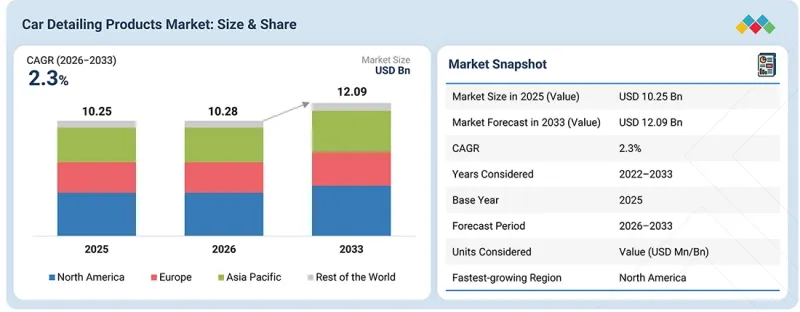
The global market for car detailing products is expected to grow from USD 10.28 billion in 2026 to USD 12.09 billion by 2033, at a CAGR of 2.3%. Although overall market growth is moderate, the industry is shifting toward premium, performance-oriented, and convenience-focused detailing solutions. Increasing value is being seen in products such as ceramic coatings, protection films, quick-detailing sprays, waterless and rinse-less cleaners, as well as specialized items for interior, tire, and wheel care.
| Scope of the Report | |
|---|---|
| Years Considered for the Study | 2026-2033 |
| Base Year | 2025 |
| Forecast Period | 2026-2033 |
| Units Considered | USD billion |
| Segments | Product, Application, End Use, Solvent, Vehicle Type, Distribution Channel & Region |
| Regions covered | Asia Pacific, North America, Europe, and the Rest of the World |
Additionally, the rise of e-commerce and the availability of professional-grade products are narrowing the gap between professional and DIY detailing. This trend allows consumers to access higher-performance formulas and tools, including foam cannons, cordless polishers, and microfiber systems.
The Do-It-Yourself (DIY) segment is the fastest-growing segment in the car detailing products market.
The DIY segment of car detailing products is gaining momentum as consumers discover they can maintain their vehicles at significantly lower cost than professional detailing services. Products are becoming easier to use and are more widely accessible online, resulting in high demand for car shampoos, waxes, polishes, microfiber towels, interior cleaners, ceramic coatings, foam cannons, and bundled detailing kits.
Consumers are increasingly adopting professional-grade yet easy-to-apply products such as ceramic spray coatings, quick detailers, waterless and rinseless cleaners, foam washes, interior protectants, and tire and wheel care formulations, making DIY detailing the fastest-growing market. E-commerce is accelerating this trend by making premium detailing chemicals, cordless polishers, foam cannons, and application kits readily available. Online platforms often provide product demonstrations and reviews, helping to reduce the learning curve for consumers.
This trend is particularly strong in North America, supported by high ownership rates of SUVs and pickups, a mature DIY culture, and a large number of vehicles in circulation. Additionally, rising electric vehicle (EV) sales are creating demand for specialized products designed for screen-safe cleaning, synthetic leather, glass, and interior care.
The Auto Care Association and MEMA project that total automotive aftermarket e-commerce sales will grow at an annual rate of approximately 6.7% through 2027, indicating a continued shift towards digital purchasing. In the future, DIY detailing is expected to evolve from basic cleaning to "at-home professional detailing," featuring concentrated and ready-to-use formulations, longer-lasting ceramic protection, antimicrobial interior products, and smart application tools, all of which will likely become mainstream.
The combination of higher-value vehicles, increasing cycles of used-car ownership, the growing prevalence of premium electric and software-defined vehicle (SDV) interiors, and OEM-quality detailing products available directly through digital channels should continue to shift consumer spending towards higher-value DIY detailing solutions.
Water-based solvents hold the largest share of all solvent types used in the car detailing products market.
Water-based solvents have a wide range of applications in cleaning and maintenance processes and comply with increasingly strict environmental and workplace standards. These formulations can be used on multiple vehicle surfaces and for various applications, including exterior cleaning, interior treatment, glass cleaning, wheel care, and general surface preparation. They are compatible with foam systems, pressure washers, spray applications, and microfiber applications, allowing suppliers to serve both professional and DIY detailing markets with scalable formulations.
Compared to solvent-heavy formulations, water-based systems offer several advantages in handling, odor control, and formulation flexibility, depending on the specific chemistry and application. The popularity of water-based solvents is further supported by their adaptability to evolving detailing technologies and consumer application methods.
In terms of regional trends, regulatory pressures in North America and Europe have pushed manufacturers to reduce the levels of volatile organic compounds (VOCs) and hazardous chemicals. For example, California's CARB consumer product regulations specifically limit VOCs in automotive consumer products, such as brake cleaners and engine cleaners, which creates pressure on manufacturers to lower VOC content or reformulate their products. In Europe, the REACH and CLP frameworks impose stricter requirements on the use, classification, labeling, and restriction of chemicals, encouraging manufacturers to develop safer and lower-emission formulations when feasible. Therefore, North America and Europe remain key markets for water-based and low-VOC car care products, supported by established detailing industries, stricter environmental standards, and rising demand for safer, low-odor formulations.
The Asia Pacific is the fastest-growing region for car detailing products.
The Asia Pacific region is experiencing rapid growth in vehicle production and detailing products due to an increasing number of vehicles on the road and consumers' willingness to spend on vehicle appearance and maintenance. In 2025, vehicle production in Asia-Pacific rose by 7.6%, while production in Europe and the Americas declined by 0.8% and 2.1%, respectively. This trend is creating a larger vehicle base for aftermarket detailing products.
China is projected to remain the largest demand center for car detailing products, bolstered by its extensive vehicle parc, strong electric vehicle (EV) penetration, a growing premium vehicle segment, and a well-established e-commerce ecosystem. India is also emerging as a high-growth market, fueled by rising vehicle ownership, increased consumer awareness of vehicle maintenance, and the expansion of professional detailing services. In both markets, there is a gradual shift in demand toward ceramic spray coatings, quick-detailers, waterless and rinseless cleaners, foam-based products, interior protectants, and EV-safe cleaning solutions.
The rise of e-commerce is a significant growth catalyst, enabling consumers in China, India, Japan, South Korea, and Southeast Asia to access professional-grade products and DIY detailing kits previously available only through specialized channels. The increasing popularity of premium SUVs and EVs is further supporting consumer spending on premium detailing, particularly for larger exterior surfaces, alloy wheels, glass, synthetic-leather interiors, and high-touch digital cabin surfaces.
Looking ahead, the combination of vehicle premiumization, the adoption of EVs and Software Defined Vehicles (SDVs), the penetration of digital retail, and the professionalization of DIY detailing is expected to make Asia Pacific an increasingly vital revenue source for global manufacturers of detailing products.
Breakdown of the profile of primary participants in the car detailing products market:
By Company Type: Car Detailing Product Manufacturers (90%) and OEMs (10%)
By Designation: C-level Executives (20%), Directors (30%), and Others (50%)
By Region: Asia Pacific (50%), North America (20%), and Europe (30%)
Global players dominate the car detailing products market, with several regional players. The key players in the car detailing products market are 3M (US), Turtle Wax Inc. (US), Wurth Group (Germany), Illinois Tool Works (US), Sonax GmbH (Germany), Tetrosyl Ltd. (UK), Simoniz USA Inc. (US), Jopasu India Pvt Ltd (India), Energizer Auto (US), Soft99 Corporation (Japan), and LIQUID MOLY (Germany).
Research Coverage:
The report covers the car detailing products market in terms of product type (cleaning & caring, polishing & waxing, sealing glaze, protective coating, interior care products), application (interior and exterior), end use (auto beauty shops, OEM & dealership service centers, DIY/retail consumers), solvent (water-based solvents and foam-based solvents), vehicle type (passenger cars and commercial vehicles), distribution channel (service centers and Do It Yourself), and region (Asia Pacific, North America, Europe, and the Rest of the World).
The report's scope covers detailed information regarding the major factors influencing the growth of the car detailing products market. A thorough analysis of the key industry players has provided insights into their business overviews, products, key strategies, contracts, partnerships, agreements, product launches, mergers & acquisitions, impact during the recession, and recent developments in the car detailing products market.
Key Benefits of Buying the Report:
The report will help market leaders and new entrants by providing the closest approximations of revenue numbers for the overall car detailing product market and its sub-segments. It will also help stakeholders understand the competitive landscape, gain insights into how to better position their businesses, and plan suitable go-to-market strategies. The report also helps stakeholders understand the market pulse and provides information on key market drivers, restraints, challenges, and opportunities.
The report provides insights into the following points:
- Analysis of critical drivers (OEM and dealers shift towards high-margin vehicle appearance package, premium vehicle protection, and growth of certified pre-owned (CPO) and used vehicle ecosystems), restraints (OEM warranty and certified coating programs), opportunities (monetization of connected vehicle ecosystems through predictive vehicle cares, AI-enabled detailing equipment and subscription-based car care services, and expansion of fleet, mobility-as-as-service (MaaS) and subscription vehicle reconditioning), and challenges (shift towards DIY products, intense competition from local manufacturers, and availability of counterfeit and low-quality products)
- Product Development/Innovation: Detailed insights into upcoming technologies and products launched in the car detailing products market
- Market Development: Comprehensive market information; the report analyzes the market across varied regions
- Market Diversification: Exhaustive information about new products & services, untapped geographies, recent developments, and investments in the car detailing products market
- Competitive Assessment: In-depth assessment of market shares, growth strategies, and service offerings of leading players in the car detailing products market, such as 3M (US), Turtle Wax Inc. (US), Wurth Group (Germany), Illinois Tool Works (US), and Sonax GmbH (Germany)
TABLE OF CONTENTS
1 INTRODUCTION
- 1.1 STUDY OBJECTIVES
- 1.2 MARKET DEFINITION
- 1.3 MARKET SCOPE
- 1.3.1 MARKET SEGMENTATION AND REGIONAL SCOPE
- 1.3.2 INCLUSIONS AND EXCLUSIONS
- 1.3.3 YEARS CONSIDERED
- 1.4 CURRENCY CONSIDERED
- 1.5 STAKEHOLDERS
- 1.6 SUMMARY OF CHANGES
2 EXECUTIVE SUMMARY
- 2.1 MARKET HIGHLIGHTS AND KEY INSIGHTS
- 2.2 KEY MARKET PARTICIPANTS: MAPPING OF STRATEGIC DEVELOPMENTS
- 2.3 DISRUPTIVE TRENDS IN CAR DETAILING PRODUCTS MARKET
- 2.4 HIGH-GROWTH SEGMENTS
- 2.5 REGIONAL SNAPSHOT: MARKET SIZE, GROWTH RATE, AND FORECAST
3 PREMIUM INSIGHTS
- 3.1 STEADY GROWTH OPPORTUNITIES FOR PLAYERS IN CAR DETAILING PRODUCTS MARKET
- 3.2 CAR DETAILING PRODUCTS MARKET, BY PRODUCT TYPE
- 3.3 CAR DETAILING PRODUCTS MARKET, BY END USER
- 3.4 CAR DETAILING PRODUCTS MARKET, BY DISTRIBUTION CHANNEL
- 3.5 CAR DETAILING PRODUCTS MARKET, BY VEHICLE TYPE
- 3.6 CAR DETAILING PRODUCTS MARKET, BY SOLVENT
- 3.7 CAR DETAILING PRODUCTS MARKET, BY APPLICATION
- 3.8 CAR DETAILING PRODUCTS MARKET, BY REGION
4 MARKET OVERVIEW
- 4.1 INTRODUCTION
- 4.2 MARKET DYNAMICS
- 4.2.1 DRIVERS
- 4.2.1.1 Growing productization of vehicle appearance care through dealership service packages
- 4.2.1.2 Shift from cosmetic repair to preventive vehicle appearance protection
- 4.2.1.3 Expansion of CPO and organized used-vehicle programs supporting professional vehicle reconditioning
- 4.2.2 RESTRAINTS
- 4.2.2.1 OEM programs limiting independent aftermarket opportunities
- 4.2.3 OPPORTUNITIES
- 4.2.3.1 Monetization of connected vehicle ecosystem through predictive vehicle care
- 4.2.3.2 Emergence of AI-enabled vehicle inspection and subscription-based detailing services
- 4.2.4 CHALLENGES
- 4.2.4.1 Growing DIY adoption reducing demand for professional detailing services
- 4.2.4.2 Intense competition from local manufacturers and availability of counterfeit and low-quality products
- 4.2.1 DRIVERS
- 4.3 UNMET NEEDS AND WHITE SPACES
- 4.3.1 UNMET NEEDS
- 4.3.2 WHITE SPACES
- 4.4 INTERCONNECTED MARKETS AND CROSS-SECTOR OPPORTUNITIES
- 4.5 STRATEGIC MOVES BY KEY PLAYERS, 1, 2, 3 PLAYERS
5 INDUSTRY TRENDS
- 5.1 MACROECONOMIC OUTLOOK
- 5.1.1 INTRODUCTION
- 5.1.2 GDP TRENDS AND FORECAST
- 5.1.3 TREND IN CAR DETAILING PRODUCT MARKET
- 5.1.3.1 Investment environment
- 5.2 SUPPLY CHAIN ANALYSIS
- 5.3 ECOSYSTEM ANALYSIS
- 5.4 CAR DETAILING PRODUCTS ECOSYSTEM
- 5.5 PRICING ANALYSIS
- 5.5.1 INDICATIVE PRICE OF CAR DETAILING PRODUCTS, BY REGION, 2026
- 5.5.1.1 Indicative price of cleaning & caring products, by region, 2026
- 5.5.1.2 Indicative price of sealing & glaze products, by region, 2026
- 5.5.1.3 Indicative price of protective coating products, by region, 2026
- 5.5.1.4 Pricing trend of interior car care products, by region, 2022-2026
- 5.5.2 PRICING RANGE OF CAR DETAILING PRODUCTS, BY KEY PLAYER, 2026
- 5.5.2.1 Pricing range of car cleaning & washing products, by key player, 2026
- 5.5.2.2 Pricing range of car polishing & waxing products, by key player, 2026
- 5.5.2.3 Pricing range of car protective coating products, by key player, 2026
- 5.5.2.4 Pricing range of interior car detailing products, by key player, 2026
- 5.5.1 INDICATIVE PRICE OF CAR DETAILING PRODUCTS, BY REGION, 2026
- 5.6 KEY CONFERENCES AND EVENTS, 2026-2028
- 5.7 TRADE ANALYSIS
- 5.7.1 IMPORT SCENARIO (HS CODE 340220)
- 5.7.2 EXPORT SCENARIO (HS CODE 340220)
- 5.8 TRENDS/DISRUPTIONS IMPACTING CUSTOMER BUSINESS
- 5.9 INVESTMENT AND FUNDING SCENARIO
- 5.10 CASE STUDY ANALYSIS
- 5.10.1 DUEL AUTO CARE ENHANCES LABELING CONSISTENCY AND OPERATIONAL RELIABILITY WITH PREMIER LABELLERS' WRAP LABELING MACHINE
- 5.10.2 THE SHINE SHOP AUTO DETAILING IMPROVES PAINT CORRECTION AND SURFACE PROTECTION WITH DR. BEASLEY'S NANO SURFACE PRIMER AND GRAPHENE COATING SYSTEM
- 5.10.3 AGENT DETAIL ENHANCES BRAND DIFFERENTIATION AND PRODUCT RECOGNITION WITH HOLMAN DESIGN'S BRANDING AND PACKAGING SYSTEM
- 5.10.4 TINO CAR CARE ELEVATES CUSTOMER EXPERIENCE AND ONLINE ENGAGEMENT WITH HULKAPPS' SHOPIFY APPLICATIONS
- 5.10.5 CLEAN MY CAR IMPROVES VEHICLE APPEARANCE AND FINISH QUALITY WITH PROFESSIONAL EXTERIOR AND INTERIOR DETAILING
- 5.11 TOTAL COST OF OWNERSHIP
- 5.12 OEM ANALYSIS
- 5.12.1 ANALYSIS OF OEM AND THIRD-PARTY CAR DETAILING PRODUCT OFFERINGS
- 5.12.2 ECO-FRIENDLY CAR DETAILING PRODUCTS OFFERED BY KEY PLAYERS, 2026
- 5.12.3 BENCHMARKING OF SUBSCRIPTION PACKAGES FOR AFTERMARKET CAR DETAILING PRODUCTS OFFERED BY KEY PLAYERS, 2026
- 5.12.4 BENCHMARKING OF CAR DETAILING PRODUCTS OFFERED BY KEY PLAYERS, 2026
- 5.13 TECHNICAL SPECIFICATIONS
- 5.13.1 TECHNICAL SPECIFICATIONS FOR CAR DETAILING PRODUCTS, 2026
- 5.13.2 TOLERANCE STANDARDS
- 5.13.2.1 Technical specifications for car detailing products, 2026
- 5.13.3 CERTIFICATION STANDARDS
- 5.13.3.1 Essential certifications and compliance requirements, 2026
6 TECHNOLOGICAL ADVANCEMENTS, PATENTS, INNOVATIONS, AND FUTURE STRATEGIC APPLICATIONS
- 6.1 TECHNOLOGY ANALYSIS
- 6.1.1 KEY TECHNOLOGIES
- 6.1.1.1 Ceramic (sio2) and graphite coatings
- 6.1.1.2 NANO CERAMIC COATING
- 6.1.1.3 Bio-based surfactants
- 6.1.1.4 Leather conditioning polymers
- 6.1.2 COMPLEMENTARY TECHNOLOGIES
- 6.1.2.1 Ai-based paint defect inspection
- 6.1.2.2 Trends in rental industry
- 6.1.2.3 Subscription management software
- 6.1.3 ADJACENT TECHNOLOGIES
- 6.1.3.1 Electrostatic dust-repellent coatings
- 6.1.3.2 Carbon-negative cleaning formulation
- 6.1.1 KEY TECHNOLOGIES
- 6.2 PATENT ANALYSIS
- 6.2.1 INTRODUCTION
- 6.3 FUTURE APPLICATIONS
- 6.4 SUCCESS STORIES AND REAL-WORLD APPLICATIONS
- 6.5 FUTURE TECHNOLOGY ROADMAP
- 6.5.1 SELF-HEALING COATING
- 6.5.2 ANTIMICROBIAL COATING
- 6.5.3 BIO-BASED AND VOC-FREE FORMULATION
- 6.5.4 SMART COATINGS FOR HEALTH MONITORING
7 REGULATORY LANDSCAPE
- 7.1 REGIONAL REGULATIONS AND COMPLIANCE
- 7.1.1 REGULATORY BODIES, GOVERNMENT AGENCIES, AND OTHER ORGANIZATIONS
- 7.1.2 REGULATORY ANALYSIS FOR CAR DETAILING PRODUCTS MARKET
- 7.1.3 KEY CHEMICAL LIMITS IMPACTING CAR CARE PRODUCTS
- 7.1.3.1 North America
- 7.1.3.1.1 US
- 7.1.3.1.2 Impact on car care product manufacturers
- 7.1.3.2 Europe
- 7.1.3.1 North America
8 CUSTOMER LANDSCAPE AND BUYER BEHAVIOR
- 8.1 DECISION-MAKING PROCESS
- 8.2 KEY STAKEHOLDERS INVOLVED IN BUYING PROCESS AND THEIR EVALUATION CRITERIA
- 8.2.1 KEY STAKEHOLDERS IN BUYING PROCESS
- 8.2.2 BUYING CRITERIA
- 8.3 ADOPTION BARRIERS AND INTERNAL CHALLENGES
- 8.4 UNMET NEEDS OF VARIOUS END USERS
- 8.5 MARKET PROFITABILITY
- 8.5.1 MARKET PROFITABILITY FOR CAR DETAILING PRODUCTS
9 CAR DETAILING PRODUCTS MARKET, BY PRODUCT TYPE
- 9.1 INTRODUCTION
- 9.2 CLEANING & CARING PRODUCTS
- 9.2.1 HIGH-FREQUENCY USAGE ACROSS DIY CONSUMERS AND PROFESSIONAL DETAILERS TO ACCELERATE SEGMENTAL GROWTH
- 9.3 POLISHING & WAXING PRODUCTS
- 9.3.1 GROWING FOCUS ON PAINT RESTORATION AND RESALE VALUE TO SUPPORT SEGMENTAL GROWTH
- 9.4 SEALING & GLAZE PRODUCTS
- 9.4.1 RISING FOCUS ON LONG-LASTING PAINT APPEARANCE AND RESALE VALUE TO STIMULATE ADOPTION OF SEALANT-GLAZE PRODUCTS
- 9.5 PROTECTIVE COATING PRODUCTS
- 9.5.1 LONGER DURABILITY AND PPF COMPATIBILITY OF CERAMIC AND GRAPHENE COATINGS TO ACCELERATE DEMAND
- 9.6 INTERIOR CAR DETAILING PRODUCTS
- 9.6.1 INCREASING EMPHASIS ON CABIN HYGIENE AND PREMIUM INTERIOR MATERIALS TO FACILITATE SEGMENTAL GROWTH
- 9.6.2 INDUSTRY INSIGHTS
10 CAR DETAILING PRODUCTS MARKET, BY APPLICATION
- 10.1 INTRODUCTION
- 10.2 INTERIOR
- 10.2.1 INCREASING CONSUMER FOCUS ON CABIN HYGIENE, COMFORT, APPEARANCE, AND ODOR CONTROL TO FOSTER MARKET GROWTH
- 10.3 EXTERIOR
- 10.3.1 RISING ADOPTION OF CERAMIC COATINGS AND PPF-COMPATIBLE PRODUCTS TO BOOST EXTERIOR SEGMENT GROWTH
- 10.3.2 INDUSTRY INSIGHTS
11 CAR DETAILING PRODUCTS MARKET, BY END USER
- 11.1 INTRODUCTION
- 11.2 AUTO BEAUTY SHOPS
- 11.2.1 SHIFT FROM LOW-VALUE WASH SERVICES TOWARD PACKAGE-BASED PAINT CORRECTION AND CERAMIC COATING TO DRIVE MARKET
- 11.3 OEM & DEALERSHIP SERVICE CENTERS
- 11.3.1 EXPANSION OF DEALER AFTERSALES INTO HIGH-MARGIN APPEARANCE AND PROTECTION PACKAGES TO PROPEL MARKET
- 11.4 DIY/RETAIL CUSTOMERS
- 11.4.1 DIGITAL-LED DISCOVERY AND READY-TO-USE, LOW-WATER FORMULATIONS TO SUPPORT MARKET GROWTH
- 11.4.2 INDUSTRY INSIGHTS
12 CAR DETAILING PRODUCTS MARKET, BY SOLVENT
- 12.1 INTRODUCTION
- 12.2 WATER-BASED SOLVENTS
- 12.2.1 ELEVATING DEMAND FOR LOW-VOC AND ENVIRONMENTALLY FRIENDLY PRODUCTS TO SUPPORT SEGMENTAL GROWTH
- 12.3 FOAM-BASED SOLVENTS
- 12.3.1 INCREASING PREFERENCE FOR HIGH-FOAMING, PH-NEUTRAL, AND CONCENTRATED FORMULATIONS TO BOOST DEMAND
- 12.3.2 INDUSTRY INSIGHTS
13 CAR DETAILING PRODUCTS MARKET, BY VEHICLE TYPE
- 13.1 INTRODUCTION
- 13.2 PASSENGER CARS
- 13.2.1 GROWING CONSUMER FOCUS ON VEHICLE CARE TO SUPPORT SEGMENTAL GROWTH
- 13.3 COMMERCIAL VEHICLES
- 13.3.1 RISING DEMAND FOR HIGH-EFFICIENCY AND DURABLE DETAILING SOLUTIONS TO FACILITATE MARKET GROWTH
- 13.3.2 INDUSTRY INSIGHTS
14 CAR DETAILING PRODUCTS MARKET, BY DISTRIBUTION CHANNEL
- 14.1 INTRODUCTION
- 14.2 SERVICE CENTERS
- 14.2.1 HIGH VEHICLE THROUGHPUT TO SUSTAIN DEMAND FOR SERVICE CENTERS
- 14.3 RETAIL & E-COMMERCE
- 14.3.1 PRODUCT ACCESSIBILITY AND DIY TRENDS TO SUPPORT RETAIL & E-COMMERCE GROWTH
- 14.3.2 INDUSTRY INSIGHTS
15 CAR DETAILING PRODUCTS MARKET, BY REGION
- 15.1 INTRODUCTION
- 15.2 NORTH AMERICA
- 15.2.1 US
- 15.2.1.1 High concentration of multi-vehicle households to accelerate demand
- 15.2.2 CANADA
- 15.2.2.1 Increasing consumer spending on vehicle maintenance due to harsh environmental conditions to boost demand
- 15.2.3 MEXICO
- 15.2.3.1 Growing sales of electric and hybrid vehicles to support market growth
- 15.2.1 US
- 15.3 ASIA PACIFIC
- 15.3.1 CHINA
- 15.3.1.1 Shift from volume-driven basic cleaning toward premium, technology-specific detailing solutions to drive market
- 15.3.2 SOUTH KOREA
- 15.3.2.1 Faster growth of EVs, including imported models and premium vehicles, to create growth opportunities
- 15.3.3 JAPAN
- 15.3.3.1 Increasing focus of vehicle owners on preserving vehicles over longer lifecycles to spike demand
- 15.3.4 INDIA
- 15.3.4.1 Gradual shift toward professional detailing packages, paint correction, and interior deep cleaning to propel market
- 15.3.5 REST OF ASIA PACIFIC
- 15.3.1 CHINA
- 15.4 EUROPE
- 15.4.1 GERMANY
- 15.4.1.1 Increasing passenger car registration to fuel car detailing product demand
- 15.4.2 UK
- 15.4.2.1 Elevating adoption of waterless and biodegradable car detailing products due to stringent wastewater regulations to drive market
- 15.4.3 FRANCE
- 15.4.3.1 Increasing used-car sales and restriction on water usage to spur demand for car detailing solutions
- 15.4.4 ITALY
- 15.4.4.1 Dense vehicle base and shift toward electrified cars to foster market growth
- 15.4.5 SPAIN
- 15.4.5.1 Expanding low-emission zones and environmental vehicle classification to spur demand for car detailing products
- 15.4.6 REST OF EUROPE
- 15.4.1 GERMANY
- 15.5 REST OF THE WORLD
- 15.5.1 SOUTH AFRICA
- 15.5.1.1 Water-use restrictions and diversifying vehicle import mix to lead to high demand for car detailing products
- 15.5.2 BRAZIL
- 15.5.2.1 Water-efficiency regulations and fragmented vehicle parc to create growth opportunities
- 15.5.3 REST OF ROW
- 15.5.4 INDUSTRY INSIGHTS
- 15.5.1 SOUTH AFRICA
16 COMPETITIVE LANDSCAPE
- 16.1 OVERVIEW
- 16.2 KEY PLAYER COMPETITIVE STRATEGIES/RIGHT TO WIN, 2023-2026
- 16.3 REVENUE ANALYSIS, 2021-2025
- 16.4 MARKET SHARE ANALYSIS, 2025
- 16.4.1 GLOBAL CAR DETAILING PRODUCTS MARKET SHARE, 2025
- 16.5 COMPANY VALUATION AND FINANCIAL METRICS
- 16.5.1 COMPANY VALUATION
- 16.5.2 FINANCIAL METRICS
- 16.6 BRAND COMPARISON
- 16.6.1 3M
- 16.6.2 ILLINOIS TOOL WORKS (ITW)
- 16.6.3 SONAX GMBH
- 16.6.4 WURTH GROUP
- 16.6.5 TURTLE WAX
- 16.7 COMPETITIVE EVALUATION MATRIX: KEY PLAYERS, 2025
- 16.7.1 STARS
- 16.7.2 EMERGING LEADERS
- 16.7.3 PERVASIVE PLAYERS
- 16.7.4 PARTICIPANTS
- 16.7.5 COMPANY FOOTPRINT: KEY PLAYERS, 2025
- 16.7.5.1 Company footprint
- 16.7.6 REGION FOOTPRINT
- 16.7.7 PRODUCT TYPE FOOTPRINT
- 16.7.8 APPLICATION FOOTPRINT
- 16.8 COMPANY EVALUATION MATRIX: STARTUPS/SMES, 2025
- 16.8.1 PROGRESSIVE COMPANIES
- 16.8.2 RESPONSIVE COMPANIES
- 16.8.3 DYNAMIC COMPANIES
- 16.8.4 STARTING BLOCKS
- 16.8.5 COMPETITIVE BENCHMARKING: STARTUPS/SMES, 2025
- 16.8.5.1 Detailed list of startups/SMEs
- 16.8.5.2 Competitive benchmarking of key startups/SMEs
- 16.9 COMPETITIVE SCENARIO
- 16.9.1 PRODUCT LAUNCHES & ENHANCEMENTS
- 16.9.2 DEALS
- 16.9.3 EXPANSIONS
17 COMPANY PROFILES
- 17.1 KEY PLAYERS
- 17.1.1 3M
- 17.1.1.1 Business overview
- 17.1.1.2 Products offered
- 17.1.1.3 Recent developments
- 17.1.1.3.1 Product launches & enhancements
- 17.1.1.4 MnM view
- 17.1.1.4.1 Key strengths
- 17.1.1.4.2 Strategic choices
- 17.1.1.4.3 Weaknesses and competitive threats
- 17.1.2 TURTLE WAX INC.
- 17.1.2.1 Business overview
- 17.1.2.2 Products offered
- 17.1.2.3 Recent developments
- 17.1.2.3.1 Product launches & enhancements
- 17.1.2.3.2 DEALS
- 17.1.2.3.3 Expansions
- 17.1.2.4 MnM view
- 17.1.2.4.1 Key strengths
- 17.1.2.4.2 Strategic choices
- 17.1.2.4.3 Weaknesses and competitive threats
- 17.1.3 WURTH GROUP
- 17.1.3.1 Business overview
- 17.1.3.2 Products offered
- 17.1.3.3 Recent developments
- 17.1.3.3.1 Expansions
- 17.1.3.4 MnM view
- 17.1.3.4.1 Key strengths
- 17.1.3.4.2 Strategic choices
- 17.1.3.4.3 Weaknesses and competitive threats
- 17.1.4 ILLINOIS TOOL WORKS INC.
- 17.1.4.1 Business overview
- 17.1.4.2 Products offered
- 17.1.4.3 Recent developments
- 17.1.4.3.1 Product launches & enhancements
- 17.1.4.3.2 Expansions
- 17.1.4.3.3 Other developments
- 17.1.4.4 MnM view
- 17.1.4.4.1 Key strengths
- 17.1.4.4.2 Strategic choices
- 17.1.4.4.3 Weaknesses and competitive threats
- 17.1.5 SONAX GMBH
- 17.1.5.1 Business overview
- 17.1.5.2 Products offered
- 17.1.5.3 Recent developments
- 17.1.5.3.1 Product launches & enhancements
- 17.1.5.3.2 DEALS
- 17.1.5.3.3 Expansions
- 17.1.5.3.4 Other developments
- 17.1.5.4 MnM view
- 17.1.5.4.1 Key strengths
- 17.1.5.4.2 Strategic choices
- 17.1.5.4.3 Weaknesses and competitive threats
- 17.1.6 SIMONIZ USA, INC.
- 17.1.6.1 Business overview
- 17.1.6.2 Products offered
- 17.1.6.3 Recent developments
- 17.1.6.3.1 Product launches & enhancements
- 17.1.7 JOPASU INDIA PRIVATE LIMITED
- 17.1.7.1 Business overview
- 17.1.7.2 Products offered
- 17.1.7.3 Recent developments
- 17.1.7.3.1 Product launches & enhancements
- 17.1.7.3.2 Other developments
- 17.1.8 ENERGIZER AUTO. ARMOR ALL
- 17.1.8.1 Business overview
- 17.1.8.2 Products offered
- 17.1.8.3 Recent developments
- 17.1.8.3.1 Product launches & enhancements
- 17.1.8.3.2 Deals
- 17.1.9 SHELL PLC
- 17.1.9.1 Business overview
- 17.1.9.2 Products offered
- 17.1.9.3 Recent developments
- 17.1.9.3.1 Product launches & enhancements
- 17.1.10 TOTALENERGIES
- 17.1.10.1 Business overview
- 17.1.10.2 Products offered
- 17.1.10.3 Recent developments
- 17.1.10.3.1 Deals
- 17.1.1 3M
- 17.2 OTHER PLAYERS
- 17.2.1 BULLSONE CO., LTD.
- 17.2.2 ALTRO GROUP LIMITED
- 17.2.3 SOFT99 CORPORATION
- 17.2.4 TETROSYL LIMITED
- 17.2.5 LIQUI MOLY
- 17.2.6 AUTO MAGIC CAR CARE INDUSTRY CO., LTD.
- 17.2.7 WEST DRIVE, LLC
- 17.2.8 MA-FRA SPA
- 17.2.9 CARTECH BV
- 17.2.10 CHEMICAL GUYS
18 RESEARCH METHODOLOGY
- 18.1 RESEARCH DATA
- 18.1.1 SECONDARY DATA
- 18.1.1.1 List of key secondary sources
- 18.1.1.2 Key data from secondary sources
- 18.1.2 PRIMARY DATA
- 18.1.2.1 List of primary participants
- 18.1.1 SECONDARY DATA
- 18.2 MARKET ESTIMATION METHODOLOGY
- 18.2.1 TOP-DOWN APPROACH
- 18.2.2 FACTOR ANALYSIS FOR MARKET SIZING: DEMAND AND SUPPLY SIDES
- 18.3 DATA TRIANGULATION
- 18.4 RISK ANALYSIS
- 18.5 RESEARCH LIMITATIONS
19 APPENDIX
- 19.1 INSIGHTS FROM INDUSTRY EXPERTS
- 19.2 DISCUSSION GUIDE
- 19.3 KNOWLEDGESTORE: MARKETSANDMARKETS' SUBSCRIPTION PORTAL
- 19.4 CUSTOMIZATION OPTIONS
- 19.4.1 CAR DETAILING PRODUCTS APPLICATION MARKET, BY COUNTRY
- 19.4.1.1 North America
- 19.4.1.1.1 US
- 19.4.1.1.2 Canada
- 19.4.1.1.3 Mexico
- 19.4.1.2 Asia Pacific
- 19.4.1.2.1 China
- 19.4.1.2.2 Australia
- 19.4.1.2.3 Japan
- 19.4.1.2.4 South Korea
- 19.4.1.2.5 India
- 19.4.1.3 Europe
- 19.4.1.3.1 Germany
- 19.4.1.3.2 UK
- 19.4.1.3.3 France
- 19.4.1.3.4 Italy
- 19.4.1.3.5 Spain
- 19.4.1.4 Rest of the World
- 19.4.1.4.1 Brazil
- 19.4.1.4.2 Russia
- 19.4.1.1 North America
- 19.4.1 CAR DETAILING PRODUCTS APPLICATION MARKET, BY COUNTRY
- 19.5 RELATED REPORTS
- 19.6 AUTHOR DETAILS
List of Tables
- TABLE 1 SEGMENT-WISE INCLUSIONS AND EXCLUSIONS
- TABLE 2 CURRENCY EXCHANGE RATES
- TABLE 3 STRATEGIC PACKAGE STRUCTURE FOR CAR-DETAILING PRODUCTS
- TABLE 4 CONNECTED-VEHICLE CAPABILITIES SUPPORTING PREDICTIVE VEHICLE CARE
- TABLE 5 AI-ENABLED MACHINES AND TECHNOLOGIES FOR VEHICLE DEFECT DETECTION AND CONDITION ASSESSMENT
- TABLE 6 SUBSCRIPTION-BASED CAR CARE AND DETAILING SERVICE MODELS
- TABLE 7 STRATEGIC MOVES BY TOP KEY PLAYERS
- TABLE 8 OEM STRATEGIES (PARTNERSHIP WITH CAR DETAILING COMPANIES IN AFTERMARKET/DEALERSHIP LEVEL)
- TABLE 9 GDP PERCENTAGE CHANGE, BY KEY COUNTRY, 2022-2031
- TABLE 10 ROLE OF COMPANIES IN CAR DETAILING PRODUCT MARKET ECOSYSTEM
- TABLE 11 REGION-WISE INDICATIVE PRICE OF CLEANING & CARING PRODUCTS, 2026 (USD)
- TABLE 12 REGION-WISE INDICATIVE PRICE OF SEALING & GLAZE PRODUCTS, 2026 (USD)
- TABLE 13 REGION-WISE INDICATIVE PRICE OF PROTECTIVE COATING PRODUCTS, 2026 (USD)
- TABLE 14 REGION-WISE PRICING TREND OF INTERIOR CAR CARE PRODUCTS, 2022-2026 (USD)
- TABLE 15 PRICING RANGE OF CAR CLEANING & WASHING PRODUCTS OFFERED BY KEY PLAYERS, 2026 (USD)
- TABLE 16 PRICING RANGE OF CAR POLISHING & WAXING PRODUCTS OFFERED BY KEY PLAYERS, 2026 (USD)
- TABLE 17 PRICING RANGE OF CAR PROTECTIVE COATING PRODUCTS OFFERED BY KEY PLAYERS, 2026 (USD)
- TABLE 18 PRICING RANGE OF INTERIOR CAR DETAILING PRODUCTS OFFERED BY KEY PLAYERS, 2026 (USD)
- TABLE 19 CAR DETAILING PRODUCT MARKET: KEY CONFERENCES & EVENTS, 2026-2028
- TABLE 20 IMPORT DATA FOR HS CODE 340220-COMPLIANT PRODUCTS, BY COUNTRY, 2021-2025 (USD THOUSAND)
- TABLE 21 EXPORT DATA FOR HS CODE 340220-COMPLIANT PRODUCTS, BY COUNTRY, 2021-2025 (USD THOUSAND)
- TABLE 22 LIST OF FUNDING, 2022-2025
- TABLE 23 ESTIMATED BILL OF MATERIALS FOR 500 ML CAR DETAILING PRODUCTS
- TABLE 24 KEY PLAYERS' ECO-FRIENDLY CAR DETAILING PRODUCTS
- TABLE 25 SUBSCRIPTION PACKAGE FOR AFTERMARKET CAR DETAILING PRODUCTS, BY KEY PLAYER
- TABLE 26 TECHNICAL SPECIFICATIONS FOR CAR DETAILING PRODUCTS
- TABLE 27 TOLERANCE STANDARDS SET FOR CAR DETAILING PRODUCTS
- TABLE 28 CRITICAL CERTIFICATION STANDARDS SET FOR CAR DETAILING PRODUCTS
- TABLE 29 COMPARISON BETWEEN GRAPHENE COATING VS. CERAMIC COATING
- TABLE 30 COMPARISON BETWEEN GRAPHENE COATING VS. CERAMIC COATING
- TABLE 31 AI-BASED PAINT DEFECT INSPECTION TECHNOLOGY
- TABLE 32 KEY TECHNOLOGIES AND COMPANIES DEVELOPING DUST-REPELLENT AUTOMOTIVE COATINGS
- TABLE 33 KEY PATENTS, 2025-2026
- TABLE 34 FUTURE TECHNOLOGY ROADMAPS, 2026-2033
- TABLE 35 SUCCESS STORIES FROM KEY PLAYERS AND OEMS
- TABLE 36 NORTH AMERICA: LIST OF REGULATORY BODIES, GOVERNMENT AGENCIES, AND OTHER ORGANIZATIONS
- TABLE 37 EUROPE: LIST OF REGULATORY BODIES, GOVERNMENT AGENCIES, AND OTHER ORGANIZATIONS
- TABLE 38 ASIA PACIFIC: LIST OF REGULATORY BODIES, GOVERNMENT AGENCIES, AND OTHER ORGANIZATIONS
- TABLE 39 REST OF THE WORLD: LIST OF REGULATORY BODIES, GOVERNMENT AGENCIES, AND OTHER ORGANIZATIONS
- TABLE 40 US: TIER 4 EMISSION STANDARDS
- TABLE 41 US: IMPACT ON CAR CARE PRODUCT MANUFACTURERS
- TABLE 42 EUROPEAN UNION: VOC LIMITS FOR VEHICLE REFINISHING PRODUCTS - EUROPE (DIRECTIVE 2004/42/EC)
- TABLE 43 INFLUENCE OF STAKEHOLDERS ON BUYING PROCESS FOR SOLVENT TYPE, BY TOP APPLICATION (%)
- TABLE 44 KEY BUYING CRITERIA FOR SOLVENTS
- TABLE 45 INDICATIVE PROFITABILITY OUTLOOK AND STRATEGIC PRIORITIES FOR CAR DETAILING PRODUCTS
- TABLE 46 CAR DETAILING PRODUCTS MARKET, BY PRODUCT TYPE, 2022-2025 (USD BILLION)
- TABLE 47 CAR DETAILING PRODUCTS MARKET, BY PRODUCT TYPE, 2026-2033 (USD BILLION)
- TABLE 48 CLEANING & CARING PRODUCTS: CAR DETAILING PRODUCTS MARKET, BY REGION, 2022-2025 (USD BILLION)
- TABLE 49 CLEANING & CARING PRODUCTS: CAR DETAILING PRODUCTS MARKET, BY REGION, 2026-2033 (USD BILLION)
- TABLE 50 POLISHING & WAXING PRODUCTS: CAR DETAILING PRODUCTS MARKET, BY REGION, 2022-2025 (USD BILLION)
- TABLE 51 POLISHING & WAXING PRODUCTS: CAR DETAILING PRODUCTS MARKET, BY REGION, 2026-2033 (USD BILLION)
- TABLE 52 SEALING & GLAZE PRODUCTS: CAR DETAILING PRODUCTS MARKET, BY REGION, 2022-2025 (USD BILLION)
- TABLE 53 SEALING & GLAZE PRODUCTS: CAR DETAILING PRODUCTS MARKET, BY REGION, 2026-2033 (USD BILLION)
- TABLE 54 PROTECTIVE COATING PRODUCTS: CAR DETAILING PRODUCTS MARKET, BY REGION, 2022-2025 (USD BILLION)
- TABLE 55 PROTECTIVE COATING PRODUCTS: CAR DETAILING PRODUCTS MARKET, BY REGION, 2026-2033 (USD BILLION)
- TABLE 56 INTERIOR CAR DETAILING PRODUCTS: CAR DETAILING PRODUCTS MARKET, BY REGION, 2022-2025 (USD BILLION)
- TABLE 57 INTERIOR CAR DETAILING PRODUCTS: CAR DETAILING PRODUCTS MARKET, BY REGION, 2026-2033 (USD BILLION)
- TABLE 58 CAR DETAILING PRODUCTS MARKET, BY APPLICATION, 2022-2025 (USD BILLION)
- TABLE 59 CAR DETAILING PRODUCTS MARKET, BY APPLICATION, 2026-2033 (USD BILLION)
- TABLE 60 INTERIOR: CAR DETAILING PRODUCTS MARKET, BY REGION, 2022-2025 (USD BILLION)
- TABLE 61 INTERIOR: CAR DETAILING PRODUCTS MARKET, BY REGION, 2026-2033 (USD BILLION)
- TABLE 62 EXTERIOR: CAR DETAILING PRODUCTS MARKET, BY REGION, 2022-2025 (USD BILLION)
- TABLE 63 EXTERIOR: CAR DETAILING PRODUCTS MARKET, BY REGION, 2026-2033 (USD BILLION)
- TABLE 64 CAR DETAILING PRODUCTS MARKET, BY END USER, 2022-2025 (USD BILLION)
- TABLE 65 CAR DETAILING PRODUCTS MARKET, BY END USER, 2026-2033 (USD BILLION)
- TABLE 66 AUTO BEAUTY SHOPS: CAR DETAILING PRODUCTS MARKET, BY REGION, 2022-2025 (USD BILLION)
- TABLE 67 AUTO BEAUTY SHOPS: CAR DETAILING PRODUCTS MARKET, BY REGION, 2026-2033 (USD BILLION)
- TABLE 68 OEM & DEALERSHIP SERVICE CENTERS: CAR DETAILING PRODUCTS MARKET, BY REGION, 2022-2025 (USD BILLION)
- TABLE 69 OEM & DEALERSHIP SERVICE CENTERS: CAR DETAILING PRODUCTS MARKET, BY REGION, 2026-2033 (USD BILLION)
- TABLE 70 DIY/RETAIL CUSTOMERS: CAR DETAILING PRODUCTS MARKET, BY REGION, 2022-2025 (USD BILLION)
- TABLE 71 DIY/RETAIL CUSTOMERS: CAR DETAILING PRODUCTS MARKET, BY REGION, 2026-2033 (USD BILLION)
- TABLE 72 CAR DETAILING PRODUCTS MARKET, BY SOLVENT, 2022-2025 (USD BILLION)
- TABLE 73 CAR DETAILING PRODUCTS MARKET, BY SOLVENT, 2026-2033 (USD BILLION)
- TABLE 74 WATER-BASED SOLVENTS: CAR DETAILING PRODUCTS MARKET, BY REGION, 2022-2025 (USD BILLION)
- TABLE 75 WATER-BASED SOLVENTS: CAR DETAILING PRODUCTS MARKET, BY REGION, 2026-2033 (USD BILLION)
- TABLE 76 FOAM-BASED SOLVENTS: CAR DETAILING PRODUCTS MARKET, BY REGION, 2022-2025 (USD BILLION)
- TABLE 77 FOAM-BASED SOLVENTS: CAR DETAILING PRODUCTS MARKET, BY REGION, 2026-2033 (USD BILLION)
- TABLE 78 CAR DETAILING PRODUCTS MARKET, BY VEHICLE TYPE, 2022-2025 (USD BILLION)
- TABLE 79 CAR DETAILING PRODUCTS MARKET, BY VEHICLE TYPE, 2026-2033 (USD BILLION)
- TABLE 80 PASSENGER CARS: CAR DETAILING PRODUCTS MARKET, BY REGION, 2022-2025 (USD BILLION)
- TABLE 81 PASSENGER CARS: CAR DETAILING PRODUCTS MARKET, BY REGION, 2026-2033 (USD BILLION)
- TABLE 82 COMMERCIAL VEHICLES: CAR DETAILING PRODUCTS MARKET, BY REGION, 2022-2025 (USD BILLION)
- TABLE 83 COMMERCIAL VEHICLES: CAR DETAILING PRODUCTS MARKET, BY REGION, 2026-2033 (USD BILLION)
- TABLE 84 CAR DETAILING PRODUCTS MARKET, BY DISTRIBUTION CHANNEL, 2022-2025 (USD BILLION)
- TABLE 85 CAR DETAILING PRODUCTS MARKET, BY DISTRIBUTION CHANNEL, 2026-2033 (USD BILLION)
- TABLE 86 SERVICE CENTERS: CAR DETAILING PRODUCTS MARKET, BY REGION, 2022-2025 (USD BILLION)
- TABLE 87 SERVICE CENTERS: CAR DETAILING PRODUCTS MARKET, BY REGION, 2026-2033 (USD BILLION)
- TABLE 88 RETAIL & E-COMMERCE: CAR DETAILING PRODUCTS MARKET, BY REGION, 2022-2025 (USD BILLION)
- TABLE 89 RETAIL & E-COMMERCE: CAR DETAILING PRODUCTS MARKET, BY REGION, 2026-2033 (USD BILLION)
- TABLE 90 CAR DETAILING PRODUCTS MARKET, BY REGION, 2022-2025 (USD BILLION)
- TABLE 91 CAR DETAILING PRODUCTS MARKET, BY REGION, 2026-2033 (USD BILLION)
- TABLE 92 NORTH AMERICA: CAR DETAILING PRODUCTS MARKET, BY COUNTRY, 2022-2025 (USD BILLION)
- TABLE 93 NORTH AMERICA: CAR DETAILING PRODUCTS MARKET, BY COUNTRY, 2026-2033 (USD BILLION)
- TABLE 94 US: CAR DETAILING PRODUCTS MARKET, BY PRODUCT TYPE, 2022-2025 (USD BILLION)
- TABLE 95 US: CAR DETAILING PRODUCTS MARKET, BY PRODUCT TYPE, 2026-2033 (USD BILLION)
- TABLE 96 CANADA: CAR DETAILING PRODUCTS MARKET, BY PRODUCT TYPE, 2022-2025 (USD BILLION)
- TABLE 97 CANADA: CAR DETAILING PRODUCTS MARKET, BY PRODUCT TYPE, 2026-2033 (USD BILLION)
- TABLE 98 MEXICO: CAR DETAILING PRODUCTS MARKET, BY PRODUCT TYPE, 2022-2025 (USD BILLION)
- TABLE 99 MEXICO: CAR DETAILING PRODUCTS MARKET, BY PRODUCT TYPE, 2026-2033 (USD BILLION)
- TABLE 100 ASIA PACIFIC: CAR DETAILING PRODUCTS MARKET, BY COUNTRY, 2022-2025 (USD BILLION)
- TABLE 101 ASIA PACIFIC: CAR DETAILING PRODUCTS MARKET, BY COUNTRY, 2026-2033 (USD BILLION)
- TABLE 102 CHINA: CAR DETAILING PRODUCTS MARKET, BY PRODUCT TYPE, 2022-2025 (USD BILLION)
- TABLE 103 CHINA: CAR DETAILING PRODUCTS MARKET, BY PRODUCT TYPE, 2026-2033 (USD BILLION)
- TABLE 104 SOUTH KOREA: CAR DETAILING PRODUCTS MARKET, BY PRODUCT TYPE, 2022-2025 (USD BILLION)
- TABLE 105 SOUTH KOREA: CAR DETAILING PRODUCTS MARKET, BY PRODUCT TYPE, 2026-2033 (USD BILLION)
- TABLE 106 JAPAN: CAR DETAILING PRODUCTS MARKET, BY PRODUCT TYPE, 2022-2025 (USD BILLION)
- TABLE 107 JAPAN: CAR DETAILING PRODUCTS MARKET, BY PRODUCT TYPE, 2026-2033 (USD BILLION)
- TABLE 108 INDIA: CAR DETAILING PRODUCTS MARKET, BY PRODUCT TYPE, 2022-2025 (USD BILLION)
- TABLE 109 INDIA: CAR DETAILING PRODUCTS MARKET, BY PRODUCT TYPE, 2026-2033 (USD BILLION)
- TABLE 110 REST OF ASIA PACIFIC: CAR DETAILING PRODUCTS MARKET, BY PRODUCT TYPE, 2022-2025 (USD BILLION)
- TABLE 111 REST OF ASIA PACIFIC: CAR DETAILING PRODUCTS MARKET, BY PRODUCT TYPE, 2026-2033 (USD BILLION)
- TABLE 112 EUROPE: CAR DETAILING PRODUCTS MARKET, BY COUNTRY, 2022-2025 (USD BILLION)
- TABLE 113 EUROPE: CAR DETAILING PRODUCTS MARKET, BY COUNTRY, 2026-2033 (USD BILLION)
- TABLE 114 GERMANY: CAR DETAILING PRODUCTS MARKET, BY PRODUCT TYPE, 2022-2025 (USD BILLION)
- TABLE 115 GERMANY: CAR DETAILING PRODUCTS MARKET, BY PRODUCT TYPE, 2026-2033 (USD BILLION)
- TABLE 116 UK: CAR DETAILING PRODUCTS MARKET, BY PRODUCT TYPE, 2022-2025 (USD BILLION)
- TABLE 117 UK: CAR DETAILING PRODUCTS MARKET, BY PRODUCT TYPE, 2026-2033 (USD BILLION)
- TABLE 118 FRANCE: CAR DETAILING PRODUCTS MARKET, BY PRODUCT TYPE, 2022-2025 (USD BILLION)
- TABLE 119 FRANCE: CAR DETAILING PRODUCTS MARKET, BY PRODUCT TYPE, 2026-2033 (USD BILLION)
- TABLE 120 ITALY: CAR DETAILING PRODUCTS MARKET, BY PRODUCT TYPE, 2022-2025 (USD BILLION)
- TABLE 121 ITALY: CAR DETAILING PRODUCTS MARKET, BY PRODUCT TYPE, 2026-2033 (USD BILLION)
- TABLE 122 SPAIN: CAR DETAILING PRODUCTS MARKET, BY PRODUCT TYPE, 2022-2025 (USD BILLION)
- TABLE 123 SPAIN: CAR DETAILING PRODUCTS MARKET, BY PRODUCT TYPE, 2026-2033 (USD BILLION)
- TABLE 124 REST OF EUROPE: CAR DETAILING PRODUCTS MARKET, BY PRODUCT TYPE, 2022-2025 (USD BILLION)
- TABLE 125 REST OF EUROPE: CAR DETAILING PRODUCTS MARKET, BY PRODUCT TYPE, 2026-2033 (USD BILLION)
- TABLE 126 REST OF THE WORLD: CAR DETAILING PRODUCTS MARKET, BY COUNTRY, 2022-2025 (USD BILLION)
- TABLE 127 REST OF THE WORLD: CAR DETAILING PRODUCTS MARKET, BY COUNTRY, 2026-2033 (USD BILLION)
- TABLE 128 SOUTH AFRICA: CAR DETAILING PRODUCTS MARKET, BY PRODUCT TYPE, 2022-2025 (USD BILLION)
- TABLE 129 SOUTH AFRICA: CAR DETAILING PRODUCTS MARKET, BY PRODUCT TYPE, 2026-2033 (USD BILLION)
- TABLE 130 BRAZIL: CAR DETAILING PRODUCTS MARKET, BY PRODUCT TYPE, 2022-2025 (USD BILLION)
- TABLE 131 BRAZIL: CAR DETAILING PRODUCTS MARKET, BY PRODUCT TYPE, 2026-2033 (USD BILLION)
- TABLE 132 REST OF ROW: CAR DETAILING PRODUCTS MARKET, BY PRODUCT TYPE, 2022-2025 (USD BILLION)
- TABLE 133 REST OF ROW: CAR DETAILING PRODUCTS MARKET, BY PRODUCT TYPE, 2026-2033 (USD BILLION)
- TABLE 134 OVERVIEW OF STRATEGIES ADOPTED BY KEY COMPANIES IN CAR DETAILING PRODUCTS MARKET
- TABLE 135 DEGREE OF COMPETITION, 2025
- TABLE 136 CAR DETAILING PRODUCTS MARKET: REGION FOOTPRINT
- TABLE 137 CAR DETAILING PRODUCTS MARKET: PRODUCT TYPE FOOTPRINT
- TABLE 138 CAR DETAILING PRODUCTS MARKET: APPLICATION FOOTPRINT
- TABLE 139 CAR DETAILING PRODUCTS MARKET: LIST OF KEY STARTUPS/SMES
- TABLE 140 CAR DETAILING PRODUCTS MARKET: COMPETITIVE BENCHMARKING OF STARTUPS/SMES
- TABLE 141 PRODUCT LAUNCHES & ENHANCEMENTS, JANUARY 2024-AUGUST 2026
- TABLE 142 DEALS, JANUARY 2024-AUGUST 2026
- TABLE 143 EXPANSIONS, JANUARY 2024-AUGUST 2026
- TABLE 144 3M: COMPANY OVERVIEW
- TABLE 145 3M: PRODUCT OFFERINGS
- TABLE 146 3M: PRODUCT LAUNCHES & ENHANCEMENTS
- TABLE 147 TURTLE WAX, INC.: COMPANY OVERVIEW
- TABLE 148 TURTLE WAX, INC.: PRODUCT OFFERINGS
- TABLE 149 TURTLE WAX, INC.: PRODUCT LAUNCHES & ENHANCEMENTS
- TABLE 150 TURTLE WAX, INC.: DEALS
- TABLE 151 TURTLE WAX, INC.: EXPANSIONS
- TABLE 152 WURTH GROUP: COMPANY OVERVIEW
- TABLE 153 WURTH GROUP: PRODUCT OFFERINGS
- TABLE 154 WURTH GROUP: EXPANSIONS
- TABLE 155 ILLINOIS TOOL WORKS INC.: COMPANY OVERVIEW
- TABLE 156 ILLINOIS TOOL WORKS INC.: PRODUCT OFFERINGS
- TABLE 157 ILLINOIS TOOL WORKS INC.: PRODUCT LAUNCHES & ENHANCEMENTS
- TABLE 158 ILLINOIS TOOL WORKS INC.: EXPANSIONS
- TABLE 159 ILLINOIS TOOL WORKS INC.: OTHER DEVELOPMENTS
- TABLE 160 SONAX GMBH: COMPANY OVERVIEW
- TABLE 161 SONAX GMBH: PRODUCT OFFERINGS
- TABLE 162 SONAX GMBH: PRODUCT LAUNCHES & ENHANCEMENTS
- TABLE 163 SONAX GMBH: DEALS
- TABLE 164 SONAX GMBH: EXPANSIONS
- TABLE 165 SONAX GMBH: OTHER DEVELOPMENTS
- TABLE 166 SIMONIZ USA, INC.: COMPANY OVERVIEW
- TABLE 167 SIMONIZ USA, INC.: PRODUCT OFFERINGS
- TABLE 168 SIMONIZ USA, INC.: PRODUCT LAUNCHES & ENHANCEMENTS
- TABLE 169 JOPASU INDIA PRIVATE LIMITED: COMPANY OVERVIEW
- TABLE 170 JOPASU INDIA PRIVATE LIMITED: PRODUCT OFFERINGS
- TABLE 171 JOPASU INDIA PRIVATE LIMITED: PRODUCT LAUNCHES
- TABLE 172 JOPASU INDIA PRIVATE LIMITED: OTHER DEVELOPMENTS
- TABLE 173 ENERGIZER AUTO. ARMOR ALL: COMPANY OVERVIEW
- TABLE 174 ENERGIZER AUTO. ARMOR ALL: PRODUCT OFFERINGS
- TABLE 175 ENERGIZER AUTO. ARMOR ALL: PRODUCT LAUNCHES & ENHANCEMENTS
- TABLE 176 ENERGIZER AUTO. ARMOR ALL: DEALS
- TABLE 177 SHELL PLC: COMPANY OVERVIEW
- TABLE 178 SHELL PLC: PRODUCT OFFERINGS
- TABLE 179 SHELL PLC: PRODUCT LAUNCHES & ENHANCEMENTS
- TABLE 180 TOTALENERGIES: COMPANY OVERVIEW
- TABLE 181 TOTALENERGIES: PRODUCTS OFFERED
- TABLE 182 TOTALENERGIES: DEALS
- TABLE 183 BULLSONE CO., LTD.: COMPANY OVERVIEW
- TABLE 184 ALTRO GROUP LIMITED: COMPANY OVERVIEW
- TABLE 185 SOFT99 CORPORATION: COMPANY OVERVIEW
- TABLE 186 TETROSYL LIMITED: COMPANY OVERVIEW
- TABLE 187 LIQUI MOLY: COMPANY OVERVIEW
- TABLE 188 GUANGZHOU BIAOBANG CAR CARE INDUSTRY CO., LTD.: COMPANY OVERVIEW
- TABLE 189 WEST DRIVE, LLC: COMPANY OVERVIEW
- TABLE 190 MA-FRA SPA: COMPANY OVERVIEW
- TABLE 191 CARTECH BV: COMPANY OVERVIEW
- TABLE 192 CHEMICAL GUYS: COMPANY OVERVIEW
- TABLE 193 RISK ASSESSMENT
List of Figures
- FIGURE 1 MARKETS COVERED AND REGIONAL SCOPE
- FIGURE 2 DURATION COVERED
- FIGURE 3 MARKET SCENARIO
- FIGURE 4 GLOBAL CAR DETAILING PRODUCTS MARKET, 2022-2033
- FIGURE 5 MAJOR STRATEGIES ADOPTED BY KEY PLAYERS IN CAR DETAILING PRODUCTS MARKET
- FIGURE 6 DISRUPTIONS INFLUENCING GROWTH OF CAR DETAILING PRODUCTS MARKET
- FIGURE 7 HIGH-GROWTH SEGMENTS IN CAR DETAILING PRODUCTS MARKET
- FIGURE 8 NORTH AMERICA TO BE LEADING MARKET DURING FORECAST PERIOD
- FIGURE 9 INTERIOR CAR PRODUCTS SEGMENT TO SHOWCASE ATTRACTIVE GROWTH
- FIGURE 10 INTERIOR CAR DETAILING PRODUCTS TO WITNESS FASTEST GROWTH DURING FORECAST PERIOD
- FIGURE 11 AUTO BEAUTY SHOPS TO CAPTURE MAJORITY OF MARKET SHARE IN 2026
- FIGURE 12 RETAIL & E-COMMERCE SEGMENT TO RECORD HIGHER CAGR DURING FORECAST PERIOD
- FIGURE 13 COMMERCIAL VEHICLES TO RECORD FASTER GROWTH RATE FROM 2026 TO 2033
- FIGURE 14 WATER-BASED SOLVENTS TO LEAD CAR CARE PRODUCTS MARKET OVER FORECAST PERIOD
- FIGURE 15 INTERIOR APPLICATIONS TO REGISTER FASTER GROWTH RATE DURING FORECAST PERIOD
- FIGURE 16 NORTH AMERICA TO ACCOUNT FOR LARGEST MARKET SHARE IN 2026
- FIGURE 17 CAR DETAILING PRODUCTS MARKET: DRIVERS, RESTRAINTS, OPPORTUNITIES, AND CHALLENGES
- FIGURE 18 CAR DETAILING PRODUCT SUPPLY CHAIN
- FIGURE 19 CAR DETAILING PRODUCTS ECOSYSTEM MAPPING
- FIGURE 20 IMPORT SCENARIO FOR HS CODE 340220-COMPLIANT PRODUCTS IN TOP 5 COUNTRIES, 2021-2025 (USD THOUSAND)
- FIGURE 21 EXPORT SCENARIO FOR HS CODE 340220-COMPLIANT PRODUCTS IN TOP 5 COUNTRIES, 2021-2025 (USD THOUSAND)
- FIGURE 22 TRENDS INFLUENCING CAR DETAILING PRODUCTS MARKET
- FIGURE 23 INVESTMENT AND FUNDING SCENARIO, 2022-2026
- FIGURE 24 OEM VS. THIRD-PARTY CAR DETAILING PRODUCT OFFERINGS
- FIGURE 25 CAR DETAILING PRODUCT PORTFOLIO, BY KEY PLAYER
- FIGURE 26 PATENTS GRANTED, 2015-2025
- FIGURE 27 FUTURE APPLICATIONS
- FIGURE 28 GLOBAL REGULATORY LANDSCAPE FOR CAR DETAILING PRODUCTS: VOC LIMITS, CHEMICAL REGISTRATION, AND GHS COMPLIANCE
- FIGURE 29 INFLUENCE OF STAKEHOLDERS ON BUYING PROCESS FOR SOLVENTS
- FIGURE 30 KEY BUYING CRITERIA FOR WATER-BASED AND FOAM-BASED SOLVENTS
- FIGURE 31 CAR DETAILING PRODUCTS MARKET: BY PRODUCT TYPE, 2026 VS 2033
- FIGURE 32 CAR DETAILING PRODUCT MARKET: BY APPLICATION, 2026 VS 2033
- FIGURE 33 CAR DETAILING PRODUCTS MARKET: BY END USE, 2026 VS 2033
- FIGURE 34 CAR DETAILING PRODUCTS MARKET:BY SOLVENT, 2026 VS 2033
- FIGURE 35 CAR DETAILING PRODUCTS MARKET: BY VEHICLE TYPE, 2026 VS 2033
- FIGURE 36 CAR DETAILING PRODUCTS MARKET: BY DISTRIBUTION CHANNEL, 2026 VS 2033
- FIGURE 37 CAR DETAILING PRODUCTS MARKET: BY REGION, 2026 VS 2033
- FIGURE 38 NORTH AMERICA: CAR DETAILING PRODUCTS MARKET SNAPSHOT
- FIGURE 39 ASIA PACIFIC: CAR DETAILING PRODUCTS MARKET SNAPSHOT
- FIGURE 40 EUROPE: CAR DETAILING PRODUCTS MARKET SNAPSHOT
- FIGURE 41 SOUTH AFRICA TO HOLD LARGEST SHARE OF CAR DETAILING PRODUCTS MARKET IN ROW IN 2033
- FIGURE 42 REVENUE ANALYSIS OF TOP PLAYERS IN CAR DETAILING PRODUCTS MARKET, 2021-2025
- FIGURE 43 MARKET SHARE ANALYSIS, 2025
- FIGURE 44 COMPANY VALUATION
- FIGURE 45 FINANCIAL METRICS
- FIGURE 46 BRAND COMPARISON ANALYSIS
- FIGURE 47 CAR DETAILING PRODUCTS MARKET: COMPANY EVALUATION MATRIX (KEY PLAYERS), 2025
- FIGURE 48 CAR DETAILING PRODUCTS MARKET: COMPANY FOOTPRINT
- FIGURE 49 CAR DETAILING PRODUCTS MARKET: COMPANY EVALUATION MATRIX (STARTUPS/SMES), 2025
- FIGURE 50 3M: COMPANY SNAPSHOT
- FIGURE 51 WURTH GROUP: COMPANY SNAPSHOT
- FIGURE 52 ILLINOIS TOOL WORKS INC.: COMPANY SNAPSHOT
- FIGURE 53 COMPANY SNAPSHOT: ENERGIZER AUTO. ARMOR ALL
- FIGURE 54 SHELL PLC: COMPANY SNAPSHOT
- FIGURE 55 TOTALENERGIES: COMPANY SNAPSHOT
- FIGURE 56 RESEARCH DESIGN
- FIGURE 57 RESEARCH METHODOLOGY MODEL
- FIGURE 58 DATA OBTAINED FROM SECONDARY SOURCES
- FIGURE 59 BREAKDOWN OF PRIMARY INTERVIEWS: BY STAKEHOLDER, DESIGNATION, AND REGION
- FIGURE 60 RESEARCH METHODOLOGY: HYPOTHESIS BUILDING
- FIGURE 61 CAR DETAILING PRODUCTS MARKET SIZE: TOP-DOWN APPROACH
- FIGURE 62 DATA TRIANGULATION METHODOLOGY
- FIGURE 63 FACTOR ANALYSIS

