PUBLISHER: MarketsandMarkets | PRODUCT CODE: 2131874

PUBLISHER: MarketsandMarkets | PRODUCT CODE: 2131874
HD maps market by LOA (L2, L3, L4 & L5), Service Type (Mapping & Localization, Update & Maintenance), Vehicle Type (Passenger Cars, Commercial Vehicle), Solution Type (Embedded, Cloud), Usage (Personal, Commercial), and Region - Global Forecast to 2033
The HD maps market is projected to grow from USD 1.34 billion in 2026 to USD 2.43 billion by 2033, at a CAGR of 8.9%.
| Scope of the Report | |
|---|---|
| Years Considered for the Study | 2026-2033 |
| Base Year | 2025 |
| Forecast Period | 2026-2033 |
| Units Considered | USD billion |
| Segments | LOA, Service Type, Vehicle Type, Solution Type, Usage, and Region |
| Regions covered | Asia Pacific, North America, Europe, and the Rest of the World |
The HD maps market is advancing with the rise of semantic mapping, where maps show roads and interpret objects such as traffic lights, crosswalks, and lane markings for contextual awareness. High-definition localization layers are being integrated to support centimeter-level positioning in complex urban areas. Another emerging trend is the use of blockchain and secure data-sharing frameworks to ensure reliability and trust in map updates across fleets. In addition, energy-efficient mapping techniques are gaining attention to reduce the computational load on autonomous vehicles while maintaining accuracy. Data for HD maps is typically collected through fleets of sensor-equipped vehicles using LiDAR, cameras, GPS, and radar, which continuously capture and update detailed road and environment information. This crowdsourced and sensor-fusion approach ensures maps remain precise and up to date for autonomous driving. Improved map accuracy, faster update cycles, precise localization, and lower processing requirements will strengthen the role of HD maps in higher levels of autonomous driving, supporting wider deployment across complex urban roads, highways, and commercial vehicle routes.
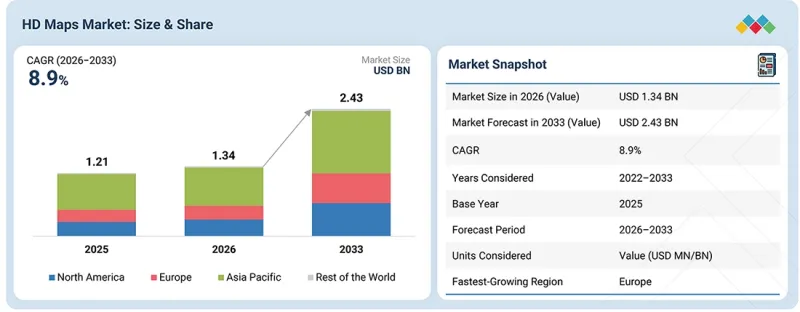
Embedded solution to hold a significant market share of the HD maps market during the forecast period.
Market demand for HD Maps is moving toward embedded map architectures that can keep critical road information available inside the vehicle while reducing dependence on continuous cloud connectivity. This is particularly relevant for functions requiring consistent localization and lane-level road context, where network latency or coverage gaps can affect map availability. HD map providers are also developing embedded map content with higher levels of road detail for automated driving functions. For instance, Dynamic Map Platform's Automotive HD Map provides high-precision, detailed road features, including lane geometry, road boundaries, and traffic-related attributes. Additionally, in June 2026, TMAP Mobility announced plans to commercialize its HD map-based 3D lane recognition navigation system in 2027, integrating HD maps with in-vehicle precise positioning and ADAS sensor recognition to provide lane-level guidance across highways and expressways. The market is also moving toward embedded maps that can be refreshed through the vehicle software lifecycle. For instance, Hyundai AutoEver distributes map and navigation updates through OTA, allowing map content stored in the vehicle to be updated without physical service intervention. As embedded mapping becomes more closely connected with vehicle computing, sensor fusion, and OTA infrastructure, competition is shifting toward solutions that can provide low-latency map access while efficiently managing map storage, update frequency, and connectivity requirements within the vehicle. This shift is strengthening demand for embedded HD map architectures that combine local availability with selective OTA updates, enabling OEMs to maintain reliable lane-level context while controlling onboard storage, connectivity dependence, and updating overhead as automated driving functions scale.
Autonomous vehicles are projected to grow at the fastest rate in the HD maps market during the forecast period.
The growth of the autonomous vehicles segment is being driven by the increasing use of HD maps as a core data layer for Level 4 autonomous driving in passenger cars and commercial vehicles. The expansion of L2+/L3 systems and emerging L4 deployment is increasing the need for precise, lane-level road intelligence, particularly for localization, lane topology, and predictive maneuvering. As autonomous vehicles expand into larger operating areas, the ability to create, update, and validate HD maps at scale is becoming as important as map accuracy itself. For instance, in May 2026, Mercedes-Benz announced that its urban point-to-point automated navigation would be available in selected German cities by the end of 2026, with nationwide rollout planned by early 2027, which is also moving automated driving into more complex urban environments. The system is designed for complex urban conditions including traffic lights, lane changes, and dense traffic, increasing the need for detailed road intelligence and precise localization.
OEMs are integrating HD maps directly into automated driving functions. For instance, Mercedes-Benz uses HERE HD Live Map within DRIVE PILOT to support autonomous driving. Similarly, BMW uses HD map information within its Personal Pilot L3 system for highway automated driving. Tier 1 suppliers are integrating HD maps with localization and sensor data. For instance, Bosch is combining vehicle-generated radar and video observations with map data, and ZF is integrating high-precision positioning and connectivity into its automated driving architecture to support higher levels of vehicle automation. For commercial vehicles, HD maps are supporting the expansion of automated driving across defined freight routes, such as DAF Trucks using HERE HD Live Map in the MODI project for Level 4 automated freight operations. As OEMs and Tier 1 suppliers integrate HD maps more deeply into localization, perception, and automated driving architectures, demand is shifting toward high-precision map content, sensor-based updates, cloud connectivity, and scalable geographic coverage, creating opportunities for HD map providers to become technology partners within higher automation vehicle platforms.
Europe is expected to grow at the fastest rate in the HD maps market during the forecast period.
In Europe, the demand is increasingly shifting toward HD map solutions that provide lane-level road geometry, high-precision positioning, road attributes, and frequently refreshed information for advanced passenger vehicle functions. The technical requirement is moving toward maintaining lane-level data across large road networks and integrating this information directly into vehicle software platforms. European passenger car OEMs are increasingly using HD maps as a data layer for automated driving functions. For instance, Volkswagen Group's software company CARIAD is using TomTom Orbis Maps for automated driving systems, while Lotus is integrating high-precision map data with its Highway Navigation Pilot for L2+ driving functions in Europe.
Additionally, HD maps in Europe are also moving toward richer 3D representations that capture road infrastructure and surrounding physical conditions in greater detail. For instance, Dynamic Map Platform provides high-precision 3D point cloud data of motorways and major arterial roads; MINDY Support has also provided enterprise-scale 3D HD map annotation and validation for ADAS and autonomous driving, covering more than 15,000 road infrastructure objects with centimeter-level positional accuracy checks as of February 2026. Across Europe, these market shifts are creating opportunities for HD map providers to combine high-precision lane-level data, frequently updated road information, and 3D road representations into scalable platforms that can support passenger vehicle automation, ADAS development, simulation, validation, and digital road applications.
In-depth interviews were conducted with CEOs, marketing directors, other innovation and technology directors, and executives from various key organizations operating in this market.
- By Company Type: OEM - 18%, Tier I - 74%, and Tier II/III - 8%
- By Designation: CXOs - 36%, Managers - 51%, and Executives - 13%
- By Region: North America - 24%, Europe - 30%, Asia Pacific - 38%, and RoW - 8%
The HD maps market is dominated by major players, including Baidu, Inc. (China), Mobileye (Israel), TomTom International BV (Netherlands), NVIDIA Corporation (US), and HERE (Netherlands). These companies offer highly detailed, lane-level HD maps with real-time updates, designed to support autonomous driving and ADAS. They also provide value-added services such as dynamic map layers (traffic, road conditions, and weather), cloud-based map delivery platforms, crowdsourced data integration, sensor fusion solutions, and software tools for path planning, localization, and navigation.
Research Coverage:
The report covers the HD maps market by Service Type (mapping & localization, update & maintenance, and advertisement), Vehicle Type (PC & CV), Solution Type (embedded & cloud-based), Usage Type, Level of Automation, and Region. It covers the competitive landscape and company profiles of the major HD maps market ecosystem players.
The study also includes an in-depth competitive analysis of key market players, along with company profiles, key observations on product and business offerings, recent developments, and key market strategies.
Key Benefits of Buying the Report:
- The report will help market leaders/new entrants with information on the closest approximations of revenue numbers for the overall HD maps market and its subsegments.
- This report will help stakeholders understand the competitive landscape and gain more insights to position their businesses better and plan suitable go-to-market strategies.
- The report also helps stakeholders understand the market pulse and provides information on key market drivers, restraints, challenges, and opportunities.
The report provides insight on the following pointers:
- Analysis of key drivers (Demand from OEMs for Continuously Refreshed rather than Static HD Maps, Integration of HD Maps into Autonomous Driving and Localization Stacks, and Increasing Adoption of L2 and L3 ADAS-Equipped Vehicles), restraints (High Cost of Creating and Maintaining Lane Level Map Coverage, and Increasing Capability of Onboard Perception to Reduce Dependence on Prebuilt HD Maps), opportunities (Vehicle Generated Data and Maps as a Service Enabling Scalable HD Map Creation and Continuous Updates, Growing Adoption of Dynamic HD Maps and 4D Mapping for Real Time Representation of Changing Road Conditions), and challenges (Maintaining Map Accuracy During Rapid Road Network Changes and Complex Real-time Merging of Multi-Sensor Data).
- Product Development/Innovation: Detailed insights on upcoming technologies and research & development activities in the HD maps market.
- Market Development: Comprehensive information about lucrative markets - the report analyzes the HD maps market across varied regions.
- Market Diversification: Exhaustive information about untapped geographies, recent developments, and investments in the HD maps market.
- Competitive Assessment: In-depth assessment of market share, growth strategies, and product offerings of leading players such as HERE (Netherlands), Baidu, Inc. (China), TomTom International BV (Netherlands), NVIDIA Corporation (US), and Mobileye (Israel) in the HD maps market.
TABLE OF CONTENTS
1 INTRODUCTION
- 1.1 STUDY OBJECTIVES
- 1.2 MARKET DEFINITION
- 1.3 STUDY SCOPE
- 1.3.1 MARKETS COVERED AND REGIONAL SCOPE
- 1.3.2 INCLUSIONS AND EXCLUSIONS
- 1.4 YEARS CONSIDERED
- 1.5 CURRENCY CONSIDERED
- 1.6 STAKEHOLDERS
- 1.7 SUMMARY OF CHANGES
2 EXECUTIVE SUMMARY
- 2.1 MARKET HIGHLIGHTS AND KEY INSIGHTS
- 2.2 KEY MARKET PARTICIPANTS: MAPPING OF STRATEGIC DEVELOPMENTS
- 2.3 DISRUPTIVE TRENDS IN HD MAPS MARKET
- 2.4 HIGH-GROWTH SEGMENTS
- 2.5 REGIONAL SNAPSHOT: MARKET SIZE, GROWTH RATE, AND FORECAST
3 PREMIUM INSIGHTS
- 3.1 ATTRACTIVE OPPORTUNITIES FOR PLAYERS IN HD MAPS MARKET
- 3.2 HD MAPS MARKET, BY SERVICE TYPE
- 3.3 HD MAPS MARKET, BY VEHICLE TYPE
- 3.4 HD MAPS MARKET, BY SOLUTION TYPE
- 3.5 HD MAPS MARKET, BY LEVEL OF AUTOMATION
- 3.6 HD MAPS MARKET, BY USAGE TYPE
- 3.7 HD MAPS MARKET, BY REGION
4 MARKET OVERVIEW
- 4.1 INTRODUCTION
- 4.2 MARKET DYNAMICS
- 4.2.1 DRIVERS
- 4.2.1.1 Shifting preference from static HD maps to updated map data
- 4.2.1.2 Rising integration of mapping, localization, and ADAS processing into shared software interfaces
- 4.2.1.3 Increasing adoption of L2 and L3 vehicles
- 4.2.2 RESTRAINTS
- 4.2.2.1 High costs of HD map creation and maintenance
- 4.2.2.2 Increasing capability of onboard perception
- 4.2.3 OPPORTUNITIES
- 4.2.3.1 Growing data generation from connected vehicles
- 4.2.3.2 Increasing reliance on dynamic HD maps and 4D mapping
- 4.2.4 CHALLENGES
- 4.2.4.1 Issues in maintaining map accuracy amid rapid road network changes
- 4.2.4.2 Complexities in achieving seamless multi-sensor fusion
- 4.2.1 DRIVERS
- 4.3 UNMET NEEDS AND WHITE SPACES
- 4.3.1 LACK OF STANDARDIZED HD MAP FORMATS AND INTERFACES ACROSS AUTONOMOUS DRIVING PLATFORMS
- 4.3.2 LIMITED COMMERCIAL MODELS FOR CONTINUOUS HD MAP UPDATES AND VEHICLE GENERATED MAP DATA
- 4.3.3 LACK OF SCALABLE MAP FRESHNESS AND AUTOMATED CHANGE VALIDATION
- 4.4 INTERCONNECTED MARKETS AND CROSS-SECTOR OPPORTUNITIES
- 4.5 STRATEGIC MOVES BY OEMS AND TIER-1/2/3 PLAYERS
5 INDUSTRY TRENDS
- 5.1 MACROECONOMIC OUTLOOK
- 5.1.1 INTRODUCTION
- 5.1.2 GDP TRENDS AND FORECAST
- 5.1.3 TRENDS IN GLOBAL MAPPING INDUSTRY
- 5.1.4 TRENDS IN GLOBAL AUTONOMOUS VEHICLE INDUSTRY
- 5.2 ECOSYSTEM ANALYSIS
- 5.3 SUPPLY CHAIN ANALYSIS
- 5.4 CASE STUDY ANALYSIS
- 5.4.1 MINDY SUPPORT DELIVERS ENTERPRISE-SCALE 3D HD MAP ANNOTATION AND VALIDATION FOR ADAS
- 5.4.2 HERE ENABLES HD MAP-BASED AUTOMATED DRIVING APPLICATIONS FOR GLOBAL OEMS
- 5.4.3 BAIDU AND TONGJI UNIVERSITY DEVELOP HISTORICAL MAP TRACKING FOR HD MAP CONSTRUCTION
- 5.4.4 MERCEDES-BENZ INTEGRATES HERE'S HD LIVE MAP INTO DRIVE PILOT SYSTEMS
- 5.4.5 INTELLIAS CONCEPTUALIZES, DEVELOPS, AND SCALES CLOUD-BASED HD MAPPING AND LOCATION DATA PLATFORM FOR AUTONOMOUS DRIVING
- 5.4.6 MAGNASOFT DEPLOYS AI-DRIVEN CONTINUOUS IMPROVEMENT PROCESSES THAT ENABLED REAL-TIME DETECTION OF CHANGES IN TRAFFIC PATTERNS AND ROAD CONDITIONS
- 5.4.7 INFOSYS ADOPTS MULTI-SOURCE HD MAPPING SOLUTION DESIGNED FOR ADAS IN URBAN ENVIRONMENTS
- 5.5 INVESTMENT AND FUNDING SCENARIO
- 5.6 TRADE ANALYSIS
- 5.6.1 IMPORT SCENARIO (HS CODE 852691)
- 5.6.2 EXPORT SCENARIO (HS CODE 852691)
- 5.7 KEY CONFERENCES AND EVENTS, 2026-2027
- 5.8 TRENDS/DISRUPTIONS IMPACTING CUSTOMER BUSINESS
6 TECHNOLOGICAL ADVANCEMENTS, AI-DRIVEN IMPACT, PATENTS, INNOVATIONS, AND FUTURE APPLICATIONS
- 6.1 KEY EMERGING TECHNOLOGIES
- 6.1.1 AI-BASED HD MAP GENERATION AND AUTOMATED FEATURE EXTRACTION
- 6.1.2 CROWD-SOURCED AND VEHICLE GENERATED HD MAPPING
- 6.1.3 DYNAMIC HD MAPS AND CONTINUOUS MAP UPDATING
- 6.1.4 CLOUD-BASED HD MAP PROCESSING AND DELIVERY
- 6.1.5 HIGH-PRECISION LOCALIZATION AND MAP MATCHING
- 6.2 COMPLEMENTARY TECHNOLOGIES
- 6.2.1 SENSOR FUSION
- 6.2.2 MACHINE LEARNING-POWERED MAP ANALYTICS
- 6.3 ADJACENT TECHNOLOGIES
- 6.3.1 DIGITAL TWIN AND SIMULATION
- 6.3.2 VEHICLE EDGE COMPUTING
- 6.4 TECHNOLOGY/PRODUCT ROADMAP
- 6.4.1 2D VS. 3D VS. 4D MAPPING
- 6.4.2 SEMANTIC HD MAPS
- 6.4.3 VECTORIZED HD MAPS
- 6.4.4 RASTER VS. VECTOR MAP ARCHITECTURE
- 6.4.5 CLOUD-BASED VS. EMBEDDED HD MAPS
- 6.4.6 EDGE/ONBOARD MAP PROCESSING
- 6.4.7 MAP HORIZON
- 6.4.8 HD MAP APIS AND DATA INTERFACES
- 6.4.9 ADASIS AND MAP DATA EXCHANGE
- 6.5 PATENT ANALYSIS
- 6.6 IMPACT OF AI/GEN AI ON HD MAPS MARKET
- 6.6.1 ACCELERATED MAP CREATION AND UPDATES
- 6.6.2 ENHANCED LOCALIZATION ACCURACY
- 6.6.3 COST REDUCTION THROUGH SYNTHETIC DATA
- 6.6.4 DYNAMIC MAP PERSONALIZATION
- 6.6.5 TOP USE CASES AND MARKET POTENTIAL
- 6.6.6 BEST PRACTICES FOLLOWED BY MANUFACTURERS/OEMS IN HD MAPS MARKET
- 6.6.7 CASE STUDIES RELATED TO AI/GEN IMPLEMENTATION IN HD MAPS MARKET
- 6.6.8 INTERCONNECTED ECOSYSTEM AND IMPACT ON MARKET PLAYERS
- 6.6.9 CLIENTS' READINESS TO ADOPT AI/GEN AI-INTEGRATED HD MAPS
- 6.7 PHASED ADOPTION STRATEGY OF HD MAPS IN AV ECOSYSTEM
- 6.7.1 ASSISTED DRIVING AND PILOT DEPLOYMENTS
- 6.7.2 LIMITED AUTONOMY IN CONTROLLED ENVIRONMENTS
- 6.7.3 EXPANDED COVERAGE AND REAL-TIME UPDATES
- 6.7.4 FULL AUTONOMY AND ECOSYSTEM INTEGRATION
- 6.8 HD MAP DATA FORMATS AND STANDARDIZATION LANDSCAPE
- 6.8.1 CORE COMPONENTS OF HD MAP DATA
- 6.8.1.1 Geometric layer
- 6.8.1.2 Semantic layer
- 6.8.1.3 Localization layer
- 6.8.1.4 Dynamic/Update layer
- 6.8.2 HD MAP: KEY STANDARDS AND FORMATS
- 6.8.1 CORE COMPONENTS OF HD MAP DATA
- 6.9 MNM INSIGHTS ON KEY INDUSTRY SOLUTIONS FOR LOCALIZATION
- 6.9.1 GNSS AND AUGMENTED POSITIONING
- 6.9.2 HD MAP-BASED LOCALIZATION
- 6.9.3 LIDAR AND CAMERA-BASED LOCALIZATION
- 6.9.4 SENSOR FUSION
- 6.9.5 V2X-ENABLED COOPERATIVE LOCALIZATION
- 6.10 EVOLVING BUSINESS MODELS FOR HD MAPPING IN AUTONOMOUS MOBILITY
- 6.10.1 LICENSING AND SUBSCRIPTION-BASED MODEL
- 6.10.2 CROWDSOURCED MAPPING AND DATA-AS-A-SERVICE (DAAS)
- 6.10.3 PAY-PER-USE MODEL
- 6.11 HYBRID MAPPING STRATEGIES FOR ENHANCING ADAS DEVELOPMENT
- 6.12 IMPACT OF MAPLESS AUTONOMY CONCEPT ON HD MAPS
- 6.13 ANALYSIS OF OEM HD MAPPING SOLUTIONS
- 6.14 HD MAPPING SERVICE PROVIDERS: COMPETITIVE LANDSCAPE
- 6.15 SUCCESS STORIES AND REAL-WORLD APPLICATIONS
- 6.15.1 WAYMO: COMMERCIAL ROBOTAXI OPERATIONS IN US
- 6.15.2 MOBILEYE REM: CROWDSOURCED HD MAPPING ACROSS EUROPE
- 6.15.3 BAIDU APOLLO GO: CHINA'S ROBOTAXI EXPANSION
- 6.15.4 DYNAMIC MAP PLATFORM: GLOBAL HD MAP DEPLOYMENT
- 6.16 FUTURE DEPLOYMENT AREAS FOR HD MAPS
- 6.16.1 AUTONOMOUS DELIVERY VEHICLES
- 6.16.2 PLATOONING SUPPORT
- 6.16.3 V2X INTEGRATION
- 6.16.4 DYNAMIC TRAFFIC ROUTING
- 6.16.5 FREIGHT CORRIDOR OPTIMIZATION
- 6.16.6 SMART CITY INTEGRATION
- 6.16.7 AUTONOMOUS RIDE HAILING AND SHUTTLES
- 6.17 HD MAP MONETIZATION AND REVENUE MODELS
- 6.17.1 MAP LICENSE
- 6.17.2 PER-VEHICLE LICENSING
- 6.17.3 ANNUAL SUBSCRIPTION
- 6.17.4 PER-KILOMETER PRICING
- 6.17.5 API-BASED PRICING
- 6.17.6 CLOUD MAP SUBSCRIPTION
- 6.17.7 UPDATE/MAINTENANCE FEES
- 6.17.8 DATA-AS-A-SERVICE
- 6.17.9 MAP-AS-A-SERVICE
- 6.17.10 REVENUE SHARING WITH OEMS
- 6.17.11 BUNDLED HD MAP + LOCALIZATION
- 6.17.12 BUNDLED MAP + ADAS SOFTWARE
- 6.18 OEM HD MAP DEPENDENCY AND STRATEGY ANALYSIS
- 6.18.1 OEM FLEET DATA STRATEGY
- 6.18.2 OEM-OWNED MAPPING ASSETS
- 6.18.3 OEM-MAP PROVIDER PARTNERSHIPS
- 6.18.4 OEM-CLOUD PROVIDER PARTNERSHIPS
- 6.18.5 OEM-AV SOFTWARE INTEGRATION
- 6.19 OEM MAP LOCALIZATION STRATEGY, BY REGION
- 6.19.1 ASIA PACIFIC
- 6.19.2 EUROPE
- 6.19.3 NORTH AMERICA
- 6.20 REGIONAL OEM STRATEGIES FOR HD MAP ADOPTION
- 6.21 HD MAP PROVIDER STRATEGIC CAPABILITY BENCHMARK
- 6.21.1 GLOBAL ROAD COVERAGE
- 6.21.2 MAP ACCURACY
- 6.21.3 MAP UPDATE CAPABILITY
- 6.21.4 CROWDSOURCED DATA SCALE
- 6.21.5 OEM INTEGRATION
- 6.21.6 AUTONOMOUS DRIVING CAPABILITY
- 6.21.7 COMMERCIAL MODEL
- 6.22 EVOLUTION OF HD MAPS FOR AUTONOMOUS DRIVING
- 6.22.1 EVOLUTION FROM SD MAPS TO DYNAMIC HD MAPS
- 6.22.2 EVOLUTION FROM STATIC MAP TO CONTINUOUSLY UPDATED MAP
- 6.23 HD MAPS: TOTAL COST OF OWNERSHIP ANALYSIS
- 6.23.1 OEM TOTAL COST OF OWNERSHIP PER VEHICLE
- 6.23.2 HD MAP SUPPLIER TOTAL COST OF OWNERSHIP PER KILOMETER
7 REGULATORY LANDSCAPE AND SUSTAINABILITY INITIATIVES
- 7.1 REGULATORY LANDSCAPE
- 7.1.1 REGULATORY BODIES, GOVERNMENT AGENCIES, AND OTHER ORGANIZATIONS
- 7.1.1.1 North America
- 7.1.1.2 Europe
- 7.1.1.3 Asia Pacific
- 7.1.1.4 RoW
- 7.1.2 KEY REGULATIONS
- 7.1.2.1 US
- 7.1.2.2 Germany
- 7.1.2.3 China
- 7.1.2.4 Japan
- 7.1.2.5 South Korea
- 7.1.2.6 UK
- 7.1.3 REGULATIONS AND INITIATIVES FOR ADAS
- 7.1.3.1 US
- 7.1.3.2 China
- 7.1.3.3 Japan
- 7.1.3.4 European Union
- 7.1.3.5 UK
- 7.1.3.6 Germany
- 7.1.3.7 France
- 7.1.3.8 India
- 7.1.4 NCAP REGULATIONS
- 7.1.4.1 US
- 7.1.4.2 Europe
- 7.1.4.3 Australia & New Zealand
- 7.1.4.4 South Korea
- 7.1.4.5 China
- 7.1.4.6 Latin America
- 7.1.4.7 Southeast Asia
- 7.1.4.8 India
- 7.1.1 REGULATORY BODIES, GOVERNMENT AGENCIES, AND OTHER ORGANIZATIONS
- 7.2 SUSTAINABILITY INITIATIVES
- 7.2.1 CHINA: INTELLIGENT CONNECTED VEHICLE AND DIGITAL ROAD INFRASTRUCTURE INITIATIVES
- 7.2.2 EUROPE: DIGITAL AND SUSTAINABLE TRANSPORT INFRASTRUCTURE INITIATIVES
- 7.2.3 US: SMART TRANSPORTATION AND CONNECTED VEHICLE INITIATIVES
- 7.2.4 JAPAN: SMART ROAD AND CONNECTED MOBILITY INITIATIVES
- 7.2.5 SOUTH KOREA: INTELLIGENT TRANSPORTATION AND AUTONOMOUS MOBILITY INITIATIVES
- 7.2.6 UAE: SMART MOBILITY AND DIGITAL ROAD INFRASTRUCTURE INITIATIVES
- 7.2.7 INDIA: INTELLIGENT TRANSPORTATION AND DIGITAL ROAD INFRASTRUCTURE INITIATIVES
- 7.2.8 GERMANY: SMART ROAD AND AUTOMATED DRIVING INFRASTRUCTURE INITIATIVES
- 7.3 IMPACT OF REGULATORY POLICIES ON SUSTAINABILITY INITIATIVES
8 CUSTOMER LANDSCAPE AND BUYER BEHAVIOR
- 8.1 DECISION-MAKING PROCESS
- 8.2 KEY STAKEHOLDERS INVOLVED IN BUYING PROCESS AND THEIR EVALUATION CRITERIA
- 8.2.1 KEY STAKEHOLDERS IN BUYING PROCESS
- 8.2.2 BUYING CRITERIA
- 8.3 ADOPTION BARRIERS AND INTERNAL CHALLENGES
- 8.3.1 MARKET PROFITABILITY
- 8.3.2 REVENUE POTENTIAL
- 8.3.3 COST DYNAMICS
- 8.3.4 MARGIN OPPORTUNITIES, BY APPLICATION
9 HD MAPS MARKET, BY LEVEL OF AUTOMATION
- 9.1 INTRODUCTION
- 9.2 SEMI-AUTONOMOUS VEHICLE
- 9.2.1 LEVEL 2/2+
- 9.2.1.1 Strong focus on safety, convenience, and ADAS regulation compliance to foster segmental growth
- 9.2.2 LEVEL 3
- 9.2.2.1 High emphasis on precise localization and safe driving during traffic congestion to boost segmental growth
- 9.2.1 LEVEL 2/2+
- 9.3 AUTONOMOUS VEHICLE
- 9.3.1 LEVEL 4
- 9.3.1.1 Ability to tackle complex driving situations and operate under pretrained or predefined conditions to fuel segmental growth
- 9.3.2 LEVEL 5
- 9.3.2.1 Focus on enabling fully driverless operation to contribute to segmental growth
- 9.3.1 LEVEL 4
- 9.4 KEY PRIMARY INSIGHTS
10 HD MAPS MARKET, BY SERVICE TYPE
- 10.1 INTRODUCTION
- 10.2 MAPPING & LOCALIZATION
- 10.2.1 RAPID ADVANCES IN AI, MACHINE LEARNING, AND SENSOR TECHNOLOGIES TO EXPEDITE SEGMENTAL GROWTH
- 10.3 UPDATE & MAINTENANCE
- 10.3.1 GROWING EMPHASIS ON MAINTAINING PRECISION IN AUTONOMOUS DRIVING AND ADJUSTING TO CHANGING ENVIRONMENTS TO DRIVE MARKET
- 10.4 ADVERTISEMENT
- 10.5 KEY PRIMARY INSIGHTS
11 HD MAPS MARKET, BY SOLUTION TYPE
- 11.1 INTRODUCTION
- 11.2 EMBEDDED
- 11.2.1 USE TO OFFER REAL-TIME, HIGH-PRECISION LOCALIZATION AND NAVIGATION TO AUGMENT SEGMENTAL GROWTH
- 11.3 CLOUD-BASED
- 11.3.1 ABILITY TO MAKE CONTINUOUS UPDATES AND PROCESS VAST AMOUNTS OF DATA FROM SENSORS AND CAMERAS TO SPUR DEMAND
- 11.4 KEY PRIMARY INSIGHTS
12 HD MAPS MARKET, BY USAGE TYPE
- 12.1 INTRODUCTION
- 12.2 PERSONAL MOBILITY
- 12.2.1 GROWING DEMAND FOR ADAS-EQUIPPED PASSENGER CARS TO ACCELERATE SEGMENTAL GROWTH
- 12.3 COMMERCIAL MOBILITY
- 12.3.1 RISING POPULARITY OF E-COMMERCE AND DEMAND FOR EFFICIENT DELIVERY AND TRANSPORT TO FUEL SEGMENTAL GROWTH
- 12.4 KEY PRIMARY INSIGHTS
13 HD MAPS MARKET, BY VEHICLE TYPE
- 13.1 INTRODUCTION
- 13.2 PASSENGER CAR
- 13.2.1 GROWING INTEGRATION OF ADAS AND SEMI-AUTONOMOUS FEATURES INTO MID- TO HIGH-END VEHICLES TO FACILITATE SEGMENTAL GROWTH
- 13.3 COMMERCIAL VEHICLE
- 13.3.1 HIGH EMPHASIS ON SUPPORTING ROUTE OPTIMIZATION, PREDICTIVE MAINTENANCE, AND LIVE TRAFFIC MONITORING TO DRIVE MARKET
- 13.4 KEY PRIMARY INSIGHTS
14 HD MAPS MARKET, BY REGION
- 14.1 INTRODUCTION
- 14.2 ASIA PACIFIC
- 14.2.1 INCREASING INVESTMENT IN AUTONOMOUS DRIVING AND ADVANCED MAPPING TECHNOLOGIES TO DRIVE MARKET
- 14.2.2 CHINA
- 14.2.3 INDIA
- 14.2.4 JAPAN
- 14.2.5 SOUTH KOREA
- 14.3 EUROPE
- 14.3.1 RISING REGULATORY FOCUS ON VEHICLE SAFETY AND AUTONOMOUS DRIVING TO FOSTER MARKET GROWTH
- 14.3.2 GERMANY
- 14.3.3 FRANCE
- 14.3.4 ITALY
- 14.3.5 SPAIN
- 14.3.6 UK
- 14.4 NORTH AMERICA
- 14.4.1 MOUNTING ADOPTION OF CONNECTED AND INTELLIGENT VEHICLE TECHNOLOGIES TO BOOST MARKET GROWTH
- 14.4.2 US
- 14.4.3 CANADA
- 14.4.4 MEXICO
- 14.5 ROW
- 14.5.1 INCREASING SMART MOBILITY INVESTMENT AND TECHNOLOGY PARTNERSHIPS TO AUGMENT MARKET GROWTH
- 14.5.2 BRAZIL
- 14.5.3 SOUTH AFRICA
- 14.5.4 RUSSIA
- 14.5.5 SAUDI ARABIA
- 14.5.6 UAE
15 COMPETITIVE LANDSCAPE
- 15.1 OVERVIEW
- 15.2 KEY PLAYER COMPETITIVE STRATEGIES/RIGHT TO WIN, 2024-2026
- 15.3 MARKET SHARE ANALYSIS, 2025
- 15.4 REVENUE ANALYSIS, 2021-2025
- 15.5 COMPANY VALUATION AND FINANCIAL METRICS
- 15.6 BRAND/PRODUCT COMPARISON
- 15.6.1 HERE (NETHERLANDS)
- 15.6.2 BAIDU (CHINA)
- 15.6.3 TOMTOM INTERNATIONAL BV (NETHERLANDS)
- 15.6.4 NVIDIA CORPORATION (US)
- 15.6.5 MOBILEYE (ISRAEL)
- 15.7 COMPANY EVALUATION MATRIX: KEY PLAYERS, 2025
- 15.7.1 STARS
- 15.7.2 EMERGING LEADERS
- 15.7.3 PERVASIVE PLAYERS
- 15.7.4 PARTICIPANTS
- 15.7.5 COMPANY FOOTPRINT: KEY PLAYERS, 2025
- 15.7.5.1 Company footprint
- 15.7.5.2 Region footprint
- 15.7.5.3 Usage type footprint
- 15.7.5.4 Vehicle type footprint
- 15.7.5.5 Level of automation footprint
- 15.8 COMPANY EVALUATION MATRIX: STARTUPS/SMES, 2025
- 15.8.1 PROGRESSIVE COMPANIES
- 15.8.2 RESPONSIVE COMPANIES
- 15.8.3 DYNAMIC COMPANIES
- 15.8.4 STARTING BLOCKS
- 15.8.5 COMPETITIVE BENCHMARKING: STARTUPS/SMES, 2025
- 15.8.5.1 Detailed list of key startups/SMEs
- 15.8.5.2 Competitive benchmarking of key startups/SMEs
- 15.9 COMPETITIVE SCENARIO
- 15.9.1 PRODUCT/SERVICE LAUNCHES/DEVELOPMENTS
- 15.9.2 DEALS
- 15.9.3 EXPANSIONS
- 15.9.4 OTHER DEVELOPMENTS
16 COMPANY PROFILES
- 16.1 KEY PLAYERS
- 16.1.1 HERE
- 16.1.1.1 Business overview
- 16.1.1.2 Products/Solutions/Services offered
- 16.1.1.3 Recent developments
- 16.1.1.3.1 Deals
- 16.1.1.3.2 Other developments
- 16.1.1.4 MnM view
- 16.1.1.4.1 Key strengths/Right to win
- 16.1.1.4.2 Strategic choices
- 16.1.1.4.3 Weaknesses/Competitive threats
- 16.1.2 BAIDU
- 16.1.2.1 Business overview
- 16.1.2.2 Products/Solutions/Services offered
- 16.1.2.3 Recent developments
- 16.1.2.3.1 Deals
- 16.1.2.4 MnM view
- 16.1.2.4.1 Key strengths/Right to win
- 16.1.2.4.2 Strategic choices
- 16.1.2.4.3 Weaknesses/Competitive threats
- 16.1.3 TOMTOM INTERNATIONAL BV
- 16.1.3.1 Business overview
- 16.1.3.2 Products/Solutions/Services offered
- 16.1.3.3 Recent developments
- 16.1.3.3.1 Product/Service launches/enhancements
- 16.1.3.3.2 Deals
- 16.1.3.3.3 Other developments
- 16.1.3.4 MnM view
- 16.1.3.4.1 Key strengths/Right to win
- 16.1.3.4.2 Strategic choices
- 16.1.3.4.3 Weaknesses/Competitive threats
- 16.1.4 NVIDIA CORPORATION
- 16.1.4.1 Business overview
- 16.1.4.2 Products/Solutions/Services offered
- 16.1.4.3 Recent developments
- 16.1.4.3.1 Deals
- 16.1.4.4 MnM view
- 16.1.4.4.1 Key strengths/Right to win
- 16.1.4.4.2 Strategic choices
- 16.1.4.4.3 Weaknesses/Competitive threats
- 16.1.5 MOBILEYE
- 16.1.5.1 Business overview
- 16.1.5.2 Products/Solutions/Services offered
- 16.1.5.3 Recent developments
- 16.1.5.3.1 Deals
- 16.1.5.3.2 Other developments
- 16.1.5.4 MnM view
- 16.1.5.4.1 Key strengths/Right to win
- 16.1.5.4.2 Strategic choices
- 16.1.5.4.3 Weaknesses/Competitive threats
- 16.1.6 WAYMO LLC
- 16.1.6.1 Business overview
- 16.1.6.2 Products/Solutions/Services offered
- 16.1.6.3 Recent developments
- 16.1.6.3.1 Deals
- 16.1.6.3.2 Expansions
- 16.1.6.3.3 Other developments
- 16.1.7 DYNAMIC MAP PLATFORM CO., LTD.
- 16.1.7.1 Business overview
- 16.1.7.2 Products/Solutions/Services offered
- 16.1.7.3 Recent developments
- 16.1.7.3.1 Product/Service launches/enhancements
- 16.1.7.3.2 Deals
- 16.1.7.3.3 Expansions
- 16.1.7.3.4 Other developments
- 16.1.8 NAVINFO CO., LTD.
- 16.1.8.1 Business overview
- 16.1.8.2 Products/Solutions/Services offered
- 16.1.8.3 Recent developments
- 16.1.8.3.1 Deals
- 16.1.8.3.2 Other developments
- 16.1.9 THE SANBORN MAP COMPANY, INC.
- 16.1.9.1 Business overview
- 16.1.9.2 Products/Solutions/Services offered
- 16.1.9.3 Recent developments
- 16.1.9.3.1 Developments
- 16.1.10 MOMENTA
- 16.1.10.1 Business overview
- 16.1.10.2 Products/Solutions/Services offered
- 16.1.11 MAPBOX
- 16.1.11.1 Business overview
- 16.1.11.2 Products/Solutions/Services offered
- 16.1.11.3 Recent developments
- 16.1.11.3.1 Product/Service launches/enhancements
- 16.1.11.3.2 Deals
- 16.1.12 CE INFO SYSTEMS LTD.
- 16.1.12.1 Business overview
- 16.1.12.2 Products/Solutions/Services offered
- 16.1.12.3 Recent developments
- 16.1.12.3.1 Deals
- 16.1.1 HERE
- 16.2 OTHER PLAYERS
- 16.2.1 NAVMII
- 16.2.2 RMSI
- 16.2.3 ZENRIN CO., LTD.
- 16.2.4 WOVEN BY TOYOTA, INC.
- 16.2.5 SWIFT NAVIGATION, INC.
- 16.2.6 EXLSERVICE HOLDINGS, INC.
- 16.2.7 ROBOTIC DATA
- 16.2.8 HYUNDAI AUTOEVER CORP.
- 16.2.9 GENESYS INTERNATIONAL CORPORATION LTD
- 16.2.10 GEOMATE
- 16.2.11 INTELLIAS
- 16.2.12 MORAI INC.
- 16.2.13 TRIMBLE INC.
17 RESEARCH METHODOLOGY
- 17.1 RESEARCH DATA
- 17.1.1 SECONDARY DATA
- 17.1.1.1 List of key secondary sources
- 17.1.1.2 Key data from secondary sources
- 17.1.2 PRIMARY DATA
- 17.1.2.1 Key data from primary sources
- 17.1.2.2 Key industry insights
- 17.1.2.3 List of primary interview participants
- 17.1.2.4 Breakdown of primary interviews
- 17.1.1 SECONDARY DATA
- 17.2 MARKET SIZE ESTIMATION
- 17.2.1 TOP-DOWN APPROACH
- 17.2.2 MARKET FORECAST APPROACH
- 17.2.2.1 Supply side
- 17.2.2.2 Demand side
- 17.3 DATA TRIANGULATION
- 17.4 FACTOR ANALYSIS
- 17.5 RESEARCH ASSUMPTIONS
- 17.6 RESEARCH LIMITATIONS
- 17.7 RISK ANALYSIS
18 APPENDIX
- 18.1 DISCUSSION GUIDE
- 18.2 KNOWLEDGESTORE: MARKETSANDMARKETS' SUBSCRIPTION PORTAL
- 18.3 CUSTOMIZATION OPTIONS
- 18.3.1 HD MAPS MARKET, BY SEMI AUTONOMOUS VEHICLES, AT REGIONAL LEVEL
- 18.3.2 HD MAPS MARKET, BY AUTONOMOUS VEHICLES, AT REGIONAL LEVEL
- 18.3.3 HD MAPS MARKET, BY VEHICLE TYPE, BY LEVEL OF AUTOMATION
- 18.3.4 COMPANY INFORMATION
- 18.3.4.1 Profiling of additional market players (up to five)
- 18.4 RELATED REPORTS
- 18.5 AUTHOR DETAILS
List of Tables
- TABLE 1 HD MAPS MARKET DEFINITION, BY SERVICE TYPE
- TABLE 2 HD MAPS MARKET DEFINITION, BY LEVEL OF AUTOMATION
- TABLE 3 HD MAPS MARKET DEFINITION, BY SOLUTION TYPE
- TABLE 4 HD MAPS MARKET DEFINITION, BY VEHICLE TYPE
- TABLE 5 HD MAPS MARKET DEFINITION, BY USAGE TYPE
- TABLE 6 HD MAPS MARKET: INCLUSIONS AND EXCLUSIONS
- TABLE 7 USD EXCHANGE RATES, 2021-2025
- TABLE 8 OEMS OFFERING HD MAPS IN L2/L3 VEHICLES
- TABLE 9 PREBUILT HD MAPS VS. ONBOARD PERCEPTION
- TABLE 10 HD MAP MONETIZATION OPPORTUNITIES FROM VEHICLE GENERATED DATA
- TABLE 11 IMPACT OF MARKET DYNAMICS
- TABLE 12 STRATEGIC FOCUS OF OEMS AND TIER-1/2/3 PLAYERS
- TABLE 13 GDP PERCENTAGE CHANGE, BY COUNTRY, 2021-2030
- TABLE 14 ROLE OF COMPANIES IN HD MAPS ECOSYSTEM
- TABLE 15 GERMAN AUTOMOTIVE TECHNOLOGY SUPPLIER ADOPTS MINDY SUPPORT'S 3D HD MAP ANNOTATION FOR ADAS AND AUTOMATED DRIVING PROGRAMS
- TABLE 16 AUTOMAKERS LEVERAGE HERE'S HD LIVE MAP TO SUPPORT AUTOMATED DRIVING FUNCTIONS
- TABLE 17 RESEARCHERS FROM BAIDU AND TONGJI UNIVERSITY DEVELOP HISTORICAL MAP TRACKING FOR HD MAP CONSTRUCTION FRAMEWORK TO IMPROVE CONSISTENCY OF MAP ELEMENTS
- TABLE 18 MERCEDES-BENZ INTEGRATES HERE'S HD LIVE MAP INTO DRIVE PILOT SYSTEM TO IMPROVE ENVIRONMENTAL AWARENESS
- TABLE 19 LOCATION-BASED SERVICES PROVIDER PARTNERS WITH INTELLIAS TO DEVELOP AND SCALE CLOUD-BASED HD MAPPING AND LOCATION DATA PLATFORM FOR AUTONOMOUS DRIVING
- TABLE 20 MAGNASOFT HELPS AUTONOMOUS MIDDLE-MILE DELIVERY SERVICE PROVIDER ACHIEVE COMPREHENSIVE HD MAPPING OF ROAD CONDITIONS
- TABLE 21 INFOSYS DEPLOYS MULTI-SOURCE HD MAPPING SOLUTION FOR ADAS IN URBAN ENVIRONMENTS TO IMPROVE NAVIGATION ACCURACY
- TABLE 22 FUNDING DETAILS, 2024-2026
- TABLE 23 IMPORT DATA FOR HS CODE 852691-COMPLIANT PRODUCTS, BY COUNTRY, 2021-2025 (USD MILLION)
- TABLE 24 EXPORT DATA FOR HS CODE 852691-COMPLIANT PRODUCTS, BY COUNTRY, 2021-2025 (USD MILLION)
- TABLE 25 LIST OF KEY CONFERENCES AND EVENTS, 2026-2027
- TABLE 26 AI-BASED HD MAP GENERATION AND AUTOMATED FEATURE EXTRACTION: KEY INDUSTRY APPLICATIONS
- TABLE 27 DYNAMIC HD MAPS AND CONTINUOUS MAP UPDATING: KEY INDUSTRY APPLICATIONS
- TABLE 28 CLOUD-BASED HD MAP PROCESSING AND DELIVERY: KEY INDUSTRY APPLICATIONS
- TABLE 29 LIDAR VS. CAMERA VS. RADAR SENSORS
- TABLE 30 TECHNOLOGY/PRODUCT ROADMAP IN HD MAPS MARKET
- TABLE 31 LIST OF KEY PATENTS, 2024-2026
- TABLE 32 BEST PRACTICES FOLLOWED BY MANUFACTURERS
- TABLE 33 AI-BASED LANE DETECTION AND HD MAP AUTOMATION FOR AUTONOMOUS DRIVING
- TABLE 34 AI-BASED HD MAP AUTOMATION AND CHANGE DETECTION
- TABLE 35 AI-BASED HD MAP LABELING AND MULTI SENSOR DATA ANNOTATION
- TABLE 36 IMPACT OF ECOSYSTEM PARTICIPANTS ON HD MAPS MARKET
- TABLE 37 STANDARDS AND FORMATS OF HD MAPS
- TABLE 38 LICENSING AND SUBSCRIPTION-BASED MODEL
- TABLE 39 CROWDSOURCED MAPPING AND DATA-AS-A-SERVICE MODEL
- TABLE 40 PAY-PER-USE MODEL
- TABLE 41 MAPLESS AUTONOMY, KEY COMPANY APPROACHES, AND IMPACT ON HD MAP DEMAND
- TABLE 42 HD MAPPING SOLUTIONS, BY KEY OEM (1/2)
- TABLE 43 HD MAPPING SOLUTIONS, BY KEY OEM (2/2)
- TABLE 44 HD MAPPING SERVICE PROVIDERS: COMPETITIVE LANDSCAPE (1/2)
- TABLE 45 HD MAPPING SERVICE PROVIDERS: COMPETITIVE LANDSCAPE (2/2)
- TABLE 46 HD MAP MONETIZATION AND REVENUE MODELS
- TABLE 47 KEY OEM FLEET DATA STRATEGY
- TABLE 48 OEM-OWNED MAPPING ASSETS
- TABLE 49 OEM-MAP PROVIDER PARTNERSHIPS
- TABLE 50 OEM-CLOUD PROVIDER PARTNERSHIPS
- TABLE 51 OEM-AV SOFTWARE INTEGRATION
- TABLE 52 ASIA PACIFIC: OEM MAP LOCALIZATION STRATEGY
- TABLE 53 EUROPE: OEM MAP LOCALIZATION STRATEGY
- TABLE 54 NORTH AMERICA: OEM MAP LOCALIZATION STRATEGY
- TABLE 55 REGIONAL OEM STRATEGIES FOR HD MAP ADOPTION
- TABLE 56 HD MAP PROVIDERS STRATEGIC BENCHMARK
- TABLE 57 NORTH AMERICA: REGULATORY BODIES, GOVERNMENT AGENCIES, AND OTHER ORGANIZATIONS
- TABLE 58 EUROPE: REGULATORY BODIES, GOVERNMENT AGENCIES, AND OTHER ORGANIZATIONS
- TABLE 59 ASIA PACIFIC: REGULATORY BODIES, GOVERNMENT AGENCIES, AND OTHER ORGANIZATIONS
- TABLE 60 ROW: REGULATORY BODIES, GOVERNMENT AGENCIES, AND OTHER ORGANIZATIONS
- TABLE 61 US: KEY REGULATIONS
- TABLE 62 GERMANY: KEY REGULATIONS
- TABLE 63 CHINA: KEY REGULATIONS
- TABLE 64 JAPAN: KEY REGULATIONS
- TABLE 65 SOUTH KOREA: KEY REGULATIONS
- TABLE 66 UK: KEY REGULATIONS
- TABLE 67 US: REGULATIONS AND INITIATIVES FOR ADAS
- TABLE 68 CHINA: REGULATIONS AND INITIATIVES FOR ADAS
- TABLE 69 JAPAN: REGULATIONS AND INITIATIVES FOR ADAS
- TABLE 70 EUROPEAN UNION: REGULATIONS AND INITIATIVES FOR ADAS
- TABLE 71 UK: REGULATIONS AND INITIATIVES FOR ADAS
- TABLE 72 GERMANY: REGULATIONS AND INITIATIVES FOR ADAS
- TABLE 73 FRANCE: REGULATIONS AND INITIATIVES FOR ADAS
- TABLE 74 INDIA: REGULATIONS AND INITIATIVES FOR ADAS
- TABLE 75 US: NCAP REGULATIONS
- TABLE 76 EUROPE: NCAP REGULATIONS
- TABLE 77 AUSTRALIA & NEW ZEALAND: NCAP REGULATIONS
- TABLE 78 SOUTH KOREA: NCAP REGULATIONS
- TABLE 79 CHINA: NCAP REGULATIONS
- TABLE 80 LATIN AMERICA: NCAP REGULATIONS
- TABLE 81 SOUTHEAST ASIA: NCAP REGULATIONS
- TABLE 82 INDIA: NCAP REGULATIONS
- TABLE 83 INFLUENCE OF STAKEHOLDERS ON BUYING PROCESS, BY VEHICLE TYPE (%)
- TABLE 84 BUYING CRITERIA, BY VEHICLE TYPE
- TABLE 85 HD MAPS MARKET, BY LEVEL OF AUTOMATION, 2022-2025 (USD MILLION)
- TABLE 86 HD MAPS MARKET, BY LEVEL OF AUTOMATION, 2026-2033 (USD MILLION)
- TABLE 87 SEMI-AUTONOMOUS VEHICLE: HD MAPS MARKET, BY AUTOMATION LEVEL, 2022-2025 (USD MILLION)
- TABLE 88 SEMI-AUTONOMOUS VEHICLE: HD MAPS MARKET, BY AUTOMATION LEVEL, 2026-2033 (USD MILLION)
- TABLE 89 SEMI-AUTONOMOUS VEHICLE: HD MAPS MARKET, BY REGION, 2022-2025 (USD MILLION)
- TABLE 90 SEMI-AUTONOMOUS VEHICLE: HD MAPS MARKET, BY REGION, 2026-2033 (USD MILLION)
- TABLE 91 AUTONOMOUS VEHICLE: HD MAPS MARKET, BY AUTOMATION LEVEL, 2022-2025 (USD MILLION)
- TABLE 92 AUTONOMOUS VEHICLE: HD MAPS MARKET, BY AUTOMATION LEVEL, 2026-2033 (USD MILLION)
- TABLE 93 AUTONOMOUS VEHICLE: HD MAPS MARKET, BY REGION, 2022-2025 (USD MILLION)
- TABLE 94 AUTONOMOUS VEHICLE: HD MAPS MARKET, BY REGION, 2026-2033 (USD MILLION)
- TABLE 95 HD MAPS MARKET, BY SERVICE TYPE, 2022-2025 (USD MILLION)
- TABLE 96 HD MAPS MARKET, BY SERVICE TYPE, 2026-2033 (USD MILLION)
- TABLE 97 MAPPING & LOCALIZATION: HD MAPS MARKET, BY REGION, 2022-2025 (USD MILLION)
- TABLE 98 MAPPING & LOCALIZATION: HD MAPS MARKET, BY REGION, 2026-2033 (USD MILLION)
- TABLE 99 UPDATE & MAINTENANCE: HD MAPS MARKET, BY REGION, 2022-2025 (USD MILLION)
- TABLE 100 UPDATE & MAINTENANCE: HD MAPS MARKET, BY REGION, 2026-2033 (USD MILLION)
- TABLE 101 HD MAPS MARKET, BY SOLUTION TYPE, 2022-2025 (USD MILLION)
- TABLE 102 HD MAPS MARKET, BY SOLUTION TYPE, 2026-2033 (USD MILLION)
- TABLE 103 EMBEDDED: HD MAPS MARKET, BY REGION, 2022-2025 (USD MILLION)
- TABLE 104 EMBEDDED: HD MAPS MARKET, BY REGION, 2026-2033 (USD MILLION)
- TABLE 105 CLOUD-BASED: HD MAPS MARKET, BY REGION, 2022-2025 (USD MILLION)
- TABLE 106 CLOUD-BASED: HD MAPS MARKET, BY REGION, 2026-2033 (USD MILLION)
- TABLE 107 HD MAPS MARKET, BY USAGE TYPE, 2022-2025 (USD MILLION)
- TABLE 108 HD MAPS MARKET, BY USAGE TYPE, 2026-2033 (USD MILLION)
- TABLE 109 PERSONAL MOBILITY: HD MAPS MARKET, BY REGION, 2022-2025 (USD MILLION)
- TABLE 110 PERSONAL MOBILITY: HD MAPS MARKET, BY REGION, 2026-2033 (USD MILLION)
- TABLE 111 COMMERCIAL MOBILITY: HD MAPS MARKET, BY REGION, 2022-2025 (USD MILLION)
- TABLE 112 COMMERCIAL MOBILITY: HD MAPS MARKET, BY REGION, 2026-2033 (USD MILLION)
- TABLE 113 HD MAPS MARKET, BY VEHICLE TYPE, 2022-2025 (USD MILLION)
- TABLE 114 HD MAPS MARKET, BY VEHICLE TYPE, 2026-2033 (USD MILLION)
- TABLE 115 OEMS PROVIDING HD MAPS IN PASSENGER CARS
- TABLE 116 PASSENGER CAR: HD MAPS MARKET, BY REGION, 2022-2025 (USD MILLION)
- TABLE 117 PASSENGER CAR: HD MAPS MARKET, BY REGION, 2026-2033 (USD MILLION)
- TABLE 118 COMMERCIAL VEHICLE: HD MAPS MARKET, BY REGION, 2022-2025 (USD MILLION)
- TABLE 119 COMMERCIAL VEHICLE: HD MAPS MARKET, BY REGION, 2026-2033 (USD MILLION)
- TABLE 120 HD MAPS MARKET, BY REGION, 2022-2025 (USD MILLION)
- TABLE 121 HD MAPS MARKET, BY REGION, 2026-2033 (USD MILLION)
- TABLE 122 ASIA PACIFIC: HD MAPS MARKET, BY VEHICLE TYPE, 2022-2025 (USD MILLION)
- TABLE 123 ASIA PACIFIC: HD MAPS MARKET, BY VEHICLE TYPE, 2026-2033 (USD MILLION)
- TABLE 124 ASIA PACIFIC: HD MAPS MARKET, BY LEVEL OF AUTOMATION, 2022-2025 (USD MILLION)
- TABLE 125 ASIA PACIFIC: HD MAPS MARKET, BY LEVEL OF AUTOMATION, 2026-2033 (USD MILLION)
- TABLE 126 ASIA PACIFIC: HD MAPS MARKET, BY USAGE TYPE, 2022-2025 (USD MILLION)
- TABLE 127 ASIA PACIFIC: HD MAPS MARKET, BY USAGE TYPE, 2026-2033 (USD MILLION)
- TABLE 128 ASIA PACIFIC: HD MAPS MARKET, BY SOLUTION TYPE, 2022-2025 (USD MILLION)
- TABLE 129 ASIA PACIFIC: HD MAPS MARKET, BY SOLUTION TYPE, 2026-2033 (USD MILLION)
- TABLE 130 ASIA PACIFIC: HD MAPS MARKET, BY SERVICE TYPE, 2022-2025 (USD MILLION)
- TABLE 131 ASIA PACIFIC: HD MAPS MARKET, BY SERVICE TYPE, 2026-2033 (USD MILLION)
- TABLE 132 KEY COMPANIES OFFERING AUTONOMOUS VEHICLE TECHNOLOGIES AND THEIR PARTNERS IN CHINA
- TABLE 133 EUROPE: HD MAPS MARKET, BY VEHICLE TYPE, 2022-2025 (USD MILLION)
- TABLE 134 EUROPE: HD MAPS MARKET, BY VEHICLE TYPE, 2026-2033 (USD MILLION)
- TABLE 135 EUROPE: HD MAPS MARKET, BY LEVEL OF AUTOMATION, 2022-2025 (USD MILLION)
- TABLE 136 EUROPE: HD MAPS MARKET, BY LEVEL OF AUTOMATION, 2026-2033 (USD MILLION)
- TABLE 137 EUROPE: HD MAPS MARKET, BY USAGE TYPE, 2022-2025 (USD MILLION)
- TABLE 138 EUROPE: HD MAPS MARKET, BY USAGE TYPE, 2026-2033 (USD MILLION)
- TABLE 139 EUROPE: HD MAPS MARKET, BY SOLUTION TYPE, 2022-2025 (USD MILLION)
- TABLE 140 EUROPE: HD MAPS MARKET, BY SOLUTION TYPE, 2026-2033 (USD MILLION)
- TABLE 141 EUROPE: HD MAPS MARKET, BY SERVICE TYPE, 2022-2025 (USD MILLION)
- TABLE 142 EUROPE: HD MAPS MARKET, BY SERVICE TYPE, 2026-2033 (USD MILLION)
- TABLE 143 NORTH AMERICA: HD MAPS MARKET, BY VEHICLE TYPE, 2022-2025 (USD MILLION)
- TABLE 144 NORTH AMERICA: HD MAPS MARKET, BY VEHICLE TYPE, 2026-2033 (USD MILLION)
- TABLE 145 NORTH AMERICA: HD MAPS MARKET, BY LEVEL OF AUTOMATION, 2022-2025 (USD MILLION)
- TABLE 146 NORTH AMERICA: HD MAPS MARKET, BY LEVEL OF AUTOMATION, 2026-2033 (USD MILLION)
- TABLE 147 NORTH AMERICA: HD MAPS MARKET, BY USAGE TYPE, 2022-2025 (USD MILLION)
- TABLE 148 NORTH AMERICA: HD MAPS MARKET, BY USAGE TYPE, 2026-2033 (USD MILLION)
- TABLE 149 NORTH AMERICA: HD MAPS MARKET, BY SOLUTION TYPE, 2022-2025 (USD MILLION)
- TABLE 150 NORTH AMERICA: HD MAPS MARKET, BY SOLUTION TYPE, 2026-2033 (USD MILLION)
- TABLE 151 NORTH AMERICA: HD MAPS MARKET, BY SERVICE TYPE, 2022-2025 (USD MILLION)
- TABLE 152 NORTH AMERICA: HD MAPS MARKET, BY SERVICE TYPE, 2026-2033 (USD MILLION)
- TABLE 153 ROW: HD MAPS MARKET, BY VEHICLE TYPE, 2022-2025 (USD MILLION)
- TABLE 154 ROW: HD MAPS MARKET, BY VEHICLE TYPE, 2026-2033 (USD MILLION)
- TABLE 155 ROW: HD MAPS MARKET, BY LEVEL OF AUTOMATION, 2022-2025 (USD MILLION)
- TABLE 156 ROW: HD MAPS MARKET, BY LEVEL OF AUTOMATION, 2026-2033 (USD MILLION)
- TABLE 157 ROW: HD MAPS MARKET, BY USAGE TYPE, 2022-2025 (USD MILLION)
- TABLE 158 ROW: HD MAPS MARKET, BY USAGE TYPE, 2026-2033 (USD MILLION)
- TABLE 159 ROW: HD MAPS MARKET, BY SOLUTION TYPE, 2022-2025 (USD MILLION)
- TABLE 160 ROW: HD MAPS MARKET, BY SOLUTION TYPE, 2026-2033 (USD MILLION)
- TABLE 161 ROW: HD MAPS MARKET, BY SERVICE TYPE, 2022-2025 (USD MILLION)
- TABLE 162 ROW: HD MAPS MARKET, BY SERVICE TYPE, 2026-2033 (USD MILLION)
- TABLE 163 HD MAPS MARKET: OVERVIEW OF STRATEGIES ADOPTED BY KEY PLAYERS, JANUARY 2025-AUGUST 2026
- TABLE 164 HD MAPS MARKET: DEGREE OF COMPETITION, 2025
- TABLE 165 HD MAPS MARKET: REGION FOOTPRINT
- TABLE 166 HD MAPS MARKET: USAGE TYPE FOOTPRINT
- TABLE 167 HD MAPS MARKET: VEHICLE TYPE FOOTPRINT
- TABLE 168 HD MAPS MARKET: LEVEL OF AUTOMATION FOOTPRINT
- TABLE 169 HD MAPS MARKET: DETAILED LIST OF KEY STARTUPS/SMES
- TABLE 170 HD MAPS MARKET: COMPETITIVE BENCHMARKING OF KEY STARTUPS/SMES
- TABLE 171 HD MAPS MARKET: PRODUCT/SERVICE LAUNCHES/DEVELOPMENTS, SEPTEMBER 2024-AUGUST 2026
- TABLE 172 HD MAPS MARKET: DEALS, JANUARY 2026-AUGUST 2026
- TABLE 173 HD MAPS MARKET: EXPANSIONS, FEBRUARY 2026-AUGUST 2026
- TABLE 174 HD MAPS MARKET: OTHER DEVELOPMENTS, JANUARY 2026-AUGUST 2026
- TABLE 175 HERE: COMPANY OVERVIEW
- TABLE 176 HERE: PRODUCTS/SOLUTIONS/SERVICES OFFERED
- TABLE 177 HERE: DEALS
- TABLE 178 HERE: OTHER DEVELOPMENTS
- TABLE 179 BAIDU: COMPANY OVERVIEW
- TABLE 180 BAIDU: PRODUCTS/SOLUTIONS/SERVICES OFFERED
- TABLE 181 BAIDU: DEALS
- TABLE 182 TOMTOM INTERNATIONAL BV: COMPANY OVERVIEW
- TABLE 183 TOMTOM INTERNATIONAL BV: PRODUCTS/SOLUTIONS/SERVICES OFFERED
- TABLE 184 TOMTOM INTERNATIONAL BV: PRODUCT/SERVICE LAUNCHES/ENHANCEMENTS
- TABLE 185 TOMTOM INTERNATIONAL BV: DEALS
- TABLE 186 TOMTOM INTERNATIONAL BV: OTHER DEVELOPMENTS
- TABLE 187 NVIDIA CORPORATION: COMPANY OVERVIEW
- TABLE 188 NVIDIA CORPORATION: PRODUCTS/SOLUTIONS/SERVICES OFFERED
- TABLE 189 NVIDIA CORPORATION: DEALS
- TABLE 190 MOBILEYE: COMPANY OVERVIEW
- TABLE 191 MOBILEYE: PRODUCTS/SOLUTIONS/SERVICES OFFERED
- TABLE 192 MOBILEYE: DEALS
- TABLE 193 MOBILEYE: OTHER DEVELOPMENTS
- TABLE 194 WAYMO LLC: COMPANY OVERVIEW
- TABLE 195 WAYMO LLC: PRODUCTS/SOLUTIONS/SERVICES OFFERED
- TABLE 196 WAYMO LLC: DEALS
- TABLE 197 WAYMO LLC: EXPANSIONS
- TABLE 198 WAYMO LLC: OTHER DEVELOPMENTS
- TABLE 199 DYNAMIC MAP PLATFORM CO., LTD.: COMPANY OVERVIEW
- TABLE 200 DYNAMIC MAP PLATFORM CO., LTD.: GROUP COMPANIES
- TABLE 201 DYNAMIC MAP PLATFORM CO., LTD.: PRODUCTS/SOLUTIONS/SERVICES OFFERED
- TABLE 202 DYNAMIC MAP PLATFORM CO., LTD.: PRODUCT/SERVICE LAUNCHES/ENHANCEMENTS
- TABLE 203 DYNAMIC MAP PLATFORM CO., LTD.: DEALS
- TABLE 204 DYNAMIC MAP PLATFORM CO., LTD.: EXPANSIONS
- TABLE 205 DYNAMIC MAP PLATFORM CO., LTD.: OTHER DEVELOPMENTS
- TABLE 206 NAVINFO CO., LTD.: COMPANY OVERVIEW
- TABLE 207 NAVINFO CO., LTD.: PRODUCTS/SOLUTIONS/SERVICES OFFERED
- TABLE 208 NAVINFO CO., LTD.: DEALS
- TABLE 209 NAVINFO CO., LTD.: OTHER DEVELOPMENTS
- TABLE 210 THE SANBORN MAP COMPANY, INC.: COMPANY OVERVIEW
- TABLE 211 THE SANBORN MAP COMPANY, INC.: PRODUCTS/SOLUTIONS/SERVICES OFFERED
- TABLE 212 THE SANBORN MAP COMPANY, INC.: DEVELOPMENTS
- TABLE 213 MOMENTA: COMPANY OVERVIEW
- TABLE 214 MOMENTA: PRODUCTS/SOLUTIONS/SERVICES OFFERED
- TABLE 215 MAPBOX: COMPANY OVERVIEW
- TABLE 216 MAPBOX: PRODUCTS/SOLUTIONS/SERVICES OFFERED
- TABLE 217 MAPBOX: PRODUCT/SERVICE LAUNCHES/ENHANCEMENTS
- TABLE 218 MAPBOX: DEALS
- TABLE 219 CE INFO SYSTEMS LTD.: COMPANY OVERVIEW
- TABLE 220 CE INFO SYSTEMS LTD.: PRODUCTS/SOLUTIONS/SERVICES OFFERED
- TABLE 221 CE INFO SYSTEMS LTD.: DEALS
- TABLE 222 NAVMII: COMPANY OVERVIEW
- TABLE 223 RMSI: COMPANY OVERVIEW
- TABLE 224 ZENRIN CO., LTD.: COMPANY OVERVIEW
- TABLE 225 WOVEN BY TOYOTA, INC.: COMPANY OVERVIEW
- TABLE 226 SWIFT NAVIGATION, INC.: COMPANY OVERVIEW
- TABLE 227 EXLSERVICE HOLDINGS, INC.: COMPANY OVERVIEW
- TABLE 228 ROBOTIC DATA: COMPANY OVERVIEW
- TABLE 229 HYUNDAI AUTOEVER CORP.: COMPANY OVERVIEW
- TABLE 230 GENESYS INTERNATIONAL CORPORATION LTD: COMPANY OVERVIEW
- TABLE 231 GEOMATE: COMPANY OVERVIEW
- TABLE 232 INTELLIAS: COMPANY OVERVIEW
- TABLE 233 MORAI INC.: COMPANY OVERVIEW
- TABLE 234 TRIMBLE INC.: COMPANY OVERVIEW
- TABLE 235 PRIMARY INTERVIEW PARTICIPANTS
- TABLE 236 HD MAPS MARKET: RESEARCH ASSUMPTIONS
- TABLE 237 HD MAPS MARKET: RISK ANALYSIS
List of Figures
- FIGURE 1 HD MAPS MARKET SEGMENTATION AND REGIONAL SCOPE
- FIGURE 2 HD MAPS MARKET: DURATION CONSIDERED
- FIGURE 3 HD MAPS MARKET SIZE, 2022-2033
- FIGURE 4 HD MAPS MARKET SCENARIO
- FIGURE 5 KEY MARKET PARCTICIPANTS: MAPPING OF STRATEGIC DEVELOPMENTS
- FIGURE 6 DISRUPTIVE TRENDS IMPACTING GROWTH OF HD MAPS MARKET DURING FORECAST PERIOD
- FIGURE 7 HIGH-GROWTH SEGMENTS IN HD MAPS MARKET
- FIGURE 8 ASIA PACIFIC TO DOMINATE HD MAPS MARKET DURING FORECAST PERIOD
- FIGURE 9 ADVANCEMENTS IN AUTONOMOUS DRIVING TECHNOLOGY AND SUPPORTIVE GOVERNMENT INITIATIVES TO DRIVE HD MAPS MARKET
- FIGURE 10 UPDATE & MAINTENANCE SEGMENT TO EXHIBIT HIGHER CAGR FROM 2026 TO 2033 DUE TO CONTINUOUS MAP CHANGE DETECTION
- FIGURE 11 COMMERCIAL VEHICLE SEGMENT TO BE THE FASTER GROWING MARKET DURING FORECAST PERIOD DUE TO LANE LEVEL ADAS AND AUTOMATED DRIVING DEPLOYMENT
- FIGURE 12 CLOUD-BASED SEGMENT TO GROW AT FASTER RATE BETWEEN 2026 AND 2033 DUE TO VEHICLE DATA PROCESSING AND OTA MAP UPDATES
- FIGURE 13 SEMI-AUTONOMOUS VEHICLE SEGMENT TO DOMINATE MARKET FROM 2026 TO 2033 DUE TO L2 AND L3 HD MAP LOCALIZATION
- FIGURE 14 COMMERCIAL MOBILITY SEGMENT TO GROW AT SIGNIFICANT RATE DURING FORECAST PERIOD DUE TO HIGH VOLUME VEHICLE BASED MAP DATA DEMAND
- FIGURE 15 ASIA PACIFIC TO ACCOUNT FOR LARGEST MARKET SHARE IN 2026 DUE INTELLIGENT VEHICLE AND AUTONOMOUS DRIVING DEPLOYMENT
- FIGURE 16 FUNCTIONS OF HD MAPS IN AUTONOMOUS DRIVING VEHICLES
- FIGURE 17 DRIVERS, RESTRAINTS, OPPORTUNITIES, AND CHALLENGES
- FIGURE 18 HD MAPS ECOSYSTEM ANALYSIS
- FIGURE 19 HD MAPS SUPPLY CHAIN ANALYSIS
- FIGURE 20 INVESTMENT AND FUNDING SCENARIO, 2024-2026
- FIGURE 21 IMPORT DATA FOR HS CODE 852691-COMPLIANT PRODUCTS FOR KEY COUNTRIES, 2021-2025
- FIGURE 22 EXPORT DATA FOR HS CODE 852691-COMPLIANT PRODUCTS FOR KEY COUNTRIES, 2021-2025
- FIGURE 23 TRENDS/DISRUPTIONS INFLUENCING CUSTOMER BUSINESS
- FIGURE 24 PATENTS APPLIED AND GRANTED, 2017-2026
- FIGURE 25 PHASED ADOPTION STRATEGY OF HD MAPS IN AV ECOSYSTEM
- FIGURE 26 VEHICLE LOCALIZATION
- FIGURE 27 FUTURE DEPLOYMENT AREAS OF HD MAPS
- FIGURE 28 EVOLUTION FROM SD MAPS TO DYNAMIC HD MAPS
- FIGURE 29 EVOLUTION FROM STATIC MAP TO CONTINUOUSLY UPDATED MAP
- FIGURE 30 OEM TCO PER VEHICLE
- FIGURE 31 HD MAP SUPPLIER TCO PER KILOMETRE
- FIGURE 32 INFLUENCE OF STAKEHOLDERS ON BUYING PROCESS, BY VEHICLE TYPE
- FIGURE 33 KEY BUYING CRITERIA, BY VEHICLE TYPE
- FIGURE 34 SEMI-AUTONOMOUS VEHICLE SEGMENT TO DOMINATE HD MAPS MARKET FROM 2026 TO 2033
- FIGURE 35 KEY PRIMARY INSIGHTS, BY LEVEL OF AUTOMATION
- FIGURE 36 MAPPING & LOCALIZATION SEGMENT TO CAPTURE LARGER MARKET SHARE IN 2026 AND 2033
- FIGURE 37 KEY PRIMARY INSIGHTS, BY SERVICE TYPE
- FIGURE 38 CLOUD-BASED SEGMENT TO HOLD LARGER SHARE OF HD MAPS MARKET IN 2026 AND 2033
- FIGURE 39 KEY PRIMARY INSIGHTS, BY SOLUTION TYPE
- FIGURE 40 PERSONAL MOBILITY SEGMENT TO ACCOUNT FOR LARGER MARKET SHARE IN 2026 AND 2033
- FIGURE 41 KEY PRIMARY INSIGHTS, BY USAGE TYPE
- FIGURE 42 PASSENGER CAR SEGMENT TO DOMINATE HD MAPS MARKET FROM 2026 TO 2033
- FIGURE 43 KEY PRIMARY INSIGHTS, BY VEHICLE TYPE
- FIGURE 44 ASIA PACIFIC TO CAPTURE LARGEST SHARE OF HD MAPS MARKET IN 2026 AND 2033
- FIGURE 45 ASIA PACIFIC: HD MAPS MARKET SNAPSHOT
- FIGURE 46 NORTH AMERICA: HD MAPS MARKET SNAPSHOT
- FIGURE 47 MARKET SHARE ANALYSIS OF COMPANIES OFFERING HD MAPS, 2025
- FIGURE 48 HD MAPS MARKET: REVENUE ANALYSIS OF TOP FIVE PLAYERS, 2021-2025
- FIGURE 49 COMPANY VALUATION OF KEY PLAYERS
- FIGURE 50 FINANCIAL METRICS OF KEY PLAYERS
- FIGURE 51 BRAND/PRODUCT COMPARISON OF KEY PLAYERS
- FIGURE 52 HD MAPS MARKET: COMPANY EVALUATION MATRIX (KEY PLAYERS), 2025
- FIGURE 53 HD MAPS MARKET: COMPANY FOOTPRINT
- FIGURE 54 HD MAPS MARKET: COMPANY EVALUATION MATRIX (STARTUPS/SMES), 2025
- FIGURE 55 HERE: PRODUCT SPECIFICATIONS
- FIGURE 56 BAIDU: COMPANY SNAPSHOT
- FIGURE 57 TOMTOM INTERNATIONAL BV: COMPANY SNAPSHOT
- FIGURE 58 NVIDIA CORPORATION: COMPANY SNAPSHOT
- FIGURE 59 MOBILEYE: COMPANY SNAPSHOT
- FIGURE 60 MOBILEYE: COMMON INDUSTRY APPROACH VS. MOBILEYE APPROACH
- FIGURE 61 MOBILEYE: REM SOLUTIONS FOR AUTONOMOUS VEHICLE MAPPING
- FIGURE 62 WAYMO LLC: COMPANY SNAPSHOT
- FIGURE 63 DYNAMIC MAP PLATFORM CO., LTD.: COMPANY SNAPSHOT
- FIGURE 64 NAVINFO CO., LTD.: COMPANY SNAPSHOT
- FIGURE 65 THE SANBORN MAP COMPANY, INC.: COMPANY SNAPSHOT
- FIGURE 66 MAPBOX: COMPANY SNAPSHOT
- FIGURE 67 CE INFO SYSTEMS LTD.: COMPANY SNAPSHOT
- FIGURE 68 HD MAPS MARKET: RESEARCH DESIGN
- FIGURE 69 DATA CAPTURED FROM SECONDARY SOURCES
- FIGURE 70 DATA CAPTURED FROM PRIMARY SOURCES
- FIGURE 71 CORE FINDINGS FROM INDUSTRY INSIGHTS
- FIGURE 72 BREAKDOWN OF PRIMARY INTERVIEWS, BY RESPONDENT TYPE, DESIGNATION, AND REGION
- FIGURE 73 HD MAPS MARKET: TOP-DOWN APPROACH
- FIGURE 74 HD MAPS MARKET: DATA TRIANGULATION
- FIGURE 75 HD MAPS MARKET: FACTOR ANALYSIS

