PUBLISHER: MarketsandMarkets | PRODUCT CODE: 2132662
PUBLISHER: MarketsandMarkets | PRODUCT CODE: 2132662
Medical Image Analysis Software Market by Function, Tech, Image, Modality, Indication, End User - Global Forecast to 2031
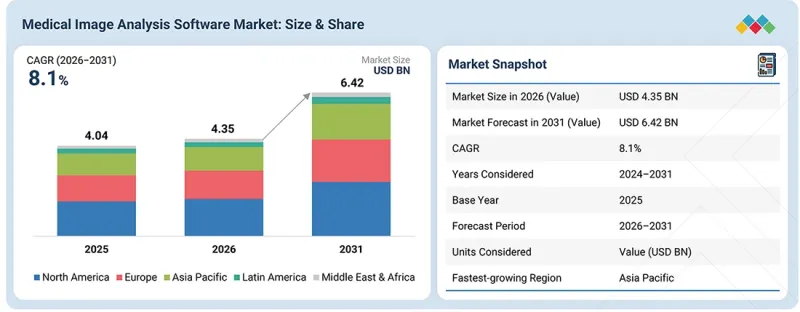
The global medical image analysis software market is projected to reach USD 6.42 billion by 2031 from USD 4.35 billion in 2026, at a CAGR of 8.1%. Market growth is mainly driven by the rising need to reduce radiologist workload across detection, segmentation, reconstruction, and reporting workflows. Hospitals are using AI-based software to triage urgent findings, reduce interpretation time, and manage rising CT, MRI, ultrasound, and mammography volumes. Diagnostic imaging centers are adopting cloud-based platforms to improve report turnaround and support remote reading across multiple sites.
| Scope of the Report | |
|---|---|
| Years Considered for the Study | 2020-2032 |
| Base Year | 2025 |
| Forecast Period | 2026-2032 |
| Units Considered | Value (USD Million/Billion) |
| Segments | By Offering, Network Type, End User, and Region |
| Regions covered | North America, Europe, Asia Pacific, Middle East & Africa, and Latin America |
Academic and research institutions are increasingly relying on AI software for multi-center clinical studies and disease-specific research as imaging datasets grow larger and more complex. The market is further supported by integrated AI-enabled hardware, deep learning algorithms, cloud-native platforms, and enterprise imaging acquisitions that help reduce cost and improve diagnostic turnaround time.
"Deep learning accounted for the largest share of the AI-enabled technology market in 2025."
By AI-enabled technology, the medical image analysis software market is segmented into machine learning, deep learning, computer vision, and natural language processing. The deep learning segment accounted for the largest market share in 2025, as radiology AI vendors continue to build convolutional neural network-based models for detecting fractures, tumors, strokes, and other abnormalities directly from raw pixel data. This segment includes automated lesion detection, image segmentation, quantitative measurement, and abnormality classification. Adoption is especially strong because deep learning models can be trained on large, multi-institutional imaging datasets and validated for FDA clearance faster than older rule-based approaches.
"Diagnostic imaging centers are expected to register the fastest growth among end users during the forecast period."
Based on end user, the medical image analysis software market is segmented into hospitals, diagnostic imaging centers, academic and research institutions, and other end users. Among these, diagnostic imaging centers are expected to record the fastest growth during the forecast period. The growth is mainly driven by rising outpatient imaging volumes, the need for faster report turnaround, and increasing use of AI to support remote and teleradiology reading models. Diagnostic imaging centers are increasingly using AI-based triage and reporting software because they process high volumes of standardized scans with limited on-site radiologist staff. As outpatient imaging demand rises and centers compete on turnaround time, AI-based detection and workflow software is becoming a priority investment area to protect margins and improve patient throughput.
"Asia Pacific to witness the highest growth rate in the medical image analysis software market during the forecast period."
Asia Pacific is expected to witness the highest growth rate in the medical image analysis software market during the forecast period. The growth is mainly supported by rising healthcare digitization, expanding private hospital networks, growing insurance coverage, and a severe shortage of radiologists relative to imaging demand. Countries such as India, China, Japan, South Korea, Australia, and the Philippines are becoming important markets as healthcare organizations try to manage higher patient volumes, reduce diagnostic delays, and improve access to specialist imaging review in rural and tier-2/tier-3 areas. India faces a critical radiologist shortage, with estimates suggesting fewer than one radiologist per 100,000 people in rural areas. India's Ayushman Bharat Digital Mission is also building the digital infrastructure needed for connected health records, having created 799 million digital health IDs and linked 410,000 healthcare facilities as of August 2025, which can increase demand for cloud-based, AI-enabled imaging software over time. Asia Pacific is also a strong delivery hub for medical imaging AI because of its large skilled technical workforce, cost-efficient software development, and growing base of homegrown AI radiology vendors. Qure.ai, an Indian AI radiology company, was recognized in 2025 by Time Magazine as one of the world's most influential AI healthcare companies, deploying its solutions in over 100 countries with multiple FDA clearances.
The breakdown of primary participants is as given below:
- By Company Type - Tier 1: 60%, Tier 2: 30%, and Tier 3: 10%
- By Designation - C-level: 30%, Director-level: 50%, and Others: 20%
- By Region - North America: 45%, Europe: 20%, Asia Pacific: 25%, Rest of the world: 10%.
Siemens Healthineers AG (Germany), GE HealthCare (US), Koninklijke Philips N.V. (Netherlands), Canon Medical Systems Corporation (Japan), FUJIFILM Holdings Corporation (Japan), and Aidoc Medical Ltd. (Israel) are key players in the medical image analysis software market.
The study includes an in-depth competitive analysis of these key players in the medical image analysis software market, with their company profiles, recent developments, and key market strategies.
Research Coverage
This research report categorizes the medical image analysis software market by Type [Integrated Software, Standalone Software], Technology [AI-Enabled Technology {Machine Learning, Deep Learning, Computer Vision, Natural Language Processing}, Conventional Technology], Function [Reconstruction & Visualization, Detection & Localization, Segmentation & Analysis, Registration & Comparison, Reporting & Communication, Clinical Decision Support], Image Type [2D Imaging, 3D Imaging, 4D Imaging], Modality [Radiography (X-Ray), Computed Tomography (CT) {High-end Slice CT, Mid-end Slice CT, Low-end Slice CT}, Magnetic Resonance Imaging (MRI) {Closed MRI Systems, Open MRI Systems}, Ultrasound Imaging {2D Ultrasound Systems, 3D and 4D Ultrasound Systems, Doppler Imaging}, Nuclear Imaging {Positron Emission Tomography (PET), Single-Photon Emission Computed Tomography (SPECT)}, Mammography, Combined/Hybrid Modalities {PET/CT, SPECT/CT, PET/MR}, Others], Therapeutic Area [Cardiology, Oncology, Neurology, Orthopedics, Dental, Obstetrics & Gynecology, Mammography/Breast Imaging, Others], End User [Hospitals, Diagnostic Imaging Centers, Academic & Research Institutions, Other End Users], and Region [North America, Europe, Asia Pacific, Latin America, and Middle East & Africa]. The report covers detailed information on major factors such as drivers, restraints, challenges, and opportunities influencing the growth of the medical image analysis software market. This report provides a detailed analysis of key industry players, including their business overview, product portfolios, technology capabilities, key strategies, contracts, partnerships, agreements, product launches, mergers & acquisitions, and recent developments in the medical image analysis software market. This report covers a competitive analysis of established and emerging players in the medical image analysis software ecosystem.
Reasons to buy this report
The report will help market leaders/new entrants in this market with information on the closest approximations of the revenue numbers for the medical image analysis software market and the subsegments. This report will help stakeholders understand the competitive landscape and gain insights to better position their businesses and plan suitable go-to-market strategies. The report also helps stakeholders understand the market pulse and provides information on key market drivers, restraints, challenges, and opportunities.
The report provides insights on the following pointers:
- The report provides insights on the following pointers: Analysis of key drivers (rising imaging volumes amid growing radiologist workforce shortages, increasing FDA and regulatory clearances for AI-enabled imaging software, growing integration of AI capabilities into imaging hardware systems, rising prevalence of chronic diseases requiring imaging-based diagnosis, increasing venture capital and strategic investment in AI radiology platforms), restraints (high cost of software validation, integration, and deployment, data privacy and cross-border health data regulations), opportunities (expansion of cloud-native and AI-as-a-service imaging platforms, untapped growth potential in emerging markets across Asia Pacific, Latin America, and Middle East & Africa, emerging applications of foundation models and multimodal AI in diagnostic imaging), and challenges (limited interoperability with legacy PACS/RIS and vendor-specific systems, algorithm generalizability and bias across diverse patient populations) influencing the growth of the medical image analysis software market.
- Product Development/Innovation: Detailed insights on upcoming technologies, research & development activities, and new product & service launches in the medical image analysis software market.
- Market Development: Comprehensive information about lucrative markets; the report analyses the medical image analysis software market across varied regions.
- Market Diversification: Exhaustive information about new products & services, untapped geographies, recent developments, and investments in the medical image analysis software market.
- Competitive Assessment: In-depth assessment of market shares, growth strategies, and service offerings of leading players like Siemens Healthineers AG (Germany), GE HealthCare (US), Koninklijke Philips N.V. (Netherlands), Canon Medical Systems Corporation (Japan), FUJIFILM Holdings Corporation (Japan), and Aidoc Medical Ltd. (Israel), among others, in the medical image analysis software market.
TABLE OF CONTENTS
1 INTRODUCTION
- 1.1 STUDY OBJECTIVES
- 1.2 MARKET DEFINITION
- 1.3 MARKET SCOPE
- 1.3.1 MARKET SEGMENTATION AND REGIONAL SCOPE
- 1.3.2 INCLUSIONS AND EXCLUSIONS
- 1.3.3 YEARS CONSIDERED
- 1.4 CURRENCY
- 1.5 STAKEHOLDERS
- 1.6 SUMMARY OF CHANGES
2 EXECUTIVE SUMMARY
- 2.1 KEY INSIGHTS AND MARKET HIGHLIGHTS
- 2.2 KEY MARKET PARTICIPANTS: SHARE INSIGHTS AND STRATEGIC DEVELOPMENTS
- 2.3 DISRUPTIVE TRENDS SHAPING THE MARKET
- 2.4 HIGH-GROWTH SEGMENTS & EMERGING FRONTIERS
- 2.5 SNAPSHOT: GLOBAL MARKET SIZE, GROWTH RATE, AND FORECAST
3 PREMIUM INSIGHTS
- 3.1 MEDICAL IMAGE ANALYSIS SOFTWARE MARKET OVERVIEW
- 3.2 NORTH AMERICA: MEDICAL IMAGE ANALYSIS SOFTWARE MARKET, BY TYPE & COUNTRY
- 3.3 MEDICAL IMAGE ANALYSIS SOFTWARE MARKET: GEOGRAPHIC SNAPSHOT
4 MARKET OVERVIEW
- 4.1 INTRODUCTION
- 4.2 MARKET DYNAMICS
- 4.2.1 DRIVERS
- 4.2.1.1 Rising imaging volumes amid growing radiologist workforce shortages
- 4.2.1.2 Increasing FDA and regulatory clearances for AI-enabled imaging software
- 4.2.1.3 Growing demand for early and accurate disease detection
- 4.2.1.4 Increasing adoption of quantitative and workflow-automation solutions
- 4.2.2 RESTRAINTS
- 4.2.2.1 High cost of software validation, integration, and deployment
- 4.2.2.2 Data privacy and cross-border health data regulations
- 4.2.3 OPPORTUNITIES
- 4.2.3.1 Expansion of cloud-native and AI-as-a-service imaging platforms
- 4.2.3.2 Emerging applications of foundation models and multimodal AI in diagnostic imaging
- 4.2.3.3 Expansion into new imaging modalities and clinical specialties
- 4.2.3.4 Integration of image analysis with clinical decision-support and longitudinal care platforms
- 4.2.4 CHALLENGES
- 4.2.4.1 Limited interoperability with legacy PACS/RIS and vendor-specific systems
- 4.2.4.2 Algorithm generalizability and bias across diverse patient populations
- 4.2.1 DRIVERS
- 4.3 UNMET NEEDS AND WHITE SPACES
- 4.4 INTERCONNECTED MARKETS AND CROSS-SECTOR OPPORTUNITIES
- 4.5 STRATEGIC MOVES BY TIER-1/2/3 PLAYERS
5 INDUSTRY TRENDS
- 5.1 PORTER'S FIVE FORCES ANALYSIS
- 5.1.1 BARGAINING POWER OF SUPPLIERS
- 5.1.2 BARGAINING POWER OF BUYERS
- 5.1.3 THREAT OF SUBSTITUTES
- 5.1.4 THREAT OF NEW ENTRANTS
- 5.1.5 INTENSITY OF COMPETITIVE RIVALRY
- 5.2 MACROECONOMIC INDICATORS
- 5.2.1 INTRODUCTION
- 5.2.2 GDP TRENDS AND FORECAST
- 5.2.3 TRENDS IN GLOBAL HEALTHCARE INDUSTRY
- 5.3 VALUE CHAIN ANALYSIS
- 5.3.1 RESEARCH, IMAGING DATA GENERATION, AND CLINICAL INPUTS
- 5.3.2 DATA ENGINEERING & AI INFRASTRUCTURE
- 5.3.3 AI MODEL & PLATFORM DEVELOPMENT
- 5.3.4 WORKFLOW INTEGRATION & INTEROPERABILITY
- 5.3.5 SOFTWARE DEPLOYMENT & CLINICAL SERVICES
- 5.3.6 CLINICAL VALIDATION, MONITORING, AND CONTINUOUS OPTIMIZATION
- 5.4 ECOSYSTEM ANALYSIS
- 5.5 PRICING ANALYSIS
- 5.5.1 MEDICAL IMAGE ANALYSIS SOFTWARE PLATFORMS, BY KEY PLAYERS (2025)
- 5.5.2 INDICATIVE PRICE FOR MEDICAL IMAGE ANALYSIS SOFTWARE, BY REGION (2025)
- 5.6 KEY CONFERENCES AND EVENTS, 2026-2027
- 5.7 TRENDS/DISRUPTIONS IMPACTING CUSTOMER BUSINESS
- 5.8 INVESTMENT AND FUNDING SCENARIO
- 5.9 CASE STUDY ANALYSIS
- 5.10 IMPACT OF 2025 US TARIFF - MEDICAL IMAGE ANALYSIS SOFTWARE MARKET
- 5.10.1 INTRODUCTION
- 5.10.2 KEY TARIFF RATES
- 5.10.3 PRICE IMPACT ANALYSIS
- 5.10.4 IMPACT ON COUNTRY/REGION
- 5.10.4.1 US
- 5.10.4.2 Europe
- 5.10.4.3 Asia Pacific
- 5.10.5 IMPACT ON END USERS
- 5.10.5.1 Hospitals and health systems
- 5.10.5.2 Diagnostic imaging centers
- 5.10.5.3 Specialty clinics and ambulatory care providers
- 5.10.5.4 Pharmaceutical and biotechnology companies
- 5.10.5.5 Academic and research institutions
6 TECHNOLOGICAL ADVANCEMENTS, AI-DRIVEN IMPACT, PATENTS, INNOVATIONS, AND FUTURE APPLICATIONS
- 6.1 KEY EMERGING TECHNOLOGIES
- 6.1.1 AI-POWERED DEEP LEARNING AND FOUNDATION MODELS
- 6.1.2 CLOUD-NATIVE MEDICAL IMAGING AND AI-AS-A-SERVICE
- 6.1.3 ADVANCED 3D VISUALIZATION, SEGMENTATION, AND QUANTITATIVE IMAGING
- 6.2 COMPLEMENTARY TECHNOLOGIES
- 6.2.1 CLOUD COMPUTING AND EDGE COMPUTING
- 6.2.2 INTEROPERABILITY, PACS/VNA, AND CLINICAL DATA INTEGRATION
- 6.3 TECHNOLOGY/PRODUCT ROADMAP
- 6.4 PATENT ANALYSIS
- 6.4.1 PATENT PUBLICATION TRENDS FOR MEDICAL IMAGE ANALYSIS SOFTWARE MARKET
- 6.4.2 INSIGHTS: JURISDICTION AND TOP APPLICANT ANALYSIS
- 6.5 FUTURE APPLICATIONS
- 6.5.1 EARLY DISEASE DETECTION AND SCREENING
- 6.5.2 PERSONALIZED TREATMENT PLANNING AND THERAPY GUIDANCE
- 6.5.3 LONGITUDINAL DISEASE MONITORING AND TREATMENT RESPONSE
- 6.6 IMPACT OF AI/GEN AI ON MEDICAL IMAGE ANALYSIS SOFTWARE SOLUTIONS
- 6.6.1 INTRODUCTION
- 6.6.2 CASE STUDIES RELATED TO AI/GEN AI IMPLEMENTATION
- 6.6.2.1 AI-powered chest X-ray analysis for tuberculosis screening
- 6.6.3 IMPACT OF AI/GEN AI ON INTERCONNECTED & ADJACENT ECOSYSTEMS
- 6.6.3.1 PACS/VNA & enterprise imaging market
- 6.6.3.2 AI in medical imaging market
- 6.6.3.3 EHR/Clinical decision support market
- 6.6.4 USER READINESS & IMPACT ASSESSMENT
- 6.6.4.1 User readiness
- 6.6.4.1.1 User A: Healthcare providers
- 6.6.4.1.2 User B: Diagnostic imaging centers
- 6.6.4.2 Impact assessment
- 6.6.4.2.1 User A: Healthcare providers
- 6.6.4.2.2 User B: Diagnostic imaging centers
- 6.6.4.1 User readiness
7 REGULATORY LANDSCAPE
- 7.1 REGIONAL REGULATIONS AND COMPLIANCE
- 7.1.1 REGULATORY BODIES, GOVERNMENT AGENCIES, AND OTHER ORGANIZATIONS
- 7.1.2 REGULATORY FRAMEWORK
- 7.1.2.1 North America
- 7.1.2.2 Europe
- 7.1.2.3 ASIA PACIFIC
- 7.1.2.4 LATIN AMERICA
- 7.1.2.5 MIDDLE EAST & AFRICA
- 7.1.3 INDUSTRY STANDARDS
8 CUSTOMER LANDSCAPE & BUYER BEHAVIOR
- 8.1 INTRODUCTION
- 8.2 DECISION-MAKING PROCESS
- 8.3 BUYER STAKEHOLDERS AND BUYING EVALUATION CRITERIA
- 8.3.1 KEY STAKEHOLDERS IN BUYING PROCESS
- 8.3.2 BUYING CRITERIA
- 8.4 ADOPTION BARRIERS & INTERNAL CHALLENGES
- 8.5 UNMET NEEDS FROM VARIOUS END-USE INDUSTRIES
- 8.5.1 UNMET NEEDS
- 8.5.2 END USER EXPECTATIONS
- 8.6 MARKET PROFITABILITY
9 MEDICAL IMAGE ANALYSIS SOFTWARE MARKET, BY END USER
- 9.1 INTRODUCTION
- 9.2 HOSPITALS
- 9.2.1 INCREASING ADOPTION OF ADVANCED MEDICAL IMAGING AND AI IN HOSPITALS
- 9.3 DIAGNOSTIC IMAGING CENTERS
- 9.3.1 RISING DEMAND FOR EFFICIENT AND HIGH-VOLUME DIAGNOSTIC IMAGING TO BOOST MARKET
- 9.4 ACADEMIC & RESEARCH INSTITUTIONS
- 9.4.1 INCREASING USE OF MEDICAL IMAGE ANALYSIS SOFTWARE IN RESEARCH TO BOOST SEGMENT
- 9.5 OTHER END USERS
- 9.5.1 EXPANDING USE OF MEDICAL IMAGE ANALYSIS BEYOND CONVENTIONAL HEALTHCARE SETTING TO BOOST SEGMENT
10 MEDICAL IMAGE ANALYSIS SOFTWARE MARKET, BY FUNCTION
- 10.1 INTRODUCTION
- 10.2 RECONSTRUCTION & VISUALIZATION
- 10.2.1 INCREASING DEMAND FOR HIGH-QUALITY IMAGE RECONSTRUCTION AND 3D VISUALIZATION TO BOOST SEGMENT
- 10.3 DETECTION & LOCALIZATION
- 10.3.1 RISING DEMAND FOR AUTOMATED DETECTION AND LOCALIZATION OF ABNORMALITIES
- 10.4 SEGMENTATION & ANALYSIS
- 10.4.1 INCREASING ADOPTION OF AUTOMATED SEGMENTATION AND QUANTITATIVE IMAGE ANALYSIS
- 10.5 REGISTRATION & COMPARISON
- 10.5.1 GROWING NEED FOR ACCURATE ALIGNMENT AND COMPARISON OF MULTIMODAL MEDICAL IMAGES TO BOOST GROWTH
- 10.6 REPORTING & COMMUNICATION
- 10.6.1 GROWING ADOPTION OF AI-POWERED RADIOLOGY REPORTING AND WORKFLOW AUTOMATION TO DRIVE SEGMENT
- 10.7 CLINICAL DECISION SUPPORT
- 10.7.1 INCREASING ADOPTION OF AI-ASSISTED CLINICAL DECISION SUPPORT
11 MEDICAL IMAGE ANALYSIS SOFTWARE MARKET, BY IMAGE TYPE
- 11.1 INTRODUCTION
- 11.2 3D IMAGING
- 11.2.1 GROWING ADOPTION OF 3D IMAGING FOR DETAILED ANATOMICAL VISUALIZATION TO BOOST SEGMENT
- 11.3 4D IMAGING
- 11.3.1 GROWING DEMAND FOR DYNAMIC AND FUNCTIONAL MEDICAL IMAGING TO DRIVE SEGMENT
- 11.4 2D IMAGING
- 11.4.1 CONTINUED DEMAND FOR 2D IMAGING IN ROUTINE DIAGNOSTIC APPLICATIONS - KEY DRIVER
12 MEDICAL IMAGE ANALYSIS SOFTWARE MARKET, BY MODALITY
- 12.1 INTRODUCTION
- 12.2 RADIOGRAPHY (X-RAY)
- 12.2.1 INCREASING ADOPTION OF AI-ENABLED X-RAY ANALYSIS AND WORKFLOW AUTOMATION TO DRIVE SEGMENT
- 12.3 COMPUTED TOMOGRAPHY (CT)
- 12.3.1 SEGMENT DRIVEN BY AI-ENABLED CT IMAGE ANALYSIS FOR RECONSTRUCTION AND DETECTION
- 12.3.2 HIGH-END SLICE CT
- 12.3.2.1 Growing demand for high-resolution and advanced CT imaging - key driver
- 12.3.3 MID-END SLICE CT
- 12.3.3.1 Demand for versatile CT systems with automated analysis to boost growth
- 12.3.4 LOW-END SLICE CT
- 12.3.4.1 Expanding access to cost-efficient CT imaging to propel growth
- 12.4 MAGNETIC RESONANCE IMAGING (MRI)
- 12.4.1 INCREASING ADOPTION OF AI-POWERED MRI RECONSTRUCTION AND WORKFLOW AUTOMATION TO DRIVE MARKET
- 12.4.2 CLOSED MRI SYSTEMS
- 12.4.2.1 Increasing demand for high-resolution and AI-optimized MRI to drive segment
- 12.4.3 OPEN MRI SYSTEMS
- 12.4.3.1 Expanding access to patient-friendly and specialized MRI to drive segment
- 12.5 ULTRASOUND IMAGING
- 12.5.1 INCREASING ADOPTION OF AI-POWERED ULTRASOUND IMAGING AND WORKFLOW AUTOMATION TO DRIVE MARKET
- 12.5.2 2D ULTRASOUND SYSTEMS
- 12.5.2.1 Expanding use of AI-assisted analysis in routine 2D ultrasound to drive segment
- 12.5.3 3D & 4D ULTRASOUND SYSTEMS
- 12.5.3.1 Increasing demand for volumetric and dynamic ultrasound analysis to boost segment
- 12.5.4 DOPPLER IMAGING
- 12.5.4.1 Growing demand for automated blood-flow assessment
- 12.6 NUCLEAR IMAGING
- 12.6.1 GROWING ADOPTION OF QUANTITATIVE ANALYSIS IN NUCLEAR IMAGING TO BOOST SEGMENT
- 12.6.2 POSITRON EMISSION TOMOGRAPHY (PET)
- 12.6.2.1 Increasing use of quantitative PET for molecular and functional imaging to drive segment
- 12.6.3 SINGLE-PHOTON EMISSION COMPUTED TOMOGRAPHY (SPECT)
- 12.6.3.1 Growing demand for quantitative SPECT in theranostics and cardiovascular imaging
- 12.7 MAMMOGRAPHY
- 12.7.1 INCREASING ADOPTION OF AI-POWERED MAMMOGRAPHY FOR BREAST CANCER DETECTION TO BOOS SEGMENT
- 12.8 COMBINED/HYBRID MODALITIES
- 12.8.1 GROWING ADOPTION OF HYBRID IMAGING FOR INTEGRATED ANATOMICAL AND FUNCTIONAL ANALYSIS TO BOOST SEGMENT
- 12.8.2 PET/CT
- 12.8.2.1 Increasing demand for quantitative PET/CT in oncology
- 12.8.3 SPECT/CT
- 12.8.3.1 Increasing use of SPECT/CT for quantitative assessment and dosimetry
- 12.8.4 PET/MR
- 12.8.4.1 Growing demand for high-resolution multimodal brain and oncology imaging to propel demand
- 12.9 OTHERS
13 MEDICAL IMAGE ANALYSIS SOFTWARE MARKET, BY TECHNOLOGY
- 13.1 INTRODUCTION
- 13.2 AI-ENABLED TECHNOLOGY
- 13.2.1 INCREASING ADOPTION OF AI FOR AUTOMATED AND QUANTITATIVE IMAGE ANALYSIS
- 13.2.2 MACHINE LEARNING
- 13.2.2.1 Increasing use of machine learning for automated medical image analysis to drive segment
- 13.2.3 DEEP LEARNING
- 13.2.3.1 Growing use of deep learning for high-precision medical image reconstruction and analysis to boost segment
- 13.2.4 COMPUTER VISION
- 13.2.4.1 Increasing adoption of computer vision for automated detection and interpretation of medical images to boost segment
- 13.2.5 NATURAL LANGUAGE PROCESSING (NLP)
- 13.2.5.1 Increasing use of NLP for automated radiology reporting and clinical information extraction
- 13.3 CONVENTIONAL TECHNOLOGY
- 13.3.1 CONTINUED DEMAND FOR RELIABLE AND ESTABLISHED IMAGE PROCESSING
14 MEDICAL IMAGE ANALYSIS SOFTWARE MARKET, BY THERAPEUTIC AREA
- 14.1 INTRODUCTION
- 14.2 CARDIOLOGY
- 14.2.1 INCREASING ADOPTION OF AI-POWERED CARDIOVASCULAR IMAGE ANALYSIS TO DRIVE MARKET
- 14.3 ONCOLOGY
- 14.3.1 INCREASING USE OF MEDICAL IMAGING AND AI FOR CANCER DETECTION AND TREATMENT MONITORING TO BOOST SEGMENT
- 14.4 NEUROLOGY
- 14.4.1 RISING DEMAND FOR AI-ASSISTED NEUROLOGICAL IMAGING AND EARLY DISEASE DETECTION
- 14.5 ORTHOPEDICS
- 14.5.1 GROWING ADOPTION OF AI-ENABLED IMAGING FOR ORTHOPEDIC DIAGNOSIS AND SURGICAL PLANNING
- 14.6 DENTAL
- 14.6.1 INCREASING ADOPTION OF AI-ENABLED DENTAL IMAGING AND DIAGNOSTIC ANALYSIS TO BOOST SEGMENT
- 14.7 OBSTETRICS & GYNECOLOGY
- 14.7.1 INCREASING ADOPTION OF AI-ENABLED OBSTETRIC AND GYNECOLOGICAL IMAGING
- 14.8 MAMMOGRAPHY/BREAST IMAGING
- 14.8.1 GROWING ADOPTION OF AI FOR BREAST CANCER DETECTION AND MAMMOGRAPHY WORKFLOW OPTIMIZATION
- 14.9 OTHER THERAPEUTIC AREAS
- 14.9.1 EXPANDING APPLICATIONS OF MEDICAL IMAGE ANALYSIS ACROSS EMERGING THERAPEUTIC AREAS
15 MEDICAL IMAGE ANALYSIS SOFTWARE MARKET, BY TYPE
- 15.1 INTRODUCTION
- 15.2 INTEGRATED SOFTWARE
- 15.2.1 GROWING INTEGRATION OF AI-POWERED IMAGE ANALYSIS INTO CLINICAL WORKFLOWS TO BOOST SEGMENT
- 15.3 STANDALONE SOFTWARE
- 15.3.1 INCREASING ADOPTION OF AI-ENABLED STANDALONE IMAGE ANALYSIS SOLUTIONS TO DRIVE SEGMENT
16 MEDICAL IMAGE ANALYSIS SOFTWARE MARKET, BY REGION
- 16.1 INTRODUCTION
- 16.2 NORTH AMERICA
- 16.2.1 MACROECONOMIC OUTLOOK FOR NORTH AMERICA
- 16.2.2 US
- 16.2.2.1 Growing demand for faster diagnostics to boost demand
- 16.2.3 CANADA
- 16.2.3.1 Increasing investments in healthcare data infrastructure and medical imaging AI to drive market
- 16.3 EUROPE
- 16.3.1 MACROECONOMIC OUTLOOK FOR EUROPE
- 16.3.2 GERMANY
- 16.3.2.1 Growing adoption of AI-powered medical imaging and radiology solutions to drive market
- 16.3.3 FRANCE
- 16.3.3.1 Increasing adoption of AI-based medical imaging solutions to drive market
- 16.3.4 UK
- 16.3.4.1 Increasing government support for AI-enabled medical imaging to boost market
- 16.3.5 ITALY
- 16.3.5.1 Growing adoption of AI in medical imaging and diagnostic workflows to boost market
- 16.3.6 SPAIN
- 16.3.6.1 Expanding adoption of AI-powered medical imaging solutions to boost market
- 16.3.7 REST OF EUROPE
- 16.4 ASIA PACIFIC
- 16.4.1 MACROECONOMIC OUTLOOK FOR ASIA PACIFIC
- 16.4.2 CHINA
- 16.4.2.1 Expanding deployment of AI-powered medical imaging solutions to boost market
- 16.4.3 JAPAN
- 16.4.3.1 Growing adoption of AI in medical imaging and radiology to boost market
- 16.4.4 INDIA
- 16.4.4.1 Increasing investment in AI-powered medical imaging and diagnostic infrastructure to drive market
- 16.4.5 AUSTRALIA
- 16.4.5.1 Increasing investment in AI-enabled medical imaging and diagnostic infrastructure
- 16.4.6 SOUTH KOREA
- 16.4.6.1 Strong government and industry investment in AI-enabled medical imaging
- 16.4.7 REST OF ASIA PACIFIC
- 16.5 LATIN AMERICA
- 16.5.1 MACROECONOMIC OUTLOOK FOR LATIN AMERICA
- 16.5.2 BRAZIL
- 16.5.2.1 Increasing investment in AI infrastructure and medical imaging to drive market
- 16.5.3 MEXICO
- 16.5.3.1 Increasing deployment of AI-enabled medical imaging infrastructure
- 16.5.4 REST OF LATIN AMERICA
- 16.5.4.1 Growing adoption of AI in medical imaging to boost market
- 16.6 MIDDLE EAST & AFRICA
- 16.6.1 MACROECONOMIC OUTLOOK FOR MIDDLE EAST & AFRICA
- 16.6.2 GCC
- 16.6.2.1 Expanding healthcare digitalization and AI adoption to drive market
- 16.6.2.2 Saudi Arabia
- 16.6.2.2.1 Accelerating adoption of AI in medical imaging - key driver
- 16.6.2.3 UAE
- 16.6.2.3.1 Government-led AI initiatives for smart healthcare to boost market
- 16.6.2.4 Rest of GCC
- 16.6.2.4.1 Increasing healthcare digitization to drive market
- 16.6.3 SOUTH AFRICA
- 16.6.3.1 Growing adoption and readiness for AI-enabled medical imaging to boost market
- 16.6.4 REST OF MIDDLE EAST & AFRICA
17 COMPETITIVE LANDSCAPE
- 17.1 INTRODUCTION
- 17.2 KEY PLAYER STRATEGIES/RIGHT TO WIN
- 17.2.1 OVERVIEW OF STRATEGIES ADOPTED BY PLAYERS IN MEDICAL IMAGE ANALYSIS SOFTWARE MARKET
- 17.3 REVENUE ANALYSIS, 2021-2025
- 17.4 MARKET SHARE ANALYSIS, 2025
- 17.5 COMPANY EVALUATION MATRIX: KEY PLAYERS, 2025
- 17.5.1 STARS
- 17.5.2 EMERGING LEADERS
- 17.5.3 PERVASIVE PLAYERS
- 17.5.4 PARTICIPANTS
- 17.5.5 COMPANY FOOTPRINT: KEY PLAYERS, 2025
- 17.5.5.1 Company footprint
- 17.5.5.2 Region footprint
- 17.5.5.3 Type footprint
- 17.5.5.4 Technology footprint
- 17.5.5.5 Image Type footprint
- 17.6 COMPANY EVALUATION MATRIX: STARTUPS /SMES, 2025
- 17.6.1 PROGRESSIVE COMPANIES
- 17.6.2 RESPONSIVE COMPANIES
- 17.6.3 DYNAMIC COMPANIES
- 17.6.4 STARTING BLOCKS
- 17.6.5 COMPETITIVE BENCHMARKING: STARTUPS/SMES, 2025
- 17.6.5.1 Detailed list of key startups/SMEs
- 17.6.5.2 Competitive benchmarking of key startups/SMEs
- 17.7 COMPANY VALUATION AND FINANCIAL METRICS
- 17.8 BRAND/SOFTWARE COMPARISON
- 17.9 COMPETITIVE SCENARIO
- 17.9.1 PRODUCT/SERVICE LAUNCHES & UPGRADES
- 17.9.2 DEALS
- 17.9.3 EXPANSIONS
18 COMPANY PROFILES
- 18.1 KEY PLAYERS
- 18.1.1 SIEMENS HEALTHINEERS AG
- 18.1.1.1 Products/solutions/services offered
- 18.1.1.2 Recent developments
- 18.1.1.2.1 Product launches & upgrades
- 18.1.1.2.2 Deals
- 18.1.1.2.3 Expansions
- 18.1.1.3 MnM view
- 18.1.1.3.1 Key strengths
- 18.1.1.3.2 Strategic choices
- 18.1.1.3.3 Weaknesses and competitive threats
- 18.1.2 GE HEALTHCARE
- 18.1.2.1 Business overview
- 18.1.2.2 Products/solutions/services offered
- 18.1.2.3 Recent developments
- 18.1.2.3.1 Product launches & upgrades
- 18.1.2.3.2 Deals
- 18.1.2.4 MnM view
- 18.1.2.4.1 Key strengths
- 18.1.2.4.2 Strategic choices
- 18.1.2.4.3 Weaknesses and competitive threats
- 18.1.3 KONINKLIJKE PHILIPS N.V.
- 18.1.3.1 Business overview
- 18.1.3.2 Products/solutions/services offered
- 18.1.3.3 Recent developments
- 18.1.3.3.1 Product launches & upgrades
- 18.1.3.3.2 Deals
- 18.1.3.3.3 Expansions
- 18.1.3.4 MnM view
- 18.1.3.4.1 Key strengths
- 18.1.3.4.2 Strategic choices
- 18.1.3.4.3 Weaknesses and competitive threats
- 18.1.4 CANON MEDICAL SYSTEMS CORPORATION
- 18.1.4.1 Business overview
- 18.1.4.2 Products/solutions/services offered
- 18.1.4.3 Recent developments
- 18.1.4.3.1 Product launches & upgrades
- 18.1.4.3.2 Deals
- 18.1.5 FUJIFILM HOLDINGS CORPORATION
- 18.1.5.1 Business overview
- 18.1.5.2 Products/solutions/services offered
- 18.1.5.3 Recent developments
- 18.1.5.3.1 Product launches & upgrades
- 18.1.5.3.2 Deals
- 18.1.6 AGFA-GEVAERT N.V.
- 18.1.6.1 Business overview
- 18.1.6.2 Products/solutions/services offered
- 18.1.6.3 Recent developments
- 18.1.6.3.1 Product launches & upgrades
- 18.1.6.3.2 Deals
- 18.1.7 CARESTREAM HEALTH
- 18.1.7.1 Business overview
- 18.1.7.2 Products/solutions/services offered
- 18.1.7.3 Recent developments
- 18.1.7.3.1 Product launches & upgrades
- 18.1.7.3.2 Deals
- 18.1.8 HOLOGIC, INC.
- 18.1.8.1 Business overview
- 18.1.8.2 Products/solutions/services offered
- 18.1.8.3 Recent developments
- 18.1.8.3.1 Product launches & upgrades
- 18.1.8.3.2 Deals
- 18.1.9 MERATIVE
- 18.1.9.1 Business overview
- 18.1.9.2 Products/solutions/services offered
- 18.1.9.3 Recent developments
- 18.1.9.3.1 Product launches & upgrades
- 18.1.9.3.2 Deals
- 18.1.9.3.3 Expansions
- 18.1.10 SECTRA AB
- 18.1.10.1 Business overview
- 18.1.10.2 Products/solutions/services offered
- 18.1.10.3 Recent developments
- 18.1.10.3.1 Product launches & upgrades
- 18.1.10.3.2 Deals
- 18.1.11 BRUKER CORPORATION
- 18.1.11.1 Business overview
- 18.1.11.2 Products/solutions/services offered
- 18.1.12 QUIBIM
- 18.1.12.1 Business overview
- 18.1.12.2 Products/solutions/services offered
- 18.1.12.3 Recent developments
- 18.1.12.3.1 Deals
- 18.1.13 MIRADA MEDICAL LTD.
- 18.1.13.1 Business overview
- 18.1.13.2 Products/solutions/services offered
- 18.1.13.3 Recent developments
- 18.1.13.3.1 Products launches & upgrades
- 18.1.13.3.2 Deals
- 18.1.13.4 Other developments
- 18.1.14 MEDIAN TECHNOLOGIES
- 18.1.14.1 Business overview
- 18.1.14.2 Products/solutions/services offered
- 18.1.14.3 Recent developments
- 18.1.14.3.1 Products launches & upgrades
- 18.1.14.3.2 Deals
- 18.1.15 ELUCID
- 18.1.15.1 Business overview
- 18.1.15.2 Products/solutions/services offered
- 18.1.15.3 Recent developments
- 18.1.15.3.1 Products launches & upgrades
- 18.1.15.3.2 Other developments
- 18.1.16 RAPIDAI, INC.
- 18.1.16.1 Business overview
- 18.1.16.2 Products/solutions/services offered
- 18.1.16.3 Recent developments
- 18.1.16.3.1 Product launches & upgrades
- 18.1.16.3.2 Deals
- 18.1.17 MICROSOFT CORPORATION
- 18.1.17.1 Business overview
- 18.1.17.2 Products/solutions/services offered
- 18.1.17.3 Recent developments
- 18.1.17.3.1 Product launches & upgrades
- 18.1.17.3.2 Deals
- 18.1.18 TEMPUS AI, INC.
- 18.1.18.1 Business overview
- 18.1.18.2 Products/solutions/services offered
- 18.1.18.3 Recent developments
- 18.1.18.3.1 Product launches & upgrades
- 18.1.18.3.2 Deals
- 18.1.19 NANO-X IMAGING LTD
- 18.1.19.1 Business overview
- 18.1.19.2 Products/solutions/services offered
- 18.1.19.3 Recent developments
- 18.1.19.3.1 Product launches & upgrades
- 18.1.19.3.2 Deals
- 18.1.20 CONTEXTVISION AB
- 18.1.20.1 Business overview
- 18.1.20.2 Products/solutions/services offered
- 18.1.20.3 Recent developments
- 18.1.20.3.1 Product launches & upgrades
- 18.1.20.3.2 Deals
- 18.1.1 SIEMENS HEALTHINEERS AG
- 18.2 OTHER PLAYERS
- 18.2.1 VIZ.AI, INC.
- 18.2.2 AIDOC MEDICAL LTD.
- 18.2.3 AVICENNA.AI
- 18.2.4 CLEERLY, INC.
- 18.2.5 OVERJET, INC.
19 RESEARCH METHODOLOGY
- 19.1 RESEARCH APPROACH
- 19.1.1 SECONDARY RESEARCH
- 19.1.1.1 Key data from secondary sources
- 19.1.2 PRIMARY RESEARCH
- 19.1.2.1 Key data from primary sources
- 19.1.2.2 Insights from primary experts
- 19.1.1 SECONDARY RESEARCH
- 19.2 RESEARCH METHODOLOGY DESIGN
- 19.3 MARKET SIZE ESTIMATION
- 19.4 MARKET BREAKDOWN DATA TRIANGULATION
- 19.5 MARKET SHARE ESTIMATION
- 19.6 STUDY ASSUMPTIONS
- 19.7 LIMITATIONS
- 19.7.1 SCOPE-RELATED LIMITATIONS
- 19.7.2 METHODOLOGY-RELATED LIMITATIONS
- 19.8 RISK ASSESSMENT
20 APPENDIX
- 20.1 DISCUSSION GUIDE
- 20.2 KNOWLEDGESTORE: MARKETSANDMARKETS' SUBSCRIPTION PORTAL
- 20.3 CUSTOMIZATION OPTIONS
- 20.4 RELATED REPORTS
- 20.5 AUTHOR DETAILS
List of Tables
- TABLE 1 USD EXCHANGE RATES
- TABLE 2 MEDICAL IMAGE ANALYSIS SOFTWARE MARKET: PORTER'S FIVE FORCES
- TABLE 3 MEDICAL IMAGE ANALYSIS SOFTWARE MARKET: ROLE IN ECOSYSTEM
- TABLE 4 INDICATIVE PRICE FOR IMAGE ANALYSIS SOFTWARE PLATFORMS, BY KEY PLAYERS, 2025
- TABLE 5 INDICATIVE PRICE FOR MEDICAL IMAGE ANALYSIS SOFTWARE MARKET, BY REGION (2025)
- TABLE 6 CASE 1: MERCY'S DEPLOYMENT OF AIDOC AIOS TO ACCELERATE MEDICAL IMAGE ANALYSIS AND CLINICAL TRIAGE
- TABLE 7 CASE 2: ADVOCATE HEALTH'S EXPANSION OF AIDOC AI FOR ENTERPRISE MEDICAL IMAGING
- TABLE 8 CASE 3: LUNIT'S AI-ASSISTED MAMMOGRAPHY SCREENING DEPLOYMENT AND CLINICAL VALIDATION
- TABLE 9 US ADJUSTED RECIPROCAL TARIFF RATES
- TABLE 10 JURISDICTION ANALYSIS OF TOP APPLICANT COUNTRIES IN MEDICAL IMAGE ANALYSIS SOFTWARE MARKET (JANUARY 2015 TO AUGUST 2026)
- TABLE 11 MEDICAL IMAGE ANALYSIS SOFTWARE MARKET: KEY PATENTS/PATENT APPLICATIONS
- TABLE 12 NORTH AMERICA: REGULATORY BODIES, GOVERNMENT AGENCIES, AND OTHER ORGANIZATIONS
- TABLE 13 EUROPE: REGULATORY BODIES, GOVERNMENT AGENCIES, AND OTHER ORGANIZATIONS
- TABLE 14 ASIA PACIFIC: REGULATORY BODIES, GOVERNMENT AGENCIES, AND OTHER ORGANIZATIONS
- TABLE 15 LATIN AMERICA: REGULATORY BODIES, GOVERNMENT AGENCIES, AND OTHER ORGANIZATIONS
- TABLE 16 MIDDLE EAST & AFRICA: REGULATORY BODIES, GOVERNMENT AGENCIES, AND OTHER ORGANIZATIONS
- TABLE 17 REGULATORY SCENARIO IN NORTH AMERICA
- TABLE 18 REGULATORY SCENARIO IN EUROPE
- TABLE 19 REGULATORY SCENARIO IN ASIA PACIFIC
- TABLE 20 REGULATORY SCENARIO IN LATIN AMERICA
- TABLE 21 REGULATORY SCENARIO IN MIDDLE EAST & AFRICA
- TABLE 22 INFLUENCE OF STAKEHOLDERS ON BUYING PROCESS OF TOP THREE END USERS (%)
- TABLE 23 KEY BUYING CRITERIA FOR TOP THREE END USERS
- TABLE 24 UNMET NEEDS IN MEDICAL IMAGE ANALYSIS SOFTWARE MARKET
- TABLE 25 END USER EXPECTATIONS IN MEDICAL IMAGE ANALYSIS SOFTWARE MARKET
- TABLE 26 MEDICAL IMAGE ANALYSIS SOFTWARE MARKET, BY END USER, 2024-2031 (USD MILLION)
- TABLE 27 MEDICAL IMAGE ANALYSIS SOFTWARE MARKET FOR HOSPITALS, BY REGION, 2024-2031 (USD MILLION)
- TABLE 28 MEDICAL IMAGE ANALYSIS SOFTWARE MARKET FOR DIAGNOSTIC IMAGING CENTERS, BY REGION, 2024-2031 (USD MILLION)
- TABLE 29 MEDICAL IMAGE ANALYSIS SOFTWARE MARKET FOR ACADEMIC & RESEARCH INSTITUTIONS, BY REGION, 2024-2031 (USD MILLION)
- TABLE 30 MEDICAL IMAGE ANALYSIS SOFTWARE MARKET FOR OTHER END USERS, BY REGION, 2024-2031 (USD MILLION)
- TABLE 31 MEDICAL IMAGE ANALYSIS SOFTWARE MARKET, BY FUNCTION, 2024-2031 (USD MILLION)
- TABLE 32 MEDICAL IMAGE ANALYSIS SOFTWARE MARKET FOR RECONSTRUCTION & VISUALIZATION, BY REGION, 2024-2031 (USD MILLION)
- TABLE 33 MEDICAL IMAGE ANALYSIS SOFTWARE MARKET FOR DETECTION & LOCALIZATION, BY REGION, 2024-2031 (USD MILLION)
- TABLE 34 MEDICAL IMAGE ANALYSIS SOFTWARE MARKET FOR SEGMENTATION & ANALYSIS, BY REGION, 2024-2031 (USD MILLION)
- TABLE 35 MEDICAL IMAGE ANALYSIS SOFTWARE MARKET FOR REGISTRATION & COMPARISON, BY REGION, 2024-2031 (USD MILLION)
- TABLE 36 MEDICAL IMAGE ANALYSIS SOFTWARE MARKET FOR REPORTING & COMMUNICATION, BY REGION, 2024-2031 (USD MILLION)
- TABLE 37 MEDICAL IMAGE ANALYSIS SOFTWARE MARKET FOR CLINICAL DECISION SUPPORT, BY REGION, 2024-2031 (USD MILLION)
- TABLE 38 MEDICAL IMAGE ANALYSIS SOFTWARE MARKET, BY IMAGE TYPE, 2024-2031 (USD MILLION)
- TABLE 39 MEDICAL IMAGE ANALYSIS SOFTWARE MARKET FOR 3D IMAGING, BY REGION, 2024-2031 (USD MILLION)
- TABLE 40 MEDICAL IMAGE ANALYSIS SOFTWARE MARKET FOR 4D IMAGING, BY REGION, 2024-2031 (USD MILLION)
- TABLE 41 MEDICAL IMAGE ANALYSIS SOFTWARE MARKET FOR 2D IMAGING, BY REGION, 2024-2031 (USD MILLION)
- TABLE 42 MEDICAL IMAGE ANALYSIS SOFTWARE MARKET, BY MODALITY, 2024-2031 (USD MILLION)
- TABLE 43 MEDICAL IMAGE ANALYSIS SOFTWARE MARKET FOR RADIOGRAPHY (X-RAY), BY REGION, 2024-2031 (USD MILLION)
- TABLE 44 MEDICAL IMAGE ANALYSIS SOFTWARE MARKET FOR COMPUTED TOMOGRAPHY (CT), BY TYPE, 2024-2031 (USD MILLION)
- TABLE 45 MEDICAL IMAGE ANALYSIS SOFTWARE MARKET FOR COMPUTED TOMOGRAPHY (CT), BY REGION, 2024-2031 (USD MILLION)
- TABLE 46 MEDICAL IMAGE ANALYSIS SOFTWARE MARKET FOR HIGH-END SLICE CT, BY REGION, 2024-2031 (USD MILLION)
- TABLE 47 MEDICAL IMAGE ANALYSIS SOFTWARE MARKET FOR MID-END SLICE CT, BY REGION, 2024-2031 (USD MILLION)
- TABLE 48 MEDICAL IMAGE ANALYSIS SOFTWARE MARKET FOR LOW-END SLICE CT, BY REGION, 2024-2031 (USD MILLION)
- TABLE 49 MEDICAL IMAGE ANALYSIS SOFTWARE MARKET FOR MAGNETIC RESONANCE IMAGING (MRI), BY TYPE, 2024-2031 (USD MILLION)
- TABLE 50 MEDICAL IMAGE ANALYSIS SOFTWARE MARKET FOR MAGNETIC RESONANCE IMAGING (MRI), BY REGION, 2024-2031 (USD MILLION)
- TABLE 51 MEDICAL IMAGE ANALYSIS SOFTWARE MARKET FOR CLOSED MRI SYSTEMS, BY REGION, 2024-2031 (USD MILLION)
- TABLE 52 MEDICAL IMAGE ANALYSIS SOFTWARE MARKET FOR OPEN MRI SYSTEMS, BY REGION, 2024-2031 (USD MILLION)
- TABLE 53 MEDICAL IMAGE ANALYSIS SOFTWARE MARKET FOR ULTRASOUND IMAGING, BY TYPE, 2024-2031 (USD MILLION)
- TABLE 54 MEDICAL IMAGE ANALYSIS SOFTWARE MARKET FOR ULTRASOUND IMAGING, BY REGION, 2024-2031 (USD MILLION)
- TABLE 55 MEDICAL IMAGE ANALYSIS SOFTWARE MARKET FOR 2D ULTRASOUND SYSTEMS, BY REGION, 2024-2031 (USD MILLION)
- TABLE 56 MEDICAL IMAGE ANALYSIS SOFTWARE MARKET FOR 3D & 4D ULTRASOUND SYSTEMS, BY REGION, 2024-2031 (USD MILLION)
- TABLE 57 MEDICAL IMAGE ANALYSIS SOFTWARE MARKET FOR DOPPLER IMAGING, BY REGION, 2024-2031 (USD MILLION)
- TABLE 58 MEDICAL IMAGE ANALYSIS SOFTWARE MARKET FOR NUCLEAR IMAGING, BY TYPE, 2024-2031 (USD MILLION)
- TABLE 59 MEDICAL IMAGE ANALYSIS SOFTWARE MARKET FOR NUCLEAR IMAGING, BY REGION, 2024-2031 (USD MILLION)
- TABLE 60 MEDICAL IMAGE ANALYSIS SOFTWARE MARKET FOR POSITRON EMISSION TOMOGRAPHY (PET), BY REGION, 2024-2031 (USD MILLION)
- TABLE 61 MEDICAL IMAGE ANALYSIS SOFTWARE MARKET FOR SINGLE-PHOTON EMISSION COMPUTED TOMOGRAPHY (SPECT), BY REGION, 2024-2031 (USD MILLION)
- TABLE 62 MEDICAL IMAGE ANALYSIS SOFTWARE MARKET FOR MAMMOGRAPHY, BY REGION, 2024-2031 (USD MILLION)
- TABLE 63 MEDICAL IMAGE ANALYSIS SOFTWARE MARKET FOR COMBINED/HYBRID MODALITIES, BY TYPE, 2024-2031 (USD MILLION)
- TABLE 64 MEDICAL IMAGE ANALYSIS SOFTWARE MARKET FOR COMBINED/HYBRID MODALITIES, BY REGION, 2024-2031 (USD MILLION)
- TABLE 65 MEDICAL IMAGE ANALYSIS SOFTWARE MARKET FOR PET/CT, BY REGION, 2024-2031 (USD MILLION)
- TABLE 66 MEDICAL IMAGE ANALYSIS SOFTWARE MARKET FOR SPECT/CT, BY REGION, 2024-2031 (USD MILLION)
- TABLE 67 MEDICAL IMAGE ANALYSIS SOFTWARE MARKET FOR PET/MR, BY REGION, 2024-2031 (USD MILLION)
- TABLE 68 MEDICAL IMAGE ANALYSIS SOFTWARE MARKET FOR OTHERS, BY REGION, 2024-2031 (USD MILLION)
- TABLE 69 MEDICAL IMAGE ANALYSIS SOFTWARE MARKET, BY TECHNOLOGY, 2024-2031 (USD MILLION)
- TABLE 70 MEDICAL IMAGE ANALYSIS SOFTWARE MARKET FOR AI-ENABLED TECHNOLOGY, BY TYPE, 2024-2031 (USD MILLION)
- TABLE 71 MEDICAL IMAGE ANALYSIS SOFTWARE MARKET FOR AI-ENABLED TECHNOLOGY, BY REGION, 2024-2031 (USD MILLION)
- TABLE 72 MEDICAL IMAGE ANALYSIS SOFTWARE MARKET FOR MACHINE LEARNING, BY REGION, 2024-2031 (USD MILLION)
- TABLE 73 MEDICAL IMAGE ANALYSIS SOFTWARE MARKET FOR DEEP LEARNING, BY REGION, 2024-2031 (USD MILLION)
- TABLE 74 MEDICAL IMAGE ANALYSIS SOFTWARE MARKET FOR COMPUTER VISION, BY REGION, 2024-2031 (USD MILLION)
- TABLE 75 MEDICAL IMAGE ANALYSIS SOFTWARE MARKET FOR NATURAL LANGUAGE PROCESSING (NLP), BY REGION, 2024-2031 (USD MILLION)
- TABLE 76 MEDICAL IMAGE ANALYSIS SOFTWARE MARKET FOR CONVENTIONAL TECHNOLOGY, BY REGION, 2024-2031 (USD MILLION)
- TABLE 77 MEDICAL IMAGE ANALYSIS SOFTWARE MARKET, BY THERAPEUTIC AREA, 2024-2031 (USD MILLION)
- TABLE 78 MEDICAL IMAGE ANALYSIS SOFTWARE MARKET FOR CARDIOLOGY, BY REGION, 2024-2031 (USD MILLION)
- TABLE 79 MEDICAL IMAGE ANALYSIS SOFTWARE MARKET FOR ONCOLOGY, BY REGION, 2024-2031 (USD MILLION)
- TABLE 80 MEDICAL IMAGE ANALYSIS SOFTWARE MARKET FOR NEUROLOGY, BY REGION, 2024-2031 (USD MILLION)
- TABLE 81 MEDICAL IMAGE ANALYSIS SOFTWARE MARKET FOR ORTHOPEDICS, BY REGION, 2024-2031 (USD MILLION)
- TABLE 82 MEDICAL IMAGE ANALYSIS SOFTWARE MARKET FOR DENTAL, BY REGION, 2024-2031 (USD MILLION)
- TABLE 83 MEDICAL IMAGE ANALYSIS SOFTWARE MARKET FOR OBSTETRICS & GYNECOLOGY, BY REGION, 2024-2031 (USD MILLION)
- TABLE 84 MEDICAL IMAGE ANALYSIS SOFTWARE MARKET FOR MAMMOGRAPHY/BREAST IMAGING, BY REGION, 2024-2031 (USD MILLION)
- TABLE 85 MEDICAL IMAGE ANALYSIS SOFTWARE MARKET FOR OTHER THERAPEUTIC AREAS, BY REGION, 2024-2031 (USD MILLION)
- TABLE 86 MEDICAL IMAGE ANALYSIS SOFTWARE MARKET, BY TYPE, 2024-2031 (USD MILLION)
- TABLE 87 MEDICAL IMAGE ANALYSIS SOFTWARE MARKET FOR INTEGRATED SOFTWARE, BY REGION, 2024-2031 (USD MILLION)
- TABLE 88 MEDICAL IMAGE ANALYSIS SOFTWARE MARKET FOR STANDALONE SOFTWARE, BY REGION, 2024-2031 (USD MILLION)
- TABLE 89 MEDICAL IMAGE ANALYSIS SOFTWARE MARKET, BY REGION, 2024-2031 (USD MILLION)
- TABLE 90 NORTH AMERICA: MEDICAL IMAGE ANALYSIS SOFTWARE MARKET, BY COUNTRY, 2024-2031 (USD MILLION)
- TABLE 91 NORTH AMERICA: MEDICAL IMAGE ANALYSIS SOFTWARE MARKET, BY TYPE, 2024-2031 (USD MILLION)
- TABLE 92 NORTH AMERICA: MEDICAL IMAGE ANALYSIS SOFTWARE MARKET, BY TECHNOLOGY, 2024-2031 (USD MILLION)
- TABLE 93 NORTH AMERICA: MEDICAL IMAGE ANALYSIS SOFTWARE MARKET FOR AI-ENABLED TECHNOLOGY, BY TYPE, 2024-2031 (USD MILLION)
- TABLE 94 NORTH AMERICA: MEDICAL IMAGE ANALYSIS SOFTWARE MARKET, BY FUNCTION, 2024-2031 (USD MILLION)
- TABLE 95 NORTH AMERICA: MEDICAL IMAGE ANALYSIS SOFTWARE MARKET, BY IMAGE TYPE, 2024-2031 (USD MILLION)
- TABLE 96 NORTH AMERICA: MEDICAL IMAGE ANALYSIS SOFTWARE MARKET, BY MODALITY, 2024-2031 (USD MILLION)
- TABLE 97 NORTH AMERICA: MEDICAL IMAGE ANALYSIS SOFTWARE MARKET FOR COMPUTED TOMOGRAPHY (CT), BY TYPE, 2024-2031 (USD MILLION)
- TABLE 98 NORTH AMERICA: MEDICAL IMAGE ANALYSIS SOFTWARE MARKET FOR MAGNETIC RESONANCE IMAGING (MRI), BY TYPE, 2024-2031 (USD MILLION)
- TABLE 99 NORTH AMERICA: MEDICAL IMAGE ANALYSIS SOFTWARE MARKET FOR ULTRASOUND IMAGING, BY TYPE, 2024-2031 (USD MILLION)
- TABLE 100 NORTH AMERICA: MEDICAL IMAGE ANALYSIS SOFTWARE MARKET FOR NUCLEAR IMAGING, BY TYPE, 2024-2031 (USD MILLION)
- TABLE 101 NORTH AMERICA: MEDICAL IMAGE ANALYSIS SOFTWARE MARKET FOR COMBINED/HYBRID MODALITIES, BY TYPE, 2024-2031 (USD MILLION)
- TABLE 102 NORTH AMERICA: MEDICAL IMAGE ANALYSIS SOFTWARE MARKET, BY THERAPEUTIC AREA, 2024-2031 (USD MILLION)
- TABLE 103 NORTH AMERICA: MEDICAL IMAGE ANALYSIS SOFTWARE MARKET, BY END USER, 2024-2031 (USD MILLION)
- TABLE 104 US: MEDICAL IMAGE ANALYSIS SOFTWARE MARKET, BY TYPE, 2024-2031 (USD MILLION)
- TABLE 105 US: MEDICAL IMAGE ANALYSIS SOFTWARE MARKET, BY TECHNOLOGY, 2024-2031 (USD MILLION)
- TABLE 106 US: MEDICAL IMAGE ANALYSIS SOFTWARE MARKET FOR AI-ENABLED TECHNOLOGY, BY TYPE, 2024-2031 (USD MILLION)
- TABLE 107 US: MEDICAL IMAGE ANALYSIS SOFTWARE MARKET, BY FUNCTION, 2024-2031 (USD MILLION)
- TABLE 108 US: MEDICAL IMAGE ANALYSIS SOFTWARE MARKET, BY IMAGE TYPE, 2024-2031 (USD MILLION)
- TABLE 109 US: MEDICAL IMAGE ANALYSIS SOFTWARE MARKET, BY MODALITY, 2024-2031 (USD MILLION)
- TABLE 110 US: MEDICAL IMAGE ANALYSIS SOFTWARE MARKET FOR COMPUTED TOMOGRAPHY (CT), BY TYPE, 2024-2031 (USD MILLION)
- TABLE 111 US: MEDICAL IMAGE ANALYSIS SOFTWARE MARKET FOR MAGNETIC RESONANCE IMAGING (MRI), BY TYPE, 2024-2031 (USD MILLION)
- TABLE 112 US: MEDICAL IMAGE ANALYSIS SOFTWARE MARKET FOR ULTRASOUND IMAGING, BY TYPE, 2024-2031 (USD MILLION)
- TABLE 113 US: MEDICAL IMAGE ANALYSIS SOFTWARE MARKET FOR NUCLEAR IMAGING, BY TYPE, 2024-2031 (USD MILLION)
- TABLE 114 US: MEDICAL IMAGE ANALYSIS SOFTWARE MARKET FOR COMBINED/HYBRID MODALITIES, BY TYPE, 2024-2031 (USD MILLION)
- TABLE 115 US: MEDICAL IMAGE ANALYSIS SOFTWARE MARKET, BY THERAPEUTIC AREA, 2024-2031 (USD MILLION)
- TABLE 116 US: MEDICAL IMAGE ANALYSIS SOFTWARE MARKET, BY END USER, 2024-2031 (USD MILLION)
- TABLE 117 CANADA: MEDICAL IMAGE ANALYSIS SOFTWARE MARKET, BY TYPE, 2024-2031 (USD MILLION)
- TABLE 118 CANADA: MEDICAL IMAGE ANALYSIS SOFTWARE MARKET, BY TECHNOLOGY, 2024-2031 (USD MILLION)
- TABLE 119 CANADA: MEDICAL IMAGE ANALYSIS SOFTWARE MARKET FOR AI-ENABLED TECHNOLOGY, BY TYPE, 2024-2031 (USD MILLION)
- TABLE 120 CANADA: MEDICAL IMAGE ANALYSIS SOFTWARE MARKET, BY FUNCTION, 2024-2031 (USD MILLION)
- TABLE 121 CANADA: MEDICAL IMAGE ANALYSIS SOFTWARE MARKET, BY IMAGE TYPE, 2024-2031 (USD MILLION)
- TABLE 122 CANADA: MEDICAL IMAGE ANALYSIS SOFTWARE MARKET, BY MODALITY, 2024-2031 (USD MILLION)
- TABLE 123 CANADA: MEDICAL IMAGE ANALYSIS SOFTWARE MARKET FOR COMPUTED TOMOGRAPHY (CT), BY TYPE, 2024-2031 (USD MILLION)
- TABLE 124 CANADA: MEDICAL IMAGE ANALYSIS SOFTWARE MARKET FOR MAGNETIC RESONANCE IMAGING (MRI), BY TYPE, 2024-2031 (USD MILLION)
- TABLE 125 CANADA: MEDICAL IMAGE ANALYSIS SOFTWARE MARKET FOR ULTRASOUND IMAGING, BY TYPE, 2024-2031 (USD MILLION)
- TABLE 126 CANADA: MEDICAL IMAGE ANALYSIS SOFTWARE MARKET FOR NUCLEAR IMAGING, BY TYPE, 2024-2031 (USD MILLION)
- TABLE 127 CANADA: MEDICAL IMAGE ANALYSIS SOFTWARE MARKET FOR COMBINED/HYBRID MODALITIES, BY TYPE, 2024-2031 (USD MILLION)
- TABLE 128 CANADA: MEDICAL IMAGE ANALYSIS SOFTWARE MARKET, BY THERAPEUTIC AREA, 2024-2031 (USD MILLION)
- TABLE 129 CANADA: MEDICAL IMAGE ANALYSIS SOFTWARE MARKET, BY END USER, 2024-2031 (USD MILLION)
- TABLE 130 EUROPE: MEDICAL IMAGE ANALYSIS SOFTWARE MARKET, BY COUNTRY, 2024-2031 (USD MILLION)
- TABLE 131 EUROPE: MEDICAL IMAGE ANALYSIS SOFTWARE MARKET, BY TYPE, 2024-2031 (USD MILLION)
- TABLE 132 EUROPE: MEDICAL IMAGE ANALYSIS SOFTWARE MARKET, BY TECHNOLOGY, 2024-2031 (USD MILLION)
- TABLE 133 EUROPE MEDICAL IMAGE ANALYSIS SOFTWARE MARKET FOR AI-ENABLED TECHNOLOGY, BY TYPE, 2024-2031 (USD MILLION)
- TABLE 134 EUROPE: MEDICAL IMAGE ANALYSIS SOFTWARE MARKET, BY FUNCTION, 2024-2031 (USD MILLION)
- TABLE 135 EUROPE: MEDICAL IMAGE ANALYSIS SOFTWARE MARKET, BY IMAGE TYPE, 2024-2031 (USD MILLION)
- TABLE 136 EUROPE: MEDICAL IMAGE ANALYSIS SOFTWARE MARKET, BY MODALITY, 2024-2031 (USD MILLION)
- TABLE 137 EUROPE: MEDICAL IMAGE ANALYSIS SOFTWARE MARKET FOR COMPUTED TOMOGRAPHY (CT), BY TYPE, 2024-2031 (USD MILLION)
- TABLE 138 EUROPE: MEDICAL IMAGE ANALYSIS SOFTWARE MARKET FOR MAGNETIC RESONANCE IMAGING (MRI), BY TYPE, 2024-2031 (USD MILLION)
- TABLE 139 EUROPE: MEDICAL IMAGE ANALYSIS SOFTWARE MARKET FOR ULTRASOUND IMAGING, BY TYPE, 2024-2031 (USD MILLION)
- TABLE 140 EUROPE: MEDICAL IMAGE ANALYSIS SOFTWARE MARKET FOR NUCLEAR IMAGING, BY TYPE, 2024-2031 (USD MILLION)
- TABLE 141 EUROPE: MEDICAL IMAGE ANALYSIS SOFTWARE MARKET FOR COMBINED/ HYBRID MODALITIES, BY TYPE, 2024-2031 (USD MILLION)
- TABLE 142 EUROPE: MEDICAL IMAGE ANALYSIS SOFTWARE MARKET, BY THERAPEUTIC AREA, 2024-2031 (USD MILLION)
- TABLE 143 EUROPE: MEDICAL IMAGE ANALYSIS SOFTWARE MARKET, BY END USER, 2024-2031 (USD MILLION)
- TABLE 144 GERMANY: MEDICAL IMAGE ANALYSIS SOFTWARE MARKET, BY TYPE, 2024-2031 (USD MILLION)
- TABLE 145 GERMANY: MEDICAL IMAGE ANALYSIS SOFTWARE MARKET, BY TECHNOLOGY, 2024-2031 (USD MILLION)
- TABLE 146 GERMANY: MEDICAL IMAGE ANALYSIS SOFTWARE MARKET FOR AI-ENABLED TECHNOLOGY, BY TYPE, 2024-2031 (USD MILLION)
- TABLE 147 GERMANY: MEDICAL IMAGE ANALYSIS SOFTWARE MARKET, BY FUNCTION, 2024-2031 (USD MILLION)
- TABLE 148 GERMANY: MEDICAL IMAGE ANALYSIS SOFTWARE MARKET, BY IMAGE TYPE, 2024-2031 (USD MILLION)
- TABLE 149 GERMANY: MEDICAL IMAGE ANALYSIS SOFTWARE MARKET, BY MODALITY, 2024-2031 (USD MILLION)
- TABLE 150 GERMANY: MEDICAL IMAGE ANALYSIS SOFTWARE MARKET FOR COMPUTED TOMOGRAPHY (CT), BY TYPE, 2024-2031 (USD MILLION)
- TABLE 151 GERMANY: MEDICAL IMAGE ANALYSIS SOFTWARE MARKET FOR MAGNETIC RESONANCE IMAGING (MRI), BY TYPE, 2024-2031 (USD MILLION)
- TABLE 152 GERMANY: MEDICAL IMAGE ANALYSIS SOFTWARE MARKET FOR ULTRASOUND IMAGING, BY TYPE, 2024-2031 (USD MILLION)
- TABLE 153 GERMANY: MEDICAL IMAGE ANALYSIS SOFTWARE MARKET FOR NUCLEAR IMAGING, BY TYPE, 2024-2031 (USD MILLION)
- TABLE 154 GERMANY: MEDICAL IMAGE ANALYSIS SOFTWARE MARKET FOR COMBINED/HYBRID MODALITIES, BY TYPE, 2024-2031 (USD MILLION)
- TABLE 155 GERMANY: MEDICAL IMAGE ANALYSIS SOFTWARE MARKET, BY THERAPEUTIC AREA, 2024-2031 (USD MILLION)
- TABLE 156 GERMANY: MEDICAL IMAGE ANALYSIS SOFTWARE MARKET, BY END USER, 2024-2031 (USD MILLION)
- TABLE 157 FRANCE: MEDICAL IMAGE ANALYSIS SOFTWARE MARKET, BY TYPE, 2024-2031 (USD MILLION)
- TABLE 158 FRANCE: MEDICAL IMAGE ANALYSIS SOFTWARE MARKET, BY TECHNOLOGY, 2024-2031 (USD MILLION)
- TABLE 159 FRANCE: MEDICAL IMAGE ANALYSIS SOFTWARE MARKET FOR AI-ENABLED TECHNOLOGY, BY TYPE, 2024-2031 (USD MILLION)
- TABLE 160 FRANCE: MEDICAL IMAGE ANALYSIS SOFTWARE MARKET, BY FUNCTION, 2024-2031 (USD MILLION)
- TABLE 161 FRANCE: MEDICAL IMAGE ANALYSIS SOFTWARE MARKET, BY IMAGE TYPE, 2024-2031 (USD MILLION)
- TABLE 162 FRANCE: MEDICAL IMAGE ANALYSIS SOFTWARE MARKET, BY MODALITY, 2024-2031 (USD MILLION)
- TABLE 163 FRANCE: MEDICAL IMAGE ANALYSIS SOFTWARE MARKET FOR COMPUTED TOMOGRAPHY (CT), BY TYPE, 2024-2031 (USD MILLION)
- TABLE 164 FRANCE: MEDICAL IMAGE ANALYSIS SOFTWARE MARKET FOR MAGNETIC RESONANCE IMAGING (MRI), BY TYPE, 2024-2031 (USD MILLION)
- TABLE 165 FRANCE: MEDICAL IMAGE ANALYSIS SOFTWARE MARKET FOR ULTRASOUND IMAGING, BY TYPE, 2024-2031 (USD MILLION)
- TABLE 166 FRANCE: MEDICAL IMAGE ANALYSIS SOFTWARE MARKET FOR NUCLEAR IMAGING, BY TYPE, 2024-2031 (USD MILLION)
- TABLE 167 FRANCE: MEDICAL IMAGE ANALYSIS SOFTWARE MARKET FOR COMBINED/HYBRID MODALITIES, BY TYPE, 2024-2031 (USD MILLION)
- TABLE 168 FRANCE: MEDICAL IMAGE ANALYSIS SOFTWARE MARKET, BY THERAPEUTIC AREA, 2024-2031 (USD MILLION)
- TABLE 169 FRANCE: MEDICAL IMAGE ANALYSIS SOFTWARE MARKET, BY END USER, 2024-2031 (USD MILLION)
- TABLE 170 UK: MEDICAL IMAGE ANALYSIS SOFTWARE MARKET, BY TYPE, 2024-2031 (USD MILLION)
- TABLE 171 UK: MEDICAL IMAGE ANALYSIS SOFTWARE MARKET, BY TECHNOLOGY, 2024-2031 (USD MILLION)
- TABLE 172 UK: MEDICAL IMAGE ANALYSIS SOFTWARE MARKET FOR AI-ENABLED TECHNOLOGY, BY TYPE, 2024-2031 (USD MILLION)
- TABLE 173 UK: MEDICAL IMAGE ANALYSIS SOFTWARE MARKET, BY FUNCTION, 2024-2031 (USD MILLION)
- TABLE 174 UK: MEDICAL IMAGE ANALYSIS SOFTWARE MARKET, BY IMAGE TYPE, 2024-2031 (USD MILLION)
- TABLE 175 UK: MEDICAL IMAGE ANALYSIS SOFTWARE MARKET, BY MODALITY, 2024-2031 (USD MILLION)
- TABLE 176 UK: MEDICAL IMAGE ANALYSIS SOFTWARE MARKET FOR COMPUTED TOMOGRAPHY (CT), BY TYPE, 2024-2031 (USD MILLION)
- TABLE 177 UK: MEDICAL IMAGE ANALYSIS SOFTWARE MARKET FOR MAGNETIC RESONANCE IMAGING (MRI), BY TYPE, 2024-2031 (USD MILLION)
- TABLE 178 UK: MEDICAL IMAGE ANALYSIS SOFTWARE MARKET FOR ULTRASOUND IMAGING, BY TYPE, 2024-2031 (USD MILLION)
- TABLE 179 UK: MEDICAL IMAGE ANALYSIS SOFTWARE MARKET FOR NUCLEAR IMAGING, BY TYPE, 2024-2031 (USD MILLION)
- TABLE 180 UK: MEDICAL IMAGE ANALYSIS SOFTWARE MARKET FOR COMBINED/HYBRID MODALITIES, BY TYPE, 2024-2031 (USD MILLION)
- TABLE 181 UK: MEDICAL IMAGE ANALYSIS SOFTWARE MARKET, BY THERAPEUTIC AREA, 2024-2031 (USD MILLION)
- TABLE 182 UK: MEDICAL IMAGE ANALYSIS SOFTWARE MARKET, BY END USER, 2024-2031 (USD MILLION)
- TABLE 183 ITALY: MEDICAL IMAGE ANALYSIS SOFTWARE MARKET, BY TYPE, 2024-2031 (USD MILLION)
- TABLE 184 ITALY: MEDICAL IMAGE ANALYSIS SOFTWARE MARKET, BY TECHNOLOGY, 2024-2031 (USD MILLION)
- TABLE 185 ITALY: MEDICAL IMAGE ANALYSIS SOFTWARE MARKET FOR AI-ENABLED TECHNOLOGY, BY TYPE, 2024-2031 (USD MILLION)
- TABLE 186 ITALY: MEDICAL IMAGE ANALYSIS SOFTWARE MARKET, BY FUNCTION, 2024-2031 (USD MILLION)
- TABLE 187 ITALY: MEDICAL IMAGE ANALYSIS SOFTWARE MARKET, BY IMAGE TYPE, 2024-2031 (USD MILLION)
- TABLE 188 ITALY: MEDICAL IMAGE ANALYSIS SOFTWARE MARKET, BY MODALITY, 2024-2031 (USD MILLION)
- TABLE 189 ITALY: MEDICAL IMAGE ANALYSIS SOFTWARE MARKET FOR COMPUTED TOMOGRAPHY (CT), BY TYPE, 2024-2031 (USD MILLION)
- TABLE 190 ITALY: MEDICAL IMAGE ANALYSIS SOFTWARE MARKET FOR MAGNETIC RESONANCE IMAGING (MRI), BY TYPE, 2024-2031 (USD MILLION)
- TABLE 191 ITALY: MEDICAL IMAGE ANALYSIS SOFTWARE MARKET FOR ULTRASOUND IMAGING, BY TYPE, 2024-2031 (USD MILLION)
- TABLE 192 ITALY: MEDICAL IMAGE ANALYSIS SOFTWARE MARKET FOR NUCLEAR IMAGING, BY TYPE, 2024-2031 (USD MILLION)
- TABLE 193 ITALY: MEDICAL IMAGE ANALYSIS SOFTWARE MARKET FOR COMBINED/HYBRID MODALITIES, BY TYPE, 2024-2031 (USD MILLION)
- TABLE 194 ITALY: MEDICAL IMAGE ANALYSIS SOFTWARE MARKET, BY THERAPEUTIC AREA, 2024-2031 (USD MILLION)
- TABLE 195 ITALY: MEDICAL IMAGE ANALYSIS SOFTWARE MARKET, BY END USER, 2024-2031 (USD MILLION)
- TABLE 196 SPAIN: MEDICAL IMAGE ANALYSIS SOFTWARE MARKET, BY TYPE, 2024-2031 (USD MILLION)
- TABLE 197 SPAIN: MEDICAL IMAGE ANALYSIS SOFTWARE MARKET, BY TECHNOLOGY, 2024-2031 (USD MILLION)
- TABLE 198 SPAIN: MEDICAL IMAGE ANALYSIS SOFTWARE MARKET FOR AI-ENABLED TECHNOLOGY, BY TYPE, 2024-2031 (USD MILLION)
- TABLE 199 SPAIN: MEDICAL IMAGE ANALYSIS SOFTWARE MARKET, BY FUNCTION, 2024-2031 (USD MILLION)
- TABLE 200 SPAIN: MEDICAL IMAGE ANALYSIS SOFTWARE MARKET, BY IMAGE TYPE, 2024-2031 (USD MILLION)
- TABLE 201 SPAIN: MEDICAL IMAGE ANALYSIS SOFTWARE MARKET, BY MODALITY, 2024-2031 (USD MILLION)
- TABLE 202 SPAIN: MEDICAL IMAGE ANALYSIS SOFTWARE MARKET FOR COMPUTED TOMOGRAPHY (CT), BY TYPE, 2024-2031 (USD MILLION)
- TABLE 203 SPAIN: MEDICAL IMAGE ANALYSIS SOFTWARE MARKET FOR MAGNETIC RESONANCE IMAGING (MRI), BY TYPE, 2024-2031 (USD MILLION)
- TABLE 204 SPAIN: MEDICAL IMAGE ANALYSIS SOFTWARE MARKET FOR ULTRASOUND IMAGING, BY TYPE, 2024-2031 (USD MILLION)
- TABLE 205 SPAIN: MEDICAL IMAGE ANALYSIS SOFTWARE MARKET FOR NUCLEAR IMAGING, BY TYPE, 2024-2031 (USD MILLION)
- TABLE 206 SPAIN: MEDICAL IMAGE ANALYSIS SOFTWARE MARKET FOR COMBINED/HYBRID MODALITIES, BY TYPE, 2024-2031 (USD MILLION)
- TABLE 207 SPAIN: MEDICAL IMAGE ANALYSIS SOFTWARE MARKET, BY THERAPEUTIC AREA, 2024-2031 (USD MILLION)
- TABLE 208 SPAIN: MEDICAL IMAGE ANALYSIS SOFTWARE MARKET, BY END USER, 2024-2031 (USD MILLION)
- TABLE 209 REST OF EUROPE: MEDICAL IMAGE ANALYSIS SOFTWARE MARKET, BY TYPE, 2024-2031 (USD MILLION)
- TABLE 210 REST OF EUROPE: MEDICAL IMAGE ANALYSIS SOFTWARE MARKET, BY TECHNOLOGY, 2024-2031 (USD MILLION)
- TABLE 211 REST OF EUROPE: MEDICAL IMAGE ANALYSIS SOFTWARE MARKET FOR AI-ENABLED TECHNOLOGY, BY TYPE, 2024-2031 (USD MILLION)
- TABLE 212 REST OF EUROPE: MEDICAL IMAGE ANALYSIS SOFTWARE MARKET, BY FUNCTION, 2024-2031 (USD MILLION)
- TABLE 213 REST OF EUROPE: MEDICAL IMAGE ANALYSIS SOFTWARE MARKET, BY IMAGE TYPE, 2024-2031 (USD MILLION)
- TABLE 214 REST OF EUROPE: MEDICAL IMAGE ANALYSIS SOFTWARE MARKET, BY MODALITY, 2024-2031 (USD MILLION)
- TABLE 215 REST OF EUROPE: MEDICAL IMAGE ANALYSIS SOFTWARE MARKET FOR COMPUTED TOMOGRAPHY (CT), BY TYPE, 2024-2031 (USD MILLION)
- TABLE 216 REST OF EUROPE: MEDICAL IMAGE ANALYSIS SOFTWARE MARKET FOR MAGNETIC RESONANCE IMAGING (MRI), BY TYPE, 2024-2031 (USD MILLION)
- TABLE 217 REST OF EUROPE: MEDICAL IMAGE ANALYSIS SOFTWARE MARKET FOR ULTRASOUND IMAGING, BY TYPE, 2024-2031 (USD MILLION)
- TABLE 218 REST OF EUROPE: MEDICAL IMAGE ANALYSIS SOFTWARE MARKET FOR NUCLEAR IMAGING, BY TYPE, 2024-2031 (USD MILLION)
- TABLE 219 REST OF EUROPE: MEDICAL IMAGE ANALYSIS SOFTWARE MARKET FOR COMBINED/HYBRID MODALITIES, BY TYPE, 2024-2031 (USD MILLION)
- TABLE 220 REST OF EUROPE: MEDICAL IMAGE ANALYSIS SOFTWARE MARKET, BY THERAPEUTIC AREA, 2024-2031 (USD MILLION)
- TABLE 221 REST OF EUROPE: MEDICAL IMAGE ANALYSIS SOFTWARE MARKET, BY END USER, 2024-2031 (USD MILLION)
- TABLE 222 ASIA PACIFIC: MEDICAL IMAGE ANALYSIS SOFTWARE MARKET, BY COUNTRY, 2024-2031 (USD MILLION)
- TABLE 223 ASIA PACIFIC: MEDICAL IMAGE ANALYSIS SOFTWARE MARKET, BY TYPE, 2024-2031 (USD MILLION)
- TABLE 224 ASIA PACIFIC: MEDICAL IMAGE ANALYSIS SOFTWARE MARKET, BY TECHNOLOGY, 2024-2031 (USD MILLION)
- TABLE 225 ASIA PACIFIC: AI-ENABLED TECHNOLOGY MARKET, BY TYPE, 2024-2031 (USD MILLION)
- TABLE 226 ASIA PACIFIC: MEDICAL IMAGE ANALYSIS SOFTWARE MARKET, BY FUNCTION, 2024-2031 (USD MILLION)
- TABLE 227 ASIA PACIFIC: MEDICAL IMAGE ANALYSIS SOFTWARE MARKET, BY IMAGE TYPE, 2024-2031 (USD MILLION)
- TABLE 228 ASIA PACIFIC: MEDICAL IMAGE ANALYSIS SOFTWARE MARKET, BY MODALITY, 2024-2031 (USD MILLION)
- TABLE 229 ASIA PACIFIC: COMPUTED TOMOGRAPHY (CT) MARKET, BY TYPE, 2024-2031 (USD MILLION)
- TABLE 230 ASIA PACIFIC: MAGNETIC RESONANCE IMAGING (MRI) MARKET, BY TYPE, 2024-2031 (USD MILLION)
- TABLE 231 ASIA PACIFIC: ULTRASOUND IMAGING MARKET, BY TYPE, 2024-2031 (USD MILLION)
- TABLE 232 ASIA PACIFIC: NUCLEAR IMAGING MARKET, BY TYPE, 2024-2031 (USD MILLION)
- TABLE 233 ASIA PACIFIC: COMBINED/HYBRID MODALITIES MARKET, BY TYPE, 2024-2031 (USD MILLION)
- TABLE 234 ASIA PACIFIC: MEDICAL IMAGE ANALYSIS SOFTWARE MARKET, BY THERAPEUTIC AREA, 2024-2031 (USD MILLION)
- TABLE 235 ASIA PACIFIC: MEDICAL IMAGE ANALYSIS SOFTWARE MARKET, BY END USER, 2024-2031 (USD MILLION)
- TABLE 236 CHINA: MEDICAL IMAGE ANALYSIS SOFTWARE MARKET, BY TYPE, 2024-2031 (USD MILLION)
- TABLE 237 CHINA: MEDICAL IMAGE ANALYSIS SOFTWARE MARKET, BY TECHNOLOGY, 2024-2031 (USD MILLION)
- TABLE 238 CHINA: MEDICAL IMAGE ANALYSIS SOFTWARE FOR AI-ENABLED TECHNOLOGY, BY TYPE, 2024-2031 (USD MILLION)
- TABLE 239 CHINA: MEDICAL IMAGE ANALYSIS SOFTWARE MARKET, BY FUNCTION, 2024-2031 (USD MILLION)
- TABLE 240 CHINA: MEDICAL IMAGE ANALYSIS SOFTWARE MARKET, BY IMAGE TYPE, 2024-2031 (USD MILLION)
- TABLE 241 CHINA: MEDICAL IMAGE ANALYSIS SOFTWARE MARKET, BY MODALITY, 2024-2031 (USD MILLION)
- TABLE 242 CHINA: MEDICAL IMAGE ANALYSIS SOFTWARE MARKET FOR COMPUTED TOMOGRAPHY (CT), BY TYPE, 2024-2031 (USD MILLION)
- TABLE 243 CHINA: MEDICAL IMAGE ANALYSIS SOFTWARE MARKET FOR MAGNETIC RESONANCE IMAGING (MRI), BY TYPE, 2024-2031 (USD MILLION)
- TABLE 244 CHINA: MEDICAL IMAGE ANALYSIS SOFTWARE MARKET FOR ULTRASOUND IMAGING, BY TYPE, 2024-2031 (USD MILLION)
- TABLE 245 CHINA: MEDICAL IMAGE ANALYSIS SOFTWARE MARKET FOR NUCLEAR IMAGING, BY TYPE, 2024-2031 (USD MILLION)
- TABLE 246 CHINA: MEDICAL IMAGE ANALYSIS SOFTWARE MARKET FOR COMBINED/HYBRID MODALITIES, BY TYPE, 2024-2031 (USD MILLION)
- TABLE 247 CHINA: MEDICAL IMAGE ANALYSIS SOFTWARE MARKET, BY THERAPEUTIC AREA, 2024-2031 (USD MILLION)
- TABLE 248 CHINA: MEDICAL IMAGE ANALYSIS SOFTWARE MARKET, BY END USER, 2024-2031 (USD MILLION)
- TABLE 249 JAPAN: MEDICAL IMAGE ANALYSIS SOFTWARE MARKET, BY TYPE, 2024-2031 (USD MILLION)
- TABLE 250 JAPAN: MEDICAL IMAGE ANALYSIS SOFTWARE MARKET, BY TECHNOLOGY, 2024-2031 (USD MILLION)
- TABLE 251 JAPAN: MEDICAL IMAGE ANALYSIS SOFTWARE MARKET FOR AI-ENABLED TECHNOLOGY, BY TYPE, 2024-2031 (USD MILLION)
- TABLE 252 JAPAN: MEDICAL IMAGE ANALYSIS SOFTWARE MARKET, BY FUNCTION, 2024-2031 (USD MILLION)
- TABLE 253 JAPAN: MEDICAL IMAGE ANALYSIS SOFTWARE MARKET, BY IMAGE TYPE, 2024-2031 (USD MILLION)
- TABLE 254 JAPAN: MEDICAL IMAGE ANALYSIS SOFTWARE MARKET, BY MODALITY, 2024-2031 (USD MILLION)
- TABLE 255 JAPAN: MEDICAL IMAGE ANALYSIS SOFTWARE MARKET FOR COMPUTED TOMOGRAPHY (CT), BY TYPE, 2024-2031 (USD MILLION)
- TABLE 256 JAPAN: MEDICAL IMAGE ANALYSIS SOFTWARE MARKET FOR MAGNETIC RESONANCE IMAGING (MRI) MARKET, BY TYPE, 2024-2031 (USD MILLION)
- TABLE 257 JAPAN: MEDICAL IMAGE ANALYSIS SOFTWARE MARKET FOR ULTRASOUND IMAGING, BY TYPE, 2024-2031 (USD MILLION)
- TABLE 258 JAPAN: MEDICAL IMAGE ANALYSIS SOFTWARE MARKET FOR NUCLEAR IMAGING, BY TYPE, 2024-2031 (USD MILLION)
- TABLE 259 JAPAN: MEDICAL IMAGE ANALYSIS SOFTWARE MARKET FOR COMBINED/HYBRID MODALITIES, BY TYPE, 2024-2031 (USD MILLION)
- TABLE 260 JAPAN: MEDICAL IMAGE ANALYSIS SOFTWARE MARKET, BY THERAPEUTIC AREA, 2024-2031 (USD MILLION)
- TABLE 261 JAPAN: MEDICAL IMAGE ANALYSIS SOFTWARE MARKET, BY END USER, 2024-2031 (USD MILLION)
- TABLE 262 INDIA: MEDICAL IMAGE ANALYSIS SOFTWARE MARKET, BY TYPE, 2024-2031 (USD MILLION)
- TABLE 263 INDIA: MEDICAL IMAGE ANALYSIS SOFTWARE MARKET, BY TECHNOLOGY, 2024-2031 (USD MILLION)
- TABLE 264 INDIA: MEDICAL IMAGE ANALYSIS SOFTWARE MARKET FOR AI-ENABLED TECHNOLOGY, BY TYPE, 2024-2031 (USD MILLION)
- TABLE 265 INDIA: MEDICAL IMAGE ANALYSIS SOFTWARE MARKET, BY FUNCTION, 2024-2031 (USD MILLION)
- TABLE 266 INDIA: MEDICAL IMAGE ANALYSIS SOFTWARE MARKET, BY IMAGE TYPE, 2024-2031 (USD MILLION)
- TABLE 267 INDIA: MEDICAL IMAGE ANALYSIS SOFTWARE MARKET, BY MODALITY, 2024-2031 (USD MILLION)
- TABLE 268 INDIA: MEDICAL IMAGE ANALYSIS SOFTWARE FOR COMPUTED TOMOGRAPHY (CT) MARKET, BY TYPE, 2024-2031 (USD MILLION)
- TABLE 269 INDIA: MEDICAL IMAGE ANALYSIS SOFTWARE MARKET FOR MAGNETIC RESONANCE IMAGING (MRI), BY TYPE, 2024-2031 (USD MILLION)
- TABLE 270 INDIA: MEDICAL IMAGE ANALYSIS SOFTWARE MARKET FOR ULTRASOUND IMAGING, BY TYPE, 2024-2031 (USD MILLION)
- TABLE 271 INDIA: MEDICAL IMAGE ANALYSIS SOFTWARE MARKET FOR NUCLEAR IMAGING, BY TYPE, 2024-2031 (USD MILLION)
- TABLE 272 INDIA: MEDICAL IMAGE ANALYSIS SOFTWARE FOR COMBINED/HYBRID MODALITIES MARKET, BY TYPE, 2024-2031 (USD MILLION)
- TABLE 273 INDIA: MEDICAL IMAGE ANALYSIS SOFTWARE MARKET, BY THERAPEUTIC AREA, 2024-2031 (USD MILLION)
- TABLE 274 INDIA: MEDICAL IMAGE ANALYSIS SOFTWARE MARKET, BY END USER, 2024-2031 (USD MILLION)
- TABLE 275 AUSTRALIA: MEDICAL IMAGE ANALYSIS SOFTWARE MARKET, BY TYPE, 2024-2031 (USD MILLION)
- TABLE 276 AUSTRALIA: MEDICAL IMAGE ANALYSIS SOFTWARE MARKET, BY TECHNOLOGY, 2024-2031 (USD MILLION)
- TABLE 277 AUSTRALIA: MEDICAL IMAGE ANALYSIS SOFTWARE MARKET FOR AI-ENABLED TECHNOLOGY, BY TYPE, 2024-2031 (USD MILLION)
- TABLE 278 AUSTRALIA: MEDICAL IMAGE ANALYSIS SOFTWARE MARKET, BY FUNCTION, 2024-2031 (USD MILLION)
- TABLE 279 AUSTRALIA: MEDICAL IMAGE ANALYSIS SOFTWARE MARKET, BY IMAGE TYPE, 2024-2031 (USD MILLION)
- TABLE 280 AUSTRALIA: MEDICAL IMAGE ANALYSIS SOFTWARE MARKET, BY MODALITY, 2024-2031 (USD MILLION)
- TABLE 281 AUSTRALIA: MEDICAL IMAGE ANALYSIS SOFTWARE MARKET FOR COMPUTED TOMOGRAPHY (CT), BY TYPE, 2024-2031 (USD MILLION)
- TABLE 282 AUSTRALIA: MEDICAL IMAGE ANALYSIS SOFTWARE MARKET FOR MAGNETIC RESONANCE IMAGING (MRI), BY TYPE, 2024-2031 (USD MILLION)
- TABLE 283 AUSTRALIA: MEDICAL IMAGE ANALYSIS SOFTWARE FOR ULTRASOUND IMAGING, BY TYPE, 2024-2031 (USD MILLION)
- TABLE 284 AUSTRALIA: MEDICAL IMAGE ANALYSIS SOFTWARE FOR NUCLEAR IMAGING, BY TYPE, 2024-2031 (USD MILLION)
- TABLE 285 AUSTRALIA: MEDICAL IMAGE ANALYSIS SOFTWARE MARKET FOR COMBINED/HYBRID MODALITIES, BY TYPE, 2024-2031 (USD MILLION)
- TABLE 286 AUSTRALIA: MEDICAL IMAGE ANALYSIS SOFTWARE MARKET, BY THERAPEUTIC AREA, 2024-2031 (USD MILLION)
- TABLE 287 AUSTRALIA: MEDICAL IMAGE ANALYSIS SOFTWARE MARKET, BY END USER, 2024-2031 (USD MILLION)
- TABLE 288 SOUTH KOREA: MEDICAL IMAGE ANALYSIS SOFTWARE MARKET, BY TYPE, 2024-2031 (USD MILLION)
- TABLE 289 SOUTH KOREA: MEDICAL IMAGE ANALYSIS SOFTWARE MARKET, BY TECHNOLOGY, 2024-2031 (USD MILLION)
- TABLE 290 SOUTH KOREA: MEDICAL IMAGE ANALYSIS SOFTWARE MARKET FOR AI-ENABLED TECHNOLOGY, BY TYPE, 2024-2031 (USD MILLION)
- TABLE 291 SOUTH KOREA: MEDICAL IMAGE ANALYSIS SOFTWARE MARKET, BY FUNCTION, 2024-2031 (USD MILLION)
- TABLE 292 SOUTH KOREA: MEDICAL IMAGE ANALYSIS SOFTWARE MARKET, BY IMAGE TYPE, 2024-2031 (USD MILLION)
- TABLE 293 SOUTH KOREA: MEDICAL IMAGE ANALYSIS SOFTWARE MARKET, BY MODALITY, 2024-2031 (USD MILLION)
- TABLE 294 SOUTH KOREA: MEDICAL IMAGE ANALYSIS SOFTWARE MARKET FOR COMPUTED TOMOGRAPHY (CT), BY TYPE, 2024-2031 (USD MILLION)
- TABLE 295 SOUTH KOREA: MEDICAL IMAGE ANALYSIS SOFTWARE MARKET FOR MAGNETIC RESONANCE IMAGING (MRI), BY TYPE, 2024-2031 (USD MILLION)
- TABLE 296 SOUTH KOREA: MEDICAL IMAGE ANALYSIS SOFTWARE MARKET FOR ULTRASOUND IMAGING, BY TYPE, 2024-2031 (USD MILLION)
- TABLE 297 SOUTH KOREA: MEDICAL IMAGE ANALYSIS SOFTWARE MARKET FOR NUCLEAR IMAGING, BY TYPE, 2024-2031 (USD MILLION)
- TABLE 298 SOUTH KOREA: MEDICAL IMAGE ANALYSIS SOFTWARE MARKET FOR COMBINED/HYBRID MODALITIES, BY TYPE, 2024-2031 (USD MILLION)
- TABLE 299 SOUTH KOREA: MEDICAL IMAGE ANALYSIS SOFTWARE MARKET, BY THERAPEUTIC AREA, 2024-2031 (USD MILLION)
- TABLE 300 SOUTH KOREA: MEDICAL IMAGE ANALYSIS SOFTWARE MARKET, BY END USER, 2024-2031 (USD MILLION)
- TABLE 301 REST OF ASIA PACIFIC: MEDICAL IMAGE ANALYSIS SOFTWARE MARKET, BY TYPE, 2024-2031 (USD MILLION)
- TABLE 302 REST OF ASIA PACIFIC: MEDICAL IMAGE ANALYSIS SOFTWARE MARKET, BY TECHNOLOGY, 2024-2031 (USD MILLION)
- TABLE 303 REST OF ASIA PACIFIC: MEDICAL IMAGE ANALYSIS SOFTWARE MARKET FOR AI-ENABLED TECHNOLOGY, BY TYPE, 2024-2031 (USD MILLION)
- TABLE 304 REST OF ASIA PACIFIC: MEDICAL IMAGE ANALYSIS SOFTWARE MARKET, BY FUNCTION, 2024-2031 (USD MILLION)
- TABLE 305 REST OF ASIA PACIFIC: MEDICAL IMAGE ANALYSIS SOFTWARE MARKET, BY IMAGE TYPE, 2024-2031 (USD MILLION)
- TABLE 306 REST OF ASIA PACIFIC: MEDICAL IMAGE ANALYSIS SOFTWARE MARKET, BY MODALITY, 2024-2031 (USD MILLION)
- TABLE 307 REST OF ASIA PACIFIC: MEDICAL IMAGE ANALYSIS SOFTWARE MARKET FOR COMPUTED TOMOGRAPHY (CT), BY TYPE, 2024-2031 (USD MILLION)
- TABLE 308 REST OF ASIA PACIFIC: MAGNETIC RESONANCE IMAGING (MRI) MARKET, BY TYPE, 2024-2031 (USD MILLION)
- TABLE 309 REST OF ASIA PACIFIC: MEDICAL IMAGE ANALYSIS SOFTWARE MARKET FOR ULTRASOUND IMAGING, BY TYPE, 2024-2031 (USD MILLION)
- TABLE 310 REST OF ASIA PACIFIC: MEDICAL IMAGE ANALYSIS SOFTWARE MARKET FOR NUCLEAR IMAGING, BY TYPE, 2024-2031 (USD MILLION)
- TABLE 311 REST OF ASIA PACIFIC: MEDICAL IMAGE ANALYSIS SOFTWARE MARKET FOR COMBINED/HYBRID MODALITIES, BY TYPE, 2024-2031 (USD MILLION)
- TABLE 312 REST OF ASIA PACIFIC: MEDICAL IMAGE ANALYSIS SOFTWARE MARKET, BY THERAPEUTIC AREA, 2024-2031 (USD MILLION)
- TABLE 313 REST OF ASIA PACIFIC: MEDICAL IMAGE ANALYSIS SOFTWARE MARKET, BY END USER, 2024-2031 (USD MILLION)
- TABLE 314 LATIN AMERICA: MEDICAL IMAGE ANALYSIS SOFTWARE MARKET, BY COUNTRY, 2024-2031 (USD MILLION)
- TABLE 315 LATIN AMERICA: MEDICAL IMAGE ANALYSIS SOFTWARE MARKET, BY TYPE, 2024-2031 (USD MILLION)
- TABLE 316 LATIN AMERICA: MEDICAL IMAGE ANALYSIS SOFTWARE MARKET, BY TECHNOLOGY, 2024-2031 (USD MILLION)
- TABLE 317 LATIN AMERICA: MEDICAL IMAGE ANALYSIS SOFTWARE MARKET FOR AI-ENABLED TECHNOLOGY MARKET, BY TYPE, 2024-2031 (USD MILLION)
- TABLE 318 LATIN AMERICA: MEDICAL IMAGE ANALYSIS SOFTWARE MARKET, BY FUNCTION, 2024-2031 (USD MILLION)
- TABLE 319 LATIN AMERICA: MEDICAL IMAGE ANALYSIS SOFTWARE MARKET, BY IMAGE TYPE, 2024-2031 (USD MILLION)
- TABLE 320 LATIN AMERICA: MEDICAL IMAGE ANALYSIS SOFTWARE MARKET, BY MODALITY, 2024-2031 (USD MILLION)
- TABLE 321 LATIN AMERICA: MEDICAL IMAGE ANALYSIS SOFTWARE MARKET FOR COMPUTED TOMOGRAPHY (CT), BY TYPE, 2024-2031 (USD MILLION)
- TABLE 322 LATIN AMERICA: MAGNETIC RESONANCE IMAGING (MRI) MARKET, BY TYPE, 2024-2031 (USD MILLION)
- TABLE 323 LATIN AMERICA: MEDICAL IMAGE ANALYSIS SOFTWARE MARKET FOR ULTRASOUND IMAGING, BY TYPE, 2024-2031 (USD MILLION)
- TABLE 324 LATIN AMERICA: MEDICAL IMAGE ANALYSIS SOFTWARE MARKET FOR NUCLEAR IMAGING, BY TYPE, 2024-2031 (USD MILLION)
- TABLE 325 LATIN AMERICA: MEDICAL IMAGE ANALYSIS SOFTWARE MARKET FOR COMBINED/HYBRID MODALITIES, BY TYPE, 2024-2031 (USD MILLION)
- TABLE 326 LATIN AMERICA: MEDICAL IMAGE ANALYSIS SOFTWARE MARKET, BY THERAPEUTIC AREA, 2024-2031 (USD MILLION)
- TABLE 327 LATIN AMERICA: MEDICAL IMAGE ANALYSIS SOFTWARE MARKET, BY END USER, 2024-2031 (USD MILLION)
- TABLE 328 BRAZIL: MEDICAL IMAGE ANALYSIS SOFTWARE MARKET, BY TYPE, 2024-2031 (USD MILLION)
- TABLE 329 BRAZIL: MEDICAL IMAGE ANALYSIS SOFTWARE MARKET, BY TECHNOLOGY, 2024-2031 (USD MILLION)
- TABLE 330 BRAZIL: MEDICAL IMAGE ANALYSIS SOFTWARE MARKET FOR AI-ENABLED TECHNOLOGY, BY TYPE, 2024-2031 (USD MILLION)
- TABLE 331 BRAZIL: MEDICAL IMAGE ANALYSIS SOFTWARE MARKET, BY FUNCTION, 2024-2031 (USD MILLION)
- TABLE 332 BRAZIL: MEDICAL IMAGE ANALYSIS SOFTWARE MARKET, BY IMAGE TYPE, 2024-2031 (USD MILLION)
- TABLE 333 BRAZIL: MEDICAL IMAGE ANALYSIS SOFTWARE MARKET, BY MODALITY, 2024-2031 (USD MILLION)
- TABLE 334 BRAZIL: MEDICAL IMAGE ANALYSIS SOFTWARE MARKET FOR COMPUTED TOMOGRAPHY (CT), BY TYPE, 2024-2031 (USD MILLION)
- TABLE 335 BRAZIL: MEDICAL IMAGE ANALYSIS SOFTWARE MARKET FOR MAGNETIC RESONANCE IMAGING (MRI), BY TYPE, 2024-2031 (USD MILLION)
- TABLE 336 BRAZIL: MEDICAL IMAGE ANALYSIS SOFTWARE MARKET FOR ULTRASOUND IMAGING, BY TYPE, 2024-2031 (USD MILLION)
- TABLE 337 BRAZIL: MEDICAL IMAGE ANALYSIS SOFTWARE MARKET FOR NUCLEAR IMAGING, BY TYPE, 2024-2031 (USD MILLION)
- TABLE 338 BRAZIL: MEDICAL IMAGE ANALYSIS SOFTWARE MARKET FOR COMBINED/HYBRID MODALITIES, BY TYPE, 2024-2031 (USD MILLION)
- TABLE 339 BRAZIL: MEDICAL IMAGE ANALYSIS SOFTWARE MARKET, BY THERAPEUTIC AREA, 2024-2031 (USD MILLION)
- TABLE 340 BRAZIL: MEDICAL IMAGE ANALYSIS SOFTWARE MARKET, BY END USER, 2024-2031 (USD MILLION)
- TABLE 341 MEXICO: MEDICAL IMAGE ANALYSIS SOFTWARE MARKET, BY TYPE, 2024-2031 (USD MILLION)
- TABLE 342 MEXICO: MEDICAL IMAGE ANALYSIS SOFTWARE MARKET, BY TECHNOLOGY, 2024-2031 (USD MILLION)
- TABLE 343 MEXICO: MEDICAL IMAGE ANALYSIS SOFTWARE MARKET FOR AI-ENABLED TECHNOLOGY, BY TYPE, 2024-2031 (USD MILLION)
- TABLE 344 MEXICO: MEDICAL IMAGE ANALYSIS SOFTWARE MARKET, BY FUNCTION, 2024-2031 (USD MILLION)
- TABLE 345 MEXICO: MEDICAL IMAGE ANALYSIS SOFTWARE MARKET, BY IMAGE TYPE, 2024-2031 (USD MILLION)
- TABLE 346 MEXICO: MEDICAL IMAGE ANALYSIS SOFTWARE MARKET, BY MODALITY, 2024-2031 (USD MILLION)
- TABLE 347 MEXICO: MEDICAL IMAGE ANALYSIS SOFTWARE MARKET FOR COMPUTED TOMOGRAPHY (CT) MARKET, BY TYPE, 2024-2031 (USD MILLION)
- TABLE 348 MEXICO: MEDICAL IMAGE ANALYSIS SOFTWARE MARKET FOR MAGNETIC RESONANCE IMAGING (MRI), BY TYPE, 2024-2031 (USD MILLION)
- TABLE 349 MEXICO: MEDICAL IMAGE ANALYSIS SOFTWARE MARKET FOR ULTRASOUND IMAGING, BY TYPE, 2024-2031 (USD MILLION)
- TABLE 350 MEXICO: MEDICAL IMAGE ANALYSIS SOFTWARE MARKET FOR NUCLEAR IMAGING, BY TYPE, 2024-2031 (USD MILLION)
- TABLE 351 MEXICO: MEDICAL IMAGE ANALYSIS SOFTWARE MARKET FOR COMBINED/HYBRID MODALITIES, BY TYPE, 2024-2031 (USD MILLION)
- TABLE 352 MEXICO: MEDICAL IMAGE ANALYSIS SOFTWARE MARKET, BY THERAPEUTIC AREA, 2024-2031 (USD MILLION)
- TABLE 353 MEXICO: MEDICAL IMAGE ANALYSIS SOFTWARE MARKET, BY END USER, 2024-2031 (USD MILLION)
- TABLE 354 REST OF LATIN AMERICA: MEDICAL IMAGE ANALYSIS SOFTWARE MARKET, BY TYPE, 2024-2031 (USD MILLION)
- TABLE 355 REST OF LATIN AMERICA: MEDICAL IMAGE ANALYSIS SOFTWARE MARKET, BY TECHNOLOGY, 2024-2031 (USD MILLION)
- TABLE 356 REST OF LATIN AMERICA: MEDICAL IMAGE ANALYSIS SOFTWARE MARKET FOR AI-ENABLED TECHNOLOGY, BY TYPE, 2024-2031 (USD MILLION)
- TABLE 357 REST OF LATIN AMERICA: MEDICAL IMAGE ANALYSIS SOFTWARE MARKET, BY FUNCTION, 2024-2031 (USD MILLION)
- TABLE 358 REST OF LATIN AMERICA: MEDICAL IMAGE ANALYSIS SOFTWARE MARKET, BY IMAGE TYPE, 2024-2031 (USD MILLION)
- TABLE 359 REST OF LATIN AMERICA: MEDICAL IMAGE ANALYSIS SOFTWARE MARKET, BY MODALITY, 2024-2031 (USD MILLION)
- TABLE 360 REST OF LATIN AMERICA: MEDICAL IMAGE ANALYSIS SOFTWARE MARKET FOR COMPUTED TOMOGRAPHY (CT), BY TYPE, 2024-2031 (USD MILLION)
- TABLE 361 REST OF LATIN AMERICA: MAGNETIC RESONANCE IMAGING (MRI) MARKET, BY TYPE, 2024-2031 (USD MILLION)
- TABLE 362 REST OF LATIN AMERICA: MEDICAL IMAGE ANALYSIS SOFTWARE MARKET FOR ULTRASOUND IMAGING, BY TYPE, 2024-2031 (USD MILLION)
- TABLE 363 REST OF LATIN AMERICA: MEDICAL IMAGE ANALYSIS SOFTWARE MARKET FOR NUCLEAR IMAGING, BY TYPE, 2024-2031 (USD MILLION)
- TABLE 364 REST OF LATIN AMERICA: MEDICAL IMAGE ANALYSIS SOFTWARE MARKET FOR COMBINED/HYBRID MODALITIES, BY TYPE, 2024-2031 (USD MILLION)
- TABLE 365 REST OF LATIN AMERICA: MEDICAL IMAGE ANALYSIS SOFTWARE MARKET, BY THERAPEUTIC AREA, 2024-2031 (USD MILLION)
- TABLE 366 REST OF LATIN AMERICA: MEDICAL IMAGE ANALYSIS SOFTWARE MARKET, BY END USER, 2024-2031 (USD MILLION)
- TABLE 367 MIDDLE EAST & AFRICA: MEDICAL IMAGE ANALYSIS SOFTWARE MARKET, BY COUNTRY, 2024-2031 (USD MILLION)
- TABLE 368 MIDDLE EAST & AFRICA: MEDICAL IMAGE ANALYSIS SOFTWARE MARKET, BY TYPE, 2024-2031 (USD MILLION)
- TABLE 369 MIDDLE EAST & AFRICA: MEDICAL IMAGE ANALYSIS SOFTWARE MARKET, BY TECHNOLOGY, 2024-2031 (USD MILLION)
- TABLE 370 MIDDLE EAST & AFRICA: MEDICAL IMAGE ANALYSIS SOFTWARE MARKET FOR AI-ENABLED TECHNOLOGY, BY TYPE, 2024-2031 (USD MILLION)
- TABLE 371 MIDDLE EAST & AFRICA: MEDICAL IMAGE ANALYSIS SOFTWARE MARKET, BY FUNCTION, 2024-2031 (USD MILLION)
- TABLE 372 MIDDLE EAST & AFRICA: MEDICAL IMAGE ANALYSIS SOFTWARE MARKET, BY IMAGE TYPE, 2024-2031 (USD MILLION)
- TABLE 373 MIDDLE EAST & AFRICA: MEDICAL IMAGE ANALYSIS SOFTWARE MARKET, BY MODALITY, 2024-2031 (USD MILLION)
- TABLE 374 MIDDLE EAST & AFRICA: MEDICAL IMAGE ANALYSIS SOFTWARE MARKET FOR COMPUTED TOMOGRAPHY (CT), BY TYPE, 2024-2031 (USD MILLION)
- TABLE 375 MIDDLE EAST & AFRICA: MEDICAL IMAGE ANALYSIS SOFTWARE MARKET FOR MAGNETIC RESONANCE IMAGING (MRI), BY TYPE, 2024-2031 (USD MILLION)
- TABLE 376 MIDDLE EAST & AFRICA: MEDICAL IMAGE ANALYSIS SOFTWARE MARKET FOR ULTRASOUND IMAGING, BY TYPE, 2024-2031 (USD MILLION)
- TABLE 377 MIDDLE EAST & AFRICA: MEDICAL IMAGE ANALYSIS SOFTWARE MARKET FOR NUCLEAR IMAGING, BY TYPE, 2024-2031 (USD MILLION)
- TABLE 378 MIDDLE EAST & AFRICA: MEDICAL IMAGE ANALYSIS SOFTWARE MARKET FOR COMBINED/HYBRID MODALITIES, BY TYPE, 2024-2031 (USD MILLION)
- TABLE 379 MIDDLE EAST & AFRICA: MEDICAL IMAGE ANALYSIS SOFTWARE MARKET, BY THERAPEUTIC AREA, 2024-2031 (USD MILLION)
- TABLE 380 MIDDLE EAST & AFRICA: MEDICAL IMAGE ANALYSIS SOFTWARE MARKET, BY END USER, 2024-2031 (USD MILLION)
- TABLE 381 GCC: MEDICAL IMAGE ANALYSIS SOFTWARE MARKET, BY COUNTRY, 2024-2031 (USD MILLION)
- TABLE 382 GCC: MEDICAL IMAGE ANALYSIS SOFTWARE MARKET, BY TYPE, 2024-2031 (USD MILLION)
- TABLE 383 GCC: MEDICAL IMAGE ANALYSIS SOFTWARE MARKET, BY TECHNOLOGY, 2024-2031 (USD MILLION)
- TABLE 384 GCC: MEDICAL IMAGE ANALYSIS SOFTWARE MARKET FOR AI-ENABLED TECHNOLOGY, BY TYPE, 2024-2031 (USD MILLION)
- TABLE 385 GCC: MEDICAL IMAGE ANALYSIS SOFTWARE MARKET, BY FUNCTION, 2024-2031 (USD MILLION)
- TABLE 386 GCC: MEDICAL IMAGE ANALYSIS SOFTWARE MARKET, BY IMAGE TYPE, 2024-2031 (USD MILLION)
- TABLE 387 GCC: MEDICAL IMAGE ANALYSIS SOFTWARE MARKET, BY MODALITY, 2024-2031 (USD MILLION)
- TABLE 388 GCC: MEDICAL IMAGE ANALYSIS SOFTWARE MARKET FOR COMPUTED TOMOGRAPHY (CT), BY TYPE, 2024-2031 (USD MILLION)
- TABLE 389 GCC: MEDICAL IMAGE ANALYSIS SOFTWARE MARKET FOR MAGNETIC RESONANCE IMAGING (MRI), BY TYPE, 2024-2031 (USD MILLION)
- TABLE 390 GCC: MEDICAL IMAGE ANALYSIS SOFTWARE MARKET FOR ULTRASOUND IMAGING, BY TYPE, 2024-2031 (USD MILLION)
- TABLE 391 GCC: MEDICAL IMAGE ANALYSIS SOFTWARE MARKET FOR NUCLEAR IMAGING, BY TYPE, 2024-2031 (USD MILLION)
- TABLE 392 GCC: MEDICAL IMAGE ANALYSIS SOFTWARE MARKET FOR COMBINED/ HYBRID MODALITIES, BY TYPE, 2024-2031 (USD MILLION)
- TABLE 393 GCC: MEDICAL IMAGE ANALYSIS SOFTWARE MARKET, BY THERAPEUTIC AREA, 2024-2031 (USD MILLION)
- TABLE 394 GCC: MEDICAL IMAGE ANALYSIS SOFTWARE MARKET, BY END USER, 2024-2031 (USD MILLION)
- TABLE 395 SAUDI ARABIA: MEDICAL IMAGE ANALYSIS SOFTWARE MARKET, BY TYPE, 2024-2031 (USD MILLION)
- TABLE 396 SAUDI ARABIA: MEDICAL IMAGE ANALYSIS SOFTWARE MARKET, BY TECHNOLOGY, 2024-2031 (USD MILLION)
- TABLE 397 SAUDI ARABIA: MEDICAL IMAGE ANALYSIS SOFTWARE MARKET FOR AI-ENABLED TECHNOLOGY, BY TYPE, 2024-2031 (USD MILLION)
- TABLE 398 SAUDI ARABIA: MEDICAL IMAGE ANALYSIS SOFTWARE MARKET, BY FUNCTION, 2024-2031 (USD MILLION)
- TABLE 399 SAUDI ARABIA: MEDICAL IMAGE ANALYSIS SOFTWARE MARKET, BY IMAGE TYPE, 2024-2031 (USD MILLION)
- TABLE 400 SAUDI ARABIA: MEDICAL IMAGE ANALYSIS SOFTWARE MARKET, BY MODALITY, 2024-2031 (USD MILLION)
- TABLE 401 SAUDI ARABIA: MEDICAL IMAGE ANALYSIS SOFTWARE MARKET FOR COMPUTED TOMOGRAPHY (CT), BY TYPE, 2024-2031 (USD MILLION)
- TABLE 402 SAUDI ARABIA: MEDICAL IMAGE ANALYSIS SOFTWARE MARKET FOR MAGNETIC RESONANCE IMAGING (MRI), BY TYPE, 2024-2031 (USD MILLION)
- TABLE 403 SAUDI ARABIA: MEDICAL IMAGE ANALYSIS SOFTWARE MARKET FOR ULTRASOUND IMAGING, BY TYPE, 2024-2031 (USD MILLION)
- TABLE 404 SAUDI ARABIA: MEDICAL IMAGE ANALYSIS SOFTWARE MARKET FOR NUCLEAR IMAGING, BY TYPE, 2024-2031 (USD MILLION)
- TABLE 405 SAUDI ARABIA: MEDICAL IMAGE ANALYSIS SOFTWARE MARKET FOR COMBINED/HYBRID MODALITIES, BY TYPE, 2024-2031 (USD MILLION)
- TABLE 406 SAUDI ARABIA: MEDICAL IMAGE ANALYSIS SOFTWARE MARKET, BY THERAPEUTIC AREA, 2024-2031 (USD MILLION)
- TABLE 407 SAUDI ARABIA: MEDICAL IMAGE ANALYSIS SOFTWARE MARKET, BY END USER, 2024-2031 (USD MILLION)
- TABLE 408 UAE: MEDICAL IMAGE ANALYSIS SOFTWARE MARKET, BY TYPE, 2024-2031 (USD MILLION)
- TABLE 409 UAE: MEDICAL IMAGE ANALYSIS SOFTWARE MARKET, BY TECHNOLOGY, 2024-2031 (USD MILLION)
- TABLE 410 UAE: MEDICAL IMAGE ANALYSIS SOFTWARE MARKET FOR AI-ENABLED TECHNOLOGY, BY TYPE, 2024-2031 (USD MILLION)
- TABLE 411 UAE: MEDICAL IMAGE ANALYSIS SOFTWARE MARKET, BY FUNCTION, 2024-2031 (USD MILLION)
- TABLE 412 UAE: MEDICAL IMAGE ANALYSIS SOFTWARE MARKET, BY IMAGE TYPE, 2024-2031 (USD MILLION)
- TABLE 413 UAE: MEDICAL IMAGE ANALYSIS SOFTWARE MARKET, BY MODALITY, 2024-2031 (USD MILLION)
- TABLE 414 UAE: MEDICAL IMAGE ANALYSIS SOFTWARE MARKET FOR COMPUTED TOMOGRAPHY (CT), BY TYPE, 2024-2031 (USD MILLION)
- TABLE 415 UAE: MEDICAL IMAGING ANALYSIS SOFTWARE MARKET FOR MAGNETIC RESONANCE IMAGING (MRI) MARKET, BY TYPE, 2024-2031 (USD MILLION)
- TABLE 416 UAE: MEDICAL IMAGE ANALYSIS SOFTWARE MARKET FOR ULTRASOUND IMAGING, BY TYPE, 2024-2031 (USD MILLION)
- TABLE 417 UAE: MEDICAL IMAGE ANALYSIS SOFTWARE MARKET FOR NUCLEAR IMAGING, BY TYPE, 2024-2031 (USD MILLION)
- TABLE 418 UAE: MEDICAL IMAGE ANALYSIS SOFTWARE MARKET FOR COMBINED/HYBRID MODALITIES, BY TYPE, 2024-2031 (USD MILLION)
- TABLE 419 UAE: MEDICAL IMAGE ANALYSIS SOFTWARE MARKET, BY THERAPEUTIC AREA, 2024-2031 (USD MILLION)
- TABLE 420 UAE: MEDICAL IMAGE ANALYSIS SOFTWARE MARKET, BY END USER, 2024-2031 (USD MILLION)
- TABLE 421 REST OF GCC: MEDICAL IMAGE ANALYSIS SOFTWARE MARKET, BY TYPE, 2024-2031 (USD MILLION)
- TABLE 422 REST OF GCC: MEDICAL IMAGE ANALYSIS SOFTWARE MARKET, BY TECHNOLOGY, 2024-2031 (USD MILLION)
- TABLE 423 REST OF GCC: MEDICAL IMAGE ANALYSIS SOFTWARE MARKET FOR AI-ENABLED TECHNOLOGY, BY TYPE, 2024-2031 (USD MILLION)
- TABLE 424 REST OF GCC: MEDICAL IMAGE ANALYSIS SOFTWARE MARKET, BY FUNCTION, 2024-2031 (USD MILLION)
- TABLE 425 REST OF GCC: MEDICAL IMAGE ANALYSIS SOFTWARE MARKET, BY IMAGE TYPE, 2024-2031 (USD MILLION)
- TABLE 426 REST OF GCC: MEDICAL IMAGE ANALYSIS SOFTWARE MARKET, BY MODALITY, 2024-2031 (USD MILLION)
- TABLE 427 REST OF GCC: MEDICAL IMAGE ANALYSIS SOFTWARE MARKET FOR COMPUTED TOMOGRAPHY (CT), BY TYPE, 2024-2031 (USD MILLION)
- TABLE 428 REST OF GCC: MEDICAL IMAGE ANALYSIS SOFTWARE MARKET FOR MAGNETIC RESONANCE IMAGING (MRI), BY TYPE, 2024-2031 (USD MILLION)
- TABLE 429 REST OF GCC: MEDICAL IMAGE ANALYSIS SOFTWARE MARKET FOR ULTRASOUND IMAGING, BY TYPE, 2024-2031 (USD MILLION)
- TABLE 430 REST OF GCC: MEDICAL IMAGE ANALYSIS SOFTWARE MARKET FOR NUCLEAR IMAGING, BY TYPE, 2024-2031 (USD MILLION)
- TABLE 431 REST OF GCC: MEDICAL IMAGE ANALYSIS SOFTWARE MARKET FOR COMBINED/HYBRID MODALITIES, BY TYPE, 2024-2031 (USD MILLION)
- TABLE 432 REST OF GCC: MEDICAL IMAGE ANALYSIS SOFTWARE MARKET, BY THERAPEUTIC AREA, 2024-2031 (USD MILLION)
- TABLE 433 REST OF GCC: MEDICAL IMAGE ANALYSIS SOFTWARE MARKET, BY END USER, 2024-2031 (USD MILLION)
- TABLE 434 SOUTH AFRICA: MEDICAL IMAGE ANALYSIS SOFTWARE MARKET, BY TYPE, 2024-2031 (USD MILLION)
- TABLE 435 SOUTH AFRICA: MEDICAL IMAGE ANALYSIS SOFTWARE MARKET, BY TECHNOLOGY, 2024-2031 (USD MILLION)
- TABLE 436 SOUTH AFRICA: MEDICAL IMAGE ANALYSIS SOFTWARE MARKET FOR AI-ENABLED TECHNOLOGY, BY TYPE, 2024-2031 (USD MILLION)
- TABLE 437 SOUTH AFRICA: MEDICAL IMAGE ANALYSIS SOFTWARE MARKET, BY FUNCTION, 2024-2031 (USD MILLION)
- TABLE 438 SOUTH AFRICA: MEDICAL IMAGE ANALYSIS SOFTWARE MARKET, BY IMAGE TYPE, 2024-2031 (USD MILLION)
- TABLE 439 SOUTH AFRICA: MEDICAL IMAGE ANALYSIS SOFTWARE MARKET, BY MODALITY, 2024-2031 (USD MILLION)
- TABLE 440 SOUTH AFRICA: MEDICAL IMAGE ANALYSIS SOFTWARE MARKET FOR COMPUTED TOMOGRAPHY (CT), BY TYPE, 2024-2031 (USD MILLION)
- TABLE 441 SOUTH AFRICA: MEDICAL IMAGE ANALYSIS SOFTWARE MARKET FOR MAGNETIC RESONANCE IMAGING (MRI), BY TYPE, 2024-2031 (USD MILLION)
- TABLE 442 SOUTH AFRICA: MEDICAL IMAGE ANALYSIS SOFTWARE MARKET FOR ULTRASOUND IMAGING, BY TYPE, 2024-2031 (USD MILLION)
- TABLE 443 SOUTH AFRICA: MEDICAL IMAGE ANALYSIS SOFTWARE MARKET FOR NUCLEAR IMAGING, BY TYPE, 2024-2031 (USD MILLION)
- TABLE 444 SOUTH AFRICA: MEDICAL IMAGE ANALYSIS SOFTWARE MARKET FOR COMBINED/HYBRID MODALITIES, BY TYPE, 2024-2031 (USD MILLION)
- TABLE 445 SOUTH AFRICA: MEDICAL IMAGE ANALYSIS SOFTWARE MARKET, BY THERAPEUTIC AREA, 2024-2031 (USD MILLION)
- TABLE 446 SOUTH AFRICA: MEDICAL IMAGE ANALYSIS SOFTWARE MARKET, BY END USER, 2024-2031 (USD MILLION)
- TABLE 447 REST OF MIDDLE EAST & AFRICA: MEDICAL IMAGE ANALYSIS SOFTWARE MARKET, BY TYPE, 2024-2031 (USD MILLION)
- TABLE 448 REST OF MIDDLE EAST & AFRICA: MEDICAL IMAGE ANALYSIS SOFTWARE MARKET, BY TECHNOLOGY, 2024-2031 (USD MILLION)
- TABLE 449 REST OF MIDDLE EAST & AFRICA: MEDICAL IMAGE ANALYSIS SOFTWARE MARKET FOR AI-ENABLED TECHNOLOGY, BY TYPE, 2024-2031 (USD MILLION)
- TABLE 450 REST OF MIDDLE EAST & AFRICA: MEDICAL IMAGE ANALYSIS SOFTWARE MARKET, BY FUNCTION, 2024-2031 (USD MILLION)
- TABLE 451 REST OF MIDDLE EAST & AFRICA: MEDICAL IMAGE ANALYSIS SOFTWARE MARKET, BY IMAGE TYPE, 2024-2031 (USD MILLION)
- TABLE 452 REST OF MIDDLE EAST & AFRICA: MEDICAL IMAGE ANALYSIS SOFTWARE MARKET, BY MODALITY, 2024-2031 (USD MILLION)
- TABLE 453 REST OF MIDDLE EAST & AFRICA: MEDICAL IMAGE ANALYSIS SOFTWARE MARKET FOR COMPUTED TOMOGRAPHY (CT), BY TYPE, 2024-2031 (USD MILLION)
- TABLE 454 REST OF MIDDLE EAST & AFRICA: MEDICAL IMAGE ANALYSIS SOFTWARE MARKET FOR MAGNETIC RESONANCE IMAGING (MRI), BY TYPE, 2024-2031 (USD MILLION)
- TABLE 455 REST OF MIDDLE EAST & AFRICA: MEDICAL IMAGE ANALYSIS SOFTWARE MARKET FOR ULTRASOUND IMAGING, BY TYPE, 2024-2031 (USD MILLION)
- TABLE 456 REST OF MIDDLE EAST & AFRICA: MEDICAL IMAGE ANALYSIS SOFTWARE MARKET FOR NUCLEAR IMAGING, BY TYPE, 2024-2031 (USD MILLION)
- TABLE 457 REST OF MIDDLE EAST & AFRICA: MEDICAL IMAGE ANALYSIS SOFTWARE MARKET FOR COMBINED/HYBRID MODALITIES, BY TYPE, 2024-2031 (USD MILLION)
- TABLE 458 REST OF MIDDLE EAST & AFRICA: MEDICAL IMAGE ANALYSIS SOFTWARE MARKET, BY THERAPEUTIC AREA, 2024-2031 (USD MILLION)
- TABLE 459 REST OF MIDDLE EAST & AFRICA: MEDICAL IMAGE ANALYSIS SOFTWARE MARKET, BY END USER, 2024-2031 (USD MILLION)
- TABLE 460 OVERVIEW OF STRATEGIES DEPLOYED BY KEY COMPANIES
- TABLE 461 MEDICAL IMAGE ANALYSIS SOFTWARE MARKET: DEGREE OF COMPETITION, 2025
- TABLE 462 MEDICAL IMAGE ANALYSIS SOFTWARE MARKET: REGION FOOTPRINT
- TABLE 463 MEDICAL IMAGE ANALYSIS SOFTWARE MARKET: TYPE FOOTPRINT
- TABLE 464 MEDICAL IMAGE ANALYSIS SOFTWARE MARKET: TECHNOLOGY FOOTPRINT
- TABLE 465 MEDICAL IMAGE ANALYSIS SOFTWARE MARKET: IMAGE TYPE FOOTPRINT
- TABLE 466 MEDICAL IMAGE ANALYSIS SOFTWARE MARKET: DETAILED LIST OF KEY STARTUPS/SMES
- TABLE 467 MEDICAL IMAGE ANALYSIS SOFTWARE MARKET: COMPETITIVE BENCHMARKING OF KEY STARTUPS/SMES
- TABLE 468 MEDICAL IMAGE ANALYSIS SOFTWARE MARKET: PRODUCT/SERVICE LAUNCHES & UPGRADES, JANUARY 2023-AUGUST 2026
- TABLE 469 MEDICAL IMAGE ANALYSIS SOFTWARE MARKET: DEALS, JANUARY 2023-AUGUST 2026
- TABLE 470 MEDICAL IMAGE ANALYSIS SOFTWARE MARKET: EXPANSIONS, JANUARY 2023- AUGUST 2026
- TABLE 471 SIEMENS HEALTHINEERS AG: BUSINESS OVERVIEW
- TABLE 472 SIEMENS HEALTHINEERS AG: PRODUCTS/SOLUTIONS/SERVICES OFFERED
- TABLE 473 SIEMENS HEALTHINEERS AG: PRODUCT LAUNCHES & UPGRADES, JANUARY 2023-AUGUST 2026
- TABLE 474 SIEMENS HEALTHINEERS AG: DEALS, JANUARY 2023-AUGUST 2026
- TABLE 475 SIEMENS HEALTHINEERS: EXPANSIONS, JANUARY 2023-JULY 2026
- TABLE 476 GE HEALTHCARE: BUSINESS OVERVIEW
- TABLE 477 GE HEALTHCARE: PRODUCTS/SOLUTIONS/SERVICES OFFERED
- TABLE 478 GE HEALTHCARE: PRODUCT LAUNCHES & UPGRADES, JANUARY 2023- AUGUST 2026
- TABLE 479 GE HEALTHCARE: DEALS, JANUARY 2023- AUGUST 2026
- TABLE 480 KONINKLIJKE PHILIPS N.V.: BUSINESS OVERVIEW
- TABLE 481 KONINKLIJKE PHILIPS N.V.: PRODUCTS/SOLUTIONS/SERVICES OFFERED
- TABLE 482 KONINKLIJKE PHILIPS N.V.: PRODUCT LAUNCHES & UPGRADES, JANUARY 2023- AUGUST 2026
- TABLE 483 KONINKLIJKE PHILIPS N.V.: DEALS, JANUARY 2023-AUGUST 2026
- TABLE 484 KONINKLIJKE PHILIPS N.V.: EXPANSIONS, JANUARY 2023-AUGUST 2026
- TABLE 485 CANON MEDICAL SYSTEMS CORPORATION: BUSINESS OVERVIEW
- TABLE 486 CANON MEDICAL SYSTEMS CORPORATION: PRODUCTS/SOLUTIONS/ SERVICES OFFERED
- TABLE 487 CANON MEDICAL SYSTEMS CORPORATION: PRODUCT LAUNCHES & UPGRADES, JANUARY 2023- AUGUST 2026
- TABLE 488 CANON MEDICAL SYSTEMS CORPORATION: DEALS, JANUARY 2023-AUGUST 2026
- TABLE 489 FUJIFILM HOLDINGS CORPORATION: BUSINESS OVERVIEW
- TABLE 490 FUJIFILM HOLDINGS CORPORATION: PRODUCTS/SOLUTIONS/SERVICES OFFERED
- TABLE 491 FUJIFILM HOLDINGS CORPORATION: PRODUCT LAUNCHES & UPGRADES, JANUARY 2023-AUGUST 2026
- TABLE 492 FUJIFILM HOLDINGS CORPORATION: DEALS, JANUARY 2023-AUGUST 2026
- TABLE 493 AGFA-GEVAERT N.V.: BUSINESS OVERVIEW
- TABLE 494 AGFA-GEVAERT N.V.: PRODUCTS/SOLUTIONS/SERVICES OFFERED
- TABLE 495 AGFA-GEVAERT N.V.: PRODUCT LAUNCHES & UPGRADES, JANUARY 2023- AUGUST 2026
- TABLE 496 AGFA-GEVAERT N.V.: DEALS, JANUARY 2023-AUGUST 2026
- TABLE 497 CARESTREAM HEALTH: BUSINESS OVERVIEW
- TABLE 498 CARESTREAM HEALTH: PRODUCTS/SOLUTIONS/SERVICES OFFERED
- TABLE 499 CARESTREAM HEALTH: PRODUCT LAUNCHES & UPGRADES, JANUARY 2023- AUGUST 2026
- TABLE 500 CARESTREAM HEALTH: DEALS, JANUARY 2023-AUGUST 2026
- TABLE 501 HOLOGIC, INC.: BUSINESS OVERVIEW
- TABLE 502 HOLOGIC, INC.: PRODUCTS/SOLUTIONS/SERVICES OFFERED
- TABLE 503 HOLOGIC, INC.: PRODUCT LAUNCHES & UPGRADES, JANUARY 2023-AUGUST 2026
- TABLE 504 HOLOGIC, INC.: DEALS, JANUARY 2023-AUGUST 2026
- TABLE 505 MERATIVE: BUSINESS OVERVIEW
- TABLE 506 MERATIVE: PRODUCTS/SOLUTIONS/SERVICES OFFERED
- TABLE 507 MERATIVE: PRODUCT LAUNCHES & UPGRADES, JANUARY 2023-AUGUST 2026
- TABLE 508 MERATIVE: DEALS, JANUARY 2023-AUGUST 2026
- TABLE 509 MERATIVE: EXPANSIONS, JANUARY 2023-AUGUST 2026
- TABLE 510 SECTRA AB: BUSINESS OVERVIEW
- TABLE 511 SECTRA AB: PRODUCTS/SOLUTIONS/SERVICES OFFERED
- TABLE 512 SECTRA AB: PRODUCT LAUNCHES & UPGRADES, JANUARY 2023- AUGUST 2026
- TABLE 513 SECTRA AB: DEALS, JANUARY 2023-AUGUST 2026
- TABLE 514 BRUKER CORPORATION: BUSINESS OVERVIEW
- TABLE 515 BRUKER CORPORATION: PRODUCTS/SOLUTIONS/SERVICES OFFERED
- TABLE 516 QUIBIM: BUSINESS OVERVIEW
- TABLE 517 QUIBIM: PRODUCTS/SOLUTIONS/SERVICES OFFERED
- TABLE 518 QUIBIM: DEALS, JANUARY 2023-AUGUST 2026
- TABLE 519 MIRADA MEDICAL LTD.: BUSINESS OVERVIEW
- TABLE 520 MIRADA MEDICAL LTD.: PRODUCTS/SOLUTIONS/SERVICES OFFERED
- TABLE 521 MIRADA MEDICAL LTD.: PRODUCT LAUNCHES & UPGRADES, JANUARY 2023-AUGUST 2026
- TABLE 522 MIRADA MEDICAL LTD.: DEALS, JANUARY 2023-AUGUST 2026
- TABLE 523 MIRADA MEDICAL LTD.: OTHER DEVELOPMENTS, JANUARY 2023-AUGUST 2026
- TABLE 524 MEDIAN TECHNOLOGIES: BUSINESS OVERVIEW
- TABLE 525 MEDIAN TECHNOLOGIES: PRODUCTS/SOLUTIONS/SERVICES OFFERED
- TABLE 526 MEDIAN TECHNOLOGIES: PRODUCTS LAUNCHES & UPGRADES, JANUARY 2023-AUGUST 2026
- TABLE 527 MEDIAN TECHNOLOGIES: DEALS, JANUARY 2023-AUGUST 2026
- TABLE 528 ELUCID: BUSINESS OVERVIEW
- TABLE 529 ELUCID: PRODUCTS/SOLUTIONS/SERVICES OFFERED
- TABLE 530 ELUCID: PRODUCT LAUNCHES & UPGRADES, JANUARY 2023-AUGUST 2026
- TABLE 531 ELUCID: OTHER DEVELOPMENTS, JANUARY 2023-AUGUST 2026
- TABLE 532 RAPIDAI INC.: BUSINESS OVERVIEW
- TABLE 533 RAPIDAI INC.: PRODUCTS/SOLUTIONS/SERVICES OFFERED
- TABLE 534 RAPIDAI INC.: PRODUCT LAUNCHES & UPGRADES, JANUARY 2023-AUGUST 2026
- TABLE 535 RAPIDAI INC.: DEALS, JANUARY 2023-AUGUST 2026
- TABLE 536 MICROSOFT CORPORATION: BUSINESS OVERVIEW
- TABLE 537 MICROSOFT CORPORATION: PRODUCTS/SOLUTIONS/SERVICES OFFERED
- TABLE 538 MICROSOFT CORPORATION: PRODUCT LAUNCHES & UPGRADES, JANUARY 2023-AUGUST 2026
- TABLE 539 MICROSOFT CORPORATION: DEALS, JANUARY 2023-AUGUST 2026
- TABLE 540 TEMPUS AI, INC.: BUSINESS OVERVIEW
- TABLE 541 TEMPUS AI, INC.: PRODUCTS/SOLUTIONS/SERVICES OFFERED
- TABLE 542 TEMPUS AI, INC.: PRODUCT LAUNCHES & UPGRADES, JANUARY 2023-AUGUST 2026
- TABLE 543 TEMPUS AI, INC.: DEALS, JANUARY 2023-AUGUST 2026
- TABLE 544 NANO-X IMAGING LTD: BUSINESS OVERVIEW
- TABLE 545 NANO-X IMAGING LTD: PRODUCTS/SOLUTIONS/SERVICES OFFERED
- TABLE 546 NANO-X IMAGING LTD: PRODUCT LAUNCHES & UPGRADES, JANUARY 2023-AUGUST 2026
- TABLE 547 NANO-X IMAGING LTD: DEALS, JANUARY 2023-AUGUST 2026
- TABLE 548 CONTEXTVISION AB: BUSINESS OVERVIEW
- TABLE 549 CONTEXTVISION AB: PRODUCTS/SOLUTIONS/SERVICES OFFERED
- TABLE 550 CONTEXTVISION AB: PRODUCT LAUNCHES & UPGRADES, JANUARY 2023-AUGUST 2026
- TABLE 551 CONTEXTVISION AB: DEALS, JANUARY 2023-AUGUST 2026
- TABLE 552 RISK ASSESSMENT: MEDICAL IMAGE ANALYSIS SOFTWARE MARKET
List of Figures
- FIGURE 1 MARKET SCENARIO
- FIGURE 2 GLOBAL MEDICAL IMAGE ANALYSIS SOFTWARE MARKET, 2024-2031
- FIGURE 3 MAJOR STRATEGIES ADOPTED BY KEY PLAYERS IN MEDICAL IMAGE ANALYSIS SOFTWARE MARKET, 2023-2026
- FIGURE 4 DISRUPTIONS INFLUENCING GROWTH OF MEDICAL IMAGE ANALYSIS SOFTWARE MARKET
- FIGURE 5 HIGH-GROWTH SEGMENTS IN MEDICAL IMAGE ANALYSIS SOFTWARE MARKET, 2026-2031
- FIGURE 6 ASIA PACIFIC TO REGISTER HIGHEST CAGR IN MEDICAL IMAGE ANALYSIS SOFTWARE MARKET DURING FORECAST PERIOD
- FIGURE 7 RISING DEMAND FOR MEDICAL IMAGE ANALYSIS SOFTWARE AND INCREASED ADOPTION TO REDUCE DIAGNOSIS TIMELINES & COSTS TO DRIVE GROWTH
- FIGURE 8 INTEGRATED SOFTWARE ACCOUNTED FOR LARGEST MARKET SHARE IN NORTH AMERICA IN 2025
- FIGURE 9 INDIA TO REGISTER HIGHEST GROWTH RATE DURING FORECAST PERIOD
- FIGURE 10 MEDICAL IMAGE ANALYSIS SOFTWARE MARKET: PORTER'S FIVE FORCES ANALYSIS
- FIGURE 11 MEDICAL IMAGE ANALYSIS SOFTWARE MARKET: VALUE CHAIN ANALYSIS
- FIGURE 12 MEDICAL IMAGE ANALYSIS SOFTWARE MARKET: ECOSYSTEM ANALYSIS
- FIGURE 13 TRENDS/DISRUPTIONS IMPACTING CUSTOMERS' BUSINESSES
- FIGURE 14 RECENT FUNDING OF PLAYERS IN THE MEDICAL IMAGE ANALYSIS SOFTWARE MARKET
- FIGURE 15 PATENT PUBLICATION TRENDS IN MEDICAL IMAGE ANALYSIS SOFTWARE MARKET, 2015-2026
- FIGURE 16 JURISDICTION AND TOP APPLICANT ANALYSIS IN MEDICAL IMAGE ANALYSIS SOFTWARE MARKET (JANUARY 2015 TO AUGUST 2026)
- FIGURE 17 TOP APPLICANTS & OWNERS (COMPANIES/INSTITUTIONS) IN MEDICAL IMAGE ANALYSIS SOFTWARE MARKET (JANUARY 2015 TO AUGUST 2026)
- FIGURE 18 MARKET POTENTIAL OF AI/GEN AI ON MEDICAL IMAGE ANALYSIS SOFTWARE ACROSS END USERS
- FIGURE 19 IMPACT OF AI/GEN AI ON INTERCONNECTED & ADJACENT ECOSYSTEMS
- FIGURE 20 INFLUENCE OF STAKEHOLDERS ON BUYING PROCESS FOR END USERS
- FIGURE 21 KEY BUYING CRITERIA FOR TOP THREE END USERS
- FIGURE 22 NORTH AMERICA: MEDICAL IMAGE ANALYSIS SOFTWARE MARKET SNAPSHOT
- FIGURE 23 ASIA PACIFIC: MEDICAL IMAGE ANALYSIS SOFTWARE MARKET SNAPSHOT
- FIGURE 24 MEDICAL IMAGE ANALYSIS SOFTWARE MARKET: REVENUE ANALYSIS OF TOP FIVE PLAYERS, 2021-2025
- FIGURE 25 MARKET SHARE ANALYSIS OF COMPANIES OFFERING MEDICAL IMAGE ANALYSIS SOFTWARE SERVICES/SOLUTIONS, 2025
- FIGURE 26 MEDICAL IMAGE ANALYSIS SOFTWARE MARKET: COMPANY EVALUATION MATRIX (KEY PLAYERS), 2025
- FIGURE 27 FOOTPRINT OF COMPANIES IN THE MEDICAL IMAGE ANALYSIS SOFTWARE MARKET
- FIGURE 28 MEDICAL IMAGE ANALYSIS SOFTWARE MARKET: COMPANY EVALUATION MATRIX (STARTUPS/SMES), 2025
- FIGURE 29 YEAR-TO-DATE (YTD) PRICE TOTAL RETURN AND 5-YEAR STOCK BETA OF MEDICAL IMAGE ANALYSIS SOFTWARE VENDORS
- FIGURE 30 FINANCIAL METRICS (EV/EBITDA)
- FIGURE 31 BRAND/PRODUCT COMPARATIVE ANALYSIS
- FIGURE 32 SIEMENS HEALTHINEERS AG: COMPANY SNAPSHOT (2025)
- FIGURE 33 GE HEALTHCARE: COMPANY SNAPSHOT (2025)
- FIGURE 34 KONINKLIJKE PHILIPS N.V.: COMPANY SNAPSHOT (2025)
- FIGURE 35 CANON MEDICAL SYSTEMS CORPORATION: COMPANY SNAPSHOT (2025)
- FIGURE 36 FUJIFILM HOLDINGS CORPORATION: COMPANY SNAPSHOT (2025)
- FIGURE 37 AGFA-GEVAERT N.V.: COMPANY SNAPSHOT (2025)
- FIGURE 38 SECTRA AB: COMPANY SNAPSHOT (2026)
- FIGURE 39 BRUKER CORPORATION: COMPANY SNAPSHOT (2025)
- FIGURE 40 MEDIAN TECHNOLOGIES: COMPANY SNAPSHOT (2025)
- FIGURE 41 MICROSOFT CORPORATION: COMPANY SNAPSHOT (2026)
- FIGURE 42 TEMPUS AI, INC.: COMPANY SNAPSHOT (2025)
- FIGURE 43 NANO-X IMAGING LTD: COMPANY SNAPSHOT (2025)
- FIGURE 44 CONTEXTVISION AB: COMPANY SNAPSHOT (2025)
- FIGURE 45 RESEARCH DESIGN
- FIGURE 46 BREAKDOWN OF PRIMARY INTERVIEWS: BY COMPANY TYPE, DESIGNATION, AND REGION
- FIGURE 47 RESEARCH METHODOLOGY: HYPOTHESIS BUILDING
- FIGURE 48 BOTTOM-UP APPROACH
- FIGURE 49 TOP-DOWN APPROACH
- FIGURE 50 CAGR PROJECTIONS FROM ANALYSIS OF DRIVERS, RESTRAINTS, OPPORTUNITIES, AND CHALLENGES
- FIGURE 51 MEDICAL IMAGE ANALYSIS SOFTWARE MARKET: CAGR PROJECTION ANALYSIS
- FIGURE 52 DATA TRIANGULATION METHODOLOGY

