PUBLISHER: MarketsandMarkets | PRODUCT CODE: 2132663
PUBLISHER: MarketsandMarkets | PRODUCT CODE: 2132663
Automotive Test Equipment Market by ICE & EV Equipment (Chassis, Engine, Transmission Dynamometer, Wheel, HIL, E-Axle, Battery, Emotor, NVH and Other), Application, Vehicle (PC, CV), Propulsion, Technology, End Market & Region - Global Forecast to 2033
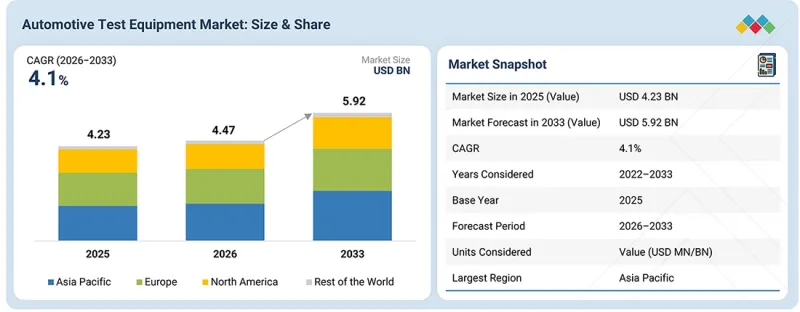
The automotive test equipment market is projected to grow from USD 4.47 billion in 2026 to USD 5.92 billion by 2033, at a CAGR of 4.1%.
| Scope of the Report | |
|---|---|
| Years Considered for the Study | 2026-2033 |
| Base Year | 2025 |
| Forecast Period | 2026-2033 |
| Units Considered | USD billion |
| Segments | ICE & EV Equipment, Application, Vehicle, Propulsion, Technology, End Market & Region |
| Regions covered | Asia Pacific, North America, Europe, Rest of the World |
Growth in the automotive industry is being driven by stricter testing regulations and rising quality standards set by OEMs. These standards are extending from component-level validation to comprehensive vehicle testing. The increasing complexity of vehicles, driven by ADAS, electrified powertrains, connected functions, and software-controlled chassis systems, necessitates a broader range of testing. This includes ADAS, ECU, durability, NVH, EMC, and end-of-line testing.
Furthermore, growth will be fueled by the expansion of OEM production facilities, the establishment of new technical and R&D centers, the expansion of authorized service networks, and the modernization or replacement of aging test equipment. The transition towards software-defined vehicles will heighten the demand for repeatable testing processes, diagnostics, calibration, Hardware-in-the-Loop (HIL) testing, automated validation, and end-of-line inspections.
Recent developments, such as the Automotive Research Association of India's (ARAI) ADAS Test City, highlight the growing infrastructure dedicated to controlled and repeatable vehicle testing. At the service level, the rise in electronic and sensor content in vehicles is driving the need for wheel alignment, inspections, diagnostics, calibration, and other workshop testing equipment. Consequently, demand is expected to grow across OEM plants, Tier 1 suppliers, testing centers, dealerships, and independent service networks. There will be a greater emphasis on equipment that offers automated measurement, OEM-specific databases, software updates, and integration capabilities.
"ADAS adoption is expanding the demand for sensor calibration and vehicle validation equipment."
ADAS test equipment is rapidly emerging as a high-potential segment in the automotive industry. This is due to the need for precise validation of various systems, including cameras, radar, LiDAR, sensors, steering, braking, and vehicle control systems in both passenger and commercial vehicles, regardless of their propulsion type. The increasing adoption of features such as adaptive cruise control, automatic emergency braking, lane-keeping assistance, and parking assistance is driving demand for both static and dynamic ADAS calibration, sensor target systems, radar and camera simulations, and controlled vehicle testing. The Automotive Research Association of India (ARAI) is expanding its dedicated ADAS validation infrastructure in India to meet this growing need for repeatable real-world scenario testing.
Equipment suppliers are also integrating ADAS testing with diagnostics, calibration, vehicle dynamics, and automated measurements. This enables OEMs, Tier 1 suppliers, dealerships, and service centers to perform multiple validation procedures within a common framework. As the content of ADAS features expands across different vehicle models, it will increasingly be influenced by regulatory requirements, safety standards, and calibration needs, rather than solely depending on advancements in propulsion technologies.
"Passenger vehicles are expected to lead the demand market for vehicles through higher testing intensity per platform."
Passenger vehicles are expected to remain the largest segment in the vehicle market. This is due to OEMs launching more vehicle platforms and variants, as well as increasing testing requirements for EV powertrains, batteries, ADAS, braking systems, NVH, EMC, electronics, and software-controlled functions.
While major OEMs have significant in-house testing facilities, the growth of production plants, R&D and technical centers, new vehicle programs, and the replacement of outdated equipment will sustain demand for test equipment manufacturers such as AVL, HORIBA, dSPACE, Keysight Technologies, AB Dynamics, and MAHA.
Additionally, independent testing providers such as TUV SUD and DEKRA will support OEMs in areas including certification, homologation, EMC, battery testing, ADAS, and vehicle validation. As a result, the market is expected to grow due to increased testing requirements for each platform, the expansion of in-house testing capabilities, the construction of new facilities, equipment replacement, and selective outsourcing-rather than solely on increased vehicle production.
"Stricter ADAS safety requirements are driving the demand for scenario-based simulation and HIL testing in Europe."
Europe is ramping up investment in advanced automotive testing equipment due to stricter safety requirements for ADAS. These requirements are expanding validation processes for features such as automatic emergency braking, lane-keeping assistance, driver monitoring, and vulnerable road user detection. The evolving Euro NCAP protocols for 2026 introduce a greater number and complexity of scenarios that OEMs must validate across various traffic conditions, road users, sensor failures, and edge cases.
As a result, testing is increasingly shifting toward scenario-based simulation, HIL testing, radar and camera target simulators, and automated proving ground systems. For example, in August 2026, AB Dynamics invested USD 11 million to acquire eMpulse Test Systems, with an additional potential payment of up to USD 15 million. These developments indicate that OEMs in Europe are transitioning from limited physical testing to high-volume, scenario-driven validation. This shift is driving increased demand for HIL platforms, scenario-generation tools, robotic target systems, and virtual homologation solutions.
In-depth interviews were conducted with CEOs, marketing directors, other innovation and technology directors, and executives from various key organizations operating in this market.
- By Company Type: OEMs (50%), Tier 1 (30%), Test Service Providers (20%)
- By Designation: CXOs (20%), Directors(30%), Others (50%)
- By Country: Asia Pacific (40%), North America (25%), Europe (20%), and the Rest of the World (15%)
The automotive test equipment market is led by established test equipment manufacturers and automotive engineering companies, including AVL (Austria), HORIBA Ltd. (Japan), National Instruments (US), Durr AG (Germany), and Robert Bosch GmbH (Germany). OEMs and Tier 1 suppliers are also strengthening their internal testing capabilities to support EV, battery, ADAS, electronics, and software-intensive vehicle programs. Market participants are focusing on integrated test cells, high-voltage powertrain testing, automated validation, HIL and virtual testing, modular measurement platforms, and production-linked EOL systems to strengthen their competitive position. Strategic initiatives include investments in EV battery and e-powertrain test facilities, partnerships with OEMs and Tier 1 suppliers, expansion of automated testing capabilities, and integration of test hardware with simulation, data acquisition, and analytics platforms.
Research Coverage:
The report covers the market by equipment (chassis dynamometers, engine dynamometers, transmission dynamometers, vehicle emission test systems, wheel alignment testers, fuel injection pump testers, Hardware-in-the-Loop (HIL) test benches, battery test equipment, E-motor test equipment, E-axle testing, vehicle charging & high-voltage test systems, EV drivetrain testing, brake test equipment, NVH test equipment, ADAS test equipment, durability test equipment, EMC & environmental test equipment, and others), application (mobile/tablet-based equipment and PC/laptop-based equipment), propulsion (ICE and EVs), vehicle type (passenger cars and commercial vehicles), end market (OEM assembly plants, R&D/technical centers, and authorized service centers), advanced technology (sensor testing, perception system testing, ECU testing, ADAS testing, simulation testing, edge computing, and V2X testing), and region (Asia Pacific, Europe, North America, and the Rest of the World). It covers the competitive landscape and profiles of the major players in the automotive test equipment market.
The study also includes an in-depth competitive analysis of the key players in the market, along with their company profiles, key observations related to product and business offerings, recent developments, and key market strategies.
Key Benefits of Buying the Report:
- This report will help market leaders/new entrants in this market with information on the closest approximations of revenue numbers for the Automotive Test Equipment Market ecosystem and its subsegments.
- This report will help stakeholders understand the competitive landscape and gain more insights to better position their businesses and plan suitable go-to-market strategies.
- This report will also help stakeholders understand the market's pulse and provide information on key market drivers, restraints, challenges, and opportunities.
The report provides insight on the following pointers:
- Analysis of key drivers (increasing vehicle electronics and software complexity, electrification driving high-voltage and battery testing investment, growing ADAS penetration and higher automation levels, stricter safety, emissions, and cybersecurity regulations, and OEM pressure to shorten vehicle development cycles), restraints (integration complexity between hardware and software testing environments, limited skilled expertise constrains advanced testing, lack of standardization across testing platforms, and high capital cost of advanced testing infrastructure), opportunities (software-defined vehicle testing platforms, EV and battery testing or ADAS/AD validation, AI-enabled automated testing, OTA and cybersecurity validation, and emerging-market testing infrastructure), and challenges (in-house development of proprietary testing platforms by large OEMs, long replacement cycles for capital-intensive testing equipment, shift from hardware-intensive testing toward software-defined and virtual validation, and large test datasets and rapid vehicle architecture changes increase system requirements)
- Product Development/Innovation: Detailed insights into upcoming technologies, research & development activities, and product launches in the automotive test equipment market.
- Market Development: Comprehensive information about lucrative markets; the report analyzes the automotive test equipment market across varied regions.
- Market Diversification: Exhaustive information about new products, untapped geographies, recent developments, and investments in the automotive test equipment market.
- Competitive Assessment: In-depth assessment of market ranking, growth strategies, and service offerings of leading players like AVL (Austria), HORIBA Ltd. (Japan), National Instruments (US), Durr AG (Germany), and Robert Bosch GmbH (Germany).
TABLE OF CONTENTS
1 INTRODUCTION
- 1.1 STUDY OBJECTIVES
- 1.2 MARKET DEFINITION
- 1.2.1 INCLUSIONS AND EXCLUSIONS
- 1.3 STUDY SCOPE
- 1.3.1 MARKET SEGMENTATION AND REGIONAL SNAPSHOT
- 1.3.2 YEARS CONSIDERED
- 1.4 CURRENCY CONSIDERED
- 1.5 STAKEHOLDERS
- 1.6 SUMMARY OF CHANGES
2 EXECUTIVE SUMMARY
- 2.1 MARKET HIGHLIGHTS AND KEY INSIGHTS
- 2.2 KEY MARKET PARTICIPANTS: MAPPING OF STRATEGIC DEVELOPMENTS
- 2.3 DISRUPTIVE TRENDS IN AUTOMOTIVE TEST EQUIPMENT MARKET
- 2.4 HIGH-GROWTH SEGMENTS IN AUTOMOTIVE TEST EQUIPMENT MARKET
- 2.5 REGIONAL SNAPSHOT: MARKET SIZE, GROWTH RATE, AND FORECAST
3 PREMIUM INSIGHTS
- 3.1 ATTRACTIVE OPPORTUNITIES FOR PLAYERS IN AUTOMOTIVE TEST EQUIPMENT MARKET
- 3.2 AUTOMOTIVE TEST EQUIPMENT MARKET, BY EQUIPMENT TYPE
- 3.3 AUTOMOTIVE TEST EQUIPMENT MARKET, BY APPLICATION
- 3.4 AUTOMOTIVE TEST EQUIPMENT MARKET, VEHICLE TYPE
- 3.5 AUTOMOTIVE TEST EQUIPMENT MARKET, BY PROPULSION
- 3.6 AUTOMOTIVE TEST EQUIPMENT MARKET, BY END MARKET
4 MARKET OVERVIEW
- 4.1 INTRODUCTION
- 4.2 MARKET DYNAMICS
- 4.2.1 DRIVERS
- 4.2.1.1 Increasing vehicle electronics and software complexity
- 4.2.1.2 Electrification driving high-voltage and battery testing investment
- 4.2.1.3 Growing ADAS penetration and higher automation levels
- 4.2.1.4 Emissions regulations
- 4.2.1.5 OEM pressure to shorten vehicle development cycles
- 4.2.2 RESTRAINTS
- 4.2.2.1 Integration of complexity between hardware and software testing environments
- 4.2.2.2 Limited expertise constrains advanced testing
- 4.2.2.3 Lack of standardization across testing platforms
- 4.2.2.4 High capital cost of advanced testing infrastructure
- 4.2.3 OPPORTUNITIES
- 4.2.3.1 Software-defined vehicle (SDV) testing platforms
- 4.2.3.2 EV and battery testing and validation
- 4.2.3.3 OTA and cybersecurity validation
- 4.2.3.4 Emerging market testing infrastructure
- 4.2.4 CHALLENGES
- 4.2.4.1 In-house development of proprietary testing platforms by large OEMs
- 4.2.4.2 Long replacement cycles for capital-intensive test equipment
- 4.2.4.3 Large test datasets and rapid vehicle architecture changes increase system requirements
- 4.2.1 DRIVERS
- 4.3 UNMET NEEDS AND WHITE SPACES
- 4.3.1 LIMITED VALIDATION COVERAGE FOR COMPLEX E/E ARCHITECTURES AND SOFTWARE-DEFINED VEHICLES
- 4.3.2 HIGH COST AND LIMITED UTILIZATION OF ADVANCED TESTING INFRASTRUCTURE
- 4.3.3 FRAGMENTED TEST DATA AND LIMITED AUTOMATED FAILURE ANALYSIS
5 INDUSTRY TRENDS
- 5.1 MACROECONOMIC INDICATORS
- 5.1.1 INTRODUCTION
- 5.1.2 GDP TRENDS AND FORECAST
- 5.1.3 TRENDS IN AUTOMOTIVE TESTING, INSPECTION, AND CERTIFICATION (TIC) INDUSTRY
- 5.1.4 TRENDS IN GLOBAL AUTOMOTIVE INDUSTRY
- 5.2 SUPPLY CHAIN ANALYSIS
- 5.3 ECOSYSTEM ANALYSIS
- 5.3.1 RAW MATERIAL/COMPONENT SUPPLIERS
- 5.3.2 TEST EQUIPMENT MANUFACTURERS
- 5.3.3 TESTING SOFTWARE PROVIDERS
- 5.3.4 SIMULATION TOOL PROVIDERS
- 5.3.5 THIRD-PARTY TESTING SERVICE PROVIDERS
- 5.3.6 END USERS
- 5.4 PRICING ANALYSIS
- 5.4.1 BY VEHICLE TYPE
- 5.4.2 PRICING ANALYSIS, BY EQUIPMENT AND REGION
- 5.5 TRADE ANALYSIS
- 5.5.1 IMPORT SCENARIO (HS CODE 903180)
- 5.5.2 EXPORT SCENARIO (HS CODE 903180)
- 5.6 KEY CONFERENCES & EVENTS, 2026-2027
- 5.7 TRENDS & DISRUPTIONS IMPACTING CUSTOMER BUSINESS
- 5.8 INVESTMENT AND FUNDING SCENARIO
- 5.9 CASE STUDY ANALYSIS
- 5.9.1 NOVELIC DEVELOPED HIGHLY PROGRAMMABLE AND CONFIGURABLE HIGH-SPEED DATA LOGGER PLATFORM TO ENABLE LOW-LATENCY DATA STREAMING
- 5.9.2 BRIGGS & STRATTON UTILIZED SIEMENS' FLEXIBLE AND INTUITIVE SIMCENTER TESTLAB SOFTWARE TO INTEGRATE SOFTWARE AND HARDWARE TESTING INTO SEAMLESS WORKFLOW
- 5.9.3 MAN TRUCK & BUS DEPLOYED VECTOR INDIGO TO OPTIMIZE DIAGNOSTIC VALIDATION AND TESTING PROCESSES
- 5.9.4 AVL DEVELOPED HIGH-VOLTAGE BATTERY TEST SYSTEM TO ACCELERATE EV BATTERY VALIDATION
- 5.9.5 HORIBA DEVELOPED INTEGRATED ELECTRIC POWERTRAIN TEST SYSTEM TO IMPROVE ELECTRIFIED DRIVELINE VALIDATION
- 5.10 STARTUP AND SME INNOVATIONS IN AUTOMOTIVE TESTING
- 5.11 REGIONAL INVESTMENT HOTSPOTS: LOCALIZED TESTING CAPABILITIES & COST ADVANTAGES
- 5.12 CAPEX OPTIMIZATION AND VALUE GENERATION ACROSS KEY AUTOMOTIVE TEST EQUIPMENT END USERS
- 5.12.1 CAPEX OPTIMIZATION FOR CHASSIS DYNAMOMETER
- 5.12.2 CAPEX OPTIMIZATION FOR EV DRIVETRAIN TESTING
- 5.12.3 CAPEX OPTIMIZATION FOR BATTERY TEST EQUIPMENT
- 5.12.4 CAPEX OPTIMIZATION FOR E-MOTOR TEST EQUIPMENT
- 5.13 OEM STRATEGIES IN AUTOMOTIVE TESTING
- 5.14 IMPACT OF ISRAEL-IRAN WAR
- 5.14.1 INTRODUCTION
- 5.14.2 ENERGY MARKET DISRUPTION
- 5.14.3 OPERATING COST IMPACT
- 5.14.4 MARKET DEMAND SHIFT
- 5.14.5 SUPPLY CHAIN AND LOCALIZATION IMPACT
- 5.14.6 STRATEGIC MARKET OUTLOOK
- 5.15 EU-INDIA TRADE DEAL IMPACT ANALYSIS
- 5.15.1 INTRODUCTION
- 5.15.2 EU TARIFFS
- 5.15.3 RECENT AUTOMOTIVE TEST CENTERS OPENED/EXPANDED
6 TECHNOLOGICAL ADVANCEMENTS, AI-DRIVEN IMPACT, PATENTS, INNOVATIONS, AND FUTURE APPLICATIONS IN AUTOMOTIVE TEST EQUIPMENT MARKET
- 6.1 TECHNOLOGY ANALYSIS
- 6.1.1 KEY TECHNOLOGIES
- 6.1.1.1 E-motor test benches
- 6.1.1.2 Battery test systems
- 6.1.1.3 Battery emulation and EV testing
- 6.1.1.4 Software in the Loop (SiL )
- 6.1.1.5 Vehicle network simulation
- 6.1.2 COMPLEMENTARY TECHNOLOGIES
- 6.1.2.1 Simulation and modeling software
- 6.1.2.2 Data acquisition & analytics (DAQ & analytics)
- 6.1.2.3 Digital twins
- 6.1.2.4 AI-enabled test automation
- 6.1.3 ADJACENT TECHNOLOGIES
- 6.1.3.1 Cybersecurity testing tools
- 6.1.3.2 Autonomous driving test ecosystem
- 6.1.3.3 Cloud connected test management
- 6.1.1 KEY TECHNOLOGIES
- 6.2 PATENT ANALYSIS
- 6.3 IMPACT OF AI/GEN AI ON AUTOMOTIVE TEST EQUIPMENT MARKET
- 6.3.1 AUTOMOTIVE TESTING STRATEGIES ADOPTED BY OEMS
- 6.3.2 IN-HOUSE VS. OUTSOURCED TESTING
- 6.3.3 TESTING INFRASTRUCTURE DIGITIZATION
- 6.3.4 END-OF-LINE (EOL) AUTOMATION
- 6.3.5 MODULAR AND SCALABLE TEST PLATFORMS
- 6.3.6 SDV AND CYBERSECURITY TESTING
- 6.3.7 GLOBAL R&D MANUFACTURING NETWORK INTEGRATION
- 6.3.8 STANDARDIZATION AND REGULATORY READINESS
- 6.3.9 PARTNERSHIP WITH TEST EQUIPMENT SUPPLIERS
- 6.3.10 SUSTAINABILITY AND ENERGY-EFFICIENT TESTING
- 6.3.11 ARTIFICIAL INTELLIGENCE AND PREDICTIVE TESTING MODELS
- 6.4 TOP USE CASES AND MARKET POTENTIAL
- 6.4.1 KEY AI/GENERATIVE AI USE CASES IN AUTOMOTIVE TEST EQUIPMENT MARKET
- 6.4.2 MARKET POTENTIAL
- 6.4.3 BEST PRACTICES FOLLOWED BY MANUFACTURERS/OEMS IN AUTOMOTIVE TEST EQUIPMENT MARKET
- 6.4.3.1 AI-driven integration patterns
- 6.4.4 CASE STUDIES RELATED TO AI IMPLEMENTATION IN AUTOMOTIVE TEST EQUIPMENT MARKET
- 6.4.4.1 AI-driven test optimization and predictive validation
- 6.4.4.2 AI-driven predictive maintenance of test equipment
- 6.4.4.3 Generative AI-driven test case and scenario generation
- 6.4.5 INTERCONNECTED ECOSYSTEM AND IMPACT ON MARKET PLAYERS
- 6.4.6 CLIENTS' READINESS TO ADOPT AI-INTEGRATED AUTOMOTIVE TEST EQUIPMENT SOLUTIONS
7 SUSTAINABILITY AND REGULATORY LANDSCAPE
- 7.1 REGULATORY LANDSCAPE
- 7.1.1 COUNTRY-WISE REGULATIONS
- 7.1.2 REGULATORY BODIES, GOVERNMENT AGENCIES, AND OTHER ORGANIZATIONS
- 7.1.3 INDUSTRY STANDARDS
- 7.2 SUSTAINABILITY INITIATIVES
- 7.2.1 SUSTAINABILITY IMPACT AND REGULATORY POLICY INITIATIVES
- 7.2.2 CERTIFICATION, LABELING, AND ECO-STANDARDS
- 7.2.2.1 Certification, labelling, and environmental standards relevant to automotive test equipment market
8 CUSTOMER LANDSCAPE AND BUYING BEHAVIOR
- 8.1 DECISION-MAKING PROCESS
- 8.2 KEY STAKEHOLDERS AND BUYING CRITERIA
- 8.2.1 MOBILE/TABLET-BASED EQUIPMENT
- 8.2.2 PC/LAPTOP-BASED EQUIPMENT
- 8.2.3 KEY STAKEHOLDERS IN BUYING PROCESS
- 8.2.4 BUYING CRITERIA
- 8.3 ADOPTION BARRIERS & INTERNAL CHALLENGES
- 8.4 UNMET NEEDS OF VARIOUS END USERS
9 AUTOMOTIVE TEST EQUIPMENT MARKET, BY EQUIPMENT
- 9.1 INTRODUCTION
- 9.2 ENGINE DYNAMOMETER
- 9.2.1 DEMAND FOR POWERTRAIN VALIDATION, EMISSIONS COMPLIANCE, AND HYBRID ENGINE TESTING TO SUPPORT MARKET GROWTH
- 9.3 CHASSIS DYNAMOMETER
- 9.3.1 STRICTER EMISSION AND VEHICLE PERFORMANCE REQUIREMENTS TO BOOST ADOPTION
- 9.4 VEHICLE EMISSION TEST SYSTEM
- 9.4.1 STRINGENT REGULATIONS, AIR QUALITY FOCUS, AND HYBRID VEHICLE ADOPTION TO DRIVE MARKET
- 9.5 WHEEL ALIGNMENT TESTER
- 9.5.1 INCREASING ADOPTION OF AUTOMATED VEHICLES AND PRECISION DRIVETRAIN TESTING TO DRIVE MARKET
- 9.6 TRANSMISSION DYNAMOMETER
- 9.6.1 HIGH VEHICLE PARC, OEM SERVICE EXPANSION, AND POWERTRAIN SHIFT TO DRIVE MARKET
- 9.7 FUEL INJECTION PUMP TESTER
- 9.7.1 HYBRID POWERTRAIN RETENTION AND DIESEL AFTERMARKET DEMAND TO SUPPORT GROWTH
- 9.8 BATTERY TEST EQUIPMENT
- 9.8.1 RISING HIGH VOLTAGE, FAST CHARGING, AND BATTERY SAFETY REQUIREMENTS TO DRIVE MARKET
- 9.9 E-MOTOR TEST EQUIPMENT
- 9.9.1 RISING EV PRODUCTION AND HIGH-VOLTAGE E-MOTOR DEVELOPMENT TO DRIVE MARKET
- 9.10 E-AXLE TESTING
- 9.10.1 GROWING DEMAND FOR LIFECYCLE TESTING OF E-AXLES IN FLEET AND SHARED MOBILITY EVS TO DRIVE MARKET
- 9.11 EV DRIVETRAIN TESTING
- 9.11.1 NEXT-GEN VALIDATION IN EV DRIVETRAINS TO DRIVE MARKET
- 9.12 HARDWARE-IN-THE-LOOP (HIL) TESTING
- 9.12.1 RISING SOFTWARE COMPLEXITY AND REAL TIME ECU VALIDATION REQUIREMENTS TO DRIVE MARKET
- 9.13 VEHICLE CHARGING & HIGH-VOLTAGE TEST SYSTEM
- 9.13.1 HIGH-VOLTAGE BATTERY PACKS AND V2G CAPABILITIES IN EVS TO DRIVE MARKET
- 9.14 BRAKE TEST EQUIPMENT
- 9.14.1 ADVANCED BRAKING SYSTEMS AND ELECTRIFICATION TO DRIVE MARKET
- 9.15 NOISE, VIBRATION, AND HARSHNESS (NVH) TEST EQUIPMENT
- 9.15.1 EV POWERTRAIN COMPLEXITY AND LOW NOISE REQUIREMENTS TO DRIVE MARKET
- 9.16 ADAS TEST EQUIPMENT
- 9.16.1 INCREASING SENSOR COMPLEXITY AND AUTOMATED DRIVING VALIDATION TO DRIVE MARKET
- 9.17 DURABILITY TEST EQUIPMENT
- 9.17.1 EV POWERTRAIN COMPLEXITY AND LONGER VALIDATION REQUIREMENTS TO DRIVE MARKET
- 9.18 ELECTROMAGNETIC COMPATIBILITY (EMC) & ENVIRONMENTAL TEST EQUIPMENT
- 9.18.1 ELECTRIFICATION AND CONNECTED VEHICLE COMPLEXITY TO DRIVE MARKET
- 9.19 OTHERS
- 9.20 KEY PRIMARY INSIGHTS
10 AUTOMOTIVE TEST EQUIPMENT MARKET, BY APPLICATION
- 10.1 INTRODUCTION
- 10.2 MOBILE/TABLET-BASED EQUIPMENT
- 10.2.1 RISING CONNECTED VEHICLE COMPLEXITY AND EV DIAGNOSTICS TO DRIVE GROWTH
- 10.3 PC/LAPTOP-BASED EQUIPMENT
- 10.3.1 HIGH COMPUTATIONAL POWER AND MULTI-SYSTEM INTEGRATION TO DRIVE MARKET
- 10.4 KEY PRIMARY INSIGHTS
11 AUTOMOTIVE TEST EQUIPMENT MARKET, BY VEHICLE TYPE
- 11.1 INTRODUCTION
- 11.1.1 COMPARISON OF TEST EQUIPMENT SPECIFICATIONS IN PASSENGER CAR AND COMMERCIAL VEHICLE
- 11.2 PASSENGER CAR
- 11.2.1 ADVANCEMENTS IN ADAS AND AUTONOMOUS DRIVING TECHNOLOGIES TO DRIVE MARKET
- 11.3 COMMERCIAL VEHICLE
- 11.3.1 INCREASING DEMAND FOR HEAVY-DUTY CHASSIS AND ENGINE DYNAMOMETERS TO DRIVE MARKET
- 11.3.2 LIGHT COMMERCIAL VEHICLE
- 11.3.3 HEAVY COMMERCIAL VEHICLE
- 11.4 KEY PRIMARY INSIGHTS
12 AUTOMOTIVE TEST EQUIPMENT MARKET, BY PROPULSION
- 12.1 INTRODUCTION
- 12.2 INTERNAL COMBUSTION ENGINE (ICE)
- 12.2.1 ADVANCEMENTS IN ENGINE TECHNOLOGIES AND STRICT EMISSION REGULATIONS TO DRIVE MARKET
- 12.3 EV
- 12.3.1 INCREASING DEMAND FOR ADVANCED BATTERY TESTING TO DRIVE MARKET
- 12.4 KEY PRIMARY INSIGHTS
13 AUTOMOTIVE TEST EQUIPMENT MARKET, BY END MARKET
- 13.1 INTRODUCTION
- 13.2 AUTHORIZED SERVICE CENTER
- 13.2.1 RISING DEMAND FOR WHEEL ALIGNMENT TESTERS TO DRIVE MARKET
- 13.3 OEM ASSEMBLY PLANT
- 13.3.1 AUTOMATED END-OF-LINE TESTING AND PLANT MODERNIZATION TO DRIVE MARKET
- 13.4 R&D/TECHNICAL CENTER
- 13.4.1 DEMAND FOR ADVANCED ADAS AND AUTONOMOUS SYSTEM TESTING TECHNOLOGIES TO DRIVE MARKET
- 13.5 KEY PRIMARY INSIGHTS
14 AUTOMOTIVE TEST EQUIPMENT MARKET, BY ADVANCED TECHNOLOGY
- 14.1 INTRODUCTION
- 14.2 ECU TESTING
- 14.3 DATA LOGGER
- 14.4 SIMULATION TESTING
- 14.4.1 CRASH IMPACT SIMULATION
- 14.4.2 AUTONOMOUS DRIVING SIMULATOR
- 14.5 SENSOR TESTING
- 14.6 PERCEPTION SYSTEM TESTING
- 14.7 EDGE COMPUTING
- 14.8 V2X TESTING
- 14.9 KEY PRIMARY INSIGHTS
15 AUTOMOTIVE TEST EQUIPMENT MARKET, BY REGION
- 15.1 INTRODUCTION
- 15.2 ASIA PACIFIC
- 15.2.1 CHINA
- 15.2.1.1 Adoption of expansion strategy by OEMs to drive market
- 15.2.2 INDIA
- 15.2.2.1 Rapid expansion of authorized service centers to foster growth
- 15.2.3 JAPAN
- 15.2.3.1 Assembly plant growth and rise in R&D investments to drive market
- 15.2.4 SOUTH KOREA
- 15.2.4.1 Heavy investments in advanced battery test equipment to boost market
- 15.2.5 REST OF ASIA PACIFIC
- 15.2.1 CHINA
- 15.3 EUROPE
- 15.3.1 FRANCE
- 15.3.1.1 EV adoption and stricter regulations accelerate demand
- 15.3.2 GERMANY
- 15.3.2.1 R&D and ADAS investments to expand demand
- 15.3.3 ITALY
- 15.3.3.1 Hybrid production and EV testing to drive demand
- 15.3.4 SPAIN
- 15.3.4.1 Advanced testing and quality assurance drive growth
- 15.3.5 UK
- 15.3.5.1 High voltage validation and ADAS protocols to reshape demand
- 15.3.6 REST OF EUROPE
- 15.3.1 FRANCE
- 15.4 NORTH AMERICA
- 15.4.1 CANADA
- 15.4.1.1 Localized EV testing capabilities to strengthen battery and powertrain equipment demand
- 15.4.2 MEXICO
- 15.4.2.1 Testing capacity to expand with rising OEM validation demand
- 15.4.3 US
- 15.4.3.1 Advanced dynamometer deployment to accelerate EV powertrain validation
- 15.4.1 CANADA
- 15.5 REST OF THE WORLD
- 15.5.1 BRAZIL
- 15.5.1.1 Production localization to strengthen automotive testing demand
- 15.5.2 RUSSIA
- 15.5.2.1 Import substitution and localized validation infrastructure to strengthen demand
- 15.5.3 OTHERS
- 15.5.1 BRAZIL
16 COMPETITIVE LANDSCAPE
- 16.1 INTRODUCTION
- 16.2 KEY PLAYER STRATEGIES/RIGHT TO WIN
- 16.3 MARKET SHARE ANALYSIS, 2025
- 16.4 REVENUE ANALYSIS, 2022-2025
- 16.5 COMPANY VALUATION AND FINANCIAL METRICS
- 16.6 BRAND/PRODUCT COMPARISON
- 16.7 COMPANY EVALUATION MATRIX: KEY PLAYERS, 2025
- 16.7.1 STARS
- 16.7.2 EMERGING LEADERS
- 16.7.3 PERVASIVE PLAYERS
- 16.7.4 PARTICIPANTS
- 16.7.5 COMPANY FOOTPRINT
- 16.7.5.1 Company footprint
- 16.7.5.2 Region footprint
- 16.7.5.3 Equipment footprint
- 16.7.5.4 Vehicle type footprint
- 16.8 COMPANY EVALUATION MATRIX: STARTUPS/SMES, 2025
- 16.8.1 PROGRESSIVE COMPANIES
- 16.8.2 RESPONSIVE COMPANIES
- 16.8.3 DYNAMIC COMPANIES
- 16.8.4 STARTING BLOCKS
- 16.8.5 COMPETITIVE BENCHMARKING
- 16.8.5.1 List of startups/SMEs
- 16.8.5.2 Competitive benchmarking of startups/SMEs
- 16.9 COMPETITIVE SCENARIO
- 16.9.1 PRODUCT LAUNCHES/DEVELOPMENTS
- 16.9.2 DEALS
- 16.9.3 EXPANSIONS
- 16.9.4 OTHER DEVELOPMENTS
17 COMPANY PROFILES
- 17.1 KEY PLAYERS
- 17.1.1 AVL
- 17.1.1.1 Business overview
- 17.1.1.2 Products offered
- 17.1.1.3 Recent developments
- 17.1.1.3.1 Product launches/developments
- 17.1.1.3.2 Deals
- 17.1.1.3.3 Expansions
- 17.1.1.3.4 Other developments
- 17.1.1.4 MnM view
- 17.1.1.4.1 Key strengths
- 17.1.1.4.2 Strategic choices
- 17.1.1.4.3 Weaknesses and competitive threats
- 17.1.2 HORIBA GROUP
- 17.1.2.1 Business overview
- 17.1.2.2 Products offered
- 17.1.2.3 Recent developments
- 17.1.2.3.1 Product launches/developments
- 17.1.2.3.2 Deals
- 17.1.2.3.3 Expansions
- 17.1.2.3.4 Other developments
- 17.1.2.4 MnM view
- 17.1.2.4.1 Key strengths
- 17.1.2.4.2 Strategic choices
- 17.1.2.4.3 Weaknesses and competitive threats
- 17.1.3 NATIONAL INSTRUMENTS
- 17.1.3.1 Business overview
- 17.1.3.2 Products offered
- 17.1.3.3 Recent developments
- 17.1.3.3.1 Product launches/developments
- 17.1.3.3.2 Deals
- 17.1.3.4 MnM view
- 17.1.3.4.1 Key strengths
- 17.1.3.4.2 Strategic choices
- 17.1.3.4.3 Weaknesses and competitive threats
- 17.1.4 DURR GROUP
- 17.1.4.1 Business overview
- 17.1.4.2 Products offered
- 17.1.4.3 Recent developments
- 17.1.4.3.1 Product launches/developments
- 17.1.4.3.2 Deals
- 17.1.4.3.3 Expansions
- 17.1.4.3.4 Other developments
- 17.1.4.4 MnM view
- 17.1.4.4.1 Key strengths
- 17.1.4.4.2 Strategic choices
- 17.1.4.4.3 Weaknesses and competitive threats
- 17.1.5 ROBERT BOSCH GMBH
- 17.1.5.1 Business overview
- 17.1.5.2 Products offered
- 17.1.5.3 Recent developments
- 17.1.5.3.1 Product launches/developments
- 17.1.5.3.2 Deals
- 17.1.5.3.3 Other developments
- 17.1.5.4 MnM view
- 17.1.5.4.1 Key strengths
- 17.1.5.4.2 Strategic choices
- 17.1.5.4.3 Weaknesses and competitive threats
- 17.1.6 PHINIA INC.
- 17.1.6.1 Business overview
- 17.1.6.2 Products offered
- 17.1.6.3 Recent developments
- 17.1.6.3.1 Product launches/developments
- 17.1.6.3.2 Deals
- 17.1.6.3.3 Other developments
- 17.1.7 ILLINOIS TOOL WORKS INC.
- 17.1.7.1 Business overview
- 17.1.7.2 Products offered
- 17.1.7.3 Recent developments
- 17.1.7.3.1 Deals
- 17.1.7.3.2 Other developments
- 17.1.8 SIEMENS
- 17.1.8.1 Business overview
- 17.1.8.2 Products offered
- 17.1.8.3 Recent developments
- 17.1.8.3.1 Product launches/developments
- 17.1.8.3.2 Deals
- 17.1.9 CONTINENTAL AG
- 17.1.9.1 Business overview
- 17.1.9.2 Products offered
- 17.1.9.3 Recent developments
- 17.1.9.3.1 Deals
- 17.1.9.3.2 Expansions
- 17.1.9.3.3 Other developments
- 17.1.10 VECTOR INFORMATIK GMBH
- 17.1.10.1 Business overview
- 17.1.10.2 Products offered
- 17.1.10.3 Recent developments
- 17.1.10.3.1 Product launches/enhancements
- 17.1.10.3.2 Deals
- 17.1.11 SOFTING AG
- 17.1.11.1 Business overview
- 17.1.11.2 Products offered
- 17.1.11.3 Recent developments
- 17.1.11.3.1 Other developments
- 17.1.12 MUSTANG ADVANCED ENGINEERING
- 17.1.12.1 Business overview
- 17.1.12.2 Products offered
- 17.1.12.3 Recent developments
- 17.1.12.3.1 Product developments
- 17.1.12.3.2 Deals
- 17.1.12.3.3 Expansions
- 17.1.12.3.4 Other developments
- 17.1.13 SCHAEFFLER AG
- 17.1.13.1 Business overview
- 17.1.13.2 Products offered
- 17.1.13.3 Recent developments
- 17.1.13.3.1 Deals
- 17.1.14 MAHA MASCHINENBAU HALDENWANG GMBH & CO. KG
- 17.1.14.1 Business overview
- 17.1.14.2 Products offered
- 17.1.14.3 Recent developments
- 17.1.14.3.1 Deals
- 17.1.14.3.2 Other developments
- 17.1.15 MULLER AUTOMOTIVE
- 17.1.15.1 Business overview
- 17.1.15.2 Products offered
- 17.1.1 AVL
- 17.2 OTHER PLAYERS
- 17.2.1 INTERTEK GROUP PLC
- 17.2.2 TUV SUD
- 17.2.3 ROHDE & SCHWARZ
- 17.2.4 SINFONIA TECHNOLOGY CO., LTD.
- 17.2.5 AMPRO TESTING MACHINES
- 17.2.6 AMETEK CTS
- 17.2.7 AUTEL INTELLIGENT TECHNOLOGY CORP., LTD.
- 17.2.8 NSM INDUSTRIAL SOLUTIONS PVT LTD
- 17.2.9 DSA DATEN- UND SYSTEMTECHNIK GMBH
- 17.2.10 IPETRONIK GMBH & CO. KG
- 17.2.11 HUFF TECHNOLOGIES
- 17.2.12 DYNO ONE INC.
- 17.2.13 DRIVE SYSTEM DESIGN
- 17.2.14 ANTHONY BEST DYNAMICS LIMITED
- 17.2.15 SAJ TEST PLANT PVT. LTD.
- 17.2.16 MAXEYE TECHNOLOGIES
18 RESEARCH METHODOLOGY
- 18.1 RESEARCH DATA
- 18.1.1 SECONDARY DATA
- 18.1.2 KEY SECONDARY SOURCES
- 18.1.2.1 List of secondary sources
- 18.1.2.2 Key data from secondary sources
- 18.1.3 PRIMARY DATA
- 18.1.3.1 Primary interviews - demand and supply sides
- 18.1.3.2 Key industry insights and breakdown of primary interviews
- 18.1.3.3 List of primary participants
- 18.2 MARKET SIZE ESTIMATION
- 18.2.1 TOP-DOWN APPROACH
- 18.3 DATA TRIANGULATION
- 18.4 FACTOR ANALYSIS
- 18.5 RESEARCH ASSUMPTIONS
- 18.6 RESEARCH LIMITATIONS
- 18.7 RISK ASSESSMENT
19 APPENDIX
- 19.1 KEY INSIGHTS OF INDUSTRY EXPERTS
- 19.2 DISCUSSION GUIDE
- 19.3 KNOWLEDGESTORE: MARKETSANDMARKETS' SUBSCRIPTION PORTAL
- 19.4 CUSTOMIZATION OPTIONS
- 19.4.1 AUTOMOTIVE TEST EQUIPMENT MARKET, BY PROPULSION, AT THE COUNTRY LEVEL
- 19.4.2 ADDITIONAL COUNTRIES MAPPING OF (UP TO THREE IN THE REPORT)
- 19.4.3 COMPANY INFORMATION
- 19.4.3.1 Profiles of additional market players (up to five)
- 19.5 RELATED REPORTS
- 19.6 AUTHOR DETAILS
List of Tables
- TABLE 1 AUTOMOTIVE TEST EQUIPMENT MARKET DEFINITION, BY EQUIPMENT TYPE
- TABLE 2 AUTOMOTIVE TEST EQUIPMENT MARKET DEFINITION, BY APPLICATION
- TABLE 3 AUTOMOTIVE TEST EQUIPMENT MARKET DEFINITION, BY PROPULSION
- TABLE 4 AUTOMOTIVE TEST EQUIPMENT MARKET DEFINITION, BY VEHICLE TYPE
- TABLE 5 AUTOMOTIVE TEST EQUIPMENT MARKET DEFINITION, BY END MARKET
- TABLE 6 CURRENCY EXCHANGE RATES, 2020-2025
- TABLE 7 SKILL REQUIREMENTS AND TRAINING INTENSITY ACROSS AUTOMOTIVE TESTING AREAS
- TABLE 8 AUTOMOTIVE TEST EQUIPMENT MARKET: MODULAR TEST SYSTEM ARCHITECTURE
- TABLE 9 AUTOMOTIVE TEST EQUIPMENT MARKET: CAPITAL COST STRUCTURE ACROSS ADVANCED AUTOMOTIVE TESTING FACILITIES
- TABLE 10 AUTOMOTIVE TEST EQUIPMENT MARKET: TESTING REQUIREMENTS ACROSS EV AND EV BATTERY
- TABLE 11 AUTOMOTIVE TEST EQUIPMENT MARKET: OEM INTERNALIZATION POTENTIAL ACROSS TEST PLATFORM LAYERS
- TABLE 12 AUTOMOTIVE TEST EQUIPMENT MARKET: REPLACEMENT DRIVERS AND UPGRADE POTENTIAL ACROSS AUTOMOTIVE TEST EQUIPMENT
- TABLE 13 AUTOMOTIVE TEST EQUIPMENT MARKET: IMPACT OF MARKET DYNAMICS
- TABLE 14 GDP PERCENTAGE CHANGE, BY KEY COUNTRY, 2021-2030
- TABLE 15 AUTOMOTIVE TEST EQUIPMENT MARKET: ROLE OF KEY PLAYERS IN ECOSYSTEM
- TABLE 16 AVERAGE SELLING PRICE TREND OF AUTOMOTIVE TEST EQUIPMENT, BY VEHICLE TYPE, 2026, USD (MILLION)
- TABLE 17 AVERAGE SELLING PRICE TREND OF AUTOMOTIVE TEST EQUIPMENT, BY REGION, 2026, USD (MILLION)
- TABLE 18 AUTOMOTIVE TEST EQUIPMENT IMPORTS, BY COUNTRY, 2022-2025 (USD BILLION)
- TABLE 19 AUTOMOTIVE TEST EQUIPMENT EXPORTS, BY COUNTRY, 2022-2025 (USD BILLION)
- TABLE 20 KEY CONFERENCES & EVENTS, 2026-2027
- TABLE 21 STARTUP AND SME INNOVATIONS IN AUTOMOTIVE TESTING
- TABLE 22 REGIONAL INVESTMENT HOTSPOTS: LOCALIZED TESTING CAPABILITIES & COST ADVANTAGES
- TABLE 23 CAPEX INVESTMENT AND ECONOMIC RETURN FOR CHASSIS DYNAMOMETER BY END USER
- TABLE 24 CAPEX INVESTMENT AND ECONOMIC RETURN FOR EV DRIVETRAIN TESTING BY END USER
- TABLE 25 CAPEX INVESTMENT AND ECONOMIC RETURN FOR BATTERY TEST EQUIPMENT BY END USER
- TABLE 26 CAPEX INVESTMENT AND ECONOMIC RETURN FOR E-MOTOR TEST EQUIPMENT BY END USER
- TABLE 27 VOLKSWAGEN GROUP: AUTOMOTIVE TESTING STRATEGY
- TABLE 28 STELLANTIS: AUTOMOTIVE TESTING STRATEGY
- TABLE 29 TOYOTA MOTOR CORPORATION: AUTOMOTIVE TESTING STRATEGY
- TABLE 30 HYUNDAI MOTOR GROUP: AUTOMOTIVE TESTING STRATEGY
- TABLE 31 FORD MOTOR COMPANY: AUTOMOTIVE TESTING STRATEGY
- TABLE 32 AUTOMOTIVE TEST CENTERS OPENED/EXPANDED, BY COUNTRY, 2022-2026
- TABLE 33 SPECIFICATIONS OF BATTERY EMULATION SYSTEMS USED IN AUTOMOTIVE TESTING
- TABLE 34 CYBERSECURITY TESTING TOOLS: KEY CAPABILITIES AND APPLICATIONS
- TABLE 35 AUTONOMOUS DRIVING TEST ECOSYSTEM: KEY COMPONENTS AND APPLICATIONS
- TABLE 36 PATENT ANALYSIS, JULY 2026
- TABLE 37 COMPARISON OF TESTING STRATEGIES BY OEMS
- TABLE 38 KEY AI/GENERATIVE AI USE CASES IN AUTOMOTIVE TEST EQUIPMENT MARKET
- TABLE 39 MARKET POTENTIAL
- TABLE 40 ROLE AND IMPACT OF AI IN AUTOMOTIVE TEST EQUIPMENT MARKET
- TABLE 41 NORTH AMERICA: REGULATORY BODIES, GOVERNMENT AGENCIES, AND OTHER ORGANIZATIONS
- TABLE 42 EUROPE: REGULATORY BODIES, GOVERNMENT AGENCIES, AND OTHER ORGANIZATIONS
- TABLE 43 ASIA PACIFIC: REGULATORY BODIES, GOVERNMENT AGENCIES, AND OTHER ORGANIZATIONS
- TABLE 44 COUNTRY-WISE/REGION-WISE REGULATIONS AND STANDARDS IN AUTOMOTIVE TEST EQUIPMENT MARKET
- TABLE 45 POLICY INITIATIVES AFFECTING SUSTAINABILITY, SAFETY, PRIVACY, AND TECHNOLOGY COMPLIANCE FOR AUTOMOTIVE TEST EQUIPMENT MARKET
- TABLE 46 CERTIFICATION, LABELING, AND ENVIRONMENTAL STANDARDS
- TABLE 47 INFLUENCE OF STAKEHOLDERS ON BUYING PROCESS FOR TOP APPLICATIONS (%)
- TABLE 48 KEY BUYING CRITERIA FOR TOP APPLICATIONS
- TABLE 49 AUTOMOTIVE TEST EQUIPMENT MARKET, BY EQUIPMENT, 2022-2025 (USD MILLION)
- TABLE 50 AUTOMOTIVE TEST EQUIPMENT MARKET, BY EQUIPMENT, 2026-2033 (USD MILLION)
- TABLE 51 ENGINE DYNAMOMETER MARKET, BY REGION, 2022-2025 (USD MILLION)
- TABLE 52 ENGINE DYNAMOMETER MARKET, BY REGION, 2026-2033 (USD MILLION)
- TABLE 53 CHASSIS DYNAMOMETER MARKET, BY REGION, 2022-2025 (USD MILLION)
- TABLE 54 CHASSIS DYNAMOMETER MARKET, BY REGION, 2026-2033 (USD MILLION)
- TABLE 55 VEHICLE EMISSION TEST SYSTEM MARKET, BY REGION, 2022-2025 (USD MILLION)
- TABLE 56 VEHICLE EMISSION TEST SYSTEM MARKET, BY REGION, 2026-2033 (USD MILLION)
- TABLE 57 WHEEL ALIGNMENT TESTER MARKET, BY REGION, 2022-2025 (USD MILLION)
- TABLE 58 WHEEL ALIGNMENT TESTER MARKET, BY REGION, 2026-2033 (USD MILLION)
- TABLE 59 TRANSMISSION DYNAMOMETER MARKET, BY REGION, 2022-2025 (USD MILLION)
- TABLE 60 TRANSMISSION DYNAMOMETER MARKET, BY REGION, 2026-2033 (USD MILLION)
- TABLE 61 FUEL INJECTOR PUMP TESTER MARKET, BY REGION, 2022-2025 (USD MILLION)
- TABLE 62 FUEL INJECTOR PUMP TESTER MARKET, BY REGION, 2026-2033 (USD MILLION)
- TABLE 63 BATTERY TEST EQUIPMENT MARKET, BY REGION, 2022-2025 (USD MILLION)
- TABLE 64 BATTERY TEST EQUIPMENT MARKET, BY REGION, 2026-2033 (USD MILLION)
- TABLE 65 E-MOTOR TEST EQUIPMENT MARKET, BY REGION, 2022-2025 (USD MILLION)
- TABLE 66 E-MOTOR TEST EQUIPMENT MARKET, BY REGION, 2026-2033 (USD MILLION)
- TABLE 67 E-AXLE TESTING EQUIPMENT MARKET, BY REGION, 2022-2025 (USD MILLION)
- TABLE 68 E-AXLE TESTING EQUIPMENT MARKET, BY REGION, 2026-2033 (USD MILLION)
- TABLE 69 EV DRIVETRAIN TEST EQUIPMENT MARKET, BY REGION, 2022-2025 (USD MILLION)
- TABLE 70 EV DRIVETRAIN TEST EQUIPMENT MARKET, BY REGION, 2026-2033 (USD MILLION)
- TABLE 71 HARDWARE-IN-THE-LOOP TEST EQUIPMENT MARKET, BY REGION, 2022-2025 (USD MILLION)
- TABLE 72 HARDWARE-IN-THE-LOOP TEST EQUIPMENT MARKET, BY REGION, 2026-2033 (USD MILLION)
- TABLE 73 VEHICLE CHARGING & HIGH-VOLTAGE TEST EQUIPMENT MARKET, BY REGION, 2022-2025 (USD MILLION)
- TABLE 74 VEHICLE CHARGING & HIGH-VOLTAGE TEST EQUIPMENT MARKET, BY REGION, 2026-2033 (USD MILLION)
- TABLE 75 BRAKE TEST EQUIPMENT MARKET, BY REGION, 2022-2025 (USD MILLION)
- TABLE 76 BRAKE TEST EQUIPMENT MARKET, BY REGION, 2026-2033 (USD MILLION)
- TABLE 77 NVH TEST EQUIPMENT MARKET, BY REGION, 2022-2025 (USD MILLION)
- TABLE 78 NVH TEST EQUIPMENT MARKET, BY REGION, 2026-2033 (USD MILLION)
- TABLE 79 ADAS TEST EQUIPMENT MARKET, BY REGION, 2022-2025 (USD MILLION)
- TABLE 80 ADAS TEST EQUIPMENT MARKET, BY REGION, 2026-2033 (USD MILLION)
- TABLE 81 DURABILITY TEST EQUIPMENT MARKET, BY REGION, 2022-2025 (USD MILLION)
- TABLE 82 DURABILITY TEST EQUIPMENT MARKET, BY REGION, 2026-2033 (USD MILLION)
- TABLE 83 EMC & ENVIRONMENTAL TEST EQUIPMENT MARKET, BY REGION, 2022-2025 (USD MILLION)
- TABLE 84 EMC & ENVIRONMENTAL TEST EQUIPMENT MARKET, BY REGION, 2026-2033 (USD MILLION)
- TABLE 85 OTHER AUTOMOTIVE TEST EQUIPMENT MARKET, BY REGION, 2022-2025 (USD MILLION)
- TABLE 86 OTHER AUTOMOTIVE TEST EQUIPMENT MARKET, BY REGION, 2026-2033 (USD MILLION)
- TABLE 87 AUTOMOTIVE TEST EQUIPMENT MARKET, BY APPLICATION, 2022-2025 (USD MILLION)
- TABLE 88 AUTOMOTIVE TEST EQUIPMENT MARKET, BY APPLICATION, 2026-2033 (USD MILLION)
- TABLE 89 MOBILE/TABLET-BASED EQUIPMENT, BY REGION, 2022-2025 (USD MILLION)
- TABLE 90 MOBILE/TABLET-BASED EQUIPMENT, BY REGION, 2026-2033 (USD MILLION)
- TABLE 91 PC/LAPTOP-BASED EQUIPMENT, BY REGION, 2022-2025 (USD MILLION)
- TABLE 92 PC/LAPTOP-BASED EQUIPMENT, BY REGION, 2026-2033 (USD MILLION)
- TABLE 93 TEST EQUIPMENT SPECIFICATIONS: PASSENGER CARS VS. COMMERCIAL VEHICLES
- TABLE 94 AUTOMOTIVE TEST EQUIPMENT MARKET, BY VEHICLE TYPE, 2022-2025 (USD MILLION)
- TABLE 95 AUTOMOTIVE TEST EQUIPMENT MARKET, BY VEHICLE TYPE, 2026-2033 (USD MILLION)
- TABLE 96 PASSENGER CAR TEST EQUIPMENT MARKET, BY REGION, 2022-2025 (USD MILLION)
- TABLE 97 PASSENGER CAR TEST EQUIPMENT MARKET, BY REGION, 2026-2033 (USD MILLION)
- TABLE 98 COMMERCIAL VEHICLE TEST EQUIPMENT MARKET, BY REGION, 2022-2025 (USD MILLION)
- TABLE 99 COMMERCIAL VEHICLE TEST EQUIPMENT MARKET, BY REGION, 2026-2033 (USD MILLION)
- TABLE 100 AUTOMOTIVE TEST EQUIPMENT MARKET, BY PROPULSION, 2022-2025 (USD MILLION)
- TABLE 101 AUTOMOTIVE TEST EQUIPMENT MARKET, BY PROPULSION, 2026-2033 (USD MILLION)
- TABLE 102 ICE TEST EQUIPMENT MARKET, BY REGION, 2022-2025 (USD MILLION)
- TABLE 103 ICE TEST EQUIPMENT MARKET, BY REGION, 2026-2033 (USD MILLION)
- TABLE 104 EV TEST EQUIPMENT MARKET, BY REGION, 2022-2025 (USD MILLION)
- TABLE 105 EV TEST EQUIPMENT MARKET, BY REGION, 2026-2033 (USD MILLION)
- TABLE 106 AUTOMOTIVE TEST EQUIPMENT MARKET, BY END MARKET, 2022-2025 (USD MILLION)
- TABLE 107 AUTOMOTIVE TEST EQUIPMENT MARKET, BY END MARKET, 2026-2033 (USD MILLION)
- TABLE 108 AUTHORIZED SERVICE CENTER: AUTOMOTIVE TEST EQUIPMENT MARKET, BY REGION, 2022-2025 (USD MILLION)
- TABLE 109 AUTHORIZED SERVICE CENTER: AUTOMOTIVE TEST EQUIPMENT MARKET, BY REGION, 2026-2033 (USD MILLION)
- TABLE 110 OEM ASSEMBLY PLANT: AUTOMOTIVE TEST EQUIPMENT MARKET, BY REGION, 2022-2025 (USD MILLION)
- TABLE 111 OEM ASSEMBLY PLANT: AUTOMOTIVE TEST EQUIPMENT MARKET, BY REGION, 2026-2033 (USD MILLION)
- TABLE 112 R&D/TECHNICAL CENTER: AUTOMOTIVE TEST EQUIPMENT MARKET, BY REGION, 2022-2025 (USD MILLION)
- TABLE 113 R&D/TECHNICAL CENTER: AUTOMOTIVE TEST EQUIPMENT MARKET, BY REGION, 2026-2033 (USD MILLION)
- TABLE 114 AUTOMOTIVE TEST EQUIPMENT MARKET, BY REGION, 2022-2025 (USD MILLION)
- TABLE 115 AUTOMOTIVE TEST EQUIPMENT MARKET, BY REGION, 2026-2033 (USD MILLION)
- TABLE 116 ASIA PACIFIC: AUTOMOTIVE TEST EQUIPMENT MARKET, BY COUNTRY, 2022-2025 (USD MILLION)
- TABLE 117 ASIA PACIFIC: AUTOMOTIVE TEST EQUIPMENT MARKET, BY COUNTRY, 2026-2033 (USD MILLION)
- TABLE 118 CHINA: AUTOMOTIVE TEST EQUIPMENT MARKET, BY EQUIPMENT TYPE, 2022-2025 (USD MILLION)
- TABLE 119 CHINA: AUTOMOTIVE TEST EQUIPMENT MARKET, BY EQUIPMENT TYPE, 2026-2033 (USD MILLION)
- TABLE 120 INDIA: AUTOMOTIVE TEST EQUIPMENT MARKET, BY EQUIPMENT TYPE, 2022-2025 (USD MILLION)
- TABLE 121 INDIA: AUTOMOTIVE TEST EQUIPMENT MARKET, BY EQUIPMENT TYPE, 2026-2033 (USD MILLION)
- TABLE 122 JAPAN: AUTOMOTIVE TEST EQUIPMENT MARKET, BY EQUIPMENT TYPE, 2022-2025 (USD MILLION)
- TABLE 123 JAPAN: AUTOMOTIVE TEST EQUIPMENT MARKET, BY EQUIPMENT TYPE, 2026-2033 (USD MILLION)
- TABLE 124 SOUTH KOREA: AUTOMOTIVE TEST EQUIPMENT MARKET, BY EQUIPMENT TYPE, 2022-2025 (USD MILLION)
- TABLE 125 SOUTH KOREA: AUTOMOTIVE TEST EQUIPMENT MARKET, BY EQUIPMENT TYPE, 2026-2033 (USD MILLION)
- TABLE 126 REST OF ASIA PACIFIC: AUTOMOTIVE TEST EQUIPMENT MARKET, BY EQUIPMENT TYPE, 2022-2025 (USD MILLION)
- TABLE 127 REST OF ASIA PACIFIC: AUTOMOTIVE TEST EQUIPMENT MARKET, BY EQUIPMENT TYPE, 2026-2033 (USD MILLION)
- TABLE 128 EUROPE: AUTOMOTIVE TEST EQUIPMENT MARKET, BY COUNTRY, 2022-2025 (USD MILLION)
- TABLE 129 EUROPE: AUTOMOTIVE TEST EQUIPMENT MARKET, BY COUNTRY 2026-2033 (USD MILLION)
- TABLE 130 FRANCE: AUTOMOTIVE TEST EQUIPMENT MARKET, BY EQUIPMENT TYPE, 2022-2025 (USD MILLION)
- TABLE 131 FRANCE: AUTOMOTIVE TEST EQUIPMENT MARKET, BY EQUIPMENT TYPE, 2026-2033 (USD MILLION)
- TABLE 132 GERMANY: AUTOMOTIVE TEST EQUIPMENT MARKET, BY EQUIPMENT TYPE, 2022-2025 (USD MILLION)
- TABLE 133 GERMANY: AUTOMOTIVE TEST EQUIPMENT MARKET, BY EQUIPMENT TYPE, 2026-2033 (USD MILLION)
- TABLE 134 ITALY: AUTOMOTIVE TEST EQUIPMENT MARKET, BY EQUIPMENT TYPE, 2022-2025 (USD MILLION)
- TABLE 135 ITALY: AUTOMOTIVE TEST EQUIPMENT MARKET, BY EQUIPMENT TYPE, 2026-2033 (USD MILLION)
- TABLE 136 SPAIN: AUTOMOTIVE TEST EQUIPMENT MARKET, BY EQUIPMENT TYPE, 2022-2025 (USD MILLION)
- TABLE 137 SPAIN: AUTOMOTIVE TEST EQUIPMENT MARKET, BY EQUIPMENT TYPE, 2026-2033 (USD MILLION)
- TABLE 138 UK: AUTOMOTIVE TEST EQUIPMENT MARKET, BY EQUIPMENT TYPE, 2022-2025 (USD MILLION)
- TABLE 139 UK: AUTOMOTIVE TEST EQUIPMENT MARKET, BY EQUIPMENT TYPE, 2026-2033 (USD MILLION)
- TABLE 140 REST OF EUROPE: AUTOMOTIVE TEST EQUIPMENT MARKET, BY EQUIPMENT TYPE, 2022-2025 (USD MILLION)
- TABLE 141 REST OF EUROPE: AUTOMOTIVE TEST EQUIPMENT MARKET, BY EQUIPMENT TYPE, 2026-2033 (USD MILLION)
- TABLE 142 NORTH AMERICA: AUTOMOTIVE TEST EQUIPMENT MARKET, BY COUNTRY, 2022-2025 (USD MILLION)
- TABLE 143 NORTH AMERICA: AUTOMOTIVE TEST EQUIPMENT MARKET, BY COUNTRY, 2026-2033 (USD MILLION)
- TABLE 144 CANADA: AUTOMOTIVE TEST EQUIPMENT MARKET, BY EQUIPMENT TYPE, 2022-2025 (USD MILLION)
- TABLE 145 CANADA: AUTOMOTIVE TEST EQUIPMENT MARKET, BY EQUIPMENT TYPE, 2026-2033 (USD MILLION)
- TABLE 146 MEXICO: AUTOMOTIVE TEST EQUIPMENT MARKET, BY EQUIPMENT TYPE, 2022-2025 (USD MILLION)
- TABLE 147 MEXICO: AUTOMOTIVE TEST EQUIPMENT MARKET, BY EQUIPMENT TYPE, 2026-2033 (USD MILLION)
- TABLE 148 US: AUTOMOTIVE TEST EQUIPMENT MARKET, BY EQUIPMENT TYPE, 2022-2025 (USD MILLION)
- TABLE 149 US: AUTOMOTIVE TEST EQUIPMENT MARKET, BY EQUIPMENT TYPE, 2026-2033 (USD MILLION)
- TABLE 150 REST OF THE WORLD: AUTOMOTIVE TEST EQUIPMENT MARKET, BY COUNTRY, 2022-2025 (USD MILLION)
- TABLE 151 REST OF THE WORLD: AUTOMOTIVE TEST EQUIPMENT MARKET, BY COUNTRY, 2026-2033 (USD MILLION)
- TABLE 152 BRAZIL: AUTOMOTIVE TEST EQUIPMENT MARKET, BY EQUIPMENT TYPE, 2022-2025 (USD MILLION)
- TABLE 153 BRAZIL: AUTOMOTIVE TEST EQUIPMENT MARKET, BY EQUIPMENT TYPE, 2026-2033 (USD MILLION)
- TABLE 154 RUSSIA: AUTOMOTIVE TEST EQUIPMENT MARKET, BY EQUIPMENT TYPE, 2022-2025 (USD MILLION)
- TABLE 155 RUSSIA: AUTOMOTIVE TEST EQUIPMENT MARKET, BY EQUIPMENT TYPE, 2026-2033 (USD MILLION)
- TABLE 156 OTHERS: AUTOMOTIVE TEST EQUIPMENT MARKET, BY EQUIPMENT TYPE, 2022-2025 (USD MILLION)
- TABLE 157 OTHERS: AUTOMOTIVE TEST EQUIPMENT MARKET, BY EQUIPMENT TYPE, 2026-2033 (USD MILLION)
- TABLE 158 KEY PLAYER STRATEGIES/RIGHT TO WIN
- TABLE 159 AUTOMOTIVE TEST EQUIPMENT (MANUFACTURERS) MARKET: DEGREE OF COMPETITION, 2025
- TABLE 160 AUTOMOTIVE TEST EQUIPMENT MARKET: REGION FOOTPRINT
- TABLE 161 AUTOMOTIVE TEST EQUIPMENT MARKET: EQUIPMENT FOOTPRINT
- TABLE 162 AUTOMOTIVE TEST EQUIPMENT MARKET: VEHICLE TYPE FOOTPRINT
- TABLE 163 AUTOMOTIVE TEST EQUIPMENT MARKET: KEY STARTUPS/SMES
- TABLE 164 AUTOMOTIVE TEST EQUIPMENT MARKET: COMPETITIVE BENCHMARKING OF KEY STARTUPS/SMES
- TABLE 165 AUTOMOTIVE TEST EQUIPMENT MARKET: PRODUCT LAUNCHES/DEVELOPMENTS JANUARY 2023-AUGUST 2026
- TABLE 166 AUTOMOTIVE TEST EQUIPMENT MARKET: DEALS, JANUARY 2023-AUGUST 2026
- TABLE 167 AUTOMOTIVE TEST EQUIPMENT MARKET: EXPANSIONS, JANUARY 2023-AUGUST 2026
- TABLE 168 AUTOMOTIVE TEST EQUIPMENT MARKET: OTHER DEVELOPMENTS, JANUARY 2023-AUGUST 2026
- TABLE 169 AVL: COMPANY OVERVIEW
- TABLE 170 AVL: PRODUCTS OFFERED
- TABLE 171 AVL: PRODUCT LAUNCHES/DEVELOPMENTS
- TABLE 172 AVL: DEALS
- TABLE 173 AVL: EXPANSIONS
- TABLE 174 AVL: OTHER DEVELOPMENTS
- TABLE 175 HORIBA GROUP: COMPANY OVERVIEW
- TABLE 176 HORIBA GROUP: PRODUCTS OFFERED
- TABLE 177 HORIBA GROUP: PRODUCT LAUNCHES/DEVELOPMENTS
- TABLE 178 HORIBA GROUP: DEALS
- TABLE 179 HORIBA GROUP: EXPANSIONS
- TABLE 180 HORIBA: OTHER DEVELOPMENTS
- TABLE 181 NATIONAL INSTRUMENTS: COMPANY OVERVIEW
- TABLE 182 NATIONAL INSTRUMENTS: PRODUCTS OFFERED
- TABLE 183 NATIONAL INSTRUMENTS: PRODUCT LAUNCHES/DEVELOPMENTS
- TABLE 184 NATIONAL INSTRUMENTS: DEALS
- TABLE 185 DURR GROUP: COMPANY OVERVIEW
- TABLE 186 DURR GROUP: PRODUCTS OFFERED
- TABLE 187 DURR AG: PRODUCT LAUNCHES/DEVELOPMENTS
- TABLE 188 DURR GROUP: DEALS
- TABLE 189 DURR GROUP: EXPANSIONS
- TABLE 190 DURR GROUP: OTHER DEVELOPMENTS
- TABLE 191 ROBERT BOSCH GMBH: COMPANY OVERVIEW
- TABLE 192 ROBERT BOSCH GMBH: PRODUCTS OFFERED
- TABLE 193 ROBERT BOSCH GMBH: PRODUCT LAUNCHES/DEVELOPMENTS
- TABLE 194 ROBERT BOSCH GMBH: DEALS
- TABLE 195 ROBERT BOSCH GMBH: OTHER DEVELOPMENTS
- TABLE 196 PHINIA INC.: COMPANY OVERVIEW
- TABLE 197 PHINIA INC.: PRODUCTS OFFERED
- TABLE 198 PHINIA INC.: PRODUCT LAUNCHES/DEVELOPMENTS
- TABLE 199 PHINIA INC.: DEALS
- TABLE 200 PHINIA INC.: OTHER DEVELOPMENTS
- TABLE 201 ILLINOIS TOOL WORKS INC.: COMPANY OVERVIEW
- TABLE 202 ILLINOIS TOOL WORKS INC.: PRODUCTS OFFERED
- TABLE 203 ILLINOIS TOOL WORKS INC.: DEALS
- TABLE 204 ILLINOIS TOOL WORKS INC.: OTHER DEVELOPMENTS
- TABLE 205 SIEMENS: COMPANY OVERVIEW
- TABLE 206 SIEMENS: PRODUCTS OFFERED
- TABLE 207 SIEMENS: PRODUCT LAUNCHES/DEVELOPMENTS
- TABLE 208 SIEMENS: DEALS
- TABLE 209 CONTINENTAL AG: COMPANY OVERVIEW
- TABLE 210 CONTINENTAL AG: PRODUCTS OFFERED
- TABLE 211 CONTINENTAL AG: DEALS
- TABLE 212 CONTINENTAL AG: EXPANSIONS
- TABLE 213 CONTINENTAL AG: OTHER DEVELOPMENTS
- TABLE 214 VECTOR INFORMATIK GMBH: COMPANY OVERVIEW
- TABLE 215 VECTOR INFORMATIK GMBH: PRODUCTS OFFERED
- TABLE 216 VECTOR INFORMATIK GMBH: PRODUCT LAUNCHES/ENHANCEMENTS
- TABLE 217 VECTOR INFORMATIK GMBH: DEALS
- TABLE 218 SOFTING AG: COMPANY OVERVIEW
- TABLE 219 SOFTING AG: PRODUCTS OFFERED
- TABLE 220 SOFTING AG: OTHER DEVELOPMENTS
- TABLE 221 MUSTANG ADVANCED ENGINEERING: COMPANY OVERVIEW
- TABLE 222 MUSTANG ADVANCED ENGINEERING: PRODUCTS OFFERED
- TABLE 223 MUSTANG ADVANCED ENGINEERING: PRODUCT DEVELOPMENTS
- TABLE 224 MUSTANG ADVANCED ENGINEERING: DEALS
- TABLE 225 MUSTANG ADVANCED ENGINEERING: EXPANSIONS
- TABLE 226 MUSTANG ADVANCED ENGINEERING: OTHER DEVELOPMENTS
- TABLE 227 SCHAEFFLER AG: COMPANY OVERVIEW
- TABLE 228 SCHAEFFLER AG: PRODUCTS OFFERED
- TABLE 229 SCHAEFFLER AG: DEALS
- TABLE 230 MAHA MASCHINENBAU HALDENWANG GMBH & CO. KG: COMPANY OVERVIEW
- TABLE 231 MAHA MASCHINENBAU HALDENWANG GMBH & CO. KG: PRODUCTS OFFERED
- TABLE 232 MAHA MASCHINENBAU HALDENWANG GMBH & CO. KG: DEALS
- TABLE 233 MAHA MASCHINENBAU HALDENWANG GMBH & CO. KG: OTHER DEVELOPMENTS
- TABLE 234 MULLER AUTOMOTIVE: COMPANY OVERVIEW
- TABLE 235 MULLER AUTOMOTIVE: PRODUCTS OFFERED
- TABLE 236 INTERTEK GROUP PLC: COMPANY OVERVIEW
- TABLE 237 TUV SUD: COMPANY OVERVIEW
- TABLE 238 ROHDE & SCHWARZ: COMPANY OVERVIEW
- TABLE 239 SINFONIA TECHNOLOGY CO., LTD.: COMPANY OVERVIEW
- TABLE 240 AMPRO TESTING MACHINES: COMPANY OVERVIEW
- TABLE 241 AMETEK CTS: COMPANY OVERVIEW
- TABLE 242 AUTEL INTELLIGENT TECHNOLOGY CORP., LTD.: COMPANY OVERVIEW
- TABLE 243 NSM INDUSTRIAL SOLUTIONS PVT LTD: COMPANY OVERVIEW
- TABLE 244 DSA DATEN- UND SYSTEMTECHNIK GMBH: COMPANY OVERVIEW
- TABLE 245 IPETRONIK GMBH & CO. KG: COMPANY OVERVIEW
- TABLE 246 HUFF TECHNOLOGIES: COMPANY OVERVIEW
- TABLE 247 DYNO ONE INC.: COMPANY OVERVIEW
- TABLE 248 DRIVE SYSTEM DESIGN: COMPANY OVERVIEW
- TABLE 249 ANTHONY BEST DYNAMICS LIMITED: COMPANY OVERVIEW
- TABLE 250 SAJ TEST PLANT PVT. LTD.: COMPANY OVERVIEW
- TABLE 251 MAXEYE TECHNOLOGIES: COMPANY OVERVIEW
List of Figures
- FIGURE 1 MARKET SCENARIO
- FIGURE 2 AUTOMOTIVE TEST EQUIPMENT MARKET, 2026-2033
- FIGURE 3 MAJOR STRATEGIES ADOPTED BY KEY PLAYERS IN AUTOMOTIVE TEST EQUIPMENT MARKET, 2022-2026
- FIGURE 4 DISRUPTIONS INFLUENCING GROWTH OF AUTOMOTIVE TEST EQUIPMENT MARKET
- FIGURE 5 HIGH-GROWTH SEGMENTS IN AUTOMOTIVE TEST EQUIPMENT MARKET, 2026-2033
- FIGURE 6 ASIA PACIFIC TO REGISTER HIGHEST CAGR IN AUTOMOTIVE TEST EQUIPMENT MARKET, IN TERMS OF VALUE, DURING FORECAST PERIOD
- FIGURE 7 ELECTRIFICATION, ADAS, AND SOFTWARE COMPLEXITY ACCELERATING AUTOMOTIVE TEST EQUIPMENT DEMAND
- FIGURE 8 CHASSIS DYNAMOMETER SEGMENT TO LEAD MARKET DURING FORECAST PERIOD
- FIGURE 9 PC/ LAPTOP-BASED EQUIPMENT SEGMENT TO LEAD MARKET DURING FORECAST PERIOD
- FIGURE 10 PASSENGER CAR SEGMENT TO LEAD MARKET DURING FORECAST PERIOD
- FIGURE 11 ICE SEGMENT TO LEAD MARKET DURING FORECAST PERIOD
- FIGURE 12 OEM ASSEMBLY PLANT SEGMENT TO BE LARGEST END MARKET DURING FORECAST PERIOD
- FIGURE 13 AUTOMOTIVE TEST EQUIPMENT MARKET: DRIVERS, RESTRAINTS, OPPORTUNITIES, AND CHALLENGES
- FIGURE 14 AUTOMOTIVE TEST EQUIPMENT MARKET: EV BATTERY VALIDATION TEST CHAIN
- FIGURE 15 AUTOMOTIVE TEST EQUIPMENT MARKET: AUTOMOTIVE TEST DATA FLOW
- FIGURE 16 SUPPLY CHAIN ANALYSIS
- FIGURE 17 ECOSYSTEM ANALYSIS
- FIGURE 18 AUTOMOTIVE TEST EQUIPMENT IMPORTS, BY COUNTRY, 2022-2025 (USD BILLION)
- FIGURE 19 AUTOMOTIVE TEST EQUIPMENT EXPORTS, BY COUNTRY, 2022-2025 (USD BILLION)
- FIGURE 20 TRENDS & DISRUPTIONS IMPACTING CUSTOMER BUSINESS
- FIGURE 21 INVESTMENT AND FUNDING SCENARIO, 2022-2026
- FIGURE 22 CRUDE OIL PRICE SURGE FOLLOWING ISRAEL-IRAN CONFLICT, 2026
- FIGURE 23 INCREASE IN PETROL PRICES ACROSS KEY COUNTRIES, 2026
- FIGURE 24 DIRECT IMPACT OF ISRAEL-IRAN CONFLICT ON AUTOMOTIVE INDUSTRY
- FIGURE 25 INDIRECT IMPACT OF ISRAEL-IRAN CONFLICT ON AUTOMOTIVE INDUSTRY
- FIGURE 26 INDUSTRIES IMPACTED BY EU-INDIA FTA
- FIGURE 27 IMPACT ON IMPORT DUTY FOR EUROPEAN VEHICLES DUE TO EU-INDIA FTA
- FIGURE 28 IMPACT ON OEMS AND SUPPLIERS IN INDIA DUE TO EU-INDIA FTA
- FIGURE 29 IMPACT ON AUTOMOTIVE COMPONENT TRADE DUE TO EU-INDIA FTA
- FIGURE 30 CLOUD-BASED VEHICLE DATA ACQUISITION & ANALYTICS SOFTWARE
- FIGURE 31 AUTOMOTIVE DIGITAL TWIN SIMULATION AND PREDICTIVE ANALYTICS SOFTWARE
- FIGURE 32 SMART VALIDATION WORKFLOW
- FIGURE 33 ISO 21434 ALIGNS WITH V-MODEL OF SYSTEMS DEVELOPMENT
- FIGURE 34 CLOUD-CONNECTED HIL TEST DATA MANAGEMENT AND ORCHESTRATION PLATFORM
- FIGURE 35 PATENT APPLICANTS, 2016-2026
- FIGURE 36 INFLUENCE OF STAKEHOLDERS ON BUYING PROCESS FOR TOP APPLICATIONS
- FIGURE 37 KEY BUYING CRITERIA FOR TOP APPLICATIONS
- FIGURE 38 AUTOMOTIVE TEST EQUIPMENT MARKET, BY EQUIPMENT, 2026 VS. 2033 (USD MILLION)
- FIGURE 39 AUTOMOTIVE TEST EQUIPMENT MARKET, BY APPLICATION, 2026 VS. 2033 (USD MILLION)
- FIGURE 40 AUTOMOTIVE TEST EQUIPMENT MARKET, BY VEHICLE TYPE, 2026 VS. 2033 (USD MILLION)
- FIGURE 41 AUTOMOTIVE TEST EQUIPMENT MARKET, BY PROPULSION, 2026 VS. 2033 (USD MILLION)
- FIGURE 42 AUTOMOTIVE TEST EQUIPMENT MARKET, BY END MARKET, 2026 VS. 2033 (USD MILLION)
- FIGURE 43 AUTOMOTIVE TEST EQUIPMENT MARKET, BY REGION, 2026 VS. 2033 (USD MILLION)
- FIGURE 44 ASIA PACIFIC: AUTOMOTIVE TEST EQUIPMENT MARKET SNAPSHOT
- FIGURE 45 EUROPE: AUTOMOTIVE TEST EQUIPMENT MARKET SNAPSHOT
- FIGURE 46 NORTH AMERICA: AUTOMOTIVE TEST EQUIPMENT MARKET SNAPSHOT
- FIGURE 47 REST OF THE WORLD: AUTOMOTIVE TEST EQUIPMENT MARKET, BY COUNTRY, 2026 VS. 2033 (USD MILLION)
- FIGURE 48 AUTOMOTIVE TEST EQUIPMENT (MANUFACTURERS) MARKET SHARE ANALYSIS, 2025
- FIGURE 49 REVENUE ANALYSIS OF KEY PLAYERS, 2022-2025 (USD BILLION)
- FIGURE 50 COMPANY VALUATION OF KEY PLAYERS, 2025
- FIGURE 51 FINANCIAL METRICS OF KEY PLAYERS, 2025
- FIGURE 52 BRAND/PRODUCT COMPARISON
- FIGURE 53 AUTOMOTIVE TEST EQUIPMENT MARKET: COMPANY EVALUATION MATRIX (KEY PLAYERS), 2025
- FIGURE 54 AUTOMOTIVE TEST EQUIPMENT MARKET: COMPANY FOOTPRINT
- FIGURE 55 AUTOMOTIVE TEST EQUIPMENT MARKET: COMPANY EVALUATION MATRIX (STARTUPS/SMES), 2025
- FIGURE 56 HORIBA GROUP: COMPANY SNAPSHOT
- FIGURE 57 DURR GROUP: COMPANY SNAPSHOT
- FIGURE 58 ROBERT BOSCH GMBH: COMPANY SNAPSHOT
- FIGURE 59 PHINIA INC.: COMPANY SNAPSHOT
- FIGURE 60 ILLINOIS TOOL WORKS INC.: COMPANY SNAPSHOT
- FIGURE 61 SIEMENS: COMPANY SNAPSHOT
- FIGURE 62 CONTINENTAL AG: COMPANY SNAPSHOT
- FIGURE 63 SOFTING AG: COMPANY SNAPSHOT
- FIGURE 64 SCHAEFFLER AG: COMPANY SNAPSHOT
- FIGURE 65 AUTOMOTIVE TEST EQUIPMENT MARKET: RESEARCH DESIGN
- FIGURE 66 RESEARCH DESIGN MODEL
- FIGURE 67 KEY INDUSTRY INSIGHTS
- FIGURE 68 BREAKDOWN OF PRIMARY INTERVIEWS
- FIGURE 69 RESEARCH METHODOLOGY: HYPOTHESIS BUILDING
- FIGURE 70 TOP-DOWN APPROACH
- FIGURE 71 MARKET BREAKDOWN AND DATA TRIANGULATION
- FIGURE 72 MARKET GROWTH PROJECTIONS FROM SUPPLY-SIDE DRIVERS AND OPPORTUNITIES

