PUBLISHER: MarketsandMarkets | PRODUCT CODE: 2142609

PUBLISHER: MarketsandMarkets | PRODUCT CODE: 2142609
Air Treatment Appliance Market by Product [Air Purifier (Portable, In-duct), Humidifier (Ultrasonic, Evaporative, Warm), Dehumidifier (Desiccant, Fixed-speed, Inverter)], Sensor (Humidity, VOC, Multi), Connectivity, Price Range - Global Forecast to 2032
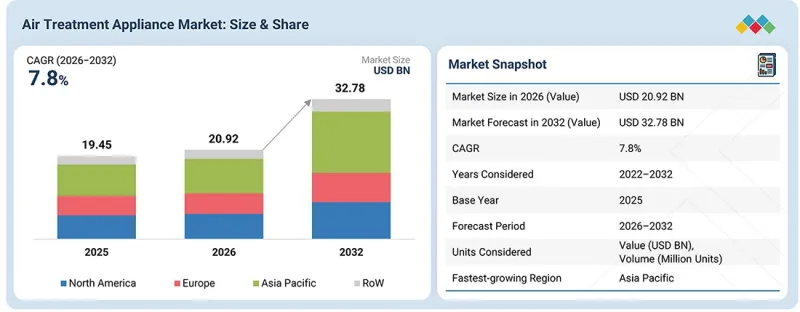
According to MarketsandMarkets, the air treatment appliance market is projected to reach USD 32.78 billion by 2032 from USD 20.92 billion in 2026, at a CAGR of 7.8% during the forecast period. The air treatment appliance market is projected to witness strong growth during the forecast period, driven by the increasing adoption of air purifiers, humidifiers, and dehumidifiers, along with growing awareness of indoor air quality, humidity control, and healthier indoor environments.
| Scope of the Report | |
|---|---|
| Years Considered for the Study | 2022-2032 |
| Base Year | 2025 |
| Forecast Period | 2026-2032 |
| Units Considered | Value (USD Billion) |
| Segments | By Product, Connectivity, Type and Region |
| Regions covered | North America, Europe, APAC, RoW |
The market is being supported by rising concerns regarding indoor air pollution, allergens, particulate matter, excessive humidity, and dry indoor air across residential, commercial, healthcare, and industrial environments. Increasing urbanization, changing lifestyles, higher disposable incomes, and growing consumer awareness of indoor environmental quality are encouraging households and businesses to invest in air treatment appliances. Air purifiers remain a major product category, while humidifiers and dehumidifiers are gaining adoption in regions and applications where maintaining appropriate indoor humidity levels is important.
Manufacturers are increasingly introducing HEPA filtration, activated carbon filtration, UV-C sterilization, advanced humidity sensing, multi-sensor systems, Wi-Fi connectivity, and AI/IoT-enabled controls to improve purification performance, automate operation, and provide real-time monitoring of indoor conditions. The development of connected-home ecosystems is further supporting demand for smart air treatment appliances that can be remotely monitored and automatically adjusted according to air quality and humidity conditions.
" By air quality sensor type, the humidity sensor segment to capture the largest market share throughout forecast period"
The humidity sensor segment holds the largest share of the air treatment appliance market because humidity sensing is directly linked to the core operating function of both humidifiers and dehumidifiers, making it broadly applicable across residential, commercial, and industrial applications. Humidity sensors continuously measure relative humidity and enable appliances to automatically adjust operation to maintain desired humidity levels, improving comfort, preventing excessive moisture, and reducing energy consumption. In addition, many advanced air treatment appliances combine humidity sensing with temperature, particulate, or gas sensing for automated indoor environment management. Products from major manufacturers such as Dyson and Sharp already integrate humidity sensors into their air treatment appliances. The increasing adoption of smart, sensor-based, and connected appliances is, therefore, expected to further strengthen the dominance of humidity sensors during the forecast period.
"By distribution channel, the offline segment is expected to capture a larger market share over the forecast period"
Offline distribution channels hold a larger market share of the air treatment appliance market because consumers often prefer to evaluate the performance of air purifiers, humidifiers, and dehumidifiers before purchasing, particularly for higher-priced or technology-intensive models. Offline stores allow customers to compare products, understand filtration and humidity control capabilities, receive advice from sales personnel, and assess product quality directly. This is especially important for consumers who are less familiar with advanced air treatment technologies. Established appliance and electronics retailers also provide wider physical accessibility, immediate product availability, installation support, and after-sales services, strengthening consumer confidence. Industry evidence indicates that appliances and electronics specialists are expected to remain the dominant distribution channel for air treatment products, although e-commerce is gaining share.
" Asia Pacific is likely to be the fastest-growing market for air treatment appliances during the forecast period"
The Asia Pacific region is expected to witness the highest CAGR in the air treatment appliance market due to rapid urbanization and industrialization, rising pollution levels, and increasing consumer awareness of indoor air quality. Asia experiences some of the world's highest air-pollution exposure levels, creating strong demand for air purifiers and other indoor air treatment solutions. Rapid economic development and rising disposable incomes in countries such as China, India, Japan, South Korea, and Southeast Asian economies are also enabling greater adoption of air purifiers, humidifiers, and dehumidifiers across residential and commercial settings. Additionally, growing smart home adoption and availability of technologically advanced, connected appliances are supporting market expansion. Increasing government attention toward air quality management and healthier indoor environments is further encouraging adoption, making Asia Pacific the fastest-growing regional market during the forecast period.
Breakdown of Primaries
A variety of executives from key organizations operating in the air treatment appliance market were interviewed in-depth, including CEOs, marketing directors, and innovation and technology directors.
- By Company Type: Tier 1 - 38%, Tier 2 - 28%, and Tier 3 - 34%
- By Designation: C-level Executives - 40%, Directors - 30%, and Others - 30%
- By Region: North America - 35%, Europe - 35, Asia Pacific - 20%, and RoW - 10%
Major players profiled in this report are as follows: Xiaomi (China), Dyson (Singapore), LG Electronics Inc. (South Korea), Coway (South Korea), Midea Group (China), Condair Group (Switzerland), Panasonic Holdings Corporation (Japan), Munters (Sweden), GREE ELECTRIC APPLIANCES, INC. (China), SHARP CORPORATION (Japan), among others.
These companies compete by continuously enhancing air treatment performance, energy efficiency, smart connectivity, and user convenience, focusing on improved purification efficiency, humidity control, airflow performance, noise reduction, energy consumption, and coverage across diverse applications. Strategic emphasis is placed on developing advanced air purifiers, humidifiers, and dehumidifiers incorporating HEPA and multi-stage filtration, inverter technology, AI-enabled controls, IoT connectivity, smart sensors, UV-C technology, and real-time air quality monitoring. Market participants prioritize high-performance solutions tailored for residential, commercial, healthcare, hospitality, industrial, and other indoor environments. Strong focus is also placed on improving particulate and VOC removal, humidity regulation, odor control, energy efficiency, automated operation, and seamless integration with smart home and building management systems. Continued investments in sensor miniaturization, advanced filtration media, AI, IoT, inverter technologies, low-noise designs, sustainable refrigerants, and multifunctional air treatment platforms, along with collaborations with OEMs, technology providers, distributors, building operators, and end users, are expected to strengthen competition and accelerate the adoption of advanced air treatment appliances globally.
The study includes an in-depth competitive analysis of these key players in the air treatment appliance market, with their company profiles, recent developments, and key market strategies.
Study Coverage:
The report segments the air treatment appliance market and forecasts its market size by product type (air purifier, humidifier, dehumidifier), connectivity (conventional, Wi-Fi-enabled, Bluetooth-enabled, AI/IoT-enabled), air quality sensor type (PM sensor, VOC sensor, humidity sensor, multi-sensor, without sensor), distribution channel (offline, online), price range (economy, mid-range, premium) and end user (residential, commercial, industrial). The report also analyzes key market drivers, restraints, opportunities, and challenges influencing industry growth. It provides a detailed regional assessment across North America, Europe, Asia Pacific, and RoW, along with country-level insights for major markets. In addition, the study includes value chain analysis and competitive landscape assessment of leading players operating in the global air treatment appliance ecosystem.
Key Benefits of Buying the Report:
- Analysis of key drivers (increasing consumer spending on indoor air quality, rising investment in healthy building environments, expanding urban exposure to indoor air pollution), restraints (high recurring costs limiting adoption in price-sensitive markets, limited consumer awareness of air treatment benefits, rising energy costs limiting continuous appliance usage), opportunities (expanding institutional procurement across commercial buildings, growing smart home adoption, rising urbanization in emerging economies), and challenges (balancing air treatment performance with energy efficiency, managing recurring maintenance to sustain product performance, adapting products to diverse regional requirements)
- Product and Service Development/Innovation: Detailed insights on upcoming technologies, research and development activities, and new product launches in the air treatment appliance market
- Market Development: Comprehensive information about lucrative markets by analyzing the air treatment appliance market across varied regions
- Market Diversification: Exhaustive information about new products/services, untapped geographies, recent developments, and investments in the air treatment appliance market
- Competitive Assessment: In-depth assessment of market shares and growth strategies of leading players, such as Xiaomi (China), Dyson (Singapore), LG Electronics Inc. (South Korea), Coway (South Korea), Midea Group (China), Condair Group (Switzerland), Panasonic Holdings Corporation (Japan), Munters (Sweden), GREE ELECTRIC APPLIANCES, INC. (China), SHARP CORPORATION (Japan)
TABLE OF CONTENTS
1 INTRODUCTION
- 1.1 STUDY OBJECTIVES
- 1.2 MARKET DEFINITION
- 1.3 MARKET SCOPE
- 1.3.1 MARKET SEGMENTATION AND REGIONAL SCOPE
- 1.3.2 INCLUSIONS AND EXCLUSIONS
- 1.3.3 YEARS CONSIDERED
- 1.4 CURRENCY CONSIDERED
- 1.5 UNIT CONSIDERED
- 1.6 LIMITATIONS
- 1.7 STAKEHOLDERS
2 EXECUTIVE SUMMARY
- 2.1 MARKET HIGHLIGHTS AND KEY INSIGHTS
- 2.2 KEY MARKET PARTICIPANTS: MAPPING OF STRATEGIC DEVELOPMENTS
- 2.3 DISRUPTIVE TRENDS IN AIR TREATMENT APPLIANCE MARKET
- 2.4 HIGH-GROWTH SEGMENTS
- 2.5 REGIONAL SNAPSHOT: MARKET SIZE, GROWTH RATE, AND FORECAST
3 PREMIUM INSIGHTS
- 3.1 ATTRACTIVE OPPORTUNITIES FOR PLAYERS IN AIR TREATMENT APPLIANCE MARKET
- 3.2 AIR TREATMENT APPLIANCE MARKET, BY PRODUCT TYPE
- 3.3 AIR TREATMENT APPLIANCE MARKET, BY CONNECTIVITY
- 3.4 AIR TREATMENT APPLIANCE MARKET, BY AIR QUALITY SENSOR TYPE
- 3.5 AIR TREATMENT APPLIANCE MARKET, BY REGION
- 3.6 AIR TREATMENT APPLIANCE MARKET, BY COUNTRY
4 MARKET OVERVIEW
- 4.1 INTRODUCTION
- 4.2 MARKET DYNAMICS
- 4.2.1 DRIVERS
- 4.2.1.1 Increasing consumer spending on indoor air quality
- 4.2.1.2 Expanding urban exposure to indoor air pollution
- 4.2.1.3 Increasing investment in healthy building environments
- 4.2.1.4 Rising demand for protection during air quality events
- 4.2.2 RESTRAINTS
- 4.2.2.1 Increasing lifecycle costs limiting appliance adoption
- 4.2.2.2 Low consumer awareness restricting market penetration
- 4.2.2.3 Rising energy costs limiting continuous appliance usage
- 4.2.3 OPPORTUNITIES
- 4.2.3.1 Expanding institutional procurement across commercial buildings
- 4.2.3.2 Growing smart home adoption creating premium demand
- 4.2.3.3 Rising urbanization creating new emerging market demand
- 4.2.4 CHALLENGES
- 4.2.4.1 Balancing air treatment performance with energy consumption
- 4.2.4.2 Managing recurring maintenance to sustain product performance
- 4.2.4.3 Adapting products to diverse regional market requirements
- 4.2.1 DRIVERS
- 4.3 INTERCONNECTED MARKETS AND CROSS-SECTOR OPPORTUNITIES
- 4.4 STRATEGIC MOVES BY TIER-1/2/3 PLAYERS
5 INDUSTRY TRENDS
- 5.1 PORTER'S FIVE FORCES ANALYSIS
- 5.1.1 THREAT OF NEW ENTRANTS
- 5.1.2 THREAT OF SUBSTITUTES
- 5.1.3 BARGAINING POWER OF SUPPLIERS
- 5.1.4 BARGAINING POWER OF BUYERS
- 5.1.5 INTENSITY OF COMPETITIVE RIVALRY
- 5.2 MACROECONOMIC OUTLOOK
- 5.2.1 INTRODUCTION
- 5.2.2 GDP TRENDS AND FORECAST
- 5.2.3 TRENDS IN GLOBAL INDIVIDUAL HOMES INDUSTRY
- 5.2.4 TRENDS IN GLOBAL OFFICES INDUSTRY
- 5.3 VALUE CHAIN ANALYSIS
- 5.4 ECOSYSTEM ANALYSIS
- 5.5 PRICING ANALYSIS
- 5.5.1 AVERAGE SELLING PRICE OF AIR TREATMENT APPLIANCES OFFERED BY KEY PLAYERS, BY PRODUCT TYPE, 2025
- 5.5.2 AVERAGE SELLING PRICE TREND OF AIR TREATMENT APPLIANCES, BY REGION, 2022-2025
- 5.6 TRADE ANALYSIS
- 5.6.1 IMPORT SCENARIO (HS CODE 842139)
- 5.6.2 EXPORT SCENARIO (HS CODE 842139)
- 5.7 KEY CONFERENCES AND EVENTS, 2026-2027
- 5.8 TRENDS/DISRUPTIONS IMPACTING CUSTOMER BUSINESS
- 5.9 INVESTMENT AND FUNDING SCENARIO
- 5.10 CASE STUDY ANALYSIS
- 5.10.1 CAMFIL IMPROVES INDOOR AIR QUALITY AT KAROLINSKA UNIVERSITY HOSPITAL
- 5.10.2 PANASONIC IMPROVES AIR QUALITY AT GIFU HOSPITAL
- 5.10.3 DAIKIN PROVIDES AIR TREATMENT SOLUTION FOR GRANGE UNIVERSITY HOSPITAL
- 5.11 IMPACT OF 2025 US TARIFF ON AIR TREATMENT APPLIANCE MARKET
- 5.11.1 INTRODUCTION
- 5.11.2 KEY TARIFF RATES
- 5.11.3 PRICE IMPACT ANALYSIS
- 5.11.4 IMPACT ON COUNTRIES/REGIONS
- 5.11.4.1 North America
- 5.11.4.2 Europe
- 5.11.4.3 Asia Pacific
- 5.11.5 IMPACT ON INDUSTRIES
6 REGULATORY LANDSCAPE
- 6.1 REGIONAL REGULATIONS AND COMPLIANCE
- 6.1.1 REGULATORY BODIES, GOVERNMENT AGENCIES, AND OTHER ORGANIZATIONS
- 6.1.2 STANDARDS
7 TECHNOLOGICAL ADVANCEMENTS, AI-DRIVEN IMPACT, PATENTS, AND INNOVATIONS
- 7.1 KEY TECHNOLOGIES
- 7.1.1 AI-ENABLED AIR QUALITY MANAGEMENT
- 7.1.2 ADVANCED AIR PURIFICATION TECHNOLOGIES
- 7.1.3 SMART SENSOR-BASED AIR TREATMENT
- 7.2 COMPLEMENTARY TECHNOLOGIES
- 7.2.1 IOT AND SMART CONNECTIVITY
- 7.2.2 BUILDING MANAGEMENT SYSTEMS
- 7.2.3 ADVANCED HVAC CONTROLS AND SENSORS
- 7.3 ADJACENT TECHNOLOGIES
- 7.3.1 HEAT PUMP TECHNOLOGY
- 7.3.2 SMART BUILDING AND HOME AUTOMATION
- 7.3.3 ENERGY RECOVERY VENTILATION
- 7.4 TECHNOLOGY ROADMAP
- 7.4.1 SHORT-TERM (2025-2027): SMART CONNECTIVITY AND SENSOR-BASED AIR MANAGEMENT
- 7.4.2 MID-TERM (2027-2030): AI-DRIVEN AIR QUALITY MANAGEMENT AND INTEGRATED INDOOR ENVIRONMENTS
- 7.4.3 LONG-TERM (2030-2035+): AUTONOMOUS INDOOR ENVIRONMENT MANAGEMENT AND PREDICTIVE AIR CARE
- 7.5 PATENT ANALYSIS
- 7.6 IMPACT OF AI/GEN AI ON AIR TREATMENT APPLIANCE MARKET
- 7.6.1 TOP USE CASES AND MARKET POTENTIAL
- 7.6.2 BEST PRACTICES FOLLOWED BY OEMS IN AIR TREATMENT APPLIANCE MARKET
- 7.6.3 CASE STUDIES RELATED TO AI IMPLEMENTATION
- 7.6.4 INTERCONNECTED ECOSYSTEM AND IMPACT ON MARKET PLAYERS
- 7.6.5 CLIENTS' READINESS TO ADOPT AI-INTEGRATED AIR TREATMENT APPLIANCE MARKET
8 CUSTOMER LANDSCAPE AND BUYER BEHAVIOR
- 8.1 DECISION-MAKING PROCESS
- 8.2 KEY STAKEHOLDERS INVOLVED IN BUYING PROCESS AND THEIR EVALUATION CRITERIA
- 8.2.1 KEY STAKEHOLDERS IN BUYING PROCESS
- 8.2.2 BUYING CRITERIA
- 8.3 ADOPTION BARRIERS AND INTERNAL CHALLENGES
- 8.4 UNMET NEEDS OF VARIOUS INDUSTRIES
9 AIR TREATMENT APPLIANCE MARKET, BY PRODUCT TYPE
- 9.1 INTRODUCTION
- 9.2 AIR PURIFIERS
- 9.2.1 BY TYPE
- 9.2.1.1 Portable room air purifiers
- 9.2.1.1.1 Increasing consumer awareness and demand for flexible air quality solutions to drive adoption
- 9.2.1.2 Whole-house air purifiers (ducted)
- 9.2.1.2.1 Growing demand for centralized indoor air quality management to accelerate adoption
- 9.2.1.3 In-duct air purifiers
- 9.2.1.3.1 Increasing HVAC integration and indoor air quality requirements to support demand
- 9.2.1.4 Vehicle air purifiers
- 9.2.1.4.1 Rising cabin air quality awareness and automotive electrification to drive adoption
- 9.2.1.1 Portable room air purifiers
- 9.2.2 BY TECHNOLOGY
- 9.2.2.1 HEPA filtration
- 9.2.2.1.1 Rising demand for high-efficiency particle removal to strengthen adoption
- 9.2.2.2 Activated carbon filtration
- 9.2.2.2.1 Growing concerns over VOCs and household odors to increase demand for activated carbon filtration
- 9.2.2.3 Electrostatic precipitator (ESP)
- 9.2.2.3.1 Increasing demand for high-airflow particle removal to support electrostatic precipitator adoption
- 9.2.2.4 Ionizer
- 9.2.2.4.1 Growing demand for multi-stage air purification to support ionizer integration in air treatment appliances
- 9.2.2.5 UV-C sterilization
- 9.2.2.5.1 Increasing focus on airborne microbial control to drive UV-C sterilization integration
- 9.2.2.6 Photocatalytic oxidation (PCO)
- 9.2.2.6.1 Growing demand for advanced VOC and microbial treatment to support photocatalytic oxidation adoption
- 9.2.2.7 Plasma technology
- 9.2.2.7.1 Advancements in multi-pollutant treatment to increase plasma technology integration in air purifiers
- 9.2.2.1 HEPA filtration
- 9.2.3 BY COVERAGE CAPACITY
- 9.2.3.1 Small room (<250 Sq Ft)
- 9.2.3.1.1 Rising demand for compact and energy-efficient solutions to drive adoption
- 9.2.3.2 Medium room (250-500 Sq Ft)
- 9.2.3.2.1 Increasing demand for balanced coverage and smart air quality monitoring to support growth
- 9.2.3.3 Large room (500-1,000 Sq Ft)
- 9.2.3.3.1 Growing adoption of high-capacity smart purifiers to support market growth
- 9.2.3.4 Extra large (>1,000 Sq Ft)
- 9.2.3.4.1 Increasing demand for high-capacity and centralized purification solutions to drive adoption
- 9.2.3.1 Small room (<250 Sq Ft)
- 9.2.4 BY PRICE RANGE
- 9.2.4.1 Expanding product differentiation across price tiers is broadening air treatment appliance adoption
- 9.2.5 AIR PURIFIERS MARKET SHARE ANALYSIS, 2025
- 9.2.6 AIR PURIFIERS MARKET SHARE ANALYSIS, BY PRODUCT TYPE
- 9.2.7 AIR PURIFIERS MARKET SHARE ANALYSIS, BY COVERAGE CAPACITY
- 9.2.1 BY TYPE
- 9.3 HUMIDIFIERS
- 9.3.1 INCREASING INDOOR DRYNESS CONCERNS AND SMART HUMIDITY CONTROL TECHNOLOGIES TO DRIVE ADOPTION
- 9.3.2 BY TYPE
- 9.3.2.1 Ultrasonic
- 9.3.2.1.1 Advancements in quiet atomization and smart controls to strengthen ultrasonic humidifier demand
- 9.3.2.2 Evaporative
- 9.3.2.2.1 Growing demand for self-regulating humidification and lower-maintenance operation to support market growth
- 9.3.2.3 Warm mist/steam
- 9.3.2.3.1 Increasing focus on hygienic moisture delivery to support adoption of warm mist and steam humidifiers
- 9.3.2.4 Hybrid
- 9.3.2.4.1 Demand for year-round comfort to accelerate adoption of multi-mode hybrid humidifiers
- 9.3.2.1 Ultrasonic
- 9.3.3 BY COVERAGE CAPACITY
- 9.3.3.1 Up to 300 Sq Ft
- 9.3.3.1.1 Growing demand for compact humidity solutions to support adoption
- 9.3.3.2 300-600 Sq Ft
- 9.3.3.2.1 Rising demand for higher-capacity residential appliances to propel market
- 9.3.3.3 Above 600 Sq Ft
- 9.3.3.3.1 Growing adoption of whole-home humidity management to drive demand
- 9.3.3.1 Up to 300 Sq Ft
- 9.3.4 BY PRICE RANGE
- 9.3.4.1 Rising awareness of indoor air quality and growing demand for automated humidity control to accelerate humidifier adoption
- 9.3.5 HUMIDIFIERS MARKET SHARE ANALYSIS, 2025
- 9.3.6 HUMIDIFIERS MARKET SHARE ANALYSIS, BY TECHNOLOGY
- 9.3.7 HUMIDIFIERS MARKET SHARE ANALYSIS, BY COVERAGE CAPACITY
- 9.4 DEHUMIDIFIERS
- 9.4.1 RISING HUMIDITY LEVELS AND GROWING DEMAND FOR AUTOMATED MOISTURE CONTROL TO ACCELERATE DEHUMIDIFIER ADOPTION
- 9.4.2 BY TECHNOLOGY
- 9.4.2.1 Desiccant
- 9.4.2.1.1 Advanced moisture adsorption materials and energy-efficient designs to expand desiccant dehumidifier applications
- 9.4.2.2 Fixed-speed compressor
- 9.4.2.2.1 Demand for cost-effective moisture removal and reliable continuous operation to drive adoption
- 9.4.2.3 Inverter compressor
- 9.4.2.3.1 Growing energy-efficiency requirements and intelligent load management to accelerate adoption
- 9.4.2.1 Desiccant
- 9.4.3 BY CAPACITY TYPE
- 9.4.3.1 Up to 10 L/Day
- 9.4.3.1.1 Rising demand for compact moisture management to support adoption of low-capacity dehumidifiers
- 9.4.3.2 10-20 L/Day
- 9.4.3.2.1 Increasing residential humidity loads and demand for flexible room coverage to drive mid-capacity dehumidifier adoption
- 9.4.3.3 20-40 L/Day
- 9.4.3.3.1 Growing demand for higher moisture removal and laundry-drying applications to support market growth
- 9.4.3.4 Above 40 L/Day
- 9.4.3.4.1 Expanding industrial moisture-control requirements to drive demand for high-capacity dehumidification systems
- 9.4.3.1 Up to 10 L/Day
- 9.4.4 BY PRICE RANGE
- 9.4.4.1 Broadening product tiers to expand air treatment appliance access across consumer spending segments
- 9.4.5 DEHUMIDIFIERS MARKET SHARE ANALYSIS, 2025
- 9.4.6 DEHUMIDIFIERS MARKET SHARE ANALYSIS, BY TECHNOLOGY
- 9.4.7 DEHUMIDIFIERS MARKET SHARE ANALYSIS, BY CAPACITY TYPE
10 AIR TREATMENT APPLIANCE MARKET, BY CONNECTIVITY
- 10.1 INTRODUCTION
- 10.2 CONVENTIONAL
- 10.2.1 DEMAND FOR AFFORDABLE AND SIMPLIFIED AIR TREATMENT SOLUTIONS CONTINUES TO SUSTAIN CONVENTIONAL APPLIANCES
- 10.3 WI-FI-ENABLED
- 10.3.1 GROWING DEMAND FOR REMOTE APPLIANCE MANAGEMENT AND SMART HOME INTEGRATION TO DRIVE WI-FI ADOPTION
- 10.4 BLUETOOTH-ENABLED
- 10.4.1 INCREASING DEMAND FOR SEAMLESS DEVICE PAIRING AND LOCAL CONTROL TO SUPPORT BLUETOOTH INTEGRATION
- 10.5 AI/IOT-ENABLED
- 10.5.1 ADVANCEMENTS IN ENVIRONMENTAL SENSING AND AUTONOMOUS CONTROL TO ACCELERATE AI AND IOT ADOPTION
11 AIR TREATMENT APPLIANCE MARKET, BY AIR QUALITY SENSOR TYPE
- 11.1 INTRODUCTION
- 11.2 PM SENSORS
- 11.2.1 INCREASING AWARENESS OF FINE-PARTICULATE POLLUTION TO DRIVE PM SENSOR INTEGRATION IN AIR TREATMENT APPLIANCES
- 11.3 VOC SENSORS
- 11.3.1 GROWING CONCERNS OVER CHEMICAL POLLUTANTS AND HOUSEHOLD EMISSIONS TO INCREASE VOC SENSOR ADOPTION
- 11.4 HUMIDITY SENSORS
- 11.4.1 GROWING FOCUS ON BALANCED INDOOR HUMIDITY TO DRIVE MARKET
- 11.5 MULTI-SENSORS
- 11.5.1 INTEGRATION OF MULTIPLE ENVIRONMENTAL PARAMETERS TO ACCELERATE DEMAND FOR COMPREHENSIVE INDOOR AIR QUALITY MONITORING
- 11.6 WITHOUT SENSORS
- 11.6.1 PRICE-SENSITIVE DEMAND AND PREFERENCE FOR SIMPLIFIED OPERATIONS TO SUSTAIN DEMAND FOR SENSOR-FREE AIR TREATMENT APPLIANCES
12 AIR TREATMENT APPLIANCE MARKET, BY DISTRIBUTION CHANNEL
- 12.1 INTRODUCTION
- 12.2 OFFLINE
- 12.2.1 CONSUMER ELECTRONICS RETAILERS
- 12.2.1.1 Expanding electronics retail networks to increase consumer access to connected and smart air treatment appliances
- 12.2.2 HOME APPLIANCE STORES
- 12.2.2.1 Dedicated appliance stores strengthen assisted selling and expand air treatment reach beyond major cities
- 12.2.3 SPECIALTY IAQ DEALERS
- 12.2.3.1 Rising demand for application-specific air quality solutions to strengthen specialty IAQ dealer networks
- 12.2.4 HYPERMARKETS & SUPERMARKETS
- 12.2.4.1 High-footfall retail formats to broaden mainstream consumer exposure to air treatment appliances
- 12.2.5 DIRECT SALES
- 12.2.5.1 Manufacturers are increasing direct sales to strengthen customer relationships and capture end-to-end product value
- 12.2.1 CONSUMER ELECTRONICS RETAILERS
- 12.3 ONLINE
- 12.3.1 BRAND-OWNED WEBSITES
- 12.3.1.1 Growing direct-to-consumer strategies are giving manufacturers greater control over online air treatment sales
- 12.3.2 E-COMMERCE PLATFORMS
- 12.3.2.1 Broader digital assortment and faster fulfillment are strengthening E-commerce platforms as a key air treatment sales channel
- 12.3.1 BRAND-OWNED WEBSITES
13 AIR TREATMENT APPLIANCE MARKET, BY END USER
- 13.1 INTRODUCTION
- 13.2 RESIDENTIAL
- 13.2.1 INDIVIDUAL HOMES
- 13.2.1.1 Health-conscious households and increasing smart home adoption to drive air treatment demand
- 13.2.2 APARTMENTS
- 13.2.2.1 Urban apartment living and building-level IAQ requirements to increase demand for compact, integrated air treatment solutions
- 13.2.1 INDIVIDUAL HOMES
- 13.3 COMMERCIAL
- 13.3.1 OFFICES
- 13.3.1.1 Employee wellness and productivity priorities to increase need for air quality monitoring and purification across offices
- 13.3.2 HEALTHCARE FACILITIES
- 13.3.2.1 Infection control priorities and high air quality standards to expand specialized air treatment adoption
- 13.3.3 HOSPITALITY
- 13.3.3.1 Guest wellness and sustainability initiatives to increase air treatment integration across hotels and resorts
- 13.3.4 EDUCATIONAL INSTITUTIONS
- 13.3.4.1 Heat resilience and student well-being to increase investment in air treatment and climate-control systems across schools
- 13.3.5 RETAIL & SHOPPING CENTERS
- 13.3.5.1 High occupancy and customer experience priorities to increase indoor air quality investment across retail properties
- 13.3.6 GOVERNMENT BUILDINGS
- 13.3.6.1 Public sector indoor air quality programs to create institutional demand for certified air treatment equipment
- 13.3.7 AIRPORTS & TRANSPORTATION
- 13.3.7.1 Passenger health, cabin air quality, and emission reduction priorities to expand air treatment applications
- 13.3.8 DATA CENTERS
- 13.3.8.1 AI workloads and rising thermal densities to accelerate advanced cooling and air management deployment in data centers
- 13.3.9 LABORATORIES
- 13.3.9.1 Strict contamination and humidity control requirements to drive specialized air treatment demand in laboratories
- 13.3.10 OTHER COMMERCIAL END USERS
- 13.3.1 OFFICES
- 13.4 INDUSTRIAL
- 13.4.1 AUTOMOTIVE
- 13.4.1.1 Electrification and precision manufacturing to increase demand for controlled air and humidity conditions in automotive plants
- 13.4.2 PHARMACEUTICALS
- 13.4.2.1 Stringent moisture and contamination controls to increase advanced dehumidification adoption in pharmaceutical manufacturing
- 13.4.3 FOOD & BEVERAGE
- 13.4.3.1 Moisture-sensitive production and storage requirements to strengthen industrial dehumidification demand in food processing
- 13.4.4 POWER GENERATION
- 13.4.4.1 Rising thermal loads and reliability requirements to increase demand for advanced cooling and environmental control in power facilities
- 13.4.5 CONSTRUCTION
- 13.4.5.1 Stricter dust control requirements and growing environmental compliance to increase air treatment adoption at construction sites
- 13.4.6 OTHER INDUSTRIAL END USERS
- 13.4.1 AUTOMOTIVE
14 AIR TREATMENT APPLIANCE MARKET, BY REGION
- 14.1 INTRODUCTION
- 14.2 NORTH AMERICA
- 14.2.1 US
- 14.2.1.1 Smart home adoption to accelerate air purifier penetration
- 14.2.2 CANADA
- 14.2.2.1 Seasonal allergens and efficiency standards to support adoption
- 14.2.3 MEXICO
- 14.2.3.1 Urbanization, industrialization, and rising health awareness to create new growth opportunities
- 14.2.1 US
- 14.3 EUROPE
- 14.3.1 GERMANY
- 14.3.1.1 Energy-conscious consumers and strong indoor-air standards to drive adoption
- 14.3.2 UK
- 14.3.2.1 Airtight homes, seasonal allergens, and growing heat exposure to increase demand for indoor air management
- 14.3.3 FRANCE
- 14.3.3.1 Urban pollution awareness and energy-efficient appliance demand to drive adoption
- 14.3.4 ITALY
- 14.3.4.1 Growing consumer preference for multi-stage filtration to propel market
- 14.3.5 SPAIN
- 14.3.5.1 Urban air pollution and rising smart home adoption to offer growth opportunities
- 14.3.6 REST OF EUROPE
- 14.3.1 GERMANY
- 14.4 ASIA PACIFIC
- 14.4.1 CHINA
- 14.4.1.1 Severe urban pollution and smart home ecosystem expansion to drive market
- 14.4.2 JAPAN
- 14.4.2.1 Technology leadership and strong indoor-comfort awareness to propel market
- 14.4.3 INDIA
- 14.4.3.1 Rapid urbanization, pollution exposure, and rising disposable income to accelerate air treatment appliance adoption
- 14.4.4 SOUTH KOREA
- 14.4.4.1 Dense urban housing and strong smart appliance adoption to drive demand
- 14.4.5 MALAYSIA
- 14.4.5.1 Tropical humidity, haze events, and growing smart home adoption to support market growth
- 14.4.6 TAIWAN
- 14.4.6.1 Advanced electronics manufacturing and rising smart home adoption to drive market
- 14.4.7 VIETNAM
- 14.4.7.1 Industrialization and growing consumer health awareness to drive market
- 14.4.8 REST OF ASIA PACIFIC
- 14.4.1 CHINA
- 14.5 ROW
- 14.5.1 MIDDLE EAST
- 14.5.1.1 Smart building investment to drive market growth
- 14.5.2 AFRICA
- 14.5.2.1 Urban pollution, industrialization, and humidity challenges to create new growth opportunities
- 14.5.3 SOUTH AMERICA
- 14.5.3.1 Expanding consumer markets to support adoption
- 14.5.1 MIDDLE EAST
15 COMPETITIVE LANDSCAPE
- 15.1 OVERVIEW
- 15.2 KEY PLAYER STRATEGIES/RIGHT TO WIN, 2023-2026
- 15.3 REVENUE ANALYSIS, 2021-2025
- 15.4 MARKET SHARE ANALYSIS, 2025
- 15.5 BRAND COMPARISON
- 15.6 COMPANY EVALUATION MATRIX: KEY PLAYERS, 2025
- 15.6.1 STARS
- 15.6.2 EMERGING LEADERS
- 15.6.3 PERVASIVE PLAYERS
- 15.6.4 PARTICIPANTS
- 15.6.5 COMPANY FOOTPRINT: KEY PLAYERS, 2025
- 15.6.5.1 Company footprint
- 15.6.5.2 Region footprint
- 15.6.5.3 Product type footprint
- 15.6.5.4 Connectivity footprint
- 15.6.5.5 Air quality sensor type footprint
- 15.6.5.6 End-user footprint
- 15.7 COMPANY EVALUATION MATRIX: STARTUPS/SMES, 2025
- 15.7.1 PROGRESSIVE COMPANIES
- 15.7.2 RESPONSIVE COMPANIES
- 15.7.3 DYNAMIC COMPANIES
- 15.7.4 STARTING BLOCKS
- 15.7.5 COMPETITIVE BENCHMARKING: STARTUPS/SMES, 2025
- 15.7.5.1 Detailed list of key startups/SMEs
- 15.7.5.2 Competitive benchmarking of startups/SMEs
- 15.8 COMPANY VALUATION AND FINANCIAL METRICS
- 15.9 COMPETITIVE SCENARIO
- 15.9.1 PRODUCT LAUNCHES
- 15.9.2 DEALS
16 COMPANY PROFILES
- 16.1 KEY PLAYERS
- 16.1.1 LG ELECTRONICS INC.
- 16.1.1.1 Business overview
- 16.1.1.2 Products/Solutions/Services offered
- 16.1.1.3 MnM view
- 16.1.1.3.1 Key strengths/Right to win
- 16.1.1.3.2 Strategic choices
- 16.1.1.3.3 Weaknesses/Competitive threats
- 16.1.2 PANASONIC HOLDINGS CORPORATION
- 16.1.2.1 Business overview
- 16.1.2.2 Products/Solutions/Services offered
- 16.1.2.3 Recent developments
- 16.1.2.3.1 Product launches
- 16.1.2.4 MnM view
- 16.1.2.4.1 Key strengths/Right to win
- 16.1.2.4.2 Strategic choices
- 16.1.2.4.3 Weaknesses/Competitive threats
- 16.1.3 MIDEA GROUP
- 16.1.3.1 Business overview
- 16.1.3.2 Products/Solutions/Services offered
- 16.1.3.3 Recent developments
- 16.1.3.3.1 Deals
- 16.1.3.3.2 Expansions
- 16.1.3.4 MnM view
- 16.1.3.4.1 Key strengths/Right to win
- 16.1.3.4.2 Strategic choices
- 16.1.3.4.3 Weaknesses/Competitive threats
- 16.1.4 MUNTERS
- 16.1.4.1 Business overview
- 16.1.4.2 Products/Solutions/Services offered
- 16.1.4.3 Recent developments
- 16.1.4.3.1 Expansions
- 16.1.4.4 MnM view
- 16.1.4.4.1 Key strengths/Right to win
- 16.1.4.4.2 Strategic choices
- 16.1.4.4.3 Weaknesses/Competitive threats
- 16.1.5 DYSON
- 16.1.5.1 Business overview
- 16.1.5.2 Products/Solutions/Services offered
- 16.1.5.3 MnM view
- 16.1.5.3.1 Key strengths/Right to win
- 16.1.5.3.2 Strategic choices
- 16.1.5.3.3 Weaknesses/Competitive threats
- 16.1.6 XIAOMI
- 16.1.6.1 Business overview
- 16.1.6.2 Products/Solutions/Services offered
- 16.1.6.3 Recent developments
- 16.1.6.3.1 Product launches
- 16.1.6.3.2 Expansions
- 16.1.7 COWAY
- 16.1.7.1 Business overview
- 16.1.7.2 Products/Solutions/Services offered
- 16.1.7.3 Recent developments
- 16.1.7.3.1 Product launches
- 16.1.8 CONDAIR GROUP
- 16.1.8.1 Business overview
- 16.1.8.2 Products/Solutions/Services offered
- 16.1.8.3 Recent developments
- 16.1.8.3.1 Product launches
- 16.1.8.3.2 Expansions
- 16.1.9 GREE ELECTRIC APPLIANCES, INC.
- 16.1.9.1 Business overview
- 16.1.9.2 Products/Solutions/Services offered
- 16.1.9.3 Recent developments
- 16.1.9.3.1 Deals
- 16.1.10 DAIKIN INDUSTRIES, LTD.
- 16.1.10.1 Business overview
- 16.1.10.2 Products/Solutions/Services offered
- 16.1.1 LG ELECTRONICS INC.
- 16.2 OTHER PLAYERS
- 16.2.1 SHARP CORPORATION
- 16.2.2 VERSUNI
- 16.2.3 SAMSUNG
- 16.2.4 CARRIER
- 16.2.5 IQAIR
- 16.2.6 DE' LONGHI GROUP
- 16.2.7 CAREL INDUSTRIES S.P.A.
- 16.2.8 UNILEVER
- 16.2.9 VESYNC
- 16.2.10 HELEN OF TROY
- 16.2.11 STADLER FORM
- 16.2.12 AIR&ME
- 16.2.13 BEURER GMBH
- 16.2.14 WOOD'S
- 16.2.15 TROTEC
17 RESEARCH METHODOLOGY
- 17.1 RESEARCH DATA
- 17.1.1 SECONDARY AND PRIMARY RESEARCH
- 17.1.2 SECONDARY DATA
- 17.1.2.1 Major secondary sources
- 17.1.2.2 Secondary sources
- 17.1.3 PRIMARY DATA
- 17.1.3.1 Breakdown of primaries
- 17.1.3.2 Key data from primary sources
- 17.1.3.3 Key industry insights
- 17.2 MARKET SIZE ESTIMATION
- 17.2.1 BOTTOM-UP APPROACH
- 17.2.2 TOP-DOWN APPROACH
- 17.3 MARKET FORECAST APPROACH
- 17.3.1 SUPPLY-SIDE
- 17.3.2 DEMAND-SIDE
- 17.4 MARKET BREAKDOWN AND DATA TRIANGULATION
- 17.5 FACTOR ANALYSIS
- 17.5.1 DEMAND-SIDE ANALYSIS
- 17.6 RESEARCH ASSUMPTIONS
- 17.7 RESEARCH LIMITATIONS
- 17.8 RISK ASSESSMENT
18 APPENDIX
- 18.1 INSIGHTS FROM INDUSTRY EXPERTS
- 18.2 DISCUSSION GUIDE
- 18.3 KNOWLEDGESTORE: MARKETSANDMARKETS' SUBSCRIPTION PORTAL
- 18.4 CUSTOMIZATION OPTIONS
- 18.5 RELATED REPORTS
- 18.6 AUTHOR DETAILS
List of Tables
- TABLE 1 INTERCONNECTED MARKETS AND OPPORTUNITIES
- TABLE 2 STRATEGIC FOCUS OF TIER-1/2/3 PLAYERS
- TABLE 3 PORTER'S FIVE FORCES ANALYSIS
- TABLE 4 GDP GROWTH RATES, BY KEY COUNTRY, 2022-2030 (%)
- TABLE 5 ROLE OF COMPANIES IN AIR TREATMENT APPLIANCE ECOSYSTEM
- TABLE 6 AVERAGE SELLING PRICE OF PORTABLE ROOM AIR PURIFIERS PROVIDED BY KEY PLAYERS, 2025 (USD)
- TABLE 7 AVERAGE SELLING PRICE OF DESICCANT DEHUMIDIFIERS PROVIDED BY KEY PLAYERS, 2025 (USD)
- TABLE 8 AVERAGE SELLING PRICE TREND OF PORTABLE ROOM AIR PURIFIERS, BY REGION, 2022-2025 (USD)
- TABLE 9 AVERAGE SELLING PRICE TREND OF DESICCANT DEHUMIDIFIERS, BY REGION, 2022-2025 (USD)
- TABLE 10 IMPORT DATA FOR HS CODE 842139-COMPLIANT PRODUCTS, BY COUNTRY, 2021-2025 (USD MILLION)
- TABLE 11 EXPORT DATA FOR HS CODE 842139-COMPLIANT PRODUCTS, BY COUNTRY, 2021-2025 (USD MILLION)
- TABLE 12 LIST OF KEY CONFERENCES AND EVENTS, 2026-2027
- TABLE 13 CAMFIL IMPROVES INDOOR AIR QUALITY AT KAROLINSKA UNIVERSITY HOSPITAL
- TABLE 14 PANASONIC IMPROVES AIR QUALITY AT GIFU HOSPITAL
- TABLE 15 DAIKIN PROVIDES AIR TREATMENT SOLUTION FOR GRANGE UNIVERSITY HOSPITAL
- TABLE 16 US-ADJUSTED RECIPROCAL TARIFF RATES
- TABLE 17 NORTH AMERICA: LIST OF REGULATORY BODIES, GOVERNMENT AGENCIES, AND OTHER ORGANIZATIONS
- TABLE 18 EUROPE: LIST OF REGULATORY BODIES, GOVERNMENT AGENCIES, AND OTHER ORGANIZATIONS
- TABLE 19 ASIA PACIFIC: LIST OF REGULATORY BODIES, GOVERNMENT AGENCIES, AND OTHER ORGANIZATIONS
- TABLE 20 ROW: LIST OF REGULATORY BODIES, GOVERNMENT AGENCIES, AND OTHER ORGANIZATIONS
- TABLE 21 STANDARDS FOLLOWED BY AIR TREATMENT APPLIANCES MANUFACTURERS
- TABLE 22 LIST OF KEY PATENTS, 2024-2025
- TABLE 23 MAJOR USE CASES AND MARKET POTENTIAL
- TABLE 24 BEST PRACTICES FOLLOWED BY COMPANIES IN AIR TREATMENT APPLIANCE MARKET
- TABLE 25 CASE STUDIES RELATED TO IMPLEMENTATION OF AI IN AIR TREATMENT APPLIANCE MARKET
- TABLE 26 INTERCONNECTED ECOSYSTEM AND IMPACT ON AIR TREATMENT APPLIANCES PLAYERS
- TABLE 27 INFLUENCE OF STAKEHOLDERS ON BUYING PROCESS FOR TOP THREE END USERS (%)
- TABLE 28 BUYING CRITERIA FOR TOP THREE END USERS
- TABLE 29 UNMET NEEDS, BY INDUSTRY
- TABLE 30 AIR TREATMENT APPLIANCE MARKET, BY PRODUCT TYPE, 2022-2025 (USD MILLION)
- TABLE 31 AIR TREATMENT APPLIANCE MARKET, BY PRODUCT TYPE, 2026-2032 (USD MILLION)
- TABLE 32 AIR PURIFIERS: AIR TREATMENT APPLIANCE MARKET, BY PRODUCT TYPE, 2022-2025 (USD MILLION)
- TABLE 33 AIR PURIFIERS: AIR TREATMENT APPLIANCE MARKET, BY PRODUCT TYPE, 2026-2032 (USD MILLION)
- TABLE 34 AIR PURIFIERS: AIR TREATMENT APPLIANCE MARKET, BY PRODUCT TYPE, 2022-2025 (MILLION UNITS)
- TABLE 35 AIR PURIFIERS: AIR TREATMENT APPLIANCE MARKET, BY PRODUCT TYPE, 2026-2032 (MILLION UNITS)
- TABLE 36 US: AIR PURIFIERS MARKET, BY PRODUCT TYPE, 2022-2025 (USD MILLION)
- TABLE 37 US: AIR PURIFIERS MARKET, BY PRODUCT TYPE, 2026-2032 (USD MILLION)
- TABLE 38 CANADA: AIR PURIFIERS MARKET, BY PRODUCT TYPE, 2022-2025 (USD MILLION)
- TABLE 39 CANADA: AIR PURIFIERS MARKET, BY PRODUCT TYPE, 2026-2032 (USD MILLION)
- TABLE 40 MEXICO: AIR PURIFIERS MARKET, BY PRODUCT TYPE, 2022-2025 (USD MILLION)
- TABLE 41 MEXICO: AIR PURIFIERS MARKET, BY PRODUCT TYPE, 2026-2032 (USD MILLION)
- TABLE 42 GERMANY: AIR PURIFIERS MARKET, BY PRODUCT TYPE, 2022-2025 (USD MILLION)
- TABLE 43 GERMANY: AIR PURIFIERS MARKET, BY PRODUCT TYPE, 2026-2032 (USD MILLION)
- TABLE 44 UK: AIR PURIFIERS MARKET, BY PRODUCT TYPE, 2022-2025 (USD MILLION)
- TABLE 45 UK: AIR PURIFIERS MARKET, BY PRODUCT TYPE, 2026-2032 (USD MILLION)
- TABLE 46 FRANCE: AIR PURIFIERS MARKET, BY PRODUCT TYPE, 2022-2025 (USD MILLION)
- TABLE 47 FRANCE: AIR PURIFIERS MARKET, BY PRODUCT TYPE, 2026-2032 (USD MILLION)
- TABLE 48 ITALY: AIR PURIFIERS MARKET, BY PRODUCT TYPE, 2022-2025 (USD MILLION)
- TABLE 49 ITALY: AIR PURIFIERS MARKET, BY PRODUCT TYPE, 2026-2032 (USD MILLION)
- TABLE 50 SPAIN: AIR PURIFIERS MARKET, BY PRODUCT TYPE, 2022-2025 (USD MILLION)
- TABLE 51 SPAIN: AIR PURIFIERS MARKET, BY PRODUCT TYPE, 2026-2032 (USD MILLION)
- TABLE 52 REST OF EUROPE: AIR PURIFIERS MARKET, BY PRODUCT TYPE, 2022-2025 (USD MILLION)
- TABLE 53 REST OF EUROPE: AIR PURIFIERS MARKET, BY PRODUCT TYPE, 2026-2032 (USD MILLION)
- TABLE 54 CHINA: AIR PURIFIERS MARKET, BY PRODUCT TYPE, 2022-2025 (USD MILLION)
- TABLE 55 CHINA: AIR PURIFIERS MARKET, BY PRODUCT TYPE, 2026-2032 (USD MILLION)
- TABLE 56 JAPAN: AIR PURIFIERS MARKET, BY PRODUCT TYPE, 2022-2025 (USD MILLION)
- TABLE 57 JAPAN: AIR PURIFIERS MARKET, BY PRODUCT TYPE, 2026-2032 (USD MILLION)
- TABLE 58 INDIA: AIR PURIFIERS MARKET, BY PRODUCT TYPE, 2022-2025 (USD MILLION)
- TABLE 59 INDIA: AIR PURIFIERS MARKET, BY PRODUCT TYPE, 2026-2032 (USD MILLION)
- TABLE 60 SOUTH KOREA: AIR PURIFIERS MARKET, BY PRODUCT TYPE, 2022-2025 (USD MILLION)
- TABLE 61 SOUTH KOREA: AIR PURIFIERS MARKET, BY PRODUCT TYPE, 2026-2032 (USD MILLION)
- TABLE 62 MALAYSIA: AIR PURIFIERS MARKET, BY PRODUCT TYPE, 2022-2025 (USD MILLION)
- TABLE 63 MALAYSIA: AIR PURIFIERS MARKET, BY PRODUCT TYPE, 2026-2032 (USD MILLION)
- TABLE 64 TAIWAN: AIR PURIFIERS MARKET, BY PRODUCT TYPE, 2022-2025 (USD MILLION)
- TABLE 65 TAIWAN: AIR PURIFIERS MARKET, BY PRODUCT TYPE, 2026-2032 (USD MILLION)
- TABLE 66 VIETNAM: AIR PURIFIERS MARKET, BY PRODUCT TYPE, 2022-2025 (USD MILLION)
- TABLE 67 VIETNAM: AIR PURIFIERS MARKET, BY PRODUCT TYPE, 2026-2032 (USD MILLION)
- TABLE 68 REST OF ASIA PACIFIC: AIR PURIFIERS MARKET, BY PRODUCT TYPE, 2022-2025 (USD MILLION)
- TABLE 69 REST OF ASIA PACIFIC: AIR PURIFIERS MARKET, BY PRODUCT TYPE, 2026-2032 (USD MILLION)
- TABLE 70 MIDDLE EAST: AIR PURIFIERS MARKET, BY PRODUCT TYPE, 2022-2025 (USD MILLION)
- TABLE 71 MIDDLE EAST: AIR PURIFIERS MARKET, BY PRODUCT TYPE, 2026-2032 (USD MILLION)
- TABLE 72 AFRICA: AIR PURIFIERS MARKET, BY PRODUCT TYPE, 2022-2025 (USD MILLION)
- TABLE 73 AFRICA: AIR PURIFIERS MARKET, BY PRODUCT TYPE, 2026-2032 (USD MILLION)
- TABLE 74 SOUTH AMERICA: AIR PURIFIERS MARKET, BY PRODUCT TYPE, 2022-2025 (USD MILLION)
- TABLE 75 SOUTH AMERICA: AIR PURIFIERS MARKET, BY PRODUCT TYPE, 2026-2032 (USD MILLION)
- TABLE 76 AIR PURIFIERS: AIR TREATMENT APPLIANCE MARKET, BY TECHNOLOGY, 2022-2025 (USD MILLION)
- TABLE 77 AIR PURIFIERS: AIR TREATMENT APPLIANCE MARKET, BY TECHNOLOGY, 2026-2032 (USD MILLION)
- TABLE 78 US: AIR PURIFIERS MARKET, BY TECHNOLOGY, 2022-2025 (USD MILLION)
- TABLE 79 US: AIR PURIFIERS MARKET, BY TECHNOLOGY, 2026-2032 (USD MILLION)
- TABLE 80 CANADA: AIR PURIFIERS MARKET, BY TECHNOLOGY, 2022-2025 (USD MILLION)
- TABLE 81 CANADA: AIR PURIFIERS MARKET, BY TECHNOLOGY, 2026-2032 (USD MILLION)
- TABLE 82 MEXICO: AIR PURIFIERS MARKET, BY TECHNOLOGY, 2022-2025 (USD MILLION)
- TABLE 83 MEXICO: AIR PURIFIERS MARKET, BY TECHNOLOGY, 2026-2032 (USD MILLION)
- TABLE 84 GERMANY: AIR PURIFIERS MARKET, BY TECHNOLOGY, 2022-2025 (USD MILLION)
- TABLE 85 GERMANY: AIR PURIFIERS MARKET, BY TECHNOLOGY, 2026-2032 (USD MILLION)
- TABLE 86 UK: AIR PURIFIERS MARKET, BY TECHNOLOGY, 2022-2025 (USD MILLION)
- TABLE 87 UK: AIR PURIFIERS MARKET, BY TECHNOLOGY, 2026-2032 (USD MILLION)
- TABLE 88 FRANCE: AIR PURIFIERS MARKET, BY TECHNOLOGY, 2022-2025 (USD MILLION)
- TABLE 89 FRANCE: AIR PURIFIERS MARKET, BY TECHNOLOGY, 2026-2032 (USD MILLION)
- TABLE 90 ITALY: AIR PURIFIERS MARKET, BY TECHNOLOGY, 2022-2025 (USD MILLION)
- TABLE 91 ITALY: AIR PURIFIERS MARKET, BY TECHNOLOGY, 2026-2032 (USD MILLION)
- TABLE 92 SPAIN: AIR PURIFIERS MARKET, BY TECHNOLOGY, 2022-2025 (USD MILLION)
- TABLE 93 SPAIN: AIR PURIFIERS MARKET, BY TECHNOLOGY, 2026-2032 (USD MILLION)
- TABLE 94 REST OF EUROPE: AIR PURIFIERS MARKET, BY TECHNOLOGY, 2022-2025 (USD MILLION)
- TABLE 95 REST OF EUROPE: AIR PURIFIERS MARKET, BY TECHNOLOGY, 2026-2032 (USD MILLION)
- TABLE 96 CHINA: AIR PURIFIERS MARKET, BY TECHNOLOGY, 2022-2025 (USD MILLION)
- TABLE 97 CHINA: AIR PURIFIERS MARKET, BY TECHNOLOGY, 2026-2032 (USD MILLION)
- TABLE 98 JAPAN: AIR PURIFIERS MARKET, BY TECHNOLOGY, 2022-2025 (USD MILLION)
- TABLE 99 JAPAN: AIR PURIFIERS MARKET, BY TECHNOLOGY, 2026-2032 (USD MILLION)
- TABLE 100 INDIA: AIR PURIFIERS MARKET, BY TECHNOLOGY, 2022-2025 (USD MILLION)
- TABLE 101 INDIA: AIR PURIFIERS MARKET, BY TECHNOLOGY, 2026-2032 (USD MILLION)
- TABLE 102 SOUTH KOREA: AIR PURIFIERS MARKET, BY TECHNOLOGY, 2022-2025 (USD MILLION)
- TABLE 103 SOUTH KOREA: AIR PURIFIERS MARKET, BY TECHNOLOGY, 2026-2032 (USD MILLION)
- TABLE 104 MALAYSIA: AIR PURIFIERS MARKET, BY TECHNOLOGY, 2022-2025 (USD MILLION)
- TABLE 105 MALAYSIA: AIR PURIFIERS MARKET, BY TECHNOLOGY, 2026-2032 (USD MILLION)
- TABLE 106 TAIWAN: AIR PURIFIERS MARKET, BY TECHNOLOGY, 2022-2025 (USD MILLION)
- TABLE 107 TAIWAN: AIR PURIFIERS MARKET, BY TECHNOLOGY, 2026-2032 (USD MILLION)
- TABLE 108 VIETNAM: AIR PURIFIERS MARKET, BY TECHNOLOGY, 2022-2025 (USD MILLION)
- TABLE 109 VIETNAM: AIR PURIFIERS MARKET, BY TECHNOLOGY, 2026-2032 (USD MILLION)
- TABLE 110 REST OF ASIA PACIFIC: AIR PURIFIERS MARKET, BY TECHNOLOGY, 2022-2025 (USD MILLION)
- TABLE 111 REST OF ASIA PACIFIC: AIR PURIFIERS MARKET, BY TECHNOLOGY, 2026-2032 (USD MILLION)
- TABLE 112 MIDDLE EAST: AIR PURIFIERS MARKET, BY TECHNOLOGY, 2022-2025 (USD MILLION)
- TABLE 113 MIDDLE EAST: AIR PURIFIERS MARKET, BY TECHNOLOGY, 2026-2032 (USD MILLION)
- TABLE 114 AFRICA: AIR PURIFIERS MARKET, BY TECHNOLOGY, 2022-2025 (USD MILLION)
- TABLE 115 AFRICA: AIR PURIFIERS MARKET, BY TECHNOLOGY, 2026-2032 (USD MILLION)
- TABLE 116 SOUTH AMERICA: AIR PURIFIERS MARKET, BY TECHNOLOGY, 2022-2025 (USD MILLION)
- TABLE 117 SOUTH AMERICA: AIR PURIFIERS MARKET, BY TECHNOLOGY, 2026-2032 (USD MILLION)
- TABLE 118 AIR PURIFIERS: AIR TREATMENT APPLIANCE MARKET, BY COVERAGE CAPACITY, 2022-2025 (USD MILLION)
- TABLE 119 AIR PURIFIERS: AIR TREATMENT APPLIANCE MARKET, BY COVERAGE CAPACITY, 2026-2032 (USD MILLION)
- TABLE 120 US: AIR PURIFIERS MARKET, BY COVERAGE CAPACITY, 2022-2025 (USD MILLION)
- TABLE 121 US: AIR PURIFIERS MARKET, BY COVERAGE CAPACITY, 2026-2032 (USD MILLION)
- TABLE 122 CANADA: AIR PURIFIERS MARKET, BY COVERAGE CAPACITY, 2022-2025 (USD MILLION)
- TABLE 123 CANADA: AIR PURIFIERS MARKET, BY COVERAGE CAPACITY, 2026-2032 (USD MILLION)
- TABLE 124 MEXICO: AIR PURIFIERS MARKET, BY COVERAGE CAPACITY, 2022-2025 (USD MILLION)
- TABLE 125 MEXICO: AIR PURIFIERS MARKET, BY COVERAGE CAPACITY, 2026-2032 (USD MILLION)
- TABLE 126 GERMANY: AIR PURIFIERS MARKET, BY COVERAGE CAPACITY, 2022-2025 (USD MILLION)
- TABLE 127 GERMANY: AIR PURIFIERS MARKET, BY COVERAGE CAPACITY, 2026-2032 (USD MILLION)
- TABLE 128 UK: AIR PURIFIERS MARKET, BY COVERAGE CAPACITY, 2022-2025 (USD MILLION)
- TABLE 129 UK: AIR PURIFIERS MARKET, BY COVERAGE CAPACITY, 2026-2032 (USD MILLION)
- TABLE 130 FRANCE: AIR PURIFIERS MARKET, BY COVERAGE CAPACITY, 2022-2025 (USD MILLION)
- TABLE 131 FRANCE: AIR PURIFIERS MARKET, BY COVERAGE CAPACITY, 2026-2032 (USD MILLION)
- TABLE 132 ITALY: AIR PURIFIERS MARKET, BY COVERAGE CAPACITY, 2022-2025 (USD MILLION)
- TABLE 133 ITALY: AIR PURIFIERS MARKET, BY COVERAGE CAPACITY, 2026-2032 (USD MILLION)
- TABLE 134 SPAIN: AIR PURIFIERS MARKET, BY COVERAGE CAPACITY, 2022-2025 (USD MILLION)
- TABLE 135 SPAIN: AIR PURIFIERS MARKET, BY COVERAGE CAPACITY, 2026-2032 (USD MILLION)
- TABLE 136 REST OF EUROPE: AIR PURIFIERS MARKET, BY COVERAGE CAPACITY, 2022-2025 (USD MILLION)
- TABLE 137 REST OF EUROPE: AIR PURIFIERS MARKET, BY COVERAGE CAPACITY, 2026-2032 (USD MILLION)
- TABLE 138 CHINA: AIR PURIFIERS MARKET, BY COVERAGE CAPACITY, 2022-2025 (USD MILLION)
- TABLE 139 CHINA: AIR PURIFIERS MARKET, BY COVERAGE CAPACITY, 2026-2032 (USD MILLION)
- TABLE 140 JAPAN: AIR PURIFIERS MARKET, BY COVERAGE CAPACITY, 2022-2025 (USD MILLION)
- TABLE 141 JAPAN: AIR PURIFIERS MARKET, BY COVERAGE CAPACITY, 2026-2032 (USD MILLION)
- TABLE 142 INDIA: AIR PURIFIERS MARKET, BY COVERAGE CAPACITY, 2022-2025 (USD MILLION)
- TABLE 143 INDIA: AIR PURIFIERS MARKET, BY COVERAGE CAPACITY, 2026-2032 (USD MILLION)
- TABLE 144 SOUTH KOREA: AIR PURIFIERS MARKET, BY COVERAGE CAPACITY, 2022-2025 (USD MILLION)
- TABLE 145 SOUTH KOREA: AIR PURIFIERS MARKET, BY COVERAGE CAPACITY, 2026-2032 (USD MILLION)
- TABLE 146 MALAYSIA: AIR PURIFIERS MARKET, BY COVERAGE CAPACITY, 2022-2025 (USD MILLION)
- TABLE 147 MALAYSIA: AIR PURIFIERS MARKET, BY COVERAGE CAPACITY, 2026-2032 (USD MILLION)
- TABLE 148 TAIWAN: AIR PURIFIERS MARKET, BY COVERAGE CAPACITY, 2022-2025 (USD MILLION)
- TABLE 149 TAIWAN: AIR PURIFIERS MARKET, BY COVERAGE CAPACITY, 2026-2032 (USD MILLION)
- TABLE 150 VIETNAM: AIR PURIFIERS MARKET, BY COVERAGE CAPACITY, 2022-2025 (USD MILLION)
- TABLE 151 VIETNAM: AIR PURIFIERS MARKET, BY COVERAGE CAPACITY, 2026-2032 (USD MILLION)
- TABLE 152 REST OF ASIA PACIFIC: AIR PURIFIERS MARKET, BY COVERAGE CAPACITY, 2022-2025 (USD MILLION)
- TABLE 153 REST OF ASIA PACIFIC: AIR PURIFIERS MARKET, BY COVERAGE CAPACITY, 2026-2032 (USD MILLION)
- TABLE 154 MIDDLE EAST: AIR PURIFIERS MARKET, BY COVERAGE CAPACITY, 2022-2025 (USD MILLION)
- TABLE 155 MIDDLE EAST: AIR PURIFIERS MARKET, BY COVERAGE CAPACITY, 2026-2032 (USD MILLION)
- TABLE 156 AFRICA: AIR PURIFIERS MARKET, BY COVERAGE CAPACITY, 2022-2025 (USD MILLION)
- TABLE 157 AFRICA: AIR PURIFIERS MARKET, BY COVERAGE CAPACITY, 2026-2032 (USD MILLION)
- TABLE 158 SOUTH AMERICA: AIR PURIFIERS MARKET, BY COVERAGE CAPACITY, 2022-2025 (USD MILLION)
- TABLE 159 SOUTH AMERICA: AIR PURIFIERS MARKET, BY COVERAGE CAPACITY, 2026-2032 (USD MILLION)
- TABLE 160 AIR PURIFIERS: AIR TREATMENT APPLIANCE MARKET, BY PRICE RANGE, 2022-2025 (USD MILLION)
- TABLE 161 AIR PURIFIERS: AIR TREATMENT APPLIANCE MARKET, BY PRICE RANGE, 2026-2032 (USD MILLION)
- TABLE 162 US: AIR PURIFIERS MARKET, BY PRICE RANGE, 2022-2025 (USD MILLION)
- TABLE 163 US: AIR PURIFIERS MARKET, BY PRICE RANGE, 2026-2032 (USD MILLION)
- TABLE 164 CANADA: AIR PURIFIERS MARKET, BY PRICE RANGE, 2022-2025 (USD MILLION)
- TABLE 165 CANADA: AIR PURIFIERS MARKET, BY PRICE RANGE, 2026-2032 (USD MILLION)
- TABLE 166 MEXICO: AIR PURIFIERS MARKET, BY PRICE RANGE, 2022-2025 (USD MILLION)
- TABLE 167 MEXICO: AIR PURIFIERS MARKET, BY PRICE RANGE, 2026-2032 (USD MILLION)
- TABLE 168 GERMANY: AIR PURIFIERS MARKET, BY PRICE RANGE, 2022-2025 (USD MILLION)
- TABLE 169 GERMANY: AIR PURIFIERS MARKET, BY PRICE RANGE, 2026-2032 (USD MILLION)
- TABLE 170 UK: AIR PURIFIERS MARKET, BY PRICE RANGE, 2022-2025 (USD MILLION)
- TABLE 171 UK: AIR PURIFIERS MARKET, BY PRICE RANGE, 2026-2032 (USD MILLION)
- TABLE 172 FRANCE: AIR PURIFIERS MARKET, BY PRICE RANGE, 2022-2025 (USD MILLION)
- TABLE 173 FRANCE: AIR PURIFIERS MARKET, BY PRICE RANGE, 2026-2032 (USD MILLION)
- TABLE 174 ITALY: AIR PURIFIERS MARKET, BY PRICE RANGE, 2022-2025 (USD MILLION)
- TABLE 175 ITALY: AIR PURIFIERS MARKET, BY PRICE RANGE, 2026-2032 (USD MILLION)
- TABLE 176 SPAIN: AIR PURIFIERS MARKET, BY PRICE RANGE, 2022-2025 (USD MILLION)
- TABLE 177 SPAIN: AIR PURIFIERS MARKET, BY PRICE RANGE, 2026-2032 (USD MILLION)
- TABLE 178 REST OF EUROPE: AIR PURIFIERS MARKET, BY PRICE RANGE, 2022-2025 (USD MILLION)
- TABLE 179 REST OF EUROPE: AIR PURIFIERS MARKET, BY PRICE RANGE, 2026-2032 (USD MILLION)
- TABLE 180 CHINA: AIR PURIFIERS MARKET, BY PRICE RANGE, 2022-2025 (USD MILLION)
- TABLE 181 CHINA: AIR PURIFIERS MARKET, BY PRICE RANGE, 2026-2032 (USD MILLION)
- TABLE 182 JAPAN: AIR PURIFIERS MARKET, BY PRICE RANGE, 2022-2025 (USD MILLION)
- TABLE 183 JAPAN: AIR PURIFIERS MARKET, BY PRICE RANGE, 2026-2032 (USD MILLION)
- TABLE 184 INDIA: AIR PURIFIERS MARKET, BY PRICE RANGE, 2022-2025 (USD MILLION)
- TABLE 185 INDIA: AIR PURIFIERS MARKET, BY PRICE RANGE, 2026-2032 (USD MILLION)
- TABLE 186 SOUTH KOREA: AIR PURIFIERS MARKET, BY PRICE RANGE, 2022-2025 (USD MILLION)
- TABLE 187 SOUTH KOREA: AIR PURIFIERS MARKET, BY PRICE RANGE, 2026-2032 (USD MILLION)
- TABLE 188 MALAYSIA: AIR PURIFIERS MARKET, BY PRICE RANGE, 2022-2025 (USD MILLION)
- TABLE 189 MALAYSIA: AIR PURIFIERS MARKET, BY PRICE RANGE, 2026-2032 (USD MILLION)
- TABLE 190 TAIWAN: AIR PURIFIERS MARKET, BY PRICE RANGE, 2022-2025 (USD MILLION)
- TABLE 191 TAIWAN: AIR PURIFIERS MARKET, BY PRICE RANGE, 2026-2032 (USD MILLION)
- TABLE 192 VIETNAM: AIR PURIFIERS MARKET, BY PRICE RANGE, 2022-2025 (USD MILLION)
- TABLE 193 VIETNAM: AIR PURIFIERS MARKET, BY PRICE RANGE, 2026-2032 (USD MILLION)
- TABLE 194 REST OF ASIA PACIFIC: AIR PURIFIERS MARKET, BY PRICE RANGE, 2022-2025 (USD MILLION)
- TABLE 195 REST OF ASIA PACIFIC: AIR PURIFIERS MARKET, BY PRICE RANGE, 2026-2032 (USD MILLION)
- TABLE 196 MIDDLE EAST: AIR PURIFIERS MARKET, BY PRICE RANGE, 2022-2025 (USD MILLION)
- TABLE 197 MIDDLE EAST: AIR PURIFIERS MARKET, BY PRICE RANGE, 2026-2032 (USD MILLION)
- TABLE 198 AFRICA: AIR PURIFIERS MARKET, BY PRICE RANGE, 2022-2025 (USD MILLION)
- TABLE 199 AFRICA: AIR PURIFIERS MARKET, BY PRICE RANGE, 2026-2032 (USD MILLION)
- TABLE 200 SOUTH AMERICA: AIR PURIFIERS MARKET, BY PRICE RANGE, 2022-2025 (USD MILLION)
- TABLE 201 SOUTH AMERICA: AIR PURIFIERS MARKET, BY PRICE RANGE, 2026-2032 (USD MILLION)
- TABLE 202 AIR PURIFIERS MARKET SHARE ANALYSIS, 2025
- TABLE 203 PORTABLE ROOM AIR PURIFIERS MARKET SHARE ANALYSIS, 2025
- TABLE 204 WHOLE-HOUSE AIR PURIFIERS MARKET SHARE ANALYSIS, 2025
- TABLE 205 IN-DUCT AIR PURIFIERS MARKET SHARE ANALYSIS, 2025
- TABLE 206 VEHICLE AIR PURIFIERS MARKET SHARE ANALYSIS, 2025
- TABLE 207 AIR PURIFIERS MARKET SHARE ANALYSIS FOR SMALL ROOM AIR PURIFIERS (<250 SQ FT), 2025
- TABLE 208 AIR PURIFIERS MARKET SHARE ANALYSIS FOR MEDIUM ROOM AIR PURIFIERS (250-500 SQ FT), 2025
- TABLE 209 AIR PURIFIERS MARKET SHARE ANALYSIS FOR LARGE ROOM AIR PURIFIERS (500-1,000 SQ FT), 2025
- TABLE 210 AIR PURIFIERS MARKET SHARE ANALYSIS FOR EXTRA LARGE AIR PURIFIERS (>1,000 SQ FT), 2025
- TABLE 211 HUMIDIFIERS: AIR TREATMENT APPLIANCE MARKET, BY TYPE, 2022-2025 (USD MILLION)
- TABLE 212 HUMIDIFIERS: AIR TREATMENT APPLIANCE MARKET, BY TYPE, 2026-2032 (USD MILLION)
- TABLE 213 HUMIDIFIERS: AIR TREATMENT APPLIANCE MARKET, BY TYPE, 2022-2025 (MILLION UNITS)
- TABLE 214 HUMIDIFIERS: AIR TREATMENT APPLIANCE MARKET, BY TYPE, 2026-2032 (MILLION UNITS)
- TABLE 215 US: HUMIDIFIERS MARKET, BY TYPE, 2022-2025 (USD MILLION)
- TABLE 216 US: HUMIDIFIERS MARKET, BY TYPE, 2026-2032 (USD MILLION)
- TABLE 217 CANADA: HUMIDIFIERS MARKET, BY TYPE, 2022-2025 (USD MILLION)
- TABLE 218 CANADA: HUMIDIFIERS MARKET, BY TYPE, 2026-2032 (USD MILLION)
- TABLE 219 MEXICO: HUMIDIFIERS MARKET, BY TYPE, 2022-2025 (USD MILLION)
- TABLE 220 MEXICO: HUMIDIFIERS MARKET, BY TYPE, 2026-2032 (USD MILLION)
- TABLE 221 GERMANY: HUMIDIFIERS MARKET, BY TYPE, 2022-2025 (USD MILLION)
- TABLE 222 GERMANY: HUMIDIFIERS MARKET, BY TYPE, 2026-2032 (USD MILLION)
- TABLE 223 UK: HUMIDIFIERS MARKET, BY TYPE, 2022-2025 (USD MILLION)
- TABLE 224 UK: HUMIDIFIERS MARKET, BY TYPE, 2026-2032 (USD MILLION)
- TABLE 225 FRANCE: HUMIDIFIERS MARKET, BY TYPE, 2022-2025 (USD MILLION)
- TABLE 226 FRANCE: HUMIDIFIERS MARKET, BY TYPE, 2026-2032 (USD MILLION)
- TABLE 227 ITALY: HUMIDIFIERS MARKET, BY TYPE, 2022-2025 (USD MILLION)
- TABLE 228 ITALY: HUMIDIFIERS MARKET, BY TYPE, 2026-2032 (USD MILLION)
- TABLE 229 SPAIN: HUMIDIFIERS MARKET, BY TYPE, 2022-2025 (USD MILLION)
- TABLE 230 SPAIN: HUMIDIFIER MARKET, BY TYPE, 2026-2032 (USD MILLION)
- TABLE 231 REST OF EUROPE: HUMIDIFIERS MARKET, BY TYPE, 2022-2025 (USD MILLION)
- TABLE 232 REST OF EUROPE: HUMIDIFIERS MARKET, BY TYPE, 2026-2032 (USD MILLION)
- TABLE 233 CHINA: HUMIDIFIERS MARKET, BY TYPE, 2022-2025 (USD MILLION)
- TABLE 234 CHINA: HUMIDIFIERS MARKET, BY TYPE, 2026-2032 (USD MILLION)
- TABLE 235 JAPAN: HUMIDIFIERS MARKET, BY TYPE, 2022-2025 (USD MILLION)
- TABLE 236 JAPAN: HUMIDIFIERS MARKET, BY TYPE, 2026-2032 (USD MILLION)
- TABLE 237 INDIA: HUMIDIFIERS MARKET, BY TYPE, 2022-2025 (USD MILLION)
- TABLE 238 INDIA: HUMIDIFIERS MARKET, BY TYPE, 2026-2032 (USD MILLION)
- TABLE 239 SOUTH KOREA: HUMIDIFIERS MARKET, BY TYPE, 2022-2025 (USD MILLION)
- TABLE 240 SOUTH KOREA: HUMIDIFIERS MARKET, BY TYPE, 2026-2032 (USD MILLION)
- TABLE 241 MALAYSIA: HUMIDIFIERS MARKET, BY TYPE, 2022-2025 (USD MILLION)
- TABLE 242 MALAYSIA: HUMIDIFIERS MARKET, BY TYPE, 2026-2032 (USD MILLION)
- TABLE 243 TAIWAN: HUMIDIFIERS MARKET, BY TYPE, 2022-2025 (USD MILLION)
- TABLE 244 TAIWAN: HUMIDIFIERS MARKET, BY TYPE, 2026-2032 (USD MILLION)
- TABLE 245 VIETNAM: HUMIDIFIERS MARKET, BY TYPE, 2022-2025 (USD MILLION)
- TABLE 246 VIETNAM: HUMIDIFIERS MARKET, BY TYPE, 2026-2032 (USD MILLION)
- TABLE 247 REST OF ASIA PACIFIC: HUMIDIFIERS MARKET, BY TYPE, 2022-2025 (USD MILLION)
- TABLE 248 REST OF ASIA PACIFIC: HUMIDIFIERS MARKET, BY TYPE, 2026-2032 (USD MILLION)
- TABLE 249 MIDDLE EAST: HUMIDIFIERS MARKET, BY TYPE, 2022-2025 (USD MILLION)
- TABLE 250 MIDDLE EAST: HUMIDIFIERS MARKET, BY TYPE, 2026-2032 (USD MILLION)
- TABLE 251 AFRICA: HUMIDIFIERS MARKET, BY TYPE, 2022-2025 (USD MILLION)
- TABLE 252 AFRICA: HUMIDIFIERS MARKET, BY TYPE, 2026-2032 (USD MILLION)
- TABLE 253 SOUTH AMERICA: HUMIDIFIERS MARKET, BY TYPE, 2022-2025 (USD MILLION)
- TABLE 254 SOUTH AMERICA: HUMIDIFIERS MARKET, BY TYPE, 2026-2032 (USD MILLION)
- TABLE 255 HUMIDIFIERS: AIR TREATMENT APPLIANCE MARKET, BY COVERAGE CAPACITY, 2022-2025 (USD MILLION)
- TABLE 256 HUMIDIFIERS: AIR TREATMENT APPLIANCE MARKET, BY COVERAGE CAPACITY, 2026-2032 (USD MILLION)
- TABLE 257 US: HUMIDIFIERS MARKET, BY COVERAGE CAPACITY, 2022-2025 (USD MILLION)
- TABLE 258 US: HUMIDIFIERS MARKET, BY COVERAGE CAPACITY, 2026-2032 (USD MILLION)
- TABLE 259 CANADA: HUMIDIFIERS MARKET, BY COVERAGE CAPACITY, 2022-2025 (USD MILLION)
- TABLE 260 CANADA: HUMIDIFIERS MARKET, BY COVERAGE CAPACITY, 2026-2032 (USD MILLION)
- TABLE 261 MEXICO: HUMIDIFIERS MARKET, BY COVERAGE CAPACITY, 2022-2025 (USD MILLION)
- TABLE 262 MEXICO: HUMIDIFIERS MARKET, BY COVERAGE CAPACITY, 2026-2032 (USD MILLION)
- TABLE 263 GERMANY: HUMIDIFIERS MARKET, BY COVERAGE CAPACITY, 2022-2025 (USD MILLION
- TABLE 264 GERMANY: HUMIDIFIERS MARKET, BY COVERAGE CAPACITY, 2026-2032 (USD MILLION)
- TABLE 265 UK: HUMIDIFIERS MARKET, BY COVERAGE CAPACITY, 2022-2025 (USD MILLION)
- TABLE 266 UK: HUMIDIFIERS MARKET, BY COVERAGE CAPACITY, 2026-2032 (USD MILLION)
- TABLE 267 FRANCE: HUMIDIFIERS MARKET, BY COVERAGE CAPACITY, 2022-2025 (USD MILLION)
- TABLE 268 FRANCE: HUMIDIFIERS MARKET, BY COVERAGE CAPACITY, 2026-2032 (USD MILLION)
- TABLE 269 ITALY: HUMIDIFIERS MARKET, BY COVERAGE CAPACITY, 2022-2025 (USD MILLION)
- TABLE 270 ITALY: HUMIDIFIERS MARKET, BY COVERAGE CAPACITY, 2026-2032 (USD MILLION)
- TABLE 271 SPAIN: HUMIDIFIERS MARKET, BY COVERAGE CAPACITY, 2022-2025 (USD MILLION)
- TABLE 272 SPAIN: HUMIDIFIERS MARKET, BY COVERAGE CAPACITY, 2026-2032 (USD MILLION)
- TABLE 273 REST OF EUROPE: HUMIDIFIERS MARKET, BY COVERAGE CAPACITY, 2022-2025 (USD MILLION)
- TABLE 274 REST OF EUROPE: HUMIDIFIERS MARKET, BY COVERAGE CAPACITY, 2026-2032 (USD MILLION)
- TABLE 275 CHINA: HUMIDIFIERS MARKET, BY COVERAGE CAPACITY, 2022-2025 (USD MILLION)
- TABLE 276 CHINA: HUMIDIFIERS MARKET, BY COVERAGE CAPACITY, 2026-2032 (USD MILLION)
- TABLE 277 JAPAN: HUMIDIFIERS MARKET, BY COVERAGE CAPACITY, 2022-2025 (USD MILLION)
- TABLE 278 JAPAN: HUMIDIFIERS MARKET, BY COVERAGE CAPACITY, 2026-2032 (USD MILLION)
- TABLE 279 INDIA: HUMIDIFIERS MARKET, BY COVERAGE CAPACITY, 2022-2025 (USD MILLION)
- TABLE 280 INDIA: HUMIDIFIERS MARKET, BY COVERAGE CAPACITY 2026-2032 (USD MILLION)
- TABLE 281 SOUTH KOREA: HUMIDIFIERS MARKET, BY COVERAGE CAPACITY, 2022-2025 (USD MILLION)
- TABLE 282 SOUTH KOREA: HUMIDIFIERS MARKET, BY COVERAGE CAPACITY, 2026-2032 (USD MILLION)
- TABLE 283 MALAYSIA: HUMIDIFIERS MARKET, BY COVERAGE CAPACITY, 2022-2025 (USD MILLION)
- TABLE 284 MALAYSIA: HUMIDIFIERS MARKET, BY COVERAGE CAPACITY, 2026-2032 (USD MILLION)
- TABLE 285 TAIWAN: HUMIDIFIERS MARKET, BY COVERAGE CAPACITY, 2022-2025 (USD MILLION)
- TABLE 286 TAIWAN: HUMIDIFIERS MARKET, BY COVERAGE CAPACITY, 2026-2032 (USD MILLION)
- TABLE 287 VIETNAM: HUMIDIFIERS MARKET, BY COVERAGE CAPACITY, 2022-2025 (USD MILLION)
- TABLE 288 VIETNAM: HUMIDIFIERS MARKET, BY COVERAGE CAPACITY, 2026-2032 (USD MILLION)
- TABLE 289 REST OF ASIA PACIFIC: HUMIDIFIERS MARKET, BY COVERAGE CAPACITY, 2022-2025 (USD MILLION)
- TABLE 290 REST OF ASIA PACIFIC: HUMIDIFIERS MARKET, BY COVERAGE CAPACITY, 2026-2032 (USD MILLION)
- TABLE 291 MIDDLE EAST: HUMIDIFIERS MARKET, BY COVERAGE CAPACITY, 2022-2025 (USD MILLION)
- TABLE 292 MIDDLE EAST: HUMIDIFIERS MARKET, BY COVERAGE CAPACITY, 2026-2032 (USD MILLION)
- TABLE 293 AFRICA: HUMIDIFIERS MARKET, BY COVERAGE CAPACITY, 2022-2025 (USD MILLION)
- TABLE 294 AFRICA: HUMIDIFIERS MARKET, BY COVERAGE CAPACITY, 2026-2032 (USD MILLION)
- TABLE 295 SOUTH AMERICA: HUMIDIFIERS MARKET, BY COVERAGE CAPACITY, 2022-2025 (USD MILLION)
- TABLE 296 SOUTH AMERICA: HUMIDIFIERS MARKET, BY COVERAGE CAPACITY, 2026-2032 (USD MILLION)
- TABLE 297 HUMIDIFIERS: AIR TREATMENT APPLIANCE MARKET, BY PRICE RANGE, 2022-2025 (USD MILLION)
- TABLE 298 HUMIDIFIERS: AIR TREATMENT APPLIANCE MARKET, BY PRICE RANGE, 2026-2032 (USD MILLION)
- TABLE 299 US: HUMIDIFIERS MARKET, BY PRICE RANGE, 2022-2025 (USD MILLION)
- TABLE 300 US: HUMIDIFIERS MARKET, BY PRICE RANGE, 2026-2032 (USD MILLION)
- TABLE 301 CANADA: HUMIDIFIERS MARKET, BY PRICE RANGE, 2022-2025 (USD MILLION)
- TABLE 302 CANADA: HUMIDIFIERS MARKET, BY PRICE RANGE, 2026-2032 (USD MILLION)
- TABLE 303 MEXICO: HUMIDIFIERS MARKET, BY PRICE RANGE, 2022-2025 (USD MILLION)
- TABLE 304 MEXICO: HUMIDIFIERS MARKET, BY PRICE RANGE, 2026-2032 (USD MILLION)
- TABLE 305 GERMANY: HUMIDIFIERS MARKET, BY PRICE RANGE, 2022-2025 (USD MILLION
- TABLE 306 GERMANY: HUMIDIFIERS MARKET, BY PRICE RANGE, 2026-2032 (USD MILLION)
- TABLE 307 UK: HUMIDIFIERS MARKET, BY PRICE RANGE, 2022-2025 (USD MILLION)
- TABLE 308 UK: HUMIDIFIERS MARKET, BY PRICE RANGE, 2026-2032 (USD MILLION)
- TABLE 309 FRANCE: HUMIDIFIERS MARKET, BY PRICE RANGE, 2022-2025 (USD MILLION)
- TABLE 310 FRANCE: HUMIDIFIERS MARKET, BY PRICE RANGE, 2026-2032 (USD MILLION)
- TABLE 311 ITALY: HUMIDIFIERS MARKET, BY PRICE RANGE, 2022-2025 (USD MILLION)
- TABLE 312 ITALY: HUMIDIFIERS MARKET, BY PRICE RANGE, 2026-2032 (USD MILLION)
- TABLE 313 SPAIN: HUMIDIFIERS MARKET, BY PRICE RANGE, 2022-2025 (USD MILLION)
- TABLE 314 SPAIN: HUMIDIFIERS MARKET, BY PRICE RANGE 2026-2032 (USD MILLION)
- TABLE 315 REST OF EUROPE: HUMIDIFIERS MARKET, BY PRICE RANGE, 2022-2025 (USD MILLION)
- TABLE 316 REST OF EUROPE: HUMIDIFIERS MARKET, BY PRICE RANGE 2026-2032 (USD MILLION)
- TABLE 317 CHINA: HUMIDIFIERS MARKET, BY PRICE RANGE, 2022-2025 (USD MILLION)
- TABLE 318 CHINA: HUMIDIFIERS MARKET, BY PRICE RANGE, 2026-2032 (USD MILLION)
- TABLE 319 JAPAN: HUMIDIFIERS MARKET, BY PRICE RANGE, 2022-2025 (USD MILLION)
- TABLE 320 JAPAN: HUMIDIFIERS MARKET, BY PRICE RANGE, 2026-2032 (USD MILLION)
- TABLE 321 INDIA: HUMIDIFIERS MARKET, BY PRICE RANGE, 2022-2025 (USD MILLION)
- TABLE 322 INDIA: HUMIDIFIERS MARKET, BY PRICE RANGE, 2026-2032 (USD MILLION)
- TABLE 323 SOUTH KOREA: HUMIDIFIERS MARKET, BY PRICE RANGE, 2022-2025 (USD MILLION)
- TABLE 324 SOUTH KOREA: HUMIDIFIERS MARKET, BY PRICE RANGE, 2026-2032 (USD MILLION)
- TABLE 325 MALAYSIA: HUMIDIFIERS MARKET, BY PRICE RANGE, 2022-2025 (USD MILLION)
- TABLE 326 MALAYSIA: HUMIDIFIERS MARKET, BY PRICE RANGE, 2026-2032 (USD MILLION)
- TABLE 327 TAIWAN: HUMIDIFIERS MARKET, BY PRICE RANGE, 2022-2025 (USD MILLION)
- TABLE 328 TAIWAN: HUMIDIFIERS MARKET, BY PRICE RANGE, 2026-2032 (USD MILLION)
- TABLE 329 VIETNAM: HUMIDIFIERS MARKET, BY PRICE RANGE, 2022-2025 (USD MILLION)
- TABLE 330 VIETNAM: HUMIDIFIERS MARKET, BY PRICE RANGE, 2026-2032 (USD MILLION)
- TABLE 331 REST OF ASIA PACIFIC: HUMIDIFIERS MARKET, BY PRICE RANGE, 2022-2025 (USD MILLION)
- TABLE 332 REST OF ASIA PACIFIC: HUMIDIFIERS MARKET, BY PRICE RANGE, 2026-2032 (USD MILLION)
- TABLE 333 MIDDLE EAST: HUMIDIFIERS MARKET, BY PRICE RANGE, 2022-2025 (USD MILLION)
- TABLE 334 MIDDLE EAST: HUMIDIFIERS MARKET, BY PRICE RANGE, 2026-2032 (USD MILLION)
- TABLE 335 AFRICA: HUMIDIFIERS MARKET, BY PRICE RANGE, 2022-2025 (USD MILLION)
- TABLE 336 AFRICA: HUMIDIFIERS MARKET, BY PRICE RANGE, 2026-2032 (USD MILLION)
- TABLE 337 SOUTH AMERICA: HUMIDIFIERS MARKET, BY PRICE RANGE, 2022-2025 (USD MILLION)
- TABLE 338 SOUTH AMERICA: HUMIDIFIERS MARKET, BY PRICE RANGE, 2026-2032 (USD MILLION)
- TABLE 339 HUMIDIFIER MARKET SHARE ANALYSIS, 2025
- TABLE 340 HUMIDIFIERS MARKET SHARE ANALYSIS FOR ULTRASONIC TECHNOLOGY, 2025
- TABLE 341 HUMIDIFIERS MARKET SHARE ANALYSIS FOR EVAPORATIVE TECHNOLOGY, 2025
- TABLE 342 HUMIDIFIERS MARKET SHARE ANALYSIS FOR WARM MIST/ STEAM TECHNOLOGY, 2025
- TABLE 343 HUMIDIFIERS MARKET SHARE ANALYSIS FOR HYBRID TECHNOLOGY, 2025
- TABLE 344 HUMIDIFIERS MARKET SHARE ANALYSIS FOR UP TO 300 SQ FT, 2025
- TABLE 345 HUMIDIFIERS MARKET SHARE ANALYSIS FOR 300-600 SQ FT, 2025
- TABLE 346 HUMIDIFIERS MARKET SHARE ANALYSIS FOR ABOVE 600 SQ FT, 2025
- TABLE 347 DEHUMIDIFIERS: AIR TREATMENT APPLIANCE MARKET, BY TECHNOLOGY, 2022-2025 (USD MILLION)
- TABLE 348 DEHUMIDIFIERS: AIR TREATMENT APPLIANCE MARKET, BY TECHNOLOGY, 2026-2032 (USD MILLION)
- TABLE 349 DEHUMIDIFIERS: AIR TREATMENT APPLIANCE MARKET, BY TECHNOLOGY, 2022-2025 (THOUSAND UNIT)
- TABLE 350 DEHUMIDIFIERS: AIR TREATMENT APPLIANCE MARKET, BY TECHNOLOGY, 2026-2032 (THOUSAND UNIT)
- TABLE 351 US: DEHUMIDIFIERS MARKET, BY TECHNOLOGY, 2022-2025 (USD MILLION)
- TABLE 352 US: DEHUMIDIFIERS MARKET, BY TECHNOLOGY, 2026-2032 (USD MILLION)
- TABLE 353 CANADA: DEHUMIDIFIERS MARKET, BY TECHNOLOGY, 2022-2025 (USD MILLION)
- TABLE 354 CANADA: DEHUMIDIFIERS MARKET, BY TECHNOLOGY, 2026-2032 (USD MILLION)
- TABLE 355 MEXICO: DEHUMIDIFIERS MARKET, BY TECHNOLOGY, 2022-2025 (USD MILLION)
- TABLE 356 MEXICO: DEHUMIDIFIERS MARKET, BY TECHNOLOGY, 2026-2032 (USD MILLION)
- TABLE 357 GERMANY: DEHUMIDIFIERS MARKET, BY TECHNOLOGY, 2022-2025 (USD MILLION
- TABLE 358 GERMANY: DEHUMIDIFIERS MARKET, BY TECHNOLOGY, 2026-2032 (USD MILLION)
- TABLE 359 UK: DEHUMIDIFIERS MARKET, BY TECHNOLOGY, 2022-2025 (USD MILLION)
- TABLE 360 UK: DEHUMIDIFIERS MARKET, BY TECHNOLOGY, 2026-2032 (USD MILLION)
- TABLE 361 FRANCE: DEHUMIDIFIERS MARKET, BY TECHNOLOGY, 2022-2025 (USD MILLION)
- TABLE 362 FRANCE: DEHUMIDIFIERS MARKET, BY TECHNOLOGY, 2026-2032 (USD MILLION)
- TABLE 363 ITALY: DEHUMIDIFIERS MARKET, BY TECHNOLOGY, 2022-2025 (USD MILLION)
- TABLE 364 ITALY: DEHUMIDIFIERS MARKET, BY TECHNOLOGY, 2026-2032 (USD MILLION)
- TABLE 365 SPAIN: DEHUMIDIFIERS MARKET, BY TECHNOLOGY, 2022-2025 (USD MILLION)
- TABLE 366 SPAIN: DEHUMIDIFIERS MARKET, BY TECHNOLOGY, 2026-2032 (USD MILLION)
- TABLE 367 REST OF EUROPE: DEHUMIDIFIERS MARKET, BY TECHNOLOGY, 2022-2025 (USD MILLION)
- TABLE 368 REST OF EUROPE: DEHUMIDIFIERS MARKET, BY TECHNOLOGY, 2026-2032 (USD MILLION)
- TABLE 369 CHINA: DEHUMIDIFIERS MARKET, BY TECHNOLOGY, 2022-2025 (USD MILLION)
- TABLE 370 CHINA: DEHUMIDIFIERS MARKET, BY TECHNOLOGY, 2026-2032 (USD MILLION)
- TABLE 371 JAPAN: DEHUMIDIFIERS MARKET, BY TECHNOLOGY, 2022-2025 (USD MILLION)
- TABLE 372 JAPAN: DEHUMIDIFIERS MARKET, BY TECHNOLOGY, 2026-2032 (USD MILLION)
- TABLE 373 INDIA: DEHUMIDIFIERS MARKET, BY TECHNOLOGY, 2022-2025 (USD MILLION)
- TABLE 374 INDIA: DEHUMIDIFIERS MARKET, BY TECHNOLOGY, 2026-2032 (USD MILLION)
- TABLE 375 SOUTH KOREA: DEHUMIDIFIERS MARKET, BY TECHNOLOGY, 2022-2025 (USD MILLION)
- TABLE 376 SOUTH KOREA: DEHUMIDIFIERS MARKET, BY TECHNOLOGY, 2026-2032 (USD MILLION)
- TABLE 377 MALAYSIA: DEHUMIDIFIERS MARKET, BY TECHNOLOGY, 2022-2025 (USD MILLION)
- TABLE 378 MALAYSIA: DEHUMIDIFIERS MARKET, BY TECHNOLOGY, 2026-2032 (USD MILLION)
- TABLE 379 TAIWAN: DEHUMIDIFIERS MARKET, BY TECHNOLOGY, 2022-2025 (USD MILLION)
- TABLE 380 TAIWAN: DEHUMIDIFIERS MARKET, BY TECHNOLOGY, 2026-2032 (USD MILLION)
- TABLE 381 VIETNAM: DEHUMIDIFIERS MARKET, BY TECHNOLOGY, 2022-2025 (USD MILLION)
- TABLE 382 VIETNAM: DEHUMIDIFIERS MARKET, BY TECHNOLOGY, 2026-2032 (USD MILLION)
- TABLE 383 REST OF ASIA PACIFIC: DEHUMIDIFIERS MARKET, BY TECHNOLOGY, 2022-2025 (USD MILLION)
- TABLE 384 REST OF ASIA PACIFIC: DEHUMIDIFIERS MARKET, BY TECHNOLOGY, 2026-2032 (USD MILLION)
- TABLE 385 MIDDLE EAST: DEHUMIDIFIERS MARKET, BY TECHNOLOGY, 2022-2025 (USD MILLION)
- TABLE 386 MIDDLE EAST: DEHUMIDIFIERS MARKET, BY TECHNOLOGY, 2026-2032 (USD MILLION)
- TABLE 387 AFRICA: DEHUMIDIFIERS MARKET, BY TECHNOLOGY, 2022-2025 (USD MILLION)
- TABLE 388 AFRICA: DEHUMIDIFIERS MARKET, BY TECHNOLOGY, 2026-2032 (USD MILLION)
- TABLE 389 SOUTH AMERICA: DEHUMIDIFIERS MARKET, BY TECHNOLOGY, 2022-2025 (USD MILLION)
- TABLE 390 SOUTH AMERICA: DEHUMIDIFIERS MARKET, BY TECHNOLOGY, 2026-2032 (USD MILLION)
- TABLE 391 DEHUMIDIFIERS: AIR TREATMENT APPLIANCE MARKET, BY CAPACITY TYPE, 2022-2025 (USD MILLION)
- TABLE 392 DEHUMIDIFIERS: AIR TREATMENT APPLIANCE MARKET, BY CAPACITY TYPE, 2026-2032 (USD MILLION)
- TABLE 393 US: DEHUMIDIFIERS MARKET, BY CAPACITY TYPE, 2022-2025 (USD MILLION)
- TABLE 394 US: DEHUMIDIFIERS MARKET, BY CAPACITY TYPE, 2026-2032 (USD MILLION)
- TABLE 395 CANADA: DEHUMIDIFIERS MARKET, BY CAPACITY TYPE, 2022-2025 (USD MILLION)
- TABLE 396 CANADA: DEHUMIDIFIERS MARKET, BY CAPACITY TYPE, 2026-2032 (USD MILLION)
- TABLE 397 MEXICO: DEHUMIDIFIERS MARKET, BY CAPACITY TYPE, 2022-2025 (USD MILLION)
- TABLE 398 MEXICO: DEHUMIDIFIERS MARKET, BY CAPACITY TYPE, 2026-2032 (USD MILLION)
- TABLE 399 GERMANY: DEHUMIDIFIERS MARKET, BY CAPACITY TYPE, 2022-2025 (USD MILLION)
- TABLE 400 GERMANY: DEHUMIDIFIERS MARKET, BY CAPACITY TYPE, 2026-2032 (USD MILLION)
- TABLE 401 UK: DEHUMIDIFIERS MARKET, BY CAPACITY TYPE, 2022-2025 (USD MILLION)
- TABLE 402 UK: DEHUMIDIFIERS MARKET, BY CAPACITY TYPE, 2026-2032 (USD MILLION)
- TABLE 403 FRANCE: DEHUMIDIFIERS MARKET, BY CAPACITY TYPE, 2022-2025 (USD MILLION)
- TABLE 404 FRANCE: DEHUMIDIFIERS MARKET, BY CAPACITY TYPE, 2026-2032 (USD MILLION)
- TABLE 405 ITALY: DEHUMIDIFIERS MARKET, BY CAPACITY TYPE, 2022-2025 (USD MILLION)
- TABLE 406 ITALY: DEHUMIDIFIERS MARKET, BY CAPACITY TYPE, 2026-2032 (USD MILLION)
- TABLE 407 SPAIN: DEHUMIDIFIERS MARKET, BY CAPACITY TYPE, 2022-2025 (USD MILLION)
- TABLE 408 SPAIN: DEHUMIDIFIERS MARKET, BY CAPACITY TYPE, 2026-2032 (USD MILLION)
- TABLE 409 REST OF EUROPE: DEHUMIDIFIERS MARKET, BY CAPACITY TYPE, 2022-2025 (USD MILLION)
- TABLE 410 REST OF EUROPE: DEHUMIDIFIERS MARKET, BY CAPACITY TYPE, 2026-2032 (USD MILLION)
- TABLE 411 CHINA: DEHUMIDIFIERS MARKET, BY CAPACITY TYPE, 2022-2025 (USD MILLION)
- TABLE 412 CHINA: DEHUMIDIFIERS MARKET, BY CAPACITY TYPE, 2026-2032 (USD MILLION)
- TABLE 413 JAPAN: DEHUMIDIFIERS MARKET, BY CAPACITY TYPE, 2022-2025 (USD MILLION)
- TABLE 414 JAPAN: DEHUMIDIFIERS MARKET, BY CAPACITY TYPE, 2026-2032 (USD MILLION)
- TABLE 415 INDIA: DEHUMIDIFIERS MARKET, BY CAPACITY TYPE, 2022-2025 (USD MILLION)
- TABLE 416 INDIA: DEHUMIDIFIERS MARKET, BY CAPACITY TYPE, 2026-2032 (USD MILLION)
- TABLE 417 SOUTH KOREA: DEHUMIDIFIERS MARKET, BY CAPACITY TYPE, 2022-2025 (USD MILLION)
- TABLE 418 SOUTH KOREA: DEHUMIDIFIERS MARKET, BY CAPACITY TYPE, 2026-2032 (USD MILLION)
- TABLE 419 MALAYSIA: DEHUMIDIFIERS MARKET, BY CAPACITY TYPE, 2022-2025 (USD MILLION)
- TABLE 420 MALAYSIA: DEHUMIDIFIERS MARKET, BY CAPACITY TYPE, 2026-2032 (USD MILLION)
- TABLE 421 TAIWAN: DEHUMIDIFIERS MARKET, BY CAPACITY TYPE, 2022-2025 (USD MILLION)
- TABLE 422 TAIWAN: DEHUMIDIFIERS MARKET, BY CAPACITY TYPE, 2026-2032 (USD MILLION)
- TABLE 423 VIETNAM: DEHUMIDIFIERS MARKET, BY CAPACITY TYPE, 2022-2025 (USD MILLION)
- TABLE 424 VIETNAM: DEHUMIDIFIERS MARKET, BY CAPACITY TYPE, 2026-2032 (USD MILLION)
- TABLE 425 REST OF ASIA PACIFIC: DEHUMIDIFIERS MARKET, BY CAPACITY TYPE, 2022-2025 (USD MILLION)
- TABLE 426 REST OF ASIA PACIFIC: DEHUMIDIFIERS MARKET, BY CAPACITY TYPE, 2026-2032 (USD MILLION)
- TABLE 427 MIDDLE EAST: DEHUMIDIFIERS MARKET, BY CAPACITY TYPE, 2022-2025 (USD MILLION)
- TABLE 428 MIDDLE EAST: DEHUMIDIFIERS MARKET, BY CAPACITY TYPE, 2026-2032 (USD MILLION)
- TABLE 429 AFRICA: DEHUMIDIFIERS MARKET, BY CAPACITY TYPE, 2022-2025 (USD MILLION)
- TABLE 430 AFRICA: DEHUMIDIFIERS MARKET, BY CAPACITY TYPE, 2026-2032 (USD MILLION)
- TABLE 431 SOUTH AMERICA: DEHUMIDIFIERS MARKET, BY CAPACITY TYPE, 2022-2025 (USD MILLION)
- TABLE 432 SOUTH AMERICA: DEHUMIDIFIERS MARKET, BY CAPACITY TYPE, 2026-2032 (USD MILLION)
- TABLE 433 DEHUMIDIFIERS: AIR TREATMENT APPLIANCE MARKET, BY PRICE RANGE, 2022-2025 (USD MILLION)
- TABLE 434 DEHUMIDIFIERS: AIR TREATMENT APPLIANCE MARKET, BY PRICE RANGE, 2026-2032 (USD MILLION)
- TABLE 435 US: DEHUMIDIFIERS MARKET, BY PRICE RANGE, 2022-2025 (USD MILLION)
- TABLE 436 US: DEHUMIDIFIERS MARKET, BY PRICE RANGE, 2026-2032 (USD MILLION)
- TABLE 437 CANADA: DEHUMIDIFIERS MARKET, BY PRICE RANGE, 2022-2025 (USD MILLION)
- TABLE 438 CANADA: DEHUMIDIFIERS MARKET, BY PRICE RANGE, 2026-2032 (USD MILLION)
- TABLE 439 MEXICO: DEHUMIDIFIERS MARKET, BY PRICE RANGE, 2022-2025 (USD MILLION)
- TABLE 440 MEXICO: DEHUMIDIFIERS MARKET, BY PRICE RANGE, 2026-2032 (USD MILLION)
- TABLE 441 GERMANY: DEHUMIDIFIERS MARKET, BY PRICE RANGE, 2022-2025 (USD MILLION)
- TABLE 442 GERMANY: DEHUMIDIFIERS MARKET, BY PRICE RANGE, 2026-2032 (USD MILLION)
- TABLE 443 UK: DEHUMIDIFIERS MARKET, BY PRICE RANGE, 2022-2025 (USD MILLION)
- TABLE 444 UK: DEHUMIDIFIERS MARKET, BY PRICE RANGE, 2026-2032 (USD MILLION)
- TABLE 445 FRANCE: DEHUMIDIFIERS MARKET, BY PRICE RANGE, 2022-2025 (USD MILLION)
- TABLE 446 FRANCE: DEHUMIDIFIERS MARKET, BY PRICE RANGE, 2026-2032 (USD MILLION)
- TABLE 447 ITALY: DEHUMIDIFIERS MARKET, BY PRICE RANGE, 2022-2025 (USD MILLION)
- TABLE 448 ITALY: DEHUMIDIFIERS MARKET, BY PRICE RANGE, 2026-2032 (USD MILLION)
- TABLE 449 SPAIN: DEHUMIDIFIERS MARKET, BY PRICE RANGE, 2022-2025 (USD MILLION)
- TABLE 450 SPAIN: DEHUMIDIFIERS MARKET, BY PRICE RANGE, 2026-2032 (USD MILLION)
- TABLE 451 REST OF EUROPE: DEHUMIDIFIERS MARKET, BY PRICE RANGE, 2022-2025 (USD MILLION)
- TABLE 452 REST OF EUROPE: DEHUMIDIFIERS MARKET, BY PRICE RANGE, 2026-2032 (USD MILLION)
- TABLE 453 CHINA: DEHUMIDIFIERS MARKET, BY PRICE RANGE, 2022-2025 (USD MILLION)
- TABLE 454 CHINA: DEHUMIDIFIERS MARKET, BY PRICE RANGE, 2026-2032 (USD MILLION)
- TABLE 455 JAPAN: DEHUMIDIFIERS MARKET, BY PRICE RANGE, 2022-2025 (USD MILLION)
- TABLE 456 JAPAN: DEHUMIDIFIERS MARKET, BY PRICE RANGE, 2026-2032 (USD MILLION)
- TABLE 457 INDIA: DEHUMIDIFIERS MARKET, BY PRICE RANGE, 2022-2025 (USD MILLION)
- TABLE 458 INDIA: DEHUMIDIFIERS MARKET, BY PRICE RANGE, 2026-2032 (USD MILLION)
- TABLE 459 SOUTH KOREA: DEHUMIDIFIERS MARKET, BY PRICE RANGE, 2022-2025 (USD MILLION)
- TABLE 460 SOUTH KOREA: DEHUMIDIFIERS MARKET, BY PRICE RANGE, 2026-2032 (USD MILLION)
- TABLE 461 MALAYSIA: DEHUMIDIFIERS MARKET, BY PRICE RANGE, 2022-2025 (USD MILLION)
- TABLE 462 MALAYSIA: DEHUMIDIFIERS MARKET, BY PRICE RANGE, 2026-2032 (USD MILLION)
- TABLE 463 TAIWAN: DEHUMIDIFIERS MARKET, BY PRICE RANGE, 2022-2025 (USD MILLION)
- TABLE 464 TAIWAN: DEHUMIDIFIERS MARKET, BY PRICE RANGE, 2026-2032 (USD MILLION)
- TABLE 465 VIETNAM: DEHUMIDIFIERS MARKET, BY PRICE RANGE, 2022-2025 (USD MILLION)
- TABLE 466 VIETNAM: DEHUMIDIFIERS MARKET, BY PRICE RANGE, 2026-2032 (USD MILLION)
- TABLE 467 REST OF ASIA PACIFIC: DEHUMIDIFIERS MARKET, BY PRICE RANGE, 2022-2025 (USD MILLION)
- TABLE 468 REST OF ASIA PACIFIC: DEHUMIDIFIERS MARKET, BY PRICE RANGE, 2026-2032 (USD MILLION)
- TABLE 469 MIDDLE EAST: DEHUMIDIFIERS MARKET, BY PRICE RANGE, 2022-2025 (USD MILLION)
- TABLE 470 MIDDLE EAST: DEHUMIDIFIERS MARKET, BY PRICE RANGE, 2026-2032 (USD MILLION)
- TABLE 471 AFRICA: DEHUMIDIFIERS MARKET, BY PRICE RANGE, 2022-2025 (USD MILLION)
- TABLE 472 AFRICA: DEHUMIDIFIERS MARKET, BY PRICE RANGE, 2026-2032 (USD MILLION)
- TABLE 473 SOUTH AMERICA: DEHUMIDIFIERS MARKET, BY PRICE RANGE, 2022-2025 (USD MILLION)
- TABLE 474 SOUTH AMERICA: DEHUMIDIFIERS MARKET, BY PRICE RANGE, 2026-2032 (USD MILLION)
- TABLE 475 DEHUMIDIFIERS MARKET SHARE ANALYSIS, 2025
- TABLE 476 DEHUMIDIFIERS MARKET SHARE ANALYSIS FOR DESICCANT TECHNOLOGY, 2025
- TABLE 477 DEHUMIDIFIERS MARKET SHARE ANALYSIS FOR FIXED-SPEED COMPRESSOR TECHNOLOGY, 2025
- TABLE 478 DEHUMIDIFIERS MARKET SHARE ANALYSIS FOR INVERTER COMPRESSOR TECHNOLOGY, 2025
- TABLE 479 DEHUMIDIFIERS MARKET SHARE ANALYSIS FOR UP TO 10L/DAY CAPACITY, 2025
- TABLE 480 DEHUMIDIFIERS MARKET SHARE ANALYSIS FOR 10-20L/DAY CAPACITY, 2025
- TABLE 481 DEHUMIDIFIERS MARKET SHARE ANALYSIS FOR 20-40L/DAY CAPACITY, 2025
- TABLE 482 DEHUMIDIFIERS MARKET SHARE ANALYSIS FOR ABOVE 40L/DAY CAPACITY, 2025
- TABLE 483 AIR TREATMENT APPLIANCE MARKET, BY CONNECTIVITY, 2022-2025 (USD MILLION)
- TABLE 484 AIR TREATMENT APPLIANCE MARKET, BY CONNECTIVITY, 2026-2032 (USD MILLION)
- TABLE 485 NORTH AMERICA: AIR TREATMENT APPLIANCE MARKET, BY CONNECTIVITY, 2022-2025 (USD MILLION)
- TABLE 486 NORTH AMERICA: AIR TREATMENT APPLIANCE MARKET, BY CONNECTIVITY, 2026-2032 (USD MILLION)
- TABLE 487 EUROPE: AIR TREATMENT APPLIANCE MARKET, BY CONNECTIVITY, 2022-2025 (USD MILLION)
- TABLE 488 EUROPE: AIR TREATMENT APPLIANCE MARKET, BY CONNECTIVITY, 2026-2032 (USD MILLION)
- TABLE 489 ASIA PACIFIC: AIR TREATMENT APPLIANCE MARKET, BY CONNECTIVITY, 2022-2025 (USD MILLION)
- TABLE 490 ASIA PACIFIC: AIR TREATMENT APPLIANCE MARKET, BY CONNECTIVITY, 2026-2032 (USD MILLION)
- TABLE 491 ROW: AIR TREATMENT APPLIANCE MARKET, BY CONNECTIVITY, 2022-2025 (USD MILLION)
- TABLE 492 ROW: AIR TREATMENT APPLIANCE MARKET, BY CONNECTIVITY, 2026-2032 (USD MILLION)
- TABLE 493 AIR TREATMENT APPLIANCE MARKET, BY AIR QUALITY SENSOR TYPE, 2022-2025 (USD MILLION)
- TABLE 494 AIR TREATMENT APPLIANCE MARKET, BY AIR QUALITY SENSOR TYPE, 2026-2032 (USD MILLION)
- TABLE 495 NORTH AMERICA: AIR TREATMENT APPLIANCE MARKET, BY AIR QUALITY SENSOR TYPE, 2022-2025 (USD MILLION)
- TABLE 496 NORTH AMERICA: AIR TREATMENT APPLIANCE MARKET, BY AIR QUALITY SENSOR TYPE, 2026-2032 (USD MILLION)
- TABLE 497 EUROPE: AIR TREATMENT APPLIANCE MARKET, BY AIR QUALITY SENSOR TYPE, 2022-2025 (USD MILLION)
- TABLE 498 EUROPE: AIR TREATMENT APPLIANCE MARKET, BY AIR QUALITY SENSOR TYPE, 2026-2032 (USD MILLION)
- TABLE 499 ASIA PACIFIC: AIR TREATMENT APPLIANCE MARKET, BY AIR QUALITY SENSOR TYPE, 2022-2025 (USD MILLION)
- TABLE 500 ASIA PACIFIC: AIR TREATMENT APPLIANCE MARKET, BY AIR QUALITY SENSOR TYPE, 2026-2032 (USD MILLION)
- TABLE 501 ROW: AIR TREATMENT APPLIANCE MARKET, BY AIR QUALITY SENSOR TYPE, 2022-2025 (USD MILLION)
- TABLE 502 ROW: AIR TREATMENT APPLIANCE MARKET, BY AIR QUALITY SENSOR TYPE, 2026-2032 (USD MILLION)
- TABLE 503 AIR TREATMENT APPLIANCE MARKET, BY DISTRIBUTION CHANNEL, 2022-2025 (USD MILLION)
- TABLE 504 AIR TREATMENT APPLIANCE MARKET, BY DISTRIBUTION CHANNEL, 2026-2032 (USD MILLION)
- TABLE 505 NORTH AMERICA: AIR TREATMENT APPLIANCE MARKET, BY DISTRIBUTION CHANNEL, 2022-2025 (USD MILLION)
- TABLE 506 NORTH AMERICA: AIR TREATMENT APPLIANCE MARKET, BY DISTRIBUTION CHANNEL, 2026-2032 (USD MILLION)
- TABLE 507 EUROPE: AIR TREATMENT APPLIANCE MARKET, BY DISTRIBUTION CHANNEL, 2022-2025 (USD MILLION)
- TABLE 508 EUROPE: AIR TREATMENT APPLIANCE MARKET, BY DISTRIBUTION CHANNEL, 2026-2032 (USD MILLION)
- TABLE 509 ASIA PACIFIC: AIR TREATMENT APPLIANCE MARKET, BY DISTRIBUTION CHANNEL, 2022-2025 (USD MILLION)
- TABLE 510 ASIA PACIFIC: AIR TREATMENT APPLIANCE MARKET, BY DISTRIBUTION CHANNEL, 2026-2032 (USD MILLION)
- TABLE 511 ROW: AIR TREATMENT APPLIANCE MARKET, BY DISTRIBUTION CHANNEL, 2022-2025 (USD MILLION)
- TABLE 512 ROW: AIR TREATMENT APPLIANCE MARKET, BY DISTRIBUTION CHANNEL, 2026-2032 (USD MILLION)
- TABLE 513 AIR TREATMENT APPLIANCE MARKET, BY END USER, 2022-2025 (USD MILLION)
- TABLE 514 AIR TREATMENT APPLIANCE MARKET, BY END USER, 2026-2032 (USD MILLION)
- TABLE 515 NORTH AMERICA: AIR TREATMENT APPLIANCE MARKET, BY END USER, 2022-2025 (USD MILLION)
- TABLE 516 NORTH AMERICA: AIR TREATMENT APPLIANCE MARKET, BY END USER, 2026-2032 (USD MILLION)
- TABLE 517 EUROPE: AIR TREATMENT APPLIANCE MARKET, BY END USER, 2022-2025 (USD MILLION)
- TABLE 518 EUROPE: AIR TREATMENT APPLIANCE MARKET, BY END USER, 2026-2032 (USD MILLION)
- TABLE 519 ASIA PACIFIC: AIR TREATMENT APPLIANCE MARKET, BY END USER, 2022-2025 (USD MILLION)
- TABLE 520 ASIA PACIFIC: AIR TREATMENT APPLIANCE MARKET, BY END USER, 2026-2032 (USD MILLION)
- TABLE 521 ROW: AIR TREATMENT APPLIANCE MARKET, BY END USER, 2022-2025 (USD MILLION)
- TABLE 522 ROW: AIR TREATMENT APPLIANCE MARKET, BY END USER, 2026-2032 (USD MILLION)
- TABLE 523 AIR TREATMENT APPLIANCE MARKET, BY REGION, 2022-2025 (USD MILLION)
- TABLE 524 AIR TREATMENT APPLIANCE MARKET, BY REGION, 2026-2032 (USD MILLION)
- TABLE 525 NORTH AMERICA: AIR TREATMENT APPLIANCE MARKET, BY COUNTRY, 2022-2025 (USD MILLION)
- TABLE 526 NORTH AMERICA: AIR TREATMENT APPLIANCE MARKET, BY COUNTRY, 2026-2032 (USD MILLION)
- TABLE 527 EUROPE: AIR TREATMENT APPLIANCE MARKET, BY COUNTRY, 2022-2025 (USD MILLION)
- TABLE 528 EUROPE: AIR TREATMENT APPLIANCE MARKET, BY COUNTRY, 2026-2032 (USD MILLION)
- TABLE 529 ASIA PACIFIC: AIR TREATMENT APPLIANCE MARKET, BY COUNTRY, 2022-2025 (USD MILLION)
- TABLE 530 ASIA PACIFIC: AIR TREATMENT APPLIANCE MARKET, BY COUNTRY, 2026-2032 (USD MILLION)
- TABLE 531 ROW: AIR TREATMENT APPLIANCE MARKET, BY REGION, 2022-2025 (USD MILLION)
- TABLE 532 ROW: AIR TREATMENT APPLIANCE MARKET, BY REGION, 2026-2032 (USD MILLION)
- TABLE 533 AIR TREATMENT APPLIANCE MARKET: OVERVIEW OF STRATEGIES ADOPTED BY KEY PLAYERS, JANUARY 2023-AUGUST 2026
- TABLE 534 AIR TREATMENT APPLIANCE MARKET: DEGREE OF COMPETITION, 2025
- TABLE 535 AIR TREATMENT APPLIANCE MARKET: REGION FOOTPRINT
- TABLE 536 AIR TREATMENT APPLIANCE MARKET: PRODUCT TYPE FOOTPRINT
- TABLE 537 AIR TREATMENT APPLIANCE MARKET: CONNECTIVITY FOOTPRINT
- TABLE 538 AIR TREATMENT APPLIANCE MARKET: AIR QUALITY SENSOR TYPE FOOTPRINT
- TABLE 539 AIR TREATMENT APPLIANCE MARKET: END-USER FOOTPRINT
- TABLE 540 AIR TREATMENT APPLIANCE MARKET: DETAILED LIST OF KEY STARTUPS/SMES
- TABLE 541 AIR TREATMENT APPLIANCE MARKET: COMPETITIVE BENCHMARKING OF STARTUPS/SMES
- TABLE 542 AIR TREATMENT APPLIANCE MARKET: PRODUCT LAUNCHES, JANUARY 2023-AUGUST 2026
- TABLE 543 AIR TREATMENT APPLIANCE MARKET: DEALS, JANUARY 2023-AUGUST 2026
- TABLE 544 LG ELECTRONICS INC.: COMPANY OVERVIEW
- TABLE 545 LG ELECTRONICS INC.: PRODUCTS/SOLUTIONS/SERVICES OFFERED
- TABLE 546 PANASONIC HOLDINGS CORPORATION: COMPANY OVERVIEW
- TABLE 547 PANASONIC HOLDINGS CORPORATION: PRODUCTS/SOLUTIONS/ SERVICES OFFERED
- TABLE 548 PANASONIC HOLDINGS CORPORATION: PRODUCT LAUNCHES
- TABLE 549 MIDEA GROUP: COMPANY OVERVIEW
- TABLE 550 MIDEA GROUP: PRODUCTS/SOLUTIONS/SERVICES OFFERED
- TABLE 551 MIDEA GROUP: DEALS
- TABLE 552 MIDEA GROUP: EXPANSIONS
- TABLE 553 MUNTERS: COMPANY OVERVIEW
- TABLE 554 MUNTERS: PRODUCTS/SOLUTIONS/SERVICES OFFERED
- TABLE 555 MUNTERS: EXPANSIONS
- TABLE 556 DYSON: COMPANY OVERVIEW
- TABLE 557 DYSON: PRODUCTS/SOLUTIONS/SERVICES OFFERED
- TABLE 558 XIAOMI: COMPANY OVERVIEW
- TABLE 559 XIAOMI: PRODUCTS/SOLUTIONS/SERVICES OFFERED
- TABLE 560 XIAOMI: PRODUCT LAUNCHES
- TABLE 561 XIAOMI: EXPANSIONS
- TABLE 562 COWAY: COMPANY OVERVIEW
- TABLE 563 COWAY: PRODUCTS/SOLUTIONS/SERVICES OFFERED
- TABLE 564 COWAY: PRODUCT LAUNCHES
- TABLE 565 CONDAIR GROUP: COMPANY OVERVIEW
- TABLE 566 CONDAIR GROUP: PRODUCTS/SOLUTIONS/SERVICES OFFERED
- TABLE 567 CONDAIR GROUP: PRODUCT LAUNCHES
- TABLE 568 CONDAIR GROUP: EXPANSIONS
- TABLE 569 GREE ELECTRIC APPLIANCES, INC.: COMPANY OVERVIEW
- TABLE 570 GREE ELECTRIC APPLIANCES, INC.: PRODUCTS/SOLUTIONS/SERVICES OFFERED
- TABLE 571 GREE ELECTRIC APPLIANCES, INC.: DEALS
- TABLE 572 DAIKIN INDUSTRIES, LTD.: COMPANY OVERVIEW
- TABLE 573 DAIKIN INDUSTRIES, LTD.: PRODUCTS/SOLUTIONS/SERVICES OFFERED
- TABLE 574 SHARP CORPORATION: COMPANY OVERVIEW
- TABLE 575 VERSUNI: COMPANY OVERVIEW
- TABLE 576 SAMSUNG: COMPANY OVERVIEW
- TABLE 577 CARRIER: COMPANY OVERVIEW
- TABLE 578 IQAIR: COMPANY OVERVIEW
- TABLE 579 DE' LONGHI GROUP: COMPANY OVERVIEW
- TABLE 580 CAREL INDUSTRIES S.P.A.: COMPANY OVERVIEW
- TABLE 581 UNILEVER: COMPANY OVERVIEW
- TABLE 582 VESYNC: COMPANY OVERVIEW
- TABLE 583 HELEN OF TROY: COMPANY OVERVIEW
- TABLE 584 STADLER FORM: COMPANY OVERVIEW
- TABLE 585 AIR&ME: COMPANY OVERVIEW
- TABLE 586 BEURER GMBH: COMPANY OVERVIEW
- TABLE 587 WOOD'S: COMPANY OVERVIEW
- TABLE 588 TROTEC: COMPANY OVERVIEW
- TABLE 589 SECONDARY SOURCES
- TABLE 590 RESEARCH LIMITATIONS
- TABLE 591 RISK ASSESSMENT
List of Figures
- FIGURE 1 AIR TREATMENT APPLIANCE MARKET SEGMENTATION AND REGIONAL SCOPE
- FIGURE 2 MARKET SCENARIO
- FIGURE 3 GLOBAL AIR TREATMENT APPLIANCE MARKET, 2022-2032
- FIGURE 4 MAJOR STRATEGIES ADOPTED BY KEY PLAYERS IN AIR TREATMENT APPLIANCE MARKET, 2023-2026
- FIGURE 5 DISRUPTIONS IMPACTING GROWTH OF AIR TREATMENT APPLIANCE MARKET
- FIGURE 6 HIGH-GROWTH SEGMENTS IN AIR TREATMENT APPLIANCE MARKET, 2026-2032
- FIGURE 7 ASIA PACIFIC TO REGISTER HIGHEST GROWTH RATE DURING FORECAST PERIOD
- FIGURE 8 RISING AWARENESS OF INDOOR AIR QUALITY, SMART APPLIANCE ADOPTION, AND CLIMATE-DRIVEN DEMAND TO DRIVE MARKET
- FIGURE 9 AIR PURIFIERS SEGMENT TO ACCOUNT FOR LARGEST MARKET SHARE IN 2032
- FIGURE 10 CONVENTIONAL SEGMENT TO DOMINATE MARKET IN 2032
- FIGURE 11 HUMIDITY SENSORS SEGMENT TO DOMINATE MARKET FROM 2026 TO 2032
- FIGURE 12 ASIA PACIFIC TO ACCOUNT FOR LARGEST MARKET SHARE IN 2026
- FIGURE 13 INDIA TO REGISTER HIGHEST CAGR IN AIR TREATMENT APPLIANCE MARKET DURING FORECAST PERIOD
- FIGURE 14 AIR TREATMENT APPLIANCE MARKET: DRIVERS, RESTRAINTS, OPPORTUNITIES, AND CHALLENGES
- FIGURE 15 IMPACT ANALYSIS: DRIVERS
- FIGURE 16 IMPACT ANALYSIS: RESTRAINTS
- FIGURE 17 IMPACT ANALYSIS: OPPORTUNITIES
- FIGURE 18 IMPACT ANALYSIS: CHALLENGES
- FIGURE 19 PORTER'S FIVE FORCES ANALYSIS
- FIGURE 20 AIR TREATMENT APPLIANCE MARKET: VALUE CHAIN
- FIGURE 21 AIR TREATMENT APPLIANCE ECOSYSTEM
- FIGURE 22 AVERAGE SELLING PRICE OF PORTABLE ROOM AIR PURIFIERS OFFERED BY KEY PLAYERS, 2025
- FIGURE 23 AVERAGE SELLING PRICE OF DESICCANT DEHUMIDIFIERS OFFERED BY KEY PLAYERS, 2025
- FIGURE 24 AVERAGE SELLING PRICE TREND OF PORTABLE ROOM AIR PURIFIERS, BY REGION, 2022-2025
- FIGURE 25 AVERAGE SELLING PRICE TREND OF DESICCANT DEHUMIDIFIERS, BY REGION, 2022-2025
- FIGURE 26 IMPORT DATA FOR HS CODE 842139-COMPLIANT PRODUCTS FOR TOP FIVE COUNTRIES, 2021-2025
- FIGURE 27 EXPORT DATA FOR HS CODE 842139-COMPLIANT PRODUCTS FOR TOP FIVE COUNTRIES, 2021-2025
- FIGURE 28 TRENDS/DISRUPTIONS IMPACTING CUSTOMER BUSINESS
- FIGURE 29 INVESTMENT AND FUNDING SCENARIO, 2022-2025
- FIGURE 30 PATENTS APPLIED AND GRANTED, 2016-2025
- FIGURE 31 DECISION-MAKING FACTORS CONSIDERED WHILE SELECTING AIR TREATMENT APPLIANCE SOLUTIONS
- FIGURE 32 INFLUENCE OF STAKEHOLDERS ON BUYING PROCESS FOR TOP THREE END USERS
- FIGURE 33 KEY BUYING CRITERIA FOR TOP THREE END USERS
- FIGURE 34 AIR TREATMENT APPLIANCE ADOPTION BARRIERS AND INTERNAL CHALLENGES
- FIGURE 35 AIR PURIFIERS SEGMENT TO DOMINATE MARKET DURING FORECAST PERIOD
- FIGURE 36 AIR PURIFIERS MARKET SHARE ANALYSIS, 2025
- FIGURE 37 PORTABLE ROOM AIR PURIFIERS MARKET SHARE ANALYSIS, 2025
- FIGURE 38 WHOLE-HOUSE AIR PURIFIERS MARKET SHARE ANALYSIS, 2025
- FIGURE 39 IN-DUCT AIR PURIFIERS MARKET SHARE ANALYSIS, 2025
- FIGURE 40 VEHICLE AIR PURIFIERS MARKET SHARE ANALYSIS, 2025
- FIGURE 41 AIR PURIFIERS MARKET SHARE ANALYSIS FOR SMALL ROOM AIR PURIFIERS (<250 SQ FT), 2025
- FIGURE 42 AIR PURIFIERS MARKET SHARE ANALYSIS FOR MEDIUM ROOM AIR PURIFIERS (250-500 SQ FT), 2025
- FIGURE 43 AIR PURIFIERS MARKET SHARE ANALYSIS FOR LARGE ROOM AIR PURIFIERS (500-1,000 SQ FT), 2025
- FIGURE 44 AIR PURIFIERS MARKET SHARE ANALYSIS FOR EXTRA LARGE AIR PURIFIERS (>1,000 SQ FT), 2025
- FIGURE 45 HUMIDIFIERS MARKET SHARE ANALYSIS, 2025
- FIGURE 46 HUMIDIFIERS MARKET SHARE ANALYSIS FOR ULTRASONIC TECHNOLOGY, 2025
- FIGURE 47 HUMIDIFIERS MARKET SHARE ANALYSIS FOR EVAPORATIVE TECHNOLOGY, 2025
- FIGURE 48 HUMIDIFIERS MARKET SHARE ANALYSIS FOR WARM MIST/ STEAM TECHNOLOGY, 2025
- FIGURE 49 HUMIDIFIERS MARKET SHARE ANALYSIS FOR HYBRID TECHNOLOGY, 2025
- FIGURE 50 HUMIDIFIERS MARKET SHARE ANALYSIS FOR UP TO 300 SQ FT, 2025
- FIGURE 51 HUMIDIFIERS MARKET SHARE ANALYSIS FOR 300-600 SQ FT, 2025
- FIGURE 52 HUMIDIFIERS MARKET SHARE ANALYSIS FOR ABOVE 600 SQ FT, 2025
- FIGURE 53 DEHUMIDIFIERS MARKET SHARE ANALYSIS, 2025
- FIGURE 54 DEHUMIDIFIERS MARKET SHARE ANALYSIS FOR DESICCANT TECHNOLOGY, 2025
- FIGURE 55 DEHUMIDIFIERS MARKET SHARE ANALYSIS FOR FIXED-SPEED COMPRESSOR TECHNOLOGY, 2025
- FIGURE 56 DEHUMIDIFIERS MARKET SHARE ANALYSIS FOR INVERTER COMPRESSOR TECHNOLOGY, 2025
- FIGURE 57 DEHUMIDIFIERS MARKET SHARE ANALYSIS FOR UP TO 10L/DAY CAPACITY, 2025
- FIGURE 58 DEHUMIDIFIERS MARKET SHARE ANALYSIS FOR 10-20L/DAY CAPACITY, 2025
- FIGURE 59 DEHUMIDIFIERS MARKET SHARE ANALYSIS FOR 20-40L/DAY CAPACITY, 2025
- FIGURE 60 DEHUMIDIFIERS MARKET SHARE ANALYSIS FOR ABOVE 40L/DAY CAPACITY, 2025
- FIGURE 61 CONVENTIONAL SEGMENT TO DOMINATE MARKET DURING FORECAST PERIOD
- FIGURE 62 HUMIDITY SENSORS SEGMENT TO DOMINATE MARKET DURING FORECAST PERIOD
- FIGURE 63 OFFLINE SEGMENT TO DOMINATE MARKET DURING FORECAST PERIOD
- FIGURE 64 RESIDENTIAL SEGMENT TO DOMINATE MARKET DURING FORECAST PERIOD
- FIGURE 65 AIR TREATMENT APPLIANCE MARKET, BY REGION
- FIGURE 66 ASIA PACIFIC TO WITNESS HIGHEST CAGR IN AIR TREATMENT APPLIANCE MARKET DURING FORECAST PERIOD
- FIGURE 67 NORTH AMERICA: AIR TREATMENT APPLIANCE MARKET SNAPSHOT
- FIGURE 68 EUROPE: AIR TREATMENT APPLIANCE MARKET SNAPSHOT
- FIGURE 69 ASIA PACIFIC: AIR TREATMENT APPLIANCE MARKET SNAPSHOT
- FIGURE 70 AIR TREATMENT APPLIANCE MARKET: REVENUE ANALYSIS OF TOP FIVE PLAYERS, 2021-2025
- FIGURE 71 MARKET SHARE ANALYSIS OF COMPANIES OFFERING AIR TREATMENT APPLIANCE SOLUTIONS, 2025
- FIGURE 72 AIR TREATMENT APPLIANCE MARKET: BRAND COMPARISON
- FIGURE 73 AIR TREATMENT APPLIANCE MARKET: COMPANY EVALUATION MATRIX (KEY PLAYERS), 2025
- FIGURE 74 AIR TREATMENT APPLIANCE MARKET: COMPANY FOOTPRINT
- FIGURE 75 AIR TREATMENT APPLIANCE MARKET: COMPANY EVALUATION MATRIX (STARTUPS/SMES), 2025
- FIGURE 76 COMPANY VALUATION
- FIGURE 77 FINANCIAL METRICS (EV/EBITDA)
- FIGURE 78 LG ELECTRONICS INC.: COMPANY SNAPSHOT
- FIGURE 79 PANASONIC HOLDINGS CORPORATION: COMPANY SNAPSHOT
- FIGURE 80 MIDEA GROUP: COMPANY SNAPSHOT
- FIGURE 81 MUNTERS: COMPANY SNAPSHOT
- FIGURE 82 XIAOMI: COMPANY SNAPSHOT
- FIGURE 83 GREE ELECTRIC APPLIANCES, INC.: COMPANY SNAPSHOT
- FIGURE 84 DAIKIN INDUSTRIES, LTD.: COMPANY SNAPSHOT
- FIGURE 85 AIR TREATMENT APPLIANCE MARKET: RESEARCH DESIGN
- FIGURE 86 AIR TREATMENT APPLIANCE MARKET: BOTTOM-UP APPROACH
- FIGURE 87 AIR TREATMENT APPLIANCE MARKET: TOP-DOWN APPROACH
- FIGURE 88 DATA TRIANGULATION
- FIGURE 89 AIR TREATMENT APPLIANCE MARKET SIZE ESTIMATION METHODOLOGY (DEMAND SIDE)

