PUBLISHER: MarketsandMarkets | PRODUCT CODE: 2146283

PUBLISHER: MarketsandMarkets | PRODUCT CODE: 2146283
Thermal Systems Market by Application (Front & Rear A/C, Powertrain, Seat, Steering, Battery, Motor, Power Electronics, Waste Heat Recovery, Sensor), Technology, Component, Vehicle (ICE & Electric), and Region - Global Forecast to 2033
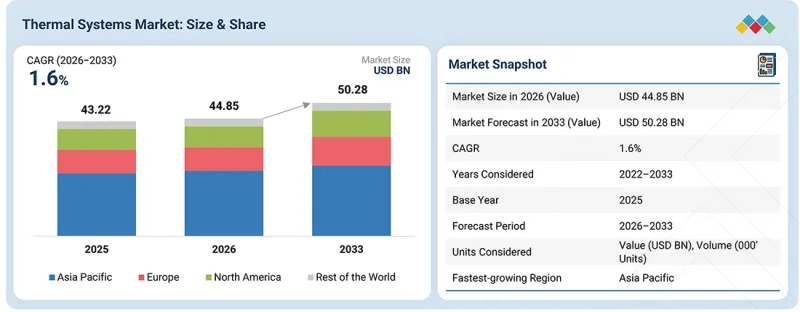
The thermal systems market for ICE vehicles is projected to reach USD 50.28 billion by 2033 from USD 44.85 billion in 2026 at a CAGR of 1.6% during the forecast period.
| Scope of the Report | |
|---|---|
| Years Considered for the Study | 2026-2033 |
| Base Year | 2025 |
| Forecast Period | 2026-2033 |
| Units Considered | USD billion |
| Segments | By Application, Technology, Component, Vehicle, and Region |
| Regions covered | Asia Pacific, Europe, North America, Rest of the World |
The thermal systems market is increasingly being shaped by the transition from component-level cooling and HVAC toward integrated, software-controlled thermal-energy management across ICE, hybrid, and electric powertrains. In ICE vehicles, higher power density, turbocharging, downsizing, and tighter efficiency requirements are increasing the need for precisely controlled engine, charge-air, transmission, EGR, exhaust and cabin thermal circuits. Further, in hybrid and EV platforms, thermal complexity is expanding as battery, e-motor, inverter, OBC/DC-DC, cabin HVAC and charging systems must be maintained within optimized temperature windows. This is accelerating adoption of liquid cooling, heat pumps, high-efficiency e-compressors, variable-speed coolant pumps, smart valves, advanced heat exchangers, battery preconditioning and integrated thermal modules. For instance, Mahle has developed a compact module integrating the compressor, heat exchanger, coolant pumps, sensors and valves, with the company targeting up to 20% higher range in cold conditions compared with electric-heater architectures.
The growing adoption of premium comfort and personalized thermal features is expanding thermal-system content beyond conventional HVAC. Features such as heated steering, heated/ventilated seats, rear A/C, and localized cabin conditioning are increasingly moving into mid-range SUVs and larger passenger vehicles as OEMs use thermal comfort as a vehicle-differentiation lever. At the same time, localized heating/cooling and intelligent seat-climate technologies can deliver occupant comfort with lower energy consumption than conditioning the entire cabin. For instance, Gentherm's ClimateSense integrates localized heating and cooling with central HVAC to enable personalized thermal comfort while improving energy efficiency. The shift toward personalized, energy-efficient cabin thermal management, particularly in hybrid and EV platforms where HVAC energy directly impacts vehicle efficiency, is creating new opportunities for higher thermal content per vehicle.
"BEV segment to lead electric & hybrid vehicle thermal systems market"
The battery electric vehicle (BEV) segment is expected to lead the thermal systems market as the architectures of BEVs require the highest level of integrated thermal control across the battery, e-motor, inverter, e-axle, charging system and cabin. The shift toward larger batteries, higher power density, 800V-1,000V architectures and ultra-fast charging is increasing the need for battery preconditioning, liquid cooling, advanced cooling plates and high-capacity thermal circuits. At the same time, the move toward CTP/CTC battery architectures, higher-performance e-drives and larger SUVs is increasing thermal uniformity and heat-flux management requirements. Since BEVs lack ICE waste heat, heat pumps, waste-heat recovery and intelligent HVAC control are also becoming critical for maintaining cabin comfort without significantly reducing driving range. Regionally, China and broader Asia are at the forefront, supported by high BEV penetration, battery manufacturing and rapid deployment of high-voltage/ultra-fast charging technologies, while Europe is advancing premium, high-efficiency thermal architectures. Overall, thermal management is shifting from component-level cooling toward integrated, software-controlled vehicle thermal-energy management, giving BEVs the highest thermal-system content and value potential per vehicle.
"Waste heat recovery segment to witness highest growth rate during forecast period"
Waste heat energy recovery is emerging as one of the fastest-growing thermal-management technologies as OEMs increasingly shift from dissipating excess heat to recovering and redistributing thermal energy across the vehicle. In ICE vehicles, heat from exhaust gases and engine coolant can be recovered for cabin heating and thermal conditioning, improving overall thermal efficiency and reducing reliance on auxiliary heating systems. In HEVs and PHEVs, frequent engine stop-start events and EV-mode operation reduce the availability of conventional engine waste heat, increasing the importance of recovering heat from the engine, e-motor, and power electronics and coordinating it with heat-pump systems. In BEVs, heat generated by the e-motor, inverter, battery, and e-axle can be recovered and redirected to the cabin or battery, reducing electrical heating demand and helping preserve driving range, particularly in cold conditions. This is driving the transition from standalone heat-recovery components toward integrated thermal modules, heat pumps, intelligent valves, and software-controlled heat-flow management that can optimize the use of available thermal energy across the vehicle. Technologically, the market is moving toward multi-source heat recovery, integrated thermal loops, intelligent valves, heat pumps, and predictive software that dynamically determine where recovered heat can deliver the greatest energy benefit. Strategically, this is shifting thermal management from component-level heat recovery toward whole-vehicle thermal-energy orchestration, enabling OEMs to capture efficiency gains across ICE, HEV/PHEV, and BEV platforms while improving cabin comfort and reducing energy consumption. Therefore, waste heat energy recovery is expected to become a core element of whole-vehicle thermal-energy management, particularly as larger batteries, higher-power electric drivetrains, and faster charging increase the importance of efficient thermal-energy utilization.
"Europe to be second-largest market for thermal systems"
Europe is estimated to be the second-largest thermal systems market, owing to its automotive industry combining rapid electrification with a strong premium/SUV vehicle mix and stringent efficiency requirements, which are increasing thermal-system content per vehicle. EV sales grew by more than 30% in Europe in 2025, reaching 28% of new-car sales, while the availability of EV models increased by nearly 35%, accelerating the adoption of battery cooling, heat pumps, e-compressors, and integrated thermal architectures. The growing penetration of larger SUVs, premium vehicles, and electrified PHEV/HEV platforms is further increasing thermal loads across batteries, e-powertrains, cabin HVAC, and high-power electronics. Technologically, European OEMs are moving toward 800V architectures, fast-charging thermal control, multi-loop cooling, waste-heat recovery, integrated thermal modules, and predictive thermal-energy management to improve range, charging performance, and cabin efficiency. Regulatory pressure is also a major catalyst, with EU CO2 standards tightening from 2025, while the regulatory framework continues to push OEMs toward lower-emission and zero-emission vehicles. HVAC efficiency improvements can also qualify as EU eco-innovations from 2025. Consequently, Europe's thermal-management opportunity is shifting from conventional engine cooling toward highly integrated, energy-efficient thermal architectures that simultaneously manage battery, e-drive, cabin, and charging loads, supporting its position as the second-largest and technologically advanced regional market.
In-depth interviews were conducted with CEOs, marketing directors, other innovation and strategy directors, and executives from various key organizations operating in this market.
- By Company Type: OEMs -30%, and Tier 1 - 70%
- By Designation: C-level Executives - 20%, Directors - 30%, and Others - 50%
- By Region: Asia Pacific - 60%, Europe - 20%, and North America - 20%
DENSO Corporation (Japan), MAHLE GmbH (Germany), Hanon Systems (South Korea), Valeo SA (France), and BorgWarner Inc. (US) are the leading providers of thermal systems in the global market.
Research Coverage:
The thermal systems market is segmented based on application (ICE) (powertrain thermal management (engine cooling), transmission cooling, cabin thermal management, & waste heat recovery), ICE vehicle type (passenger car, LCV, truck, and bus), application (electric & hybrid vehicle) (battery thermal management, powertrain thermal management (transmission cooling & engine cooling), cabin thermal management, e-motor, power electronics, & waste heat recovery), electric & hybrid vehicle type (BEV, HEV, PHEV, FCEV, 48V mild hybrid, and electric commercial vehicle), technology (active transmission warm-up, exhaust gas recirculation, engine thermal mass reduction, reduced HVAC system loading, and other technologies), component (ICE) (air filter, condenser, compressor, water pump, motor, heat exchanger, heater control unit, thermoelectric generator, EGR Valve, oxygen sensor, temperature sensor, charge air cooler), component (electric & hybrid vehicle) (air filter, condenser, electric compressor, electric water pump, electric motor, heat exchanger, heater control unit, and thermoelectric generator), and region (Asia Pacific, Europe, North America, and the Rest of the World).
The study also includes an in-depth competitive analysis of the major thermal systems product manufacturers in the market, their company profiles, key observations related to product and business offerings, recent developments, and key market strategies.
Key Benefits of Buying the Report:
The report will help market leaders/new entrants in this market with information on the closest approximations of the revenue numbers for the overall automotive thermal systems market and the sub-segments. This report will help stakeholders understand the competitive landscape and gain more insights to better position their businesses and plan suitable go-to-market strategies. The report also helps stakeholders understand the market's pulse and provides information on key market drivers, restraints, challenges, and opportunities.
TABLE OF CONTENTS
1 INTRODUCTION
- 1.1 STUDY OBJECTIVES
- 1.2 MARKET DEFINITION
- 1.3 INCLUSIONS AND EXCLUSIONS
- 1.4 MARKET SCOPE
- 1.4.1 YEARS CONSIDERED
- 1.5 CURRENCY CONSIDERED
- 1.6 STAKEHOLDERS
- 1.7 SUMMARY OF CHANGES
2 EXECUTIVE SUMMARY
- 2.1 MARKET HIGHLIGHTS AND KEY INSIGHTS
- 2.2 KEY MARKET PARTICIPANTS: MAPPING OF STRATEGIC DEVELOPMENTS
- 2.3 DISRUPTIVE TRENDS IN AUTOMOTIVE THERMAL SYSTEMS MARKET
- 2.4 HIGH-GROWTH SEGMENTS IN AUTOMOTIVE THERMAL SYSTEMS MARKET
- 2.5 REGIONAL SNAPSHOT: MARKET SIZE, GROWTH RATE, AND FORECAST
3 PREMIUM INSIGHTS
- 3.1 ATTRACTIVE OPPORTUNITIES IN AUTOMOTIVE THERMAL SYSTEMS MARKET
- 3.2 AUTOMOTIVE THERMAL SYSTEMS MARKET, BY REGION (ICE)
- 3.3 AUTOMOTIVE THERMAL SYSTEMS MARKET, BY APPLICATION (ICE)
- 3.4 AUTOMOTIVE THERMAL SYSTEMS MARKET, BY TECHNOLOGY (ICE)
- 3.5 AUTOMOTIVE THERMAL SYSTEMS MARKET, BY COMPONENT (ICE)
- 3.6 AUTOMOTIVE THERMAL SYSTEMS MARKET, BY VEHICLE TYPE (ICE)
- 3.7 ELECTRIC & HYBRID VEHICLE THERMAL SYSTEMS MARKET, BY APPLICATION
- 3.8 ELECTRIC & HYBRID THERMAL SYSTEMS MARKET, BY COMPONENT
- 3.9 ELECTRIC & HYBRID VEHICLE THERMAL SYSTEMS MARKET, BY ELECTRIC VEHICLE TYPE
4 MARKET OVERVIEW
- 4.1 INTRODUCTION
- 4.2 MARKET DYNAMICS
- 4.2.1 DRIVERS
- 4.2.1.1 Thermal management becoming vehicle efficiency and range-critical system
- 4.2.1.2 Fast charging, higher power density, and software-defined vehicles raising thermal control requirements
- 4.2.2 RESTRAINTS
- 4.2.2.1 Limited adoption of advanced thermal management systems in cost-sensitive vehicles
- 4.2.3 OPPORTUNITIES
- 4.2.3.1 Electrification of thermal components across ICE, hybrid, and commercial vehicles
- 4.2.3.1.1 Active air management creating new thermal content across ICE, hybrid, and EV platforms
- 4.2.3.2 Shift from individual thermal components to integrated thermal modules
- 4.2.3.3 Thermal management becoming software-controlled energy optimization layer
- 4.2.3.1 Electrification of thermal components across ICE, hybrid, and commercial vehicles
- 4.2.4 CHALLENGES
- 4.2.4.1 Complex multi-loop thermal coordination across powertrain and vehicle systems
- 4.2.4.2 Durability and reliability under high thermal loads and transient operating conditions
- 4.2.1 DRIVERS
- 4.3 UNMET NEEDS AND WHITE SPACES
- 4.4 INTERCONNECTED MARKETS AND CROSS-SECTOR OPPORTUNITIES
- 4.5 STRATEGIC MOVES BY TIER 1/2/3 PLAYERS
5 INDUSTRY TRENDS
- 5.1 MACROECONOMIC OUTLOOK
- 5.1.1 INTRODUCTION
- 5.1.2 GDP TRENDS AND FORECAST
- 5.1.3 TRENDS IN GLOBAL AUTOMOTIVE INDUSTRY INFLUENCING AUTOMOTIVE THERMAL SYSTEMS MARKET
- 5.1.3.1 Integrated thermal management architectures driving demand for advanced thermal systems
- 5.1.3.2 Heat pump adoption in electric vehicles driving demand for high-efficiency thermal technologies
- 5.1.3.3 Fast-charging and higher battery power density driving advanced battery thermal management
- 5.1.3.4 Software-defined thermal management driving demand for intelligent thermal control systems
- 5.1.3.5 Waste heat recovery and thermal energy reuse driving demand for integrated thermal circuits
- 5.2 SUPPLY CHAIN ANALYSIS
- 5.2.1 DISTRIBUTED VS. INTEGRATED THERMAL SYSTEMS
- 5.3 PRICING ANALYSIS
- 5.3.1 REGIONAL PRICE TREND: LIGHT VEHICLES THERMAL SYSTEM COMPONENTS (USD/UNIT), 2025
- 5.3.2 REGIONAL PRICE TREND: TRUCK THERMAL SYSTEM COMPONENTS (USD/UNIT), 2025
- 5.4 THERMAL CONTENT EVOLUTION
- 5.4.1 EVOLUTION FROM ENGINE-CENTRIC COOLING TO MULTI-DOMAIN THERMAL MANAGEMENT
- 5.5 TRADE ANALYSIS
- 5.5.1 IMPORT DATA FOR HS CODE (870891)
- 5.5.1.1 Radiators and parts - Import data, by country, 2022-2025 (USD million)
- 5.5.2 EXPORT DATA FOR HS CODE (870891)
- 5.5.2.1 Radiators and parts - Export data, by country, 2022-2025 (USD million)
- 5.5.3 IMPORT DATA FOR HS CODE (841520)
- 5.5.3.1 Air conditioning machines used in vehicles for cabin - Import data, by country, 2022-2025 (USD million)
- 5.5.4 EXPORT DATA FOR HS CODE (841520)
- 5.5.4.1 Air conditioning machines used in vehicles for cabin - Export data, by country, 2022-2025 (USD million)
- 5.5.1 IMPORT DATA FOR HS CODE (870891)
- 5.6 TRENDS/DISRUPTIONS IMPACTING CUSTOMER BUSINESS
- 5.7 KEY CONFERENCES & EVENTS IN 2026-2027
- 5.8 INVESTMENT AND FUNDING SCENARIO
- 5.9 CASE STUDY ANALYSIS
- 5.9.1 DENSO MOVES FROM STANDALONE THERMAL MANAGEMENT TOWARD INTEGRATED VEHICLE ENERGY OPTIMIZATION
- 5.9.2 MAHLE OPTIMIZES BATTERY, CABIN AND COOLING SYSTEM ENERGY USE FOR MAHINDRA'S BEV PLATFORM
- 5.9.3 HANON SYSTEMS INTEGRATES MULTIPLE REFRIGERANT THERMAL FUNCTIONS INTO A SINGLE MODULE FOR BMW'S ELECTRIC IX3
- 5.9.4 COOLING SYSTEM MAINTENANCE AND SERVICE BY GRAYSON THERMAL SYSTEMS
- 5.9.5 OPTARE SUPPLIED 94 SOLO BUSES TO DUBAI FOR ROADS AND TRANSPORT AUTHORITY (RTA)
- 5.9.6 DENSO OFFERS ADVANCED AUTOMOTIVE SYSTEMS, TECHNOLOGIES, AND PRODUCTS
- 5.10 AUTOMOTIVE THERMAL SYSTEMS MARKET ECOSYSTEM
6 TECHNOLOGICAL ADVANCEMENTS, AI-DRIVEN IMPACT, PATENTS, INNOVATIONS, AND FUTURE STRATEGIC APPLICATIONS
- 6.1 TECHNOLOGY ANALYSIS
- 6.1.1 COMPLEMENTARY TECHNOLOGIES
- 6.1.1.1 Battery thermal management systems
- 6.1.1.2 Automotive heat pump systems
- 6.1.1.3 Integrated thermal management systems
- 6.1.1.4 Multi-loop coolant and refrigerant architectures
- 6.1.1.5 Waste heat recovery and thermal energy utilization
- 6.1.1.6 Software-defined and intelligent thermal management
- 6.1.2 ADJACENT TECHNOLOGIES
- 6.1.2.1 Vehicle electrification and e-powertrain technologies
- 6.1.2.2 Battery energy storage and battery management systems
- 6.1.2.3 Fast charging and charging technologies
- 6.1.2.4 Power electronics and advanced semiconductor technologies
- 6.1.2.5 Vehicle energy management and centralized e/e architectures
- 6.1.2.6 Software-defined vehicles and predictive control
- 6.1.1 COMPLEMENTARY TECHNOLOGIES
- 6.2 TECHNOLOGY ROADMAP
- 6.2.1 AUTOMOTIVE THERMAL SYSTEM TECHNOLOGY ROADMAP
- 6.3 EVOLUTION OF AUTOMOTIVE THERMAL SYSTEMS MARKET
- 6.3.1 AUTOMOTIVE THERMAL SYSTEMS MARKET EVOLVING FROM COMPONENT-BASED COOLING AND HVAC TO INTEGRATED, VEHICLE-WIDE THERMAL ENERGY MANAGEMENT
- 6.4 REGIONAL VARIATION IN AUTOMOTIVE THERMAL SYSTEM REQUIREMENTS
- 6.5 PATENT ANALYSIS
- 6.5.1 INTRODUCTION
- 6.5.2 APPLICATIONS AND PATENTS GRANTED, JANUARY 2017-AUGUST 2026
- 6.6 IMPACT OF AI/GENERATIVE AI ON AUTOMOTIVE THERMAL SYSTEMS MARKET
- 6.7 IMPACT OF EU-INDIA FTA ON AUTOMOTIVE THERMAL SYSTEMS MARKET
- 6.8 IMPACT OF ISRAEL-IRAN WAR ON AUTOMOTIVE THERMAL SYSTEMS MARKET
7 REGULATORY LANDSCAPE
- 7.1 REGIONAL REGULATIONS AND COMPLIANCE
- 7.1.1 REGULATORY BODIES, GOVERNMENT AGENCIES, AND OTHER ORGANIZATIONS
- 7.2 FUEL ECONOMY NORMS
- 7.2.1 US
- 7.2.2 EUROPE
- 7.2.3 CHINA
- 7.2.4 INDIA
- 7.3 INDUSTRY STANDARDS
- 7.4 SUSTAINABILITY INITIATIVES
- 7.4.1 HIGH-EFFICIENCY HEAT PUMP SYSTEMS
- 7.4.2 INTEGRATED THERMAL MANAGEMENT ARCHITECTURES
- 7.4.3 INTELLIGENT AND SOFTWARE-CONTROLLED THERMAL MANAGEMENT
8 CUSTOMER LANDSCAPE & BUYER BEHAVIOR
- 8.1 DECISION-MAKING PROCESS
- 8.2 KEY STAKEHOLDERS IN BUYING PROCESS AND THEIR EVALUATION CRITERIA
- 8.2.1 KEY STAKEHOLDERS IN BUYING PROCESS
- 8.2.2 BUYING CRITERIA
- 8.3 ADOPTION BARRIERS & INTERNAL CHALLENGES
- 8.4 UNMET NEEDS FROM VARIOUS END-USE INDUSTRIES
- 8.4.1 PASSENGER CARS: RANGE-EFFICIENT THERMAL COMFORT WITHOUT SYSTEM OVERSIZING
- 8.4.2 PREMIUM AND HIGH-PERFORMANCE EVS: THERMAL SYSTEMS FOR SUSTAINED FAST CHARGING AND HIGH-POWER OUTPUT
- 8.4.3 LIGHT COMMERCIAL VEHICLES: DURABLE THERMAL SYSTEMS FOR HIGH-UTILIZATION AND COST-SENSITIVE OPERATIONS
- 8.4.4 HEAVY COMMERCIAL VEHICLES: HIGH-CAPACITY COOLING WITH LOWER ENERGY PENALTY
- 8.4.5 HYBRID VEHICLES: INTELLIGENT COORDINATION BETWEEN ICE AND ELECTRIFIED THERMAL LOOPS
- 8.4.6 VEHICLES OPERATING IN EXTREME CLIMATES: CLIMATE-RESILIENT THERMAL PERFORMANCE
- 8.5 MARKET PROFITABILITY
- 8.5.1 PROFITABILITY OVERVIEW
9 AUTOMOTIVE THERMAL SYSTEMS MARKET, BY VEHICLE TYPE (ICE)
- 9.1 INTRODUCTION
- 9.2 PASSENGER CAR
- 9.2.1 INCREASING THERMAL MANAGEMENT REQUIREMENTS TO DRIVE SEGMENTAL GROWTH
- 9.3 LIGHT COMMERCIAL VEHICLE (LCV)
- 9.3.1 GROWTH IN COMMERCIAL VEHICLE UTILIZATION AND LOGISTICS ACTIVITIES TO DRIVE SEGMENTAL GROWTH
- 9.4 TRUCK
- 9.4.1 HIGHER ENGINE OUTPUT AND STRINGENT EMISSION REQUIREMENTS TO DRIVE SEGMENTAL GROWTH
- 9.5 BUS
- 9.5.1 INCREASING PASSENGER COMFORT AND HVAC REQUIREMENTS TO DRIVE SEGMENTAL GROWTH
- 9.5.2 INDUSTRY INSIGHTS: BY VEHICLE TYPE (ICE)
10 ELECTRIC AND HYBRID VEHICLE THERMAL SYSTEMS MARKET, BY VEHICLE TYPE
- 10.1 INTRODUCTION
- 10.2 BATTERY ELECTRIC VEHICLE (BEV)
- 10.2.1 INCREASING BATTERY DEPLOYMENT AND FAST-CHARGING REQUIREMENTS TO DRIVE GROWTH
- 10.3 PLUG-IN HYBRID ELECTRIC VEHICLE (PHEV)
- 10.3.1 DUAL POWERTRAIN THERMAL MANAGEMENT REQUIREMENTS TO DRIVE GROWTH
- 10.4 FUEL CELL ELECTRIC VEHICLE (FCEV)
- 10.4.1 PRECISE FUEL-CELL STACK THERMAL CONTROL TO DRIVE GROWTH
- 10.5 48V MILD HYBRID
- 10.5.1 GROWING ADOPTION OF 48V ELECTRIFICATION TO DRIVE GROWTH
- 10.6 ELECTRIC COMMERCIAL VEHICLE (ECV)
- 10.6.1 HIGHER BATTERY CAPACITY AND DEMANDING DUTY CYCLES TO DRIVE GROWTH
- 10.7 INDUSTRY INSIGHTS
11 AUTOMOTIVE THERMAL SYSTEMS MARKET, BY APPLICATION (ICE)
- 11.1 INTRODUCTION
- 11.2 POWERTRAIN THERMAL MANAGEMENT
- 11.2.1 INCREASING THERMAL LOADS AND STRINGENT EMISSION REQUIREMENTS TO DRIVE ADVANCED POWERTRAIN THERMAL MANAGEMENT
- 11.3 CABIN THERMAL MANAGEMENT
- 11.3.1 RISING VEHICLE SIZES AND HIGHER CABIN COMFORT CONTENT TO SUPPORT DEMAND FOR CABIN THERMAL MANAGEMENT
- 11.4 TRANSMISSION COOLING
- 11.4.1 SHIFT FROM MANUAL TO AUTOMATIC TRANSMISSIONS TO INCREASE TRANSMISSION COOLING REQUIREMENTS
- 11.5 WASTE HEAT RECOVERY
- 11.5.1 INCREASING FUEL EFFICIENCY REQUIREMENTS TO DRIVE WASTE HEAT RECOVERY
- 11.6 INDUSTRY INSIGHTS
12 ELECTRIC & HYBRID VEHICLE THERMAL SYSTEMS MARKET, BY APPLICATION
- 12.1 INTRODUCTION
- 12.2 BATTERY THERMAL MANAGEMENT
- 12.2.1 FAST-CHARGING AND BATTERY PERFORMANCE REQUIREMENTS TO DRIVE NEED FOR PRECISE THERMAL CONTROL
- 12.3 POWERTRAIN THERMAL MANAGEMENT
- 12.3.1 INTEGRATION OF ELECTRIC POWERTRAIN COMPONENTS TO INCREASE THERMAL MANAGEMENT REQUIREMENTS
- 12.4 CABIN THERMAL MANAGEMENT
- 12.4.1 CABIN ENERGY CONSUMPTION AND RANGE REQUIREMENTS TO DRIVE DEMAND
- 12.5 E-MOTOR THERMAL MANAGEMENT
- 12.5.1 HIGHER ELECTRIC-MOTOR POWER DENSITY TO DRIVE DEMAND FOR ADVANCED THERMAL MANAGEMENT
- 12.6 POWER ELECTRONICS
- 12.6.1 HIGHER POWER DENSITY AND HIGH-VOLTAGE ARCHITECTURES TO INCREASE POWER-ELECTRONICS COOLING REQUIREMENTS
- 12.7 WASTE HEAT RECOVERY
- 12.7.1 THERMAL ENERGY REUSE GAINS IMPORTANCE AS ELECTRIFIED VEHICLES REDUCE CONVENTIONAL WASTE-HEAT AVAILABILITY
- 12.8 INDUSTRY INSIGHTS
13 AUTOMOTIVE THERMAL SYSTEMS MARKET, BY COMPONENT (ICE)
- 13.1 INTRODUCTION
- 13.2 AIR FILTER
- 13.2.1 RISING CABIN AIR-QUALITY REQUIREMENTS TO DRIVE HIGHER PERFORMANCE OF A/C AIR FILTERS
- 13.3 CONDENSER
- 13.3.1 HIGHER COOLING EFFICIENCY AND REFRIGERANT REQUIREMENTS TO DRIVE ADVANCED CONDENSER DESIGNS
- 13.4 COMPRESSOR
- 13.4.1 HIGHER CABIN COOLING REQUIREMENTS AND HVAC EFFICIENCY TO DRIVE HIGH-PERFORMANCE COMPRESSORS
- 13.5 WATER PUMP
- 13.5.1 DEMAND-BASED COOLING TO DRIVE ELECTRICALLY CONTROLLED WATER PUMPS
- 13.6 MOTOR
- 13.6.1 HIGHER THERMAL LOADS TO DRIVE NEED FOR MORE EFFICIENT COOLING-FAN AND ACTUATION MOTORS
- 13.7 HEAT EXCHANGER
- 13.7.1 HIGHER THERMAL LOADS AND PACKAGING CONSTRAINTS TO DRIVE NEED FOR MORE EFFICIENT HEAT EXCHANGERS
- 13.8 HEATER CONTROL
- 13.8.1 DEMAND FOR PRECISE CABIN TEMPERATURE CONTROL TO DRIVE ADVANCED HEATER MANAGEMENT
- 13.9 THERMOELECTRIC GENERATOR
- 13.9.1 FUEL-EFFICIENCY AND CO2 REDUCTION REQUIREMENTS TO SUSTAIN INTEREST IN EXHAUST HEAT RECOVERY
- 13.10 EGR VALVE
- 13.10.1 STRICTER EMISSION REQUIREMENTS TO DRIVE MORE PRECISE EGR FLOW CONTROL
- 13.11 A/C VALVE
- 13.11.1 DEMAND FOR EFFICIENT CABIN CLIMATE CONTROL TECHNOLOGIES TO DRIVE GROWTH
- 13.12 OXYGEN SENSOR
- 13.12.1 STRINGENT EMISSION STANDARDS TO INCREASE DEMAND FOR FASTER AND MORE ACCURATE OXYGEN SENSING
- 13.13 TEMPERATURE SENSOR
- 13.13.1 INCREASING THERMAL SYSTEM COMPLEXITY TO EXPAND TEMPERATURE-SENSING REQUIREMENTS
- 13.14 CHARGE AIR COOLER
- 13.14.1 HIGHER BOOSTING AND DOWNSIZED ENGINES TO DRIVE ADVANCED CHARGE-AIR COOLING
- 13.14.2 INDUSTRY INSIGHTS
14 ELECTRIC & HYBRID VEHICLE THERMAL SYSTEMS MARKET, BY COMPONENT
- 14.1 INTRODUCTION
- 14.2 AIR FILTER
- 14.2.1 DEMAND FOR COMPLEX FLOW GUIDANCE DESIGNS TO DRIVE GROWTH
- 14.3 CONDENSER
- 14.3.1 FOCUS ON REDUCING POWER CONSUMPTION AND INCREASING FUEL EFFICIENCY TO DRIVE GROWTH
- 14.4 ELECTRIC COMPRESSOR
- 14.4.1 ENGINE-INDEPENDENT OPERATION AND BATTERY CONDITIONING TO DRIVE GROWTH
- 14.5 ELECTRIC WATER PUMP
- 14.6 MULTIPLE ELECTRIFIED THERMAL LOADS TO DRIVE DEMAND FOR HIGHER-PERFORMANCE ELECTRIC COOLANT PUMPS
- 14.7 HEAT EXCHANGER
- 14.8 INTEGRATION OF BATTERY, E-DRIVE, AND CABIN THERMAL LOOPS TO INCREASE DEMAND
- 14.9 HEATER CONTROL
- 14.9.1 REDUCED AVAILABILITY OF ENGINE WASTE HEAT TO INCREASE IMPORTANCE OF EFFICIENT HEATING CONTROL
- 14.10 ELECTRIC MOTOR
- 14.10.1 HIGHER ELECTRIC-MOTOR POWER DENSITY TO DRIVE DIRECT AND TARGETED COOLING
- 14.11 THERMOELECTRIC GENERATOR
- 14.11.1 NEED FOR REDUCTION IN FUEL CONSUMPTION TO DRIVE GROWTH
- 14.12 INDUSTRY INSIGHTS
15 AUTOMOTIVE THERMAL SYSTEMS MARKET, BY TECHNOLOGY (ICE)
- 15.1 INTRODUCTION
- 15.1.1 ACTIVE TRANSMISSION WARM UP
- 15.1.1.1 Increasing need to shorten transmission cold-start operation to drive growth
- 15.1.1 ACTIVE TRANSMISSION WARM UP
- 15.2 EGR
- 15.2.1 INCREASING NEED FOR IN-CYLINDER NOX CONTROL IN ICE POWERTRAINS TO DRIVE GROWTH
- 15.3 ENGINE THERMAL MASS REDUCTION
- 15.3.1 INCREASING ADVANCEMENTS IN THERMAL SYSTEMS TO DRIVE GROWTH
- 15.4 REDUCED HVAC SYSTEM LOADING
- 15.4.1 MINIMIZING COMPRESSOR-DRIVEN THERMAL LOAD DURING CABIN CONDITIONING TO DRIVE GROWTH
- 15.5 OTHER TECHNOLOGIES
- 15.6 AIR-BASED COOLING
- 15.7 LIQUID INDIRECT COOLING
- 15.8 DIRECT/IMMERSION COOLING
- 15.9 REFRIGERANT-BASED COOLING
- 15.10 HEAT PUMP SYSTEM
- 15.11 PCM / ADVANCED THERMAL STORAGE
- 15.12 INDUSTRY INSIGHTS
16 AUTOMOTIVE THERMAL SYSTEMS MARKET (ICE), BY REGION
- 16.1 INTRODUCTION
- 16.2 ASIA PACIFIC
- 16.2.1 CHINA
- 16.2.1.1 High vehicle production and a diverse powertrain mix to sustain thermal system demand
- 16.2.2 INDIA
- 16.2.2.1 SUV-led vehicle production and growing commercial-vehicle HVAC requirements to support demand
- 16.2.3 JAPAN
- 16.2.3.1 Fuel-efficiency requirements to increase thermal management requirements in ICE vehicles
- 16.2.4 SOUTH KOREA
- 16.2.4.1 Mature vehicle production shifting thermal demand toward higher-efficiency ICE systems
- 16.2.5 THAILAND
- 16.2.5.1 Stricter ICE emission standards increasing thermal content in Thailand's pickup-led vehicle base
- 16.2.6 REST OF ASIA PACIFIC
- 16.2.1 CHINA
- 16.3 EUROPE
- 16.3.1 GERMANY
- 16.3.1.1 Higher-output ICE platforms increasing thermal content in Germany's mature vehicle base
- 16.3.2 FRANCE
- 16.3.2.1 Passenger car production recovery expanding ICE thermal system demand base
- 16.3.3 UK
- 16.3.3.1 SUV and premium-car production to sustain demand for higher-content ICE thermal systems
- 16.3.4 SPAIN
- 16.3.4.1 High vehicle production and factory diversification sustaining broad-based thermal demand
- 16.3.5 ITALY
- 16.3.5.1 High HVAC content and increasing thermal control requirements to sustain demand for cabin and powertrain thermal systems
- 16.3.6 RUSSIA
- 16.3.6.1 Localization of automotive components creates distinct opportunity for conventional thermal systems
- 16.3.7 REST OF EUROPE
- 16.3.1 GERMANY
- 16.4 NORTH AMERICA
- 16.4.1 US
- 16.4.1.1 Large vehicle platforms and higher thermal loads to sustain demand for advanced ICE thermal systems
- 16.4.2 CANADA
- 16.4.2.1 Cold-climate vehicle operation to strengthen demand for thermal regulation and heating systems
- 16.4.3 MEXICO
- 16.4.3.1 Export-oriented vehicle manufacturing to expand local thermal system supply base
- 16.4.1 US
- 16.5 REST OF THE WORLD (ROW)
- 16.5.1 SOUTH AFRICA
- 16.5.1.1 Export-oriented vehicle manufacturing to support high-value cooling and HVAC applications
- 16.5.2 BRAZIL
- 16.5.2.1 Growing light vehicle production and high thermal loads to sustain demand for integrated cooling and HVAC systems
- 16.5.3 ARGENTINA
- 16.5.3.1 Production and export volatility makes OEM programs key driver of thermal system demand
- 16.5.4 OTHERS
- 16.5.5 INDUSTRY INSIGHTS
- 16.5.1 SOUTH AFRICA
17 COMPETITIVE LANDSCAPE
- 17.1 OVERVIEW
- 17.2 KEY PLAYER STRATEGIES/RIGHT TO WIN, 2022-2026
- 17.3 AUTOMOTIVE THERMAL SYSTEMS MARKET SHARE ANALYSIS, 2025
- 17.4 REVENUE ANALYSIS OF TOP LISTED/PUBLIC PLAYERS, 2023-2025
- 17.5 COMPANY EVALUATION MATRIX: AUTOMOTIVE THERMAL SYSTEM MANUFACTURERS, 2025
- 17.5.1 STARS
- 17.5.2 EMERGING LEADERS
- 17.5.3 PERVASIVE COMPANIES
- 17.5.4 PARTICIPANTS
- 17.5.5 COMPANY FOOTPRINT
- 17.5.5.1 Company footprint
- 17.5.5.2 Region footprint, 2025
- 17.5.5.3 Vehicle type footprint, 2025
- 17.6 COMPANY EVALUATION QUADRANT: ELECTRIC & HYBRID VEHICLE THERMAL SYSTEM MANUFACTURERS
- 17.6.1 STARS
- 17.6.2 EMERGING LEADERS
- 17.6.3 PERVASIVE COMPANIES
- 17.6.4 PARTICIPANTS
- 17.7 PRODUCT COMPARISON
- 17.8 COMPANY VALUATION, 2025
- 17.9 COMPANY FINANCIAL METRICS, 2025
- 17.10 COMPETITIVE SCENARIO
- 17.10.1 PRODUCT LAUNCHES/DEVELOPMENTS
- 17.10.2 DEALS
- 17.10.3 EXPANSIONS
- 17.11 OTHER DEVELOPMENTS
18 COMPANY PROFILES
- 18.1 KEY PLAYERS
- 18.1.1 DENSO CORPORATION
- 18.1.1.1 Business overview
- 18.1.1.2 Products offered
- 18.1.1.3 Recent developments
- 18.1.1.3.1 Product launches/developments/upgrades
- 18.1.1.3.2 Deals
- 18.1.1.3.3 EXPANSIONS
- 18.1.1.3.4 Other developments
- 18.1.1.4 Mnm view
- 18.1.1.4.1 Key strengths
- 18.1.1.4.2 Strategic choices
- 18.1.1.4.3 Weaknesses and competitive threats
- 18.1.2 MAHLE GMBH
- 18.1.2.1 Business overview
- 18.1.2.2 Products offered
- 18.1.2.3 Recent developments
- 18.1.2.3.1 Product launches/developments
- 18.1.2.3.2 Deals
- 18.1.2.3.3 EXPANSIONS
- 18.1.2.3.4 Other Developments
- 18.1.2.4 MNM VIEW
- 18.1.2.4.1 Key strengths
- 18.1.2.4.2 Strategic choices
- 18.1.2.4.3 Weaknesses and competitive threats
- 18.1.3 VALEO
- 18.1.3.1 Business overview
- 18.1.3.2 Products offered
- 18.1.3.3 Recent developments
- 18.1.3.3.1 Product launches/developments/enhancements
- 18.1.3.3.2 Deals
- 18.1.3.3.3 EXPANSIONS
- 18.1.3.3.4 Other Developments
- 18.1.3.4 MnM view
- 18.1.3.4.1 Key strengths
- 18.1.3.4.2 Strategic choices
- 18.1.3.4.3 Weaknesses and competitive threats
- 18.1.4 HANON SYSTEMS
- 18.1.4.1 Business overview
- 18.1.4.2 Products offered
- 18.1.4.3 Recent developments
- 18.1.4.3.1 Product launches/developments/enhancements
- 18.1.4.3.2 Expansions
- 18.1.4.3.3 Other Developments
- 18.1.4.4 MnM view
- 18.1.4.4.1 Key strengths
- 18.1.4.4.2 Strategic choices
- 18.1.4.4.3 Weaknesses and competitive threats
- 18.1.5 BORGWARNER INC.
- 18.1.5.1 Business overview
- 18.1.5.2 Products offered
- 18.1.5.3 Recent developments
- 18.1.5.3.1 Product launches/developments
- 18.1.5.3.2 Other Developments
- 18.1.5.4 MnM view
- 18.1.5.4.1 Key strengths
- 18.1.5.4.2 Strategic choices
- 18.1.5.4.3 Weaknesses and competitive threats
- 18.1.6 GENTHERM INC.
- 18.1.6.1 Business overview
- 18.1.6.2 Products offered
- 18.1.6.3 Recent developments
- 18.1.6.3.1 Deals
- 18.1.6.3.2 Expansions
- 18.1.6.3.3 Other Developments
- 18.1.7 SCHAEFFLER AG
- 18.1.7.1 Business overview
- 18.1.7.2 Products offered
- 18.1.7.3 Recent developments
- 18.1.7.3.1 Product launches/developments
- 18.1.7.3.2 Deals
- 18.1.7.3.3 Other Developments
- 18.1.8 JOHNSON ELECTRIC HOLDINGS LIMITED
- 18.1.8.1 Business overview
- 18.1.8.2 Products offered
- 18.1.8.3 Recent developments
- 18.1.8.3.1 Product launches
- 18.1.8.3.2 Other Developments
- 18.1.9 DANA LIMITED
- 18.1.9.1 Business overview
- 18.1.9.2 Products offered
- 18.1.9.3 Recent developments
- 18.1.9.3.1 Other Developments
- 18.1.10 ROBERT BOSCH GMBH
- 18.1.10.1 Business overview
- 18.1.10.2 Products offered
- 18.1.10.3 Recent developments
- 18.1.10.3.1 Product launches/developments
- 18.1.10.3.2 Other Developments
- 18.1.1 DENSO CORPORATION
- 18.2 OTHER PLAYERS
- 18.2.1 EBERSPACHER
- 18.2.2 AUMOVIO SE
- 18.2.3 VOSS AUTOMOTIVE GMBH
- 18.2.4 GRAYSON THERMAL SYSTEMS
- 18.2.5 DUPONT
- 18.2.6 BEHR-HELLA THERMOCONTROL GMBH (BHTC)
- 18.2.7 SANDEN HOLDINGS CORPORATION
- 18.2.8 SANHUA AUTOMOTIVE
- 18.2.9 SHANDONG HOUFENG GROUP
- 18.3 AUTOMOTIVE THERMAL SYSTEMS MARKET - ADDITIONAL PLAYERS (NORTH AMERICA)
- 18.3.1 MAGNA INTERNATIONAL
- 18.3.2 LEAR CORPORATION
- 18.3.3 STANT CORPORATION
- 18.3.4 AIR INTERNATIONAL THERMAL SYSTEMS
- 18.3.5 MICHIGAN AUTOMOTIVE COMPRESSOR, INC.
- 18.3.6 MODINE MANUFACTURING COMPANY
- 18.3.7 WELLS VEHICLE ELECTRONICS
- 18.3.8 T.RAD NORTH AMERICA, INC.
- 18.3.9 THERMAL SOLUTION MANUFACTURING, INC.
- 18.3.10 AKG THERMAL SYSTEM, INC.
19 RESEARCH METHODOLOGY
- 19.1 RESEARCH DATA
- 19.2 SECONDARY DATA
- 19.2.1 KEY SECONDARY SOURCES FOR VEHICLE PRODUCTION AND ELECTRIC VEHICLE SALES
- 19.2.2 KEY SECONDARY SOURCES FOR MARKET SIZING
- 19.2.3 KEY DATA FROM SECONDARY SOURCES
- 19.3 PRIMARY DATA
- 19.3.1 SAMPLING TECHNIQUES & DATA COLLECTION METHODS
- 19.3.2 PRIMARY PARTICIPANTS
- 19.4 MARKET SIZE ESTIMATION
- 19.4.1 BOTTOM-UP APPROACH
- 19.4.2 BOTTOM-UP APPROACH
- 19.4.3 TOP-DOWN APPROACH
- 19.4.4 TOP-DOWN APPROACH
- 19.4.5 FACTOR ANALYSIS FOR MARKET SIZING: DEMAND AND SUPPLY SIDES
- 19.5 MARKET BREAKDOWN AND DATA TRIANGULATION
- 19.6 FACTOR ANALYSIS
- 19.7 RESEARCH ASSUMPTIONS & ASSOCIATED RISKS
- 19.7.1 MARKET ASSUMPTIONS
- 19.8 RESEARCH LIMITATIONS
20 APPENDIX
- 20.1 KEY INSIGHTS OF INDUSTRY EXPERTS
- 20.2 DISCUSSION GUIDE
- 20.3 KNOWLEDGESTORE: MARKETSANDMARKETS' SUBSCRIPTION PORTAL
- 20.4 CUSTOMIZATION OPTIONS
- 20.4.1 ELECTRIC & HYBRID THERMAL SYSTEMS MARKET, BY APPLICATION COUNTRY-WISE DATA
- 20.4.1.1 Battery thermal system
- 20.4.1.2 Transmission system
- 20.4.1.3 Engine cooling
- 20.4.1.4 Front air conditioning
- 20.4.1.5 Motor thermal system
- 20.4.1.6 Power electronics
- 20.4.1.7 Rear air conditioning
- 20.4.1.8 Heated/ventilated seats
- 20.4.1.9 Heated steering
- 20.4.1.10 Waste heat recovery
- 20.4.2 ELECTRIC & HYBRID THERMAL SYSTEMS MARKET, BY VEHICLE TYPE COUNTRY-WISE DATA
- 20.4.2.1 BEV
- 20.4.2.2 PHEV
- 20.4.2.3 HEV
- 20.4.2.4 FCEV
- 20.4.2.5 Mild hybrid
- 20.4.1 ELECTRIC & HYBRID THERMAL SYSTEMS MARKET, BY APPLICATION COUNTRY-WISE DATA
- 20.5 RELATED REPORTS
- 20.6 AUTHOR DETAILS
List of Tables
- TABLE 1 INCLUSIONS AND EXCLUSIONS
- TABLE 2 CURRENCY EXCHANGE RATES, 2022-2025
- TABLE 3 AUTOMOTIVE THERMAL SYSTEMS MARKET: IMPACT OF MARKET DYNAMICS
- TABLE 4 INTERCONNECTED MARKETS AND CROSS-SECTOR OPPORTUNITIES
- TABLE 5 STRATEGIC MOVES BY TIER 1 PLAYERS
- TABLE 6 STRATEGIC MOVES BY TIER 2 PLAYERS
- TABLE 7 STRATEGIC MOVES BY TIER 3 PLAYERS
- TABLE 8 GDP PERCENTAGE CHANGE, BY KEY COUNTRY, 2022-2031
- TABLE 9 RADIATORS AND PARTS IMPORT TRADE DATA, BY COUNTRY, 2022-2025 (USD MILLION)
- TABLE 10 RADIATORS AND PARTS EXPORT TRADE DATA, BY COUNTRY, 2022-2025 (USD MILLION)
- TABLE 11 VEHICLE AIR CONDITIONERS IMPORT TRADE DATA, BY COUNTRY, 2022-2025 (USD MILLION)
- TABLE 12 VEHICLE AIR CONDITIONERS EXPORT TRADE DATA, BY COUNTRY, 2022-2025 (USD MILLION)
- TABLE 13 AUTOMOTIVE THERMAL SYSTEMS MARKET: UPCOMING CONFERENCES & EVENTS, 2026-2027
- TABLE 14 AUTOMOTIVE THERMAL SYSTEMS MARKET: ROLE OF COMPANIES IN ECOSYSTEM
- TABLE 15 REGIONAL VARIATIONS IN AUTOMOTIVE THERMAL REQUIREMENTS AND TECHNOLOGY PRIORITIES
- TABLE 16 NORTH AMERICA: REGULATORY BODIES, GOVERNMENT AGENCIES, AND OTHER ORGANIZATIONS
- TABLE 17 EUROPE: REGULATORY BODIES, GOVERNMENT AGENCIES, AND OTHER ORGANIZATIONS
- TABLE 18 ASIA PACIFIC: REGULATORY BODIES, GOVERNMENT AGENCIES, AND OTHER ORGANIZATIONS
- TABLE 19 REST OF THE WORLD: REGULATORY BODIES, GOVERNMENT AGENCIES AND OTHER ORGANIZATIONS
- TABLE 20 US: CAFE STANDARDS FOR EACH MODEL YEAR IN MILES PER GALLON, 2022-2026
- TABLE 21 CHINA: CHINA 6A AND 6B STANDARD, 2022 ONWARDS
- TABLE 22 REGULATIONS AND INITIATIVES
- TABLE 23 KEY STAKEHOLDERS IN BUYING PROCESS FOR AUTOMOTIVE THERMAL SYSTEMS, BY ICE VEHICLE TYPE
- TABLE 24 KEY BUYING CRITERIA FOR TOP 5 THERMAL MANAGEMENT TECHNOLOGIES
- TABLE 25 UNMET NEEDS, BY END-USE INDUSTRY
- TABLE 26 PROFITABILITY BY THERMAL SYSTEM / TECHNOLOGY
- TABLE 27 AUTOMOTIVE THERMAL SYSTEMS MARKET, BY VEHICLE TYPE (ICE), 2022-2025 ('000 UNITS)
- TABLE 28 AUTOMOTIVE THERMAL SYSTEMS MARKET, BY VEHICLE TYPE (ICE), 2026-2033 ('000 UNITS)
- TABLE 29 AUTOMOTIVE THERMAL SYSTEMS MARKET, BY VEHICLE TYPE (ICE), 2022-2025 (USD MILLION)
- TABLE 30 AUTOMOTIVE THERMAL SYSTEMS MARKET, BY VEHICLE TYPE (ICE), 2026-2033 (USD MILLION)
- TABLE 31 PASSENGER CAR: AUTOMOTIVE THERMAL SYSTEMS MARKET, BY REGION, 2022-2025 ('000 UNITS)
- TABLE 32 PASSENGER CAR: AUTOMOTIVE THERMAL SYSTEMS MARKET, BY REGION, 2026-2033 ('000 UNITS)
- TABLE 33 PASSENGER CAR: AUTOMOTIVE THERMAL SYSTEMS MARKET, 2022-2025 (USD MILLION)
- TABLE 34 PASSENGER CAR: AUTOMOTIVE THERMAL SYSTEMS MARKET, BY REGION, 2026-2033 (USD MILLION)
- TABLE 35 LIGHT COMMERCIAL VEHICLE: AUTOMOTIVE THERMAL SYSTEMS MARKET, BY REGION, 2022-2025 ('000 UNITS)
- TABLE 36 LIGHT COMMERCIAL VEHICLE: AUTOMOTIVE THERMAL SYSTEMS MARKET, BY REGION, 2026-2033 ('000 UNITS)
- TABLE 37 LIGHT COMMERCIAL VEHICLE: AUTOMOTIVE THERMAL SYSTEMS MARKET, BY REGION, 2022-2025 (USD MILLION)
- TABLE 38 LIGHT COMMERCIAL VEHICLE: AUTOMOTIVE THERMAL SYSTEMS MARKET, BY REGION, 2026-2033 (USD MILLION)
- TABLE 39 TRUCK: AUTOMOTIVE THERMAL SYSTEMS MARKET, BY REGION, 2022-2025 ('000 UNITS)
- TABLE 40 TRUCK: AUTOMOTIVE THERMAL SYSTEMS MARKET, BY REGION, 2026-2033 ('000 UNITS)
- TABLE 41 TRUCK: AUTOMOTIVE THERMAL SYSTEMS MARKET, BY REGION, 2022-2025 (USD MILLION)
- TABLE 42 TRUCK: AUTOMOTIVE THERMAL SYSTEMS MARKET, BY REGION, 2026-2033 (USD MILLION)
- TABLE 43 BUS: AUTOMOTIVE THERMAL SYSTEMS MARKET, BY REGION, 2022-2025 ('000 UNITS)
- TABLE 44 BUS: AUTOMOTIVE THERMAL SYSTEMS MARKET, BY REGION, 2026-2033 ('000 UNITS)
- TABLE 45 BUS: AUTOMOTIVE THERMAL SYSTEMS MARKET, BY REGION, 2022-2025 (USD MILLION)
- TABLE 46 BUS: AUTOMOTIVE THERMAL SYSTEMS MARKET, BY REGION, 2026-2033 (USD MILLION)
- TABLE 47 ELECTRIC AND HYBRID VEHICLE THERMAL SYSTEMS MARKET, BY VEHICLE TYPE, 2022-2025 ('000 UNITS)
- TABLE 48 ELECTRIC AND HYBRID VEHICLE THERMAL SYSTEMS MARKET, BY VEHICLE TYPE, 2026-2033 ('000 UNITS)
- TABLE 49 ELECTRIC AND HYBRID VEHICLE THERMAL SYSTEMS MARKET, BY VEHICLE TYPE, 2022-2025 (USD MILLION)
- TABLE 50 ELECTRIC AND HYBRID VEHICLE THERMAL SYSTEMS MARKET, BY VEHICLE TYPE, 2026-2033 (USD MILLION)
- TABLE 51 BATTERY ELECTRIC VEHICLE (BEV) THERMAL SYSTEMS MARKET, BY REGION, 2022-2025 ('000 UNITS)
- TABLE 52 BATTERY ELECTRIC VEHICLE (BEV) THERMAL SYSTEMS MARKET, BY REGION, 2026-2033 ('000 UNITS)
- TABLE 53 BATTERY ELECTRIC VEHICLE (BEV) THERMAL SYSTEMS MARKET, BY REGION , 2022-2025 (USD MILLION)
- TABLE 54 BATTERY ELECTRIC VEHICLE (BEV) THERMAL SYSTEMS MARKET, BY REGION, 2026-2033 (USD MILLION)
- TABLE 55 PLUG-IN HYBRID ELECTRIC VEHICLE (PHEV) THERMAL SYSTEMS MARKET, BY REGION, 2022-2025 ('000 UNITS)
- TABLE 56 PLUG-IN HYBRID ELECTRIC VEHICLE (PHEV) THERMAL SYSTEMS MARKET, BY REGION, 2026-2033 ('000 UNITS)
- TABLE 57 PLUG-IN HYBRID ELECTRIC VEHICLE (PHEV) THERMAL SYSTEMS MARKET, BY REGION, 2022-2025 (USD MILLION)
- TABLE 58 PLUG-IN HYBRID ELECTRIC VEHICLE (PHEV) THERMAL SYSTEMS MARKET, BY REGION, 2026-2033 (USD MILLION)
- TABLE 59 FUEL CELL ELECTRIC VEHICLE (FCEV) THERMAL SYSTEMS MARKET, BY REGION, 2022-2025 ('000 UNITS)
- TABLE 60 FUEL CELL ELECTRIC VEHICLE (FCEV) THERMAL SYSTEMS MARKET, BY REGION, 2026-2033 ('000 UNITS)
- TABLE 61 FUEL CELL ELECTRIC VEHICLE (FCEV) THERMAL SYSTEMS MARKET, BY REGION, 2022-2025 (USD MILLION)
- TABLE 62 FUEL CELL ELECTRIC VEHICLE (FCEV) THERMAL SYSTEMS MARKET, BY REGION, 2026-2033 (USD MILLION)
- TABLE 63 48V MILD-HYBRID THERMAL SYSTEMS MARKET, BY REGION, 2022-2025 ('000 UNITS)
- TABLE 64 48V MILD-HYBRID THERMAL SYSTEMS MARKET, BY REGION, 2026-2033 ('000 UNITS)
- TABLE 65 48V MILD-HYBRID THERMAL SYSTEMS MARKET, BY REGION, 2022-2025 (USD MILLION)
- TABLE 66 48V MILD-HYBRID THERMAL SYSTEMS MARKET, BY REGION, 2026-2033 (USD MILLION)
- TABLE 67 ELECTRIC COMMERCIAL VEHICLE (ECV) THERMAL SYSTEMS MARKET, BY REGION, 2022-2025 ('000 UNITS)
- TABLE 68 ELECTRIC COMMERCIAL VEHICLE (ECV) THERMAL SYSTEMS MARKET, BY REGION, 2026-2033 ('000 UNITS)
- TABLE 69 ELECTRIC COMMERCIAL VEHICLE (ECV) THERMAL SYSTEMS MARKET, BY REGION, 2022-2025 (USD MILLION)
- TABLE 70 ELECTRIC COMMERCIAL VEHICLE (ECV) THERMAL SYSTEMS MARKET, BY REGION, 2026-2033 (USD MILLION)
- TABLE 71 AUTOMOTIVE THERMAL SYSTEMS MARKET, BY APPLICATION (ICE), 2022-2025 ('000 UNITS)
- TABLE 72 AUTOMOTIVE THERMAL SYSTEMS MARKET, BY APPLICATION (ICE), 2026-2033 ('000 UNITS)
- TABLE 73 AUTOMOTIVE THERMAL SYSTEMS MARKET, BY APPLICATION (ICE), 2022-2025 (USD MILLION)
- TABLE 74 AUTOMOTIVE THERMAL SYSTEMS MARKET, BY APPLICATION (ICE), 2026-2033 (USD MILLION)
- TABLE 75 POWERTRAIN THERMAL MANAGEMENT: AUTOMOTIVE THERMAL SYSTEMS MARKET, BY REGION, 2022-2025 ('000 UNITS)
- TABLE 76 POWERTRAIN THERMAL MANAGEMENT: AUTOMOTIVE THERMAL SYSTEMS MARKET, BY REGION, 2026-2033('000 UNITS)
- TABLE 77 POWERTRAIN THERMAL MANAGEMENT: AUTOMOTIVE THERMAL SYSTEMS MARKET, BY REGION, 2022-2025 (MILLION USD)
- TABLE 78 POWERTRAIN THERMAL MANAGEMENT: AUTOMOTIVE THERMAL SYSTEMS MARKET, BY REGION, 2026-2033 (USD MILLION)
- TABLE 79 CABIN THERMAL MANAGEMENT: AUTOMOTIVE THERMAL SYSTEMS MARKET, BY REGION, 2022-2025 ('000 UNITS)
- TABLE 80 CABIN THERMAL MANAGEMENT: AUTOMOTIVE THERMAL SYSTEMS MARKET, BY REGION, 2026-2033 ('000 UNITS)
- TABLE 81 CABIN THERMAL MANAGEMENT: AUTOMOTIVE THERMAL SYSTEMS MARKET, BY REGION, 2022-2025 (USD MILLION)
- TABLE 82 CABIN THERMAL MANAGEMENT: AUTOMOTIVE THERMAL SYSTEMS MARKET, BY REGION, 2026-2033 (USD MILLION)
- TABLE 83 TRANSMISSION COOLING: AUTOMOTIVE THERMAL SYSTEMS MARKET, BY REGION, 2022-2025 ('000 UNITS)
- TABLE 84 TRANSMISSION COOLING: AUTOMOTIVE THERMAL SYSTEMS MARKET, BY REGION, 2026-2033('000 UNITS)
- TABLE 85 TRANSMISSION COOLING: AUTOMOTIVE THERMAL SYSTEMS MARKET, BY REGION, 2022-2025 (USD MILLION)
- TABLE 86 TRANSMISSION COOLING: AUTOMOTIVE THERMAL SYSTEMS MARKET, BY REGION, 2026-2033 (USD MILLION)
- TABLE 87 WASTE HEAT RECOVERY: AUTOMOTIVE THERMAL SYSTEMS MARKET, BY REGION, 2022-2025 ('000 UNITS)
- TABLE 88 WASTE HEAT RECOVERY: AUTOMOTIVE THERMAL SYSTEMS MARKET, BY REGION, 2026-2033 ('000 UNITS)
- TABLE 89 WASTE HEAT RECOVERY: AUTOMOTIVE THERMAL SYSTEMS MARKET, BY REGION, 2022-2025 (USD MILLION)
- TABLE 90 WASTE HEAT RECOVERY: AUTOMOTIVE THERMAL SYSTEMS MARKET, BY REGION, 2026-2033 (USD MILLION)
- TABLE 91 ELECTRIC & HYBRID VEHICLE THERMAL SYSTEMS MARKET, BY APPLICATION, 2022-2025 ('000 UNITS)
- TABLE 92 ELECTRIC & HYBRID VEHICLE THERMAL SYSTEMS MARKET, BY APPLICATION, 2026-2033 ('000 UNITS)
- TABLE 93 ELECTRIC & HYBRID VEHICLE THERMAL SYSTEMS MARKET, BY APPLICATION, 2022-2025 (USD MILLION)
- TABLE 94 ELECTRIC & HYBRID VEHICLE THERMAL SYSTEMS MARKET, BY APPLICATION, 2026-2033 (USD MILLION)
- TABLE 95 BATTERY THERMAL MANAGEMENT: ELECTRIC & HYBRID VEHICLE THERMAL SYSTEMS MARKET, BY REGION, 2022-2025 ('000 UNITS)
- TABLE 96 BATTERY THERMAL MANAGEMENT: ELECTRIC & HYBRID VEHICLE THERMAL SYSTEMS MARKET, BY REGION, 2026-2033 ('000 UNITS)
- TABLE 97 BATTERY THERMAL MANAGEMENT: ELECTRIC & HYBRID VEHICLE THERMAL SYSTEMS MARKET, BY REGION, 2022-2025 (MILLION USD)
- TABLE 98 BATTERY THERMAL MANAGEMENT: ELECTRIC & HYBRID VEHICLE THERMAL SYSTEMS MARKET, BY REGION, 2026-2033 (MILLION USD)
- TABLE 99 POWERTRAIN THERMAL MANAGEMENT: ELECTRIC & HYBRID VEHICLE THERMAL SYSTEMS MARKET, BY REGION, 2022-2025 ('000 UNITS)
- TABLE 100 POWERTRAIN THERMAL MANAGEMENT: ELECTRIC & HYBRID VEHICLE THERMAL SYSTEMS MARKET, BY REGION, 2026-2033 ('000 UNITS)
- TABLE 101 POWERTRAIN THERMAL MANAGEMENT: ELECTRIC & HYBRID VEHICLE THERMAL SYSTEMS MARKET, BY REGION, 2022-2025 (USD MILLION)
- TABLE 102 POWERTRAIN THERMAL MANAGEMENT: ELECTRIC & HYBRID VEHICLE THERMAL SYSTEMS MARKET, BY REGION, 2026-2033 (USD MILLION)
- TABLE 103 CABIN THERMAL MANAGEMENT: ELECTRIC & HYBRID VEHICLE THERMAL SYSTEMS MARKET, BY REGION, 2022-2025 ('000 UNITS)
- TABLE 104 CABIN THERMAL MANAGEMENT: ELECTRIC & HYBRID VEHICLE THERMAL SYSTEMS MARKET, BY REGION, 2026-2033 ('000 UNITS)
- TABLE 105 CABIN THERMAL MANAGEMENT: ELECTRIC & HYBRID VEHICLE THERMAL SYSTEMS MARKET, BY REGION, 2022-2025 (USD MILLION)
- TABLE 106 CABIN THERMAL MANAGEMENT: ELECTRIC & HYBRID VEHICLE THERMAL SYSTEMS MARKET, BY REGION, 2026-2033 (USD MILLION)
- TABLE 107 E-MOTOR TYPE USED IN DIFFERENT ELECTRIC VEHICLES
- TABLE 108 E-MOTOR THERMAL MANAGEMENT: ELECTRIC & HYBRID VEHICLE THERMAL SYSTEMS MARKET, BY REGION, 2022-2025 ('000 UNITS)
- TABLE 109 E-MOTOR THERMAL MANAGEMENT: ELECTRIC & HYBRID VEHICLE THERMAL SYSTEMS MARKET, BY REGION, 2026-2033 ('000 UNITS)
- TABLE 110 E-MOTOR THERMAL MANAGEMENT: ELECTRIC & HYBRID VEHICLE THERMAL SYSTEMS MARKET, BY REGION, 2022-2025 (USD MILLION)
- TABLE 111 E-MOTOR THERMAL MANAGEMENT: ELECTRIC & HYBRID VEHICLE THERMAL SYSTEMS MARKET, BY REGION, 2026-2033 (USD MILLION)
- TABLE 112 POWER ELECTRONICS: ELECTRIC & HYBRID VEHICLE THERMAL SYSTEMS MARKET, BY REGION, 2022-2025 ('000 UNITS)
- TABLE 113 POWER ELECTRONICS: ELECTRIC & HYBRID VEHICLE THERMAL SYSTEMS MARKET, BY REGION, 2026-2033 ('000 UNITS)
- TABLE 114 POWER ELECTRONICS: ELECTRIC & HYBRID VEHICLE THERMAL SYSTEMS MARKET, BY REGION, 2022-2025 (USD MILLION)
- TABLE 115 POWER ELECTRONICS: ELECTRIC & HYBRID VEHICLE THERMAL SYSTEMS MARKET, BY REGION, 2026-2033 (USD MILLION)
- TABLE 116 WASTE HEAT RECOVERY: ELECTRIC & HYBRID VEHICLE THERMAL SYSTEMS MARKET, BY REGION, 2022-2025 ('000 UNITS)
- TABLE 117 WASTE HEAT RECOVERY: ELECTRIC & HYBRID VEHICLE THERMAL SYSTEMS MARKET, BY REGION, 2026-2033 ('000 UNITS)
- TABLE 118 WASTE HEAT RECOVERY: ELECTRIC & HYBRID VEHICLE THERMAL SYSTEMS MARKET, BY REGION, 2022-2025 (USD MILLION)
- TABLE 119 WASTE HEAT RECOVERY: ELECTRIC & HYBRID VEHICLE THERMAL SYSTEMS MARKET, BY REGION, 2026-2033 (USD MILLION)
- TABLE 120 AUTOMOTIVE THERMAL SYSTEMS MARKET, BY COMPONENT, 2022-2025 ('000 UNITS)
- TABLE 121 AUTOMOTIVE THERMAL SYSTEMS MARKET, BY COMPONENT, 2026-2033 ('000 UNITS)
- TABLE 122 AUTOMOTIVE THERMAL SYSTEMS MARKET, BY COMPONENT, 2022-2025 (USD MILLION)
- TABLE 123 AUTOMOTIVE THERMAL SYSTEMS MARKET, BY COMPONENT, 2026-2033 (USD MILLION)
- TABLE 124 AIR FILTER: AUTOMOTIVE THERMAL SYSTEMS MARKET, BY REGION, 2022-2025 ('000 UNITS)
- TABLE 125 AIR FILTER: AUTOMOTIVE THERMAL SYSTEMS MARKET, BY REGION, 2026-2033 ('000 UNITS)
- TABLE 126 AIR FILTER: AUTOMOTIVE THERMAL SYSTEMS MARKET, BY REGION, 2022-2025 (MILLION USD)
- TABLE 127 AIR FILTER: AUTOMOTIVE THERMAL SYSTEMS MARKET, BY REGION, 2026-2033 (MILLION USD)
- TABLE 128 CONDENSER: AUTOMOTIVE THERMAL SYSTEMS MARKET, BY REGION, 2022-2025 ('000 UNITS)
- TABLE 129 CONDENSER: AUTOMOTIVE THERMAL SYSTEMS MARKET, BY REGION, 2026-2033 ('000 UNITS)
- TABLE 130 CONDENSER: AUTOMOTIVE THERMAL SYSTEMS MARKET, BY REGION, 2022-2025 (USD MILLION)
- TABLE 131 CONDENSER: AUTOMOTIVE THERMAL SYSTEMS MARKET, BY REGION, 2026-2033 (USD MILLION)
- TABLE 132 COMPRESSOR: AUTOMOTIVE THERMAL SYSTEMS MARKET, BY REGION, 2022-2025 ('000 UNITS)
- TABLE 133 COMPRESSOR: AUTOMOTIVE THERMAL SYSTEMS MARKET, BY REGION, 2026-2033 ('000 UNITS)
- TABLE 134 COMPRESSOR: AUTOMOTIVE THERMAL SYSTEMS MARKET, BY REGION, 2022-2025 (USD MILLION)
- TABLE 135 COMPRESSOR: AUTOMOTIVE THERMAL SYSTEMS MARKET, BY REGION, 2026-2033 (USD MILLION)
- TABLE 136 WATER PUMP: AUTOMOTIVE THERMAL SYSTEMS MARKET, BY REGION, 2022-2025 ('000 UNITS)
- TABLE 137 WATER PUMP: AUTOMOTIVE THERMAL SYSTEMS MARKET, BY REGION, 2026-2033 ('000 UNITS)
- TABLE 138 WATER PUMP: AUTOMOTIVE THERMAL SYSTEMS MARKET, BY REGION, 2022-2025 (USD MILLION)
- TABLE 139 WATER PUMP: AUTOMOTIVE THERMAL SYSTEMS MARKET, BY REGION, 2026-2033 (USD MILLION)
- TABLE 140 MOTOR: AUTOMOTIVE THERMAL SYSTEMS MARKET, BY REGION, 2022-2025 ('000 UNITS)
- TABLE 141 MOTOR: AUTOMOTIVE THERMAL SYSTEMS MARKET, BY REGION, 2026-2033 ('000 UNITS)
- TABLE 142 MOTOR: AUTOMOTIVE THERMAL SYSTEMS MARKET, BY REGION, 2022-2025 (USD MILLION)
- TABLE 143 MOTOR: AUTOMOTIVE THERMAL SYSTEMS MARKET, BY REGION, 2026-2033 (USD MILLION)
- TABLE 144 HEAT EXCHANGER: AUTOMOTIVE THERMAL SYSTEMS MARKET, BY REGION, 2022-2025 ('000 UNITS)
- TABLE 145 HEAT EXCHANGER: AUTOMOTIVE THERMAL SYSTEMS MARKET, BY REGION, 2026-2033 ('000 UNITS)
- TABLE 146 HEAT EXCHANGER: AUTOMOTIVE THERMAL SYSTEMS MARKET, BY REGION, 2022-2025 (USD MILLION)
- TABLE 147 HEAT EXCHANGER: AUTOMOTIVE THERMAL SYSTEMS MARKET, BY REGION, 2026-2033 (USD MILLION)
- TABLE 148 HEATER CONTROL: AUTOMOTIVE THERMAL SYSTEMS MARKET, BY REGION, 2022-2025 ('000 UNITS)
- TABLE 149 HEATER CONTROL: AUTOMOTIVE THERMAL SYSTEMS MARKET, BY REGION, 2026-2033 ('000 UNITS)
- TABLE 150 HEATER CONTROL: AUTOMOTIVE THERMAL SYSTEMS MARKET, BY REGION, 2022-2025 (USD MILLION)
- TABLE 151 HEATER CONTROL: AUTOMOTIVE THERMAL SYSTEMS MARKET, BY REGION, 2026-2033 (USD MILLION)
- TABLE 152 THERMOELECTRIC GENERATOR: AUTOMOTIVE THERMAL SYSTEMS MARKET, BY REGION, 2022-2025 ('000 UNITS)
- TABLE 153 THERMOELECTRIC GENERATOR: AUTOMOTIVE THERMAL SYSTEMS MARKET, BY REGION, 2026-2033 ('000 UNITS)
- TABLE 154 THERMOELECTRIC GENERATOR: AUTOMOTIVE THERMAL SYSTEMS MARKET, BY REGION, 2022-2025 (USD MILLION)
- TABLE 155 THERMOELECTRIC GENERATOR: AUTOMOTIVE THERMAL SYSTEMS MARKET, BY REGION, 2026-2033 (USD MILLION)
- TABLE 156 EGR VALVE: AUTOMOTIVE THERMAL SYSTEMS MARKET, BY REGION, 2022-2025 ('000 UNITS)
- TABLE 157 EGR VALVE: AUTOMOTIVE THERMAL SYSTEMS MARKET, BY REGION, 2026-2033 ('000 UNITS)
- TABLE 158 EGR VALVE: AUTOMOTIVE THERMAL SYSTEMS MARKET, BY REGION, 2022-2025 (USD MILLION)
- TABLE 159 EGR VALVE: AUTOMOTIVE THERMAL SYSTEMS MARKET, BY REGION, 2026-2033 (USD MILLION)
- TABLE 160 A/C VALVE: AUTOMOTIVE THERMAL SYSTEMS MARKET, BY REGION, 2022-2025 ('000 UNITS)
- TABLE 161 A/C VALVE: AUTOMOTIVE THERMAL SYSTEMS MARKET, BY REGION, 2026-2033 ('000 UNITS)
- TABLE 162 A/C VALVE: AUTOMOTIVE THERMAL SYSTEMS MARKET, BY REGION, 2022-2025 (USD MILLION)
- TABLE 163 A/C VALVE: AUTOMOTIVE THERMAL SYSTEMS MARKET, BY REGION, 2026-2033 (USD MILLION)
- TABLE 164 OXYGEN SENSOR: AUTOMOTIVE THERMAL SYSTEMS MARKET, BY REGION, 2022-2025 ('000 UNITS)
- TABLE 165 OXYGEN SENSOR: AUTOMOTIVE THERMAL SYSTEMS MARKET, BY REGION, 2026-2033 ('000 UNITS)
- TABLE 166 OXYGEN SENSOR: AUTOMOTIVE THERMAL SYSTEMS MARKET, BY REGION, 2022-2025 (USD MILLION)
- TABLE 167 OXYGEN SENSOR: AUTOMOTIVE THERMAL SYSTEMS MARKET, BY REGION, 2026-2033 (USD MILLION)
- TABLE 168 TEMPERATURE SENSOR: AUTOMOTIVE THERMAL SYSTEMS MARKET, BY REGION, 2022-2025 ('000 UNITS)
- TABLE 169 TEMPERATURE SENSOR: AUTOMOTIVE THERMAL SYSTEMS MARKET, BY REGION, 2026-2033 ('000 UNITS)
- TABLE 170 TEMPERATURE SENSOR: AUTOMOTIVE THERMAL SYSTEMS MARKET, BY REGION, 2022-2025 (USD MILLION)
- TABLE 171 TEMPERATURE SENSOR: AUTOMOTIVE THERMAL SYSTEMS MARKET, BY REGION, 2026-2033 (USD MILLION)
- TABLE 172 CHARGE AIR COOLER: AUTOMOTIVE THERMAL SYSTEMS MARKET, BY REGION, 2022-2025 ('000 UNITS)
- TABLE 173 CHARGE AIR COOLER: AUTOMOTIVE THERMAL SYSTEMS MARKET, BY REGION, 2026-2033 ('000 UNITS)
- TABLE 174 CHARGE AIR COOLER: AUTOMOTIVE THERMAL SYSTEMS MARKET, BY REGION, 2022-2025 (USD MILLION)
- TABLE 175 CHARGE AIR COOLER: AUTOMOTIVE THERMAL SYSTEMS MARKET, BY REGION, 2026-2033 (USD MILLION)
- TABLE 176 ELECTRIC & HYBRID VEHICLE THERMAL SYSTEMS MARKET, BY COMPONENT, 2022-2025 ('000 UNITS)
- TABLE 177 ELECTRIC & HYBRID VEHICLE THERMAL SYSTEMS MARKET, BY COMPONENT, 2026-2033 ('000 UNITS)
- TABLE 178 ELECTRIC & HYBRID VEHICLE THERMAL SYSTEMS MARKET, BY COMPONENT, 2022-2025 (USD MILLION)
- TABLE 179 ELECTRIC & HYBRID VEHICLE THERMAL SYSTEMS MARKET, BY COMPONENT, 2026-2033 (USD MILLION)
- TABLE 180 AIR FILTER: ELECTRIC & HYBRID VEHICLE THERMAL SYSTEMS MARKET, BY REGION, 2022-2025 ('000 UNITS)
- TABLE 181 AIR FILTER: ELECTRIC & HYBRID VEHICLE THERMAL SYSTEMS MARKET, BY REGION, 2026-2033 ('000 UNITS)
- TABLE 182 AIR FILTER: ELECTRIC & HYBRID VEHICLE THERMAL SYSTEMS MARKET, BY REGION, 2022-2025 (MILLION USD)
- TABLE 183 AIR FILTER: ELECTRIC & HYBRID VEHICLE THERMAL SYSTEMS MARKET, BY REGION, 2026-2033 (MILLION USD)
- TABLE 184 CONDENSER: ELECTRIC & HYBRID VEHICLE THERMAL SYSTEMS MARKET, BY REGION, 2022-2025 ('000 UNITS)
- TABLE 185 CONDENSER: ELECTRIC & HYBRID VEHICLE THERMAL SYSTEMS MARKET, BY REGION, 2026-2033 ('000 UNITS)
- TABLE 186 CONDENSER: ELECTRIC & HYBRID VEHICLE THERMAL SYSTEMS MARKET, BY REGION, 2022-2025 (USD MILLION)
- TABLE 187 CONDENSER: ELECTRIC & HYBRID VEHICLE THERMAL SYSTEMS MARKET, BY REGION, 2026-2033 (USD MILLION)
- TABLE 188 ELECTRIC COMPRESSOR: ELECTRIC & HYBRID VEHICLE THERMAL SYSTEMS MARKET, BY REGION, 2022-2025 ('000 UNITS)
- TABLE 189 ELECTRIC COMPRESSOR: ELECTRIC & HYBRID VEHICLE THERMAL SYSTEMS MARKET, BY REGION, 2026-2033 ('000 UNITS)
- TABLE 190 ELECTRIC COMPRESSOR: ELECTRIC & HYBRID VEHICLE THERMAL SYSTEMS MARKET, BY REGION, 2022-2025 (USD MILLION)
- TABLE 191 ELECTRIC COMPRESSOR: ELECTRIC & HYBRID VEHICLE THERMAL SYSTEMS MARKET, BY REGION, 2026-2033 (USD MILLION)
- TABLE 192 ELECTRIC WATER PUMP: ELECTRIC & HYBRID VEHICLE THERMAL SYSTEMS MARKET, BY REGION, 2022-2025 ('000 UNITS)
- TABLE 193 ELECTRIC WATER PUMP: ELECTRIC & HYBRID VEHICLE THERMAL SYSTEMS MARKET, BY REGION, 2026-2033 ('000 UNITS)
- TABLE 194 ELECTRIC WATER PUMP: ELECTRIC & HYBRID VEHICLE THERMAL SYSTEMS MARKET, BY REGION, 2022-2025 (USD MILLION)
- TABLE 195 ELECTRIC WATER PUMP: ELECTRIC & HYBRID VEHICLE THERMAL SYSTEMS MARKET, BY REGION, 2026-2033 (USD MILLION)
- TABLE 196 HEAT EXCHANGER: ELECTRIC & HYBRID VEHICLE THERMAL SYSTEMS MARKET, BY REGION, 2022-2025 ('000 UNITS)
- TABLE 197 HEAT EXCHANGER: ELECTRIC & HYBRID VEHICLE THERMAL SYSTEMS MARKET, BY REGION, 2026-2033 ('000 UNITS)
- TABLE 198 HEAT EXCHANGER: ELECTRIC & HYBRID VEHICLE THERMAL SYSTEMS MARKET, BY REGION, 2022-2025 (USD MILLION)
- TABLE 199 HEAT EXCHANGER: ELECTRIC & HYBRID VEHICLE THERMAL SYSTEMS MARKET, BY REGION, 2026-2033 (USD MILLION)
- TABLE 200 HEATER CONTROL: ELECTRIC & HYBRID VEHICLE THERMAL SYSTEMS MARKET, BY REGION, 2022-2025 ('000 UNITS)
- TABLE 201 HEATER CONTROL: ELECTRIC & HYBRID VEHICLE THERMAL SYSTEMS MARKET, BY REGION, 2026-2033 ('000 UNITS)
- TABLE 202 HEATER CONTROL: ELECTRIC & HYBRID VEHICLE THERMAL SYSTEMS MARKET, BY REGION, 2022-2025 (USD MILLION)
- TABLE 203 HEATER CONTROL: ELECTRIC & HYBRID VEHICLE THERMAL SYSTEMS MARKET, BY REGION, 2026-2033 (USD MILLION)
- TABLE 204 ELECTRIC MOTOR: ELECTRIC & HYBRID VEHICLE THERMAL SYSTEMS MARKET, BY REGION, 2022-2025 ('000 UNITS)
- TABLE 205 ELECTRIC MOTOR: ELECTRIC & HYBRID VEHICLE THERMAL SYSTEMS MARKET, BY REGION, 2026-2033 ('000 UNITS)
- TABLE 206 ELECTRIC MOTOR: ELECTRIC & HYBRID VEHICLE THERMAL SYSTEMS MARKET, BY REGION, 2022-2025 (USD MILLION)
- TABLE 207 ELECTRIC MOTOR: ELECTRIC & HYBRID VEHICLE THERMAL SYSTEMS MARKET, BY REGION, 2026-2033 (USD MILLION)
- TABLE 208 THERMOELECTRIC GENERATOR: ELECTRIC & HYBRID VEHICLE THERMAL SYSTEMS MARKET, BY REGION, 2022-2025 ('000 UNITS)
- TABLE 209 THERMOELECTRIC GENERATOR: ELECTRIC & HYBRID VEHICLE THERMAL SYSTEMS MARKET, BY REGION, 2026-2033 ('000 UNITS)
- TABLE 210 THERMOELECTRIC GENERATOR: ELECTRIC & HYBRID VEHICLE THERMAL SYSTEMS MARKET, BY REGION, 2022-2025 (USD MILLION)
- TABLE 211 THERMOELECTRIC GENERATOR: ELECTRIC & HYBRID VEHICLE THERMAL SYSTEMS MARKET, BY REGION, 2026-2033 (USD MILLION)
- TABLE 212 AUTOMOTIVE THERMAL SYSTEMS OE MARKET, BY TECHNOLOGY, 2022-2025 ('000 UNITS)
- TABLE 213 AUTOMOTIVE THERMAL SYSTEMS OE MARKET, BY TECHNOLOGY, 2026-2033 ('000 UNITS)
- TABLE 214 ACTIVE TRANSMISSION WARM UP: AUTOMOTIVE THERMAL SYSTEM OE MARKET, BY REGION, 2022-2025 ('000 UNITS)
- TABLE 215 ACTIVE TRANSMISSION WARM UP: AUTOMOTIVE THERMAL SYSTEM OE MARKET, BY REGION, 2026-2033 ('000 UNITS)
- TABLE 216 EGR: AUTOMOTIVE THERMAL SYSTEM OE MARKET, BY REGION, 2022-2025 ('000 UNITS)
- TABLE 217 EGR: AUTOMOTIVE THERMAL SYSTEM OE MARKET, BY REGION, 2026-2033 ('000 UNITS)
- TABLE 218 ENGINE THERMAL MASS REDUCTION: AUTOMOTIVE THERMAL SYSTEM OE MARKET, BY REGION, 2022-2025 ('000 UNITS)
- TABLE 219 ENGINE THERMAL MASS REDUCTION: AUTOMOTIVE THERMAL SYSTEM OE MARKET, BY REGION, 2026-2033 ('000 UNITS)
- TABLE 220 REDUCED HVAC SYSTEM LOADING: AUTOMOTIVE THERMAL SYSTEM OE MARKET, BY REGION, 2022-2025 ('000 UNITS)
- TABLE 221 REDUCED HVAC SYSTEM LOADING: AUTOMOTIVE THERMAL SYSTEM OE MARKET, BY REGION, 2026-2033 ('000 UNITS)
- TABLE 222 OTHER TECHNOLOGIES: AUTOMOTIVE THERMAL SYSTEM OE MARKET, BY REGION, 2022-2025 ('000 UNITS)
- TABLE 223 OTHER TECHNOLOGIES: AUTOMOTIVE THERMAL SYSTEM OE MARKET, BY REGION, 2026-2033 ('000 UNITS)
- TABLE 224 AUTOMOTIVE THERMAL SYSTEMS MARKET, BY REGION, 2022-2025 ('000 UNITS)
- TABLE 225 AUTOMOTIVE THERMAL SYSTEMS MARKET, BY REGION, 2026-2033 ('000 UNITS)
- TABLE 226 AUTOMOTIVE THERMAL SYSTEMS MARKET, BY REGION, 2022-2025 (USD MILLION)
- TABLE 227 AUTOMOTIVE THERMAL SYSTEMS MARKET, BY REGION, 2026-2033 (USD MILLION)
- TABLE 228 ASIA PACIFIC: AUTOMOTIVE THERMAL SYSTEMS MARKET, BY COUNTRY, 2022-2025 ('000 UNITS)
- TABLE 229 ASIA PACIFIC: AUTOMOTIVE THERMAL SYSTEMS MARKET, BY COUNTRY, 2026-2033 ('000 UNITS)
- TABLE 230 ASIA PACIFIC: AUTOMOTIVE THERMAL SYSTEMS MARKET, BY COUNTRY, 2022-2025 (USD MILLION)
- TABLE 231 ASIA PACIFIC: AUTOMOTIVE THERMAL SYSTEMS MARKET, BY COUNTRY, 2026-2033 (USD MILLION)
- TABLE 232 CHINA: AUTOMOTIVE THERMAL SYSTEMS MARKET, BY APPLICATION, 2022-2025 ('000 UNITS)
- TABLE 233 CHINA: AUTOMOTIVE THERMAL SYSTEMS MARKET, BY APPLICATION, 2026-2033 ('000 UNITS)
- TABLE 234 CHINA: AUTOMOTIVE THERMAL SYSTEMS MARKET, BY APPLICATION, 2022-2025 (USD MILLION)
- TABLE 235 CHINA: AUTOMOTIVE THERMAL SYSTEMS MARKET, BY APPLICATION, 2026-2033 (USD MILLION)
- TABLE 236 INDIA: AUTOMOTIVE THERMAL SYSTEMS MARKET, BY APPLICATION, 2022-2025 ('000 UNITS)
- TABLE 237 INDIA: AUTOMOTIVE THERMAL SYSTEMS MARKET, BY APPLICATION, 2026-2033 ('000 UNITS)
- TABLE 238 INDIA: AUTOMOTIVE THERMAL SYSTEMS MARKET, BY APPLICATION, 2022-2025 (USD MILLION)
- TABLE 239 INDIA: AUTOMOTIVE THERMAL SYSTEMS MARKET, BY APPLICATION, 2026-2033 (USD MILLION)
- TABLE 240 JAPAN: AUTOMOTIVE THERMAL SYSTEMS MARKET, BY APPLICATION, 2022-2025 ('000 UNITS)
- TABLE 241 JAPAN: AUTOMOTIVE THERMAL SYSTEMS MARKET, BY APPLICATION, 2026-2033 ('000 UNITS)
- TABLE 242 JAPAN: AUTOMOTIVE THERMAL SYSTEMS MARKET, BY APPLICATION, 2022-2025 (USD MILLION)
- TABLE 243 JAPAN: AUTOMOTIVE THERMAL SYSTEMS MARKET, BY APPLICATION, 2026-2033 (USD MILLION)
- TABLE 244 SOUTH KOREA: AUTOMOTIVE THERMAL SYSTEMS MARKET, BY APPLICATION, 2022-2025 ('000 UNITS)
- TABLE 245 SOUTH KOREA: AUTOMOTIVE THERMAL SYSTEMS MARKET, BY APPLICATION, 2026-2033 ('000 UNITS)
- TABLE 246 SOUTH KOREA: AUTOMOTIVE THERMAL SYSTEMS MARKET, BY APPLICATION, 2022-2025 (USD MILLION)
- TABLE 247 SOUTH KOREA: AUTOMOTIVE THERMAL SYSTEMS MARKET, BY APPLICATION, 2026-2033 (USD MILLION)
- TABLE 248 THAILAND: AUTOMOTIVE THERMAL SYSTEMS MARKET, BY APPLICATION, 2022-2025 ('000 UNITS)
- TABLE 249 THAILAND: AUTOMOTIVE THERMAL SYSTEMS MARKET, BY APPLICATION, 2026-2033 ('000 UNITS)
- TABLE 250 THAILAND: AUTOMOTIVE THERMAL SYSTEMS MARKET, BY APPLICATION, 2022-2025 (USD MILLION)
- TABLE 251 THAILAND: AUTOMOTIVE THERMAL SYSTEMS MARKET, BY APPLICATION, 2026-2033 (USD MILLION)
- TABLE 252 REST OF ASIA PACIFIC: AUTOMOTIVE THERMAL SYSTEMS MARKET, BY APPLICATION, 2022-2025 ('000 UNITS)
- TABLE 253 REST OF ASIA PACIFIC: AUTOMOTIVE THERMAL SYSTEMS MARKET, BY APPLICATION, 2026-2033 ('000 UNITS)
- TABLE 254 REST OF ASIA PACIFIC: AUTOMOTIVE THERMAL SYSTEMS MARKET, BY APPLICATION, 2022-2025 (USD MILLION)
- TABLE 255 REST OF ASIA PACIFIC: AUTOMOTIVE THERMAL SYSTEMS MARKET, BY APPLICATION, 2026-2033 (USD MILLION)
- TABLE 256 EUROPE: AUTOMOTIVE THERMAL SYSTEMS MARKET, BY COUNTRY, 2022-2025 ('000 UNITS)
- TABLE 257 EUROPE: AUTOMOTIVE THERMAL SYSTEMS MARKET, BY COUNTRY, 2026-2033 ('000 UNITS)
- TABLE 258 EUROPE: AUTOMOTIVE THERMAL SYSTEMS MARKET, BY COUNTRY, 2022-2025 (USD MILLION)
- TABLE 259 EUROPE: AUTOMOTIVE THERMAL SYSTEMS MARKET, BY COUNTRY, 2026-2033 (USD MILLION)
- TABLE 260 GERMANY: AUTOMOTIVE THERMAL SYSTEMS MARKET, BY APPLICATION, 2022-2025 ('000 UNITS)
- TABLE 261 GERMANY: AUTOMOTIVE THERMAL SYSTEMS MARKET, BY APPLICATION, 2026-2033 ('000 UNITS)
- TABLE 262 GERMANY: AUTOMOTIVE THERMAL SYSTEMS MARKET, BY APPLICATION, 2022-2025 (USD MILLION)
- TABLE 263 GERMANY: AUTOMOTIVE THERMAL SYSTEMS MARKET, BY APPLICATION, 2026-2033 (USD MILLION)
- TABLE 264 FRANCE: AUTOMOTIVE THERMAL SYSTEMS MARKET, BY APPLICATION, 2022-2025 ('000 UNITS)
- TABLE 265 FRANCE: AUTOMOTIVE THERMAL SYSTEMS MARKET, BY APPLICATION, 2026-2033 ('000 UNITS)
- TABLE 266 FRANCE: AUTOMOTIVE THERMAL SYSTEMS MARKET, BY APPLICATION, 2022-2025 (USD MILLION)
- TABLE 267 FRANCE: AUTOMOTIVE THERMAL SYSTEMS MARKET, BY APPLICATION, 2026-2033 (USD MILLION)
- TABLE 268 UK: AUTOMOTIVE THERMAL SYSTEMS MARKET, BY APPLICATION, 2022-2025 ('000 UNITS)
- TABLE 269 UK: AUTOMOTIVE THERMAL SYSTEMS MARKET, BY APPLICATION, 2026-2033 ('000 UNITS)
- TABLE 270 UK: AUTOMOTIVE THERMAL SYSTEMS MARKET, BY APPLICATION, 2022-2025 (USD MILLION)
- TABLE 271 UK: AUTOMOTIVE THERMAL SYSTEMS MARKET, BY APPLICATION, 2026-2033 (USD MILLION)
- TABLE 272 SPAIN: AUTOMOTIVE THERMAL SYSTEMS MARKET, BY APPLICATION, 2022-2025 ('000 UNITS)
- TABLE 273 SPAIN: AUTOMOTIVE THERMAL SYSTEMS MARKET, BY APPLICATION, 2026-2033 ('000 UNITS)
- TABLE 274 SPAIN: AUTOMOTIVE THERMAL SYSTEMS MARKET, BY APPLICATION, 2022-2025 (USD MILLION)
- TABLE 275 SPAIN: AUTOMOTIVE THERMAL SYSTEMS MARKET, BY APPLICATION, 2026-2033 (USD MILLION)
- TABLE 276 ITALY: AUTOMOTIVE THERMAL SYSTEMS MARKET, BY APPLICATION, 2022-2025 ('000 UNITS)
- TABLE 277 ITALY: AUTOMOTIVE THERMAL SYSTEMS MARKET, BY APPLICATION, 2026-2033 ('000 UNITS)
- TABLE 278 ITALY: AUTOMOTIVE THERMAL SYSTEMS MARKET, BY APPLICATION, 2022-2025 (USD MILLION)
- TABLE 279 ITALY: AUTOMOTIVE THERMAL SYSTEMS MARKET, BY APPLICATION, 2026-2033 (USD MILLION)
- TABLE 280 RUSSIA: AUTOMOTIVE THERMAL SYSTEMS MARKET, BY APPLICATION, 2022-2025 ('000 UNITS)
- TABLE 281 RUSSIA: AUTOMOTIVE THERMAL SYSTEMS MARKET, BY APPLICATION, 2026-2033 ('000 UNITS)
- TABLE 282 RUSSIA: AUTOMOTIVE THERMAL SYSTEMS MARKET, BY APPLICATION, 2022-2025 (USD MILLION)
- TABLE 283 RUSSIA: AUTOMOTIVE THERMAL SYSTEMS MARKET, BY APPLICATION, 2026-2033 (USD MILLION)
- TABLE 284 REST OF EUROPE: AUTOMOTIVE THERMAL SYSTEMS MARKET, BY APPLICATION, 2022-2025 ('000 UNITS)
- TABLE 285 REST OF EUROPE: AUTOMOTIVE THERMAL SYSTEMS MARKET, BY APPLICATION, 2026-2033 ('000 UNITS)
- TABLE 286 REST OF EUROPE: AUTOMOTIVE THERMAL SYSTEMS MARKET, BY APPLICATION, 2022-2025 (USD MILLION)
- TABLE 287 REST OF EUROPE: AUTOMOTIVE THERMAL SYSTEMS MARKET, BY APPLICATION, 2026-2033 (USD MILLION)
- TABLE 288 NORTH AMERICA: AUTOMOTIVE THERMAL SYSTEMS MARKET, BY COUNTRY, 2022-2025 ('000 UNITS)
- TABLE 289 NORTH AMERICA: AUTOMOTIVE THERMAL SYSTEMS MARKET, BY COUNTRY, 2026-2033 ('000 UNITS)
- TABLE 290 NORTH AMERICA: AUTOMOTIVE THERMAL SYSTEMS MARKET, BY COUNTRY, 2022-2025 (USD MILLION)
- TABLE 291 NORTH AMERICA: AUTOMOTIVE THERMAL SYSTEMS MARKET, BY COUNTRY, 2026-2033 (USD MILLION)
- TABLE 292 US: AUTOMOTIVE THERMAL SYSTEMS MARKET, BY APPLICATION, 2022-2025 ('000 UNITS)
- TABLE 293 US: AUTOMOTIVE THERMAL SYSTEMS MARKET, BY APPLICATION, 2026-2033 ('000 UNITS)
- TABLE 294 US: AUTOMOTIVE THERMAL SYSTEMS MARKET, BY APPLICATION, 2022-2025 (USD MILLION)
- TABLE 295 US: AUTOMOTIVE THERMAL SYSTEMS MARKET, BY APPLICATION, 2026-2033 (USD MILLION)
- TABLE 296 CANADA: AUTOMOTIVE THERMAL SYSTEMS MARKET, BY APPLICATION, 2022-2025 ('000 UNITS)
- TABLE 297 CANADA: AUTOMOTIVE THERMAL SYSTEMS MARKET, BY APPLICATION, 2026-2033 ('000 UNITS)
- TABLE 298 CANADA: AUTOMOTIVE THERMAL SYSTEMS MARKET, BY APPLICATION, 2022-2025 (USD MILLION)
- TABLE 299 CANADA: AUTOMOTIVE THERMAL SYSTEMS MARKET, BY APPLICATION, 2026-2033 (USD MILLION)
- TABLE 300 MEXICO: AUTOMOTIVE THERMAL SYSTEMS MARKET, BY APPLICATION, 2022-2025 ('000 UNITS)
- TABLE 301 MEXICO: AUTOMOTIVE THERMAL SYSTEMS MARKET, BY APPLICATION, 2026-2033 ('000 UNITS)
- TABLE 302 MEXICO: AUTOMOTIVE THERMAL SYSTEMS MARKET, BY APPLICATION, 2022-2025 (USD MILLION)
- TABLE 303 MEXICO: AUTOMOTIVE THERMAL SYSTEMS MARKET, BY APPLICATION, 2026-2033 (USD MILLION)
- TABLE 304 ROW: AUTOMOTIVE THERMAL SYSTEMS MARKET, BY COUNTRY, 2022-2025 ('000 UNITS)
- TABLE 305 ROW: AUTOMOTIVE THERMAL SYSTEMS MARKET, BY COUNTRY, 2026-2033 ('000 UNITS)
- TABLE 306 ROW: AUTOMOTIVE THERMAL SYSTEMS MARKET, BY COUNTRY, 2022-2025 (USD MILLION)
- TABLE 307 ROW: AUTOMOTIVE THERMAL SYSTEMS MARKET, BY COUNTRY, 2026-2033 (USD MILLION)
- TABLE 308 SOUTH AFRICA: AUTOMOTIVE THERMAL SYSTEMS MARKET, BY APPLICATION, 2022-2025 ('000 UNITS)
- TABLE 309 SOUTH AFRICA: AUTOMOTIVE THERMAL SYSTEMS MARKET, BY APPLICATION, 2026-2033 ('000 UNITS)
- TABLE 310 SOUTH AFRICA: AUTOMOTIVE THERMAL SYSTEMS MARKET, BY APPLICATION, 2022-2025 (USD MILLION)
- TABLE 311 SOUTH AFRICA: AUTOMOTIVE THERMAL SYSTEMS MARKET, BY APPLICATION, 2026-2033 (USD MILLION)
- TABLE 312 BRAZIL: AUTOMOTIVE THERMAL SYSTEMS MARKET, BY APPLICATION, 2022-2025 ('000 UNITS)
- TABLE 313 BRAZIL: AUTOMOTIVE THERMAL SYSTEMS MARKET, BY APPLICATION, 2026-2033 ('000 UNITS)
- TABLE 314 BRAZIL: AUTOMOTIVE THERMAL SYSTEMS MARKET, BY APPLICATION, 2022-2025 (USD MILLION)
- TABLE 315 BRAZIL: AUTOMOTIVE THERMAL SYSTEMS MARKET, BY APPLICATION, 2026-2033 (USD MILLION)
- TABLE 316 ARGENTINA: AUTOMOTIVE THERMAL SYSTEMS MARKET, BY APPLICATION, 2022-2025 ('000 UNITS)
- TABLE 317 ARGENTINA: AUTOMOTIVE THERMAL SYSTEMS MARKET, BY APPLICATION, 2026-2033 ('000 UNITS)
- TABLE 318 ARGENTINA: AUTOMOTIVE THERMAL SYSTEMS MARKET, BY APPLICATION, 2022-2025 (USD MILLION)
- TABLE 319 ARGENTINA: AUTOMOTIVE THERMAL SYSTEMS MARKET, BY APPLICATION, 2026-2033 (USD MILLION)
- TABLE 320 OTHERS: AUTOMOTIVE THERMAL SYSTEMS MARKET, BY APPLICATION, 2022-2025 ('000 UNITS)
- TABLE 321 OTHERS: AUTOMOTIVE THERMAL SYSTEMS MARKET, BY APPLICATION, 2026-2033 ('000 UNITS)
- TABLE 322 OTHERS: AUTOMOTIVE THERMAL SYSTEMS MARKET, BY APPLICATION, 2022-2025 (USD MILLION)
- TABLE 323 OTHERS: AUTOMOTIVE THERMAL SYSTEMS MARKET, BY APPLICATION, 2026-2033 (USD MILLION)
- TABLE 324 KEY PLAYER STRATEGIES/RIGHT TO WIN, JANUARY 2022-AUGUST 2026
- TABLE 325 DEGREE OF COMPETITION IN AUTOMOTIVE THERMAL SYSTEMS MARKET, 2025
- TABLE 326 AUTOMOTIVE THERMAL SYSTEMS MARKET: COMPANY REGION FOOTPRINT, 2025
- TABLE 327 AUTOMOTIVE THERMAL SYSTEMS MARKET: VEHICLE TYPE FOOTPRINT, 2025
- TABLE 328 AUTOMOTIVE THERMAL SYSTEMS MARKET: PRODUCT LAUNCHES/DEVELOPMENTS, JANUARY 2022-AUGUST 2026
- TABLE 329 AUTOMOTIVE THERMAL SYSTEMS MARKET: DEALS, JANUARY 2022-AUGUST 2026
- TABLE 330 AUTOMOTIVE THERMAL SYSTEMS MARKET: EXPANSIONS, JANUARY 2022-AUGUST 2026
- TABLE 331 AUTOMOTIVE THERMAL SYSTEMS MARKET: OTHER DEVELOPMENTS, JANUARY 2022-AUGUST 2026
- TABLE 332 DENSO CORPORATION: COMPANY OVERVIEW
- TABLE 333 DENSO CORPORATION: PRODUCTS OFFERED
- TABLE 334 DENSO CORPORATION: PRODUCT LAUNCHES/DEVELOPMENTS/UPGRADES
- TABLE 335 DENSO CORPORATION: DEALS
- TABLE 336 DENSO CORPORATION: EXPANSIONS
- TABLE 337 DENSO CORPORATION - OTHER DEVELOPMENTS
- TABLE 338 MAHLE GMBH: COMPANY OVERVIEW
- TABLE 339 MAHLE GMBH: PRODUCTS OFFERED
- TABLE 340 MAHLE GMBH: PRODUCT LAUNCHES/DEVELOPMENTS
- TABLE 341 MAHLE GMBH: DEALS
- TABLE 342 MAHLE GMBH: EXPANSIONS
- TABLE 343 MAHLE GMBH: OTHER DEVELOPMENTS
- TABLE 344 VALEO: COMPANY OVERVIEW
- TABLE 345 VALEO: PRODUCTS OFFERED
- TABLE 346 VALEO: PRODUCT LAUNCHES/DEVELOPMENTS/ENHANCEMENTS
- TABLE 347 VALEO: DEALS
- TABLE 348 VALEO: EXPANSIONS
- TABLE 349 VALEO: OTHER DEVELOPMENTS
- TABLE 350 HANON SYSTEMS: COMPANY OVERVIEW
- TABLE 351 HANON SYSTEMS: PRODUCTS OFFERED
- TABLE 352 HANON SYSTEMS: PRODUCT LAUNCHES/DEVELOPMENTS/ENHANCEMENTS
- TABLE 353 HANON SYSTEMS: EXPANSIONS
- TABLE 354 HANON SYSTEMS: OTHER DEVELOPMENTS
- TABLE 355 BORGWARNER INC.: COMPANY OVERVIEW
- TABLE 356 BORGWARNER: PRODUCTS OFFERED
- TABLE 357 BORGWARNER INC.: PRODUCT LAUNCHES/DEVELOPMENTS
- TABLE 358 BORGWARNER INC.: OTHER DEVELOPMENTS
- TABLE 359 GENTHERM INC.: COMPANY OVERVIEW
- TABLE 360 GENTHERM INC.: PRODUCTS OFFERED
- TABLE 361 GENTHERM: DEALS
- TABLE 362 GENTHERM INC.: EXPANSIONS
- TABLE 363 GENTHERM INC.: OTHER DEVELOPMENTS
- TABLE 364 SCHAEFFLER AG: COMPANY OVERVIEW
- TABLE 365 SCHAEFFLER AG: PRODUCTS OFFERED
- TABLE 366 SCHAEFFLER AG: PRODUCT LAUNCHES/DEVELOPMENTS
- TABLE 367 SCHAEFFLER AG : DEALS
- TABLE 368 SCHAEFFLER AG: OTHER DEVELOPMENTS
- TABLE 369 JOHNSON ELECTRIC HOLDINGS LIMITED: COMPANY OVERVIEW
- TABLE 370 JOHNSON ELECTRIC HOLDINGS LIMITED: PRODUCTS OFFERED
- TABLE 371 JOHNSON ELECTRIC HOLDINGS LIMITED: PRODUCT LAUNCHES
- TABLE 372 JOHNSON ELECTRIC HOLDINGS LIMITED: OTHER DEVELOPMENTS
- TABLE 373 DANA LIMITED: COMPANY OVERVIEW
- TABLE 374 DANA LIMITED: PRODUCTS OFFERED
- TABLE 375 DANA LIMITED: OTHER DEVELOPMENTS
- TABLE 376 ROBERT BOSCH GMBH: COMPANY OVERVIEW
- TABLE 377 ROBERT BOSCH GMBH: PRODUCTS OFFERED
- TABLE 378 ROBERT BOSCH GMBH: PRODUCT LAUNCHES/DEVELOPMENTS
- TABLE 379 ROBERT BOSCH GMBH: OTHER DEVELOPMENTS
- TABLE 380 EBERSPACHER: COMPANY OVERVIEW
- TABLE 381 AUMOVIO SE: COMPANY OVERVIEW
- TABLE 382 VOSS AUTOMOTIVE GMBH: COMPANY OVERVIEW
- TABLE 383 GRAYSON THERMAL SYSTEMS: COMPANY OVERVIEW
- TABLE 384 DUPONT: COMPANY OVERVIEW
- TABLE 385 BEHR-HELLA THERMOCONTROL GMBH (BHTC): COMPANY OVERVIEW
- TABLE 386 SANDEN HOLDINGS CORPORATION: COMPANY OVERVIEW
- TABLE 387 SANHUA AUTOMOTIVE: COMPANY OVERVIEW
- TABLE 388 SHANDONG HOUFENG GROUP: COMPANY OVERVIEW
- TABLE 389 MAGNA INTERNATIONAL: COMPANY OVERVIEW
- TABLE 390 LEAR CORPORATION: COMPANY OVERVIEW
- TABLE 391 STANT CORPORATION: COMPANY OVERVIEW
- TABLE 392 AIR INTERNATIONAL THERMAL SYSTEMS: COMPANY OVERVIEW
- TABLE 393 MICHIGAN AUTOMOTIVE COMPRESSOR, INC: COMPANY OVERVIEW
- TABLE 394 MODINE MANUFACTURING COMPANY: COMPANY OVERVIEW
- TABLE 395 WELLS VEHICLE ELECTRONICS: COMPANY OVERVIEW
- TABLE 396 T.RAD NORTH AMERICA, INC.: COMPANY OVERVIEW
- TABLE 397 THERMAL SOLUTIONS MANUFACTURING, INC.: COMPANY OVERVIEW
- TABLE 398 AKG THERMAL SYSTEMS, INC.: COMPANY OVERVIEW
- TABLE 399 ASSUMPTIONS, ASSOCIATED RISKS, AND IMPACT
List of Figures
- FIGURE 1 AUTOMOTIVE THERMAL SYSTEMS MARKET SEGMENTATION
- FIGURE 2 MARKET SCENARIO
- FIGURE 3 AUTOMOTIVE THERMAL SYSTEMS MARKET, BY APPLICATION (ICE), 2026-2033
- FIGURE 4 MAJOR STRATEGIES ADOPTED BY KEY PLAYERS IN AUTOMOTIVE THERMAL SYSTEMS MARKET, 2022-2025
- FIGURE 5 DISRUPTIONS INFLUENCING GROWTH OF AUTOMOTIVE THERMAL SYSTEMS MARKET
- FIGURE 6 HIGH-GROWTH SEGMENTS IN AUTOMOTIVE THERMAL SYSTEM MARKET, 2026-2033
- FIGURE 7 ASIA PACIFIC TO LEAD AUTOMOTIVE THERMAL SYSTEM MARKET, IN TERMS OF VALUE, DURING FORECAST PERIOD
- FIGURE 8 STRINGENT EMISSION NORMS, GROWING PREMIUM VEHICLES, AND RISING DEMAND FOR ELECTRIC VEHICLES TO DRIVE MARKET
- FIGURE 9 ASIA PACIFIC TO DOMINATE AUTOMOTIVE THERMAL SYSTEMS MARKET IN 2026
- FIGURE 10 CABIN THERMAL MANAGEMENT LEADS ON HIGH HVAC PENETRATION AND RISING COMFORT DEMAND
- FIGURE 11 EGR SYSTEMS LEAD ON EMISSION-CONTROL REQUIREMENTS IN ICE VEHICLES
- FIGURE 12 HEAT EXCHANGERS LEAD ON MULTI-SYSTEM THERMAL MANAGEMENT REQUIREMENTS
- FIGURE 13 PASSENGER CARS LEAD ON HIGH HVAC PENETRATION AND THERMAL-CONTENT INTENSITY
- FIGURE 14 WASTE-HEAT RECOVERY TO GROW FASTEST AS EV THERMAL SYSTEMS OPTIMIZE ENERGY EFFICIENCY
- FIGURE 15 HEAT EXCHANGERS LEAD ON BATTERY, MOTOR, AND POWER-ELECTRONICS COOLING
- FIGURE 16 BEV SEGMENT TO HOLD LARGEST MARKET SHARE, DRIVEN BY HIGHER THERMAL-CONTENT REQUIREMENTS PER VEHICLE
- FIGURE 17 AUTOMOTIVE THERMAL SYSTEMS: DRIVERS, RESTRAINTS, OPPORTUNITIES, AND CHALLENGES
- FIGURE 18 SUPPLY CHAIN ANALYSIS: AUTOMOTIVE THERMAL SYSTEMS MARKET
- FIGURE 19 RADIATORS AND PARTS IMPORT TRADE DATA, BY COUNTRY, 2022-2025
- FIGURE 20 RADIATORS AND PARTS EXPORT TRADE DATA, BY COUNTRY, 2022-2025
- FIGURE 21 VEHICLE AIR CONDITIONERS IMPORT TRADE DATA, BY COUNTRY, 2022-2025
- FIGURE 22 VEHICLE AIR CONDITIONERS EXPORT TRADE DATA, BY COUNTRY, 2022-2025
- FIGURE 23 TRENDS/DISRUPTIONS IMPACTING CUSTOMER BUSINESS
- FIGURE 24 FUNDING SCENARIO, 2022-2026
- FIGURE 25 AUTOMOTIVE THERMAL SYSTEMS MARKET: ECOSYSTEM ANALYSIS
- FIGURE 26 PATENT ANALYSIS OF AUTOMOTIVE THERMAL SYSTEMS MARKET, 2017-2026
- FIGURE 27 ON-ROAD VEHICLE EMISSION REGULATION OUTLOOK FOR HEAVY-DUTY VEHICLES, 2022-2033
- FIGURE 28 INFLUENCE OF KEY STAKEHOLDERS ON BUYING PROCESS FOR AUTOMOTIVE THERMAL SYSTEMS, BY ICE VEHICLE TYPE
- FIGURE 29 KEY BUYING CRITERIA FOR TOP 5 THERMAL MANAGEMENT TECHNOLOGIES
- FIGURE 30 AUTOMOTIVE THERMAL SYSTEMS MARKET, BY VEHICLE TYPE (ICE), 2026 VS. 2033 (USD MILLION)
- FIGURE 31 ELECTRIC AND HYBRID VEHICLE THERMAL SYSTEMS MARKET, BY VEHICLE TYPE, 2026 VS. 2033 (USD MILLION)
- FIGURE 32 AUTOMOTIVE THERMAL SYSTEMS MARKET, BY APPLICATION (ICE), 2026 VS. 2033 (USD MILLION)
- FIGURE 33 ELECTRIC & HYBRID VEHICLE THERMAL SYSTEMS MARKET, BY APPLICATION, 2026 VS. 2033 (USD MILLION)
- FIGURE 34 AUTOMOTIVE THERMAL SYSTEMS MARKET, BY COMPONENT, 2026 VS. 2033 (USD MILLION)
- FIGURE 35 ELECTRIC & HYBRID VEHICLE THERMAL SYSTEMS MARKET, BY COMPONENT, 2026 VS. 2033 (USD MILLION)
- FIGURE 36 AUTOMOTIVE THERMAL SYSTEMS OE MARKET, BY TECHNOLOGY, 2026 VS. 2033 ('000 UNITS)
- FIGURE 37 AUTOMOTIVE THERMAL SYSTEMS MARKET, 2026 VS. 2033 (USD MILLION)
- FIGURE 38 ASIA PACIFIC: AUTOMOTIVE THERMAL SYSTEMS MARKET SNAPSHOT
- FIGURE 39 EUROPE: AUTOMOTIVE THERMAL SYSTEMS MARKET SNAPSHOT
- FIGURE 40 NORTH AMERICA: AUTOMOTIVE THERMAL SYSTEMS MARKET SNAPSHOT
- FIGURE 41 ROW: AUTOMOTIVE THERMAL SYSTEMS MARKET, 2026-2033 (USD MILLION)
- FIGURE 42 MARKET SHARE ANALYSIS OF KEY PLAYERS, 2025
- FIGURE 43 REVENUE ANALYSIS OF TOP LISTED/PUBLIC PLAYERS, 2023-2025
- FIGURE 44 AUTOMOTIVE THERMAL SYSTEMS MARKET: COMPANY FOOTPRINT, 2025
- FIGURE 45 AUTOMOTIVE THERMAL SYSTEM MANUFACTURERS: COMPANY EVALUATION MATRIX, 2025
- FIGURE 46 ELECTRIC VEHICLE THERMAL SYSTEM MANUFACTURERS: COMPANY EVALUATION MATRIX, 2025
- FIGURE 47 COMPANY VALUATION, 2025
- FIGURE 48 COMPANY FINANCIAL METRICS, 2025 (USD BILLION)
- FIGURE 49 DENSO CORPORATION: COMPANY SNAPSHOT
- FIGURE 50 MAHLE GMBH: COMPANY SNAPSHOT
- FIGURE 51 VALEO: COMPANY SNAPSHOT
- FIGURE 52 HANON SYSTEMS: COMPANY SNAPSHOT
- FIGURE 53 BORGWARNER INC.: COMPANY SNAPSHOT
- FIGURE 54 GENTHERM INC.: COMPANY SNAPSHOT
- FIGURE 55 SCHAEFFLER AG: COMPANY SNAPSHOT
- FIGURE 56 JOHNSON ELECTRIC HOLDINGS LIMITED: COMPANY SNAPSHOT
- FIGURE 57 DANA LIMITED: COMPANY SNAPSHOT
- FIGURE 58 ROBERT BOSCH GMBH: COMPANY SNAPSHOT
- FIGURE 59 AUTOMOTIVE THERMAL SYSTEMS MARKET: RESEARCH DESIGN
- FIGURE 60 RESEARCH DESIGN MODEL
- FIGURE 61 BREAKDOWN OF PRIMARY INTERVIEWS
- FIGURE 62 RESEARCH METHODOLOGY: HYPOTHESIS BUILDING
- FIGURE 63 DATA TRIANGULATION

