PUBLISHER: MarketsandMarkets | PRODUCT CODE: 2151258

PUBLISHER: MarketsandMarkets | PRODUCT CODE: 2151258
Digital Education Market by Learning Model, Course Type - Global Forecast to 2031
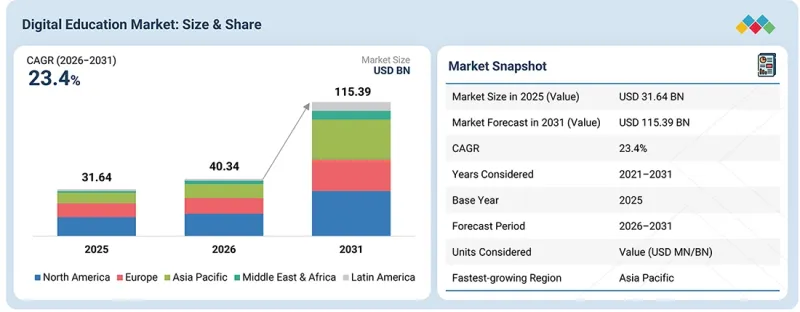
The digital education market is projected to grow from USD 40.34 billion in 2026 to USD 115.39 billion by 2031, at a CAGR of 23.4% during the forecast period.
| Scope of the Report | |
|---|---|
| Years Considered for the Study | 2021-2031 |
| Base Year | 2025 |
| Forecast Period | 2026-2031 |
| Units Considered | Value (USD Million/USD Billion) |
| Segments | Learning Model, Delivery Mode, Course Type, End User |
| Regions covered | North America, Europe, Asia Pacific, Middle East & Africa, and Latin America |
Organizations are adopting digital education systems to deliver and manage learning content efficiently, flexibly, and at scale, supporting students, employees, and professionals across locations. These platforms integrate multiple tools such as interactive content, virtual classrooms, learning management systems, and real-time analytics to enhance engagement and track progress. Institutions rely on cloud-based digital platforms to allow quick updates, personalized learning paths, and seamless integration with existing systems. As the demand for continuous learning and upskilling grows, digital education enables accessible, adaptive, and cost-effective learning experiences for diverse audiences.
Based on end user, the academic institutions segment is expected to lead the market during the forecast period.
Based on end user, the academic institutions segment is expected to hold the largest share of the digital education market during the forecast period. The widespread adoption of digital platforms by schools, colleges, and universities is driving this growth as these institutions increasingly integrate online learning tools to enhance teaching and learning experiences. The shift toward blended and hybrid learning models, accelerated by the pandemic, has created sustained demand for digital content, virtual classrooms, and learning management systems. Moreover, academic institutions are investing in advanced technologies such as AI-driven personalized learning, virtual labs, and immersive simulations to offer flexible, engaging, and accessible education. Government initiatives promoting digital literacy and growing collaborations between educational institutions and technology providers further support this expansion. As academic institutions modernize their infrastructure and curricula, their reliance on digital education solutions is expected to remain strong, securing their dominant market position.
Based on course type, the professional certifications & skill development segment is expected to register the highest CAGR during the forecast period.
As industries rapidly evolve with advances in AI, data analytics, cybersecurity, and emerging technologies, demand for continuous upskilling and reskilling among professionals is growing. Digital platforms offer flexible, accessible, and industry-relevant certification programs for working individuals seeking career advancement or transitions. Moreover, organizations increasingly invest in employee development programs to bridge skill gaps and maintain competitiveness in a dynamic job market. The rise of micro-credentials, modular learning, and partnerships between digital education providers and industry leaders further enhances the credibility and applicability of these courses. Additionally, the global recognition of online certifications and employers' growing acceptance of alternative credentials are driving strong growth in this segment of the digital education landscape.
Based on learning models, the mobile learning segment is expected to hold the largest market share during the forecast period.
This growth is primarily driven by the widespread penetration of smartphones, tablets, and mobile internet connectivity, allowing learners to access educational content anytime and anywhere. Mobile learning supports microlearning, enabling users to engage with short, focused content that fits busy schedules and making it highly suitable for working professionals and students. The increasing adoption of interactive apps, gamified learning, and AI-powered personalized content further enhances learner engagement and retention. Moreover, mobile learning facilitates real-time assessments, instant feedback, and collaborative learning through social features, fostering an interactive educational experience. The flexibility, convenience, and scalability of mobile learning make it increasingly popular across corporate training, K-12, and higher education, contributing significantly to its robust growth in the evolving digital education landscape.
Breakdown of Primaries
We interviewed Chief Executive Officers (CEOs), directors of innovation and technology, system integrators, and executives from several major digital education companies.
- By Company: Tier 1 (25%), Tier 2 (65%), and Tier 3 (10%)
- By Designation: C-level Executives (25%), Directors (50%), and Others (25%)
- By Region: North America (40%), Europe (30%), Asia Pacific (20%), and the Rest of the World (10%)
Some of the significant digital education market vendors are Skillsoft (US), Coursera (US), LinkedIn Learning (US), Pluralsight (US), edX (US), Udacity (US), Intellipaat (India), Swayam (India), Veranda Learning (India), and Alison (Ireland).
Research Coverage:
The market report covered the digital education market across segments. The report estimated market size and growth potential by learning model, delivery mode, course type, end user, and region. It includes a thorough competitive analysis of major market participants, information about their businesses, key observations on their product and service offerings, current trends, and critical market strategies.
Reasons to Buy This Report:
With the most accurate revenue estimates for the digital education industry and its subsegments, the research will benefit market leaders and new entrants. Stakeholders will benefit from this report's increased understanding of the competitive environment, which will help them better position their companies and develop go-to-market strategies. The research covers the main market drivers, constraints, opportunities, and challenges, and helps players understand the pulse of the industry.
The report provides insights on the following pointers:
Analysis of key drivers (growing demand for personalized learning driven by adaptive technologies, gamification enhancing student engagement in learning, increasing need for upskilling and reskilling, and enhancing digital education with IoT devices in learning), restraints (infrastructure shortage in rural areas and prolonged screen time strains), opportunities (transforming microlearning and modular learning with digital education, offering localized language content boosting student engagement and course completion rates, blockchain integration in the education system facilitating instant credential verification for employees and institutions, and strategic alliances between edtech and corporate entities empowering students with industry-aligned learning experiences), and challenges (insufficient interaction in virtual classrooms hindering student engagement and insufficient teacher training hampering effective integration of digital tools) influencing the growth of the digital education market.
- Product Development/Innovation: Comprehensive analysis of emerging technologies, R&D initiatives, and new service and product introductions in the digital education market.
- Market Development: In-depth details regarding profitable markets: the paper examines the digital education market.
- Market Diversification: Comprehensive details regarding recent advancements, investments, unexplored regions, new goods and services, and the digital education market.
- Competitive Assessment: Thorough analysis of the market shares, expansion plans, and service portfolios of the top competitors in the digital education industry, such as Skillsoft (US), Coursera (US), LinkedIn Learning (US), Pluralsight (US), edX (US), Udacity (US), Intellipaat (India), Swayam (India), Veranda Learning (India), Alison (Ireland), Iversity (Germany), NovoEd (US), XuetangX (China), Khan Academy (US), Kadenze (US), Federica Web Learning (Italy), My Mooc (France), Treehouse (US), Skillshare (US), CXL (US), Go1 (Australia), DataCamp (US), Platzi (US), Chegg (US), and Duolingo (US).
TABLE OF CONTENTS
1 INTRODUCTION
- 1.1 STUDY OBJECTIVES
- 1.2 MARKET DEFINITION
- 1.3 MARKET SCOPE
- 1.3.1 MARKET SEGMENTATION AND REGIONAL SCOPE
- 1.3.2 INCLUSIONS AND EXCLUSIONS
- 1.3.3 YEARS CONSIDERED
- 1.4 CURRENCY CONSIDERED
- 1.5 LIMITATIONS
- 1.6 STAKEHOLDERS
- 1.7 SUMMARY OF CHANGES
2 EXECUTIVE SUMMARY
- 2.1 MARKET HIGHLIGHTS AND KEY INSIGHTS
- 2.2 KEY MARKET PARTICIPANTS: MAPPING OF STRATEGIC DEVELOPMENTS
- 2.3 DISRUPTIVE TRENDS IN DIGITAL EDUCATION MARKET
- 2.4 HIGH-GROWTH SEGMENTS
- 2.5 REGIONAL SNAPSHOT: MARKET SIZE, GROWTH RATE, AND FORECAST
3 PREMIUM INSIGHTS
- 3.1 ATTRACTIVE OPPORTUNITIES FOR PLAYERS IN DIGITAL EDUCATION MARKET
- 3.2 DIGITAL EDUCATION MARKET, BY LEARNING MODEL
- 3.3 DIGITAL EDUCATION MARKET, BY DELIVERY MODE
- 3.4 DIGITAL EDUCATION MARKET, BY COURSE TYPE
- 3.5 DIGITAL EDUCATION MARKET, BY END USER
- 3.6 DIGITAL EDUCATION MARKET, BY REGION
4 MARKET OVERVIEW
- 4.1 INTRODUCTION
- 4.2 MARKET DYNAMICS
- 4.2.1 DRIVERS
- 4.2.1.1 Growing Demand for Adaptive and Personalized Digital Learning
- 4.2.1.2 Expanding Global Internet and Mobile Connectivity
- 4.2.1.3 Rising Demand for Digital and Job-Ready Skills
- 4.2.1.4 Government-led Digital Education Initiatives and National Learning Platforms
- 4.2.2 RESTRAINTS
- 4.2.2.1 Infrastructure and Connectivity Gaps Limiting Digital Education Access
- 4.2.2.2 Concerns Over Learner Well-being, Privacy, and Safe Use of Digital Technologies
- 4.2.3 OPPORTUNITIES
- 4.2.3.1 AI-Enabled Tutoring, Content Creation, and Learning Support
- 4.2.3.2 Localized, Multilingual, and Offline Digital Education for Underserved Learners
- 4.2.3.3 Expansion of Microlearning, Modular Learning, and Skills-Based Digital Credentials
- 4.2.4 CHALLENGES
- 4.2.4.1 Inadequate Teacher Digital Readiness Hindering Effective Technology Integration
- 4.2.4.2 Data Governance, Interoperability, and Evidence Requirements Increasing Adoption Complexity
- 4.2.1 DRIVERS
- 4.3 UNMET NEEDS AND WHITE SPACES
- 4.3.1 UNMET NEEDS IN THE DIGITAL EDUCATION MARKET
- 4.3.2 WHITE SPACE OPPORTUNITIES
- 4.4 INTERCONNECTED MARKETS AND CROSS-SECTOR OPPORTUNITIES
- 4.4.1 INTERCONNECTED MARKETS
- 4.4.2 CROSS-SECTOR OPPORTUNITIES
- 4.5 EMERGING BUSINESS MODELS AND ECOSYSTEM SHIFTS
- 4.5.1 EMERGING BUSINESS MODELS
- 4.5.1.1 Digital Education Business Models
- 4.5.2 ECOSYSTEM SHIFTS
- 4.5.1 EMERGING BUSINESS MODELS
- 4.6 STRATEGIC MOVES BY TIER-1/2/3 PLAYERS
- 4.6.1 KEY MOVES AND STRATEGIC FOCUS
5 INDUSTRY TRENDS
- 5.1 PORTER'S FIVE FORCES ANALYSIS
- 5.1.1 THREAT OF NEW ENTRANTS
- 5.1.2 THREAT OF SUBSTITUTES
- 5.1.3 BARGAINING POWER OF BUYERS
- 5.1.4 BARGAINING POWER OF SUPPLIERS
- 5.1.5 INTENSITY OF COMPETITIVE RIVALRY
- 5.2 MACROECONOMIC INDICATORS
- 5.2.1 INTRODUCTION
- 5.2.2 GDP TRENDS & FORECASTS
- 5.2.3 TRENDS IN GLOBAL E-LEARNING MARKET
- 5.2.4 TRENDS IN GLOBAL AI IN EDUCATION MARKET
- 5.3 VALUE CHAIN ANALYSIS
- 5.4 ECOSYSTEM ANALYSIS
- 5.5 PRICING ANALYSIS
- 5.5.1 AVERAGE SELLING PRICE TRENDS OF VENDORS, BY REGION, 2025
- 5.5.1.1 North America
- 5.5.1.2 Europe
- 5.5.1.3 Asia Pacific
- 5.5.1.4 Middle East & Africa
- 5.5.1.5 Latin America
- 5.5.2 PRICING LANDSCAPE FOR DIGITAL EDUCATION MARKET, 2025
- 5.5.3 INDICATIVE PRICING TRENDS, BY KEY VENDOR, 2025
- 5.5.1 AVERAGE SELLING PRICE TRENDS OF VENDORS, BY REGION, 2025
- 5.6 KEY CONFERENCES AND EVENTS, 2026-2027
- 5.7 TRENDS/DISRUPTIONS IMPACTING CUSTOMER BUSINESS
- 5.8 INVESTMENT AND FUNDING SCENARIO
- 5.9 CASE STUDY ANALYSIS
- 5.9.1 INSTRUCTURE AND ARIZONA STATE UNIVERSITY SCALE DIGITAL LEARNING FOR LARGE, DISTRIBUTED STUDENT POPULATION
- 5.9.2 D2L AND UNIVERSITY OF CALGARY MODERNIZE ONLINE LEARNING EXPERIENCE WITH BRIGHTSPACE
- 5.9.3 GOOGLE FOR EDUCATION AND CHICAGO PUBLIC SCHOOLS EXPAND ACCESS TO DIGITAL CLASSROOMS DISTRICT-WIDE
- 5.9.4 COURSERA AND PWC ACCELERATE WORKFORCE UPSKILLING THROUGH ENTERPRISE ONLINE LEARNING
- 5.9.5 MICROSOFT EDUCATION AND MIAMI UNIVERSITY IMPROVE HYBRID CAMPUS EXPERIENCE WITH TEAMS
- 5.10 IMPACT OF 2025 US TARIFF - DIGITAL EDUCATION MARKET
- 5.10.1 INTRODUCTION
- 5.10.2 KEY TARIFF RATES
- 5.10.3 PRICE IMPACT ANALYSIS
- 5.10.4 IMPACT ON COUNTRY/REGION
- 5.10.4.1 North America
- 5.10.4.2 Europe
- 5.10.4.3 Asia Pacific
- 5.10.5 IMPACT ON END USERS
- 5.10.5.1 Academic Institutions
- 5.10.5.2 Corporate Enterprise
- 5.10.5.3 Government & Public Sector
6 CUSTOMER LANDSCAPE AND BUYER BEHAVIOR
- 6.1 DECISION-MAKING PROCESS
- 6.2 BUYER STAKEHOLDERS AND BUYING EVALUATION CRITERIA
- 6.2.1 KEY STAKEHOLDERS IN BUYING PROCESS
- 6.2.2 BUYING CRITERIA
- 6.3 ADOPTION BARRIERS AND INTERNAL CHALLENGES
- 6.4 UNMET NEEDS IN VARIOUS END-USER INDUSTRIES
- 6.5 MARKET PROFITABILITY
- 6.5.1 REVENUE POTENTIAL
- 6.5.2 COST DYNAMICS
- 6.5.3 MARGIN OPPORTUNITIES IN KEY APPLICATIONS
7 STRATEGIC DISRUPTION THROUGH TECHNOLOGY, PATENTS, DIGITAL, AND AI ADOPTION
- 7.1 TECHNOLOGY ANALYSIS
- 7.1.1 KEY EMERGING TECHNOLOGIES
- 7.1.1.1 Artificial Intelligence and Adaptive Learning Technologies
- 7.1.1.2 Immersive and Virtual Learning Technologies
- 7.1.1.3 Learning Analytics and Predictive Intelligence
- 7.1.2 COMPLEMENTARY TECHNOLOGIES
- 7.1.2.1 Learning Management Systems & Digital Content Platforms
- 7.1.2.2 Digital Assessment, Proctoring & Credentialing Technologies
- 7.1.2.3 Mobile Learning & Collaboration Technologies
- 7.1.3 ADJACENT TECHNOLOGIES
- 7.1.3.1 Student Information, Academic Administration & Education ERP Technologies
- 7.1.3.2 Workforce Learning, Skills Intelligence & Talent Technologies
- 7.1.3.3 Digital Identity, Payments & Credential Verification Technologies
- 7.1.1 KEY EMERGING TECHNOLOGIES
- 7.2 TECHNOLOGY/PRODUCT ROADMAP
- 7.2.1 SHORT-TERM (2026-2028) | AI-ASSISTED LEARNING & EXPERIENCE DIGITIZATION
- 7.2.2 MID-TERM (2028-2031) | ADAPTIVE LEARNING INTELLIGENCE & CONNECTED SKILLS WORKFLOWS
- 7.2.3 LONG-TERM (2031-2035+) | AUTONOMOUS LEARNING ORCHESTRATION & IMMERSIVE LEARNING ECOSYSTEMS
- 7.3 PATENT ANALYSIS
- 7.4 IMPACT OF AI/GENERATIVE AI ON DIGITAL EDUCATION MARKET
- 7.4.1 TOP USE CASES AND MARKET POTENTIAL
- 7.4.2 BEST PRACTICES IN DIGITAL EDUCATION MANAGEMENT
- 7.4.3 CASE STUDY OF AI IMPLEMENTATION IN DIGITAL EDUCATION MARKET
- 7.4.3.1 Khan Academy: Implementing AI-Powered Tutoring and Personalized Learning Through Khanmigo
- 7.4.4 INTERCONNECTED ADJACENCY ECOSYSTEM AND IMPACT ON MARKET PLAYERS
- 7.4.5 CLIENT READINESS TO ADOPT GENERATIVE AI IN DIGITAL EDUCATION MARKET
8 REGULATORY LANDSCAPE
- 8.1 REGULATORY LANDSCAPE
- 8.1.1 REGULATORY BODIES, GOVERNMENT AGENCIES, AND OTHER ORGANIZATIONS
- 8.1.2 REGULATIONS, BY REGION
- 8.1.2.1 North America
- 8.1.2.2 Europe
- 8.1.2.3 Asia Pacific
- 8.1.2.4 Middle East & South Africa
- 8.1.2.5 Latin America
- 8.1.3 INDUSTRY STANDARDS, BY REGION
- 8.1.3.1 North America
- 8.1.3.2 Europe
- 8.1.3.3 Asia Pacific
- 8.1.3.4 Rest of the World
9 DIGITAL EDUCATION MARKET, BY LEARNING MODEL
- 9.1 INTRODUCTION
- 9.1.1 LEARNING MODEL: DIGITAL EDUCATION MARKET DRIVERS
- 9.2 SELF-PACED LEARNING
- 9.2.1 ADVANCING FLEXIBILITY THROUGH SELF-PACED LEARNING
- 9.2.2 VIDEO-BASED COURSES
- 9.2.3 TEXT-BASED MODULES
- 9.2.4 INTERACTIVE LEARNING
- 9.3 INSTRUCTOR-LED
- 9.3.1 STRENGTHENING LEARNERS' SUPPORT THROUGH INSTRUCTOR-LED LEARNING
- 9.3.2 SCHEDULED WEBINARS
- 9.3.3 MENTORSHIP & TUTORING SESSIONS
- 9.4 BLENDED LEARNING
- 9.4.1 ADAPTING LEARNING TO DIVERSE NEEDS WITH BLENDED APPROACHES
- 9.4.2 FLIPPED CLASSROOMS
- 9.4.3 PROJECT-BASED LEARNING MODELS
- 9.5 MICROLEARNING
- 9.5.1 BOOSTING RETENTION WITH MICROLEARNING MODULES
- 9.5.2 INFOGRAPHICS & SHORT CAPSULES
- 9.5.3 SHORT VIDEOS
- 9.6 ADAPTIVE LEARNING
- 9.6.1 PERSONALIZING LEARNING THROUGH REAL-TIME ADAPTATION
- 9.6.2 AI-PERSONALIZED PATHWAYS
- 9.6.3 SKILL-GAP ASSESSMENT TOOLS
- 9.7 MOBILE LEARNING
- 9.7.1 BOOSTING LEARNING CONTINUITY THROUGH MOBILE DEVICES
- 9.7.2 APP-BASED LEARNING PLATFORMS
- 9.7.3 GAME-BASED LEARNING APPS
10 DIGITAL EDUCATION MARKET, BY DELIVERY MODE
- 10.1 INTRODUCTION
- 10.1.1 DELIVERY MODE: DIGITAL EDUCATION MARKET DRIVERS
- 10.2 SYNCHRONOUS LEARNING
- 10.2.1 FOSTERING REAL-TIME INTERACTION WITH SYNCHRONOUS LEARNING
- 10.3 ASYNCHRONOUS LEARNING
- 10.3.1 LEARNING BEYOND TIME CONSTRAINTS WITH ASYNCHRONOUS LEARNING
- 10.4 HYBRID LEARNING
- 10.4.1 EMPOWERING LEARNERS WITH FLEXIBILITY AND REAL-TIME INTERACTION
11 DIGITAL EDUCATION MARKET, BY COURSE TYPE
- 11.1 INTRODUCTION
- 11.1.1 COURSE TYPE: DIGITAL EDUCATION MARKET DRIVERS
- 11.2 ACADEMIC EDUCATION
- 11.2.1 TRANSFORMING TRADITIONAL EDUCATION THROUGH TECHNOLOGY
- 11.2.2 K-12
- 11.2.3 HIGHER EDUCATION
- 11.3 TEST PREPARATION
- 11.3.1 EMPOWERING ASPIRANTS WITH ONLINE TEST PREPARATION
- 11.4 PROFESSIONAL CERTIFICATION & SKILL DEVELOPMENT
- 11.4.1 UPSKILLING THROUGH DIGITAL EDUCATION
- 11.5 VOCATIONAL TRAINING
- 11.5.1 UPGRADING VOCATIONAL TRAINING THROUGH DIGITAL PLATFORMS
- 11.6 CORPORATE LEARNING & COMPLIANCE TRAINING
- 11.6.1 ENSURING COMPLIANCE THROUGH DIGITAL TRAINING
12 DIGITAL EDUCATION MARKET, BY END USER
- 12.1 INTRODUCTION
- 12.1.1 END USER: DIGITAL EDUCATION MARKET DRIVERS
- 12.2 ACADEMIC INSTITUTIONS
- 12.2.1 MODERNIZING CLASSROOMS WITH DIGITAL EDUCATION
- 12.2.2 SCHOOLS
- 12.2.3 COLLEGES & UNIVERSITIES
- 12.3 CORPORATE & ENTERPRISE ORGANIZATIONS
- 12.3.1 TRANSFORMING WORKFORCE AGILITY WITH DIGITAL LEARNING
- 12.3.2 SMES
- 12.3.3 LARGE ENTERPRISES
- 12.4 GOVERNMENT & PUBLIC SECTOR
- 12.4.1 EQUIPPING CITIZENS WITH TECH-ENABLED TRAINING
13 DIGITAL EDUCATION MARKET, BY REGION
- 13.1 INTRODUCTION
- 13.2 NORTH AMERICA
- 13.2.1 NORTH AMERICA: MARKET DRIVERS
- 13.2.2 US
- 13.2.2.1 Government initiatives and technological adoptions to drive market
- 13.2.3 CANADA
- 13.2.3.1 Strong focus on technology adoption in education to drive market
- 13.3 EUROPE
- 13.3.1 EUROPE: MARKET DRIVERS
- 13.3.2 UK
- 13.3.2.1 Government investments and partnerships with tech companies to drive market
- 13.3.3 GERMANY
- 13.3.3.1 Investment in Digital Pact 2.0 to drive market
- 13.3.4 FRANCE
- 13.3.4.1 Emphasis on ensuring equal access to digital education resources to drive market
- 13.3.5 ITALY
- 13.3.5.1 Increasing focus on AI-integrated classrooms to drive market
- 13.3.6 REST OF EUROPE
- 13.4 ASIA PACIFIC
- 13.4.1 ASIA PACIFIC: MARKET DRIVERS
- 13.4.2 CHINA
- 13.4.2.1 Strong government initiatives for online learning to drive market
- 13.4.3 JAPAN
- 13.4.3.1 GIGA School Program to expand digital education
- 13.4.4 INDIA
- 13.4.4.1 Widespread internet penetration, smartphone adoption, and government initiatives to drive market
- 13.4.5 ANZ
- 13.4.5.1 Increasing internet penetration and strong focus on future-ready skills to drive market
- 13.4.6 REST OF ASIA PACIFIC
- 13.5 MIDDLE EAST & AFRICA
- 13.5.1 MIDDLE EAST & AFRICA: MARKET DRIVERS
- 13.5.2 GULF COOPERATION COUNCIL (GCC)
- 13.5.2.1 UAE
- 13.5.2.1.1 Evolution of digital learning solutions in schools to drive market
- 13.5.2.2 Saudi Arabia
- 13.5.2.2.1 Increasing adoption of AI-powered learning tools and virtual collaboration technologies to drive market
- 13.5.2.3 Rest of GCC
- 13.5.2.1 UAE
- 13.5.3 SOUTH AFRICA
- 13.5.3.1 Increasing internet penetration and rising demand for quality education to drive market
- 13.5.4 REST OF MIDDLE EAST & AFRICA
- 13.6 LATIN AMERICA
- 13.6.1 LATIN AMERICA: MARKET DRIVERS
- 13.6.2 BRAZIL
- 13.6.2.1 Investments from international financing institutions to drive market
- 13.6.3 MEXICO
- 13.6.3.1 Growing emphasis on enhancing educational access and quality to drive market
- 13.6.4 REST OF LATIN AMERICA
14 COMPETITIVE LANDSCAPE
- 14.1 INTRODUCTION
- 14.2 KEY PLAYER STRATEGIES/RIGHT TO WIN, 2024-2026
- 14.3 REVENUE ANALYSIS, 2021-2025
- 14.4 MARKET SHARE ANALYSIS, 2025
- 14.5 PRODUCT COMPARISON
- 14.5.1 COURSERA
- 14.5.2 DUOLINGO
- 14.5.3 LINKEDIN
- 14.6 COMPANY EVALUATION MATRIX: KEY PLAYERS, 2026
- 14.6.1 STARS
- 14.6.2 EMERGING LEADERS
- 14.6.3 PERVASIVE PLAYERS
- 14.6.4 PARTICIPANTS
- 14.6.5 COMPANY FOOTPRINT: KEY PLAYERS, 2026
- 14.6.5.1 Company footprint
- 14.6.5.2 Regional footprint
- 14.6.5.3 End user footprint
- 14.6.5.4 Learning model footprint
- 14.7 COMPANY EVALUATION MATRIX: STARTUPS/SMES, 2026
- 14.7.1 PROGRESSIVE COMPANIES
- 14.7.2 RESPONSIVE COMPANIES
- 14.7.3 DYNAMIC COMPANIES
- 14.7.4 STARTING BLOCKS
- 14.7.5 COMPETITIVE BENCHMARKING: STARTUP/SMES, 2026
- 14.7.5.1 Detailed list of key startups/SMEs
- 14.7.5.2 Competitive benchmarking of key startups/SMEs
- 14.8 COMPANY VALUATION AND FINANCIAL METRICS
- 14.8.1 COMPANY VALUATION OF KEY VENDORS
- 14.8.2 FINANCIAL METRICS OF KEY VENDORS
- 14.9 COMPETITIVE SCENARIO
- 14.9.1 PRODUCT LAUNCHES/ENHANCEMENTS
- 14.9.2 DEALS
15 COMPANY PROFILES
- 15.1 INTRODUCTION
- 15.2 MAJOR PLAYERS
- 15.2.1 COURSERA
- 15.2.1.1 Business overview
- 15.2.1.2 Products/Solutions/Services offered
- 15.2.1.3 Recent developments
- 15.2.1.3.1 Product launches and enhancements
- 15.2.1.3.2 Deals
- 15.2.1.4 MnM view
- 15.2.1.4.1 Right to win
- 15.2.1.4.2 Strategic choices
- 15.2.1.4.3 Weaknesses and competitive threats
- 15.2.2 DUOLINGO
- 15.2.2.1 Business overview
- 15.2.2.2 Products/Solutions/Services offered
- 15.2.2.3 Recent developments
- 15.2.2.3.1 Deals
- 15.2.2.4 MnM view
- 15.2.2.4.1 Right to win
- 15.2.2.4.2 Strategic choices
- 15.2.2.4.3 Weaknesses and competitive threats
- 15.2.3 EDX
- 15.2.3.1 Business overview
- 15.2.3.2 Products/Solutions/Services offered
- 15.2.3.3 Recent developments
- 15.2.3.3.1 Product launches and enhancements
- 15.2.3.3.2 Deals
- 15.2.3.4 MnM view
- 15.2.3.4.1 Right to win
- 15.2.3.4.2 Strategic choices
- 15.2.3.4.3 Weaknesses and competitive threats
- 15.2.4 PLURALSIGHT
- 15.2.4.1 Business overview
- 15.2.4.2 Products/Solutions/Services offered
- 15.2.4.3 Recent developments
- 15.2.4.3.1 Product launches and enhancements
- 15.2.4.3.2 Deals
- 15.2.4.4 MnM view
- 15.2.4.4.1 Right to win
- 15.2.4.4.2 Strategic choices
- 15.2.4.4.3 Weaknesses and competitive threats
- 15.2.5 UDACITY
- 15.2.5.1 Business overview
- 15.2.5.2 Products/Solutions/Services offered
- 15.2.5.3 Recent developments
- 15.2.5.3.1 Product launches and enhancements
- 15.2.5.3.2 Deals
- 15.2.5.4 MnM view
- 15.2.5.4.1 Right to win
- 15.2.5.4.2 Strategic choices
- 15.2.5.4.3 Weaknesses and competitive threats
- 15.2.6 INTELLIPAAT SOFTWARE SOLUTIONS
- 15.2.6.1 Business overview
- 15.2.6.2 Products/Solutions/Services offered
- 15.2.6.3 Recent developments
- 15.2.6.3.1 Product launches and enhancements
- 15.2.6.3.2 Deals
- 15.2.7 SWAYAM
- 15.2.7.1 Business overview
- 15.2.7.2 Products/Solutions/Services offered
- 15.2.7.3 Recent developments
- 15.2.7.3.1 Product launches and enhancements
- 15.2.7.3.2 Deals
- 15.2.8 VERANDA LEARNING SOLUTIONS
- 15.2.8.1 Business overview
- 15.2.8.2 Products/Solutions/Services offered
- 15.2.8.3 Recent developments
- 15.2.8.3.1 Deals
- 15.2.9 ALISON
- 15.2.9.1 Business overview
- 15.2.9.2 Products/Solutions/Services offered
- 15.2.9.3 Recent developments
- 15.2.9.3.1 Product launches and enhancements
- 15.2.9.3.2 Deals
- 15.2.10 LINKEDIN
- 15.2.10.1 Business overview
- 15.2.10.2 Products/Solutions/Services offered
- 15.2.10.3 Recent developments
- 15.2.10.3.1 Deals
- 15.2.11 SPRINGER NATURE
- 15.2.11.1 Business overview
- 15.2.11.2 Products/Solutions/Services offered
- 15.2.1 COURSERA
- 15.3 OTHER PLAYERS
- 15.3.1 FUTURELEARN
- 15.3.2 NOVOED
- 15.3.3 XUETANG
- 15.3.4 KHAN ACADEMY
- 15.3.5 KADENZE
- 15.3.6 FEDERICA WEB LEARNING
- 15.3.7 TREEHOUSE ISLAND
- 15.3.8 SKILLSHARE
- 15.3.9 CXL
- 15.3.10 GO1
- 15.3.11 DATACAMP
- 15.3.12 PLATZI
- 15.3.13 CHEGG
- 15.3.14 MY MOOC
16 RESEARCH METHODOLOGY
- 16.1 RESEARCH DATA
- 16.1.1 SECONDARY DATA
- 16.1.1.1 Data & List of Key Secondary Sources
- 16.1.2 PRIMARY DATA
- 16.1.2.1 Breakdown of primary interviews
- 16.1.2.2 Key industry insights
- 16.1.3 MARKET SIZE ESTIMATION
- 16.1.4 DATA TRIANGULATION
- 16.1.5 FACTOR ANALYSIS
- 16.1.6 RESEARCH ASSUMPTIONS
- 16.1.1 SECONDARY DATA
17 APPENDIX
- 17.1 DISCUSSION GUIDE
- 17.2 KNOWLEDGESTORE: MARKETSANDMARKETS' SUBSCRIPTION PORTAL
- 17.3 CUSTOMIZATION OPTIONS
- 17.4 RELATED REPORTS
- 17.5 AUTHOR DETAILS
List of Tables
- TABLE 1 USD EXCHANGE RATES, 2020-2025
- TABLE 2 IMPACT OF PORTER'S FIVE FORCES ON DIGITAL EDUCATION MARKET
- TABLE 3 GDP PERCENTAGE CHANGE, BY KEY COUNTRY, 2021-2029
- TABLE 4 AVERAGE SELLING PRICE TREND OF VENDORS, BY REGION, 2025 (USD THOUSAND)
- TABLE 5 PRICING LANDSCAPE FOR DIGITAL EDUCATION MARKET, 2025
- TABLE 6 DIGITAL EDUCATION MARKET: INDICATIVE PRICING ANALYSIS, BY KEY VENDOR, 2025
- TABLE 7 DIGITAL EDUCATION MARKET: LIST OF KEY CONFERENCES AND EVENTS, 2026-2027
- TABLE 8 US ADJUSTED RECIPROCAL TARIFF RATES
- TABLE 9 INFLUENCE OF STAKEHOLDERS ON BUYING PROCESS FOR THE TOP THREE END USERS (%)
- TABLE 10 KEY BUYING CRITERIA FOR TOP THREE END USERS
- TABLE 11 DIGITAL EDUCATION MARKET: UNMET NEEDS IN KEY END-USER SEGMENTS
- TABLE 12 LIST OF GRANTED PATENTS IN DIGITAL EDUCATION MARKET, 2003-2011
- TABLE 13 TOP USE CASES AND MARKET POTENTIAL
- TABLE 14 BEST PRACTICES: COMPANIES IMPLEMENTING USE CASES
- TABLE 15 INTERCONNECTED ADJACENT ECOSYSTEM AND IMPLICATIONS FOR MARKET PLAYERS
- TABLE 16 NORTH AMERICA: REGULATORY BODIES, GOVERNMENT AGENCIES, AND OTHER ORGANIZATIONS
- TABLE 17 EUROPE: REGULATORY BODIES, GOVERNMENT AGENCIES, AND OTHER ORGANIZATIONS
- TABLE 18 ASIA PACIFIC: REGULATORY BODIES, GOVERNMENT AGENCIES, AND OTHER ORGANIZATIONS
- TABLE 19 REST OF THE WORLD: REGULATORY BODIES, GOVERNMENT AGENCIES, AND OTHER ORGANIZATIONS
- TABLE 20 DIGITAL EDUCATION MARKET, BY LEARNING MODEL, 2021-2025 (USD MILLION)
- TABLE 21 DIGITAL EDUCATION MARKET, BY LEARNING MODEL, 2026-2031 (USD MILLION)
- TABLE 22 SELF-PACED LEARNING: DIGITAL EDUCATION MARKET, BY REGION, 2021-2025 (USD MILLION)
- TABLE 23 SELF-PACED LEARNING: DIGITAL EDUCATION MARKET, BY REGION, 2026-2031 (USD MILLION)
- TABLE 24 INSTRUCTOR-LED: DIGITAL EDUCATION MARKET, BY REGION, 2021-2025 (USD MILLION)
- TABLE 25 INSTRUCTOR-LED: DIGITAL EDUCATION MARKET, BY REGION, 2026-2031 (USD MILLION)
- TABLE 26 BLENDED LEARNING: DIGITAL EDUCATION MARKET, BY REGION, 2021-2025 (USD MILLION)
- TABLE 27 BLENDED LEARNING: DIGITAL EDUCATION MARKET, BY REGION, 2026-2031 (USD MILLION)
- TABLE 28 MICROLEARNING: DIGITAL EDUCATION MARKET, BY REGION, 2021-2025 (USD MILLION)
- TABLE 29 MICROLEARNING: DIGITAL EDUCATION MARKET, BY REGION, 2026-2031 (USD MILLION)
- TABLE 30 ADAPTIVE LEARNING: DIGITAL EDUCATION MARKET, BY REGION, 2021-2025 (USD MILLION)
- TABLE 31 ADAPTIVE LEARNING: DIGITAL EDUCATION MARKET, BY REGION, 2026-2031 (USD MILLION)
- TABLE 32 MOBILE LEARNING: DIGITAL EDUCATION MARKET, BY REGION, 2021-2025 (USD MILLION)
- TABLE 33 MOBILE LEARNING: DIGITAL EDUCATION MARKET, BY REGION, 2026-2031 (USD MILLION)
- TABLE 34 DIGITAL EDUCATION MARKET, BY DELIVERY MODE, 2021-2025 (USD MILLION)
- TABLE 35 DIGITAL EDUCATION MARKET, BY DELIVERY MODE, 2026-2031 (USD MILLION)
- TABLE 36 SYNCHRONOUS LEARNING: DIGITAL EDUCATION MARKET, BY REGION, 2021-2025 (USD MILLION)
- TABLE 37 SYNCHRONOUS LEARNING: DIGITAL EDUCATION MARKET, BY REGION, 2026-2031 (USD MILLION)
- TABLE 38 ASYNCHRONOUS LEARNING: DIGITAL EDUCATION MARKET, BY REGION, 2021-2025 (USD MILLION)
- TABLE 39 ASYNCHRONOUS LEARNING: DIGITAL EDUCATION MARKET, BY REGION, 2026-2031 (USD MILLION)
- TABLE 40 HYBRID LEARNING: DIGITAL EDUCATION MARKET, BY REGION, 2021-2025 (USD MILLION)
- TABLE 41 HYBRID LEARNING: DIGITAL EDUCATION MARKET, BY REGION, 2026-2031 (USD MILLION)
- TABLE 42 DIGITAL EDUCATION MARKET, BY COURSE TYPE, 2021-2025 (USD MILLION)
- TABLE 43 DIGITAL EDUCATION MARKET, BY COURSE TYPE, 2026-2031 (USD MILLION)
- TABLE 44 ACADEMIC EDUCATION: DIGITAL EDUCATION MARKET, BY REGION, 2021-2025 (USD MILLION)
- TABLE 45 ACADEMIC EDUCATION: DIGITAL EDUCATION MARKET, BY REGION, 2026-2031 (USD MILLION)
- TABLE 46 TEST PREPARATION: DIGITAL EDUCATION MARKET, BY REGION, 2021-2025 (USD MILLION)
- TABLE 47 TEST PREPARATION: DIGITAL EDUCATION MARKET, BY REGION, 2026-2031 (USD MILLION)
- TABLE 48 PROFESSIONAL CERTIFICATION & SKILL DEVELOPMENT: DIGITAL EDUCATION MARKET, BY REGION, 2021-2025 (USD MILLION)
- TABLE 49 PROFESSIONAL CERTIFICATION & SKILL DEVELOPMENT: DIGITAL EDUCATION MARKET, BY REGION, 2026-2031 (USD MILLION)
- TABLE 50 VOCATIONAL TRAINING: DIGITAL EDUCATION MARKET, BY REGION, 2021-2025 (USD MILLION)
- TABLE 51 VOCATIONAL TRAINING: DIGITAL EDUCATION MARKET, BY REGION, 2026-2031 (USD MILLION)
- TABLE 52 CORPORATE LEARNING & COMPLIANCE TRAINING: DIGITAL EDUCATION MARKET, BY REGION, 2021-2025 (USD MILLION)
- TABLE 53 CORPORATE TRAINING & COMPLIANCE TRAINING: DIGITAL EDUCATION MARKET, BY REGION, 2026-2031 (USD MILLION)
- TABLE 54 DIGITAL EDUCATION MARKET, BY END USER, 2021-2025 (USD MILLION)
- TABLE 55 DIGITAL EDUCATION MARKET, BY END USER, 2026-2031 (USD MILLION)
- TABLE 56 ACADEMIC INSTITUTIONS: DIGITAL EDUCATION MARKET, BY REGION, 2021-2025 (USD MILLION)
- TABLE 57 ACADEMIC INSTITUTIONS: DIGITAL EDUCATION MARKET, BY REGION, 2026-2031 (USD MILLION)
- TABLE 58 CORPORATE & ENTERPRISE ORGANIZATIONS: DIGITAL EDUCATION MARKET, BY REGION, 2021-2025 (USD MILLION)
- TABLE 59 CORPORATE & ENTERPRISE ORGANIZATIONS: DIGITAL EDUCATION MARKET, BY REGION, 2026-2031 (USD MILLION)
- TABLE 60 GOVERNMENT & PUBLIC SECTOR: DIGITAL EDUCATION MARKET, BY REGION, 2021-2025 (USD MILLION)
- TABLE 61 GOVERNMENT & PUBLIC SECTOR: DIGITAL EDUCATION MARKET, BY REGION, 2026-2031 (USD MILLION)
- TABLE 62 DIGITAL EDUCATION MARKET, BY REGION, 2021-2025 (USD MILLION)
- TABLE 63 DIGITAL EDUCATION MARKET, BY REGION, 2026-2031 (USD MILLION)
- TABLE 64 NORTH AMERICA: DIGITAL EDUCATION MARKET, BY LEARNING MODEL, 2021-2025 (USD MILLION)
- TABLE 65 NORTH AMERICA: DIGITAL EDUCATION MARKET, BY LEARNING MODEL, 2026-2031 (USD MILLION)
- TABLE 66 NORTH AMERICA: DIGITAL EDUCATION MARKET, BY DELIVERY MODE, 2021-2025 (USD MILLION)
- TABLE 67 NORTH AMERICA: DIGITAL EDUCATION MARKET, BY DELIVERY MODE, 2026-2031 (USD MILLION)
- TABLE 68 NORTH AMERICA: DIGITAL EDUCATION MARKET, BY COURSE TYPE, 2021-2025 (USD MILLION)
- TABLE 69 NORTH AMERICA: DIGITAL EDUCATION MARKET, BY COURSE TYPE, 2026-2031 (USD MILLION)
- TABLE 70 NORTH AMERICA: DIGITAL EDUCATION MARKET, BY END USER, 2021-2025 (USD MILLION)
- TABLE 71 NORTH AMERICA: DIGITAL EDUCATION MARKET, BY END USER, 2026-2031 (USD MILLION)
- TABLE 72 NORTH AMERICA: DIGITAL EDUCATION MARKET, BY COUNTRY, 2021-2025 (USD MILLION)
- TABLE 73 NORTH AMERICA: DIGITAL EDUCATION MARKET, BY COUNTRY, 2026-2031 (USD MILLION)
- TABLE 74 US: DIGITAL EDUCATION MARKET, BY LEARNING MODEL, 2021-2025 (USD MILLION)
- TABLE 75 US: DIGITAL EDUCATION MARKET, BY LEARNING MODEL, 2026-2031 (USD MILLION)
- TABLE 76 CANADA: DIGITAL EDUCATION MARKET, BY LEARNING MODEL, 2021-2025 (USD MILLION)
- TABLE 77 CANADA: DIGITAL EDUCATION MARKET, BY LEARNING MODEL, 2026-2031 (USD MILLION)
- TABLE 78 EUROPE: DIGITAL EDUCATION MARKET, BY LEARNING MODEL, 2021-2025 (USD MILLION)
- TABLE 79 EUROPE: DIGITAL EDUCATION MARKET, BY LEARNING MODEL, 2026-2031 (USD MILLION)
- TABLE 80 EUROPE: DIGITAL EDUCATION MARKET, BY DELIVERY MODE, 2021-2025 (USD MILLION)
- TABLE 81 EUROPE: DIGITAL EDUCATION MARKET, BY DELIVERY MODE, 2026-2031 (USD MILLION)
- TABLE 82 EUROPE: DIGITAL EDUCATION MARKET, BY COURSE TYPE, 2021-2025 (USD MILLION)
- TABLE 83 EUROPE: DIGITAL EDUCATION MARKET, BY COURSE TYPE, 2026-2031 (USD MILLION)
- TABLE 84 EUROPE: DIGITAL EDUCATION MARKET, BY END USER, 2021-2025 (USD MILLION)
- TABLE 85 EUROPE: DIGITAL EDUCATION MARKET, BY END USER, 2026-2031 (USD MILLION)
- TABLE 86 EUROPE: DIGITAL EDUCATION MARKET, BY COUNTRY, 2021-2025 (USD MILLION)
- TABLE 87 EUROPE: DIGITAL EDUCATION MARKET, BY COUNTRY, 2026-2031 (USD MILLION)
- TABLE 88 UK: DIGITAL EDUCATION MARKET, BY LEARNING MODEL, 2021-2025 (USD MILLION)
- TABLE 89 UK: DIGITAL EDUCATION MARKET, BY LEARNING MODEL, 2026-2031 (USD MILLION)
- TABLE 90 GERMANY: DIGITAL EDUCATION MARKET, BY LEARNING MODEL, 2021-2025 (USD MILLION)
- TABLE 91 GERMANY: DIGITAL EDUCATION MARKET, BY LEARNING MODEL, 2026-2031 (USD MILLION)
- TABLE 92 FRANCE: DIGITAL EDUCATION MARKET, BY LEARNING MODEL, 2021-2025 (USD MILLION)
- TABLE 93 FRANCE: DIGITAL EDUCATION MARKET, BY LEARNING MODEL, 2026-2031 (USD MILLION)
- TABLE 94 ITALY: DIGITAL EDUCATION MARKET, BY LEARNING MODEL, 2021-2025 (USD MILLION)
- TABLE 95 ITALY: DIGITAL EDUCATION MARKET, BY LEARNING MODEL, 2026-2031 (USD MILLION)
- TABLE 96 REST OF EUROPE: DIGITAL EDUCATION MARKET, BY LEARNING MODEL, 2021-2025 (USD MILLION)
- TABLE 97 REST OF EUROPE: DIGITAL EDUCATION MARKET, BY LEARNING MODEL, 2026-2031 (USD MILLION)
- TABLE 98 ASIA PACIFIC: DIGITAL EDUCATION MARKET, BY LEARNING MODEL, 2021-2025 (USD MILLION)
- TABLE 99 ASIA PACIFIC: DIGITAL EDUCATION MARKET, BY LEARNING MODEL, 2026-2031 (USD MILLION)
- TABLE 100 ASIA PACIFIC: DIGITAL EDUCATION MARKET, BY DELIVERY MODE, 2021-2025 (USD MILLION)
- TABLE 101 ASIA PACIFIC: DIGITAL EDUCATION MARKET, BY DELIVERY MODE, 2026-2031 (USD MILLION)
- TABLE 102 ASIA PACIFIC: DIGITAL EDUCATION MARKET, BY COURSE TYPE, 2021-2025 (USD MILLION)
- TABLE 103 ASIA PACIFIC: DIGITAL EDUCATION MARKET, BY COURSE TYPE, 2026-2031 (USD MILLION)
- TABLE 104 ASIA PACIFIC: DIGITAL EDUCATION MARKET, BY END USER, 2021-2025 (USD MILLION)
- TABLE 105 ASIA PACIFIC: DIGITAL EDUCATION MARKET, BY END USER, 2026-2031 (USD MILLION)
- TABLE 106 ASIA PACIFIC: DIGITAL EDUCATION MARKET, BY COUNTRY, 2021-2025 (USD MILLION)
- TABLE 107 ASIA PACIFIC: DIGITAL EDUCATION MARKET, BY COUNTRY, 2026-2031 (USD MILLION)
- TABLE 108 CHINA: DIGITAL EDUCATION MARKET, BY LEARNING MODEL, 2021-2025 (USD MILLION)
- TABLE 109 CHINA: DIGITAL EDUCATION MARKET, BY LEARNING MODEL, 2026-2031 (USD MILLION)
- TABLE 110 JAPAN: DIGITAL EDUCATION MARKET, BY LEARNING MODEL, 2021-2025 (USD MILLION)
- TABLE 111 JAPAN: DIGITAL EDUCATION MARKET, BY LEARNING MODEL, 2026-2031 (USD MILLION)
- TABLE 112 INDIA: DIGITAL EDUCATION MARKET, BY LEARNING MODEL, 2021-2025 (USD MILLION)
- TABLE 113 INDIA: DIGITAL EDUCATION MARKET, BY LEARNING MODEL, 2026-2031 (USD MILLION)
- TABLE 114 ANZ: DIGITAL EDUCATION MARKET, BY LEARNING MODEL, 2021-2025 (USD MILLION)
- TABLE 115 ANZ: DIGITAL EDUCATION MARKET, BY LEARNING MODEL, 2026-2031 (USD MILLION)
- TABLE 116 REST OF ASIA PACIFIC: DIGITAL EDUCATION MARKET, BY LEARNING MODEL, 2021-2025 (USD MILLION)
- TABLE 117 REST OF ASIA PACIFIC: DIGITAL EDUCATION MARKET, BY LEARNING MODEL, 2026-2031 (USD MILLION)
- TABLE 118 MIDDLE EAST & AFRICA: DIGITAL EDUCATION MARKET, BY LEARNING MODEL, 2021-2025 (USD MILLION)
- TABLE 119 MIDDLE EAST & AFRICA: DIGITAL EDUCATION MARKET, BY LEARNING MODEL, 2026-2031 (USD MILLION)
- TABLE 120 MIDDLE EAST & AFRICA: DIGITAL EDUCATION MARKET, BY DELIVERY MODE, 2021-2025 (USD MILLION)
- TABLE 121 MIDDLE EAST & AFRICA: DIGITAL EDUCATION MARKET, BY DELIVERY MODE, 2026-2031 (USD MILLION)
- TABLE 122 MIDDLE EAST & AFRICA: DIGITAL EDUCATION MARKET, BY COURSE TYPE, 2021-2025 (USD MILLION)
- TABLE 123 MIDDLE EAST & AFRICA: DIGITAL EDUCATION MARKET, BY COURSE TYPE, 2026-2031 (USD MILLION)
- TABLE 124 MIDDLE EAST & AFRICA: DIGITAL EDUCATION MARKET, BY END USER, 2021-2025 (USD MILLION)
- TABLE 125 MIDDLE EAST & AFRICA: DIGITAL EDUCATION MARKET, BY END USER, 2026-2031 (USD MILLION)
- TABLE 126 MIDDLE EAST & AFRICA: DIGITAL EDUCATION MARKET, BY COUNTRY, 2021-2025 (USD MILLION)
- TABLE 127 MIDDLE EAST & AFRICA: DIGITAL EDUCATION MARKET, BY COUNTRY, 2026-2031 (USD MILLION)
- TABLE 128 GCC: DIGITAL EDUCATION MARKET, BY LEARNING MODEL, 2021-2025 (USD MILLION)
- TABLE 129 GCC: DIGITAL EDUCATION MARKET, BY LEARNING MODEL, 2026-2031 (USD MILLION)
- TABLE 130 GCC: DIGITAL EDUCATION MARKET, BY COUNTRY, 2021-2025 (USD MILLION)
- TABLE 131 GCC: DIGITAL EDUCATION MARKET, BY COUNTRY, 2026-2031 (USD MILLION)
- TABLE 132 UAE: DIGITAL EDUCATION MARKET, BY LEARNING MODEL, 2021-2025 (USD MILLION)
- TABLE 133 UAE: DIGITAL EDUCATION MARKET, BY LEARNING MODEL, 2026-2031 (USD MILLION)
- TABLE 134 SAUDI ARABIA: DIGITAL EDUCATION MARKET, BY LEARNING MODEL, 2021-2025 (USD MILLION)
- TABLE 135 SAUDI ARABIA: DIGITAL EDUCATION MARKET, BY LEARNING MODEL, 2026-2031 (USD MILLION)
- TABLE 136 REST OF GCC: DIGITAL EDUCATION MARKET, BY LEARNING MODEL, 2021-2025 (USD MILLION)
- TABLE 137 REST OF GCC: DIGITAL EDUCATION MARKET, BY LEARNING MODEL, 2026-2031 (USD MILLION)
- TABLE 138 SOUTH AFRICA: DIGITAL EDUCATION MARKET, BY LEARNING MODEL, 2021-2025 (USD MILLION)
- TABLE 139 SOUTH AFRICA: DIGITAL EDUCATION MARKET, BY LEARNING MODEL, 2026-2031 (USD MILLION)
- TABLE 140 REST OF MIDDLE EAST & AFRICA: DIGITAL EDUCATION MARKET, BY LEARNING MODEL, 2021-2025 (USD MILLION)
- TABLE 141 REST OF MIDDLE EAST & AFRICA: DIGITAL EDUCATION MARKET, BY LEARNING MODEL, 2026-2031 (USD MILLION)
- TABLE 142 LATIN AMERICA: DIGITAL EDUCATION MARKET, BY LEARNING MODEL, 2021-2025 (USD MILLION)
- TABLE 143 LATIN AMERICA: DIGITAL EDUCATION MARKET, BY LEARNING MODEL, 2026-2031 (USD MILLION)
- TABLE 144 LATIN AMERICA: DIGITAL EDUCATION MARKET, BY DELIVERY MODE, 2021-2025 (USD MILLION)
- TABLE 145 LATIN AMERICA: DIGITAL EDUCATION MARKET, BY DELIVERY MODE, 2026-2031 (USD MILLION)
- TABLE 146 LATIN AMERICA: DIGITAL EDUCATION MARKET, BY COURSE TYPE, 2021-2025 (USD MILLION)
- TABLE 147 LATIN AMERICA: DIGITAL EDUCATION MARKET, BY COURSE TYPE, 2026-2031 (USD MILLION)
- TABLE 148 LATIN AMERICA: DIGITAL EDUCATION MARKET, BY END USER, 2021-2025 (USD MILLION)
- TABLE 149 LATIN AMERICA: DIGITAL EDUCATION MARKET, BY END USER, 2026-2031 (USD MILLION)
- TABLE 150 LATIN AMERICA: DIGITAL EDUCATION MARKET, BY COUNTRY, 2021-2025 (USD MILLION)
- TABLE 151 LATIN AMERICA: DIGITAL EDUCATION MARKET, BY COUNTRY, 2026-2031 (USD MILLION)
- TABLE 152 BRAZIL: DIGITAL EDUCATION MARKET, BY LEARNING MODEL, 2021-2025 (USD MILLION)
- TABLE 153 BRAZIL: DIGITAL EDUCATION MARKET, BY LEARNING MODEL, 2026-2031 (USD MILLION)
- TABLE 154 MEXICO: DIGITAL EDUCATION MARKET, BY LEARNING MODEL, 2021-2025 (USD MILLION)
- TABLE 155 MEXICO: DIGITAL EDUCATION MARKET, BY LEARNING MODEL, 2026-2031 (USD MILLION)
- TABLE 156 REST OF LATIN AMERICA: DIGITAL EDUCATION MARKET, BY LEARNING MODEL, 2021-2025 (USD MILLION)
- TABLE 157 REST OF LATIN AMERICA: DIGITAL EDUCATION MARKET, BY LEARNING MODEL, 2026-2031 (USD MILLION)
- TABLE 158 DIGITAL EDUCATION MARKET: OVERVIEW OF STRATEGIES ADOPTED BY KEY PLAYERS, 2024-2026
- TABLE 159 DIGITAL EDUCATION MARKET: DEGREE OF COMPARISON
- TABLE 160 DIGITAL EDUCATION MARKET: REGIONAL FOOTPRINT, 2026
- TABLE 161 DIGITAL EDUCATION MARKET: END USER FOOTPRINT, 2026
- TABLE 162 DIGITAL EDUCATION MARKET: LEARNING MODEL FOOTPRINT, 2026
- TABLE 163 DIGITAL EDUCATION MARKET: LIST OF KEY STARTUPS/SMES, 2026
- TABLE 164 DIGITAL EDUCATION MARKET: COMPETITIVE BENCHMARKING OF KEY STARTUPS/SMES, 2026
- TABLE 165 DIGITAL EDUCATION MARKET: PRODUCT LAUNCHES/ENHANCEMENTS, JANUARY 2024-SEPTEMBER 2026
- TABLE 166 DIGITAL EDUCATION MARKET: DEALS, JUNE 2023-SEPTEMBER 2026
- TABLE 167 COURSERA: COMPANY OVERVIEW
- TABLE 168 COURSERA: PRODUCTS/SOLUTIONS/SERVICES OFFERED
- TABLE 169 COURSERA: PRODUCT LAUNCHES AND ENHANCEMENTS
- TABLE 170 COURSERA: DEALS
- TABLE 171 DUOLINGO: COMPANY OVERVIEW
- TABLE 172 DUOLINGO: PRODUCTS/SOLUTIONS/SERVICES OFFERED
- TABLE 173 DUOLINGO: DEALS
- TABLE 174 EDX: COMPANY OVERVIEW
- TABLE 175 EDX: PRODUCTS/SOLUTIONS/SERVICES OFFERED
- TABLE 176 EDX: PRODUCT LAUNCHES AND ENHANCEMENTS
- TABLE 177 EDX: DEALS
- TABLE 178 PLURALSIGHT: COMPANY OVERVIEW
- TABLE 179 PLURALSIGHT: PRODUCTS/SOLUTIONS/SERVICES OFFERED
- TABLE 180 PLURALSIGHT: PRODUCT LAUNCHES AND ENHANCEMENTS
- TABLE 181 PLURALSIGHT: DEALS
- TABLE 182 UDACITY: COMPANY OVERVIEW
- TABLE 183 UDACITY: PRODUCTS/SOLUTIONS/SERVICES OFFERED
- TABLE 184 UDACITY: PRODUCT LAUNCHES AND ENHANCEMENTS
- TABLE 185 UDACITY: DEALS
- TABLE 186 INTELLIPAAT SOFTWARE SOLUTIONS: COMPANY OVERVIEW
- TABLE 187 INTELLIPAAT SOFTWARE SOLUTIONS: PRODUCTS/SOLUTIONS/SERVICES OFFERED
- TABLE 188 INTELLIPAAT SOFTWARE SOLUTIONS: PRODUCT LAUNCHES AND ENHANCEMENTS
- TABLE 189 INTELLIPAAT SOFTWARE SOLUTIONS: DEALS
- TABLE 190 SWAYAM: COMPANY OVERVIEW
- TABLE 191 SWAYAM: PRODUCTS/SOLUTIONS/SERVICES OFFERED
- TABLE 192 SWAYAM: PRODUCT LAUNCHES AND ENHANCEMENTS
- TABLE 193 SWAYAM: DEALS
- TABLE 194 VERANDA LEARNING SOLUTIONS: COMPANY OVERVIEW
- TABLE 195 VERANDA LEARNING SOLUTIONS: PRODUCTS/SOLUTIONS/SERVICES OFFERED
- TABLE 196 VERANDA LEARNING: DEALS
- TABLE 197 ALISON: COMPANY OVERVIEW
- TABLE 198 ALISON: PRODUCTS/SOLUTIONS/SERVICES OFFERED
- TABLE 199 ALISON: PRODUCT LAUNCHES AND ENHANCEMENTS
- TABLE 200 ALISON: DEALS
- TABLE 201 LINKEDIN: COMPANY OVERVIEW
- TABLE 202 LINKEDIN: PRODUCTS/SOLUTIONS/SERVICES OFFERED
- TABLE 203 LINKEDIN: DEALS
- TABLE 204 SPRINGER NATURE: COMPANY OVERVIEW
- TABLE 205 SPRINGER NATURE: PRODUCTS/SOLUTIONS/SERVICES OFFERED
- TABLE 206 FACTOR ANALYSIS
List of Figures
- FIGURE 1 DIGITAL EDUCATION MARKET SEGMENTATION AND REGIONAL SCOPE
- FIGURE 2 MARKET SCENARIO
- FIGURE 3 DIGITAL EDUCATION MARKET, 2026-2031
- FIGURE 4 MAJOR STRATEGIES ADOPTED BY KEY PLAYERS IN DIGITAL EDUCATION MARKET (2024-2026)
- FIGURE 5 DISRUPTIONS INFLUENCING GROWTH OF DIGITAL EDUCATION MARKET
- FIGURE 6 HIGH-GROWTH SEGMENTS IN DIGITAL EDUCATION MARKET, 2026-2031
- FIGURE 7 ASIA PACIFIC TO REGISTER HIGHEST CAGR DURING FORECAST PERIOD
- FIGURE 8 RISING DIGITAL LEARNING ADOPTION AND NEED FOR PERSONALIZED EDUCATION TO DRIVE DIGITAL EDUCATION MARKET
- FIGURE 9 INSTRUCTOR-LED SEGMENT TO DOMINATE MARKET
- FIGURE 10 SYNCHRONOUS LEARNING TO ACCOUNT FOR LARGEST MARKET SHARE
- FIGURE 11 ACADEMIC EDUCATION TO ACCOUNT FOR LARGEST MARKET SHARE
- FIGURE 12 ACADEMIC INSTITUTIONS TO ACCOUNT FOR LARGEST MARKET SHARE
- FIGURE 13 NORTH AMERICA TO REMAIN MOST SIGNIFICANT MARKET IN NEXT FIVE YEARS
- FIGURE 14 DIGITAL EDUCATION MARKET: DRIVERS, RESTRAINTS, OPPORTUNITIES, AND CHALLENGES
- FIGURE 15 DIGITAL EDUCATION MARKET: PORTER'S FIVE FORCES ANALYSIS
- FIGURE 16 DIGITAL EDUCATION MARKET: VALUE CHAIN ANALYSIS
- FIGURE 17 DIGITAL EDUCATION MARKET: ECOSYSTEM ANALYSIS
- FIGURE 18 AVERAGE SELLING PRICE TREND OF VENDORS, BY REGION, 2025 (USD THOUSAND)
- FIGURE 19 TRENDS/DISRUPTIONS IMPACTING CUSTOMER BUSINESS
- FIGURE 20 DIGITAL EDUCATION MARKET: INVESTMENT AND FUNDING SCENARIO
- FIGURE 21 DIGITAL EDUCATION MARKET: DECISION-MAKING FACTORS
- FIGURE 22 INFLUENCE OF STAKEHOLDERS ON BUYING PROCESS FOR TOP THREE END USERS
- FIGURE 23 KEY BUYING CRITERIA FOR TOP THREE END USERS
- FIGURE 24 ADOPTION BARRIERS AND INTERNAL CHALLENGES
- FIGURE 25 PATENTS APPLIED FOR AND GRANTED, 2015-2026
- FIGURE 26 INSTRUCTOR-LED SEGMENT TO DOMINATE MARKET DURING THE FORECAST PERIOD
- FIGURE 27 SYNCHRONOUS LEARNING SEGMENT TO LEAD MARKET
- FIGURE 28 ACADEMIC EDUCATION SEGMENT TO HOLD LARGEST MARKET SIZE
- FIGURE 29 ACADEMIC INSTITUTIONS SEGMENT TO DOMINATE MARKET
- FIGURE 30 NORTH AMERICA TO HOLD LARGEST MARKET SIZE
- FIGURE 31 NORTH AMERICA: MARKET SNAPSHOT
- FIGURE 32 ASIA PACIFIC: MARKET SNAPSHOT
- FIGURE 33 REVENUE ANALYSIS OF KEY VENDORS, 2021-2025 (USD MILLION)
- FIGURE 34 DIGITAL EDUCATION MARKET: MARKET SHARE ANALYSIS, 2025
- FIGURE 35 DIGITAL EDUCATION MARKET: COMPARISON OF VENDORS' PRODUCTS
- FIGURE 36 COMPANY EVALUATION MATRIX FOR KEY PLAYERS: CRITERIA WEIGHTAGE
- FIGURE 37 DIGITAL EDUCATION MARKET: COMPANY EVALUATION MATRIX (KEY PLAYERS), 2026
- FIGURE 38 DIGITAL EDUCATION MARKET: COMPANY FOOTPRINT, 2026
- FIGURE 39 EVALUATION MATRIX FOR STARTUPS/SMES: CRITERIA WEIGHTAGE
- FIGURE 40 DIGITAL EDUCATION MARKET: COMPANY EVALUATION MATRIX (STARTUPS/SMES), 2026
- FIGURE 41 COMPANY VALUATION OF KEY VENDORS, 2026 (USD BILLION)
- FIGURE 42 EV/EBITDA ANALYSIS OF KEY VENDORS, 2025
- FIGURE 43 YEAR-TO-DATE (YTD) PRICE TOTAL RETURN, AND 5-YEAR STOCK BETA OF KEY VENDORS
- FIGURE 44 COURSERA: COMPANY SNAPSHOT
- FIGURE 45 DUOLINGO: COMPANY SNAPSHOT
- FIGURE 46 VERANDA LEARNING SOLUTIONS: COMPANY SNAPSHOT
- FIGURE 47 DIGITAL EDUCATION MARKET: RESEARCH DESIGN
- FIGURE 48 DIGITAL EDUCATION MARKET: TOP-DOWN AND BOTTOM-UP APPROACHES
- FIGURE 49 MARKET SIZE ESTIMATION METHODOLOGY: SUPPLY-SIDE ANALYSIS
- FIGURE 50 MARKET SIZE ESTIMATION METHODOLOGY - BOTTOM-UP APPROACH (SUPPLY SIDE): COLLECTIVE REVENUE OF DIGITAL EDUCATION VENDORS
- FIGURE 51 MARKET SIZE ESTIMATION METHODOLOGY - APPROACH 2 (DEMAND SIDE): REVENUE GENERATED FROM DELIVERY MODE
- FIGURE 52 MARKET SIZE ESTIMATION METHODOLOGY - APPROACH 2 (DEMAND SIDE): DIGITAL EDUCATION MARKET
- FIGURE 53 DIGITAL EDUCATION MARKET: DATA TRIANGULATION

