PUBLISHER: MarketsandMarkets | PRODUCT CODE: 2158066

PUBLISHER: MarketsandMarkets | PRODUCT CODE: 2158066
Compounding Pharmacy Market by Product, Type, Therapeutic Application, Sterility, End User, Competition, Region - Global Forecast to 2031
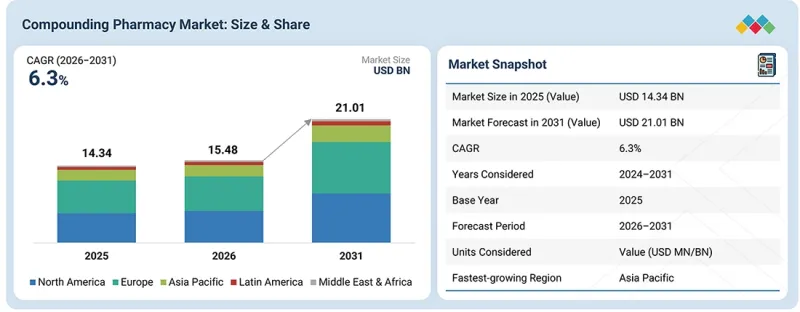
The global compounding pharmacy market is projected to reach USD 21.01 billion by 2031 from USD 15.48 billion in 2026, reflecting a CAGR of 6.3% over the forecast period. The global compounding pharmacy market is projected to expand significantly over the forecast period, driven by rising demand for personalized medications, customized dosage forms, and formulations not commercially available.
| Scope of the Report | |
|---|---|
| Years Considered for the Study | 2026-2031 |
| Base Year | 2025 |
| Forecast Period | 2026-2031 |
| Units Considered | Value (USD billion) |
| Segments | Product, Compounding Type, Therapeutic Application, Sterility, End User, and Region |
| Regions covered | North America, Europe, Asia Pacific, Latin America, Middle East & Africa |
Market growth is supported by the increasing prevalence of chronic and complex conditions, greater adoption of patient-specific therapies, and growing reliance on compounded medications during drug shortages. Advances in automated compounding systems, digital prescription management, and precision dosing technologies are further improving efficiency and quality. However, stringent regulatory requirements, high investments in sterile compounding facilities, specialized workforce requirements, and quality-control challenges may constrain market expansion, particularly for smaller compounding pharmacies.
By product type, oral drugs held the largest share of the compounding pharmacy market in 2025.
By product type, the compounding pharmacy market is segmented into topical drugs, oral drugs, parenteral drugs, rectal drugs, nasal drugs, ophthalmic drugs, and other products. Among these, the oral drugs segment holds a significant position in the compounding pharmacy market, supported by rising demand for personalized medications. Compounded capsules, tablets, lozenges, solutions, and suspensions enable customized dosages, flavors, excipients, and release profiles for pediatric, geriatric, and chronic disease patients. The growing prevalence of endocrine disorders, diabetes, and other chronic conditions further drives demand. Technological advancements in taste masking, sustained-release formulations, and bioavailability enhancement improve patient adherence and treatment outcomes. Increasing emphasis on personalized medicine, compliance with FDA and USP standards, and expanding availability through hospitals, specialty clinics, and retail pharmacies continue to support segment growth.
By therapeutic application, the pain management segment reported the largest market share in 2025.
By therapeutic application, the market is segmented into pain management, hormone replacement therapy, dermal disorders, nutritional supplements, and other therapeutic applications. In 2025, the pain management segment held the largest share of the compounding pharmacy market, driven by the widespread prevalence of acute and chronic pain. Growing cases of arthritis, neuropathic pain, cancer-related pain, migraines, and postoperative conditions are increasing demand for customized analgesic formulations. Compounding pharmacies enable personalized strengths, dosage forms, and delivery methods, supporting improved tolerability and adherence. Advances in topical preparations, transdermal systems, sustained-release formulations, and localized therapies further expand treatment options. Rising demand for individualized pain management, an aging population, and increasing healthcare awareness are expected to support continued segment growth.
Asia Pacific is growing at the highest CAGR in the compounding pharmacy market from 2026 to 2031.
The compounding pharmacy market is segmented into North America, Europe, Asia Pacific, Latin America, and the Middle East & Africa. During the forecast period, Asia Pacific is expected to register the highest CAGR, driven by rising demand for personalized medications, increasing healthcare expenditure, and expanding pharmaceutical and biotechnology industries. Regional growth is further supported by improving healthcare infrastructure, growing awareness of customized therapies, increasing prevalence of chronic diseases, and rising adoption of advanced compounding technologies. Expanding hospital networks, specialty clinics, and compounding pharmacies, along with investments in sterile compounding facilities and quality-control systems, are strengthening the region's capabilities. Additionally, pharmaceutical and healthcare expansion in China, Japan, South Korea, and India is expected to drive demand for customized drug formulations and compounding services.
The primary interviews conducted for this report can be categorized as follows:
- By Respondent: Supply Side (70%) and Demand Side (30%)
- By Designation: Managers (45%), CXOs & Directors (30%), and Executives (25%)
- By Region: North America (40%), Europe (25%), Asia Pacific (20%), Latin America (10%), and the Middle East & Africa (5%)
Companies Profiled in the Report:
- Baxter (US)
- Empower Pharmacy (US)
- B. Braun (Germany)
- Fagron (Netherlands)
- QuVa Pharma (US)
- SCA Pharma (US)
- Nephron Pharmaceuticals (US)
- Leiters Health (US)
- Pharmaxo (UK)
- Icon Group (Australia)
- Roseway Labs (UK)
- ITH Pharma (UK)
- Pencol Compounding Pharmacy (Canada)
- Formula 8 (South Africa)
- Aurora Compounding Pharmacy (Canada)
Research Coverage:
This research report categorizes the compounding pharmacy market by product, compounding type, therapeutic application, sterility, and end user. The report includes detailed information on the main factors affecting growth in the compounding pharmacy market, such as drivers, restraints, challenges, and opportunities. It also features an in-depth analysis of key industry players, offering insights into their business overview, products, solutions, strategies, collaborations, partnerships, and agreements. The report covers recent developments such as new approvals, launches, collaborations, acquisitions, and other updates in the compounding pharmacy market.
Key Benefits of Buying the Report:
The report will help market leaders and new entrants by providing the closest estimates of revenue for the entire compounding pharmacy market and its subsegments. It will also help stakeholders better understand the competitive landscape and gain more insights to position their businesses effectively and develop appropriate go-to-market strategies. This report enables stakeholders to understand the market's key indicators and provides information on the main market drivers, restraints, opportunities, and challenges.
The report provides insights into the following pointers:
- Analysis of key drivers (persistent drug shortages in North America and Europe, full enforcement of USP standards, safety push for ready-to-administer and standardized doses, continued demand creating supply gap for GLP-1 drugs, and trend toward personalization of doses), restraints (resolution of GLP-1 shortages reduces reliance on compounded alternatives, stricter FDA oversight and insanitary conditions enforcement, and limitations on bulk drug substances), opportunities (expansion of hospital outsourcing into anesthesia, critical care, ophthalmic & chemo-adjuncts and radiopharmaceutical compounding standardization), and challenges (capacity bottlenecks in API, excipient supply, and CCI/testing, and limited quality-system maturity and gaps in stability/BUD evidence generation) influencing the growth of the market.
- Service Development/Innovation: Detailed insights on upcoming technologies, research & development activities in the compounding pharmacy market.
- Market Development: Comprehensive information about lucrative markets; the report analyzes the market across varied regions.
- Market Diversification: Exhaustive information about untapped geographies, recent developments, and investments in the compounding pharmacy market.
- Competitive Assessment: In-depth assessment of market shares, growth strategies, and product offerings of leading players. A detailed analysis of the key industry players has been done to provide insights into their key strategies, product launches/approvals, pipeline analysis, acquisitions, partnerships, agreements, collaborations, other recent developments, investment and funding activities, brand/product comparative analysis, and vendor valuation and financial metrics of the compounding pharmacy market.
TABLE OF CONTENTS
1 INTRODUCTION
- 1.1 STUDY OBJECTIVES
- 1.2 MARKET DEFINITION
- 1.3 STUDY SCOPE
- 1.3.1 MARKET SEGMENTATION & REGIONAL SCOPE
- 1.3.2 INCLUSIONS & EXCLUSIONS
- 1.3.3 YEARS CONSIDERED
- 1.3.4 CURRENCY CONSIDERED
- 1.4 STAKEHOLDERS
- 1.5 SUMMARY OF CHANGES
2 EXECUTIVE SUMMARY
- 2.1 KEY INSIGHTS & MARKET HIGHLIGHTS
- 2.2 KEY MARKET PARTICIPANTS: INSIGHTS & STRATEGIC DEVELOPMENTS
- 2.3 DISRUPTIVE TRENDS SHAPING MARKET GROWTH
- 2.4 HIGH-GROWTH SEGMENTS & EMERGING FRONTIERS
- 2.5 SNAPSHOT: GLOBAL MARKET SIZE, GROWTH RATE, AND FORECAST
3 PREMIUM INSIGHTS
- 3.1 COMPOUNDING PHARMACY MARKET OVERVIEW
- 3.2 COMPOUNDING PHARMACY MARKET, BY COMPOUNDING TYPE & REGION
- 3.3 COMPOUNDING PHARMACY MARKET: GEOGRAPHIC SNAPSHOT
- 3.4 COMPOUNDING PHARMACY MARKET SHARE, BY STERILITY, 2026 VS. 2031
4 MARKET OVERVIEW
- 4.1 INTRODUCTION
- 4.2 MARKET DYNAMICS
- 4.2.1 DRIVERS
- 4.2.1.1 Persistent drug shortages in North America and Europe
- 4.2.1.2 Enforcement of USP standards
- 4.2.1.3 Push for ready-to-administer (RTA) and standardized doses
- 4.2.1.4 Continued demand-supply gap for GLP-1 drugs
- 4.2.1.5 Trend towards personalization of doses
- 4.2.2 RESTRAINTS
- 4.2.2.1 Resolution of GLP-1 shortages and reduced reliance on compounded alternatives
- 4.2.2.2 Stricter FDA oversight and intensified enforcement of unsanitary conditions violations
- 4.2.2.3 Limitations on bulk drug substances
- 4.2.3 OPPORTUNITIES
- 4.2.3.1 Expansion of hospital outsourcing into anesthesia, critical care, ophthalmic, and chemo-adjuncts
- 4.2.3.2 Radiopharmaceutical compounding standardization
- 4.2.4 CHALLENGES
- 4.2.4.1 Capacity bottlenecks in API, excipient supply, and critical compounding infrastructure testing
- 4.2.4.2 Limited quality-system maturity and gaps in stability/BUD evidence generation
- 4.2.1 DRIVERS
- 4.3 UNMET NEEDS & WHITE SPACES
- 4.4 INTERCONNECTED MARKETS & CROSS-SECTOR OPPORTUNITIES
- 4.5 STRATEGIC MOVES BY TIER-1/2/3 PLAYERS
5 INDUSTRY TRENDS
- 5.1 PORTER'S FIVE FORCES ANALYSIS
- 5.1.1 THREAT OF NEW ENTRANTS
- 5.1.2 THREAT OF SUBSTITUTES
- 5.1.3 BARGAINING POWER OF SUPPLIERS
- 5.1.4 BARGAINING POWER OF BUYERS
- 5.1.5 INTENSITY OF COMPETITIVE RIVALRY
- 5.2 MACROECONOMIC OUTLOOK
- 5.2.1 INTRODUCTION
- 5.2.2 GDP TRENDS & FORECAST
- 5.2.3 TRENDS IN GLOBAL COMPOUNDING PHARMACY MARKET
- 5.3 VALUE CHAIN ANALYSIS
- 5.4 ECOSYSTEM ANALYSIS
- 5.4.1 ROLE IN ECOSYSTEM
- 5.5 PRICING ANALYSIS
- 5.5.1 INDICATIVE PRICING ANALYSIS FOR COMPOUNDING PHARMACY PRODUCTS, BY KEY PLAYER, 2025
- 5.5.2 INDICATIVE PRICING ANALYSIS FOR COMPOUNDING PHARMACY PRODUCTS, BY REGION, 2025
- 5.6 KEY CONFERENCES & EVENTS, 2026-2027
- 5.7 TRENDS/DISRUPTIONS IMPACTING CUSTOMERS' BUSINESSES
- 5.8 INVESTMENT & FUNDING SCENARIO
- 5.9 IMPACT OF 2025 US TARIFFS ON COMPOUNDING PHARMACY MARKET
- 5.9.1 INTRODUCTION
- 5.9.2 KEY TARIFF RATES
- 5.9.3 PRICE IMPACT ANALYSIS
- 5.9.4 IMPACT ON COUNTRY/REGION
- 5.9.4.1 US
- 5.9.4.2 Europe
- 5.9.4.3 Asia Pacific
- 5.9.4.4 Rest of the World
- 5.9.5 IMPACT ON END-USE INDUSTRIES
6 TECHNOLOGICAL ADVANCEMENTS, AI-DRIVEN IMPACT, PATENTS, INNOVATIONS, AND FUTURE APPLICATIONS
- 6.1 TECHNOLOGY ANALYSIS
- 6.2 KEY EMERGING TECHNOLOGIES
- 6.2.1 AI-DRIVEN FORMULATION & COMPOUNDING MANAGEMENT
- 6.2.2 AUTOMATED & ROBOTIC COMPOUNDING SYSTEMS
- 6.3 ADJACENT TECHNOLOGIES
- 6.3.1 BARCODE & IMAGE-BASED VERIFICATION TECHNOLOGIES
- 6.3.2 CLOSED-SYSTEM TRANSFER & CONTAINMENT TECHNOLOGIES
- 6.4 COMPLEMENTARY TECHNOLOGIES
- 6.4.1 ELECTRONIC PRESCRIBING & COMPOUNDING WORKFLOW MANAGEMENT
- 6.4.2 CLOUD-BASED PHARMACY MANAGEMENT & DATA ANALYTICS
- 6.5 TECHNOLOGY/PRODUCT ROADMAP
- 6.6 FUTURE APPLICATIONS
- 6.7 IMPACT OF AI/GEN AI ON COMPOUNDING PHARMACY MARKET
- 6.7.1 TOP USE CASES & MARKET POTENTIAL
- 6.7.2 CASE STUDIES OF AI IMPLEMENTATION IN COMPOUNDING PHARMACY MARKET
- 6.7.3 INTERCONNECTED ADJACENT ECOSYSTEM & IMPACT ON MARKET PLAYERS
- 6.7.4 CLIENTS' READINESS TO ADOPT GENERATIVE AI IN COMPOUNDING PHARMACY MARKET
7 SUSTAINABILITY & REGULATORY LANDSCAPE
- 7.1 REGIONAL REGULATIONS & COMPLIANCE
- 7.1.1 REGULATORY BODIES, GOVERNMENT AGENCIES, AND OTHER ORGANIZATIONS, BY REGION
- 7.1.2 INDUSTRY STANDARDS
- 7.2 SUSTAINABILITY INITIATIVES
- 7.3 IMPACT & REGULATORY POLICY INITIATIVES
- 7.4 CERTIFICATIONS, LABELING, & ECO-STANDARDS
8 CUSTOMER LANDSCAPE & BUYER BEHAVIOR
- 8.1 DECISION-MAKING PROCESS
- 8.2 BUYER STAKEHOLDERS & BUYING EVALUATION CRITERIA
- 8.2.1 KEY STAKEHOLDERS IN BUYING PROCESS
- 8.2.2 KEY BUYING CRITERIA
- 8.3 ADOPTION BARRIERS & INTERNAL CHALLENGES
- 8.4 UNMET NEEDS FROM VARIOUS END-USE INDUSTRIES
- 8.5 MARKET PROFITABILITY
9 COMPOUNDING PHARMACY MARKET, BY PRODUCT
- 9.1 INTRODUCTION
- 9.2 ORAL DRUGS
- 9.2.1 INCREASING DEMAND FOR PRECISE AND CUSTOMIZABLE ORAL FORMULATIONS IN UNMET PATIENT POPULATIONS TO DRIVE MARKET
- 9.3 TOPICAL DRUGS
- 9.3.1 RISING DEMAND FOR PERSONALIZED TOPICAL TREATMENTS AND ADVANCED DELIVERY VEHICLES TO FUEL MARKET GROWTH
- 9.4 PARENTERAL DRUGS
- 9.4.1 RISING DEMAND FOR STERILE INJECTABLE THERAPIES AND SUPPLY-CHAIN DISRUPTIONS TO BOOST MARKET GROWTH
- 9.5 OPHTHALMIC DRUGS
- 9.5.1 RISING CASES OF EYE-RELATED DISORDERS TO ACCELERATE MARKET GROWTH
- 9.6 NASAL DRUGS
- 9.6.1 ADVANCEMENTS IN NASAL DRUG DELIVERY SYSTEMS AND FAVORABLE REGULATORY POLICIES TO PROPEL MARKET GROWTH
- 9.7 RECTAL DRUGS
- 9.7.1 PERSONALIZED FORMULATIONS AND REGULATORY SUPPORT TO DRIVE GROWTH IN RECTAL COMPOUNDING THERAPIES
- 9.8 OTHER PRODUCTS
10 COMPOUNDING PHARMACY MARKET, BY COMPOUNDING TYPE
- 10.1 INTRODUCTION
- 10.2 PHARMACEUTICAL DOSAGE ALTERATION
- 10.2.1 TAILORED DOSAGE FORMS TO ENHANCE PATIENT ADHERENCE AND CUSTOMIZATION IN COMPOUNDED MEDICATIONS
- 10.3 PHARMACEUTICAL INGREDIENT ALTERATION
- 10.3.1 INCREASED NEED FOR CUSTOMIZED PHARMACEUTICAL INGREDIENTS TO ENHANCE PATIENT-CENTRIC COMPOUNDING SOLUTIONS
- 10.4 CURRENTLY UNAVAILABLE PHARMACEUTICAL MANUFACTURING
- 10.4.1 PERSISTENT GLOBAL DRUG SHORTAGES AND LIMITATIONS OF LARGE-SCALE PHARMACEUTICAL PRODUCTION TO PROPEL ADOPTION
11 COMPOUNDING PHARMACY MARKET, BY THERAPEUTIC APPLICATION
- 11.1 INTRODUCTION
- 11.2 PAIN MANAGEMENT
- 11.2.1 NEED FOR PERSONALIZED PAIN RELIEF SOLUTIONS FOR CHRONIC AILMENTS TO SUPPORT MARKET
- 11.3 HORMONE REPLACEMENT THERAPY
- 11.3.1 POPULARITY OF PERSONALIZED HORMONE THERAPIES TO DRIVE STEADY GROWTH IN GLOBAL COMPOUNDING PHARMACY MARKET
- 11.4 DERMAL DISORDERS
- 11.4.1 CUSTOMIZED DERMATOLOGICAL SOLUTIONS TO PROPEL GLOBAL COMPOUNDING PHARMACY MARKET EXPANSION
- 11.5 NUTRITIONAL SUPPLEMENTS
- 11.5.1 PERSONALIZED NUTRACEUTICALS TO OFFER NICHE BUT BETTER GROWTH OPPORTUNITIES IN COMPOUNDING PHARMACIES
- 11.6 OTHER THERAPEUTIC APPLICATIONS
12 COMPOUNDING PHARMACY MARKET, BY STERILITY
- 12.1 INTRODUCTION
- 12.2 STERILE
- 12.2.1 RTU/RTA STERILE PREPARATIONS AND OPHTHALMIC PACKS TO DRIVE RAPID GROWTH IN COMPOUNDING PHARMACIES
- 12.3 NON-STERILE
- 12.3.1 503A/MAGISTRAL NON-STERILE PREPARATIONS TO DRIVE GLOBAL VOLUME AND VALUE LEADERSHIP IN COMPOUNDING PHARMACIES
13 COMPOUNDING PHARMACY MARKET, BY END USER
- 13.1 INTRODUCTION
- 13.2 ADULTS
- 13.2.1 RISING CHRONIC DISEASE BURDEN AND PERSONALIZED THERAPIES TO AUGMENT ADULT SEGMENT GROWTH
- 13.3 GERIATRIC PATIENTS
- 13.3.1 AGING DEMOGRAPHICS AND DOSE-FORM CUSTOMIZATION TO PROPEL GERIATRIC SEGMENT GROWTH
- 13.4 PEDIATRIC PATIENTS
- 13.4.1 CUSTOMIZED DOSAGE FORMS AND PEDIATRIC-SPECIFIC NEEDS TO DRIVE GROWTH
14 COMPOUNDING PHARMACY MARKET, BY REGION
- 14.1 INTRODUCTION
- 14.2 NORTH AMERICA
- 14.2.1 US
- 14.2.1.1 US to dominate North American compounding pharmacy market during forecast period
- 14.2.2 CANADA
- 14.2.2.1 Personalized treatments, regulatory reinforcement, and supply-gap filling to fuel global compounding pharmacy growth
- 14.2.1 US
- 14.3 EUROPE
- 14.3.1 GERMANY
- 14.3.1.1 Aging demographics, technological advancements, and supportive regulations to drive market
- 14.3.2 UK
- 14.3.2.1 Personalized treatments, chronic disease management, and regulatory support to support market growth
- 14.3.3 FRANCE
- 14.3.3.1 Focus on chronic disease management to fuel growth in French compounding pharmacy market
- 14.3.4 ITALY
- 14.3.4.1 Rising commercial drug development pipeline to spur market growth
- 14.3.5 SPAIN
- 14.3.5.1 Global regulatory advancements and rising R&D activities to drive market
- 14.3.6 REST OF EUROPE
- 14.3.1 GERMANY
- 14.4 ASIA PACIFIC
- 14.4.1 CHINA
- 14.4.1.1 Low manufacturing cost and high demand for medicines to favor market growth
- 14.4.2 JAPAN
- 14.4.2.1 Increasing prevalence of chronic diseases and growing geriatric population to fuel demand for customized medications
- 14.4.3 INDIA
- 14.4.3.1 Increasing pharma R&D activities to support market growth
- 14.4.4 AUSTRALIA
- 14.4.4.1 Innovation in clinical practice and regulatory support to accelerate compounding pharmacy growth
- 14.4.5 SOUTH KOREA
- 14.4.5.1 Regulatory innovation and automation to fuel South Korean compounding pharmacy market growth
- 14.4.6 REST OF ASIA PACIFIC
- 14.4.1 CHINA
- 14.5 LATIN AMERICA
- 14.5.1 BRAZIL
- 14.5.1.1 Growing pharmacy & biologics manufacturing sectors and rising R&D spending to drive market
- 14.5.2 MEXICO
- 14.5.2.1 Regulatory improvements, high cancer rates, and robust pharmaceutical industry to boost market growth
- 14.5.3 REST OF LATIN AMERICA
- 14.5.1 BRAZIL
- 14.6 MIDDLE EAST & AFRICA
- 14.6.1 GCC COUNTRIES
- 14.6.1.1 Rising demand for biologics and increasing prevalence of non-communicable diseases to propel market growth
- 14.6.2 REST OF MIDDLE EAST & AFRICA
- 14.6.1 GCC COUNTRIES
15 COMPETITIVE LANDSCAPE
- 15.1 INTRODUCTION
- 15.2 KEY PLAYER STRATEGIES/RIGHT TO WIN
- 15.2.1 OVERVIEW OF STRATEGIES ADOPTED BY KEY PLAYERS IN COMPOUNDING PHARMACY MARKET, 2024-2026
- 15.3 REVENUE ANALYSIS, 2023-2025
- 15.4 MARKET SHARE ANALYSIS, 2025
- 15.5 COMPANY EVALUATION MATRIX: KEY PLAYERS, 2025
- 15.5.1 STARS
- 15.5.2 EMERGING LEADERS
- 15.5.3 PERVASIVE PLAYERS
- 15.5.4 PARTICIPANTS
- 15.5.5 COMPETITIVE BENCHMARKING: KEY PLAYERS, 2025
- 15.5.5.1 Company footprint
- 15.5.5.2 Region footprint
- 15.5.5.3 Product footprint
- 15.5.5.4 Therapeutic application footprint
- 15.5.5.5 Sterility footprint
- 15.6 COMPANY EVALUATION MATRIX: STARTUPS/SMES, 2025
- 15.6.1 PROGRESSIVE COMPANIES
- 15.6.2 RESPONSIVE COMPANIES
- 15.6.3 DYNAMIC COMPANIES
- 15.6.4 STARTING BLOCKS
- 15.6.5 COMPETITIVE BENCHMARKING: STARTUPS/SMES, 2025
- 15.6.5.1 Detailed list of key startup/SMEs
- 15.6.5.2 Competitive benchmarking of key startups/SMEs
- 15.7 COMPANY VALUATION & FINANCIAL METRICS
- 15.7.1 FINANCIAL METRICS
- 15.7.2 COMPANY VALUATION
- 15.8 BRAND/PRODUCT COMPARISON
- 15.9 COMPETITIVE SCENARIO
- 15.9.1 PRODUCT LAUNCHES
- 15.9.2 DEALS
- 15.9.3 EXPANSIONS
16 COMPANY PROFILES
- 16.1 KEY PLAYERS
- 16.1.1 BAXTER
- 16.1.1.1 Business overview
- 16.1.1.2 Products offered
- 16.1.1.3 Recent developments
- 16.1.1.3.1 Product launches
- 16.1.1.3.2 Expansions
- 16.1.1.4 MnM view
- 16.1.1.4.1 Key strengths
- 16.1.1.4.2 Strategic choices
- 16.1.1.4.3 Weaknesses & competitive threats
- 16.1.2 EMPOWER PHARMACY
- 16.1.2.1 Business overview
- 16.1.2.2 Products offered
- 16.1.2.3 Recent developments
- 16.1.2.3.1 Product launches
- 16.1.2.3.2 Expansions
- 16.1.2.4 MnM view
- 16.1.2.4.1 Key strengths
- 16.1.2.4.2 Strategic choices
- 16.1.2.4.3 Weaknesses & competitive threats
- 16.1.3 B. BRAUN SE
- 16.1.3.1 Business overview
- 16.1.3.2 Products offered
- 16.1.3.3 Recent developments
- 16.1.3.3.1 Product launches
- 16.1.3.4 MnM view
- 16.1.3.4.1 Key strengths
- 16.1.3.4.2 Strategic choices
- 16.1.3.4.3 Weaknesses & competitive threats
- 16.1.4 FAGRON
- 16.1.4.1 Business overview
- 16.1.4.2 Products offered
- 16.1.4.3 Recent developments
- 16.1.4.3.1 Deals
- 16.1.4.3.2 Expansions
- 16.1.4.4 MnM view
- 16.1.4.4.1 Key strengths
- 16.1.4.4.2 Strategic choices
- 16.1.4.4.3 Weaknesses & competitive threats
- 16.1.5 QUVA PHARMA, INC.
- 16.1.5.1 Business overview
- 16.1.5.2 Products offered
- 16.1.5.3 Recent developments
- 16.1.5.3.1 Expansions
- 16.1.5.4 MnM view
- 16.1.5.4.1 Key strengths
- 16.1.5.4.2 Strategic choices
- 16.1.5.4.3 Weaknesses & competitive threats
- 16.1.6 SCA PHARMA
- 16.1.6.1 Business overview
- 16.1.6.2 Products offered
- 16.1.6.3 Recent developments
- 16.1.6.3.1 Product launches
- 16.1.6.3.2 Deals
- 16.1.7 NEPHRON PHARMACEUTICALS
- 16.1.7.1 Business overview
- 16.1.7.2 Products offered
- 16.1.7.3 Recent developments
- 16.1.7.3.1 Expansions
- 16.1.8 LEITERS HEALTH
- 16.1.8.1 Business overview
- 16.1.8.2 Products offered
- 16.1.8.3 Recent developments
- 16.1.8.3.1 Product Launches
- 16.1.8.3.2 Expansions
- 16.1.9 ICON GROUP
- 16.1.9.1 Business overview
- 16.1.9.2 Products offered
- 16.1.9.3 Recent developments
- 16.1.9.3.1 Deals
- 16.1.10 ROSEWAY LABS
- 16.1.10.1 Business overview
- 16.1.10.2 Products offered
- 16.1.10.3 Recent developments
- 16.1.10.3.1 Deals
- 16.1.11 ITH PHARMA
- 16.1.11.1 Business overview
- 16.1.11.2 Products offered
- 16.1.11.3 Recent developments
- 16.1.11.3.1 Expansions
- 16.1.12 PENCOL COMPOUNDING PHARMACY
- 16.1.12.1 Business overview
- 16.1.12.2 Products offered
- 16.1.13 FORMUL8
- 16.1.13.1 Business overview
- 16.1.13.2 Products offered
- 16.1.14 AURORA COMPOUNDING PHARMACY
- 16.1.14.1 Business overview
- 16.1.14.2 Products offered
- 16.1.1 BAXTER
- 16.2 OTHER PLAYERS
- 16.2.1 CUSTOM MED APOTHECARY
- 16.2.2 INSTITUTIONAL PHARMACY SOLUTIONS
- 16.2.3 FUSION APOTHECARY
- 16.2.4 INNOVATION COMPOUNDING PHARMACY
- 16.2.5 RX3 COMPOUNDING PHARMACY
- 16.2.6 DOUGHERTY'S PHARMACY, INC.
- 16.2.7 LORRAINE'S PHARMACY
- 16.2.8 WELLS PHARMA
- 16.2.9 OLYMPIA PHARMACY
- 16.2.10 FRESH THERAPEUTICS
- 16.2.11 MEDIOS AG
17 RESEARCH METHODOLOGY
- 17.1 RESEARCH DATA
- 17.1.1 SECONDARY DATA
- 17.1.1.1 Key sources of secondary data
- 17.1.1.2 Key objective of secondary research
- 17.1.2 PRIMARY DATA
- 17.1.2.1 Breakdown of primaries
- 17.1.2.2 Key objectives of primary research
- 17.1.1 SECONDARY DATA
- 17.2 MARKET ESTIMATION METHODOLOGY
- 17.2.1 GLOBAL MARKET ESTIMATION
- 17.2.1.1 Company revenue analysis (bottom-up approach)
- 17.2.1.2 Revenue share analysis
- 17.2.1.3 MnM repository analysis
- 17.2.1.4 Primary interviews
- 17.2.2 INSIGHTS OF PRIMARY EXPERTS
- 17.2.3 SEGMENTAL MARKET SIZE ESTIMATION (TOP-DOWN APPROACH)
- 17.2.1 GLOBAL MARKET ESTIMATION
- 17.3 MARKET GROWTH RATE PROJECTIONS
- 17.4 DATA TRIANGULATION
- 17.5 STUDY ASSUMPTIONS
- 17.6 RESEARCH LIMITATIONS
- 17.7 RISK ANALYSIS
18 APPENDIX
- 18.1 DISCUSSION GUIDE
- 18.2 KNOWLEDGESTORE: MARKETSANDMARKETS' SUBSCRIPTION PORTAL
- 18.3 CUSTOMIZATION OPTIONS
- 18.4 RELATED REPORTS
- 18.5 AUTHOR DETAILS
List of Tables
- TABLE 1 COMPOUNDING PHARMACY MARKET: INCLUSIONS & EXCLUSIONS
- TABLE 2 COMPOUNDING PHARMACY MARKET: IMPACT ANALYSIS OF MARKET DYNAMICS
- TABLE 3 COMPOUNDING PHARMACY MARKET: PORTER'S FIVE FORCES
- TABLE 4 COMPOUNDING PHARMACY MARKET: ROLE IN ECOSYSTEM
- TABLE 5 INDICATIVE PRICING ANALYSIS FOR COMPOUNDING PHARMACY PRODUCTS, BY KEY PLAYER, 2025
- TABLE 6 INDICATIVE PRICING ANALYSIS FOR COMPOUNDING PHARMACY PRODUCTS, BY REGION, 2025
- TABLE 7 COMPOUNDING PHARMACY MARKET: DETAILED LIST OF KEY CONFERENCES & EVENTS, JANUARY 2025-DECEMBER 2026
- TABLE 8 US-ADJUSTED RECIPROCAL TARIFF RATES
- TABLE 9 CASE STUDIES OF AI IMPLEMENTATION IN COMPOUNDING PHARMACY MARKET
- TABLE 10 CLIENTS' READINESS TO ADOPT GENERATIVE AI IN COMPOUNDING PHARMACY MARKET
- TABLE 11 NORTH AMERICA: REGULATORY BODIES, GOVERNMENT AGENCIES, AND OTHER ORGANIZATIONS
- TABLE 12 EUROPE: REGULATORY BODIES, GOVERNMENT AGENCIES, AND OTHER ORGANIZATIONS
- TABLE 13 ASIA PACIFIC: REGULATORY BODIES, GOVERNMENT AGENCIES, AND OTHER ORGANIZATIONS
- TABLE 14 REST OF THE WORLD: REGULATORY BODIES, GOVERNMENT AGENCIES, AND OTHER ORGANIZATIONS
- TABLE 15 INFLUENCE OF STAKEHOLDERS ON BUYING PROCESS OF COMPOUNDING PHARMACY PRODUCTS (%)
- TABLE 16 KEY BUYING CRITERIA FOR COMPOUNDING PHARMACY PRODUCTS, BY END USER
- TABLE 17 COMPOUNDING PHARMACY MARKET, BY PRODUCT, 2023-2031 (USD MILLION)
- TABLE 18 COMPOUNDING PHARMACY MARKET FOR ORAL DRUGS, BY REGION, 2023-2031 (USD MILLION)
- TABLE 19 NORTH AMERICA: COMPOUNDING PHARMACY MARKET FOR ORAL DRUGS, BY COUNTRY, 2023-2031 (USD MILLION)
- TABLE 20 EUROPE: COMPOUNDING PHARMACY MARKET FOR ORAL DRUGS, BY COUNTRY, 2023-2031 (USD MILLION)
- TABLE 21 ASIA PACIFIC: COMPOUNDING PHARMACY MARKET FOR ORAL DRUGS, BY COUNTRY, 2023-2031 (USD MILLION)
- TABLE 22 LATIN AMERICA: COMPOUNDING PHARMACY MARKET FOR ORAL DRUGS, BY COUNTRY, 2023-2031 (USD MILLION)
- TABLE 23 MIDDLE EAST & AFRICA: COMPOUNDING PHARMACY MARKET FOR ORAL DRUGS, BY REGION, 2023-2031 (USD MILLION)
- TABLE 24 COMPOUNDING PHARMACY MARKET FOR TOPICAL DRUGS, BY REGION, 2023-2031 (USD MILLION)
- TABLE 25 NORTH AMERICA: COMPOUNDING PHARMACY MARKET FOR TOPICAL DRUGS, BY COUNTRY, 2023-2031 (USD MILLION)
- TABLE 26 EUROPE: COMPOUNDING PHARMACY MARKET FOR TOPICAL DRUGS, BY COUNTRY, 2023-2031 (USD MILLION)
- TABLE 27 ASIA PACIFIC: COMPOUNDING PHARMACY MARKET FOR TOPICAL DRUGS, BY COUNTRY, 2023-2031 (USD MILLION)
- TABLE 28 LATIN AMERICA: COMPOUNDING PHARMACY MARKET FOR TOPICAL DRUGS, BY COUNTRY, 2023-2031 (USD MILLION)
- TABLE 29 MIDDLE EAST & AFRICA: COMPOUNDING PHARMACY MARKET FOR TOPICAL DRUGS, BY REGION, 2023-2031 (USD MILLION)
- TABLE 30 COMPOUNDING PHARMACY MARKET FOR PARENTERAL DRUGS, BY REGION, 2023-2031 (USD MILLION)
- TABLE 31 NORTH AMERICA: COMPOUNDING PHARMACY MARKET FOR PARENTERAL DRUGS, BY COUNTRY, 2023-2031 (USD MILLION)
- TABLE 32 EUROPE: COMPOUNDING PHARMACY MARKET FOR PARENTERAL DRUGS, BY COUNTRY, 2023-2031 (USD MILLION)
- TABLE 33 ASIA PACIFIC: COMPOUNDING PHARMACY MARKET FOR PARENTERAL DRUGS, BY COUNTRY, 2023-2031 (USD MILLION)
- TABLE 34 LATIN AMERICA: COMPOUNDING PHARMACY MARKET FOR PARENTERAL DRUGS, BY COUNTRY, 2023-2031 (USD MILLION)
- TABLE 35 MIDDLE EAST & AFRICA: COMPOUNDING PHARMACY MARKET FOR PARENTERAL DRUGS, BY REGION, 2023-2031 (USD MILLION)
- TABLE 36 COMPOUNDING PHARMACY MARKET FOR OPHTHALMIC DRUGS, BY REGION, 2023-2031 (USD MILLION)
- TABLE 37 NORTH AMERICA: COMPOUNDING PHARMACY MARKET FOR OPHTHALMIC DRUGS, BY COUNTRY, 2023-2031 (USD MILLION)
- TABLE 38 EUROPE: COMPOUNDING PHARMACY MARKET FOR OPHTHALMIC DRUGS, BY COUNTRY, 2023-2031 (USD MILLION)
- TABLE 39 ASIA PACIFIC: COMPOUNDING PHARMACY MARKET FOR OPHTHALMIC DRUGS, BY COUNTRY, 2023-2031 (USD MILLION)
- TABLE 40 LATIN AMERICA: COMPOUNDING PHARMACY MARKET FOR OPHTHALMIC DRUGS, BY COUNTRY, 2023-2031 (USD MILLION)
- TABLE 41 MIDDLE EAST & AFRICA: COMPOUNDING PHARMACY MARKET FOR OPHTHALMIC DRUGS, BY REGION, 2023-2031 (USD MILLION)
- TABLE 42 COMPOUNDING PHARMACY MARKET FOR NASAL DRUGS, BY REGION, 2023-2031 (USD MILLION)
- TABLE 43 NORTH AMERICA: COMPOUNDING PHARMACY MARKET FOR NASAL DRUGS, BY COUNTRY, 2023-2031 (USD MILLION)
- TABLE 44 EUROPE: COMPOUNDING PHARMACY MARKET FOR NASAL DRUGS, BY COUNTRY, 2023-2031 (USD MILLION)
- TABLE 45 ASIA PACIFIC: COMPOUNDING PHARMACY MARKET FOR NASAL DRUGS, BY COUNTRY, 2023-2031 (USD MILLION)
- TABLE 46 LATIN AMERICA: COMPOUNDING PHARMACY MARKET FOR NASAL DRUGS, BY COUNTRY, 2023-2031 (USD MILLION)
- TABLE 47 MIDDLE EAST & AFRICA: COMPOUNDING PHARMACY MARKET FOR NASAL DRUGS, BY REGION, 2023-2031 (USD MILLION)
- TABLE 48 COMPOUNDING PHARMACY MARKET FOR RECTAL DRUGS, BY REGION, 2023-2031 (USD MILLION)
- TABLE 49 NORTH AMERICA: COMPOUNDING PHARMACY MARKET FOR RECTAL DRUGS, BY COUNTRY, 2023-2031 (USD MILLION)
- TABLE 50 EUROPE: COMPOUNDING PHARMACY MARKET FOR RECTAL DRUGS, BY COUNTRY, 2023-2031 (USD MILLION)
- TABLE 51 ASIA PACIFIC: COMPOUNDING PHARMACY MARKET FOR RECTAL DRUGS, BY COUNTRY, 2023-2031 (USD MILLION)
- TABLE 52 LATIN AMERICA: COMPOUNDING PHARMACY MARKET FOR RECTAL DRUGS, BY COUNTRY, 2023-2031 (USD MILLION)
- TABLE 53 MIDDLE EAST & AFRICA: COMPOUNDING PHARMACY MARKET FOR RECTAL DRUGS, BY REGION, 2023-2031 (USD MILLION)
- TABLE 54 COMPOUNDING PHARMACY MARKET FOR OTHER PRODUCTS, BY REGION, 2023-2031 (USD MILLION)
- TABLE 55 NORTH AMERICA: COMPOUNDING PHARMACY MARKET FOR OTHER PRODUCTS, BY COUNTRY, 2023-2031 (USD MILLION)
- TABLE 56 EUROPE: COMPOUNDING PHARMACY MARKET FOR OTHER PRODUCTS, BY COUNTRY, 2023-2031 (USD MILLION)
- TABLE 57 ASIA PACIFIC: COMPOUNDING PHARMACY MARKET FOR OTHER PRODUCTS, BY COUNTRY, 2023-2031 (USD MILLION)
- TABLE 58 LATIN AMERICA: COMPOUNDING PHARMACY MARKET FOR OTHER PRODUCTS, BY COUNTRY, 2023-2031 (USD MILLION)
- TABLE 59 MIDDLE EAST & AFRICA: COMPOUNDING PHARMACY MARKET FOR OTHER PRODUCTS, BY REGION, 2023-2031 (USD MILLION)
- TABLE 60 COMPOUNDING PHARMACY MARKET, BY COMPOUNDING TYPE, 2023-2031 (USD MILLION)
- TABLE 61 COMPOUNDING PHARMACY MARKET FOR PHARMACEUTICAL DOSAGE ALTERATION, BY REGION, 2023-2031 (USD MILLION)
- TABLE 62 NORTH AMERICA: COMPOUNDING PHARMACY MARKET FOR PHARMACEUTICAL DOSAGE ALTERATION, BY COUNTRY, 2023-2031 (USD MILLION)
- TABLE 63 EUROPE: COMPOUNDING PHARMACY MARKET FOR PHARMACEUTICAL DOSAGE ALTERATION, BY COUNTRY, 2023-2031 (USD MILLION)
- TABLE 64 ASIA PACIFIC: COMPOUNDING PHARMACY MARKET FOR PHARMACEUTICAL DOSAGE ALTERATION, BY COUNTRY, 2023-2031 (USD MILLION)
- TABLE 65 LATIN AMERICA: COMPOUNDING PHARMACY MARKET FOR PHARMACEUTICAL DOSAGE ALTERATION, BY COUNTRY, 2023-2031 (USD MILLION)
- TABLE 66 MIDDLE EAST & AFRICA: COMPOUNDING PHARMACY MARKET FOR PHARMACEUTICAL DOSAGE ALTERATION, BY REGION, 2023-2031 (USD MILLION)
- TABLE 67 COMPOUNDING PHARMACY MARKET FOR PHARMACEUTICAL INGREDIENT ALTERATION, BY REGION, 2023-2031 (USD MILLION)
- TABLE 68 NORTH AMERICA: COMPOUNDING PHARMACY MARKET FOR PHARMACEUTICAL INGREDIENT ALTERATION, BY COUNTRY, 2023-2031 (USD MILLION)
- TABLE 69 EUROPE: COMPOUNDING PHARMACY MARKET FOR PHARMACEUTICAL INGREDIENT ALTERATION, BY COUNTRY, 2023-2031 (USD MILLION)
- TABLE 70 ASIA PACIFIC: COMPOUNDING PHARMACY MARKET FOR PHARMACEUTICAL INGREDIENT ALTERATION, BY COUNTRY, 2023-2031 (USD MILLION)
- TABLE 71 LATIN AMERICA: COMPOUNDING PHARMACY MARKET FOR PHARMACEUTICAL INGREDIENT ALTERATION, BY COUNTRY, 2023-2031 (USD MILLION)
- TABLE 72 MIDDLE EAST & AFRICA: COMPOUNDING PHARMACY MARKET FOR PHARMACEUTICAL INGREDIENT ALTERATION, BY REGION, 2023-2031 (USD MILLION)
- TABLE 73 COMPOUNDING PHARMACY MARKET FOR CURRENTLY UNAVAILABLE PHARMACEUTICAL MANUFACTURING, BY REGION, 2023-2031 (USD MILLION)
- TABLE 74 NORTH AMERICA: COMPOUNDING PHARMACY MARKET FOR CURRENTLY UNAVAILABLE PHARMACEUTICAL MANUFACTURING, BY COUNTRY, 2023-2031 (USD MILLION)
- TABLE 75 EUROPE: COMPOUNDING PHARMACY MARKET FOR CURRENTLY UNAVAILABLE PHARMACEUTICAL MANUFACTURING, BY COUNTRY, 2023-2031 (USD MILLION)
- TABLE 76 ASIA PACIFIC: COMPOUNDING PHARMACY MARKET FOR CURRENTLY UNAVAILABLE PHARMACEUTICAL MANUFACTURING, BY COUNTRY, 2023-2031 (USD MILLION)
- TABLE 77 LATIN AMERICA: COMPOUNDING PHARMACY MARKET FOR CURRENTLY UNAVAILABLE PHARMACEUTICAL MANUFACTURING, BY COUNTRY, 2023-2031 (USD MILLION)
- TABLE 78 MIDDLE EAST & AFRICA: COMPOUNDING PHARMACY MARKET FOR CURRENTLY UNAVAILABLE PHARMACEUTICAL MANUFACTURING, BY REGION, 2023-2031 (USD MILLION)
- TABLE 79 COMPOUNDING PHARMACY MARKET, BY THERAPEUTIC APPLICATION, 2023-2031 (USD MILLION)
- TABLE 80 COMPOUNDING PHARMACY MARKET FOR PAIN MANAGEMENT, BY REGION, 2023-2031 (USD MILLION)
- TABLE 81 NORTH AMERICA: COMPOUNDING PHARMACY MARKET FOR PAIN MANAGEMENT, BY COUNTRY, 2023-2031 (USD MILLION)
- TABLE 82 EUROPE: COMPOUNDING PHARMACY MARKET FOR PAIN MANAGEMENT, BY COUNTRY, 2023-2031 (USD MILLION)
- TABLE 83 ASIA PACIFIC: COMPOUNDING PHARMACY MARKET FOR PAIN MANAGEMENT, BY COUNTRY, 2023-2031 (USD MILLION)
- TABLE 84 LATIN AMERICA: COMPOUNDING PHARMACY MARKET FOR PAIN MANAGEMENT, BY COUNTRY, 2023-2031 (USD MILLION)
- TABLE 85 MIDDLE EAST & AFRICA: COMPOUNDING PHARMACY MARKET FOR PAIN MANAGEMENT, BY REGION, 2023-2031 (USD MILLION)
- TABLE 86 COMPOUNDING PHARMACY MARKET FOR HORMONE REPLACEMENT THERAPY, BY REGION, 2023-2031 (USD MILLION)
- TABLE 87 NORTH AMERICA: COMPOUNDING PHARMACY MARKET FOR HORMONE REPLACEMENT THERAPY, BY COUNTRY, 2023-2031 (USD MILLION)
- TABLE 88 EUROPE: COMPOUNDING PHARMACY MARKET FOR HORMONE REPLACEMENT THERAPY, BY COUNTRY, 2023-2031 (USD MILLION)
- TABLE 89 ASIA PACIFIC: COMPOUNDING PHARMACY MARKET FOR HORMONE REPLACEMENT THERAPY, BY COUNTRY, 2023-2031 (USD MILLION)
- TABLE 90 LATIN AMERICA: COMPOUNDING PHARMACY MARKET FOR HORMONE REPLACEMENT THERAPIES, BY COUNTRY, 2023-2031 (USD MILLION)
- TABLE 91 MIDDLE EAST & AFRICA: COMPOUNDING PHARMACY MARKET FOR HORMONE REPLACEMENT THERAPIES, BY REGION, 2023-2031 (USD MILLION)
- TABLE 92 COMPOUNDING PHARMACY MARKET FOR DERMAL DISORDERS, BY REGION, 2023-2031 (USD MILLION)
- TABLE 93 NORTH AMERICA: COMPOUNDING PHARMACY MARKET FOR DERMAL DISORDERS, BY COUNTRY, 2023-2031 (USD MILLION)
- TABLE 94 EUROPE: COMPOUNDING PHARMACY MARKET FOR DERMAL DISORDERS, BY COUNTRY, 2023-2031 (USD MILLION)
- TABLE 95 ASIA PACIFIC: COMPOUNDING PHARMACY MARKET FOR DERMAL DISORDERS, BY COUNTRY, 2023-2031 (USD MILLION)
- TABLE 96 LATIN AMERICA: COMPOUNDING PHARMACY MARKET FOR DERMAL DISORDERS, BY COUNTRY, 2023-2031 (USD MILLION)
- TABLE 97 MIDDLE EAST & AFRICA: COMPOUNDING PHARMACY MARKET FOR DERMAL DISORDERS, BY REGION, 2023-2031 (USD MILLION)
- TABLE 98 COMPOUNDING PHARMACY MARKET FOR NUTRITIONAL SUPPLEMENTS, BY REGION, 2023-2031 (USD MILLION)
- TABLE 99 NORTH AMERICA: COMPOUNDING PHARMACY MARKET FOR NUTRITIONAL SUPPLEMENTS, BY COUNTRY, 2023-2031 (USD MILLION)
- TABLE 100 EUROPE: COMPOUNDING PHARMACY MARKET FOR NUTRITIONAL SUPPLEMENTS, BY COUNTRY, 2023-2031 (USD MILLION)
- TABLE 101 ASIA PACIFIC: COMPOUNDING PHARMACY MARKET FOR NUTRITIONAL SUPPLEMENTS, BY COUNTRY, 2023-2031 (USD MILLION)
- TABLE 102 LATIN AMERICA: COMPOUNDING PHARMACY MARKET FOR NUTRITIONAL SUPPLEMENTS, BY COUNTRY, 2023-2031 (USD MILLION)
- TABLE 103 MIDDLE EAST & AFRICA: COMPOUNDING PHARMACY MARKET FOR NUTRITIONAL SUPPLEMENTS, BY REGION, 2023-2031 (USD MILLION)
- TABLE 104 COMPOUNDING PHARMACY MARKET FOR OTHER THERAPEUTIC APPLICATIONS, BY REGION, 2023-2031 (USD MILLION)
- TABLE 105 NORTH AMERICA: COMPOUNDING PHARMACY MARKET FOR OTHER THERAPEUTIC APPLICATIONS, BY COUNTRY, 2023-2031 (USD MILLION)
- TABLE 106 EUROPE: COMPOUNDING PHARMACY MARKET FOR OTHER THERAPEUTIC APPLICATIONS, BY COUNTRY, 2023-2031 (USD MILLION)
- TABLE 107 ASIA PACIFIC: COMPOUNDING PHARMACY MARKET FOR OTHER THERAPEUTIC APPLICATIONS, BY COUNTRY, 2023-2031 (USD MILLION)
- TABLE 108 LATIN AMERICA: COMPOUNDING PHARMACY MARKET FOR OTHER THERAPEUTIC APPLICATIONS, BY COUNTRY, 2023-2031 (USD MILLION)
- TABLE 109 MIDDLE EAST & AFRICA: COMPOUNDING PHARMACY MARKET FOR OTHER THERAPEUTIC APPLICATIONS, BY REGION, 2023-2031 (USD MILLION)
- TABLE 110 COMPOUNDING PHARMACY MARKET, BY STERILITY, 2023-2031 (USD MILLION)
- TABLE 111 STERILE COMPOUNDING PHARMACY MARKET, BY REGION, 2023-2031 (USD MILLION)
- TABLE 112 NORTH AMERICA: STERILE COMPOUNDING PHARMACY MARKET, BY COUNTRY, 2023-2031 (USD MILLION)
- TABLE 113 EUROPE: STERILE COMPOUNDING PHARMACY MARKET, BY COUNTRY, 2023-2031 (USD MILLION)
- TABLE 114 ASIA PACIFIC: STERILE COMPOUNDING PHARMACY MARKET, BY COUNTRY, 2023-2031 (USD MILLION)
- TABLE 115 LATIN AMERICA: STERILE COMPOUNDING PHARMACY MARKET, BY COUNTRY, 2023-2031 (USD MILLION)
- TABLE 116 MIDDLE EAST & AFRICA: STERILE COMPOUNDING PHARMACY MARKET, BY REGION, 2023-2031 (USD MILLION)
- TABLE 117 NON-STERILE COMPOUNDING PHARMACY MARKET, BY REGION, 2023-2031 (USD MILLION)
- TABLE 118 NORTH AMERICA: NON-STERILE COMPOUNDING PHARMACY MARKET, BY COUNTRY, 2023-2031 (USD MILLION)
- TABLE 119 EUROPE: NON-STERILE COMPOUNDING PHARMACY MARKET, BY COUNTRY, 2023-2031 (USD MILLION)
- TABLE 120 ASIA PACIFIC: NON-STERILE COMPOUNDING PHARMACY MARKET, BY COUNTRY, 2023-2031 (USD MILLION)
- TABLE 121 LATIN AMERICA: NON-STERILE COMPOUNDING PHARMACY MARKET, BY COUNTRY, 2023-2031 (USD MILLION)
- TABLE 122 MIDDLE EAST & AFRICA: NON-STERILE COMPOUNDING PHARMACY MARKET, BY REGION, 2023-2031 (USD MILLION)
- TABLE 123 COMPOUNDING PHARMACY MARKET, BY END USER, 2023-2031 (USD MILLION)
- TABLE 124 COMPOUNDING PHARMACY MARKET FOR ADULTS, BY REGION, 2023-2031 (USD MILLION)
- TABLE 125 NORTH AMERICA: COMPOUNDING PHARMACY MARKET FOR ADULTS, BY COUNTRY, 2023-2031 (USD MILLION)
- TABLE 126 EUROPE: COMPOUNDING PHARMACY MARKET FOR ADULTS, BY COUNTRY, 2023-2031 (USD MILLION)
- TABLE 127 ASIA PACIFIC: COMPOUNDING PHARMACY MARKET FOR ADULTS, BY COUNTRY, 2023-2031 (USD MILLION)
- TABLE 128 LATIN AMERICA: COMPOUNDING PHARMACY MARKET FOR ADULTS, BY COUNTRY, 2023-2031 (USD MILLION)
- TABLE 129 MIDDLE EAST & AFRICA: COMPOUNDING PHARMACY MARKET FOR ADULTS, BY REGION, 2023-2031 (USD MILLION)
- TABLE 130 COMPOUNDING PHARMACY MARKET FOR GERIATRIC PATIENTS, BY REGION, 2023-2031 (USD MILLION)
- TABLE 131 NORTH AMERICA: COMPOUNDING PHARMACY MARKET FOR GERIATRIC PATIENTS, BY COUNTRY, 2023-2031 (USD MILLION)
- TABLE 132 EUROPE: COMPOUNDING PHARMACY MARKET FOR GERIATRIC PATIENTS, BY COUNTRY, 2023-2031 (USD MILLION)
- TABLE 133 ASIA PACIFIC: COMPOUNDING PHARMACY MARKET FOR GERIATRIC PATIENTS, BY COUNTRY, 2023-2031 (USD MILLION)
- TABLE 134 LATIN AMERICA: COMPOUNDING PHARMACY MARKET FOR GERIATRIC PATIENTS, BY COUNTRY, 2023-2031 (USD MILLION)
- TABLE 135 MIDDLE EAST & AFRICA: COMPOUNDING PHARMACY MARKET FOR GERIATRIC PATIENTS, BY REGION, 2023-2031 (USD MILLION)
- TABLE 136 COMPOUNDING PHARMACY MARKET FOR PEDIATRIC PATIENTS, BY REGION, 2023-2031 (USD MILLION)
- TABLE 137 NORTH AMERICA: COMPOUNDING PHARMACY MARKET FOR PEDIATRIC PATIENTS, BY COUNTRY, 2023-2031 (USD MILLION)
- TABLE 138 EUROPE: COMPOUNDING PHARMACY MARKET FOR PEDIATRIC PATIENTS, BY COUNTRY, 2023-2031 (USD MILLION)
- TABLE 139 ASIA PACIFIC: COMPOUNDING PHARMACY MARKET FOR PEDIATRIC PATIENTS, BY COUNTRY, 2023-2031 (USD MILLION)
- TABLE 140 LATIN AMERICA: COMPOUNDING PHARMACY MARKET FOR PEDIATRIC PATIENTS, BY COUNTRY, 2023-2031 (USD MILLION)
- TABLE 141 MIDDLE EAST & AFRICA: COMPOUNDING PHARMACY MARKET FOR PEDIATRIC PATIENTS, BY REGION, 2023-2031 (USD MILLION)
- TABLE 142 COMPOUNDING PHARMACY MARKET, BY REGION, 2023-2031 (USD MILLION)
- TABLE 143 NORTH AMERICA: COMPOUNDING PHARMACY MARKET, BY COUNTRY, 2023-2031 (USD MILLION)
- TABLE 144 NORTH AMERICA: COMPOUNDING PHARMACY MARKET, BY PRODUCT, 2023-2031 (USD MILLION)
- TABLE 145 NORTH AMERICA: COMPOUNDING PHARMACY MARKET, BY COMPOUNDING TYPE, 2023-2031 (USD MILLION)
- TABLE 146 NORTH AMERICA: COMPOUNDING PHARMACY MARKET, BY THERAPEUTIC APPLICATION, 2023-2031 (USD MILLION)
- TABLE 147 NORTH AMERICA: COMPOUNDING PHARMACY MARKET, BY STERILITY, 2023-2031 (USD MILLION)
- TABLE 148 NORTH AMERICA: COMPOUNDING PHARMACY MARKET, BY END USER, 2023-2031 (USD MILLION)
- TABLE 149 US: COMPOUNDING PHARMACY MARKET, BY PRODUCT, 2023-2031 (USD MILLION)
- TABLE 150 US: COMPOUNDING PHARMACY MARKET, BY COMPOUNDING TYPE, 2023-2031 (USD MILLION)
- TABLE 151 US: COMPOUNDING PHARMACY MARKET, BY THERAPEUTIC APPLICATION, 2023-2031 (USD MILLION)
- TABLE 152 US: COMPOUNDING PHARMACY MARKET, BY STERILITY, 2023-2031 (USD MILLION)
- TABLE 153 US: COMPOUNDING PHARMACY MARKET, BY END USER, 2023-2031 (USD MILLION)
- TABLE 154 CANADA: COMPOUNDING PHARMACY MARKET, BY PRODUCT, 2023-2031 (USD MILLION)
- TABLE 155 CANADA: COMPOUNDING PHARMACY MARKET, BY COMPOUNDING TYPE, 2023-2031 (USD MILLION)
- TABLE 156 CANADA: COMPOUNDING PHARMACY MARKET, BY THERAPEUTIC APPLICATION, 2023-2031 (USD MILLION)
- TABLE 157 CANADA: COMPOUNDING PHARMACY MARKET, BY STERILITY, 2023-2031 (USD MILLION)
- TABLE 158 CANADA: COMPOUNDING PHARMACY MARKET, BY END USER, 2023-2031 (USD MILLION)
- TABLE 159 EUROPE: COMPOUNDING PHARMACY MARKET, BY COUNTRY, 2023-2031 (USD MILLION)
- TABLE 160 EUROPE: COMPOUNDING PHARMACY MARKET, BY PRODUCT, 2023-2031 (USD MILLION)
- TABLE 161 EUROPE: COMPOUNDING PHARMACY MARKET, BY COMPOUNDING TYPE, 2023-2031 (USD MILLION)
- TABLE 162 EUROPE: COMPOUNDING PHARMACY MARKET, BY THERAPEUTIC APPLICATION, 2023-2031 (USD MILLION)
- TABLE 163 EUROPE: COMPOUNDING PHARMACY MARKET, BY STERILITY, 2023-2031 (USD MILLION)
- TABLE 164 EUROPE: COMPOUNDING PHARMACY MARKET, BY END USER, 2023-2031 (USD MILLION)
- TABLE 165 GERMANY: COMPOUNDING PHARMACY MARKET, BY PRODUCT, 2023-2031 (USD MILLION)
- TABLE 166 GERMANY: COMPOUNDING PHARMACY MARKET, BY COMPOUNDING TYPE, 2023-2031 (USD MILLION)
- TABLE 167 GERMANY: COMPOUNDING PHARMACY MARKET, BY THERAPEUTIC APPLICATION, 2023-2031 (USD MILLION)
- TABLE 168 GERMANY: COMPOUNDING PHARMACY MARKET, BY STERILITY, 2023-2031 (USD MILLION)
- TABLE 169 GERMANY: COMPOUNDING PHARMACY MARKET, BY END USER, 2023-2031 (USD MILLION)
- TABLE 170 UK: COMPOUNDING PHARMACY MARKET, BY PRODUCT, 2023-2031 (USD MILLION)
- TABLE 171 UK: COMPOUNDING PHARMACY MARKET, BY COMPOUNDING TYPE, 2023-2031 (USD MILLION)
- TABLE 172 UK: COMPOUNDING PHARMACY MARKET, BY THERAPEUTIC APPLICATION, 2023-2031 (USD MILLION)
- TABLE 173 UK: COMPOUNDING PHARMACY MARKET, BY STERILITY, 2023-2031 (USD MILLION)
- TABLE 174 UK: COMPOUNDING PHARMACY MARKET, BY END USER, 2023-2031 (USD MILLION)
- TABLE 175 FRANCE: COMPOUNDING PHARMACY MARKET, BY PRODUCT, 2023-2031 (USD MILLION)
- TABLE 176 FRANCE: COMPOUNDING PHARMACY MARKET, BY COMPOUNDING TYPE, 2023-2031 (USD MILLION)
- TABLE 177 FRANCE: COMPOUNDING PHARMACY MARKET, BY THERAPEUTIC APPLICATION, 2023-2031 (USD MILLION)
- TABLE 178 FRANCE: COMPOUNDING PHARMACY MARKET, BY STERILITY, 2023-2031 (USD MILLION)
- TABLE 179 FRANCE: COMPOUNDING PHARMACY MARKET, BY END USER, 2023-2031 (USD MILLION)
- TABLE 180 ITALY: COMPOUNDING PHARMACY MARKET, BY PRODUCT, 2023-2031 (USD MILLION)
- TABLE 181 ITALY: COMPOUNDING PHARMACY MARKET, BY COMPOUNDING TYPE, 2023-2031 (USD MILLION)
- TABLE 182 ITALY: COMPOUNDING PHARMACY MARKET, BY THERAPEUTIC APPLICATION, 2023-2031 (USD MILLION)
- TABLE 183 ITALY: COMPOUNDING PHARMACY MARKET, BY STERILITY, 2023-2031 (USD MILLION)
- TABLE 184 ITALY: COMPOUNDING PHARMACY MARKET, BY END USER, 2023-2031 (USD MILLION)
- TABLE 185 SPAIN: COMPOUNDING PHARMACY MARKET, BY PRODUCT, 2023-2031 (USD MILLION)
- TABLE 186 SPAIN: COMPOUNDING PHARMACY MARKET, BY COMPOUNDING TYPE, 2023-2031 (USD MILLION)
- TABLE 187 SPAIN: COMPOUNDING PHARMACY MARKET, BY THERAPEUTIC APPLICATION, 2023-2031 (USD MILLION)
- TABLE 188 SPAIN: COMPOUNDING PHARMACY MARKET, BY STERILITY, 2023-2031 (USD MILLION)
- TABLE 189 SPAIN: COMPOUNDING PHARMACY MARKET, BY END USER, 2023-2031 (USD MILLION)
- TABLE 190 REST OF EUROPE: COMPOUNDING PHARMACY MARKET, BY PRODUCT, 2023-2031 (USD MILLION)
- TABLE 191 REST OF EUROPE: COMPOUNDING PHARMACY MARKET, BY COMPOUNDING TYPE, 2023-2031 (USD MILLION)
- TABLE 192 REST OF EUROPE: COMPOUNDING PHARMACY MARKET, BY THERAPEUTIC APPLICATION, 2023-2031 (USD MILLION)
- TABLE 193 REST OF EUROPE: COMPOUNDING PHARMACY MARKET, BY STERILITY, 2023-2031 (USD MILLION)
- TABLE 194 REST OF EUROPE: COMPOUNDING PHARMACY MARKET, BY END USER, 2023-2031 (USD MILLION)
- TABLE 195 ASIA PACIFIC: COMPOUNDING PHARMACY MARKET, BY COUNTRY, 2023-2031 (USD MILLION)
- TABLE 196 ASIA PACIFIC: COMPOUNDING PHARMACY MARKET, BY PRODUCT, 2023-2031 (USD MILLION)
- TABLE 197 ASIA PACIFIC: COMPOUNDING PHARMACY MARKET, BY COMPOUNDING TYPE, 2023-2031 (USD MILLION)
- TABLE 198 ASIA PACIFIC: COMPOUNDING PHARMACY MARKET, BY THERAPEUTIC APPLICATION, 2023-2031 (USD MILLION)
- TABLE 199 ASIA PACIFIC: COMPOUNDING PHARMACY MARKET, BY STERILITY, 2023-2031 (USD MILLION)
- TABLE 200 ASIA PACIFIC: COMPOUNDING PHARMACY MARKET, BY END USER, 2023-2031 (USD MILLION)
- TABLE 201 CHINA: COMPOUNDING PHARMACY MARKET, BY PRODUCT, 2023-2031 (USD MILLION)
- TABLE 202 CHINA: COMPOUNDING PHARMACY MARKET, BY COMPOUNDING TYPE, 2023-2031 (USD MILLION)
- TABLE 203 CHINA: COMPOUNDING PHARMACY MARKET, BY THERAPEUTIC APPLICATION, 2023-2031 (USD MILLION)
- TABLE 204 CHINA: COMPOUNDING PHARMACY MARKET, BY STERILITY, 2023-2031 (USD MILLION)
- TABLE 205 CHINA: COMPOUNDING PHARMACY MARKET, BY END USER, 2023-2031 (USD MILLION)
- TABLE 206 JAPAN: COMPOUNDING PHARMACY MARKET, BY PRODUCT, 2023-2031 (USD MILLION)
- TABLE 207 JAPAN: COMPOUNDING PHARMACY MARKET, BY COMPOUNDING TYPE, 2023-2031 (USD MILLION)
- TABLE 208 JAPAN: COMPOUNDING PHARMACY MARKET, BY THERAPEUTIC APPLICATION, 2023-2031 (USD MILLION)
- TABLE 209 JAPAN: COMPOUNDING PHARMACY MARKET, BY STERILITY, 2023-2031 (USD MILLION)
- TABLE 210 JAPAN: COMPOUNDING PHARMACY MARKET, BY END USER, 2023-2031 (USD MILLION)
- TABLE 211 INDIA: COMPOUNDING PHARMACY MARKET, BY PRODUCT, 2023-2031 (USD MILLION)
- TABLE 212 INDIA: COMPOUNDING PHARMACY MARKET, BY COMPOUNDING TYPE, 2023-2031 (USD MILLION)
- TABLE 213 INDIA: COMPOUNDING PHARMACY MARKET, BY THERAPEUTIC APPLICATION, 2023-2031 (USD MILLION)
- TABLE 214 INDIA: COMPOUNDING PHARMACY MARKET, BY STERILITY, 2023-2031 (USD MILLION)
- TABLE 215 INDIA: COMPOUNDING PHARMACY MARKET, BY END USER, 2023-2031 (USD MILLION)
- TABLE 216 AUSTRALIA: COMPOUNDING PHARMACY MARKET, BY PRODUCT, 2023-2031 (USD MILLION)
- TABLE 217 AUSTRALIA: COMPOUNDING PHARMACY MARKET, BY COMPOUNDING TYPE, 2023-2031 (USD MILLION)
- TABLE 218 AUSTRALIA: COMPOUNDING PHARMACY MARKET, BY THERAPEUTIC APPLICATION, 2023-2031 (USD MILLION)
- TABLE 219 AUSTRALIA: COMPOUNDING PHARMACY MARKET, BY STERILITY, 2023-2031 (USD MILLION)
- TABLE 220 AUSTRALIA: COMPOUNDING PHARMACY MARKET, BY END USER, 2023-2031 (USD MILLION)
- TABLE 221 SOUTH KOREA: COMPOUNDING PHARMACY MARKET, BY PRODUCT, 2023-2031 (USD MILLION)
- TABLE 222 SOUTH KOREA: COMPOUNDING PHARMACY MARKET, BY COMPOUNDING TYPE, 2023-2031 (USD MILLION)
- TABLE 223 SOUTH KOREA: COMPOUNDING PHARMACY MARKET, BY THERAPEUTIC APPLICATION, 2023-2031 (USD MILLION)
- TABLE 224 SOUTH KOREA: COMPOUNDING PHARMACY MARKET, BY STERILITY, 2023-2031 (USD MILLION)
- TABLE 225 SOUTH KOREA: COMPOUNDING PHARMACY MARKET, BY END USER, 2023-2031 (USD MILLION)
- TABLE 226 REST OF ASIA PACIFIC: COMPOUNDING PHARMACY MARKET, BY PRODUCT, 2023-2031 (USD MILLION)
- TABLE 227 REST OF ASIA PACIFIC: COMPOUNDING PHARMACY MARKET, BY COMPOUNDING TYPE, 2023-2031 (USD MILLION)
- TABLE 228 REST OF ASIA PACIFIC: COMPOUNDING PHARMACY MARKET, BY THERAPEUTIC APPLICATION, 2023-2031 (USD MILLION)
- TABLE 229 REST OF ASIA PACIFIC: COMPOUNDING PHARMACY MARKET, BY STERILITY, 2023-2031 (USD MILLION)
- TABLE 230 REST OF ASIA PACIFIC: COMPOUNDING PHARMACY MARKET, BY END USER, 2023-2031 (USD MILLION)
- TABLE 231 LATIN AMERICA: COMPOUNDING PHARMACY MARKET, BY COUNTRY, 2023-2031 (USD MILLION)
- TABLE 232 LATIN AMERICA: COMPOUNDING PHARMACY MARKET, BY PRODUCT, 2023-2031 (USD MILLION)
- TABLE 233 LATIN AMERICA: COMPOUNDING PHARMACY MARKET, BY COMPOUNDING TYPE, 2023-2031 (USD MILLION)
- TABLE 234 LATIN AMERICA: COMPOUNDING PHARMACY MARKET, BY THERAPEUTIC APPLICATION, 2023-2031 (USD MILLION)
- TABLE 235 LATIN AMERICA: COMPOUNDING PHARMACY MARKET, BY STERILITY, 2023-2031 (USD MILLION)
- TABLE 236 LATIN AMERICA: COMPOUNDING PHARMACY MARKET, BY END USER, 2023-2031 (USD MILLION)
- TABLE 237 BRAZIL: COMPOUNDING PHARMACY MARKET, BY PRODUCT, 2023-2031 (USD MILLION)
- TABLE 238 BRAZIL: COMPOUNDING PHARMACY MARKET, BY COMPOUNDING TYPE, 2023-2031 (USD MILLION)
- TABLE 239 BRAZIL: COMPOUNDING PHARMACY MARKET, BY THERAPEUTIC APPLICATION, 2023-2031 (USD MILLION)
- TABLE 240 BRAZIL: COMPOUNDING PHARMACY MARKET, BY STERILITY, 2023-2031 (USD MILLION)
- TABLE 241 BRAZIL: COMPOUNDING PHARMACY MARKET, BY END USER, 2023-2031 (USD MILLION)
- TABLE 242 MEXICO: COMPOUNDING PHARMACY MARKET, BY PRODUCT, 2023-2031 (USD MILLION)
- TABLE 243 MEXICO: COMPOUNDING PHARMACY MARKET, BY COMPOUNDING TYPE, 2023-2031 (USD MILLION)
- TABLE 244 MEXICO: COMPOUNDING PHARMACY MARKET, BY THERAPEUTIC APPLICATION, 2023-2031 (USD MILLION)
- TABLE 245 MEXICO: COMPOUNDING PHARMACY MARKET, BY STERILITY, 2023-2031 (USD MILLION)
- TABLE 246 MEXICO: COMPOUNDING PHARMACY MARKET, BY END USER, 2023-2031 (USD MILLION)
- TABLE 247 REST OF LATIN AMERICA: COMPOUNDING PHARMACY MARKET, BY PRODUCT, 2023-2031 (USD MILLION)
- TABLE 248 REST OF LATIN AMERICA: COMPOUNDING PHARMACY MARKET, BY COMPOUNDING TYPE, 2023-2031 (USD MILLION)
- TABLE 249 REST OF LATIN AMERICA: COMPOUNDING PHARMACY MARKET, BY THERAPEUTIC APPLICATION, 2023-2031 (USD MILLION)
- TABLE 250 REST OF LATIN AMERICA: COMPOUNDING PHARMACY MARKET, BY STERILITY, 2023-2031 (USD MILLION)
- TABLE 251 REST OF LATIN AMERICA: COMPOUNDING PHARMACY MARKET, BY END USER, 2023-2031 (USD MILLION)
- TABLE 252 MIDDLE EAST & AFRICA: COMPOUNDING PHARMACY MARKET, BY REGION, 2023-2031 (USD MILLION)
- TABLE 253 MIDDLE EAST & AFRICA: COMPOUNDING PHARMACY MARKET, BY PRODUCT, 2023-2031 (USD MILLION)
- TABLE 254 MIDDLE EAST & AFRICA: COMPOUNDING PHARMACY MARKET, BY COMPOUNDING TYPE, 2023-2031 (USD MILLION)
- TABLE 255 MIDDLE EAST & AFRICA: COMPOUNDING PHARMACY MARKET, BY THERAPEUTIC APPLICATION, 2023-2031 (USD MILLION)
- TABLE 256 MIDDLE EAST & AFRICA: COMPOUNDING PHARMACY MARKET, BY STERILITY, 2023-2031 (USD MILLION)
- TABLE 257 MIDDLE EAST & AFRICA: COMPOUNDING PHARMACY MARKET, BY END USER, 2023-2031 (USD MILLION)
- TABLE 258 GCC COUNTRIES: COMPOUNDING PHARMACY MARKET, BY PRODUCT, 2023-2031 (USD MILLION)
- TABLE 259 GCC COUNTRIES: COMPOUNDING PHARMACY MARKET, BY COMPOUNDING TYPE, 2023-2031 (USD MILLION)
- TABLE 260 GCC COUNTRIES: COMPOUNDING PHARMACY MARKET, BY THERAPEUTIC APPLICATION, 2023-2031 (USD MILLION)
- TABLE 261 GCC COUNTRIES: COMPOUNDING PHARMACY MARKET, BY STERILITY, 2023-2031 (USD MILLION)
- TABLE 262 GCC COUNTRIES: COMPOUNDING PHARMACY MARKET, BY END USER, 2023-2031 (USD MILLION)
- TABLE 263 REST OF MIDDLE EAST & AFRICA: COMPOUNDING PHARMACY MARKET, BY PRODUCT, 2023-2031 (USD MILLION)
- TABLE 264 REST OF MIDDLE EAST & AFRICA: COMPOUNDING PHARMACY MARKET, BY COMPOUNDING TYPE, 2023-2031 (USD MILLION)
- TABLE 265 REST OF MIDDLE EAST & AFRICA: COMPOUNDING PHARMACY MARKET, BY THERAPEUTIC APPLICATION, 2023-2031 (USD MILLION)
- TABLE 266 REST OF MIDDLE EAST & AFRICA: COMPOUNDING PHARMACY MARKET, BY STERILITY, 2023-2031 (USD MILLION)
- TABLE 267 REST OF MIDDLE EAST & AFRICA: COMPOUNDING PHARMACY MARKET, BY END USER, 2023-2031 (USD MILLION)
- TABLE 268 OVERVIEW OF MAJOR STRATEGIES DEPLOYED BY KEY PLAYERS IN COMPOUNDING PHARMACY MARKET, 2024-2026
- TABLE 269 COMPOUNDING PHARMACY MARKET: DEGREE OF COMPETITION
- TABLE 270 COMPOUNDING PHARMACY MARKET: REGION FOOTPRINT
- TABLE 271 COMPOUNDING PHARMACY MARKET: PRODUCT FOOTPRINT
- TABLE 272 COMPOUNDING PHARMACY MARKET: THERAPEUTIC APPLICATION FOOTPRINT
- TABLE 273 COMPOUNDING PHARMACY MARKET: STERILITY FOOTPRINT
- TABLE 274 COMPOUNDING PHARMACY MARKET: DETAILED LIST OF KEY STARTUP/SME PLAYERS
- TABLE 275 COMPOUNDING PHARMACY MARKET: COMPETITIVE BENCHMARKING OF KEY STARTUPS/SME PLAYERS, BY PRODUCT, THERAPEUTIC APPLICATION, AND REGION, 2025
- TABLE 276 COMPOUNDING PHARMACY MARKET: PRODUCT LAUNCHES, JANUARY 2023-SEPTEMBER 2026
- TABLE 277 COMPOUNDING PHARMACY MARKET: DEALS, JANUARY 2023-SEPTEMBER 2026
- TABLE 278 COMPOUNDING PHARMACY MARKET: EXPANSIONS, JANUARY 2023-SEPTEMBER 2026
- TABLE 279 BAXTER: COMPANY OVERVIEW
- TABLE 280 BAXTER: PRODUCTS OFFERED
- TABLE 281 BAXTER: PRODUCT LAUNCHES, JANUARY 2023-SEPTEMBER 2026
- TABLE 282 BAXTER: EXPANSIONS, JANUARY 2023-SEPTEMBER 2026
- TABLE 283 EMPOWER PHARMACY: COMPANY OVERVIEW
- TABLE 284 EMPOWER PHARMACY: PRODUCTS OFFERED
- TABLE 285 EMPOWER PHARMACY: PRODUCT LAUNCHES, JANUARY 2023-SEPTEMBER 2026
- TABLE 286 EMPOWER PHARMACY: EXPANSIONS, JANUARY 2023-SEPTEMBER 2026
- TABLE 287 B. BRAUN SE: COMPANY OVERVIEW
- TABLE 288 B. BRAUN SE: PRODUCTS OFFERED
- TABLE 289 B. BRAUN SE: PRODUCT LAUNCHES, JANUARY 2023-SEPTEMBER 2026
- TABLE 290 FAGRON: COMPANY OVERVIEW
- TABLE 291 FAGRON: PRODUCTS OFFERED
- TABLE 292 FAGRON: DEALS, JANUARY 2023-SEPTEMBER 2026
- TABLE 293 FAGRON: EXPANSIONS, JANUARY 2023-SEPTEMBER 2026
- TABLE 294 QUVA PHARMA, INC.: COMPANY OVERVIEW
- TABLE 295 QUVA PHARMA, INC.: PRODUCTS OFFERED
- TABLE 296 QUVA PHARMA: EXPANSIONS, JANUARY 2023-SEPTEMBER 2026
- TABLE 297 SCA PHARMA: COMPANY OVERVIEW
- TABLE 298 SCA PHARMA: PRODUCTS OFFERED
- TABLE 299 SCA PHARMA: PRODUCT LAUNCHES, JANUARY 2023-SEPTEMBER 2026
- TABLE 300 SCA PHARMA: DEALS, JANUARY 2023-SEPTEMBER 2026
- TABLE 301 NEPHRON PHARMACEUTICALS: COMPANY OVERVIEW
- TABLE 302 NEPHRON PHARMACEUTICALS: PRODUCTS OFFERED
- TABLE 303 NEPHRON PHARMACEUTICALS: EXPANSIONS, JANUARY 2023-SEPTEMBER 2026
- TABLE 304 LEITERS HEALTH: COMPANY OVERVIEW
- TABLE 305 LEITERS HEALTH: PRODUCTS OFFERED
- TABLE 306 LEITERS HEALTH: PRODUCT LAUNCHES, JANUARY 2023-SEPTEMBER 2026
- TABLE 307 LEITERS HEALTH: EXPANSIONS, JANUARY 2023-SEPTEMBER 2026
- TABLE 308 ICON GROUP: COMPANY OVERVIEW
- TABLE 309 ICON GROUP: PRODUCTS OFFERED
- TABLE 310 ICON GROUP: DEALS, JANUARY 2023-SEPTEMBER 2026
- TABLE 311 ROSEWAY LABS: COMPANY OVERVIEW
- TABLE 312 ROSEWAY LABS: PRODUCTS OFFERED
- TABLE 313 ROSEWAY LABS: DEALS, JANUARY 2023-SEPTEMBER 2026
- TABLE 314 ITH PHARMA: COMPANY OVERVIEW
- TABLE 315 ITH PHARMA: PRODUCTS OFFERED
- TABLE 316 ITH PHARMA: EXPANSIONS, JANUARY 2023-SEPTEMBER 2026
- TABLE 317 PENCOL COMPOUNDING PHARMACY: COMPANY OVERVIEW
- TABLE 318 PENCOL COMPOUNDING PHARMACY: PRODUCTS OFFERED
- TABLE 319 FORMUL8: COMPANY OVERVIEW
- TABLE 320 FORMUL8: PRODUCTS OFFERED
- TABLE 321 AURORA COMPOUNDING PHARMACY: COMPANY OVERVIEW
- TABLE 322 AURORA COMPOUNDING PHARMACY: PRODUCTS OFFERED
- TABLE 323 CUSTOM MED APOTHECARY: COMPANY OVERVIEW
- TABLE 324 INSTITUTIONAL PHARMACY SOLUTIONS: COMPANY OVERVIEW
- TABLE 325 FUSION APOTHECARY: COMPANY OVERVIEW
- TABLE 326 INNOVATION COMPOUNDING PHARMACY: COMPANY OVERVIEW
- TABLE 327 RX3 COMPOUNDING PHARMACY: COMPANY OVERVIEW
- TABLE 328 DOUGHERTY'S PHARMACY, INC.: COMPANY OVERVIEW
- TABLE 329 LORRAINE'S PHARMACY: COMPANY OVERVIEW
- TABLE 330 WELLS PHARMA: COMPANY OVERVIEW
- TABLE 331 OLYMPIA PHARMACY: COMPANY OVERVIEW
- TABLE 332 FRESH THERAPEUTICS: COMPANY OVERVIEW
- TABLE 333 MEDIOS AG: COMPANY OVERVIEW
- TABLE 334 IMPACT ANALYSIS OF SUPPLY- AND DEMAND-SIDE FACTORS
- TABLE 335 COMPOUNDING PHARMACY MARKET: RISK ANALYSIS
List of Figures
- FIGURE 1 COMPOUNDING PHARMACY MARKET SEGMENTATION & REGIONAL SCOPE
- FIGURE 2 COMPOUNDING PHARMACY MARKET: YEARS CONSIDERED
- FIGURE 3 MARKET SCENARIO
- FIGURE 4 GLOBAL COMPOUNDING PHARMACY MARKET, 2024-2031
- FIGURE 5 MAJOR STRATEGIES ADOPTED BY KEY PLAYERS IN COMPOUNDING PHARMACY MARKET, 2023-2026
- FIGURE 6 DISRUPTIONS INFLUENCING GROWTH OF COMPOUNDING PHARMACY MARKET
- FIGURE 7 HIGH-GROWTH SEGMENTS IN COMPOUNDING PHARMACY MARKET, 2026-2031
- FIGURE 8 ASIA PACIFIC TO REGISTER HIGHEST CAGR IN COMPOUNDING PHARMACY MARKET, IN TERMS OF VALUE, DURING FORECAST PERIOD
- FIGURE 9 PUSH FOR READY-TO-ADMINISTER (RTA) AND STANDARDIZED DOSES TO DRIVE MARKET GROWTH DURING FORECAST PERIOD
- FIGURE 10 PHARMACEUTICAL DOSE ALTERATION SEGMENT ACCOUNTED FOR LARGEST MARKET SHARE IN NORTH AMERICA IN 2025
- FIGURE 11 INDIA TO REGISTER HIGHEST CAGR DURING FORECAST PERIOD
- FIGURE 12 STERILE SEGMENT TO DOMINATE MARKET DURING FORECAST PERIOD
- FIGURE 13 COMPOUNDING PHARMACY MARKET: DRIVERS, RESTRAINTS, OPPORTUNITIES, AND CHALLENGES
- FIGURE 14 COMPOUNDING PHARMACY MARKET: PORTER'S FIVE FORCES ANALYSIS
- FIGURE 15 COMPOUNDING PHARMACY MARKET: VALUE CHAIN ANALYSIS
- FIGURE 16 COMPOUNDING PHARMACY MARKET: ECOSYSTEM MAP
- FIGURE 17 TRENDS/DISRUPTIONS IMPACTING CUSTOMERS' BUSINESSES IN COMPOUNDING PHARMACY MARKET
- FIGURE 18 INVESTMENT AND NUMBER OF DEALS IN COMPOUNDING PHARMACY MARKET, 2023-2025 (USD MILLION)
- FIGURE 19 IMPACT OF AI/GEN AI ON COMPOUNDING PHARMACY MARKET
- FIGURE 20 INFLUENCE OF KEY STAKEHOLDERS ON BUYING PROCESS OF KEY COMPOUNDING PHARMACY PRODUCTS
- FIGURE 21 KEY BUYING CRITERIA FOR COMPOUNDING PHARMACY PRODUCTS, BY END USER
- FIGURE 22 NORTH AMERICA: COMPOUNDING PHARMACY MARKET SNAPSHOT
- FIGURE 23 ASIA PACIFIC: COMPOUNDING PHARMACY MARKET SNAPSHOT
- FIGURE 24 REVENUE ANALYSIS OF KEY PLAYERS IN COMPOUNDING PHARMACY MARKET, 2023-2025 (USD MILLION)
- FIGURE 25 MARKET SHARE ANALYSIS OF KEY PLAYERS IN COMPOUNDING PHARMACY MARKET (2025)
- FIGURE 26 COMPOUNDING PHARMACY MARKET: COMPANY EVALUATION MATRIX (KEY PLAYERS), 2025
- FIGURE 27 COMPOUNDING PHARMACY MARKET: COMPANY FOOTPRINT
- FIGURE 28 COMPOUNDING PHARMACY MARKET: COMPANY EVALUATION MATRIX (STARTUPS/SMES), 2025
- FIGURE 29 EV/EBITDA OF KEY VENDORS
- FIGURE 30 YEAR-TO-DATE (YTD) PRICE TOTAL RETURN AND 5-YEAR STOCK BETA OF KEY VENDORS
- FIGURE 31 COMPOUNDING PHARMACY MARKET: BRAND/PRODUCT COMPARATIVE ANALYSIS
- FIGURE 32 BAXTER: COMPANY SNAPSHOT (2025)
- FIGURE 33 B. BRAUN SE: COMPANY SNAPSHOT (2025)
- FIGURE 34 FAGRON: COMPANY SNAPSHOT (2025)
- FIGURE 35 COMPOUNDING PHARMACY MARKET: RESEARCH DESIGN
- FIGURE 36 COMPOUNDING PHARMACY MARKET: BREAKDOWN OF PRIMARY INTERVIEWS (SUPPLY- AND DEMAND-SIDE PARTICIPANTS)
- FIGURE 37 COMPOUNDING PHARMACY MARKET SIZE ESTIMATION (SUPPLY-SIDE ANALYSIS), 2025
- FIGURE 38 COMPANY REVENUE ANALYSIS-BASED ESTIMATION: BOTTOM-UP APPROACH (2025)
- FIGURE 39 ILLUSTRATIVE EXAMPLE OF BAXTER: REVENUE SHARE ANALYSIS, (2025)
- FIGURE 40 COMPOUNDING PHARMACY MARKET SIZE VALIDATION FROM PRIMARY SOURCES
- FIGURE 41 COMPOUNDING PHARMACY MARKET: TOP-DOWN APPROACH
- FIGURE 42 COMPOUNDING PHARMACY MARKET: CAGR PROJECTIONS
- FIGURE 43 COMPOUNDING PHARMACY MARKET: DATA TRIANGULATION

