PUBLISHER: MarketsandMarkets | PRODUCT CODE: 2169404

PUBLISHER: MarketsandMarkets | PRODUCT CODE: 2169404
Sports Analytics Market by Offering (Performance Analytics, Predictive Analytics, and Video Analytics), Sports Type (Team Sports, Individual Sports, Racing Sports, Virtual Sports ) and Region - Global Forecast to 2031
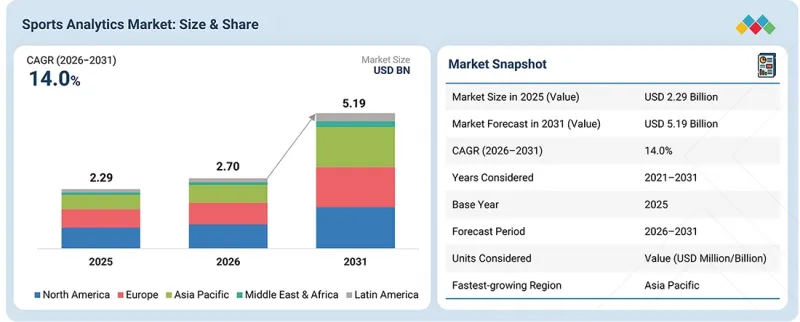
The sports analytics market is experiencing strong growth, projected to rise from USD 2.70 billion in 2026 to USD 5.19 billion by 2031, at a CAGR of 14.0% during the forecast period. As competitive demands intensify, sports organizations are shifting from observational coaching to data-driven performance models.
| Scope of the Report | |
|---|---|
| Years Considered for the Study | 2021-2031 |
| Base Year | 2025 |
| Forecast Period | 2026-2031 |
| Units Considered | USD Billion |
| Segments | Offering, Deployment Mode, Sports Type, Application, and Region |
| Regions covered | North America, Europe, Asia Pacific, Middle East & Africa, and Latin America |
Advanced analytics platforms are now central to optimizing training loads, monitoring biomechanics, and refining tactics. AI-powered tools convert real-time physiological and gameplay data into actionable insights that support precision coaching and injury mitigation. By embedding analytics into day-to-day operations, teams unlock consistent performance gains, accelerate player development, and make informed adjustments under pressure. This structured, analytics-first approach is transforming how clubs and federations manage talent, maximize output, and sustain long-term competitive advantages.
"Predictive analytics tools are expected to be the fastest-growing segment during the 2026-2031 forecast period"
Predictive analytics tools are expected to be the fastest-growing segment in the sports analytics market during the 2026-2031 forecast period, driven by increasing demand for outcome forecasting, injury risk assessment, player performance prediction, and real-time decision support. These tools leverage AI and machine learning to analyze historical and real-time sports data, enabling teams and organizations to identify performance patterns, anticipate potential risks, and support strategic decisions. Adoption is increasing across professional teams, leagues, and other sports organizations as they seek to improve player management, match preparation, and competitive performance. The growing availability of high-quality sports data and advancements in AI-powered predictive models are expected to further accelerate segment growth through 2031.
"Sports teams & clubs are expected to account for the largest share of the sports analytics market in 2026"
Based on end user, sports teams & clubs are expected to account for the largest share of the sports analytics market in 2026, supported by increasing investments in player performance optimization, injury prevention, workload management, and tactical decision-making. These organizations increasingly use player tracking, video analytics, biometric data, and predictive analytics to evaluate performance and gain competitive advantages. Growing adoption across professional leagues and clubs, along with the integration of AI-powered analytics into coaching and performance workflows, is expected to strengthen demand during the 2026-2031 forecast period.
"Asia Pacific is expected to be the fastest-growing region in the sports analytics market during the 2026-2031 forecast period"
Asia Pacific is expected to be the fastest-growing region in the sports analytics market during the 2026-2031 forecast period, driven by increasing digitization of sports, rising investments in professional leagues, and growing adoption of data-driven performance management. Countries such as India, Japan, Australia, and South Korea are increasingly adopting AI-powered analytics, player tracking, video analysis, performance monitoring, and predictive tools across professional and emerging sports. The rapid growth of cricket, football, esports, and other organized sports, along with expanding sports infrastructure and investments in sports technology, is further supporting market growth. Increasing use of analytics for player development, scouting, injury prevention, tactical analysis, and fan engagement is expected to accelerate adoption across the region through 2031.
Breakdown of Primaries
In-depth interviews were conducted with Chief Executive Officers (CEOs), innovation and technology directors, system integrators, and executives from various key organizations operating in the sports analytics market.
- By Company: Tier I - 25%, Tier II - 45%, and Tier III - 30%.
- By Designation: C-level executives - 35%, D-level executives - 40%, and others - 25%.
- By Region: North America - 45%, Europe - 25%, Asia Pacific - 15%, Middle East & Africa - 10%, and Latin America - 5%.
The report includes a study of key players offering sports analytics solutions. The major market players include IBM (US), SAS Institute (US), SAP (Germany), HCL Technologies (India), Salesforce (US), Zebra Technologies (US), Catapult (Australia), EXL (US), Chyron (US), GlobalStep (US), Stats Perform (UK), Exasol (Germany), DataArt (US), TruMedia Networks (US), Orreco (Ireland), Sportradar (Switzerland), WHOOP (US), Kitman Labs (Ireland), Hudl (US), Trace (US), Kinduct Technologies (Canada), Oracle (US), Uplift Labs (US), SportLogiq (Canada), L2P Limited (UK), Quant4Sport (Italy), Veo Technologies (Denmark), Carv (UK), Real Sports AI (India), Vekta (US), Zone14 (Austria), SportAI (Canada), BodyPro (US), HIT Coach (US), PULSE (Netherlands), PunchLab (Italy), Marelli (Italy), MoTeC (Australia), Race Technology (UK), and PandaScore (France).
Research Coverage
This research report categorizes the sports analytics market based on offering [solution (performance analytics software, video analytics platforms, predictive analytics tools, and other solutions) and services (professional services [training & consulting services, system integration & implementation services, and support & maintenance services] and managed services)], deployment mode (cloud, on-premises, and hybrid), sports type [team sports (cricket, football [soccer], American football/rugby, basketball, baseball, hockey, and volleyball), individual sports (tennis, athletics [track & field], golf, swimming, cycling, gymnastics, combat sports [boxing, mixed martial arts (MMA), wrestling, and judo], and other individual sports), racing sports (Formula 1, MotoGP, National Association for Stock Car Auto Racing [NASCAR], horse racing, and other racing sports), online or virtual sports (fantasy sports, online betting, daily fantasy leagues, online poker & card games, and other online sports), and emerging sports (digital extreme sports, Paralympic sports, and other emerging sports)], application [on-field (player load & movement analysis, player tracking & movement, injury prediction & health monitoring, biomechanical & kinematic analysis, training & recovery optimization, match fitness & performance benchmarking, and other on-field applications) and off-field (opposition scouting, in-game decision support, fan engagement & experience, sponsorship & marketing ROI, merchandise sales optimization, fan behavior tracking, and other off-field applications)], end user (sports teams & clubs, sports academies & colleges, sports leagues/associations & governing bodies, broadcasters & media companies, sponsorship & marketing agencies, sports equipment manufacturers, and sports betting companies), and region (North America, Europe, Asia Pacific, Middle East & Africa, and Latin America).
The scope of the report covers detailed information regarding drivers, restraints, challenges, and opportunities influencing the growth of the sports analytics market. A detailed analysis of the key industry players was done to provide insights into their business overview, solutions, and services; key strategies; contracts, partnerships, agreements, product & service launches, and mergers and acquisitions; and recent developments associated with the market. This report also covered the competitive analysis of upcoming startups in the market ecosystem.
Key Benefits of Buying the Report
The report will provide market leaders and new entrants with information on the closest approximations of the revenue numbers for the overall sports analytics market and its subsegments. It will help stakeholders understand the competitive landscape and gain more insights to better position their businesses and plan suitable go-to-market strategies. It will also help stakeholders understand the market's pulse and provide them with information on key market drivers, restraints, challenges, and opportunities.
The report provides insights into the following pointers:
- Analysis of key drivers (operationalize advanced analytics for performance enhancement, leveraging fan data to personalize and monetize consumer engagement, leverage predictive analytics to drive growth in betting and fantasy sports), restraints (persistent data silos undermine platform level analytics consolidation and accelerate real-time decision-making through AI-powered sports analytics), opportunities (enable scalable performance optimization in sports through modular analytics deployment and enhance tactical precision and player development with tailored analytics for esports optimization), and challenges (ensure data confidentiality and integrity with secure architectures and access control protocols and rapid software evolution limits analytics accessibility for smaller teams)
- Product Development/Innovation: Detailed insights into upcoming technologies, research & development activities, and product & service launches in sports analytics
- Market Development: Comprehensive information about lucrative markets - analyzing the market across varied regions
- Market Diversification: Exhaustive information about new solutions & services, untapped geographies, recent developments, and investments in the sports analytics market
- Competitive Assessment: In-depth assessment of market shares, growth strategies, and service offerings of leading players such as IBM (US), SAS Institute (US), SAP (Germany), HCL Technologies (India), Salesforce (US), Zebra Technologies (US), Catapult (Australia), EXL (US), Chyron (US), GlobalStep (US), Stats Perform (UK), Exasol (Germany), DataArt (US), TruMedia Networks (US), Orreco (Ireland), Sportradar (Switzerland), WHOOP (US), Kitman Labs (Ireland), Hudl (US), Trace (US), Kinduct Technologies (Canada), Oracle (US), Uplift Labs (US), Sportlogiq (Canada), L2P Limited (UK), Quant4Sport (Italy), Veo Technologies (Denmark), Carv (UK), Real Sports AI (India), Vekta (US), Zone14 (Austria), SportAI (Canada), BodyPro (US), HIT Coach (US), Pulse Sport (India), and Race Technology (UK)
TABLE OF CONTENTS
1 INTRODUCTION
- 1.1 STUDY OBJECTIVES
- 1.2 MARKET DEFINITION
- 1.2.1 INCLUSIONS AND EXCLUSIONS
- 1.3 MARKET SCOPE
- 1.3.1 MARKET SEGMENTATION
- 1.3.2 YEARS CONSIDERED
- 1.4 CURRENCY CONSIDERED
- 1.5 STAKEHOLDERS
- 1.6 SUMMARY OF CHANGES
2 EXECUTIVE SUMMARY
- 2.1 MARKET HIGHLIGHTS AND KEY INSIGHTS
- 2.2 KEY MARKET PARTICIPANTS: MAPPING OF STRATEGIC DEVELOPMENTS
- 2.3 DISRUPTIVE TRENDS IN SPORTS ANALYTICS MARKET
- 2.4 HIGH-GROWTH SEGMENTS
- 2.5 REGIONAL SNAPSHOT: MARKET SIZE, GROWTH RATE, AND FORECAST
3 PREMIUM INSIGHTS
- 3.1 ATTRACTIVE OPPORTUNITIES IN SPORTS ANALYTICS MARKET
- 3.2 SPORTS ANALYTICS MARKET, BY REGION
- 3.3 SPORTS ANALYTICS MARKET, BY DEPLOYMENT MODE
- 3.4 NORTH AMERICA: SPORTS ANALYTICS MARKET, BY OFFERING
- 3.5 SPORTS ANALYTICS MARKET, BY REGION
4 MARKET OVERVIEW
- 4.1 INTRODUCTION
- 4.2 MARKET DYNAMICS
- 4.2.1 DRIVERS
- 4.2.1.1 Operationalize Advanced Analytics for Performance Enhancement
- 4.2.1.2 Leveraging Fan Data to Personalize and Monetize Consumer Engagement
- 4.2.1.3 Harness Predictive Analytics to Accelerate Betting and Fantasy Sports Market Expansion
- 4.2.1.4 Accelerate Real-Time Decision-Making through AI-Powered Sports Analytics
- 4.2.2 RESTRAINTS
- 4.2.2.1 Persistent Data Silos Undermine Platform-Level Analytics Consolidation
- 4.2.2.2 High Implementation and Integration Costs Limit Analytics Adoption among Smaller Teams
- 4.2.3 OPPORTUNITIES
- 4.2.3.1 Enable Scalable Performance Optimization in Sports through Modular Analytics Deployment
- 4.2.3.2 Enhance Tactical Precision and Player Development with Tailored Analytics for Esports Optimization
- 4.2.4 CHALLENGES
- 4.2.4.1 Ensure Data Confidentiality and Integrity with Secure Architectures and Access Control Protocols
- 4.2.4.2 Rapid Software Evolution Limits Analytics Accessibility for Smaller Teams
- 4.2.1 DRIVERS
- 4.3 UNMET NEEDS AND WHITE SPACES
- 4.3.1 UNMET NEEDS IN SPORTS ANALYTICS MARKET
- 4.3.2 WHITE SPACE OPPORTUNITIES
- 4.4 INTERCONNECTED MARKETS AND CROSS-SECTOR OPPORTUNITIES
- 4.4.1 INTERCONNECTED MARKETS
- 4.4.2 CROSS-SECTOR OPPORTUNITIES
- 4.5 STRATEGIC MOVES BY TIER-1/2/3 PLAYERS
- 4.5.1 STRATEGIC MOVES BY TIER-1/2/3 PLAYERS
5 INDUSTRY TRENDS
- 5.1 EVOLUTION OF SPORTS ANALYTICS MARKET
- 5.2 PORTER'S FIVE FORCES ANALYSIS
- 5.2.1 THREAT OF NEW ENTRANTS
- 5.2.2 THREAT OF SUBSTITUTES
- 5.2.3 BARGAINING POWER OF SUPPLIERS
- 5.2.4 BARGAINING POWER OF BUYERS
- 5.2.5 INTENSITY OF COMPETITIVE RIVALRY
- 5.3 MACROECONOMIC OUTLOOK
- 5.3.1 INTRODUCTION
- 5.3.2 GDP TRENDS AND FORECAST
- 5.3.3 TRENDS IN GLOBAL SPORTS ANALYTICS DATA INDUSTRY
- 5.3.4 TRENDS IN GLOBAL ARTIFICIAL INTELLIGENCE INDUSTRY
- 5.4 SUPPLY CHAIN ANALYSIS
- 5.5 ECOSYSTEM ANALYSIS
- 5.5.1 TEAM SPORTS
- 5.5.2 INDIVIDUAL SPORTS
- 5.5.3 RACING SPORTS
- 5.5.4 ONLINE OR VIRTUAL SPORTS
- 5.5.5 EMERGING SPORTS
- 5.6 PRICING ANALYSIS
- 5.6.1 AVERAGE SELLING PRICE OF OFFERING, BY KEY PLAYER, 2026
- 5.6.2 AVERAGE SELLING PRICE, BY SPORT TYPE, 2026
- 5.7 KEY CONFERENCES AND EVENTS, 2026-2027
- 5.8 TRENDS/DISRUPTIONS IMPACTING CUSTOMER BUSINESS
- 5.9 INVESTMENT LANDSCAPE AND FUNDING SCENARIO
- 5.10 CASE STUDY ANALYSIS
- 5.10.1 CASE STUDY 1: IBM AND ESPN TRANSFORM FANTASY FOOTBALL EXPERIENCE WITH SCALABLE, AI-DRIVEN DECISION SUPPORT
- 5.10.2 CASE STUDY 2: ORLANDO MAGIC AND SAS INSTITUTE LEVERAGE ANALYTICS TO OVERCOME REVENUE CHALLENGES
- 5.10.3 CASE STUDY 3: BOSTON CELTICS AND MISSION CLOUD ACCELERATING DATA ANALYTICS AND ENHANCING OPERATIONAL EFFICIENCY THROUGH CLOUD
- 5.11 IMPACT OF 2025 US TARIFF - SPORTS ANALYTICS MARKET
- 5.11.1 INTRODUCTION
- 5.11.1.1 Tariff/Trade Policy Updates (June-August 2026)
- 5.11.2 KEY TARIFF RATES
- 5.11.3 PRICE IMPACT ANALYSIS
- 5.11.3.1 Strategic shifts and emerging trends
- 5.11.4 IMPACT ON COUNTRY/REGION
- 5.11.4.1 US
- 5.11.4.2 China
- 5.11.4.3 Europe
- 5.11.4.4 Asia Pacific (excluding China)
- 5.11.5 IMPACT ON END-USE INDUSTRIES
- 5.11.1 INTRODUCTION
6 TECHNOLOGICAL ADVANCEMENTS, PATENTS, INNOVATIONS, AND FUTURE APPLICATIONS
- 6.1 KEY TECHNOLOGIES
- 6.1.1 AI-BASED COMPUTER VISION & VIDEO ANALYTICS
- 6.1.2 PLAYER & BALL TRACKING TECHNOLOGIES
- 6.1.3 WEARABLE & BIOMETRIC SENSOR TECHNOLOGIES
- 6.1.4 AI & MACHINE LEARNING
- 6.1.5 REAL-TIME SPORTS DATA & PERFORMANCE ANALYTICS
- 6.2 COMPLEMENTARY TECHNOLOGIES
- 6.2.1 CLOUD COMPUTING & BIG DATA ANALYTICS
- 6.2.2 EDGE COMPUTING
- 6.2.3 INTERNET OF THINGS (IOT)
- 6.2.4 SPORTS DATA INTEGRATION & API TECHNOLOGIES
- 6.2.5 HIGH-PRECISION POSITIONING TECHNOLOGIES
- 6.3 ADJACENT TECHNOLOGIES
- 6.3.1 ADVANCED BIOMECHANICS & MOTION ANALYSIS
- 6.3.2 AUGMENTED REALITY (AR) & VIRTUAL REALITY (VR)
- 6.3.3 DIGITAL TWIN TECHNOLOGIES FOR SPORTS
- 6.3.4 SPORTS SIMULATION & SCENARIO MODELING
- 6.3.5 NATURAL LANGUAGE PROCESSING (NLP) & GENERATIVE AI
- 6.4 TECHNOLOGY ROADMAP
- 6.5 PATENT ANALYSIS
- 6.5.1 METHODOLOGY
- 6.5.2 PATENTS FILED, BY DOCUMENT TYPE, 2016-2026
- 6.5.3 INNOVATION AND PATENT APPLICATIONS
- 6.6 FUTURE OUTLOOK & EMERGING USE CASES
- 6.6.1 NEXT-GEN FAN ENGAGEMENT MODELS
- 6.6.2 PERSONALIZED ATHLETE HEALTH AND NUTRITION
- 6.6.3 RISE OF BETTING AND FANTASY SPORTS ANALYTICS
- 6.6.4 INTEGRATION WITH ESPORTS AND VIRTUAL LEAGUES
7 REGULATORY LANDSCAPE
- 7.1 REGULATORY LANDSCAPE
- 7.1.1 REGULATORY BODIES, GOVERNMENT AGENCIES, AND OTHER ORGANIZATIONS
- 7.1.2 KEY REGULATIONS
- 7.1.2.1 North America
- 7.1.2.1.1 US
- 7.1.2.1.2 Canada
- 7.1.2.2 Europe
- 7.1.2.2.1 UK
- 7.1.2.3 Asia Pacific
- 7.1.2.3.1 India
- 7.1.2.3.2 China
- 7.1.2.3.3 Japan
- 7.1.2.3.4 South Korea
- 7.1.2.3.5 Australia
- 7.1.2.3.6 New Zealand
- 7.1.2.4 Middle East & Africa
- 7.1.2.4.1 Saudi Arabia
- 7.1.2.4.2 UAE
- 7.1.2.4.3 Qatar
- 7.1.2.4.4 Turkey
- 7.1.2.4.5 South Africa
- 7.1.2.5 Latin America
- 7.1.2.5.1 Brazil
- 7.1.2.1 North America
- 7.1.3 INDUSTRY STANDARDS
8 CUSTOMER LANDSCAPE & BUYER BEHAVIOR
- 8.1 DECISION-MAKING PROCESS
- 8.2 KEY STAKEHOLDERS AND BUYING CRITERIA
- 8.2.1 KEY STAKEHOLDERS IN BUYING PROCESS
- 8.2.2 BUYING CRITERIA
- 8.3 ADOPTION BARRIERS & INTERNAL CHALLENGES
- 8.4 UNMET NEEDS FROM VARIOUS INDUSTRY END USERS
9 SPORTS ANALYTICS MARKET, BY OFFERING
- 9.1 INTRODUCTION
- 9.1.1 OFFERING: SPORTS ANALYTICS MARKET DRIVERS
- 9.2 SOLUTIONS
- 9.2.1 PERFORMANCE ANALYTICS SOFTWARE
- 9.2.1.1 Enhancing Player Efficiency and Tactical Accuracy through Performance Insights
- 9.2.2 VIDEO ANALYTICS SOFTWARE
- 9.2.2.1 Driving Tactical Precision and Visual Breakdown for Smarter Game Planning
- 9.2.3 PREDICTIVE ANALYTICAL TOOLS
- 9.2.3.1 Optimizing Strategic Forecasting and Outcome Modeling with Advanced Predictive Tools
- 9.2.4 OTHER SOLUTIONS
- 9.2.4.1 Expanding Strategic Impact Through Audience Intelligence and Data-Led Talent Acquisition
- 9.2.1 PERFORMANCE ANALYTICS SOFTWARE
- 9.3 SERVICES
- 9.3.1 PROFESSIONAL SERVICES
- 9.3.1.1 Aligning Analytics Execution with Strategic Objectives Through Expert-Led Services
- 9.3.1.2 Training & Consulting Services
- 9.3.1.3 System Integration & Implementation Services
- 9.3.1.4 Support & Maintenance Services
- 9.3.2 MANAGED SERVICES
- 9.3.2.1 Ensuring Seamless Operations and Scalable Performance Through Managed Analytics Services
- 9.3.1 PROFESSIONAL SERVICES
10 SPORTS ANALYTICS MARKET, BY DEPLOYMENT MODE
- 10.1 INTRODUCTION
- 10.1.1 DEPLOYMENT MODE: SPORTS ANALYTICS MARKET DRIVERS
- 10.2 CLOUD
- 10.2.1 ENABLING SCALABLE, REAL-TIME ANALYTICS WITH FLEXIBLE CLOUD-BASED INFRASTRUCTURE
- 10.3 ON-PREMISES
- 10.3.1 DELIVERING DATA CONTROL AND COMPLIANCE THROUGH ON-PREMISES DEPLOYMENT MODELS
- 10.4 HYBRID
- 10.4.1 BALANCING FLEXIBILITY AND CONTROL WITH HYBRID DEPLOYMENT IN SPORTS ANALYTICS
11 SPORTS ANALYTICS MARKET, BY SPORTS TYPE
- 11.1 INTRODUCTION
- 11.1.1 SPORTS TYPE: SPORTS ANALYTICS MARKET DRIVERS
- 11.2 TEAM SPORTS
- 11.2.1 ENHANCING TACTICAL COORDINATION AND SCALABLE FAN ENGAGEMENT THROUGH SPORTS INTELLIGENCE TOOLS
- 11.2.2 CRICKET
- 11.2.3 FOOTBALL (SOCCER)
- 11.2.4 AMERICAN FOOTBALL/RUGBY
- 11.2.5 BASKETBALL
- 11.2.6 BASEBALL
- 11.2.7 HOCKEY
- 11.2.8 VOLLEYBALL
- 11.2.9 OTHER TEAM SPORTS
- 11.3 INDIVIDUAL SPORTS
- 11.3.1 PERSONALIZED PERFORMANCE OPTIMIZATION DRIVING ANALYTICS ADOPTION IN INDIVIDUAL SPORTS
- 11.3.2 TENNIS
- 11.3.3 ATHLETICS (TRACK & FIELD)
- 11.3.4 GOLF
- 11.3.5 SWIMMING
- 11.3.6 CYCLING
- 11.3.7 GYMNASTICS
- 11.3.8 COMBAT SPORTS
- 11.3.8.1 Boxing
- 11.3.8.2 Mixed Martial Arts (MMA)
- 11.3.8.3 Wrestling
- 11.3.8.4 Judo
- 11.3.9 OTHER INDIVIDUAL SPORTS
- 11.4 RACING SPORTS
- 11.4.1 IMPROVING TACTICAL ACCURACY AND COMPETITIVE CONSISTENCY IN RACE ENVIRONMENTS
- 11.4.2 FORMULA 1
- 11.4.3 MOTOGP
- 11.4.4 NATIONAL ASSOCIATION FOR STOCK CAR AUTO RACING (NASCAR)
- 11.4.5 HORSE RACING
- 11.4.6 OTHER RACING SPORTS
- 11.5 ONLINE OR VIRTUAL SPORTS
- 11.5.1 DRIVING ENGAGEMENT AND MONETIZATION THROUGH REAL-TIME COMPETITIVE INTELLIGENCE
- 11.5.2 FANTASY SPORTS
- 11.5.3 ONLINE BETTING
- 11.5.4 DAILY FANTASY SPORTS
- 11.5.5 ONLINE POKER & CARD GAMES
- 11.5.6 OTHER ONLINE SPORTS
- 11.6 EMERGING SPORTS
- 11.6.1 BUILDING DATA-FIRST GROWTH MODELS FOR NICHE AND HYBRID SPORTS FORMATS
- 11.6.2 DIGITAL EXTREME SPORTS
- 11.6.3 PARALYMPIC SPORTS
- 11.6.4 OTHER EMERGING SPORTS
12 SPORTS ANALYTICS MARKET, BY APPLICATION
- 12.1 INTRODUCTION
- 12.1.1 APPLICATION: SPORTS ANALYTICS MARKET DRIVERS
- 12.2 ON-FIELD
- 12.2.1 MAXIMIZING ON-FIELD PERFORMANCE THROUGH TACTICAL INSIGHTS AND REAL-TIME DECISION SUPPORT
- 12.2.2 PLAYER PERFORMANCE ANALYSIS
- 12.2.3 TACTICAL AND POSITIONAL ANALYSIS
- 12.2.4 GAME STRATEGY OPTIMIZATION
- 12.2.5 FATIGUE & WORKLOAD MONITORING
- 12.2.6 OPPONENT SCOUTING AND MATCH PREPARATION
- 12.2.7 INJURY RISK PREDICTION
- 12.2.8 OTHER ON-FIELD APPLICATIONS
- 12.3 OFF-FIELD
- 12.3.1 OPTIMIZING OFF-FIELD DECISIONS THROUGH STRATEGIC, OPERATIONAL, AND COMMERCIAL ANALYTICS
- 12.3.2 FAN ENGAGEMENT ANALYTICS
- 12.3.3 SPONSORSHIP VALUATION AND ROI TRACKING
- 12.3.4 TICKETING AND ATTENDANCE FORECASTING
- 12.3.5 SOCIAL MEDIA AND SENTIMENT ANALYSIS
- 12.3.6 MERCHANDISE SALES OPTIMIZATION
- 12.3.7 OTHER OFF-FIELD APPLICATIONS
13 SPORTS ANALYTICS MARKET, BY END USER
- 13.1 INTRODUCTION
- 13.1.1 END USER: SPORTS ANALYTICS MARKET DRIVERS
- 13.1.2 SPORTS TEAMS & CLUBS
- 13.1.2.1 Leveraging Data to Enhance Competitive Performance and Guide Tactical, Physical, and Talent Decisions
- 13.1.3 SPORTS ACADEMIES & COLLEGES
- 13.1.3.1 Driving Athlete Development and Curriculum Design Through Integrated Performance and Training Analytics
- 13.1.4 SPORTS LEAGUES/ASSOCIATIONS & GOVERNING BODIES
- 13.1.4.1 Sports Leagues Helps in Optimizing Competition Integrity and Strategic Growth Through Data-Driven Oversight
- 13.1.5 BROADCASTERS & MEDIA COMPANIES
- 13.1.5.1 Enhancing Viewer Experience and Content Strategy Through Real-Time Performance and Audience Analytics
- 13.1.6 SPONSORSHIP & MARKETING AGENCIES
- 13.1.6.1 Using Fan Engagement and Performance Data to Maximize Sponsorship and Campaign Outcomes
- 13.1.7 SPORTS EQUIPMENT MANUFACTURERS
- 13.1.7.1 Driving Product Innovation and Athlete-Centric Solutions Through Data Insights and Performance Trends
- 13.1.8 SPORTS BETTING COMPANIES
- 13.1.8.1 Maximizing Competitive Advantage Through Real-Time Data and Predictive Analytics in Betting Operations
- 13.1.9 OTHERS
- 13.1.9.1 Driving Performance, Rehabilitation, and Innovation Through Rising Demand for Data-Backed Health and Training Solutions
14 SPORTS ANALYTICS MARKET, BY REGION
- 14.1 INTRODUCTION
- 14.2 NORTH AMERICA
- 14.2.1 NORTH AMERICA: SPORTS ANALYTICS MARKET DRIVERS
- 14.2.2 US
- 14.2.2.1 Integrating Sports Analytics for Performance Optimization and Enhanced Betting Insights
- 14.2.3 CANADA
- 14.2.3.1 Advancing Canadian Sports Analytics with Virtual and Fantasy Sports
- 14.3 EUROPE
- 14.3.1 EUROPE: SPORTS ANALYTICS MARKET DRIVERS
- 14.3.2 EUROPE: MACROECONOMIC OUTLOOK
- 14.3.3 UK
- 14.3.3.1 Empowering Data-Centric Engagement through Strategic Collaborations
- 14.3.4 GERMANY
- 14.3.4.1 Advancing Competitive Edge through Integrated Predictive Analytics
- 14.3.5 FRANCE
- 14.3.5.1 Transforming Tactical Dynamics and Academy Outcomes via Advanced Analytics
- 14.3.6 ITALY
- 14.3.6.1 Optimizing Coaching and Recruitment Methodologies with Data-Driven Intelligence
- 14.3.7 SPAIN
- 14.3.7.1 Elevating Tactical Intelligence and Fan Connection through Data Modeling
- 14.3.8 REST OF EUROPE
- 14.4 ASIA PACIFIC
- 14.4.1 ASIA PACIFIC: SPORTS ANALYTICS MARKET DRIVERS
- 14.4.2 CHINA
- 14.4.2.1 Leveraging Analytics for Optimized Athlete Performance and Enhanced Data-Driven Decisions
- 14.4.3 JAPAN
- 14.4.3.1 Olympic-Focused Investment and Institutional Partnerships Accelerate Analytics Adoption Across Sports
- 14.4.4 INDIA
- 14.4.4.1 Real-Time Performance Analysis Accelerates Team Strategy and Player Development Nationwide
- 14.4.5 SOUTH KOREA
- 14.4.5.1 Maximizing Competitive Gains Through Data-Driven Decisions in eSports
- 14.4.6 AUSTRALIA & NEW ZEALAND
- 14.4.6.1 Integrated Analytics Adoption and Collaboration Drive Sporting Excellence in Australia and New Zealand Sports
- 14.4.7 SINGAPORE
- 14.4.7.1 National Data Exchange Enhances Athlete Performance and Institutional Planning
- 14.4.8 REST OF ASIA PACIFIC
- 14.5 MIDDLE EAST & AFRICA
- 14.5.1 MIDDLE EAST & AFRICA: SPORTS ANALYTICS MARKET DRIVERS
- 14.5.2 SAUDI ARABIA
- 14.5.2.1 Vision 2030 and Club-Tech Partnerships Drive Analytics-Led Sports Innovation
- 14.5.3 UAE
- 14.5.3.1 Advancing Talent and Increased Fan Engagement Through Targeted Analytics Adoption in UAE
- 14.5.4 SOUTH AFRICA
- 14.5.4.1 Digital Integration and Youth Development Propel South Africa's Sports Analytics Momentum
- 14.5.5 QATAR
- 14.5.5.1 Embedding Advanced Sports Analytics Across Qatar for Enhanced Talent and Fan Experiences
- 14.5.6 TURKEY
- 14.5.6.1 Elevating Turkish Football and Basketball Growth Through Targeted Club and Federation Analytics Partnerships
- 14.5.7 REST OF MIDDLE EAST & AFRICA
- 14.6 LATIN AMERICA
- 14.6.1 LATIN AMERICA: SPORTS ANALYTICS MARKET DRIVERS
- 14.6.2 BRAZIL
- 14.6.2.1 Institutional Backing and Club Innovation Accelerate Data-Driven Athletic Advancements
- 14.6.3 MEXICO
- 14.6.3.1 Sports Analytics Advances Tactical Precision and Fan Engagement in Mexican Leagues
- 14.6.4 ARGENTINA
- 14.6.4.1 Performance Intelligence Fuels Argentina's Academy Systems and Strategic Decision Making
- 14.6.5 REST OF LATIN AMERICA
15 COMPETITIVE LANDSCAPE
- 15.1 OVERVIEW
- 15.2 KEY PLAYER STRATEGIES/RIGHT TO WIN, 2021-2025
- 15.3 REVENUE ANALYSIS, 2021-2025
- 15.4 MARKET SHARE ANALYSIS, 2025
- 15.5 PRODUCT COMPARATIVE ANALYSIS
- 15.5.1 PRODUCT COMPARATIVE ANALYSIS, BY SPORTS TYPE (TEAM SPORTS)
- 15.5.2 PRODUCT COMPARATIVE ANALYSIS, BY SPORTS TYPE (INDIVIDUAL SPORTS)
- 15.5.3 PRODUCT COMPARATIVE ANALYSIS, BY SPORTS TYPE (ONLINE OR VIRTUAL SPORTS)
- 15.6 COMPANY VALUATION AND FINANCIAL METRICS
- 15.7 COMPANY EVALUATION MATRIX: KEY PLAYERS, 2025
- 15.7.1 STARS
- 15.7.2 EMERGING LEADERS
- 15.7.3 PERVASIVE PLAYERS
- 15.7.4 PARTICIPANTS
- 15.7.5 COMPANY FOOTPRINT: KEY PLAYERS, 2025
- 15.7.5.1 Company footprint
- 15.7.5.2 Regional footprint
- 15.7.5.3 Offering footprint
- 15.7.5.4 Sports type footprint
- 15.7.5.5 End user footprint
- 15.8 COMPANY EVALUATION MATRIX: STARTUPS/SMES, 2025
- 15.8.1 PROGRESSIVE COMPANIES
- 15.8.2 RESPONSIVE COMPANIES
- 15.8.3 DYNAMIC COMPANIES
- 15.8.4 STARTING BLOCKS
- 15.8.5 COMPETITIVE BENCHMARKING: STARTUPS/SMES, 2025
- 15.8.5.1 Detailed list of key startups/SMEs
- 15.8.5.2 Competitive benchmarking of key startups/SMEs
- 15.9 COMPETITIVE SCENARIO AND TRENDS
- 15.9.1 PRODUCT LAUNCHES AND ENHANCEMENTS
- 15.9.2 DEALS
16 COMPANY PROFILES
- 16.1 INTRODUCTION
- 16.2 KEY PLAYERS
- 16.2.1 IBM
- 16.2.1.1 Business overview
- 16.2.1.2 Products/Solutions/Services offered
- 16.2.1.3 Recent developments
- 16.2.1.3.1 Product Launches and Enhancements
- 16.2.1.3.2 Deals
- 16.2.1.4 MnM view
- 16.2.1.4.1 Key strengths
- 16.2.1.4.2 Strategic choices
- 16.2.1.4.3 Weaknesses and competitive threats
- 16.2.2 SAP
- 16.2.2.1 Business overview
- 16.2.2.2 Products/Solutions/Services offered
- 16.2.2.3 Recent developments
- 16.2.2.3.1 Product Enhancements
- 16.2.2.3.2 Deals
- 16.2.2.4 MnM view
- 16.2.2.4.1 Key strengths
- 16.2.2.4.2 Strategic choices
- 16.2.2.4.3 Weaknesses and competitive threats
- 16.2.3 SAS INSTITUTE
- 16.2.3.1 Business overview
- 16.2.3.2 Products/Solutions/Services offered
- 16.2.3.3 Recent developments
- 16.2.3.3.1 Product Enhancements
- 16.2.3.3.2 Deals
- 16.2.3.4 MnM view
- 16.2.3.4.1 Key strengths
- 16.2.3.4.2 Strategic choices
- 16.2.3.4.3 Weaknesses and competitive threats
- 16.2.4 HCL TECHNOLOGIES
- 16.2.4.1 Business overview
- 16.2.4.2 Products/Solutions/Services offered
- 16.2.4.3 Recent developments
- 16.2.4.3.1 Product Launches and Enhancements
- 16.2.4.3.2 Deals
- 16.2.4.4 MnM view
- 16.2.4.4.1 Key strengths
- 16.2.4.4.2 Strategic choices
- 16.2.4.4.3 Weaknesses and competitive threats
- 16.2.5 ZEBRA TECHNOLOGIES
- 16.2.5.1 Business overview
- 16.2.5.2 Products/Solutions/Services offered
- 16.2.5.3 Recent developments
- 16.2.5.3.1 Product Launches and Enhancements
- 16.2.5.3.2 Deals
- 16.2.5.4 MnM view
- 16.2.5.4.1 Key strengths
- 16.2.5.4.2 Strategic choices
- 16.2.5.4.3 Weaknesses and competitive threats
- 16.2.6 GLOBALSTEP
- 16.2.6.1 Business overview
- 16.2.6.2 Products/Solutions/Services offered
- 16.2.6.3 Recent developments
- 16.2.6.3.1 Product Enhancements
- 16.2.6.3.2 Deals
- 16.2.7 STATS PERFORM
- 16.2.7.1 Business overview
- 16.2.7.2 Products/Solutions/Services offered
- 16.2.7.3 Recent developments
- 16.2.7.3.1 Product Launches
- 16.2.7.3.2 Deals
- 16.2.8 SPORTRADAR
- 16.2.8.1 Business overview
- 16.2.8.2 Products/Solutions/Services offered
- 16.2.8.3 Recent developments
- 16.2.8.3.1 Product Launches
- 16.2.8.3.2 Deals
- 16.2.9 HUDL
- 16.2.9.1 Business overview
- 16.2.9.2 Products/Solutions/Services offered
- 16.2.9.3 Recent developments
- 16.2.9.3.1 Product enhancements
- 16.2.9.3.2 Deals
- 16.2.10 EXL
- 16.2.10.1 Business overview
- 16.2.10.2 Products/Solutions/Services offered
- 16.2.1 IBM
- 16.3 OTHER PLAYERS
- 16.3.1 MOTEC (BOSCH)
- 16.3.2 CHYRON
- 16.3.3 CATAPULT
- 16.3.4 SPORTS ANALYTICS WORLD
- 16.3.5 VEKTA
- 16.3.6 BODYPRO (HEALTHCENTRAL NETWORK)
- 16.3.7 ZONE14
- 16.3.8 SPORTLOGIQ
- 16.3.9 UPLIFT LABS
- 16.3.10 KITMAN LABS
- 16.3.11 ORRECO
- 16.3.12 TRUMEDIA NETWORKS
- 16.3.13 VEO TECHNOLOGIES
- 16.3.14 SPORTANALYTICS
- 16.3.15 SPORTAI
- 16.3.16 RACE TECHNOLOGY
- 16.3.17 PANDASCORE
17 RESEARCH METHODOLOGY
- 17.1 RESEARCH DATA
- 17.1.1 SECONDARY DATA
- 17.1.2 PRIMARY DATA
- 17.1.2.1 Primary Interviews
- 17.1.2.2 Breakdown of Primary Profiles
- 17.1.2.3 Key industry insights
- 17.2 MARKET BREAKDOWN AND DATA TRIANGULATION
- 17.3 MARKET SIZE ESTIMATION
- 17.3.1 TOP-DOWN APPROACH
- 17.3.2 BOTTOM-UP APPROACH
- 17.4 MARKET FORECAST
- 17.5 STUDY ASSUMPTIONS
- 17.6 STUDY LIMITATIONS
18 ADJACENT AND RELATED MARKETS
- 18.1 INTRODUCTION
- 18.2 AI IN SPORTS MARKET - GLOBAL FORECAST TO 2030
- 18.2.1 MARKET DEFINITION
- 18.2.2 MARKET OVERVIEW
- 18.2.2.1 AI in Sports Market, by Offering
- 18.2.2.2 AI in Sports Market, by End User
- 18.2.2.3 AI in Sports Market, by Region
- 18.3 AI IN MEDIA MARKET- GLOBAL FORECAST TO 2030
- 18.3.1 MARKET DEFINITION
- 18.3.2 MARKET OVERVIEW
- 18.3.2.1 AI in Media market, by Offering
- 18.3.2.2 AI in Media market, by Application
- 18.3.2.3 AI in media market, by End User
- 18.3.2.4 AI in Media market, by Region
19 APPENDIX
- 19.1 DISCUSSION GUIDE
- 19.2 KNOWLEDGESTORE: MARKETSANDMARKETS' SUBSCRIPTION PORTAL
- 19.3 CUSTOMIZATION OPTIONS
- 19.4 RELATED REPORTS
- 19.5 AUTHOR DETAILS
List of Tables
- TABLE 1 UNITED STATES DOLLAR EXCHANGE RATES, 2023-2025
- TABLE 2 PORTER'S FIVE FORCES IMPACT ON THE SPORTS ANALYTICS MARKET
- TABLE 3 GDP PERCENTAGE CHANGE, BY KEY COUNTRY, 2026-2031
- TABLE 4 SPORTS ANALYTICS MARKET: ROLE OF PLAYERS IN ECOSYSTEM
- TABLE 5 AVERAGE SELLING PRICE OF OFFERING, BY KEY PLAYER, 2026
- TABLE 6 AVERAGE SELLING PRICE, BY SPORTS TYPE, 2026
- TABLE 7 SPORT ANALYTICS MARKET: LIST OF CONFERENCES AND EVENTS, 2026-2027
- TABLE 8 TARIFF/TRADE POLICY UPDATES (JUNE-AUGUST 2026)
- TABLE 9 US-ADJUSTED RECIPROCAL TARIFF RATES
- TABLE 10 PATENTS FILED, 2016-2026
- TABLE 11 LIST OF TOP PATENTS IN SPORTS ANALYTICS MARKET
- TABLE 12 NORTH AMERICA: LIST OF REGULATORY BODIES, GOVERNMENT AGENCIES, AND OTHER ORGANIZATIONS
- TABLE 13 EUROPE: LIST OF REGULATORY BODIES, GOVERNMENT AGENCIES, AND OTHER ORGANIZATIONS
- TABLE 14 ASIA PACIFIC: LIST OF REGULATORY BODIES, GOVERNMENT AGENCIES, AND OTHER ORGANIZATIONS
- TABLE 15 MIDDLE EAST & AFRICA: LIST OF REGULATORY BODIES, GOVERNMENT AGENCIES, AND OTHER ORGANIZATIONS
- TABLE 16 LATIN AMERICA: LIST OF REGULATORY BODIES, GOVERNMENT AGENCIES, AND OTHER ORGANIZATIONS
- TABLE 17 GLOBAL INDUSTRY STANDARDS FOR SPORTS ANALYTICS
- TABLE 18 INFLUENCE OF STAKEHOLDERS ON BUYING PROCESS FOR TOP THREE END USERS
- TABLE 19 KEY BUYING CRITERIA FOR TOP THREE END USERS
- TABLE 20 UNMET NEEDS IN SPORTS ANALYTICS MARKET, BY END USER
- TABLE 21 SPORTS ANALYTICS MARKET, BY OFFERING, 2021-2025 (USD MILLION)
- TABLE 22 SPORTS ANALYTICS MARKET, BY OFFERING, 2026-2031 (USD MILLION)
- TABLE 23 SPORTS ANALYTICS MARKET, BY SOLUTION, 2021-2025 (USD MILLION)
- TABLE 24 SPORTS ANALYTICS MARKET, BY SOLUTION, 2026-2031 (USD MILLION)
- TABLE 25 SOLUTION: SPORTS ANALYTICS MARKET, BY REGION, 2021-2025 (USD MILLION)
- TABLE 26 SOLUTION: SPORTS ANALYTICS MARKET, BY REGION, 2026-2031 (USD MILLION)
- TABLE 27 PERFORMANCE ANALYTICS SOFTWARE: SPORTS ANALYTICS MARKET, BY REGION, 2021-2025 (USD MILLION)
- TABLE 28 PERFORMANCE ANALYTICS SOFTWARE: SPORTS ANALYTICS MARKET, BY REGION, 2026-2031 (USD MILLION)
- TABLE 29 VIDEO ANALYTICS SOFTWARE: SPORTS ANALYTICS MARKET, BY REGION, 2021-2025 (USD MILLION)
- TABLE 30 VIDEO ANALYTICS SOFTWARE: SPORTS ANALYTICS MARKET, BY REGION, 2026-2031 (USD MILLION)
- TABLE 31 PREDICTIVE ANALYTICAL TOOLS: SPORTS ANALYTICS MARKET, BY REGION, 2021-2025 (USD MILLION)
- TABLE 32 PREDICTIVE ANALYTICAL TOOLS: SPORTS ANALYTICS MARKET, BY REGION, 2026-2031 (USD MILLION)
- TABLE 33 OTHER SOLUTIONS: SPORTS ANALYTICS MARKET, BY REGION, 2021-2025 (USD MILLION)
- TABLE 34 OTHER SOLUTIONS: SPORTS ANALYTICS MARKET, BY REGION, 2026-2031 (USD MILLION)
- TABLE 35 SPORTS ANALYTICS MARKET, BY SERVICE, 2021-2025 (USD MILLION)
- TABLE 36 SPORTS ANALYTICS MARKET, BY SERVICE, 2026-2031 (USD MILLION)
- TABLE 37 ERVICES: SPORTS ANALYTICS MARKET, BY REGION, 2021-2025 (USD MILLION)
- TABLE 38 SERVICES: SPORTS ANALYTICS MARKET, BY REGION, 2026-2031 (USD MILLION)
- TABLE 39 SPORTS ANALYTICS MARKET, BY PROFESSIONAL SERVICE, 2021-2025 (USD MILLION)
- TABLE 40 SPORTS ANALYTICS MARKET, BY PROFESSIONAL SERVICE, 2026-2031 (USD MILLION)
- TABLE 41 PROFESSIONAL SERVICES: SPORTS ANALYTICS MARKET, BY REGION, 2021-2025 (USD MILLION)
- TABLE 42 PROFESSIONAL SERVICES: SPORTS ANALYTICS MARKET, BY REGION, 2026-2031 (USD MILLION)
- TABLE 43 TRAINING & CONSULTING SERVICES: SPORTS ANALYTICS MARKET, BY REGION, 2021-2025 (USD MILLION)
- TABLE 44 TRAINING & CONSULTING SERVICES: SPORTS ANALYTICS MARKET, BY REGION, 2026-2031 (USD MILLION)
- TABLE 45 SYSTEM INTEGRATION & IMPLEMENTATION SERVICES: SPORTS ANALYTICS MARKET, BY REGION, 2021-2025 (USD MILLION)
- TABLE 46 SYSTEM INTEGRATION & IMPLEMENTATION SERVICES: SPORTS ANALYTICS MARKET, BY REGION, 2026-2031 (USD MILLION)
- TABLE 47 SUPPORT & MAINTENANCE SERVICES: SPORTS ANALYTICS MARKET, BY REGION, 2021-2025 (USD MILLION)
- TABLE 48 SUPPORT & MAINTENANCE SERVICES: SPORTS ANALYTICS MARKET, BY REGION, 2026-2031 (USD MILLION)
- TABLE 49 MANAGED SERVICES: SPORTS ANALYTICS MARKET, BY REGION, 2021-2025 (USD MILLION)
- TABLE 50 MANAGED SERVICES: SPORTS ANALYTICS MARKET, BY REGION, 2026-2031 (USD MILLION)
- TABLE 51 SPORTS ANALYTICS MARKET, BY DEPLOYMENT MODE, 2021-2025 (USD MILLION)
- TABLE 52 SPORTS ANALYTICS MARKET, BY DEPLOYMENT MODE, 2026-2031 (USD MILLION)
- TABLE 53 CLOUD: SPORTS ANALYTICS MARKET, BY REGION, 2021-2025 (USD MILLION)
- TABLE 54 CLOUD: SPORTS ANALYTICS MARKET, BY REGION, 2026-2031 (USD MILLION)
- TABLE 55 ON-PREMISES: SPORTS ANALYTICS MARKET, BY REGION, 2021-2025 (USD MILLION)
- TABLE 56 ON-PREMISES: SPORTS ANALYTICS MARKET, BY REGION, 2026-2031 (USD MILLION)
- TABLE 57 HYBRID: SPORTS ANALYTICS MARKET, BY REGION, 2021-2025 (USD MILLION)
- TABLE 58 HYBRID: SPORTS ANALYTICS MARKET, BY REGION, 2026-2031 (USD MILLION)
- TABLE 59 SPORTS ANALYTICS MARKET, BY SPORTS TYPE, 2021-2025 (USD MILLION)
- TABLE 60 SPORTS ANALYTICS MARKET, BY SPORTS TYPE, 2026-2031 (USD MILLION)
- TABLE 61 SPORTS ANALYTICS MARKET, BY TEAM SPORTS, 2021-2025 (USD MILLION)
- TABLE 62 SPORTS ANALYTICS MARKET, BY TEAM SPORTS, 2026-2031 (USD MILLION)
- TABLE 63 TEAM SPORTS: SPORTS ANALYTICS MARKET, BY REGION, 2021-2025 (USD MILLION)
- TABLE 64 TEAM SPORTS: SPORTS ANALYTICS MARKET, BY REGION, 2026-2031 (USD MILLION)
- TABLE 65 CRICKET: SPORTS ANALYTICS MARKET, BY REGION, 2021-2025 (USD MILLION)
- TABLE 66 CRICKET: SPORTS ANALYTICS MARKET, BY REGION, 2026-2031 (USD MILLION)
- TABLE 67 FOOTBALL (SOCCER): SPORTS ANALYTICS MARKET, BY REGION, 2021-2025 (USD MILLION)
- TABLE 68 FOOTBALL (SOCCER): SPORTS ANALYTICS MARKET, BY REGION, 2026-2031 (USD MILLION)
- TABLE 69 AMERICAN FOOTBALL: SPORTS ANALYTICS MARKET, BY REGION, 2021-2025 (USD MILLION)
- TABLE 70 AMERICAN FOOTBALL: SPORTS ANALYTICS MARKET, BY REGION, 2026-2031 (USD MILLION)
- TABLE 71 BASKETBALL: SPORTS ANALYTICS MARKET, BY REGION, 2021-2025 (USD MILLION)
- TABLE 72 BASKETBALL: SPORTS ANALYTICS MARKET, BY REGION, 2026-2031 (USD MILLION)
- TABLE 73 BASEBALL: SPORTS ANALYTICS MARKET, BY REGION, 2021-2025 (USD MILLION)
- TABLE 74 BASEBALL: SPORTS ANALYTICS MARKET, BY REGION, 2026-2031 (USD MILLION)
- TABLE 75 HOCKEY: SPORTS ANALYTICS MARKET, BY REGION, 2021-2025 (USD MILLION)
- TABLE 76 HOCKEY: SPORTS ANALYTICS MARKET, BY REGION, 2026-2031 (USD MILLION)
- TABLE 77 VOLLEYBALL: SPORTS ANALYTICS MARKET, BY REGION, 2021-2025 (USD MILLION)
- TABLE 78 VOLLEYBALL: SPORTS ANALYTICS MARKET, BY REGION, 2026-2031 (USD MILLION)
- TABLE 79 OTHER TEAM SPORTS: SPORTS ANALYTICS MARKET, BY REGION, 2021-2025 (USD MILLION)
- TABLE 80 OTHER TEAM SPORTS: SPORTS ANALYTICS MARKET, BY REGION, 2026-2031 (USD MILLION)
- TABLE 81 SPORTS ANALYTICS MARKET, BY INDIVIDUAL SPORTS, 2021-2025 (USD MILLION)
- TABLE 82 SPORTS ANALYTICS MARKET, BY INDIVIDUAL SPORTS, 2026-2031 (USD MILLION)
- TABLE 83 INDIVIDUAL SPORTS: SPORTS ANALYTICS MARKET, BY REGION, 2021-2025 (USD MILLION)
- TABLE 84 INDIVIDUAL SPORTS: SPORTS ANALYTICS MARKET, BY REGION, 2026-2031 (USD MILLION)
- TABLE 85 TENNIS: SPORTS ANALYTICS MARKET, BY REGION, 2021-2025 (USD MILLION)
- TABLE 86 TENNIS: SPORTS ANALYTICS MARKET, BY REGION, 2026-2031 (USD MILLION)
- TABLE 87 ATHLETICS: SPORTS ANALYTICS MARKET, BY REGION, 2021-2025 (USD MILLION)
- TABLE 88 ATHLETICS: SPORTS ANALYTICS MARKET, BY REGION, 2026-2031 (USD MILLION)
- TABLE 89 GOLF: SPORTS ANALYTICS MARKET, BY REGION, 2021-2025 (USD MILLION)
- TABLE 90 GOLF: SPORTS ANALYTICS MARKET, BY REGION, 2026-2031 (USD MILLION)
- TABLE 91 SWIMMING: SPORTS ANALYTICS MARKET, BY REGION, 2021-2025 (USD MILLION)
- TABLE 92 SWIMMING: SPORTS ANALYTICS MARKET, BY REGION, 2026-2031 (USD MILLION)
- TABLE 93 CYCLING: SPORTS ANALYTICS MARKET, BY REGION, 2021-2025 (USD MILLION)
- TABLE 94 CYCLING: SPORTS ANALYTICS MARKET, BY REGION, 2026-2031 (USD MILLION)
- TABLE 95 GYMNASTICS: SPORTS ANALYTICS MARKET, BY REGION, 2021-2025 (USD MILLION)
- TABLE 96 GYMNASTICS: SPORTS ANALYTICS MARKET, BY REGION, 2026-2031 (USD MILLION)
- TABLE 97 COMBAT SPORTS: SPORTS ANALYTICS MARKET, BY REGION, 2021-2025 (USD MILLION)
- TABLE 98 COMBAT SPORTS: SPORTS ANALYTICS MARKET, BY REGION, 2026-2031 (USD MILLION)
- TABLE 99 OTHER INDIVIDUAL SPORTS: SPORTS ANALYTICS MARKET, BY REGION, 2021-2025 (USD MILLION)
- TABLE 100 OTHER INDIVIDUAL SPORTS: SPORTS ANALYTICS MARKET, BY REGION, 2026-2031 (USD MILLION)
- TABLE 101 SPORTS ANALYTICS MARKET, BY RACING SPORTS, 2021-2025 (USD MILLION)
- TABLE 102 SPORTS ANALYTICS MARKET, BY RACING SPORTS, 2026-2031 (USD MILLION)
- TABLE 103 RACING SPORTS: SPORTS ANALYTICS MARKET, BY REGION, 2021-2025 (USD MILLION)
- TABLE 104 RACING SPORTS: SPORTS ANALYTICS MARKET, BY REGION, 2026-2031 (USD MILLION)
- TABLE 105 FORMULA 1: SPORTS ANALYTICS MARKET, BY REGION, 2021-2025 (USD MILLION)
- TABLE 106 FORMULA 1: SPORTS ANALYTICS MARKET, BY REGION, 2026-2031 (USD MILLION)
- TABLE 107 MOTOGP: SPORTS ANALYTICS MARKET, BY REGION, 2021-2025 (USD MILLION)
- TABLE 108 MOTOGP: SPORTS ANALYTICS MARKET, BY REGION, 2026-2031 (USD MILLION)
- TABLE 109 NATIONAL ASSOCIATION FOR STOCK CAR AUTO RACING (NASCAR): SPORTS ANALYTICS MARKET, BY REGION, 2021-2025 (USD MILLION)
- TABLE 110 NATIONAL ASSOCIATION FOR STOCK CAR AUTO RACING (NASCAR): SPORTS ANALYTICS MARKET, BY REGION, 2026-2031 (USD MILLION)
- TABLE 111 HORSE RACING: SPORTS ANALYTICS MARKET, BY REGION, 2021-2025 (USD MILLION)
- TABLE 112 HORSE RACING: SPORTS ANALYTICS MARKET, BY REGION, 2026-2031 (USD MILLION)
- TABLE 113 OTHER RACING SPORTS: SPORTS ANALYTICS MARKET, BY REGION, 2021-2025 (USD MILLION)
- TABLE 114 OTHER RACING SPORTS: SPORTS ANALYTICS MARKET, BY REGION, 2026-2031 (USD MILLION)
- TABLE 115 SPORTS ANALYTICS MARKET, BY ONLINE OR VIRTUAL SPORTS, 2021-2025 (USD MILLION)
- TABLE 116 SPORTS ANALYTICS MARKET, BY ONLINE OR VIRTUAL SPORTS, 2026-2031 (USD MILLION)
- TABLE 117 ONLINE OR VIRTUAL SPORTS: SPORTS ANALYTICS MARKET, BY REGION, 2021-2025 (USD MILLION)
- TABLE 118 ONLINE OR VIRTUAL SPORTS: SPORTS ANALYTICS MARKET, BY REGION, 2026-2031 (USD MILLION)
- TABLE 119 FANTASY SPORTS: SPORTS ANALYTICS MARKET, BY REGION, 2021-2025 (USD MILLION)
- TABLE 120 FANTASY SPORTS: SPORTS ANALYTICS MARKET, BY REGION, 2026-2031 (USD MILLION)
- TABLE 121 ONLINE BETTING: SPORTS ANALYTICS MARKET, BY REGION, 2021-2025 (USD MILLION)
- TABLE 122 ONLINE BETTING: SPORTS ANALYTICS MARKET, BY REGION, 2026-2031 (USD MILLION)
- TABLE 123 DAILY FANTASY SPORTS: SPORTS ANALYTICS MARKET, BY REGION, 2021-2025 (USD MILLION)
- TABLE 124 DAILY FANTASY SPORTS: SPORTS ANALYTICS MARKET, BY REGION, 2026-2031 (USD MILLION)
- TABLE 125 ONLINE POKER & CARD GAMES: SPORTS ANALYTICS MARKET, BY REGION, 2021-2025 (USD MILLION)
- TABLE 126 ONLINE POKER & CARD GAMES: SPORTS ANALYTICS MARKET, BY REGION, 2026-2031 (USD MILLION)
- TABLE 127 OTHER ONLINE SPORTS: SPORTS ANALYTICS MARKET, BY REGION, 2021-2025 (USD MILLION)
- TABLE 128 OTHER ONLINE SPORTS: SPORTS ANALYTICS MARKET, BY REGION, 2026-2031 (USD MILLION)
- TABLE 129 SPORTS ANALYTICS MARKET, BY EMERGING SPORTS, 2021-2025 (USD MILLION)
- TABLE 130 SPORTS ANALYTICS MARKET, BY EMERGING SPORTS, 2026-2031 (USD MILLION)
- TABLE 131 EMERGING SPORTS: SPORTS ANALYTICS MARKET, BY REGION, 2021-2025 (USD MILLION)
- TABLE 132 EMERGING SPORTS: SPORTS ANALYTICS MARKET, BY REGION, 2026-2031 (USD MILLION)
- TABLE 133 DIGITAL EXTREME SPORTS: SPORTS ANALYTICS MARKET, BY REGION, 2021-2025 (USD MILLION)
- TABLE 134 DIGITAL EXTREME SPORTS: SPORTS ANALYTICS MARKET, BY REGION, 2026-2031 (USD MILLION)
- TABLE 135 PARALYMPIC SPORTS: SPORTS ANALYTICS MARKET, BY REGION, 2021-2025 (USD MILLION)
- TABLE 136 PARALYMPIC SPORTS: SPORTS ANALYTICS MARKET, BY REGION, 2026-2031 (USD MILLION)
- TABLE 137 OTHER EMERGING SPORTS: SPORTS ANALYTICS MARKET, BY REGION, 2021-2025 (USD MILLION)
- TABLE 138 OTHER EMERGING SPORTS: SPORTS ANALYTICS MARKET, BY REGION, 2026-2031 (USD MILLION)
- TABLE 139 SPORTS ANALYTICS MARKET, BY APPLICATION, 2021-2025 (USD MILLION)
- TABLE 140 SPORTS ANALYTICS MARKET, BY APPLICATION, 2026-2031 (USD MILLION)
- TABLE 141 ON-FIELD: SPORTS ANALYTICS MARKET, BY REGION, 2021-2025 (USD MILLION)
- TABLE 142 ON-FIELD: SPORTS ANALYTICS MARKET, BY REGION, 2026-2031 (USD MILLION)
- TABLE 143 OFF-FIELD: SPORTS ANALYTICS MARKET, BY REGION, 2021-2025 (USD MILLION)
- TABLE 144 OFF-FIELD: SPORTS ANALYTICS MARKET, BY REGION, 2026-2031 (USD MILLION)
- TABLE 145 SPORTS ANALYTICS MARKET, BY END USER, 2021-2025 (USD MILLION)
- TABLE 146 SPORTS ANALYTICS MARKET, BY END USER, 2026-2031 (USD MILLION)
- TABLE 147 SPORTS TEAMS & CLUBS: SPORTS ANALYTICS MARKET, BY REGION, 2021-2025 (USD MILLION)
- TABLE 148 SPORTS TEAMS & CLUBS: SPORTS ANALYTICS MARKET, BY REGION, 2026-2031 (USD MILLION)
- TABLE 149 SPORTS ACADEMIES & COLLEGES: SPORTS ANALYTICS MARKET, BY REGION, 2021-2025 (USD MILLION)
- TABLE 150 SPORTS ACADEMIES & COLLEGES: SPORTS ANALYTICS MARKET, BY REGION, 2026-2031 (USD MILLION)
- TABLE 151 SPORTS LEAGUES/ASSOCIATIONS & GOVERNING BODIES: SPORTS ANALYTICS MARKET, BY REGION, 2021-2025 (USD MILLION)
- TABLE 152 SPORTS LEAGUES/ASSOCIATIONS & GOVERNING BODIES: SPORTS ANALYTICS MARKET, BY REGION, 2026-2031 (USD MILLION)
- TABLE 153 BROADCASTERS & MEDIA COMPANIES: SPORTS ANALYTICS MARKET, BY REGION, 2021-2025 (USD MILLION)
- TABLE 154 BROADCASTERS & MEDIA COMPANIES: SPORTS ANALYTICS MARKET, BY REGION, 2026-2031 (USD MILLION)
- TABLE 155 SPONSORSHIP & MARKETING AGENCIES: SPORTS ANALYTICS MARKET, BY REGION, 2021-2025 (USD MILLION)
- TABLE 156 SPONSORSHIP & MARKETING AGENCIES: SPORTS ANALYTICS MARKET, BY REGION, 2026-2031 (USD MILLION)
- TABLE 157 SPORTS EQUIPMENT MANUFACTURERS: SPORTS ANALYTICS MARKET, BY REGION, 2021-2025 (USD MILLION)
- TABLE 158 SPORTS EQUIPMENT MANUFACTURERS: SPORTS ANALYTICS MARKET, BY REGION, 2026-2031 (USD MILLION)
- TABLE 159 SPORTS BETTING COMPANIES: SPORTS ANALYTICS MARKET, BY REGION, 2021-2025 (USD MILLION)
- TABLE 160 SPORTS BETTING COMPANIES: SPORTS ANALYTICS MARKET, BY REGION, 2026-2031 (USD MILLION)
- TABLE 161 OTHERS: SPORTS ANALYTICS MARKET, BY REGION, 2021-2025 (USD MILLION)
- TABLE 162 OTHERS: SPORTS ANALYTICS MARKET, BY REGION, 2026-2031 (USD MILLION)
- TABLE 163 SPORTS ANALYTICS MARKET, BY REGION, 2021-2025 (USD MILLION)
- TABLE 164 SPORTS ANALYTICS MARKET, BY REGION, 2026-2031 (USD MILLION)
- TABLE 165 NORTH AMERICA: SPORTS ANALYTICS MARKET, BY OFFERING, 2021-2025 (USD MILLION)
- TABLE 166 NORTH AMERICA: SPORTS ANALYTICS MARKET, BY OFFERING, 2026-2031 (USD MILLION)
- TABLE 167 NORTH AMERICA: SPORTS ANALYTICS MARKET, BY SOLUTION, 2021-2025 (USD MILLION)
- TABLE 168 NORTH AMERICA: SPORTS ANALYTICS MARKET, BY SOLUTION, 2026-2031 (USD MILLION)
- TABLE 169 NORTH AMERICA: SPORTS ANALYTICS MARKET, BY SERVICE, 2021-2025 (USD MILLION)
- TABLE 170 NORTH AMERICA: SPORTS ANALYTICS MARKET, BY SERVICE, 2026-2031 (USD MILLION)
- TABLE 171 NORTH AMERICA: SPORTS ANALYTICS MARKET, BY PROFESSIONAL SERVICE, 2021-2025 (USD MILLION)
- TABLE 172 NORTH AMERICA: SPORTS ANALYTICS MARKET, BY PROFESSIONAL SERVICE, 2026-2031 (USD MILLION)
- TABLE 173 NORTH AMERICA: SPORTS ANALYTICS MARKET, BY DEPLOYMENT MODE, 2021-2025 (USD MILLION)
- TABLE 174 NORTH AMERICA: SPORTS ANALYTICS MARKET, BY DEPLOYMENT MODE, 2026-2031 (USD MILLION)
- TABLE 175 NORTH AMERICA: SPORTS ANALYTICS MARKET, BY APPLICATION, 2021-2025 (USD MILLION)
- TABLE 176 NORTH AMERICA: SPORTS ANALYTICS MARKET, BY APPLICATION, 2026-2031 (USD MILLION)
- TABLE 177 NORTH AMERICA: SPORTS ANALYTICS MARKET, BY SPORTS TYPE, 2021-2025 (USD MILLION)
- TABLE 178 NORTH AMERICA: SPORTS ANALYTICS MARKET, BY SPORTS TYPE, 2026-2031 (USD MILLION)
- TABLE 179 NORTH AMERICA: SPORTS ANALYTICS MARKET, BY TEAM SPORTS, 2021-2025 (USD MILLION)
- TABLE 180 NORTH AMERICA: SPORTS ANALYTICS MARKET, BY TEAM SPORTS, 2026-2031 (USD MILLION)
- TABLE 181 NORTH AMERICA: SPORTS ANALYTICS MARKET, BY INDIVIDUAL SPORTS, 2021-2025 (USD MILLION)
- TABLE 182 NORTH AMERICA: SPORTS ANALYTICS MARKET, BY INDIVIDUAL SPORTS, 2026-2031 (USD MILLION)
- TABLE 183 NORTH AMERICA: SPORTS ANALYTICS MARKET, BY RACING SPORTS, 2021-2025 (USD MILLION)
- TABLE 184 NORTH AMERICA: SPORTS ANALYTICS MARKET, BY RACING SPORTS, 2026-2031 (USD MILLION)
- TABLE 185 NORTH AMERICA: SPORTS ANALYTICS MARKET, BY ONLINE OR VIRTUAL SPORTS, 2021-2025 (USD MILLION)
- TABLE 186 NORTH AMERICA: SPORTS ANALYTICS MARKET, BY ONLINE OR VIRTUAL SPORTS, 2026-2031 (USD MILLION)
- TABLE 187 NORTH AMERICA: SPORTS ANALYTICS MARKET, BY EMERGING SPORTS, 2021-2025 (USD MILLION)
- TABLE 188 NORTH AMERICA: SPORTS ANALYTICS MARKET, BY EMERGING SPORTS, 2026-2031 (USD MILLION)
- TABLE 189 NORTH AMERICA: SPORTS ANALYTICS MARKET, BY END USER, 2021-2025 (USD MILLION)
- TABLE 190 NORTH AMERICA: SPORTS ANALYTICS MARKET, BY END USER, 2026-2031 (USD MILLION)
- TABLE 191 NORTH AMERICA: SPORTS ANALYTICS MARKET, BY COUNTRY, 2021-2025 (USD MILLION)
- TABLE 192 NORTH AMERICA: SPORTS ANALYTICS MARKET, BY COUNTRY, 2026-2031 (USD MILLION)
- TABLE 193 US: SPORTS ANALYTICS MARKET, BY OFFERING, 2021-2025 (USD MILLION)
- TABLE 194 US: SPORTS ANALYTICS MARKET, BY OFFERING, 2026-2031 (USD MILLION)
- TABLE 195 CANADA: SPORTS ANALYTICS MARKET, BY OFFERING, 2021-2025 (USD MILLION)
- TABLE 196 CANADA: SPORTS ANALYTICS MARKET, BY OFFERING, 2026-2031 (USD MILLION)
- TABLE 197 EUROPE: SPORTS ANALYTICS MARKET, BY OFFERING, 2021-2025 (USD MILLION)
- TABLE 198 EUROPE: SPORTS ANALYTICS MARKET, BY OFFERING, 2026-2031 (USD MILLION)
- TABLE 199 EUROPE: SPORTS ANALYTICS MARKET, BY SOLUTION, 2021-2025 (USD MILLION)
- TABLE 200 EUROPE: SPORTS ANALYTICS MARKET, BY SOLUTION, 2026-2031 (USD MILLION)
- TABLE 201 EUROPE: SPORTS ANALYTICS MARKET, BY SERVICE, 2021-2025 (USD MILLION)
- TABLE 202 EUROPE: SPORTS ANALYTICS MARKET, BY SERVICE, 2026-2031 (USD MILLION)
- TABLE 203 EUROPE: SPORTS ANALYTICS MARKET, BY PROFESSIONAL SERVICE, 2021-2025 (USD MILLION)
- TABLE 204 EUROPE: SPORTS ANALYTICS MARKET, BY PROFESSIONAL SERVICE, 2026-2031 (USD MILLION)
- TABLE 205 EUROPE: SPORTS ANALYTICS MARKET, BY DEPLOYMENT MODE, 2021-2025 (USD MILLION)
- TABLE 206 EUROPE: SPORTS ANALYTICS MARKET, BY DEPLOYMENT MODE, 2026-2031 (USD MILLION)
- TABLE 207 EUROPE: SPORTS ANALYTICS MARKET, BY APPLICATION, 2021-2025 (USD MILLION)
- TABLE 208 EUROPE: SPORTS ANALYTICS MARKET, BY APPLICATION, 2026-2031 (USD MILLION)
- TABLE 209 EUROPE: SPORTS ANALYTICS MARKET, BY SPORTS TYPE, 2021-2025 (USD MILLION)
- TABLE 210 EUROPE: SPORTS ANALYTICS MARKET, BY SPORTS TYPE, 2026-2031 (USD MILLION)
- TABLE 211 EUROPE: SPORTS ANALYTICS MARKET, BY TEAM SPORTS, 2021-2025 (USD MILLION)
- TABLE 212 EUROPE: SPORTS ANALYTICS MARKET, BY TEAM SPORTS, 2026-2031 (USD MILLION)
- TABLE 213 EUROPE: SPORTS ANALYTICS MARKET, BY INDIVIDUAL SPORTS, 2021-2025 (USD MILLION)
- TABLE 214 EUROPE: SPORTS ANALYTICS MARKET, BY INDIVIDUAL SPORTS, 2026-2031 (USD MILLION)
- TABLE 215 EUROPE: SPORTS ANALYTICS MARKET, BY RACING SPORTS, 2021-2025 (USD MILLION)
- TABLE 216 EUROPE: SPORTS ANALYTICS MARKET, BY RACING SPORTS, 2026-2031 (USD MILLION)
- TABLE 217 EUROPE: SPORTS ANALYTICS MARKET, BY ONLINE OR VIRTUAL SPORTS, 2021-2025 (USD MILLION)
- TABLE 218 EUROPE: SPORTS ANALYTICS MARKET, BY ONLINE OR VIRTUAL SPORTS, 2026-2031 (USD MILLION)
- TABLE 219 EUROPE: SPORTS ANALYTICS MARKET, BY EMERGING SPORTS, 2021-2025 (USD MILLION)
- TABLE 220 EUROPE: SPORTS ANALYTICS MARKET, BY EMERGING SPORTS, 2026-2031 (USD MILLION)
- TABLE 221 EUROPE: SPORTS ANALYTICS MARKET, BY END USER, 2021-2025 (USD MILLION)
- TABLE 222 EUROPE: SPORTS ANALYTICS MARKET, BY END USER, 2026-2031 (USD MILLION)
- TABLE 223 EUROPE: SPORTS ANALYTICS MARKET, BY COUNTRY, 2021-2025 (USD MILLION)
- TABLE 224 EUROPE: SPORTS ANALYTICS MARKET, BY COUNTRY, 2026-2031 (USD MILLION)
- TABLE 225 UK: SPORTS ANALYTICS MARKET, BY OFFERING, 2021-2025 (USD MILLION)
- TABLE 226 UK: SPORTS ANALYTICS MARKET, BY OFFERING, 2026-2031 (USD MILLION)
- TABLE 227 GERMANY: SPORTS ANALYTICS MARKET, BY OFFERING, 2021-2025 (USD MILLION)
- TABLE 228 GERMANY: SPORTS ANALYTICS MARKET, BY OFFERING, 2026-2031 (USD MILLION)
- TABLE 229 FRANCE: SPORTS ANALYTICS MARKET, BY OFFERING, 2021-2025 (USD MILLION)
- TABLE 230 FRANCE: SPORTS ANALYTICS MARKET, BY OFFERING, 2026-2031 (USD MILLION)
- TABLE 231 ITALY: SPORTS ANALYTICS MARKET, BY OFFERING, 2021-2025 (USD MILLION)
- TABLE 232 ITALY: SPORTS ANALYTICS MARKET, BY OFFERING, 2026-2031 (USD MILLION)
- TABLE 233 SPAIN: SPORTS ANALYTICS MARKET, BY OFFERING, 2021-2025 (USD MILLION)
- TABLE 234 SPAIN: SPORTS ANALYTICS MARKET, BY OFFERING, 2026-2031 (USD MILLION)
- TABLE 235 REST OF EUROPE: SPORTS ANALYTICS MARKET, BY OFFERING, 2021-2025 (USD MILLION)
- TABLE 236 REST OF EUROPE: SPORTS ANALYTICS MARKET, BY OFFERING, 2026-2031 (USD MILLION)
- TABLE 237 ASIA PACIFIC: SPORTS ANALYTICS MARKET, BY OFFERING, 2021-2025 (USD MILLION)
- TABLE 238 ASIA PACIFIC: SPORTS ANALYTICS MARKET, BY OFFERING, 2026-2031 (USD MILLION)
- TABLE 239 ASIA PACIFIC: SPORTS ANALYTICS MARKET, BY SOLUTION, 2021-2025 (USD MILLION)
- TABLE 240 ASIA PACIFIC: SPORTS ANALYTICS MARKET, BY SOLUTION, 2026-2031 (USD MILLION)
- TABLE 241 ASIA PACIFIC: SPORTS ANALYTICS MARKET, BY SERVICE, 2021-2025 (USD MILLION)
- TABLE 242 ASIA PACIFIC: SPORTS ANALYTICS MARKET, BY SERVICE, 2026-2031 (USD MILLION)
- TABLE 243 ASIA PACIFIC: SPORTS ANALYTICS MARKET, BY PROFESSIONAL SERVICE, 2021-2025 (USD MILLION)
- TABLE 244 ASIA PACIFIC: SPORTS ANALYTICS MARKET, BY PROFESSIONAL SERVICE, 2026-2031 (USD MILLION)
- TABLE 245 ASIA PACIFIC: SPORTS ANALYTICS MARKET, BY DEPLOYMENT MODE, 2021-2025 (USD MILLION)
- TABLE 246 ASIA PACIFIC: SPORTS ANALYTICS MARKET, BY DEPLOYMENT MODE, 2026-2031 (USD MILLION)
- TABLE 247 ASIA PACIFIC: SPORTS ANALYTICS MARKET, BY APPLICATION, 2021-2025 (USD MILLION)
- TABLE 248 ASIA PACIFIC: SPORTS ANALYTICS MARKET, BY APPLICATION, 2026-2031 (USD MILLION)
- TABLE 249 ASIA PACIFIC: SPORTS ANALYTICS MARKET, BY SPORTS TYPE, 2021-2025 (USD MILLION)
- TABLE 250 ASIA PACIFIC: SPORTS ANALYTICS MARKET, BY SPORTS TYPE, 2026-2031 (USD MILLION)
- TABLE 251 ASIA PACIFIC: SPORTS ANALYTICS MARKET, BY TEAM SPORTS, 2021-2025 (USD MILLION)
- TABLE 252 ASIA PACIFIC: SPORTS ANALYTICS MARKET, BY TEAM SPORTS, 2026-2031 (USD MILLION)
- TABLE 253 ASIA PACIFIC: SPORTS ANALYTICS MARKET, BY INDIVIDUAL SPORTS, 2021-2025 (USD MILLION)
- TABLE 254 ASIA PACIFIC: SPORTS ANALYTICS MARKET, BY INDIVIDUAL SPORTS, 2026-2031 (USD MILLION)
- TABLE 255 ASIA PACIFIC: SPORTS ANALYTICS MARKET, BY RACING SPORTS, 2021-2025 (USD MILLION)
- TABLE 256 ASIA PACIFIC: SPORTS ANALYTICS MARKET, BY RACING SPORTS, 2026-2031 (USD MILLION)
- TABLE 257 ASIA PACIFIC: SPORTS ANALYTICS MARKET, BY ONLINE OR VIRTUAL SPORTS, 2021-2025 (USD MILLION)
- TABLE 258 ASIA PACIFIC: SPORTS ANALYTICS MARKET, BY ONLINE OR VIRTUAL SPORTS, 2026-2031 (USD MILLION)
- TABLE 259 ASIA PACIFIC: SPORTS ANALYTICS MARKET, BY EMERGING SPORTS, 2021-2025 (USD MILLION)
- TABLE 260 ASIA PACIFIC: SPORTS ANALYTICS MARKET, BY EMERGING SPORTS, 2026-2031 (USD MILLION)
- TABLE 261 ASIA PACIFIC: SPORTS ANALYTICS MARKET, BY END USER, 2021-2025 (USD MILLION)
- TABLE 262 ASIA PACIFIC: SPORTS ANALYTICS MARKET, BY END USER, 2026-2031 (USD MILLION)
- TABLE 263 ASIA PACIFIC: SPORTS ANALYTICS MARKET, BY COUNTRY, 2021-2025 (USD MILLION)
- TABLE 264 ASIA PACIFIC: SPORTS ANALYTICS MARKET, BY COUNTRY, 2026-2031 (USD MILLION)
- TABLE 265 CHINA: SPORTS ANALYTICS MARKET, BY OFFERING, 2021-2025 (USD MILLION)
- TABLE 266 CHINA: SPORTS ANALYTICS MARKET, BY OFFERING, 2026-2031 (USD MILLION)
- TABLE 267 JAPAN: SPORTS ANALYTICS MARKET, BY OFFERING, 2021-2025 (USD MILLION)
- TABLE 268 JAPAN: SPORTS ANALYTICS MARKET, BY OFFERING, 2026-2031 (USD MILLION)
- TABLE 269 INDIA: SPORTS ANALYTICS MARKET, BY OFFERING, 2021-2025 (USD MILLION)
- TABLE 270 INDIA: SPORTS ANALYTICS MARKET, BY OFFERING, 2026-2031 (USD MILLION)
- TABLE 271 SOUTH KOREA: SPORTS ANALYTICS MARKET, BY OFFERING, 2021-2025 (USD MILLION)
- TABLE 272 SOUTH KOREA: SPORTS ANALYTICS MARKET, BY OFFERING, 2026-2031 (USD MILLION)
- TABLE 273 AUSTRALIA & NEW ZEALAND: SPORTS ANALYTICS MARKET, BY OFFERING, 2021-2025 (USD MILLION)
- TABLE 274 AUSTRALIA & NEW ZEALAND: SPORTS ANALYTICS MARKET, BY OFFERING, 2026-2031 (USD MILLION)
- TABLE 275 SINGAPORE: SPORTS ANALYTICS MARKET, BY OFFERING, 2021-2025 (USD MILLION)
- TABLE 276 SINGAPORE: SPORTS ANALYTICS MARKET, BY OFFERING, 2026-2031 (USD MILLION)
- TABLE 277 REST OF ASIA PACIFIC: SPORTS ANALYTICS MARKET, BY OFFERING, 2021-2025 (USD MILLION)
- TABLE 278 REST OF ASIA PACIFIC: SPORTS ANALYTICS MARKET, BY OFFERING, 2026-2031 (USD MILLION)
- TABLE 279 MIDDLE EAST & AFRICA: SPORTS ANALYTICS MARKET, BY OFFERING, 2021-2025 (USD MILLION)
- TABLE 280 MIDDLE EAST & AFRICA: SPORTS ANALYTICS MARKET, BY OFFERING, 2026-2031 (USD MILLION)
- TABLE 281 MIDDLE EAST & AFRICA: SPORTS ANALYTICS MARKET, BY SOLUTION, 2021-2025 (USD MILLION)
- TABLE 282 MIDDLE EAST & AFRICA: SPORTS ANALYTICS MARKET, BY SOLUTION, 2026-2031 (USD MILLION)
- TABLE 283 MIDDLE EAST & AFRICA: SPORTS ANALYTICS MARKET, BY SERVICE, 2021-2025 (USD MILLION)
- TABLE 284 MIDDLE EAST & AFRICA: SPORTS ANALYTICS MARKET, BY SERVICE, 2026-2031 (USD MILLION)
- TABLE 285 MIDDLE EAST & AFRICA: SPORTS ANALYTICS MARKET, BY PROFESSIONAL SERVICE, 2021-2025 (USD MILLION)
- TABLE 286 MIDDLE EAST & AFRICA: SPORTS ANALYTICS MARKET, BY PROFESSIONAL SERVICE, 2026-2031 (USD MILLION)
- TABLE 287 MIDDLE EAST & AFRICA: SPORTS ANALYTICS MARKET, BY DEPLOYMENT MODE, 2021-2025 (USD MILLION)
- TABLE 288 MIDDLE EAST & AFRICA: SPORTS ANALYTICS MARKET, BY DEPLOYMENT MODE, 2026-2031 (USD MILLION)
- TABLE 289 MIDDLE EAST & AFRICA: SPORTS ANALYTICS MARKET, BY APPLICATION, 2021-2025 (USD MILLION)
- TABLE 290 MIDDLE EAST & AFRICA: SPORTS ANALYTICS MARKET, BY APPLICATION, 2026-2031 (USD MILLION)
- TABLE 291 MIDDLE EAST & AFRICA: SPORTS ANALYTICS MARKET, BY SPORTS TYPE, 2021-2025 (USD MILLION)
- TABLE 292 MIDDLE EAST & AFRICA: SPORTS ANALYTICS MARKET, BY SPORTS TYPE, 2026-2031 (USD MILLION)
- TABLE 293 MIDDLE EAST & AFRICA: SPORTS ANALYTICS MARKET, BY TEAM SPORTS, 2021-2025 (USD MILLION)
- TABLE 294 MIDDLE EAST & AFRICA: SPORTS ANALYTICS MARKET, BY TEAM SPORTS, 2026-2031 (USD MILLION)
- TABLE 295 MIDDLE EAST & AFRICA: SPORTS ANALYTICS MARKET, BY INDIVIDUAL SPORTS, 2021-2025 (USD MILLION)
- TABLE 296 MIDDLE EAST & AFRICA: SPORTS ANALYTICS MARKET, BY INDIVIDUAL SPORTS, 2026-2031 (USD MILLION)
- TABLE 297 MIDDLE EAST & AFRICA: SPORTS ANALYTICS MARKET, BY RACING SPORTS, 2021-2025 (USD MILLION)
- TABLE 298 MIDDLE EAST & AFRICA: SPORTS ANALYTICS MARKET, BY RACING SPORTS, 2026-2031 (USD MILLION)
- TABLE 299 MIDDLE EAST & AFRICA: SPORTS ANALYTICS MARKET, BY ONLINE OR VIRTUAL SPORTS, 2021-2025 (USD MILLION)
- TABLE 300 MIDDLE EAST & AFRICA: SPORTS ANALYTICS MARKET, BY ONLINE OR VIRTUAL SPORTS, 2026-2031 (USD MILLION)
- TABLE 301 MIDDLE EAST & AFRICA: SPORTS ANALYTICS MARKET, BY EMERGING SPORTS, 2021-2025 (USD MILLION)
- TABLE 302 MIDDLE EAST & AFRICA: SPORTS ANALYTICS MARKET, BY EMERGING SPORTS, 2026-2031 (USD MILLION)
- TABLE 303 MIDDLE EAST & AFRICA: SPORTS ANALYTICS MARKET, BY END USER, 2021-2025 (USD MILLION)
- TABLE 304 MIDDLE EAST & AFRICA: SPORTS ANALYTICS MARKET, BY END USER, 2026-2031 (USD MILLION)
- TABLE 305 MIDDLE EAST & AFRICA: SPORTS ANALYTICS MARKET, BY COUNTRY, 2021-2025 (USD MILLION)
- TABLE 306 MIDDLE EAST & AFRICA: SPORTS ANALYTICS MARKET, BY COUNTRY, 2026-2031 (USD MILLION)
- TABLE 307 SAUDI ARABIA: SPORTS ANALYTICS MARKET, BY OFFERING, 2021-2025 (USD MILLION)
- TABLE 308 SAUDI ARABIA: SPORTS ANALYTICS MARKET, BY OFFERING, 2026-2031 (USD MILLION)
- TABLE 309 UAE: SPORTS ANALYTICS MARKET, BY OFFERING, 2021-2025 (USD MILLION)
- TABLE 310 UAE: SPORTS ANALYTICS MARKET, BY OFFERING, 2026-2031 (USD MILLION)
- TABLE 311 SOUTH AFRICA: SPORTS ANALYTICS MARKET, BY OFFERING, 2021-2025 (USD MILLION)
- TABLE 312 SOUTH AFRICA: SPORTS ANALYTICS MARKET, BY OFFERING, 2026-2031 (USD MILLION)
- TABLE 313 QATAR: SPORTS ANALYTICS MARKET, BY OFFERING, 2021-2025 (USD MILLION)
- TABLE 314 QATAR: SPORTS ANALYTICS MARKET, BY OFFERING, 2026-2031 (USD MILLION)
- TABLE 315 TURKEY: SPORTS ANALYTICS MARKET, BY OFFERING, 2021-2025 (USD MILLION)
- TABLE 316 TURKEY: SPORTS ANALYTICS MARKET, BY OFFERING, 2026-2031 (USD MILLION)
- TABLE 317 REST OF MIDDLE EAST & AFRICA: SPORTS ANALYTICS MARKET, BY OFFERING, 2021-2025 (USD MILLION)
- TABLE 318 REST OF MIDDLE EAST & AFRICA: SPORTS ANALYTICS MARKET, BY OFFERING, 2026-2031 (USD MILLION)
- TABLE 319 LATIN AMERICA: SPORTS ANALYTICS MARKET, BY OFFERING, 2021-2025 (USD MILLION)
- TABLE 320 LATIN AMERICA: SPORTS ANALYTICS MARKET, BY OFFERING, 2026-2031 (USD MILLION)
- TABLE 321 LATIN AMERICA: SPORTS ANALYTICS MARKET, BY SOLUTION, 2021-2025 (USD MILLION)
- TABLE 322 LATIN AMERICA: SPORTS ANALYTICS MARKET, BY SOLUTION, 2026-2031 (USD MILLION)
- TABLE 323 LATIN AMERICA: SPORTS ANALYTICS MARKET, BY SERVICE, 2021-2025 (USD MILLION)
- TABLE 324 LATIN AMERICA: SPORTS ANALYTICS MARKET, BY SERVICE, 2026-2031 (USD MILLION)
- TABLE 325 LATIN AMERICA: SPORTS ANALYTICS MARKET, BY PROFESSIONAL SERVICE, 2021-2025 (USD MILLION)
- TABLE 326 LATIN AMERICA: SPORTS ANALYTICS MARKET, BY PROFESSIONAL SERVICE, 2026-2031 (USD MILLION)
- TABLE 327 LATIN AMERICA: SPORTS ANALYTICS MARKET, BY DEPLOYMENT MODE, 2021-2025 (USD MILLION)
- TABLE 328 LATIN AMERICA: SPORTS ANALYTICS MARKET, BY DEPLOYMENT MODE, 2026-2031 (USD MILLION)
- TABLE 329 LATIN AMERICA: SPORTS ANALYTICS MARKET, BY APPLICATION, 2021-2025 (USD MILLION)
- TABLE 330 LATIN AMERICA: SPORTS ANALYTICS MARKET, BY APPLICATION, 2026-2031 (USD MILLION)
- TABLE 331 LATIN AMERICA: SPORTS ANALYTICS MARKET, BY SPORTS TYPE, 2021-2025 (USD MILLION)
- TABLE 332 LATIN AMERICA: SPORTS ANALYTICS MARKET, BY SPORTS TYPE, 2026-2031 (USD MILLION)
- TABLE 333 LATIN AMERICA: SPORTS ANALYTICS MARKET, BY TEAM SPORTS, 2021-2025 (USD MILLION)
- TABLE 334 LATIN AMERICA: SPORTS ANALYTICS MARKET, BY TEAM SPORTS, 2026-2031 (USD MILLION)
- TABLE 335 LATIN AMERICA: SPORTS ANALYTICS MARKET, BY INDIVIDUAL SPORTS, 2021-2025 (USD MILLION)
- TABLE 336 LATIN AMERICA: SPORTS ANALYTICS MARKET, BY INDIVIDUAL SPORTS, 2026-2031 (USD MILLION)
- TABLE 337 LATIN AMERICA: SPORTS ANALYTICS MARKET, BY RACING SPORTS, 2021-2025 (USD MILLION)
- TABLE 338 LATIN AMERICA: SPORTS ANALYTICS MARKET, BY RACING SPORTS, 2026-2031 (USD MILLION)
- TABLE 339 LATIN AMERICA: SPORTS ANALYTICS MARKET, BY ONLINE OR VIRTUAL SPORTS, 2021-2025 (USD MILLION)
- TABLE 340 LATIN AMERICA: SPORTS ANALYTICS MARKET, BY ONLINE OR VIRTUAL SPORTS, 2026-2031 (USD MILLION)
- TABLE 341 LATIN AMERICA: SPORTS ANALYTICS MARKET, BY EMERGING SPORTS, 2021-2025 (USD MILLION)
- TABLE 342 LATIN AMERICA: SPORTS ANALYTICS MARKET, BY EMERGING SPORTS, 2026-2031 (USD MILLION)
- TABLE 343 LATIN AMERICA: SPORTS ANALYTICS MARKET, BY END USER, 2021-2025 (USD MILLION)
- TABLE 344 LATIN AMERICA: SPORTS ANALYTICS MARKET, BY END USER, 2026-2031 (USD MILLION)
- TABLE 345 LATIN AMERICA: SPORTS ANALYTICS MARKET, BY COUNTRY, 2021-2025 (USD MILLION)
- TABLE 346 LATIN AMERICA: SPORTS ANALYTICS MARKET, BY COUNTRY, 2026-2031 (USD MILLION)
- TABLE 347 BRAZIL: SPORTS ANALYTICS MARKET, BY OFFERING, 2021-2025 (USD MILLION)
- TABLE 348 BRAZIL: SPORTS ANALYTICS MARKET, BY OFFERING, 2026-2031 (USD MILLION)
- TABLE 349 MEXICO: SPORTS ANALYTICS MARKET, BY OFFERING, 2021-2025 (USD MILLION)
- TABLE 350 MEXICO: SPORTS ANALYTICS MARKET, BY OFFERING, 2026-2031 (USD MILLION)
- TABLE 351 ARGENTINA: SPORTS ANALYTICS MARKET, BY OFFERING, 2021-2025 (USD MILLION)
- TABLE 352 ARGENTINA: SPORTS ANALYTICS MARKET, BY OFFERING, 2026-2031 (USD MILLION)
- TABLE 353 REST OF LATIN AMERICA: SPORTS ANALYTICS MARKET, BY OFFERING, 2021-2025 (USD MILLION)
- TABLE 354 REST OF LATIN AMERICA: SPORTS ANALYTICS MARKET, BY OFFERING, 2026-2031 (USD MILLION)
- TABLE 355 OVERVIEW OF STRATEGIES ADOPTED BY KEY SPORTS ANALYTICS VENDORS, 2021-2025
- TABLE 356 SPORTS ANALYTICS MARKET: DEGREE OF COMPETITION
- TABLE 357 SPORTS ANALYTICS MARKET: REGIONAL FOOTPRINT (12 PLAYERS)
- TABLE 358 SPORTS ANALYTICS MARKET: OFFERING FOOTPRINT (12 PLAYERS)
- TABLE 359 SPORTS ANALYTICS MARKET: SPORTS TYPE FOOTPRINT (12 PLAYERS)
- TABLE 360 SPORTS ANALYTICS MARKET: END USER FOOTPRINT (12 PLAYERS)
- TABLE 361 SPORTS ANALYTICS MARKET: KEY STARTUPS/SMES, 2025
- TABLE 362 SPORTS ANALYTICS MARKET: COMPETITIVE BENCHMARKING OF KEY STARTUPS/SMES
- TABLE 363 SPORTS ANALYTICS MARKET: PRODUCT LAUNCHES AND ENHANCEMENTS, 2021-2026
- TABLE 364 SPORTS ANALYTICS MARKET: DEALS, 2021-2026
- TABLE 365 IBM: COMPANY OVERVIEW
- TABLE 366 IBM: PRODUCTS/SOLUTIONS/SERVICES OFFERED
- TABLE 367 IBM: PRODUCT LAUNCHES AND ENHANCEMENTS
- TABLE 368 IBM: DEALS
- TABLE 369 SAP: COMPANY OVERVIEW
- TABLE 370 SAP: PRODUCTS/SOLUTIONS/SERVICES OFFERED
- TABLE 371 SAP: PRODUCT ENHANCEMENTS
- TABLE 372 SAP: DEALS
- TABLE 373 SAS INSTITUTE: COMPANY OVERVIEW
- TABLE 374 SAS INSTITUTE: PRODUCTS/SOLUTIONS/SERVICES OFFERED
- TABLE 375 SAS INSTITUTE: PRODUCT ENHANCEMENTS
- TABLE 376 SAS INSTITUTE: DEALS
- TABLE 377 HCL TECHNOLOGIES: COMPANY OVERVIEW
- TABLE 378 HCL TECHNOLOGIES: PRODUCTS/SOLUTIONS/SERVICES OFFERED
- TABLE 379 HCL TECHNOLOGIES: PRODUCT LAUNCHES AND ENHANCEMENTS
- TABLE 380 HCL TECHNOLOGIES: DEALS
- TABLE 381 ZEBRA TECHNOLOGIES: COMPANY OVERVIEW
- TABLE 382 ZEBRA TECHNOLOGIES: PRODUCTS/SOLUTIONS/SERVICES OFFERED
- TABLE 383 ZEBRA TECHNOLOGIES: PRODUCT LAUNCHES AND ENHANCEMENTS
- TABLE 384 ZEBRA TECHNOLOGIES: DEALS
- TABLE 385 GLOBALSTEP: COMPANY OVERVIEW
- TABLE 386 GLOBALSTEP: PRODUCTS/SOLUTIONS/SERVICES OFFERED
- TABLE 387 GLOBALSTEP: PRODUCT ENHANCEMENTS
- TABLE 388 GLOBALSTEP: DEALS
- TABLE 389 STATS PERFORM: COMPANY OVERVIEW
- TABLE 390 STATS PERFORM: PRODUCTS/SOLUTIONS/SERVICES OFFERED
- TABLE 391 STATS PERFORM: PRODUCT LAUNCHES
- TABLE 392 STATS PERFORM: DEALS
- TABLE 393 SPORTRADAR: COMPANY OVERVIEW
- TABLE 394 SPORTRADAR: PRODUCTS/SOLUTIONS/SERVICES OFFERED
- TABLE 395 SPORTRADAR: PRODUCT LAUNCHES
- TABLE 396 SPORTRADAR: DEALS
- TABLE 397 HUDL: COMPANY OVERVIEW
- TABLE 398 HUDL: PRODUCTS/SOLUTIONS/SERVICES OFFERED
- TABLE 399 HUDL: PRODUCT ENHANCEMENTS
- TABLE 400 HUDL: DEALS
- TABLE 401 EXL: COMPANY OVERVIEW
- TABLE 402 EXL: PRODUCTS/SOLUTIONS/SERVICES OFFERED
- TABLE 403 FACTOR ANALYSIS
List of Figures
- FIGURE 1 MARKET SCENARIO
- FIGURE 2 GLOBAL SPORTS ANALYTICS MARKET, 2021-2031
- FIGURE 3 MAJOR STRATEGIES ADOPTED BY KEY PLAYERS IN SPORTS ANALYTICS MARKET, 2025-2026
- FIGURE 4 DISRUPTIONS INFLUENCING GROWTH OF SPORTS ANALYTICS MARKET
- FIGURE 5 HIGH-GROWTH SEGMENTS IN SPORTS ANALYTICS MARKET, 2026-2031
- FIGURE 6 ASIA PACIFIC TO REGISTER HIGHEST CAGR IN SPORTS ANALYTICS MARKET DURING FORECAST PERIOD
- FIGURE 7 SPORTS ANALYTICS SOLUTIONS EVOLVING INTO CRITICAL INTELLIGENCE LAYER FOR DATA-DRIVEN PERFORMANCE OPTIMIZATION
- FIGURE 8 ASIA PACIFIC SPORTS ANALYTICS MARKET POISED TO EXPAND AT FASTEST PACE BETWEEN 2026 AND 2031
- FIGURE 9 CLOUD TO BE FASTEST-GROWING DEPLOYMENT MODE DURING FORECAST PERIOD
- FIGURE 10 SOLUTIONS AND CLOUD TO BE LARGEST SEGMENTS IN NORTH AMERICAN SPORTS ANALYTICS MARKET IN 2026
- FIGURE 11 NORTH AMERICA TO HOLD LARGEST MARKET SHARE IN 2026
- FIGURE 12 SPORTS ANALYTICS MARKET: DRIVERS, RESTRAINTS, OPPORTUNITIES, AND CHALLENGES
- FIGURE 13 SPORTS ANALYTICS MARKET EVOLUTION
- FIGURE 14 SPORTS ANALYTICS MARKET: PORTER'S FIVE FORCES ANALYSIS
- FIGURE 15 SPORTS ANALYTICS MARKET: SUPPLY CHAIN ANALYSIS
- FIGURE 16 KEY PLAYERS IN SPORTS ANALYTICS ECOSYSTEM
- FIGURE 17 AVERAGE SELLING PRICE, BY SPORTS TYPE, 2026
- FIGURE 18 SPORTS ANALYTICS MARKET: TRENDS/DISRUPTIONS IMPACTING BUYERS/CLIENTS
- FIGURE 19 SPORTS ANALYTICS MARKET: INVESTMENT LANDSCAPE AND FUNDING SCENARIO
- FIGURE 20 SPORT ANALYTICS TECHNOLOGY ROADMAP, 2026-2031
- FIGURE 21 NUMBER OF PATENTS GRANTED IN LAST 10 YEARS, 2016-2026
- FIGURE 22 REGIONAL ANALYSIS OF PATENTS GRANTED, 2016-2026
- FIGURE 23 SPORT ANALYTICS MARKET DECISION-MAKING FACTORS
- FIGURE 24 INFLUENCE OF STAKEHOLDERS ON BUYING PROCESS FOR TOP THREE END USERS
- FIGURE 25 KEY BUYING CRITERIA FOR TOP THREE END USERS
- FIGURE 26 ADOPTION BARRIERS & INTERNAL CHALLENGES: SPORTS ANALYTICS MARKET
- FIGURE 27 SERVICES SEGMENT TO REGISTER HIGHEST CAGR DURING FORECAST PERIOD
- FIGURE 28 CLOUD TO REGISTER HIGHEST CAGR DURING FORECAST PERIOD
- FIGURE 29 ONLINE OR VIRTUAL SPORTS SEGMENT TO REGISTER HIGHEST CAGR DURING FORECAST PERIOD
- FIGURE 30 ON-FIELD SEGMENT TO REGISTER HIGHER CAGR DURING FORECAST PERIOD
- FIGURE 31 SPORTS LEAGUES & GOVERNING BODIES SEGMENT TO REGISTER HIGHEST CAGR DURING THE FORECAST PERIOD
- FIGURE 32 NORTH AMERICA TO BE LARGEST REGIONAL MARKET
- FIGURE 33 INDIA TO WITNESS FASTEST GROWTH DURING FORECAST PERIOD
- FIGURE 34 NORTH AMERICA: SPORTS ANALYTICS MARKET SNAPSHOT
- FIGURE 35 ASIA PACIFIC: SPORTS ANALYTICS MARKET SNAPSHOT
- FIGURE 36 REVENUE ANALYSIS OF KEY PLAYERS IN SPORTS ANALYTICS MARKET, 2021-2025
- FIGURE 37 SHARE OF LEADING COMPANIES IN SPORTS ANALYTICS MARKET, 2025
- FIGURE 38 PRODUCT COMPARATIVE ANALYSIS (TEAM SPORTS)
- FIGURE 39 PRODUCT COMPARATIVE ANALYSIS (INDIVIDUAL SPORTS)
- FIGURE 40 PRODUCT COMPARATIVE ANALYSIS (ONLINE OR VIRTUAL SPORTS)
- FIGURE 41 FINANCIAL METRICS OF KEY VENDORS
- FIGURE 42 YEAR-TO-DATE (YTD) PRICE TOTAL RETURN AND 5-YEAR STOCK BETA OF KEY VENDORS
- FIGURE 43 SPORTS ANALYTICS MARKET: COMPANY EVALUATION MATRIX (KEY PLAYERS), 2025
- FIGURE 44 SPORTS ANALYTICS MARKET: COMPANY FOOTPRINT (12 PLAYERS)
- FIGURE 45 SPORTS ANALYTICS MARKET: COMPANY EVALUATION MATRIX (STARTUPS/SMES), 2025
- FIGURE 46 IBM: COMPANY SNAPSHOT
- FIGURE 47 SAP: COMPANY SNAPSHOT
- FIGURE 48 HCL TECHNOLOGIES: COMPANY SNAPSHOT
- FIGURE 49 ZEBRA TECHNOLOGIES: COMPANY SNAPSHOT
- FIGURE 50 SPORTRADAR: COMPANY SNAPSHOT
- FIGURE 51 EXL: COMPANY SNAPSHOT
- FIGURE 52 SPORTS ANALYTICS MARKET: RESEARCH DESIGN
- FIGURE 53 DATA TRIANGULATION
- FIGURE 54 SPORTS ANALYTICS MARKET: TOP-DOWN AND BOTTOM-UP APPROACHES
- FIGURE 55 APPROACH 1, BOTTOM-UP (SUPPLY-SIDE): REVENUE FROM OFFERINGS IN SPORTS ANALYTICS MARKET
- FIGURE 56 APPROACH 2, BOTTOM-UP (SUPPLY-SIDE): COLLECTIVE REVENUE FROM ALL SOLUTION/SERVICE COMPANIES OF SPORTS ANALYTICS MARKET
- FIGURE 57 APPROACH 3, BOTTOM-UP (SUPPLY-SIDE): COLLECTIVE REVENUE FROM ALL SOLUTIONS/SERVICES OF SPORTS ANALYTICS MARKET
- FIGURE 58 APPROACH 4, BOTTOM-UP (DEMAND-SIDE): SHARE OF SPORTS ANALYTICS THROUGH OVERALL IT SPENDING

