PUBLISHER: MarketsandMarkets | PRODUCT CODE: 2169407

PUBLISHER: MarketsandMarkets | PRODUCT CODE: 2169407
Medical Device Contract Manufacturing Market by Device (IVD, Drug Delivery, Surgical, Orthopedic Implants), Class of Device (Class I, II, III), and Service (QMS, Process Development, Device & Component Manufacturing, Packaging) - Global Forecast to 2031
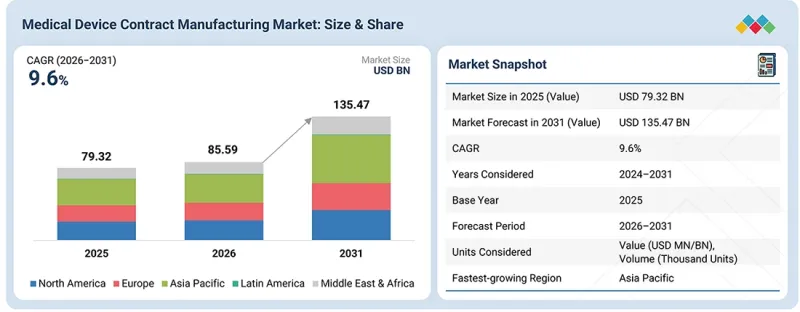
The global medical device contract manufacturing market is projected to reach USD 135.47 billion in 2031 from USD 85.59 billion in 2026, at a 9.6% CAGR between 2026 and 2031. Rising technological advancements in medical devices, along with an increasing geriatric population, are expected to drive the market.
| Scope of the Report | |
|---|---|
| Years Considered for the Study | 2026-2031 |
| Base Year | 2025 |
| Forecast Period | 2026-2031 |
| Units Considered | Value (USD billion) |
| Segments | By Device Type, Device Class, Service, Region |
| Regions covered | North America, Europe, Asia Pacific, Middle East & Africa, and Latin America |
The market is anticipated to grow due to continuous developments in medical fields such as robotics and minimally invasive surgery, artificial intelligence (AI) in medical devices, telemedicine, and remote patient monitoring. An aging population and rising demand for medical diagnostics further contribute to market growth. However, strict regulatory compliance and supply chain complexities are expected to limit market growth to some extent.
"By device type, the diabetes care devices segment is expected to witness the highest CAGR in the medical device contract manufacturing market."
The diabetes care devices segment is projected to experience the highest CAGR in the medical device contract manufacturing market from 2026 to 2031. This growth is driven by increasing demand for advanced diabetes management devices, including continuous glucose monitoring systems, insulin delivery devices, insulin pens, and other connected solutions. The growing complexity of these devices is encouraging diabetes care companies to outsource manufacturing activities to specialized contract manufacturers with expertise in precision components, electronics integration, automated assembly, and high-volume production. The increasing adoption of connected and wearable diabetes devices is further creating opportunities for contract manufacturers to support product development, NPI, assembly, testing, and commercial-scale manufacturing.
"The device development & manufacturing services segment accounted for the largest share of the market in 2025, by service."
The device development & manufacturing services segment commands the largest market share in the medical device contract manufacturing sector, largely because it transforms concepts into viable medical devices. Smaller enterprises and mid-sized firms often outsource these services to reduce costs, speed product timelines, and leverage specialized knowledge and advanced manufacturing techniques. This segment covers the entire product development lifecycle, from initial design and prototyping to large-scale commercialization, making it crucial for both emerging and established companies. Furthermore, escalating demand for sophisticated, high-precision medical instruments-such as minimally invasive surgical devices and wearable health monitoring technologies-has significantly increased the need for comprehensive manufacturing partnerships, further solidifying this segment's market prominence.
"Asia Pacific accounted for the largest market share in 2025."
The Asia Pacific (APAC) region is experiencing a significant surge in demand for medical device contract manufacturing services, driven by several key factors. First, rapid population growth in many countries in the region is increasing the need for advanced medical solutions. Additionally, growing awareness among healthcare providers and patients of the benefits and capabilities of modern medical devices further fuels this demand. The expanding middle class in various Asia Pacific nations is also contributing to this trend, as more consumers gain access to healthcare services and products. As a result, global leaders in the medical device contract manufacturing sector are actively establishing and expanding operations in the Asia Pacific market. These companies are introducing a variety of cutting-edge medical devices, innovative software solutions, and a diverse range of biocompatible materials tailored to different healthcare settings. In particular, China is set to dominate the APAC medical device contract manufacturing market, and it is projected to capture the largest share in 2024. This growth can be attributed to the increasing prevalence of chronic diseases, along with greater public and institutional awareness of the availability and efficacy of medical devices. As a result, the Asia Pacific region has accounted for the largest share of the market, driven by these interconnected trends and the continued evolution of the healthcare landscape.
Breakdown of supply-side primary interviews:
By Company Type: Tier 1 (60%), Tier 2 (30%), and Tier 3 (10%)
By Designation: C-level Executives (30%), Directors (50%), and Other Designations (20%)
By Region: North America (40%), Europe (25%), Asia Pacific (20%), Latin America (10%), and the Middle East & Africa (5%)
Demand-side:
By End User: Medical Device Manufacturers (50%), Pharmaceutical & Drug Delivery Companies (33%), and Diagnostic Companies (17%)
By Designation: Procurement/Purchasing Managers (47%), R&D/Product Development Heads (22%), Manufacturing/Engineering Heads (15%), and Others (16%)
By Region: North America (25%), Europe (24%), Asia Pacific (25%), Latin America (11%), and Middle East & Africa (15%)
Research Coverage
The report examines the medical device contract manufacturing market and estimates market size and future growth potential across segments, including device type, device class, service, and region. It also includes a competitive analysis of major players, highlighting company profiles, product and service offerings, recent developments, and key market strategies.
Reasons to Buy the Report
The report helps established companies and newer or smaller firms understand market trends, enabling them to capture a larger market share. Firms that acquire the report can implement one or more of the five strategies outlined below.
This report provides insights into the following points:
- Analysis of key drivers (growth in the medical devices market in developing countries, adoption of robotics and automation in manufacturing, technological advancements in medical device modalities, and the impact of Industry 4.0 on the medical device industry), restraints (consolidation in the medical devices market), opportunities (increasing healthcare expenditure, infrastructure, and awareness in developing economies, and a rising geriatric population and its associated diseases), and challenges (lack of constant innovation to balance technological capabilities against costs).
- Market Penetration: It includes extensive information on product portfolios offered by the major players in the global medical device contract manufacturing market. The report includes various segments in market device type, class of device, service, and region.
- Product Enhancement/Innovation: Comprehensive details about new product launches and anticipated trends in the global medical device contract manufacturing market.
- Market Development: Thorough knowledge and analysis of the profitable rising markets by device type, class of device, service, and region.
- Market Diversification: Comprehensive information about newly launched products and services, expanding markets, current advancements, and investments in the global medical device contract manufacturing market.
- Competitive Assessment: Thorough evaluation of the market shares, growth plans, offerings of products and services, and capacities of the major competitors in the global medical device contract manufacturing market.
TABLE OF CONTENTS
1 INTRODUCTION
- 1.1 STUDY OBJECTIVES
- 1.2 MARKET DEFINITION
- 1.3 STUDY SCOPE
- 1.3.1 MARKETS COVERED & REGIONAL SCOPE
- 1.3.2 INCLUSIONS & EXCLUSIONS
- 1.3.3 YEARS CONSIDERED
- 1.4 CURRENCY
- 1.5 STAKEHOLDERS
- 1.6 SUMMARY OF CHANGES
2 EXECUTIVE SUMMARY
- 2.1 MARKET HIGHLIGHTS & KEY INSIGHTS
- 2.2 KEY MARKET PARTICIPANTS: MAPPING OF STRATEGIC DEVELOPMENTS
- 2.3 DISRUPTIVE TRENDS IN MEDICAL DEVICE CONTRACT MANUFACTURING MARKET
- 2.4 HIGH-GROWTH SEGMENTS
- 2.5 REGIONAL SNAPSHOT: MARKET SIZE, GROWTH RATE, AND FORECAST
3 PREMIUM INSIGHTS
- 3.1 MEDICAL DEVICE CONTRACT MANUFACTURING MARKET OVERVIEW
- 3.2 ASIA PACIFIC: MEDICAL DEVICE CONTRACT MANUFACTURING MARKET, BY SERVICE AND COUNTRY (2025)
- 3.3 MEDICAL DEVICE CONTRACT MANUFACTURING MARKET: GEOGRAPHIC GROWTH OPPORTUNITIES
- 3.4 MEDICAL DEVICE CONTRACT MANUFACTURING MARKET: REGION (2026-2031)
- 3.5 MEDICAL DEVICE CONTRACT MANUFACTURING MARKET: DEVELOPED VS. DEVELOPING ECONOMIES
4 MARKET OVERVIEW
- 4.1 INTRODUCTION
- 4.2 MARKET DYNAMICS
- 4.2.1 DRIVERS
- 4.2.1.1 Growing medical devices market in developing countries
- 4.2.1.2 Adoption of robotics and automation in manufacturing
- 4.2.1.3 Technological advancements in medical device modalities
- 4.2.1.4 Impact of Industry 4.0 on medical device industry
- 4.2.1.5 Growing emphasis on patient convenience driving demand for specialized medical device contract manufacturing
- 4.2.2 RESTRAINTS
- 4.2.2.1 Intellectual property and confidentiality concerns
- 4.2.2.2 Pricing pressure from OEM customers
- 4.2.3 OPPORTUNITIES
- 4.2.3.1 Increasing healthcare expenditure, infrastructure, and awareness in developing economies
- 4.2.3.2 Rising geriatric population and increasing incidence of associated diseases
- 4.2.4 CHALLENGES
- 4.2.4.1 Lack of constant innovation to balance technological capabilities against costs
- 4.2.4.2 Balancing cost reduction with quality
- 4.2.1 DRIVERS
- 4.3 UNMET NEEDS & WHITE SPACES
- 4.4 INTERCONNECTED MARKETS & CROSS-SECTOR OPPORTUNITIES
- 4.4.1 INTERCONNECTED MARKETS
- 4.4.2 CROSS-SECTOR OPPORTUNITIES
- 4.5 STRATEGIC MOVES BY TIER-1/2/3 PLAYERS
- 4.5.1 STRATEGIC MOVES BY TIER-1/2/3 PLAYERS
5 INDUSTRY TRENDS
- 5.1 PORTER'S FIVE FORCE ANALYSIS
- 5.1.1 THREAT OF NEW ENTRANTS
- 5.1.2 THREAT OF SUBSTITUTES
- 5.1.3 BARGAINING POWER OF SUPPLIERS
- 5.1.4 BARGAINING POWER OF BUYERS
- 5.1.5 INTENSITY OF COMPETITIVE RIVALRY
- 5.2 MACROECONOMIC INDICATORS
- 5.2.1 INTRODUCTION
- 5.2.2 GDP TRENDS & FORECAST
- 5.2.3 TRENDS IN GLOBAL HEALTHCARE INDUSTRY
- 5.2.4 TRENDS IN GLOBAL MEDICAL DEVICE CONTRACT MANUFACTURING INDUSTRY
- 5.3 VALUE CHAIN ANALYSIS
- 5.4 ECOSYSTEM ANALYSIS
- 5.5 PRICING ANALYSIS
- 5.5.1 AVERAGE SELLING PRICE TREND IN MEDICAL DEVICE CONTRACT MANUFACTURING, BY KEY PLAYER, 2023-2025
- 5.5.1.1 Average selling price trend in medical device contract manufacturing (drug delivery devices, cardiovascular devices, and IVD devices), by key player, 2023-2025
- 5.5.2 AVERAGE SELLING PRICE TREND IN MEDICAL DEVICE CONTRACT MANUFACTURING, BY REGION, 2023-2025
- 5.5.2.1 Average selling price trend of drug delivery devices, by region, 2023-2025
- 5.5.2.2 Average selling price trend of IVD devices, by region, 2023-2025
- 5.5.2.3 Average selling price trend of cardiovascular devices, by region, 2023-2025
- 5.5.1 AVERAGE SELLING PRICE TREND IN MEDICAL DEVICE CONTRACT MANUFACTURING, BY KEY PLAYER, 2023-2025
- 5.6 TRADE ANALYSIS
- 5.6.1 IMPORT DATA FOR HS CODE 9018, 2021-2025
- 5.6.2 EXPORT DATA FOR HS CODE 9018, 2021-2025
- 5.7 KEY CONFERENCES & EVENTS, 2026-2027
- 5.8 TRENDS/DISRUPTIONS IMPACTING CUSTOMERS' BUSINESSES
- 5.9 INVESTMENT & FUNDING SCENARIO
- 5.10 CASE STUDY ANALYSIS
- 5.10.1 CASE STUDY 1: JABIL INC. AND AMS OSRAM PARTNER TO ACCELERATE POINT-OF-CARE DIAGNOSTIC TESTING
- 5.10.2 CASE STUDY 2: SANMINA AND MEDICAL DIAGNOSTICS COMPANY PARTNER FOR RAPID NPI AND MANUFACTURING
- 5.10.3 CASE STUDY 3: PLEXUS AND QUIDEL COLLABORATE TO SCALE POINT-OF-CARE DIAGNOSTIC MANUFACTURING
- 5.11 IMPACT OF 2025 US TARIFFS ON MEDICAL DEVICE CONTRACT MANUFACTURING MARKET
- 5.11.1 INTRODUCTION
- 5.11.2 KEY TARIFF RATES
- 5.11.3 PRICE IMPACT ANALYSIS
- 5.11.4 IMPACT ON COUNTRY/REGION
- 5.11.4.1 NORTH AMERICA
- 5.11.4.2 ASIA PACIFIC
- 5.11.4.3 EUROPE
- 5.11.4.4 LATIN AMERICA
- 5.11.5 IMPACT ON END-USE INDUSTRIES
6 STRATEGIC DISRUPTIONS THROUGH TECHNOLOGY, PATENTS, AND DIGITAL & AI ADOPTION
- 6.1 TECHNOLOGY ANALYSIS
- 6.1.1 KEY EMERGING TECHNOLOGIES
- 6.1.1.1 Additive manufacturing/3D printing
- 6.1.1.2 Advanced laser micromachining and processing
- 6.1.2 COMPLEMENTARY TECHNOLOGIES
- 6.1.2.1 Digital twins
- 6.1.2.2 IIOT
- 6.1.3 ADJACENT TECHNOLOGIES
- 6.1.3.1 Nitinol & shape-memory materials for advanced medical devices
- 6.1.1 KEY EMERGING TECHNOLOGIES
- 6.2 TECHNOLOGY/PRODUCT ROADMAP
- 6.3 FUTURE APPLICATIONS
- 6.3.1 PERSONALIZED & PATIENT-SPECIFIC MEDICAL DEVICES
- 6.3.2 MINIMALLY INVASIVE & COMPLEX DEVICES
- 6.3.3 CONNECTED AND SMART MEDICAL DEVICES
- 6.3.4 AI-ENABLED & DIGITAL MANUFACTURING
- 6.4 IMPACT OF AI/GENERATIVE AI ON MEDICAL DEVICE CONTRACT MANUFACTURING MARKET
- 6.4.1 INTRODUCTION
- 6.4.2 MARKET POTENTIAL IN MEDICAL DEVICE CONTRACT MANUFACTURING ECOSYSTEM
- 6.4.3 AI USE CASES
- 6.4.4 KEY COMPANIES IMPLEMENTING AI IN MEDICAL DEVICE CONTRACT MANUFACTURING MARKET
7 SUSTAINABILITY & REGULATORY LANDSCAPE
- 7.1 REGULATORY LANDSCAPE
- 7.1.1 REGULATORY FRAMEWORK
- 7.1.1.1 North America
- 7.1.1.1.1 US
- 7.1.1.1.2 Canada
- 7.1.1.2 Europe
- 7.1.1.3 Asia Pacific
- 7.1.1.3.1 Japan
- 7.1.1.3.2 China
- 7.1.1.3.3 India
- 7.1.1.1 North America
- 7.1.2 REGULATORY BODIES, GOVERNMENT AGENCIES, AND OTHER ORGANIZATIONS
- 7.1.1 REGULATORY FRAMEWORK
- 7.2 SUSTAINABILITY INITIATIVES
- 7.2.1 ENERGY-EFFICIENT MANUFACTURING & CARBON REDUCTION IN MEDICAL DEVICE CONTRACT MANUFACTURING MARKET
- 7.2.2 SUSTAINABILITY IMPACT & REGULATORY POLICY INITIATIVES
- 7.2.3 CERTIFICATIONS, LABELING, AND ECO-STANDARDS
8 CUSTOMER LANDSCAPE & BUYER BEHAVIOR
- 8.1 KEY STAKEHOLDERS & BUYING CRITERIA
- 8.1.1 KEY STAKEHOLDERS IN BUYING PROCESS
- 8.1.2 BUYING CRITERIA
- 8.2 CUSTOMER LANDSCAPE & BUYER BEHAVIOR
- 8.2.1 DECISION-MAKING PROCESS
- 8.2.2 ADOPTION BARRIERS & INTERNAL CHALLENGES
- 8.2.3 UNMET NEEDS FROM VARIOUS END-USE INDUSTRIES
- 8.2.4 MARKET PROFITABILITY
9 MEDICAL DEVICE CONTRACT MANUFACTURING MARKET, BY DEVICE TYPE
- 9.1 INTRODUCTION
- 9.2 IVD DEVICES
- 9.2.1 IVD CONSUMABLES
- 9.2.1.1 Increasing demand for reagents & kits to drive market
- 9.2.2 IVD EQUIPMENT
- 9.2.2.1 Advancements in diagnostic technologies to support market growth
- 9.2.1 IVD CONSUMABLES
- 9.3 DIAGNOSTIC IMAGING DEVICES
- 9.3.1 ADOPTION OF NEW AND ADVANCED DIAGNOSTIC IMAGING SYSTEMS IN DEVELOPING COUNTRIES TO AUGMENT MARKET
- 9.4 CARDIOVASCULAR DEVICES
- 9.4.1 RISING PREVALENCE OF CARDIOVASCULAR DISEASES TO PROPEL MARKET
- 9.5 DRUG DELIVERY DEVICES
- 9.5.1 INFUSION DEVICES & ADMINISTRATION SETS
- 9.5.1.1 Rising incidence of chronic diseases and growing number of surgical procedures to fuel market
- 9.5.2 SYRINGES
- 9.5.2.1 High cost of safety syringes and increasing incidence of needlestick injuries to hinder market
- 9.5.3 INHALERS
- 9.5.3.1 High prevalence of asthma, COPD, and cystic fibrosis to aid market growth
- 9.5.4 AUTOINJECTORS
- 9.5.4.1 Rising number of regulatory approvals for new drug therapies and advancements to drive market
- 9.5.5 PEN INJECTORS
- 9.5.5.1 Rising prevalence of chronic diseases and growing pipeline of biologics and biosimilars to boost market growth
- 9.5.6 OTHER DRUG DELIVERY DEVICES
- 9.5.1 INFUSION DEVICES & ADMINISTRATION SETS
- 9.6 ORTHOPEDIC DEVICES
- 9.6.1 HIGH PREVALENCE OF ORTHOPEDIC CONDITIONS TO DRIVE MARKET
- 9.7 RESPIRATORY CARE DEVICES
- 9.7.1 GROWING PREVALENCE OF RESPIRATORY INFECTIONS TO DRIVE MARKET
- 9.8 OPHTHALMOLOGY DEVICES
- 9.8.1 INCREASING PREVALENCE OF OPHTHALMIC DISEASES TO DRIVE MARKET
- 9.9 SURGICAL DEVICES
- 9.9.1 INCREASE IN SURGICAL PROCEDURES TO FUEL MARKET
- 9.10 DIABETES CARE DEVICES
- 9.10.1 RISING PREVALENCE OF DIABETES TO PROPEL MARKET
- 9.11 DENTAL DEVICES
- 9.11.1 RISING INCIDENCE OF DENTAL DISEASES TO DRIVE MARKET
- 9.12 ENDOSCOPY & LAPAROSCOPY DEVICES
- 9.12.1 RISING PATIENT PREFERENCE FOR MINIMALLY INVASIVE PROCEDURES TO AUGMENT MARKET
- 9.13 GYNECOLOGY/UROLOGY DEVICES
- 9.13.1 GROWING AWARENESS AND PREVENTIVE CHECK-UPS FOR LATE-PHASE DIAGNOSIS OF STDS TO PROPEL MARKET
- 9.14 PERSONAL CARE DEVICES
- 9.14.1 SHIFT IN CONSUMPTION PATTERN TOWARD PREMIUM PERSONAL CARE PRODUCTS TO FUEL MARKET
- 9.15 NEUROLOGY DEVICES
- 9.15.1 RISING GLOBAL BURDEN OF NEUROLOGICAL DISEASES TO DRIVE MARKET
- 9.16 PATIENT MONITORING DEVICES
- 9.16.1 GROWING AVAILABILITY OF INTEGRATED MONITORING TECHNOLOGY TO AID MARKET
- 9.17 PATIENT ASSISTIVE DEVICES
- 9.17.1 RISING GERIATRIC POPULATION TO PROPEL MARKET
- 9.18 OTHER DEVICES
10 MEDICAL DEVICE CONTRACT MANUFACTURING MARKET, BY DEVICE CLASS
- 10.1 INTRODUCTION
- 10.2 CLASS II MEDICAL DEVICES
- 10.2.1 BROAD DEVICE APPLICATIONS AND HIGH UTILIZATION TO DRIVE MARKET GROWTH
- 10.3 CLASS I MEDICAL DEVICES
- 10.3.1 HIGH-VOLUME DEMAND FOR CLASS I DEVICES TO SUPPORT MARKET GROWTH
- 10.4 CLASS III MEDICAL DEVICES
- 10.4.1 RISING DEMAND FOR HIGH-RISK AND TECHNOLOGICALLY ADVANCED DEVICES TO DRIVE SEGMENT GROWTH
11 MEDICAL DEVICE CONTRACT MANUFACTURING MARKET, BY SERVICE
- 11.1 INTRODUCTION
- 11.2 DEVICE DEVELOPMENT & MANUFACTURING SERVICES
- 11.2.1 DEVICE & COMPONENT MANUFACTURING SERVICES
- 11.2.1.1 Growing demand for specialized manufacturing capabilities to drive growth
- 11.2.2 PROCESS DEVELOPMENT SERVICES
- 11.2.2.1 Increasing product complexity and regulatory requirements to drive demand
- 11.2.3 DEVICE ENGINEERING SERVICES
- 11.2.3.1 Increasing device complexity to drive demand for engineering services
- 11.2.1 DEVICE & COMPONENT MANUFACTURING SERVICES
- 11.3 QUALITY MANAGEMENT SERVICES
- 11.3.1 PACKAGING VALIDATION SERVICES
- 11.3.1.1 Increasing product safety requirements to drive demand
- 11.3.2 INSPECTION & TESTING SERVICES
- 11.3.2.1 Growing regulatory requirements and device complexity to drive demand
- 11.3.3 STERILIZATION SERVICES
- 11.3.3.1 Rising complexity of sterility standards to augment market
- 11.3.1 PACKAGING VALIDATION SERVICES
- 11.4 PACKAGING & ASSEMBLY SERVICES
- 11.4.1 PRIMARY & SECONDARY PACKAGING SERVICES
- 11.4.1.1 Growing concerns for patient safety to aid segment
- 11.4.2 LABELING SERVICES
- 11.4.2.1 Increasing regulatory requirements and traceability needs to drive demand
- 11.4.3 OTHER PACKAGING & ASSEMBLY SERVICES
- 11.4.1 PRIMARY & SECONDARY PACKAGING SERVICES
- 11.5 OTHER SERVICES
12 BY REGION
- 12.1 INTRODUCTION
- 12.2 NORTH AMERICA
- 12.2.1 MACROECONOMIC OUTLOOK FOR NORTH AMERICA
- 12.2.2 US
- 12.2.2.1 Presence of stringent government regulations to drive market
- 12.2.3 CANADA
- 12.2.3.1 Strong presence of key contract manufacturing companies to augment market
- 12.3 EUROPE
- 12.3.1 MACROECONOMIC OUTLOOK FOR EUROPE
- 12.3.2 GERMANY
- 12.3.2.1 Presence of major device manufacturers and high healthcare expenditure to support market growth
- 12.3.3 UK
- 12.3.3.1 Rising number of accredited clinical laboratories and hospital laboratories to propel market
- 12.3.4 FRANCE
- 12.3.4.1 Increasing government pressure for healthcare cost reduction and budgetary constraints to support market growth
- 12.3.5 SPAIN
- 12.3.5.1 Increasing adoption of home-based medical devices to drive market
- 12.3.6 ITALY
- 12.3.6.1 Healthcare coverage for all citizens and foreign residents to increase demand for medical devices
- 12.3.7 REST OF EUROPE
- 12.4 ASIA PACIFIC
- 12.4.1 MACROECONOMIC OUTLOOK FOR ASIA PACIFIC
- 12.4.2 CHINA
- 12.4.2.1 Low labor costs and rapidly changing healthcare infrastructure to drive market
- 12.4.3 INDIA
- 12.4.3.1 Rising contract manufacturing capabilities to support market growth
- 12.4.4 JAPAN
- 12.4.4.1 Universal healthcare reimbursement policies to propel market
- 12.4.5 MALAYSIA
- 12.4.5.1 Increasing R&D activities and investments by established players to augment market growth
- 12.4.6 THAILAND
- 12.4.6.1 Government-supported industrial clustering and export competitiveness to propel market
- 12.4.7 SOUTH KOREA
- 12.4.7.1 High-value imports from other countries to offer growth opportunities
- 12.4.8 AUSTRALIA
- 12.4.8.1 Government-backed investment in sovereign capability to drive medtech manufacturing growth
- 12.4.9 PHILIPPINES
- 12.4.9.1 Skilled labor force and IT-enabled support to drive market growth
- 12.4.10 SINGAPORE
- 12.4.10.1 Strong government support and global investments to drive market
- 12.4.11 NEW ZEALAND
- 12.4.11.1 Deregulation of therapeutic products unlocking expedited access and export potential
- 12.4.12 REST OF ASIA PACIFIC
- 12.5 LATIN AMERICA
- 12.5.1 MACROECONOMIC OUTLOOK FOR LATIN AMERICA
- 12.5.2 BRAZIL
- 12.5.2.1 Favorable government initiatives and willingness to pay for better healthcare to boost market
- 12.5.3 MEXICO
- 12.5.3.1 Proximity to US and other LATAM countries to strengthen Mexico's relevance as contract manufacturing hub
- 12.5.4 REST OF LATIN AMERICA
- 12.6 MIDDLE EAST & AFRICA
- 12.6.1 MACROECONOMIC OUTLOOK FOR MIDDLE EAST & AFRICA
- 12.6.2 GCC COUNTRIES
- 12.6.2.1 Kingdom of Saudi Arabia (KSA)
- 12.6.2.1.1 Focus on healthcare localization and Vision 2030 to drive investment
- 12.6.2.2 United Arab Emirates (UAE)
- 12.6.2.2.1 Advanced infrastructure and regulatory efficiency to attract global medtech contract manufacturers
- 12.6.2.3 Rest of GCC Countries
- 12.6.2.1 Kingdom of Saudi Arabia (KSA)
- 12.6.3 REST OF MIDDLE EAST & AFRICA
13 COMPETITIVE LANDSCAPE
- 13.1 INTRODUCTION
- 13.1.1 KEY STRATEGIES ADOPTED BY PLAYERS IN THE MEDICAL DEVICE CONTRACT MANUFACTURING MARKET
- 13.2 REVENUE ANALYSIS, 2023-2025
- 13.3 GLOBAL MARKET SHARE ANALYSIS, 2025
- 13.3.1 US MEDICAL DEVICE CONTRACT MANUFACTURING MARKET SHARE ANALYSIS, 2025
- 13.3.2 EUROPE MEDICAL DEVICE CONTRACT MANUFACTURING MARKET SHARE ANALYSIS, 2025
- 13.4 COMPANY EVALUATION MATRIX: KEY PLAYERS, 2025
- 13.4.1 STARS
- 13.4.2 EMERGING LEADERS
- 13.4.3 PERVASIVE PLAYERS
- 13.4.4 PARTICIPANTS
- 13.4.5 COMPANY FOOTPRINT: KEY PLAYERS, 2025
- 13.4.5.1 Company footprint
- 13.4.5.2 Region footprint
- 13.4.5.3 Device type footprint
- 13.4.5.4 Service footprint
- 13.4.5.5 Device class footprint
- 13.5 COMPANY EVALUATION MATRIX: START-UPS/SMES, 2025
- 13.5.1 PROGRESSIVE COMPANIES
- 13.5.2 RESPONSIVE COMPANIES
- 13.5.3 DYNAMIC COMPANIES
- 13.5.4 STARTING BLOCKS
- 13.5.5 COMPETITIVE BENCHMARKING: START-UPS/SMES, 2025
- 13.5.5.1 List of start-ups/SMEs
- 13.5.5.2 Competitive benchmarking of start-ups/SMEs
- 13.6 COMPANY VALUATION & FINANCIAL METRICS
- 13.6.1 FINANCIAL METRICS
- 13.6.2 COMPANY EVALUATION
- 13.7 R&D ASSESSMENT OF KEY PLAYERS
- 13.8 PRODUCT/BRAND COMPARISON
- 13.9 COMPETITIVE SCENARIO
14 COMPANY PROFILES
- 14.1 KEY PLAYERS
- 14.1.1 JABIL INC.
- 14.1.1.1 Business overview
- 14.1.1.2 Products & services offered
- 14.1.1.3 Recent developments
- 14.1.1.3.1 Product approvals
- 14.1.1.3.2 Deals
- 14.1.1.3.3 Expansions
- 14.1.1.4 MnM view
- 14.1.1.4.1 Right to win
- 14.1.1.4.2 Strategic choices
- 14.1.1.4.3 Weaknesses & competitive threats
- 14.1.2 FLEX LTD.
- 14.1.2.1 Business overview
- 14.1.2.2 Products & services offered
- 14.1.2.3 Recent developments
- 14.1.2.3.1 Deals
- 14.1.2.3.2 Expansions
- 14.1.2.4 MnM view
- 14.1.2.4.1 Right to win
- 14.1.2.4.2 Strategic choices
- 14.1.2.4.3 Weaknesses & competitive threats
- 14.1.3 PLEXUS CORP.
- 14.1.3.1 Business overview
- 14.1.3.2 Products & services offered
- 14.1.3.3 Recent developments
- 14.1.3.3.1 Expansions
- 14.1.3.4 MnM view
- 14.1.3.4.1 Right to win
- 14.1.3.4.2 Strategic choices
- 14.1.3.4.3 Weaknesses & competitive threats
- 14.1.4 SANMINA CORPORATION
- 14.1.4.1 Business overview
- 14.1.4.2 Products & services offered
- 14.1.4.3 Recent developments
- 14.1.4.3.1 Deals
- 14.1.4.4 MnM view
- 14.1.4.4.1 Right to win
- 14.1.4.4.2 Strategic choices
- 14.1.4.4.3 Weaknesses & competitive threats
- 14.1.5 INTEGER HOLDINGS CORPORATION
- 14.1.5.1 Business overview
- 14.1.5.2 Products & services offered
- 14.1.5.3 Recent developments
- 14.1.5.3.1 Deals
- 14.1.5.3.2 Expansions
- 14.1.5.4 MnM view
- 14.1.5.4.1 Right to win
- 14.1.5.4.2 Strategic choices
- 14.1.5.4.3 Weaknesses & competitive threats
- 14.1.6 TE CONNECTIVITY LTD.
- 14.1.6.1 Business overview
- 14.1.6.2 Products & services offered
- 14.1.6.3 Recent developments
- 14.1.6.3.1 Product launches
- 14.1.7 CELESTICA INC.
- 14.1.7.1 Business overview
- 14.1.7.2 Products & services offered
- 14.1.7.3 Recent developments
- 14.1.7.3.1 Expansions
- 14.1.7.3.2 Other developments
- 14.1.8 WEST PHARMACEUTICAL SERVICES, INC.
- 14.1.8.1 Business overview
- 14.1.8.2 Products & services offered
- 14.1.8.3 Recent developments
- 14.1.8.3.1 Product launches
- 14.1.8.3.2 Deals
- 14.1.8.3.3 Expansions
- 14.1.9 BENCHMARK ELECTRONICS INC.
- 14.1.9.1 Business overview
- 14.1.9.2 Products & services offered
- 14.1.9.3 Recent developments
- 14.1.9.3.1 Deals
- 14.1.9.3.2 Expansions
- 14.1.10 APTAR
- 14.1.10.1 Business overview
- 14.1.10.2 Products & services offered
- 14.1.10.3 Recent developments
- 14.1.10.3.1 Product launches
- 14.1.10.3.2 Deals
- 14.1.10.3.3 Expansions
- 14.1.11 GERRESHEIMER AG
- 14.1.11.1 Business overview
- 14.1.11.2 Products & services offered
- 14.1.11.3 Recent developments
- 14.1.11.3.1 Deals
- 14.1.12 KIMBALL ELECTRONICS, INC.
- 14.1.12.1 Business overview
- 14.1.12.2 Products & services offered
- 14.1.12.3 Recent developments
- 14.1.12.3.1 Deals
- 14.1.12.3.2 Expansions
- 14.1.13 NORTECH SYSTEMS, INC.
- 14.1.13.1 Business overview
- 14.1.13.2 Products & services offered
- 14.1.13.3 Recent developments
- 14.1.13.3.1 Other developments
- 14.1.14 CARCLO PLC
- 14.1.14.1 Business overview
- 14.1.14.2 Products & services offered
- 14.1.15 NOLATO GW, INC. (A PART OF NOLATO AB)
- 14.1.15.1 Business overview
- 14.1.15.2 Products & services offered
- 14.1.15.3 Recent developments
- 14.1.15.3.1 Deals
- 14.1.1 JABIL INC.
- 14.2 OTHER PLAYERS
- 14.2.1 NEMERA
- 14.2.2 VIANT MEDICAL HOLDINGS, INC.
- 14.2.3 TECOMET, INC.
- 14.2.4 SMC LTD.
- 14.2.5 PHILLIPS-MEDISIZE CORPORATION
- 14.2.6 TESSY PLASTICS CORP.
- 14.2.7 MEHOW
- 14.2.8 TEKNI-PLEX
- 14.2.9 CIRTEC MEDICAL
- 14.2.10 PETER'S TECHNOLOGY
15 RESEARCH METHODOLOGY
- 15.1 RESEARCH DATA
- 15.1.1 SECONDARY SOURCES
- 15.1.1.1 Key data from secondary sources
- 15.1.2 PRIMARY SOURCES
- 15.1.2.1 Key data from primary sources
- 15.1.2.2 Key industry insights
- 15.1.1 SECONDARY SOURCES
- 15.2 MARKET SIZE ESTIMATION
- 15.2.1 APPROACH 1: SUPPLY-SIDE ANALYSIS
- 15.2.2 APPROACH 2: COMPANY PRESENTATIONS AND PRIMARY INTERVIEWS
- 15.2.3 APPROACH 3: PARENT MARKET APPROACH - MEDICAL DEVICES MARKET
- 15.2.4 APPROACH 4: COGS APPROACH
- 15.3 MARKET BREAKDOWN & DATA TRIANGULATION
- 15.4 MARKET SHARE ESTIMATION
- 15.5 STUDY ASSUMPTIONS
- 15.6 RISK ASSESSMENT
- 15.7 LIMITATIONS
- 15.7.1 METHODOLOGY-RELATED LIMITATIONS
- 15.7.2 SCOPE-RELATED LIMITATIONS
16 APPENDIX
- 16.1 DISCUSSION GUIDE
- 16.2 KNOWLEDGESTORE: MARKETSANDMARKETS' SUBSCRIPTION PORTAL
- 16.3 CUSTOMIZATION OPTIONS
- 16.3.1 SERVICE/PRODUCT ANALYSIS
- 16.3.2 COMPANY INFORMATION
- 16.3.3 GEOGRAPHIC ANALYSIS
- 16.3.4 COUNTRY-LEVEL VOLUME ANALYSIS BY PRODUCT
- 16.3.5 ANY CONSULT/CUSTOM REQUIREMENTS AS PER CLIENT REQUESTS
- 16.4 RELATED REPORTS
- 16.5 AUTHOR DETAILS
List of Tables
- TABLE 1 STANDARD CURRENCY CONVERSION RATES (UNIT OF USD)
- TABLE 2 ESTIMATED INCREASE IN GERIATRIC POPULATION, BY REGION, 2019 VS. 2050
- TABLE 3 UNMET CUSTOMER NEEDS & WHITE SPACES IN MEDICAL DEVICE CONTRACT MANUFACTURING MARKET
- TABLE 4 +INTERCONNECTED MARKETS IN MEDICAL DEVICE CONTRACT MANUFACTURING MARKET
- TABLE 5 CROSS-SECTOR MARKETS IN MEDICAL DEVICE CONTRACT MANUFACTURING MARKET
- TABLE 6 MEDICAL DEVICE CONTRACT MANUFACTURING MARKET: PORTER'S FIVE FORCES ANALYSIS
- TABLE 7 GDP, CURRENT PRICES, 2021-2030 (USD BILLION)
- TABLE 8 AVERAGE SELLING PRICE TREND IN MEDICAL DEVICE CONTRACT MANUFACTURING (DRUG DELIVERY DEVICES, CARDIOVASCULAR DEVICES, AND IVD DEVICES), BY KEY PLAYER, 2023-2025
- TABLE 9 AVERAGE SELLING PRICE TREND OF DRUG DELIVERY DEVICES, BY REGION, 2023-2025 (USD)
- TABLE 10 AVERAGE SELLING PRICE TREND OF IVD DEVICES, BY REGION, 2023-2025 (USD)
- TABLE 11 AVERAGE SELLING PRICE TREND OF CARDIOVASCULAR DEVICES, BY REGION, 2023-2025 (USD)
- TABLE 12 IMPORT DATA FOR HS CODE 9018, BY COUNTRY, 2021-2025 (USD THOUSAND)
- TABLE 13 EXPORT DATA FOR HS CODE 9018, BY COUNTRY, 2021-2025 (USD THOUSAND)
- TABLE 14 DETAILED LIST OF CONFERENCES & EVENTS IN MEDICAL DEVICE CONTRACT MANUFACTURING MARKET, 2026-2027
- TABLE 15 US IMPORTS AND APPLICABLE TARIFF FRAMEWORK BY COUNTRY (2025-2026)
- TABLE 16 KEY PRODUCT-RELATED TARIFFS EFFECTIVE MEDICAL DEVICES
- TABLE 17 NORTH AMERICA: IMPACT OF US TARIFFS ON CANADA
- TABLE 18 ASIA PACIFIC: IMPACT OF US TARIFFS ON CHINA, JAPAN, AND INDIA
- TABLE 19 EUROPE: IMPACT OF US TARIFFS ON GERMANY AND UK
- TABLE 20 LATIN AMERICA: IMPACT OF US TARIFFS ON MEXICO
- TABLE 21 MEDICAL DEVICE CONTRACT MANUFACTURING MARKET: TECHNOLOGY/PRODUCT ROADMAP
- TABLE 22 KEY COMPANIES IMPLEMENTING AI IN MEDICAL DEVICE CONTRACT MANUFACTURING MARKET
- TABLE 23 US: CLASSIFICATION OF MEDICAL EQUIPMENT
- TABLE 24 US: TIME, COST, AND COMPLEXITY OF REGISTRATION PROCESS
- TABLE 25 CANADA: RISK, TIME, COST, AND COMPLEXITY OF REGISTRATION PROCESS
- TABLE 26 EUROPE: RISK, TIME, COST, AND COMPLEXITY OF REGISTRATION PROCESS
- TABLE 27 JAPAN: TIME, COST, AND COMPLEXITY OF REGISTRATION PROCESS
- TABLE 28 CHINA: TIME, COST, AND COMPLEXITY OF REGISTRATION PROCESS
- TABLE 29 NORTH AMERICA: REGULATORY BODIES, GOVERNMENT AGENCIES, AND OTHER ORGANIZATIONS
- TABLE 30 EUROPE: REGULATORY BODIES, GOVERNMENT AGENCIES, AND OTHER ORGANIZATIONS
- TABLE 31 ASIA PACIFIC: REGULATORY BODIES, GOVERNMENT AGENCIES, AND OTHER ORGANIZATIONS
- TABLE 32 LATIN AMERICA: REGULATORY BODIES, GOVERNMENT AGENCIES, AND OTHER ORGANIZATIONS
- TABLE 33 MIDDLE EAST & AFRICA: REGULATORY BODIES, GOVERNMENT AGENCIES, AND OTHER ORGANIZATIONS
- TABLE 34 MEDICAL DEVICE CONTRACT MANUFACTURING MARKET: INFLUENCE OF KEY STAKEHOLDERS ON BUYING PROCESS (%), BY DEVICE CLASS
- TABLE 35 KEY BUYING CRITERIA, BY CLASS OF DEVICE
- TABLE 36 MEDICAL DEVICE CONTRACT MANUFACTURING MARKET, BY DEVICE TYPE, 2024-2031 (USD MILLION)
- TABLE 37 MEDICAL DEVICE CONTRACT MANUFACTURING MARKET FOR IVD DEVICES, BY TYPE, 2024-2031 (USD MILLION)
- TABLE 38 MEDICAL DEVICE CONTRACT MANUFACTURING MARKET FOR IVD DEVICES, BY COUNTRY, 2024-2031 (USD MILLION)
- TABLE 39 MEDICAL DEVICE CONTRACT MANUFACTURING MARKET FOR IVD CONSUMABLES, BY COUNTRY, 2024-2031 (USD MILLION)
- TABLE 40 MEDICAL DEVICE CONTRACT MANUFACTURING MARKET FOR IVD EQUIPMENT, BY COUNTRY, 2024-2031 (USD MILLION)
- TABLE 41 MEDICAL DEVICE CONTRACT MANUFACTURING MARKET FOR DIAGNOSTIC IMAGING DEVICES, BY COUNTRY, 2024-2031 (USD MILLION)
- TABLE 42 PREVALENCE OF CVDS, 2015-2035
- TABLE 43 MEDICAL DEVICE CONTRACT MANUFACTURING MARKET FOR CARDIOVASCULAR DEVICES, BY COUNTRY, 2024-2031 (USD MILLION)
- TABLE 44 MEDICAL DEVICE CONTRACT MANUFACTURING MARKET FOR DRUG DELIVERY DEVICES, BY TYPE, 2024-2031 (USD MILLION)
- TABLE 45 MEDICAL DEVICE CONTRACT MANUFACTURING MARKET FOR DRUG DELIVERY DEVICES, BY COUNTRY, 2024-2031 (USD MILLION)
- TABLE 46 MEDICAL DEVICE CONTRACT MANUFACTURING MARKET FOR INFUSION DEVICES & ADMINISTRATION SETS, BY COUNTRY, 2024-2031 (USD MILLION)
- TABLE 47 MEDICAL DEVICE CONTRACT MANUFACTURING MARKET FOR SYRINGES, BY COUNTRY, 2024-2031 (USD MILLION)
- TABLE 48 MEDICAL DEVICE CONTRACT MANUFACTURING MARKET FOR INHALERS, BY COUNTRY, 2024-2031 (USD MILLION)
- TABLE 49 RECENT APPROVALS FOR AUTOINJECTORS AND PEN INJECTORS GLOBALLY
- TABLE 50 MEDICAL DEVICE CONTRACT MANUFACTURING MARKET FOR AUTOINJECTORS, BY COUNTRY, 2024-2031 (USD MILLION)
- TABLE 51 MEDICAL DEVICE CONTRACT MANUFACTURING MARKET FOR PEN INJECTORS, BY COUNTRY, 2024-2031 (USD MILLION)
- TABLE 52 MEDICAL DEVICE CONTRACT MANUFACTURING MARKET FOR OTHER DRUG DELIVERY DEVICES, BY COUNTRY, 2024-2031 (USD MILLION)
- TABLE 53 MEDICAL DEVICE CONTRACT MANUFACTURING MARKET FOR ORTHOPEDIC DEVICES, BY COUNTRY, 2024-2031 (USD MILLION)
- TABLE 54 MEDICAL DEVICE CONTRACT MANUFACTURING MARKET FOR RESPIRATORY CARE DEVICES, BY COUNTRY, 2024-2031 (USD MILLION)
- TABLE 55 MEDICAL DEVICE CONTRACT MANUFACTURING MARKET FOR OPHTHALMOLOGY DEVICES, BY COUNTRY, 2024-2031 (USD MILLION)
- TABLE 57 MEDICAL DEVICE CONTRACT MANUFACTURING MARKET FOR SURGICAL DEVICES, BY COUNTRY, 2024-2031 (USD MILLION)
- TABLE 58 TOP FIVE COUNTRIES WITH HIGHEST NUMBER OF DIABETIC PATIENTS (20-79 YRS) (2024 VS. 2050)
- TABLE 59 MEDICAL DEVICE CONTRACT MANUFACTURING MARKET FOR DIABETES CARE DEVICES, BY COUNTRY, 2024-2031 (USD MILLION)
- TABLE 60 MEDICAL DEVICE CONTRACT MANUFACTURING MARKET FOR DENTAL DEVICES, BY COUNTRY, 2024-2031 (USD MILLION)
- TABLE 61 MEDICAL DEVICE CONTRACT MANUFACTURING MARKET FOR ENDOSCOPY & LAPAROSCOPY DEVICES, BY COUNTRY, 2024-2031 (USD MILLION)
- TABLE 62 MEDICAL DEVICE CONTRACT MANUFACTURING MARKET FOR GYNECOLOGY/UROLOGY DEVICES, BY COUNTRY, 2024-2031 (USD MILLION)
- TABLE 63 MEDICAL DEVICE CONTRACT MANUFACTURING MARKET FOR PERSONAL CARE DEVICES, BY COUNTRY, 2024-2031 (USD MILLION)
- TABLE 64 MEDICAL DEVICE CONTRACT MANUFACTURING MARKET FOR NEUROLOGY DEVICES, BY COUNTRY, 2024-2031 (USD MILLION)
- TABLE 65 MEDICAL DEVICE CONTRACT MANUFACTURING MARKET FOR PATIENT MONITORING DEVICES, BY COUNTRY, 2024-2031 (USD MILLION)
- TABLE 66 MEDICAL DEVICE CONTRACT MANUFACTURING MARKET FOR PATIENT ASSISTIVE DEVICES, BY COUNTRY, 2024-2031 (USD MILLION)
- TABLE 67 MEDICAL DEVICE CONTRACT MANUFACTURING MARKET FOR OTHER DEVICES, BY COUNTRY, 2024-2031 (USD MILLION)
- TABLE 68 MEDICAL DEVICE CONTRACT MANUFACTURING MARKET, BY DEVICE CLASS, 2024-2031 (USD MILLION)
- TABLE 69 MEDICAL DEVICE CONTRACT MANUFACTURING MARKET FOR CLASS II MEDICAL DEVICES, BY COUNTRY, 2024-2031 (USD MILLION)
- TABLE 70 MEDICAL DEVICE CONTRACT MANUFACTURING MARKET FOR CLASS I MEDICAL DEVICES, BY COUNTRY, 2024-2031 (USD MILLION)
- TABLE 71 MEDICAL DEVICE CONTRACT MANUFACTURING MARKET FOR CLASS III MEDICAL DEVICES, BY COUNTRY, 2024-2031 (USD MILLION)
- TABLE 72 MEDICAL DEVICE CONTRACT MANUFACTURING MARKET, BY SERVICE, 2024-2031 (USD MILLION)
- TABLE 73 MEDICAL DEVICE CONTRACT MANUFACTURING MARKET FOR DEVICE DEVELOPMENT & MANUFACTURING SERVICES, BY TYPE, 2024-2031 (USD MILLION)
- TABLE 74 MEDICAL DEVICE CONTRACT MANUFACTURING MARKET FOR DEVICE DEVELOPMENT & MANUFACTURING SERVICES, BY COUNTRY, 2024-2031 (USD MILLION)
- TABLE 76 MEDICAL DEVICE CONTRACT MANUFACTURING MARKET FOR DEVICE & COMPONENT MANUFACTURING SERVICES, BY COUNTRY, 2024-2031 (USD MILLION)
- TABLE 77 MEDICAL DEVICE CONTRACT MANUFACTURING MARKET FOR PROCESS DEVELOPMENT SERVICES, BY COUNTRY, 2024-2031 (USD MILLION)
- TABLE 78 MEDICAL DEVICE CONTRACT MANUFACTURING MARKET FOR DEVICE ENGINEERING SERVICES, BY COUNTRY, 2024-2031 (USD MILLION)
- TABLE 79 MEDICAL DEVICE CONTRACT MANUFACTURING MARKET FOR QUALITY MANAGEMENT SERVICES, BY TYPE, 2024-2031 (USD MILLION)
- TABLE 80 MEDICAL DEVICE CONTRACT MANUFACTURING MARKET FOR QUALITY MANAGEMENT SERVICES, BY COUNTRY, 2024-2031 (USD MILLION)
- TABLE 81 MEDICAL DEVICE CONTRACT MANUFACTURING MARKET FOR PACKAGING VALIDATION SERVICES, BY COUNTRY, 2024-2031 (USD MILLION)
- TABLE 82 MEDICAL DEVICE CONTRACT MANUFACTURING MARKET FOR INSPECTION & TESTING SERVICES, BY COUNTRY, 2024-2031 (USD MILLION)
- TABLE 83 MEDICAL DEVICE STERILIZATION PATENTS PUBLISHED BY MAJOR COMPANIES WORLDWIDE
- TABLE 84 MEDICAL DEVICE CONTRACT MANUFACTURING MARKET FOR STERILIZATION SERVICES, BY COUNTRY, 2024-2031 (USD MILLION)
- TABLE 85 MEDICAL DEVICE CONTRACT MANUFACTURING MARKET FOR PACKAGING & ASSEMBLY SERVICES, BY TYPE, 2024-2031 (USD MILLION)
- TABLE 86 MEDICAL DEVICE CONTRACT MANUFACTURING MARKET FOR PACKAGING & ASSEMBLY SERVICES, BY COUNTRY, 2024-2031 (USD MILLION)
- TABLE 87 MEDICAL DEVICE CONTRACT MANUFACTURING MARKET FOR PRIMARY & SECONDARY PACKAGING SERVICES, BY COUNTRY, 2024-2031 (USD MILLION)
- TABLE 88 MEDICAL DEVICE CONTRACT MANUFACTURING MARKET FOR LABELING SERVICES, BY COUNTRY, 2024-2031 (USD MILLION)
- TABLE 89 MEDICAL DEVICE CONTRACT MANUFACTURING MARKET FOR OTHER PACKAGING & ASSEMBLY SERVICES, BY COUNTRY, 2024-2031 (USD MILLION)
- TABLE 90 MEDICAL DEVICE CONTRACT MANUFACTURING MARKET FOR OTHER SERVICES, BY COUNTRY, 2024-2031 (USD MILLION)
- TABLE 91 MEDICAL DEVICE CONTRACT MANUFACTURING MARKET, BY REGION, 2024-2031 (USD MILLION)
- TABLE 92 NORTH AMERICA: MEDICAL DEVICE CONTRACT MANUFACTURING MARKET, BY COUNTRY, 2024-2031 (USD MILLION)
- TABLE 93 NORTH AMERICA: MEDICAL DEVICE CONTRACT MANUFACTURING MARKET, BY DEVICE TYPE, 2024-2031 (USD MILLION)
- TABLE 94 NORTH AMERICA: MEDICAL DEVICE CONTRACT MANUFACTURING MARKET FOR IVD DEVICES, BY TYPE, 2024-2031 (USD MILLION)
- TABLE 95 NORTH AMERICA: MEDICAL DEVICE CONTRACT MANUFACTURING MARKET FOR DRUG DELIVERY DEVICES, BY TYPE, 2024-2031 (USD MILLION)
- TABLE 96 NORTH AMERICA: MEDICAL DEVICE CONTRACT MANUFACTURING MARKET, BY DEVICE CLASS, 2024-2031 (USD MILLION)
- TABLE 97 NORTH AMERICA: MEDICAL DEVICE CONTRACT MANUFACTURING MARKET, BY SERVICE, 2024-2031 (USD MILLION)
- TABLE 98 NORTH AMERICA: MEDICAL DEVICE CONTRACT MANUFACTURING MARKET FOR DEVICE DEVELOPMENT & MANUFACTURING SERVICES, BY TYPE, 2024-2031 (USD MILLION)
- TABLE 99 NORTH AMERICA: MEDICAL DEVICE CONTRACT MANUFACTURING MARKET FOR QUALITY MANAGEMENT SERVICES, BY TYPE, 2024-2031 (USD MILLION)
- TABLE 100 NORTH AMERICA: MEDICAL DEVICE CONTRACT MANUFACTURING MARKET FOR PACKAGING & ASSEMBLY SERVICES, BY TYPE, 2024-2031 (USD MILLION)
- TABLE 101 US: KEY MACROINDICATORS
- TABLE 102 US: MEDICAL DEVICE CONTRACT MANUFACTURING MARKET, BY DEVICE TYPE, 2024-2031 (USD MILLION)
- TABLE 103 US: MEDICAL DEVICE CONTRACT MANUFACTURING MARKET FOR IVD DEVICES, BY TYPE, 2024-2031 (USD MILLION)
- TABLE 104 US: MEDICAL DEVICE CONTRACT MANUFACTURING MARKET FOR DRUG DELIVERY DEVICES, BY TYPE, 2024-2031 (USD MILLION)
- TABLE 105 US: MEDICAL DEVICE CONTRACT MANUFACTURING MARKET, BY DEVICE CLASS, 2024-2031 (USD MILLION)
- TABLE 106 US: MEDICAL DEVICE CONTRACT MANUFACTURING MARKET, BY SERVICE, 2024-2031 (USD MILLION)
- TABLE 107 US: MEDICAL DEVICE CONTRACT MANUFACTURING MARKET FOR DEVICE DEVELOPMENT & MANUFACTURING SERVICES, BY TYPE, 2024-2031 (USD MILLION)
- TABLE 108 US: MEDICAL DEVICE CONTRACT MANUFACTURING MARKET FOR QUALITY MANAGEMENT SERVICES, BY TYPE, 2024-2031 (USD MILLION)
- TABLE 109 US: MEDICAL DEVICE CONTRACT MANUFACTURING MARKET FOR PACKAGING & ASSEMBLY SERVICES, BY TYPE, 2024-2031 (USD MILLION)
- TABLE 110 CANADA: KEY MACROINDICATORS
- TABLE 111 CANADA: MEDICAL DEVICE CONTRACT MANUFACTURING MARKET, BY DEVICE TYPE, 2024-2031 (USD MILLION)
- TABLE 112 CANADA: MEDICAL DEVICE CONTRACT MANUFACTURING MARKET FOR IVD DEVICES, BY TYPE, 2024-2031 (USD MILLION)
- TABLE 113 CANADA: MEDICAL DEVICE CONTRACT MANUFACTURING MARKET FOR DRUG DELIVERY DEVICES, BY TYPE, 2024-2031 (USD MILLION)
- TABLE 114 CANADA: MEDICAL DEVICE CONTRACT MANUFACTURING MARKET, BY DEVICE CLASS, 2024-2031 (USD MILLION)
- TABLE 115 CANADA: MEDICAL DEVICE CONTRACT MANUFACTURING MARKET, BY SERVICE, 2024-2031 (USD MILLION)
- TABLE 116 CANADA: MEDICAL DEVICE CONTRACT MANUFACTURING MARKET FOR DEVICE DEVELOPMENT & MANUFACTURING SERVICES, BY TYPE, 2024-2031 (USD MILLION)
- TABLE 117 CANADA: MEDICAL DEVICE CONTRACT MANUFACTURING MARKET FOR QUALITY MANAGEMENT SERVICES, BY TYPE, 2024-2031 (USD MILLION)
- TABLE 118 CANADA: MEDICAL DEVICE CONTRACT MANUFACTURING MARKET FOR PACKAGING & ASSEMBLY SERVICES, BY TYPE, 2024-2031 (USD MILLION)
- TABLE 119 EUROPE: MEDICAL DEVICE CONTRACT MANUFACTURING MARKET, BY COUNTRY, 2024-2031 (USD MILLION)
- TABLE 120 EUROPE: MEDICAL DEVICE CONTRACT MANUFACTURING MARKET, BY DEVICE TYPE, 2024-2031 (USD MILLION)
- TABLE 121 EUROPE: MEDICAL DEVICE CONTRACT MANUFACTURING MARKET FOR IVD DEVICES, BY TYPE, 2024-2031 (USD MILLION)
- TABLE 122 EUROPE: MEDICAL DEVICE CONTRACT MANUFACTURING MARKET FOR DRUG DELIVERY DEVICES, BY TYPE, 2024-2031 (USD MILLION)
- TABLE 123 EUROPE: MEDICAL DEVICE CONTRACT MANUFACTURING MARKET, BY DEVICE CLASS, 2024-2031 (USD MILLION)
- TABLE 124 EUROPE: MEDICAL DEVICE CONTRACT MANUFACTURING MARKET, BY SERVICE, 2024-2031 (USD MILLION)
- TABLE 125 EUROPE: MEDICAL DEVICE CONTRACT MANUFACTURING MARKET FOR DEVICE DEVELOPMENT & MANUFACTURING SERVICES, BY TYPE, 2024-2031 (USD MILLION)
- TABLE 126 EUROPE: MEDICAL DEVICE CONTRACT MANUFACTURING MARKET FOR QUALITY MANAGEMENT SERVICES, BY TYPE, 2024-2031 (USD MILLION)
- TABLE 127 EUROPE: MEDICAL DEVICE CONTRACT MANUFACTURING MARKET FOR PACKAGING & ASSEMBLY SERVICES, BY TYPE, 2024-2031 (USD MILLION)
- TABLE 128 GERMANY: KEY MACROINDICATORS
- TABLE 129 GERMANY: MEDICAL DEVICE CONTRACT MANUFACTURING MARKET, BY DEVICE TYPE, 2024-2031 (USD MILLION)
- TABLE 130 GERMANY: MEDICAL DEVICE CONTRACT MANUFACTURING MARKET FOR IVD DEVICES, BY TYPE, 2024-2031 (USD MILLION)
- TABLE 131 GERMANY: MEDICAL DEVICE CONTRACT MANUFACTURING MARKET FOR DRUG DELIVERY DEVICES, BY TYPE, 2024-2031 (USD MILLION)
- TABLE 132 GERMANY: MEDICAL DEVICE CONTRACT MANUFACTURING MARKET, BY DEVICE CLASS, 2024-2031 (USD MILLION)
- TABLE 133 GERMANY: MEDICAL DEVICE CONTRACT MANUFACTURING MARKET, BY SERVICE, 2024-2031 (USD MILLION)
- TABLE 134 GERMANY: MEDICAL DEVICE CONTRACT MANUFACTURING MARKET FOR DEVICE DEVELOPMENT & MANUFACTURING SERVICES, BY TYPE, 2024-2031 (USD MILLION)
- TABLE 135 GERMANY: MEDICAL DEVICE CONTRACT MANUFACTURING MARKET FOR QUALITY MANAGEMENT SERVICES, BY TYPE, 2024-2031 (USD MILLION)
- TABLE 136 GERMANY: MEDICAL DEVICE CONTRACT MANUFACTURING MARKET FOR PACKAGING & ASSEMBLY SERVICES, BY TYPE, 2024-2031 (USD MILLION)
- TABLE 137 UK: KEY MACROINDICATORS
- TABLE 138 UK: MEDICAL DEVICE CONTRACT MANUFACTURING MARKET, BY DEVICE TYPE, 2024-2031 (USD MILLION)
- TABLE 139 UK: MEDICAL DEVICE CONTRACT MANUFACTURING MARKET FOR IVD DEVICES, BY TYPE, 2024-2031 (USD MILLION)
- TABLE 140 UK: MEDICAL DEVICE CONTRACT MANUFACTURING MARKET FOR DRUG DELIVERY DEVICES, BY TYPE, 2024-2031 (USD MILLION)
- TABLE 141 UK: MEDICAL DEVICE CONTRACT MANUFACTURING MARKET, BY DEVICE CLASS, 2024-2031 (USD MILLION)
- TABLE 142 UK: MEDICAL DEVICE CONTRACT MANUFACTURING MARKET, BY SERVICE, 2024-2031 (USD MILLION)
- TABLE 143 UK: MEDICAL DEVICE CONTRACT MANUFACTURING MARKET FOR DEVICE DEVELOPMENT & MANUFACTURING SERVICES, BY TYPE, 2024-2031 (USD MILLION)
- TABLE 144 UK: MEDICAL DEVICE CONTRACT MANUFACTURING MARKET FOR QUALITY MANAGEMENT SERVICES, BY TYPE, 2024-2031 (USD MILLION)
- TABLE 145 UK: MEDICAL DEVICE CONTRACT MANUFACTURING MARKET FOR PACKAGING & ASSEMBLY SERVICES, BY TYPE, 2024-2031 (USD MILLION)
- TABLE 146 FRANCE: KEY MACROINDICATORS
- TABLE 147 FRANCE: MEDICAL DEVICE CONTRACT MANUFACTURING MARKET, BY DEVICE TYPE, 2024-2031 (USD MILLION)
- TABLE 148 FRANCE: MEDICAL DEVICE CONTRACT MANUFACTURING MARKET FOR IVD DEVICES, BY TYPE, 2024-2031 (USD MILLION)
- TABLE 149 FRANCE: MEDICAL DEVICE CONTRACT MANUFACTURING MARKET FOR DRUG DELIVERY DEVICES, BY TYPE, 2024-2031 (USD MILLION)
- TABLE 150 FRANCE: MEDICAL DEVICE CONTRACT MANUFACTURING MARKET, BY DEVICE CLASS, 2024-2031 (USD MILLION)
- TABLE 151 FRANCE: MEDICAL DEVICE CONTRACT MANUFACTURING MARKET, BY SERVICE, 2024-2031 (USD MILLION)
- TABLE 152 FRANCE: MEDICAL DEVICE CONTRACT MANUFACTURING MARKET FOR DEVICE DEVELOPMENT & MANUFACTURING SERVICES, BY TYPE, 2024-2031 (USD MILLION)
- TABLE 153 FRANCE: MEDICAL DEVICE CONTRACT MANUFACTURING MARKET FOR QUALITY MANAGEMENT SERVICES, BY TYPE, 2024-2031 (USD MILLION)
- TABLE 154 FRANCE: MEDICAL DEVICE CONTRACT MANUFACTURING MARKET FOR PACKAGING & ASSEMBLY SERVICES, BY TYPE, 2024-2031 (USD MILLION)
- TABLE 155 SPAIN: KEY MACROINDICATORS
- TABLE 156 SPAIN: MEDICAL DEVICE CONTRACT MANUFACTURING MARKET, BY DEVICE TYPE, 2024-2031 (USD MILLION)
- TABLE 157 SPAIN: MEDICAL DEVICE CONTRACT MANUFACTURING MARKET FOR IVD DEVICES, BY TYPE, 2024-2031 (USD MILLION)
- TABLE 158 SPAIN: MEDICAL DEVICE CONTRACT MANUFACTURING MARKET FOR DRUG DELIVERY DEVICES, BY TYPE, 2024-2031 (USD MILLION)
- TABLE 159 SPAIN: MEDICAL DEVICE CONTRACT MANUFACTURING MARKET, BY DEVICE CLASS, 2024-2031 (USD MILLION)
- TABLE 160 SPAIN: MEDICAL DEVICE CONTRACT MANUFACTURING MARKET, BY SERVICE, 2024-2031 (USD MILLION)
- TABLE 161 SPAIN: MEDICAL DEVICE CONTRACT MANUFACTURING MARKET FOR DEVICE DEVELOPMENT & MANUFACTURING SERVICES, BY TYPE, 2024-2031 (USD MILLION)
- TABLE 162 SPAIN: MEDICAL DEVICE CONTRACT MANUFACTURING MARKET FOR QUALITY MANAGEMENT SERVICES, BY TYPE, 2024-2031 (USD MILLION)
- TABLE 163 SPAIN: MEDICAL DEVICE CONTRACT MANUFACTURING MARKET FOR PACKAGING & ASSEMBLY SERVICES, BY TYPE, 2024-2031 (USD MILLION)
- TABLE 164 ITALY: KEY MACROINDICATORS
- TABLE 165 ITALY: MEDICAL DEVICE CONTRACT MANUFACTURING MARKET, BY DEVICE TYPE, 2024-2031 (USD MILLION)
- TABLE 166 ITALY: MEDICAL DEVICE CONTRACT MANUFACTURING MARKET FOR IVD DEVICES, BY TYPE, 2024-2031 (USD MILLION)
- TABLE 167 ITALY: MEDICAL DEVICE CONTRACT MANUFACTURING MARKET FOR DRUG DELIVERY DEVICES, BY TYPE, 2024-2031 (USD MILLION)
- TABLE 168 ITALY: MEDICAL DEVICE CONTRACT MANUFACTURING MARKET, BY DEVICE CLASS, 2024-2031 (USD MILLION)
- TABLE 169 ITALY: MEDICAL DEVICE CONTRACT MANUFACTURING MARKET, BY SERVICE, 2024-2031 (USD MILLION)
- TABLE 170 ITALY: MEDICAL DEVICE CONTRACT MANUFACTURING MARKET FOR DEVICE DEVELOPMENT & MANUFACTURING SERVICES, BY TYPE, 2024-2031 (USD MILLION)
- TABLE 171 ITALY: MEDICAL DEVICE CONTRACT MANUFACTURING MARKET FOR QUALITY MANAGEMENT SERVICES, BY TYPE, 2024-2031 (USD MILLION)
- TABLE 172 ITALY: MEDICAL DEVICE CONTRACT MANUFACTURING MARKET FOR PACKAGING & ASSEMBLY SERVICES, BY TYPE, 2024-2031 (USD MILLION)
- TABLE 173 REST OF EUROPE: MEDICAL DEVICE CONTRACT MANUFACTURING MARKET, BY DEVICE TYPE, 2024-2031 (USD MILLION)
- TABLE 174 REST OF EUROPE: MEDICAL DEVICE CONTRACT MANUFACTURING MARKET FOR IVD DEVICES, BY TYPE, 2024-2031 (USD MILLION)
- TABLE 175 REST OF EUROPE: MEDICAL DEVICE CONTRACT MANUFACTURING MARKET FOR DRUG DELIVERY DEVICES, BY TYPE, 2024-2031 (USD MILLION)
- TABLE 176 REST OF EUROPE: MEDICAL DEVICE CONTRACT MANUFACTURING MARKET, BY DEVICE CLASS, 2024-2031 (USD MILLION)
- TABLE 177 REST OF EUROPE: MEDICAL DEVICE CONTRACT MANUFACTURING MARKET, BY SERVICE, 2024-2031 (USD MILLION)
- TABLE 178 REST OF EUROPE: MEDICAL DEVICE CONTRACT MANUFACTURING MARKET FOR DEVICE DEVELOPMENT & MANUFACTURING SERVICES, BY TYPE, 2024-2031 (USD MILLION)
- TABLE 179 REST OF EUROPE: MEDICAL DEVICE CONTRACT MANUFACTURING MARKET FOR QUALITY MANAGEMENT SERVICES, BY TYPE, 2024-2031 (USD MILLION)
- TABLE 180 REST OF EUROPE: MEDICAL DEVICE CONTRACT MANUFACTURING MARKET FOR PACKAGING & ASSEMBLY SERVICES, BY TYPE, 2024-2031 (USD MILLION)
- TABLE 181 ASIA PACIFIC: MEDICAL DEVICE CONTRACT MANUFACTURING MARKET, BY COUNTRY, 2024-2031 (USD MILLION)
- TABLE 182 ASIA PACIFIC: MEDICAL DEVICE CONTRACT MANUFACTURING MARKET, BY DEVICE TYPE, 2024-2031 (USD MILLION)
- TABLE 183 ASIA PACIFIC: MEDICAL DEVICE CONTRACT MANUFACTURING MARKET FOR IVD DEVICES, BY TYPE, 2024-2031 (USD MILLION)
- TABLE 184 ASIA PACIFIC: MEDICAL DEVICE CONTRACT MANUFACTURING MARKET FOR DRUG DELIVERY DEVICES, BY TYPE, 2024-2031 (USD MILLION)
- TABLE 185 ASIA PACIFIC: MEDICAL DEVICE CONTRACT MANUFACTURING MARKET, BY DEVICE CLASS, 2024-2031 (USD MILLION)
- TABLE 186 ASIA PACIFIC: MEDICAL DEVICE CONTRACT MANUFACTURING MARKET, BY SERVICE, 2024-2031 (USD MILLION)
- TABLE 187 ASIA PACIFIC: MEDICAL DEVICE CONTRACT MANUFACTURING MARKET FOR DEVICE DEVELOPMENT & MANUFACTURING SERVICES, BY TYPE, 2024-2031 (USD MILLION)
- TABLE 188 ASIA PACIFIC: MEDICAL DEVICE CONTRACT MANUFACTURING MARKET FOR QUALITY MANAGEMENT SERVICES, BY TYPE, 2024-2031 (USD MILLION)
- TABLE 189 ASIA PACIFIC: MEDICAL DEVICE CONTRACT MANUFACTURING MARKET FOR PACKAGING & ASSEMBLY SERVICES, BY TYPE, 2024-2031 (USD MILLION)
- TABLE 190 CHINA: KEY MACROINDICATORS
- TABLE 191 CHINA: MEDICAL DEVICE CONTRACT MANUFACTURING MARKET, BY DEVICE TYPE, 2024-2031 (USD MILLION)
- TABLE 192 CHINA: MEDICAL DEVICE CONTRACT MANUFACTURING MARKET FOR IVD DEVICES, BY TYPE, 2024-2031 (USD MILLION)
- TABLE 193 CHINA: MEDICAL DEVICE CONTRACT MANUFACTURING MARKET FOR DRUG DELIVERY DEVICES, BY TYPE, 2024-2031 (USD MILLION)
- TABLE 194 CHINA: MEDICAL DEVICE CONTRACT MANUFACTURING MARKET, BY DEVICE CLASS, 2024-2031 (USD MILLION)
- TABLE 195 CHINA: MEDICAL DEVICE CONTRACT MANUFACTURING MARKET, BY SERVICE, 2024-2031 (USD MILLION)
- TABLE 196 CHINA: MEDICAL DEVICE CONTRACT MANUFACTURING MARKET FOR DEVICE DEVELOPMENT & MANUFACTURING SERVICES, BY TYPE, 2024-2031 (USD MILLION)
- TABLE 197 CHINA: MEDICAL DEVICE CONTRACT MANUFACTURING MARKET FOR QUALITY MANAGEMENT SERVICES, BY TYPE, 2024-2031 (USD MILLION)
- TABLE 198 CHINA: MEDICAL DEVICE CONTRACT MANUFACTURING MARKET FOR PACKAGING & ASSEMBLY SERVICES, BY TYPE, 2024-2031 (USD MILLION)
- TABLE 199 INDIA: KEY MACROINDICATORS
- TABLE 200 INDIA: MEDICAL DEVICE CONTRACT MANUFACTURING MARKET, BY DEVICE TYPE, 2024-2031 (USD MILLION)
- TABLE 201 INDIA: MEDICAL DEVICE CONTRACT MANUFACTURING MARKET FOR IVD DEVICES, BY TYPE, 2024-2031 (USD MILLION)
- TABLE 202 INDIA: MEDICAL DEVICE CONTRACT MANUFACTURING MARKET FOR DRUG DELIVERY DEVICES, BY TYPE, 2024-2031 (USD MILLION)
- TABLE 203 INDIA: MEDICAL DEVICE CONTRACT MANUFACTURING MARKET, BY DEVICE CLASS, 2024-2031 (USD MILLION)
- TABLE 204 INDIA: MEDICAL DEVICE CONTRACT MANUFACTURING MARKET, BY SERVICE, 2024-2031 (USD MILLION)
- TABLE 205 INDIA: MEDICAL DEVICE CONTRACT MANUFACTURING MARKET FOR DEVICE DEVELOPMENT & MANUFACTURING SERVICES, BY TYPE, 2024-2031 (USD MILLION)
- TABLE 206 INDIA: MEDICAL DEVICE CONTRACT MANUFACTURING MARKET FOR QUALITY MANAGEMENT SERVICES, BY TYPE, 2024-2031 (USD MILLION)
- TABLE 207 INDIA: MEDICAL DEVICE CONTRACT MANUFACTURING MARKET FOR PACKAGING & ASSEMBLY SERVICES, BY TYPE, 2024-2031 (USD MILLION)
- TABLE 208 JAPAN: KEY MACROINDICATORS
- TABLE 209 JAPAN: MEDICAL DEVICE CONTRACT MANUFACTURING MARKET, BY DEVICE TYPE, 2024-2031 (USD MILLION)
- TABLE 210 JAPAN: MEDICAL DEVICE CONTRACT MANUFACTURING MARKET FOR IVD DEVICES, BY TYPE, 2024-2031 (USD MILLION)
- TABLE 211 JAPAN: MEDICAL DEVICE CONTRACT MANUFACTURING MARKET FOR DRUG DELIVERY DEVICES, BY TYPE, 2024-2031 (USD MILLION)
- TABLE 212 JAPAN: MEDICAL DEVICE CONTRACT MANUFACTURING MARKET, BY DEVICE CLASS, 2024-2031 (USD MILLION)
- TABLE 213 JAPAN: MEDICAL DEVICE CONTRACT MANUFACTURING MARKET, BY SERVICE, 2024-2031 (USD MILLION)
- TABLE 214 JAPAN: MEDICAL DEVICE CONTRACT MANUFACTURING MARKET FOR DEVICE DEVELOPMENT & MANUFACTURING SERVICES, BY TYPE, 2024-2031 (USD MILLION)
- TABLE 215 JAPAN: MEDICAL DEVICE CONTRACT MANUFACTURING MARKET FOR QUALITY MANAGEMENT SERVICES, BY TYPE, 2024-2031 (USD MILLION)
- TABLE 216 JAPAN: MEDICAL DEVICE CONTRACT MANUFACTURING MARKET FOR PACKAGING & ASSEMBLY SERVICES, BY TYPE, 2024-2031 (USD MILLION) li>TABLE 217 MALAYSIA: KEY MACROINDICATORS
- TABLE 218 MALAYSIA:MEDICAL DEVICE CONTRACT MANUFACTURING MARKET, BY DEVICE TYPE, 2024-2031 (USD MILLION)
- TABLE 219 MALAYSIA:MEDICAL DEVICE CONTRACT MANUFACTURING MARKET FOR IVD DEVICES, BY TYPE, 2024-2031 (USD MILLION)
- TABLE 220 MALAYSIA:MEDICAL DEVICE CONTRACT MANUFACTURING MARKET FOR DRUG DELIVERY DEVICES, BY TYPE, 2024-2031 (USD MILLION)
- TABLE 221 MALAYSIA:MEDICAL DEVICE CONTRACT MANUFACTURING MARKET, BY DEVICE CLASS, 2024-2031 (USD MILLION)
- TABLE 222 MALAYSIA:MEDICAL DEVICE CONTRACT MANUFACTURING MARKET, BY SERVICE, 2024-2031 (USD MILLION)
- TABLE 223 MALAYSIA:MEDICAL DEVICE CONTRACT MANUFACTURING MARKET FOR DEVICE DEVELOPMENT & MANUFACTURING SERVICES, BY TYPE, 2024-2031 (USD MILLION)
- TABLE 224 MALAYSIA:MEDICAL DEVICE CONTRACT MANUFACTURING MARKET FOR QUALITY MANAGEMENT SERVICES, BY TYPE, 2024-2031 (USD MILLION)
- TABLE 225 MALAYSIA:MEDICAL DEVICE CONTRACT MANUFACTURING MARKET FOR PACKAGING & ASSEMBLY SERVICES, BY TYPE, 2024-2031 (USD MILLION)
- TABLE 226 THAILAND: KEY MACROINDICATORS
- TABLE 228 THAILAND: MEDICAL DEVICE CONTRACT MANUFACTURING MARKET, BY DEVICE TYPE, 2024-2031 (USD MILLION)
- TABLE 229 THAILAND: MEDICAL DEVICE CONTRACT MANUFACTURING MARKET FOR IVD DEVICES, BY TYPE, 2024-2031 (USD MILLION)
- TABLE 230 THAILAND: MEDICAL DEVICE CONTRACT MANUFACTURING MARKET FOR DRUG DELIVERY DEVICES, BY TYPE, 2024-2031 (USD MILLION)
- TABLE 231 THAILAND: MEDICAL DEVICE CONTRACT MANUFACTURING MARKET, BY DEVICE CLASS, 2024-2031 (USD MILLION)
- TABLE 232 THAILAND: MEDICAL DEVICE CONTRACT MANUFACTURING MARKET, BY SERVICE, 2024-2031 (USD MILLION)
- TABLE 233 THAILAND: MEDICAL DEVICE CONTRACT MANUFACTURING MARKET FOR DEVICE DEVELOPMENT & MANUFACTURING SERVICES, BY TYPE, 2024-2031 (USD MILLION)
- TABLE 234 THAILAND: MEDICAL DEVICE CONTRACT MANUFACTURING MARKET FOR QUALITY MANAGEMENT SERVICES, BY TYPE, 2024-2031 (USD MILLION)
- TABLE 235 THAILAND: MEDICAL DEVICE CONTRACT MANUFACTURING MARKET FOR PACKAGING & ASSEMBLY SERVICES, BY TYPE, 2024-2031 (USD MILLION)
- TABLE 236 SOUTH KOREA: KEY MACROINDICATORS
- TABLE 237 SOUTH KOREA:MEDICAL DEVICE CONTRACT MANUFACTURING MARKET, BY DEVICE TYPE, 2024-2031 (USD MILLION)
- TABLE 238 SOUTH KOREA:MEDICAL DEVICE CONTRACT MANUFACTURING MARKET FOR IVD DEVICES, BY TYPE, 2024-2031 (USD MILLION)
- TABLE 239 SOUTH KOREA:MEDICAL DEVICE CONTRACT MANUFACTURING MARKET FOR DRUG DELIVERY DEVICES, BY TYPE, 2024-2031 (USD MILLION)
- TABLE 240 SOUTH KOREA:MEDICAL DEVICE CONTRACT MANUFACTURING MARKET, BY DEVICE CLASS, 2024-2031 (USD MILLION)
- TABLE 241 SOUTH KOREA:MEDICAL DEVICE CONTRACT MANUFACTURING MARKET, BY SERVICE, 2024-2031 (USD MILLION)
- TABLE 242 SOUTH KOREA:MEDICAL DEVICE CONTRACT MANUFACTURING MARKET FOR DEVICE DEVELOPMENT & MANUFACTURING SERVICES, BY TYPE, 2024-2031 (USD MILLION)
- TABLE 243 SOUTH KOREA:MEDICAL DEVICE CONTRACT MANUFACTURING MARKET FOR QUALITY MANAGEMENT SERVICES, BY TYPE, 2024-2031 (USD MILLION)
- TABLE 244 SOUTH KOREA:MEDICAL DEVICE CONTRACT MANUFACTURING MARKET FOR PACKAGING & ASSEMBLY SERVICES, BY TYPE, 2024-2031 (USD MILLION)
- TABLE 246 AUSTRALIA: KEY MACROINDICATORS
- TABLE 247 AUSTRALIA: MEDICAL DEVICE CONTRACT MANUFACTURING MARKET, BY DEVICE TYPE, 2024-2031 (USD MILLION)
- TABLE 248 AUSTRALIA: MEDICAL DEVICE CONTRACT MANUFACTURING MARKET FOR IVD DEVICES, BY TYPE, 2024-2031 (USD MILLION)
- TABLE 249 AUSTRALIA: MEDICAL DEVICE CONTRACT MANUFACTURING MARKET FOR DRUG DELIVERY DEVICES, BY TYPE, 2024-2031 (USD MILLION)
- TABLE 250 AUSTRALIA: MEDICAL DEVICE CONTRACT MANUFACTURING MARKET, BY DEVICE CLASS, 2024-2031 (USD MILLION)
- TABLE 251 AUSTRALIA: MEDICAL DEVICE CONTRACT MANUFACTURING MARKET, BY SERVICE, 2024-2031 (USD MILLION)
- TABLE 252 AUSTRALIA: MEDICAL DEVICE CONTRACT MANUFACTURING MARKET FOR DEVICE DEVELOPMENT & MANUFACTURING SERVICES, BY TYPE, 2024-2031 (USD MILLION)
- TABLE 253 AUSTRALIA: MEDICAL DEVICE CONTRACT MANUFACTURING MARKET FOR QUALITY MANAGEMENT SERVICES, BY TYPE, 2024-2031 (USD MILLION)
- TABLE 254 AUSTRALIA: MEDICAL DEVICE CONTRACT MANUFACTURING MARKET FOR PACKAGING & ASSEMBLY SERVICES, BY TYPE, 2024-2031 (USD MILLION)
- TABLE 255 PHILIPPINES: KEY MACROINDICATORS
- TABLE 256 PHILIPPINES: MEDICAL DEVICE CONTRACT MANUFACTURING MARKET, BY DEVICE TYPE, 2024-2031 (USD MILLION)
- TABLE 257 PHILIPPINES: MEDICAL DEVICE CONTRACT MANUFACTURING MARKET FOR IVD DEVICES, BY TYPE, 2024-2031 (USD MILLION)
- TABLE 258 PHILIPPINES: MEDICAL DEVICE CONTRACT MANUFACTURING MARKET FOR DRUG DELIVERY DEVICES, BY TYPE, 2024-2031 (USD MILLION)
- TABLE 259 PHILIPPINES: MEDICAL DEVICE CONTRACT MANUFACTURING MARKET, BY DEVICE CLASS, 2024-2031 (USD MILLION)
- TABLE 260 PHILIPPINES: MEDICAL DEVICE CONTRACT MANUFACTURING MARKET, BY SERVICE, 2024-2031 (USD MILLION)
- TABLE 261 PHILIPPINES: MEDICAL DEVICE CONTRACT MANUFACTURING MARKET FOR DEVICE DEVELOPMENT & MANUFACTURING SERVICES, BY TYPE, 2024-2031 (USD MILLION)
- TABLE 262 PHILIPPINES: MEDICAL DEVICE CONTRACT MANUFACTURING MARKET FOR QUALITY MANAGEMENT SERVICES, BY TYPE, 2024-2031 (USD MILLION)
- TABLE 263 PHILIPPINES: MEDICAL DEVICE CONTRACT MANUFACTURING MARKET FOR PACKAGING & ASSEMBLY SERVICES, BY TYPE, 2024-2031 (USD MILLION)
- TABLE 264 SINGAPORE: KEY MACROINDICATORS
- TABLE 265 SINGAPORE: MEDICAL DEVICE CONTRACT MANUFACTURING MARKET, BY DEVICE TYPE, 2024-2031 (USD MILLION)
- TABLE 266 SINGAPORE: MEDICAL DEVICE CONTRACT MANUFACTURING MARKET FOR IVD DEVICES, BY TYPE, 2024-2031 (USD MILLION)
- TABLE 267 SINGAPORE: MEDICAL DEVICE CONTRACT MANUFACTURING MARKET FOR DRUG DELIVERY DEVICES, BY TYPE, 2024-2031 (USD MILLION)
- TABLE 268 SINGAPORE: MEDICAL DEVICE CONTRACT MANUFACTURING MARKET, BY DEVICE CLASS, 2024-2031 (USD MILLION)
- TABLE 269 SINGAPORE: MEDICAL DEVICE CONTRACT MANUFACTURING MARKET, BY SERVICE, 2024-2031 (USD MILLION)
- TABLE 270 SINGAPORE: MEDICAL DEVICE CONTRACT MANUFACTURING MARKET FOR DEVICE DEVELOPMENT & MANUFACTURING SERVICES, BY TYPE, 2024-2031 (USD MILLION)
- TABLE 271 SINGAPORE: MEDICAL DEVICE CONTRACT MANUFACTURING MARKET FOR QUALITY MANAGEMENT SERVICES, BY TYPE, 2024-2031 (USD MILLION)
- TABLE 272 SINGAPORE: MEDICAL DEVICE CONTRACT MANUFACTURING MARKET FOR PACKAGING & ASSEMBLY SERVICES, BY TYPE, 2024-2031 (USD MILLION)
- TABLE 273 NEW ZEALAND: KEY MACROINDICATORS
- TABLE 274 NEW ZEALAND: MEDICAL DEVICE CONTRACT MANUFACTURING MARKET, BY DEVICE TYPE, 2024-2031 (USD MILLION)
- TABLE 275 NEW ZEALAND: MEDICAL DEVICE CONTRACT MANUFACTURING MARKET FOR IVD DEVICES, BY TYPE, 2024-2031 (USD MILLION)
- TABLE 276 NEW ZEALAND: MEDICAL DEVICE CONTRACT MANUFACTURING MARKET FOR DRUG DELIVERY DEVICES, BY TYPE, 2024-2031 (USD MILLION)
- TABLE 277 NEW ZEALAND: MEDICAL DEVICE CONTRACT MANUFACTURING MARKET, BY DEVICE CLASS, 2024-2031 (USD MILLION)
- TABLE 278 NEW ZEALAND: MEDICAL DEVICE CONTRACT MANUFACTURING MARKET, BY SERVICE, 2024-2031 (USD MILLION)
- TABLE 279 NEW ZEALAND: MEDICAL DEVICE CONTRACT MANUFACTURING MARKET FOR DEVICE DEVELOPMENT & MANUFACTURING SERVICES, BY TYPE, 2024-2031 (USD MILLION)
- TABLE 280 NEW ZEALAND: MEDICAL DEVICE CONTRACT MANUFACTURING MARKET FOR QUALITY MANAGEMENT SERVICES, BY TYPE, 2024-2031 (USD MILLION)
- TABLE 281 NEW ZEALAND: MEDICAL DEVICE CONTRACT MANUFACTURING MARKET FOR PACKAGING & ASSEMBLY SERVICES, BY TYPE, 2024-2031 (USD MILLION)
- TABLE 282 REST OF ASIA PACIFIC: MEDICAL DEVICE CONTRACT MANUFACTURING MARKET, BY DEVICE TYPE, 2024-2031 (USD MILLION)
- TABLE 283 REST OF ASIA PACIFIC: MEDICAL DEVICE CONTRACT MANUFACTURING MARKET FOR IVD DEVICES, BY TYPE, 2024-2031 (USD MILLION)
- TABLE 284 REST OF ASIA PACIFIC: MEDICAL DEVICE CONTRACT MANUFACTURING MARKET FOR DRUG DELIVERY DEVICES, BY TYPE, 2024-2031 (USD MILLION)
- TABLE 285 REST OF ASIA PACIFIC: MEDICAL DEVICE CONTRACT MANUFACTURING MARKET, BY DEVICE CLASS, 2024-2031 (USD MILLION)
- TABLE 286 REST OF ASIA PACIFIC: MEDICAL DEVICE CONTRACT MANUFACTURING MARKET, BY SERVICE, 2024-2031 (USD MILLION)
- TABLE 287 REST OF ASIA PACIFIC: DEVICE DEVELOPMENT & MANUFACTURING SERVICES MARKET, BY TYPE, 2024-2031 (USD MILLION)
- TABLE 288 REST OF ASIA PACIFIC: QUALITY MANAGEMENT SERVICES MARKET, BY TYPE, 2024-2031 (USD MILLION)
- TABLE 289 REST OF ASIA PACIFIC: MEDICAL DEVICE CONTRACT MANUFACTURING MARKET FOR PACKAGING & ASSEMBLY SERVICES, BY TYPE, 2024-2031 (USD MILLION)
- TABLE 290 LATIN AMERICA: MEDICAL DEVICE CONTRACT MANUFACTURING MARKET, BY COUNTRY, 2024-2031 (USD MILLION)
- TABLE 291 LATIN AMERICA: MEDICAL DEVICE CONTRACT MANUFACTURING MARKET, BY DEVICE TYPE, 2024-2031 (USD MILLION)
- TABLE 292 LATIN AMERICA: MEDICAL DEVICE CONTRACT MANUFACTURING MARKET FOR IVD DEVICES, BY TYPE, 2024-2031 (USD MILLION)
- TABLE 293 LATIN AMERICA: MEDICAL DEVICE CONTRACT MANUFACTURING MARKET FOR DRUG DELIVERY DEVICES, BY TYPE, 2024-2031 (USD MILLION)
- TABLE 294 LATIN AMERICA: MEDICAL DEVICE CONTRACT MANUFACTURING MARKET, BY DEVICE CLASS, 2024-2031 (USD MILLION)
- TABLE 295 LATIN AMERICA: MEDICAL DEVICE CONTRACT MANUFACTURING MARKET, BY SERVICE, 2024-2031 (USD MILLION)
- TABLE 296 LATIN AMERICA: DEVICE DEVELOPMENT & MANUFACTURING SERVICES MARKET, BY TYPE, 2024-2031 (USD MILLION)
- TABLE 297 LATIN AMERICA: MEDICAL DEVICE CONTRACT MANUFACTURING MARKET FOR QUALITY MANAGEMENT SERVICES, BY TYPE, 2024-2031 (USD MILLION)
- TABLE 298 LATIN AMERICA: MEDICAL DEVICE CONTRACT MANUFACTURING MARKET FOR PACKAGING & ASSEMBLY SERVICES, BY TYPE, 2024-2031 (USD MILLION)
- TABLE 299 BRAZIL: KEY MACROINDICATORS
- TABLE 300 BRAZIL: MEDICAL DEVICE CONTRACT MANUFACTURING MARKET, BY DEVICE TYPE, 2024-2031 (USD MILLION)
- TABLE 301 BRAZIL: MEDICAL DEVICE CONTRACT MANUFACTURING MARKET FOR IVD DEVICES, BY TYPE, 2024-2031 (USD MILLION)
- TABLE 302 BRAZIL: MEDICAL DEVICE CONTRACT MANUFACTURING MARKET FOR DRUG DELIVERY DEVICES, BY TYPE, 2024-2031 (USD MILLION)
- TABLE 303 BRAZIL: MEDICAL DEVICE CONTRACT MANUFACTURING MARKET, BY DEVICE CLASS, 2024-2031 (USD MILLION)
- TABLE 304 BRAZIL: MEDICAL DEVICE CONTRACT MANUFACTURING MARKET, BY SERVICE, 2024-2031 (USD MILLION)
- TABLE 305 BRAZIL: MEDICAL DEVICE CONTRACT MANUFACTURING MARKET FOR DEVICE DEVELOPMENT & MANUFACTURING SERVICES, BY TYPE, 2024-2031 (USD MILLION)
- TABLE 306 BRAZIL: MEDICAL DEVICE CONTRACT MANUFACTURING MARKET FOR QUALITY MANAGEMENT SERVICES, BY TYPE, 2024-2031 (USD MILLION)
- TABLE 307 BRAZIL: MEDICAL DEVICE CONTRACT MANUFACTURING MARKET FOR PACKAGING & ASSEMBLY SERVICES, BY TYPE, 2024-2031 (USD MILLION)
- TABLE 308 MEXICO: KEY MACROINDICATORS
- TABLE 309 MEXICO: MEDICAL DEVICE CONTRACT MANUFACTURING MARKET, BY DEVICE TYPE, 2024-2031 (USD MILLION)
- TABLE 310 MEXICO: MEDICAL DEVICE CONTRACT MANUFACTURING MARKET FOR IVD DEVICES, BY TYPE, 2024-2031 (USD MILLION)
- TABLE 311 MEXICO: MEDICAL DEVICE CONTRACT MANUFACTURING MARKET FOR DRUG DELIVERY DEVICES, BY TYPE, 2024-2031 (USD MILLION)
- TABLE 312 MEXICO: MEDICAL DEVICE CONTRACT MANUFACTURING MARKET, BY DEVICE CLASS, 2024-2031 (USD MILLION)
- TABLE 313 MEXICO: MEDICAL DEVICE CONTRACT MANUFACTURING MARKET, BY SERVICE, 2024-2031 (USD MILLION)
- TABLE 314 MEXICO: MEDICAL DEVICE CONTRACT MANUFACTURING MARKET FOR DEVICE DEVELOPMENT & MANUFACTURING SERVICES, BY TYPE, 2024-2031 (USD MILLION)
- TABLE 315 MEXICO: MEDICAL DEVICE CONTRACT MANUFACTURING MARKET FOR QUALITY MANAGEMENT SERVICES, BY TYPE, 2024-2031 (USD MILLION)
- TABLE 316 MEXICO: MEDICAL DEVICE CONTRACT MANUFACTURING MARKET FOR PACKAGING & ASSEMBLY SERVICES, BY TYPE, 2024-2031 (USD MILLION)
- TABLE 317 REST OF LATIN AMERICA: MEDICAL DEVICE CONTRACT MANUFACTURING MARKET, BY DEVICE TYPE, 2024-2031 (USD MILLION)
- TABLE 318 REST OF LATIN AMERICA: MEDICAL DEVICE CONTRACT MANUFACTURING MARKET FOR IVD DEVICES, BY TYPE, 2024-2031 (USD MILLION)
- TABLE 319 REST OF LATIN AMERICA: MEDICAL DEVICE CONTRACT MANUFACTURING MARKET FOR DRUG DELIVERY DEVICES, BY TYPE, 2024-2031 (USD MILLION)
- TABLE 320 REST OF LATIN AMERICA: MEDICAL DEVICE CONTRACT MANUFACTURING MARKET, BY DEVICE CLASS, 2024-2031 (USD MILLION)
- TABLE 321 REST OF LATIN AMERICA: MEDICAL DEVICE CONTRACT MANUFACTURING MARKET, BY SERVICE, 2024-2031 (USD MILLION)
- TABLE 322 REST OF LATIN AMERICA: MEDICAL DEVICE CONTRACT MANUFACTURING MARKET FOR DEVICE DEVELOPMENT & MANUFACTURING SERVICES, BY TYPE, 2024-2031 (USD MILLION)
- TABLE 323 REST OF LATIN AMERICA: MEDICAL DEVICE CONTRACT MANUFACTURING MARKET FOR QUALITY MANAGEMENT SERVICES, BY TYPE, 2024-2031 (USD MILLION)
- TABLE 324 REST OF LATIN AMERICA: MEDICAL DEVICE CONTRACT MANUFACTURING MARKET FOR PACKAGING & ASSEMBLY SERVICES, BY TYPE, 2024-2031 (USD MILLION)
- TABLE 325 MIDDLE EAST & AFRICA: MEDICAL DEVICE CONTRACT MANUFACTURING MARKET, BY REGION, 2024-2031 (USD MILLION)
- TABLE 326 MIDDLE EAST & AFRICA: MEDICAL DEVICE CONTRACT MANUFACTURING MARKET, BY DEVICE TYPE, 2024-2031 (USD MILLION)
- TABLE 327 MIDDLE EAST & AFRICA: MEDICAL DEVICE CONTRACT MANUFACTURING MARKET FOR IVD DEVICES, BY TYPE, 2024-2031 (USD MILLION)
- TABLE 328 MIDDLE EAST & AFRICA: MEDICAL DEVICE CONTRACT MANUFACTURING MARKET FOR DRUG DELIVERY DEVICES, BY TYPE, 2024-2031 (USD MILLION)
- TABLE 329 MIDDLE EAST & AFRICA: MEDICAL DEVICE CONTRACT MANUFACTURING MARKET, BY DEVICE CLASS, 2024-2031 (USD MILLION)
- TABLE 330 MIDDLE EAST & AFRICA: MEDICAL DEVICE CONTRACT MANUFACTURING MARKET, BY SERVICE, 2024-2031 (USD MILLION)
- TABLE 331 MIDDLE EAST & AFRICA: MEDICAL DEVICE CONTRACT MANUFACTURING MARKET FOR DEVICE DEVELOPMENT & MANUFACTURING SERVICES, BY TYPE, 2024-2031 (USD MILLION)
- TABLE 332 MIDDLE EAST & AFRICA: MEDICAL DEVICE CONTRACT MANUFACTURING MARKET FOR QUALITY MANAGEMENT SERVICES, BY TYPE, 2024-2031 (USD MILLION)
- TABLE 333 MIDDLE EAST & AFRICA: MEDICAL DEVICE CONTRACT MANUFACTURING MARKET FOR PACKAGING & ASSEMBLY SERVICES, BY TYPE, 2024-2031 (USD MILLION)
- TABLE 334 GCC COUNTRIES: MEDICAL DEVICE CONTRACT MANUFACTURING MARKET, BY COUNTRY, 2024-2031 (USD MILLION)
- TABLE 335 GCC COUNTRIES: MEDICAL DEVICE CONTRACT MANUFACTURING MARKET, BY DEVICE TYPE, 2024-2031 (USD MILLION)
- TABLE 336 GCC COUNTRIES: MEDICAL DEVICE CONTRACT MANUFACTURING MARKET FOR IVD DEVICES, BY TYPE, 2024-2031 (USD MILLION)
- TABLE 337 GCC COUNTRIES: MEDICAL DEVICE CONTRACT MANUFACTURING MARKET FOR DRUG DELIVERY DEVICES, BY TYPE, 2024-2031 (USD MILLION)
- TABLE 338 GCC COUNTRIES: MEDICAL DEVICE CONTRACT MANUFACTURING MARKET, BY DEVICE CLASS, 2024-2031 (USD MILLION)
- TABLE 339 GCC COUNTRIES: MEDICAL DEVICE CONTRACT MANUFACTURING MARKET, BY SERVICE, 2024-2031 (USD MILLION)
- TABLE 340 GCC COUNTRIES: MEDICAL DEVICE CONTRACT MANUFACTURING MARKET FOR DEVICE DEVELOPMENT & MANUFACTURING SERVICES, BY TYPE, 2024-2031 (USD MILLION)
- TABLE 341 GCC COUNTRIES: MEDICAL DEVICE CONTRACT MANUFACTURING MARKET FOR QUALITY MANAGEMENT SERVICES, BY TYPE, 2024-2031 (USD MILLION)
- TABLE 342 GCC COUNTRIES: MEDICAL DEVICE CONTRACT MANUFACTURING MARKET FOR PACKAGING & ASSEMBLY SERVICES, BY TYPE, 2024-2031 (USD MILLION)
- TABLE 343 KSA: KEY MACROINDICATORS
- TABLE 344 KINGDOM OF SAUDI ARABIA: MEDICAL DEVICE CONTRACT MANUFACTURING MARKET, BY DEVICE TYPE, 2024-2031 (USD MILLION)
- TABLE 345 KINGDOM OF SAUDI ARABIA: MEDICAL DEVICE CONTRACT MANUFACTURING MARKET FOR IVD DEVICES, BY TYPE, 2024-2031 (USD MILLION)
- TABLE 346 KINGDOM OF SAUDI ARABIA: MEDICAL DEVICE CONTRACT MANUFACTURING MARKET FOR DRUG DELIVERY DEVICES, BY TYPE, 2024-2031 (USD MILLION)
- TABLE 347 KINGDOM OF SAUDI ARABIA: MEDICAL DEVICE CONTRACT MANUFACTURING MARKET, BY DEVICE CLASS, 2024-2031 (USD MILLION)
- TABLE 348 KINGDOM OF SAUDI ARABIA: MEDICAL DEVICE CONTRACT MANUFACTURING MARKET, BY SERVICE, 2024-2031 (USD MILLION)
- TABLE 349 KINGDOM OF SAUDI ARABIA: MEDICAL DEVICE CONTRACT MANUFACTURING MARKET FOR DEVICE DEVELOPMENT & MANUFACTURING SERVICES, BY TYPE, 2024-2031 (USD MILLION)
- TABLE 350 KINGDOM OF SAUDI ARABIA: MEDICAL DEVICE CONTRACT MANUFACTURING MARKET FOR QUALITY MANAGEMENT SERVICES, BY TYPE, 2024-2031 (USD MILLION)
- TABLE 351 KINGDOM OF SAUDI ARABIA: MEDICAL DEVICE CONTRACT MANUFACTURING MARKET FOR PACKAGING & ASSEMBLY SERVICES, BY TYPE, 2024-2031 (USD MILLION)
- TABLE 352 UAE: KEY MACROINDICATORS
- TABLE 353 UAE: MEDICAL DEVICE CONTRACT MANUFACTURING MARKET, BY DEVICE TYPE, 2024-2031 (USD MILLION)
- TABLE 354 UAE: MEDICAL DEVICE CONTRACT MANUFACTURING MARKET FOR IVD DEVICES, BY TYPE, 2024-2031 (USD MILLION)
- TABLE 355 UAE: MEDICAL DEVICE CONTRACT MANUFACTURING MARKET FOR DRUG DELIVERY DEVICES, BY TYPE, 2024-2031 (USD MILLION)
- TABLE 356 UAE: MEDICAL DEVICE CONTRACT MANUFACTURING MARKET, BY DEVICE CLASS, 2024-2031 (USD MILLION)
- TABLE 357 UAE: MEDICAL DEVICE CONTRACT MANUFACTURING MARKET, BY SERVICE, 2024-2031 (USD MILLION)
- TABLE 358 UAE: MEDICAL DEVICE CONTRACT MANUFACTURING MARKET FOR DEVICE DEVELOPMENT & MANUFACTURING SERVICES, BY TYPE, 2024-2031 (USD MILLION)
- TABLE 359 UAE: MEDICAL DEVICE CONTRACT MANUFACTURING MARKET FOR QUALITY MANAGEMENT SERVICES, BY TYPE, 2024-2031 (USD MILLION)
- TABLE 360 UAE: MEDICAL DEVICE CONTRACT MANUFACTURING MARKET FOR PACKAGING & ASSEMBLY SERVICES, BY TYPE, 2024-2031 (USD MILLION)
- TABLE 361 REST OF GCC COUNTRIES: MEDICAL DEVICE CONTRACT MANUFACTURING MARKET, BY DEVICE TYPE, 2024-2031 (USD MILLION)
- TABLE 362 REST OF GCC COUNTRIES: MEDICAL DEVICE CONTRACT MANUFACTURING MARKET FOR IVD DEVICES, BY TYPE, 2024-2031 (USD MILLION)
- TABLE 363 REST OF GCC COUNTRIES: MEDICAL DEVICE CONTRACT MANUFACTURING MARKET FOR DRUG DELIVERY DEVICES, BY TYPE, 2024-2031 (USD MILLION)
- TABLE 364 REST OF GCC COUNTRIES: MEDICAL DEVICE CONTRACT MANUFACTURING MARKET, BY DEVICE CLASS, 2024-2031 (USD MILLION)
- TABLE 365 REST OF GCC COUNTRIES: MEDICAL DEVICE CONTRACT MANUFACTURING MARKET, BY SERVICE, 2024-2031 (USD MILLION)
- TABLE 366 REST OF GCC COUNTRIES: MEDICAL DEVICE CONTRACT MANUFACTURING MARKET FOR DEVICE DEVELOPMENT & MANUFACTURING SERVICES, BY TYPE, 2024-2031 (USD MILLION)
- TABLE 367 REST OF GCC COUNTRIES: MEDICAL DEVICE CONTRACT MANUFACTURING MARKET FOR QUALITY MANAGEMENT SERVICES, BY TYPE, 2024-2031 (USD MILLION)
- TABLE 368 REST OF GCC COUNTRIES: MEDICAL DEVICE CONTRACT MANUFACTURING MARKET FOR PACKAGING & ASSEMBLY SERVICES, BY TYPE, 2024-2031 (USD MILLION)
- TABLE 369 REST OF MIDDLE EAST & AFRICA: MEDICAL DEVICE CONTRACT MANUFACTURING MARKET, BY DEVICE TYPE, 2024-2031 (USD MILLION)
- TABLE 370 REST OF MIDDLE EAST & AFRICA: MEDICAL DEVICE CONTRACT MANUFACTURING MARKET FOR IVD DEVICES, BY TYPE, 2024-2031 (USD MILLION)
- TABLE 371 REST OF MIDDLE EAST & AFRICA: MEDICAL DEVICE CONTRACT MANUFACTURING MARKET FOR DRUG DELIVERY DEVICES, BY TYPE, 2024-2031 (USD MILLION)
- TABLE 372 REST OF MIDDLE EAST & AFRICA: MEDICAL DEVICE CONTRACT MANUFACTURING MARKET, BY DEVICE CLASS, 2024-2031 (USD MILLION)
- TABLE 373 REST OF MIDDLE EAST & AFRICA: MEDICAL DEVICE CONTRACT MANUFACTURING MARKET, BY SERVICE, 2024-2031 (USD MILLION)
- TABLE 374 REST OF MIDDLE EAST & AFRICA: MEDICAL DEVICE CONTRACT MANUFACTURING MARKET FOR DEVICE DEVELOPMENT & MANUFACTURING SERVICES, BY TYPE, 2024-2031 (USD MILLION)
- TABLE 375 REST OF MIDDLE EAST & AFRICA: MEDICAL DEVICE CONTRACT MANUFACTURING MARKET FOR QUALITY MANAGEMENT SERVICES, BY TYPE, 2024-2031 (USD MILLION)
- TABLE 376 REST OF MIDDLE EAST & AFRICA: MEDICAL DEVICE CONTRACT MANUFACTURING MARKET FOR PACKAGING & ASSEMBLY SERVICES, BY TYPE, 2024-2031 (USD MILLION)
- TABLE 377 OVERVIEW OF STRATEGIES ADOPTED BY PLAYERS IN MEDICAL DEVICE CONTRACT MANUFACTURING MARKET
- TABLE 378 MEDICAL DEVICE CONTRACT MANUFACTURING MARKET: DEGREE OF COMPETITION
- TABLE 379 US MEDICAL DEVICE CONTRACT MANUFACTURING MARKET: DEGREE OF COMPETITION
- TABLE 380 EUROPE MEDICAL DEVICE CONTRACT MANUFACTURING MARKET: DEGREE OF COMPETITION
- TABLE 381 MEDICAL DEVICE CONTRACT MANUFACTURING MARKET: REGION FOOTPRINT
- TABLE 382 MEDICAL DEVICE CONTRACT MANUFACTURING MARKET: DEVICE TYPE FOOTPRINT
- TABLE 383 MEDICAL DEVICE CONTRACT MANUFACTURING MARKET: SERVICE FOOTPRINT
- TABLE 384 MEDICAL DEVICE CONTRACT MANUFACTURING MARKET: DEVICE CLASS FOOTPRINT
- TABLE 385 MEDICAL DEVICE CONTRACT MANUFACTURING MARKET: LIST OF START-UPS/SMES
- TABLE 386 MEDICAL DEVICE CONTRACT MANUFACTURING MARKET: COMPETITIVE BENCHMARKING OF START-UPS/SMES
- TABLE 387 MEDICAL DEVICE CONTRACT MANUFACTURING MARKET: PRODUCT LAUNCHES, JANUARY 2022-SEPTEMBER 2026
- TABLE 388 MEDICAL DEVICE CONTRACT MANUFACTURING MARKET: DEALS, JANUARY 2022-SEPTEMBER 2026
- TABLE 389 MEDICAL DEVICE CONTRACT MANUFACTURING MARKET: EXPANSIONS, JANUARY 2022-SEPTEMBER 2026
- TABLE 390 JABIL INC.: COMPANY OVERVIEW
- TABLE 391 JABIL INC.: PRODUCTS & SERVICES OFFERED
- TABLE 392 JABIL INC.: PRODUCT APPROVALS, JANUARY 2022-SEPTEMBER 2026
- TABLE 393 JABIL INC.: DEALS, JANUARY 2022-SEPTEMBER 2026
- TABLE 394 JABIL INC.: EXPANSIONS, JANUARY 2022-SEPTEMBER 2026
- TABLE 395 FLEX LTD.: COMPANY OVERVIEW
- TABLE 396 FLEX LTD.: PRODUCTS & SERVICES OFFERED
- TABLE 397 FLEX LTD.: DEALS, JANUARY 2022-SEPTEMBER 2026
- TABLE 398 FLEX LTD.: EXPANSIONS, JANUARY 2022-SEPTEMBER 2026
- TABLE 399 PLEXUS CORP.: COMPANY OVERVIEW
- TABLE 400 PLEXUS CORP.: PRODUCTS & SERVICES OFFERED
- TABLE 401 PLEXUS CORP.: EXPANSIONS, JANUARY 2022-SEPTEMBER 2026
- TABLE 402 SANMINA CORPORATION: COMPANY OVERVIEW
- TABLE 403 SANMINA CORPORATION: PRODUCTS & SERVICES OFFERED
- TABLE 404 SANMINA CORPORATION: DEALS, JANUARY 2022-SEPTEMBER 2026
- TABLE 405 INTEGER HOLDINGS CORPORATION: COMPANY OVERVIEW
- TABLE 406 INTEGER HOLDINGS CORPORATION: PRODUCTS & SERVICES OFFERED
- TABLE 407 INTEGER HOLDINGS CORPORATION: DEALS, JANUARY 2022-SEPTEMBER 2026
- TABLE 408 INTEGER HOLDINGS CORPORATION: EXPANSIONS, JANUARY 2022-SEPTEMBER 2026
- TABLE 409 TE CONNECTIVITY LTD.: COMPANY OVERVIEW
- TABLE 410 TE CONNECTIVITY LTD.: PRODUCTS & SERVICES OFFERED
- TABLE 411 TE CONNECTIVITY LTD.: PRODUCT LAUNCHES, JANUARY 2022-SEPTEMBER 2026
- TABLE 412 CELESTICA INC.: COMPANY OVERVIEW
- TABLE 413 CELESTICA INC.: PRODUCTS & SERVICES OFFERED
- TABLE 414 CELESTICA INC.: EXPANSIONS: JANUARY 2022-SEPTEMBER 2026
- TABLE 415 CELESTICA INC.: OTHER DEVELOPMENTS, JANUARY 2022-SEPTEMBER 2026
- TABLE 416 WEST PHARMACEUTICAL SERVICES, INC.: COMPANY OVERVIEW
- TABLE 417 WEST PHARMACEUTICAL SERVICES, INC.: PRODUCTS & SERVICES OFFERED
- TABLE 418 WEST PHARMACEUTICAL SERVICES, INC.: PRODUCT LAUNCHES, JANUARY 2022-JUNE 2025
- TABLE 419 WEST PHARMACEUTICAL SERVICES, INC.: DEALS, JANUARY 2022-SEPTEMBER 2026
- TABLE 420 WEST PHARMACEUTICAL SERVICES, INC.: EXPANSIONS: JANUARY 2022-SEPTEMBER 2026
- TABLE 421 BENCHMARK ELECTRONICS INC.: COMPANY OVERVIEW
- TABLE 422 BENCHMARK ELECTRONICS INC.: PRODUCTS & SERVICES OFFERED
- TABLE 423 BENCHMARK ELECTRONICS INC.: DEALS, JANUARY 2022-SEPTEMBER 2026
- TABLE 424 BENCHMARK ELECTRONICS INC.: EXPANSIONS, JANUARY 2022-SEPTEMBER 2026
- TABLE 425 APTAR: COMPANY OVERVIEW
- TABLE 426 APTAR: PRODUCTS & SERVICES OFFERED
- TABLE 427 APTAR: PRODUCT LAUNCHES, JANUARY 2022-SEPTEMBER 2026
- TABLE 428 APTAR: DEALS, JANUARY 2022-SEPTEMBER 2026
- TABLE 429 APTAR: EXPANSIONS, JANUARY 2022-SEPTEMBER 2026
- TABLE 430 GERRESHEIMER AG: COMPANY OVERVIEW
- TABLE 431 GERRESHEIMER AG: PRODUCTS & SERVICES OFFERED
- TABLE 432 GERRESHEIMER AG: DEALS, JANUARY 2022-JUNE 2025
- TABLE 433 KIMBALL ELECTRONICS, INC.: COMPANY OVERVIEW
- TABLE 434 KIMBALL ELECTRONICS, INC.: PRODUCTS & SERVICES OFFERED
- TABLE 435 KIMBALL ELECTRONICS INC.: DEALS, JANUARY 2022-SEPTEMBER 2026
- TABLE 436 KIMBALL ELECTRONICS INC.: EXPANSIONS, JANUARY 2022-SEPTEMBER 2026
- TABLE 437 NORTECH SYSTEMS, INC.: COMPANY OVERVIEW
- TABLE 438 NORTECH SYSTEMS, INC.: PRODUCTS & SERVICES OFFERED
- TABLE 439 NORTECH SYSTEMS, INC.: OTHER DEVELOPMENTS, JANUARY 2022-SEPTEMBER 2026
- TABLE 440 CARCLO PLC: COMPANY OVERVIEW
- TABLE 441 CARCLO PLC: PRODUCTS & SERVICES OFFERED
- TABLE 442 NOLATO GW, INC.: COMPANY OVERVIEW
- TABLE 443 NOLATO GW, INC.: PRODUCTS & SERVICES OFFERED
- TABLE 444 NOLATO GW, INC.: DEALS, JANUARY 2022-SEPTEMBER 2026
- TABLE 445 NEMERA: COMPANY OVERVIEW
- TABLE 446 VIANT MEDICAL HOLDINGS, INC.: COMPANY OVERVIEW
- TABLE 447 TECOMET, INC.: COMPANY OVERVIEW
- TABLE 448 SMC LTD.: COMPANY OVERVIEW
- TABLE 449 PHILLIPS-MEDISIZE CORPORATION: COMPANY OVERVIEW
- TABLE 450 TESSY PLASTICS CORP.: COMPANY OVERVIEW
- TABLE 451 MEHOW: COMPANY OVERVIEW
- TABLE 452 TEKNI-PLEX: COMPANY OVERVIEW
- TABLE 453 CIRTEC MEDICAL: COMPANY OVERVIEW
- TABLE 454 PETER'S TECHNOLOGY: COMPANY OVERVIEW
- TABLE 455 RISK ASSESSMENT: MEDICAL DEVICE CONTRACT MANUFACTURING MARKET
List of Figures
- FIGURE 1 MEDICAL DEVICE CONTRACT MANUFACTURING MARKET SEGMENTATION & REGIONAL SCOPE
- FIGURE 2 MARKET SCENARIO
- FIGURE 3 GLOBAL MEDICAL DEVICE CONTRACT MANUFACTURING MARKET, 2024-2031
- FIGURE 4 MAJOR STRATEGIES ADOPTED BY KEY PLAYERS IN MEDICAL DEVICE CONTRACT MANUFACTURING MARKET, 2023-2025
- FIGURE 5 DISRUPTIONS INFLUENCING GROWTH OF MEDICAL DEVICE CONTRACT MANUFACTURING MARKET
- FIGURE 6 HIGH-GROWTH SEGMENTS IN MEDICAL DEVICE CONTRACT MANUFACTURING MARKET, 2026-2031
- FIGURE 7 ASIA PACIFIC TO REGISTER HIGHEST CAGR IN MEDICAL DEVICE CONTRACT MANUFACTURING MARKET, IN TERMS OF VALUE, DURING FORECAST PERIOD
- FIGURE 8 EMERGING ECONOMIES TO OFFER HIGH-GROWTH OPPORTUNITIES FOR MEDICAL DEVICE CONTRACT MANUFACTURING MARKET
- FIGURE 9 DEVICE DEVELOPMENT & MANUFACTURING SERVICES AND CHINA DOMINATED MARKET IN 2025
- FIGURE 10 APAC TO REGISTER HIGHEST GROWTH DURING FORECAST PERIOD
- FIGURE 11 CHINA TO REGISTER HIGHEST GROWTH RATE DURING FORECAST PERIOD
- FIGURE 12 DEVELOPING ECONOMIES TO REGISTER HIGHER GROWTH RATES DURING FORECAST PERIOD
- FIGURE 13 MARKET DYNAMICS: MEDICAL DEVICE CONTRACT MANUFACTURING MARKET
- FIGURE 14 GDP GROWTH FORECAST: COMPARISON OF INDIA, CHINA, US, AND GERMANY, 2022 VS. 2030 (FORECAST)
- FIGURE 15 FACTORS DRIVING DEMAND FOR CONTRACT MANUFACTURING
- FIGURE 16 HEALTHCARE EXPENDITURE (%), BY COUNTRY (2010 TO 2022)
- FIGURE 17 MEDICAL DEVICE CONTRACT MANUFACTURING MARKET: PORTER'S FIVE FORCES ANALYSIS
- FIGURE 18 MEDICAL DEVICE CONTRACT MANUFACTURING MARKET: VALUE CHAIN ANALYSIS
- FIGURE 19 MEDICAL DEVICE CONTRACT MANUFACTURING MARKET: ECOSYSTEM ANALYSIS
- FIGURE 20 AVERAGE SELLING PRICE TREND IN MEDICAL DEVICE CONTRACT MANUFACTURING (DRUG DELIVERY DEVICES, CARDIOVASCULAR DEVICES, AND IVD DEVICES), BY REGION, 2025
- FIGURE 21 TRENDS/DISRUPTIONS IMPACTING CUSTOMERS' BUSINESSES
- FIGURE 22 INVESTMENT/VENTURE CAPITAL SCENARIO IN MEDICAL DEVICE CONTRACT MANUFACTURING MARKET, 2021-2025
- FIGURE 23 AI USE CASES
- FIGURE 24 KEY STAKEHOLDERS IN BUYING PROCESS FOR MEDICAL DEVICE CONTRACT MANUFACTURING, BY DEVICE CLASS
- FIGURE 25 KEY BUYING CRITERIA, BY CLASS OF DEVICE
- FIGURE 26 US: NUMBER OF CASES OF SEXUALLY TRANSMITTED DISEASES, 2023 VS. 2024
- FIGURE 27 DISTRIBUTION OF GLOBAL UNIQUE DEVICE IDENTIFICATION DATABASE (GUDID) RECORDS, BY DEVICE CLASS, 2025
- FIGURE 28 STAGES INVOLVED IN CONTRACT MANUFACTURING OF MEDICAL DEVICES
- FIGURE 29 DEVICE PROCESS DEVELOPMENT SERVICES
- FIGURE 30 FINAL ASSEMBLY SERVICES IN GLOBAL VALUE CHAIN OF MEDICAL DEVICES
- FIGURE 31 MEDICAL DEVICE CONTRACT MANUFACTURING MARKET: GEOGRAPHIC GROWTH OPPORTUNITIES
- FIGURE 32 NORTH AMERICA: MEDICAL DEVICE CONTRACT MANUFACTURING MARKET SNAPSHOT
- FIGURE 33 ASIA PACIFIC: MEDICAL DEVICE CONTRACT MANUFACTURING MARKET SNAPSHOT
- FIGURE 34 REVENUE ANALYSIS OF KEY PLAYERS IN MEDICAL DEVICE CONTRACT MANUFACTURING MARKET (2023-2025)
- FIGURE 35 MEDICAL DEVICE CONTRACT MANUFACTURING MARKET SHARE ANALYSIS, 2025
- FIGURE 36 US MEDICAL DEVICE CONTRACT MANUFACTURING MARKET SHARE ANALYSIS, 2025
- FIGURE 37 EUROPE MEDICAL DEVICE CONTRACT MANUFACTURING MARKET SHARE ANALYSIS, 2025
- FIGURE 38 MEDICAL DEVICE CONTRACT MANUFACTURING MARKET: COMPANY EVALUATION MATRIX (KEY PLAYERS), 2025
- FIGURE 39 MEDICAL DEVICE CONTRACT MANUFACTURING MARKET: COMPANY FOOTPRINT
- FIGURE 40 MEDICAL DEVICE CONTRACT MANUFACTURING MARKET: COMPANY EVALUATION MATRIX (START-UPS/SMES), 2025
- FIGURE 41 EV/EBITDA OF KEY VENDORS
- FIGURE 42 5-YEAR STOCK BETA OF KEY VENDORS
- FIGURE 43 R&D ASSESSMENT OF KEY PLAYERS IN MEDICAL DEVICE CONTRACT MANUFACTURING MARKET, 2023-2025
- FIGURE 44 BRAND/PRODUCT COMPARATIVE ANALYSIIS
- FIGURE 45 JABIL INC.: COMPANY SNAPSHOT (2025)
- FIGURE 46 FLEX LTD.: COMPANY SNAPSHOT (2025)
- FIGURE 47 PLEXUS CORP.: COMPANY SNAPSHOT (2025)
- FIGURE 48 SANMINA CORPORATION: COMPANY SNAPSHOT (2025)
- FIGURE 49 INTEGER HOLDINGS CORPORATION: COMPANY SNAPSHOT (2025)
- FIGURE 50 TE CONNECTIVITY LTD.: COMPANY SNAPSHOT (2025)
- FIGURE 51 CELESTICA INC.: COMPANY SNAPSHOT (2025)
- FIGURE 52 WEST PHARMACEUTICAL SERVICES, INC.: COMPANY SNAPSHOT (2025)
- FIGURE 53 BENCHMARK ELECTRONICS INC.: COMPANY SNAPSHOT (2025)
- FIGURE 54 APTAR: COMPANY SNAPSHOT (2025)
- FIGURE 55 GERRESHEIMER AG: COMPANY SNAPSHOT (2025)
- FIGURE 56 KIMBALL ELECTRONICS, INC.: COMPANY SNAPSHOT (2025)
- FIGURE 57 NORTECH SYSTEMS, INC.: COMPANY SNAPSHOT (2025)
- FIGURE 58 CARCLO PLC: COMPANY SNAPSHOT (2025)
- FIGURE 59 NOLATO GW, INC.: COMPANY SNAPSHOT (2025)
- FIGURE 60 MEDICAL DEVICE CONTRACT MANUFACTURING MARKET: RESEARCH DESIGN
- FIGURE 61 PRIMARY SOURCES
- FIGURE 62 BREAKDOWN OF PRIMARY INTERVIEWS: SUPPLY-SIDE AND DEMAND-SIDE PARTICIPANTS
- FIGURE 63 BREAKDOWN OF PRIMARY INTERVIEWS (SUPPLY SIDE): BY COMPANY TYPE, DESIGNATION, AND REGION
- FIGURE 64 BREAKDOWN OF PRIMARY INTERVIEWS (DEMAND SIDE): BY END USER, DESIGNATION, AND REGION
- FIGURE 65 SUPPLY-SIDE MARKET SIZE ESTIMATION: REVENUE SHARE ANALYSIS
- FIGURE 66 REVENUE SHARE ANALYSIS ILLUSTRATION: FLEX, LTD.
- FIGURE 67 SUPPLY-SIDE ANALYSIS: MEDICAL DEVICE CONTRACT MANUFACTURING MARKET (2024)
- FIGURE 68 DEMAND-SIDE ESTIMATION FOR MEDICAL DEVICE CONTRACT MANUFACTURING MARKET
- FIGURE 69 CAGR PROJECTIONS FROM ANALYSIS OF DRIVERS, RESTRAINTS, OPPORTUNITIES, AND CHALLENGES (2026-2031)
- FIGURE 70 CAGR PROJECTIONS: SUPPLY-SIDE ANALYSIS
- FIGURE 71 TOP-DOWN APPROACH
- FIGURE 72 MARKET DATA TRIANGULATION METHODOLOGY

