PUBLISHER: MarketsandMarkets | PRODUCT CODE: 2171596

PUBLISHER: MarketsandMarkets | PRODUCT CODE: 2171596
Al Data Center Liquid Cooling Market by Cooling Type (Direct-to-chip cooling, Immersion cooling), Data Center Type (Hyperscale, Colocation, Enterprise), Component (Solutions, Services), Rack Density and Region - Global Forecast To 2032
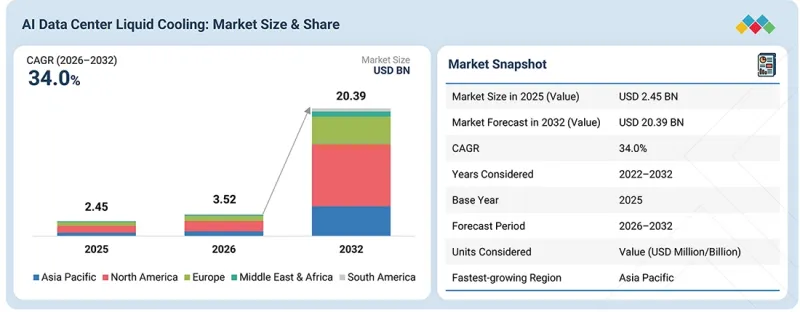
The global AI data center liquid cooling market is projected to grow from USD 3.52 billion in 2026 to USD 20.39 billion in 2032, at a CAGR of 34.0% during the forecast period. AI data center liquid cooling encompasses specialized technologies that use liquid-based heat transfer to maintain suitable operating conditions for AI-focused computing infrastructure. The approach is particularly relevant to data centers handling demanding workloads, where conventional cooling methods may face increasing thermal management requirements.
| Scope of the Report | |
|---|---|
| Years Considered for the Study | 2022-2032 |
| Base Year | 2025 |
| Forecast Period | 2026-2032 |
| Units Considered | Value (USD Million/Billion) |
| Segments | By Cooling Type, Rack Density, Component, Data Center Type, and Region |
| Regions covered | North America, Asia Pacific, Europe, and Rest of the World |
Adoption is expected to increase alongside the expansion of AI servers, high-performance processors, and dense rack configurations, as operators seek effective and scalable approaches to heat dissipation. Growing investments in modern data center infrastructure and the deployment of AI capabilities across different facility types will also contribute to market development.
"By cooling type, the immersion segment is expected to account for the second-largest share during the forecast period in terms of value."
By cooling type, the immersion segment is expected to account for the second-largest share of the market in terms of value during the forecast period. The segment is supported by the growing need for effective thermal management in high-density AI computing environments, where increasing processing requirements generate substantial heat. Immersion cooling offers an alternative approach for managing thermal loads and supporting the operation of advanced computing infrastructure. Its adoption is expected to increase as data center operators seek scalable and efficient cooling solutions for evolving AI workloads.
"By data center type, the colocation segment is expected to account for the second-largest market share during the forecast period."
By data center type, the colocation segment is expected to account for the second-largest market share during the forecast period. The segment is supported by increasing demand for flexible and scalable data center infrastructure among organizations deploying AI and high-performance computing applications. As colocation facilities accommodate diverse workloads and increasingly dense computing environments, the need for effective thermal management solutions is growing. The expansion of third-party data center services and continued adoption of AI infrastructure are expected to support the use of liquid cooling solutions within colocation facilities.
"Asia Pacific is expected to account for the second-largest market share during the forecast period."
Asia Pacific is expected to account for the second-largest market share during the forecast period, supported by the expansion of data center infrastructure and increasing adoption of AI and high-performance computing across the region. Growing digitalization, rising demand for computing capacity, and the development of high-density data center facilities are contributing to the need for advanced thermal management solutions. Increasing investments in data center expansion and the adoption of liquid cooling technologies are expected to further support market development across the region.
Profile breakdown of primary participants for the report:
- By Company Type: Tier 1 - 20%, Tier 2 - 40%, Tier 3 - 40%
- By Designation: Directors - 10%, C-level Executives - 70%, Others - 20%
- By Region: North America - 45%, Asia Pacific - 25%, Europe - 20%, Middle East & Africa - 7%, South America - 3%
Vertiv Group Corp. (US), Schneider Electric (France), Super Micro Computer, Inc. (US), DCX Liquid Cooling Systems (Poland), and CoolIT Systems (Ecolab) (Canada) are some of the major players operating in the AI data center liquid cooling market.
Research Coverage:
The report segments the AI data center liquid cooling market based on cooling type, data center type, and region. It provides detailed information regarding the major factors influencing the market's growth, such as drivers, restraints, opportunities, and challenges. It strategically profiles AI data center liquid cooling manufacturers, comprehensively analyzing their market shares and core competencies.
Reasons to Buy the Report:
The report is expected to help market leaders/new entrants by providing them with the closest approximations of revenue numbers for the AI data center liquid cooling market and its segments. This report is also expected to help stakeholders obtain an improved understanding of the market's competitive landscape, gain insights to improve the position of their businesses, and develop suitable go-to-market strategies. It also enables stakeholders to understand the market's pulse and provides information on key market drivers, restraints, challenges, and opportunities.
The report provides insights on the following pointers:
- Analysis of critical DROCs: Drivers (increasing number of data centers and server density, growing need for energy-efficient cooling solutions, rising demand for compact and noise-free solutions), restraints (high capital expenditure and maintenance, slow recognition from end users), opportunities (emergence of AI, blockchain, and other advanced technologies, adoption of immersion cooling solutions in low-density data centers), and challenges (lack of standardization, high investments in existing infrastructure).
- Product Development/Innovation: Detailed insights on upcoming technologies and research and development activities in the AI data center liquid cooling market
- Market Development: Comprehensive information about lucrative markets - the report analyzes the AI data center liquid cooling market across varied regions
- Competitive Assessment: In-depth assessment of market shares, growth strategies, and product offerings of leading players such as Vertiv Group Corp. (US), Schneider Electric (France), Super Micro Computer, Inc. (US), DCX Liquid Cooling Systems (Poland), and CoolIT Systems (Ecolab) (Canada) in the AI data center liquid cooling market
TABLE OF CONTENTS
1 INTRODUCTION
- 1.1 STUDY OBJECTIVES
- 1.2 MARKET DEFINITION
- 1.3 STUDY SCOPE
- 1.3.1 MARKETS COVERED AND REGIONAL SCOPE
- 1.3.2 INCLUSIONS AND EXCLUSIONS
- 1.3.3 YEARS CONSIDERED
- 1.4 CURRENCY CONSIDERED
- 1.5 STAKEHOLDERS
2 EXECUTIVE SUMMARY
- 2.1 KEY INSIGHTS AND MARKET HIGHLIGHTS
- 2.2 KEY MARKET PARTICIPANTS: SHARE INSIGHTS AND STRATEGIC DEVELOPMENTS
- 2.3 DISRUPTIVE TRENDS IN AI DATA CENTER LIQUID COOLING MARKET
- 2.4 HIGH-GROWTH SEGMENTS
- 2.5 REGIONAL SNAPSHOT: MARKET SIZE, GROWTH RATE, AND FORECAST
3 PREMIUM INSIGHTS
- 3.1 ATTRACTIVE OPPORTUNITIES FOR PLAYERS IN AI DATA CENTER LIQUID COOLING MARKET
- 3.2 AI DATA CENTER LIQUID COOLING MARKET, BY COUNTRY
4 MARKET OVERVIEW
- 4.1 INTRODUCTION
- 4.2 MARKET DYNAMICS
- 4.2.1 DRIVERS
- 4.2.1.1 Increasing server density and high number of data centers
- 4.2.1.2 Growing need for energy-efficient cooling solutions
- 4.2.1.3 Rising demand for compact and noise-free solutions
- 4.2.1.4 Surging need for better overclocking potential
- 4.2.1.5 Increasing requirement for eco-friendly data center cooling solutions
- 4.2.2 RESTRAINTS
- 4.2.2.1 High capital expenditure and maintenance requirements
- 4.2.2.2 Slow recognition from end users
- 4.2.3 OPPORTUNITIES
- 4.2.3.1 Emergence of artificial intelligence, blockchain, and other advanced technologies
- 4.2.3.2 Adoption of immersion cooling solutions in low-density data centers
- 4.2.4 CHALLENGES
- 4.2.4.1 Lack of standardization
- 4.2.4.2 High investments in existing data center infrastructure
- 4.2.1 DRIVERS
- 4.3 UNMET NEEDS AND WHITE SPACES
- 4.3.1 UNMET NEEDS IN THE AI DATA CENTER LIQUID COOLING MARKET
- 4.3.2 WHITE SPACE OPPORTUNITIES
- 4.4 INTERCONNECTED MARKETS AND CROSS-SECTOR OPPORTUNITIES
- 4.4.1 INTERCONNECTED MARKETS
- 4.4.2 CROSS-SECTOR OPPORTUNITIES
- 4.5 EMERGING BUSINESS MODELS AND ECOSYSTEM SHIFTS
- 4.5.1 EMERGING BUSINESS MODELS
- 4.5.2 ECOSYSTEM SHIFTS
- 4.6 STRATEGIC MOVES BY TIER 1/2/3 PLAYERS
- 4.6.1 KEY MOVES AND STRATEGIC FOCUS
5 INDUSTRY TRENDS
- 5.1 PORTER'S FIVE FORCES ANALYSIS
- 5.1.1 BARGAINING POWER OF SUPPLIERS
- 5.1.2 BARGAINING POWER OF BUYERS
- 5.1.3 THREAT OF NEW ENTRANTS
- 5.1.4 THREAT OF SUBSTITUTES
- 5.1.5 INTENSITY OF COMPETITIVE RIVALRY
- 5.2 MACROECONOMIC OUTLOOK
- 5.2.1 GDP TRENDS AND FORECAST
- 5.2.2 TRENDS IN GLOBAL AI DATA CENTER LIQUID COOLING INDUSTRY
- 5.3 VALUE CHAIN ANALYSIS
- 5.4 ECOSYSTEM ANALYSIS
- 5.5 KEY CONFERENCES AND EVENTS, 2026-2027
- 5.6 TRENDS/DISRUPTIONS INFLUENCING CUSTOMER BUSINESS
- 5.7 INVESTMENT AND FUNDING SCENARIO
- 5.8 CASE STUDY ANALYSIS
- 5.8.1 MICROSOFT FAIRWATER - PURPOSE-BUILT LIQUID COOLING FOR LARGE-SCALE AI INFRASTRUCTURE
- 5.8.2 NVIDIA-VERTIV GB200 NVL72 - 132 KW/RACK LIQUID-COOLED AI ARCHITECTURE
- 5.8.3 EQUINIX HK1 - LIQUID COOLING FOR AI IN EXISTING COLOCATION DATA CENTER
6 TECHNOLOGICAL ADVANCEMENTS, AI-DRIVEN IMPACT, PATENTS, INNOVATIONS, AND FUTURE APPLICATIONS
- 6.1 KEY TECHNOLOGIES
- 6.1.1 DIRECT-TO-LIQUID COOLING IN HIGH-DENSITY DATA CENTERS
- 6.1.2 IMMERSION COOLING
- 6.2 ADJACENT TECHNOLOGY
- 6.2.1 MICROCHANNEL LIQUID COOLING
- 6.3 TECHNOLOGY ROADMAP
- 6.3.1 SHORT-TERM (2025-2027): ADVANCED DIRECT-TO-CHIP AND MODULAR LIQUID COOLING
- 6.3.2 MID-TERM (2027-2030): AI-READY INTEGRATED COOLING AND HIGHER LIQUID COVERAGE
- 6.3.3 LONG-TERM (2030-2035+): CHIP-LEVEL, TWO-PHASE AND NEXT-GENERATION COOLING ARCHITECTURES
- 6.4 PATENT ANALYSIS
- 6.4.1 METHODOLOGY
- 6.4.2 INSIGHTS
- 6.4.3 LEGAL STATUS OF PATENTS
- 6.4.4 JURISDICTION ANALYSIS
- 6.4.5 TOP APPLICANTS
- 6.5 FUTURE APPLICATIONS
- 6.5.1 AI-OPTIMIZED HYPERSCALE DATA CENTERS: ULTRA-HIGH-DENSITY GPU & AI TRAINING CLUSTERS
- 6.5.2 WASTE HEAT RECOVERY & DISTRICT ENERGY SYSTEMS: CIRCULAR ENERGY & SUSTAINABILITY INTEGRATION
- 6.5.3 IMMERSION COOLING FOR HIGH-PERFORMANCE INDUSTRIES: DEFENSE, RESEARCH, FINANCIAL TRADING, AND SCIENTIFIC HPC
- 6.5.4 SUSTAINABLE & WATERLESS COOLING TECHNOLOGIES: LOW-CARBON, LOW-WUE THERMAL ARCHITECTURES
- 6.6 IMPACT OF GEN AI
- 6.6.1 OVERVIEW
7 REGULATORY LANDSCAPE AND SUSTAINABILITY INITIATIVES
- 7.1 REGIONAL REGULATIONS AND COMPLIANCE
- 7.1.1 REGULATORY BODIES, GOVERNMENT AGENCIES, AND OTHER ORGANIZATIONS
- 7.1.2 INDUSTRY STANDARDS
- 7.2 SUSTAINABILITY INITIATIVES
- 7.2.1 CARBON IMPACT REDUCTION
- 7.2.2 ECO-APPLICATIONS
- 7.3 SUSTAINABILITY IMPACT AND REGULATORY POLICY INITIATIVES
- 7.4 CERTIFICATIONS, LABELING, AND ECO-STANDARDS
8 CUSTOMER LANDSCAPE AND BUYER BEHAVIOR
- 8.1 DECISION-MAKING PROCESS
- 8.2 KEY STAKEHOLDERS IN BUYING PROCESS AND THEIR EVALUATION CRITERIA
- 8.2.1 KEY STAKEHOLDERS IN BUYING PROCESS
- 8.2.2 BUYING CRITERIA
- 8.3 ADOPTION BARRIERS AND INTERNAL CHALLENGES
- 8.4 UNMET NEEDS FROM END-USE INDUSTRIES
- 8.5 MARKET PROFITABILITY
- 8.5.1 REVENUE POTENTIAL
- 8.5.2 COST DYNAMICS
- 8.5.3 MARGIN OPPORTUNITIES IN KEY APPLICATIONS
9 AI DATA CENTER LIQUID COOLING MARKET, BY COMPONENT
- 9.1 INTRODUCTION
- 9.2 SOLUTIONS
- 9.2.1 RISING AI RACK POWER DENSITIES AND GPU HEAT LOADS ARE ACCELERATING THE ADOPTION OF INTEGRATED LIQUID COOLING
- 9.3 SERVICES
- 9.3.1 GROWING AI COOLING COMPLEXITY IS DRIVING DEMAND FOR SPECIALIZED COMMISSIONING, MONITORING, AND MAINTENANCE SERVICES.
10 AI DATA CENTER LIQUID COOLING MARKET, BY COOLING TYPE
- 10.1 INTRODUCTION
- 10.2 DIRECT-TO-CHIP
- 10.2.1 INCREASING HIGH-DENSITY DATA CENTER INSTALLATIONS TO DRIVE DEMAND
- 10.3 IMMERSION
- 10.3.1 ABILITY TO LOWER POWER CONSUMPTION AND CARBON FOOTPRINT TO DRIVE MARKET
11 AI DATA CENTER LIQUID COOLING MARKET, BY DATA CENTER TYPE
- 11.1 INTRODUCTION
- 11.2 HYPERSCALE
- 11.2.1 RAPID DEPLOYMENT OF HIGH-DENSITY AI/GPU CLUSTERS DRIVING HYPERSCALE OPERATORS TOWARD 100 KW+ RACK DENSITIES THAT INCREASINGLY REQUIRE DIRECT LIQUID COOLING
- 11.3 COLOCATION
- 11.3.1 GROWING DEMAND FROM AI TENANTS FOR HIGH-DENSITY COMPUTING ENCOURAGING COLOCATION PROVIDERS TO DEVELOP LIQUID-READY AND LIQUID-COOLED CAPACITY
- 11.4 ENTERPRISE
- 11.4.1 RISING NEED FOR DATA MANAGEMENT AND DOWNTIME REDUCTION TO DRIVE MARKET
12 AI DATA CENTER LIQUID COOLING MARKET, BY RACK DENSITY
- 12.1 INTRODUCTION
- 12.2 30 KW-40 KW
- 12.2.1 INCREASING DEPLOYMENT OF MODERATE-DENSITY AI AND GPU RACKS IS DRIVING DEMAND FOR ENHANCED COOLING
- 12.3 40 KW-60 KW
- 12.3.1 RISING GPU CONSOLIDATION AND INCREASING RACK-LEVEL THERMAL LOADS ARE ACCELERATING ADOPTION OF LIQUID-ASSISTED AND DIRECT- TO-CHIP COOLING
- 12.4 60 KW-120 KW
- 12.4.1 INCREASING GPU POWER DENSITY AND RACK-SCALE AI ARCHITECTURES ARE DRIVING RAPID ADOPTION OF LIQUID COOLING
- 12.5 120 KW & ABOVE
- 12.5.1 ESCALATING RACK-SCALE GPU POWER DENSITY IS PUSHING NEXT-GENERATION AI INFRASTRUCTURE TOWARD ULTRA-HIGH-DENSITY RACKS THAT REQUIRE ADVANCED LIQUID COOLING
13 AI DATA CENTER LIQUID COOLING MARKET, BY REGION
- 13.1 INTRODUCTION
- 13.2 NORTH AMERICA
- 13.2.1 US
- 13.2.1.1 Rapid expansion of AI and high-density computing infrastructure to drive market
- 13.2.2 CANADA
- 13.2.2.1 Expansion of AI and high-performance computing infrastructure to drive demand
- 13.2.3 MEXICO
- 13.2.3.1 Expanding hyperscale data center capacity and AI infrastructure to boost market
- 13.2.1 US
- 13.3 ASIA PACIFIC
- 13.3.1 CHINA
- 13.3.1.1 Rapid AI infrastructure expansion and domestic liquid-cooling innovation to accelerate market growth
- 13.3.2 SOUTH KOREA
- 13.3.2.1 Expansion of high-density AI infrastructure and government-backed cooling technologies to accelerate liquid-cooling adoption
- 13.3.3 JAPAN
- 13.3.3.1 Rising AI/HPC workloads and government-backed liquid-cooling R&D to accelerate adoption
- 13.3.4 INDIA
- 13.3.4.1 Large-scale AI infrastructure investments and advanced cooling adoption to drive demand
- 13.3.5 MALAYSIA
- 13.3.5.1 Rapid hyperscale AI expansion and tightening water-efficiency requirements to accelerate liquid-cooling adoption
- 13.3.6 SINGAPORE
- 13.3.6.1 Rising AI workloads to accelerate demand
- 13.3.7 AUSTRALIA
- 13.3.7.1 Growing AI infrastructure and tightening water-efficiency requirements to drive liquid cooling adoption
- 13.3.8 REST OF ASIA PACIFIC
- 13.3.1 CHINA
- 13.4 EUROPE
- 13.4.1 UK
- 13.4.1.1 Rapid expansion of AI compute infrastructure and high-density deployments to drive demand
- 13.4.2 GERMANY
- 13.4.2.1 Expansion of AI/HPC infrastructure and water-efficient cooling requirements to boost market
- 13.4.3 FRANCE
- 13.4.3.1 Large AI projects and sovereign-cloud initiatives to drive demand for liquid cooling solutions
- 13.4.4 REST OF EUROPE
- 13.4.1 UK
- 13.5 SOUTH AMERICA
- 13.5.1 BRAZIL
- 13.5.1.1 Surge in IT spending across enterprises to fuel demand for data centers
- 13.5.2 REST OF SOUTH AMERICA
- 13.5.1 BRAZIL
- 13.6 MIDDLE EAST & AFRICA
- 13.6.1 GCC COUNTRIES
- 13.6.1.1 Saudi Arabia
- 13.6.1.1.1 Rapid AI data-center expansion and mega-scale high-density deployments to propel market
- 13.6.1.2 Rest of GCC countries
- 13.6.1.1 Saudi Arabia
- 13.6.2 SOUTH AFRICA
- 13.6.2.1 Rising AI rack densities and growing demand for advanced thermal management to drive liquid-cooling adoption
- 13.6.3 REST OF MIDDLE EAST & AFRICA
- 13.6.1 GCC COUNTRIES
14 COMPETITIVE LANDSCAPE
- 14.1 INTRODUCTION
- 14.2 KEY PLAYER STRATEGIES/RIGHT TO WIN
- 14.3 REVENUE ANALYSIS
- 14.3.1 TOP 3 PLAYERS' REVENUE ANALYSIS
- 14.4 MARKET SHARE ANALYSIS
- 14.4.1 RANKING OF KEY MARKET PLAYERS, 2025
- 14.4.2 MARKET SHARE OF KEY PLAYERS
- 14.5 BRAND/PRODUCT COMPARISON
- 14.5.1 VERTIV COOLLOOP TRIM COOLER
- 14.5.2 SUPERMICRO LIQUID-COOLED RACK-SCALE SOLUTION
- 14.5.3 FLOOR-MOUNTED DISTRIBUTION UNIT
- 14.5.4 COOLIT SYSTEMS CHX2000
- 14.5.5 DCX FDU SERIES
- 14.6 COMPANY EVALUATION MATRIX: KEY PLAYERS, 2025
- 14.6.1 STARS
- 14.6.2 EMERGING LEADERS
- 14.6.3 PERVASIVE PLAYERS
- 14.6.4 PARTICIPANTS
- 14.6.5 COMPANY FOOTPRINT: KEY PLAYERS, 2025
- 14.6.5.1 Company footprint
- 14.6.5.2 Region footprint
- 14.6.5.3 Component footprint
- 14.6.5.4 Cooling type footprint
- 14.6.6 DATA CENTER TYPE FOOTPRINT
- 14.7 COMPANY EVALUATION MATRIX: STARTUPS/SMES, 2025
- 14.7.1 PROGRESSIVE COMPANIES
- 14.7.2 RESPONSIVE COMPANIES
- 14.7.3 DYNAMIC COMPANIES
- 14.7.4 STARTING BLOCKS
- 14.7.5 COMPETITIVE BENCHMARKING: STARTUPS/SMES, 2025
- 14.7.5.1 Detailed list of key startups/SMEs
- 14.7.6 COMPETITIVE BENCHMARKING OF KEY STARTUPS/SMES
- 14.8 COMPETITIVE SCENARIO
- 14.8.1 PRODUCT LAUNCHES
- 14.8.2 DEALS
- 14.8.3 EXPANSIONS
- 14.9 VALUATION AND FINANCIAL METRICS
15 COMPANY PROFILES
- 15.1 KEY PLAYERS
- 15.1.1 VERTIV GROUP CORP.
- 15.1.1.1 Business overview
- 15.1.1.2 Products/Solutions/Services offered
- 15.1.1.3 Recent developments
- 15.1.1.3.1 Product Launches
- 15.1.1.3.2 Deals
- 15.1.1.3.3 Expansions
- 15.1.1.4 MnM view
- 15.1.1.4.1 Right to win
- 15.1.1.4.2 Strategic choices
- 15.1.1.4.3 Weaknesses and competitive threats
- 15.1.2 SUPER MICRO COMPUTER, INC.
- 15.1.2.1 Business overview
- 15.1.2.2 Products/Solutions/Services offered
- 15.1.2.3 Recent development
- 15.1.2.3.1 Product Launches
- 15.1.2.3.2 Deals
- 15.1.2.3.3 Expansions
- 15.1.2.4 MnM view
- 15.1.2.4.1 Right to win
- 15.1.2.4.2 Strategic choices
- 15.1.2.4.3 Weaknesses and competitive threats
- 15.1.3 SCHNEIDER ELECTRIC
- 15.1.3.1 Business overview
- 15.1.3.2 Products/Solutions/Services offered
- 15.1.3.3 Recent developments
- 15.1.3.3.1 Product Launches
- 15.1.3.3.2 Deals
- 15.1.3.3.3 Expansions
- 15.1.3.4 MnM view
- 15.1.3.4.1 Right to win
- 15.1.3.4.2 Strategic choices
- 15.1.3.4.3 Weaknesses and competitive threats
- 15.1.4 DCX LIQUID COOLING SYSTEMS
- 15.1.4.1 Business overview
- 15.1.4.2 Products/Solutions/Services offered
- 15.1.4.3 Recent developments
- 15.1.4.3.1 Product Launches
- 15.1.4.3.2 Deals
- 15.1.4.3.3 Expansions
- 15.1.4.4 MnM view
- 15.1.4.4.1 Right to win
- 15.1.4.4.2 Strategic choices
- 15.1.4.4.3 Weaknesses and competitive threats
- 15.1.5 COOLIT SYSTEMS (ECOLAB)
- 15.1.5.1 Business overview
- 15.1.5.2 Products/Solutions/Services offered
- 15.1.5.3 Recent developments
- 15.1.5.3.1 Product Launches
- 15.1.5.3.2 Deals
- 15.1.5.3.3 Expansions
- 15.1.5.4 MnM view
- 15.1.5.4.1 Right to win
- 15.1.5.4.2 Strategic choices
- 15.1.5.4.3 Weaknesses and competitive threats
- 15.1.6 MODINE MANUFACTURING COMPANY
- 15.1.6.1 Business overview
- 15.1.6.2 Products/Solutions/Services offered
- 15.1.6.3 Recent developments
- 15.1.6.3.1 Product Launches
- 15.1.6.3.2 Deals
- 15.1.6.3.3 Expansions
- 15.1.7 GREEN REVOLUTION COOLING, INC
- 15.1.7.1 Business overview
- 15.1.7.2 Products/Solutions/Services offered
- 15.1.7.3 Recent developments
- 15.1.7.3.1 Product Launches
- 15.1.7.3.2 Deals
- 15.1.8 SUBMER GROUP LTD.
- 15.1.8.1 Business overview
- 15.1.8.2 Products/Solutions/Services offered
- 15.1.8.3 Recent developments
- 15.1.8.3.1 Product Launches
- 15.1.8.3.2 Deals
- 15.1.8.3.3 Expansions
- 15.1.9 ASPERITAS
- 15.1.9.1 Business overview
- 15.1.9.2 Products/Solutions/Services offered
- 15.1.9.3 Recent developments
- 15.1.9.3.1 Product Launches
- 15.1.9.3.2 Deals
- 15.1.9.3.3 Expansions
- 15.1.10 ICEOTOPE
- 15.1.10.1 Business overview
- 15.1.10.2 Products/Solutions/Services offered
- 15.1.10.3 Recent developments
- 15.1.10.3.1 Product Launches
- 15.1.10.3.2 Deals
- 15.1.10.3.3 Expansions
- 15.1.11 RITTAL GMBH & CO. KG
- 15.1.11.1 Business overview
- 15.1.11.2 Products/Solutions/Services offered
- 15.1.11.3 Recent developments
- 15.1.11.3.1 Product Launches
- 15.1.11.3.2 Deals
- 15.1.12 MIDAS IMMERSION COOLING
- 15.1.12.1 Business overview
- 15.1.12.2 Products/Solutions/Services offered
- 15.1.12.3 Recent developments
- 15.1.12.3.1 Deals
- 15.1.13 LIQUIDSTACK HOLDING B.V. (TRANE TECHNOLOGIES)
- 15.1.13.1 Business overview
- 15.1.13.2 Products/Solutions/Services offered
- 15.1.13.3 Recent developments
- 15.1.13.3.1 Product Launches
- 15.1.14 DAIKIN INDUSTRIES, LTD.
- 15.1.14.1 Business overview
- 15.1.14.2 Products/Solutions/Services offered
- 15.1.14.3 Recent developments
- 15.1.14.3.1 Deals
- 15.1.15 BALTIMORE AIRCOIL COMPANY, INC.
- 15.1.15.1 Business overview
- 15.1.15.2 Products/Solutions/Services offered
- 15.1.15.3 Recent developments
- 15.1.15.3.1 Deals
- 15.1.16 LIQUIDCOOL SOLUTIONS
- 15.1.16.1 Business overview
- 15.1.16.2 Products/Solutions/Services offered
- 15.1.16.3 Recent developments
- 15.1.16.3.1 Deals
- 15.1.17 STULZ GMBH
- 15.1.17.1 Business overview
- 15.1.17.2 Products/Solutions/Services offered
- 15.1.17.3 Recent developments
- 15.1.17.3.1 Product Launches
- 15.1.18 DELTA POWER SOLUTIONS
- 15.1.18.1 Business overview
- 15.1.18.2 Products/Solutions/Services offered
- 15.1.18.3 Recent developments
- 15.1.18.3.1 Deals
- 15.1.19 ZUTACORE, INC.
- 15.1.19.1 Business overview
- 15.1.19.2 Products/Solutions/Services offered
- 15.1.19.3 Recent developments
- 15.1.19.3.1 Product Launches
- 15.1.19.3.2 Deals
- 15.1.20 WIWYNN CORPORATION
- 15.1.20.1 Business overview
- 15.1.20.2 Products/Solutions/Services offered
- 15.1.20.3 Recent developments
- 15.1.21 EATON
- 15.1.21.1 Business overview
- 15.1.21.2 Products/Solutions/Services offered
- 15.1.21.3 Recent developments
- 15.1.21.3.1 Product Launches
- 15.1.21.3.2 Deals
- 15.1.21.3.3 Expansions
- 15.1.22 KAORI HEAT TREATMENT CO., LTD.
- 15.1.22.1 Business overview
- 15.1.22.2 Products/Solutions/Services offered
- 15.1.22.3 Recent developments
- 15.1.22.3.1 Product Launches
- 15.1.23 FLEX LTD.
- 15.1.23.1 Business overview
- 15.1.23.2 Products/Solutions/Services offered
- 15.1.23.3 Recent developments
- 15.1.23.3.1 Product Launches
- 15.1.23.3.2 Deals
- 15.1.24 LENOVO
- 15.1.24.1 Business overview
- 15.1.24.2 Products/Solutions/Services offered
- 15.1.24.3 Recent developments
- 15.1.24.3.1 Product Launches
- 15.1.24.3.2 Deals
- 15.1.24.3.3 Expansions
- 15.1.25 DAWNING INFORMATION INDUSTRY CO., LTD.
- 15.1.25.1 Business overview
- 15.1.25.2 Products/Solutions/Services offered
- 15.1.26 INSPUR CO., LTD.
- 15.1.26.1 Business overview
- 15.1.26.2 Products/Solutions/Services offered
- 15.1.26.3 Recent developments
- 15.1.27 NVENT
- 15.1.27.1 Business overview
- 15.1.27.2 Products/Solutions/Services offered
- 15.1.27.3 Recent developments
- 15.1.27.3.1 Deals
- 15.1.27.3.2 Expansions
- 15.1.28 TAISOL ELECTRONICS CO., LTD.
- 15.1.28.1 Business overview
- 15.1.28.2 Products/Solutions/Services offered
- 15.1.28.3 Recent developments
- 15.1.29 ACCELSIUS LLC
- 15.1.29.1 Business overview
- 15.1.29.2 Products/Solutions/Services offered
- 15.1.29.3 Recent developments
- 15.1.29.3.1 Product Launches
- 15.1.29.3.2 Deals
- 15.1.30 REFROID TECHNOLOGIES
- 15.1.30.1 Business overview
- 15.1.30.2 Products/Solutions/Services offered
- 15.1.30.3 Recent developments
- 15.1.30.3.1 Deals
- 15.1.1 VERTIV GROUP CORP.
- 15.2 OTHER PLAYERS
- 15.2.1 KOOLANCE, INC.
- 15.2.2 GIGA-BYTE TECHNOLOGY CO., LTD.
- 15.2.3 PEZY COMPUTING
- 15.2.4 TEIMMERS
16 RESEARCH METHODOLOGY
- 16.1 RESEARCH DATA
- 16.1.1 SECONDARY DATA
- 16.1.1.1 List of key secondary sources
- 16.1.1.2 Key data from secondary sources
- 16.1.2 PRIMARY DATA
- 16.1.2.1 Key data from primary sources
- 16.1.2.2 List of primary interview participants (demand and supply sides)
- 16.1.2.3 Key industry insights
- 16.1.2.4 Breakdown of interviews with experts
- 16.1.1 SECONDARY DATA
- 16.2 DEMAND-SIDE ANALYSIS
- 16.3 MARKET SIZE ESTIMATION
- 16.3.1 BOTTOM-UP APPROACH
- 16.3.2 TOP-DOWN APPROACH
- 16.4 SUPPLY-SIDE ANALYSIS OF THE AI DATA CENTER LIQUID COOLING MARKET
- 16.4.1 CALCULATIONS FOR SUPPLY-SIDE ANALYSIS
- 16.5 GROWTH FORECAST
- 16.6 DATA TRIANGULATION
- 16.7 FACTOR ANALYSIS
- 16.8 RESEARCH ASSUMPTIONS
- 16.9 RESEARCH LIMITATIONS
- 16.10 RISK ASSESSMENT
17 APPENDIX
- 17.1 DISCUSSION GUIDE
- 17.2 KNOWLEDGESTORE: MARKETSANDMARKETS' SUBSCRIPTION PORTAL
- 17.3 CUSTOMIZATION OPTIONS
- 17.4 RELATED REPORTS
- 17.5 AUTHOR DETAILS
List of Tables
- TABLE 1 POWER USAGE BY AIR-COOLED VS. LIQUID-COOLED DATA CENTERS WITH 1 MW OF TECHNICAL LOAD
- TABLE 2 AI DATA CENTER LIQUID COOLING MARKET: PORTER'S FIVE FORCES ANALYSIS
- TABLE 3 REAL GDP GROWTH (ANNUAL PERCENTAGE CHANGE), BY COUNTRY, 2022-2025 (%)
- TABLE 4 UNEMPLOYMENT RATE, BY COUNTRY, 2022-2025 (%)
- TABLE 5 INFLATION RATE, AVERAGE CONSUMER PRICES, BY COUNTRY, 2022-2025 (%)
- TABLE 6 FOREIGN DIRECT INVESTMENT, BY REGION, 2022-2024 (USD BILLION)
- TABLE 7 ROLE OF COMPANIES IN ECOSYSTEM
- TABLE 8 KEY CONFERENCES AND EVENTS, 2026-2027
- TABLE 9 AI DATA CENTER LIQUID COOLING MARKET: TOTAL NUMBER OF PATENTS, 2015-2025
- TABLE 10 MAJOR PATENTS RELATED TO AI DATA CENTER LIQUID COOLING SOLUTIONS
- TABLE 11 NORTH AMERICA: REGULATORY BODIES, GOVERNMENT AGENCIES, AND OTHER ORGANIZATIONS
- TABLE 12 EUROPE: REGULATORY BODIES, GOVERNMENT AGENCIES, AND OTHER ORGANIZATIONS
- TABLE 13 ASIA PACIFIC: REGULATORY BODIES, GOVERNMENT AGENCIES, AND OTHER ORGANIZATIONS
- TABLE 14 GLOBAL INDUSTRY STANDARDS
- TABLE 15 CERTIFICATIONS, LABELING, AND ECO-STANDARDS
- TABLE 16 INFLUENCE OF STAKEHOLDERS ON BUYING PROCESS FOR TOP DATA CENTER TYPES (%)
- TABLE 17 KEY BUYING CRITERIA FOR TOP DATA CENTER TYPES
- TABLE 18 UNMET NEEDS FROM END-USE INDUSTRIES
- TABLE 19 AI DATA CENTER LIQUID COOLING MARKET, BY COMPONENT, 2022-2025 (USD MILLION)
- TABLE 20 AI DATA CENTER LIQUID COOLING MARKET, BY COMPONENT, 2026-2032 (USD MILLION)
- TABLE 21 AI DATA CENTER LIQUID COOLING MARKET, BY COOLING TYPE, 2022-2025 (USD MILLION)
- TABLE 22 AI DATA CENTER LIQUID COOLING MARKET, BY COOLING TYPE, 2026-2032 (USD MILLION)
- TABLE 23 AI DATA CENTER LIQUID COOLING MARKET, BY DATA CENTER TYPE, 2022-2025 (USD MILLION)
- TABLE 24 AI DATA CENTER LIQUID COOLING MARKET, BY DATA CENTER TYPE, 2026-2032 (USD MILLION)
- TABLE 25 AI DATA CENTER LIQUID COOLING MARKET, BY RACK DENSITY, 2022-2025 (USD MILLION)
- TABLE 26 AI DATA CENTER LIQUID COOLING MARKET, BY RACK DENSITY, 2026-2032 (USD MILLION)
- TABLE 27 AI DATA CENTER LIQUID COOLING MARKET, BY REGION, 2022-2025 (USD MILLION)
- TABLE 28 AI DATA CENTER LIQUID COOLING MARKET, BY REGION, 2026-2032 (USD MILLION)
- TABLE 29 NORTH AMERICA: AI DATA CENTER LIQUID COOLING MARKET, BY COUNTRY, 2022-2025 (USD MILLION)
- TABLE 30 NORTH AMERICA: AI DATA CENTER LIQUID COOLING MARKET, BY COUNTRY, 2026-2032 (USD MILLION)
- TABLE 31 NORTH AMERICA: AI DATA CENTER LIQUID COOLING MARKET, BY COMPONENT, 2022-2025 (USD MILLION)
- TABLE 32 NORTH AMERICA: AI DATA CENTER LIQUID COOLING MARKET, BY COMPONENT, 2026-2032 (USD MILLION)
- TABLE 33 NORTH AMERICA: AI DATA CENTER LIQUID COOLING MARKET, BY COOLING TYPE, 2022-2025 (USD MILLION)
- TABLE 34 NORTH AMERICA: AI DATA CENTER LIQUID COOLING MARKET, BY COOLING TYPE, 2026-2032 (USD MILLION)
- TABLE 35 NORTH AMERICA: AI DATA CENTER LIQUID COOLING MARKET, BY DATA CENTER TYPE, 2022-2025 (USD MILLION)
- TABLE 36 NORTH AMERICA: AI DATA CENTER LIQUID COOLING MARKET, BY DATA CENTER TYPE, 2026-2032 (USD MILLION)
- TABLE 37 US: AI DATA CENTER LIQUID COOLING MARKET, BY COMPONENT, 2022-2025 (USD MILLION)
- TABLE 38 US: AI DATA CENTER LIQUID COOLING MARKET, BY COMPONENT, 2026-2032 (USD MILLION)
- TABLE 39 CANADA: AI DATA CENTER LIQUID COOLING MARKET, BY COMPONENT, 2022-2025 (USD MILLION)
- TABLE 40 CANADA: AI DATA CENTER LIQUID COOLING MARKET, BY COMPONENT, 2026-2032 (USD MILLION)
- TABLE 41 MEXICO: AI DATA CENTER LIQUID COOLING MARKET, BY COMPONENT, 2022-2025 (USD MILLION)
- TABLE 42 MEXICO: AI DATA CENTER LIQUID COOLING MARKET, BY COMPONENT, 2026-2032 (USD MILLION)
- TABLE 43 ASIA PACIFIC: AI DATA CENTER LIQUID COOLING MARKET, BY COUNTRY, 2022-2025 (USD MILLION)
- TABLE 44 ASIA PACIFIC: AI DATA CENTER LIQUID COOLING MARKET, BY COUNTRY, 2026-2032 (USD MILLION)
- TABLE 45 ASIA PACIFIC: AI DATA CENTER LIQUID COOLING MARKET, BY COMPONENT, 2022-2025 (USD MILLION)
- TABLE 46 ASIA PACIFIC: AI DATA CENTER LIQUID COOLING MARKET, BY COMPONENT, 2026-2032 (USD MILLION)
- TABLE 47 ASIA PACIFIC: AI DATA CENTER LIQUID COOLING MARKET, BY COOLING TYPE, 2022-2025 (USD MILLION)
- TABLE 48 ASIA PACIFIC: AI DATA CENTER LIQUID COOLING MARKET, BY COOLING TYPE, 2026-2032 (USD MILLION)
- TABLE 49 ASIA PACIFIC: AI DATA CENTER LIQUID COOLING MARKET, BY DATA CENTER TYPE, 2022-2025 (USD MILLION)
- TABLE 50 ASIA PACIFIC: AI DATA CENTER LIQUID COOLING MARKET, BY DATA CENTER TYPE, 2026-2032 (USD MILLION)
- TABLE 51 CHINA: AI DATA CENTER LIQUID COOLING MARKET, BY COMPONENT, 2022-2025 (USD MILLION)
- TABLE 52 CHINA: AI DATA CENTER LIQUID COOLING MARKET, BY COMPONENT, 2026-2032 (USD MILLION)
- TABLE 53 SOUTH KOREA: AI DATA CENTER LIQUID COOLING MARKET, BY COMPONENT, 2022-2025 (USD MILLION)
- TABLE 54 SOUTH KOREA: AI DATA CENTER LIQUID COOLING MARKET, BY COMPONENT, 2026-2032 (USD MILLION)
- TABLE 55 JAPAN: AI DATA CENTER LIQUID COOLING MARKET, BY COMPONENT, 2022-2025 (USD MILLION)
- TABLE 56 JAPAN: AI DATA CENTER LIQUID COOLING MARKET, BY COMPONENT, 2026-2032 (USD MILLION)
- TABLE 57 INDIA: AI DATA CENTER LIQUID COOLING MARKET, BY COMPONENT, 2022-2025 (USD MILLION)
- TABLE 58 INDIA: AI DATA CENTER LIQUID COOLING MARKET, BY COMPONENT, 2026-2032 (USD MILLION)
- TABLE 59 MALAYSIA: AI DATA CENTER LIQUID COOLING MARKET, BY COMPONENT, 2022-2025 (USD MILLION)
- TABLE 60 MALAYSIA: AI DATA CENTER LIQUID COOLING MARKET, BY COMPONENT, 2026-2032 (USD MILLION)
- TABLE 61 SINGAPORE: AI DATA CENTER LIQUID COOLING MARKET, BY COMPONENT, 2022-2025 (USD MILLION)
- TABLE 62 SINGAPORE: AI DATA CENTER LIQUID COOLING MARKET, BY COMPONENT, 2026-2032 (USD MILLION)
- TABLE 63 AUSTRALIA: AI DATA CENTER LIQUID COOLING MARKET, BY COMPONENT, 2022-2025 (USD MILLION)
- TABLE 64 AUSTRALIA: AI DATA CENTER LIQUID COOLING MARKET, BY COMPONENT, 2026-2032 (USD MILLION)
- TABLE 65 REST OF ASIA PACIFIC: AI DATA CENTER LIQUID COOLING MARKET, BY COMPONENT, 2022-2025 (USD MILLION)
- TABLE 66 REST OF ASIA PACIFIC: AI DATA CENTER LIQUID COOLING MARKET, BY COMPONENT, 2026-2032 (USD MILLION)
- TABLE 67 EUROPE: AI DATA CENTER LIQUID COOLING MARKET, BY COUNTRY, 2022-2025 (USD MILLION)
- TABLE 68 EUROPE: AI DATA CENTER LIQUID COOLING MARKET, BY COUNTRY, 2026-2032 (USD MILLION)
- TABLE 69 EUROPE: AI DATA CENTER LIQUID COOLING MARKET, BY COMPONENT, 2022-2025 (USD MILLION)
- TABLE 70 EUROPE: AI DATA CENTER LIQUID COOLING MARKET, BY COMPONENT, 2026-2032 (USD MILLION)
- TABLE 71 EUROPE: AI DATA CENTER LIQUID COOLING MARKET, BY COOLING TYPE, 2022-2025 (USD MILLION)
- TABLE 72 EUROPE: AI DATA CENTER LIQUID COOLING MARKET, BY COOLING TYPE, 2026-2032 (USD MILLION)
- TABLE 73 EUROPE: AI DATA CENTER LIQUID COOLING MARKET, BY DATA CENTER TYPE, 2022-2025 (USD MILLION)
- TABLE 74 EUROPE: AI DATA CENTER LIQUID COOLING MARKET, BY DATA CENTER TYPE, 2026-2032 (USD MILLION)
- TABLE 75 UK: AI DATA CENTER LIQUID COOLING MARKET, BY COMPONENT, 2022-2025 (USD MILLION)
- TABLE 76 UK: AI DATA CENTER LIQUID COOLING MARKET, BY COMPONENT, 2026-2032 (USD MILLION)
- TABLE 77 GERMANY: AI DATA CENTER LIQUID COOLING MARKET, BY COMPONENT, 2022-2025 (USD MILLION)
- TABLE 78 GERMANY: AI DATA CENTER LIQUID COOLING MARKET, BY COMPONENT, 2026-2032 (USD MILLION)
- TABLE 79 FRANCE: AI DATA CENTER LIQUID COOLING MARKET, BY COMPONENT, 2022-2025 (USD MILLION)
- TABLE 80 FRANCE: AI DATA CENTER LIQUID COOLING MARKET, BY COMPONENT, 2026-2032 (USD MILLION)
- TABLE 81 REST OF EUROPE: AI DATA CENTER LIQUID COOLING MARKET, BY COMPONENT, 2022-2025 (USD MILLION)
- TABLE 82 REST OF EUROPE: AI DATA CENTER LIQUID COOLING MARKET, BY COMPONENT, 2026-2032 (USD MILLION)
- TABLE 83 SOUTH AMERICA: AI DATA CENTER LIQUID COOLING MARKET, BY COUNTRY, 2022-2025 (USD MILLION)
- TABLE 84 SOUTH AMERICA: AI DATA CENTER LIQUID COOLING MARKET, BY COUNTRY, 2026-2032 (USD MILLION)
- TABLE 85 SOUTH AMERICA: AI DATA CENTER LIQUID COOLING MARKET, BY COMPONENT, 2022-2025 (USD MILLION)
- TABLE 86 SOUTH AMERICA: AI DATA CENTER LIQUID COOLING MARKET, BY COMPONENT, 2026-2032 (USD MILLION)
- TABLE 87 SOUTH AMERICA: AI DATA CENTER LIQUID COOLING MARKET, BY COOLING TYPE, 2022-2025 (USD MILLION)
- TABLE 88 SOUTH AMERICA: AI DATA CENTER LIQUID COOLING MARKET, BY COOLING TYPE, 2026-2032 (USD MILLION)
- TABLE 89 SOUTH AMERICA: AI DATA CENTER LIQUID COOLING MARKET, BY DATA CENTER TYPE, 2022-2025 (USD MILLION)
- TABLE 90 SOUTH AMERICA: AI DATA CENTER LIQUID COOLING MARKET, BY DATA CENTER TYPE, 2026-2032 (USD MILLION)
- TABLE 91 BRAZIL: AI DATA CENTER LIQUID COOLING MARKET, BY COMPONENT, 2022-2025 (USD MILLION)
- TABLE 92 BRAZIL: AI DATA CENTER LIQUID COOLING MARKET, BY COMPONENT, 2026-2032 (USD MILLION)
- TABLE 93 REST OF SOUTH AMERICA: AI DATA CENTER LIQUID COOLING MARKET, BY COMPONENT, 2022-2025 (USD MILLION)
- TABLE 94 REST OF SOUTH AMERICA: AI DATA CENTER LIQUID COOLING MARKET, BY COMPONENT, 2026-2032 (USD MILLION)
- TABLE 95 MIDDLE EAST & AFRICA: AI DATA CENTER LIQUID COOLING MARKET, BY COUNTRY, 2022-2025 (USD MILLION)
- TABLE 96 MIDDLE EAST & AFRICA: AI DATA CENTER LIQUID COOLING MARKET, BY COUNTRY, 2026-2032 (USD MILLION)
- TABLE 97 MIDDLE EAST & AFRICA: AI DATA CENTER LIQUID COOLING MARKET, BY COMPONENT, 2022-2025 (USD MILLION)
- TABLE 98 MIDDLE EAST & AFRICA: AI DATA CENTER LIQUID COOLING MARKET, BY COMPONENT, 2026-2032 (USD MILLION)
- TABLE 99 MIDDLE EAST & AFRICA: AI DATA CENTER LIQUID COOLING MARKET, BY COOLING TYPE, 2022-2025 (USD MILLION)
- TABLE 100 MIDDLE EAST & AFRICA: AI DATA CENTER LIQUID COOLING MARKET, BY COOLING TYPE, 2026-2032 (USD MILLION)
- TABLE 101 MIDDLE EAST & AFRICA: AI DATA CENTER LIQUID COOLING MARKET, BY DATA CENTER TYPE, 2022-2025 (USD MILLION)
- TABLE 102 MIDDLE EAST & AFRICA: AI DATA CENTER LIQUID COOLING MARKET, BY DATA CENTER TYPE, 2026-2032 (USD MILLION)
- TABLE 103 SAUDI ARABIA: AI DATA CENTER LIQUID COOLING MARKET, BY COMPONENT, 2022-2025 (USD MILLION)
- TABLE 104 SAUDI ARABIA: AI DATA CENTER LIQUID COOLING MARKET, BY COMPONENT, 2026-2032 (USD MILLION)
- TABLE 105 REST OF GCC COUNTRIES: AI DATA CENTER LIQUID COOLING MARKET, BY COMPONENT, 2022-2025 (USD MILLION)
- TABLE 106 REST OF GCC COUNTRIES: AI DATA CENTER LIQUID COOLING MARKET, BY COMPONENT, 2026-2032 (USD MILLION)
- TABLE 107 SOUTH AFRICA: AI DATA CENTER LIQUID COOLING MARKET, BY COMPONENT, 2022-2025 (USD MILLION)
- TABLE 108 SOUTH AFRICA: AI DATA CENTER LIQUID COOLING MARKET, BY COMPONENT, 2026-2032 (USD MILLION)
- TABLE 109 REST OF MIDDLE EAST & AFRICA: AI DATA CENTER LIQUID COOLING MARKET, BY COMPONENT, 2022-2025 (USD MILLION)
- TABLE 110 REST OF MIDDLE EAST & AFRICA: AI DATA CENTER LIQUID COOLING MARKET, BY COMPONENT, 2026-2032 (USD MILLION)
- TABLE 111 AI DATA CENTER LIQUID COOLING MARKET: OVERVIEW OF STRATEGIES ADOPTED BY KEY PLAYERS, 2021-2026
- TABLE 112 AI DATA CENTER LIQUID COOLING MARKET: DEGREE OF COMPETITION, 2025
- TABLE 113 AI DATA CENTER LIQUID COOLING MARKET: REGION FOOTPRINT
- TABLE 114 AI DATA CENTER LIQUID COOLING MARKET: COMPONENT FOOTPRINT
- TABLE 115 AI DATA CENTER LIQUID COOLING MARKET: COOLING TYPE FOOTPRINT
- TABLE 116 AI DATA CENTER LIQUID COOLING MARKET: DATA CENTER TYPE FOOTPRINT
- TABLE 117 AI DATA CENTER LIQUID COOLING MARKET: DETAILED LIST OF KEY STARTUPS/SMES
- TABLE 118 AI DATA CENTER LIQUID COOLING MARKET: COMPETITIVE BENCHMARKING OF KEY STARTUPS/SMES (1/2)
- TABLE 119 AI DATA CENTER LIQUID COOLING MARKET: COMPETITIVE BENCHMARKING OF KEY STARTUPS/SMES (2/2)
- TABLE 120 AI DATA CENTER LIQUID COOLING MARKET: PRODUCT LAUNCHES, 2021-2026
- TABLE 121 AI DATA CENTER LIQUID COOLING MARKET: DEALS, 2021-2026
- TABLE 122 AI DATA CENTER LIQUID COOLING MARKET: EXPANSIONS, 2021- 2026
- TABLE 123 VERTIV GROUP CORP.: COMPANY OVERVIEW
- TABLE 124 VERTIV GROUP CORP.: PRODUCTS/SOLUTIONS/SERVICES OFFERED
- TABLE 125 VERTIV GROUP CORP.: PRODUCT LAUNCHES (JANUARY 2021- SEPTEMBER 2026)
- TABLE 126 VERTIV GROUP CORP.: DEALS (JANUARY 2021- SEPTEMBER 2026)
- TABLE 127 VERTIV GROUP CORP.: EXPANSIONS (JANUARY 2021- SEPTEMBER 2026)
- TABLE 128 SUPER MICRO COMPUTER, INC.: COMPANY OVERVIEW
- TABLE 129 SUPER MICRO COMPUTER, INC.: PRODUCTS/SOLUTIONS/SERVICES OFFERED
- TABLE 130 SUPER MICRO COMPUTER, INC.: PRODUCT LAUNCHES (JANUARY 2021- SEPTEMBER 2026)
- TABLE 131 SUPER MICRO COMPUTER, INC.: DEALS (JANUARY 2021- SEPTEMBER 2026)
- TABLE 132 SUPER MICRO COMPUTER, INC.: EXPANSIONS (JANUARY 2021- SEPTEMBER 2026)
- TABLE 133 SCHNEIDER ELECTRIC: COMPANY OVERVIEW
- TABLE 134 SCHNEIDER ELECTRIC: PRODUCTS/SOLUTIONS/SERVICES OFFERED
- TABLE 135 SCHNEIDER ELECTRIC: PRODUCT LAUNCHES (JANUARY 2021- SEPTEMBER 2026)
- TABLE 136 SCHNEIDER ELECTRIC: DEALS (JANUARY 2021- SEPTEMBER 2026)
- TABLE 137 SCHNEIDER ELECTRIC: EXPANSIONS (JANUARY 2021- SEPTEMBER 2026)
- TABLE 138 DCX LIQUID COOLING SYSTEMS: COMPANY OVERVIEW
- TABLE 139 DCX LIQUID COOLING SYSTEMS: PRODUCTS/SOLUTIONS/SERVICES OFFERED
- TABLE 140 DCX LIQUID COOLING SYSTEMS: PRODUCT LAUNCHES (JANUARY 2021- SEPTEMBER 2026)
- TABLE 141 DCX LIQUID COOLING SYSTEMS: DEALS (JANUARY 2021- SEPTEMBER 2026)
- TABLE 142 DCX LIQUID COOLING SYSTEMS: EXPANSIONS (JANUARY 2021- SEPTEMBER 2026)
- TABLE 143 COOLIT SYSTEMS: COMPANY OVERVIEW
- TABLE 144 COOLIT SYSTEMS: PRODUCTS/SOLUTIONS/SERVICES OFFERED
- TABLE 145 COOLIT SYSTEMS: PRODUCT LAUNCHES (JANUARY 2021- SEPTEMBER 2026)
- TABLE 146 COOLIT SYSTEMS: DEALS (JANUARY 2021- SEPTEMBER 2026)
- TABLE 147 COOLIT SYSTEMS: EXPANSIONS (JANUARY 2021- SEPTEMBER 2026)
- TABLE 148 MODINE MANUFACTURING COMPANY: COMPANY OVERVIEW
- TABLE 149 MODINE MANUFACTURING COMPANY: PRODUCTS/SOLUTIONS/ SERVICES OFFERED
- TABLE 150 MODINE MANUFACTURING COMPANY: PRODUCT LAUNCHES (JANUARY 2021- SEPTEMBER 2026)
- TABLE 151 MODINE MANUFACTURING COMPANY: DEALS (JANUARY 2021- SEPTEMBER 2026)
- TABLE 152 MODINE MANUFACTURING COMPANY: EXPANSIONS (JANUARY 2021- SEPTEMBER 2026)
- TABLE 153 GREEN REVOLUTION COOLING, INC.: COMPANY OVERVIEW
- TABLE 154 GREEN REVOLUTION COOLING, INC.: PRODUCTS/SOLUTIONS/SERVICES OFFERED
- TABLE 155 GREEN REVOLUTION COOLING, INC.: PRODUCT LAUNCHES (JANUARY 2021- SEPTEMBER 2026)
- TABLE 156 GREEN REVOLUTION COOLING, INC.: DEALS (JANUARY 2021- SEPTEMBER 2026)
- TABLE 157 SUBMER GROUP LTD.: COMPANY OVERVIEW
- TABLE 158 SUBMER GROUP LTD.: PRODUCTS/SOLUTIONS/SERVICES OFFERED
- TABLE 159 SUBMER GROUP LTD.: PRODUCT LAUNCHES (JANUARY 2021- SEPTEMBER 2026)
- TABLE 160 SUBMER GROUP LTD.: DEALS (JANUARY 2021- SEPTEMBER 2026)
- TABLE 161 SUBMER GROUP LTD.: EXPANSIONS (JANUARY 2021- SEPTEMBER 2026)
- TABLE 162 ASPERITAS: COMPANY OVERVIEW
- TABLE 163 ASPERITAS: PRODUCTS/SOLUTIONS/SERVICES OFFERED
- TABLE 164 ASPERITAS: PRODUCT LAUNCHES (JANUARY 2021- SEPTEMBER 2026)
- TABLE 165 ASPERITAS: DEALS (JANUARY 2021- SEPTEMBER 2026)
- TABLE 166 ASPERITAS: EXPANSIONS (JANUARY 2021- SEPTEMBER 2026)
- TABLE 167 ICEOTOPE: COMPANY OVERVIEW
- TABLE 168 ICEOTOPE: PRODUCTS/SOLUTIONS/SERVICES OFFERED
- TABLE 169 ICEOTOPE: PRODUCT LAUNCHES (JANUARY 2021- SEPTEMBER 2026)
- TABLE 170 ICEOTOPE: DEALS (JANUARY 2021- SEPTEMBER 2026)
- TABLE 171 ICEOTOPE: EXPANSIONS (JANUARY 2021- SEPTEMBER 2026)
- TABLE 172 RITTAL GMBH & CO. KG: COMPANY OVERVIEW
- TABLE 173 RITTAL GMBH & CO. KG: PRODUCTS/SOLUTIONS/SERVICES OFFERED
- TABLE 174 RITTAL GMBH & CO. KG: PRODUCT LAUNCHES (JANUARY 2021- SEPTEMBER 2026)
- TABLE 175 RITTAL GMBH & CO. KG: DEALS (JANUARY 2021- SEPTEMBER 2026)
- TABLE 176 MIDAS IMMERSION COOLING: COMPANY OVERVIEW
- TABLE 177 MIDAS IMMERSION COOLING: PRODUCTS/SOLUTIONS/SERVICES OFFERED
- TABLE 178 MIDAS IMMERSION COOLING: DEALS (JANUARY 2021- SEPTEMBER 2026)
- TABLE 179 LIQUIDSTACK HOLDING B.V.( TRANE TECHNOLOGIES): COMPANY OVERVIEW
- TABLE 180 LIQUIDSTACK HOLDING B.V.( TRANE TECHNOLOGIES).: PRODUCTS/ SOLUTIONS/ SERVICES OFFERED
- TABLE 181 LIQUIDSTACK HOLDING B.V.(TRANE TECHNOLOGIES): PRODUCT LAUNCHES (JANUARY 2021- SEPTEMBER 2026)
- TABLE 182 DAIKIN INDUSTRIES, LTD.: COMPANY OVERVIEW
- TABLE 183 DAIKIN INDUSTRIES, LTD.: PRODUCTS/SOLUTIONS/SERVICES OFFERED
- TABLE 184 DAIKIN INDUSTRIES, LTD.: DEALS (JANUARY 2021- SEPTEMBER 2026)
- TABLE 185 BALTIMORE AIRCOIL COMPANY, INC.: COMPANY OVERVIEW
- TABLE 186 BALTIMORE AIRCOIL COMPANY, INC.: PRODUCTS/SOLUTIONS/SERVICES OFFERED
- TABLE 187 BALTIMORE AIRCOIL COMPANY, INC.: DEALS (JANUARY 2021- SEPTEMBER 2026)
- TABLE 188 LIQUIDCOOL SOLUTIONS: COMPANY OVERVIEW
- TABLE 189 LIQUIDCOOL SOLUTIONS: PRODUCTS/SOLUTIONS/SERVICES OFFERED
- TABLE 190 LIQUIDCOOL SOLUTIONS: DEALS (JANUARY 2021- SEPTEMBER 2026)
- TABLE 191 STULZ GMBH: COMPANY OVERVIEW
- TABLE 192 STULZ GMBH: PRODUCTS/SOLUTIONS/SERVICES OFFERED
- TABLE 193 STULZ GMBH: PRODUCT LAUNCHES (JANUARY 2021- SEPTEMBER 2026)
- TABLE 194 DELTA POWER SOLUTIONS: COMPANY OVERVIEW
- TABLE 195 DELTA POWER SOLUTIONS: PRODUCTS/SOLUTIONS/SERVICES OFFERED
- TABLE 196 DELTA POWER SOLUTIONS: DEALS (JANUARY 2021- SEPTEMBER 2026)
- TABLE 197 ZUTACORE, INC: COMPANY OVERVIEW
- TABLE 198 ZUTACORE, INC: PRODUCTS/SOLUTIONS/SERVICES OFFERED
- TABLE 199 ZUTACORE, INC: PRODUCT LAUNCHES (JANUARY 2021- SEPTEMBER 2026)
- TABLE 200 ZUTACORE, INC: DEALS (JANUARY 2021- SEPTEMBER 2026)
- TABLE 201 WIWYNN CORPORATION: COMPANY OVERVIEW
- TABLE 202 WIWYNN CORPORATION: PRODUCTS/SOLUTIONS/SERVICES OFFERED
- TABLE 203 EATON: COMPANY OVERVIEW
- TABLE 204 EATON: PRODUCTS/SOLUTIONS/SERVICES OFFERED
- TABLE 205 EATON: PRODUCT LAUNCHES (JANUARY 2021- SEPTEMBER 2026)
- TABLE 206 EATON: DEALS (JANUARY 2021- SEPTEMBER 2026)
- TABLE 207 EATON: EXPANSIONS (JANUARY 2021- SEPTEMBER 2026)
- TABLE 208 KAORI HEAT TREATMENT CO., LTD.: COMPANY OVERVIEW
- TABLE 209 KAORI HEAT TREATMENT CO., LTD.: PRODUCTS/SOLUTIONS/SERVICES OFFERED
- TABLE 210 KAORI HEAT TREATMENT CO., LTD.: PRODUCT LAUNCHES (JANUARY 2021- SEPTEMBER 2026)
- TABLE 211 FLEX LTD.: COMPANY OVERVIEW
- TABLE 212 FLEX LTD.: PRODUCTS/SOLUTIONS/SERVICES OFFERED
- TABLE 213 FLEX LTD: PRODUCT LAUNCHES (JANUARY 2021- SEPTEMBER 2026)
- TABLE 214 FLEX LTD: DEALS (JANUARY 2021- SEPTEMBER 2026)
- TABLE 215 LENOVO: COMPANY OVERVIEW
- TABLE 216 LENOVO: PRODUCTS/SOLUTIONS/SERVICES OFFERED
- TABLE 217 LENOVO: PRODUCT LAUNCHES (JANUARY 2021- SEPTEMBER 2026)
- TABLE 218 LENOVO: DEALS (JANUARY 2021- SEPTEMBER 2026)
- TABLE 219 LENOVO: EXPANSIONS (JANUARY 2021- SEPTEMBER 2026)
- TABLE 220 DAWNING INFORMATION INDUSTRY CO., LTD.: COMPANY OVERVIEW
- TABLE 221 DAWNING INFORMATION INDUSTRY CO., LTD.: PRODUCTS/SOLUTIONS/ SERVICES OFFERED
- TABLE 222 INSPUR CO., LTD.: COMPANY OVERVIEW
- TABLE 223 INSPUR CO., LTD.: PRODUCTS/SOLUTIONS/SERVICES OFFERED
- TABLE 224 NVENT: COMPANY OVERVIEW
- TABLE 225 NVENT: PRODUCTS/SOLUTIONS/SERVICES OFFERED
- TABLE 226 NVENT: DEALS (JANUARY 2021- SEPTEMBER 2026)
- TABLE 227 NVENT: EXPANSIONS (JANUARY 2021- SEPTEMBER 2026)
- TABLE 228 TAISOL ELECTRONICS CO., LTD.: COMPANY OVERVIEW
- TABLE 229 TAISOL ELECTRONICS CO., LTD.: PRODUCTS/SOLUTIONS/SERVICES OFFERED
- TABLE 230 TAISOL ELECTRONICS CO., LTD.: PRODUCT LAUNCHES (JANUARY 2021- SEPTEMBER 2026)
- TABLE 231 ACCELSIUS LLC: COMPANY OVERVIEW
- TABLE 232 ACCELSIUS LLC: PRODUCTS/SOLUTIONS/SERVICES OFFERED
- TABLE 233 ACCELSIUS LLC: PRODUCT LAUNCHES (JANUARY 2021- SEPTEMBER 2026)
- TABLE 234 ACCELSIUS LLC: DEALS (JANUARY 2021- SEPTEMBER 2026)
- TABLE 235 REFROID TECHNOLOGIES: COMPANY OVERVIEW
- TABLE 236 REFROID TECHNOLOGIES: PRODUCTS/SOLUTIONS/SERVICES OFFERED
- TABLE 237 REFROID TECHNOLOGIES: DEALS (JANUARY 2021- SEPTEMBER 2026)
- TABLE 238 KOOLANCE, INC.: COMPANY OVERVIEW
- TABLE 239 GIGA-BYTE TECHNOLOGY CO., LTD.: COMPANY OVERVIEW
- TABLE 240 PEZY COMPUTING: COMPANY OVERVIEW
- TABLE 241 TEIMMERS: COMPANY OVERVIEW
List of Figures
- FIGURE 1 AI DATA CENTER LIQUID COOLING MARKET SEGMENTATION
- FIGURE 2 KEY INSIGHTS AND MARKET HIGHLIGHTS
- FIGURE 3 GLOBAL AI DATA CENTER LIQUID COOLING MARKET, 2022-2032
- FIGURE 4 MAJOR STRATEGIES ADOPTED BY KEY PLAYERS IN AI DATA CENTER LIQUID COOLING MARKET (2021-2026)
- FIGURE 5 DISRUPTIVE TRENDS IMPACTING GROWTH OF AI DATA CENTER LIQUID COOLING MARKET
- FIGURE 6 HIGH-GROWTH SEGMENTS IN AI DATA CENTER LIQUID COOLING MARKET
- FIGURE 7 ASIA PACIFIC TO EXHIBIT FASTEST GROWTH DURING FORECAST PERIOD
- FIGURE 8 INCREASING NUMBER OF DATA CENTERS AND SERVER DENSITY TO DRIVE MARKET
- FIGURE 9 CHINA TO BE FASTEST-GROWING MARKET DURING FORECAST PERIOD
- FIGURE 10 AI DATA CENTER LIQUID COOLING MARKET DYNAMICS
- FIGURE 11 COUNTRIES WITH HIGHEST NUMBER OF DATA CENTERS, 2022 AND 2024
- FIGURE 12 POWER DENSITIES, BY DEVELOPMENT TYPE (KW PER RACK)
- FIGURE 13 GLOBAL DATA CENTER POWER USAGE EFFECTIVENESS (PUE) 2007-2035
- FIGURE 14 LIQUID COOLING FOR HIGH-DENSITY RACKS AND IMMERSION COOLING FOR ABOVE 150 KW PER RACK
- FIGURE 15 REGIONAL SPENDING ON BLOCKCHAIN SOLUTIONS, 2022 (USD BILLION)
- FIGURE 16 PORTER'S FIVE FORCES ANALYSIS FOR THE AI DATA CENTER LIQUID COOLING MARKET
- FIGURE 17 VALUE CHAIN ANALYSIS
- FIGURE 18 ECOSYSTEM ANALYSIS
- FIGURE 19 TRENDS/DISRUPTIONS INFLUENCING CUSTOMER BUSINESS
- FIGURE 20 AI DATA CENTER LIQUID COOLING MARKET: INVESTMENT AND FUNDING RELATED TO STARTUPS/SMES, 2019-2024
- FIGURE 21 PATENT ANALYSIS, BY DOCUMENT TYPE, 2015-2025
- FIGURE 22 PATENT PUBLICATION TRENDS, 2015-2025
- FIGURE 23 DATA CENTER LIQUID COOLING MARKET: LEGAL STATUS OF PATENTS, JANUARY 2015-DECEMBER 2025
- FIGURE 24 US JURISDICTION REGISTERED HIGHEST SHARE OF PATENTS, 2015-2025
- FIGURE 25 TOP PATENT APPLICANTS, 2015-2025
- FIGURE 26 FUTURE APPLICATIONS OF AI DATA CENTER LIQUID COOLING MARKET
- FIGURE 27 DECISION-MAKING FACTORS
- FIGURE 28 INFLUENCE OF STAKEHOLDERS ON BUYING PROCESS FOR TOP DATA CENTER TYPES
- FIGURE 29 KEY BUYING CRITERIA FOR THE TOP DATA CENTER TYPES
- FIGURE 30 ADOPTION BARRIERS AND INTERNAL CHALLENGES
- FIGURE 31 SERVICES SEGMENT TO REGISTER HIGHER CAGR DURING THE FORECAST PERIOD
- FIGURE 32 DIRECT-TO-CHIP SEGMENT TO LEAD MARKET DURING FORECAST PERIOD
- FIGURE 33 HYPERSCALE SEGMENT TO LEAD MARKET DURING FORECAST PERIOD
- FIGURE 34 120 KW & ABOVE SEGMENT TO REGISTER HIGHEST CAGR DURING FORECAST PERIOD
- FIGURE 35 NORTH AMERICA TO LEAD MARKET BY 2032
- FIGURE 36 NORTH AMERICA: AI DATA CENTER LIQUID COOLING MARKET SNAPSHOT
- FIGURE 37 ASIA PACIFIC: AI DATA CENTER LIQUID COOLING MARKET SNAPSHOT
- FIGURE 38 EUROPE: AI DATA CENTER LIQUID COOLING MARKET SNAPSHOT
- FIGURE 39 AI DATA CENTER LIQUID COOLING MARKET: REVENUE ANALYSIS OF KEY COMPANIES, 2021-2025 (USD BILLION)
- FIGURE 40 RANKING OF KEY PLAYERS IN AI DATA CENTER LIQUID COOLING MARKET, 2025
- FIGURE 41 AI DATA CENTER LIQUID COOLING MARKET SHARE ANALYSIS, 2025
- FIGURE 42 PRODUCT COMPARISON
- FIGURE 43 AI DATA CENTER LIQUID COOLING MARKET: COMPANY EVALUATION MATRIX (KEY PLAYERS), 2025
- FIGURE 44 AI DATA CENTER LIQUID COOLING MARKET: COMPANY FOOTPRINT
- FIGURE 45 AI DATA CENTER LIQUID COOLING MARKET: COMPANY EVALUATION MATRIX (STARTUPS/SMES), 2025
- FIGURE 46 EV/EBITDA
- FIGURE 47 ENTERPRISE VALUE
- FIGURE 48 YEAR-TO-DATE (YTD) PRICE TOTAL RETURN AND FIVE-YEAR STOCK BETA OF KEY MANUFACTURERS
- FIGURE 49 VERTIV GROUP CORP.: COMPANY SNAPSHOT
- FIGURE 50 SUPER MICRO COMPUTER, INC.: COMPANY SNAPSHOT
- FIGURE 51 SCHNEIDER ELECTRIC: COMPANY SNAPSHOT
- FIGURE 52 MODINE MANUFACTURING COMPANY: COMPANY SNAPSHOT
- FIGURE 53 DAIKIN INDUSTRIES, LTD.: COMPANY SNAPSHOT
- FIGURE 54 DELTA POWER SOLUTIONS: COMPANY SNAPSHOT
- FIGURE 55 WIWYNN CORPORATION: COMPANY SNAPSHOT
- FIGURE 56 EATON: COMPANY SNAPSHOT
- FIGURE 57 KAORI HEAT TREATMENT CO., LTD.: COMPANY SNAPSHOT
- FIGURE 58 FLEX LTD.: COMPANY SNAPSHOT
- FIGURE 59 LENOVO: COMPANY SNAPSHOT
- FIGURE 60 INSPUR CO., LTD.: COMPANY SNAPSHOT
- FIGURE 61 NVENT: COMPANY SNAPSHOT
- FIGURE 62 TAISOL ELECTRONICS CO., LTD.: COMPANY SNAPSHOT
- FIGURE 63 AI DATA CENTER LIQUID COOLING MARKET: RESEARCH DESIGN
- FIGURE 64 MATRIX CONSIDERED TO ASSESS DEMAND FOR AI DATA CENTER LIQUID COOLING
- FIGURE 65 MARKET SIZE ESTIMATION METHODOLOGY: BOTTOM-UP APPROACH
- FIGURE 66 MARKET SIZE ESTIMATION METHODOLOGY: TOP-DOWN APPROACH
- FIGURE 67 METHODOLOGY USED FOR SUPPLY-SIDE SIZING OF THE AI DATA CENTER LIQUID COOLING MARKET
- FIGURE 68 AI DATA CENTER LIQUID COOLING MARKET: DATA TRIANGULATION

