PUBLISHER: MarketsandMarkets | PRODUCT CODE: 2174827

PUBLISHER: MarketsandMarkets | PRODUCT CODE: 2174827
LEO PNT Market by Hardware (GNSS Module, Time Synchronization, Backhaul Module, Navigation Signal Generation, Signal Transmission Module), End Use (Government & Defense, Others), Frequency, Satellite Mass, and Region - Global Forecast to 2031
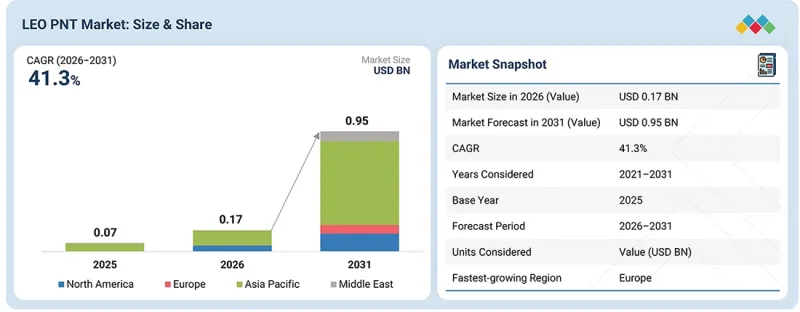
The LEO PNT market is estimated at USD 0.17 billion in 2026 and is projected to reach USD 0.95 billion by 2031, growing at a CAGR of 41.3%.
| Scope of the Report | |
|---|---|
| Years Considered for the Study | 2021-2031 |
| Base Year | 2025 |
| Forecast Period | 2026-2031 |
| Units Considered | Value (USD Billion) |
| Segments | By Hardware, End Use and Region |
| Regions covered | North America, Europe, APAC, RoW |
The market is growing due to the increasing need for accurate time synchronization across 5G networks, data centers, power grids, and financial institutions. These sectors rely on precise timing to manage network operations, electricity distribution, and financial transactions. Companies such as Iridium are expanding their satellite-based timing services to support critical infrastructure. The ongoing expansion of 5G networks, cloud computing facilities, and digital financial services is expected to further increase the demand for LEO-based timing solutions in the coming years.
By end use, the government & defense segment is expected to dominate the LEO PNT market from 2026 to 2031.
The segment is expected to hold the largest market share as government-funded programs continue to account for a major portion of LEO PNT development and deployment spending. While commercial applications are still moving toward wider adoption, government agencies are investing in dedicated navigation satellites, PNT payloads, ground infrastructure and technology demonstrations. ESA's Celeste program is one example, aimed at developing LEO-based navigation capabilities to support existing GNSS systems. Defense agencies are also exploring alternative PNT technologies to ensure reliable navigation and timing in GPS-denied environments.
By small satellite, MiniSat is expected to be the fastest-growing during the forecast period.
The segment is expected to grow as satellite operators increasingly use larger platforms to support advanced navigation payloads, high-power transmitters, as well as precision timing equipment. MiniSats offer higher power capacity and more space for payloads compared to smaller satellites. This makes them a suitable choice for LEO PNT constellations. For example, Turkiye's Fergani Space launched its 104 kg FGN-100-D2 satellite in November 2025 as part of its planned Ulug Bey positioning system. The company also plans to expand its navigation constellation, which also shows the growing use of MiniSats for dedicated PNT services.
By Region, North America is expected to be the second-largest region during the forecast period.
North America is expected to be the second-largest region in the LEO PNT market mainly due to growing investments in GPS-independent navigation technologies in the US. The US Space Development Agency is working on its Navigation Layer to provide alternative PNT services through LEO satellite networks and optical time-transfer technologies. In 2026, the US Army also sought satellite airtime and engineering support to develop alternative PNT solutions using LEO networks. These efforts reflect the increasing need for navigation and timing services that can work even when GPS is unavailable or disrupted.
The breakdown of profiles for primary participants in the LEO PNT market is provided below:
- By Company Type: Tier 1 - 35%, Tier 2 - 45%, and Tier 3 - 20%
- By Designation: C-Level Executives - 35%, Directors - 25%, and Others - 40%
- By Region: North America - 30%, Europe - 20%, Asia Pacific - 35%, and Middle East - 15%
Research Coverage:
This market study covers the LEO PNT market across various segments and subsegments. It aims to estimate the size and growth potential of this market across different regions. This study also includes an in-depth competitive analysis of the key players in the market, their company profiles, key observations related to their products and business offerings, recent developments, and key market strategies they adopted.
Reasons to Buy This Report:
The report will help market leaders/new entrants with information on the closest approximations of the revenue numbers for the overall LEO PNT market. It will also help stakeholders understand the competitive landscape and gain insights to better position their businesses and plan suitable go-to-market strategies. The report will also help stakeholders understand the market pulse and will provide information on key market drivers, restraints, challenges, and opportunities.
The report provides insights into the following pointers:
- Market drivers (rising GNSS jamming and spoofing incidents, government initiatives to strengthen PNT resilience), restraints (widespread availability of free GNSS services, high upfront constellation deployment costs), opportunities (sovereign navigation initiatives creating procurement opportunities, growing demand for GPS-independent timing-as-a-service), and challenges (rapid LEO orbital dynamics complicating orbit determination and clock synchronization, technical complexity of ensuring anti-jamming, anti-spoofing, and signal integrity performance).
- Market Penetration: Comprehensive information on the LEO PNT market and solutions offered by the top players in the market.
- Product Development/Innovation: Detailed insights into upcoming technologies, research & development activities, and product launches in the LEO PNT market.
- Market Development: Comprehensive information about lucrative markets across varied regions.
- Market Diversification: Exhaustive information about new products, untapped geographies, recent developments, and investments in the LEO PNT market.
- Competitive Assessment: In-depth assessment of market share, growth strategies, products, and manufacturing capabilities of leading players in the LEO PNT market.
TABLE OF CONTENTS
1 INTRODUCTION
- 1.1 STUDY OBJECTIVES
- 1.2 MARKET DEFINITION
- 1.3 STUDY SCOPE
- 1.3.1 MARKET SEGMENTATION AND REGIONAL SNAPSHOT
- 1.3.2 INCLUSIONS AND EXCLUSIONS
- 1.3.3 YEARS CONSIDERED
- 1.4 CURRENCY CONSIDERED
- 1.5 STAKEHOLDERS
- 1.6 SUMMARY OF CHANGES
2 EXECUTIVE SUMMARY
- 2.1 KEY INSIGHTS AND MARKET HIGHLIGHTS
- 2.2 KEY MARKET PARTICIPANTS: MAPPING OF STRATEGIC DEVELOPMENTS
- 2.3 DISRUPTIVE TRENDS IN LEO PNT MARKET
- 2.4 HIGH-GROWTH SEGMENTS
- 2.5 REGIONAL SNAPSHOT: MARKET SIZE, GROWTH RATE, AND FORECAST
3 PREMIUM INSIGHTS
- 3.1 ATTRACTIVE OPPORTUNITIES FOR PLAYERS IN LEO PNT MARKET
- 3.2 LEO PNT MARKET, BY SATELLITE MASS
- 3.3 LEO PNT MARKET, BY HARDWARE
- 3.4 LEO PNT MARKET, BY FREQUENCY
- 3.5 LEO PNT MARKET, BY END USE
4 MARKET OVERVIEW
- 4.1 INTRODUCTION
- 4.2 MARKET DYNAMICS
- 4.2.1 DRIVERS
- 4.2.1.1 Rising GNSS jamming and spoofing incidents accelerating demand for resilient LEO-based PNT solutions
- 4.2.1.2 Government initiatives to strengthen PNT resilience encouraging investment in alternative satellite navigation infrastructure
- 4.2.1.3 Successful in-orbit demonstrations supporting development and adoption of LEO PNT payload hardware
- 4.2.1.4 Increasing private investment and satellite manufacturing capacity accelerating dedicated LEO PNT constellation development
- 4.2.2 RESTRAINTS
- 4.2.2.1 Widespread availability of free GNSS services limiting willingness to pay for LEO PNT alternatives
- 4.2.2.2 High upfront constellation deployment costs constraining commercial scalability of dedicated LEO PNT networks
- 4.2.3 OPPORTUNITIES
- 4.2.3.1 Sovereign navigation initiatives creating new procurement opportunities for LEO PNT payload hardware
- 4.2.3.2 Growing demand for gps-independent synchronization creating opportunities for LEO PNT timing payload hardware
- 4.2.3.3 Increasing precision navigation requirements in industrial applications are opening new markets for leo-based positioning services
- 4.2.4 CHALLENGES
- 4.2.4.1 Rapid leo orbital dynamics complicating precise orbit determination and onboard clock synchronization
- 4.2.4.2 Ensuring reliable anti-jamming, anti-spoofing, and signal integrity performance remains technically demanding
- 4.2.4.3 Growing orbital congestion and frequent satellite replenishment requirements increasing long-term constellation operating complexity
- 4.2.1 DRIVERS
- 4.3 UNMET NEEDS AND WHITE SPACES
- 4.3.1 RELIABLE POSITIONING IN PARTIALLY OBSTRUCTED ENVIRONMENTS
- 4.3.2 INDEPENDENT TIMING CONTINUITY FOR CRITICAL INFRASTRUCTURE
- 4.3.3 CONTINUOUS PRECISION POSITIONING FOR AUTOMATED AND AUTONOMOUS OPERATIONS
- 4.3.4 COMPATIBILITY WITH EXISTING GNSS EQUIPMENT AND NAVIGATION ARCHITECTURES
- 4.4 INTERCONNECTED MARKETS AND CROSS-SECTOR OPPORTUNITIES
- 4.4.1 SPACE-QUALIFIED PRECISION TIMING HARDWARE
- 4.4.2 SATELLITE RF AND MICROWAVE ELECTRONICS
- 4.4.3 SATELLITE PAYLOAD INTEGRATION AND MANUFACTURING
- 4.4.4 SPACE-BASED ORBIT DETERMINATION AND SYNCHRONIZATION HARDWARE
- 4.5 STRATEGIC MOVES BY TIER-1/2/3 PLAYERS
5 INDUSTRY TRENDS
- 5.1 INTRODUCTION
- 5.2 ECOSYSTEM ANALYSIS
- 5.2.1 PAYLOAD AND COMPONENT MANUFACTURERS
- 5.2.2 PRIVATE AND NICHE MANUFACTURERS
- 5.2.3 END USERS
- 5.3 VALUE CHAIN ANALYSIS
- 5.4 PRICING ANALYSIS
- 5.4.1 AVERAGE SELLING PRICE TREND, BY REGION (2021-2025)
- 5.4.2 INDICATIVE PRICING ANALYSIS, BY SATELLITE MASS, 2025
- 5.5 TRADE DATA
- 5.5.1 IMPORT SCENARIO (HS CODE 880260)
- 5.5.2 EXPORT SCENARIO (HS CODE 880260)
- 5.6 CASE STUDIES
- 5.6.1 EUROPEAN SPACE AGENCY (ESA) AND INDUSTRIAL PARTNERS ADVANCED LEO-BASED NAVIGATION THROUGH CELESTE MISSION
- 5.6.2 XONA SPACE SYSTEMS DEVELOPED PULSAR AS COMMERCIAL ALTERNATIVE TO GPS
- 5.6.3 TRUSTPOINT ADVANCED GPS-INDEPENDENT PNT THROUGH SATELLITE AND GROUND INFRASTRUCTURE DEVELOPMENT
- 5.7 KEY CONFERENCES AND EVENTS, 2026-2027
- 5.8 INVESTMENT & FUNDING SCENARIO
- 5.9 TRENDS & DISRUPTIONS IMPACTING CUSTOMER BUSINESS
- 5.10 MACROECONOMIC OUTLOOK
- 5.10.1 INTRODUCTION
- 5.10.2 GDP TRENDS AND FORECAST
- 5.10.3 TRENDS IN GLOBAL POSITIONING, NAVIGATION, AND TIMING (PNT) INDUSTRY
- 5.10.4 TRENDS IN GLOBAL SPACE INDUSTRY
- 5.11 VOLUME DATA
- 5.12 BILL OF MATERIALS
- 5.13 TOTAL COST OF OWNERSHIP
- 5.14 BUSINESS MODELS
- 5.14.1 SUBSYSTEM OEM SALES
- 5.14.2 PNT-AS-A-SERVICE
- 5.14.3 CUSTOM PAYLOAD INTEGRATION
6 TECHNOLOGICAL ADVANCEMENTS, AI-DRIVEN IMPACT, PATENTS, INNOVATIONS, AND FUTURE APPLICATIONS
- 6.1 KEY TECHNOLOGIES
- 6.1.1 MULTI-FREQUENCY LEO NAVIGATION SIGNALS
- 6.1.2 CRYPTOGRAPHICALLY AUTHENTICATED NAVIGATION SIGNALS
- 6.1.3 5G NON-TERRESTRIAL NETWORK POSITIONING
- 6.1.4 MINIATURIZED LEO PNT RECEIVER CHIPS
- 6.2 COMPLEMENTARY TECHNOLOGIES
- 6.2.1 INERTIAL NAVIGATION AND DEAD RECKONING
- 6.2.2 COMPUTER VISION, LIDAR, AND TERRAIN-REFERENCED NAVIGATION
- 6.2.3 FIBER-OPTIC TIME TRANSFER AND NETWORK SYNCHRONIZATION
- 6.3 ADJACENT TECHNOLOGIES
- 6.3.1 GNSS AUGMENTATION SYSTEMS
- 6.3.2 ENHANCED LONG-RANGE NAVIGATION (ELORAN)
- 6.3.3 OPTICAL INTER-SATELLITE COMMUNICATION AND TIME TRANSFER
- 6.3.4 HARD KILL SOLUTIONS SATELLITE LASER RANGING AND PRECISE ORBIT DETERMINATION
- 6.4 TECHNOLOGY ROADMAP
- 6.5 PATENT ANALYSIS
- 6.6 FUTURE APPLICATIONS
- 6.6.1 IMPACT OF AI/GENERATIVE AI
- 6.6.2 IMPLEMENTATION OF AI IN LEO PNT MARKET: TOP USE CASES AND MARKET POTENTIAL
- 6.6.3 IMPLEMENTATION OF AI IN LEO PNT MARKET: CASE STUDIES
- 6.6.4 INTERCONNECTED ECOSYSTEM AND IMPACT ON MARKET PLAYERS
- 6.6.5 CLIENTS' READINESS TO ADOPT AI/GENERATIVE AI
- 6.7 SUCCESS STORIES AND REAL-WORLD APPLICATIONS
- 6.7.1 XONA SPACE SYSTEMS (US): PULSAR-0 DEMONSTRATES LEO-BASED PRECISION POSITIONING AND TIMING
- 6.7.2 THALES ALENIA SPACE (FRANCE): CELESTE DEMONSTRATES MULTI-FREQUENCY NAVIGATION AND 5G POSITIONING FROM LEO
- 6.7.3 TRUSTPOINT (US): C-BAND NAVIGATION PAYLOAD ADVANCES GPS-INDEPENDENT PNT CAPABILITIES
7 SUSTAINABILITY AND REGULATORY LANDSCAPE
- 7.1 REGIONAL REGULATIONS AND COMPLIANCE
- 7.1.1 REGULATORY BODIES, GOVERNMENT AGENCIES, AND OTHER ORGANIZATIONS
- 7.1.2 INDUSTRY STANDARDS
- 7.2 SUSTAINABILITY INITIATIVES
- 7.2.1 LONGER-LIFE AND ENERGY-EFFICIENT NAVIGATION PAYLOAD HARDWARE
- 7.2.2 MODULAR PAYLOAD DESIGNS AND STANDARDIZED MANUFACTURING
- 7.2.3 RESPONSIBLE SATELLITE REPLENISHMENT AND PAYLOAD RESOURCE EFFICIENCY
- 7.2.4 ENVIRONMENTAL IMPACT ASSESSMENT AND SUSTAINABLE PAYLOAD MANUFACTURING
- 7.2.5 RESPONSIBLE COMPONENT SOURCING AND SUPPLY CHAIN MANAGEMENT
- 7.3 IMPACT OF REGULATORY POLICIES ON SUSTAINABILITY INITIATIVES
8 CUSTOMER LANDSCAPE & BUYER BEHAVIOR
- 8.1 DECISION MAKING PROCESS
- 8.2 BUYER STAKEHOLDERS AND BUYING EVALUATION CRITERIA
- 8.2.1 BUYING EVALUATION CRITERIA
- 8.3 ADOPTION BARRIERS & INTERNAL CHALLENGES
- 8.4 UNMET NEEDS OF VARIOUS END-USE INDUSTRIES
- 8.4.1 GOVERNMENT & DEFENSE:
- 8.4.2 CIVIL AVIATION & UAS:
- 8.4.3 MARITIME & OFFSHORE:
- 8.4.4 AUTOMOTIVE & MOBILITY:
- 8.4.5 TELECOM & POWER:
- 8.4.6 CONSTRUCTION & PRECISION AGRICULTURE:
- 8.4.7 INDUSTRIAL & LOGISTICS:
- 8.4.8 OTHERS (ENTERPRISE AND SPACE OPERATIONS):
9 LEO PNT MARKET, BY SATELLITE MASS
- 9.1 INTRODUCTION
- 9.2 USE CASE ANALYSIS
- 9.2.1 EUROPEAN SPACE AGENCY (ESA): CELESTE CUBESAT MISSION DEMONSTRATES LEO-BASED NAVIGATION AND 5G POSITIONING CAPABILITIES
- 9.2.2 XONA SPACE SYSTEMS: PULSAR-0 MINISATELLITE DEMONSTRATES HIGH-PRECISION POSITIONING AND RESILIENT NAVIGATION FOR COMMERCIAL APPLICATIONS
- 9.3 CUBESAT
- 9.3.1 LOW-COST IN-ORBIT VALIDATION OF GPS-INDEPENDENT NAVIGATION AND TIMING TECHNOLOGIES TO DRIVE SEGMENTAL GROWTH
- 9.4 SMALLSAT (11 - 1200 KG)
- 9.4.1 COMMERCIALIZATION OF PNT SERVICES THROUGH EXISTING LEO COMMUNICATION CONSTELLATIONS TO DRIVE SEGMENTAL GROWTH
- 9.4.2 MICROSAT (11 - 100 KG)
- 9.4.3 MINISAT (101 - 500 KG)
10 LEO PNT MARKET, BY HARDWARE
- 10.1 INTRODUCTION
- 10.2 GNSS MODULE
- 10.2.1 INTEGRATING ANTENNA-TO-RECEIVER PNT FUNCTIONALITY FOR COMPACT LEO PAYLOAD ARCHITECTURES TO DRIVE THE SEGMENT
- 10.2.2 GNSS ANTENNA
- 10.2.3 GNSS RECEIVER
- 10.3 TIME SYNCHRONIZATION
- 10.3.1 ESTABLISHING SUB-MICROSECOND COHERENCE ACROSS LEO-BASED PNT ARCHITECTURES TO DRIVE THE SEGMENT
- 10.3.2 ATOMIC CLOCKS
- 10.3.3 CLOCK MONITORING AND CONTROL UNIT
- 10.3.4 OCXO/PLL/DISTRIBUTION
- 10.4 BACKHAUL MODULE
- 10.4.1 ENABLING HIGH-CAPACITY DATA UPLINK FOR PNT COMMAND, CONTROL, AND SYNCHRONIZATION TO DRIVE THE SEGMENT
- 10.4.2 BACKHAUL ANTENNA
- 10.4.3 BACKHAUL RECEIVER
- 10.5 NAVIGATION SIGNAL GENERATION
- 10.5.1 ENABLING REAL-TIME, SOFTWARE-DEFINED PNT BROADCASTS IN DYNAMIC LEO ENVIRONMENTS TO DRIVE THE SEGMENT
- 10.5.2 NAVIGATION SIGNAL GENERATION UNIT (NSGU)
- 10.5.3 FREQUENCY GENERATION AND UP-CONVERSION UNIT
- 10.6 SIGNAL TRANSMISSION MODULE
- 10.6.1 BRIDGING PRECISION SIGNALS TO END USERS THROUGH ROBUST TRANSMISSION CHAINS TO DRIVE THE SEGMENT
- 10.6.2 HIGH-POWER AMPLIFIERS
- 10.6.3 RF FILTERS
- 10.6.4 ANTENNA
- 10.6.5 INTER-SATELLITE LINKS
11 LEO PNT MARKET, BY FREQUENCY
- 11.1 INTRODUCTION
- 11.2 USE CASE ANALYSIS
- 11.2.1 KINEIS (FRANCE): DEPLOYS UHF-BASED LEO SATELLITE CONSTELLATION TO ENABLE DOPPLER-BASED ASSET GEOLOCATION WITHOUT GPS RECEIVERS
- 11.2.2 UNIVERSITY OF TEXAS AT AUSTIN AND VIRGINIA TECH (US): DEMONSTRATE KU-BAND STARLINK SIGNAL PROCESSING FOR OPPORTUNISTIC POSITIONING AND TIMING USING COMPACT RECEIVERS
- 11.3 VERY-HIGH FREQUENCY (VHF) & ULTRA-HIGH FREQUENCY (UHF) (30 MHZ - 3 GHZ)
- 11.3.1 ENHANCING SIGNAL PENETRATION AND RELIABILITY IN CHALLENGING ENVIRONMENT TO DRIVE THE SEGMENT
- 11.4 L-BAND (1 GHZ - 2 GHZ)
- 11.4.1 DELIVERING CORE PNT FUNCTIONALITY WITH BROAD TERMINAL COMPATIBILITY TO DRIVE THE SEGMENT
- 11.5 S-BAND (2 GHZ - 4 GHZ)
- 11.5.1 ENABLING AGILE PNT SIGNAL MANAGEMENT FOR DYNAMIC ENVIRONMENTS TO DRIVE THE SEGMENT
- 11.6 C-BAND (4 GHZ - 8 GHZ)
- 11.6.1 SUPPORTING HIGH-CAPACITY PNT SIGNAL DELIVERY FOR ENCRYPTED AND SECURE APPLICATIONS TO DRIVE THE SEGMENTS
- 11.7 KU & KA- BAND (12 GHZ - 40 GHZ)
- 11.7.1 ENABLING HIGH-CAPACITY, LOW-LATENCY PNT THROUGH NEXT-GENERATION HIGH-FREQUENCY INNOVATION TO DRIVE THE SEGMENT
12 LEO PNT MARKET, BY END-USE
- 12.1 INTRODUCTION
- 12.2 USE CASE ANALYSIS
- 12.2.1 GROUND CONTROL (UK): DEPLOYS IRIDIUM-BASED ASSURED PNT TECHNOLOGY TO STRENGTHEN MARITIME NAVIGATION AND VESSEL TRACKING IN GNSS-CONTESTED WATERS
- 12.2.2 IRIDIUM COMMUNICATIONS AND L3HARRIS TECHNOLOGIES (US): IMPLEMENT LEO-BASED SATELLITE TIMING SYNCHRONIZATION ACROSS FAA COMMUNICATIONS INFRASTRUCTURE TO REDUCE GPS DEPENDENCE
- 12.3 GOVERNMENT & DEFENSE
- 12.3.1 STRENGTHENING MULTI-DOMAIN DEFENSE OPERATIONS WITH SECURE, HIGH-RESILIENCE NAVIGATION SOLUTIONS TO DRIVE THE SEGMENT
- 12.3.2 PLATFORM NAVIGATION IN GNSS-DENIED ENVIRONMENTS
- 12.3.3 DISMOUNTED FORCE POSITIONING
- 12.3.4 SECURE TIMING FOR TACTICAL NETWORKS (C2/ISR/EW)
- 12.3.5 TEST & TRAINING RANGE TIME/POSITION INSTRUMENTATION
- 12.4 CIVIL AVIATION & UAS
- 12.4.1 ENHANCING AIRSPACE SAFETY AND UAS INTEGRATION WITH HIGH-ACCURACY, LOW-LATENCY POSITIONING SYSTEMS TO DRIVE THE SEGMENT
- 12.4.2 PBN/RNP PERFORMANCE SUPPORT
- 12.4.3 AIRPORT SURFACE OPERATIONS COORDINATION
- 12.4.4 UTM/BVLOS DRONE NAVIGATION & GEOFENCING
- 12.5 MARITIME & OFFSHORE
- 12.5.1 DRIVING RELIABLE MARITIME AND OFFSHORE OPERATIONS WITH LOW-LATENCY, INTERFERENCE-RESILIENT LEO PNT SYSTEMS TO DRIVE THE SEGMENT
- 12.5.2 PORT NAVIGATION & PILOTAGE
- 12.5.3 VESSEL TRAFFIC SERVICES (VTS) TIMING
- 12.5.4 DYNAMIC POSITIONING & STATION KEEPING
- 12.5.5 OFFSHORE PLATFORM/ WIND-FARM POSITIONING & TIMING
- 12.5.6 SEARCH-AND-RESCUE LOCALIZATION
- 12.6 AUTOMOTIVE & MOBILITY
- 12.6.1 ENABLING NEXT-GENERATION AUTONOMOUS AND CONNECTED MOBILITY WITH RESILIENT LOCALIZATION AND TIMING TO DRIVE THE SEGMENT
- 12.6.2 LANE-LEVEL LOCALIZATION FOR ADAS/AV
- 12.6.3 FLEET TELEMATICS & ROAD-ASSET TRACKING
- 12.6.4 RAIL/METRO TIMING & LOCALIZATION FOR SIGNALING
- 12.7 TELECOM & POWER
- 12.7.1 STRENGTHENING CRITICAL INFRASTRUCTURES WITH LOW-LATENCY AND RESILIENT PNT TO DRIVE THE SEGMENT
- 12.7.2 5G/6G NETWORK SYNCHRONIZATION & BACKHAUL TIMING
- 12.7.3 POWER-GRID SYNCHROPHASOR TIMING & PROTECTION
- 12.7.4 DATA-CENTER/ENTERPRISE GRANDMASTER HOLDOVER (PTP/NTP)
- 12.8 CONSTRUCTION & PRECISION AGRICULTURE
- 12.8.1 TRANSFORMING INFRASTRUCTURE DEVELOPMENT AND FARMING THROUGH LEO PNT TO DRIVE THE SEGMENT
- 12.8.2 SURVEY/GEOMATICS PRECISE POSITIONING
- 12.8.3 CONSTRUCTION MACHINE GUIDANCE
- 12.8.4 PRECISION-AGRICULTURE GUIDANCE & OPERATIONS
- 12.9 INDUSTRIAL & LOGISTICS
- 12.9.1 ENABLING PRECISE INDUSTRIAL OPERATIONS AND GLOBAL SUPPLY CHAIN EFFICIENCY TO DRIVE THE SEGMENT
- 12.9.2 INDUSTRIAL LOCALIZATION IN HARSH/NEAR-INDOOR SITES
- 12.9.3 YARD/WAREHOUSE/PORT LOGISTICS ASSET TRACKING
- 12.10 OTHERS (ENTERPRISE AND SPACE OPERATIONS)
13 LEO PNT MARKET, BY REGION
- 13.1 INTRODUCTION
- 13.2 NORTH AMERICA
- 13.2.1 US
- 13.2.1.1 Commercial LEO navigation constellations, GPS-independent architectures, and satellite-based timing services to drive market
- 13.2.1 US
- 13.3 EUROPE
- 13.3.1 UK
- 13.3.1.1 Integration of commercial LEO navigation signals into national timing infrastructure to fuel market
- 13.3.2 FRANCE
- 13.3.2.1 Multi-frequency navigation payload development and satellite-based 5G positioning to drive market
- 13.3.3 ITALY
- 13.3.3.1 Production of successive Celeste satellite generations and navigation payload integration to drive market
- 13.3.4 RUSSIA
- 13.3.4.1 Planned low-orbit GLONASS augmentation and interference-resistant navigation requirements to fuel market
- 13.3.5 SPAIN
- 13.3.5.1 End-to-end LEO navigation system contracts and specialized satellite receiver development to drive market
- 13.3.6 POLAND
- 13.3.6.1 Space-based GNSS interference detection and domestic satellite platform integration to fuel market
- 13.3.7 NORWAY
- 13.3.7.1 Arctic navigation requirements and multi-frequency PNT broadcasting to drive market
- 13.3.1 UK
- 13.4 ASIA PACIFIC
- 13.4.1 CHINA
- 13.4.1.1 Commercial navigation-augmentation constellation deployment and domestic satellite production to drive market
- 13.4.2 JAPAN
- 13.4.2.1 Dedicated dual-band navigation satellites and commercial receiver partnerships to fuel market
- 13.4.3 INDIA
- 13.4.3.1 Indigenous LEO navigation receiver development and international PNT technology partnerships to fuel market
- 13.4.4 AUSTRALIA
- 13.4.4.1 Government-funded LEO PNT demonstrations and international satellite navigation partnerships to drive market
- 13.4.1 CHINA
- 13.5 MIDDLE EAST
- 13.5.1 UAE
- 13.5.1.1 National LEO navigation satellite demonstrations and smart infrastructure requirements to fuel demand
- 13.5.2 TURKEY
- 13.5.2.1 Defense-led satellite programs and indigenous subsystem development to strengthen market
- 13.5.1 UAE
14 COMPETITIVE LANDSCAPE
- 14.1 INTRODUCTION
- 14.2 KEY PLAYER STRATEGIES/RIGHT TO WIN, 2021-2025
- 14.3 REVENUE ANALYSIS, 2021-2025
- 14.4 MARKET SHARE ANALYSIS, 2025
- 14.5 BRAND/PRODUCT COMPARISON
- 14.6 COMPANY VALUATION AND FINANCIAL METRICS
- 14.7 COMPANY EVALUATION MATRIX: KEY PLAYERS, 2025
- 14.7.1 STARS
- 14.7.2 EMERGING LEADERS
- 14.7.3 PERVASIVE PLAYERS
- 14.7.4 PARTICIPANTS
- 14.7.5 COMPANY FOOTPRINT
- 14.7.5.1 Company footprint
- 14.7.5.2 Region footprint
- 14.7.5.3 Satellite mass footprint
- 14.7.5.4 Frequency footprint
- 14.8 COMPANY EVALUATION MATRIX: STARTUPS/SMES, 2025
- 14.8.1 PROGRESSIVE COMPANIES
- 14.8.2 RESPONSIVE COMPANIES
- 14.8.3 DYNAMIC COMPANIES
- 14.8.4 STARTING BLOCKS
- 14.8.5 COMPETITIVE BENCHMARKING
- 14.8.5.1 List of startups/smes
- 14.8.5.2 Competitive benchmarking of startups/smes
- 14.9 COMPETITIVE SCENARIO
- 14.9.1 PRODUCT LAUNCHES AND DEVELOPMENTS
- 14.9.2 DEALS
- 14.9.3 OTHER DEVELOPMENTS
15 COMPANY PROFILES
- 15.1 KEY PLAYERS
- 15.1.1 GMV INNOVATING SOLUTIONS S.L.
- 15.1.1.1 Business overview
- 15.1.1.2 Products offered
- 15.1.1.3 Recent developments
- 15.1.1.3.1 Product launches
- 15.1.1.3.2 Deals
- 15.1.1.3.3 Other Developments
- 15.1.1.4 MnM view
- 15.1.1.4.1 Right to win
- 15.1.1.4.2 Strategic choices
- 15.1.1.4.3 Weaknesses and competitive threats
- 15.1.2 SAFRAN S.A.
- 15.1.2.1 Business overview
- 15.1.2.2 Products offered
- 15.1.2.3 Recent developments
- 15.1.2.3.1 Product launches
- 15.1.2.3.2 Deals
- 15.1.2.3.3 Other developments
- 15.1.2.4 Mnm view
- 15.1.2.4.1 Right to win
- 15.1.2.4.2 Strategic choices
- 15.1.2.4.3 Weaknesses and competitive threats
- 15.1.3 THALES ALENIA SPACE
- 15.1.3.1 Business overview
- 15.1.3.2 Products offered
- 15.1.3.3 Recent developments
- 15.1.3.3.1 Product launches
- 15.1.3.3.2 Deals
- 15.1.3.3.3 Other developments
- 15.1.3.4 MnM view
- 15.1.3.4.1 Right to win
- 15.1.3.4.2 Strategic choices
- 15.1.3.4.3 Weaknesses and competitive threats
- 15.1.4 XONA SPACE SYSTEMS, INC.
- 15.1.4.1 Business overview
- 15.1.4.2 Products offered
- 15.1.4.3 Recent developments
- 15.1.4.3.1 Product launches
- 15.1.4.3.2 Deals
- 15.1.4.3.3 Other developments
- 15.1.4.4 MnM view
- 15.1.4.4.1 Right to win
- 15.1.4.4.2 Strategic choices
- 15.1.4.4.3 Weaknesses and competitive threats
- 15.1.5 TRUSTPOINT, INC.
- 15.1.5.1 Business overview
- 15.1.5.2 Products offered
- 15.1.5.3 Recent developments
- 15.1.5.3.1 Product launches and developments
- 15.1.5.3.2 Deals
- 15.1.5.3.3 Other developments
- 15.1.5.4 MnM view
- 15.1.5.4.1 Right to win
- 15.1.5.4.2 Strategic choices
- 15.1.5.4.3 Weaknesses and competitive threats
- 15.1.6 L3HARRIS TECHNOLOGIES, INC.
- 15.1.6.1 Business overview
- 15.1.6.2 Products offered
- 15.1.6.3 Recent developments
- 15.1.6.3.1 Other developments
- 15.1.7 BEYOND GRAVITY SCHWEIZ AG
- 15.1.7.1 Business overview
- 15.1.7.2 Products offered
- 15.1.7.3 Recent developments
- 15.1.7.3.1 Product launches and developments
- 15.1.7.3.2 Deals
- 15.1.7.3.3 Other developments
- 15.1.8 HEXAGON AB
- 15.1.8.1 Business overview
- 15.1.8.2 Products offered
- 15.1.8.3 Recent developments
- 15.1.8.3.1 Deals
- 15.1.9 NORTHROP GRUMMAN
- 15.1.9.1 Business overview
- 15.1.9.2 Products offered
- 15.1.9.3 Recent developments
- 15.1.9.3.1 Product developments
- 15.1.9.3.2 Other developments
- 15.1.10 HONEYWELL INTERNATIONAL INC.
- 15.1.10.1 Business overview
- 15.1.10.2 Products offered
- 15.1.10.3 Recent developments
- 15.1.10.3.1 Product launches
- 15.1.10.3.2 Deals
- 15.1.10.3.3 Other developments
- 15.1.11 FERGANI SPACE
- 15.1.11.1 Business overview
- 15.1.11.2 Products offered
- 15.1.11.3 Recent developments
- 15.1.11.3.1 Product launches
- 15.1.11.3.2 Other developments
- 15.1.12 KONGSBERG GRUPPEN ASA
- 15.1.12.1 Business overview
- 15.1.12.2 Products offered
- 15.1.12.3 Recent developments
- 15.1.12.3.1 Product developments
- 15.1.12.3.2 Deals
- 15.1.12.3.3 Other developments
- 15.1.13 IRIDIUM COMMUNICATIONS INC.
- 15.1.13.1 Business overview
- 15.1.13.2 Products offered
- 15.1.13.3 Recent developments
- 15.1.13.3.1 Product launches
- 15.1.13.3.2 Deals
- 15.1.13.3.3 Other developments
- 15.1.14 OHB SE
- 15.1.14.1 Business overview
- 15.1.14.2 Products offered
- 15.1.14.3 Recent developments
- 15.1.14.3.1 Product launches and developments
- 15.1.14.3.2 Deals
- 15.1.14.3.3 Other developments
- 15.1.15 BEIJING NAVIGATION CONTROL TECHNOLOGY CO., LTD.
- 15.1.15.1 Business overview
- 15.1.15.2 Products offered
- 15.1.15.3 Recent developments
- 15.1.15.3.1 Product developments
- 15.1.15.3.2 Deals
- 15.1.15.3.3 Other developments
- 15.1.1 GMV INNOVATING SOLUTIONS S.L.
- 15.2 OTHER PLAYERS
- 15.2.1 AEROSPACELAB S.A.
- 15.2.2 ENDUROSAT EAD
- 15.2.3 U-SPACE SAS
- 15.2.4 ARKEDGE SPACE INC.
- 15.2.5 SATELIO IOT SERVICES S.L.
- 15.2.6 ANYWAVES SAS
- 15.2.7 IFEN GMBH
- 15.2.8 SKYKRAFT PTY LTD
- 15.2.9 SPACEPNT SA
- 15.2.10 VYOMA GMBH
16 RESEARCH METHODOLOGY
- 16.1 RESEARCH DATA
- 16.1.1 SECONDARY DATA
- 16.1.1.1 Key data from secondary sources
- 16.1.2 PRIMARY DATA
- 16.1.2.1 Primary sources
- 16.1.2.2 Key data from primary sources
- 16.1.2.3 Breakdown of primary interviews
- 16.1.1 SECONDARY DATA
- 16.2 FACTOR ANALYSIS
- 16.2.1 DEMAND-SIDE INDICATORS
- 16.2.2 SUPPLY-SIDE INDICATORS
- 16.3 MARKET SIZE ESTIMATION
- 16.3.1 BOTTOM-UP APPROACH
- 16.3.2 TOP-DOWN APPROACH
- 16.4 DATA TRIANGULATION
- 16.5 RESEARCH ASSUMPTIONS
- 16.6 RESEARCH LIMITATIONS
- 16.7 RISK ASSESSMENT
17 APPENDIX
- 17.1 DISCUSSION GUIDE
- 17.2 KNOWLEDGESTORE: MARKETSANDMARKETS' SUBSCRIPTION PORTAL
- 17.3 CUSTOMIZATION OPTIONS
- 17.4 RELATED REPORTS
- 17.5 AUTHOR DETAILS
List of Tables
- TABLE 1 USD EXCHANGE RATES, 2021-2025
- TABLE 2 UNMET NEEDS AND WHITE SPACES
- TABLE 3 CROSS-SECTOR OPPORTUNITIES
- TABLE 4 STRATEGIC MOVES BY TIER-1/2/3 PLAYERS
- TABLE 5 ROLE OF COMPANIES IN ECOSYSTEM
- TABLE 1 AVERAGE SELLING PRICE TREND, BY REGION, 2021-2025 (USD MILLION)
- TABLE 2 INDICATIVE PRICING ANALYSIS, BY SATELLITE MASS, 2025 (USD MILLION)
- TABLE 3 IMPORT DATA FOR HS CODE 880260-COMPLIANT PRODUCTS, BY COUNTRY, 2021-2025 (USD THOUSAND)
- TABLE 4 EXPORT DATA FOR HS CODE 880260-COMPLIANT PRODUCTS, BY COUNTRY, 2021-2025 (USD THOUSAND)
- TABLE 5 KEY CONFERENCES AND EVENTS, 2026-2027
- TABLE 6 GDP PERCENTAGE CHANGE, BY COUNTRY, 2021-2030
- TABLE 7 LEO PNT LAUNCHES, BY SATELLITE MASS, 2021-2025 (UNITS)
- TABLE 8 LEO PNT LAUNCHES, BY SATELLITE MASS, 2026-2031 (UNITS)
- TABLE 9 BILL OF MATERIALS, BY HARDWARE
- TABLE 10 BILL OF MATERIALS FOR CUBESAT VS. SMALLSAT
- TABLE 11 BUSINESS MODELS IN LEO PNT MARKET
- TABLE 12 LEO-PNT SYSTEM COMPARISON
- TABLE 13 EVOLUTION AND ROADMAP FOR LEO PNT MARKET
- TABLE 14 KEY PATENTS, 2021-2026
- TABLE 15 RESILIENT NAVIGATION FOR CIVIL AVIATION & UAS
- TABLE 16 GPS-INDEPENDENT TIMING FOR TELECOM & POWER INFRASTRUCTURE
- TABLE 17 IMPLEMENTATION OF AI IN LEO PNT MARKET: TOP USE CASES AND MARKET POTENTIAL
- TABLE 18 IMPLEMENTATION OF AI IN LEO PNT MARKET: CASE STUDIES
- TABLE 19 INTERCONNECTED ECOSYSTEM AND IMPACT ON MARKET PLAYERS
- TABLE 20 NORTH AMERICA: REGULATORY BODIES, GOVERNMENT AGENCIES, AND OTHER ORGANIZATIONS
- TABLE 21 EUROPE: REGULATORY BODIES, GOVERNMENT AGENCIES, AND OTHER ORGANIZATIONS
- TABLE 22 ASIA PACIFIC: REGULATORY BODIES, GOVERNMENT AGENCIES, AND OTHER ORGANIZATIONS
- TABLE 23 MIDDLE EAST: REGULATORY BODIES, GOVERNMENT AGENCIES AND OTHER ORGANIZATIONS
- TABLE 24 INDUSTRY STANDARDS IN LEO PNT MARKET
- TABLE 25 SUSTAINABILITY INITIATIVES IN LEO PNT MARKET
- TABLE 26 CERTIFICATIONS, LABELING, AND ECO-STANDARDS
- TABLE 27 INFLUENCE OF STAKEHOLDERS ON BUYING PROCESS, BY SATELLITE MASS (%)
- TABLE 28 KEY BUYING CRITERIA, BY HARDWARE
- TABLE 29 LEO PNT MARKET, BY SATELLITE MASS, 2021-2025 (USD MILLION)
- TABLE 30 LEO PNT MARKET, BY SATELLITE MASS, 2026-2031 (USD MILLION)
- TABLE 31 LEO PNT MARKET, BY SMALLSAT, 2021-2025 (USD MILLION)
- TABLE 32 LEO PNT MARKET, BY SMALLSAT, 2026-2031 (USD MILLION)
- TABLE 33 LEO PNT MARKET, BY HARDWARE, 2021-2025 (USD MILLION)
- TABLE 34 LEO PNT MARKET, BY HARDWARE, 2026-2031 (USD MILLION)
- TABLE 35 LEO PNT MARKET FOR HARDWARE, BY GNSS MODULE, 2021-2025 (USD MILLION)
- TABLE 36 LEO PNT MARKET FOR HARDWARE, BY GNSS MODULE, 2026-2031 (USD MILLION)
- TABLE 37 LEO PNT MARKET FOR HARDWARE, BY TIME SYNCHRONIZATION, 2021-2025 (USD MILLION)
- TABLE 38 LEO PNT MARKET FOR HARDWARE, BY TIME SYNCHRONIZATION, 2026-2031 (USD MILLION)
- TABLE 39 LEO PNT MARKET FOR HARDWARE, BY BACKHAUL MODULE, 2021-2025 (USD MILLION)
- TABLE 40 LEO PNT MARKET FOR HARDWARE, BY BACKHAUL MODULE, 2026-2031 (USD MILLION)
- TABLE 41 LEO PNT MARKET FOR HARDWARE, BY NAVIGATION SIGNAL GENERATOR, 2021-2025 (USD MILLION)
- TABLE 42 LEO PNT MARKET FOR HARDWARE, BY NAVIGATION SIGNAL GENERATOR, 2026-2031 (USD MILLION)
- TABLE 43 LEO PNT MARKET FOR HARDWARE, BY SIGNAL TRANSMISSION MODULE, 2021-2025 (USD MILLION)
- TABLE 44 LEO PNT MARKET FOR HARDWARE, BY SIGNAL TRANSMISSION MODULE, 2026-2031 (USD MILLION)
- TABLE 45 LEO PNT MARKET, BY FREQUENCY, 2021-2025 (USD MILLION)
- TABLE 46 LEO PNT MARKET, BY FREQUENCY, 2026-2031 (USD MILLION)
- TABLE 47 LEO PNT MARKET, BY END-USE, 2021-2025 (USD MILLION)
- TABLE 48 LEO PNT MARKET, BY END-USE, 2026-2031 (USD MILLION)
- TABLE 49 LEO PNT MARKET, BY REGION, 2021-2025 (USD MILLION)
- TABLE 50 LEO PNT MARKET, BY REGION, 2026-2031 (USD MILLION)
- TABLE 51 LEO PNT MARKET, BY REGION, 2021-2025 (UNITS)
- TABLE 52 LEO PNT MARKET, BY REGION, 2026-2031 (UNITS)
- TABLE 53 NORTH AMERICA: LEO PNT MARKET, BY SATELLITE MASS, 2021-2025 (USD MILLION)
- TABLE 54 NORTH AMERICA: LEO PNT MARKET, BY SATELLITE MASS, 2026-2031 (USD MILLION)
- TABLE 55 NORTH AMERICA: LEO PNT MARKET, BY FREQUENCY, 2021-2025 (USD MILLION)
- TABLE 56 NORTH AMERICA: LEO PNT MARKET, BY FREQUENCY, 2026-2031 (USD MILLION)
- TABLE 57 NORTH AMERICA: LEO PNT MARKET, BY COUNTRY, 2021-2025 (USD MILLION)
- TABLE 58 NORTH AMERICA: LEO PNT MARKET, BY COUNTRY, 2026-2031 (USD MILLION)
- TABLE 59 US: LEO PNT MARKET, BY SATELLITE MASS, 2021-2025 (USD MILLION)
- TABLE 60 US: LEO PNT MARKET, BY SATELLITE MASS, 2026-2031 (USD MILLION)
- TABLE 61 US: LEO PNT MARKET, BY FREQUENCY, 2021-2025 (USD MILLION)
- TABLE 62 US: LEO PNT MARKET, BY FREQUENCY, 2026-2031 (USD MILLION)
- TABLE 63 EUROPE: LEO PNT MARKET, BY SATELLITE MASS, 2021-2025 (USD MILLION)
- TABLE 64 EUROPE: LEO PNT MARKET, BY SATELLITE MASS, 2026-2031 (USD MILLION)
- TABLE 65 EUROPE: LEO PNT MARKET, BY FREQUENCY, 2021-2025 (USD MILLION)
- TABLE 66 EUROPE: LEO PNT MARKET, BY FREQUENCY, 2026-2031 (USD MILLION)
- TABLE 67 EUROPE: LEO PNT MARKET, BY COUNTRY, 2021-2025 (USD MILLION)
- TABLE 68 EUROPE: LEO PNT MARKET, BY COUNTRY, 2026-2031 (USD MILLION)
- TABLE 69 UK: LEO PNT MARKET, BY SATELLITE MASS, 2026-2031 (USD MILLION)
- TABLE 70 UK: LEO PNT MARKET, BY FREQUENCY, 2026-2031 (USD MILLION)
- TABLE 71 FRANCE: LEO PNT MARKET, BY SATELLITE MASS, 2021-2025 (USD MILLION)
- TABLE 72 FRANCE: LEO PNT MARKET, BY SATELLITE MASS, 2026-2031 (USD MILLION)
- TABLE 73 FRANCE: LEO PNT MARKET, BY FREQUENCY, 2021-2025 (USD MILLION)
- TABLE 74 FRANCE: LEO PNT MARKET, BY FREQUENCY, 2026-2031 (USD MILLION)
- TABLE 75 ITALY: LEO PNT MARKET, BY SATELLITE MASS, 2026-2031 (USD MILLION)
- TABLE 76 ITALY: LEO PNT MARKET, BY FREQUENCY, 2026-2031 (USD MILLION)
- TABLE 77 RUSSIA: LEO PNT MARKET, BY SATELLITE MASS, 2026-2031 (USD MILLION)
- TABLE 78 RUSSIA: LEO PNT MARKET, BY FREQUENCY, 2026-2031 (USD MILLION)
- TABLE 79 SPAIN: LEO PNT MARKET, BY SATELLITE MASS, 2026-2031 (USD MILLION)
- TABLE 80 SPAIN: LEO PNT MARKET, BY FREQUENCY, 2026-2031 (USD MILLION)
- TABLE 81 POLAND: LEO PNT MARKET, BY SATELLITE MASS, 2026-2031 (USD MILLION)
- TABLE 82 POLAND: LEO PNT MARKET, BY FREQUENCY, 2026-2031 (USD MILLION)
- TABLE 83 NORWAY: LEO PNT MARKET, BY SATELLITE MASS, 2026-2031 (USD MILLION)
- TABLE 84 NORWAY: LEO PNT MARKET, BY FREQUENCY, 2026-2031 (USD MILLION)
- TABLE 85 ASIA PACIFIC: LEO PNT MARKET, BY SATELLITE MASS, 2021-2025 (USD MILLION)
- TABLE 86 ASIA PACIFIC: LEO PNT MARKET, BY SATELLITE MASS, 2026-2031 (USD MILLION)
- TABLE 87 ASIA PACIFIC: LEO PNT MARKET, BY FREQUENCY, 2021-2025 (USD MILLION)
- TABLE 88 ASIA PACIFIC: LEO PNT MARKET, BY FREQUENCY, 2026-2031 (USD MILLION)
- TABLE 89 ASIA PACIFIC: LEO PNT MARKET, BY COUNTRY, 2021-2025 (USD MILLION)
- TABLE 90 ASIA PACIFIC: LEO PNT MARKET, BY COUNTRY, 2026-2031 (USD MILLION)
- TABLE 91 CHINA: LEO PNT MARKET, BY SATELLITE MASS, 2021-2025 (USD MILLION)
- TABLE 92 CHINA: LEO PNT MARKET, BY SATELLITE MASS, 2026-2031 (USD MILLION)
- TABLE 93 CHINA: LEO PNT MARKET, BY FREQUENCY, 2021-2025 (USD MILLION)
- TABLE 94 CHINA: LEO PNT MARKET, BY FREQUENCY, 2026-2031 (USD MILLION)
- TABLE 95 JAPAN: LEO PNT MARKET, BY SATELLITE MASS, 2026-2031 (USD MILLION)
- TABLE 96 JAPAN: LEO PNT MARKET, BY FREQUENCY, 2026-2031 (USD MILLION)
- TABLE 97 INDIA: LEO PNT MARKET, BY SATELLITE MASS, 2026-2031 (USD MILLION)
- TABLE 98 INDIA: LEO PNT MARKET, BY FREQUENCY, 2026-2031 (USD MILLION)
- TABLE 99 AUSTRALIA: LEO PNT MARKET, BY SATELLITE MASS, 2026-2031 (USD MILLION)
- TABLE 100 AUSTRALIA: LEO PNT MARKET, BY FREQUENCY, 2026-2031 (USD MILLION)
- TABLE 101 MIDDLE EAST: LEO PNT MARKET, BY SATELLITE MASS, 2021-2025 (USD MILLION)
- TABLE 102 MIDDLE EAST: LEO PNT MARKET, BY SATELLITE MASS, 2026-2031 (USD MILLION)
- TABLE 103 MIDDLE EAST: LEO PNT MARKET, BY FREQUENCY, 2021-2025 (USD MILLION)
- TABLE 104 MIDDLE EAST: LEO PNT MARKET, BY FREQUENCY, 2026-2031 (USD MILLION)
- TABLE 105 MIDDLE EAST: LEO PNT MARKET, BY COUNTRY, 2021-2025 (USD MILLION)
- TABLE 106 MIDDLE EAST: LEO PNT MARKET, BY COUNTRY, 2026-2031 (USD MILLION)
- TABLE 107 UAE: LEO PNT MARKET, BY SATELLITE MASS, 2026-2031 (USD MILLION)
- TABLE 108 UAE: LEO PNT MARKET, BY FREQUENCY, 2026-2031 (USD MILLION)
- TABLE 109 TURKEY: LEO PNT MARKET, BY SATELLITE MASS, 2021-2025 (USD MILLION)
- TABLE 110 TURKEY: LEO PNT MARKET, BY SATELLITE MASS, 2026-2031 (USD MILLION)
- TABLE 111 TURKEY: LEO PNT MARKET, BY FREQUENCY, 2021-2025 (USD MILLION)
- TABLE 112 TURKEY: LEO PNT MARKET, BY FREQUENCY, 2026-2031 (USD MILLION)
- TABLE 113 KEY PLAYER STRATEGIES/RIGHT TO WIN, 2021-2025
- TABLE 114 LEO PNT MARKET: DEGREE OF COMPETITION
- TABLE 115 REGION FOOTPRINT
- TABLE 116 SATELLITE MASS FOOTPRINT
- TABLE 117 FREQUENCY FOOTPRINT
- TABLE 118 LIST OF STARTUPS/SMES
- TABLE 119 COMPETITIVE BENCHMARKING OF STARTUPS/SMES
- TABLE 120 LEO PNT MARKET: PRODUCT LAUNCHES AND DEVELOPMENTS, JANUARY 2021 - OCTOBER 2026
- TABLE 121 LEO PNT MARKET: DEALS, JANUARY 2021 - OCTOBER 2026
- TABLE 122 LEO PNT MARKET: OTHER DEVELOPMENTS, JANUARY 2021 - OCTOBER 2026
- TABLE 123 GMV INNOVATING SOLUTIONS S.L.: COMPANY OVERVIEW
- TABLE 124 GMV INNOVATING SOLUTIONS S.L.: PRODUCTS OFFERED
- TABLE 125 GMV INNOVATING SOLUTIONS S.L.: PRODUCT LAUNCHES
- TABLE 126 GMV INNOVATING SOLUTIONS S.L.: DEALS
- TABLE 127 GMV INNOVATING SOLUTIONS S.L.: OTHER DEVELOPMENTS
- TABLE 128 SAFRAN S.A.: COMPANY OVERVIEW
- TABLE 129 SAFRAN S.A.: PRODUCTS OFFERED
- TABLE 130 SAFRAN S.A. : PRODUCT LAUNCHES
- TABLE 131 SAFRAN S.A.: DEALS
- TABLE 132 SAFRAN S.A.: OTHER DEVELOPMENTS
- TABLE 133 THALES ALENIA SPACE: COMPANY OVERVIEW
- TABLE 134 THALES ALENIA SPACE: PRODUCTS OFFERED
- TABLE 135 THALES ALENIA SPACE: PRODUCT LAUNCHES
- TABLE 136 THALES ALENIA SPACE: DEALS
- TABLE 137 THALES ALENIA SPACE: OTHER DEVELOPMENTS
- TABLE 138 XONA SPACE SYSTEMS, INC. COMPANY OVERVIEW
- TABLE 139 XONA SPACE SYSTEMS, INC.: PRODUCTS OFFERED
- TABLE 140 XONA SPACE SYSTEMS, INC: PRODUCT LAUNCHES
- TABLE 141 XONA SPACE SYSTEMS, INC.: DEALS
- TABLE 142 XONA SPACE SYSTEMS, INC.: OTHER DEVELOPMENTS
- TABLE 143 TRUSTPOINT, INC.: COMPANY OVERVIEW
- TABLE 144 TRUSTPOINT, INC.: PRODUCTS OFFERED
- TABLE 145 TRUSTPOINT, INC.: PRODUCT LAUNCHES AND DEVELOPMENTS
- TABLE 146 TRUSTPOINT, INC.: DEALS
- TABLE 147 TRUSTPOINT, INC.: OTHER DEVELOPMENTS
- TABLE 148 L3HARRIS TECHNOLOGIES, INC.: COMPANY OVERVIEW
- TABLE 149 L3HARRIS TECHNOLOGIES, INC.: PRODUCTS OFFERED
- TABLE 150 L3HARRIS TECHNOLOGIES, INC.: OTHER DEVELOPMENTS
- TABLE 151 BEYONG GRAVITY SCHWEIZ AG: COMPANY OVERVIEW
- TABLE 152 BEYOND GRAVITY SCHWEIZ AG: PRODUCTS OFFERED
- TABLE 153 BEYOND GRAVITY SCHWEIZ AG: PRODUCT LAUNCHES AND DEVELOPMENTS
- TABLE 154 BEYOND GRAVITY SCHWEIZ AG: DEALS
- TABLE 155 BEYOND GRAVITY SCHWEIZ AG: OTHER DEVELOPMENTS
- TABLE 156 HEXAGON AB: COMPANY OVERVIEW
- TABLE 157 HEXAGON AB: PRODUCTS OFFERED
- TABLE 158 HEXAGON AB: DEALS
- TABLE 159 NORTHROP GRUMMAN: COMPANY OVERVIEW
- TABLE 160 NORTHROP GRUMMAN: PRODUCTS OFFERED
- TABLE 161 NORTHROP GRUMMAN: PRODUCT DEVELOPMENTS
- TABLE 162 NORTHROP GRUMMAN: OTHER DEVELOPMENTS
- TABLE 163 HONEYWELL INTERNATIONAL INC.: COMPANY OVERVIEW
- TABLE 164 HONEYWELL INTERNATIONAL INC.: PRODUCTS OFFERED
- TABLE 165 HONEYWELL INTERNATIONAL INC.: PRODUCT LAUNCHES
- TABLE 166 HONEYWELL INTERNATIONAL INC.: DEALS
- TABLE 167 HONEYWELL INTERNATIONAL INC.: OTHER DEVELOPMENTS
- TABLE 168 FERGANI SPACE: COMPANY OVERVIEW
- TABLE 169 FERGANI SPACE: PRODUCTS OFFERED
- TABLE 170 FERGANI SPACE: PRODUCT LAUNCHES
- TABLE 171 FERGANI SPACE: OTHER DEVELOPMENTS
- TABLE 172 KONGSBERG GRUPPEN ASA: COMPANY OVERVIEW
- TABLE 173 KONGSBERG GRUPPEN ASA: PRODUCTS OFFERED
- TABLE 174 KONGSBERG GRUPPEN ASA: PRODUCT DEVELOPMENTS
- TABLE 175 KONGSBERG GRUPPEN ASA: DEALS
- TABLE 176 KONGSBERG GRUPPEN ASA: OTHER DEVELOPMENTS
- TABLE 177 IRIDIUM COMMUNICATIONS INC.: COMPANY OVERVIEW
- TABLE 178 IRIDIUM COMMUNICATIONS INC.: PRODUCTS OFFERED
- TABLE 179 IRIDIUM COMMUNICATIONS INC.: PRODUCT LAUNCHES
- TABLE 180 IRIDIUM COMMUNICATIONS INC.: DEALS
- TABLE 181 IRIDIUM COMMUNICATIONS INC.: OTHER DEVELOPMENTS
- TABLE 182 OHB SE: COMPANY OVERVIEW
- TABLE 183 OHB SE: PRODUCTS OFFERED
- TABLE 184 OHB SE: PRODUCT LAUNCHES AND DEVELOPMENTS
- TABLE 185 OHB SE: DEALS
- TABLE 186 OHB SE: OTHER DEVELOPMENTS
- TABLE 187 BEIJING NAVIGATION CONTROL TECHNOLOGY CO., LTD.: COMPANY OVERVIEW
- TABLE 188 BEIJING NAVIGATION CONTROL TECHNOLOGY CO., LTD.: PRODUCTS OFFERED
- TABLE 189 BEIJING NAVIGATION CONTROL TECHNOLOGY CO., LTD.: PRODUCT DEVELOPMENTS
- TABLE 190 BEIJING NAVIGATION CONTROL TECHNOLOGY CO., LTD.: DEALS
- TABLE 191 BEIJING NAVIGATION CONTROL TECHNOLOGY CO., LTD.: OTHER DEVELOPMENTS
- TABLE 192 AEROSPACELAB S.A.: COMPANY OVERVIEW
- TABLE 193 ENDUROSAT EAD: COMPANY OVERVIEW
- TABLE 194 U-SPACE SAS: COMPANY OVERVIEW
- TABLE 195 ARKEDGE SPACE INC.: COMPANY OVERVIEW
- TABLE 196 SATELIO IOT SERVICES S.L.: COMPANY OVERVIEW
- TABLE 197 ANYWAVES SAS: COMPANY OVERVIEW
- TABLE 198 IFEN GMBH: COMPANY OVERVIEW
- TABLE 199 SKYKRAFT PTY LTD: COMPANY OVERVIEW
- TABLE 200 SPACEPNT SA: COMPANY OVERVIEW
- TABLE 201 VYOMA GMBH: COMPANY OVERVIEW
- TABLE 202 MARKET SIZE ESTIMATION METHODOLOGY (DEMAND SIDE)
List of Figures
- FIGURE 1 MARKET SCENARIO
- FIGURE 2 LEO PNT MARKET, 2021-2031
- FIGURE 3 MAJOR STRATEGIES ADOPTED BY KEY PLAYERS IN LEO PNT MARKET
- FIGURE 4 DISRUPTIONS INFLUENCING GROWTH OF LEO PNT MARKET
- FIGURE 5 HIGH-GROWTH SEGMENTS IN LEO PNT MARKET (2026-2031)
- FIGURE 6 EUROPE TO BE FASTEST-GROWING MARKET DURING FORECAST PERIOD
- FIGURE 7 RISING DEMAND FOR RESILIENT POSITIONING AND TIMING SOLUTIONS, ADVANCEMENTS IN NAVIGATION PAYLOAD HARDWARE, AND EXPANSION OF LEO PNT CONSTELLATIONS TO DRIVE MARKET
- FIGURE 8 SMALLSAT SEGMENT TO HOLD DOMINANT MARKET SHARE IN 2026
- FIGURE 9 BACKHAUL MODULE SEGMENT TO EXHIBIT FASTEST GROWTH DURING FORECAST PERIOD
- FIGURE 10 S-BAND SEGMENT TO GROW AT HIGHEST CAGR DURING FORECAST PERIOD
- FIGURE 11 AUTOMOTIVE & MOBILITY FASTEST-GROWING SEGMENT DURING FORECAST PERIOD
- FIGURE 12 LEO PNT MARKET: DRIVERS, RESTRAINTS, OPPORTUNITIES, AND CHALLENGES
- FIGURE 13 ECOSYSTEM ANALYSIS
- FIGURE 14 VALUE CHAIN ANALYSIS
- FIGURE 15 AVERAGE SELLING PRICE TREND, BY REGION, 2021-2025 (USD MILLION)
- FIGURE 16 IMPORT DATA FOR HS CODE 880260- COMPLIANT PRODUCTS, BY COUNTRY, 2021-2025 (USD THOUSAND)
- FIGURE 17 EXPORT DATA FOR HS CODE 880260-COMPLIANT PRODUCTS, BY COUNTRY, 2021-2025 (USD THOUSAND)
- FIGURE 18 INVESTMENT & FUNDING SCENARIO, 2021-2025 (USD MILLION)
- FIGURE 19 TRENDS & DISRUPTIONS IMPACTING CUSTOMER BUSINESS
- FIGURE 20 BILL OF MATERIALS, BY HARDWARE
- FIGURE 21 BREAKDOWN OF TOTAL COST OF OWNERSHIP
- FIGURE 22 BUSINESS MODELS IN LEO PNT MARKET
- FIGURE 23 TECHNOLOGY ROADMAP FOR LEO PNT MARKET
- FIGURE 24 PATENT ANALYSIS, 2016-2026
- FIGURE 25 FUTURE APPLICATIONS
- FIGURE 26 IMPACT OF AI/GENERATIVE AI
- FIGURE 27 LEO PNT MARKET: DECISION-MAKING FACTORS
- FIGURE 28 INFLUENCE OF STAKEHOLDERS ON BUYING PROCESS, BY SATELLITE MASS
- FIGURE 29 KEY BUYING CRITERIA, BY HARDWARE
- FIGURE 30 ADOPTION BARRIERS & INTERNAL CHALLENGES
- FIGURE 31 LEO PNT MARKET, BY SATELLITE MASS, 2026-2031 (USD MILLION)
- FIGURE 32 LEO PNT MARKET, BY HARDWARE, 2026-2031 (USD MILLION)
- FIGURE 33 LEO PNT MARKET, BY FREQUENCY, 2026-2031 (USD MILLION)
- FIGURE 34 LEO PNT MARKET, BY END USE, 2026-2031 (USD MILLION)
- FIGURE 35 LEO PNT MARKET, BY REGION, 2026-2031 (USD MILLION)
- FIGURE 36 NORTH AMERICA: LEO PNT MARKET SNAPSHOT
- FIGURE 37 EUROPE: LEO PNT MARKET SNAPSHOT
- FIGURE 38 ASIA PACIFIC: LEO PNT MARKET SNAPSHOT
- FIGURE 39 MIDDLE EAST: LEO PNT MARKET SNAPSHOT
- FIGURE 40 REVENUE ANALYSIS OF TOP THREE PLAYERS, 2021-2025
- FIGURE 41 MARKET SHARE ANALYSIS OF KEY PLAYERS, 2025
- FIGURE 42 BRAND/PRODUCT COMPARISON
- FIGURE 43 FINANCIAL METRICS (EV/EBITDA)
- FIGURE 44 COMPANY VALUATION (USD BILLION)
- FIGURE 45 COMPANY EVALUATION MATRIX (KEY PLAYERS), 2025
- FIGURE 46 COMPANY FOOTPRINT
- FIGURE 47 COMPANY EVALUATION MATRIX (STARTUPS/SMES), 2025
- FIGURE 48 SAFRAN S.A.: COMPANY SNAPSHOT
- FIGURE 49 L3HARRIS TECHNOLOGIES, INC.: COMPANY SNAPSHOT
- FIGURE 50 HEXAGON AB: COMPANY SNAPSHOT
- FIGURE 51 NORTHROP GRUMMAN: COMPANY SNAPSHOT
- FIGURE 52 HONEYWELL INTERNATIONAL INC.: COMPANY SNAPSHOT
- FIGURE 53 KONGSBERG GRUPPEN ASA: COMPANY SNAPSHOT
- FIGURE 54 IRIDIUM COMMUNICATIONS INC.: COMPANY SNAPSHOT
- FIGURE 55 OHB SE: COMPANY SNAPSHOT
- FIGURE 56 RESEARCH DESIGN MODEL
- FIGURE 57 RESEARCH DESIGN
- FIGURE 58 BOTTOM-UP APPROACH
- FIGURE 59 TOP-DOWN APPROACH
- FIGURE 60 DATA TRIANGULATION

