PUBLISHER: MarketsandMarkets | PRODUCT CODE: 2174828

PUBLISHER: MarketsandMarkets | PRODUCT CODE: 2174828
Fiber Optic Components Market Size, Share & Trends By Component (Transceivers, AOCs, Cables, Amplifiers), Data Rate (Less than 10Gbps, 10 Gbps to 40 Gbps, 41 Gbps to 100 Gbps, More than 100 Gbps), and Region - Global Forecast to 2032
According to MarketsandMarkets, the fiber optic components market is projected to reach USD 76.44 billion by 2032 from USD 41.13 billion in 2026, at a CAGR of 10.9% during the forecast period. The fiber optic components market is projected to growth steadily during the forecast period, driven by the increasing deployment of fiber-optic infrastructure across telecommunications, data centers, enterprise networks, broadband networks, and other communication applications.
| Scope of the Report | |
|---|---|
| Years Considered for the Study | 2021-2032 |
| Base Year | 2025 |
| Forecast Period | 2026-2032 |
| Units Considered | Value (USD Billion) |
| Segments | By Component, Data Rate and Region |
| Regions covered | North America, Europe, APAC, RoW |
The market is being supported by rising demand for high-speed, high-capacity, and low-latency data transmission. The expansion of 5G networks, fiber-to-the-home (FTTH), cloud infrastructure, and data center interconnects is increasing demand for fiber optic cables, transceivers, active optical cables, connectors, splitters, and amplifiers. Rising internet traffic and data consumption are further encouraging network operators and data center companies to upgrade existing optical infrastructure and deploy higher-capacity connectivity solutions.
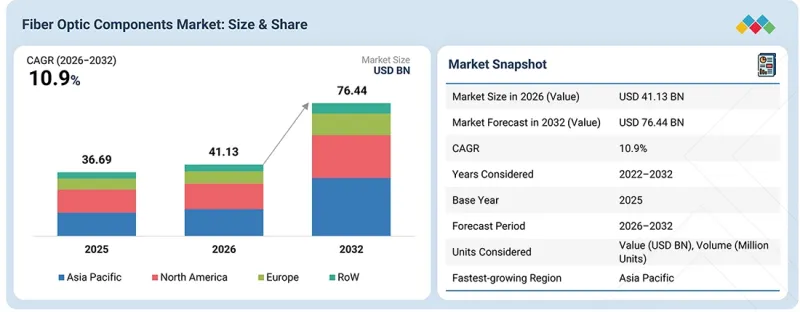
Manufacturers are increasingly developing fiber optic components with higher data-rate capabilities, improved transmission performance, lower power consumption, and compact form factors to address evolving network requirements. The migration toward 100G, 400G, 800G, and higher-speed optical connections is supporting demand for advanced transceivers, active optical cables, and related components. In addition, continued expansion of broadband infrastructure, 5G backhaul, data center capacity, and enterprise networks is creating opportunities for fiber optic component manufacturers to expand their product portfolios and manufacturing capabilities. The growing need for scalable, reliable optical connectivity across telecommunications, data centers, cloud infrastructure, and broadband networks is expected to further support market growth.
"Based on data rate, the 41 Gbps to 100 Gbps segment is likely to hold the largest market share"
The 41 Gbps to 100 Gbps segment is expected to hold the largest share of the fiber optic components market because 40G and 100G optical connections are widely deployed across telecommunications networks, data centers, enterprise networks, and data center interconnects. These data rates provide higher transmission capacity than lower-speed connections while supporting ongoing network infrastructure upgrades to accommodate increasing internet traffic, cloud applications, video content, and data-intensive services. In addition, the expansion of 5G networks, FTTH deployments, and data center infrastructure is increasing demand for 100G transceivers, active optical cables, and related fiber optic components. The continued migration from lower-speed optical links to higher-capacity connections, along with the need for scalable, reliable network infrastructure, further supports growth in the 41 Gbps to 100 Gbps segment.
"Based on application, the distributed sensing segment is expected to witness the highest CAGR during the forecast period."
The distributed sensing segment is expected to witness the highest CAGR during the forecast period, driven by the increasing use of fiber optic components in applications that require continuous monitoring of temperature, acoustic signals, and other physical parameters across long distances. Fiber optic cables and related components are used in distributed sensing systems for infrastructure monitoring, oil & gas pipelines, industrial facilities, transportation networks, and other applications requiring real-time, remote monitoring. The immunity of fiber-optic systems to electromagnetic interference and their ability to support long-distance sensing further support adoption. In addition, increasing investments in infrastructure monitoring, industrial automation, pipeline safety, and structural health monitoring are creating demand for fiber optic cables, connectors, circulators, and other optical components used in distributed sensing systems. The growing need for continuous, reliable, remote monitoring is further supporting growth in the distributed sensing segment.
"Asia Pacific is projected to be the fastest-growing market for fiber optic components during the forecast period"
The Asia Pacific region is expected to witness the highest CAGR in the fiber optic components market due to rapid expansion of telecommunications and broadband infrastructure, increasing data center deployments, and growing investments in 5G and fiber-to-the-home (FTTH) networks. Increasing adoption of high-speed optical connectivity across countries such as China, Japan, South Korea, and India is driving demand for fiber optic cables, transceivers, active optical cables, connectors, splitters, and amplifiers. The expansion of cloud infrastructure, rising internet traffic, and increasing enterprise connectivity requirements are further supporting regional market growth. Additionally, growing investments in data centers, 5G backhaul, data center interconnects, and broadband networks are creating demand for high-capacity optical components. Major telecommunications operators, data center providers, network equipment manufacturers, and optical component suppliers are further supporting Asia Pacific's position as the fastest-growing regional market during the forecast period.
Breakdown of Primaries
A variety of executives from key organizations operating in the fiber optic components market were interviewed in-depth, including CEOs, marketing directors, and innovation and technology directors.
- By Company Type: Tier 1 - 40%, Tier 2 - 35%, and Tier 3 - 25%
- By Designation: C-level Executives - 48%, Directors - 33%, and Others - 19%
- By Region: North America - 35%, Europe - 18%, Asia Pacific - 40%, and RoW - 7%
Major players profiled in this report are Coherent Corporation (US), Lumentum Holdings Inc. (US), Broadcom Inc. (US), Sumitomo Electric Industries, Ltd. (Japan), Accelink Technologies Co., Ltd. (China), Furukawa Electric Co., Ltd. (Japan), Fujitsu Optical Component Ltd. (Japan), Oclaro Inc. (US), Acacia Communications Inc. (US), EMCORE Corporation (US), and Corning Incorporated (US), among others.
These companies compete by continuously improving optical transmission performance, data-rate capabilities, power efficiency, product reliability, manufacturing capabilities, and application-specific functionality. Strategic emphasis is placed on developing high-speed optical transceivers, fiber optic cables, active optical cables, amplifiers, connectors, splitters, circulators, and other optical components for applications such as telecommunications, data centers, enterprise networks, distributed sensing, analytical & medical equipment, and lighting. Market participants focus on providing high-performance fiber optic solutions for telecom operators, data center operators, cloud service providers, network equipment manufacturers, and enterprise users. The industry also emphasizes higher data rates, increased transmission capacity, reduced power consumption, improved component integration, and reliable network connectivity. Continued investment in research and development, high-speed optical technologies, manufacturing capacity, advanced transceivers, optical fiber and cable technologies, and application-specific solutions, along with collaborations with network operators, data center companies, and equipment manufacturers, is expected to strengthen competition and support the global adoption of advanced fiber optic components.
The study includes an in-depth competitive analysis of key players in the fiber optic components market, including company profiles, recent developments, and key market strategies.
Study Coverage:
The report segments the fiber optic components market and forecasts its market size by product type (fiber optic cables, active optical cables, amplifiers, splitters, connectors, circulators, transceivers, and others), data rate (less than 10 Gbps, 10 Gbps to 40 Gbps, 41 Gbps to 100 Gbps, and more than 100 Gbps), and application (analytical & medical equipment, communication, distributed sensing, and lighting). The report also analyzes key market drivers, restraints, opportunities, and challenges influencing industry growth. It provides a detailed regional assessment across North America, Europe, Asia Pacific, and Rest of the World (ROW), along with country-level insights for major markets. In addition, the study includes value chain analysis and competitive landscape assessment of leading players operating in the global fiber optic components market.
Key Benefits of Buying the Report:
- Analysis of key drivers (Increasing deployment of data centers, growing internet penetration and data traffic), restraints (Prone to physical damage and transmission loss), opportunities (Increasing adoption of fiber optic components in digital signage, Rising demand for fiber optics due to reliability), and challenges (Threat to optical network security)
- Product and Service Development/Innovation: Detailed insights into upcoming technologies, research and development activities, advanced optical technologies, and new product developments in the fiber optic components market, including high-speed optical transceivers, fiber optic cables, active optical cables, amplifiers, splitters, connectors, circulators, and optical modules for high-capacity data transmission and connectivity
- Market Development: Comprehensive information about lucrative markets by analyzing the fiber optic components market across varied regions
- Market Diversification: Exhaustive information about new products/services, untapped geographies, recent developments, and investments in the market
- Competitive Assessment: In-depth assessment of the competitive landscape, market strategies, product offerings, and recent developments of leading players, such as Coherent Corporation (US), Lumentum Holdings Inc. (US), Broadcom Inc. (US), Sumitomo Electric Industries, Ltd. (Japan), Accelink Technologies Co., Ltd. (China), Furukawa Electric Co., Ltd. (Japan), Fujitsu Optical Component Ltd. (Japan), EMCORE Corporation (US), and Corning Incorporated (US).
TABLE OF CONTENTS
1 INTRODUCTION
- 1.1 STUDY OBJECTIVES
- 1.2 MARKET DEFINITION
- 1.3 STUDY SCOPE
- 1.3.1 MARKETS COVERED AND REGIONAL SCOPE
- 1.3.2 INCLUSIONS AND EXCLUSIONS
- 1.3.3 YEARS CONSIDERED
- 1.4 CURRENCY CONSIDERED
- 1.5 UNIT CONSIDERED
- 1.6 LIMITATIONS
- 1.7 STAKEHOLDERS
- 1.8 SUMMARY OF CHANGES
2 EXECUTIVE SUMMARY
- 2.1 MARKET HIGHLIGHTS AND KEY INSIGHTS
- 2.2 KEY MARKET PARTICIPANTS: MAPPING OF STRATEGIC DEVELOPMENTS
- 2.3 DISRUPTIVE TRENDS IN FIBER OPTIC COMPONENTS MARKET
- 2.4 HIGH-GROWTH SEGMENTS
- 2.5 REGIONAL SNAPSHOT: MARKET SIZE, GROWTH RATE, AND FORECAST
3 PREMIUM INSIGHTS
- 3.1 ATTRACTIVE OPPORTUNITIES FOR PLAYERS IN FIBER OPTIC COMPONENTS MARKET
- 3.2 FIBER OPTIC COMPONENTS MARKET, BY TYPE
- 3.3 FIBER OPTIC COMPONENTS MARKET, BY DATA RATE
- 3.4 FIBER OPTIC COMPONENTS MARKET, BY APPLICATION
- 3.5 FIBER OPTIC COMPONENTS MARKET, BY GEOGRAPHY
4 MARKET OVERVIEW
- 4.1 INTRODUCTION
- 4.2 MARKET DYNAMICS
- 4.2.1 DRIVERS
- 4.2.1.1 Increasing deployment of data centers
- 4.2.1.2 Growing internet penetration and data traffic
- 4.2.1.3 Rising demand for bandwidth
- 4.2.2 RESTRAINTS
- 4.2.2.1 Prone to physical damage and transmission loss
- 4.2.3 OPPORTUNITIES
- 4.2.3.1 Increasing adoption of fiber optic components in digital signage market
- 4.2.3.2 Rising demand for fiber optics due to reliability
- 4.2.3.3 Expansion of telecom infrastructure in developing economies
- 4.2.4 CHALLENGES
- 4.2.4.1 Threat to optical network security
- 4.2.1 DRIVERS
- 4.3 UNMET NEEDS AND WHITE SPACES
- 4.4 INTERCONNECTED MARKETS AND CROSS-SECTOR OPPORTUNITIES
- 4.5 STRATEGIC MOVES BY TIER 1/2/3 PLAYERS
5 INDUSTRY TRENDS
- 5.1 INTRODUCTION
- 5.2 PORTER'S FIVE FORCES ANALYSIS
- 5.2.1 INTENSITY OF COMPETITIVE RIVALRY
- 5.2.2 BARGAINING POWER OF SUPPLIERS
- 5.2.3 BARGAINING POWER OF BUYERS
- 5.2.4 THREAT OF SUBSTITUTES
- 5.2.5 THREAT OF NEW ENTRANTS
- 5.3 MACROECONOMIC OUTLOOK
- 5.3.1 INTRODUCTION
- 5.3.2 GDP TRENDS AND FORECAST
- 5.3.3 TRENDS IN GLOBAL COMMUNICATIONS INDUSTRY
- 5.3.4 TRENDS IN GLOBAL DISTRIBUTED SENSING INDUSTRY
- 5.4 SUPPLY CHAIN ANALYSIS
- 5.5 ECOSYSTEM ANALYSIS
- 5.6 PRICING ANALYSIS
- 5.6.1 AVERAGE SELLING PRICE TREND FOR OPTICAL TRANSCEIVERS OFFERED BY KEY PLAYERS, BY DATA RATE, 2025
- 5.6.2 AVERAGE SELLING PRICE TREND OF OPTICAL TRANSCEIVERS, BY REGION, 2022-2025
- 5.7 TRADE ANALYSIS
- 5.7.1 IMPORT SCENARIO (HS CODE 9001)
- 5.7.2 EXPORT SCENARIO (HS CODE 9001)
- 5.8 KEY CONFERENCES AND EVENTS, 2026-2027
- 5.9 TRENDS/DISRUPTIONS IMPACTING CUSTOMER BUSINESS
- 5.10 INVESTMENT AND FUNDING SCENARIO
- 5.11 CASE STUDY ANALYSIS
- 5.11.1 PRO OPTIX PROVIDES MULTI-FIBER PUSH-ON (MPO) SOLUTION TO HANDLE FUTURE DATA DEMANDS EFFECTIVELY
- 5.11.2 NORDIC-BASED TV BROADCASTING COMPANY ADOPTS 100G OPTICAL TRANSCEIVERS TO ENHANCE DATA TRANSFER RATES
- 5.11.3 PRO OPTIX COLLABORATES WITH NORDIC SYSTEMS INTEGRATOR TO IMPLEMENT BIDI OPTICAL TRANSCEIVERS TO OFFER HIGH-SPEED INTERNET ACCESS
- 5.12 IMPACT OF US TARIFFS - FIBER OPTIC COMPONENTS MARKET
- 5.12.1 INTRODUCTION
- 5.12.2 KEY TARIFF RATES
- 5.12.3 PRICE IMPACT ANALYSIS
- 5.12.4 IMPACT ON COUNTRIES/REGIONS
- 5.12.4.1 US
- 5.12.4.2 Europe
- 5.12.4.3 Asia Pacific
- 5.12.5 IMPACT ON APPLICATIONS
6 TECHNOLOGICAL ADVANCEMENTS, AI-DRIVEN IMPACT, PATENTS, AND INNOVATIONS
- 6.1 KEY TECHNOLOGIES
- 6.1.1 PLASTIC OPTICAL FIBERS (POF)
- 6.1.2 GLASS OPTICAL FIBERS
- 6.1.3 NANF HOLLOW-CORE FIBER
- 6.2 COMPLEMENTARY TECHNOLOGIES
- 6.2.1 DIGITAL SIGNAL PROCESSOR (DSP)
- 6.3 ADJACENT TECHNOLOGIES
- 6.3.1 WIRELESS COMMUNICATION
- 6.4 PATENT ANALYSIS
- 6.5 IMPACT OF AI ON FIBER OPTIC COMPONENTS MARKET
- 6.5.1 TOP USE CASES AND MARKET POTENTIAL
- 6.5.2 BEST PRACTICES FOLLOWED BY MANUFACTURERS/OEMS IN FIBER OPTIC COMPONENTS MARKET
- 6.5.3 CASE STUDIES RELATED TO AI IMPLEMENTATION IN FIBER OPTIC COMPONENTS MARKET
- 6.5.4 INTERCONNECTED ECOSYSTEM AND IMPACT ON MARKET PLAYERS
- 6.5.5 CLIENTS' READINESS TO ADOPT AI-INTEGRATED FIBER OPTIC COMPONENTS
7 REGULATORY LANDSCAPE
- 7.1 REGIONAL REGULATIONS AND COMPLIANCE
- 7.1.1 REGULATORY BODIES, GOVERNMENT AGENCIES, AND OTHER ORGANIZATIONS
- 7.1.2 REGULATORY STANDARDS
- 7.1.2.1 International Organization for Standardization (ISO)/International Electrotechnical Commission (IEC)
- 7.1.2.2 ITU standards
8 CUSTOMER LANDSCAPE AND BUYER BEHAVIOR
- 8.1 DECISION-MAKING PROCESS
- 8.2 KEY STAKEHOLDERS INVOLVED IN BUYING PROCESS AND THEIR EVALUATION CRITERIA
- 8.2.1 KEY STAKEHOLDERS IN BUYING PROCESS
- 8.2.2 BUYING CRITERIA
- 8.3 ADOPTION BARRIERS AND INTERNAL CHALLENGES
- 8.4 UNMET NEEDS OF VARIOUS APPLICATIONS
9 FIBER OPTIC COMPONENTS MARKET, BY TYPE
- 9.1 INTRODUCTION
- 9.2 CABLES
- 9.2.1 SINGLE-MODE
- 9.2.1.1 Adoption in long-distance and high-bandwidth applications to bolster segmental growth
- 9.2.2 MULTI-MODE
- 9.2.2.1 Demand for unlimited bandwidth capacity to foster segmental growth
- 9.2.1 SINGLE-MODE
- 9.3 AOCS
- 9.3.1 LIGHTWEIGHT AND ELECTROMAGNETIC IMMUNITY TO CONTRIBUTE TO SEGMENTAL GROWTH
- 9.4 AMPLIFIERS
- 9.4.1 EXTENSIVE APPLICATIONS FOR SIGNAL AMPLIFICATION IN LONG-DISTANCE TRANSMISSIONS TO DRIVE MARKET
- 9.4.2 ERBIUM-DOPED FIBER AMPLIFIERS
- 9.4.3 FIBER RAMAN AMPLIFIERS
- 9.4.4 SEMICONDUCTOR OPTICAL AMPLIFIERS
- 9.5 SPLITTERS
- 9.5.1 COMPACT AND LOWER COST WITH GREATER DEGREES OF SPLITTING TO FUEL SEGMENTAL GROWTH
- 9.6 CONNECTORS
- 9.6.1 LC CONNECTORS
- 9.6.1.1 Use in modern telecommunications networks, data centers, and enterprise networks to expedite segmental growth
- 9.6.2 SC CONNECTORS
- 9.6.2.1 Convenient connection and disconnection while maintaining fiber alignment to augment segmental growth
- 9.6.3 FC CONNECTORS
- 9.6.3.1 Availability in configurations for varied fiber types and operating requirements to facilitate segmental growth
- 9.6.4 ST CONNECTORS
- 9.6.4.1 Usage in enterprise networks, building networks, and other fiber optic installations to foster segmental growth
- 9.6.5 MTP/MPO CONNECTORS
- 9.6.5.1 Support for high-density cabling and adoption in data center environments to accelerate segmental growth
- 9.6.6 MMC CONNECTORS
- 9.6.6.1 Small form factor and support for dense fiber routing in advanced architectures to drive market
- 9.6.7 SN-MT CONNECTORS
- 9.6.7.1 Focus on high-density optical connectivity in data centers and applications requiring compact multifiber connections to boost segmental growth
- 9.6.8 OTHER CONNECTION TYPES
- 9.6.1 LC CONNECTORS
- 9.7 CIRCULATORS
- 9.7.1 NON-RECIPROCAL DEVICES FOR DIRECTING OPTICAL SIGNALS TO SUPPORT SEGMENTAL GROWTH
- 9.8 TRANSCEIVERS
- 9.8.1 FOCUS ON DATA TRANSMISSION OVER FIBER OPTIC LINKS WHILE MAINTAINING COMPATIBILITY WITH CORRESPONDING EQUIPMENT INTERFACES TO DRIVE MARKET
- 9.8.2 BY FORM FACTOR
- 9.8.2.1 SFF and SFP
- 9.8.2.1.1 By wavelength
- 9.8.2.2 SFP+ and SFP28
- 9.8.2.2.1 By wavelength
- 9.8.2.1 SFF and SFP
- 9.8.3 QSFP, QSFP+, QSFP14, AND QSFP28
- 9.8.3.1 By wavelength
- 9.8.4 CFP, CFP2, AND CFP4
- 9.8.4.1 By wavelength
- 9.8.5 XFP
- 9.8.5.1 By wavelength
- 9.8.6 CXP
- 9.8.6.1 By wavelength
- 9.9 OTHER TYPES
- 9.9.1 FIBER OPTIC FILTERS
- 9.9.2 FIBER OPTIC ATTENUATORS
- 9.9.3 FIBER OPTIC MULTIPLEXERS
- 9.9.4 FIBER OPTIC AGGREGATORS
10 FIBER OPTIC COMPONENTS MARKET, BY DATA RATE
- 10.1 INTRODUCTION
- 10.2 LESS THAN 10 GBPS
- 10.2.1 SUPPORT FOR SINGLE-MODE AND MULTI-MODE FIBERS TO CONTRIBUTE TO SEGMENTAL GROWTH
- 10.3 10 TO 40 GBPS
- 10.3.1 USE OF HIGHER-SPEED TRANSCEIVERS IN BACKBONE AND CORE NETWORK APPLICATIONS TO FUEL SEGMENTAL GROWTH
- 10.4 41 TO 100 GBPS
- 10.4.1 CONTINUOUS DEVELOPMENT OF BIG DATA, CLOUD COMPUTING, MASSIVE VIDEO, AND 5G APPLICATIONS TO DRIVE MARKET
- 10.5 MORE THAN 100 GBPS
- 10.5.1 FOCUS ON DATA SECURITY IN COMMUNICATIONS NETWORKS TO ACCELERATE SEGMENTAL GROWTH
11 FIBER OPTIC COMPONENTS MARKET, BY APPLICATION
- 11.1 INTRODUCTION
- 11.2 ANALYTICAL & MEDICAL EQUIPMENT
- 11.2.1 NEED FOR OPTIC ILLUMINATION IN MEDICAL PROCEDURES TO DRIVE MARKET
- 11.3 COMMUNICATIONS
- 11.3.1 TELECOMMUNICATIONS
- 11.3.1.1 Need for high-speed data transmission to contribute to segmental growth
- 11.3.2 DATA CENTERS
- 11.3.2.1 Rise in network traffic and cloud computing services to bolster segmental growth
- 11.3.3 ENTERPRISES
- 11.3.3.1 Growing demand for communication solutions to expedite segmental growth
- 11.3.1 TELECOMMUNICATIONS
- 11.4 DISTRIBUTED SENSING
- 11.4.1 SUPPORT FOR MONITORING IN REMOTE AND CHALLENGING ENVIRONMENTS TO BOOST SEGMENTAL GROWTH
- 11.4.2 TEMPERATURE SENSING
- 11.4.3 ACOUSTIC SENSING
- 11.4.4 OTHER SENSING APPLICATIONS
- 11.5 LIGHTING
- 11.5.1 USE OF FIBER OPTIC COMPONENTS FOR ILLUMINATION IN REMOTE LOCATIONS TO FOSTER SEGMENTAL GROWTH
12 FIBER OPTIC COMPONENTS MARKET, BY REGION
- 12.1 INTRODUCTION
- 12.2 NORTH AMERICA
- 12.2.1 US
- 12.2.1.1 Increasing data center investments and demand for high-speed connectivity to drive market
- 12.2.2 CANADA
- 12.2.2.1 Rising development of network infrastructure to augment market growth
- 12.2.3 MEXICO
- 12.2.3.1 Growing internet data traffic to boost market growth
- 12.2.1 US
- 12.3 EUROPE
- 12.3.1 UK
- 12.3.1.1 Rising emphasis on Industry 4.0 and technological initiatives by huge telecommunications service providers to fuel market growth
- 12.3.2 GERMANY
- 12.3.2.1 Mounting adoption of IoT in manufacturing and automotive industries to expedite market growth
- 12.3.3 FRANCE
- 12.3.3.1 Increasing implementation of 5G technology to bolster market growth
- 12.3.4 ITALY
- 12.3.4.1 High adoption of FTTH broadband to provide market growth opportunities
- 12.3.5 REST OF EUROPE
- 12.3.1 UK
- 12.4 ASIA PACIFIC
- 12.4.1 CHINA
- 12.4.1.1 Rapid advances in AI, IoT, and 5G technologies to accelerate market growth
- 12.4.2 JAPAN
- 12.4.2.1 Increasing adoption of cloud-based services to drive market
- 12.4.3 INDIA
- 12.4.3.1 Surging demand for network upgrades to contribute to market growth
- 12.4.4 REST OF ASIA PACIFIC
- 12.4.1 CHINA
- 12.5 ROW
- 12.5.1 MIDDLE EAST & AFRICA
- 12.5.1.1 GCC
- 12.5.1.2 Rest of Middle East & Africa
- 12.5.2 SOUTH AMERICA
- 12.5.2.1 Growing internet usage and data centers to support market growth
- 12.5.1 MIDDLE EAST & AFRICA
13 COMPETITIVE LANDSCAPE
- 13.1 OVERVIEW
- 13.2 KEY PLAYER COMPETITIVE STRATEGIES, RIGHT TO WIN, 2023-2026
- 13.3 MARKET SHARE ANALYSIS, 2025
- 13.4 REVENUE ANALYSIS, 2022-2025
- 13.5 COMPANY VALUATION AND FINANCIAL METRICS
- 13.6 BRAND/PRODUCT COMPARISON
- 13.6.1 COHERENT CORP. (US)
- 13.6.2 LUMENTUM OPERATIONS LLC (US)
- 13.6.3 BROADCOM INC. (US)
- 13.6.4 SUMITOMO ELECTRIC INDUSTRIES, LTD. (JAPAN)
- 13.6.5 ACCELINK TECHNOLOGIES CO., LTD. (CHINA)
- 13.7 COMPANY EVALUATION MATRIX: KEY PLAYERS, 2025
- 13.7.1 STARS
- 13.7.2 PERVASIVE PLAYERS
- 13.7.3 EMERGING LEADERS
- 13.7.4 PARTICIPANTS
- 13.7.5 COMPANY FOOTPRINTS: KEY PLAYERS, 2025
- 13.7.5.1 Company footprint
- 13.7.5.1.1 Region footprint
- 13.7.5.2 Type footprint
- 13.7.5.3 Data rate footprint
- 13.7.5.4 Application footprint
- 13.7.5.1 Company footprint
- 13.8 COMPANY EVALUATION MATRIX: KEY STARTUPS/SMES, 2025
- 13.8.1 PROGRESSIVE COMPANIES
- 13.8.2 RESPONSIVE COMPANIES
- 13.8.3 DYNAMIC COMPANIES
- 13.8.4 STARTING BLOCKS
- 13.8.5 COMPETITIVE BENCHMARKING: STARTUPS/SMES, 2025
- 13.8.5.1 Detailed list of key startups/SMEs
- 13.8.5.2 Competitive benchmarking of key startups/SMEs
- 13.9 COMPETITIVE SCENARIO
- 13.9.1 PRODUCT LAUNCHES/ENHANCEMENTS
- 13.9.2 DEALS
- 13.9.3 EXPANSIONS
14 COMPANY PROFILES
- 14.1 KEY PLAYERS
- 14.1.1 COHERENT CORP.
- 14.1.1.1 Business overview
- 14.1.1.2 Products/Solutions/Services offered
- 14.1.1.3 Recent developments
- 14.1.1.3.1 Product launches/enhancements
- 14.1.1.3.2 Deals
- 14.1.1.4 MnM view
- 14.1.1.4.1 Key strengths/Right to win
- 14.1.1.4.2 Strategic choices
- 14.1.1.4.3 Weaknesses/Competitive threats
- 14.1.2 LUMENTUM OPERATIONS LLC
- 14.1.2.1 Business overview
- 14.1.2.2 Products/Solutions/Services offered
- 14.1.2.3 Recent developments
- 14.1.2.3.1 Product launches/enhancements
- 14.1.2.3.2 Deals
- 14.1.2.4 MnM view
- 14.1.2.4.1 Key strengths/Right to win
- 14.1.2.4.2 Strategic choices
- 14.1.2.4.3 Weaknesses/Competitive threats
- 14.1.3 BROADCOM
- 14.1.3.1 Business overview
- 14.1.3.2 Products/Solutions/Services offered
- 14.1.3.3 Recent developments
- 14.1.3.3.1 Product launches/enhancements
- 14.1.3.3.2 Deals
- 14.1.3.3.3 Other developments
- 14.1.3.4 MnM view
- 14.1.3.4.1 Key strengths/Right to win
- 14.1.3.4.2 Strategic choices
- 14.1.3.4.3 Weaknesses/Competitive threats
- 14.1.4 SUMITOMO ELECTRIC INDUSTRIES, LTD.
- 14.1.4.1 Business overview
- 14.1.4.2 Products/Solutions/Services offered
- 14.1.4.3 Recent developments
- 14.1.4.3.1 Product launches/enhancements
- 14.1.4.3.2 Deals
- 14.1.4.4 MnM view
- 14.1.4.4.1 Key strengths/Right to win
- 14.1.4.4.2 Strategic choices
- 14.1.4.4.3 Weaknesses/Competitive threats
- 14.1.5 ACCELINK TECHNOLOGY CO. LTD
- 14.1.5.1 Business overview
- 14.1.5.2 Products/Solutions/Services offered
- 14.1.5.3 Recent developments
- 14.1.5.3.1 Product launches/enhancements
- 14.1.5.3.2 Expansions
- 14.1.5.4 MnM view
- 14.1.5.4.1 Key strengths/Right to win
- 14.1.5.4.2 Strategic choices
- 14.1.5.4.3 Weaknesses/Competitive threats
- 14.1.6 ACACIA COMMUNICATIONS, INC.
- 14.1.6.1 Business overview
- 14.1.6.2 Products/Solutions/Services offered
- 14.1.6.3 Recent developments
- 14.1.6.3.1 Product launches/enhancements
- 14.1.6.3.2 Deals
- 14.1.7 EMCORE LLC
- 14.1.7.1 Business overview
- 14.1.7.2 Products/Solutions/Services offered
- 14.1.7.3 Recent developments
- 14.1.7.3.1 Product launches/enhancements
- 14.1.8 FURUKAWA FITEL OPTICAL COMPONENTS CO., LTD.
- 14.1.8.1 Business overview
- 14.1.8.2 Products/Solutions/Services offered
- 14.1.8.3 Recent developments
- 14.1.8.3.1 Product launches/enhancements
- 14.1.8.3.2 Deals
- 14.1.9 FURUKAWA ELECTRIC CO., LTD.
- 14.1.9.1 Business overview
- 14.1.9.2 Products/Solutions/Services offered
- 14.1.9.3 Recent developments
- 14.1.9.3.1 Product launches/enhancements
- 14.1.9.3.2 Deals
- 14.1.10 CORNING INCORPORATED
- 14.1.10.1 Business overview
- 14.1.10.2 Products/Solutions/Services offered
- 14.1.10.3 Recent developments
- 14.1.10.3.1 Product launches/enhancements
- 14.1.10.3.2 Deals
- 14.1.10.3.3 Expansions
- 14.1.1 COHERENT CORP.
- 14.2 OTHER KEY PLAYERS
- 14.2.1 HEXATRONIC GROUP
- 14.2.2 O-NET TECHNOLOGIES (SHENZHEN) GROUP CO., LTD.
- 14.2.3 SMITHS INTERCONNECT
- 14.2.4 SOURCE PHOTONICS
- 14.2.5 FIBRE MOUNTAIN
- 14.2.6 AMPHENOL CORPORATION
- 14.2.7 TE CONNECTIVITY PLC
- 14.2.8 FIBER OPTIC COMMUNICATIONS, INC. (FOCI)
- 14.2.9 MW TECHNOLOGIES
- 14.2.10 SHENZHEN NOKOXIN TECHNOLOGY CO., LTD.
- 14.2.11 BELDEN, INC.
- 14.2.12 HUBER+SUHNER
- 14.2.13 REICHLE & DE-MASSARI AG (R&M)
- 14.2.14 PANDUIT CORP.
- 14.2.15 CLEARFIELD INC.
- 14.2.16 RPG CABLES
15 RESEARCH METHODOLOGY
- 15.1 RESEARCH DATA
- 15.1.1 SECONDARY DATA
- 15.1.1.1 Major secondary sources
- 15.1.1.2 Key data from secondary sources
- 15.1.2 PRIMARY DATA
- 15.1.2.1 Participants in primary interviews
- 15.1.2.2 Key data from primary sources
- 15.1.2.3 Key industry insights
- 15.1.2.4 Breakdown of primaries
- 15.1.3 SECONDARY AND PRIMARY RESEARCH
- 15.1.1 SECONDARY DATA
- 15.2 MARKET SIZE ESTIMATION
- 15.2.1 BOTTOM-UP APPROACH
- 15.2.1.1 Approach to estimate market size through bottom-up analysis (demand side)
- 15.2.2 TOP-DOWN APPROACH
- 15.2.2.1 Approach to estimate market size through top-down analysis (supply side)
- 15.2.1 BOTTOM-UP APPROACH
- 15.3 DATA TRIANGULATION
- 15.4 RESEARCH ASSUMPTIONS
- 15.5 RISK ASSESSMENT
- 15.6 RESEARCH LIMITATIONS
16 APPENDIX
- 16.1 DISCUSSION GUIDE
- 16.2 KNOWLEDGESTORE: MARKETSANDMARKETS' SUBSCRIPTION PORTAL
- 16.3 CUSTOMIZATION OPTIONS
- 16.4 RELATED REPORTS
- 16.5 AUTHOR DETAILS
List of Tables
- TABLE 1 FIBER OPTIC COMPONENTS MARKET: INCLUSIONS AND EXCLUSIONS
- TABLE 2 FIBER OPTIC COMPONENTS MARKET: SUMMARY OF CHANGES
- TABLE 3 KEY STRATEGIC FOCUS OF TIER 1/2/3 PLAYERS
- TABLE 4 IMPACT OF PORTER'S FIVE FORCES ANALYSIS
- TABLE 5 GDP PERCENTAGE CHANGE, BY KEY COUNTRY, 2021-2030
- TABLE 6 ROLE OF COMPANIES IN FIBER OPTIC COMPONENTS ECOSYSTEM
- TABLE 7 AVERAGE SELLING PRICE TREND OF OPTICAL TRANSCEIVERS, BY DATA RATE, 2022-2025 (USD)
- TABLE 8 AVERAGE SELLING PRICE TREND OF OPTICAL TRANSCEIVERS, BY REGION, 2022-2025 (USD)
- TABLE 9 IMPORT DATA FOR HS CODE 9001-COMPLIANT PRODUCTS, BY COUNTRY, 2021-2025 (USD MILLION)
- TABLE 10 EXPORT DATA FOR HS CODE 9001-COMPLIANT PRODUCTS, BY COUNTRY, 2021-2025 (USD MILLION)
- TABLE 11 LIST OF KEY CONFERENCES AND EVENTS, 2026-2027
- TABLE 12 LINKOPING UNIVERSITY DATA CENTER AIMS TO BUILD FUTURE-PROOF DATA CENTER WITH MULTI-FIBER PUSH-ON (MPO) SOLUTION
- TABLE 13 NORDIC BROADCASTING COMPANY ENHANCES DATA TRANSFER RATES AND ENSURES RELIABLE SITE CONNECTIVITY WITH FIBER OPTICS
- TABLE 14 PRO OPTIX AND NORDIC SYSTEMS INTEGRATOR UNITE TO FACILITATE HIGH-SPEED INTERNET USING BIDI OPTICAL TRANSCEIVERS
- TABLE 15 US-ADJUSTED RECIPROCAL TARIFF RATES
- TABLE 16 EVOLUTION OF FIBER OPTIC COMPONENTS TECHNOLOGIES
- TABLE 17 LIST OF MAJOR PATENTS, 2023-2025
- TABLE 18 KEY USE CASES AND MARKET POTENTIAL
- TABLE 19 BEST PRACTICES ADOPTED BY MARKET PLAYERS, BY USE CASE
- TABLE 20 CASE STUDIES RELATED TO AI IMPLEMENTATION
- TABLE 21 INTERCONNECTED ECOSYSTEM AND INFLUENCE ON MARKET PLAYERS
- TABLE 22 NORTH AMERICA: LIST OF REGULATORY BODIES, GOVERNMENT AGENCIES, AND OTHER ORGANIZATIONS
- TABLE 23 EUROPE: LIST OF REGULATORY BODIES, GOVERNMENT AGENCIES, AND OTHER ORGANIZATIONS
- TABLE 24 ASIA PACIFIC: LIST OF REGULATORY BODIES, GOVERNMENT AGENCIES, AND OTHER ORGANIZATIONS
- TABLE 25 ROW: LIST OF REGULATORY BODIES, GOVERNMENT AGENCIES, AND OTHER ORGANIZATIONS
- TABLE 26 INFLUENCE OF STAKEHOLDERS ON BUYING PROCESS FOR TOP THREE APPLICATIONS (%)
- TABLE 27 BUYING CRITERIA FOR TOP THREE APPLICATIONS
- TABLE 28 UNMET NEEDS IN FIBER OPTIC COMPONENTS MARKET, BY APPLICATION
- TABLE 29 FIBER OPTIC COMPONENTS MARKET, BY TYPE, 2022-2025 (USD MILLION)
- TABLE 30 FIBER OPTIC COMPONENTS MARKET, BY TYPE, 2026-2032 (USD MILLION)
- TABLE 31 FIBER OPTIC COMPONENTS MARKET, BY TYPE, 2022-2025 (MILLION UNITS)
- TABLE 32 FIBER OPTIC COMPONENTS MARKET, BY TYPE, 2026-2032 (MILLION UNITS)
- TABLE 33 CABLES: FIBER OPTIC COMPONENTS MARKET, BY APPLICATION, 2022-2025 (USD MILLION)
- TABLE 34 CABLES: FIBER OPTIC COMPONENTS MARKET, BY APPLICATION, 2026-2032 (USD MILLION)
- TABLE 35 CABLES: FIBER OPTIC COMPONENTS MARKET FOR COMMUNICATIONS, BY APPLICATION TYPE, 2022-2025 (USD MILLION)
- TABLE 36 CABLES: FIBER OPTIC COMPONENTS MARKET FOR COMMUNICATIONS, BY APPLICATION TYPE, 2026-2032 (USD MILLION)
- TABLE 37 CABLES: FIBER OPTIC COMPONENTS MARKET, BY CABLE TYPE, 2022-2025 (USD MILLION)
- TABLE 38 CABLES: FIBER OPTIC COMPONENTS MARKET, BY CABLE TYPE, 2026-2032 (USD MILLION)
- TABLE 39 SINGLE-MODE: FIBER OPTIC COMPONENTS MARKET, BY APPLICATION, 2022-2025 (USD MILLION)
- TABLE 40 SINGLE-MODE: FIBER OPTIC COMPONENTS MARKET, BY APPLICATION, 2026-2032 (USD MILLION)
- TABLE 41 SINGLE-MODE: FIBER OPTIC COMPONENTS MARKET FOR COMMUNICATIONS, BY APPLICATION TYPE, 2022-2025 (USD MILLION)
- TABLE 42 SINGLE-MODE: FIBER OPTIC COMPONENTS MARKET FOR COMMUNICATIONS, BY APPLICATION TYPE, 2026-2032 (USD MILLION)
- TABLE 43 MULTI-MODE: FIBER OPTIC COMPONENTS MARKET, BY APPLICATION, 2022-2025 (USD MILLION)
- TABLE 44 MULTI-MODE: FIBER OPTIC COMPONENTS MARKET, BY APPLICATION, 2026-2032 (USD MILLION)
- TABLE 45 MULTI-MODE: FIBER OPTIC COMPONENTS MARKET FOR COMMUNICATIONS, BY APPLICATION TYPE, 2022-2025 (USD MILLION)
- TABLE 46 MULTI-MODE: FIBER OPTIC COMPONENTS MARKET FOR COMMUNICATIONS, BY APPLICATION TYPE, 2026-2032 (USD MILLION)
- TABLE 47 AOCS: FIBER OPTIC COMPONENTS MARKET, BY APPLICATION, 2022-2025 (USD MILLION)
- TABLE 48 AOCS: FIBER OPTIC COMPONENTS MARKET, BY APPLICATION, 2026-2032 (USD MILLION)
- TABLE 49 AOCS: FIBER OPTIC COMPONENTS MARKET FOR COMMUNICATIONS, BY APPLICATION TYPE, 2022-2025 (USD MILLION)
- TABLE 50 AOCS: FIBER OPTIC COMPONENTS MARKET FOR COMMUNICATIONS, BY APPLICATION TYPE, 2026-2032 (USD MILLION)
- TABLE 51 AMPLIFIERS: FIBER OPTIC COMPONENTS MARKET, BY APPLICATION, 2022-2025 (USD MILLION)
- TABLE 52 AMPLIFIERS: FIBER OPTIC COMPONENTS MARKET, BY APPLICATION, 2026-2032 (USD MILLION)
- TABLE 53 AMPLIFIERS: FIBER OPTIC COMPONENTS MARKET FOR COMMUNICATIONS, BY APPLICATION TYPE, 2022-2025 (USD MILLION)
- TABLE 54 AMPLIFIERS: FIBER OPTIC COMPONENTS MARKET FOR COMMUNICATIONS, BY APPLICATION TYPE, 2026-2032 (USD MILLION)
- TABLE 55 SPLITTERS: FIBER OPTIC COMPONENTS MARKET, BY APPLICATION, 2022-2025 (USD MILLION)
- TABLE 56 SPLITTERS: FIBER OPTIC COMPONENTS MARKET, BY APPLICATION, 2026-2032 (USD MILLION)
- TABLE 57 SPLITTERS: FIBER OPTIC COMPONENTS MARKET FOR COMMUNICATIONS, BY APPLICATION TYPE, 2022-2025 (USD MILLION)
- TABLE 58 SPLITTERS: FIBER OPTIC COMPONENTS MARKET FOR COMMUNICATIONS, BY APPLICATION TYPE, 2026-2032 (USD MILLION)
- TABLE 59 CONNECTORS: FIBER OPTIC COMPONENTS MARKET, BY CONNECTION TYPE, 2022-2025 (USD MILLION)
- TABLE 60 CONNECTORS: FIBER OPTIC COMPONENTS MARKET, BY CONNECTION TYPE, 2026-2032 (USD MILLION)
- TABLE 61 CONNECTORS: FIBER OPTIC COMPONENTS MARKET, BY APPLICATION, 2022-2025 (USD MILLION)
- TABLE 62 CONNECTORS: FIBER OPTIC COMPONENTS MARKET, BY APPLICATION, 2026-2032 (USD MILLION)
- TABLE 63 CONNECTORS: FIBER OPTIC COMPONENTS MARKET FOR COMMUNICATIONS, BY APPLICATION TYPE, 2022-2025 (USD MILLION)
- TABLE 64 CONNECTORS: FIBER OPTIC COMPONENTS MARKET FOR COMMUNICATIONS, BY APPLICATION TYPE, 2026-2032 (USD MILLION)
- TABLE 65 CIRCULATORS: FIBER OPTIC COMPONENTS MARKET, BY APPLICATION, 2022-2025 (USD MILLION)
- TABLE 66 CIRCULATORS: FIBER OPTIC COMPONENTS MARKET, BY APPLICATION, 2026-2032 (USD MILLION)
- TABLE 67 CIRCULATORS: FIBER OPTIC COMPONENTS MARKET FOR COMMUNICATIONS, BY APPLICATION TYPE, 2022-2025 (USD MILLION)
- TABLE 68 CIRCULATORS: FIBER OPTIC COMPONENTS MARKET FOR COMMUNICATIONS, BY APPLICATION TYPE, 2026-2032 (USD MILLION)
- TABLE 69 TRANSCEIVERS: FIBER OPTIC COMPONENTS MARKET, BY APPLICATION, 2022-2025 (USD MILLION)
- TABLE 70 TRANSCEIVERS: FIBER OPTIC COMPONENTS MARKET, BY APPLICATION, 2026-2032 (USD MILLION)
- TABLE 71 TRANSCEIVERS: FIBER OPTIC COMPONENTS MARKET FOR COMMUNICATIONS, BY APPLICATION TYPE, 2022-2025 (USD MILLION)
- TABLE 72 TRANSCEIVERS: FIBER OPTIC COMPONENTS MARKET FOR COMMUNICATIONS, BY APPLICATION TYPE, 2026-2032 (USD MILLION)
- TABLE 73 TRANSCEIVERS: FIBER OPTIC COMPONENTS MARKET, BY FORM FACTOR, 2022-2025 (USD MILLION)
- TABLE 74 TRANSCEIVERS: FIBER OPTIC COMPONENTS MARKET, BY FORM FACTOR, 2026-2032 (USD MILLION)
- TABLE 75 SFF AND SFP: FIBER OPTIC COMPONENTS MARKET, BY DATA RATE, 2022-2025 (USD MILLION)
- TABLE 76 SFF AND SFP: FIBER OPTIC COMPONENTS MARKET, BY DATA RATE, 2026-2032 (USD MILLION)
- TABLE 77 SFF AND SFP: FIBER OPTIC COMPONENTS MARKET, BY WAVELENGTH, 2022-2025 (USD MILLION)
- TABLE 78 SFF AND SFP: FIBER OPTIC COMPONENTS MARKET, BY WAVELENGTH, 2026-2032 (USD MILLION)
- TABLE 79 SFP+ AND SFP28: FIBER OPTIC COMPONENTS MARKET, BY DATA RATE, 2022-2025 (USD MILLION)
- TABLE 80 SFP+ AND SFP28: FIBER OPTIC COMPONENTS MARKET, BY DATA RATE, 2026-2032 (USD MILLION)
- TABLE 81 SFP+ AND SFP28: FIBER OPTIC COMPONENTS MARKET, BY WAVELENGTH, 2022-2025 (USD MILLION)
- TABLE 82 SFP+ AND SFP28: FIBER OPTIC COMPONENTS MARKET, BY WAVELENGTH, 2026-2032 (USD MILLION)
- TABLE 83 QSFP, QSFP+, QSFP-DD, QSFP28, AND QSFP56: FIBER OPTIC COMPONENTS MARKET, BY DATA RATE, 2022-2025 (USD MILLION)
- TABLE 84 QSFP, QSFP+, QSFP-DD, QSFP28, AND QSFP56: FIBER OPTIC COMPONENTS MARKET, BY DATA RATE, 2026-2032 (USD MILLION)
- TABLE 85 QSFP, QSFP+, QSFP-DD, QSFP28, AND QSFP56: FIBER OPTIC COMPONENTS MARKET, BY WAVELENGTH, 2022-2025 (USD MILLION)
- TABLE 86 QSFP, QSFP+, QSFP-DD, QSFP28, AND QSFP56: FIBER OPTIC COMPONENTS MARKET, BY WAVELENGTH, 2026-2032 (USD MILLION)
- TABLE 87 CFP, CFP2, CFP4, AND CFP8: FIBER OPTIC COMPONENTS MARKET, BY DATA RATE, 2022-2025 (USD MILLION)
- TABLE 88 CFP, CFP2, CFP4, AND CFP8: FIBER OPTIC COMPONENTS MARKET, BY DATA RATE, 2026-2032 (USD MILLION)
- TABLE 89 CFP, CFP2, CFP4, AND CFP8: FIBER OPTIC COMPONENTS MARKET, BY WAVELENGTH, 2022-2025 (USD MILLION)
- TABLE 90 CFP, CFP2, CFP4, AND CFP8: FIBER OPTIC COMPONENTS MARKET, BY WAVELENGTH, 2026-2032 (USD MILLION)
- TABLE 91 XFP: FIBER OPTIC COMPONENTS MARKET, BY DATA RATE, 2022-2025 (USD MILLION)
- TABLE 92 XFP: FIBER OPTIC COMPONENTS MARKET, BY DATA RATE, 2026-2032 (USD MILLION)
- TABLE 93 XFP: FIBER OPTIC COMPONENTS MARKET, BY WAVELENGTH, 2022-2025 (USD MILLION)
- TABLE 94 XFP: FIBER OPTIC COMPONENTS MARKET, BY WAVELENGTH, 2026-2032 (USD MILLION)
- TABLE 95 CXP: FIBER OPTIC COMPONENTS MARKET, BY DATA RATE, 2022-2025 (USD MILLION)
- TABLE 96 CXP: FIBER OPTIC COMPONENTS MARKET, BY DATA RATE, 2026-2032 (USD MILLION)
- TABLE 97 CXP: FIBER OPTIC COMPONENTS MARKET, BY WAVELENGTH, 2022-2025 (USD MILLION)
- TABLE 98 CXP: FIBER OPTIC COMPONENTS MARKET, BY WAVELENGTH, 2026-2032 (USD MILLION)
- TABLE 99 OTHER TYPES: FIBER OPTIC COMPONENTS MARKET, BY APPLICATION, 2022-2025 (USD MILLION)
- TABLE 100 OTHER TYPES: FIBER OPTIC COMPONENTS MARKET, BY APPLICATION, 2026-2032 (USD MILLION)
- TABLE 101 OTHER TYPES: FIBER OPTIC COMPONENTS MARKET FOR COMMUNICATIONS, BY APPLICATION TYPE, 2022-2025 (USD MILLION)
- TABLE 102 OTHER TYPES: FIBER OPTIC COMPONENTS MARKET FOR COMMUNICATIONS, BY APPLICATION TYPE, 2026-2032 (USD MILLION)
- TABLE 103 FIBER OPTIC COMPONENTS MARKET, BY DATA RATE, 2022-2025 (USD MILLION)
- TABLE 104 FIBER OPTIC COMPONENTS MARKET, BY DATA RATE, 2026-2032 (USD MILLION)
- TABLE 105 LESS THAN 10 GBPS: OPTICAL TRANSCEIVER MARKET, BY FORM FACTOR, 2022-2025 (USD MILLION)
- TABLE 106 LESS THAN 10 GBPS: OPTICAL TRANSCEIVER MARKET, BY FORM FACTOR, 2026-2032 (USD MILLION)
- TABLE 107 LESS THAN 10 GBPS: OPTICAL TRANSCEIVER MARKET, BY REGION, 2022-2025 (USD MILLION)
- TABLE 108 LESS THAN 10 GBPS: OPTICAL TRANSCEIVER MARKET, BY REGION, 2026-2032 (USD MILLION)
- TABLE 109 10 TO 40 GBPS: OPTICAL TRANSCEIVER MARKET, BY FORM FACTOR, 2022-2025 (USD MILLION)
- TABLE 110 10 TO 40 GBPS: OPTICAL TRANSCEIVER MARKET, BY FORM FACTOR, 2026-2032 (USD MILLION)
- TABLE 111 10 TO 40 GBPS: OPTICAL TRANSCEIVER MARKET, BY REGION, 2022-2025 (USD MILLION)
- TABLE 112 10 TO 40 GBPS: OPTICAL TRANSCEIVER MARKET, BY REGION, 2026-2032 (USD MILLION)
- TABLE 113 41 TO 100 GBPS: OPTICAL TRANSCEIVER MARKET, BY FORM FACTOR, 2022-2025 (USD MILLION)
- TABLE 114 41 TO 100 GBPS: OPTICAL TRANSCEIVER MARKET, BY FORM FACTOR, 2026-2032 (USD MILLION)
- TABLE 115 41 TO 100 GBPS: OPTICAL TRANSCEIVER MARKET, BY REGION, 2022-2025 (USD MILLION)
- TABLE 116 41 TO 100 GBPS: OPTICAL TRANSCEIVER MARKET, BY REGION, 2026-2032 (USD MILLION)
- TABLE 117 MORE THAN 100 GBPS: OPTICAL TRANSCEIVER MARKET, BY FORM FACTOR, 2022-2025 (USD MILLION)
- TABLE 118 MORE THAN 100 GBPS: OPTICAL TRANSCEIVER MARKET, BY FORM FACTOR, 2026-2032 (USD MILLION)
- TABLE 119 MORE THAN 100 GBPS: OPTICAL TRANSCEIVER MARKET, BY REGION, 2022-2025 (USD MILLION)
- TABLE 120 MORE THAN 100 GBPS: OPTICAL TRANSCEIVER MARKET, BY REGION, 2026-2032 (USD MILLION)
- TABLE 121 FIBER OPTIC COMPONENTS MARKET, BY APPLICATION, 2022-2025 (USD MILLION)
- TABLE 122 FIBER OPTIC COMPONENTS MARKET, BY APPLICATION, 2026-2032 (USD MILLION)
- TABLE 123 ANALYTICAL & MEDICAL EQUIPMENT: FIBER OPTIC COMPONENTS MARKET, BY TYPE, 2022-2025 (USD MILLION)
- TABLE 124 ANALYTICAL & MEDICAL EQUIPMENT: FIBER OPTIC COMPONENTS MARKET, BY TYPE, 2026-2032 (USD MILLION)
- TABLE 125 ANALYTICAL & MEDICAL EQUIPMENT: FIBER OPTIC COMPONENTS MARKET, BY CABLE TYPE, 2022-2025 (USD MILLION)
- TABLE 126 ANALYTICAL & MEDICAL EQUIPMENT: FIBER OPTIC COMPONENTS MARKET, BY CABLE TYPE, 2026-2032 (USD MILLION)
- TABLE 127 ANALYTICAL & MEDICAL EQUIPMENT: FIBER OPTIC COMPONENTS MARKET, BY REGION, 2022-2025 (USD MILLION)
- TABLE 128 ANALYTICAL & MEDICAL EQUIPMENT: FIBER OPTIC COMPONENTS MARKET, BY REGION, 2026-2032 (USD MILLION)
- TABLE 129 COMMUNICATIONS: FIBER OPTIC COMPONENTS MARKET, BY TYPE, 2022-2025 (USD MILLION)
- TABLE 130 COMMUNICATIONS: FIBER OPTIC COMPONENTS MARKET, BY TYPE, 2026-2032 (USD MILLION)
- TABLE 131 COMMUNICATIONS: FIBER OPTIC COMPONENTS MARKET, BY CABLE TYPE, 2022-2025 (USD MILLION)
- TABLE 132 COMMUNICATIONS: FIBER OPTIC COMPONENTS MARKET, BY CABLE TYPE, 2026-2032 (USD MILLION)
- TABLE 133 COMMUNICATIONS: FIBER OPTIC COMPONENTS MARKET, BY REGION, 2022-2025 (USD MILLION)
- TABLE 134 COMMUNICATIONS: FIBER OPTIC COMPONENTS MARKET, BY REGION, 2026-2032 (USD MILLION)
- TABLE 135 COMMUNICATIONS: FIBER OPTIC COMPONENTS MARKET, BY APPLICATION TYPE, 2022-2025 (USD MILLION)
- TABLE 136 COMMUNICATIONS: FIBER OPTIC COMPONENTS MARKET, BY APPLICATION TYPE, 2026-2032 (USD MILLION)
- TABLE 137 TELECOMMUNICATIONS: FIBER OPTIC COMPONENTS MARKET, BY TYPE, 2022-2025 (USD MILLION)
- TABLE 138 TELECOMMUNICATIONS: FIBER OPTIC COMPONENTS MARKET, BY TYPE, 2026-2032 (USD MILLION)
- TABLE 139 TELECOMMUNICATIONS: FIBER OPTIC COMPONENTS MARKET, BY CABLE TYPE, 2022-2025 (USD MILLION)
- TABLE 140 TELECOMMUNICATIONS: FIBER OPTIC COMPONENTS MARKET, BY CABLE TYPE, 2026-2032 (USD MILLION)
- TABLE 141 DATA CENTERS: FIBER OPTIC COMPONENTS MARKET, BY TYPE, 2022-2025 (USD MILLION)
- TABLE 142 DATA CENTERS: FIBER OPTIC COMPONENTS MARKET, BY TYPE, 2026-2032 (USD MILLION)
- TABLE 143 DATA CENTERS: FIBER OPTIC COMPONENTS MARKET, BY CABLE TYPE, 2022-2025 (USD MILLION)
- TABLE 144 DATA CENTERS: FIBER OPTIC COMPONENTS MARKET, BY CABLE TYPE, 2026-2032 (USD MILLION)
- TABLE 145 ENTERPRISES: FIBER OPTIC COMPONENTS MARKET, BY TYPE, 2022-2025 (USD MILLION)
- TABLE 146 ENTERPRISES: FIBER OPTIC COMPONENTS MARKET, BY TYPE, 2026-2032 (USD MILLION)
- TABLE 147 ENTERPRISES: FIBER OPTIC COMPONENTS MARKET, BY CABLE TYPE, 2022-2025 (USD MILLION)
- TABLE 148 ENTERPRISES: FIBER OPTIC COMPONENTS MARKET, BY CABLE TYPE, 2026-2032 (USD MILLION)
- TABLE 149 DISTRIBUTED SENSING: FIBER OPTIC COMPONENTS MARKET, BY TYPE, 2022-2025 (USD MILLION)
- TABLE 150 DISTRIBUTED SENSING: FIBER OPTIC COMPONENTS MARKET, BY TYPE, 2026-2032 (USD MILLION)
- TABLE 151 DISTRIBUTED SENSING: FIBER OPTIC COMPONENTS MARKET, BY CABLE TYPE, 2022-2025 (USD MILLION)
- TABLE 152 DISTRIBUTED SENSING: FIBER OPTIC COMPONENTS MARKET, BY CABLE TYPE, 2026-2032 (USD MILLION)
- TABLE 153 DISTRIBUTED SENSING: FIBER OPTIC COMPONENTS MARKET, BY REGION, 2022-2025 (USD MILLION)
- TABLE 154 DISTRIBUTED SENSING: FIBER OPTIC COMPONENTS MARKET, BY REGION, 2026-2032 (USD MILLION)
- TABLE 155 LIGHTING: FIBER OPTIC COMPONENTS MARKET, BY TYPE, 2022-2025 (USD MILLION)
- TABLE 156 LIGHTING: FIBER OPTIC COMPONENTS MARKET, BY TYPE, 2026-2032 (USD MILLION)
- TABLE 157 LIGHTING: FIBER OPTIC COMPONENTS MARKET, BY CABLE TYPE, 2022-2025 (USD MILLION)
- TABLE 158 LIGHTING: FIBER OPTIC COMPONENTS MARKET, BY CABLE TYPE, 2026-2032 (USD MILLION)
- TABLE 159 LIGHTING: FIBER OPTIC COMPONENTS MARKET, BY REGION, 2022-2025 (USD MILLION)
- TABLE 160 LIGHTING: FIBER OPTIC COMPONENTS MARKET, BY REGION, 2026-2032 (USD MILLION)
- TABLE 161 FIBER OPTIC COMPONENTS MARKET, BY REGION, 2022-2025 (USD MILLION)
- TABLE 162 FIBER OPTIC COMPONENTS MARKET, BY REGION, 2026-2032 (USD MILLION)
- TABLE 163 NORTH AMERICA: FIBER OPTIC COMPONENTS MARKET, BY APPLICATION, 2022-2025 (USD MILLION)
- TABLE 164 NORTH AMERICA: FIBER OPTIC COMPONENTS MARKET, BY APPLICATION, 2026-2032 (USD MILLION)
- TABLE 165 NORTH AMERICA: FIBER OPTIC COMPONENTS MARKET, BY COUNTRY, 2022-2025 (USD MILLION)
- TABLE 166 NORTH AMERICA: FIBER OPTIC COMPONENTS MARKET, BY COUNTRY, 2026-2032 (USD MILLION)
- TABLE 167 EUROPE: FIBER OPTIC COMPONENTS MARKET, BY APPLICATION, 2022-2025 (USD MILLION)
- TABLE 168 EUROPE: FIBER OPTIC COMPONENTS MARKET, BY APPLICATION, 2026-2032 (USD MILLION)
- TABLE 169 EUROPE: FIBER OPTIC COMPONENTS MARKET, BY COUNTRY, 2022-2025 (USD MILLION)
- TABLE 170 EUROPE: FIBER OPTIC COMPONENTS MARKET, BY COUNTRY, 2026-2032 (USD MILLION)
- TABLE 171 ASIA PACIFIC: FIBER OPTIC COMPONENTS MARKET, BY APPLICATION, 2022-2025 (USD MILLION)
- TABLE 172 ASIA PACIFIC: FIBER OPTIC COMPONENTS MARKET, BY APPLICATION, 2026-2032 (USD MILLION)
- TABLE 173 ASIA PACIFIC: FIBER OPTIC COMPONENTS MARKET, BY COUNTRY, 2022-2025 (USD MILLION)
- TABLE 174 ASIA PACIFIC: FIBER OPTIC COMPONENTS MARKET, BY COUNTRY, 2026-2032 (USD MILLION)
- TABLE 175 ROW: FIBER OPTIC COMPONENTS MARKET, BY APPLICATION, 2022-2025 (USD MILLION)
- TABLE 176 ROW: FIBER OPTIC COMPONENTS MARKET, BY APPLICATION, 2026-2032 (USD MILLION)
- TABLE 177 ROW: FIBER OPTIC COMPONENTS MARKET, BY REGION, 2022-2025 (USD MILLION)
- TABLE 178 ROW: FIBER OPTIC COMPONENTS MARKET, BY REGION, 2026-2032 (USD MILLION)
- TABLE 179 MIDDLE EAST & AFRICA: FIBER OPTIC COMPONENTS MARKET, BY COUNTRY, 2022-2025 (USD MILLION)
- TABLE 180 MIDDLE EAST & AFRICA: FIBER OPTIC COMPONENTS MARKET, BY COUNTRY, 2026-2032 (USD MILLION)
- TABLE 181 FIBER OPTIC COMPONENTS MARKET: OVERVIEW OF STRATEGIES ADOPTED BY KEY PLAYERS, JANUARY 2023-OCTOBER 2026
- TABLE 182 FIBER OPTIC COMPONENTS MARKET: DEGREE OF COMPETITION
- TABLE 183 FIBER OPTIC COMPONENTS MARKET: REGION FOOTPRINT
- TABLE 184 FIBER OPTIC COMPONENTS MARKET: TYPE FOOTPRINT
- TABLE 185 FIBER OPTIC COMPONENTS MARKET: DATA RATE FOOTPRINT
- TABLE 186 FIBER OPTIC COMPONENTS MARKET: APPLICATION FOOTPRINT
- TABLE 187 FIBER OPTIC COMPONENTS MARKET: DETAILED LIST OF KEY STARTUPS/SMES
- TABLE 188 FIBER OPTIC COMPONENTS MARKET: COMPETITIVE BENCHMARKING OF KEY STARTUPS/SMES
- TABLE 189 FIBER OPTIC COMPONENTS MARKET: PRODUCT LAUNCHES/ENHANCEMENTS, JANUARY 2023-OCTOBER 2026
- TABLE 190 FIBER OPTIC COMPONENTS MARKET: DEALS, JANUARY 2023-OCTOBER 2026
- TABLE 191 FIBER OPTIC COMPONENTS MARKET: EXPANSIONS, JANUARY 2023-OCTOBER 2026
- TABLE 192 COHERENT CORP.: COMPANY OVERVIEW
- TABLE 193 COHERENT CORP.: PRODUCTS/SOLUTIONS/SERVICES OFFERED
- TABLE 194 COHERENT CORP.: PRODUCT LAUNCHES/ENHANCEMENTS
- TABLE 195 COHERENT CORP.: DEALS
- TABLE 196 LUMENTUM OPERATIONS LLC: COMPANY OVERVIEW
- TABLE 197 LUMENTUM OPERATIONS LLC: PRODUCTS/SOLUTIONS/ SERVICES OFFERED
- TABLE 198 LUMENTUM OPERATIONS LLC: PRODUCT LAUNCHES/ENHANCEMENTS
- TABLE 199 LUMENTUM OPERATIONS LLC INC: DEALS
- TABLE 200 BROADCOM: COMPANY OVERVIEW
- TABLE 201 BROADCOM: PRODUCTS/SOLUTIONS/SERVICES OFFERED
- TABLE 202 BROADCOM: PRODUCT LAUNCHES/ENHANCEMENTS
- TABLE 203 BROADCOM: DEALS
- TABLE 204 BROADCOM: OTHER DEVELOPMENTS
- TABLE 205 SUMITOMO ELECTRIC INDUSTRIES, LTD.: COMPANY OVERVIEW
- TABLE 206 SUMITOMO ELECTRIC INDUSTRIES, LTD.: PRODUCTS OFFERED
- TABLE 207 SUMITOMO ELECTRIC INDUSTRIES, LTD.: PRODUCT LAUNCHES/ENHANCEMENTS
- TABLE 208 SUMITOMO ELECTRIC INDUSTRIES, LTD.: DEALS
- TABLE 209 ACCELINK TECHNOLOGY CO., LTD.: COMPANY OVERVIEW
- TABLE 210 ACCELINK TECHNOLOGY CO., LTD.: PRODUCTS OFFERED
- TABLE 211 ACCELINK TECHNOLOGY CO., LTD.: PRODUCT LAUNCHES/ENHANCEMENTS
- TABLE 212 ACCELINK TECHNOLOGY CO., LTD.: EXPANSIONS
- TABLE 213 ACACIA COMMUNICATIONS, INC.: COMPANY OVERVIEW
- TABLE 214 ACACIA COMMUNICATIONS, INC.: PRODUCTS/SOLUTIONS/SERVICES OFFERED
- TABLE 215 ACACIA COMMUNICATIONS, INC.: PRODUCT LAUNCHES/ENHANCEMENTS
- TABLE 216 ACACIA COMMUNICATIONS, INC.: DEALS
- TABLE 217 EMCORE LLC: COMPANY OVERVIEW
- TABLE 218 EMCORE LLC: PRODUCTS/SOLUTIONS/SERVICES OFFERED
- TABLE 219 EMCORE LLC: PRODUCT LAUNCHES/ENHANCEMENTS
- TABLE 220 FURUKAWA FITEL OPTICAL COMPONENTS CO., LTD.: COMPANY OVERVIEW
- TABLE 221 FURUKAWA FITEL OPTICAL COMPONENTS CO., LTD.: PRODUCTS/SOLUTIONS/SERVICES OFFERED
- TABLE 222 FURUKAWA FITEL OPTICAL COMPONENTS CO., LTD.: PRODUCT LAUNCHES/ENHANCEMENTS
- TABLE 223 FURUKAWA FITEL OPTICAL COMPONENTS CO., LTD.: DEALS
- TABLE 224 FURUKAWA ELECTRIC CO., LTD.: COMPANY OVERVIEW
- TABLE 225 FURUKAWA ELECTRIC CO., LTD.: PRODUCTS/SOLUTIONS/SERVICES OFFERED
- TABLE 226 FURUKAWA ELECTRIC CO., LTD.: PRODUCT LAUNCHES/ENHANCEMENTS
- TABLE 227 FURUKAWA ELECTRIC CO., LTD.: DEALS
- TABLE 228 CORNING INCORPORATED: COMPANY OVERVIEW
- TABLE 229 CORNING INCORPORATED: PRODUCTS/SOLUTIONS/SERVICES OFFERED
- TABLE 230 CORNING INCORPORATED: PRODUCT LAUNCHES/ENHANCEMENTS
- TABLE 231 CORNING INCORPORATED: DEALS
- TABLE 232 CORNING INCORPORATED: EXPANSIONS
- TABLE 233 KEY SECONDARY SOURCES
- TABLE 234 KEY PRIMARY INTERVIEW PARTICIPANTS
- TABLE 235 FIBER OPTIC COMPONENTS MARKET: RISK ANALYSIS
List of Figures
- FIGURE 1 FIBER OPTIC COMPONENTS MARKET SEGMENTATION AND REGIONAL SCOPE
- FIGURE 2 FIBER OPTIC COMPONENTS MARKET: DURATION COVERED
- FIGURE 3 FIBER OPTIC COMPONENTS MARKET SCENARIO
- FIGURE 4 FIBER OPTIC COMPONENTS MARKET, 2022-2032
- FIGURE 5 MAJOR STRATEGIES ADOPTED BY KEY PLAYERS IN FIBER OPTIC COMPONENTS MARKET, JANUARY 2023-SEPTEMBER 2026
- FIGURE 6 DISRUPTIVE TRENDS IMPACTING GROWTH OF FIBER OPTIC COMPONENTS MARKET
- FIGURE 7 HIGH-GROWTH SEGMENTS IN FIBER OPTIC COMPONENTS MARKET, 2026-2032
- FIGURE 8 ASIA PACIFIC TO EXHIBIT HIGHEST CAGR DURING FORECAST PERIOD
- FIGURE 9 RISING DEMAND FOR HIGH-SPEED CONNECTIVITY, AI DATA CENTERS, AND FIBER BROADBAND TO DRIVE MARKET
- FIGURE 10 TRANSCEIVERS SEGMENT TO ACCOUNT FOR MAJORITY OF MARKET SHARE IN 2032
- FIGURE 11 41 TO 100 GBPS TO BE FASTEST-GROWING IN FIBER OPTIC COMPONENTS MARKET DURING FORECAST PERIOD
- FIGURE 12 DISTRIBUTED SENSING TO RECORD HIGHEST CAGR IN FIBER OPTIC COMPONENTS MARKET FROM 2026 TO 2032
- FIGURE 13 CHINA TO RECORD HIGHEST CAGR IN GLOBAL FIBER OPTIC COMPONENTS MARKET DURING FORECAST PERIOD
- FIGURE 14 DRIVERS, RESTRAINTS, OPPORTUNITIES, AND CHALLENGES
- FIGURE 15 IMPACT ANALYSIS: DRIVERS
- FIGURE 16 IMPACT ANALYSIS: RESTRAINTS
- FIGURE 17 IMPACT ANALYSIS: OPPORTUNITIES
- FIGURE 18 IMPACT ANALYSIS: CHALLENGES
- FIGURE 19 PORTER'S FIVE FORCES ANALYSIS
- FIGURE 20 FIBER OPTIC COMPONENTS SUPPLY CHAIN ANALYSIS
- FIGURE 21 FIBER OPTIC COMPONENTS ECOSYSTEM ANALYSIS
- FIGURE 22 ASP TREND FOR OPTICAL TRANSCEIVERS OFFERED BY KEY PLAYERS, BY DATA RATE, 2025
- FIGURE 23 ASP TREND OF OPTICAL TRANSCEIVERS, BY REGION, 2022-2025
- FIGURE 24 IMPORT DATA FOR HS CODE 9001-COMPLIANT PRODUCTS FOR TOP FIVE COUNTRIES, 2021-2025
- FIGURE 25 EXPORT DATA FOR HS CODE 9001-COMPLIANT PRODUCTS FOR TOP FIVE COUNTRIES, 2021-2025
- FIGURE 26 TRENDS/DISRUPTIONS INFLUENCING CUSTOMER BUSINESS
- FIGURE 27 INVESTMENT AND FUNDING SCENARIO, 2022-2025
- FIGURE 28 PATENTS APPLIED AND GRANTED, 2016-2025
- FIGURE 29 DECISION-MAKING FACTORS IN FIBER OPTIC COMPONENTS MARKET
- FIGURE 30 INFLUENCE OF STAKEHOLDERS ON BUYING PROCESS FOR TOP THREE APPLICATIONS
- FIGURE 31 KEY BUYING CRITERIA FOR TOP THREE APPLICATIONS
- FIGURE 32 ADOPTION BARRIERS AND INTERNAL CHALLENGES
- FIGURE 33 TRANSCEIVERS SEGMENT TO ACCOUNT FOR LARGEST MARKET SHARE IN 2032
- FIGURE 34 41 TO 100 GBPS SEGMENT TO GROW AT HIGHEST CAGR DURING FORECAST PERIOD
- FIGURE 35 COMMUNICATIONS SEGMENT TO ACCOUNT FOR MAJORITY OF MARKET SHARE IN 2032
- FIGURE 36 CHINA TO WITNESS HIGHEST GROWTH IN GLOBAL FIBER OPTIC COMPONENTS MARKET FROM 2026 TO 2032
- FIGURE 37 NORTH AMERICA: FIBER OPTIC COMPONENTS MARKET SNAPSHOT
- FIGURE 38 EUROPE: FIBER OPTIC COMPONENTS MARKET SNAPSHOT
- FIGURE 39 ASIA PACIFIC: FIBER OPTIC COMPONENTS MARKET SNAPSHOT
- FIGURE 40 MARKET SHARE ANALYSIS OF COMPANIES OFFERING FIBER OPTIC COMPONENTS, 2025
- FIGURE 41 FIBER OPTIC COMPONENTS MARKET: REVENUE ANALYSIS OF TOP FIVE PLAYERS, 2021-2025
- FIGURE 42 COMPANY VALUATION
- FIGURE 43 FINANCIAL METRICS (EV/EBITDA)
- FIGURE 44 BRAND/PRODUCT COMPARATIVE ANALYSIS
- FIGURE 45 FIBER OPTIC COMPONENTS MARKET: COMPANY EVALUATION MATRIX (KEY PLAYERS), 2025
- FIGURE 46 FIBER OPTIC COMPONENTS MARKET: COMPANY FOOTPRINT
- FIGURE 47 FIBER OPTIC COMPONENTS MARKET: COMPANY EVALUATION MATRIX (STARTUPS/SMES), 2025
- FIGURE 48 COHERENT CORP.: COMPANY SNAPSHOT
- FIGURE 49 LUMENTUM OPERATIONS LLC: COMPANY SNAPSHOT
- FIGURE 50 BROADCOM: COMPANY SNAPSHOT
- FIGURE 51 SUMITOMO ELECTRIC INDUSTRIES, LTD.: COMPANY SNAPSHOT
- FIGURE 52 ACCELINK TECHNOLOGY CO., LTD.: COMPANY SNAPSHOT
- FIGURE 53 FURUKAWA ELECTRIC CO., LTD.: COMPANY SNAPSHOT
- FIGURE 54 CORNING INCORPORATED: COMPANY SNAPSHOT
- FIGURE 55 FIBER OPTIC COMPONENTS MARKET: RESEARCH DESIGN
- FIGURE 56 DATA OBTAINED FROM PRIMARY SOURCES
- FIGURE 57 KEY FINDINGS FROM INDUSTRY EXPERTS
- FIGURE 58 BREAKDOWN OF PRIMARY PARTICIPANTS: BY COMPANY TYPE, DESIGNATION, AND REGION
- FIGURE 59 PRIMARY RESEARCH AND SECONDARY RESEARCH APPROACH
- FIGURE 60 RESEARCH FLOW OF MARKET SIZE ESTIMATION
- FIGURE 61 MARKET SIZE ESTIMATION METHODOLOGY: BOTTOM-UP APPROACH
- FIGURE 62 APPROACH TO ESTIMATE MARKET SIZE USING SUPPLY SIDE (APPROACH 1)
- FIGURE 63 APPROACH TO ESTIMATE MARKET SIZE FROM SUPPLY SIDE (APPROACH 2)
- FIGURE 64 MARKET SIZE ESTIMATION METHODOLOGY: TOP-DOWN APPROACH
- FIGURE 65 DATA TRIANGULATION

