PUBLISHER: MarketsandMarkets | PRODUCT CODE: 2181758

PUBLISHER: MarketsandMarkets | PRODUCT CODE: 2181758
GNSS Simulator Market by Component (Hardware, Software, Services), Simulator Type (Single- and Multi-Channel), Application (Navigation & Positioning, Mapping & Surveying, Timing), Vertical (Defense, Automotive, Aerospace) - Global Forecast to 2031
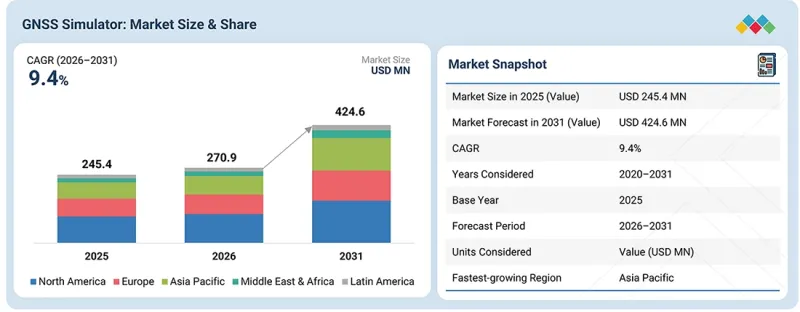
The GNSS simulator market is projected to grow from USD 270.9 million in 2026 to USD 424.6 million by 2031 at a CAGR of 9.4% during the forecast period. Increasing reliance on satellite-based positioning across aerospace and defense, automotive, telecommunications, and precision agriculture is driving demand for GNSS simulation solutions.
| Scope of the Report | |
|---|---|
| Years Considered for the Study | 2020-2031 |
| Base Year | 2025 |
| Forecast Period | 2026-2031 |
| Units Considered | Value (USD Million/USD Billion) |
| Segments | Component, Simulator Type, Application, Vertical, and Region |
| Regions covered | North America, Europe, Asia Pacific, Middle East & Africa, Latin America |
The growing complexity of multi-constellation and multi-frequency receivers is increasing the need for controlled testing environments that enable manufacturers to evaluate signal acquisition, positioning accuracy, and receiver performance under different operating conditions. Additionally, the need to validate navigation systems before deployment is supporting the adoption of simulation platforms across product development and testing workflows. These factors are expected to support market expansion through 2031.
"By component, the services segment is expected to register the highest CAGR during the forecast period."
The services segment is expected to register the highest CAGR in the GNSS simulator market during the forecast period, driven by increasing requirements for installation, integration, technical support, and maintenance of simulation platforms. As GNSS testing environments become more complex, customers require specialized expertise to configure simulators, integrate them with receiver equipment and hardware-in-the-loop systems, and customize test scenarios. Training and consulting services also help organizations build internal testing capabilities and optimize simulation workflows. The segment includes installation and integration services, consulting services, training and enablement services, support and maintenance services, and managed services.
"By simulator type, the multi-channel GNSS simulators segment is expected to account for the largest market share and register the highest CAGR during the forecast period."
The multi-channel GNSS simulators segment is expected to hold the largest market share and register the highest CAGR throughout the forecast period, reflecting its suitability for complex receiver testing and advanced navigation-system validation. These simulators can reproduce signals from multiple satellites and support the testing of multi-constellation receivers under configurable operating conditions. Their capabilities are particularly relevant to aerospace and defense, automotive, and autonomous-system applications that require comprehensive evaluation of positioning performance. Increasing requirements for realistic signal environments and integrated system testing are expected to support demand for multi-channel simulation platforms.
"By vertical, the military and defense segment is expected to hold the largest market share in 2026."
The military and defense segment is expected to hold the largest share of the GNSS simulator market in 2026, driven by the need to validate navigation systems under demanding operational conditions. Defense organizations use GNSS simulators to evaluate receiver performance, test positioning equipment, and assess system behavior under degraded signal environments. Simulation platforms also support developing and verifying military navigation equipment, avionics, and resilient positioning technologies before deployment. The vertical analysis also covers automotive, consumer electronics, telecommunications, agriculture, government and research institutes, marine, aerospace, and other industries.
Breakdown of Primaries
The study draws insights from industry experts, including GNSS simulator manufacturers, hardware and software providers, system integrators, component suppliers, and original equipment manufacturers (OEMs). The breakdown of the primaries is as follows:
- By Company Type: Tier 1 - 40%, Tier 2 - 35%, and Tier 3 - 25%
- By Designation: C-level Executives - 50%, Managers and Other Levels - 50%
- By Region: North America - 30%, Europe - 25%, Asia Pacific - 30%, Middle East & Africa - 10%, Latin America - 5%
Major vendors in the GNSS simulator market include Keysight Technologies (US), Rohde & Schwarz (Germany), Safran (France), VIAVI Solutions (US), IFEN GmbH (Germany), TeleOrbit (Germany), IP-Solutions Satellite Applications (US), WORK Microwave (Germany), M3 Systems (France), QASCOM (Italy), Saluki Technology (Taiwan), MaxEye Technologies (India), Digilogic Systems (India), Hexagon (Sweden), Averna (Canada), Racelogic (UK), GMV (Spain), NOFFZ Technologies (Germany), Ultrontek (South Korea), Trimble (US), Topcon Positioning Systems (US), CHC Navigation (China), ComNav Technology (China), Shanghai Viyur Technology (China), and ALTEN (France).
The study includes an in-depth competitive analysis of the key players in the GNSS simulator market, their company profiles, recent developments, and key market strategies.
Research Coverage
The report segments the GNSS simulator market and forecasts its size based on component (hardware, software, and services [installation and integration services, consulting services, training and enablement services, support and maintenance services, and managed services]), simulator type (single-channel GNSS simulators and multi-channel GNSS simulators), application (navigation and positioning, mapping, geospatial & surveying, timing and synchronization, safety-critical and autonomous systems, and others), vertical (military and defense, automotive, consumer electronics, telecommunications, agriculture, government and research institutes, marine, aerospace, and others), and region (North America, Europe, Asia Pacific, Middle East & Africa, and Latin America).
The study also includes an in-depth competitive analysis of the market's key players, including company profiles, key observations on product and business offerings, recent developments, and key market strategies.
Key Benefits of Buying the Report
The report will help market leaders and new entrants obtain detailed estimates of revenue for the overall GNSS simulator market and its segments. It will help stakeholders understand the competitive landscape, evaluate product positioning, and identify opportunities for business expansion. The report also supports strategic planning, investment decisions, product development, and go-to-market strategies.
The report provides insights on the following pointers:
- Analysis of critical drivers (Increasing complexity of multi-constellation and multi-frequency GNSS receiver validation, rising demand for GNSS resilience testing amid escalating jamming and spoofing risks, growing use of hardware-in-the-loop and automated testing in GNSS product development), restraints (High initial capital expenditure and total cost of ownership of advanced GNSS simulation platforms, complexity of integrating GNSS simulators into existing test and validation infrastructure), opportunities (Emergence of resilient PNT testing as a growth avenue for advanced GNSS simulation solutions, expansion of simulation requirements for LEO-based and hybrid PNT architectures, growing demand for multi-sensor fusion validation across autonomous mobility and robotics), and challenges (Maintaining high-fidelity signal simulation across increasingly complex GNSS environments, keeping pace with evolving GNSS signals, constellation modernization, and emerging PNT standards).
- Product Development/Innovation: Detailed insights into product portfolios, simulator configurations, supported GNSS constellations and frequencies, channel capabilities, and developments in GNSS simulation hardware, software, and services.
- Market Development: Comprehensive information on market size, forecasts, growth rates, and commercial opportunities across components, simulator types, applications, verticals, and geographic regions.
- Market Diversification: Assessment of opportunities across single-channel and multi-channel simulators, hardware, software and service offerings, end-use applications, industry verticals, and emerging geographic markets.
- Competitive Assessment: In-depth assessment of the competitive positioning, product portfolios, business strategies, and offerings of leading GNSS simulator manufacturers and other relevant participants, including Keysight Technologies (US), Safran (France), Rohde & Schwarz (Germany), VIAVI Solutions (US), IFEN GmbH (Germany), WORK Microwave (Germany), M3 Systems (France), and QASCOM (Italy).
TABLE OF CONTENTS
1 INTRODUCTION
- 1.1 STUDY OBJECTIVES
- 1.2 MARKET DEFINITION
- 1.3 STUDY SCOPE
- 1.3.1 MARKET SEGMENTATION
- 1.3.2 INCLUSIONS AND EXCLUSIONS
- 1.3.3 YEARS CONSIDERED
- 1.4 CURRENCY CONSIDERED
- 1.5 STAKEHOLDERS
- 1.6 SUMMARY OF CHANGES
2 EXECUTIVE SUMMARY
- 2.1 MARKET HIGHLIGHTS AND KEY INSIGHTS
- 2.2 KEY MARKET PARTICIPANTS: MAPPING OF STRATEGIC DEVELOPMENTS
- 2.3 DISRUPTIVE TRENDS SHAPING GNSS SIMULATOR MARKET
- 2.4 HIGH-GROWTH SEGMENTS AND EMERGING FRONTIERS
- 2.5 REGIONAL SNAPSHOT: MARKET SIZE, GROWTH RATE, AND FORECAST
3 PREMIUM INSIGHTS
- 3.1 ATTRACTIVE OPPORTUNITIES FOR PLAYERS IN GNSS SIMULATOR MARKET
- 3.2 GNSS SIMULATOR MARKET, BY OFFERING
- 3.3 GNSS SIMULATOR MARKET, BY SERVICE
- 3.4 GNSS SIMULATOR MARKET, BY SIMULATOR TYPE
- 3.5 GNSS SIMULATOR MARKET, BY APPLICATION
- 3.6 GNSS SIMULATOR MARKET, BY VERTICAL
- 3.7 GNSS SIMULATOR MARKET, BY REGION
4 MARKET OVERVIEW AND INDUSTRY TRENDS
- 4.1 INTRODUCTION
- 4.2 MARKET DYNAMICS
- 4.2.1 DRIVERS
- 4.2.1.1 Increasing complexity of multi-constellation and multi-frequency GNSS receiver validation
- 4.2.1.2 Rising demand for GNSS resilience testing amid escalating jamming and spoofing risks
- 4.2.1.3 Growing use of hardware-in-the-loop and automated testing in GNSS product development
- 4.2.2 RESTRAINTS
- 4.2.2.1 High initial capital expenditure and total cost of ownership of advanced GNSS simulation platforms
- 4.2.2.2 Complexity of integrating GNSS simulators into existing test and validation infrastructure
- 4.2.3 OPPORTUNITIES
- 4.2.3.1 Emergence of resilient PNT testing
- 4.2.3.2 Expansion of simulation requirements for LEO-based and hybrid PNT architectures
- 4.2.3.3 Growing demand for multi-sensor fusion validation across autonomous mobility and robotics
- 4.2.4 CHALLENGES
- 4.2.4.1 Maintaining high-fidelity signal simulation across increasingly complex GNSS environments
- 4.2.4.2 Keeping pace with evolving GNSS signals, constellation modernization, and emerging PNT standards
- 4.2.1 DRIVERS
- 4.3 UNMET NEEDS AND WHITE SPACES
- 4.4 INTERCONNECTED MARKETS AND CROSS-SECTOR OPPORTUNITIES
- 4.4.1 INTERCONNECTED MARKETS
- 4.4.2 CROSS-SECTOR OPPORTUNITIES
- 4.5 STRATEGIC MOVES BY TIER -1/2/3 PLAYERS
- 4.5.1 CROSS-TIER STRATEGIC PATTERNS
- 4.5.2 STRATEGIC TRENDS
- 4.5.2.1 Expansion of multi-constellation and multi-frequency simulation
- 4.5.2.2 Growing focus on GNSS interference and spoofing simulation
- 4.5.2.3 Integration of hardware-in-the-loop and automated testing
- 4.5.2.4 Emergence of LEO-based and hybrid PNT simulation
5 INDUSTRY TRENDS
- 5.1 PORTER'S FIVE FORCES ANALYSIS
- 5.1.1 THREAT OF NEW ENTRANTS
- 5.1.2 BARGAINING POWER OF SUPPLIERS
- 5.1.3 BARGAINING POWER OF BUYERS
- 5.1.4 THREAT OF SUBSTITUTES
- 5.1.5 INTENSITY OF COMPETITIVE RIVALRY
- 5.2 MACROECONOMIC INDICATORS
- 5.2.1 INTRODUCTION
- 5.2.2 GDP TRENDS AND FORECAST
- 5.2.3 TRENDS IN GLOBAL ICT INDUSTRY
- 5.2.4 TRENDS IN GLOBAL GNSS SIMULATOR INDUSTRY
- 5.3 VALUE CHAIN ANALYSIS
- 5.3.1 GNSS SIGNAL AND COMPONENT ECOSYSTEM
- 5.3.2 GNSS SIMULATOR TECHNOLOGY PROVIDERS
- 5.3.3 SIMULATION SOFTWARE AND TEST PLATFORMS
- 5.3.4 SYSTEM INTEGRATION AND CHANNEL PARTNERS
- 5.3.5 END-USER INDUSTRIES
- 5.4 ECOSYSTEM ANALYSIS
- 5.5 PRICING ANALYSIS
- 5.5.1 AVERAGE SELLING PRICE OF KEY PLAYERS, BY SOLUTION OFFERING
- 5.6 KEY CONFERENCES AND EVENTS, 2027
- 5.7 TRENDS AND DISRUPTIONS IMPACTING CUSTOMER BUSINESS
- 5.8 INVESTMENT AND FUNDING SCENARIO
- 5.9 CASE STUDY ANALYSIS
- 5.9.1 KEY GNSS SIMULATOR USE CASES AND REAL-WORLD IMPLEMENTATIONS
- 5.9.1.1 GNSS simulator for automotive navigation testing
- 5.9.1.2 GNSS simulator for jamming and spoofing resilience testing
- 5.9.1.3 GNSS simulator for aerospace and spaceborne receiver testing
- 5.9.1.4 GNSS simulator for multi-antenna and autonomous navigation systems
- 5.9.1.5 GNSS simulator for controlled RF interference and navigation warfare testing
- 5.9.2 CASE STUDIES
- 5.9.2.1 GNSS simulator for satellite receiver testing and space operations
- 5.9.2.2 GNSS simulator for autonomous driving research and development
- 5.9.2.3 GNSS simulator for helicopter approach and landing system validation
- 5.9.2.4 GNSS simulator for avionics receiver certification and interference testing
- 5.9.2.5 GNSS simulator for resilient maritime positioning and navigation
- 5.9.1 KEY GNSS SIMULATOR USE CASES AND REAL-WORLD IMPLEMENTATIONS
- 5.10 IMPACT OF 2025 US TARIFFS - GNSS SIMULATOR MARKET
- 5.10.1 INTRODUCTION
- 5.10.2 KEY TARIFF RATES
- 5.10.3 PRICE IMPACT ANALYSIS
- 5.10.4 IMPACT ON COUNTRY/REGION
- 5.10.4.1 North America
- 5.10.4.2 Europe
- 5.10.4.3 Asia Pacific
- 5.10.5 IMPACT ON END-USE INDUSTRIES
6 TECHNOLOGICAL ADVANCEMENTS, AI-DRIVEN IMPACT, PATENTS, INNOVATIONS, AND FUTURE APPLICATIONS
- 6.1 TECHNOLOGY ANALYSIS
- 6.1.1 KEY EMERGING TECHNOLOGIES
- 6.1.1.1 Artificial intelligence & machine learning
- 6.1.1.2 Multi-Constellation & Multi-Frequency Simulation
- 6.1.1.3 Advanced Signal Generation & Interference Simulation
- 6.1.1.4 Real-Time Simulation & Hardware-in-the-Loop Testing
- 6.1.2 COMPLEMENTARY TECHNOLOGIES
- 6.1.2.1 Cloud & API-Based GNSS Simulation
- 6.1.2.2 Digital Twins & Virtual Testing Environments
- 6.1.2.3 5G Networks
- 6.1.2.4 Software-Defined Radio & Signal Processing
- 6.1.3 ADJACENT TECHNOLOGIES
- 6.1.3.1 Advanced Driver Assistance Systems & Autonomous Driving
- 6.1.3.2 Edge computing
- 6.1.3.3 Internet of Things (IoT)
- 6.1.3.4 Artificial intelligence infrastructure
- 6.1.1 KEY EMERGING TECHNOLOGIES
- 6.2 TECHNOLOGY/PRODUCT ROADMAP
- 6.2.1 SHORT-TERM (2026-2027) | FOUNDATION & EARLY ENTERPRISE ADOPTION
- 6.2.2 MID-TERM (2027-2030) | SCALE-UP, INTELLIGENT AUTOMATION, & INTEROPERABILITY
- 6.2.3 LONG-TERM (2030-2035+) | AUTONOMOUS, CONTINUOUS, & RESILIENT PNT SIMULATION
- 6.3 IMPLEMENTATION OF GNSS SIMULATOR
- 6.4 PATENT ANALYSIS
- 6.5 FUTURE APPLICATIONS
- 6.5.1 AI-ENABLED GNSS SIMULATION AND AUTOMATED TEST GENERATION
- 6.5.2 RESILIENT PNT, JAMMING, AND SPOOFING SIMULATION
- 6.5.3 MULTI-CONSTELLATION AND MULTI-FREQUENCY SIGNAL SIMULATION
- 6.5.4 LEO-BASED AND HYBRID PNT SIMULATION
- 6.5.5 MULTI-SENSOR FUSION AND HARDWARE-IN-THE-LOOP TESTING
- 6.5.6 CLOUD-BASED GNSS SIMULATION AND REMOTE TESTING
- 6.6 IMPACT OF AI/GEN AI ON GNSS SIMULATOR MARKET
- 6.6.1 TOP USE CASES IN GNSS SIMULATOR MARKET
- 6.6.2 BEST PRACTICES IN GNSS SIMULATOR MARKET
- 6.6.3 CASE STUDIES OF AI IMPLEMENTATION IN GNSS SIMULATOR MARKET
- 6.6.4 INTERCONNECTED ADJACENT ECOSYSTEM AND IMPACT ON MARKET PLAYERS
- 6.6.5 CLIENTS' READINESS TO ADOPT GENERATIVE AI IN GNSS SIMULATOR MARKET
- 6.7 SUCCESS STORIES AND REAL-WORLD APPLICATIONS
- 6.7.1 KEYSIGHT TECHNOLOGIES: ASTROCAST'S GNSS SIMULATOR FOR SATELLITE DEVELOPMENT
- 6.7.2 VIAVI SOLUTIONS: GPS SIMULATION FOR RECEIVER TESTING AND VALIDATION
7 REGULATORY LANDSCAPE
- 7.1 REGIONAL REGULATIONS AND COMPLIANCE
- 7.1.1 REGULATORY BODIES, GOVERNMENT AGENCIES, AND OTHER ORGANIZATIONS
- 7.1.2 INDUSTRY STANDARDS
8 CONSUMER LANDSCAPE AND BUYER BEHAVIOR
- 8.1 DECISION-MAKING PROCESS
- 8.2 KEY STAKEHOLDERS INVOLVED IN BUYING PROCESS AND THEIR EVALUATION CRITERIA
- 8.2.1 KEY STAKEHOLDERS IN BUYING PROCESS
- 8.2.2 BUYING CRITERIA
- 8.3 ADOPTION BARRIERS AND INTERNAL CHALLENGES
- 8.4 UNMET NEEDS IN VARIOUS END-USE INDUSTRIES
9 GNSS SIMULATOR MARKET, BY OFFERING
- 9.1 INTRODUCTION
- 9.1.1 OFFERING: GNSS SIMULATOR MARKET DRIVERS
- 9.2 HARDWARE
- 9.2.1 INCREASING DEMAND FOR ADVANCED GNSS SIGNAL GENERATION HARDWARE TO BOOST MARKET
- 9.3 SOFTWARE
- 9.3.1 GROWING NEED FOR FLEXIBLE AND AUTOMATED GNSS SIMULATION SOFTWARE TO DRIVE MARKET
- 9.4 SERVICES
- 9.4.1 INCREASING DEMAND FOR SPECIALIZED GNSS SIMULATOR SERVICES TO BOOST MARKET
- 9.4.2 INSTALLATION AND INTEGRATION
- 9.4.3 CONSULTING
- 9.4.4 TRAINING AND ENABLEMENT
- 9.4.5 SUPPORT AND MAINTENANCE
- 9.4.6 MANAGED
10 GNSS SIMULATOR MARKET, BY SIMULATOR TYPE
- 10.1 INTRODUCTION
- 10.1.1 SIMULATOR TYPE: GNSS SIMULATOR MARKET DRIVERS
- 10.2 SINGLE-CHANNEL
- 10.2.1 DEMAND FOR BASIC RECEIVER TESTING TO SUPPORT MARKET EXPANSION
- 10.3 MULTI-CHANNEL
- 10.3.1 GROWING NEED FOR REALISTIC SATELLITE-SIGNAL SIMULATION TO BOOST MARKET
11 GNSS SIMULATOR MARKET, BY APPLICATION
- 11.1 INTRODUCTION
- 11.1.1 APPLICATION: GNSS SIMULATOR MARKET DRIVERS
- 11.2 NAVIGATION AND POSITIONING
- 11.2.1 INCREASING DEMAND FOR ACCURATE POSITIONING SYSTEMS TO BOOST MARKET
- 11.3 MAPPING, GEOSPATIAL, AND SURVEYING
- 11.3.1 GROWING REQUIREMENT FOR PRECISION POSITIONING EQUIPMENT TO DRIVE MARKET
- 11.4 TIMING AND SYNCHRONIZATION
- 11.4.1 INCREASING NEED FOR RELIABLE SATELLITE-DERIVED TIMING TO BOOST MARKET
- 11.5 SAFETY-CRITICAL AND AUTONOMOUS SYSTEMS
- 11.5.1 GROWING ADOPTION OF AUTONOMOUS TECHNOLOGIES TO DRIVE MARKET
- 11.6 OTHERS
12 GNSS SIMULATOR MARKET, BY VERTICAL
- 12.1 INTRODUCTION
- 12.1.1 VERTICAL: GNSS SIMULATOR MARKET DRIVERS
- 12.2 MILITARY AND DEFENSE
- 12.2.1 INCREASING REQUIREMENTS FOR RESILIENT MILITARY NAVIGATION SYSTEMS TO BOOST MARKET
- 12.3 AUTOMOTIVE
- 12.3.1 GROWING ADOPTION OF CONNECTED AND AUTONOMOUS VEHICLES TO DRIVE MARKET
- 12.4 CONSUMER ELECTRONICS
- 12.4.1 INCREASING INTEGRATION OF GNSS RECEIVERS IN CONNECTED DEVICES TO BOOST MARKET
- 12.5 TELECOMMUNICATIONS
- 12.5.1 GROWING NEED FOR GNSS-BASED TIMING AND SYNCHRONIZATION TO DRIVE MARKET
- 12.6 AGRICULTURE
- 12.6.1 GROWING ADOPTION OF PRECISION AGRICULTURE TECHNOLOGIES TO SUPPORT MARKET EXPANSION
- 12.7 GOVERNMENT AND RESEARCH INSTITUTES
- 12.7.1 INCREASING INVESTMENT IN GNSS RESEARCH AND RECEIVER DEVELOPMENT TO BOOST MARKET
- 12.8 MARINE
- 12.8.1 INCREASING NEED FOR RELIABLE MARITIME NAVIGATION EQUIPMENT TO SUPPORT MARKET GROWTH
- 12.9 AEROSPACE
- 12.9.1 INCREASING REQUIREMENTS FOR AEROSPACE RECEIVER VALIDATION TO DRIVE MARKET
- 12.10 OTHERS
13 GNSS SIMULATOR MARKET, BY REGION
- 13.1 INTRODUCTION
- 13.2 NORTH AMERICA
- 13.2.1 NORTH AMERICA: GNSS SIMULATOR MARKET DRIVERS
- 13.2.2 US
- 13.2.2.1 Accelerating GNSS simulator adoption through autonomous driving, defense testing, and PNT resilience
- 13.2.3 CANADA
- 13.2.3.1 Expanding GNSS simulator demand through aerospace testing, satellite navigation research, and resilient positioning technologies
- 13.3 EUROPE
- 13.3.1 EUROPE: OPERATIONAL TECHNOLOGY SECURITY MARKET DRIVERS
- 13.3.2 UK
- 13.3.2.1 Strengthening GNSS simulation through resilient positioning, navigation, and timing testing
- 13.3.3 GERMANY
- 13.3.3.1 Driving GNSS simulator adoption through automotive electronics, autonomous mobility, and precision testing
- 13.3.4 FRANCE
- 13.3.4.1 Expanding GNSS simulation through aerospace engineering, satellite navigation, and defense applications
- 13.3.5 ITALY
- 13.3.5.1 Advancing GNSS simulator demand through aerospace systems, automotive testing, and satellite navigation development
- 13.3.6 REST OF EUROPE
- 13.4 ASIA PACIFIC
- 13.4.1 ASIA PACIFIC: GNSS SIMULATOR MARKET DRIVERS
- 13.4.2 CHINA
- 13.4.2.1 Expanding GNSS simulator adoption through BeiDou-enabled devices, autonomous systems, and domestic receiver development
- 13.4.3 JAPAN
- 13.4.3.1 Strengthening GNSS simulation through automotive innovation, QZSS integration, and high-precision positioning applications
- 13.4.4 INDIA
- 13.4.4.1 Advancing GNSS simulator demand through NavIC integration, aerospace development, and indigenous navigation technologies
- 13.4.5 SOUTH KOREA
- 13.4.5.1 Expanding GNSS simulation through automotive electronics, advanced receiver development, and autonomous mobility testing
- 13.4.6 REST OF ASIA PACIFIC
- 13.5 MIDDLE EAST & AFRICA
- 13.5.1 MIDDLE EAST & AFRICA: GNSS SIMULATOR MARKET DRIVERS
- 13.5.2 MIDDLE EAST
- 13.5.2.1 Expanding GNSS simulator adoption through defense testing, aviation systems, and resilient navigation capabilities
- 13.5.2.2 Gulf Cooperation Council (GCC)
- 13.5.2.2.1 UAE
- 13.5.2.2.2 KSA
- 13.5.2.2.3 Rest of GCC
- 13.5.2.3 Rest of Middle East
- 13.5.3 AFRICA
- 13.5.3.1 Developing GNSS simulator demand through satellite navigation applications, surveying technologies, and transport infrastructure modernization
- 13.6 LATIN AMERICA
- 13.6.1 LATIN AMERICA: GNSS SIMULATOR MARKET DRIVERS
- 13.6.2 BRAZIL
- 13.6.2.1 Driving GNSS simulator demand through precision agriculture, aerospace development, and automotive electronics testing
- 13.6.3 MEXICO
- 13.6.3.1 Expanding GNSS simulator adoption through automotive electronics manufacturing, receiver validation, and export-oriented vehicle testing
- 13.6.4 REST OF LATIN AMERICA
14 COMPETITIVE LANDSCAPE
- 14.1 KEY PLAYER COMPETITIVE STRATEGIES/RIGHT TO WIN, 2024-2026
- 14.2 REVENUE ANALYSIS, 2021-2025
- 14.3 MARKET SHARE ANALYSIS, 2025
- 14.4 BRAND/PRODUCT COMPARISON
- 14.5 COMPANY EVALUATION MATRIX: ESTABLISHED VENDORS
- 14.5.1 STARS
- 14.5.2 EMERGING LEADERS
- 14.5.3 PERVASIVE PLAYERS
- 14.5.4 PARTICIPANTS
- 14.5.5 COMPANY FOOTPRINT: ESTABLISHED VENDORS
- 14.5.5.1 Company footprint
- 14.5.5.2 Region footprint
- 14.5.5.3 Offering footprint
- 14.5.5.4 Simulator type footprint
- 14.5.5.5 Application footprint
- 14.5.5.6 Vertical footprint
- 14.6 COMPANY EVALUATION MATRIX: SPECIALIST VENDORS
- 14.6.1 PROGRESSIVE COMPANIES
- 14.6.2 RESPONSIVE COMPANIES
- 14.6.3 DYNAMIC COMPANIES
- 14.6.4 STARTING BLOCKS
- 14.6.5 COMPETITIVE BENCHMARKING: SPECIALIST VENDORS
- 14.6.5.1 Detailed list of key specialist vendors
- 14.6.5.2 Competitive benchmarking of key specialist vendors
- 14.6.5.2.1 Offering footprint
- 14.6.5.2.2 Simulator type footprint
- 14.6.5.2.3 Application footprint
- 14.6.5.2.4 Vertical footprint
- 14.6.5.2.5 Region footprint
- 14.7 COMPANY VALUATION AND FINANCIAL METRICS
- 14.7.1 COMPANY VALUATION
- 14.7.2 FINANCIAL METRICS USING EV/EBIDTA
- 14.8 COMPETITIVE SCENARIO
- 14.8.1 PRODUCT LAUNCHES AND ENHANCEMENTS
- 14.8.2 DEALS
- 14.8.3 EXPANSIONS
15 COMPANY PROFILES
- 15.1 KEY PLAYERS
- 15.1.1 KEYSIGHT TECHNOLOGIES
- 15.1.1.1 Business overview
- 15.1.1.2 Products/Solutions/Services offered
- 15.1.1.3 Recent developments
- 15.1.1.3.1 Product launches and enhancements
- 15.1.1.3.2 Deals
- 15.1.1.3.3 Expansions
- 15.1.1.4 MnM view
- 15.1.1.4.1 Key strengths
- 15.1.1.4.2 Strategic choices
- 15.1.1.4.3 Weaknesses and competitive threats
- 15.1.2 SAFRAN
- 15.1.2.1 Business overview
- 15.1.2.2 Products/Solutions/Services offered
- 15.1.2.3 Recent developments
- 15.1.2.3.1 Product launches and enhancements
- 15.1.2.3.2 Deals
- 15.1.2.4 MnM view
- 15.1.2.4.1 Key strengths
- 15.1.2.4.2 Strategic choices
- 15.1.2.4.3 Weaknesses and competitive threats
- 15.1.3 VIAVI SOLUTIONS
- 15.1.3.1 Business overview
- 15.1.3.2 Products/Solutions/Services offered
- 15.1.3.3 Recent developments
- 15.1.3.3.1 Product launches and enhancements
- 15.1.3.3.2 Deals
- 15.1.3.4 MnM view
- 15.1.3.4.1 Key strengths
- 15.1.3.4.2 Strategic choices
- 15.1.3.4.3 Weaknesses and competitive threats
- 15.1.4 IFEN
- 15.1.4.1 Business overview
- 15.1.4.2 Products/Solutions/Services offered
- 15.1.4.3 Recent developments
- 15.1.4.3.1 Product launches and enhancements
- 15.1.4.4 MnM view
- 15.1.4.4.1 Key strengths
- 15.1.4.4.2 Strategic choices
- 15.1.4.4.3 Weaknesses and competitive threats
- 15.1.5 ROHDE & SCHWARZ
- 15.1.5.1 Business overview
- 15.1.5.2 Products/Solutions/Services offered
- 15.1.5.3 Recent developments
- 15.1.5.3.1 Product launches and enhancements
- 15.1.5.4 MnM view
- 15.1.5.4.1 Key strengths
- 15.1.5.4.2 Strategic choices
- 15.1.5.4.3 Weaknesses and competitive threats
- 15.1.6 TELEORBIT
- 15.1.6.1 Business overview
- 15.1.6.2 Products/Solutions/Services offered
- 15.1.7 IP-SOLUTIONS SATELLITE APPLICATIONS
- 15.1.7.1 Business overview
- 15.1.7.2 Products/Solutions/Services offered
- 15.1.8 QASCOM
- 15.1.8.1 Business overview
- 15.1.8.2 Products/Solutions/Services offered
- 15.1.9 GMV
- 15.1.9.1 Business overview
- 15.1.9.2 Products/Solutions/Services offered
- 15.1.9.3 Recent developments
- 15.1.9.3.1 Deals
- 15.1.10 M3 SYSTEMS
- 15.1.10.1 Business overview
- 15.1.10.2 Products/Solutions/Services offered
- 15.1.1 KEYSIGHT TECHNOLOGIES
- 15.2 OTHER KEY PLAYERS
- 15.2.1 ACCORD SOFTWARE & SYSTEMS (ALTEN GROUP)
- 15.2.2 WORK MICROWAVE
- 15.2.3 OHB AUSTRIA
- 15.2.4 MAXEYE TECHNOLOGIES
- 15.2.5 AVERNA (SPHEREA GROUP)
- 15.2.6 RACELOGIC
- 15.2.7 NOFFZ TECHNOLOGIES
- 15.2.8 SALUKI TECHNOLOGY
- 15.2.9 DIGILOGIC SYSTEMS
- 15.2.10 HEXAGON
- 15.2.11 TRIMBLE
- 15.2.12 TOPCON POSITIONING SYSTEMS
- 15.2.13 CHC NAVIGATION (CHCNAV)
- 15.2.14 COMNAV TECHNOLOGY
- 15.2.15 SHANGHAI VIYUR TECHNOLOGY
16 RESEARCH METHODOLOGY
- 16.1 RESEARCH DATA
- 16.1.1 SECONDARY DATA
- 16.1.2 PRIMARY DATA
- 16.1.2.1 Breakup of primary profiles
- 16.1.2.2 Key industry insights
- 16.2 DATA TRIANGULATION
- 16.3 MARKET SIZE ESTIMATION
- 16.4 MARKET FORECAST
- 16.5 RESEARCH ASSUMPTIONS
- 16.6 RESEARCH LIMITATIONS AND RISK ASSESSMENT
17 APPENDIX
- 17.1 DISCUSSION GUIDE
- 17.2 KNOWLEDGESTORE: MARKETSANDMARKETS' SUBSCRIPTION PORTAL
- 17.3 CUSTOMIZATION OPTIONS
- 17.4 RELATED REPORTS
- 17.5 AUTHOR DETAILS
List of Tables
- TABLE 1 INCLUSIONS AND EXCLUSIONS
- TABLE 2 USD EXCHANGE RATES, 2020-2025
- TABLE 3 UNMET NEEDS AND WHITE SPACES IN GNSS SIMULATOR MARKET
- TABLE 4 INTERCONNECTED MARKETS
- TABLE 5 STRATEGIC MOVES BY PLAYERS IN GNSS SIMULATOR MARKET
- TABLE 6 CROSS-TIER STRATEGIC PATTERNS OF VENDORS
- TABLE 7 IMPACT OF PORTER'S FIVE FORCES ON GNSS SIMULATOR MARKET
- TABLE 8 GDP PERCENTAGE CHANGE, BY KEY COUNTRY, 2021-2030
- TABLE 9 ROLE OF COMPANIES IN GNSS SIMULATOR MARKET ECOSYSTEM
- TABLE 10 GNSS SIMULATOR SOLUTIONS - COMPONENT-WISE COST BREAKDOWN, 2025 (USD)
- TABLE 11 GNSS SIMULATOR SOLUTIONS - TOTAL SYSTEM BUDGET ESTIMATES, 2025 (USD)
- TABLE 12 GNSS SIMULATOR MARKET: LIST OF KEY CONFERENCES AND EVENTS, 2027
- TABLE 13 ADDITIONAL US TARIFF MEASURES RELEVANT TO GNSS SIMULATOR SUPPLY CHAIN
- TABLE 14 LIST OF TOP PATENTS IN GNSS SIMULATOR MARKET, 2024-2026
- TABLE 15 TOP USE CASES AND MARKET POTENTIAL
- TABLE 16 BEST PRACTICES: COMPANIES IMPLEMENTING USE CASES
- TABLE 17 GNSS SIMULATOR MARKET: CASE STUDIES RELATED TO AI IMPLEMENTATION
- TABLE 18 INTERCONNECTED ADJACENT ECOSYSTEM AND IMPACT ON MARKET PLAYERS
- TABLE 19 NORTH AMERICA: LIST OF REGULATORY BODIES, GOVERNMENT AGENCIES, AND OTHER ORGANIZATIONS
- TABLE 20 EUROPE: LIST OF REGULATORY BODIES, GOVERNMENT AGENCIES, AND OTHER ORGANIZATIONS
- TABLE 21 ASIA PACIFIC: LIST OF REGULATORY BODIES, GOVERNMENT AGENCIES, AND OTHER ORGANIZATIONS
- TABLE 22 MIDDLE EAST & AFRICA: LIST OF REGULATORY BODIES, GOVERNMENT AGENCIES, AND OTHER ORGANIZATIONS
- TABLE 23 LATIN AMERICA: LIST OF REGULATORY BODIES, GOVERNMENT AGENCIES, AND OTHER ORGANIZATIONS
- TABLE 24 GLOBAL INDUSTRY STANDARDS IN GNSS SIMULATOR MARKET
- TABLE 25 INFLUENCE OF STAKEHOLDERS ON BUYING PROCESS FOR TOP THREE VERTICALS
- TABLE 26 KEY BUYING CRITERIA FOR TOP THREE VERTICALS
- TABLE 27 UNMET NEEDS IN GNSS SIMULATOR MARKET, BY END-USE INDUSTRY
- TABLE 28 GNSS SIMULATOR MARKET, BY OFFERING, 2020-2025 (USD MILLION)
- TABLE 29 GNSS SIMULATOR MARKET, BY OFFERING, 2026-2031 (USD MILLION)
- TABLE 30 HARDWARE: GNSS SIMULATOR MARKET, BY REGION, 2020-2025 (USD MILLION)
- TABLE 31 HARDWARE: GNSS SIMULATOR MARKET, BY REGION, 2026-2031 (USD MILLION)
- TABLE 32 SOFTWARE: GNSS SIMULATOR MARKET, BY REGION, 2020-2025 (USD MILLION)
- TABLE 33 SOFTWARE: GNSS SIMULATOR MARKET, BY REGION, 2026-2031 (USD MILLION)
- TABLE 34 SERVICES: GNSS SIMULATOR MARKET, BY REGION, 2020-2025 (USD MILLION)
- TABLE 35 SERVICES: GNSS SIMULATOR MARKET, BY REGION, 2026-2031 (USD MILLION)
- TABLE 36 GNSS SIMULATOR MARKET, BY SIMULATOR TYPE, 2020-2025 (USD MILLION)
- TABLE 37 GNSS SIMULATOR MARKET, BY SIMULATOR TYPE, 2026-2031 (USD MILLION)
- TABLE 38 SINGLE-CHANNEL: GNSS SIMULATOR MARKET, BY REGION, 2020-2025 (USD MILLION)
- TABLE 39 SINGLE-CHANNEL: GNSS SIMULATOR MARKET, BY REGION, 2026-2031 (USD MILLION)
- TABLE 40 MULTI-CHANNEL: GNSS SIMULATOR MARKET, BY REGION, 2020-2025 (USD MILLION)
- TABLE 41 MULTI-CHANNEL: GNSS SIMULATOR MARKET, BY REGION, 2026-2031 (USD MILLION)
- TABLE 42 GNSS SIMULATOR MARKET, BY APPLICATION, 2020-2025 (USD MILLION)
- TABLE 43 GNSS SIMULATOR MARKET, BY APPLICATION, 2026-2031 (USD MILLION)
- TABLE 44 NAVIGATION AND POSITIONING: GNSS SIMULATOR MARKET, BY REGION, 2020-2025 (USD MILLION)
- TABLE 45 NAVIGATION AND POSITIONING: GNSS SIMULATOR MARKET, BY REGION, 2026-2031 (USD MILLION)
- TABLE 46 MAPPING, GEOSPATIAL, AND SURVEYING: GNSS SIMULATOR MARKET, BY REGION, 2020-2025 (USD MILLION)
- TABLE 47 MAPPING, GEOSPATIAL, AND SURVEYING: GNSS SIMULATOR MARKET, BY REGION, 2026-2031 (USD MILLION)
- TABLE 48 TIMING AND SYNCHRONIZATION: GNSS SIMULATOR MARKET, BY REGION, 2020-2025 (USD MILLION)
- TABLE 49 TIMING AND SYNCHRONIZATION: GNSS SIMULATOR MARKET, BY REGION, 2026-2031 (USD MILLION)
- TABLE 50 SAFETY-CRITICAL AND AUTONOMOUS SYSTEMS: GNSS SIMULATOR MARKET, BY REGION, 2020-2025 (USD MILLION)
- TABLE 51 SAFETY-CRITICAL AND AUTONOMOUS SYSTEMS: GNSS SIMULATOR MARKET, BY REGION, 2026-2031 (USD MILLION)
- TABLE 52 OTHERS: GNSS SIMULATOR MARKET, BY REGION, 2020-2025 (USD MILLION)
- TABLE 53 OTHERS: GNSS SIMULATOR MARKET, BY REGION, 2026-2031 (USD MILLION)
- TABLE 54 GNSS SIMULATOR MARKET, BY VERTICAL, 2020-2025 (USD MILLION)
- TABLE 55 GNSS SIMULATOR MARKET, BY VERTICAL, 2026-2031 (USD MILLION)
- TABLE 56 MILITARY AND DEFENSE: GNSS SIMULATOR MARKET, BY REGION, 2020-2025 (USD MILLION)
- TABLE 57 MILITARY AND DEFENSE: GNSS SIMULATOR MARKET, BY REGION, 2026-2031 (USD MILLION)
- TABLE 58 AUTOMOTIVE: GNSS SIMULATOR MARKET, BY REGION, 2020-2025 (USD MILLION)
- TABLE 59 AUTOMOTIVE: GNSS SIMULATOR MARKET, BY REGION, 2026-2031 (USD MILLION)
- TABLE 60 CONSUMER ELECTRONICS: GNSS SIMULATOR MARKET, BY REGION, 2020-2025 (USD MILLION)
- TABLE 61 CONSUMER ELECTRONICS: GNSS SIMULATOR MARKET, BY REGION, 2026-2031 (USD MILLION)
- TABLE 62 TELECOMMUNICATIONS: GNSS SIMULATOR MARKET, BY REGION, 2020-2025 (USD MILLION)
- TABLE 63 TELECOMMUNICATIONS: GNSS SIMULATOR MARKET, BY REGION, 2026-2031 (USD MILLION)
- TABLE 64 AGRICULTURE: GNSS SIMULATOR MARKET, BY REGION, 2020-2025 (USD MILLION)
- TABLE 65 AGRICULTURE: GNSS SIMULATOR MARKET, BY REGION, 2026-2031 (USD MILLION)
- TABLE 66 GOVERNMENT AND RESEARCH INSTITUTES: GNSS SIMULATOR MARKET, BY REGION, 2020-2025 (USD MILLION)
- TABLE 67 GOVERNMENT AND RESEARCH INSTITUTES: GNSS SIMULATOR MARKET, BY REGION, 2026-2031 (USD MILLION)
- TABLE 68 MARINE: GNSS SIMULATOR MARKET, BY REGION, 2020-2025 (USD MILLION)
- TABLE 69 MARINE: GNSS SIMULATOR MARKET, BY REGION, 2026-2031 (USD MILLION)
- TABLE 70 AEROSPACE: GNSS SIMULATOR MARKET, BY REGION, 2020-2025 (USD MILLION)
- TABLE 71 AEROSPACE: GNSS SIMULATOR MARKET, BY REGION, 2026-2031 (USD MILLION)
- TABLE 72 OTHERS: GNSS SIMULATOR MARKET, BY REGION, 2020-2025 (USD MILLION)
- TABLE 73 OTHERS: GNSS SIMULATOR MARKET, BY REGION, 2026-2031 (USD MILLION)
- TABLE 74 GNSS SIMULATOR MARKET, BY REGION, 2020-2025 (USD MILLION)
- TABLE 75 GNSS SIMULATOR MARKET, BY REGION, 2026-2031 (USD MILLION)
- TABLE 76 NORTH AMERICA: GNSS SIMULATOR MARKET, BY OFFERING, 2020-2025 (USD MILLION)
- TABLE 77 NORTH AMERICA: GNSS SIMULATOR MARKET, BY OFFERING, 2026-2031 (USD MILLION)
- TABLE 78 NORTH AMERICA: GNSS SIMULATOR MARKET, BY SIMULATOR TYPE, 2020-2025 (USD MILLION)
- TABLE 79 NORTH AMERICA: GNSS SIMULATOR MARKET, BY SIMULATOR TYPE, 2026-2031 (USD MILLION)
- TABLE 80 NORTH AMERICA: GNSS SIMULATOR MARKET, BY APPLICATION, 2020-2025 (USD MILLION)
- TABLE 81 NORTH AMERICA: GNSS SIMULATOR MARKET, BY APPLICATION, 2026-2031 (USD MILLION)
- TABLE 82 NORTH AMERICA: GNSS SIMULATOR MARKET, BY VERTICAL, 2020-2025 (USD MILLION)
- TABLE 83 NORTH AMERICA: GNSS SIMULATOR MARKET, BY VERTICAL, 2026-2031 (USD MILLION)
- TABLE 84 NORTH AMERICA: GNSS SIMULATOR MARKET, BY COUNTRY, 2020-2025 (USD MILLION)
- TABLE 85 NORTH AMERICA: GNSS SIMULATOR MARKET, BY COUNTRY, 2026-2031 (USD MILLION)
- TABLE 86 US: GNSS SIMULATOR MARKET, BY OFFERING, 2020-2025 (USD MILLION)
- TABLE 87 US: GNSS SIMULATOR MARKET, BY OFFERING, 2026-2031 (USD MILLION)
- TABLE 88 US: GNSS SIMULATOR MARKET, BY SIMULATOR TYPE, 2020-2025 (USD MILLION)
- TABLE 89 US: GNSS SIMULATOR MARKET, BY SIMULATOR TYPE, 2026-2031 (USD MILLION)
- TABLE 90 US: GNSS SIMULATOR MARKET, BY APPLICATION, 2020-2025 (USD MILLION)
- TABLE 91 US: GNSS SIMULATOR MARKET, BY APPLICATION, 2026-2031 (USD MILLION)
- TABLE 92 US: GNSS SIMULATOR MARKET, BY VERTICAL, 2020-2025 (USD MILLION)
- TABLE 93 US: GNSS SIMULATOR MARKET, BY VERTICAL, 2026-2031 (USD MILLION)
- TABLE 94 CANADA: GNSS SIMULATOR MARKET, BY OFFERING, 2020-2025 (USD MILLION)
- TABLE 95 CANADA: GNSS SIMULATOR MARKET, BY OFFERING, 2026-2031 (USD MILLION)
- TABLE 96 CANADA: GNSS SIMULATOR MARKET, BY SIMULATOR TYPE, 2020-2025 (USD MILLION)
- TABLE 97 CANADA: GNSS SIMULATOR MARKET, BY SIMULATOR TYPE, 2026-2031 (USD MILLION)
- TABLE 98 CANADA: GNSS SIMULATOR MARKET, BY APPLICATION, 2020-2025 (USD MILLION)
- TABLE 99 CANADA: GNSS SIMULATOR MARKET, BY APPLICATION, 2026-2031 (USD MILLION)
- TABLE 100 CANADA: GNSS SIMULATOR MARKET, BY VERTICAL, 2020-2025 (USD MILLION)
- TABLE 101 CANADA: GNSS SIMULATOR MARKET, BY VERTICAL, 2026-2031 (USD MILLION)
- TABLE 102 EUROPE: GNSS SIMULATOR MARKET, BY OFFERING, 2020-2025 (USD MILLION)
- TABLE 103 EUROPE: GNSS SIMULATOR MARKET, BY OFFERING, 2026-2031 (USD MILLION)
- TABLE 104 EUROPE: GNSS SIMULATOR MARKET, BY SIMULATOR TYPE, 2020-2025 (USD MILLION)
- TABLE 105 EUROPE: GNSS SIMULATOR MARKET, BY SIMULATOR TYPE, 2026-2031 (USD MILLION)
- TABLE 106 EUROPE: GNSS SIMULATOR MARKET, BY APPLICATION, 2020-2025 (USD MILLION)
- TABLE 107 EUROPE: GNSS SIMULATOR MARKET, BY APPLICATION, 2026-2031 (USD MILLION)
- TABLE 108 EUROPE: GNSS SIMULATOR MARKET, BY VERTICAL, 2020-2025 (USD MILLION)
- TABLE 109 EUROPE: GNSS SIMULATOR MARKET, BY VERTICAL, 2026-2031 (USD MILLION)
- TABLE 110 EUROPE: GNSS SIMULATOR MARKET, BY COUNTRY, 2020-2025 (USD MILLION)
- TABLE 111 EUROPE: GNSS SIMULATOR MARKET, BY COUNTRY, 2026-2031 (USD MILLION)
- TABLE 112 UK: GNSS SIMULATOR MARKET, BY OFFERING, 2020-2025 (USD MILLION)
- TABLE 113 UK: GNSS SIMULATOR MARKET, BY OFFERING, 2026-2031 (USD MILLION)
- TABLE 114 UK: GNSS SIMULATOR MARKET, BY SIMULATOR TYPE, 2020-2025 (USD MILLION)
- TABLE 115 UK: GNSS SIMULATOR MARKET, BY SIMULATOR TYPE, 2026-2031 (USD MILLION)
- TABLE 116 UK: GNSS SIMULATOR MARKET, BY APPLICATION, 2020-2025 (USD MILLION)
- TABLE 117 UK: GNSS SIMULATOR MARKET, BY APPLICATION, 2026-2031 (USD MILLION)
- TABLE 118 UK: GNSS SIMULATOR MARKET, BY VERTICAL, 2020-2025 (USD MILLION)
- TABLE 119 UK: GNSS SIMULATOR MARKET, BY VERTICAL, 2026-2031 (USD MILLION)
- TABLE 120 GERMANY: GNSS SIMULATOR MARKET, BY OFFERING, 2020-2025 (USD MILLION)
- TABLE 121 GERMANY: GNSS SIMULATOR MARKET, BY OFFERING, 2026-2031 (USD MILLION)
- TABLE 122 GERMANY: GNSS SIMULATOR MARKET, BY SIMULATOR TYPE, 2020-2025 (USD MILLION)
- TABLE 123 GERMANY: GNSS SIMULATOR MARKET, BY SIMULATOR TYPE, 2026-2031 (USD MILLION)
- TABLE 124 GERMANY: GNSS SIMULATOR MARKET, BY APPLICATION, 2020-2025 (USD MILLION)
- TABLE 125 GERMANY: GNSS SIMULATOR MARKET, BY APPLICATION, 2026-2031 (USD MILLION)
- TABLE 126 GERMANY: GNSS SIMULATOR MARKET, BY VERTICAL, 2020-2025 (USD MILLION)
- TABLE 127 GERMANY: GNSS SIMULATOR MARKET, BY VERTICAL, 2026-2031 (USD MILLION)
- TABLE 128 FRANCE: GNSS SIMULATOR MARKET, BY OFFERING, 2020-2025 (USD MILLION)
- TABLE 129 FRANCE: GNSS SIMULATOR MARKET, BY OFFERING, 2026-2031 (USD MILLION)
- TABLE 130 FRANCE: GNSS SIMULATOR MARKET, BY SIMULATOR TYPE, 2020-2025 (USD MILLION)
- TABLE 131 FRANCE: GNSS SIMULATOR MARKET, BY SIMULATOR TYPE, 2026-2031 (USD MILLION)
- TABLE 132 FRANCE: GNSS SIMULATOR MARKET, BY APPLICATION, 2020-2025 (USD MILLION)
- TABLE 133 FRANCE: GNSS SIMULATOR MARKET, BY APPLICATION, 2026-2031 (USD MILLION)
- TABLE 134 FRANCE: GNSS SIMULATOR MARKET, BY VERTICAL, 2020-2025 (USD MILLION)
- TABLE 135 FRANCE: GNSS SIMULATOR MARKET, BY VERTICAL, 2026-2031 (USD MILLION)
- TABLE 136 ITALY: GNSS SIMULATOR MARKET, BY OFFERING, 2020-2025 (USD MILLION)
- TABLE 137 ITALY: GNSS SIMULATOR MARKET, BY OFFERING, 2026-2031 (USD MILLION)
- TABLE 138 ITALY: GNSS SIMULATOR MARKET, BY SIMULATOR TYPE, 2020-2025 (USD MILLION)
- TABLE 139 ITALY: GNSS SIMULATOR MARKET, BY SIMULATOR TYPE, 2026-2031 (USD MILLION)
- TABLE 140 ITALY: GNSS SIMULATOR MARKET, BY APPLICATION, 2020-2025 (USD MILLION)
- TABLE 141 ITALY: GNSS SIMULATOR MARKET, BY APPLICATION, 2026-2031 (USD MILLION)
- TABLE 142 ITALY: GNSS SIMULATOR MARKET, BY VERTICAL, 2020-2025 (USD MILLION)
- TABLE 143 ITALY: GNSS SIMULATOR MARKET, BY VERTICAL, 2026-2031 (USD MILLION)
- TABLE 144 REST OF EUROPE: GNSS SIMULATOR MARKET, BY OFFERING, 2020-2025 (USD MILLION)
- TABLE 145 REST OF EUROPE: GNSS SIMULATOR MARKET, BY OFFERING, 2026-2031 (USD MILLION)
- TABLE 146 REST OF EUROPE: GNSS SIMULATOR MARKET, BY SIMULATOR TYPE, 2020-2025 (USD MILLION)
- TABLE 147 REST OF EUROPE: GNSS SIMULATOR MARKET, BY SIMULATOR TYPE, 2026-2031 (USD MILLION)
- TABLE 148 REST OF EUROPE: GNSS SIMULATOR MARKET, BY APPLICATION, 2020-2025 (USD MILLION)
- TABLE 149 REST OF EUROPE: GNSS SIMULATOR MARKET, BY APPLICATION, 2026-2031 (USD MILLION)
- TABLE 150 REST OF EUROPE: GNSS SIMULATOR MARKET, BY VERTICAL, 2020-2025 (USD MILLION)
- TABLE 151 REST OF EUROPE: GNSS SIMULATOR MARKET, BY VERTICAL, 2026-2031 (USD MILLION)
- TABLE 152 ASIA PACIFIC: GNSS SIMULATOR MARKET, BY OFFERING, 2020-2025 (USD MILLION)
- TABLE 153 ASIA PACIFIC: GNSS SIMULATOR MARKET, BY OFFERING, 2026-2031 (USD MILLION)
- TABLE 154 ASIA PACIFIC: GNSS SIMULATOR MARKET, BY SIMULATOR TYPE, 2020-2025 (USD MILLION)
- TABLE 155 ASIA PACIFIC: GNSS SIMULATOR MARKET, BY SIMULATOR TYPE, 2026-2031 (USD MILLION)
- TABLE 156 ASIA PACIFIC: GNSS SIMULATOR MARKET, BY APPLICATION, 2020-2025 (USD MILLION)
- TABLE 157 ASIA PACIFIC: GNSS SIMULATOR MARKET, BY APPLICATION, 2026-2031 (USD MILLION)
- TABLE 158 ASIA PACIFIC: GNSS SIMULATOR MARKET, BY VERTICAL, 2020-2025 (USD MILLION)
- TABLE 159 ASIA PACIFIC: GNSS SIMULATOR MARKET, BY VERTICAL, 2026-2031 (USD MILLION)
- TABLE 160 ASIA PACIFIC: GNSS SIMULATOR MARKET, BY COUNTRY, 2020-2025 (USD MILLION)
- TABLE 161 ASIA PACIFIC: GNSS SIMULATOR MARKET, BY COUNTRY, 2026-2031 (USD MILLION)
- TABLE 162 CHINA: GNSS SIMULATOR MARKET, BY OFFERING, 2020-2025 (USD MILLION)
- TABLE 163 CHINA: GNSS SIMULATOR MARKET, BY OFFERING, 2026-2031 (USD MILLION)
- TABLE 164 CHINA: GNSS SIMULATOR MARKET, BY SIMULATOR TYPE, 2020-2025 (USD MILLION)
- TABLE 165 CHINA: GNSS SIMULATOR MARKET, BY SIMULATOR TYPE, 2026-2031 (USD MILLION)
- TABLE 166 CHINA: GNSS SIMULATOR MARKET, BY APPLICATION, 2020-2025 (USD MILLION)
- TABLE 167 CHINA: GNSS SIMULATOR MARKET, BY APPLICATION, 2026-2031 (USD MILLION)
- TABLE 168 CHINA: GNSS SIMULATOR MARKET, BY VERTICAL, 2020-2025 (USD MILLION)
- TABLE 169 CHINA: GNSS SIMULATOR MARKET, BY VERTICAL, 2026-2031 (USD MILLION)
- TABLE 170 JAPAN: GNSS SIMULATOR MARKET, BY OFFERING, 2020-2025 (USD MILLION)
- TABLE 171 JAPAN: GNSS SIMULATOR MARKET, BY OFFERING, 2026-2031 (USD MILLION)
- TABLE 172 JAPAN: GNSS SIMULATOR MARKET, BY SIMULATOR TYPE, 2020-2025 (USD MILLION)
- TABLE 173 JAPAN: GNSS SIMULATOR MARKET, BY SIMULATOR TYPE, 2026-2031 (USD MILLION)
- TABLE 174 JAPAN: GNSS SIMULATOR MARKET, BY APPLICATION, 2020-2025 (USD MILLION)
- TABLE 175 JAPAN: GNSS SIMULATOR MARKET, BY APPLICATION, 2026-2031 (USD MILLION)
- TABLE 176 JAPAN: GNSS SIMULATOR MARKET, BY VERTICAL, 2020-2025 (USD MILLION)
- TABLE 177 JAPAN: GNSS SIMULATOR MARKET, BY VERTICAL, 2026-2031 (USD MILLION)
- TABLE 178 INDIA: GNSS SIMULATOR MARKET, BY OFFERING, 2020-2025 (USD MILLION)
- TABLE 179 INDIA: GNSS SIMULATOR MARKET, BY OFFERING, 2026-2031 (USD MILLION)
- TABLE 180 INDIA: GNSS SIMULATOR MARKET, BY SIMULATOR TYPE, 2020-2025 (USD MILLION)
- TABLE 181 INDIA: GNSS SIMULATOR MARKET, BY SIMULATOR TYPE, 2026-2031 (USD MILLION)
- TABLE 182 INDIA: GNSS SIMULATOR MARKET, BY APPLICATION, 2020-2025 (USD MILLION)
- TABLE 183 INDIA: GNSS SIMULATOR MARKET, BY APPLICATION, 2026-2031 (USD MILLION)
- TABLE 184 INDIA: GNSS SIMULATOR MARKET, BY VERTICAL, 2020-2025 (USD MILLION)
- TABLE 185 INDIA: GNSS SIMULATOR MARKET, BY VERTICAL, 2026-2031 (USD MILLION)
- TABLE 186 SOUTH KOREA: GNSS SIMULATOR MARKET, BY OFFERING, 2020-2025 (USD MILLION)
- TABLE 187 SOUTH KOREA: GNSS SIMULATOR MARKET, BY OFFERING, 2026-2031 (USD MILLION)
- TABLE 188 SOUTH KOREA: GNSS SIMULATOR MARKET, BY SIMULATOR TYPE, 2020-2025 (USD MILLION)
- TABLE 189 SOUTH KOREA: GNSS SIMULATOR MARKET, BY SIMULATOR TYPE, 2026-2031 (USD MILLION)
- TABLE 190 SOUTH KOREA: GNSS SIMULATOR MARKET, BY APPLICATION, 2020-2025 (USD MILLION)
- TABLE 191 SOUTH KOREA: GNSS SIMULATOR MARKET, BY APPLICATION, 2026-2031 (USD MILLION)
- TABLE 192 SOUTH KOREA: GNSS SIMULATOR MARKET, BY VERTICAL, 2020-2025 (USD MILLION)
- TABLE 193 SOUTH KOREA: GNSS SIMULATOR MARKET, BY VERTICAL, 2026-2031 (USD MILLION)
- TABLE 194 REST OF ASIA PACIFIC: GNSS SIMULATOR MARKET, BY OFFERING, 2020-2025 (USD MILLION)
- TABLE 195 REST OF ASIA PACIFIC: GNSS SIMULATOR MARKET, BY OFFERING, 2026-2031 (USD MILLION)
- TABLE 196 REST OF ASIA PACIFIC: GNSS SIMULATOR MARKET, BY SIMULATOR TYPE, 2020-2025 (USD MILLION)
- TABLE 197 REST OF ASIA PACIFIC: GNSS SIMULATOR MARKET, BY SIMULATOR TYPE, 2026-2031 (USD MILLION)
- TABLE 198 REST OF ASIA PACIFIC: GNSS SIMULATOR MARKET, BY APPLICATION, 2020-2025 (USD MILLION)
- TABLE 199 REST OF ASIA PACIFIC: GNSS SIMULATOR MARKET, BY APPLICATION, 2026-2031 (USD MILLION)
- TABLE 200 REST OF ASIA PACIFIC: GNSS SIMULATOR MARKET, BY VERTICAL, 2020-2025 (USD MILLION)
- TABLE 201 REST OF ASIA PACIFIC: GNSS SIMULATOR MARKET, BY VERTICAL, 2026-2031 (USD MILLION)
- TABLE 202 MIDDLE EAST & AFRICA: GNSS SIMULATOR MARKET, BY OFFERING, 2020-2025 (USD MILLION)
- TABLE 203 MIDDLE EAST & AFRICA: GNSS SIMULATOR MARKET, BY OFFERING, 2026-2031 (USD MILLION)
- TABLE 204 MIDDLE EAST & AFRICA: GNSS SIMULATOR MARKET, BY SIMULATOR TYPE, 2020-2025 (USD MILLION)
- TABLE 205 MIDDLE EAST & AFRICA: GNSS SIMULATOR MARKET, BY SIMULATOR TYPE, 2026-2031 (USD MILLION)
- TABLE 206 MIDDLE EAST & AFRICA: GNSS SIMULATOR MARKET, BY APPLICATION, 2020-2025 (USD MILLION)
- TABLE 207 MIDDLE EAST & AFRICA: GNSS SIMULATOR MARKET, BY APPLICATION, 2026-2031 (USD MILLION)
- TABLE 208 MIDDLE EAST & AFRICA: GNSS SIMULATOR MARKET, BY VERTICAL, 2020-2025 (USD MILLION)
- TABLE 209 MIDDLE EAST & AFRICA: GNSS SIMULATOR MARKET, BY VERTICAL, 2026-2031 (USD MILLION)
- TABLE 210 MIDDLE EAST & AFRICA: GNSS SIMULATOR MARKET, BY COUNTRY, 2020-2025 (USD MILLION)
- TABLE 211 MIDDLE EAST & AFRICA: GNSS SIMULATOR MARKET, BY COUNTRY, 2026-2031 (USD MILLION)
- TABLE 212 MIDDLE EAST: GNSS SIMULATOR MARKET, BY OFFERING, 2020-2025 (USD MILLION)
- TABLE 213 MIDDLE EAST: GNSS SIMULATOR MARKET, BY OFFERING, 2026-2031 (USD MILLION)
- TABLE 214 MIDDLE EAST: GNSS SIMULATOR MARKET, BY SIMULATOR TYPE, 2020-2025 (USD MILLION)
- TABLE 215 MIDDLE EAST: GNSS SIMULATOR MARKET, BY SIMULATOR TYPE, 2026-2031 (USD MILLION)
- TABLE 216 MIDDLE EAST: GNSS SIMULATOR MARKET, BY APPLICATION, 2020-2025 (USD MILLION)
- TABLE 217 MIDDLE EAST: GNSS SIMULATOR MARKET, BY APPLICATION, 2026-2031 (USD MILLION)
- TABLE 218 MIDDLE EAST: GNSS SIMULATOR MARKET, BY VERTICAL, 2020-2025 (USD MILLION)
- TABLE 219 MIDDLE EAST: GNSS SIMULATOR MARKET, BY VERTICAL, 2026-2031 (USD MILLION)
- TABLE 220 MIDDLE EAST: GNSS SIMULATOR MARKET, BY COUNTRY, 2020-2025 (USD MILLION)
- TABLE 221 MIDDLE EAST: GNSS SIMULATOR MARKET, BY COUNTRY, 2026-2031 (USD MILLION)
- TABLE 222 GCC: GNSS SIMULATOR MARKET, BY COUNTRY, 2020-2025 (USD MILLION)
- TABLE 223 GCC: GNSS SIMULATOR MARKET, BY COUNTRY, 2026-2031 (USD MILLION)
- TABLE 224 AFRICA: GNSS SIMULATOR MARKET, BY OFFERING, 2020-2025 (USD MILLION)
- TABLE 225 AFRICA: GNSS SIMULATOR MARKET, BY OFFERING, 2026-2031 (USD MILLION)
- TABLE 226 AFRICA: GNSS SIMULATOR MARKET, BY SIMULATOR TYPE, 2020-2025 (USD MILLION)
- TABLE 227 AFRICA: GNSS SIMULATOR MARKET, BY SIMULATOR TYPE, 2026-2031 (USD MILLION)
- TABLE 228 AFRICA: GNSS SIMULATOR MARKET, BY APPLICATION, 2020-2025 (USD MILLION)
- TABLE 229 AFRICA: GNSS SIMULATOR MARKET, BY APPLICATION, 2026-2031 (USD MILLION)
- TABLE 230 AFRICA: GNSS SIMULATOR MARKET, BY VERTICAL, 2020-2025 (USD MILLION)
- TABLE 231 AFRICA: GNSS SIMULATOR MARKET, BY VERTICAL, 2026-2031 (USD MILLION)
- TABLE 232 LATIN AMERICA: GNSS SIMULATOR MARKET, BY OFFERING, 2020-2025 (USD MILLION)
- TABLE 233 LATIN AMERICA: GNSS SIMULATOR MARKET, BY OFFERING, 2026-2031 (USD MILLION)
- TABLE 234 LATIN AMERICA: GNSS SIMULATOR MARKET, BY SIMULATOR TYPE, 2020-2025 (USD MILLION)
- TABLE 235 LATIN AMERICA: GNSS SIMULATOR MARKET, BY SIMULATOR TYPE, 2026-2031 (USD MILLION)
- TABLE 236 LATIN AMERICA: GNSS SIMULATOR MARKET, BY APPLICATION, 2020-2025 (USD MILLION)
- TABLE 237 LATIN AMERICA: GNSS SIMULATOR MARKET, BY APPLICATION, 2026-2031 (USD MILLION)
- TABLE 238 LATIN AMERICA: GNSS SIMULATOR MARKET, BY VERTICAL, 2020-2025 (USD MILLION)
- TABLE 239 LATIN AMERICA: GNSS SIMULATOR MARKET, BY VERTICAL, 2026-2031 (USD MILLION)
- TABLE 240 LATIN AMERICA: GNSS SIMULATOR MARKET, BY COUNTRY, 2020-2025 (USD MILLION)
- TABLE 241 LATIN AMERICA: GNSS SIMULATOR MARKET, BY COUNTRY, 2026-2031 (USD MILLION)
- TABLE 242 BRAZIL: GNSS SIMULATOR MARKET, BY OFFERING, 2020-2025 (USD MILLION)
- TABLE 243 BRAZIL: GNSS SIMULATOR MARKET, BY OFFERING, 2026-2031 (USD MILLION)
- TABLE 244 BRAZIL: GNSS SIMULATOR MARKET, BY SIMULATOR TYPE, 2020-2025 (USD MILLION)
- TABLE 245 BRAZIL: GNSS SIMULATOR MARKET, BY SIMULATOR TYPE, 2026-2031 (USD MILLION)
- TABLE 246 BRAZIL: GNSS SIMULATOR MARKET, BY APPLICATION, 2020-2025 (USD MILLION)
- TABLE 247 BRAZIL: GNSS SIMULATOR MARKET, BY APPLICATION, 2026-2031 (USD MILLION)
- TABLE 248 BRAZIL: GNSS SIMULATOR MARKET, BY VERTICAL, 2020-2025 (USD MILLION)
- TABLE 249 BRAZIL: GNSS SIMULATOR MARKET, BY VERTICAL, 2026-2031 (USD MILLION)
- TABLE 250 MEXICO: GNSS SIMULATOR MARKET, BY OFFERING, 2020-2025 (USD MILLION)
- TABLE 251 MEXICO: GNSS SIMULATOR MARKET, BY OFFERING, 2026-2031 (USD MILLION)
- TABLE 252 MEXICO: GNSS SIMULATOR MARKET, BY SIMULATOR TYPE, 2020-2025 (USD MILLION)
- TABLE 253 MEXICO: GNSS SIMULATOR MARKET, BY SIMULATOR TYPE, 2026-2031 (USD MILLION)
- TABLE 254 MEXICO: GNSS SIMULATOR MARKET, BY APPLICATION, 2020-2025 (USD MILLION)
- TABLE 255 MEXICO: GNSS SIMULATOR MARKET, BY APPLICATION, 2026-2031 (USD MILLION)
- TABLE 256 MEXICO: GNSS SIMULATOR MARKET, BY VERTICAL, 2020-2025 (USD MILLION)
- TABLE 257 MEXICO: GNSS SIMULATOR MARKET, BY VERTICAL, 2026-2031 (USD MILLION)
- TABLE 258 REST OF LATIN AMERICA: GNSS SIMULATOR MARKET, BY OFFERING, 2020-2025 (USD MILLION)
- TABLE 259 REST OF LATIN AMERICA: GNSS SIMULATOR MARKET, BY OFFERING, 2026-2031 (USD MILLION)
- TABLE 260 REST OF LATIN AMERICA: GNSS SIMULATOR MARKET, BY SIMULATOR TYPE, 2020-2025 (USD MILLION)
- TABLE 261 REST OF LATIN AMERICA: GNSS SIMULATOR MARKET, BY SIMULATOR TYPE, 2026-2031 (USD MILLION)
- TABLE 262 REST OF LATIN AMERICA: GNSS SIMULATOR MARKET, BY APPLICATION, 2020-2025 (USD MILLION)
- TABLE 263 REST OF LATIN AMERICA: GNSS SIMULATOR MARKET, BY APPLICATION, 2026-2031 (USD MILLION)
- TABLE 264 REST OF LATIN AMERICA: GNSS SIMULATOR MARKET, BY VERTICAL, 2020-2025 (USD MILLION)
- TABLE 265 REST OF LATIN AMERICA: GNSS SIMULATOR MARKET, BY VERTICAL, 2026-2031 (USD MILLION)
- TABLE 266 OVERVIEW OF STRATEGIES ADOPTED BY KEY GNSS SIMULATOR VENDORS, 2024-2026
- TABLE 267 GNSS SIMULATOR MARKET: DEGREE OF COMPETITION
- TABLE 268 GNSS SIMULATOR MARKET: REGION FOOTPRINT
- TABLE 269 GNSS SIMULATOR MARKET: OFFERING FOOTPRINT
- TABLE 270 GNSS SIMULATOR MARKET: SIMULATOR TYPE FOOTPRINT
- TABLE 271 GNSS SIMULATOR MARKET: APPLICATION FOOTPRINT
- TABLE 272 GNSS SIMULATOR MARKET: VERTICAL FOOTPRINT
- TABLE 273 GNSS SIMULATOR MARKET: DETAILED LIST OF KEY SPECIALIST VENDORS
- TABLE 274 OFFERING FOOTPRINT
- TABLE 275 SIMULATOR TYPE FOOTPRINT
- TABLE 276 APPLICATION FOOTPRINT
- TABLE 277 VERTICAL FOOTPRINT
- TABLE 278 REGION FOOTPRINT
- TABLE 279 GNSS SIMULATOR MARKET: PRODUCT LAUNCHES AND ENHANCEMENTS, JANUARY 2024-OCTOBER 2026
- TABLE 280 GNSS SIMULATOR MARKET: DEALS, JANUARY 2024-OCTOBER 2026
- TABLE 281 GNSS SIMULATOR MARKET: EXPANSIONS, JANUARY 2024-OCTOBER 2026
- TABLE 282 KEYSIGHT TECHNOLOGIES: COMPANY OVERVIEW
- TABLE 283 KEYSIGHT TECHNOLOGIES: PRODUCTS/SOLUTIONS/SERVICES OFFERED
- TABLE 284 KEYSIGHT TECHNOLOGIES: PRODUCT LAUNCHES AND ENHANCEMENTS
- TABLE 285 KEYSIGHT TECHNOLOGIES: DEALS
- TABLE 286 KEYSIGHT TECHNOLOGIES: EXPANSIONS
- TABLE 287 SAFRAN: COMPANY OVERVIEW
- TABLE 288 SAFRAN: PRODUCTS/SOLUTIONS/SERVICES OFFERED
- TABLE 289 SAFRAN: PRODUCT LAUNCHES AND ENHANCEMENTS
- TABLE 290 SAFRAN: DEALS
- TABLE 291 VIAVI SOLUTIONS: COMPANY OVERVIEW
- TABLE 292 VIAVI SOLUTIONS: PRODUCTS/SOLUTIONS/SERVICES OFFERED
- TABLE 293 VIAVI SOLUTIONS: PRODUCT LAUNCHES AND ENHANCEMENTS
- TABLE 294 VIAVI SOLUTIONS: DEALS
- TABLE 295 IFEN: COMPANY OVERVIEW
- TABLE 296 IFEN: PRODUCTS/SOLUTIONS/SERVICES OFFERED
- TABLE 297 IFEN: PRODUCT LAUNCHES AND ENHANCEMENTS
- TABLE 298 ROHDE & SCHWARZ: COMPANY OVERVIEW
- TABLE 299 ROHDE & SCHWARZ: PRODUCTS/SOLUTIONS/SERVICES OFFERED
- TABLE 300 ROHDE & SCHWARZ: PRODUCT LAUNCHES AND ENHANCEMENTS
- TABLE 301 TELEORBIT: COMPANY OVERVIEW
- TABLE 302 TELEORBIT: PRODUCTS/SOLUTIONS/SERVICES OFFERED
- TABLE 303 IP-SOLUTIONS SATELLITE APPLICATIONS: COMPANY OVERVIEW
- TABLE 304 IP-SOLUTIONS SATELLITE APPLICATIONS: PRODUCTS/SOLUTIONS/SERVICES OFFERED
- TABLE 305 QASCOM: COMPANY OVERVIEW
- TABLE 306 QASCOM: PRODUCTS/SOLUTIONS/SERVICES OFFERED
- TABLE 307 GMV: COMPANY OVERVIEW
- TABLE 308 GMV: PRODUCTS/SOLUTIONS/SERVICES OFFERED
- TABLE 309 GMV: DEALS
- TABLE 310 M3 SYSTEMS: COMPANY OVERVIEW
- TABLE 311 M3 SYSTEMS: PRODUCTS/SOLUTIONS/SERVICES OFFERED
- TABLE 312 FACTOR ANALYSIS
- TABLE 313 RESEARCH ASSUMPTIONS
List of Figures
- FIGURE 1 MARKET SEGMENTATION AND REGIONAL SCOPE
- FIGURE 2 STUDY YEARS CONSIDERED
- FIGURE 3 MARKET SCENARIO
- FIGURE 4 GNSS SIMULATOR MARKET, 2020-2031 (USD MILLION)
- FIGURE 5 MAJOR STRATEGIES ADOPTED BY KEY PLAYERS IN GNSS SIMULATOR MARKET, 2020-2026
- FIGURE 6 DISRUPTIVE TRENDS IMPACTING GROWTH OF GNSS SIMULATOR MARKET
- FIGURE 7 HIGH-GROWTH SEGMENTS AND EMERGING FRONTIERS IN GNSS SIMULATOR MARKET, 2026-2031
- FIGURE 8 ASIA PACIFIC TO REGISTER HIGHEST GROWTH RATE DURING FORECAST PERIOD
- FIGURE 9 RISING ENTERPRISE GNSS SIMULATOR ADOPTION, DIGITAL TRANSFORMATION, AND TOKENIZATION INITIATIVES TO DRIVE MARKET
- FIGURE 10 HARDWARE SEGMENT TO ACCOUNT FOR LARGEST MARKET SHARE DURING FORECAST PERIOD
- FIGURE 11 SUPPORT AND MAINTENANCE SEGMENT TO ACCOUNT FOR LARGEST MARKET SHARE DURING FORECAST PERIOD
- FIGURE 12 MULTI-CHANNEL SEGMENT TO DOMINATE MARKET DURING FORECAST PERIOD
- FIGURE 13 SAFETY-CRITICAL AND AUTONOMOUS SYSTEMS SEGMENT TO HOLD LARGEST MARKET SHARE DURING FORECAST PERIOD
- FIGURE 14 MILITARY AND DEFENSE SEGMENT TO HOLD LARGEST MARKET SHARE DURING FORECAST PERIOD
- FIGURE 15 ASIA PACIFIC TO EMERGE AS MOST SIGNIFICANT MARKET IN NEXT FIVE YEARS
- FIGURE 16 GNSS SIMULATOR MARKET: DRIVERS, RESTRAINTS, OPPORTUNITIES, AND CHALLENGES
- FIGURE 17 GNSS SIMULATOR MARKET: PORTER'S FIVE FORCES ANALYSIS
- FIGURE 18 GNSS SIMULATOR MARKET: VALUE CHAIN ANALYSIS
- FIGURE 19 GNSS SIMULATOR MARKET: ECOSYSTEM ANALYSIS
- FIGURE 20 GNSS SIMULATOR MARKET: TRENDS/DISRUPTIONS IMPACTING CUSTOMER BUSINESS
- FIGURE 21 STEPS INVOLVED IN IMPLEMENTING GNSS SIMULATOR TECHNOLOGY IN ORGANIZATIONS
- FIGURE 22 PATENTS APPLIED AND GRANTED IN GNSS SIMULATOR MARKET, 2016-2026
- FIGURE 23 REGIONAL ANALYSIS OF PATENTS GRANTED IN GNSS SIMULATOR MARKET
- FIGURE 24 FUTURE APPLICATIONS: GNSS SIMULATOR MARKET
- FIGURE 25 GNSS SIMULATOR MARKET: DECISION-MAKING FACTORS
- FIGURE 26 INFLUENCE OF STAKEHOLDERS ON BUYING PROCESS FOR TOP THREE VERTICALS
- FIGURE 27 KEY BUYING CRITERIA FOR TOP THREE VERTICALS
- FIGURE 28 ADOPTION BARRIERS AND INTERNAL CHALLENGES
- FIGURE 29 HARDWARE SEGMENT TO DOMINATE MARKET DURING FORECAST PERIOD
- FIGURE 30 MULTI-CHANNEL SEGMENT TO DOMINATE MARKET DURING FORECAST PERIOD
- FIGURE 31 SAFETY-CRITICAL AND AUTONOMOUS SYSTEMS SEGMENT TO LEAD MARKET DURING FORECAST PERIOD
- FIGURE 32 MILITARY AND DEFENSE SEGMENT TO LEAD MARKET DURING FORECAST PERIOD
- FIGURE 33 ASIA PACIFIC TO REGISTER HIGHEST CAGR DURING FORECAST PERIOD
- FIGURE 34 NORTH AMERICA: GNSS SIMULATOR MARKET SNAPSHOT
- FIGURE 35 ASIA PACIFIC: GNSS SIMULATOR MARKET SNAPSHOT
- FIGURE 36 SEGMENTAL REVENUE ANALYSIS OF ESTABLISHED VENDORS, 2021-2025 (USD MILLION)
- FIGURE 37 SHARE OF LEADING COMPANIES IN GNSS SIMULATOR MARKET, 2025
- FIGURE 38 GNSS SIMULATOR MARKET: COMPARATIVE ANALYSIS OF VENDOR BRANDS/PRODUCTS
- FIGURE 39 GNSS SIMULATOR MARKET: COMPANY EVALUATION MATRIX (ESTABLISHED VENDORS)
- FIGURE 40 GNSS SIMULATOR MARKET: COMPANY FOOTPRINT
- FIGURE 41 GNSS SIMULATOR MARKET: COMPANY EVALUATION MATRIX (SPECIALIST VENDORS)
- FIGURE 42 COMPANY VALUATION, 2026 (USD BILLION)
- FIGURE 43 EV/EBIDTA, 2026
- FIGURE 44 KEYSIGHT TECHNOLOGIES: COMPANY SNAPSHOT
- FIGURE 45 SAFRAN: COMPANY SNAPSHOT
- FIGURE 46 VIAVI SOLUTIONS: COMPANY SNAPSHOT
- FIGURE 47 GMV: COMPANY SNAPSHOT
- FIGURE 48 GNSS SIMULATOR MARKET: RESEARCH DESIGN
- FIGURE 49 BREAKUP OF PRIMARY PROFILES, BY COMPANY TYPE, DESIGNATION, AND REGION
- FIGURE 50 KEY INSIGHTS FROM INDUSTRY
- FIGURE 51 DATA TRIANGULATION
- FIGURE 52 GNSS SIMULATOR MARKET: RESEARCH FLOW
- FIGURE 53 APPROACH 1 (SUPPLY SIDE): REVENUE FROM SOLUTIONS/ SERVICES OF GNSS SIMULATOR VENDORS
- FIGURE 54 APPROACH 2, BOTTOM-UP (SUPPLY SIDE): COLLECTIVE REVENUE FROM ALL SOLUTIONS IN GNSS SIMULATOR MARKET
- FIGURE 55 MARKET SIZE ESTIMATION METHODOLOGY (TOP-DOWN APPROACH): DEMAND-SIDE ANALYSIS
- FIGURE 56 RESEARCH LIMITATIONS AND RISK ASSESSMENT

