PUBLISHER: MarketsandMarkets | PRODUCT CODE: 2190630

PUBLISHER: MarketsandMarkets | PRODUCT CODE: 2190630
V2X Market by Vehicle Type (PC, CV), V2X Communication Type (V2I, V2V+V2I, V2V+V2N), V2X Charging Type (V2L, V2H+V2L), Connectivity (CV2X, DSRC), Propulsion (ICE, EV), Offering, Technology, Fitment, Unit, and Region - Global Forecast to 2035
The V2X market is projected to grow from USD 0.50 billion in 2026 to USD 4.05 billion by 2035, at a CAGR of 26.1%. The market is expanding as automakers and transport authorities integrate vehicle communication with connected road infrastructure, traffic management systems, and advanced driver assistance systems. Arizona's Connected Vehicle Acceleration Zone was announced with plans for up to 750 physical and virtual roadside units and around 400 onboard units, targeting emergency response, transit, freight, and vulnerable-road-user safety.
| Scope of the Report | |
|---|---|
| Years Considered for the Study | 2026-2035 |
| Base Year | 2025 |
| Forecast Period | 2026-2035 |
| Units Considered | USD billion |
| Segments | by Vehicle Type, V2X Communication Type, V2X Charging Type, Connectivity, Propulsion, Offering, Technology, Fitment, Unit, and Region |
| Regions covered | Asia Pacific, North America, Europe, and Rest of the World |
Growth is driven by regulatory initiatives promoting C-V2X deployment, connected vehicle safety, and intelligent transportation infrastructure, alongside government-funded programs and OEM integration of OBUs and RSUs. Demand is shaped by the transition toward connected vehicle architectures that support V2V, V2I, and V2N communication. These technologies enable collision warnings, signal phase and timing information, emergency braking alerts, road hazard notifications, and cooperative perception. As these applications expand, suppliers are developing automotive-qualified chipsets, secure communication modules, integrated telematics platforms, and interoperable software stacks to support reliable message exchange.
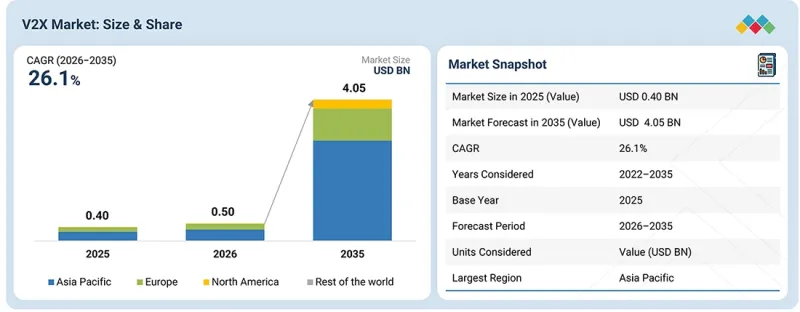
Regional deployment initiatives are creating opportunities for V2X suppliers, particularly in Asia Pacific, where China is advancing vehicle road cloud integration through connected vehicles, roadside equipment, and cloud control platforms. Europe is progressing with cooperative intelligent transport systems and cross-border interoperability, while North America is advancing C-V2X deployment and connected road safety applications. These developments are increasing demand for communication hardware and software that comply with regional spectrum, cybersecurity, and interoperability requirements.
V2X adoption is increasingly influenced by OEM integration strategies, infrastructure readiness, and the commercial viability of connected safety applications. Suppliers are focusing on compact OBUs, multi-band antennas, secure message authentication, software-upgradeable communication platforms, and RSUs that can support multiple applications. As passenger cars and commercial vehicles adopt more connected functions, market growth is shifting toward integrated vehicle communication systems, cooperative road safety applications, and scalable vehicle infrastructure connectivity rather than standalone communication hardware alone.
Integrated V2X Platforms Advance Through Combined Communication, Security, and Telematics Functions
- Qualcomm integrates V2X connectivity with automotive computing platforms: Qualcomm's Snapdragon Digital Chassis portfolio combines connectivity, computing, and vehicle communication capabilities, creating opportunities to integrate V2X functions with telematics and advanced driver assistance systems. This supports demand for automotive-qualified chipsets, secure message processing, and scalable connectivity architectures.
- HARMAN advances vehicle-to-network safety applications: HARMAN's Ready Aware solution uses network connectivity and real-time road event information to provide contextual alerts for hazards such as sudden braking, stationary vehicles, and road risks. This demonstrates the potential to extend V2X safety functions through software-enabled telematics platforms and connected vehicle services.
- NXP develops dedicated V2X communication and security components: NXP's V2X portfolio supports secure vehicle communication through dedicated automotive communication processors and security technologies. These capabilities address requirements for low-latency message processing, authenticated safety messages, and reliable communication between vehicles and roadside infrastructure.
- European regulations support interoperable V2X deployment: The EU's harmonized 5.9 GHz spectrum framework and C-Roads Platform promote cooperative ITS deployment, driving demand for spectrum-compliant V2X modules, secure communication systems, and interoperable roadside units.
"EV Propulsion Accelerates V2X Integration With Charging and Energy Management Systems"
EV adoption is creating demand for V2X functions that connect vehicle energy requirements with charging infrastructure and road conditions. Charging station availability, battery range, traffic signal timing, and route information can support charging stop selection, range-aware routing, and energy-efficient driving. Integration with battery management systems and charging platforms also creates opportunities for coordinated charging and vehicle-to-grid services. For suppliers, this drives demand for C-V2X modules that integrate with EV telematics and energy management systems while maintaining reliable radio performance around high-voltage power electronics. For instance, Nissan LEAF supports bidirectional energy applications, including vehicle-to-home and vehicle-to-grid, demonstrating how connected EV platforms can extend beyond mobility into energy management. This creates opportunities for V2X suppliers to integrate communication systems with charging controls, energy management platforms, and smart grid infrastructure.
" ICE Propulsion to Lead V2X Adoption Through High Vehicle Production Volumes"
Internal combustion engine (ICE) vehicles currently lead automotive V2X demand due to their large installed base, continued production volumes, and gradual integration of connected vehicle technologies. OEMs are incorporating V2X capabilities into ICE vehicle platforms through telematics control units and integrated communication modules, enabling safety alerts, traffic signal information, and hazard notifications without requiring an electric powertrain. For instance, China's vehicle road cloud integration initiatives support the deployment of connected vehicle technologies across participating vehicle platforms. This creates opportunities for suppliers offering cost-optimized C V2X modules compatible with existing vehicle electrical architectures, enabling OEMs to scale V2X adoption across high-volume passenger cars and commercial vehicles while managing integration costs.
"Europe Accelerates V2V + V2I Adoption Through Cooperative Intelligent Transport Systems"
Europe is increasing demand for V2V + V2I communication as road safety initiatives and cooperative intelligent transport systems (C-ITS) drive integration between connected vehicles and roadside infrastructure. For instance, the European C-Roads platform supports the deployment of interoperable C-ITS services across national road networks, including traffic signal information, roadworks warnings, and hazardous location alerts. This supports demand for V2X onboard units, roadside units, and communication systems capable of exchanging standardized safety messages between vehicles and infrastructure. For instance, the C-Roads program promotes cross-border interoperability, creating opportunities for suppliers to develop compatible V2X platforms for multiple European markets rather than individual national deployments. These developments indicate that European V2V + V2I demand is increasingly linked to interoperable road infrastructure, standardized safety applications, and integration with intelligent traffic management systems, rather than vehicle communication hardware alone.
In-depth interviews were conducted with CEOs, marketing directors, other innovation and technology directors, and executives from various key organizations operating in this market.
- By Company Type: Tier 1- 31%, OEMs - 21%, Tier-2 - 48%
- By Designation: CXOs - 40%, Directors - 35%, Others - 25%
- By Country: Asia Pacific- 15%, Europe- 50%, North America- 30%, Rest of the World- 5%
The V2X market is shaped by semiconductor developers, automotive electronics suppliers, and connected mobility technology companies, including Qualcomm (US), HARMAN International (US), NXP Semiconductors (Netherlands), Huawei Technologies (China), and AUMOVIO SE (Germany). Competition is increasingly centered on enabling OEMs and transport authorities to deploy interoperable vehicle communication systems across production vehicles and connected road corridors. Industry participants are developing automotive-qualified communication chipsets, compact V2X modules, secure message processing systems, and infrastructure connectivity platforms that support deployment across multiple vehicle models and regional standards. Strategic priorities include securing design wins in OEM vehicle programs, establishing partnerships with road infrastructure operators, adapting products to local spectrum requirements, and reducing integration complexity for vehicle manufacturers. Suppliers are also targeting commercial fleet operators and infrastructure projects with retrofit communication units and scalable V2X solutions that enable safety alerts, traffic coordination, and real-time road condition sharing.
Research Coverage:
The report covers the V2X market by vehicle type (passenger cars, commercial vehicle), propulsion (ICE, EV), communication (V2I, V2V+V2I, V2V+V2N, V2V+V2I+V2N), charging (V2L, V2H+V2L, V2G+V2H+V2L), connectivity (C-V2X, DSRC), offering (hardware, software), technology (automated driver assistance, intelligent traffic system, emergency vehicle notification, passenger information system, fleet & asset management, parking management system, line of sight, non line of sight, backing, others), fitment (plug and play, retrofit, integrated fitment), unit (on-board unit, roadside unit), and region (Asia Pacific, Europe, North America, and the Rest of the World). It covers the competitive landscape and company profiles of the major players in the V2X market ecosystem.
The study also includes an in-depth competitive analysis of the key players in the market, along with their company profiles, key observations related to product and business offerings, recent developments, and key market strategies.
Key Benefits of Buying the Report:
- This report will help market leaders/new entrants in this market with information on the closest approximations of revenue numbers for the V2X market ecosystem and its subsegments.
- This report will help stakeholders understand the competitive landscape and gain more insights to better position their businesses and plan suitable go-to-market strategies.
- This report will also help stakeholders understand the market's pulse and provide information on key market drivers, restraints, challenges, and opportunities.
The report provides insights into the following pointers:
- Analysis of key drivers (V2X becoming a complementary perception layer for ADAS and automated driving, integration of C-V2X directly into next-generation automotive E/E and connectivity architectures, shift from isolated vehicle awareness to cooperative traffic and road-operations intelligence), restraints (low V2X penetration creates a network-effect barrier to value realization, Interoperability, cybersecurity and trust requirements complicate large-scale deployment), opportunities (retrofitting existing vehicles with aftermarket V2X devices, commercialization of V2X-enabled smart corridors and connected intersections, integration of V2X with autonomous driving and cooperative perception), and challenges (unclear commercial ownership and monetization of V2X services, lack of interoperability across vehicle and infrastructure ecosystems)
- Product Development/Innovation: Detailed insights into upcoming technologies, research & development activities, and product launches in the V2X market
- Market Development: Comprehensive information about lucrative markets (the report analyzes the V2X market across varied regions)
- Market Diversification: Exhaustive information about products, untapped geographies, recent developments, and investments in the V2X market
- Competitive Assessment: In-depth assessment of market ranking, growth strategies, and service offerings of leading players like Qualcomm (US), HARMAN International (US), Huawei Technologies (China), NXP Semiconductors (Netherlands), and AUMOVIO SE (Germany)
TABLE OF CONTENTS
1 INTRODUCTION
- 1.1 STUDY OBJECTIVES
- 1.2 MARKET DEFINITION
- 1.3 INCLUSIONS AND EXCLUSIONS
- 1.3.1 STUDY SCOPE
- 1.3.2 YEARS CONSIDERED
- 1.4 CURRENCY CONSIDERED
- 1.5 STAKEHOLDERS
- 1.6 SUMMARY OF CHANGES
2 EXECUTIVE SUMMARY
- 2.1 MARKET HIGHLIGHTS AND KEY INSIGHTS
- 2.2 KEY MARKET PARTICIPANTS: MAPPING OF STRATEGIC DEVELOPMENTS
- 2.3 DISRUPTIVE TRENDS IN V2X MARKET
- 2.4 HIGH-GROWTH SEGMENTS IN V2X MARKET
- 2.5 REGIONAL SNAPSHOT: MARKET SIZE, GROWTH RATE, AND FORECAST
3 PREMIUM INSIGHTS
- 3.1 OPPORTUNITIES FOR PLAYERS IN V2X MARKET
- 3.2 V2X MARKET, BY PROPULSION
- 3.3 V2X MARKET, BY VEHICLE TYPE
- 3.4 V2X MARKET, BY COMMUNICATION
- 3.5 V2X MARKET, BY CONNECTIVITY
- 3.6 V2X MARKET, BY OFFERING
- 3.7 V2X MARKET, BY CHARGING
4 MARKET OVERVIEW
- 4.1 INTRODUCTION
- 4.2 MARKET DYNAMICS
- 4.2.1 DRIVERS
- 4.2.1.1 V2X becoming complementary perception layer for ADAS and automated driving
- 4.2.1.2 Integration of C-V2X into next-generation automotive E/E and connectivity architectures
- 4.2.1.3 Shift from isolated vehicle awareness to cooperative traffic and road-operations intelligence
- 4.2.2 RESTRAINTS
- 4.2.2.1 Low V2X penetration creates network-effect barrier to value realization
- 4.2.2.2 Interoperability, cybersecurity, and trust requirements complicate large-scale deployment
- 4.2.3 OPPORTUNITIES
- 4.2.3.1 Retrofitting existing vehicles with aftermarket V2X devices
- 4.2.3.2 Commercialization of V2X-enabled smart corridors and connected intersections
- 4.2.3.3 Integration of V2X with autonomous driving and cooperative perception
- 4.2.4 CHALLENGES
- 4.2.4.1 Unclear commercial ownership and monetization of V2X services
- 4.2.4.2 Lack of interoperability across vehicle and infrastructure ecosystems
- 4.2.1 DRIVERS
- 4.3 UNMET NEEDS AND WHITE SPACES
- 4.3.1 RELIABLE, INTEROPERABLE, AND SCALABLE V2X COMMUNICATION ACROSS DIVERSE VEHICLE AND INFRASTRUCTURE ECOSYSTEMS
- 4.3.2 LIMITED END-TO-END V2X SYSTEM INTEGRATION AND CONTINUOUS COMPLIANCE
- 4.3.3 LIMITED DATA UTILIZATION FOR INTELLIGENT V2X APPLICATIONS
- 4.4 V2X-ENABLED COOPERATIVE PERCEPTION AND AUTOMATED DRIVING
- 4.4.1 SENSOR AUGMENTATION
- 4.4.2 NON-LINE-OF-SIGHT PERCEPTION
- 4.4.3 INTERSECTION AWARENESS
- 4.4.4 VULNERABLE ROAD USER DETECTION
- 4.4.5 EMERGENCY VEHICLE ALERTS
- 4.4.6 PLATOONING AND L2+/L3 APPLICATIONS
5 INDUSTRY TRENDS
- 5.1 MACROECONOMIC INDICATORS
- 5.1.1 INTRODUCTION
- 5.1.2 GDP TRENDS AND FORECAST
- 5.1.3 TRENDS IN AUTOMOTIVE TELEMATICS MARKET
- 5.1.4 TRENDS IN GLOBAL V2X INDUSTRY
- 5.2 SUPPLY CHAIN ANALYSIS
- 5.3 ECOSYSTEM MAPPING
- 5.3.1 TELECOM NETWORK PROVIDERS
- 5.3.2 ROAD INFRASTRUCTURE UNIT PROVIDERS
- 5.3.3 MAPPING AND POSITIONING PROVIDERS
- 5.3.4 FLEET OPERATORS AND MOBILITY SERVICE PROVIDERS
- 5.3.5 V2X HARDWARE PROVIDERS
- 5.3.6 V2X SOFTWARE PROVIDERS
- 5.3.7 AUTOMOTIVE ENGINEERING SERVICE PROVIDERS
- 5.3.8 C-V2X MODULE SUPPLIERS
- 5.3.9 ANTENNA SUPPLIERS
- 5.3.10 OEMS
- 5.4 PRICING ANALYSIS
- 5.5 KEY CONFERENCES AND EVENTS, 2027
- 5.6 TRENDS AND DISRUPTIONS IMPACTING CUSTOMER BUSINESSES
- 5.7 INVESTMENT AND FUNDING SCENARIO
- 5.8 BILL OF MATERIALS
- 5.8.1 BILL OF MATERIALS FOR V2X COMMUNICATION ON BOARD UNIT
- 5.9 CASE STUDY ANALYSIS
- 5.9.1 PILOT PROJECT ON VIRGINIA SMART ROAD
- 5.9.2 VEHICLE POSITIONING ACCURACY IN NEW YORK
- 5.9.3 TOWARDS ZERO ROAD SAFETY STRATEGY
- 5.9.4 PREPARING ROADS FOR AUTONOMOUS VEHICLES
- 5.9.5 PILOT PROJECT ON SAN DIEGO ROADWAYS
- 5.9.6 ECOCAR MOBILITY CHALLENGE
- 5.9.7 TRANSFORMING SNOW REMOVAL IN DENVER WITH V2X TECHNOLOGY
- 5.10 OEM VS. AFTERMARKET V2X DEPLOYMENT STRATEGIES
- 5.11 V2X RETROFIT OPPORTUNITY IN EXISTING VEHICLE FLEETS
- 5.12 AFTERMARKET V2X BUSINESS MODELS AND REVENUE STREAMS
6 TECHNOLOGICAL ADVANCEMENTS, AI-DRIVEN IMPACT, PATENTS, INNOVATIONS, AND FUTURE APPLICATIONS IN V2X MARKET
- 6.1 TECHNOLOGY ANALYSIS
- 6.1.1 INTRODUCTION
- 6.1.2 KEY EMERGING TECHNOLOGIES
- 6.1.2.1 5G NR-V2X
- 6.1.2.2 Cooperative Perception / Sensor Sharing
- 6.1.2.3 Predictive QoS & Adaptive V2X
- 6.1.2.4 V2X as a Service
- 6.1.3 ADJACENT TECHNOLOGIES
- 6.1.3.1 Edge Computing / MEC for V2X
- 6.1.3.2 V2N2X / Hybrid Direct + Network V2X
- 6.2 TECHNOLOGY/PRODUCT ROADMAP
- 6.3 PATENT ANALYSIS
- 6.3.1 INTRODUCTION
- 6.3.1.1 List of Patents
- 6.3.1 INTRODUCTION
- 6.4 FUTURE APPLICATIONS
- 6.4.1 COOPERATIVE AUTONOMOUS DRIVING
- 6.4.2 REAL-TIME COOPERATIVE PERCEPTION
- 6.4.3 PREDICTIVE V2X
- 6.4.4 V2X + DIGITAL TWINS / DYNAMIC HD MAPS
- 6.4.5 COOPERATIVE TRAFFIC FLOW & INTERSECTION INTELLIGENCE
7 REGULATORY LANDSCAPE
- 7.1 REGULATORY LANDSCAPE
- 7.1.1 COUNTRY-WISE REGULATIONS
- 7.1.1.1 V2X Spectrum Allocation
- 7.1.1.2 V2X Technology Regulatory Direction
- 7.1.1.3 C-ITS & Automated Driving Regulations
- 7.1.2 REGULATORY BODIES, GOVERNMENT AGENCIES, AND OTHER ORGANIZATIONS
- 7.1.1 COUNTRY-WISE REGULATIONS
8 CUSTOMER LANDSCAPE AND BUYING BEHAVIOR
- 8.1 DECISION-MAKING PROCESS
- 8.2 KEY STAKEHOLDERS AND BUYING CRITERIA
- 8.2.1 V2I
- 8.2.2 V2V + V2I
- 8.2.3 V2V + V2N
- 8.2.4 V2V + V2I + V2N
- 8.2.5 KEY STAKEHOLDERS IN BUYING PROCESS
- 8.2.6 BUYING CRITERIA
- 8.3 ADOPTION BARRIERS & INTERNAL CHALLENGES
9 V2X MARKET, BY OFFERING
- 9.1 INTRODUCTION
- 9.2 HARDWARE
- 9.2.1 INCREASING DEPLOYMENT OF CONNECTED VEHICLE AND ROADSIDE INFRASTRUCTURE
- 9.3 SOFTWARE
- 9.3.1 RISING INTEGRATION OF V2X APPLICATIONS WITH SOFTWARE-DEFINED VEHICLES
- 9.4 KEY PRIMARY INSIGHTS
10 V2X MARKET, BY CHARGING
- 10.1 INTRODUCTION
- 10.2 V2L
- 10.2.1 RISING DEMAND FOR PORTABLE AND EMERGENCY VEHICLE POWER
- 10.3 V2H + V2L
- 10.3.1 INCREASING DEMAND FOR RESIDENTIAL ENERGY FLEXIBILITY
- 10.4 V2G + V2H + V2L
- 10.4.1 EXPANDING ROLE OF EV BATTERIES IN GRID FLEXIBILITY
- 10.5 KEY PRIMARY INSIGHTS
11 V2X MARKET, BY PROPULSION
- 11.1 INTRODUCTION
- 11.2 INTERNAL COMBUSTION ENGINE (ICE)
- 11.2.1 EXPANDING V2X ADOPTION THROUGH CONNECTED AND SAFETY-FOCUSED ICE VEHICLES
- 11.3 ELECTRIC VEHICLE (EV)
- 11.3.1 ACCELERATING V2X DEPLOYMENT THROUGH ELECTRIFICATION AND SOFTWARE-DEFINED VEHICLES
- 11.4 KEY PRIMARY INSIGHTS
12 V2X MARKET, BY COMMUNICATION
- 12.1 INTRODUCTION
- 12.2 V2I
- 12.2.1 INCREASING DEPLOYMENT OF INTELLIGENT ROADSIDE INFRASTRUCTURE
- 12.3 V2V+V2I
- 12.3.1 ACCELERATING COOPERATIVE SAFETY THROUGH VEHICLE AND INFRASTRUCTURE CONNECTIVITY
- 12.4 V2V+V2N
- 12.4.1 EXPANDING CELLULAR CONNECTIVITY AND CLOUD-BASED VEHICLE COMMUNICATION
- 12.5 V2V+V2I+V2N
- 12.5.1 INTEGRATING DIRECT, INFRASTRUCTURE, AND NETWORK CONNECTIVITY
- 12.6 V2P
- 12.6.1 INCREASING FOCUS ON VULNERABLE ROAD USER SAFETY
- 12.7 KEY PRIMARY INSIGHTS
13 V2X MARKET, BY VEHICLE TYPE
- 13.1 INTRODUCTION
- 13.2 PASSENGER CARS
- 13.2.1 INCREASING INTEGRATION OF V2X WITH CONNECTED PASSENGER VEHICLES AND ADAS
- 13.3 COMMERCIAL VEHICLES
- 13.3.1 RISING ADOPTION OF V2X FOR FLEET SAFETY, AUTOMATION, AND LOGISTICS EFFICIENCY
- 13.4 KEY PRIMARY INSIGHTS
14 V2X MARKET, BY CONNECTIVITY
- 14.1 INTRODUCTION
- 14.2 C-V2X
- 14.2.1 ACCELERATING CELLULAR-BASED V2X DEPLOYMENT AND CONNECTED VEHICLE INTEGRATION
- 14.3 DSRC
- 14.3.1 SUPPORTING LEGACY V2X INFRASTRUCTURE AND INTEROPERABILITY REQUIREMENTS
- 14.4 KEY PRIMARY INSIGHTS
15 V2X MARKET, BY UNIT
- 15.1 INTRODUCTION
- 15.2 ONBOARD UNITS
- 15.3 ROADSIDE UNITS
- 15.4 KEY PRIMARY INSIGHTS
16 V2X MARKET, BY FITMENT
- 16.1 INTRODUCTION
- 16.2 PLUG-AND-PLAY FITMENT
- 16.3 RETROFIT FITMENT
- 16.4 INTEGRATED FITMENT
- 16.5 KEY PRIMARY INSIGHTS
17 V2X MARKET, BY TECHNOLOGY
- 17.1 INTRODUCTION
- 17.2 AUTOMATED DRIVER ASSISTANCE
- 17.3 INTELLIGENT TRAFFIC SYSTEM
- 17.4 EMERGENCY VEHICLE NOTIFICATION
- 17.5 PASSENGER INFORMATION SYSTEM
- 17.6 FLEET & ASSET MANAGEMENT
- 17.7 PARKING MANAGEMENT SYSTEM
- 17.8 LINE-OF-SIGHT
- 17.9 NON-LINE-OF-SIGHT
- 17.10 BACKING
- 17.11 OTHERS
- 17.12 KEY PRIMARY INSIGHTS
18 V2X MARKET, BY REGION
- 18.1 INTRODUCTION
- 18.2 ASIA PACIFIC
- 18.2.1 CHINA
- 18.2.1.1 Rapid C-V2X deployment and vehicle-road-cloud integration to drive market
- 18.2.2 JAPAN
- 18.2.2.1 C-V2X deployment and connected vehicle development to drive market
- 18.2.3 INDIA
- 18.2.3.1 Proposed V2X Mandates to drive market in India
- 18.2.4 SOUTH KOREA
- 18.2.4.1 C-ITS deployment on major roads to drive market
- 18.2.1 CHINA
- 18.3 EUROPE
- 18.3.1 GERMANY
- 18.3.1.1 Growing V2X deployment and 5G V2X trials to drive market
- 18.3.2 FRANCE
- 18.3.2.1 Government support and connected mobility programs to drive market
- 18.3.3 ITALY
- 18.3.3.1 Expansion of 5G infrastructure and connected mobility corridors to drive market
- 18.3.4 SPAIN
- 18.3.4.1 Smart road infrastructure and 5G corridors to accelerate V2X commercialization
- 18.3.5 UK
- 18.3.5.1 Government-backed V2X and automated mobility programs to drive market
- 18.3.1 GERMANY
- 18.4 NORTH AMERICA
- 18.4.1 US
- 18.4.1.1 C-V2X deployment and connected mobility applications to drive market
- 18.4.2 CANADA
- 18.4.2.1 Connected vehicle research, C-V2X deployment, and cybersecurity programs to drive market
- 18.4.3 MEXICO
- 18.4.3.1 Expansion of connected road infrastructure and automotive manufacturing to drive market
- 18.4.1 US
- 18.5 REST OF THE WORLD
- 18.5.1 BRAZIL
- 18.5.1.1 Connected road infrastructure and automotive technology programs to support V2X adoption
- 18.5.2 ARGENTINA
- 18.5.2.1 Connected road infrastructure and automated mobility programs to drive market
- 18.5.1 BRAZIL
19 COMPETITIVE LANDSCAPE
- 19.1 OVERVIEW
- 19.2 KEY PLAYER STRATEGIES/RIGHT TO WIN
- 19.2.1 OVERVIEW OF STRATEGIES ADOPTED BY PLAYERS IN V2X MARKET
- 19.3 MARKET SHARE ANALYSIS, 2025
- 19.4 REVENUE ANALYSIS, 2021-2025
- 19.5 COMPANY VALUATION AND FINANCIAL METRICS
- 19.5.1 COMPANY VALUATION
- 19.5.2 FINANCIAL METRICS
- 19.6 BRAND/PRODUCT COMPARISON
- 19.7 COMPANY EVALUATION MATRIX: KEY PLAYERS, 2025
- 19.7.1 STARS
- 19.7.2 EMERGING LEADERS
- 19.7.3 PERVASIVE PLAYERS
- 19.7.4 PARTICIPANTS
- 19.7.5 COMPANY FOOTPRINT: KEY PLAYERS, 2025
- 19.7.5.1 Company footprint
- 19.7.5.2 Region footprint
- 19.7.5.3 Vehicle type footprint
- 19.8 COMPANY EVALUATION MATRIX: STARTUPS/SMES, 2025
- 19.8.1 PROGRESSIVE COMPANIES
- 19.8.2 RESPONSIVE COMPANIES
- 19.8.3 DYNAMIC COMPANIES
- 19.8.4 STARTING BLOCKS
- 19.8.5 COMPETITIVE BENCHMARKING, STARTUPS/SMES, 2025
- 19.8.5.1 List of key startups/SMEs
- 19.8.5.2 Competitive benchmarking of startups/SMEs
- 19.9 COMPETITIVE SCENARIO
- 19.9.1 PRODUCT LAUNCHES/DEVELOPMENTS/ENHANCEMENTS
- 19.9.2 DEALS
- 19.9.3 EXPANSIONS
- 19.9.4 OTHER DEVELOPMENTS
20 COMPANY PROFILES
- 20.1 KEY PLAYERS
- 20.1.1 QUALCOMM INCORPORATED
- 20.1.1.1 Business overview
- 20.1.1.2 Products/Solutions/Services offered
- 20.1.1.3 Recent developments
- 20.1.1.4 MnM view
- 20.1.1.4.1 Key strengths
- 20.1.1.4.2 Strategic choices
- 20.1.1.4.3 Weaknesses and competitive threats
- 20.1.2 HARMAN INTERNATIONAL
- 20.1.2.1 Business overview
- 20.1.2.2 Products/Solutions/Services offered
- 20.1.2.3 Recent developments
- 20.1.2.4 MnM view
- 20.1.2.4.1 Key strengths
- 20.1.2.4.2 Strategic choices
- 20.1.2.4.3 Weaknesses and competitive threats
- 20.1.3 HUAWEI TECHNOLOGIES CO., LTD.
- 20.1.3.1 Business overview
- 20.1.3.2 Products/Solutions/Services offered
- 20.1.3.3 Recent developments
- 20.1.3.4 MnM view
- 20.1.3.4.1 Key strengths
- 20.1.3.4.2 Strategic choices
- 20.1.3.4.3 Weaknesses and competitive threats
- 20.1.4 NXP SEMICONDUCTORS
- 20.1.4.1 Business overview
- 20.1.4.2 Products/Solutions/Services offered
- 20.1.4.3 Recent developments
- 20.1.4.4 MnM view
- 20.1.4.4.1 Key strengths
- 20.1.4.4.2 Strategic choices
- 20.1.4.4.3 Weaknesses and competitive threats
- 20.1.5 AUMOVIO SE
- 20.1.5.1 Business overview
- 20.1.5.2 Products/Solutions/Services offered
- 20.1.5.3 Recent developments
- 20.1.5.4 MnM view
- 20.1.5.4.1 Key strengths
- 20.1.5.4.2 Strategic choices
- 20.1.5.4.3 Weaknesses and competitive threats
- 20.1.6 ROBERT BOSCH GMBH
- 20.1.6.1 Business overview
- 20.1.6.2 Products/Solutions/Services offered
- 20.1.6.3 Recent developments
- 20.1.7 COHDA WIRELESS
- 20.1.7.1 Business overview
- 20.1.7.2 Products/Solutions/Services offered
- 20.1.7.3 Recent developments
- 20.1.8 INFINEON TECHNOLOGIES AG
- 20.1.8.1 Business overview
- 20.1.8.2 Products/Solutions/Services offered
- 20.1.8.3 Recent developments
- 20.1.9 DENSO CORPORATION
- 20.1.9.1 Business overview
- 20.1.9.2 Products/Solutions/Services offered
- 20.1.9.3 Recent developments
- 20.1.10 STMICROELECTRONICS
- 20.1.10.1 Business overview
- 20.1.10.2 Products/Solutions/Services offered
- 20.1.10.3 Recent developments
- 20.1.11 HYUNDAI MOBIS
- 20.1.11.1 Business overview
- 20.1.11.2 Products/Solutions/Services offered
- 20.1.11.3 Recent developments
- 20.1.12 KAPSCH GROUP
- 20.1.12.1 Business overview
- 20.1.12.2 Products/Solutions/Services offered
- 20.1.12.3 Recent developments
- 20.1.1 QUALCOMM INCORPORATED
- 20.2 OTHER PLAYERS
- 20.2.1 MARBEN PRODUCTS
- 20.2.2 CAPGEMINI ENGINEERING
- 20.2.3 NOKIA
- 20.2.4 DSPACE GMBH
- 20.2.5 FICOSA INTERNACIONAL SA
- 20.2.6 VECTOR INFORMATIK GMBH
- 20.2.7 BMW AG
- 20.2.8 MERCEDES-BENZ GROUP AG
- 20.2.9 RENAULT GROUP
- 20.2.10 UNEX TECHNOLOGY CORP.
- 20.2.11 MITSUBISHI ELECTRIC CORPORATION
- 20.2.12 FLEX LTD.
- 20.2.13 TATA MOTORS PASSENGER VEHICLES LIMITED
- 20.2.14 HITACHI SOLUTIONS, LTD.
- 20.2.15 NISSAN MOTOR CO., LTD.
- 20.2.16 LEAR CORPORATION
- 20.2.17 INTEL CORPORATION
- 20.2.18 DANLAW, INC.
- 20.2.19 COMMSIGNIA LTD.
- 20.2.20 GENERAL MOTORS
- 20.2.21 FORD MOTOR COMPANY
21 RESEARCH METHODOLOGY
- 21.1 RESEARCH DATA
- 21.1.1 SECONDARY DATA
- 21.1.2 KEY SECONDARY SOURCES
- 21.1.2.1 List of secondary sources
- 21.1.2.2 Key data from secondary sources
- 21.1.3 PRIMARY DATA
- 21.1.3.1 Primary interviews - demand and supply sides
- 21.1.3.2 Key industry insights and breakdown of primary interviews
- 21.1.3.3 List of primary participants
- 21.2 MARKET SIZE ESTIMATION
- 21.2.1 BOTTOM-UP APPROACH
- 21.2.2 TOP-DOWN APPROACH
- 21.3 DATA TRIANGULATION
- 21.4 FACTOR ANALYSIS
- 21.5 RESEARCH LIMITATIONS
- 21.6 RESEARCH ASSUMPTIONS AND RISK ASSESSMENT
22 APPENDIX
- 22.1 KEY INSIGHTS OF INDUSTRY EXPERTS
- 22.2 DISCUSSION GUIDE
- 22.3 KNOWLEDGESTORE: MARKETSANDMARKETS' SUBSCRIPTION PORTAL
- 22.4 CUSTOMIZATION OPTIONS
- 22.4.1 V2X MARKET, BY CHARGING, AT THE COUNTRY LEVEL (FOR REGIONS COVERED IN THE REPORT)
- 22.4.2 V2X MARKET, BY PROPULSION, AT THE COUNTRY LEVEL (FOR THE COUNTRIES ADDED UP TO 3 IN THE REPORT)
- 22.4.3 COMPANY INFORMATION
- 22.4.3.1 Profiles of additional market players (up to five)
- 22.5 RELATED REPORTS
- 22.6 AUTHOR DETAILS
List of Tables
- TABLE 1 V2X MARKET DEFINITION, BY COMMUNICATION
- TABLE 2 V2X MARKET DEFINITION, BY CHARGING
- TABLE 3 V2X MARKET DEFINITION, BY VEHICLE TYPE
- TABLE 4 V2X MARKET DEFINITION, BY CONNECTIVITY
- TABLE 5 V2X MARKET DEFINITION, BY UNIT
- TABLE 6 V2X MARKET DEFINITION, BY PROPULSION
- TABLE 7 V2X MARKET DEFINITION, BY OFFERING
- TABLE 8 V2X MARKET DEFINITION, BY FITMENT
- TABLE 9 V2X MARKET DEFINITION, BY TECHNOLOGY
- TABLE 10 V2X MARKET: INCLUSIONS AND EXCLUSIONS
- TABLE 11 CURRENCY EXCHANGE RATES, 2021-2025
- TABLE 12 V2X MARKET: V2X TECHNOLOGY AND APPLICATION COMPARISON
- TABLE 13 V2X MARKET: V2X INTEROPERABILITY AND CYBERSECURITY ASSESSMENT
- TABLE 14 V2X MARKET: AFTERMARKET V2X RETROFIT ASSESSMENT
- TABLE 15 V2X MARKET: SMART CORRIDOR AND CONNECTED INTERSECTION DEPLOYMENT
- TABLE 16 V2X MARKET: V2X COMMERCIALIZATION AND MONETIZATION MODELS
- TABLE 17 V2X MARKET: REAL-WORLD V2X INTEROPERABILITY CHALLENGES
- TABLE 18 V2X MARKET: IMPACT OF MARKET DYNAMICS
- TABLE 19 APPLICATION OVERVIEW OF V2X-ENABLED COOPERATIVE PERCEPTION AND AUTOMATED DRIVING IN V2X MARKET
- TABLE 20 GDP PERCENTAGE CHANGE, BY KEY COUNTRY, 2022-2031
- TABLE 21 V2X MARKET: ROLE OF KEY PLAYERS IN ECOSYSTEM
- TABLE 22 KEY CONFERENCES AND EVENTS, 2027
- TABLE 23 BILL OF MATERIALS FOR V2X COMMUNICATION ON BOARD UNIT (USD PER UNIT)
- TABLE 24 V2X MARKET: OEM VS. AFTERMARKET V2X DEPLOYMENT STRATEGIES
- TABLE 25 V2X MARKET: REVENUE STREAMS BY APPLICATION
- TABLE 26 V2X MARKET: TECHNOLOGY EVOLUTION AND ADVANCED USE CASES OF 5G NR-V2X
- TABLE 27 V2X MARKET: QUANTIFIED GOVERNMENT RESULTS DEMONSTRATE SAFETY IMPACT OF COOPERATIVE PERCEPTION
- TABLE 28 V2X MARKET: LEADING COMPANIES ARE IMPLEMENTING HYBRID PC5-UU CONNECTIVITY FOR V2X
- TABLE 29 PATENT REGISTRATIONS IN V2X MARKET, MAY 2026-OCTOBER 2026
- TABLE 30 COUNTRY-WISE V2X SPECTRUM ALLOCATION AND REGULATORY REQUIREMENTS
- TABLE 31 COUNTRY-WISE V2X TECHNOLOGY DIRECTION AND REGULATORY IMPLICATIONS
- TABLE 32 COUNTRY-WISE C-ITS AND AUTOMATED DRIVING REGULATORY FRAMEWORK
- TABLE 33 NORTH AMERICA: REGULATORY BODIES, GOVERNMENT AGENCIES, AND OTHER ORGANIZATIONS
- TABLE 34 EUROPE: REGULATORY BODIES, GOVERNMENT AGENCIES, AND OTHER ORGANIZATIONS
- TABLE 35 ASIA PACIFIC: REGULATORY BODIES, GOVERNMENT AGENCIES, AND OTHER ORGANIZATIONS
- TABLE 36 INFLUENCE OF STAKEHOLDERS ON BUYING PROCESS FOR TOP APPLICATIONS (%)
- TABLE 37 KEY BUYING CRITERIA FOR TOP APPLICATIONS
- TABLE 38 V2X MARKET, BY OFFERING, 2022-2025 (USD MILLION)
- TABLE 39 V2X MARKET, BY OFFERING, 2026-2035 (USD MILLION)
- TABLE 40 HARDWARE V2X MARKET, BY REGION, 2022-2025 (USD MILLION)
- TABLE 41 HARDWARE V2X MARKET, BY REGION, 2026-2035 (USD MILLION)
- TABLE 42 SOFTWARE V2X MARKET, BY REGION, 2022-2025 (USD MILLION)
- TABLE 43 SOFTWARE V2X MARKET, BY REGION, 2026-2035 (USD MILLION)
- TABLE 44 V2X MARKET, BY CHARGING, 2022-2025 (USD MILLION)
- TABLE 45 V2X MARKET, BY CHARGING, 2026-2035 (USD MILLION)
- TABLE 46 V2L CHARGING MARKET, BY REGION, 2022-2025 (USD MILLION)
- TABLE 47 V2L CHARGING MARKET, BY REGION, 2026-2035 (USD MILLION)
- TABLE 48 V2H + V2L CHARGING MARKET, BY REGION, 2022-2025 (USD MILLION)
- TABLE 49 V2H + V2L CHARGING MARKET, BY REGION, 2026-2035 (USD MILLION)
- TABLE 50 V2G + V2H + V2L CHARGING MARKET, BY REGION, 2022-2025 (USD MILLION)
- TABLE 51 V2G + V2H + V2L CHARGING MARKET, BY REGION, 2026-2035 (USD MILLION)
- TABLE 52 V2X MARKET, BY PROPULSION, 2022-2025 (THOUSAND UNITS)
- TABLE 53 V2X MARKET, BY PROPULSION, 2026-2035 (THOUSAND UNITS)
- TABLE 54 V2X MARKET, BY PROPULSION, 2022-2025 (USD MILLION)
- TABLE 55 V2X MARKET, BY PROPULSION, 2026-2035 (USD MILLION)
- TABLE 56 ICE V2X MARKET, BY REGION, 2022-2025 (THOUSAND UNITS)
- TABLE 57 ICE V2X MARKET, BY REGION, 2026-2035 (THOUSAND UNITS)
- TABLE 58 ICE V2X MARKET, BY REGION, 2022-2025 (USD MILLION)
- TABLE 59 ICE V2X MARKET, BY REGION, 2026-2035 (USD MILLION)
- TABLE 60 EV V2X MARKET, BY REGION, 2022-2025 (THOUSAND UNITS)
- TABLE 61 EV V2X MARKET, BY REGION, 2026-2035 (THOUSAND UNITS)
- TABLE 62 EV V2X MARKET, BY REGION, 2022-2025 (USD MILLION)
- TABLE 63 EV V2X MARKET, BY REGION, 2026-2035 (USD MILLION)
- TABLE 64 V2X MARKET, BY COMMUNICATION, 2022-2025 (THOUSAND UNITS)
- TABLE 65 V2X MARKET, BY COMMUNICATION, 2026-2035 (THOUSAND UNITS)
- TABLE 66 V2X MARKET, BY COMMUNICATION, 2022-2025 (USD MILLION)
- TABLE 67 V2X MARKET, BY COMMUNICATION, 2026-2035 (USD MILLION)
- TABLE 68 V2I MARKET, BY REGION, 2022-2025 (THOUSAND UNITS)
- TABLE 69 V2I MARKET, BY REGION, 2026-2035 (THOUSAND UNITS)
- TABLE 70 V2I MARKET, BY REGION, 2022-2025 (USD MILLION)
- TABLE 71 V2I MARKET, BY REGION, 2026-2035 (USD MILLION)
- TABLE 72 V2V+V2I MARKET, BY REGION, 2022-2025 (THOUSAND UNITS)
- TABLE 73 V2V+V2I MARKET, BY REGION, 2026-2035 (THOUSAND UNITS)
- TABLE 74 V2V+V2I MARKET, BY REGION, 2022-2025 (USD MILLION)
- TABLE 75 V2V+V2I MARKET, BY REGION, 2026-2035 (USD MILLION)
- TABLE 76 V2V+V2N MARKET, BY REGION, 2022-2025 (THOUSAND UNITS)
- TABLE 77 V2V+V2N MARKET, BY REGION, 2026-2035 (THOUSAND UNITS)
- TABLE 78 V2V+V2N MARKET, BY REGION, 2022-2025 (USD MILLION)
- TABLE 79 V2V+V2N MARKET, BY REGION, 2026-2035 (USD MILLION)
- TABLE 80 V2V+V2I+V2N MARKET, BY REGION, 2022-2025 (THOUSAND UNITS)
- TABLE 81 V2V+V2I+V2N MARKET, BY REGION, 2026-2035 (THOUSAND UNITS)
- TABLE 82 V2V+V2I+V2N MARKET, BY REGION, 2022-2025 (USD MILLION)
- TABLE 83 V2V+V2I+V2N MARKET, BY REGION, 2026-2035 (USD MILLION)
- TABLE 84 V2X MARKET, BY VEHICLE TYPE, 2022-2025 (THOUSAND UNITS)
- TABLE 85 V2X MARKET, BY VEHICLE TYPE, 2026-2035 (THOUSAND UNITS)
- TABLE 86 PASSENGER CAR V2X MARKET, BY REGION, 2022-2025 (THOUSAND UNITS)
- TABLE 87 PASSENGER CAR V2X MARKET, BY REGION, 2026-2035 (THOUSAND UNITS)
- TABLE 88 COMMERCIAL VEHICLE V2X MARKET, BY REGION, 2022-2025 (THOUSAND UNITS)
- TABLE 89 COMMERCIAL VEHICLE V2X MARKET, BY REGION, 2026-2035 (THOUSAND UNITS)
- TABLE 90 V2X MARKET, BY CONNECTIVITY, 2022-2025 (THOUSAND UNITS)
- TABLE 91 V2X MARKET, BY CONNECTIVITY, 2026-2035 (THOUSAND UNITS)
- TABLE 92 C-V2X MARKET, BY REGION, 2022-2025 (THOUSAND UNITS)
- TABLE 93 C-V2X MARKET, BY REGION, 2026-2035 (THOUSAND UNITS)
- TABLE 94 DSRC MARKET, BY REGION, 2022-2025 (THOUSAND UNITS)
- TABLE 95 DSRC MARKET, BY REGION, 2026-2035 (THOUSAND UNITS)
- TABLE 96 V2X MARKET, BY REGION, 2022-2025 (THOUSAND UNITS)
- TABLE 97 V2X MARKET, BY REGION, 2026-2035 (THOUSAND UNITS)
- TABLE 98 V2X MARKET, BY REGION, 2022-2025 (USD MILLION)
- TABLE 99 V2X MARKET, BY REGION, 2026-2035 (USD MILLION)
- TABLE 100 ASIA PACIFIC: V2X MARKET, BY COUNTRY, 2022-2025 (THOUSAND UNITS)
- TABLE 101 ASIA PACIFIC: V2X MARKET, BY COUNTRY, 2026-2035 (THOUSAND UNITS)
- TABLE 102 ASIA PACIFIC: V2X MARKET, BY COUNTRY, 2022-2025 (USD MILLION)
- TABLE 103 ASIA PACIFIC: V2X MARKET, BY COUNTRY, 2026-2035 (USD MILLION)
- TABLE 104 CHINA: V2X MARKET, BY COMMUNICATION TYPE, 2022-2025 (THOUSAND UNITS)
- TABLE 105 CHINA: V2X MARKET, BY COMMUNICATION TYPE, 2026-2035 (THOUSAND UNITS)
- TABLE 106 CHINA: V2X MARKET, BY COMMUNICATION TYPE, 2022-2025 (USD MILLION)
- TABLE 107 CHINA: V2X MARKET, BY COMMUNICATION TYPE, 2026-2035 (USD MILLION)
- TABLE 108 JAPAN: V2X MARKET, BY CAPACITY TYPE, 2022-2025 (THOUSAND UNITS)
- TABLE 109 JAPAN: V2X MARKET, BY COMMUNICATION TYPE, 2026-2035 (THOUSAND UNITS)
- TABLE 110 JAPAN: V2X MARKET, BY COMMUNICATION TYPE, 2022-2025 (USD MILLION)
- TABLE 111 JAPAN: V2X MARKET, BY COMMUNICATION TYPE, 2026-2035 (USD MILLION)
- TABLE 112 INDIA: V2X MARKET, BY COMMUNICATION TYPE, 2026-2035 (THOUSAND UNITS)
- TABLE 113 INDIA: V2X MARKET, BY COMMUNICATION TYPE, 2026-2035 (USD MILLION)
- TABLE 114 SOUTH KOREA: V2X MARKET, BY COMMUNICATION TYPE, 2026-2035 (THOUSAND UNITS)
- TABLE 115 SOUTH KOREA: V2X MARKET, BY COMMUNICATION TYPE, 2026-2035 (USD MILLION)
- TABLE 116 EUROPE: V2X MARKET, BY COUNTRY, 2022-2025 (THOUSAND UNITS)
- TABLE 117 EUROPE: V2X MARKET, BY COUNTRY, 2026-2035 (THOUSAND UNITS)
- TABLE 118 EUROPE: V2X MARKET, BY COUNTRY, 2022-2025 (USD MILLION)
- TABLE 119 EUROPE: V2X MARKET, BY COUNTRY, 2026-2035 (USD MILLION)
- TABLE 120 GERMANY: V2X MARKET, BY COMMUNICATION TYPE, 2022-2025 (THOUSAND UNITS)
- TABLE 121 GERMANY: V2X MARKET, BY COMMUNICATION TYPE, 2026-2035 (THOUSAND UNITS)
- TABLE 122 GERMANY: V2X MARKET, BY COMMUNICATION TYPE, 2022-2025 (USD MILLION)
- TABLE 123 GERMANY: V2X MARKET, BY COMMUNICATION TYPE, 2026-2035 (USD MILLION)
- TABLE 124 FRANCE: V2X MARKET, BY COMMUNICATION TYPE, 2026-2035 (THOUSAND UNITS)
- TABLE 125 FRANCE: V2X MARKET, BY COMMUNICATION TYPE, 2026-2035 (USD MILLION)
- TABLE 126 ITALY: V2X MARKET, BY COMMUNICATION TYPE, 2026-2035 (THOUSAND UNITS)
- TABLE 127 ITALY: V2X MARKET, BY COMMUNICATION TYPE, 2026-2035 (USD MILLION)
- TABLE 128 SPAIN: V2X MARKET, BY COMMUNICATION TYPE, 2026-2035 (THOUSAND UNITS)
- TABLE 129 SPAIN: V2X MARKET, BY COMMUNICATION TYPE, 2026-2035 (USD MILLION)
- TABLE 130 UK: V2X MARKET, BY COMMUNICATION TYPE, 2026-2035 (THOUSAND UNITS)
- TABLE 131 UK: V2X MARKET, BY COMMUNICATION TYPE, 2026-2035 (USD MILLION)
- TABLE 132 NORTH AMERICA: V2X MARKET, BY COUNTRY, 2022-2025 (THOUSAND UNITS)
- TABLE 133 NORTH AMERICA: V2X MARKET, BY COUNTRY, 2026-2035 (THOUSAND UNITS)
- TABLE 134 NORTH AMERICA: V2X MARKET, BY COUNTRY, 2022-2025 (USD MILLION)
- TABLE 135 NORTH AMERICA: V2X MARKET, BY COUNTRY, 2026-2035 (USD MILLION)
- TABLE 136 US: V2X MARKET, BY COMMUNICATION TYPE, 2022-2025 (THOUSAND UNITS)
- TABLE 137 US: V2X MARKET, BY COMMUNICATION TYPE, 2026-2035 (THOUSAND UNITS)
- TABLE 138 US: V2X MARKET, BY COMMUNICATION TYPE, 2022-2025 (USD MILLION)
- TABLE 139 US: V2X MARKET, BY COMMUNICATION TYPE, 2026-2035 (USD MILLION)
- TABLE 140 CANADA: V2X MARKET, BY COMMUNICATION TYPE, 2022-2025 (THOUSAND UNITS)
- TABLE 141 CANADA: V2X MARKET, BY COMMUNICATION TYPE, 2026-2035 (THOUSAND UNITS)
- TABLE 142 CANADA: V2X MARKET, BY COMMUNICATION TYPE, 2022-2025 (USD MILLION)
- TABLE 143 CANADA: V2X MARKET, BY COMMUNICATION TYPE, 2026-2035 (USD MILLION)
- TABLE 144 MEXICO: V2X MARKET, BY COMMUNICATION TYPE, 2022-2025 (THOUSAND UNITS)
- TABLE 145 MEXICO: V2X MARKET, BY COMMUNICATION TYPE, 2026-2035 (THOUSAND UNITS)
- TABLE 146 MEXICO: V2X MARKET, BY COMMUNICATION TYPE, 2022-2025 (USD MILLION)
- TABLE 147 MEXICO: V2X MARKET, BY COMMUNICATION TYPE, 2026-2035 (USD MILLION)
- TABLE 148 REST OF THE WORLD: V2X MARKET, BY COUNTRY, 2026-2035 (THOUSAND UNITS)
- TABLE 149 REST OF THE WORLD: V2X MARKET, BY COUNTRY, 2026-2035 (USD MILLION)
- TABLE 150 BRAZIL: V2X MARKET, BY COMMUNICATION TYPE, 2026-2035 (THOUSAND UNITS)
- TABLE 151 BRAZIL: V2X MARKET, BY COMMUNICATION TYPE, 2026-2035 (USD MILLION)
- TABLE 152 ARGENTINA: V2X MARKET, BY COMMUNICATION TYPE, 2026-2035 (THOUSAND UNITS)
- TABLE 153 ARGENTINA: V2X MARKET, BY COMMUNICATION TYPE, 2026-2035 (USD MILLION)
- TABLE 154 OVERVIEW OF STRATEGIES DEPLOYED BY KEY COMPANIES
- TABLE 155 DEGREE OF COMPETITION IN V2X MARKET, 2025
- TABLE 156 V2X MARKET: REGION FOOTPRINT, 2025
- TABLE 157 V2X MARKET: VEHICLE TYPE FOOTPRINT, 2025
- TABLE 158 V2X MARKET: KEY STARTUPS/SMES
- TABLE 159 COMPETITIVE BENCHMARKING OF KEY STARTUPS/SMES
- TABLE 160 V2X MARKET: PRODUCT LAUNCHES/DEVELOPMENTS/ENHANCEMENTS, JANUARY 2022-OCTOBER 2026
- TABLE 161 V2X MARKET: DEALS, JANUARY 2022-OCTOBER 2026
- TABLE 162 V2X MARKET: EXPANSIONS, JANUARY 2022-OCTOBER 2026
- TABLE 163 V2X MARKET: OTHER DEVELOPMENTS, JANUARY 2022-OCTOBER 2026
- TABLE 164 QUALCOMM INCORPORATED: COMPANY OVERVIEW
- TABLE 165 QUALCOMM INCORPORATED: PRODUCTS/SOLUTIONS/SERVICES OFFERED
- TABLE 166 QUALCOMM INCORPORATED: PRODUCT LAUNCHES
- TABLE 167 QUALCOMM INCORPORATED: DEALS
- TABLE 168 QUALCOMM INCORPORATED: EXPANSIONS
- TABLE 169 HARMAN INTERNATIONAL: COMPANY OVERVIEW
- TABLE 170 HARMAN INTERNATIONAL: PRODUCTS/SOLUTIONS/SERVICES OFFERED
- TABLE 171 HARMAN INTERNATIONAL: PRODUCT LAUNCHES/ENHANCEMENTS
- TABLE 172 HARMAN INTERNATIONAL: DEALS
- TABLE 173 HARMAN INTERNATIONAL: OTHER DEVELOPMENTS
- TABLE 174 HUAWEI TECHNOLOGIES CO., LTD.: COMPANY OVERVIEW
- TABLE 175 HUAWEI TECHNOLOGIES CO., LTD.: PRODUCTS/SOLUTIONS/SERVICES OFFERED
- TABLE 176 HUAWEI TECHNOLOGIES CO., LTD.: PRODUCT LAUNCHES
- TABLE 177 HUAWEI TECHNOLOGIES CO., LTD.: DEALS
- TABLE 178 NXP SEMICONDUCTORS: COMPANY OVERVIEW
- TABLE 179 NXP SEMICONDUCTORS: PRODUCTS/SOLUTIONS/SERVICES OFFERED
- TABLE 180 NXP SEMICONDUCTORS: DEALS
- TABLE 181 NXP SEMICONDUCTORS: EXPANSIONS
- TABLE 182 NXP SEMICONDUCTORS: OTHER DEVELOPMENTS
- TABLE 183 AUMOVIO SE: COMPANY OVERVIEW
- TABLE 184 AUMOVIO SE: PRODUCTS/SOLUTIONS/SERVICES OFFERED
- TABLE 185 AUMOVIO SE: DEALS
- TABLE 186 ROBERT BOSCH GMBH: COMPANY OVERVIEW
- TABLE 187 ROBERT BOSCH GMBH: PRODUCTS/SOLUTIONS/SERVICES OFFERED
- TABLE 188 ROBERT BOSCH GMBH: KEY CUSTOMERS
- TABLE 189 ROBERT BOSCH GMBH: PRODUCT LAUNCHES
- TABLE 190 ROBERT BOSCH GMBH: DEALS
- TABLE 191 ROBERT BOSCH GMBH: OTHER DEVELOPMENTS
- TABLE 192 COHDA WIRELESS: COMPANY OVERVIEW
- TABLE 193 COHDA WIRELESS: PRODUCTS/SOLUTIONS/SERVICES OFFERED
- TABLE 194 COHDA WIRELESS: DEALS
- TABLE 195 COHDA WIRELESS: OTHER DEVELOPMENTS
- TABLE 196 INFINEON TECHNOLOGIES AG: COMPANY OVERVIEW
- TABLE 197 INFINEON TECHNOLOGIES AG: KEY CUSTOMERS
- TABLE 198 INFINEON TECHNOLOGIES AG: PRODUCTS/SOLUTIONS/SERVICES OFFERED
- TABLE 199 INFINEON TECHNOLOGIES AG: PRODUCT LAUNCHES/DEVELOPMENTS
- TABLE 200 INFINEON TECHNOLOGIES AG: DEALS
- TABLE 201 DENSO CORPORATION: COMPANY OVERVIEW
- TABLE 202 DENSO CORPORATION: KEY CUSTOMERS
- TABLE 203 DENSO CORPORATION: PRODUCTS/SOLUTIONS/SERVICES OFFERED
- TABLE 204 DENSO CORPORATION: PRODUCT LAUNCHES
- TABLE 205 DENSO CORPORATION: DEALS
- TABLE 206 STMICROELECTRONICS: COMPANY OVERVIEW
- TABLE 207 STMICROELECTRONICS: PRODUCTS/SOLUTIONS/SERVICES OFFERED
- TABLE 208 STMICROELECTRONICS: PRODUCT LAUNCHES
- TABLE 209 STMICROELECTRONICS: DEALS
- TABLE 210 HYUNDAI MOBIS: COMPANY OVERVIEW
- TABLE 211 HYUNDAI MOBIS: PRODUCTS/SOLUTIONS/SERVICES OFFERED
- TABLE 212 HYUNDAI MOBIS: PRODUCT DEVELOPMENTS
- TABLE 213 HYUNDAI MOBIS: DEALS
- TABLE 214 KAPSCH GROUP: COMPANY OVERVIEW
- TABLE 215 KAPSCH GROUP: PRODUCTS/SOLUTIONS/SERVICES OFFERED
- TABLE 216 KAPSCH GROUP: PRODUCT LAUNCHES
- TABLE 217 KAPSCH GROUP: DEALS
- TABLE 218 KAPSCH GROUP: OTHER DEVELOPMENTS
- TABLE 219 MARBEN PRODUCTS: COMPANY OVERVIEW
- TABLE 220 CAPGEMINI ENGINEERING: COMPANY OVERVIEW
- TABLE 221 NOKIA: COMPANY OVERVIEW
- TABLE 222 DSPACE GMBH: COMPANY OVERVIEW
- TABLE 223 FICOSA INTERNACIONAL SA: COMPANY OVERVIEW
- TABLE 224 VECTOR INFORMATIK GMBH: COMPANY OVERVIEW
- TABLE 225 BMW AG: COMPANY OVERVIEW
- TABLE 226 MERCEDES-BENZ GROUP AG: COMPANY OVERVIEW
- TABLE 227 RENAULT GROUP: COMPANY OVERVIEW
- TABLE 228 UNEX TECHNOLOGY CORP.: COMPANY OVERVIEW
- TABLE 229 MITSUBISHI ELECTRIC CORPORATION: COMPANY OVERVIEW
- TABLE 230 FLEX LTD.: COMPANY OVERVIEW
- TABLE 231 TATA MOTORS PASSENGER VEHICLES LIMITED: COMPANY OVERVIEW
- TABLE 232 HITACHI SOLUTIONS, LTD.: COMPANY OVERVIEW
- TABLE 233 NISSAN MOTOR CO., LTD.: COMPANY OVERVIEW
- TABLE 234 LEAR CORPORATION: COMPANY OVERVIEW
- TABLE 235 INTEL CORPORATION: COMPANY OVERVIEW
- TABLE 236 DANLAW, INC.: COMPANY OVERVIEW
- TABLE 237 COMMSIGNIA LTD.: COMPANY OVERVIEW
- TABLE 238 GENERAL MOTORS: COMPANY OVERVIEW
- TABLE 239 FORD MOTOR COMPANY: COMPANY OVERVIEW
List of Figures
- FIGURE 1 V2X SEGMENTATION AND REGIONAL SNAPSHOT
- FIGURE 2 MARKET SCENARIO
- FIGURE 3 V2X MARKET, BY COMMUNICATION, 2022-2035
- FIGURE 4 MAJOR STRATEGIES ADOPTED BY KEY PLAYERS IN V2X MARKET, 2022-2026
- FIGURE 5 DISRUPTIONS INFLUENCING GROWTH OF V2X MARKET
- FIGURE 6 HIGH-GROWTH SEGMENTS IN V2X MARKET, 2026-2035
- FIGURE 7 ASIA PACIFIC TO BE LARGEST V2X MARKET, IN TERMS OF VALUE, DURING FORECAST PERIOD
- FIGURE 8 SHIFT TOWARD CONNECTED VEHICLE TECHNOLOGIES AND INTEGRATED COMMUNICATION SYSTEMS DRIVING V2X MARKET GROWTH
- FIGURE 9 ELECTRIFICATION AND CONNECTED POWERTRAIN PLATFORMS CREATING NEW V2X INTEGRATION OPPORTUNITIES
- FIGURE 10 SHIFT TOWARDS AUTONOMOUS AND CONNECTED TRANSPORT TO DRIVE V2X MARKET IN PASSENGER CARS
- FIGURE 11 GROWING OEM INTEGRATION OF ONBOARD V2X UNITS SUPPORTING CONNECTED VEHICLE SAFETY
- FIGURE 12 ADVANCEMENTS IN CELLULAR CONNECTIVITY SUPPORTING REAL-TIME VEHICLE COMMUNICATION
- FIGURE 13 MULTI-APPLICATION V2X SYSTEMS TO DRIVE SOFTWARE CONTENT PER V2X SYSTEMS
- FIGURE 14 CONNECTED CHARGING INFRASTRUCTURE CREATING OPPORTUNITIES FOR V2X-ENABLED ENERGY COMMUNICATION
- FIGURE 15 V2X MARKET: DRIVERS, RESTRAINTS, OPPORTUNITIES, AND CHALLENGES
- FIGURE 16 V2X MARKET: SUPPLY CHAIN ANALYSIS
- FIGURE 17 V2X MARKET: ECOSYSTEM MAPPING
- FIGURE 18 AVERAGE SELLING PRICE OF V2X MARKET, BY V2X COMMUNICATION TYPE, 2024-2026
- FIGURE 19 AVERAGE SELLING PRICE OF V2X, BY REGION, 2024-2026
- FIGURE 20 TRENDS AND DISRUPTIONS IMPACTING CUSTOMER BUSINESSES
- FIGURE 21 INVESTMENT AND FUNDING, 2022-2025
- FIGURE 22 BILL OF MATERIALS FOR V2X COMMUNICATION ON BOARD UNIT (USD PER UNIT)
- FIGURE 23 V2X MARKET: INCREASING OPERATIONAL BENEFITS
- FIGURE 24 V2X TECHNOLOGY AND PRODUCT ROADMAP
- FIGURE 25 PUBLICATION TRENDS, 2015-2026
- FIGURE 26 INFLUENCE OF STAKEHOLDERS ON BUYING PROCESS FOR TOP APPLICATIONS
- FIGURE 27 KEY BUYING CRITERIA FOR TOP APPLICATIONS
- FIGURE 28 V2X MARKET, BY OFFERING, 2026 VS. 2035
- FIGURE 29 V2X MARKET, BY CHARGING, 2026 VS. 2035
- FIGURE 30 V2X MARKET, BY PROPULSION, 2026 VS. 2035
- FIGURE 31 V2X MARKET, BY COMMUNICATION, 2026 VS. 2035
- FIGURE 32 V2X MARKET, BY VEHICLE TYPE, 2026 VS. 2035
- FIGURE 33 V2X MARKET, BY CONNECTIVITY, 2026 VS. 2035
- FIGURE 34 V2X MARKET, BY REGION, 2026 VS. 2035 (USD MILLION)
- FIGURE 35 ASIA PACIFIC: V2X MARKET SNAPSHOT
- FIGURE 36 EUROPE: V2X MARKET SNAPSHOT
- FIGURE 37 NORTH AMERICA: V2X MARKET SNAPSHOT
- FIGURE 38 REST OF THE WORLD: V2X MARKET SNAPSHOT
- FIGURE 39 V2X MARKET SHARE ANALYSIS, 2025
- FIGURE 40 V2X MARKET: REVENUE ANALYSIS OF KEY PLAYERS, 2021-2025
- FIGURE 41 COMPANY VALUATION OF KEY PLAYERS, 2026 (USD BILLION)
- FIGURE 42 FINANCIAL METRICS OF KEY PLAYERS (EV/EBITDA), 2026
- FIGURE 43 V2X MARKET: BRAND/PRODUCT COMPARISON
- FIGURE 44 V2X MARKET: COMPANY EVALUATION MATRIX (KEY PLAYERS), 2025
- FIGURE 45 V2X MARKET: COMPANY FOOTPRINT, 2025
- FIGURE 46 V2X MARKET: COMPANY EVALUATION MATRIX (STARTUPS/SMES), 2025
- FIGURE 47 QUALCOMM INCORPORATED: COMPANY SNAPSHOT
- FIGURE 48 HARMAN INTERNATIONAL: COMPANY SNAPSHOT
- FIGURE 49 HUAWEI TECHNOLOGIES CO., LTD.: COMPANY SNAPSHOT
- FIGURE 50 NXP SEMICONDUCTORS: COMPANY SNAPSHOT
- FIGURE 51 AUMOVIO SE: COMPANY SNAPSHOT
- FIGURE 52 ROBERT BOSCH GMBH: COMPANY SNAPSHOT
- FIGURE 53 INFINEON TECHNOLOGIES AG: COMPANY SNAPSHOT
- FIGURE 54 DENSO CORPORATION: COMPANY SNAPSHOT
- FIGURE 55 STMICROELECTRONICS: COMPANY SNAPSHOT
- FIGURE 56 HYUNDAI MOBIS: COMPANY SNAPSHOT
- FIGURE 57 V2X MARKET: RESEARCH DESIGN
- FIGURE 58 RESEARCH DESIGN MODEL
- FIGURE 59 KEY INDUSTRY INSIGHTS
- FIGURE 60 BREAKDOWN OF PRIMARY INTERVIEWS
- FIGURE 61 RESEARCH METHODOLOGY: HYPOTHESIS BUILDING
- FIGURE 62 BOTTOM-UP APPROACH
- FIGURE 63 TOP-DOWN APPROACH
- FIGURE 64 MARKET BREAKDOWN AND DATA TRIANGULATION
- FIGURE 65 MARKET GROWTH PROJECTIONS FROM SUPPLY-SIDE DRIVERS AND OPPORTUNITIES

