PUBLISHER: MarketsandMarkets | PRODUCT CODE: 2193645

PUBLISHER: MarketsandMarkets | PRODUCT CODE: 2193645
Unmanned Surface Vehicles Market by Type, Application, Speed, Endurance, Hull Type, Launch Mode, & Power Source - Global Forecast to 2031
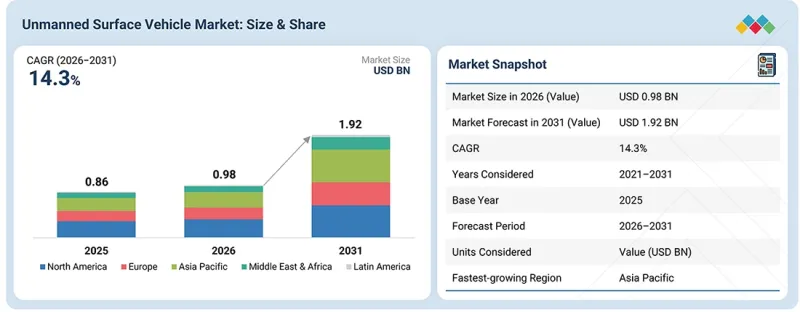
The unmanned surface vehicles market is projected to grow from USD 0.98 billion in 2026 to USD 1.92 billion by 2031, at a CAGR of 14.3%. In terms of volume (new deliveries), the market is projected to reach 4,615 units by 2031, up from 2,318 units in 2026. The unmanned surface vehicles market is driven by expanding maritime security and monitoring requirements. Governments, defense organizations, and commercial operators are increasingly deploying USVs for applications such as coastal surveillance, border protection, anti-piracy, and critical infrastructure monitoring.
| Scope of the Report | |
|---|---|
| Years Considered for the Study | 2021-2031 |
| Base Year | 2025 |
| Forecast Period | 2026-2031 |
| Units Considered | Value (USD Billion) |
| Segments | By Type, Application, Power Source and Region |
| Regions covered | North America, Europe, APAC, RoW |
The need for persistent, cost-effective, and low-risk operations in challenging, remote maritime environments is accelerating USV adoption. Advancements in autonomous navigation, sensor integration and communication technologies are further enhancing the capabilities of unmanned surface vehicles, which supports their growing use across defense, security, and commercial applications.
"By type, the autonomous surface vehicles (ASV) segment is expected to register the highest CAGR during the forecast period."
The autonomous surface vehicles (ASV) segment is expected to register the highest CAGR during the forecast period, supported by the rising adoption of autonomous operations for maritime surveillance, security and monitoring. ASVs can operate with limited human interference, enabling continuous missions over long durations and reducing the need for onboard personnel. The growing use of ASVs for applications such as oceanographic surveys, hydrographic mapping, border surveillance, mine detection, and infrastructure monitoring further supports demand. Advances in autonomous navigation, sensors, communication systems, and onboard decision-making are also improving ASVs' ability to operate in complex maritime environments.
"By application, the defense & security segment is expected to account for the largest market share during the forecast period."
The defense & security segment is expected to account for the largest market share during the forecast period, supported by growing adoption of USVs for maritime surveillance, border security, mine detection and naval operations. Defense organizations are increasingly using USVs for missions that require persistent monitoring and operations in high-risk or difficult maritime environments. USVs can support these missions without placing personnel directly onboard, while autonomous navigation, advanced sensors, as well as communication systems enable remote and long-duration operations. A growing focus on maritime domain awareness and naval modernization is further driving demand for USVs in defense and security applications.
"Asia Pacific is expected to account for the largest market share during the forecast period."
Asia Pacific is expected to account for the largest market share during the forecast period, supported by increasing investments in naval modernization, maritime security and unmanned maritime technologies. Countries in the region are expanding their use of USVs for applications such as coastal surveillance, mine detection, oceanographic surveys, in addition to maritime domain awareness. Rising territorial and maritime security requirements are encouraging defense organizations to adopt unmanned systems for persistent monitoring and operations in challenging environments. Growing development of indigenous USV capabilities and increasing investments in autonomous navigation, sensors and communication technologies are further supporting market growth in the region.
Some major market players include L3Harris Technologies, Inc. (US), Exail Technologies (France), Thales (France), Textron Inc. (US), and Teledyne Technologies Incorporated (US).
The breakdown of profiles for primary participants in the unmanned surface vehicles market is provided below:
- By Company Type: Tier 1 - 45%, Tier 2 - 35%, and Tier 3 - 20%
- By Designation: Directors - 25%, C-level Executives - 50%, and Others (Managers and Other Non-C-level Executives) - 25%
- By Region: North America -25%, Europe - 52%, Asia Pacific - 14%, and RoW-9%
Research Coverage:
This study covers the unmanned surface vehicles market across various segments and subsegments. It aims to estimate the size and growth potential of this market across different parts and regions. Additionally, this study includes an in-depth competitive analysis of key players in the market, their company profiles, key observations on their products and business offerings, recent developments, and the key market strategies they have adopted.
Reasons to Buy This Report:
The report will help market leaders/new entrants with information on the closest approximations of revenue for the overall unmanned surface vehicles market. It will also help stakeholders understand the competitive landscape and gain more insights to position their businesses better and plan suitable go-to-market strategies. Moreover, the report will help stakeholders understand the market pulse and will provide information on key market drivers, restraints, challenges, and opportunities.
Lastly, the report provides insights into the following pointers:
- Market Drivers (growing naval adoption of autonomous and uncrewed systems for ISR, MCM, ASW, and maritime security, rising demand for hydrographic survey, seabed mapping, and offshore asset inspection, advances in AI-enabled autonomy, collision avoidance, and over-the-horizon communications, need to reduce crew exposure, operating costs, and emissions in persistent maritime missions), Restraints (evolving regulatory, certification, and COLREGs compliance requirements, high upfront cost of platforms, payloads, communication links, and systems integration, dependence on resilient positioning and BLOS communications for long-range operations), Opportunities (expansion of USV-as-a-service and mission-as-a-service models, offshore wind, subsea cable, pipeline, and critical maritime infrastructure inspection, manned-unmanned teaming, multi-USV coordination, and swarm operations, Modular payload integration for EW, counter-UAS, ASW, MCM, and multi-domain missions), Challenges (safe autonomous navigation in congested and mixed-traffic maritime environments, cybersecurity, GNSS-denied navigation, and communications resilience, launch, recovery, maintenance, and logistics for extended-duration operations)
- Market Penetration: Comprehensive information on the unmanned surface vehicles solutions offered by the top players in the market
- Product Development/Innovation: Detailed insights on upcoming technologies, research & development activities, and product launches in the unmanned surface vehicles market
- Market Development: Comprehensive information about lucrative markets across varied regions
- Market Diversification: Exhaustive information about new products, untapped geographies, recent developments, and investments in the unmanned surface vehicles market
- Competitive Assessment: In-depth assessment of market share, growth strategies, products, and manufacturing capabilities of leading players in the unmanned surface vehicles market
TABLE OF CONTENTS
1 INTRODUCTION
- 1.1 STUDY OBJECTIVES
- 1.2 MARKET DEFINITION
- 1.3 STUDY SCOPE
- 1.3.1 MARKET SEGMENTATION & REGIONAL SNAPSHOT
- 1.3.2 REGIONAL SNAPSHOT
- 1.3.3 INCLUSIONS AND EXCLUSIONS
- 1.3.4 YEARS CONSIDERED
- 1.4 CURRENCY CONSIDERED
- 1.5 STAKEHOLDERS
- 1.6 SUMMARY OF CHANGES
2 EXECUTIVE SUMMARY
- 2.1 KEY INSIGHTS AND MARKET HIGHLIGHTS
- 2.2 KEY MARKET PARTICIPANTS: MAPPING OF STRATEGIC DEVELOPMENTS
- 2.3 DISRUPTIVE TRENDS IN UNMANNED SURFACE VEHICLES MARKET
- 2.4 HIGH GROWTH SEGMENTS
- 2.5 REGIONAL SNAPSHOT: MARKET SIZE, GROWTH RATE, AND FORECAST
3 PREMIUM INSIGHTS
- 3.1 ATTRACTIVE OPPORTUNITIES FOR PLAYERS IN UNMANNED SURFACE VEHICLES MARKET
- 3.2 UNMANNED SURFACE VEHICLES MARKET, BY TYPE
- 3.3 UNMANNED SURFACE VEHICLES MARKET, BY LENGTH OVERALL
- 3.4 UNMANNED SURFACE VEHICLES MARKET, BY APPLICATION
- 3.5 UNMANNED SURFACE VEHICLES MARKET, BY HULL CONFIGURATION
4 MARKET OVERVIEW
- 4.1 INTRODUCTION
- 4.2 MARKET DYNAMICS
- 4.2.1 DRIVERS
- 4.2.1.1 Growing naval adoption of autonomous and uncrewed systems for ISR, MCM, ASW, and maritime security
- 4.2.1.2 Rising demand for hydrographic survey, seabed mapping, and offshore asset inspection
- 4.2.1.3 Advances in AI-enabled autonomy, collision avoidance, and over-the-horizon communications
- 4.2.1.4 Need to reduce crew exposure, operating costs, and emissions in persistent maritime missions
- 4.2.2 RESTRAINTS
- 4.2.2.1 Evolving regulatory, certification, and COLREGs compliance requirements
- 4.2.2.2 High upfront cost of platforms, payloads, communication links, and systems integration
- 4.2.2.3 Dependence on resilient positioning and BLOS communications for long-range operations
- 4.2.3 OPPORTUNITIES
- 4.2.3.1 Expansion of USV-as-a-Service and Mission-as-a-Service models
- 4.2.3.2 Offshore wind, subsea cable, pipeline, and critical maritime infrastructure inspection
- 4.2.3.3 Manned-unmanned teaming, multi-USV coordination, and swarm operations
- 4.2.3.4 Modular payload integration for EW, counter-UAS, ASW, MCM, and multi-domain missions
- 4.2.4 CHALLENGES
- 4.2.4.1 Safe autonomous navigation in congested and mixed-traffic maritime environments
- 4.2.4.2 Cybersecurity, GNSS-denied navigation, and communications resilience
- 4.2.4.3 Launch, recovery, maintenance, and logistics for extended-duration operations
- 4.2.1 DRIVERS
- 4.3 UNMET NEEDS AND WHITE SPACES IN THE UNMANNED SURFACE VEHICLES MARKET
- 4.4 INTER-CONNECTED MARKETS AND CROSS-SECTOR OPPORTUNITIES
- 4.5 STRATEGIC MOVES BY TIER 1/2/3 PLAYERS
- 4.5.1 STRATEGIC MOVES BY TIER 1, 2, AND 3 PLAYERS
5 INDUSTRY TRENDS
- 5.1 INTRODUCTION
- 5.2 ECOSYSTEM ANALYSIS
- 5.2.1 USV PLATFORM OEMS & MANUFACTURERS
- 5.2.2 AUTONOMY SOFTWARE, C2 & COMMUNICATION PROVIDERS
- 5.2.3 SERVICE PROVIDERS, OPERATORS & SYSTEM INTEGRATORS
- 5.2.4 END USERS
- 5.2.5 TRENDS IN GLOBAL UNMANNED SURFACE VEHICLES INDUSTRY
- 5.3 VALUE CHAIN ANALYSIS
- 5.4 INDICATIVE PRICING ANALYSIS
- 5.5 TRADE ANALYSIS
- 5.5.1 IMPORT SCENARIO (HS CODE 8906)
- 5.5.2 EXPORT SCENARIO (HS CODE 8906)
- 5.6 CASE STUDIES
- 5.6.1 CASE STUDY 1: US NAVY TASK FORCE 59: SAILDRONE AND MULTI-VENDOR USV INTEGRATION FOR MARITIME DOMAIN AWARENESS
- 5.6.2 CASE STUDY 2: FUGRO BLUE ESSENCE: REMOTE OFFSHORE WIND INSPECTION FOR VATTENFALL HOLLANDSE KUST ZUID
- 5.6.3 CASE STUDY 3: EXAIL DRIX: HYDROGRAPHIC SURVEY AND ISR ADOPTION ACROSS CIVIL AND DEFENSE MISSIONS
- 5.7 KEY CONFERENCES & EVENTS, 2026-2027
- 5.8 TRENDS & DISRUPTIONS IMPACTING CUSTOMER BUSINESS
- 5.9 MACROECONOMIC OUTLOOK
- 5.9.1 GDP TRENDS AND FORECAST
- 5.9.2 BUSINESS MODELS
- 5.9.2.1 Direct Platform Sale & Lifecycle Support
- 5.9.2.2 Mission-as-a-Service / USV-as-a-Service
- 5.9.2.3 Survey/Data-as-a-Service
- 5.9.2.4 Leasing, Charter & Managed Fleet Operations
- 5.9.2.5 Prime Contracting, Systems Integration & Government Procurement
6 TECHNOLOGICAL ADVANCEMENTS, AI-DRIVEN IMPACT, PATENTS, INNOVATIONS, AND FUTURE APPLICATIONS
- 6.1 KEY TECHNOLOGIES
- 6.1.1 AI-ENABLED AUTONOMOUS NAVIGATION AND COLLISION AVOIDANCE
- 6.1.2 MULTI-SENSOR PERCEPTION AND SENSOR FUSION
- 6.1.3 BEYOND-LINE-OF-SIGHT COMMUNICATIONS AND SATCOM
- 6.1.4 RESILIENT AND GNSS-DENIED NAVIGATION
- 6.1.5 MULTI-USV COORDINATION AND SWARM AUTONOMY
- 6.1.6 REMOTE OPERATIONS CENTERS AND DIGITAL MISSION MANAGEMENT
- 6.2 COMPLEMENTARY TECHNOLOGIES
- 6.2.1 EO/IR, RADAR, SONAR, LIDAR, AND OCEANOGRAPHIC SENSORS
- 6.2.2 EDGE COMPUTING AND ONBOARD AI ACCELERATORS
- 6.2.3 HYBRID-ELECTRIC, BATTERY, SOLAR, WIND, AND WAVE ENERGY SYSTEMS
- 6.2.4 CYBERSECURITY AND SECURE MARITIME COMMUNICATIONS
- 6.2.5 CLOUD, GIS, DIGITAL TWIN, AND MARINE DATA ANALYTICS
- 6.3 ADJACENT TECHNOLOGIES
- 6.3.1 MARITIME AUTONOMOUS SURFACE SHIPS (MASS) AND AUTONOMOUS BOATS
- 6.3.2 AUTONOMOUS UNDERWATER VEHICLES, ROVS, AND OTHER UNMANNED MARINE SYSTEMS
- 6.3.3 UNMANNED AERIAL VEHICLES AND SHIPBORNE DRONES
- 6.3.4 MANNED-UNMANNED TEAMING, C4ISR, AND MULTI-DOMAIN COMMAND & CONTROL
- 6.3.5 SMART PORTS AND AUTONOMOUS MARINE LOGISTICS
- 6.4 TECHNOLOGY ROADMAP
- 6.5 IMPACT OF AI/ GENERATIVE AI
- 6.5.1 TOP USE CASES AND MARKET POTENTIAL
- 6.5.2 CASE STUDIES OF AI IMPLEMENTATION
- 6.5.3 INTERCONNECTED ECOSYSTEM AND IMPACT ON MARKET PLAYERS
- 6.5.4 CLIENTS' READINESS TO ADOPT GENERATIVE AI
- 6.6 PATENT ANALYSIS
- 6.7 FUTURE APPLICATIONS
- 6.8 SUCCESS STORIES AND REAL-WORLD APPLICATIONS
- 6.8.1 L3HARRIS TECHNOLOGIES INC: SUHAIL AUTONOMOUS USV FOR REGIONAL MARITIME OPERATIONS
- 6.8.2 ELBIT SYSTEMS: SEAGULL USV FOR AUTONOMOUS ANTI-SUBMARINE WARFARE
- 6.8.3 MARTAC: DEVIL RAY T38 192-HOUR AUTONOMOUS USV MISSION
7 CUSTOMER LANDSCAPE & BUYER BEHAVIOR
- 7.1 DECISION-MAKING PROCESS
- 7.2 BUYERS, STAKEHOLDERS, AND BUYING EVALUATION CRITERIA
- 7.2.1 KEY STAKEHOLDERS IN BUYING PROCESS
- 7.2.2 BUYING CRITERIA
- 7.3 ADOPTION BARRIERS & INTERNAL CHALLENGES
- 7.4 UNMET NEEDS FROM VARIOUS END-USE INDUSTRIES
- 7.4.1 MILITARY & DEFENSE
- 7.4.1.1 NAVY
- 7.4.1.2 SPECIAL OPERATIONS & OTHER DEFENSE AGENCIES
- 7.4.2 HOMELAND SECURITY & MARITIME LAW ENFORCEMENT
- 7.4.2.1 COAST GUARD
- 7.4.2.2 BORDER, PORT & HARBOR SECURITY AGENCIES
- 7.4.3 COMMERCIAL & CIVIL
- 7.4.3.1 Oil & Gas
- 7.4.3.2 Offshore wind & marine renewables
- 7.4.3.3 Hydrographic, bathymetric & survey companies
- 7.4.3.4 Ports, harbors & maritime infrastructure operators
- 7.4.3.5 Marine aquaculture & fisheries
- 7.4.4 SCIENTIFIC & RESEARCH
- 7.4.4.1 HYDROGRAPHIC & OCEANOGRAPHIC INSTITUTES
- 7.4.4.2 UNIVERSITIES & RESEARCH ORGANIZATIONS
- 7.4.1 MILITARY & DEFENSE
8 SUSTAINABILITY AND REGULATORY LANDSCAPE
- 8.1 REGIONAL REGULATIONS AND COMPLIANCE
- 8.1.1 REGULATORY BODIES, GOVERNMENT AGENCIES, AND OTHER ORGANIZATIONS
- 8.2 REGULATORY FRAMEWORK
- 8.2.1 INTERNATIONAL REGULATIONS FOR PREVENTING COLLISIONS AT SEA (COLREGS) AND NAVIGATION SAFETY REQUIREMENTS
- 8.2.2 IMO MASS FRAMEWORK
- 8.2.3 NATIONAL RULES FOR REMOTE AND AUTONOMOUS VESSEL OPERATIONS
- 8.2.4 INDUSTRY STANDARDS
- 8.3 SUSTAINABILITY INITIATIVES
- 8.3.1 REDUCED FUEL CONSUMPTION AND EMISSIONS THROUGH UNCREWED, HYBRID-ELECTRIC, AND RENEWABLE-POWERED OPERATIONS
9 UNMANNED SURFACE VEHICLES MARKET, BY TYPE
- 9.1 INTRODUCTION
- 9.2 REMOTELY OPERATED SURFACE VEHICLES
- 9.2.1 REMOTE CONTROL, OFFSHORE INSPECTION, AND CREW-RISK REDUCTION DRIVE MARKET
- 9.3 AUTONOMOUS SURFACE VEHICLES
- 9.3.1 PERSISTENT OPERATIONS, AI-BASED NAVIGATION, AND NAVAL AUTONOMY TO DRIVE MARKET
10 UNMANNED SURFACE VEHICLES MARKET, BY LENGTH OVERALL
- 10.1 INTRODUCTION
- 10.2 SMALL (<=7 METERS)
- 10.2.1 SUITABLE FOR COASTAL WATERS, PORTS, RIVERS, SHALLOW AREAS, AND SHIP-LAUNCHED MISSIONS WHERE LARGER VESSELS MAY HAVE OPERATING LIMITATIONS
- 10.3 MEDIUM (>7-12 METERS)
- 10.3.1 ALLOW OPERATORS TO COMBINE SEVERAL SYSTEMS
- 10.4 LARGE (>12-50 METERS)
- 10.4.1 PARTICULARLY RELEVANT TO MISSIONS THAT REQUIRE EXTENDED ENDURANCE AND OPERATION FARTHER FROM SHORE
- 10.5 EXTRA LARGE (>50 METERS)
- 10.5.1 PROVIDE GREATER SPACE FOR PROPULSION, ENERGY STORAGE, COMMUNICATIONS, RADAR, SONAR, MISSION SYSTEMS, AND EQUIPMENT
11 UNMANNED SURFACE VEHICLES MARKET, BY APPLICATION
- 11.1 INTRODUCTION
- 11.2 DEFENSE & SECURITY
- 11.2.1 ISR & MARITIME DOMAIN AWARENESS
- 11.2.1.1 Persistent surveillance and distributed sensing to drive market
- 11.2.2 MINE COUNTERMEASURES
- 11.2.2.1 Personnel risk reduction and stand-off operations to drive market
- 11.2.3 ANTI-SUBMARINE WARFARE
- 11.2.3.1 Long-endurance tracking and distributed sensors to drive market
- 11.2.4 SURFACE WARFARE & STRIKE
- 11.2.4.1 Distributed naval operations and manned-unmanned teaming to drive market
- 11.2.5 ELECTRONIC WARFARE & SIGINT
- 11.2.5.1 Remote sensing and distributed maritime intelligence to drive market
- 11.2.6 COMMUNICATIONS RELAY & GATEWAY
- 11.2.6.1 Extended network coverage and distributed operations to drive market
- 11.2.7 PORT, HARBOR & FORCE PROTECTION
- 11.2.7.1 Persistent monitoring and reduced personnel exposure to drive market
- 11.2.8 LOGISTICS & RESUPPLY
- 11.2.8.1 Autonomous delivery and distributed naval logistics to drive market
- 11.2.9 TARGET, TRAINING & TEST SUPPORT
- 11.2.9.1 Repeatable testing and safe unmanned operations to drive market
- 11.2.10 SEARCH, RESCUE & EMERGENCY RESPONSE
- 11.2.10.1 Remote operations in hazardous conditions to drive market
- 11.2.1 ISR & MARITIME DOMAIN AWARENESS
- 11.3 COMMERCIAL & CIVIL
- 11.3.1 HYDROGRAPHIC & BATHYMETRIC SURVEY
- 11.3.1.1 Shallow-water access and efficient seabed mapping to drive market
- 11.3.2 OFFSHORE ENERGY SURVEY & INSPECTION
- 11.3.2.1 Remote asset inspection and reduced offshore personnel to drive market
- 11.3.2.1.1 Oil & gas platforms
- 11.3.2.1.2 Offshore wind farms and export cables
- 11.3.2.1 Remote asset inspection and reduced offshore personnel to drive market
- 11.3.3 SUBSEA CABLE & MARITIME INFRASTRUCTURE INSPECTION
- 11.3.3.1 Increasing infrastructure exposure and remote monitoring to drive market
- 11.3.4 ENVIRONMENTAL & WATER QUALITY MONITORING
- 11.3.4.1 Continuous sampling and access to difficult areas to drive market
- 11.3.5 OCEANOGRAPHIC & SCIENTIFIC RESEARCH
- 11.3.5.1 Long-duration data collection and wider ocean access to drive market
- 11.3.6 WEATHER & METOCEAN MONITORING
- 11.3.6.1 Persistent observation in severe conditions to drive demand
- 11.3.7 MARINE AQUACULTURE
- 11.3.7.1 Continuous farm monitoring and reduced routine vessel use to drive market
- 11.3.8 FIREFIGHTING & SPILL RESPONSE
- 11.3.8.1 Hazardous-area access and remote assessment to drive market
- 11.3.1 HYDROGRAPHIC & BATHYMETRIC SURVEY
12 UNMANNED SURFACE VEHICLES MARKET, BY SYSTEM
- 12.1 INTRODUCTION
- 12.2 PLATFORM & HULL STRUCTURE
- 12.2.1 CHASSIS/HULL
- 12.2.1.1 Hydrodynamic efficiency, payload integration, and long-endurance operations to drive market
- 12.2.2 MECHANICAL & DECK SYSTEMS
- 12.2.2.1 Autonomous launch, recovery, and multi-mission handling to drive market
- 12.2.1 CHASSIS/HULL
- 12.3 PROPULSION SYSTEM
- 12.3.1 ENGINE/MOTOR
- 12.3.1.1 Propulsion reliability and extended autonomous endurance to drive market
- 12.3.2 PROPELLER, THRUSTER & WATERJET
- 12.3.2.1 Maneuverability, speed, and low-noise operation to drive market
- 12.3.1 ENGINE/MOTOR
- 12.4 POWER & ENERGY MANAGEMENT
- 12.4.1 BATTERY & ENERGY STORAGE
- 12.4.1.1 Higher energy requirements and longer autonomous missions drive market
- 12.4.2 POWER MANAGEMENT & DISTRIBUTION
- 12.4.2.1 Reliable energy allocation and autonomous system resilience to drive market
- 12.4.1 BATTERY & ENERGY STORAGE
- 12.5 NAVIGATION, GUIDANCE & CONTROL
- 12.5.1 GNSS/GPS
- 12.5.1.1 Accurate positioning and autonomous mission execution to drive market
- 12.5.2 INERTIAL NAVIGATION SYSTEM
- 12.5.2.1 GNSS-independent positioning and sensor accuracy to drive market
- 12.5.3 COLLISION AVOIDANCE
- 12.5.3.1 Safer autonomous navigation in mixed maritime traffic to drive market
- 12.5.4 AUTOPILOT & PATH PLANNING
- 12.5.4.1 Automated mission execution and reduced remote-operator workload to drive market
- 12.5.1 GNSS/GPS
- 12.6 AUTONOMY & MISSION MANAGEMENT SOFTWARE
- 12.6.1 AUTONOMOUS NAVIGATION
- 12.6.1.1 Autonomous mission execution and safer vessel control to drive market
- 12.6.2 AI-BASED PERCEPTION & SENSOR FUSION
- 12.6.2.1 Multi-sensor situational awareness and automated obstacle detection to drive market
- 12.6.3 MISSION PLANNING & DECISION SUPPORT
- 12.6.3.1 Complex mission execution and autonomous decision-making to drive market
- 12.6.4 FLEET & SWARM MANAGEMENT
- 12.6.4.1 Coordinated multi-USV operations and collaborative autonomy to drive market
- 12.6.1 AUTONOMOUS NAVIGATION
- 12.7 COMMAND, CONTROL & REMOTE OPERATIONS
- 12.7.1 MISSION CONTROL STATION
- 12.7.1.1 Integrated mission execution and platform monitoring to drive market
- 12.7.2 REMOTE OPERATIONS CENTER
- 12.7.2.1 Shore-based supervision and multi-vessel management to drive market
- 12.7.3 HUMAN-MACHINE INTERFACE
- 12.7.3.1 Human oversight of autonomous functions to drive market
- 12.7.1 MISSION CONTROL STATION
- 12.8 OMMUNICATION & NETWORKING
- 12.8.1 RADIO FREQUENCY
- 12.8.1.1 Short-range control, maritime awareness, and tactical data exchange to drive market
- 12.8.1.1.1 UHF/VHF
- 12.8.1.1.2 Cellular/Wi-Fi
- 12.8.1.1 Short-range control, maritime awareness, and tactical data exchange to drive market
- 12.8.2 SATELLITE COMMUNICATION
- 12.8.2.1 Beyond-line-of-sight operations and persistent remote supervision to drive market
- 12.8.3 MESH & MULTI-LINK COMMUNICATIONS
- 12.8.3.1 Resilient connectivity across distributed USV fleets to drive market
- 12.8.1 RADIO FREQUENCY
- 12.9 PAYLOAD & SENSORS
- 12.9.1 EO/IR & OPTICAL SYSTEMS
- 12.9.1.1 Visual identification and autonomous surface awareness to drive market
- 12.9.2 RADAR
- 12.9.2.1 Long-range surface detection and navigation in variable visibility to drive market
- 12.9.3 SONAR
- 12.9.3.1 Underwater detection, seabed mapping, and subsurface mission capability to drive market
- 12.9.3.1.1 Multibeam Echosounder
- 12.9.3.1.2 Side-Scan Sonar
- 12.9.3.1.3 Towed/Variable-Depth Sonar
- 12.9.3.1 Underwater detection, seabed mapping, and subsurface mission capability to drive market
- 12.9.4 LIDAR
- 12.9.4.1 Precise near-field perception and autonomous obstacle avoidance to drive market
- 12.9.5 ELECTRONIC WARFARE & SIGINT PAYLOADS
- 12.9.5.1 Unmanned collection and distributed maritime sensing to drive market
- 12.9.6 OCEANOGRAPHIC & METOCEAN SENSORS
- 12.9.6.1 Persistent data collection across remote waters to drive market
- 12.9.7 WEAPON & EFFECTOR PAYLOADS
- 12.9.7.1 Remote engagement and modular naval missions to drive market
- 12.9.8 OTHER MISSION PAYLOADS
- 12.9.1 EO/IR & OPTICAL SYSTEMS
- 12.10 OTHER ELECTRONIC COMPONENTS
13 UNMANNED SURFACE VEHICLES MARKET, BY POWER SOURCE
- 13.1 INTRODUCTION
- 13.2 CONVENTIONAL FUEL
- 13.2.1 DIESEL
- 13.2.1.1 Long-endurance operations and established marine propulsion to drive market
- 13.2.2 GASOLINE
- 13.2.2.1 High-speed operations and flexible small-USV deployment to drive market
- 13.2.1 DIESEL
- 13.3 BATTERY ELECTRIC
- 13.3.1 LOW-NOISE OPERATIONS, RAPID DEPLOYMENT, AND SHORT-DURATION MISSIONS TO DRIVE MARKET
- 13.4 HYBRID ELECTRIC
- 13.4.1 EXTENDED ENDURANCE, FUEL EFFICIENCY, AND FLEXIBLE POWER MANAGEMENT TO DRIVE MARKET
- 13.5 RENEWABLE & ENERGY HARVESTING
- 13.5.1 SOLAR
- 13.5.1.1 Persistent endurance and reduced refueling requirements to drive market
- 13.5.2 WIND/SAIL
- 13.5.2.1 Long-duration operations and reduced fuel dependence to drive market
- 13.5.3 WAVE ENERGY
- 13.5.3.1 Persistent propulsion and reduced fuel dependence to drive market
- 13.5.1 SOLAR
- 13.6 OTHER POWER SOURCES
14 UNMANNED SURFACE VEHICLES MARKET, BY HULL CONFIGURATION
- 14.1 INTRODUCTION
- 14.2 SINGLE HULL/MONOHULL
- 14.2.1 PROVIDES PRACTICAL BALANCE BETWEEN SEAKEEPING, PAYLOAD INTEGRATION, ENDURANCE, AND OPERATIONAL SIMPLICITY
- 14.3 TWIN HULL/CATAMARAN
- 14.3.1 PROVIDES WIDE OPERATING PLATFORM AND HIGH TRANSVERSE STABILITY
- 14.4 TRIPLE HULL/TRIMARAN & OTHER MULTIHULL
- 14.4.1 PROVIDE BROAD BEAM AND DISTRIBUTED BUOYANCY
- 14.5 RIGID INFLATABLE 181 14.5.1 COMBINES RIGID HULL WITH INFLATABLE TUBES
- 14.6 SEMI-SUBMERSIBLE & LOW-PROFILE
- 14.6.1 USEFUL FOR MISSIONS THAT REQUIRE PERSISTENT OPERATION IN EXPOSED WATERS
- 14.7 OTHER HULL CONFIGURATIONS
15 UNMANNED SURFACE VEHICLES MARKET, BY CRUISING SPEED
- 15.1 INTRODUCTION
- 15.2 <10 KNOTS
- 15.2.1 HYDROGRAPHIC SURVEYING, OCEANOGRAPHIC RESEARCH, ENVIRONMENTAL MONITORING, AND OFFSHORE INSPECTION TO DRIVE MARKET
- 15.3 10-30 KNOTS
- 15.3.1 BALANCE BETWEEN TRANSIT SPEED, SENSOR PERFORMANCE, ENDURANCE, AND OPERATIONAL RANGE
- 15.4 >30 KNOTS
- 15.4.1 RAPID TRANSIT, TACTICAL RESPONSIVENESS, AND HIGH-SPEED MISSION PROFILES TO DRIVE MARKET
16 UNMANNED SURFACE VEHICLES MARKET, BY ENDURANCE
- 16.1 INTRODUCTION
- 16.2 <100 HOURS
- 16.2.1 USED FOR BATHYMETRIC AND SIDE-SCAN SONAR SURVEYS IN VERY SHALLOW WATER
- 16.3 100-500 HOURS
- 16.3.1 MULTI-DAY MISSIONS, OFFSHORE SURVEY DEMAND, AND OPERATIONAL FLEXIBILITY TO DRIVE MARKET
- 16.4 501-1,000 HOURS
- 16.4.1 COMMERCIAL SURVEY REQUIREMENTS TO DRIVE MARKET
- 16.5 >1,000 HOURS
- 16.5.1 COMMERCIAL AND SCIENTIFIC APPLICATIONS TO DRIVE MARKET
17 UNMANNED SURFACE VEHICLES MARKET, BY LAUNCH MODE
- 17.1 INTRODUCTION
- 17.2 HORE/PIER-LAUNCHED
- 17.2.1 ALLOWS OPERATORS TO LAUNCH VEHICLE DIRECTLY INTO MISSION AREA
- 17.3 SHIP/MOTHERSHIP-DEPLOYED
- 17.3.1 ALLOWS USV TO OPERATE BEYOND RANGE THAT CAN BE EFFICIENTLY SUPPORTED FROM SHORE
- 17.3.2 CRANE & DAVIT LAUNCH
- 17.3.3 STERN RAMP, BOAT BAY & WELL DECK
- 17.4 TRAILER/VEHICLE-DEPLOYED
- 17.4.1 ALLOWS USV TO BE TRANSPORTED DIRECTLY TO REQUIRED OPERATING AREA WITHOUT DEPENDING ON MOTHERSHIP OR PERMANENT WATERFRONT FACILITY
- 17.5 OTHER DEPLOYMENT MODES
18 UNMANNED SURFACE VEHICLES MARKET, BY REGION
- 18.1 INTRODUCTION
- 18.2 NORTH AMERICA
- 18.2.1 US
- 18.2.1.1 Defense modernization and operational deployment to drive market
- 18.2.2 CANADA
- 18.2.2.1 Arctic maritime operations and autonomous vessel development to drive market
- 18.2.1 US
- 18.3 EUROPE
- 18.3.1 UK
- 18.3.1.1 Shift to higher use of uncrewed systems for mine warfare, surveillance, experimentation, and fleet operations to drive market
- 18.3.2 FRANCE
- 18.3.2.1 Increasing use of autonomous platforms for hydrographic missions to drive market
- 18.3.3 GERMANY
- 18.3.3.1 Bundeswehr's increasing use of uncrewed platforms for maritime reconnaissance and sensing to drive market
- 18.3.4 NORWAY
- 18.3.4.1 Offshore remote operations and maritime defense to drive market
- 18.3.5 NETHERLANDS
- 18.3.5.1 Multi-domain unmanned operations to drive market
- 18.3.6 ITALY
- 18.3.6.1 Naval experimentation involving mine warfare, maritime surveillance, and integration with broader unmanned systems to drive market
- 18.3.7 SPAIN
- 18.3.7.1 Naval testing and modular payload integration to drive market
- 18.3.8 POLAND
- 18.3.8.1 Efforts to strengthen surveillance, mine-countermeasure, and autonomous-system capabilities in Baltic Sea to drive market
- 18.3.9 UKRAINE
- 18.3.9.1 Combat-proven maritime drones and domestic production to drive market
- 18.3.10 REST OF EUROPE
- 18.3.1 UK
- 18.4 ASIA PACIFIC
- 18.4.1 CHINA
- 18.4.1.1 Maritime surveillance, marine research, and autonomous vessel development to drive market
- 18.4.2 JAPAN
- 18.4.2.1 Human resource constraints and unmanned naval capability development to drive market
- 18.4.3 INDIA
- 18.4.3.1 Expansion of autonomous systems for underwater and maritime surveillance to drive market
- 18.4.4 SOUTH KOREA
- 18.4.4.1 Anti-submarine warfare and manned-unmanned teaming to drive market
- 18.4.5 AUSTRALIA
- 18.4.5.1 Persistent maritime surveillance of large maritime domain to drive market
- 18.4.6 SINGAPORE
- 18.4.6.1 Maritime security and mine-countermeasure modernization to drive market
- 18.4.7 REST OF ASIA PACIFIC
- 18.4.1 CHINA
- 18.5 MIDDLE EAST & AFRICA
- 18.5.1 UAE
- 18.5.1.1 Integration of autonomous technology into both public-waterway monitoring and offshore maritime operations to drive market
- 18.5.2 SAUDI ARABIA
- 18.5.2.1 Defense localization and autonomous maritime capability to drive market
- 18.5.3 ISRAEL
- 18.5.3.1 Multi-mission naval systems and autonomous warfare to drive market
- 18.5.4 REST OF MIDDLE EAST & AFRICA
- 18.5.1 UAE
- 18.6 LATIN AMERICA
- 18.6.1 BRAZIL
- 18.6.1.1 Indigenous naval development and mine-countermeasure applications to drive market
- 18.6.2 MEXICO
- 18.6.2.1 Maritime security requirements across Pacific, Gulf of Mexico, and Caribbean operating areas to drive market
- 18.6.3 REST OF LATIN AMERICA
- 18.6.1 BRAZIL
19 COMPETITIVE LANDSCAPE
- 19.1 INTRODUCTION
- 19.2 OVERVIEW OF STRATEGIES ADOPTED BY KEY PLAYERS, 2021-2026
- 19.3 REVENUE ANALYSIS, 2021-2025
- 19.4 MARKET SHARE ANALYSIS, 2025
- 19.5 BRAND/PRODUCT COMPARISON
- 19.6 COMPANY VALUATION AND FINANCIAL METRICS
- 19.7 COMPANY EVALUATION MATRIX: KEY PLAYERS
- 19.7.1 STARS
- 19.7.2 EMERGING LEADERS
- 19.7.3 PERVASIVE PLAYERS
- 19.7.4 PARTICIPANTS
- 19.7.5 COMPANY FOOTPRINT
- 19.8 COMPANY EVALUATION MATRIX: STARTUPS/SMES
- 19.8.1 PROGRESSIVE COMPANIES
- 19.8.2 RESPONSIVE COMPANIES
- 19.8.3 DYNAMIC COMPANIES
- 19.8.4 STARTING BLOCKS
- 19.8.5 COMPETITIVE BENCHMARKING
- 19.9 COMPETITIVE SCENARIO
- 19.9.1 PRODUCT LAUNCHES
- 19.9.2 DEALS
- 19.9.3 OTHER DEVELOPMENTS
20 COMPANY PROFILES
- 20.1 KEY PLAYERS
- 20.1.1 L3HARRIS TECHNOLOGIES, INC.
- 20.1.1.1 Business overview
- 20.1.1.2 Products/Solutions/Services offered
- 20.1.1.3 Recent developments
- 20.1.1.3.1 Product developments
- 20.1.1.3.2 Deals
- 20.1.1.3.3 Other developments
- 20.1.1.4 MnM view
- 20.1.1.4.1 Right to win
- 20.1.1.4.2 Strategic choices
- 20.1.1.4.3 Weaknesses and competitive threats
- 20.1.2 THALES
- 20.1.2.1 Business overview
- 20.1.2.2 Products/Solutions/Services offered
- 20.1.2.3 Recent developments
- 20.1.2.3.1 Deals
- 20.1.2.3.2 Other developments
- 20.1.2.4 MnM view
- 20.1.2.4.1 Right to win
- 20.1.2.4.2 Strategic choices
- 20.1.2.4.3 Weaknesses and competitive threats
- 20.1.3 EXAIL TECHNOLOGIES
- 20.1.3.1 Business overview
- 20.1.3.2 Products/Solutions/Services offered
- 20.1.3.3 Recent developments
- 20.1.3.3.1 Deals
- 20.1.3.3.2 Other developments
- 20.1.3.4 MnM view
- 20.1.3.4.1 Right to win
- 20.1.3.4.2 Strategic choices
- 20.1.3.4.3 Weaknesses and competitive threats
- 20.1.4 TEXTRON INC.
- 20.1.4.1 Business overview
- 20.1.4.2 Products/Solutions/Services offered
- 20.1.4.3 Recent developments
- 20.1.4.3.1 Product developments
- 20.1.4.3.2 Other developments
- 20.1.4.4 MnM view
- 20.1.4.4.1 Right to Win
- 20.1.4.4.2 Strategic choices
- 20.1.4.4.3 Weaknesses and competitive threats
- 20.1.5 TELEDYNE TECHNOLOGIES INCORPORATED
- 20.1.5.1 Business overview
- 20.1.5.2 Products/Solutions/Services offered
- 20.1.5.3 Recent developments
- 20.1.5.3.1 Product developments
- 20.1.5.3.2 Other developments
- 20.1.5.4 MnM view
- 20.1.5.4.1 Right to win
- 20.1.5.4.2 Strategic choices
- 20.1.5.4.3 Weaknesses and competitive threats
- 20.1.6 ELBIT SYSTEMS LTD.
- 20.1.6.1 Business overview
- 20.1.6.2 Products/Solutions/Services offered
- 20.1.6.3 Recent developments
- 20.1.6.3.1 Product developments
- 20.1.6.3.2 Other developments
- 20.1.7 KONGSBERG
- 20.1.7.1 Business overview
- 20.1.7.2 Products/Solutions/Services offered
- 20.1.7.3 Recent developments
- 20.1.7.3.1 Other developments
- 20.1.8 ISRAEL AEROSPACE INDUSTRIES LTD.
- 20.1.8.1 Business overview
- 20.1.8.2 Products/Solutions/Services offered
- 20.1.8.3 Recent developments
- 20.1.8.3.1 Deals
- 20.1.9 LIG NEX1
- 20.1.9.1 Business overview
- 20.1.9.2 Products/Solutions/Services offered
- 20.1.10 BAE SYSTEMS
- 20.1.10.1 Business overview
- 20.1.10.2 Products/Solutions/Services offered
- 20.1.11 ATLAS ELEKTRONIK GMBH
- 20.1.11.1 Business overview
- 20.1.11.2 Products/Solutions/Services offered
- 20.1.11.3 Recent developments
- 20.1.11.3.1 Other developments
- 20.1.12 MARTAC
- 20.1.12.1 Business overview
- 20.1.12.2 Products/Solutions/Services offered
- 20.1.12.3 Recent developments
- 20.1.12.3.1 Product developments
- 20.1.12.4 Recent developments
- 20.1.12.4.1 Deals
- 20.1.13 SAILDRONE, INC.
- 20.1.13.1 Business overview
- 20.1.13.2 Products/Solutions/Services offered
- 20.1.13.3 Recent developments
- 20.1.13.3.1 Product developments
- 20.1.13.3.2 Deals
- 20.1.13.3.3 Other developments
- 20.1.14 SEAFLOOR SYSTEMS, INC.
- 20.1.14.1 Business overview
- 20.1.14.2 Products/Solutions/Services offered
- 20.1.14.3 Recent developments
- 20.1.14.3.1 Deals
- 20.1.14.3.2 Other developments
- 20.1.15 SEA-KIT INTERNATIONAL
- 20.1.15.1 Business overview
- 20.1.15.2 Products/Solutions/Services offered
- 20.1.15.3 Recent developments
- 20.1.15.3.1 Other developments
- 20.1.16 BHARAT ELECTRONICS LIMITED (BEL)
- 20.1.16.1 Business overview
- 20.1.16.2 Products/Solutions/Services offered
- 20.1.16.3 Recent developments
- 20.1.16.3.1 Product launches
- 20.1.1 L3HARRIS TECHNOLOGIES, INC.
- 20.2 OTHER PLAYERS
- 20.2.1 MARITIME ROBOTICS AS
- 20.2.2 SEA MACHINES ROBOTICS, INC.
- 20.2.3 FUGRO N.V.
- 20.2.4 OCEAN AERO, INC.
- 20.2.5 OPEN OCEAN ROBOTICS
- 20.2.6 SEASATS
- 20.2.7 SEATRAC SYSTEMS, INC.
- 20.2.8 AUTONAUT LTD.
- 20.2.9 MARINE ADVANCED ROBOTICS, INC.
- 20.2.10 LIQUID ROBOTICS, INC.
- 20.2.11 OCEANALPHA / ZHUHAI YUNZHOU INTELLIGENCE TECHNOLOGY CO., LTD.
- 20.2.12 SEAROBOTICS CORPORATION
- 20.2.13 HYDRONALIX
21 RESEARCH METHODOLOGY
- 21.1 RESEARCH DATA
- 21.1.1 SECONDARY DATA
- 21.1.1.1 Secondary sources
- 21.1.2 PRIMARY DATA
- 21.1.2.1 Primary sources
- 21.1.2.2 Key data from primary sources
- 21.1.1 SECONDARY DATA
- 21.2 FACTOR ANALYSIS
- 21.2.1 INTRODUCTION
- 21.2.2 DEMAND-SIDE INDICATORS
- 21.2.3 SUPPLY-SIDE INDICATORS
- 21.3 MARKET SIZE ESTIMATION
- 21.3.1 BOTTOM-UP APPROACH
- 21.3.1.1 Bottom-up estimation methodology
- 21.3.2 TOP-DOWN APPROACH
- 21.3.1 BOTTOM-UP APPROACH
- 21.4 DATA TRIANGULATION
- 21.5 RESEARCH ASSUMPTIONS
- 21.6 RESEARCH LIMITATIONS
- 21.7 RISK ASSESSMENT
22 APPENDIX
- 22.1 DISCUSSION GUIDE
- 22.2 KNOWLEDGESTORE: MARKETSANDMARKETS' SUBSCRIPTION PORTAL
- 22.3 CUSTOMIZATION OPTIONS
- 22.4 RELATED REPORTS
- 22.5 AUTHOR DETAILS
List of Tables
- TABLE 1 UNMANNED SURFACE VEHICLES MARKET: INCLUSIONS AND EXCLUSIONS
- TABLE 2 USD EXCHANGE RATES, 2021-2025
- TABLE 3 ROLE OF COMPANIES IN ECOSYSTEM
- TABLE 4 INDICATIVE PRICING ANALYSIS, BY SIZE, 2021-2025 (USD THOUSAND PER USV)
- TABLE 5 INDICATIVE PRICING ANALYSIS, BY TYPE, 2021-2025 (USD THOUSAND PER USV)
- TABLE 6 INDICATIVE PRICING ANALYSIS, BY REGION, 2021-2025 (USD THOUSAND PER USV)
- TABLE 7 IMPORT DATA FOR HS CODE 8906 -COMPLIANT PRODUCTS, BY COUNTRY, 2021-2025 (USD THOUSAND)
- TABLE 8 EXPORT DATA FOR HS CODE 8906-COMPLIANT PRODUCTS, BY COUNTRY, 2021-2025 (USD THOUSAND)
- TABLE 9 KEY CONFERENCES & EVENTS, 2026-2027
- TABLE 10 GDP PERCENTAGE CHANGE, BY COUNTRY, 2021-2030
- TABLE 11 EVOLUTION OF UNMANNED SURFACE VEHICLES MARKET
- TABLE 12 PATENT ANALYSIS, 2021-2026
- TABLE 13 AUTONOMOUS MULTI-USV SWARM OPERATIONS
- TABLE 14 AUTONOMOUS MARITIME LOGISTICS AND RESUPPLY
- TABLE 15 INFLUENCE OF STAKEHOLDERS ON BUYING PROCESS, BY ENDURANCE (%)
- TABLE 16 KEY BUYING CRITERIA, BY APPLICATION
- TABLE 17 NORTH AMERICA: REGULATORY BODIES, GOVERNMENT AGENCIES, AND OTHER ORGANIZATIONS
- TABLE 18 EUROPE: REGULATORY BODIES, GOVERNMENT AGENCIES, AND OTHER ORGANIZATIONS
- TABLE 19 ASIA PACIFIC: REGULATORY BODIES, GOVERNMENT AGENCIES, AND OTHER ORGANIZATIONS
- TABLE 20 MIDDLE EAST: REGULATORY BODIES, GOVERNMENT AGENCIES, AND OTHER ORGANIZATIONS
- TABLE 21 LATIN AMERICA : REGULATORY BODIES, GOVERNMENT AGENCIES, AND OTHER ORGANIZATIONS
- TABLE 22 INDUSTRY STANDARDS IN UNMANNED SURFACE VEHICLES MARKET
- TABLE 23 SUSTAINABILITY INITIATIVES IN UNMANNED SURFACE VEHICLES MARKET
- TABLE 24 UNMANNED SURFACE VEHICLES MARKET, BY TYPE, 2021-2025 (USD MILLION)
- TABLE 25 UNMANNED SURFACE VEHICLES MARKET, BY TYPE, 2026-2031 (USD MILLION)
- TABLE 26 UNMANNED SURFACE VEHICLES MARKET, BY TYPE, 2021-2025 (UNITS)
- TABLE 27 UNMANNED SURFACE VEHICLES MARKET, BY TYPE, 2026-2031 (UNITS)
- TABLE 28 UNMANNED SURFACE VEHICLES MARKET, BY LENGTH OVERALL, 2021-2025 (USD MILLION)
- TABLE 29 UNMANNED SURFACE VEHICLES MARKET, BY LENGTH OVERALL, 2026-2031 (USD MILLION)
- TABLE 30 UNMANNED SURFACE VEHICLES MARKET, BY LENGTH OVERALL, 2021-2025 (UNITS)
- TABLE 31 UNMANNED SURFACE VEHICLES MARKET, BY LENGTH OVERALL, 2026-2031 (UNITS)
- TABLE 32 UNMANNED SURFACE VEHICLES MARKET, BY APPLICATION, 2021-2025 (USD MILLION)
- TABLE 33 UNMANNED SURFACE VEHICLES MARKET, BY APPLICATION, 2026-2031 (USD MILLION)
- TABLE 34 UNMANNED SURFACE VEHICLES MARKET, BY APPLICATION, 2021-2025 (UNITS)
- TABLE 35 UNMANNED SURFACE VEHICLES MARKET, BY APPLICATION, 2026-2031 (UNITS)
- TABLE 36 UNMANNED SURFACE VEHICLES MARKET, BY SYSTEM, 2021-2025 (USD MILLION)
- TABLE 37 UNMANNED SURFACE VEHICLES MARKET, BY SYSTEM, 2026-2031 (USD MILLION)
- TABLE 38 UNMANNED SURFACE VEHICLES MARKET, BY SYSTEM, 2021-2025 (UNITS)
- TABLE 39 UNMANNED SURFACE VEHICLES MARKET, BY SYSTEM, 2026-2031 (UNITS)
- TABLE 40 UNMANNED SURFACE VEHICLES MARKET, BY POWER SOURCE, 2021-2025 (USD MILLION)
- TABLE 41 UNMANNED SURFACE VEHICLES MARKET, BY POWER SOURCE, 2026-2031 (USD MILLION)
- TABLE 42 UNMANNED SURFACE VEHICLES MARKET, BY POWER SOURCE, 2021-2025 (UNITS)
- TABLE 43 UNMANNED SURFACE VEHICLES MARKET, BY POWER SOURCE, 2026-2031 (UNITS)
- TABLE 44 UNMANNED SURFACE VEHICLES MARKET, BY HULL CONFIGURATION, 2021-2025 (USD MILLION)
- TABLE 45 UNMANNED SURFACE VEHICLES MARKET, BY HULL CONFIGURATION, 2026-2031 (USD MILLION)
- TABLE 46 UNMANNED SURFACE VEHICLES MARKET, BY HULL CONFIGURATION, 2021-2025 (UNITS)
- TABLE 47 UNMANNED SURFACE VEHICLES MARKET, BY HULL CONFIGURATION, 2026-2031 (UNITS)
- TABLE 48 UNMANNED SURFACE VEHICLES MARKET, BY CRUISING SPEED, 2021-2025 (USD MILLION)
- TABLE 49 UNMANNED SURFACE VEHICLES MARKET, BY CRUISING SPEED, 2026-2031 (USD MILLION)
- TABLE 50 UNMANNED SURFACE VEHICLES MARKET, BY CRUISING SPEED, 2021-2025 (UNITS)
- TABLE 51 UNMANNED SURFACE VEHICLES MARKET, BY CRUISING SPEED, 2026-2031 (UNITS)
- TABLE 52 UNMANNED SURFACE VEHICLES MARKET, BY ENDURANCE, 2021-2025 (USD MILLION)
- TABLE 53 UNMANNED SURFACE VEHICLES MARKET, BY ENDURANCE, 2026-2031 (USD MILLION)
- TABLE 54 UNMANNED SURFACE VEHICLES MARKET, BY ENDURANCE, 2021-2025 (UNITS)
- TABLE 55 UNMANNED SURFACE VEHICLES MARKET, BY ENDURANCE, 2026-2031 (UNITS)
- TABLE 56 UNMANNED SURFACE VEHICLES MARKET, BY LAUNCH MODE, 2021-2025 (USD MILLION)
- TABLE 57 UNMANNED SURFACE VEHICLES MARKET, BY LAUNCH MODE, 2026-2031 (USD MILLION)
- TABLE 58 UNMANNED SURFACE VEHICLES MARKET, BY LAUNCH MODE, 2021-2025 (UNITS)
- TABLE 59 UNMANNED SURFACE VEHICLES MARKET, BY LAUNCH MODE, 2026-2031 (UNITS)
- TABLE 60 UNMANNED SURFACE VEHICLES MARKET, BY REGION, 2021-2025 (USD MILLION)
- TABLE 61 UNMANNED SURFACE VEHICLES MARKET, BY REGION, 2026-2031 (USD MILLION)
- TABLE 62 NORTH AMERICA: UNMANNED SURFACE VEHICLES MARKET, BY COUNTRY, 2021-2025 (USD MILLION)
- TABLE 63 NORTH AMERICA: UNMANNED SURFACE VEHICLES MARKET, BY COUNTRY, 2026-2031 (USD MILLION)
- TABLE 64 NORTH AMERICA: UNMANNED SURFACE VEHICLES MARKET, BY TYPE, 2021-2025 (USD MILLION)
- TABLE 65 NORTH AMERICA: UNMANNED SURFACE VEHICLES MARKET, BY TYPE, 2026-2031 (USD MILLION)
- TABLE 66 NORTH AMERICA: UNMANNED SURFACE VEHICLES MARKET, BY LENGTH OVERALL, 2021-2025 (USD MILLION)
- TABLE 67 NORTH AMERICA: UNMANNED SURFACE VEHICLES MARKET, BY LENGTH OVERALL, 2026-2031 (USD MILLION)
- TABLE 68 NORTH AMERICA: UNMANNED SURFACE VEHICLES MARKET, BY APPLICATION, 2021-2025 (USD MILLION)
- TABLE 69 NORTH AMERICA: UNMANNED SURFACE VEHICLES MARKET, BY APPLICATION, 2026-2031 (USD MILLION)
- TABLE 70 NORTH AMERICA: UNMANNED SURFACE VEHICLES MARKET, BY TYPE, 2021-2025 (UNITS)
- TABLE 71 NORTH AMERICA: UNMANNED SURFACE VEHICLES MARKET, BY TYPE, 2026-2031 (UNITS)
- TABLE 72 NORTH AMERICA: UNMANNED SURFACE VEHICLES MARKET, BY LENGTH OVERALL, 2021-2025 (UNITS)
- TABLE 73 NORTH AMERICA: UNMANNED SURFACE VEHICLES MARKET, BY LENGTH OVERALL, 2026-2031 (UNITS)
- TABLE 74 NORTH AMERICA: UNMANNED SURFACE VEHICLES MARKET, BY APPLICATION, 2021-2025 (UNITS)
- TABLE 75 NORTH AMERICA: UNMANNED SURFACE VEHICLES MARKET, BY APPLICATION, 2026-2031 (UNITS)
- TABLE 76 US: UNMANNED SURFACE VEHICLES MARKET, BY TYPE, 2021-2025 (USD MILLION)
- TABLE 77 US: UNMANNED SURFACE VEHICLES MARKET, BY TYPE, 2026-2031 (USD MILLION)
- TABLE 78 US: UNMANNED SURFACE VEHICLES MARKET, BY LENGTH OVERALL, 2021-2025 (USD MILLION)
- TABLE 79 US: UNMANNED SURFACE VEHICLES MARKET, BY LENGTH OVERALL, 2026-2031 (USD MILLION)
- TABLE 80 US: UNMANNED SURFACE VEHICLES MARKET, BY APPLICATION, 2021-2025 (USD MILLION)
- TABLE 81 US: UNMANNED SURFACE VEHICLES MARKET, BY APPLICATION, 2026-2031 (USD MILLION)
- TABLE 82 US: UNMANNED SURFACE VEHICLES MARKET, BY TYPE, 2021-2025 (UNITS)
- TABLE 83 US: UNMANNED SURFACE VEHICLES MARKET, BY TYPE, 2026-2031 (UNITS)
- TABLE 84 US: UNMANNED SURFACE VEHICLES MARKET, BY LENGTH OVERALL, 2021-2025 (UNITS)
- TABLE 85 US: UNMANNED SURFACE VEHICLES MARKET, BY LENGTH OVERALL, 2026-2031 (UNITS)
- TABLE 86 US: UNMANNED SURFACE VEHICLES MARKET, BY APPLICATION, 2021-2025 (UNITS)
- TABLE 87 US: UNMANNED SURFACE VEHICLES MARKET, BY APPLICATION, 2026-2031 (UNITS)
- TABLE 88 CANADA: UNMANNED SURFACE VEHICLES MARKET, BY TYPE, 2021-2025 (USD MILLION)
- TABLE 89 CANADA: UNMANNED SURFACE VEHICLES MARKET, BY TYPE, 2026-2031 (USD MILLION)
- TABLE 90 CANADA: UNMANNED SURFACE VEHICLES MARKET, BY LENGTH OVERALL, 2021-2025 (USD MILLION)
- TABLE 91 CANADA: UNMANNED SURFACE VEHICLES MARKET, BY LENGTH OVERALL, 2026-2031 (USD MILLION)
- TABLE 92 CANADA: UNMANNED SURFACE VEHICLES MARKET, BY APPLICATION, 2021-2025 (USD MILLION)
- TABLE 93 CANADA: UNMANNED SURFACE VEHICLES MARKET, BY APPLICATION, 2026-2031 (USD MILLION)
- TABLE 94 CANADA: UNMANNED SURFACE VEHICLES MARKET, BY TYPE, 2021-2025 (UNITS)
- TABLE 95 CANADA: UNMANNED SURFACE VEHICLES MARKET, BY TYPE, 2026-2031 (UNITS)
- TABLE 96 CANADA: UNMANNED SURFACE VEHICLES MARKET, BY LENGTH OVERALL, 2021-2025 (UNITS)
- TABLE 97 CANADA: UNMANNED SURFACE VEHICLES MARKET, BY LENGTH OVERALL, 2026-2031 (UNITS)
- TABLE 98 CANADA: UNMANNED SURFACE VEHICLES MARKET, BY APPLICATION, 2021-2025 (UNITS)
- TABLE 99 CANADA: UNMANNED SURFACE VEHICLES MARKET, BY APPLICATION, 2026-2031 (UNITS)
- TABLE 100 EUROPE: UNMANNED SURFACE VEHICLES MARKET, BY COUNTRY, 2021-2025 (USD MILLION)
- TABLE 101 EUROPE: UNMANNED SURFACE VEHICLES MARKET, BY COUNTRY, 2026-2031 (USD MILLION)
- TABLE 102 EUROPE: UNMANNED SURFACE VEHICLES MARKET, BY TYPE, 2021-2025 (USD MILLION)
- TABLE 103 EUROPE: UNMANNED SURFACE VEHICLES MARKET, BY TYPE, 2026-2031 (USD MILLION)
- TABLE 104 EUROPE: UNMANNED SURFACE VEHICLES MARKET, BY LENGTH OVERALL, 2021-2025 (USD MILLION)
- TABLE 105 EUROPE: UNMANNED SURFACE VEHICLES MARKET, BY LENGTH OVERALL, 2026-2031 (USD MILLION)
- TABLE 106 EUROPE: UNMANNED SURFACE VEHICLES MARKET, BY APPLICATION, 2021-2025 (USD MILLION)
- TABLE 107 EUROPE: UNMANNED SURFACE VEHICLES MARKET, BY APPLICATION, 2026-2031 (USD MILLION)
- TABLE 108 EUROPE: UNMANNED SURFACE VEHICLES MARKET, BY TYPE, 2021-2025 (UNITS)
- TABLE 109 EUROPE: UNMANNED SURFACE VEHICLES MARKET, BY TYPE, 2026-2031 (UNITS)
- TABLE 110 EUROPE: UNMANNED SURFACE VEHICLES MARKET, BY LENGTH OVERALL, 2021-2025 (UNITS)
- TABLE 111 EUROPE: UNMANNED SURFACE VEHICLES MARKET, BY LENGTH OVERALL, 2026-2031 (UNITS)
- TABLE 112 EUROPE: UNMANNED SURFACE VEHICLES MARKET, BY APPLICATION, 2021-2025 (UNITS)
- TABLE 113 EUROPE: UNMANNED SURFACE VEHICLES MARKET, BY APPLICATION, 2026-2031 (UNITS)
- TABLE 114 UK: UNMANNED SURFACE VEHICLES MARKET, BY TYPE, 2021-2025 (USD MILLION)
- TABLE 115 UK: UNMANNED SURFACE VEHICLES MARKET, BY TYPE, 2026-2031 (USD MILLION)
- TABLE 116 UK: UNMANNED SURFACE VEHICLES MARKET, BY LENGTH OVERALL, 2021-2025 (USD MILLION)
- TABLE 117 UK: UNMANNED SURFACE VEHICLES MARKET, BY LENGTH OVERALL, 2026-2031 (USD MILLION)
- TABLE 118 UK: UNMANNED SURFACE VEHICLES MARKET, BY APPLICATION, 2021-2025 (USD MILLION)
- TABLE 119 UK: UNMANNED SURFACE VEHICLES MARKET, BY APPLICATION, 2026-2031 (USD MILLION)
- TABLE 120 UK: UNMANNED SURFACE VEHICLES MARKET, BY TYPE, 2021-2025 (UNITS)
- TABLE 121 UK: UNMANNED SURFACE VEHICLES MARKET, BY TYPE, 2026-2031 (UNITS)
- TABLE 122 UK: UNMANNED SURFACE VEHICLES MARKET, BY LENGTH OVERALL, 2021-2025 (UNITS)
- TABLE 123 UK: UNMANNED SURFACE VEHICLES MARKET, BY LENGTH OVERALL, 2026-2031 (UNITS)
- TABLE 124 UK: UNMANNED SURFACE VEHICLES MARKET, BY APPLICATION, 2021-2025 (UNITS)
- TABLE 125 UK: UNMANNED SURFACE VEHICLES MARKET, BY APPLICATION, 2026-2031 (UNITS)
- TABLE 126 FRANCE: UNMANNED SURFACE VEHICLES MARKET, BY TYPE, 2021-2025 (USD MILLION)
- TABLE 127 FRANCE: UNMANNED SURFACE VEHICLES MARKET, BY TYPE, 2026-2031 (USD MILLION)
- TABLE 128 FRANCE: UNMANNED SURFACE VEHICLES MARKET, BY LENGTH OVERALL, 2021-2025 (USD MILLION)
- TABLE 129 FRANCE: UNMANNED SURFACE VEHICLES MARKET, BY LENGTH OVERALL, 2026-2031 (USD MILLION)
- TABLE 130 FRANCE: UNMANNED SURFACE VEHICLES MARKET, BY APPLICATION, 2021-2025 (USD MILLION)
- TABLE 131 FRANCE: UNMANNED SURFACE VEHICLES MARKET, BY APPLICATION, 2026-2031 (USD MILLION)
- TABLE 132 FRANCE: UNMANNED SURFACE VEHICLES MARKET, BY TYPE, 2021-2025 (UNITS)
- TABLE 133 FRANCE: UNMANNED SURFACE VEHICLES MARKET, BY TYPE, 2026-2031 (UNITS)
- TABLE 134 FRANCE: UNMANNED SURFACE VEHICLES MARKET, BY LENGTH OVERALL, 2021-2025 (UNITS)
- TABLE 135 FRANCE: UNMANNED SURFACE VEHICLES MARKET, BY LENGTH OVERALL, 2026-2031 (UNITS)
- TABLE 136 FRANCE: UNMANNED SURFACE VEHICLES MARKET, BY APPLICATION, 2021-2025 (UNITS)
- TABLE 137 FRANCE: UNMANNED SURFACE VEHICLES MARKET, BY APPLICATION, 2026-2031 (UNITS)
- TABLE 138 GERMANY: UNMANNED SURFACE VEHICLES MARKET, BY TYPE, 2021-2025 (USD MILLION)
- TABLE 139 GERMANY: UNMANNED SURFACE VEHICLES MARKET, BY TYPE, 2026-2031 (USD MILLION)
- TABLE 140 GERMANY: UNMANNED SURFACE VEHICLES MARKET, BY LENGTH OVERALL, 2021-2025 (USD MILLION)
- TABLE 141 GERMANY: UNMANNED SURFACE VEHICLES MARKET, BY LENGTH OVERALL, 2026-2031 (USD MILLION)
- TABLE 142 GERMANY: UNMANNED SURFACE VEHICLES MARKET, BY APPLICATION, 2021-2025 (USD MILLION)
- TABLE 143 GERMANY: UNMANNED SURFACE VEHICLES MARKET, BY APPLICATION, 2026-2031 (USD MILLION)
- TABLE 144 GERMANY: UNMANNED SURFACE VEHICLES MARKET, BY TYPE, 2021-2025 (UNITS)
- TABLE 145 GERMANY: UNMANNED SURFACE VEHICLES MARKET, BY TYPE, 2026-2031 (UNITS)
- TABLE 146 GERMANY: UNMANNED SURFACE VEHICLES MARKET, BY LENGTH OVERALL, 2021-2025 (UNITS)
- TABLE 147 GERMANY: UNMANNED SURFACE VEHICLES MARKET, BY LENGTH OVERALL, 2026-2031 (UNITS)
- TABLE 148 GERMANY: UNMANNED SURFACE VEHICLES MARKET, BY APPLICATION, 2021-2025 (UNITS)
- TABLE 149 GERMANY: UNMANNED SURFACE VEHICLES MARKET, BY APPLICATION, 2026-2031 (UNITS)
- TABLE 150 NORWAY: UNMANNED SURFACE VEHICLES MARKET, BY TYPE, 2021-2025 (USD MILLION)
- TABLE 151 NORWAY: UNMANNED SURFACE VEHICLES MARKET, BY TYPE, 2026-2031 (USD MILLION)
- TABLE 152 NORWAY: UNMANNED SURFACE VEHICLES MARKET, BY LENGTH OVERALL, 2021-2025 (USD MILLION)
- TABLE 153 NORWAY: UNMANNED SURFACE VEHICLES MARKET, BY LENGTH OVERALL, 2026-2031 (USD MILLION)
- TABLE 154 NORWAY: UNMANNED SURFACE VEHICLES MARKET, BY APPLICATION, 2021-2025 (USD MILLION)
- TABLE 155 NORWAY: UNMANNED SURFACE VEHICLES MARKET, BY APPLICATION, 2026-2031 (USD MILLION)
- TABLE 156 NORWAY: UNMANNED SURFACE VEHICLES MARKET, BY TYPE, 2021-2025 (UNITS)
- TABLE 157 NORWAY: UNMANNED SURFACE VEHICLES MARKET, BY TYPE, 2026-2031 (UNITS)
- TABLE 158 NORWAY: UNMANNED SURFACE VEHICLES MARKET, BY LENGTH OVERALL, 2021-2025 (UNITS)
- TABLE 159 NORWAY: UNMANNED SURFACE VEHICLES MARKET, BY LENGTH OVERALL, 2026-2031 (UNITS)
- TABLE 160 NORWAY: UNMANNED SURFACE VEHICLES MARKET, BY APPLICATION, 2021-2025 (UNITS)
- TABLE 161 NORWAY: UNMANNED SURFACE VEHICLES MARKET, BY APPLICATION, 2026-2031 (UNITS)
- TABLE 162 NETHERLANDS: UNMANNED SURFACE VEHICLES MARKET, BY TYPE, 2021-2025 (USD MILLION)
- TABLE 163 NETHERLANDS: UNMANNED SURFACE VEHICLES MARKET, BY TYPE, 2026-2031 (USD MILLION)
- TABLE 164 NETHERLANDS: UNMANNED SURFACE VEHICLES MARKET, BY LENGTH OVERALL, 2021-2025 (USD MILLION)
- TABLE 165 NETHERLANDS: UNMANNED SURFACE VEHICLES MARKET, BY LENGTH OVERALL, 2026-2031 (USD MILLION)
- TABLE 166 NETHERLANDS: UNMANNED SURFACE VEHICLES MARKET, BY APPLICATION, 2021-2025 (USD MILLION)
- TABLE 167 NETHERLANDS: UNMANNED SURFACE VEHICLES MARKET, BY APPLICATION, 2026-2031 (USD MILLION)
- TABLE 168 NETHERLANDS: UNMANNED SURFACE VEHICLES MARKET, BY TYPE, 2021-2025 (UNITS)
- TABLE 169 NETHERLANDS: UNMANNED SURFACE VEHICLES MARKET, BY TYPE, 2026-2031 (UNITS)
- TABLE 170 NETHERLANDS: UNMANNED SURFACE VEHICLES MARKET, BY LENGTH OVERALL, 2021-2025 (UNITS)
- TABLE 171 NETHERLANDS: UNMANNED SURFACE VEHICLES MARKET, BY LENGTH OVERALL, 2026-2031 (UNITS)
- TABLE 172 NETHERLANDS: UNMANNED SURFACE VEHICLES MARKET, BY APPLICATION, 2021-2025 (UNITS)
- TABLE 173 NETHERLANDS: UNMANNED SURFACE VEHICLES MARKET, BY APPLICATION, 2026-2031 (UNITS)
- TABLE 174 ITALY: UNMANNED SURFACE VEHICLES MARKET, BY TYPE, 2021-2025 (USD MILLION)
- TABLE 175 ITALY: UNMANNED SURFACE VEHICLES MARKET, BY TYPE, 2026-2031 (USD MILLION)
- TABLE 176 ITALY: UNMANNED SURFACE VEHICLES MARKET, BY LENGTH OVERALL, 2021-2025 (USD MILLION)
- TABLE 177 ITALY: UNMANNED SURFACE VEHICLES MARKET, BY LENGTH OVERALL, 2026-2031 (USD MILLION)
- TABLE 178 ITALY: UNMANNED SURFACE VEHICLES MARKET, BY APPLICATION, 2021-2025 (USD MILLION)
- TABLE 179 ITALY: UNMANNED SURFACE VEHICLES MARKET, BY APPLICATION, 2026-2031 (USD MILLION)
- TABLE 180 ITALY: UNMANNED SURFACE VEHICLES MARKET, BY TYPE, 2021-2025 (UNITS)
- TABLE 181 ITALY: UNMANNED SURFACE VEHICLES MARKET, BY TYPE, 2026-2031 (UNITS)
- TABLE 182 ITALY: UNMANNED SURFACE VEHICLES MARKET, BY LENGTH OVERALL, 2021-2025 (UNITS)
- TABLE 183 ITALY: UNMANNED SURFACE VEHICLES MARKET, BY LENGTH OVERALL, 2026-2031 (UNITS)
- TABLE 184 ITALY: UNMANNED SURFACE VEHICLES MARKET, BY APPLICATION, 2021-2025 (UNITS)
- TABLE 185 ITALY: UNMANNED SURFACE VEHICLES MARKET, BY APPLICATION, 2026-2031 (UNITS)
- TABLE 186 SPAIN: UNMANNED SURFACE VEHICLES MARKET, BY TYPE, 2021-2025 (USD MILLION)
- TABLE 187 SPAIN: UNMANNED SURFACE VEHICLES MARKET, BY TYPE, 2026-2031 (USD MILLION)
- TABLE 188 SPAIN: UNMANNED SURFACE VEHICLES MARKET, BY LENGTH OVERALL, 2021-2025 (USD MILLION)
- TABLE 189 SPAIN: UNMANNED SURFACE VEHICLES MARKET, BY LENGTH OVERALL, 2026-2031 (USD MILLION)
- TABLE 190 SPAIN: UNMANNED SURFACE VEHICLES MARKET, BY APPLICATION, 2021-2025 (USD MILLION)
- TABLE 191 SPAIN: UNMANNED SURFACE VEHICLES MARKET, BY APPLICATION, 2026-2031 (USD MILLION)
- TABLE 192 SPAIN: UNMANNED SURFACE VEHICLES MARKET, BY TYPE, 2021-2025 (UNITS)
- TABLE 193 SPAIN: UNMANNED SURFACE VEHICLES MARKET, BY TYPE, 2026-2031 (UNITS)
- TABLE 194 SPAIN: UNMANNED SURFACE VEHICLES MARKET, BY LENGTH OVERALL, 2021-2025 (UNITS)
- TABLE 195 SPAIN: UNMANNED SURFACE VEHICLES MARKET, BY LENGTH OVERALL, 2026-2031 (UNITS)
- TABLE 196 SPAIN: UNMANNED SURFACE VEHICLES MARKET, BY APPLICATION, 2021-2025 (UNITS)
- TABLE 197 SPAIN: UNMANNED SURFACE VEHICLES MARKET, BY APPLICATION, 2026-2031 (UNITS)
- TABLE 198 POLAND: UNMANNED SURFACE VEHICLES MARKET, BY TYPE, 2021-2025 (USD MILLION)
- TABLE 199 POLAND: UNMANNED SURFACE VEHICLES MARKET, BY TYPE, 2026-2031 (USD MILLION)
- TABLE 200 POLAND: UNMANNED SURFACE VEHICLES MARKET, BY LENGTH OVERALL, 2021-2025 (USD MILLION)
- TABLE 201 POLAND: UNMANNED SURFACE VEHICLES MARKET, BY LENGTH OVERALL, 2026-2031 (USD MILLION)
- TABLE 202 POLAND: UNMANNED SURFACE VEHICLES MARKET, BY APPLICATION, 2021-2025 (USD MILLION)
- TABLE 203 POLAND: UNMANNED SURFACE VEHICLES MARKET, BY APPLICATION, 2026-2031 (USD MILLION)
- TABLE 204 POLAND: UNMANNED SURFACE VEHICLES MARKET, BY TYPE, 2021-2025 (UNITS)
- TABLE 205 POLAND: UNMANNED SURFACE VEHICLES MARKET, BY TYPE, 2026-2031 (UNITS)
- TABLE 206 POLAND: UNMANNED SURFACE VEHICLES MARKET, BY LENGTH OVERALL, 2021-2025 (UNITS)
- TABLE 207 POLAND: UNMANNED SURFACE VEHICLES MARKET, BY LENGTH OVERALL, 2026-2031 (UNITS)
- TABLE 208 POLAND: UNMANNED SURFACE VEHICLES MARKET, BY APPLICATION, 2021-2025 (UNITS)
- TABLE 209 POLAND: UNMANNED SURFACE VEHICLES MARKET, BY APPLICATION, 2026-2031 (UNITS)
- TABLE 210 UKRAINE: UNMANNED SURFACE VEHICLES MARKET, BY TYPE, 2021-2025 (USD MILLION)
- TABLE 211 UKRAINE: UNMANNED SURFACE VEHICLES MARKET, BY TYPE, 2026-2031 (USD MILLION)
- TABLE 212 UKRAINE: UNMANNED SURFACE VEHICLES MARKET, BY LENGTH OVERALL, 2021-2025 (USD MILLION)
- TABLE 213 UKRAINE: UNMANNED SURFACE VEHICLES MARKET, BY LENGTH OVERALL, 2026-2031 (USD MILLION)
- TABLE 214 UKRAINE: UNMANNED SURFACE VEHICLES MARKET, BY APPLICATION, 2021-2025 (USD MILLION)
- TABLE 215 UKRAINE: UNMANNED SURFACE VEHICLES MARKET, BY APPLICATION, 2026-2031 (USD MILLION)
- TABLE 216 UKRAINE: UNMANNED SURFACE VEHICLES MARKET, BY TYPE, 2021-2025 (UNITS)
- TABLE 217 UKRAINE: UNMANNED SURFACE VEHICLES MARKET, BY TYPE, 2026-2031 (UNITS)
- TABLE 218 UKRAINE: UNMANNED SURFACE VEHICLES MARKET, BY LENGTH OVERALL, 2021-2025 (UNITS)
- TABLE 219 UKRAINE: UNMANNED SURFACE VEHICLES MARKET, BY LENGTH OVERALL, 2026-2031 (UNITS)
- TABLE 220 UKRAINE: UNMANNED SURFACE VEHICLES MARKET, BY APPLICATION, 2021-2025 (UNITS)
- TABLE 221 UKRAINE: UNMANNED SURFACE VEHICLES MARKET, BY APPLICATION, 2026-2031 (UNITS)
- TABLE 222 REST OF EUROPE: UNMANNED SURFACE VEHICLES MARKET, BY TYPE, 2021-2025 (USD MILLION)
- TABLE 223 REST OF EUROPE: UNMANNED SURFACE VEHICLES MARKET, BY TYPE, 2026-2031 (USD MILLION)
- TABLE 224 REST OF EUROPE: UNMANNED SURFACE VEHICLES MARKET, BY LENGTH OVERALL, 2021-2025 (USD MILLION)
- TABLE 225 REST OF EUROPE: UNMANNED SURFACE VEHICLES MARKET, BY LENGTH OVERALL, 2026-2031 (USD MILLION)
- TABLE 226 REST OF EUROPE: UNMANNED SURFACE VEHICLES MARKET, BY APPLICATION, 2021-2025 (USD MILLION)
- TABLE 227 REST OF EUROPE: UNMANNED SURFACE VEHICLES MARKET, BY APPLICATION, 2026-2031 (USD MILLION)
- TABLE 228 REST OF EUROPE: UNMANNED SURFACE VEHICLES MARKET, BY TYPE, 2021-2025 (UNITS)
- TABLE 229 REST OF EUROPE: UNMANNED SURFACE VEHICLES MARKET, BY TYPE, 2026-2031 (UNITS)
- TABLE 230 REST OF EUROPE: UNMANNED SURFACE VEHICLES MARKET, BY LENGTH OVERALL, 2021-2025 (UNITS)
- TABLE 231 REST OF EUROPE: UNMANNED SURFACE VEHICLES MARKET, BY LENGTH OVERALL, 2026-2031 (UNITS)
- TABLE 232 REST OF EUROPE: UNMANNED SURFACE VEHICLES MARKET, BY APPLICATION, 2021-2025 (UNITS)
- TABLE 233 REST OF EUROPE: UNMANNED SURFACE VEHICLES MARKET, BY APPLICATION, 2026-2031 (UNITS)
- TABLE 234 ASIA PACIFIC: UNMANNED SURFACE VEHICLES MARKET, BY COUNTRY, 2021-2025 (USD MILLION)
- TABLE 235 ASIA PACIFIC: UNMANNED SURFACE VEHICLES MARKET, BY COUNTRY, 2026-2031 (USD MILLION)
- TABLE 236 ASIA PACIFIC: UNMANNED SURFACE VEHICLES MARKET, BY TYPE, 2021-2025 (USD MILLION)
- TABLE 237 ASIA PACIFIC: UNMANNED SURFACE VEHICLES MARKET, BY TYPE, 2026-2031 (USD MILLION)
- TABLE 238 ASIA PACIFIC: UNMANNED SURFACE VEHICLES MARKET, BY LENGTH OVERALL, 2021-2025 (USD MILLION)
- TABLE 239 ASIA PACIFIC: UNMANNED SURFACE VEHICLES MARKET, BY LENGTH OVERALL, 2026-2031 (USD MILLION)
- TABLE 240 ASIA PACIFIC: UNMANNED SURFACE VEHICLES MARKET, BY APPLICATION, 2021-2025 (USD MILLION)
- TABLE 241 ASIA PACIFIC: UNMANNED SURFACE VEHICLES MARKET, BY APPLICATION, 2026-2031 (USD MILLION)
- TABLE 242 ASIA-PACIFIC: UNMANNED SURFACE VEHICLES MARKET, BY TYPE, 2021-2025 (UNITS)
- TABLE 243 ASIA PACIFIC: UNMANNED SURFACE VEHICLES MARKET, BY TYPE, 2026-2031 (UNITS)
- TABLE 244 ASIA PACIFIC: UNMANNED SURFACE VEHICLES MARKET, BY LENGTH OVERALL, 2021-2025 (UNITS)
- TABLE 245 ASIA PACIFIC: UNMANNED SURFACE VEHICLES MARKET, BY LENGTH OVERALL, 2026-2031 (UNITS)
- TABLE 246 ASIA PACIFIC: UNMANNED SURFACE VEHICLES MARKET, BY APPLICATION, 2021-2025 (UNITS)
- TABLE 247 ASIA PACIFIC: UNMANNED SURFACE VEHICLES MARKET, BY APPLICATION, 2026-2031 (UNITS)
- TABLE 248 CHINA: UNMANNED SURFACE VEHICLES MARKET, BY TYPE, 2021-2025 (USD MILLION)
- TABLE 249 CHINA: UNMANNED SURFACE VEHICLES MARKET, BY TYPE, 2026-2031 (USD MILLION)
- TABLE 250 CHINA: UNMANNED SURFACE VEHICLES MARKET, BY LENGTH OVERALL, 2021-2025 (USD MILLION)
- TABLE 251 CHINA: UNMANNED SURFACE VEHICLES MARKET, BY LENGTH OVERALL, 2026-2031 (USD MILLION)
- TABLE 252 CHINA: UNMANNED SURFACE VEHICLES MARKET, BY APPLICATION, 2021-2025 (USD MILLION)
- TABLE 253 CHINA: UNMANNED SURFACE VEHICLES MARKET, BY APPLICATION, 2026-2031 (USD MILLION)
- TABLE 254 CHINA: UNMANNED SURFACE VEHICLES MARKET, BY TYPE, 2021-2025 (UNITS)
- TABLE 255 CHINA: UNMANNED SURFACE VEHICLES MARKET, BY TYPE, 2026-2031 (UNITS)
- TABLE 256 CHINA: UNMANNED SURFACE VEHICLES MARKET, BY LENGTH OVERALL, 2021-2025 (UNITS)
- TABLE 257 CHINA: UNMANNED SURFACE VEHICLES MARKET, BY LENGTH OVERALL, 2026-2031 (UNITS)
- TABLE 258 CHINA: UNMANNED SURFACE VEHICLES MARKET, BY APPLICATION, 2021-2025 (UNITS)
- TABLE 259 CHINA: UNMANNED SURFACE VEHICLES MARKET, BY APPLICATION, 2026-2031 (UNITS)
- TABLE 260 JAPAN: UNMANNED SURFACE VEHICLES MARKET, BY TYPE, 2021-2025 (USD MILLION)
- TABLE 261 JAPAN: UNMANNED SURFACE VEHICLES MARKET, BY TYPE, 2026-2031 (USD MILLION)
- TABLE 262 JAPAN: UNMANNED SURFACE VEHICLES MARKET, BY LENGTH OVERALL, 2021-2025 (USD MILLION)
- TABLE 263 JAPAN: UNMANNED SURFACE VEHICLES MARKET, BY LENGTH OVERALL, 2026-2031 (USD MILLION)
- TABLE 264 JAPAN: UNMANNED SURFACE VEHICLES MARKET, BY APPLICATION, 2021-2025 (USD MILLION)
- TABLE 265 JAPAN: UNMANNED SURFACE VEHICLES MARKET, BY APPLICATION, 2026-2031 (USD MILLION)
- TABLE 266 JAPAN: UNMANNED SURFACE VEHICLES MARKET, BY TYPE, 2021-2025 (UNITS)
- TABLE 267 JAPAN: UNMANNED SURFACE VEHICLES MARKET, BY TYPE, 2026-2031 (UNITS)
- TABLE 268 JAPAN: UNMANNED SURFACE VEHICLES MARKET, BY LENGTH OVERALL, 2021-2025 (UNITS)
- TABLE 269 JAPAN: UNMANNED SURFACE VEHICLES MARKET, BY LENGTH OVERALL, 2026-2031 (UNITS)
- TABLE 270 JAPAN: UNMANNED SURFACE VEHICLES MARKET, BY APPLICATION, 2021-2025 (UNITS)
- TABLE 271 JAPAN: UNMANNED SURFACE VEHICLES MARKET, BY APPLICATION, 2026-2031 (UNITS)
- TABLE 272 INDIA: UNMANNED SURFACE VEHICLES MARKET, BY TYPE, 2021-2025 (USD MILLION)
- TABLE 273 INDIA: UNMANNED SURFACE VEHICLES MARKET, BY TYPE, 2026-2031 (USD MILLION)
- TABLE 274 INDIA: UNMANNED SURFACE VEHICLES MARKET, BY LENGTH OVERALL, 2021-2025 (USD MILLION)
- TABLE 275 INDIA: UNMANNED SURFACE VEHICLES MARKET, BY LENGTH OVERALL, 2026-2031 (USD MILLION)
- TABLE 276 INDIA: UNMANNED SURFACE VEHICLES MARKET, BY APPLICATION, 2021-2025 (USD MILLION)
- TABLE 277 INDIA: UNMANNED SURFACE VEHICLES MARKET, BY APPLICATION, 2026-2031 (USD MILLION)
- TABLE 278 INDIA: UNMANNED SURFACE VEHICLES MARKET, BY TYPE, 2021-2025 (UNITS)
- TABLE 279 INDIA: UNMANNED SURFACE VEHICLES MARKET, BY TYPE, 2026-2031 (UNITS)
- TABLE 280 INDIA: UNMANNED SURFACE VEHICLES MARKET, BY LENGTH OVERALL, 2021-2025 (UNITS)
- TABLE 281 INDIA: UNMANNED SURFACE VEHICLES MARKET, BY LENGTH OVERALL, 2026-2031 (UNITS)
- TABLE 282 INDIA: UNMANNED SURFACE VEHICLES MARKET, BY APPLICATION, 2021-2025 (UNITS)
- TABLE 283 INDIA: UNMANNED SURFACE VEHICLES MARKET, BY APPLICATION, 2026-2031 (UNITS)
- TABLE 284 SOUTH KOREA: UNMANNED SURFACE VEHICLES MARKET, BY TYPE, 2021-2025 (USD MILLION)
- TABLE 285 SOUTH KOREA: UNMANNED SURFACE VEHICLES MARKET, BY TYPE, 2026-2031 (USD MILLION)
- TABLE 286 SOUTH KOREA: UNMANNED SURFACE VEHICLES MARKET, BY LENGTH OVERALL, 2021-2025 (USD MILLION)
- TABLE 287 SOUTH KOREA: UNMANNED SURFACE VEHICLES MARKET, BY LENGTH OVERALL, 2026-2031 (USD MILLION)
- TABLE 288 SOUTH KOREA: UNMANNED SURFACE VEHICLES MARKET, BY APPLICATION, 2021-2025 (USD MILLION)
- TABLE 289 SOUTH KOREA: UNMANNED SURFACE VEHICLES MARKET, BY APPLICATION, 2026-2031 (USD MILLION)
- TABLE 290 SOUTH KOREA: UNMANNED SURFACE VEHICLES MARKET, BY TYPE, 2021-2025 (UNITS)
- TABLE 291 SOUTH KOREA: UNMANNED SURFACE VEHICLES MARKET, BY TYPE, 2026-2031 (UNITS)
- TABLE 292 SOUTH KOREA: UNMANNED SURFACE VEHICLES MARKET, BY LENGTH OVERALL, 2021-2025 (UNITS)
- TABLE 293 SOUTH KOREA: UNMANNED SURFACE VEHICLES MARKET, BY LENGTH OVERALL, 2026-2031 (UNITS)
- TABLE 294 SOUTH KOREA: UNMANNED SURFACE VEHICLES MARKET, BY APPLICATION, 2021-2025 (UNITS)
- TABLE 295 SOUTH KOREA: UNMANNED SURFACE VEHICLES MARKET, BY APPLICATION, 2026-2031 (UNITS)
- TABLE 296 AUSTRALIA: UNMANNED SURFACE VEHICLES MARKET, BY TYPE, 2021-2025 (USD MILLION)
- TABLE 297 AUSTRALIA: UNMANNED SURFACE VEHICLES MARKET, BY TYPE, 2026-2031 (USD MILLION)
- TABLE 298 AUSTRALIA: UNMANNED SURFACE VEHICLES MARKET, BY LENGTH OVERALL, 2021-2025 (USD MILLION)
- TABLE 299 AUSTRALIA: UNMANNED SURFACE VEHICLES MARKET, BY LENGTH OVERALL, 2026-2031 (USD MILLION)
- TABLE 300 AUSTRALIA: UNMANNED SURFACE VEHICLES MARKET, BY APPLICATION, 2021-2025 (USD MILLION)
- TABLE 301 AUSTRALIA: UNMANNED SURFACE VEHICLES MARKET, BY APPLICATION, 2026-2031 (USD MILLION)
- TABLE 302 AUSTRALIA: UNMANNED SURFACE VEHICLES MARKET, BY TYPE, 2021-2025 (UNITS)
- TABLE 303 AUSTRALIA: UNMANNED SURFACE VEHICLES MARKET, BY TYPE, 2026-2031 (UNITS)
- TABLE 304 AUSTRALIA: UNMANNED SURFACE VEHICLES MARKET, BY LENGTH OVERALL, 2021-2025 (UNITS)
- TABLE 305 AUSTRALIA: UNMANNED SURFACE VEHICLES MARKET, BY LENGTH OVERALL, 2026-2031 (UNITS)
- TABLE 306 AUSTRALIA: UNMANNED SURFACE VEHICLES MARKET, BY APPLICATION, 2021-2025 (UNITS)
- TABLE 307 AUSTRALIA: UNMANNED SURFACE VEHICLES MARKET, BY APPLICATION, 2026-2031 (UNITS)
- TABLE 308 SINGAPORE: UNMANNED SURFACE VEHICLES MARKET, BY TYPE, 2021-2025 (USD MILLION)
- TABLE 309 SINGAPORE: UNMANNED SURFACE VEHICLES MARKET, BY TYPE, 2026-2031 (USD MILLION)
- TABLE 310 SINGAPORE: UNMANNED SURFACE VEHICLES MARKET, BY LENGTH OVERALL, 2021-2025 (USD MILLION)
- TABLE 311 SINGAPORE: UNMANNED SURFACE VEHICLES MARKET, BY LENGTH OVERALL, 2026-2031 (USD MILLION)
- TABLE 312 SINGAPORE: UNMANNED SURFACE VEHICLES MARKET, BY APPLICATION, 2021-2025 (USD MILLION)
- TABLE 313 SINGAPORE: UNMANNED SURFACE VEHICLES MARKET, BY APPLICATION, 2026-2031 (USD MILLION)
- TABLE 314 SINGAPORE: UNMANNED SURFACE VEHICLES MARKET, BY TYPE, 2021-2025 (UNITS)
- TABLE 315 SINGAPORE: UNMANNED SURFACE VEHICLES MARKET, BY TYPE, 2026-2031 (UNITS)
- TABLE 316 SINGAPORE: UNMANNED SURFACE VEHICLES MARKET, BY LENGTH OVERALL, 2021-2025 (UNITS)
- TABLE 317 SINGAPORE: UNMANNED SURFACE VEHICLES MARKET, BY LENGTH OVERALL, 2026-2031 (UNITS)
- TABLE 318 SINGAPORE: UNMANNED SURFACE VEHICLES MARKET, BY APPLICATION, 2021-2025 (UNITS)
- TABLE 319 SINGAPORE: UNMANNED SURFACE VEHICLES MARKET, BY APPLICATION, 2026-2031 (UNITS)
- TABLE 320 REST OF ASIA PACIFIC: UNMANNED SURFACE VEHICLES MARKET, BY TYPE, 2021-2025 (USD MILLION)
- TABLE 321 REST OF ASIA PACIFIC: UNMANNED SURFACE VEHICLES MARKET, BY TYPE, 2026-2031 (USD MILLION)
- TABLE 322 REST OF ASIA PACIFIC: UNMANNED SURFACE VEHICLES MARKET, BY LENGTH OVERALL, 2021-2025 (USD MILLION)
- TABLE 323 REST OF ASIA PACIFIC: UNMANNED SURFACE VEHICLES MARKET, BY LENGTH OVERALL, 2026-2031 (USD MILLION)
- TABLE 324 REST OF ASIA PACIFIC: UNMANNED SURFACE VEHICLES MARKET, BY APPLICATION, 2021-2025 (USD MILLION)
- TABLE 325 REST OF ASIA PACIFIC: UNMANNED SURFACE VEHICLES MARKET, BY APPLICATION, 2026-2031 (USD MILLION)
- TABLE 326 REST OF ASIA-PACIFIC: UNMANNED SURFACE VEHICLES MARKET, BY TYPE, 2021-2025 (UNITS)
- TABLE 327 REST OF ASIA PACIFIC: UNMANNED SURFACE VEHICLES MARKET, BY TYPE, 2026-2031 (UNITS)
- TABLE 328 REST OF ASIA PACIFIC: UNMANNED SURFACE VEHICLES MARKET, BY LENGTH OVERALL, 2021-2025 (UNITS)
- TABLE 329 REST OF ASIA PACIFIC: UNMANNED SURFACE VEHICLES MARKET, BY LENGTH OVERALL, 2026-2031 (UNITS)
- TABLE 330 REST OF ASIA PACIFIC: UNMANNED SURFACE VEHICLES MARKET, BY APPLICATION, 2021-2025 (UNITS)
- TABLE 331 REST OF ASIA PACIFIC: UNMANNED SURFACE VEHICLES MARKET, BY APPLICATION, 2026-2031 (UNITS)
- TABLE 332 MIDDLE EAST & AFRICA: UNMANNED SURFACE VEHICLES MARKET, BY COUNTRY, 2021-2025 (USD MILLION)
- TABLE 333 MIDDLE EAST & AFRICA: UNMANNED SURFACE VEHICLES MARKET, BY COUNTRY, 2026-2031 (USD MILLION)
- TABLE 334 MIDDLE EAST & AFRICA: UNMANNED SURFACE VEHICLES MARKET, BY TYPE, 2021-2025 (USD MILLION)
- TABLE 335 MIDDLE EAST & AFRICA: UNMANNED SURFACE VEHICLES MARKET, BY TYPE, 2026-2031 (USD MILLION)
- TABLE 336 MIDDLE EAST & AFRICA: UNMANNED SURFACE VEHICLES MARKET, BY LENGTH OVERALL, 2021-2025 (USD MILLION)
- TABLE 337 MIDDLE EAST & AFRICA: UNMANNED SURFACE VEHICLES MARKET, BY LENGTH OVERALL, 2026-2031 (USD MILLION)
- TABLE 338 MIDDLE EAST & AFRICA: UNMANNED SURFACE VEHICLES MARKET, BY APPLICATION, 2021-2025 (USD MILLION)
- TABLE 339 MIDDLE EAST & AFRICA: UNMANNED SURFACE VEHICLES MARKET, BY APPLICATION, 2026-2031 (USD MILLION)
- TABLE 340 MIDDLE EAST & AFRICA: UNMANNED SURFACE VEHICLES MARKET, BY TYPE, 2021-2025 (UNITS)
- TABLE 341 MIDDLE EAST & AFRICA: UNMANNED SURFACE VEHICLES MARKET, BY TYPE, 2026-2031 (UNITS)
- TABLE 342 MIDDLE EAST & AFRICA: UNMANNED SURFACE VEHICLES MARKET, BY LENGTH OVERALL, 2021-2025 (UNITS)
- TABLE 343 MIDDLE EAST & AFRICA: UNMANNED SURFACE VEHICLES MARKET, BY LENGTH OVERALL, 2026-2031 (UNITS)
- TABLE 344 MIDDLE EAST & AFRICA: UNMANNED SURFACE VEHICLES MARKET, BY APPLICATION, 2021-2025 (UNITS)
- TABLE 345 MIDDLE EAST & AFRICA: UNMANNED SURFACE VEHICLES MARKET, BY APPLICATION, 2026-2031 (UNITS)
- TABLE 346 UAE: UNMANNED SURFACE VEHICLES MARKET, BY TYPE, 2021-2025 (USD MILLION)
- TABLE 347 UAE: UNMANNED SURFACE VEHICLES MARKET, BY TYPE, 2026-2031 (USD MILLION)
- TABLE 348 UAE: UNMANNED SURFACE VEHICLES MARKET, BY LENGTH OVERALL, 2021-2025 (USD MILLION)
- TABLE 349 UAE: UNMANNED SURFACE VEHICLES MARKET, BY LENGTH OVERALL, 2026-2031 (USD MILLION)
- TABLE 350 UAE: UNMANNED SURFACE VEHICLES MARKET, BY APPLICATION, 2021-2025 (USD MILLION)
- TABLE 351 UAE: UNMANNED SURFACE VEHICLES MARKET, BY APPLICATION, 2026-2031 (USD MILLION)
- TABLE 352 UAE: UNMANNED SURFACE VEHICLES MARKET, BY TYPE, 2021-2025 (UNITS)
- TABLE 353 UAE: UNMANNED SURFACE VEHICLES MARKET, BY TYPE, 2026-2031 (UNITS)
- TABLE 354 UAE: UNMANNED SURFACE VEHICLES MARKET, BY LENGTH OVERALL, 2021-2025 (UNITS)
- TABLE 355 UAE: UNMANNED SURFACE VEHICLES MARKET, BY LENGTH OVERALL, 2026-2031 (UNITS)
- TABLE 356 UAE: UNMANNED SURFACE VEHICLES MARKET, BY APPLICATION, 2021-2025 (UNITS)
- TABLE 357 UAE: UNMANNED SURFACE VEHICLES MARKET, BY APPLICATION, 2026-2031 (UNITS)
- TABLE 358 SAUDI ARABIA: UNMANNED SURFACE VEHICLES MARKET, BY TYPE, 2021-2025 (USD MILLION)
- TABLE 359 SAUDI ARABIA: UNMANNED SURFACE VEHICLES MARKET, BY TYPE, 2026-2031 (USD MILLION)
- TABLE 360 SAUDI ARABIA: UNMANNED SURFACE VEHICLES MARKET, BY LENGTH OVERALL, 2021-2025 (USD MILLION)
- TABLE 361 SAUDI ARABIA: UNMANNED SURFACE VEHICLES MARKET, BY LENGTH OVERALL, 2026-2031 (USD MILLION)
- TABLE 362 SAUDI ARABIA: UNMANNED SURFACE VEHICLES MARKET, BY APPLICATION, 2021-2025 (USD MILLION)
- TABLE 363 SAUDI ARABIA: UNMANNED SURFACE VEHICLES MARKET, BY APPLICATION, 2026-2031 (USD MILLION)
- TABLE 364 SAUDI ARABIA: UNMANNED SURFACE VEHICLES MARKET, BY TYPE, 2021-2025 (UNITS)
- TABLE 365 SAUDI ARABIA: UNMANNED SURFACE VEHICLES MARKET, BY TYPE, 2026-2031 (UNITS)
- TABLE 366 SAUDI ARABIA: UNMANNED SURFACE VEHICLES MARKET, BY LENGTH OVERALL, 2021-2025 (UNITS)
- TABLE 367 SAUDI ARABIA: UNMANNED SURFACE VEHICLES MARKET, BY LENGTH OVERALL, 2026-2031 (UNITS)
- TABLE 368 SAUDI ARABIA: UNMANNED SURFACE VEHICLES MARKET, BY APPLICATION, 2021-2025 (UNITS)
- TABLE 369 SAUDI ARABIA: UNMANNED SURFACE VEHICLES MARKET, BY APPLICATION, 2026-2031 (UNITS)
- TABLE 370 ISRAEL: UNMANNED SURFACE VEHICLES MARKET, BY TYPE, 2021-2025 (USD MILLION)
- TABLE 371 ISRAEL: UNMANNED SURFACE VEHICLES MARKET, BY TYPE, 2026-2031 (USD MILLION)
- TABLE 372 ISRAEL: UNMANNED SURFACE VEHICLES MARKET, BY LENGTH OVERALL, 2021-2025 (USD MILLION)
- TABLE 373 ISRAEL: UNMANNED SURFACE VEHICLES MARKET, BY LENGTH OVERALL, 2026-2031 (USD MILLION)
- TABLE 374 ISRAEL: UNMANNED SURFACE VEHICLES MARKET, BY APPLICATION, 2021-2025 (USD MILLION)
- TABLE 375 ISRAEL: UNMANNED SURFACE VEHICLES MARKET, BY APPLICATION, 2026-2031 (USD MILLION)
- TABLE 376 ISRAEL: UNMANNED SURFACE VEHICLES MARKET, BY TYPE, 2021-2025 (UNITS)
- TABLE 377 ISRAEL: UNMANNED SURFACE VEHICLES MARKET, BY TYPE, 2026-2031 (UNITS)
- TABLE 378 ISRAEL: UNMANNED SURFACE VEHICLES MARKET, BY LENGTH OVERALL, 2021-2025 (UNITS)
- TABLE 379 ISRAEL: UNMANNED SURFACE VEHICLES MARKET, BY LENGTH OVERALL, 2026-2031 (UNITS)
- TABLE 380 ISRAEL: UNMANNED SURFACE VEHICLES MARKET, BY APPLICATION, 2021-2025 (UNITS)
- TABLE 381 ISRAEL: UNMANNED SURFACE VEHICLES MARKET, BY APPLICATION, 2026-2031 (UNITS)
- TABLE 382 REST OF MIDDLE EAST & AFRICA: UNMANNED SURFACE VEHICLES MARKET, BY TYPE, 2021-2025 (USD MILLION)
- TABLE 383 REST OF MIDDLE EAST & AFRICA: UNMANNED SURFACE VEHICLES MARKET, BY TYPE, 2026-2031 (USD MILLION)
- TABLE 384 REST OF MIDDLE EAST & AFRICA: UNMANNED SURFACE VEHICLES MARKET, BY LENGTH OVERALL, 2021-2025 (USD MILLION)
- TABLE 385 REST OF MIDDLE EAST & AFRICA: UNMANNED SURFACE VEHICLES MARKET, BY LENGTH OVERALL, 2026-2031 (USD MILLION)
- TABLE 386 REST OF MIDDLE EAST & AFRICA: UNMANNED SURFACE VEHICLES MARKET, BY APPLICATION, 2021-2025 (USD MILLION)
- TABLE 387 REST OF MIDDLE EAST & AFRICA: UNMANNED SURFACE VEHICLES MARKET, BY APPLICATION, 2026-2031 (USD MILLION)
- TABLE 388 REST OF MIDDLE EAST & AFRICA: UNMANNED SURFACE VEHICLES MARKET, BY TYPE, 2021-2025 (UNITS)
- TABLE 389 REST OF MIDDLE EAST & AFRICA: UNMANNED SURFACE VEHICLES MARKET, BY TYPE, 2026-2031 (UNITS)
- TABLE 390 REST OF MIDDLE EAST & AFRICA: UNMANNED SURFACE VEHICLES MARKET, BY LENGTH OVERALL, 2021-2025 (UNITS)
- TABLE 391 REST OF MIDDLE EAST & AFRICA: UNMANNED SURFACE VEHICLES MARKET, BY LENGTH OVERALL, 2026-2031 (UNITS)
- TABLE 392 REST OF MIDDLE EAST & AFRICA: UNMANNED SURFACE VEHICLES MARKET, BY APPLICATION, 2021-2025 (UNITS)
- TABLE 393 REST OF MIDDLE EAST & AFRICA: UNMANNED SURFACE VEHICLES MARKET, BY APPLICATION, 2026-2031 (UNITS)
- TABLE 394 LATIN AMERICA: UNMANNED SURFACE VEHICLES MARKET, BY COUNTRY, 2021-2025 (USD MILLION)
- TABLE 395 LATIN AMERICA: UNMANNED SURFACE VEHICLES MARKET, BY COUNTRY, 2026-2031 (USD MILLION)
- TABLE 396 LATIN AMERICA: UNMANNED SURFACE VEHICLES MARKET, BY TYPE, 2021-2025 (USD MILLION)
- TABLE 397 LATIN AMERICA: UNMANNED SURFACE VEHICLES MARKET, BY TYPE, 2026-2031 (USD MILLION)
- TABLE 398 LATIN AMERICA: UNMANNED SURFACE VEHICLES MARKET, BY LENGTH OVERALL, 2021-2025 (USD MILLION)
- TABLE 399 LATIN AMERICA: UNMANNED SURFACE VEHICLES MARKET, BY LENGTH OVERALL, 2026-2031 (USD MILLION)
- TABLE 400 LATIN AMERICA: UNMANNED SURFACE VEHICLES MARKET, BY APPLICATION, 2021-2025 (USD MILLION)
- TABLE 401 LATIN AMERICA: UNMANNED SURFACE VEHICLES MARKET, BY APPLICATION, 2026-2031 (USD MILLION)
- TABLE 402 LATIN AMERICA: UNMANNED SURFACE VEHICLES MARKET, BY TYPE, 2021-2025 (UNITS)
- TABLE 403 LATIN AMERICA: UNMANNED SURFACE VEHICLES MARKET, BY TYPE, 2026-2031 (UNITS)
- TABLE 404 LATIN AMERICA: UNMANNED SURFACE VEHICLES MARKET, BY LENGTH OVERALL, 2021-2025 (UNITS)
- TABLE 405 LATIN AMERICA: UNMANNED SURFACE VEHICLES MARKET, BY LENGTH OVERALL, 2026-2031 (UNITS)
- TABLE 406 LATIN AMERICA: UNMANNED SURFACE VEHICLES MARKET, BY APPLICATION, 2021-2025 (UNITS)
- TABLE 407 LATIN AMERICA: UNMANNED SURFACE VEHICLES MARKET, BY APPLICATION, 2026-2031 (UNITS)
- TABLE 408 BRAZIL: UNMANNED SURFACE VEHICLES MARKET, BY TYPE, 2021-2025 (USD MILLION)
- TABLE 409 BRAZIL: UNMANNED SURFACE VEHICLES MARKET, BY TYPE, 2026-2031 (USD MILLION)
- TABLE 410 BRAZIL: UNMANNED SURFACE VEHICLES MARKET, BY LENGTH OVERALL, 2021-2025 (USD MILLION)
- TABLE 411 BRAZIL: UNMANNED SURFACE VEHICLES MARKET, BY LENGTH OVERALL, 2026-2031 (USD MILLION)
- TABLE 412 BRAZIL: UNMANNED SURFACE VEHICLES MARKET, BY APPLICATION, 2021-2025 (USD MILLION)
- TABLE 413 BRAZIL: UNMANNED SURFACE VEHICLES MARKET, BY APPLICATION, 2026-2031 (USD MILLION)
- TABLE 414 BRAZIL: UNMANNED SURFACE VEHICLES MARKET, BY TYPE, 2021-2025 (UNITS)
- TABLE 415 BRAZIL: UNMANNED SURFACE VEHICLES MARKET, BY TYPE, 2026-2031 (UNITS)
- TABLE 416 BRAZIL: UNMANNED SURFACE VEHICLES MARKET, BY LENGTH OVERALL, 2021-2025 (UNITS)
- TABLE 417 BRAZIL: UNMANNED SURFACE VEHICLES MARKET, BY LENGTH OVERALL, 2026-2031 (UNITS)
- TABLE 418 BRAZIL: UNMANNED SURFACE VEHICLES MARKET, BY APPLICATION, 2021-2025 (UNITS)
- TABLE 419 BRAZIL: UNMANNED SURFACE VEHICLES MARKET, BY APPLICATION, 2026-2031 (UNITS)
- TABLE 420 MEXICO: UNMANNED SURFACE VEHICLES MARKET, BY TYPE, 2021-2025 (USD MILLION)
- TABLE 421 MEXICO: UNMANNED SURFACE VEHICLES MARKET, BY TYPE, 2026-2031 (USD MILLION)
- TABLE 422 MEXICO: UNMANNED SURFACE VEHICLES MARKET, BY LENGTH OVERALL, 2021-2025 (USD MILLION)
- TABLE 423 MEXICO: UNMANNED SURFACE VEHICLES MARKET, BY LENGTH OVERALL, 2026-2031 (USD MILLION)
- TABLE 424 MEXICO: UNMANNED SURFACE VEHICLES MARKET, BY APPLICATION, 2021-2025 (USD MILLION)
- TABLE 425 MEXICO: UNMANNED SURFACE VEHICLES MARKET, BY APPLICATION, 2026-2031 (USD MILLION)
- TABLE 426 MEXICO: UNMANNED SURFACE VEHICLES MARKET, BY TYPE, 2021-2025 (UNITS)
- TABLE 427 MEXICO: UNMANNED SURFACE VEHICLES MARKET, BY TYPE, 2026-2031 (UNITS)
- TABLE 428 MEXICO: UNMANNED SURFACE VEHICLES MARKET, BY LENGTH OVERALL, 2021-2025 (UNITS)
- TABLE 429 MEXICO: UNMANNED SURFACE VEHICLES MARKET, BY LENGTH OVERALL, 2026-2031 (UNITS)
- TABLE 430 MEXICO: UNMANNED SURFACE VEHICLES MARKET, BY APPLICATION, 2021-2025 (UNITS)
- TABLE 431 MEXICO: UNMANNED SURFACE VEHICLES MARKET, BY APPLICATION, 2026-2031 (UNITS)
- TABLE 432 REST OF LATIN AMERICA: UNMANNED SURFACE VEHICLES MARKET, BY TYPE, 2021-2025 (USD MILLION)
- TABLE 433 REST OF LATIN AMERICA: UNMANNED SURFACE VEHICLES MARKET, BY TYPE, 2026-2031 (USD MILLION)
- TABLE 434 REST OF LATIN AMERICA: UNMANNED SURFACE VEHICLES MARKET, BY LENGTH OVERALL, 2021-2025 (USD MILLION)
- TABLE 435 REST OF LATIN AMERICA: UNMANNED SURFACE VEHICLES MARKET, BY LENGTH OVERALL, 2026-2031 (USD MILLION)
- TABLE 436 REST OF LATIN AMERICA: UNMANNED SURFACE VEHICLES MARKET, BY APPLICATION, 2021-2025 (USD MILLION)
- TABLE 437 REST OF LATIN AMERICA: UNMANNED SURFACE VEHICLES MARKET, BY APPLICATION, 2026-2031 (USD MILLION)
- TABLE 438 REST OF LATIN AMERICA: UNMANNED SURFACE VEHICLES MARKET, BY TYPE, 2021-2025 (UNITS)
- TABLE 439 REST OF LATIN AMERICA: UNMANNED SURFACE VEHICLES MARKET, BY TYPE, 2026-2031 (UNITS)
- TABLE 440 REST OF LATIN AMERICA: UNMANNED SURFACE VEHICLES MARKET, BY LENGTH OVERALL, 2021-2025 (UNITS)
- TABLE 441 REST OF LATIN AMERICA: UNMANNED SURFACE VEHICLES MARKET, BY LENGTH OVERALL, 2026-2031 (UNITS)
- TABLE 442 REST OF LATIN AMERICA: UNMANNED SURFACE VEHICLES MARKET, BY APPLICATION, 2021-2025 (UNITS)
- TABLE 443 REST OF LATIN AMERICA: UNMANNED SURFACE VEHICLES MARKET, BY APPLICATION, 2026-2031 (UNITS)
- TABLE 444 OVERVIEW OF STRATEGIES ADOPTED BY KEY PLAYERS, 2021-2026
- TABLE 445 UNMANNED SURFACE VEHICLES MARKET: DEGREE OF COMPETITION
- TABLE 446 REGION FOOTPRINT
- TABLE 447 APPLICATION FOOTPRINT
- TABLE 448 TYPE FOOTPRINT
- TABLE 449 LIST OF KEY STARTUPS/SMES
- TABLE 450 COMPETITIVE BENCHMARKING OF KEY STARTUPS/SMES
- TABLE 451 UNMANNED SURFACE VEHICLES MARKET: PRODUCT LAUNCHES, JANUARY 2021-SEPTEMBER 2026
- TABLE 452 UNMANNED SURFACE VEHICLES MARKET: DEALS, JANUARY 2021-SEPTEMBER 2026
- TABLE 453 UNMANNED SURFACE VEHICLES MARKET: OTHER DEVELOPMENTS, JANUARY 2021-SEPTEMBER 2026
- TABLE 454 L3HARRIS TECHNOLOGIES, INC.: COMPANY OVERVIEW
- TABLE 455 L3HARRIS TECHNOLOGIES, INC.: PRODUCTS/SOLUTIONS/SERVICES OFFERED
- TABLE 456 L3HARRIS TECHNOLOGIES, INC.: PRODUCT DEVELOPMENTS
- TABLE 457 L3HARRIS TECHNOLOGIES, INC.: DEALS
- TABLE 458 L3HARRIS TECHNOLOGIES, INC.: OTHER DEVELOPMENTS
- TABLE 459 THALES: COMPANY OVERVIEW
- TABLE 460 THALES: PRODUCTS/SOLUTIONS/SERVICES OFFERED
- TABLE 461 THALES: DEALS
- TABLE 462 THALES: OTHER DEVELOPMENTS
- TABLE 463 EXAIL TECHNOLOGIES: COMPANY OVERVIEW
- TABLE 464 EXAIL TECHNOLOGIES: PRODUCTS/SOLUTIONS/SERVICES OFFERED
- TABLE 465 EXAIL TECHNOLOGIES: DEALS
- TABLE 466 EXAIL TECHNOLOGIES: OTHER DEVELOPMENTS
- TABLE 467 TEXTRON INC.: COMPANY OVERVIEW
- TABLE 468 TEXTRON INC.: PRODUCTS/SOLUTIONS/SERVICES OFFERED
- TABLE 469 TEXTRON INC.: PRODUCT DEVELOPMENTS
- TABLE 470 TEXTRON INC.: OTHER DEVELOPMENTS
- TABLE 471 TELEDYNE TECHNOLOGIES INCORPORATED: COMPANY OVERVIEW
- TABLE 472 TELEDYNE TECHNOLOGIES INCORPORATED: PRODUCTS/SOLUTIONS/SERVICES OFFERED
- TABLE 473 TELEDYNE TECHNOLOGIES INCORPORATED: PRODUCT DEVELOPMENTS
- TABLE 474 TELEDYNE TECHNOLOGIES INCORPORATED: OTHER DEVELOPMENTS
- TABLE 475 ELBIT SYSTEMS LTD.: COMPANY OVERVIEW
- TABLE 476 ELBIT SYSTEMS LTD.: PRODUCTS/SOLUTIONS/SERVICES OFFERED
- TABLE 477 ELBIT SYSTEMS LTD.: PRODUCT DEVELOPMENTS
- TABLE 478 ELBIT SYSTEMS LTD.: OTHER DEVELOPMENTS
- TABLE 479 KONGSBERG: COMPANY OVERVIEW
- TABLE 480 KONGSBERG: PRODUCTS/SOLUTIONS/SERVICES OFFERED
- TABLE 481 KONGSBERG: OTHER DEVELOPMENTS
- TABLE 482 ISRAEL AEROSPACE INDUSTRIES LTD.: COMPANY OVERVIEW
- TABLE 483 ISRAEL AEROSPACE INDUSTRIES LTD.: PRODUCTS/SOLUTIONS/SERVICES OFFERED
- TABLE 484 ISRAEL AEROSPACE INDUSTRIES LTD.: DEALS
- TABLE 485 LIG NEX1: COMPANY OVERVIEW
- TABLE 486 LIG NEX1: PRODUCTS/SOLUTIONS/SERVICES OFFERED
- TABLE 487 BAE SYSTEMS: COMPANY OVERVIEW
- TABLE 488 BAE SYSTEMS: PRODUCTS/SOLUTIONS/SERVICES OFFERED
- TABLE 489 ATLAS ELEKTRONIK GMBH: COMPANY OVERVIEW
- TABLE 490 ATLAS ELEKTRONIK GMBH: PRODUCTS/SOLUTIONS/SERVICES OFFERED
- TABLE 491 ATLAS ELEKTRONIK GMBH: OTHER DEVELOPMENTS
- TABLE 492 MARTAC: COMPANY OVERVIEW
- TABLE 493 MARTAC: PRODUCTS/SOLUTIONS/SERVICES OFFERED
- TABLE 494 MARTAC: PRODUCT DEVELOPMENTS
- TABLE 495 MARTAC: DEALS
- TABLE 496 SAILDRONE, INC.: COMPANY OVERVIEW
- TABLE 497 SAILDRONE, INC.: PRODUCTS/SOLUTIONS/SERVICES OFFERED
- TABLE 498 SAILDRONE, INC.: PRODUCT DEVELOPMENTS
- TABLE 499 SAILDRONE, INC.: DEALS
- TABLE 500 SAILDRONE, INC.: OTHER DEVELOPMENTS
- TABLE 501 SEAFLOOR SYSTEMS, INC.: COMPANY OVERVIEW
- TABLE 502 SEAFLOOR SYSTEMS, INC.: PRODUCTS/SOLUTIONS/SERVICES OFFERED
- TABLE 503 SEAFLOOR SYSTEMS, INC.: DEALS
- TABLE 504 SEAFLOOR SYSTEMS, INC.: OTHER DEVELOPMENTS
- TABLE 505 SEA-KIT INTERNATIONAL: COMPANY OVERVIEW
- TABLE 506 SEA-KIT INTERNATIONAL: PRODUCTS/SOLUTIONS/SERVICES OFFERED
- TABLE 507 SEA-KIT INTERNATIONAL: OTHER DEVELOPMENTS
- TABLE 508 BHARAT ELECTRONICS LIMITED (BEL): COMPANY OVERVIEW
- TABLE 509 BHARAT ELECTRONICS LIMITED (BEL): PRODUCTS/SOLUTIONS/SERVICES OFFERED
- TABLE 510 BHARAT ELECTRONICS LIMITED (BEL): PRODUCT LAUNCHES
- TABLE 511 MARITIME ROBOTICS AS: COMPANY OVERVIEW
- TABLE 512 SEA MACHINES ROBOTICS, INC.: COMPANY OVERVIEW
- TABLE 513 FUGRO N.V.: COMPANY OVERVIEW
- TABLE 514 OCEAN AERO, INC.: COMPANY OVERVIEW
- TABLE 515 OPEN OCEAN ROBOTICS: COMPANY OVERVIEW
- TABLE 516 SEASATS: COMPANY OVERVIEW
- TABLE 517 SEATRAC SYSTEMS, INC.: COMPANY OVERVIEW
- TABLE 518 AUTONAUT LTD.: COMPANY OVERVIEW
- TABLE 519 MARINE ADVANCED ROBOTICS, INC.: COMPANY OVERVIEW
- TABLE 520 LIQUID ROBOTICS, INC.: COMPANY OVERVIEW
- TABLE 521 OCEANALPHA / ZHUHAI YUNZHOU INTELLIGENCE TECHNOLOGY CO., LTD.: COMPANY OVERVIEW
- TABLE 522 SEAROBOTICS CORPORATION: COMPANY OVERVIEW
- TABLE 523 HYDRONALIX: COMPANY OVERVIEW
List of Figures
- FIGURE 1 MARKET SCENARIO
- FIGURE 2 UNMANNED SURFACE VEHICLES MARKET, 2021-2031
- FIGURE 3 MAJOR STRATEGIES ADOPTED BY KEY PLAYERS IN UNMANNED SURFACE VEHICLES MARKET
- FIGURE 4 DISRUPTIONS INFLUENCING GROWTH OF UNMANNED SURFACE VEHICLES MARKET
- FIGURE 5 HIGH-GROWTH SEGMENTS IN UNMANNED SURFACE VEHICLES MARKET
- FIGURE 6 ASIA PACIFIC TO BE FASTEST-GROWING MARKET DURING FORECAST PERIOD
- FIGURE 7 AUTONOMOUS SURFACE VEHICLES TO HOLD LARGER SHARE THAN REMOTELY OPERATED SURFACE VEHICLES IN 2026
- FIGURE 8 EXTRA LARGE (>50 METERS) TO SURPASS OTHER SEGMENTS DURING FORECAST PERIOD
- FIGURE 9 DEFENSE & SECURITY SEGMENT TO EXHIBIT FASTER GROWTH THAN COMMERCIAL & CIVIL DURING FORECAST PERIOD
- FIGURE 10 TWIN HULL/CATAMARAN TO SECURE LEADING POSITION IN 2026
- FIGURE 11 UNMANNED SURFACE VEHICLES MARKET: DRIVERS, RESTRAINTS, OPPORTUNITIES, AND CHALLENGES
- FIGURE 12 ECOSYSTEM ANALYSIS
- FIGURE 13 VALUE CHAIN ANALYSIS
- FIGURE 14 IMPORT DATA FOR HS CODE 8906 -COMPLIANT PRODUCTS, BY COUNTRY, 2021-2025 (USD THOUSAND)
- FIGURE 15 EXPORT DATA FOR HS CODE 8906 -COMPLIANT PRODUCTS, BY COUNTRY, 2021-2025 (USD THOUSAND)
- FIGURE 16 INVESTMENT & FUNDING SCENARIO, 2021-2026 (USD MILLION)
- FIGURE 17 TRENDS & DISRUPTIONS IMPACTING CUSTOMER BUSINESS
- FIGURE 18 TECHNOLOGY ROADMAP
- FIGURE 19 IMPACT OF AI/GENERATIVE AI
- FIGURE 20 PATENT ANALYSIS, 2016-2026
- FIGURE 21 FUTURE APPLICATIONS
- FIGURE 22 UNMANNED SURFACE VEHICLES MARKET: DECISION-MAKING FACTORS
- FIGURE 23 INFLUENCE OF STAKEHOLDERS ON BUYING PROCESS, BY ENDURANCE
- FIGURE 24 KEY BUYING CRITERIA, BY APPLICATION
- FIGURE 25 ADOPTION BARRIERS & INTERNAL CHALLENGES
- FIGURE 26 AUTONOMOUS SURFACE VEHICLES SEGMENT TO WITNESS HIGHEST CAGR GROWTH DURING FORECAST PERIOD
- FIGURE 27 EXTRA LARGE (>50 METERS) SEGMENT TO WITNESS HIGHEST CAGR DURING FORECAST PERIOD
- FIGURE 28 DEFENSE & SECURITY SEGMENT TO WITNESS HIGHER CAGR DURING FORECAST PERIOD
- FIGURE 29 AUTONOMY & MISSION MANAGEMENT SOFTWARE SEGMENT TO WITNESS HIGHEST CAGR DURING FORECAST PERIOD
- FIGURE 30 RENEWABLE & ENERGY HARVESTING SEGMENT TO WITNESS HIGHEST CAGR DURING FORECAST PERIOD
- FIGURE 31 SEMI-SUBMERSIBLE & LOW-PROFILE SEGMENT TO WITNESS HIGHEST CAGR DURING FORECAST PERIOD
- FIGURE 32 >30 KNOTS SEGMENT TO WITNESS HIGHEST CAGR DURING FORECAST PERIOD
- FIGURE 33 >1,000 HOURS SEGMENT TO WITNESS HIGHEST CAGR DURING FORECAST PERIOD
- FIGURE 34 OTHER DEPLOYMENT MODES TO WITNESS HIGHEST CAGR DURING FORECAST PERIOD
- FIGURE 35 UNMANNED SURFACE VEHICLES MARKET, BY REGION, 2026-2031
- FIGURE 36 NORTH AMERICA: UNMANNED SURFACE VEHICLES MARKET SNAPSHOT
- FIGURE 37 EUROPE: UNMANNED SURFACE VEHICLES MARKET SNAPSHOT
- FIGURE 38 ASIA PACIFIC: UNMANNED SURFACE VEHICLES MARKET SNAPSHOT
- FIGURE 39 MIDDLE EAST & AFRICA: UNMANNED SURFACE VEHICLES MARKET SNAPSHOT
- FIGURE 40 LATIN AMERICA: UNMANNED SURFACE VEHICLES MARKET SNAPSHOT
- FIGURE 41 REVENUE ANALYSIS OF KEY PLAYERS, 2021-2025 (USD MILLION)
- FIGURE 42 MARKET SHARE ANALYSIS OF KEY PLAYERS, 2025
- FIGURE 43 BRAND/PRODUCT COMPARISON
- FIGURE 44 FINANCIAL METRICS OF PROMINENT PLAYERS, 2026
- FIGURE 45 VALUATION OF PROMINENT MARKET PLAYERS, 2026
- FIGURE 46 UNMANNED SURFACE VEHICLES MARKET: COMPANY EVALUATION MATRIX (KEY PLAYERS), 2025
- FIGURE 47 COMPANY FOOTPRINT
- FIGURE 48 UNMANNED SURFACE VEHICLES MARKET: COMPANY EVALUATION MARKET (STARTUPS/SMES), 2025
- FIGURE 49 L3HARRIS TECHNOLOGIES, INC.: COMPANY SNAPSHOT
- FIGURE 50 THALES: COMPANY SNAPSHOT
- FIGURE 51 EXAIL TECHNOLOGIES: COMPANY SNAPSHOT
- FIGURE 52 TEXTRON INC.: COMPANY SNAPSHOT
- FIGURE 53 TELEDYNE TECHNOLOGIES INCORPORATED: COMPANY SNAPSHOT
- FIGURE 54 ELBIT SYSTEMS LTD.: COMPANY SNAPSHOT
- FIGURE 55 KONGSBERG: COMPANY SNAPSHOT
- FIGURE 56 BAE SYSTEMS: COMPANY SNAPSHOT
- FIGURE 57 RESEARCH PROCESS FLOW
- FIGURE 58 RESEARCH DESIGN
- FIGURE 59 BREAKDOWN OF PRIMARY INTERVIEWS
- FIGURE 60 KEY INSIGHTS FROM INDUSTRY EXPERTS
- FIGURE 61 BOTTOM-UP APPROACH
- FIGURE 62 TOP-DOWN APPROACH
- FIGURE 63 DATA TRIANGULATION

