PUBLISHER: MarketsandMarkets | PRODUCT CODE: 2193649

PUBLISHER: MarketsandMarkets | PRODUCT CODE: 2193649
Patient Registry Software Market by Disease (Diabetes, Cancer, Rare, Asthma, Kidney), Product (Drugs, Device), Use Case (Population Health, Research), End User [Profit (Pharma, Payer, Hospital), Non-profit (Govt)], and Region - Global Forecast to 2031
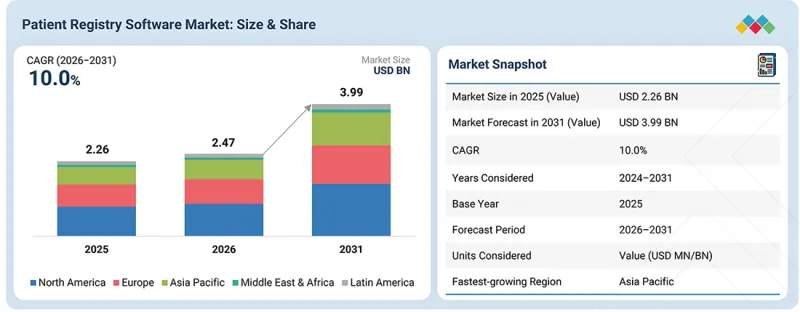
The global patient registry software market is projected to grow from USD 2.47 billion in 2026 to USD 3.99 billion by 2031, at a CAGR of 10.0% during the forecast period. The rising burden of chronic and rare diseases is driving demand for patient registry software as healthcare providers, research organizations, and public health agencies seek to improve disease monitoring, treatment evaluation, and long-term patient care. Conditions such as cancer, cardiovascular diseases, diabetes, and rare genetic disorders often require continuous tracking of disease progression, treatment responses, and patient outcomes. Patient registry software enables organizations to systematically collect and manage longitudinal patient data, helping researchers identify disease patterns, assess treatment effectiveness, and support real-world evidence generation.
| Scope of the Report | |
|---|---|
| Years Considered for the Study | 2026-2031 |
| Base Year | 2025 |
| Forecast Period | 2026-2031 |
| Units Considered | Value (USD billion) |
| Segments | Product, Use Case, Registry Type, Deployment Model, and End User |
| Regions covered | North America, Europe, Asia, Latin America, and the Middle East & Africa |
As more patients require long-term monitoring, the need for structured, reliable, and accessible patient information is expected to drive adoption of registry solutions across clinical research, healthcare delivery, and public health management.
"By registry type, disease registries accounted for the largest share of the patient registry software market in 2025."
Based on registry type, the patient registry software market is segmented into disease registries and product registries. The disease registries segment accounted for the largest share of the market in 2025, driven by the growing need to monitor chronic and rare diseases, track treatment outcomes, and support clinical research. Disease registries collect and organize patient-level information related to conditions such as cancer, cardiovascular diseases, diabetes, and rare disorders, enabling healthcare providers, researchers, and public health agencies to assess disease progression and evaluate treatment effectiveness. The rising burden of chronic diseases and the growing emphasis on real-world evidence and long-term patient monitoring are further supporting adoption. In addition, disease registries help organizations identify patient populations, evaluate care variations, and improve disease surveillance, strengthening their role in clinical research, healthcare quality improvement, and population health management.
"By deployment model, cloud-based models are expected to register the fastest growth in the patient registry software market during the forecast period."
By deployment model, the patient registry software market is segmented into on-premises and cloud-based models. The cloud-based segment is expected to grow fastest during the forecast period, driven by the growing need for scalable, accessible, and cost-efficient platforms to manage patient data. Cloud-based registry solutions allow healthcare providers, research organizations, pharmaceutical companies, and public health agencies to access and manage registry information across multiple locations without relying entirely on locally maintained IT infrastructure. These platforms can simplify software updates, support collaboration, and facilitate integration with electronic health records and other healthcare data sources. In addition, the growing focus on real-world evidence generation, longitudinal patient monitoring, and digital health transformation is encouraging organizations to adopt flexible registry platforms. The potential to reduce upfront infrastructure requirements and scale capacity as data volumes grow further supports cloud-based adoption.
"North America accounted for the largest share of the patient registry software market in 2025."
Based on region, the patient registry software market is segmented into North America, Europe, Asia Pacific, Latin America, and the Middle East & Africa. North America accounted for the largest share in 2025, supported by its established healthcare infrastructure, high adoption of digital health technologies, and strong clinical research ecosystem. Pharmaceutical companies, healthcare providers, research institutions, and specialized registry software vendors support demand for solutions that enable longitudinal patient monitoring, clinical data management, and real-world evidence generation. In addition, initiatives focused on healthcare quality improvement, disease surveillance, and post-market safety monitoring encourage the use of patient registries across clinical and public health settings. The growing integration of electronic health records, investments in healthcare analytics, and emphasis on data-driven clinical decision-making further support the region's leading market position.
The breakdown of primary participants is as mentioned below:
- By Company Type: Tier 1 (45%), Tier 2 (30%), and Tier 3 (25%)
- By Designation: C-level Executives (42%), Directors (31%), and Others (27%)
- By Region: North America (35%), Asia Pacific (30%), Europe (25%), Latin America (5%), and the Middle East & Africa (5%)
IBM (US) and IQVIA (US) are key players in the patient registry software market. The study includes an in-depth competitive analysis of these key players, including their company profiles, recent developments, and key market strategies.
Research Coverage:
The report analyzes the patient registry software market and estimates the market size and future growth potential across segments by product, use case, registry type, deployment model, end user, and region. The report also analyzes factors (such as drivers, opportunities, and challenges) affecting market growth. It evaluates market opportunities and challenges for stakeholders. The report also examines micromarkets, including their growth trends, prospects, and contributions to the total patient registry software market. The report forecasts revenue for market segments across five major regions. The report also provides a competitive analysis of key players, including company profiles, product offerings, recent developments, and key market strategies.
Reasons to Buy the Report
This report helps established firms and new entrants/smaller firms gauge the market pulse, which can help them gain greater market share. Firms purchasing the report could use one or more of the strategies below to strengthen their market position.
This report provides insights on:
- Analysis of key drivers (rising burden of chronic and rare diseases, shift toward value-based and patient-centered care, expansion of real-world evidence (RWE) and post-marketing surveillance needs, increasing use of digital health technologies and interoperable EHRs, and government and regulatory incentives for registry implementation), restraints (shortage of trained and skilled resources and high implementation and maintenance costs), opportunities (expansion of population health management and outcomes tracking, rising demand for pregnancy and congenital anomaly registries for maternal-fetal safety monitoring, and growing preference for subscription-based deployment models), and challenges (privacy and data security-related concerns, reluctance to adopt advanced patient registry solutions, and limited awareness among healthcare stakeholders) are factors contributing to the growth of the patient registry software market.
- Product Development/Innovation: Detailed insights into upcoming trends, research & development activities, and new software launches in the patient registry software market.
- Market Development: Comprehensive information on the lucrative emerging markets, registry types, use cases, deployment models, and end users.
- Market Diversification: Exhaustive information about the software portfolios, growing geographies, recent developments, and investments in the patient registry software market.
- Competitive Assessment: In-depth assessment of market shares, growth strategies, and service offerings of leading players like IBM (US), IQVIA (US), Health Catalyst (US), Oracle (US), Optum, Inc. (US), Conduent Incorporated (US), and Elekta (Sweden).
TABLE OF CONTENTS
1 INTRODUCTION
- 1.1 STUDY OBJECTIVES
- 1.2 MARKET DEFINITION
- 1.3 MARKET SCOPE
- 1.3.1 MARKET SEGMENTATION & REGIONAL SCOPE
- 1.3.2 INCLUSIONS & EXCLUSIONS
- 1.3.3 YEARS CONSIDERED
- 1.4 CURRENCY CONSIDERED
- 1.5 STAKEHOLDERS
- 1.6 SUMMARY OF CHANGES
2 EXECUTIVE SUMMARY
- 2.1 KEY INSIGHTS AND MARKET HIGHLIGHTS
- 2.2 KEY MARKET PARTICIPANTS: SHARE INSIGHTS AND STRATEGIC DEVELOPMENTS
- 2.3 DISRUPTIVE TRENDS SHAPING THE MARKET
- 2.4 HIGH-GROWTH SEGMENTS & EMERGING FRONTIERS
- 2.5 SNAPSHOT: GLOBAL MARKET SIZE, GROWTH RATE, AND FORECAST
3 PREMIUM INSIGHTS
- 3.1 PATIENT REGISTRY SOFTWARE MARKET OVERVIEW
- 3.2 NORTH AMERICA: PATIENT REGISTRY SOFTWARE MARKET, BY REGISTRY TYPE AND COUNTRY
- 3.3 PATIENT REGISTRY SOFTWARE MARKET: GEOGRAPHICAL GROWTH OPPORTUNITIES
4 MARKET OVERVIEW
- 4.1 INTRODUCTION
- 4.2 MARKET DYNAMICS
- 4.2.1 DRIVERS
- 4.2.1.1 Rising burden of chronic and rare diseases
- 4.2.1.2 Shift toward value-based and patient-centered care
- 4.2.1.3 Expansion of real-world evidence (rwe) and post-marketing surveillance needs
- 4.2.1.4 Increasing use of digital health technologies and interoperable ehrs
- 4.2.1.5 Government and regulatory incentives for registry implementation
- 4.2.2 RESTRAINTS
- 4.2.2.1 Shortage of trained and skilled resources
- 4.2.2.2 High implementation and maintenance costs
- 4.2.3 OPPORTUNITIES
- 4.2.3.1 Expansion of population health management and outcomes tracking
- 4.2.3.2 Rising demand for pregnancy and congenital anomaly registries for maternal-fetal safety monitoring
- 4.2.3.3 Growing preference for subscription-based deployment models
- 4.2.4 CHALLENGES
- 4.2.4.1 Privacy- and data security-related concerns
- 4.2.4.2 Reluctance to adopt advanced patient registry solutions
- 4.2.4.3 Limited awareness among healthcare stakeholders
- 4.2.1 DRIVERS
- 4.3 UNMET NEEDS AND WHITE SPACES
- 4.4 INTERCONNECTED MARKETS AND CROSS-SECTOR OPPORTUNITIES
- 4.5 STRATEGIC MOVES BY TIER-1/2/3 PLAYERS
5 INDUSTRY TRENDS
- 5.1 PORTER'S FIVE FORCES ANALYSIS
- 5.1.1 INTENSITY OF COMPETITIVE RIVALRY
- 5.1.2 BARGAINING POWER OF BUYERS
- 5.1.3 THREAT OF SUBSTITUTES
- 5.1.4 THREAT OF NEW ENTRANTS
- 5.1.5 BARGAINING POWER OF SUPPLIERS
- 5.2 MACROECONOMIC INDICATORS
- 5.2.1 INTRODUCTION
- 5.2.2 GDP TRENDS AND FORECAST
- 5.2.3 TRENDS IN GLOBAL HEALTHCARE IT INDUSTRY
- 5.3 VALUE CHAIN ANALYSIS
- 5.3.1 RESEARCH & PRODUCT DEVELOPMENT
- 5.3.2 TECHNOLOGY INFRASTRUCTURE
- 5.3.3 PLATFORM DEVELOPMENT
- 5.3.4 DISTRIBUTION
- 5.3.5 MARKETING & SALES
- 5.3.6 POST-SALES SERVICES
- 5.4 ECOSYSTEM ANALYSIS
- 5.5 PRICING ANALYSIS
- 5.5.1 INDICATIVE PRICE OF PATIENT REGISTRY SOFTWARE, BY END USER (2025)
- 5.5.2 INDICATIVE PRICE OF PATIENT REGISTRY SOFTWARE, BY REGION (2025)
- 5.6 KEY CONFERENCES & EVENTS, 2026-2027
- 5.7 TRENDS/DISRUPTIONS IMPACTING CUSTOMERS' BUSINESSES
- 5.8 INVESTMENT & FUNDING SCENARIO
- 5.9 CASE STUDY ANALYSIS
- 5.10 IMPACT OF US TARIFF OVERVIEW
- 5.10.1 INTRODUCTION
- 5.11 KEY TARIFF RATES
- 5.11.1 PRICE IMPACT ANALYSIS
- 5.11.2 IMPACT ON COUNTRY/REGION
- 5.11.2.1 US
- 5.11.2.2 Europe
- 5.11.2.3 Asia Pacific
- 5.11.3 IMPACT ON END USERS
- 5.11.3.1 Healthcare providers
- 5.11.3.2 Pharmaceutical and biotechnology companies
- 5.11.3.3 Research institutions and government agencies
6 STRATEGIC DISRUPTION THROUGH TECHNOLOGY, PATENTS, DIGITAL, AND AI ADOPTION
- 6.1 KEY EMERGING TECHNOLOGIES
- 6.1.1 ELECTRONIC DATA CAPTURE (EDC) SYSTEMS
- 6.1.1.1 Cloud computing & saas architecture
- 6.1.1.2 Data privacy & security technologies
- 6.1.2 COMPLEMENTARY TECHNOLOGIES
- 6.1.2.1 Electronic health record (ehr) systems
- 6.1.2.2 Clinical trial management systems (ctms)
- 6.1.3 ADJACENT TECHNOLOGIES
- 6.1.3.1 Digital therapeutics (dtx) platforms
- 6.1.3.2 Wearable devices & remote monitoring tools
- 6.1.3.3 Blockchain for health data management
- 6.1.1 ELECTRONIC DATA CAPTURE (EDC) SYSTEMS
- 6.2 TECHNOLOGY/PRODUCT ROADMAP
- 6.3 PATENT ANALYSIS
- 6.3.1 PATENT PUBLICATION TRENDS FOR PATIENT REGISTRY SOFTWARE MARKET
- 6.3.2 INSIGHTS: JURISDICTION AND TOP APPLICANT ANALYSIS
- 6.4 FUTURE APPLICATIONS
- 6.4.1 AI-ASSISTED DATA COLLECTION AND CLINICAL OUTCOME ANALYSIS
- 6.4.2 INTEROPERABLE REGISTRIES AND PATIENT-CENTRIC DATA INTEGRATION
- 6.5 IMPACT OF AI/GEN AI ON PATIENT REGISTRY SOFTWARE MARKET
- 6.5.1 KEY USE CASES
- 6.5.2 CASE STUDIES OF AI/GENERATIVE AI IMPLEMENTATION
- 6.5.2.1 Case study: AI-powered data summarization improves registry utilization efficiency
- 6.5.3 IMPACT OF AI/GEN AI ON INTERCONNECTED AND ADJACENT ECOSYSTEM
- 6.5.4 ELECTRONIC HEALTH RECORD (EHR) MARKET
- 6.5.5 REAL WORLD EVIDENCE (RWE) MARKET
- 6.5.6 REAL WORLD EVIDENCE (RWE) MARKET
- 6.5.7 USER READINESS AND IMPACT ASSESSMENT
- 6.5.7.1 User readiness
- 6.5.7.1.1 Profit registries
- 6.5.7.1.2 Nonprofit registries
- 6.5.7.1.3 Others
- 6.5.7.2 Impact assessment
- 6.5.7.2.1 Profit registries
- 6.5.7.2.1.1 Implementation
- 6.5.7.2.1.2 Impact
- 6.5.7.2.2 Nonprofit registries
- 6.5.7.2.2.1 Implementation
- 6.5.7.2.2.2 Impact
- 6.5.7.2.3 Other end users
- 6.5.7.2.3.1 Implementation
- 6.5.7.2.3.2 Impact
- 6.5.7.2.1 Profit registries
- 6.5.7.1 User readiness
7 REGULATORY LANDSCAPE
- 7.1 REGIONAL REGULATIONS AND COMPLIANCE
- 7.2 REGULATORY ANALYSIS
- 7.2.1 REGULATORY BODIES, GOVERNMENT AGENCIES, AND OTHER ORGANIZATIONS
- 7.2.2 REGULATORY LANDSCAPE
- 7.2.2.1 North america
- 7.2.2.2 Europe
- 7.2.2.3 Asia pacific
- 7.2.2.4 Middle East & Africa
- 7.2.2.5 Latin America
- 7.2.3 INDUSTRY STANDARDS
8 CUSTOMER LANDSCAPE & BUYER BEHAVIOR
- 8.1 INTRODUCTION
- 8.2 DECISION-MAKING PROCESS
- 8.3 BUYER STAKEHOLDERS AND BUYING EVALUATION CRITERIA
- 8.4 KEY STAKEHOLDERS & BUYING CRITERIA
- 8.4.1 KEY STAKEHOLDERS IN BUYING PROCESS
- 8.4.2 KEY BUYING CRITERIA
- 8.5 ADOPTION BARRIERS & INTERNAL CHALLENGES
- 8.6 UNMET NEEDS FROM VARIOUS END USERS
- 8.6.1 UNMET NEEDS
- 8.6.2 END-USER EXPECTATIONS
- 8.7 MARKET PROFITABILITY
9 PATIENT REGISTRY SOFTWARE MARKET, BY PRODUCT
- 9.1 INTRODUCTION
- 9.2 DIRECT-TO-PATIENT (PATIENT-RECORDED) REGISTRIES
- 9.2.1 INCREASING PATIENT ENGAGEMENT AND DEMAND FOR SELF-REPORTED DATA
- 9.3 SITE-BASED/CLINICAL DATA (PROVIDER-RECORDED) REGISTRIES
- 9.3.1 GROWING NEED FOR ACCURATE, CLINICIAN-VERIFIED DATA AND SEAMLESS EHR INTEGRATION
10 PATIENT REGISTRY SOFTWARE MARKET, BY USE CASE
- 10.1 INTRODUCTION
- 10.2 MEDICAL RESEARCH & CLINICAL STUDIES
- 10.2.1 LEVERAGING REGISTRIES TO ENHANCE REAL-WORLD EVIDENCE AND CLINICAL TRIAL EFFICIENCY
- 10.3 QUALITY IMPROVEMENT
- 10.3.1 EVIDENCE-BASED PRACTICE AND PERFORMANCE BENCHMARKING DRIVING SEGMENTAL GROWTH
- 10.4 PATIENT CARE MANAGEMENT
- 10.4.1 EMPOWERING PROACTIVE CHRONIC DISEASE MANAGEMENT THROUGH CENTRALIZED REGISTRIES
- 10.5 POPULATION HEALTH
- 10.5.1 EXPANDING ROLE OF PATIENT MANAGEMENT SYSTEMS IN DRIVING DIGITAL TRANSFORMATION
- 10.6 POINT OF CARE SUPPORT
- 10.6.1 SPECIALTY INFORMATION MANAGEMENT SOLUTIONS DRIVING EFFICIENCY AND QUALITY IN HEALTHCARE
- 10.7 PUBLIC HEALTH SURVEILLANCE
- 10.7.1 OPTIMIZING CHRONIC CARE COORDINATION DRIVING THE SEGMENTAL GROWTH
- 10.8 PATIENT SELF-CARE
- 10.8.1 GROWING EMPHASIS ON PATIENT EMPOWERMENT AND SELF-MANAGEMENT
- 10.9 PATIENT ENGAGEMENT
- 10.9.1 STRENGTHENING PATIENT PARTICIPATION AND COMMUNICATION
- 10.10 OTHER USE CASES
- 10.10.1 SUPPORTING DIVERSE NEEDS ACROSS THE HEALTHCARE ECOSYSTEM
11 PATIENT REGISTRY SOFTWARE MARKET, BY REGISTRY TYPE
- 11.1 INTRODUCTION
- 11.2 DISEASE REGISTRIES
- 11.2.1 RISING CASES OF CHRONIC DISEASE LEADING TO TRACKING AND EVIDENCE-BASED CARES
- 11.2.2 DIABETES REGISTRIES
- 11.2.2.1 Tracking trends and improving diabetes care
- 11.2.3 CARDIOVASCULAR REGISTRIES
- 11.2.3.1 Enhancing care quality and reducing heart disease burden
- 11.2.4 CANCER REGISTRIES
- 11.2.4.1 Informing cancer control strategies and advancing research
- 11.2.5 RARE DISEASE REGISTRIES
- 11.2.5.1 Facilitating orphan drug development and patient support
- 11.2.6 ASTHMA REGISTRIES
- 11.2.6.1 Improving asthma management and reducing exacerbations
- 11.2.7 CHRONIC KIDNEY REGISTRIES
- 11.2.7.1 Optimizing ckd care and supporting research
- 11.2.8 ORTHOPEDIC REGISTRIES
- 11.2.8.1 Monitoring implants and enhancing musculoskeletal care
- 11.2.9 IMMUNIZATION REGISTRIES
- 11.2.9.1 Strengthening vaccine coverage and safety monitoring
- 11.2.10 BIRTH DEFECT REGISTRIES
- 11.2.10.1 Tracking and preventing congenital anomalies through birth defect registries
- 11.2.11 OTHER DISEASE REGISTRIES
- 11.2.11.1 Capturing data on diverse conditions for comprehensive research
- 11.3 PRODUCT REGISTRIES
- 11.3.1 ENSURING SAFETY, PERFORMANCE, AND POST-MARKET SURVEILLANCE OF MEDICAL DEVICES AND DRUGS
- 11.3.2 MEDICAL DEVICE REGISTRIES
- 11.3.2.1 Enhancing safety, performance monitoring, and regulatory compliance
- 11.3.3 DRUG REGISTRIES
- 11.3.3.1 Supporting long-term safety, real-world evidence, and optimal therapy use
12 PATIENT REGISTRY SOFTWARE MARKET, BY DEPLOYMENT MODEL
- 12.1 INTRODUCTION
- 12.2 ON-PREMISE DEPLOYMENT MODEL
- 12.2.1 GROWING DEMAND FOR SECURITY, CONTROL, AND COMPLIANCE DRIVING MARKET GROWTH
- 12.3 CLOUD-BASED DEPLOYMENT MODEL
- 12.3.1 SCALABILITY, INTEROPERABILITY, AND COST-EFFECTIVENESS DRIVING GROWTH OF CLOUD-BASED DEPLOYMENT
13 PATIENT REGISTRY SOFTWARE MARKET, BY END USER
- 13.1 INTRODUCTION
- 13.2 PROFIT REGISTRIES
- 13.2.1 RISING CASES OF CHRONIC DISEASE LEADING TO TRACKING AND EVIDENCE-BASED CARES
- 13.2.2 PHARMACEUTICAL, BIOTECHNOLOGY & MEDTECH COMPANIES
- 13.2.2.1 Driving innovation and post-market surveillance
- 13.2.3 HEALTHCARE PAYERS
- 13.2.3.1 Enabling risk stratification and value-based contracting
- 13.2.4 HEALTHCARE PROVIDERS
- 13.2.4.1 Operationalizing quality improvement and clinical benchmarking
- 13.2.4.2 Hospitals
- 13.2.4.2.1 Central hubs for comprehensive patient data collection and care coordination
- 13.2.4.3 Clinics & outpatient settings
- 13.2.4.3.1 Growing demand for ambulatory care and real-time patient monitoring
- 13.2.4.4 Other healthcare providers
- 13.2.4.4.1 Expanding integration of diverse health services into digital registries
- 13.2.5 NON-PROFIT REGISTRIES
- 13.2.5.1 Supporting public health, advocacy, and evidence-based guidelines
- 13.2.6 MEDICAL SPECIALTY SOCIETIES
- 13.2.6.1 Driving quality standards through clinical expertise
- 13.2.7 PATIENT ORGANIZATIONS
- 13.2.7.1 Empowering patients and amplifying advocacy efforts
- 13.2.8 GOVERNMENT & THIRD-PARTY ADMINISTRATORS
- 13.2.8.1 Enabling public health surveillance and policy planning
- 13.2.9 OTHER END USERS
- 13.2.9.1 Advancing research and trial excellence
14 PATIENT REGISTRY SOFTWARE MARKET, BY REGION
- 14.1 INTRODUCTION
- 14.2 NORTH AMERICA
- 14.2.1 MACROECONOMIC OUTLOOK FOR NORTH AMERICA
- 14.2.2 US
- 14.2.2.1 Us to dominate global market for patient registry software
- 14.2.3 CANADA
- 14.2.3.1 Government investment, collaborative initiatives, and strong push to standardize rare disease registries to drive growth
- 14.3 EUROPE
- 14.3.1 MACROECONOMIC OUTLOOK FOR EUROPE
- 14.3.2 UK
- 14.3.2.1 Growing incidence of cancer to drive market growth
- 14.3.3 GERMANY
- 14.3.3.1 National rollout of e-patient files and rare disease registries to strengthen patient care and research
- 14.3.4 FRANCE
- 14.3.4.1 Growing patient registry adoption with national data platforms and rare disease initiatives to support market growth
- 14.3.5 ITALY
- 14.3.5.1 Growing number of national networks and disease-specific registries to drive growth
- 14.3.6 SPAIN
- 14.3.6.1 Growing need to address rising chronic and cardiovascular disease prevalence to drive adoption
- 14.3.7 REST OF EUROPE
- 14.4 ASIA PACIFIC
- 14.4.1 MACROECONOMIC OUTLOOK FOR ASIA PACIFIC
- 14.4.2 JAPAN
- 14.4.2.1 Japan's aging population and advanced digital strategies to drive growth in patient registry software market
- 14.4.3 CHINA
- 14.4.3.1 Robust national registries and expanding pharmaceutical approvals to drive patient registry software market
- 14.4.4 INDIA
- 14.4.4.1 Digital health advances to boost india's patient registry software market
- 14.4.5 REST OF ASIA PACIFIC
- 14.5 LATIN AMERICA
- 14.5.1 MACROECONOMIC OUTLOOK FOR LATIN AMERICA
- 14.5.2 BRAZIL
- 14.5.2.1 Brazil to dominate patient registry software market in latin america
- 14.5.3 MEXICO
- 14.5.3.1 Increase in focus of digital health to boost market growth
- 14.5.4 REST OF LATIN AMERICA
- 14.6 MIDDLE EAST & AFRICA
- 14.6.1 MACROECONOMIC OUTLOOK FOR MIDDLE EAST & AFRICA
- 14.6.2 GCC COUNTRIES
- 14.6.2.1 Rising healthcare investments to fuel uptake
- 14.6.3 REST OF MIDDLE EAST & AFRICA
15 COMPETITIVE LANDSCAPE
- 15.1 OVERVIEW
- 15.2 KEY PLAYER STRATEGIES/RIGHT TO WIN
- 15.2.1 OVERVIEW OF STRATEGIES ADOPTED BY KEY PLAYERS IN PATIENT REGISTRY SOFTWARE MARKET
- 15.3 REVENUE ANALYSIS, 2020-2024
- 15.4 MARKET SHARE ANALYSIS, 2025
- 15.5 BRAND/SOFTWARE COMPARISON
- 15.6 COMPANY VALUATION & FINANCIAL METRICS
- 15.6.1 FINANCIAL METRICS
- 15.6.2 COMPANY VALUATION
- 15.7 COMPANY EVALUATION MATRIX: KEY PLAYERS, 2025
- 15.7.1 STARS
- 15.7.2 EMERGING LEADERS
- 15.7.3 PERVASIVE PLAYERS
- 15.7.4 PARTICIPANTS
- 15.7.5 COMPANY FOOTPRINT: KEY PLAYERS, 2025
- 15.7.5.1 Company footprint
- 15.7.5.2 Region footprint
- 15.7.5.3 Product footprint
- 15.7.5.4 Registry type footprint
- 15.7.5.5 Deployment model footprint
- 15.8 COMPANY EVALUATION MATRIX: STARTUPS/SMES, 2025
- 15.8.1 PROGRESSIVE COMPANIES
- 15.8.2 RESPONSIVE COMPANIES
- 15.8.3 DYNAMIC COMPANIES
- 15.8.4 STARTING BLOCKS
- 15.8.5 COMPETITIVE BENCHMARKING: STARTUPS/SMES, 2025
- 15.8.5.1 Detailed list of key startups/SMEs
- 15.8.5.2 Competitive benchmarking of startups/SMEs
- 15.8.5.2.1 Region footprint
- 15.8.5.2.2 Registry type footprint
- 15.9 COMPETITIVE SCENARIO
- 15.9.1 PRODUCT LAUNCHES, APPROVALS, AND ENHANCEMENTS
- 15.9.2 DEALS
- 15.9.3 OTHER DEVELOPMENTS
16 COMPANY PROFILES
- 16.1 KEY PLAYERS
- 16.1.1 IBM
- 16.1.1.1 Business overview
- 16.1.1.2 Products/Services/Solutions offered
- 16.1.1.3 Recent developments
- 16.1.1.3.1 Product launches & upgrades
- 16.1.1.3.2 Deals
- 16.1.1.4 MnM view
- 16.1.1.4.1 Right to win
- 16.1.1.4.2 Strategic choices
- 16.1.1.4.3 Weaknesses & competitive threats
- 16.1.2 IQVIA
- 16.1.2.1 Business overview
- 16.1.2.2 Products/Services/Solutions offered
- 16.1.2.3 Recent developments
- 16.1.2.3.1 Product launches & upgrades
- 16.1.2.3.2 Deals
- 16.1.2.4 MnM view
- 16.1.2.4.1 Right to win
- 16.1.2.4.2 Strategic choices
- 16.1.2.4.3 Weaknesses & competitive threats
- 16.1.3 HEALTH CATALYST, INC.
- 16.1.3.1 Business overview
- 16.1.3.2 2.2 Products/Services/Solutions offered
- 16.1.3.3 Recent developments
- 16.1.3.3.1 Product launches & upgrades
- 16.1.3.3.2 Deals
- 16.1.3.3.3 Other developments
- 16.1.3.4 MnM view
- 16.1.3.4.1 Right to win
- 16.1.3.4.2 Strategic choices
- 16.1.3.4.3 Weaknesses & competitive threats
- 16.1.4 ORACLE
- 16.1.4.1 Business overview
- 16.1.4.2 Products/Services/Solutions offered
- 16.1.4.3 Recent developments
- 16.1.4.3.1 Product launches & upgrades
- 16.1.4.3.2 Deals
- 16.1.4.4 MnM view
- 16.1.4.4.1 Right to win
- 16.1.4.4.2 Strategic choices
- 16.1.4.4.3 Weaknesses & competitive threats
- 16.1.5 OPTUM, INC.
- 16.1.5.1 Business overview
- 16.1.5.2 Products/Services/Solutions offered
- 16.1.5.3 Recent developments
- 16.1.5.3.1 Product launches & upgrades
- 16.1.5.3.2 Deals
- 16.1.5.4 Mnm view
- 16.1.5.4.1 Right to win
- 16.1.5.4.2 Strategic choices
- 16.1.5.4.3 Weaknesses & competitive threats
- 16.1.6 CONDUENT INCORPORATED
- 16.1.6.1 Business overview
- 16.1.6.2 Products/Services/Solutions offered
- 16.1.6.3 Recent developments
- 16.1.6.3.1 Deals
- 16.1.7 ELEKTA
- 16.1.7.1 Business overview
- 16.1.7.2 Products/Services/Solutions offered
- 16.1.7.3 Recent developments
- 16.1.7.3.1 Deals
- 16.1.8 NEC CORPORATION (NEC SOFTWARE SOLUTIONS UK LIMITED)
- 16.1.8.1 Business overview
- 16.1.8.2 Products/Services/Solutions offered
- 16.1.8.3 Recent developments
- 16.1.8.3.1 Product launches & upgrades
- 16.1.8.3.2 Deals
- 16.1.9 MEDIDATA (DASSAULT SYSTEMES)
- 16.1.9.1 Business overview
- 16.1.9.2 Product/services/solutions offered
- 16.1.9.3 Recent developments
- 16.1.9.3.1 Product launches & upgrades
- 16.1.9.3.2 Deals
- 16.1.10 DACIMA SOFTWARE INC (EVIDENT IQ)
- 16.1.10.1 Business overview
- 16.1.10.2 Products/Services/Solutions offered
- 16.1.10.3 Recent developments
- 16.1.10.3.1 Product launches & upgrades
- 16.1.11 FIGMD, INC. (MRO)
- 16.1.11.1 Business overview
- 16.1.11.2 Products/Services/Solutions offered
- 16.1.11.3 Recent developments
- 16.1.11.3.1 Deals
- 16.1.11.3.2 Other developments
- 16.1.12 IMAGETREND
- 16.1.12.1 Business overview
- 16.1.12.2 Products/Services/Solutions offered
- 16.1.12.3 Recent developments
- 16.1.12.3.1 Product launches & upgrades
- 16.1.12.3.2 Deals
- 16.1.13 GLOBAL VISION TECHNOLOGIES, INC.
- 16.1.13.1 Business overview
- 16.1.13.2 Products/services/solutions offered
- 16.1.13.3 Recent developments
- 16.1.13.3.1 Product launches & upgrades
- 16.1.13.3.2 Deals
- 16.1.14 SYNEOS HEALTH
- 16.1.14.1 Business overview
- 16.1.14.2 Products/Services/Solutions offered
- 16.1.14.3 Recent developments
- 16.1.14.3.1 Deals
- 16.1.15 VERADIGM LLC
- 16.1.15.1 Business overview
- 16.1.15.2 Products/Services/Solutions Offered
- 16.1.15.3 Recent developments
- 16.1.15.3.1 Product launches & upgrades
- 16.1.15.3.2 Deals
- 16.1.16 ESO
- 16.1.16.1 Business overview
- 16.1.16.2 Products/Services/Solutions offered
- 16.1.16.3 Recent developments
- 16.1.16.3.1 Product launches & upgrades
- 16.1.16.3.2 Deals
- 16.1.17 ORDINAL DATA INC.
- 16.1.17.1 Business overview
- 16.1.17.2 Products/Services/Solutions offered
- 16.1.18 CEDARON MEDICAL
- 16.1.18.1 Business overview
- 16.1.18.2 Products/Services/Solutions offered
- 16.1.18.3 Recent developments
- 16.1.18.3.1 Deals
- 16.1.19 FIVOS HEALTH
- 16.1.19.1 Business overview
- 16.1.19.2 Products/Services/Solutions offered
- 16.1.19.3 Recent developments
- 16.1.19.3.1 Deals
- 16.1.20 ACROSS HEALTHCARE
- 16.1.20.1 Business overview
- 16.1.20.2 Products/Services/Solutions offered
- 16.1.20.3 Recent developments
- 16.1.20.3.1 Deals
- 16.1.1 IBM
- 16.2 OTHER PLAYERS
- 16.2.1 VERANA HEALTH
- 16.2.2 PULSE INFOFRAME INC.
- 16.2.3 AMPLITUDE CLINICAL OUTCOMES
- 16.2.4 NPHASE, INC. (REDCAP CLOUD)
- 16.2.5 OM1
17 RESEARCH METHODOLOGY
- 17.1 RESEARCH DATA
- 17.1.1 SECONDARY RESEARCH
- 17.1.1.1 Key data from secondary sources
- 17.1.2 PRIMARY RESEARCH
- 17.1.2.1 Key data from primary sources
- 17.1.2.2 Breakdown of primary sources
- 17.1.1 SECONDARY RESEARCH
- 17.2 RESEARCH METHODOLOGY DESIGN
- 17.3 MARKET SIZE ESTIMATION
- 17.4 MARKET BREAKDOWN & DATA TRIANGULATION
- 17.5 MARKET SHARE ESTIMATION
- 17.6 STUDY ASSUMPTIONS
- 17.7 LIMITATIONS
- 17.7.1 METHODOLOGY-RELATED LIMITATIONS
- 17.7.2 SCOPE-RELATED LIMITATIONS
- 17.8 RISK ASSESSMENT
18 APPENDIX
- 18.1 DISCUSSION GUIDE
- 18.2 KNOWLEDGESTORE: MARKETSANDMARKETS' SUBSCRIPTION PORTAL
- 18.3 CUSTOMIZATION OPTIONS
- 18.4 RELATED REPORTS
- 18.5 AUTHOR DETAILS
List of Tables
- TABLE 1 EXCHANGE RATES UTILIZED FOR CONVERSION TO USD
- TABLE 2 US: HEALTHCARE DATA BREACHES
- TABLE 3 PATIENT REGISTRY SOFTWARE MARKET: PORTER'S FIVE FORCES ANALYSIS
- TABLE 4 PATIENT REGISTRY SOFTWARE MARKET: ROLE IN ECOSYSTEM
- TABLE 5 INDICATIVE PRICE OF PATIENT REGISTRY SOFTWARE, BY END USER (2025)
- TABLE 6 INDICATIVE PRICE FOR PATIENT REGISTRY SOFTWARE, BY REGION (2025)
- TABLE 7 KEY CONFERENCES & EVENTS, 2026-2027
- TABLE 8 CASE STUDY 1: CANCER REGISTRY IMPLEMENTATION WITH DACIMA CLINICAL SUITE
- TABLE 9 CASE STUDY 2: ENHANCING REAL-WORLD EVIDENCE WITH CASTOR RWE
- TABLE 10 CASE STUDY 3: DEVICE DATA INTEGRATION USING MEDIREPORT 360
- TABLE 11 CASE STUDY 4: CANCER REGISTRY IMPLEMENTATION WITH ELEKTA METRIQ
- TABLE 12 US ADJUSTED RECIPROCAL TARIFF RATES
- TABLE 13 TOP APPLICANTS FOR PATIENT REGISTRY SOFTWARE
- TABLE 14 PATIENT REGISTRY SOFTWARE MARKET: LIST OF PATENTS/PATENT APPLICATIONS
- TABLE 15 NORTH AMERICA: REGULATORY BODIES, GOVERNMENT AGENCIES, AND OTHER ORGANIZATIONS
- TABLE 16 EUROPE: REGULATORY BODIES, GOVERNMENT AGENCIES, AND OTHER ORGANIZATIONS
- TABLE 17 ASIA PACIFIC: REGULATORY BODIES, GOVERNMENT AGENCIES, AND OTHER ORGANIZATIONS
- TABLE 18 LATIN AMERICA: REGULATORY BODIES, GOVERNMENT AGENCIES, AND OTHER ORGANIZATIONS
- TABLE 19 MIDDLE EAST & AFRICA: REGULATORY BODIES, GOVERNMENT AGENCIES, AND OTHER ORGANIZATIONS
- TABLE 20 REGULATORY SCENARIO OF NORTH AMERICA
- TABLE 21 REGULATORY SCENARIO OF EUROPE
- TABLE 22 REGULATORY SCENARIO OF ASIA PACIFIC
- TABLE 23 REGULATORY SCENARIO OF MIDDLE EAST & AFRICA
- TABLE 24 REGULATORY SCENARIO OF LATIN AMERICA
- TABLE 25 INFLUENCE OF STAKEHOLDERS ON BUYING PROCESS OF TOP THREE END USERS (%)
- TABLE 26 KEY BUYING CRITERIA FOR TOP THREE END USERS
- TABLE 27 UNMET NEEDS IN PATIENT REGISTRY SOFTWARE MARKET
- TABLE 28 END USER EXPECTATIONS IN PATIENT REGISTRY SOFTWARE MARKET
- TABLE 29 PATIENT REGISTRY SOFTWARE MARKET, BY PRODUCT, 2024-2031 (USD MILLION)
- TABLE 30 PATIENT REGISTRY SOFTWARE MARKET FOR DIRECT-TO-PATIENT (PATIENT-RECORDED) REGISTRIES, BY REGION, 2024-2031 (USD MILLION)
- TABLE 31 PATIENT REGISTRY SOFTWARE MARKET FOR SITE-BASED/CLINICAL DATA (PROVIDER-RECORDED) REGISTRIES, BY REGION, 2024-2031 (USD MILLION)
- TABLE 32 PATIENT REGISTRY SOFTWARE MARKET, BY USE CASE, 2024-2031 (USD MILLION)
- TABLE 33 PATIENT REGISTRY SOFTWARE MARKET FOR MEDICAL RESEARCH & CLINICAL STUDIES, BY REGION, 2024-2031 (USD MILLION)
- TABLE 34 PATIENT REGISTRY SOFTWARE MARKET FOR QUALITY IMPROVEMENT, BY REGION, 2024-2031 (USD MILLION)
- TABLE 35 PATIENT REGISTRY SOFTWARE MARKET FOR PATIENT CARE MANAGEMENT, BY REGION, 2024-2031 (USD MILLION)
- TABLE 36 PATIENT REGISTRY SOFTWARE MARKET FOR POPULATION HEALTH, BY REGION, 2024-2031 (USD MILLION)
- TABLE 37 PATIENT REGISTRY SOFTWARE MARKET FOR POINT OF CARE SUPPORT, BY REGION, 2024-2031 (USD MILLION)
- TABLE 38 PATIENT REGISTRY SOFTWARE MARKET FOR PUBLIC HEALTH SURVEILLANCE, BY REGION, 2024-2031 (USD MILLION)
- TABLE 39 PATIENT REGISTRY SOFTWARE MARKET FOR PATIENT SELF-CARE, BY REGION, 2024-2031 (USD MILLION)
- TABLE 40 PATIENT REGISTRY SOFTWARE MARKET FOR PATIENT ENGAGEMENT, BY REGION, 2024-2031 (USD MILLION)
- TABLE 41 PATIENT REGISTRY SOFTWARE MARKET FOR OTHER USE CASES, BY REGION, 2024-2031 (USD MILLION)
- TABLE 42 PATIENT REGISTRY SOFTWARE MARKET, BY REGISTRY TYPE, 2024-2031 (USD MILLION)
- TABLE 43 PATIENT REGISTRY SOFTWARE MARKET, BY DISEASE REGISTRY, 2024-2031 (USD MILLION)
- TABLE 44 PATIENT REGISTRY SOFTWARE MARKET FOR DISEASE REGISTRIES, BY REGION, 2024-2031 (USD MILLION)
- TABLE 45 DIABETES REGISTRIES MARKET, BY REGION, 2024-2031 (USD MILLION)
- TABLE 46 CARDIOVASCULAR REGISTRIES MARKET, BY REGION, 2024-2031 (USD MILLION)
- TABLE 47 CANCER REGISTRIES MARKET, BY REGION, 2024-2031 (USD MILLION)
- TABLE 48 RARE DISEASE REGISTRIES MARKET, BY REGION, 2024-2031 (USD MILLION)
- TABLE 49 ASTHMA REGISTRIES MARKET, BY REGION, 2024-2031 (USD MILLION)
- TABLE 50 CHRONIC KIDNEY REGISTRIES MARKET, BY REGION, 2024-2031 (USD MILLION)
- TABLE 51 ORTHOPEDIC REGISTRIES MARKET, BY REGION, 2024-2031 (USD MILLION)
- TABLE 52 IMMUNIZATION REGISTRIES MARKET, BY REGION, 2024-2031 (USD MILLION)
- TABLE 53 BIRTH DEFECT REGISTRIES MARKET, BY REGION, 2024-2031 (USD MILLION)
- TABLE 54 OTHER DISEASE REGISTRIES MARKET, BY REGION, 2024-2031 (USD MILLION)
- TABLE 55 PATIENT REGISTRY SOFTWARE MARKET, BY PRODUCT REGISTRY, 2024-2031 (USD MILLION)
- TABLE 56 PATIENT REGISTRY SOFTWARE MARKET FOR PRODUCT REGISTRIES, BY REGION, 2024-2031 (USD MILLION)
- TABLE 57 MEDICAL DEVICE REGISTRIES MARKET, BY REGION, 2024-2031 (USD MILLION)
- TABLE 58 DRUG REGISTRIES MARKET, BY REGION, 2024-2031 (USD MILLION)
- TABLE 59 PATIENT REGISTRY SOFTWARE MARKET, BY DEPLOYMENT MODEL, 2024-2031 (USD MILLION)
- TABLE 60 PATIENT REGISTRY SOFTWARE MARKET FOR ON-PREMISE DEPLOYMENT, BY REGION, 2024-2031 (USD MILLION)
- TABLE 61 PATIENT REGISTRY SOFTWARE MARKET FOR CLOUD-BASED DEPLOYMENT, BY REGION, 2024-2031 (USD MILLION)
- TABLE 62 PATIENT REGISTRY SOFTWARE MARKET, BY END USER, 2024-2031 (USD MILLION)
- TABLE 63 PATIENT REGISTRY SOFTWARE MARKET, BY PROFIT REGISTRY, 2024-2031 (USD MILLION)
- TABLE 64 PATIENT REGISTRY SOFTWARE MARKET FOR PROFIT REGISTRIES, BY REGION, 2024-2031 (USD MILLION)
- TABLE 65 PHARMACEUTICAL, BIOTECHNOLOGY & MEDTECH COMPANIES MARKET FOR PROFIT REGISTRIES, BY REGION, 2024-2031 (USD MILLION)
- TABLE 66 HEALTHCARE PAYERS MARKET FOR PROFIT REGISTRIES, BY REGION, 2024-2031 (USD MILLION)
- TABLE 67 HEALTHCARE PROVIDERS MARKET FOR PROFIT REGISTRIES, BY TYPE, 2024-2031 (USD MILLION)
- TABLE 68 HEALTHCARE PROVIDERS MARKET FOR PROFIT REGISTRIES, BY REGION, 2024-2031 (USD MILLION)
- TABLE 69 HOSPITALS: HEALTHCARE PROVIDERS MARKET FOR PROFIT REGISTRIES, BY REGION, 2024-2031 (USD MILLION)
- TABLE 70 CLINICS & OUTPATIENT SETTINGS: HEALTHCARE PROVIDERS MARKET FOR PROFIT REGISTRIES, BY REGION, 2024-2031 (USD MILLION)
- TABLE 71 OTHER HEALTHCARE PROVIDERS MARKET FOR PROFIT REGISTRIES, BY REGION, 2024-2031 (USD MILLION)
- TABLE 72 PATIENT REGISTRY SOFTWARE MARKET, BY NON-PROFIT REGISTRY, 2024-2031 (USD MILLION)
- TABLE 73 PATIENT REGISTRY SOFTWARE MARKET FOR NON-PROFIT REGISTRIES, BY REGION, 2024-2031 (USD MILLION)
- TABLE 74 MEDICAL SPECIALTY SOCIETIES MARKET FOR NON-PROFIT REGISTRIES, BY REGION, 2024-2031 (USD MILLION)
- TABLE 75 PATIENT ORGANIZATIONS MARKET FOR NON-PROFIT REGISTRIES, BY REGION, 2024-2031 (USD MILLION)
- TABLE 76 PATIENT REGISTRY SOFTWARE MARKET FOR GOVERNMENT & THIRD-PARTY ADMINISTRATORS, BY REGION, 2024-2031 (USD MILLION)
- TABLE 77 PATIENT REGISTRY SOFTWARE MARKET FOR OTHER END USERS, BY REGION, 2024-2031 (USD MILLION)
- TABLE 78 PATIENT REGISTRY SOFTWARE MARKET, BY REGION, 2024-2031 (USD MILLION)
- TABLE 79 NORTH AMERICA: PATIENT REGISTRY SOFTWARE MARKET, BY COUNTRY, 2024-2031 (USD MILLION)
- TABLE 80 NORTH AMERICA: PATIENT REGISTRY SOFTWARE MARKET, BY PRODUCT, 2024-2031 (USD MILLION)
- TABLE 81 NORTH AMERICA: PATIENT REGISTRY SOFTWARE MARKET, BY USE CASE, 2024-2031 (USD MILLION)
- TABLE 82 NORTH AMERICA: PATIENT REGISTRY SOFTWARE MARKET, BY REGISTRY TYPE, 2024-2031 (USD MILLION)
- TABLE 83 NORTH AMERICA: PATIENT REGISTRY SOFTWARE MARKET FOR DISEASE REGISTRIES, BY TYPE, 2024-2031 (USD MILLION)
- TABLE 84 NORTH AMERICA: PATIENT REGISTRY SOFTWARE MARKET FOR PRODUCT REGISTRIES, BY TYPE, 2024-2031 (USD MILLION)
- TABLE 85 NORTH AMERICA: PATIENT REGISTRY SOFTWARE MARKET, BY DEPLOYMENT, 2024-2031 (USD MILLION)
- TABLE 86 NORTH AMERICA: PATIENT REGISTRY SOFTWARE MARKET, BY END USER, 2024-2031 (USD MILLION)
- TABLE 87 NORTH AMERICA: PATIENT REGISTRY SOFTWARE MARKET FOR FOR-PROFIT REGISTRIES, BY TYPE, 2024-2031 (USD MILLION)
- TABLE 88 NORTH AMERICA: PATIENT REGISTRY SOFTWARE MARKET FOR HEALTHCARE PROVIDERS, BY TYPE, 2024-2031 (USD MILLION)
- TABLE 89 NORTH AMERICA: PATIENT REGISTRY SOFTWARE MARKET FOR NON-PROFIT REGISTRIES, BY TYPE, 2024-2031 (USD MILLION)
- TABLE 90 US: PATIENT REGISTRY SOFTWARE MARKET, BY PRODUCT, 2024-2031 (USD MILLION)
- TABLE 91 US: PATIENT REGISTRY SOFTWARE MARKET, BY USE CASE, 2024-2031 (USD MILLION)
- TABLE 92 US: PATIENT REGISTRY SOFTWARE MARKET, BY REGISTRY TYPE, 2024-2031 (USD MILLION)
- TABLE 93 US: PATIENT REGISTRY SOFTWARE MARKET FOR DISEASE REGISTRIES, BY TYPE, 2024-2031 (USD MILLION)
- TABLE 94 US: PATIENT REGISTRY SOFTWARE MARKET FOR PRODUCT REGISTRIES, BY TYPE, 2024-2031 (USD MILLION)
- TABLE 95 US: PATIENT REGISTRY SOFTWARE MARKET, BY DEPLOYMENT, 2024-2031 (USD MILLION)
- TABLE 96 US: PATIENT REGISTRY SOFTWARE MARKET, BY END USER, 2024-2031 (USD MILLION)
- TABLE 97 US: PATIENT REGISTRY SOFTWARE MARKET FOR FOR-PROFIT REGISTRIES, BY TYPE, 2024-2031 (USD MILLION)
- TABLE 98 US: PATIENT REGISTRY SOFTWARE MARKET FOR HEALTHCARE PROVIDERS, BY TYPE, 2024-2031 (USD MILLION)
- TABLE 99 US: PATIENT REGISTRY SOFTWARE MARKET FOR NON-PROFIT REGISTRIES, BY TYPE, 2024-2031 (USD MILLION)
- TABLE 100 CANADA: PATIENT REGISTRY SOFTWARE MARKET, BY PRODUCT, 2024-2031 (USD MILLION)
- TABLE 101 CANADA: PATIENT REGISTRY SOFTWARE MARKET, BY USE CASE, 2024-2031 (USD MILLION)
- TABLE 102 CANADA: PATIENT REGISTRY SOFTWARE MARKET, BY REGISTRY TYPE, 2024-2031 (USD MILLION)
- TABLE 103 CANADA: PATIENT REGISTRY SOFTWARE MARKET FOR DISEASE REGISTRIES, BY TYPE, 2024-2031 (USD MILLION)
- TABLE 104 CANADA: PATIENT REGISTRY SOFTWARE MARKET FOR PRODUCT REGISTRIES, BY TYPE, 2024-2031 (USD MILLION)
- TABLE 105 CANADA: PATIENT REGISTRY SOFTWARE MARKET, BY DEPLOYMENT, 2024-2031 (USD MILLION)
- TABLE 106 CANADA: PATIENT REGISTRY SOFTWARE MARKET, BY END USER, 2024-2031 (USD MILLION)
- TABLE 107 CANADA: PATIENT REGISTRY SOFTWARE MARKET FOR FOR-PROFIT REGISTRIES, BY TYPE, 2024-2031 (USD MILLION)
- TABLE 108 CANADA: PATIENT REGISTRY SOFTWARE MARKET FOR HEALTHCARE PROVIDERS, BY TYPE, 2024-2031 (USD MILLION)
- TABLE 109 CANADA: PATIENT REGISTRY SOFTWARE MARKET FOR NON-PROFIT REGISTRIES, BY TYPE, 2024-2031 (USD MILLION)
- TABLE 110 EUROPE: PATIENT REGISTRY SOFTWARE MARKET, BY COUNTRY, 2024-2031 (USD MILLION)
- TABLE 111 EUROPE: PATIENT REGISTRY SOFTWARE MARKET, BY PRODUCT, 2024-2031 (USD MILLION)
- TABLE 112 EUROPE: PATIENT REGISTRY SOFTWARE MARKET, BY USE CASE, 2024-2031 (USD MILLION)
- TABLE 113 EUROPE: PATIENT REGISTRY SOFTWARE MARKET, BY REGISTRY TYPE, 2024-2031 (USD MILLION)
- TABLE 114 EUROPE: PATIENT REGISTRY SOFTWARE MARKET FOR DISEASE REGISTRIES, BY TYPE, 2024-2031 (USD MILLION)
- TABLE 115 EUROPE: PATIENT REGISTRY SOFTWARE MARKET FOR PRODUCT REGISTRIES, BY TYPE, 2024-2031 (USD MILLION)
- TABLE 116 EUROPE: PATIENT REGISTRY SOFTWARE MARKET, BY DEPLOYMENT, 2024-2031 (USD MILLION)
- TABLE 117 EUROPE: PATIENT REGISTRY SOFTWARE MARKET, BY END USER, 2024-2031 (USD MILLION)
- TABLE 118 EUROPE: PATIENT REGISTRY SOFTWARE MARKET FOR FOR-PROFIT REGISTRIES, BY TYPE, 2024-2031 (USD MILLION)
- TABLE 119 EUROPE: PATIENT REGISTRY SOFTWARE MARKET FOR HEALTHCARE PROVIDERS, BY TYPE, 2024-2031 (USD MILLION)
- TABLE 120 EUROPE: PATIENT REGISTRY SOFTWARE MARKET FOR NON-PROFIT REGISTRIES, BY TYPE, 2024-2031 (USD MILLION)
- TABLE 121 UK: PATIENT REGISTRY SOFTWARE MARKET, BY PRODUCT, 2024-2031 (USD MILLION)
- TABLE 122 UK: PATIENT REGISTRY SOFTWARE MARKET, BY USE CASE, 2024-2031 (USD MILLION)
- TABLE 123 UK: PATIENT REGISTRY SOFTWARE MARKET, BY REGISTRY TYPE, 2024-2031 (USD MILLION)
- TABLE 124 UK: PATIENT REGISTRY SOFTWARE MARKET FOR DISEASE REGISTRIES, BY TYPE, 2024-2031 (USD MILLION)
- TABLE 125 UK: PATIENT REGISTRY SOFTWARE MARKET FOR PRODUCT REGISTRIES, BY TYPE, 2024-2031 (USD MILLION)
- TABLE 126 UK: PATIENT REGISTRY SOFTWARE MARKET, BY DEPLOYMENT, 2024-2031 (USD MILLION)
- TABLE 127 UK: PATIENT REGISTRY SOFTWARE MARKET, BY END USER, 2024-2031 (USD MILLION)
- TABLE 128 UK: PATIENT REGISTRY SOFTWARE MARKET FOR FOR-PROFIT REGISTRIES, BY TYPE, 2024-2031 (USD MILLION)
- TABLE 129 UK: PATIENT REGISTRY SOFTWARE MARKET FOR HEALTHCARE PROVIDERS, BY TYPE, 2024-2031 (USD MILLION)
- TABLE 130 UK: PATIENT REGISTRY SOFTWARE MARKET FOR NON-PROFIT REGISTRIES, BY TYPE, 2024-2031 (USD MILLION)
- TABLE 131 GERMANY: PATIENT REGISTRY SOFTWARE MARKET, BY PRODUCT, 2024-2031 (USD MILLION)
- TABLE 132 GERMANY: PATIENT REGISTRY SOFTWARE MARKET, BY USE CASE, 2024-2031 (USD MILLION)
- TABLE 133 GERMANY: PATIENT REGISTRY SOFTWARE MARKET, BY REGISTRY TYPE, 2024-2031 (USD MILLION)
- TABLE 134 GERMANY: PATIENT REGISTRY SOFTWARE MARKET FOR DISEASE REGISTRIES, BY TYPE, 2024-2031 (USD MILLION)
- TABLE 135 GERMANY: PATIENT REGISTRY SOFTWARE MARKET FOR PRODUCT REGISTRIES, BY TYPE, 2024-2031 (USD MILLION)
- TABLE 136 GERMANY: PATIENT REGISTRY SOFTWARE MARKET, BY DEPLOYMENT, 2024-2031 (USD MILLION)
- TABLE 137 GERMANY: PATIENT REGISTRY SOFTWARE MARKET, BY END USER, 2024-2031 (USD MILLION)
- TABLE 138 GERMANY: PATIENT REGISTRY SOFTWARE MARKET FOR FOR-PROFIT REGISTRIES, BY TYPE, 2024-2031 (USD MILLION)
- TABLE 139 GERMANY: PATIENT REGISTRY SOFTWARE MARKET FOR HEALTHCARE PROVIDERS, BY TYPE, 2024-2031 (USD MILLION)
- TABLE 140 GERMANY: PATIENT REGISTRY SOFTWARE MARKET FOR NON-PROFIT REGISTRIES, BY TYPE, 2024-2031 (USD MILLION)
- TABLE 141 FRANCE: PATIENT REGISTRY SOFTWARE MARKET, BY PRODUCT, 2024-2031 (USD MILLION)
- TABLE 142 FRANCE: PATIENT REGISTRY SOFTWARE MARKET, BY USE CASE, 2024-2031 (USD MILLION)
- TABLE 143 FRANCE: PATIENT REGISTRY SOFTWARE MARKET, BY REGISTRY TYPE, 2024-2031 (USD MILLION)
- TABLE 144 FRANCE: PATIENT REGISTRY SOFTWARE MARKET FOR DISEASE REGISTRIES, BY TYPE, 2024-2031 (USD MILLION)
- TABLE 145 FRANCE: PATIENT REGISTRY SOFTWARE MARKET FOR PRODUCT REGISTRIES, BY TYPE, 2024-2031 (USD MILLION)
- TABLE 146 FRANCE: PATIENT REGISTRY SOFTWARE MARKET, BY DEPLOYMENT, 2024-2031 (USD MILLION)
- TABLE 147 FRANCE: PATIENT REGISTRY SOFTWARE MARKET, BY END USER, 2024-2031 (USD MILLION)
- TABLE 148 FRANCE: PATIENT REGISTRY SOFTWARE MARKET FOR FOR-PROFIT REGISTRIES, BY TYPE, 2024-2031 (USD MILLION)
- TABLE 149 FRANCE: PATIENT REGISTRY SOFTWARE MARKET FOR HEALTHCARE PROVIDERS, BY TYPE, 2024-2031 (USD MILLION)
- TABLE 150 FRANCE: PATIENT REGISTRY SOFTWARE MARKET FOR NON-PROFIT REGISTRIES, BY TYPE, 2024-2031 (USD MILLION)
- TABLE 151 ITALY: PATIENT REGISTRY SOFTWARE MARKET, BY PRODUCT, 2024-2031 (USD MILLION)
- TABLE 152 ITALY: PATIENT REGISTRY SOFTWARE MARKET, BY USE CASE, 2024-2031 (USD MILLION)
- TABLE 153 ITALY: PATIENT REGISTRY SOFTWARE MARKET, BY REGISTRY TYPE, 2024-2031 (USD MILLION)
- TABLE 154 ITALY: PATIENT REGISTRY SOFTWARE MARKET FOR DISEASE REGISTRIES, BY TYPE, 2024-2031 (USD MILLION)
- TABLE 155 ITALY: PATIENT REGISTRY SOFTWARE MARKET FOR PRODUCT REGISTRIES, BY TYPE, 2024-2031 (USD MILLION)
- TABLE 156 ITALY: PATIENT REGISTRY SOFTWARE MARKET, BY DEPLOYMENT, 2024-2031 (USD MILLION)
- TABLE 157 ITALY: PATIENT REGISTRY SOFTWARE MARKET, BY END USER, 2024-2031 (USD MILLION)
- TABLE 158 ITALY: PATIENT REGISTRY SOFTWARE MARKET FOR FOR-PROFIT REGISTRIES, BY TYPE, 2024-2031 (USD MILLION)
- TABLE 159 ITALY: PATIENT REGISTRY SOFTWARE MARKET FOR HEALTHCARE PROVIDERS, BY TYPE, 2024-2031 (USD MILLION)
- TABLE 160 ITALY: PATIENT REGISTRY SOFTWARE MARKET FOR NON-PROFIT REGISTRIES, BY TYPE, 2024-2031 (USD MILLION)
- TABLE 161 SPAIN: PATIENT REGISTRY SOFTWARE MARKET, BY PRODUCT, 2024-2031 (USD MILLION)
- TABLE 162 SPAIN: PATIENT REGISTRY SOFTWARE MARKET, BY USE CASE, 2024-2031 (USD MILLION)
- TABLE 163 SPAIN: PATIENT REGISTRY SOFTWARE MARKET, BY REGISTRY TYPE, 2024-2031 (USD MILLION)
- TABLE 164 SPAIN: PATIENT REGISTRY SOFTWARE MARKET FOR DISEASE REGISTRIES, BY TYPE, 2024-2031 (USD MILLION)
- TABLE 165 SPAIN: PATIENT REGISTRY SOFTWARE MARKET FOR PRODUCT REGISTRIES, BY TYPE, 2024-2031 (USD MILLION)
- TABLE 166 SPAIN: PATIENT REGISTRY SOFTWARE MARKET, BY DEPLOYMENT, 2024-2031 (USD MILLION)
- TABLE 167 SPAIN: PATIENT REGISTRY SOFTWARE MARKET, BY END USER, 2024-2031 (USD MILLION)
- TABLE 168 SPAIN: PATIENT REGISTRY SOFTWARE MARKET FOR FOR-PROFIT REGISTRIES, BY TYPE, 2024-2031 (USD MILLION)
- TABLE 169 SPAIN: PATIENT REGISTRY SOFTWARE MARKET FOR HEALTHCARE PROVIDERS, BY TYPE, 2024-2031 (USD MILLION)
- TABLE 170 SPAIN: PATIENT REGISTRY SOFTWARE MARKET FOR NON-PROFIT REGISTRIES, BY TYPE, 2024-2031 (USD MILLION)
- TABLE 171 REST OF EUROPE: PATIENT REGISTRY SOFTWARE MARKET, BY PRODUCT, 2024-2031 (USD MILLION)
- TABLE 172 REST OF EUROPE: PATIENT REGISTRY SOFTWARE MARKET, BY USE CASE, 2024-2031 (USD MILLION)
- TABLE 173 REST OF EUROPE: PATIENT REGISTRY SOFTWARE MARKET, BY REGISTRY TYPE, 2024-2031 (USD MILLION)
- TABLE 174 REST OF EUROPE: PATIENT REGISTRY SOFTWARE MARKET FOR DISEASE REGISTRIES, BY TYPE, 2024-2031 (USD MILLION)
- TABLE 175 REST OF EUROPE: PATIENT REGISTRY SOFTWARE MARKET FOR PRODUCT REGISTRIES, BY TYPE, 2024-2031 (USD MILLION)
- TABLE 176 REST OF EUROPE: PATIENT REGISTRY SOFTWARE MARKET, BY DEPLOYMENT, 2024-2031 (USD MILLION)
- TABLE 177 REST OF EUROPE: PATIENT REGISTRY SOFTWARE MARKET, BY END USER, 2024-2031 (USD MILLION)
- TABLE 178 REST OF EUROPE: PATIENT REGISTRY SOFTWARE MARKET FOR FOR-PROFIT REGISTRIES, BY TYPE, 2024-2031 (USD MILLION)
- TABLE 179 REST OF EUROPE: PATIENT REGISTRY SOFTWARE MARKET FOR HEALTHCARE PROVIDERS, BY TYPE, 2024-2031 (USD MILLION)
- TABLE 180 REST OF EUROPE: PATIENT REGISTRY SOFTWARE MARKET FOR NON-PROFIT REGISTRIES, BY TYPE, 2024-2031 (USD MILLION)
- TABLE 181 ASIA PACIFIC: PATIENT REGISTRY SOFTWARE MARKET, BY COUNTRY, 2024-2031 (USD MILLION)
- TABLE 182 ASIA PACIFIC: PATIENT REGISTRY SOFTWARE MARKET, BY PRODUCT, 2024-2031 (USD MILLION)
- TABLE 183 ASIA PACIFIC: PATIENT REGISTRY SOFTWARE MARKET, BY USE CASE, 2024-2031 (USD MILLION)
- TABLE 184 ASIA PACIFIC: PATIENT REGISTRY SOFTWARE MARKET, BY REGISTRY TYPE, 2024-2031 (USD MILLION)
- TABLE 185 ASIA PACIFIC: PATIENT REGISTRY SOFTWARE MARKET FOR DISEASE REGISTRIES, BY TYPE, 2024-2031 (USD MILLION)
- TABLE 186 ASIA PACIFIC: PATIENT REGISTRY SOFTWARE MARKET FOR PRODUCT REGISTRIES, BY TYPE, 2024-2031 (USD MILLION)
- TABLE 187 ASIA PACIFIC: PATIENT REGISTRY SOFTWARE MARKET, BY DEPLOYMENT, 2024-2031 (USD MILLION)
- TABLE 188 ASIA PACIFIC: PATIENT REGISTRY SOFTWARE MARKET, BY END USER, 2024-2031 (USD MILLION)
- TABLE 189 ASIA PACIFIC: PATIENT REGISTRY SOFTWARE MARKET FOR FOR-PROFIT REGISTRIES, BY TYPE, 2024-2031 (USD MILLION)
- TABLE 190 ASIA PACIFIC: PATIENT REGISTRY SOFTWARE MARKET FOR HEALTHCARE PROVIDERS, BY TYPE, 2024-2031 (USD MILLION)
- TABLE 191 ASIA PACIFIC: PATIENT REGISTRY SOFTWARE MARKET FOR NON-PROFIT REGISTRIES, BY TYPE, 2024-2031 (USD MILLION)
- TABLE 192 JAPAN: PATIENT REGISTRY SOFTWARE MARKET, BY PRODUCT, 2024-2031 (USD MILLION)
- TABLE 193 JAPAN: PATIENT REGISTRY SOFTWARE MARKET, BY USE CASE, 2024-2031 (USD MILLION)
- TABLE 194 JAPAN: PATIENT REGISTRY SOFTWARE MARKET, BY REGISTRY TYPE, 2024-2031 (USD MILLION)
- TABLE 195 JAPAN: PATIENT REGISTRY SOFTWARE MARKET FOR DISEASE REGISTRIES, BY TYPE, 2024-2031 (USD MILLION)
- TABLE 196 JAPAN: PATIENT REGISTRY SOFTWARE MARKET FOR PRODUCT REGISTRIES, BY TYPE, 2024-2031 (USD MILLION)
- TABLE 197 JAPAN: PATIENT REGISTRY SOFTWARE MARKET, BY DEPLOYMENT, 2024-2031 (USD MILLION)
- TABLE 198 JAPAN: PATIENT REGISTRY SOFTWARE MARKET, BY END USER, 2024-2031 (USD MILLION)
- TABLE 199 JAPAN: PATIENT REGISTRY SOFTWARE MARKET FOR FOR-PROFIT REGISTRIES, BY TYPE, 2024-2031 (USD MILLION)
- TABLE 200 JAPAN: PATIENT REGISTRY SOFTWARE MARKET FOR HEALTHCARE PROVIDERS, BY TYPE, 2024-2031 (USD MILLION)
- TABLE 201 JAPAN: PATIENT REGISTRY SOFTWARE MARKET FOR NON-PROFIT REGISTRIES, BY TYPE, 2024-2031 (USD MILLION)
- TABLE 202 CHINA: PATIENT REGISTRY SOFTWARE MARKET, BY PRODUCT, 2024-2031 (USD MILLION)
- TABLE 203 CHINA: PATIENT REGISTRY SOFTWARE MARKET, BY USE CASE, 2024-2031 (USD MILLION)
- TABLE 204 CHINA: PATIENT REGISTRY SOFTWARE MARKET, BY REGISTRY TYPE, 2024-2031 (USD MILLION)
- TABLE 205 CHINA: PATIENT REGISTRY SOFTWARE MARKET FOR DISEASE REGISTRIES, BY TYPE, 2024-2031 (USD MILLION)
- TABLE 206 CHINA: PATIENT REGISTRY SOFTWARE MARKET FOR PRODUCT REGISTRIES, BY TYPE, 2024-2031 (USD MILLION)
- TABLE 207 CHINA: PATIENT REGISTRY SOFTWARE MARKET, BY DEPLOYMENT, 2024-2031 (USD MILLION)
- TABLE 208 CHINA: PATIENT REGISTRY SOFTWARE MARKET, BY END USER, 2024-2031 (USD MILLION)
- TABLE 209 CHINA: PATIENT REGISTRY SOFTWARE MARKET FOR FOR-PROFIT REGISTRIES, BY TYPE, 2024-2031 (USD MILLION)
- TABLE 210 CHINA: PATIENT REGISTRY SOFTWARE MARKET FOR HEALTHCARE PROVIDERS, BY TYPE, 2024-2031 (USD MILLION)
- TABLE 211 CHINA: PATIENT REGISTRY SOFTWARE MARKET FOR NON-PROFIT REGISTRIES, BY TYPE, 2024-2031 (USD MILLION)
- TABLE 212 INDIA: PATIENT REGISTRY SOFTWARE MARKET, BY PRODUCT, 2024-2031 (USD MILLION)
- TABLE 213 INDIA: PATIENT REGISTRY SOFTWARE MARKET, BY USE CASE, 2024-2031 (USD MILLION)
- TABLE 214 INDIA: PATIENT REGISTRY SOFTWARE MARKET, BY REGISTRY TYPE, 2024-2031 (USD MILLION)
- TABLE 215 INDIA: PATIENT REGISTRY SOFTWARE MARKET FOR DISEASE REGISTRIES, BY TYPE, 2024-2031 (USD MILLION)
- TABLE 216 INDIA: PATIENT REGISTRY SOFTWARE MARKET FOR PRODUCT REGISTRIES, BY TYPE, 2024-2031 (USD MILLION)
- TABLE 217 INDIA: PATIENT REGISTRY SOFTWARE MARKET, BY DEPLOYMENT, 2024-2031 (USD MILLION)
- TABLE 218 INDIA: PATIENT REGISTRY SOFTWARE MARKET, BY END USER, 2024-2031 (USD MILLION)
- TABLE 219 INDIA: PATIENT REGISTRY SOFTWARE MARKET FOR FOR-PROFIT REGISTRIES, BY TYPE, 2024-2031 (USD MILLION)
- TABLE 220 INDIA: PATIENT REGISTRY SOFTWARE MARKET FOR HEALTHCARE PROVIDERS, BY TYPE, 2024-2031 (USD MILLION)
- TABLE 221 INDIA: PATIENT REGISTRY SOFTWARE MARKET FOR NON-PROFIT REGISTRIES, BY TYPE, 2024-2031 (USD MILLION)
- TABLE 222 REST OF ASIA PACIFIC: PATIENT REGISTRY SOFTWARE MARKET, BY PRODUCT, 2024-2031 (USD MILLION)
- TABLE 223 REST OF ASIA PACIFIC: PATIENT REGISTRY SOFTWARE MARKET, BY USE CASE, 2024-2031 (USD MILLION)
- TABLE 224 REST OF ASIA PACIFIC: PATIENT REGISTRY SOFTWARE MARKET, BY REGISTRY TYPE, 2024-2031 (USD MILLION)
- TABLE 225 REST OF ASIA PACIFIC: PATIENT REGISTRY SOFTWARE MARKET FOR DISEASE REGISTRIES, BY TYPE, 2024-2031 (USD MILLION)
- TABLE 226 REST OF ASIA PACIFIC: PATIENT REGISTRY SOFTWARE MARKET FOR PRODUCT REGISTRIES, BY TYPE, 2024-2031 (USD MILLION)
- TABLE 227 REST OF ASIA PACIFIC: PATIENT REGISTRY SOFTWARE MARKET, BY DEPLOYMENT, 2024-2031 (USD MILLION)
- TABLE 228 REST OF ASIA PACIFIC: PATIENT REGISTRY SOFTWARE MARKET, BY END USER, 2024-2031 (USD MILLION)
- TABLE 229 REST OF ASIA PACIFIC: PATIENT REGISTRY SOFTWARE MARKET FOR FOR-PROFIT REGISTRIES, BY TYPE, 2024-2031 (USD MILLION)
- TABLE 230 REST OF ASIA PACIFIC: PATIENT REGISTRY SOFTWARE MARKET FOR HEALTHCARE PROVIDERS, BY TYPE, 2024-2031 (USD MILLION)
- TABLE 231 REST OF ASIA PACIFIC: PATIENT REGISTRY SOFTWARE MARKET FOR NON-PROFIT REGISTRIES, BY TYPE, 2024-2031 (USD MILLION)
- TABLE 232 LATIN AMERICA: PATIENT REGISTRY SOFTWARE MARKET, BY COUNTRY, 2024-2031 (USD MILLION)
- TABLE 233 LATIN AMERICA: PATIENT REGISTRY SOFTWARE MARKET, BY PRODUCT, 2024-2031 (USD MILLION)
- TABLE 234 LATIN AMERICA: PATIENT REGISTRY SOFTWARE MARKET, BY USE CASE, 2024-2031 (USD MILLION)
- TABLE 235 LATIN AMERICA: PATIENT REGISTRY SOFTWARE MARKET, BY REGISTRY TYPE, 2024-2031 (USD MILLION)
- TABLE 236 LATIN AMERICA: PATIENT REGISTRY SOFTWARE MARKET FOR DISEASE REGISTRIES, BY TYPE, 2024-2031 (USD MILLION)
- TABLE 237 LATIN AMERICA: PATIENT REGISTRY SOFTWARE MARKET FOR PRODUCT REGISTRIES, BY TYPE, 2024-2031 (USD MILLION)
- TABLE 238 LATIN AMERICA: PATIENT REGISTRY SOFTWARE MARKET, BY DEPLOYMENT, 2024-2031 (USD MILLION)
- TABLE 239 LATIN AMERICA: PATIENT REGISTRY SOFTWARE MARKET, BY END USER, 2024-2031 (USD MILLION)
- TABLE 240 LATIN AMERICA: PATIENT REGISTRY SOFTWARE MARKET FOR FOR-PROFIT REGISTRIES, BY TYPE, 2024-2031 (USD MILLION)
- TABLE 241 LATIN AMERICA: PATIENT REGISTRY SOFTWARE MARKET FOR HEALTHCARE PROVIDERS, BY TYPE, 2024-2031 (USD MILLION)
- TABLE 242 LATIN AMERICA: PATIENT REGISTRY SOFTWARE MARKET FOR NON-PROFIT REGISTRIES, BY TYPE, 2024-2031 (USD MILLION)
- TABLE 243 BRAZIL: PATIENT REGISTRY SOFTWARE MARKET, BY PRODUCT, 2024-2031 (USD MILLION)
- TABLE 244 BRAZIL: PATIENT REGISTRY SOFTWARE MARKET, BY USE CASE, 2024-2031 (USD MILLION)
- TABLE 245 BRAZIL: PATIENT REGISTRY SOFTWARE MARKET, BY REGISTRY TYPE, 2024-2031 (USD MILLION)
- TABLE 246 BRAZIL: PATIENT REGISTRY SOFTWARE MARKET FOR DISEASE REGISTRIES, BY TYPE, 2024-2031 (USD MILLION)
- TABLE 247 BRAZIL: PATIENT REGISTRY SOFTWARE MARKET FOR PRODUCT REGISTRIES, BY TYPE, 2024-2031 (USD MILLION)
- TABLE 248 BRAZIL: PATIENT REGISTRY SOFTWARE MARKET, BY DEPLOYMENT, 2024-2031 (USD MILLION)
- TABLE 249 BRAZIL: PATIENT REGISTRY SOFTWARE MARKET, BY END USER, 2024-2031 (USD MILLION)
- TABLE 250 BRAZIL: PATIENT REGISTRY SOFTWARE MARKET FOR FOR-PROFIT REGISTRIES, BY TYPE, 2024-2031 (USD MILLION)
- TABLE 251 BRAZIL: PATIENT REGISTRY SOFTWARE MARKET FOR HEALTHCARE PROVIDERS, BY TYPE, 2024-2031 (USD MILLION)
- TABLE 252 BRAZIL: PATIENT REGISTRY SOFTWARE MARKET FOR NON-PROFIT REGISTRIES, BY TYPE, 2024-2031 (USD MILLION)
- TABLE 253 MEXICO: PATIENT REGISTRY SOFTWARE MARKET, BY PRODUCT, 2024-2031 (USD MILLION)
- TABLE 254 MEXICO: PATIENT REGISTRY SOFTWARE MARKET, BY USE CASE, 2024-2031 (USD MILLION)
- TABLE 255 MEXICO: PATIENT REGISTRY SOFTWARE MARKET, BY REGISTRY TYPE, 2024-2031 (USD MILLION)
- TABLE 256 MEXICO: PATIENT REGISTRY SOFTWARE MARKET FOR DISEASE REGISTRIES, BY TYPE, 2024-2031 (USD MILLION)
- TABLE 257 MEXICO: PATIENT REGISTRY SOFTWARE MARKET FOR PRODUCT REGISTRIES, BY TYPE, 2024-2031 (USD MILLION)
- TABLE 258 MEXICO: PATIENT REGISTRY SOFTWARE MARKET, BY DEPLOYMENT, 2024-2031 (USD MILLION)
- TABLE 259 MEXICO: PATIENT REGISTRY SOFTWARE MARKET, BY END USER, 2024-2031 (USD MILLION)
- TABLE 260 MEXICO: PATIENT REGISTRY SOFTWARE MARKET FOR FOR-PROFIT REGISTRIES, BY TYPE, 2024-2031 (USD MILLION)
- TABLE 261 MEXICO: PATIENT REGISTRY SOFTWARE MARKET FOR HEALTHCARE PROVIDERS, BY TYPE, 2024-2031 (USD MILLION)
- TABLE 262 MEXICO: PATIENT REGISTRY SOFTWARE MARKET FOR NON-PROFIT REGISTRIES, BY TYPE, 2024-2031 (USD MILLION)
- TABLE 263 REST OF LATIN AMERICA: PATIENT REGISTRY SOFTWARE MARKET, BY PRODUCT, 2024-2031 (USD MILLION)
- TABLE 264 REST OF LATIN AMERICA: PATIENT REGISTRY SOFTWARE MARKET, BY USE CASE, 2024-2031 (USD MILLION)
- TABLE 265 REST OF LATIN AMERICA: PATIENT REGISTRY SOFTWARE MARKET, BY REGISTRY TYPE, 2024-2031 (USD MILLION)
- TABLE 266 REST OF LATIN AMERICA: PATIENT REGISTRY SOFTWARE MARKET FOR DISEASE REGISTRIES, BY TYPE, 2024-2031 (USD MILLION)
- TABLE 267 REST OF LATIN AMERICA: PATIENT REGISTRY SOFTWARE MARKET FOR PRODUCT REGISTRIES, BY TYPE, 2024-2031 (USD MILLION)
- TABLE 268 REST OF LATIN AMERICA: PATIENT REGISTRY SOFTWARE MARKET, BY DEPLOYMENT, 2024-2031 (USD MILLION)
- TABLE 269 REST OF LATIN AMERICA: PATIENT REGISTRY SOFTWARE MARKET, BY END USER, 2024-2031 (USD MILLION)
- TABLE 270 REST OF LATIN AMERICA: PATIENT REGISTRY SOFTWARE MARKET FOR FOR-PROFIT REGISTRIES, BY TYPE, 2024-2031 (USD MILLION)
- TABLE 271 REST OF LATIN AMERICA: PATIENT REGISTRY SOFTWARE MARKET FOR HEALTHCARE PROVIDERS, BY TYPE, 2024-2031 (USD MILLION)
- TABLE 272 REST OF LATIN AMERICA: PATIENT REGISTRY SOFTWARE MARKET FOR NON-PROFIT REGISTRIES, BY TYPE, 2024-2031 (USD MILLION)
- TABLE 273 MIDDLE EAST & AFRICA: PATIENT REGISTRY SOFTWARE MARKET, BY REGION, 2024-2031 (USD MILLION)
- TABLE 274 MIDDLE EAST & AFRICA: PATIENT REGISTRY SOFTWARE MARKET, BY PRODUCT, 2024-2031 (USD MILLION)
- TABLE 275 MIDDLE EAST & AFRICA: PATIENT REGISTRY SOFTWARE MARKET, BY USE CASE, 2024-2031 (USD MILLION)
- TABLE 276 MIDDLE EAST & AFRICA: PATIENT REGISTRY SOFTWARE MARKET, BY REGISTRY TYPE, 2024-2031 (USD MILLION)
- TABLE 277 MIDDLE EAST & AFRICA: PATIENT REGISTRY SOFTWARE MARKET FOR DISEASE REGISTRIES, BY TYPE, 2024-2031 (USD MILLION)
- TABLE 278 MIDDLE EAST & AFRICA: PATIENT REGISTRY SOFTWARE MARKET FOR PRODUCT REGISTRIES, BY TYPE, 2024-2031 (USD MILLION)
- TABLE 279 MIDDLE EAST & AFRICA: PATIENT REGISTRY SOFTWARE MARKET, BY DEPLOYMENT, 2024-2031 (USD MILLION)
- TABLE 280 MIDDLE EAST & AFRICA: PATIENT REGISTRY SOFTWARE MARKET, BY END USER, 2024-2031 (USD MILLION)
- TABLE 281 MIDDLE EAST & AFRICA: PATIENT REGISTRY SOFTWARE MARKET FOR FOR-PROFIT REGISTRIES, BY TYPE, 2024-2031 (USD MILLION)
- TABLE 282 MIDDLE EAST & AFRICA: PATIENT REGISTRY SOFTWARE MARKET FOR HEALTHCARE PROVIDERS, BY TYPE, 2024-2031 (USD MILLION)
- TABLE 283 MIDDLE EAST & AFRICA: PATIENT REGISTRY SOFTWARE MARKET FOR NON-PROFIT REGISTRIES, BY TYPE, 2024-2031 (USD MILLION)
- TABLE 284 GCC COUNTRIES: PATIENT REGISTRY SOFTWARE MARKET, BY PRODUCT, 2024-2031 (USD MILLION)
- TABLE 285 GCC COUNTRIES: PATIENT REGISTRY SOFTWARE MARKET, BY USE CASE, 2024-2031 (USD MILLION)
- TABLE 286 GCC COUNTRIES: PATIENT REGISTRY SOFTWARE MARKET, BY REGISTRY TYPE, 2024-2031 (USD MILLION)
- TABLE 287 GCC COUNTRIES: PATIENT REGISTRY SOFTWARE MARKET FOR DISEASE REGISTRIES, BY TYPE, 2024-2031 (USD MILLION)
- TABLE 288 GCC COUNTRIES: PATIENT REGISTRY SOFTWARE MARKET FOR PRODUCT REGISTRIES, BY TYPE, 2024-2031 (USD MILLION)
- TABLE 289 GCC COUNTRIES: PATIENT REGISTRY SOFTWARE MARKET, BY DEPLOYMENT, 2024-2031 (USD MILLION)
- TABLE 290 GCC COUNTRIES: PATIENT REGISTRY SOFTWARE MARKET, BY END USER, 2024-2031 (USD MILLION)
- TABLE 291 GCC COUNTRIES: PATIENT REGISTRY SOFTWARE MARKET FOR FOR-PROFIT REGISTRIES, BY TYPE, 2024-2031 (USD MILLION)
- TABLE 292 GCC COUNTRIES: PATIENT REGISTRY SOFTWARE MARKET FOR HEALTHCARE PROVIDERS, BY TYPE, 2024-2031 (USD MILLION)
- TABLE 293 GCC COUNTRIES: PATIENT REGISTRY SOFTWARE MARKET FOR NON-PROFIT REGISTRIES, BY TYPE, 2024-2031 (USD MILLION)
- TABLE 294 REST OF MIDDLE EAST & AFRICA: PATIENT REGISTRY SOFTWARE MARKET, BY PRODUCT, 2024-2031 (USD MILLION)
- TABLE 295 REST OF MIDDLE EAST & AFRICA: PATIENT REGISTRY SOFTWARE MARKET, BY USE CASE, 2024-2031 (USD MILLION)
- TABLE 296 REST OF MIDDLE EAST & AFRICA: PATIENT REGISTRY SOFTWARE MARKET, BY REGISTRY TYPE, 2024-2031 (USD MILLION)
- TABLE 297 REST OF MIDDLE EAST & AFRICA: PATIENT REGISTRY SOFTWARE MARKET FOR DISEASE REGISTRIES, BY TYPE, 2024-2031 (USD MILLION)
- TABLE 298 REST OF MIDDLE EAST & AFRICA: PATIENT REGISTRY SOFTWARE MARKET FOR PRODUCT REGISTRIES, BY TYPE, 2024-2031 (USD MILLION)
- TABLE 299 REST OF MIDDLE EAST & AFRICA: PATIENT REGISTRY SOFTWARE MARKET, BY DEPLOYMENT, 2024-2031 (USD MILLION)
- TABLE 300 REST OF MIDDLE EAST & AFRICA: PATIENT REGISTRY SOFTWARE MARKET, BY END USER, 2024-2031 (USD MILLION)
- TABLE 301 REST OF MIDDLE EAST & AFRICA: PATIENT REGISTRY SOFTWARE MARKET FOR FOR- PROFIT REGISTRIES, BY TYPE, 2024-2031 (USD MILLION)
- TABLE 302 REST OF MIDDLE EAST & AFRICA: PATIENT REGISTRY SOFTWARE MARKET FOR HEALTHCARE PROVIDERS, BY TYPE, 2024-2031 (USD MILLION)
- TABLE 303 REST OF MIDDLE EAST & AFRICA: PATIENT REGISTRY SOFTWARE MARKET FOR NON-PROFIT REGISTRIES, BY TYPE, 2024-2031 (USD MILLION)
- TABLE 304 OVERVIEW OF STRATEGIES ADOPTED BY KEY PLAYERS IN PATIENT REGISTRY SOFTWARE MARKET, JANUARY 2023-OCTOBER 2026
- TABLE 305 PATIENT REGISTRY SOFTWARE MARKET: DEGREE OF COMPETITION
- TABLE 306 PATIENT REGISTRY SOFTWARE MARKET: REGION FOOTPRINT
- TABLE 307 PATIENT REGISTRY SOFTWARE MARKET: PRODUCT FOOTPRINT
- TABLE 308 PATIENT REGISTRY SOFTWARE MARKET: REGISTRY TYPE FOOTPRINT
- TABLE 309 PATIENT REGISTRY SOFTWARE MARKET: DEPLOYMENT FOOTPRINT
- TABLE 310 PATIENT REGISTRY SOFTWARE MARKET: DETAILED LIST OF KEY STARTUP/SME PLAYERS
- TABLE 311 PATIENT REGISTRY SOFTWARE MARKET: REGION FOOTPRINT OF KEY STARTUP/SME PLAYERS
- TABLE 312 PATIENT REGISTRY SOFTWARE MARKET: REGISTRY TYPE FOOTPRINT OF KEY STARTUP/SME PLAYERS
- TABLE 313 PATIENT REGISTRY SOFTWARE MARKET: PRODUCT LAUNCHES, APPROVALS, AND ENHANCEMENTS, JANUARY 2023-OCTOBER 2026
- TABLE 314 PATIENT REGISTRY SOFTWARE MARKET: DEALS, JANUARY 2023-OCTOBER 2026
- TABLE 315 PATIENT REGISTRY SOFTWARE MARKET: OTHER DEVELOPMENTS, JANUARY 2023-OCTOBER 2026
- TABLE 316 IBM: COMPANY OVERVIEW
- TABLE 317 IBM: PRODUCTS/SERVICES/SOLUTIONS OFFERED
- TABLE 318 TABLE 3 IBM: PRODUCT LAUNCHES & UPGRADES, JANUARY 2023-OCTOBER 2026
- TABLE 319 TABLE 4 IBM: DEALS, JANUARY 2023-OCTOBER 2026
- TABLE 320 IQVIA: COMPANY OVERVIEW
- TABLE 321 IQVIA HOLDINGS INC.: PRODUCTS/SERVICES/SOLUTIONS OFFERED
- TABLE 322 IQVIA: PRODUCT LAUNCHES & UPGRADES, JANUARY 2023-OCTOBER 2026
- TABLE 323 IQVIA: DEALS, JANUARY 2023-OCTOBER 2026
- TABLE 324 HEALTH CATALYST, INC.: COMPANY OVERVIEW
- TABLE 325 HEALTH CATALYST, INC.: PRODUCTS/SERVICES/SOLUTIONS OFFERED
- TABLE 326 HEALTH CATALYST, INC.: PRODUCT LAUNCHES & UPGRADES, JANUARY 2023-OCTOBER 2026
- TABLE 327 HEALTH CATALYST, INC.: DEALS, JANUARY 2023-OCTOBER 2026
- TABLE 328 HEALTH CATALYST, INC.: OTHER DEVELOPMENTS, JANUARY 2023-OCTOBER 2026
- TABLE 329 ORACLE: COMPANY OVERVIEW
- TABLE 330 ORACLE: PRODUCTS/SERVICES/SOLUTIONS OFFERED
- TABLE 331 ORACLE: PRODUCT LAUNCHES & UPGRADES, JANUARY 2023-OCTOBER 2026
- TABLE 332 ORACLE: DEALS, JANUARY 2023-OCTOBER 2026
- TABLE 333 OPTUM, INC.: COMPANY OVERVIEW
- TABLE 334 OPTUM, INC.: PRODUCTS/SERVICES/SOLUTIONS OFFERED
- TABLE 335 OPTUM, INC.: PRODUCT LAUNCHES & UPGRADES, JANUARY 2023-OCTOBER 2026
- TABLE 336 OPTUM, INC.: DEALS, JANUARY 2023-OCTOBER 2026
- TABLE 337 CONDUENT INCORPORATED: COMPANY OVERVIEW
- TABLE 338 CONDUENT INCORPORATED: PRODUCTS/SERVICES/SOLUTIONS OFFERED
- TABLE 339 CONDUENT INCORPORATED: DEALS, JANUARY 2023-OCTOBER 2026
- TABLE 340 ELEKTA: COMPANY OVERVIEW
- TABLE 341 ELEKTA: PRODUCTS/SERVICES/SOLUTIONS OFFERED
- TABLE 342 ELEKTA: DEALS, JANUARY 2023-OCTOBER 2026
- TABLE 343 NEC CORPORATION (NEC SOFTWARE SOLUTIONS UK LIMITED): COMPANY OVERVIEW
- TABLE 344 NEC CORPORATION (NEC SOFTWARE SOLUTIONS UK LIMITED): PRODUCTS/ SERVICES/SOLUTIONS OFFERED
- TABLE 345 NEC CORPORATION (NEC SOFTWARE SOLUTIONS UK LIMITED): PRODUCT LAUNCHES & UPGRADES, JANUARY 2023-OCTOBER 2026
- TABLE 346 NEC CORPORATION (NEC SOFTWARE SOLUTIONS UK LIMITED): DEALS, JANUARY 2023-OCTOBER 2026
- TABLE 347 MEDIDATA (DASSAULT SYSTEMES): COMPANY OVERVIEW
- TABLE 348 MEDIDATA (DASSAULT SYSTEMES): PRODUCTS/SERVICES/SOLUTIONS OFFERED
- TABLE 349 MEDIDATA (DASSAULT SYSTEMES): PRODUCT LAUNCHES & UPGRADES, JANUARY 2023-OCTOBER 2026
- TABLE 350 MEDIDATA (DASSAULT SYSTEMES): DEALS, JANUARY 2023-OCTOBER 2026
- TABLE 351 DACIMA SOFTWARE INC (EVIDENT IQ): COMPANY OVERVIEW
- TABLE 352 DACIMA SOFTWARE INC (EVIDENT IQ): PRODUCTS/SERVICES/SOLUTIONS OFFERED
- TABLE 353 DACIMA SOFTWARE INC (EVIDENT IQ): PRODUCT LAUNCHES & UPGRADES, JANUARY 2023-OCTOBER 2026
- TABLE 354 FIGMD, INC. (MRO): COMPANY OVERVIEW
- TABLE 355 FIGMD, INC. (MRO): PRODUCTS/SERVICES/SOLUTIONS OFFERED
- TABLE 356 FIGMD, INC. (MRO): DEALS, JANUARY 2023-OCTOBER 2026
- TABLE 357 MRO: OTHER DEVELOPMENTS, JANUARY 2023-OCTOBER 2026
- TABLE 358 IMAGETREND: COMPANY OVERVIEW
- TABLE 359 IMAGETREND: PRODUCTS/SERVICES/SOLUTIONS OFFERED
- TABLE 360 IMAGETREND: PRODUCT LAUNCHES & UPGRADES, JANUARY 2023-OCTOBER 2026
- TABLE 361 IMAGETREND: DEALS, JANUARY 2023-OCTOBER 2026
- TABLE 362 GLOBAL VISION TECHNOLOGIES, INC.: COMPANY OVERVIEW
- TABLE 363 GLOBAL VISION TECHNOLOGIES, INC.: PRODUCTS/SERVICES/SOLUTIONS OFFERED
- TABLE 364 GLOBAL VISION TECHNOLOGIES, INC.: PRODUCT LAUNCHES & UPGRADES, JANUARY 2023-OCTOBER 2026
- TABLE 365 GLOBAL VISION TECHNOLOGIES, INC.: DEALS, JANUARY 2023-OCTOBER 2026
- TABLE 366 SYNEOS HEALTH: COMPANY OVERVIEW
- TABLE 367 SYNEOS HEALTH: PRODUCTS/SERVICES/SOLUTIONS OFFERED
- TABLE 368 SYNEOS HEALTH: DEALS, JANUARY 2023-OCTOBER 2026
- TABLE 369 VERADIGM LLC: COMPANY OVERVIEW
- TABLE 370 VERADIGM LLC: PRODUCTS/SERVICES/SOLUTIONS OFFERED
- TABLE 371 VERADIGM LLC: PRODUCT LAUNCHES & UPGRADES, JANUARY 2023-OCTOBER 2026
- TABLE 372 VERADIGM LLC: DEALS, JANUARY 2023-OCTOBER 2026
- TABLE 373 ESO: COMPANY OVERVIEW
- TABLE 374 ESO: PRODUCTS/SERVICES/SOLUTIONS OFFERED
- TABLE 375 ESO: PRODUCT LAUNCHES & UPGRADES, JANUARY 2023-OCTOBER 2026
- TABLE 376 ESO: DEALS, JANUARY 2023-OCTOBER 2026
- TABLE 377 ORDINAL DATA, INC.: COMPANY OVERVIEW
- TABLE 378 ORDINAL DATA, INC.: PRODUCTS/SERVICES/SOLUTIONS OFFERED
- TABLE 379 CEDARON MEDICAL: COMPANY OVERVIEW
- TABLE 380 CEDARON MEDICAL: PRODUCTS/SERVICES/SOLUTIONS OFFERED
- TABLE 381 CEDARON MEDICAL: DEALS, JANUARY 2023-OCTOBER 2026
- TABLE 382 FIVOS HEALTH: COMPANY OVERVIEW
- TABLE 383 FIVOS HEALTH: PRODUCTS/SERVICES/SOLUTIONS OFFERED
- TABLE 384 FIVOS HEALTH: DEALS, JANUARY 2023-OCTOBER 2026
- TABLE 385 ACROSS HEALTHCARE: COMPANY OVERVIEW
- TABLE 386 ACROSS HEALTHCARE: PRODUCTS/SERVICES/SOLUTIONS OFFERED
- TABLE 387 ACROSS HEALTHCARE: DEALS, JANUARY 2023-OCTOBER 2026
- TABLE 388 RISK ASSESSMENT: PATIENT REGISTRY SOFTWARE MARKET
List of Figures
- FIGURE 1 PATIENT REGISTRY SOFTWARE MARKET SEGMENTATION & REGIONAL SCOPE
- FIGURE 2 MARKET SCENARIO
- FIGURE 3 GLOBAL PATIENT REGISTRY SOFTWARE MARKET, 2025-2031
- FIGURE 4 MAJOR STRATEGIES ADOPTED BY KEY PLAYERS IN PATIENT REGISTRY SOFTWARE MARKET, 2023-2026
- FIGURE 5 DISRUPTIONS INFLUENCING GROWTH OF PATIENT REGISTRY SOFTWARE MARKET
- FIGURE 6 HIGH-GROWTH SEGMENTS IN PATIENT REGISTRY SOFTWARE MARKET, 2026-2031
- FIGURE 7 ASIA PACIFIC TO REGISTER HIGHEST CAGR IN PATIENT REGISTRY SOFTWARE MARKET DURING FORECAST PERIOD
- FIGURE 8 RISING DEMAND FOR PATIENT REGISTRIES AND ADVANCED CLINICAL DATA MANAGEMENT TO DRIVE MARKET GROWTH
- FIGURE 9 DISEASE REGISTRIES ACCOUNTED FOR LARGEST MARKET SHARE IN NORTH AMERICA IN 2025
- FIGURE 10 CHINA TO REGISTER HIGHEST GROWTH RATE DURING FORECAST PERIOD
- FIGURE 11 PATIENT REGISTRY SOFTWARE MARKET: DRIVERS, RESTRAINTS, OPPORTUNITIES, AND CHALLENGES
- FIGURE 12 PATIENT REGISTRY SOFTWARE MARKET: PORTER'S FIVE FORCES ANALYSIS
- FIGURE 13 PATIENT REGISTRY SOFTWARE MARKET: VALUE CHAIN ANALYSIS
- FIGURE 14 PATIENT REGISTRY SOFTWARE MARKET: ECOSYSTEM ANALYSIS
- FIGURE 15 TRENDS/DISRUPTIONS IMPACTING CUSTOMERS' BUSINESSES
- FIGURE 16 RECENT FUNDING OF PLAYERS IN PATIENT REGISTRY SOFTWARE MARKET
- FIGURE 17 PATENT PUBLICATION TRENDS IN PATIENT REGISTRY SOFTWARE MARKET, 2015-2026
- FIGURE 18 JURISDICTION AND TOP APPLICANT ANALYSIS FOR "PATIENT REGISTRY SOFTWARE" PATENTS, 2015-2026
- FIGURE 19 PATIENT REGISTRY SOFTWARE MARKET: TOP APPLICANTS AND OWNERS (COMPANIES/INSTITUTES) FOR PATENTS (JANUARY 2015-OCTOBER 2026)
- FIGURE 20 MARKET POTENTIAL OF AI/GENERATIVE AI IN ENHANCING PATIENT REGISTRY SOFTWARE
- FIGURE 21 IMPACT OF AI/GEN AI ON INTERCONNECTED AND ADJACENT ECOSYSTEMS
- FIGURE 22 INFLUENCE OF STAKEHOLDERS ON BUYING PROCESS FOR END USERS
- FIGURE 23 KEY BUYING CRITERIA FOR TOP THREE END USERS
- FIGURE 24 NORTH AMERICA: PATIENT REGISTRY SOFTWARE MARKET SNAPSHOT
- FIGURE 25 ASIA PACIFIC: PATIENT REGISTRY SOFTWARE MARKET SNAPSHOT
- FIGURE 26 REVENUE ANALYSIS OF KEY PLAYERS IN PATIENT REGISTRY SOFTWARE MARKET, 2021-2025 (USD MILLION)
- FIGURE 27 PATIENT REGISTRY SOFTWARE MARKET SHARE ANALYSIS OF KEY PLAYERS (2025)
- FIGURE 28 PATIENT REGISTRY SOFTWARE MARKET: BRAND/SOFTWARE COMPARATIVE ANALYSIS
- FIGURE 29 EV/EBITDA OF KEY VENDORS
- FIGURE 30 YEAR-TO-DATE (YTD) PRICE TOTAL RETURN AND 5-YEAR STOCK BETA OF KEY VENDORS
- FIGURE 31 PATIENT REGISTRY SOFTWARE MARKET: COMPANY EVALUATION MATRIX (KEY PLAYERS), 2025
- FIGURE 32 PATIENT REGISTRY SOFTWARE MARKET: COMPANY FOOTPRINT
- FIGURE 33 PATIENT REGISTRY SOFTWARE MARKET: COMPANY EVALUATION MATRIX (STARTUPS/SMES), 2025
- FIGURE 34 IBM: COMPANY SNAPSHOT (2025)
- FIGURE 35 IQVIA: COMPANY SNAPSHOT (2025)
- FIGURE 36 HEALTH CATALYST, INC.: COMPANY SNAPSHOT
- FIGURE 37 ORACLE: COMPANY SNAPSHOT (2026)
- FIGURE 38 OPTUM, INC.: COMPANY SNAPSHOT (2025)
- FIGURE 39 CONDUENT INCORPORATED: COMPANY SNAPSHOT (2025)
- FIGURE 40 ELEKTA: COMPANY SNAPSHOT (2026)
- FIGURE 41 NEC CORPORATION (NEC SOFTWARE SOLUTIONS UK LIMITED): COMPANY SNAPSHOT (2026)
- FIGURE 42 MEDIDATA (DASSAULT SYSTEMES): COMPANY SNAPSHOT
- FIGURE 43 VERADIGM LLC: COMPANY SNAPSHOT (2024)
- FIGURE 44 RESEARCH DESIGN
- FIGURE 45 PRIMARY SOURCES
- FIGURE 46 BREAKDOWN OF PRIMARY INTERVIEWS: BY COMPANY TYPE, DESIGNATION, AND REGION
- FIGURE 47 INSIGHTS FROM INDUSTRY EXPERTS
- FIGURE 48 RESEARCH METHODOLOGY: HYPOTHESIS BUILDING
- FIGURE 49 BOTTOM-UP APPROACH
- FIGURE 50 TOP-DOWN APPROACH
- FIGURE 51 CAGR PROJECTIONS FROM ANALYSIS OF DRIVERS, RESTRAINTS, OPPORTUNITIES, AND CHALLENGES
- FIGURE 52 PATIENT REGISTRY SOFTWARE MARKET: CAGR PROJECTION ANALYSIS
- FIGURE 53 DATA TRIANGULATION METHODOLOGY

