PUBLISHER: MarketsandMarkets | PRODUCT CODE: 2193650

PUBLISHER: MarketsandMarkets | PRODUCT CODE: 2193650
Flexible Packaging Market by Material (Plastic, Paper, Metal), Packaging Type, Printing Technologies (Flexography, Rotogravure, Digital Printing), Application (Food, Beverages, Pharmaceutical & Healthcare), & Region - Global Forecast to 2031
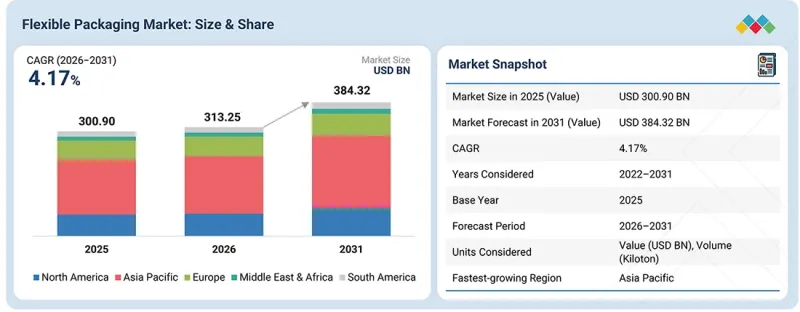
The flexible packaging market is projected to grow from USD 313.25 billion in 2026 to USD 384.32 billion by 2031, at a CAGR of 4.17% during the forecast period. The demand for flexible packaging is increasing due to the need for enhanced product protection, longer shelf life, and reduced transportation costs. Manufacturers and brands are adopting flexible formats for their ability to improve operational efficiency, enable smaller batch production, and support innovative, eye-catching designs that attract consumers.
| Scope of the Report | |
|---|---|
| Years Considered for the Study | 2022-2031 |
| Base Year | 2025 |
| Forecast Period | 2026-2031 |
| Units Considered | Value (USD Million/Billion) Volume (Kiloton) |
| Segments | Material, Packaging Type, Printing Technology, Application, and Region |
| Regions covered | North America, Asia Pacific, Europe, Middle East & Africa, and South America |
Growing regulatory focus on minimizing packaging waste and the shift toward circular economy practices are also encouraging the use of flexible, high-barrier, and eco-conscious materials across diverse industries, including food, beverages, healthcare, and personal care.
"The paper segment is predicted to account for the second-largest market share during the forecast period."
Paper is projected to be the second-largest material segment in the flexible packaging market during the forecast period. Its growth is driven by increasing demand for sustainable, recyclable, and eco-friendly packaging solutions as brands and regulators prioritize reducing plastic waste. Innovations in coated, laminated, and high-barrier paper technologies enhance durability, moisture resistance, and product protection, making paper suitable for food, beverages, personal care, and pharmaceutical applications. Rising consumer preference for environmentally responsible packaging further supports the segment's expansion globally.
"The bags segment is projected to account for the second-largest market share during the forecast period."
The bags segment is projected to be the second-largest packaging type segment in the flexible packaging market during the forecast period. Growth is driven by their versatility, durability, and cost-effectiveness across food, beverage, personal care, and industrial applications. Bags offer convenient storage, portability, and extended shelf life, making them ideal for retail and bulk packaging. Increasing demand for customizable, lightweight, and sustainable materials, along with the rise of modern retail and e-commerce, is further supporting the segment's expansion globally.
"The rotogravure segment is predicted to hold the second-largest market share during the forecast period."
The rotogravure segment is projected to be the second-largest printing technology segment in the flexible packaging market during the forecast period. Its growth is driven by the demand for high-quality, consistent, and detailed printing on flexible packaging, particularly for premium food, beverage, and personal care products. Rotogravure enables superior color reproduction, intricate designs, and large-scale production efficiency. Increasing brand emphasis on visual appeal, combined with expanding adoption in emerging markets, supports the segment's steady growth alongside the rise of customized and aesthetically enhanced packaging solutions
"The personal care & cosmetics segment is projected to hold the second-largest market share during the forecast period."
By application, the personal care & cosmetics segment is estimated to account for the second-largest market share during the forecast period. Growth is driven by rising demand for travel-friendly, lightweight, and aesthetically appealing packaging formats that enhance brand differentiation. Increasing consumer preference for sustainable, recyclable, and refillable packaging further supports adoption. Flexible pouches, sachets, and tubes offer convenience, product protection, and extended shelf life. Rapid product innovation, e-commerce expansion, and rising skincare and beauty consumption in emerging markets are also contributing to the segment's robust growth.
"In terms of value, the Asia Pacific flexible packaging market is projected to register the highest CAGR during the forecast period."
Asia Pacific is the largest market for flexible packaging, driven by rapid urbanization, rising disposable incomes, and growing demand for packaged food, beverages, and personal care products. Strong industrial and manufacturing growth in countries like China, India, and Southeast Asia, combined with expanding e-commerce and modern retail penetration, fuels regional demand. Increasing focus on sustainable and recyclable packaging, along with investments by global and local manufacturers to expand production capacities, further reinforces Asia Pacific's dominance, making it the key growth hub for flexible packaging worldwide.
By Company Type: Tier 1: 25%, Tier 2: 42%, and Tier 3: 33%
By Designation: C-level Executives: 20%, Directors: 30%, and Other Designations: 50%
By Region: North America: 20%, Europe: 10%, Asia Pacific: 40%, South America: 10%, and Middle East & Africa 20%
Note: Tier 1: >USD 1 billion; Tier 2: USD 500 million-1 billion; and Tier 3: <USD 500 million. Other designations include sales, marketing, and product managers.
Companies Covered: Amcor plc (Switzerland), Smurfit Westrock (Ireland), Mondi (UK), TOPPAN Holdings Inc. (Japan), Sealed Air (US), Huhtamaki (Finland), Constantia Flexibles (Austria), Bischof+Klein SE & Co. KG (Germany), and UFlex Limited (India), among others, are covered in the report.
The study includes an in-depth competitive analysis of these key players in the flexible packaging market, with their company profiles, recent developments, and key market strategies.
Research Coverage
This research report categorizes the flexible packaging market based on material (plastic, paper, metal), packaging type (pouches, bags, rollstock, films & wraps, other packaging types), printing technology (flexography, rotogravure, digital printing, other printing technologies), application (food, beverages, pharmaceutical & healthcare, personal care & cosmetics, other applications), and region (Asia Pacific, North America, Europe, South America, Middle East & Africa). The report's scope covers detailed information regarding the drivers, restraints, challenges, and opportunities influencing the growth of the flexible packaging market. A detailed analysis of the key industry players has been done to provide insights into their business overview, products offered, and key strategies, such as partnerships, mergers, product launches, expansions, and acquisitions, associated with the flexible packaging market. This report covers a competitive analysis of upcoming startups in the flexible packaging market ecosystem.
Reasons to Buy the Report
The report will offer market leaders/new entrants with information on the closest approximations of the revenue numbers for the overall flexible packaging market and its subsegments. This report will help stakeholders understand the competitive landscape, gain more insights into positioning their businesses better, and plan suitable go-to-market strategies. The report will also help stakeholders understand the pulse of the market and provide them with information on key market drivers, restraints, challenges, and opportunities.
The report provides insights into the following points:
- Analysis of key drivers (Growth of e-commerce), restraints (Non-availability of efficient recycling infrastructure), opportunities (Commercialization of mono-material high-barrier films), and challenges (High dependence on petrochemical-based resins).
- Product Development/Innovation: Detailed insights into upcoming technologies, research & development activities, and product & service launches in the flexible packaging market.
- Market Development: Comprehensive information about profitable markets - the report analyzes the flexible packaging market across varied regions.
Market Diversification: Exhaustive information about new products & services, untapped geographies, recent developments, and investments in the flexible packaging market.
- Competitive Assessment: In-depth assessment of market shares, growth strategies, and service offerings of leading players such as Amcor plc (Switzerland), Smurfit Westrock (Ireland), Mondi (UK), TOPPAN Holdings Inc. (Japan), Sealed Air (US), Huhtamaki (Finland), Constantia Flexibles (Austria), and others.
TABLE OF CONTENTS
1 INTRODUCTION
- 1.1 STUDY OBJECTIVES
- 1.2 MARKET DEFINITION
- 1.3 STUDY SCOPE
- 1.3.1 MARKET SEGMENTATION AND REGIONS COVERED
- 1.3.2 INCLUSIONS AND EXCLUSIONS
- 1.3.3 YEARS CONSIDERED
- 1.3.4 CURRENCY CONSIDERED
- 1.3.5 UNITS CONSIDERED
- 1.4 LIMITATIONS
- 1.5 STAKEHOLDERS
- 1.6 SUMMARY OF CHANGES
2 EXECUTIVE SUMMARY
- 2.1 MARKET HIGHLIGHTS AND KEY INSIGHTS
- 2.2 KEY MARKET PARTICIPANTS: MAPPING OF STRATEGIC DEVELOPMENTS
- 2.3 DISRUPTIVE TRENDS IN FLEXIBLE PACKAGING MARKET
- 2.4 HIGH-GROWTH SEGMENTS
- 2.5 REGIONAL SNAPSHOT: MARKET SIZE, GROWTH RATE, AND FORECAST
3 PREMIUM INSIGHTS
- 3.1 ATTRACTIVE OPPORTUNITIES FOR PLAYERS IN FLEXIBLE PACKAGING MARKET
- 3.2 FLEXIBLE PACKAGING MARKET, BY MATERIAL AND REGION
- 3.3 FLEXIBLE PACKAGING MARKET, BY PACKAGING TYPE
- 3.4 FLEXIBLE PACKAGING MARKET, BY PRINTING TECHNOLOGY
- 3.5 FLEXIBLE PACKAGING MARKET, BY APPLICATION
- 3.6 FLEXIBLE PACKAGING MARKET, BY COUNTRY
4 MARKET OVERVIEW
- 4.1 INTRODUCTION
- 4.2 MARKET DYNAMICS
- 4.2.1 DRIVERS
- 4.2.1.1 Growth of e-commerce
- 4.2.1.2 Cost-effectiveness and enhanced product shelf life
- 4.2.1.3 Rising demand for disposable packaging
- 4.2.1.4 Growing concerns toward sustainability
- 4.2.2 RESTRAINTS
- 4.2.2.1 Non-availability of efficient recycling infrastructure
- 4.2.2.2 Surge in raw material price
- 4.2.3 OPPORTUNITIES
- 4.2.3.1 Commercialization of mono-material high-barrier films
- 4.2.3.2 Expansion of refill, reuse, and concentrate-compatible formats
- 4.2.3.3 Integration of recycled content via advanced mechanical & chemical recycling
- 4.2.4 CHALLENGES
- 4.2.4.1 High dependence on petrochemical-based resins
- 4.2.4.2 Rapidly evolving sustainability standards and certification requirements
- 4.2.1 DRIVERS
- 4.3 UNMET NEEDS AND WHITE SPACES
- 4.3.1 SHELF-LIFE TRANSPARENCY
- 4.3.2 MATERIAL LIMITATIONS VS. CONSUMER EXPECTATIONS
- 4.3.3 PORTIONING AND USABILITY
- 4.3.4 PREMIUMIZATION WITHOUT PLASTIC WASTE
- 4.4 INTERCONNECTED MARKETS AND CROSS-SECTOR OPPORTUNITIES
- 4.4.1 INTERCONNECTED MARKETS
- 4.4.2 CROSS-SECTOR OPPORTUNITIES
- 4.4.2.1 Food ↔ Beverages
- 4.4.2.2 Food & Beverages ↔ Pharmaceutical & Healthcare
- 4.4.2.3 Personal Care & Cosmetics ↔ Food & Beverages
- 4.4.2.4 Pharmaceutical & Healthcare ↔ Personal Care & Cosmetics
- 4.4.2.5 Other Sectors (Automotive, Agriculture, Sports) ↔ Food & Beverages/Healthcare/Cosmetics
- 4.5 STRATEGIC MOVES BY TIER 1/2/3 PLAYERS
- 4.5.1 TIER 1 PLAYERS: GLOBAL LEADERS DRIVING CONSOLIDATION AND INNOVATION
- 4.5.1.1 Amcor and Berry Global Merger
- 4.5.2 TIER 2 PLAYERS: REGIONAL INNOVATORS AND NICHE LEADERS
- 4.5.2.1 Jindal Poly Films' Expansion in Nashik
- 4.5.3 TIER 3 PLAYERS: AGILE INNOVATORS AND SPECIALIZED PROVIDERS
- 4.5.3.1 ProAmpac's Innovations in Sustainable Packaging
- 4.5.1 TIER 1 PLAYERS: GLOBAL LEADERS DRIVING CONSOLIDATION AND INNOVATION
5 INDUSTRY TRENDS
- 5.1 PORTER'S FIVE FORCES ANALYSIS
- 5.1.1 THREAT OF NEW ENTRANTS
- 5.1.2 THREAT OF SUBSTITUTES
- 5.1.3 BARGAINING POWER OF SUPPLIERS
- 5.1.4 BARGAINING POWER OF BUYERS
- 5.1.5 INTENSITY OF COMPETITIVE RIVALRY
- 5.2 MACROECONOMIC ANALYSIS
- 5.2.1 INTRODUCTION
- 5.2.2 GDP TRENDS AND FORECASTS
- 5.2.3 URBANIZATION AND DEMOGRAPHIC SHIFTS
- 5.2.4 TRADE AND GLOBAL SUPPLY CHAIN DYNAMICS
- 5.3 VALUE CHAIN ANALYSIS
- 5.4 ECOSYSTEM ANALYSIS
- 5.5 PRICING ANALYSIS
- 5.5.1 PRICING ANALYSIS, REGION
- 5.6 TRADE ANALYSIS
- 5.6.1 IMPORT DATA RELATED TO HS CODE 3920, BY COUNTRY
- 5.6.2 EXPORT DATA RELATED TO HS CODE 3920, BY COUNTRY
- 5.6.3 IMPORT DATA RELATED TO HS CODE 48, BY COUNTRY
- 5.6.4 EXPORT DATA RELATED TO HS CODE 48, BY COUNTRY
- 5.7 KEY CONFERENCES AND EVENTS, 2026-2027
- 5.8 TRENDS/DISRUPTIONS IMPACTING CUSTOMER BUSINESS
- 5.9 INVESTMENT AND FUNDING SCENARIO
- 5.10 CASE STUDY ANALYSIS
- 5.10.1 PAPERPAK PARTNERS WITH KATHMANDU FOR BIODEGRADABLE AND COMPOSTABLE SOLUTIONS
- 5.10.2 PAPERPAK'S REFINED BAG FOR HARPER, INC. TO MEET SUSTAINABILITY DEMAND
- 5.10.3 AMCOR'S 30% RECYCLED CONTENT PACKAGING REDUCES VIRGIN PLASTIC USAGE
- 5.11 IMPACT OF 2025 US TARIFF ON FLEXIBLE PACKAGING MARKET
- 5.11.1 INTRODUCTION
- 5.11.2 KEY TARIFF RATES
- 5.11.3 PRICE IMPACT ANALYSIS
- 5.11.4 KEY IMPACT ON VARIOUS REGIONS
- 5.11.4.1 US
- 5.11.4.2 Europe
- 5.11.4.3 Asia Pacific
- 5.11.5 END-USE INDUSTRY IMPACT
6 STRATEGIC DISRUPTION THROUGH TECHNOLOGY, PATENTS, DIGITAL, AND AI ADOPTION
- 6.1 KEY EMERGING TECHNOLOGIES
- 6.2 KEY TECHNOLOGIES
- 6.2.1 COEXTRUSION TECHNOLOGY
- 6.2.2 MODIFIED ATMOSPHERE PACKAGING (MAP)
- 6.3 COMPLEMENTARY TECHNOLOGIES
- 6.3.1 ACTIVE PACKAGING
- 6.3.2 ADVANCED RECYCLING
- 6.4 ADJACENT TECHNOLOGIES
- 6.4.1 PACKAGING AUTOMATION
- 6.4.2 SMART PACKAGING (RFID, NFC, SENSORS)
- 6.5 TECHNOLOGY/PRODUCT ROADMAP
- 6.5.1 SHORT-TERM (2025-2027) | TRANSITION AND DIGITAL INTEGRATION PHASE
- 6.5.2 MID-TERM (2027-2030): CIRCULAR ECONOMY AND SMART PACKAGING CONSOLIDATION
- 6.5.3 LONG-TERM (2030-2035+): FULLY CIRCULAR, INTELLIGENT, AND ADAPTIVE PACKAGING SYSTEMS
- 6.6 PATENT ANALYSIS
- 6.6.1 INTRODUCTION
- 6.6.2 METHODOLOGY
- 6.6.3 FLEXIBLE PACKAGING MARKET, PATENT ANALYSIS, 2016-2025
- 6.7 FUTURE APPLICATIONS
- 6.7.1 BIO-DERIVED SELF-DECONTAMINATING FILMS (PHOTOCATALYTIC/ ENZYMATIC SURFACES)
- 6.7.2 FULLY EDIBLE FLEXIBLE PACKAGING FILMS
- 6.7.3 SHAPE-ADAPTIVE FILMS USING EMBEDDED SOFT ACTUATORS
- 6.7.4 BIOLUMINESCENT INDICATOR FILMS
- 6.8 IMPACT OF AI/GEN AI ON FLEXIBLE PACKAGING MARKET
- 6.8.1 TOP USE CASES AND MARKET POTENTIAL
- 6.8.2 BEST PRACTICES IN FLEXIBLE PACKAGING
- 6.8.3 CASE STUDIES OF AI IMPLEMENTATION IN FLEXIBLE PACKAGING MARKET
- 6.8.4 INTERCONNECTED ADJACENT ECOSYSTEM AND IMPACT ON MARKET PLAYERS
- 6.8.5 CLIENTS' READINESS TO ADOPT GENERATIVE AI IN FLEXIBLE PACKAGING MARKET
- 6.9 SUCCESS STORIES AND REAL-WORLD APPLICATIONS
- 6.9.1 DOW AND LIBY DEPLOY RECYCLABLE BOPE RESIN IN CHINA
- 6.9.2 HUHTAMAKI'S MONO-MATERIAL FLEXIBLE INNOVATIONS REDEFINE RECYCLABILITY
- 6.9.3 AMCOR'S AMPRIMA PE PLUS POUCH REDUCES NON-RECYCLABLE LAMINATE USE
7 SUSTAINABILITY AND REGULATORY LANDSCAPE
- 7.1 REGIONAL REGULATIONS AND COMPLIANCE
- 7.1.1 REGULATORY BODIES, GOVERNMENT AGENCIES, AND OTHER ORGANIZATIONS
- 7.1.2 INDUSTRY STANDARDS
- 7.2 SUSTAINABILITY INITIATIVES
- 7.2.1 CARBON IMPACT AND ECO-APPLICATIONS OF FLEXIBLE PACKAGING
- 7.2.1.1 Carbon Impact Reduction
- 7.2.1.2 Eco-Applications
- 7.2.1 CARBON IMPACT AND ECO-APPLICATIONS OF FLEXIBLE PACKAGING
- 7.3 SUSTAINABILITY IMPACT AND REGULATORY POLICY INITIATIVES
- 7.4 CERTIFICATIONS, LABELING, AND ECO-STANDARDS
8 CUSTOMER LANDSCAPE & BUYER BEHAVIOR
- 8.1 DECISION-MAKING PROCESS
- 8.2 KEY STAKEHOLDERS INVOLVED IN BUYING PROCESS AND THEIR EVALUATION CRITERIA
- 8.2.1 KEY STAKEHOLDERS IN BUYING PROCESS
- 8.2.2 BUYING CRITERIA
- 8.3 ADOPTION BARRIERS & INTERNAL CHALLENGES
- 8.4 UNMET NEEDS IN VARIOUS APPLICATIONS
- 8.5 MARKET PROFITABILITY
- 8.5.1 REVENUE POTENTIAL
- 8.5.2 COST DYNAMICS
- 8.6 MARGIN OPPORTUNITIES, BY APPLICATION
9 FLEXIBLE PACKAGING MARKET, BY MATERIAL
- 9.1 INTRODUCTION
- 9.2 PAPER
- 9.2.1 EXPANDING PULP SUPPLY AND RECYCLING EFFICIENCY REINFORCE PAPER'S ROLE IN FLEXIBLE PACKAGING
- 9.3 PLASTIC
- 9.3.1 MONO-MATERIAL INNOVATION AND RECYCLING TO DRIVE DEMAND FOR PLASTICS IN FLEXIBLE PACKAGING
- 9.4 METAL
- 9.4.1 LIGHTWEIGHT FOIL INNOVATION AND HIGH RECYCLING RATES TO SUSTAIN METAL'S RELEVANCE IN FLEXIBLE PACKAGING
10 FLEXIBLE PACKAGING MARKET, BY PACKAGING TYPE
- 10.1 INTRODUCTION
- 10.2 POUCHES
- 10.2.1 MONO-MATERIAL AND HYBRID POUCH DESIGNS TO DRIVE GROWTH
- 10.3 BAGS
- 10.3.1 HIGH-BARRIER AND RECYCLABLE FLEXIBLE BAGS TO DRIVE EFFICIENCY AND CIRCULARITY IN PACKAGING
- 10.4 ROLLSTOCK
- 10.4.1 MODULAR ROLLSTOCK SOLUTIONS DRIVE CUSTOMIZATION, EFFICIENCY, AND HIGH-BARRIER PACKAGING
- 10.5 FILMS & WRAPS
- 10.5.1 OFFERS PERFORMANCE, FLEXIBILITY, AND SUSTAINABLE PACKAGING SOLUTIONS
- 10.6 OTHER PACKAGING TYPES
11 FLEXIBLE PACKAGING MARKET, BY PRINTING TECHNOLOGY
- 11.1 INTRODUCTION
- 11.2 FLEXOGRAPHY
- 11.2.1 DEMAND FOR SUSTAINABLE, HIGH-PRECISION PRINTING TO DRIVE MARKET
- 11.3 ROTOGRAVURE
- 11.3.1 OFFERS PREMIUM, LONG-RUN FLEXIBLE PACKAGING PRODUCTION
- 11.4 DIGITAL PRINTING
- 11.4.1 OFFERS CUSTOMIZATION, AGILITY, AND SUSTAINABILITY
- 11.5 OTHER PRINTING TECHNOLOGIES
12 FLEXIBLE PACKAGING MARKET, BY APPLICATION
- 12.1 INTRODUCTION
- 12.2 FOOD
- 12.2.1 INCREASING DEMAND FOR CONVENIENCE FOODS TO DRIVE MARKET GROWTH
- 12.3 BEVERAGES
- 12.3.1 DEMAND FOR SUSTAINABLE PACKAGING AND POPULARITY OF ON-THE-GO CONSUMPTION TO DRIVE MARKET
- 12.4 PHARMACEUTICAL & HEALTHCARE
- 12.4.1 ENSURES SAFETY, COMPLIANCE, AND EFFICIENCY IN PHARMACEUTICALS
- 12.5 PERSONAL CARE & COSMETICS
- 12.5.1 RISING DEMAND FOR CONVENIENT, PREMIUM, AND SUSTAINABLE PACKAGING TO FUEL GROWTH
- 12.6 OTHER APPLICATIONS
13 FLEXIBLE PACKAGING MARKET, BY REGION
- 13.1 INTRODUCTION
- 13.2 ASIA PACIFIC
- 13.2.1 CHINA
- 13.2.1.1 Growing food, beverage, healthcare, and beauty sectors to fuel demand
- 13.2.2 INDIA
- 13.2.2.1 Rapid industrialization and growing consumer base to drive demand
- 13.2.3 JAPAN
- 13.2.3.1 Expanding food, beverage, pharma, and beauty exports to drive market
- 13.2.4 SOUTH KOREA
- 13.2.4.1 Expanding agri-food, pharma, and cosmetics exports to propel market
- 13.2.5 REST OF ASIA PACIFIC
- 13.2.1 CHINA
- 13.3 NORTH AMERICA
- 13.3.1 US
- 13.3.1.1 Evolving consumer and industry trends to accelerate shift toward flexible packaging
- 13.3.2 CANADA
- 13.3.2.1 Expanding manufacturing and export sectors to propel growth
- 13.3.3 MEXICO
- 13.3.3.1 Expanding agri-food, pharma, and beauty exports strengthening shift toward flexible packaging
- 13.3.1 US
- 13.4 EUROPE
- 13.4.1 GERMANY
- 13.4.1.1 Strong economy and food processing sector growth to drive demand
- 13.4.2 UK
- 13.4.2.1 Expanding exports and evolving lifestyles to drive growth
- 13.4.3 FRANCE
- 13.4.3.1 Strong exports and eco-innovation to propel market
- 13.4.4 RUSSIA
- 13.4.4.1 Policy support and evolving consumer lifestyles to accelerate demand
- 13.4.5 SPAIN
- 13.4.5.1 Expanding agri-food and biotech sectors to support market growth
- 13.4.6 ITALY
- 13.4.6.1 Strong food, pharma, and beauty sectors to drive demand
- 13.4.7 REST OF EUROPE
- 13.4.1 GERMANY
- 13.5 SOUTH AMERICA
- 13.5.1 BRAZIL
- 13.5.1.1 Expanding manufacturing sector and export integration to support market growth
- 13.5.2 ARGENTINA
- 13.5.2.1 Expanding export-oriented and consumer-driven demand to drive market
- 13.5.3 CHILE
- 13.5.3.1 Rising exports and urban consumption to drive demand
- 13.5.4 REST OF SOUTH AMERICA
- 13.5.1 BRAZIL
- 13.6 MIDDLE EAST & AFRICA
- 13.6.1 GCC COUNTRIES
- 13.6.2 SAUDI ARABIA
- 13.6.2.1 Expanding economy to support market growth
- 13.6.3 UAE
- 13.6.3.1 Strong growth of food, healthcare, and personal care sectors to drive market
- 13.6.4 REST OF GCC COUNTRIES
- 13.6.5 SOUTH AFRICA
- 13.6.5.1 Growth of food, healthcare, and beauty sectors to increase demand
- 13.6.6 REST OF MIDDLE EAST & AFRICA
14 COMPETITIVE LANDSCAPE
- 14.1 OVERVIEW
- 14.2 KEY PLAYERS' STRATEGIES/RIGHT TO WIN
- 14.3 REVENUE ANALYSIS
- 14.4 MARKET SHARE ANALYSIS
- 14.5 COMPANY VALUATION AND FINANCIAL METRICS
- 14.5.1 COMPANY VALUATION
- 14.6 FINANCIAL METRICS
- 14.7 BRAND/PRODUCT COMPARISON
- 14.8 COMPANY EVALUATION MATRIX: KEY PLAYERS, 2025
- 14.8.1 STARS
- 14.8.2 EMERGING LEADERS
- 14.8.3 PERVASIVE PLAYERS
- 14.8.4 PARTICIPANTS
- 14.8.5 COMPANY FOOTPRINT: KEY PLAYERS, 2025
- 14.8.5.1 Company footprint
- 14.8.5.2 Region footprint
- 14.8.5.3 Packaging type footprint
- 14.8.5.4 Application footprint
- 14.8.5.5 Material footprint
- 14.8.5.6 Printing technology footprint
- 14.9 COMPANY EVALUATION MATRIX: STARTUPS/SMES, 2025
- 14.9.1 PROGRESSIVE COMPANIES
- 14.9.2 RESPONSIVE COMPANIES
- 14.9.3 DYNAMIC COMPANIES
- 14.9.4 STARTING BLOCKS
- 14.9.5 COMPETITIVE BENCHMARKING: STARTUPS/SMES, 2025
- 14.9.5.1 Detailed list of key startups/SMEs
- 14.9.6 COMPETITIVE BENCHMARKING OF KEY STARTUPS/SMES
- 14.10 COMPETITIVE SCENARIO
- 14.10.1 PRODUCT LAUNCHES
- 14.10.2 DEALS
- 14.10.3 EXPANSIONS
15 COMPANY PROFILES
- 15.1 KEY PLAYERS
- 15.1.1 AMCOR PLC
- 15.1.1.1 Business overview
- 15.1.1.2 Products/Solutions/Services offered
- 15.1.1.3 Recent developments
- 15.1.1.3.1 Product launches
- 15.1.1.3.2 Deals
- 15.1.1.3.3 Expansions
- 15.1.1.4 MnM view
- 15.1.1.4.1 Right to win
- 15.1.1.4.2 Strategic choices
- 15.1.1.4.3 Weaknesses & competitive threats
- 15.1.2 SMURFIT WESTROCK
- 15.1.2.1 Business overview
- 15.1.2.2 Products/Solutions/Services offered
- 15.1.2.3 Recent developments
- 15.1.2.3.1 Product launches
- 15.1.2.3.2 Deals
- 15.1.2.3.3 Expansions
- 15.1.2.4 MnM view
- 15.1.2.4.1 Right to win
- 15.1.2.4.2 Strategic choices
- 15.1.2.4.3 Weaknesses and competitive threats
- 15.1.3 MONDI
- 15.1.3.1 Business overview
- 15.1.3.2 Products/Solutions/Services offered
- 15.1.3.3 Recent developments
- 15.1.3.3.1 Product launches
- 15.1.3.3.2 Deals
- 15.1.3.3.3 Expansions
- 15.1.3.4 MnM view
- 15.1.3.4.1 Right to win
- 15.1.3.4.2 Strategic choices
- 15.1.3.4.3 Weakness and competitive threats
- 15.1.4 TOPPAN HOLDINGS INC.
- 15.1.4.1 Business overview
- 15.1.4.2 Products/Solutions/Services offered
- 15.1.4.3 Recent developments
- 15.1.4.3.1 Product launches
- 15.1.4.3.2 Deals
- 15.1.4.3.3 Expansions
- 15.1.4.4 MnM view
- 15.1.4.4.1 Right to win
- 15.1.4.4.2 Strategic choices
- 15.1.4.4.3 Weakness and competitive threats
- 15.1.5 SEALED AIR
- 15.1.5.1 Business overview
- 15.1.5.2 Products/Solutions/Services offered
- 15.1.5.3 Recent developments
- 15.1.5.3.1 Product launches
- 15.1.5.3.2 Deals
- 15.1.5.3.3 Expansions
- 15.1.5.4 MnM view
- 15.1.5.4.1 Right to win
- 15.1.5.4.2 Strategic choices
- 15.1.5.4.3 Weakness and competitive threats
- 15.1.6 HUHTAMAKI
- 15.1.6.1 Business overview
- 15.1.6.2 Products/Solutions/Services offered
- 15.1.6.3 Recent developments
- 15.1.6.3.1 Product launches
- 15.1.6.3.2 Deals
- 15.1.6.3.3 Expansions
- 15.1.6.4 MnM view
- 15.1.7 CONSTANTIA FLEXIBLES
- 15.1.7.1 Business overview
- 15.1.7.2 Products/Solutions/Services offered
- 15.1.7.3 Recent developments
- 15.1.7.3.1 Product launches
- 15.1.7.3.2 Deals
- 15.1.7.3.3 Expansions
- 15.1.7.4 MnM view
- 15.1.8 PROAMPAC
- 15.1.8.1 Business overview
- 15.1.8.2 Products/Solutions/Services offered
- 15.1.8.3 Recent developments
- 15.1.8.3.1 Product Launches
- 15.1.8.3.2 Deals
- 15.1.8.4 MnM view
- 15.1.9 UFLEX LIMITED
- 15.1.9.1 Business overview
- 15.1.9.2 Products/Solutions/Services offered
- 15.1.9.3 Recent developments
- 15.1.9.3.1 Product launches
- 15.1.9.3.2 Deals
- 15.1.9.4 MnM view
- 15.1.10 BISCHOF+KLEIN SE & CO. KG
- 15.1.10.1 Business overview
- 15.1.10.2 Products/Solutions/Services offered
- 15.1.10.3 Recent developments
- 15.1.10.3.1 Deals
- 15.1.10.3.2 Expansions
- 15.1.10.4 MnM view
- 15.1.1 AMCOR PLC
- 15.2 OTHER PLAYERS
- 15.2.1 NOVOLEX
- 15.2.2 SILAFRICA
- 15.2.3 PPC FLEX COMPANY, INC.
- 15.2.4 PRINTPACK
- 15.2.5 NOVUS HOLDINGS LTD.
- 15.2.6 AHLSTROM
- 15.2.7 WIHURI GROUP
- 15.2.8 C-P FLEXIBLE PACKAGING
- 15.2.9 COSMO FIRST LIMITED
- 15.2.10 GUALA PACK S.P.A.
- 15.2.11 EPAC HOLDINGS, LLC
- 15.2.12 POLYPLEX CORPORATION LTD.
- 15.2.13 GLENROY, INC.
- 15.2.14 ATHAR PACKAGING SOLUTIONS PVT. LTD.
- 15.2.15 JPFL FILMS PRIVATE LIMITED
16 RESEARCH METHODOLOGY
- 16.1 RESEARCH DATA
- 16.1.1 SECONDARY DATA
- 16.1.1.1 Key data from secondary sources
- 16.1.2 PRIMARY DATA
- 16.1.2.1 Key data from primary sources
- 16.1.1 SECONDARY DATA
- 16.2 MARKET SIZE ESTIMATION
- 16.3 DATA TRIANGULATION
- 16.4 RESEARCH ASSUMPTIONS
- 16.5 RISK ASSESSMENT
- 16.6 GROWTH RATE ASSUMPTIONS
17 APPENDIX
- 17.1 DISCUSSION GUIDE
- 17.2 KNOWLEDGESTORE: MARKETSANDMARKETS' SUBSCRIPTION PORTAL
- 17.3 CUSTOMIZATION OPTIONS
- 17.4 RELATED REPORTS
- 17.5 AUTHOR DETAILS
List of Tables
- TABLE 1 PACKAGE COMPARISON
- TABLE 2 FLEXIBLE PACKAGING MARKET: IMPACT OF PORTER'S FIVE FORCES
- TABLE 3 GLOBAL GDP GROWTH PROJECTION, 2021-2028 (USD TRILLION)
- TABLE 4 FLEXIBLE PACKAGING MARKET: ROLE OF COMPANIES IN ECOSYSTEM
- TABLE 5 AVERAGE SELLING PRICE OF KEY PLAYERS, BY KEY MATERIAL, 2025 (USD/KG)
- TABLE 6 AVERAGE SELLING PRICE TREND OF KEY PLAYERS, BY REGION, 2022-2026 (USD/KG)
- TABLE 7 IMPORT DATA FOR HS CODE 3920-COMPLIANT PRODUCTS, BY COUNTRY, 2021-2025 (USD BILLION)
- TABLE 8 EXPORT DATA FOR HS CODE 3920-COMPLIANT PRODUCTS, BY COUNTRY, 2021-2025 (USD BILLION)
- TABLE 9 IMPORT DATA FOR HS CODE 48-COMPLIANT PRODUCTS, BY COUNTRY, 2021-2025 (USD BILLION)
- TABLE 10 EXPORT DATA FOR HS CODE 48-COMPLIANT PRODUCTS, BY COUNTRY, 2021-2025 (USD BILLION)
- TABLE 11 FLEXIBLE PACKAGING MARKET: LIST OF KEY CONFERENCES AND EVENTS, 2026-2027
- TABLE 12 FLEXIBLE PACKAGING MARKET: LIST OF KEY PATENTS, 2025
- TABLE 13 TOP USE CASES AND MARKET POTENTIAL
- TABLE 14 BEST PRACTICES: COMPANIES IMPLEMENTING USE CASES
- TABLE 15 FLEXIBLE PACKAGING MARKET: CASE STUDIES RELATED TO GEN AI IMPLEMENTATION
- TABLE 16 NORTH AMERICA: REGULATORY BODIES, GOVERNMENT AGENCIES, AND OTHER ORGANIZATIONS
- TABLE 17 EUROPE: REGULATORY BODIES, GOVERNMENT AGENCIES, AND OTHER ORGANIZATIONS
- TABLE 18 ASIA PACIFIC: REGULATORY BODIES, GOVERNMENT AGENCIES, AND OTHER ORGANIZATIONS
- TABLE 19 SOUTH AMERICA: LIST OF REGULATORY BODIES, GOVERNMENT AGENCIES, AND OTHER ORGANIZATIONS
- TABLE 20 MIDDLE EAST & AFRICA: LIST OF REGULATORY BODIES, GOVERNMENT AGENCIES, AND OTHER ORGANIZATIONS
- TABLE 21 GLOBAL INDUSTRY STANDARDS IN FLEXIBLE PACKAGING MARKET
- TABLE 22 CERTIFICATIONS, LABELING, ECO-STANDARDS IN FLEXIBLE PACKAGING MARKET
- TABLE 23 INFLUENCE OF STAKEHOLDERS IN BUYING PROCESS, BY APPLICATION
- TABLE 24 KEY BUYING CRITERIA, BY APPLICATION
- TABLE 25 UNMET NEEDS IN FLEXIBLE PACKAGING MARKET, BY APPLICATION
- TABLE 26 FLEXIBLE PACKAGING MARKET, BY MATERIAL, 2022-2024 (KILOTON)
- TABLE 27 FLEXIBLE PACKAGING MARKET, BY MATERIAL, 2025-2031 (KILOTON)
- TABLE 28 FLEXIBLE PACKAGING MARKET, BY MATERIAL, 2022-2024 (USD MILLION)
- TABLE 29 FLEXIBLE PACKAGING MARKET, BY MATERIAL, 2025-2031 (USD MILLION)
- TABLE 30 FLEXIBLE PACKAGING MARKET, BY PACKAGING TYPE, 2022-2024 (KILOTON)
- TABLE 31 FLEXIBLE PACKAGING MARKET, BY PACKAGING TYPE, 2025-2031 (KILOTON)
- TABLE 32 FLEXIBLE PACKAGING MARKET, BY PACKAGING TYPE, 2022-2024 (USD MILLION)
- TABLE 33 FLEXIBLE PACKAGING MARKET, BY PACKAGING TYPE, 2025-2031 (USD MILLION)
- TABLE 34 COMPARATIVE ANALYSIS OF PRINTING TECHNOLOGIES IN FLEXIBLE PACKAGING
- TABLE 35 FLEXIBLE PACKAGING MARKET, BY PRINTING TECHNOLOGY, 2022-2024 (KILOTON)
- TABLE 36 FLEXIBLE PACKAGING MARKET, BY PRINTING TECHNOLOGY, 2025-2031 (KILOTON)
- TABLE 37 FLEXIBLE PACKAGING MARKET, BY PRINTING TECHNOLOGY, 2022-2024 (USD MILLION)
- TABLE 38 FLEXIBLE PACKAGING MARKET, BY PRINTING TECHNOLOGY, 2025-2031 (USD MILLION)
- TABLE 39 FLEXIBLE PACKAGING MARKET, BY APPLICATION, 2022-2024 (KILOTON)
- TABLE 40 FLEXIBLE PACKAGING MARKET, BY APPLICATION, 2025-2031 (KILOTON)
- TABLE 41 FLEXIBLE PACKAGING MARKET, BY APPLICATION, 2022-2024 (USD MILLION)
- TABLE 42 FLEXIBLE PACKAGING MARKET, BY APPLICATION, 2025-2031 (USD MILLION)
- TABLE 43 FLEXIBLE PACKAGING MARKET, BY REGION, 2022-2024 (KILOTON)
- TABLE 44 FLEXIBLE PACKAGING MARKET, BY REGION, 2025-2031 (KILOTON)
- TABLE 45 FLEXIBLE PACKAGING MARKET, BY REGION, 2022-2024 (USD MILLION)
- TABLE 46 FLEXIBLE PACKAGING MARKET, BY REGION, 2025-2031 (USD MILLION)
- TABLE 47 ASIA PACIFIC: FLEXIBLE PACKAGING MARKET, BY COUNTRY, 2022-2024 (KILOTON)
- TABLE 48 ASIA PACIFIC: FLEXIBLE PACKAGING MARKET, BY COUNTRY, 2025-2031 (KILOTON)
- TABLE 49 ASIA PACIFIC: FLEXIBLE PACKAGING MARKET, BY COUNTRY, 2022-2024 (USD MILLION)
- TABLE 50 ASIA PACIFIC: FLEXIBLE PACKAGING MARKET, BY COUNTRY, 2025-2031 (USD MILLION)
- TABLE 51 ASIA PACIFIC: FLEXIBLE PACKAGING MARKET, BY MATERIAL, 2022-2024 (KILOTON)
- TABLE 52 ASIA PACIFIC: FLEXIBLE PACKAGING MARKET, BY MATERIAL, 2025-2031 (KILOTON)
- TABLE 53 ASIA PACIFIC: FLEXIBLE PACKAGING MARKET, BY MATERIAL, 2022-2024 (USD MILLION)
- TABLE 54 ASIA PACIFIC: FLEXIBLE PACKAGING MARKET, BY MATERIAL, 2025-2031 (USD MILLION)
- TABLE 55 ASIA PACIFIC: FLEXIBLE PACKAGING MARKET, BY PACKAGING TYPE, 2022-2024 (KILOTON)
- TABLE 56 ASIA PACIFIC: FLEXIBLE PACKAGING MARKET, BY PACKAGING TYPE, 2025-2031 (KILOTON)
- TABLE 57 ASIA PACIFIC: FLEXIBLE PACKAGING MARKET, BY PACKAGING TYPE, 2022-2024 (USD MILLION)
- TABLE 58 ASIA PACIFIC: FLEXIBLE PACKAGING MARKET, BY PACKAGING TYPE, 2025-2031 (USD MILLION)
- TABLE 59 ASIA PACIFIC: FLEXIBLE PACKAGING MARKET, BY PRINTING TECHNOLOGY, 2022-2024 (KILOTON)
- TABLE 60 ASIA PACIFIC: FLEXIBLE PACKAGING MARKET, BY PRINTING TECHNOLOGY, 2025-2031 (KILOTON)
- TABLE 61 ASIA PACIFIC: FLEXIBLE PACKAGING MARKET, BY PRINTING TECHNOLOGY, 2022-2024 (USD MILLION)
- TABLE 62 ASIA PACIFIC: FLEXIBLE PACKAGING MARKET, BY PRINTING TECHNOLOGY, 2025-2031 (USD MILLION)
- TABLE 63 ASIA PACIFIC: FLEXIBLE PACKAGING MARKET, BY APPLICATION, 2022-2024 (KILOTON)
- TABLE 64 ASIA PACIFIC: FLEXIBLE PACKAGING MARKET, BY APPLICATION, 2025-2031 (KILOTON)
- TABLE 65 ASIA PACIFIC: FLEXIBLE PACKAGING MARKET, BY APPLICATION, 2022-2024 (USD MILLION)
- TABLE 66 ASIA PACIFIC: FLEXIBLE PACKAGING MARKET, BY APPLICATION, 2025-2031 (USD MILLION)
- TABLE 67 CHINA: FLEXIBLE PACKAGING MARKET, BY MATERIAL, 2022-2024 (KILOTON)
- TABLE 68 CHINA: FLEXIBLE PACKAGING MARKET, BY MATERIAL, 2025-2031 (KILOTON)
- TABLE 69 CHINA: FLEXIBLE PACKAGING MARKET, BY MATERIAL, 2022-2024 (USD MILLION)
- TABLE 70 CHINA: FLEXIBLE PACKAGING MARKET, BY MATERIAL, 2025-2031 (USD MILLION)
- TABLE 71 CHINA: FLEXIBLE PACKAGING MARKET, BY PACKAGING TYPE, 2022-2024 (KILOTON)
- TABLE 72 CHINA: FLEXIBLE PACKAGING MARKET, BY PACKAGING TYPE, 2025-2031 (KILOTON)
- TABLE 73 CHINA: FLEXIBLE PACKAGING MARKET, BY PACKAGING TYPE, 2022-2024 (USD MILLION)
- TABLE 74 CHINA: FLEXIBLE PACKAGING MARKET, BY PACKAGING TYPE, 2025-2031 (USD MILLION)
- TABLE 75 CHINA: FLEXIBLE PACKAGING MARKET, BY APPLICATION, 2022-2024 (KILOTON)
- TABLE 76 CHINA: FLEXIBLE PACKAGING MARKET, BY APPLICATION, 2025-2031 (KILOTON)
- TABLE 77 CHINA: FLEXIBLE PACKAGING MARKET, BY APPLICATION, 2022-2024 (USD MILLION)
- TABLE 78 CHINA: FLEXIBLE PACKAGING MARKET, BY APPLICATION, 2025-2031 (USD MILLION)
- TABLE 79 INDIA: FLEXIBLE PACKAGING MARKET, BY MATERIAL, 2022-2024 (KILOTON)
- TABLE 80 INDIA: FLEXIBLE PACKAGING MARKET, BY MATERIAL, 2025-2031 (KILOTON)
- TABLE 81 INDIA: FLEXIBLE PACKAGING MARKET, BY MATERIAL, 2022-2024 (USD MILLION)
- TABLE 82 INDIA: FLEXIBLE PACKAGING MARKET, BY MATERIAL, 2025-2031 (USD MILLION)
- TABLE 83 INDIA: FLEXIBLE PACKAGING MARKET, BY PACKAGING TYPE, 2022-2024 (KILOTON)
- TABLE 84 INDIA: FLEXIBLE PACKAGING MARKET, BY PACKAGING TYPE, 2025-2031 (KILOTON)
- TABLE 85 INDIA: FLEXIBLE PACKAGING MARKET, BY PACKAGING TYPE, 2022-2024 (USD MILLION)
- TABLE 86 INDIA: FLEXIBLE PACKAGING MARKET, BY PACKAGING TYPE, 2025-2031 (USD MILLION)
- TABLE 87 INDIA: FLEXIBLE PACKAGING MARKET, BY APPLICATION, 2022-2024 (KILOTON)
- TABLE 88 INDIA: FLEXIBLE PACKAGING MARKET, BY APPLICATION, 2025-2031 (KILOTON)
- TABLE 89 INDIA: FLEXIBLE PACKAGING MARKET, BY APPLICATION, 2022-2024 (USD MILLION)
- TABLE 90 INDIA: FLEXIBLE PACKAGING MARKET, BY APPLICATION, 2025-2031 (USD MILLION)
- TABLE 91 JAPAN: FLEXIBLE PACKAGING MARKET, BY MATERIAL, 2022-2024 (KILOTON)
- TABLE 92 JAPAN: FLEXIBLE PACKAGING MARKET, BY MATERIAL, 2025-2031 (KILOTON)
- TABLE 93 JAPAN: FLEXIBLE PACKAGING MARKET, BY MATERIAL, 2022-2024 (USD MILLION)
- TABLE 94 JAPAN: FLEXIBLE PACKAGING MARKET, BY MATERIAL, 2025-2031 (USD MILLION)
- TABLE 95 JAPAN: FLEXIBLE PACKAGING MARKET, BY PACKAGING TYPE, 2022-2024 (KILOTON)
- TABLE 96 JAPAN: FLEXIBLE PACKAGING MARKET, BY PACKAGING TYPE, 2025-2031 (KILOTON)
- TABLE 97 JAPAN: FLEXIBLE PACKAGING MARKET, BY PACKAGING TYPE, 2022-2024 (USD MILLION)
- TABLE 98 JAPAN: FLEXIBLE PACKAGING MARKET, BY PACKAGING TYPE, 2025-2031 (USD MILLION)
- TABLE 99 JAPAN: FLEXIBLE PACKAGING MARKET, BY APPLICATION, 2022-2024 (KILOTON)
- TABLE 100 JAPAN: FLEXIBLE PACKAGING MARKET, BY APPLICATION, 2025-2031 (KILOTON)
- TABLE 101 JAPAN: FLEXIBLE PACKAGING MARKET, BY APPLICATION, 2022-2024 (USD MILLION)
- TABLE 102 JAPAN: FLEXIBLE PACKAGING MARKET, BY APPLICATION, 2025-2031 (USD MILLION)
- TABLE 103 SOUTH KOREA: FLEXIBLE PACKAGING MARKET, BY MATERIAL, 2022-2024 (KILOTON)
- TABLE 104 SOUTH KOREA: FLEXIBLE PACKAGING MARKET, BY MATERIAL, 2025-2031 (KILOTON)
- TABLE 105 SOUTH KOREA: FLEXIBLE PACKAGING MARKET, BY MATERIAL, 2022-2024 (USD MILLION)
- TABLE 106 SOUTH KOREA: FLEXIBLE PACKAGING MARKET, BY MATERIAL, 2025-2031 (USD MILLION)
- TABLE 107 SOUTH KOREA: FLEXIBLE PACKAGING MARKET, BY PACKAGING TYPE, 2022-2024 (KILOTON)
- TABLE 108 SOUTH KOREA: FLEXIBLE PACKAGING MARKET, BY PACKAGING TYPE, 2025-2031 (KILOTON)
- TABLE 109 SOUTH KOREA: FLEXIBLE PACKAGING MARKET, BY PACKAGING TYPE, 2022-2024 (USD MILLION)
- TABLE 110 SOUTH KOREA: FLEXIBLE PACKAGING MARKET, BY PACKAGING TYPE, 2025-2031 (USD MILLION)
- TABLE 111 SOUTH KOREA: FLEXIBLE PACKAGING MARKET, BY APPLICATION, 2022-2024 (KILOTON)
- TABLE 112 SOUTH KOREA: FLEXIBLE PACKAGING MARKET, BY APPLICATION, 2025-2031 (KILOTON)
- TABLE 113 SOUTH KOREA: FLEXIBLE PACKAGING MARKET, BY APPLICATION, 2022-2024 (USD MILLION)
- TABLE 114 SOUTH KOREA: FLEXIBLE PACKAGING MARKET, BY APPLICATION, 2025-2031 (USD MILLION)
- TABLE 115 REST OF ASIA PACIFIC: FLEXIBLE PACKAGING MARKET, BY MATERIAL, 2022-2024 (KILOTON)
- TABLE 116 REST OF ASIA PACIFIC: FLEXIBLE PACKAGING MARKET, BY MATERIAL, 2025-2031 (KILOTON)
- TABLE 117 REST OF ASIA PACIFIC: FLEXIBLE PACKAGING MARKET, BY MATERIAL, 2022-2024 (USD MILLION)
- TABLE 118 REST OF ASIA PACIFIC: FLEXIBLE PACKAGING MARKET, BY MATERIAL, 2025-2031 (USD MILLION)
- TABLE 119 REST OF ASIA PACIFIC: FLEXIBLE PACKAGING MARKET, BY PACKAGING TYPE, 2022-2024 (KILOTON)
- TABLE 120 REST OF ASIA PACIFIC: FLEXIBLE PACKAGING MARKET, BY PACKAGING TYPE, 2025-2031 (KILOTON)
- TABLE 121 REST OF ASIA PACIFIC: FLEXIBLE PACKAGING MARKET, BY PACKAGING TYPE, 2022-2024 (USD MILLION)
- TABLE 122 REST OF ASIA PACIFIC: FLEXIBLE PACKAGING MARKET, BY PACKAGING TYPE, 2025-2031 (USD MILLION)
- TABLE 123 REST OF ASIA PACIFIC: FLEXIBLE PACKAGING MARKET, BY APPLICATION, 2022-2024 (KILOTON)
- TABLE 124 REST OF ASIA PACIFIC: FLEXIBLE PACKAGING MARKET, BY APPLICATION, 2025-2031 (KILOTON)
- TABLE 125 REST OF ASIA PACIFIC: FLEXIBLE PACKAGING MARKET, BY APPLICATION, 2022-2024 (USD MILLION)
- TABLE 126 REST OF ASIA PACIFIC: FLEXIBLE PACKAGING MARKET, BY APPLICATION, 2025-2031 (USD MILLION)
- TABLE 127 NORTH AMERICA: FLEXIBLE PACKAGING MARKET, BY COUNTRY, 2022-2024 (KILOTON)
- TABLE 128 NORTH AMERICA: FLEXIBLE PACKAGING MARKET, BY COUNTRY, 2025-2031 (KILOTON)
- TABLE 129 NORTH AMERICA: FLEXIBLE PACKAGING MARKET, BY COUNTRY, 2022-2024 (USD MILLION)
- TABLE 130 NORTH AMERICA: FLEXIBLE PACKAGING MARKET, BY COUNTRY, 2025-2031 (USD MILLION)
- TABLE 131 NORTH AMERICA: FLEXIBLE PACKAGING MARKET, BY MATERIAL, 2022-2024 (KILOTON)
- TABLE 132 NORTH AMERICA: FLEXIBLE PACKAGING MARKET, BY MATERIAL, 2025-2031 (KILOTON)
- TABLE 133 NORTH AMERICA: FLEXIBLE PACKAGING MARKET, BY MATERIAL, 2022-2024 (USD MILLION)
- TABLE 134 NORTH AMERICA: FLEXIBLE PACKAGING MARKET, BY MATERIAL, 2025-2031 (USD MILLION)
- TABLE 135 NORTH AMERICA: FLEXIBLE PACKAGING MARKET, BY PACKAGING TYPE, 2022-2024 (KILOTON)
- TABLE 136 NORTH AMERICA: FLEXIBLE PACKAGING MARKET, BY PACKAGING TYPE, 2025-2031 (KILOTON)
- TABLE 137 NORTH AMERICA: FLEXIBLE PACKAGING MARKET, BY PACKAGING TYPE, 2022-2024 (USD MILLION)
- TABLE 138 NORTH AMERICA: FLEXIBLE PACKAGING MARKET, BY PACKAGING TYPE, 2025-2031 (USD MILLION)
- TABLE 139 NORTH AMERICA: FLEXIBLE PACKAGING MARKET, BY PRINTING TECHNOLOGY, 2022-2024 (KILOTON)
- TABLE 140 NORTH AMERICA: FLEXIBLE PACKAGING MARKET, BY PRINTING TECHNOLOGY, 2025-2031 (KILOTON)
- TABLE 141 NORTH AMERICA: FLEXIBLE PACKAGING MARKET, BY PRINTING TECHNOLOGY, 2022-2024 (USD MILLION)
- TABLE 142 NORTH AMERICA: FLEXIBLE PACKAGING MARKET, BY PRINTING TECHNOLOGY, 2025-2031 (USD MILLION)
- TABLE 143 NORTH AMERICA: FLEXIBLE PACKAGING MARKET, BY APPLICATION, 2022-2024 (KILOTON)
- TABLE 144 NORTH AMERICA: FLEXIBLE PACKAGING MARKET, BY APPLICATION, 2025-2031 (KILOTON)
- TABLE 145 NORTH AMERICA: FLEXIBLE PACKAGING MARKET, BY APPLICATION, 2022-2024 (USD MILLION)
- TABLE 146 NORTH AMERICA: FLEXIBLE PACKAGING MARKET, BY APPLICATION, 2025-2031 (USD MILLION)
- TABLE 147 US: FLEXIBLE PACKAGING MARKET, BY MATERIAL, 2022-2024 (KILOTON)
- TABLE 148 US: FLEXIBLE PACKAGING MARKET, BY MATERIAL, 2025-2031 (KILOTON)
- TABLE 149 US: FLEXIBLE PACKAGING MARKET, BY MATERIAL, 2022-2024 (USD MILLION)
- TABLE 150 US: FLEXIBLE PACKAGING MARKET, BY MATERIAL, 2025-2031 (USD MILLION)
- TABLE 151 US: FLEXIBLE PACKAGING MARKET, BY PACKAGING TYPE, 2022-2024 (KILOTON)
- TABLE 152 US: FLEXIBLE PACKAGING MARKET, BY PACKAGING TYPE, 2025-2031 (KILOTON)
- TABLE 153 US: FLEXIBLE PACKAGING MARKET, BY PACKAGING TYPE, 2022-2024 (USD MILLION)
- TABLE 154 US: FLEXIBLE PACKAGING MARKET, BY PACKAGING TYPE, 2025-2031 (USD MILLION)
- TABLE 155 US: FLEXIBLE PACKAGING MARKET, BY APPLICATION, 2022-2024 (KILOTON)
- TABLE 156 US: FLEXIBLE PACKAGING MARKET, BY APPLICATION, 2025-2031 (KILOTON)
- TABLE 157 US: FLEXIBLE PACKAGING MARKET, BY APPLICATION, 2022-2024 (USD MILLION)
- TABLE 158 US: FLEXIBLE PACKAGING MARKET, BY APPLICATION, 2025-2031 (USD MILLION)
- TABLE 159 CANADA: FLEXIBLE PACKAGING MARKET, BY MATERIAL, 2022-2024 (KILOTON)
- TABLE 160 CANADA: FLEXIBLE PACKAGING MARKET, BY MATERIAL, 2025-2031 (KILOTON)
- TABLE 161 CANADA: FLEXIBLE PACKAGING MARKET, BY MATERIAL, 2022-2024 (USD MILLION)
- TABLE 162 CANADA: FLEXIBLE PACKAGING MARKET, BY MATERIAL, 2025-2031 (USD MILLION)
- TABLE 163 CANADA: FLEXIBLE PACKAGING MARKET, BY PACKAGING TYPE, 2022-2024 (KILOTON)
- TABLE 164 CANADA: FLEXIBLE PACKAGING MARKET, BY PACKAGING TYPE, 2025-2031 (KILOTON)
- TABLE 165 CANADA: FLEXIBLE PACKAGING MARKET, BY PACKAGING TYPE, 2022-2024 (USD MILLION)
- TABLE 166 CANADA: FLEXIBLE PACKAGING MARKET, BY PACKAGING TYPE, 2025-2031 (USD MILLION)
- TABLE 167 CANADA: FLEXIBLE PACKAGING MARKET, BY APPLICATION, 2022-2024 (KILOTON)
- TABLE 168 CANADA: FLEXIBLE PACKAGING MARKET, BY APPLICATION, 2025-2031 (KILOTON)
- TABLE 169 CANADA: FLEXIBLE PACKAGING MARKET, BY APPLICATION, 2022-2024 (USD MILLION)
- TABLE 170 CANADA: FLEXIBLE PACKAGING MARKET, BY APPLICATION, 2025-2031 (USD MILLION)
- TABLE 171 MEXICO: FLEXIBLE PACKAGING MARKET, BY MATERIAL, 2022-2024 (KILOTON)
- TABLE 172 MEXICO: FLEXIBLE PACKAGING MARKET, BY MATERIAL, 2025-2031 (KILOTON)
- TABLE 173 MEXICO: FLEXIBLE PACKAGING MARKET, BY MATERIAL, 2022-2024 (USD MILLION)
- TABLE 174 MEXICO: FLEXIBLE PACKAGING MARKET, BY MATERIAL, 2025-2031 (USD MILLION)
- TABLE 175 MEXICO: FLEXIBLE PACKAGING MARKET, BY PACKAGING TYPE, 2022-2024 (KILOTON)
- TABLE 176 MEXICO: FLEXIBLE PACKAGING MARKET, BY PACKAGING TYPE, 2025-2031 (KILOTON)
- TABLE 177 MEXICO: FLEXIBLE PACKAGING MARKET, BY PACKAGING TYPE, 2022-2024 (USD MILLION)
- TABLE 178 MEXICO: FLEXIBLE PACKAGING MARKET, BY PACKAGING TYPE, 2025-2031 (USD MILLION)
- TABLE 179 MEXICO: FLEXIBLE PACKAGING MARKET, BY APPLICATION, 2022-2024 (KILOTON)
- TABLE 180 MEXICO: FLEXIBLE PACKAGING MARKET, BY APPLICATION, 2025-2031 (KILOTON)
- TABLE 181 MEXICO: FLEXIBLE PACKAGING MARKET, BY APPLICATION, 2022-2024 (USD MILLION)
- TABLE 182 MEXICO: FLEXIBLE PACKAGING MARKET, BY APPLICATION, 2025-2031 (USD MILLION)
- TABLE 183 EUROPE: FLEXIBLE PACKAGING MARKET, BY COUNTRY, 2022-2024 (KILOTON)
- TABLE 184 EUROPE: FLEXIBLE PACKAGING MARKET, BY COUNTRY, 2025-2031 (KILOTON)
- TABLE 185 EUROPE: FLEXIBLE PACKAGING MARKET, BY COUNTRY, 2022-2024 (USD MILLION)
- TABLE 186 EUROPE: FLEXIBLE PACKAGING MARKET, BY COUNTRY, 2025-2031 (USD MILLION)
- TABLE 187 EUROPE: FLEXIBLE PACKAGING MARKET, BY MATERIAL, 2022-2024 (KILOTON)
- TABLE 188 EUROPE: FLEXIBLE PACKAGING MARKET, BY MATERIAL, 2025-2031 (KILOTON)
- TABLE 189 EUROPE: FLEXIBLE PACKAGING MARKET, BY MATERIAL, 2022-2024 (USD MILLION)
- TABLE 190 EUROPE: FLEXIBLE PACKAGING MARKET, BY MATERIAL, 2025-2031 (USD MILLION)
- TABLE 191 EUROPE: FLEXIBLE PACKAGING MARKET, BY PACKAGING TYPE, 2022-2024 (KILOTON)
- TABLE 192 EUROPE: FLEXIBLE PACKAGING MARKET, BY PACKAGING TYPE, 2025-2031 (KILOTON)
- TABLE 193 EUROPE: FLEXIBLE PACKAGING MARKET, BY PACKAGING TYPE, 2022-2024 (USD MILLION)
- TABLE 194 EUROPE: FLEXIBLE PACKAGING MARKET, BY PACKAGING TYPE, 2025-2031 (USD MILLION)
- TABLE 195 EUROPE: FLEXIBLE PACKAGING MARKET, BY PRINTING TECHNOLOGY, 2022-2024 (KILOTON)
- TABLE 196 EUROPE: FLEXIBLE PACKAGING MARKET, BY PRINTING TECHNOLOGY, 2025-2031 (KILOTON)
- TABLE 197 EUROPE: FLEXIBLE PACKAGING MARKET, BY PRINTING TECHNOLOGY, 2022-2024 (USD MILLION)
- TABLE 198 EUROPE: FLEXIBLE PACKAGING MARKET, BY PRINTING TECHNOLOGY, 2025-2031 (USD MILLION)
- TABLE 199 EUROPE: FLEXIBLE PACKAGING MARKET, BY APPLICATION, 2022-2024 (KILOTON)
- TABLE 200 EUROPE: FLEXIBLE PACKAGING MARKET, BY APPLICATION, 2025-2031 (KILOTON)
- TABLE 201 EUROPE: FLEXIBLE PACKAGING MARKET, BY APPLICATION, 2022-2024 (USD MILLION)
- TABLE 202 EUROPE: FLEXIBLE PACKAGING MARKET, BY APPLICATION, 2025-2031 (USD MILLION)
- TABLE 203 GERMANY: FLEXIBLE PACKAGING MARKET, BY MATERIAL, 2022-2024 (KILOTON)
- TABLE 204 GERMANY: FLEXIBLE PACKAGING MARKET, BY MATERIAL, 2025-2031 (KILOTON)
- TABLE 205 GERMANY: FLEXIBLE PACKAGING MARKET, BY MATERIAL, 2022-2024 (USD MILLION)
- TABLE 206 GERMANY: FLEXIBLE PACKAGING MARKET, BY MATERIAL, 2025-2031 (USD MILLION)
- TABLE 207 GERMANY: FLEXIBLE PACKAGING MARKET, BY PACKAGING TYPE, 2022-2024 (KILOTON)
- TABLE 208 GERMANY: FLEXIBLE PACKAGING MARKET, BY PACKAGING TYPE, 2025-2031 (KILOTON)
- TABLE 209 GERMANY: FLEXIBLE PACKAGING MARKET, BY PACKAGING TYPE, 2022-2024 (USD MILLION)
- TABLE 210 GERMANY: FLEXIBLE PACKAGING MARKET, BY PACKAGING TYPE, 2025-2031 (USD MILLION)
- TABLE 211 GERMANY: FLEXIBLE PACKAGING MARKET, BY APPLICATION, 2022-2024 (KILOTON)
- TABLE 212 GERMANY: FLEXIBLE PACKAGING MARKET, BY APPLICATION, 2025-2031 (KILOTON)
- TABLE 213 GERMANY: FLEXIBLE PACKAGING MARKET, BY APPLICATION, 2022-2024 (USD MILLION)
- TABLE 214 GERMANY: FLEXIBLE PACKAGING MARKET, BY APPLICATION, 2025-2031 (USD MILLION)
- TABLE 215 UK: FLEXIBLE PACKAGING MARKET, BY MATERIAL, 2022-2024 (KILOTON)
- TABLE 216 UK: FLEXIBLE PACKAGING MARKET, BY MATERIAL, 2025-2031 (KILOTON)
- TABLE 217 UK: FLEXIBLE PACKAGING MARKET, BY MATERIAL, 2022-2024 (USD MILLION)
- TABLE 218 UK: FLEXIBLE PACKAGING MARKET, BY MATERIAL, 2025-2031 (USD MILLION)
- TABLE 219 UK: FLEXIBLE PACKAGING MARKET, BY PACKAGING TYPE, 2022-2024 (KILOTON)
- TABLE 220 UK: FLEXIBLE PACKAGING MARKET, BY PACKAGING TYPE, 2025-2031 (KILOTON)
- TABLE 221 UK: FLEXIBLE PACKAGING MARKET, BY PACKAGING TYPE, 2022-2024 (USD MILLION)
- TABLE 222 UK: FLEXIBLE PACKAGING MARKET, BY PACKAGING TYPE, 2025-2031 (USD MILLION)
- TABLE 223 UK: FLEXIBLE PACKAGING MARKET, BY APPLICATION, 2022-2024 (KILOTON)
- TABLE 224 UK: FLEXIBLE PACKAGING MARKET, BY APPLICATION, 2025-2031 (KILOTON)
- TABLE 225 UK: FLEXIBLE PACKAGING MARKET, BY APPLICATION, 2022-2024 (USD MILLION)
- TABLE 226 UK: FLEXIBLE PACKAGING MARKET, BY APPLICATION, 2025-2031 (USD MILLION)
- TABLE 227 FRANCE: FLEXIBLE PACKAGING MARKET, BY MATERIAL, 2022-2024 (KILOTON)
- TABLE 228 FRANCE: FLEXIBLE PACKAGING MARKET, BY MATERIAL, 2025-2031 (KILOTON)
- TABLE 229 FRANCE: FLEXIBLE PACKAGING MARKET, BY MATERIAL, 2022-2024 (USD MILLION)
- TABLE 230 FRANCE: FLEXIBLE PACKAGING MARKET, BY MATERIAL, 2025-2031 (USD MILLION)
- TABLE 231 FRANCE: FLEXIBLE PACKAGING MARKET, BY PACKAGING TYPE, 2022-2024 (KILOTON)
- TABLE 232 FRANCE: FLEXIBLE PACKAGING MARKET, BY PACKAGING TYPE, 2025-2031 (KILOTON)
- TABLE 233 FRANCE: FLEXIBLE PACKAGING MARKET, BY PACKAGING TYPE, 2022-2024 (USD MILLION)
- TABLE 234 FRANCE: FLEXIBLE PACKAGING MARKET, BY PACKAGING TYPE, 2025-2031 (USD MILLION)
- TABLE 235 FRANCE: FLEXIBLE PACKAGING MARKET, BY APPLICATION, 2022-2024 (KILOTON)
- TABLE 236 FRANCE: FLEXIBLE PACKAGING MARKET, BY APPLICATION, 2025-2031 (KILOTON)
- TABLE 237 FRANCE: FLEXIBLE PACKAGING MARKET, BY APPLICATION, 2022-2024 (USD MILLION)
- TABLE 238 FRANCE: FLEXIBLE PACKAGING MARKET, BY APPLICATION, 2025-2031 (USD MILLION)
- TABLE 239 RUSSIA: FLEXIBLE PACKAGING MARKET, BY MATERIAL, 2022-2024 (KILOTON)
- TABLE 240 RUSSIA: FLEXIBLE PACKAGING MARKET, BY MATERIAL, 2025-2031 (KILOTON)
- TABLE 241 RUSSIA: FLEXIBLE PACKAGING MARKET, BY MATERIAL, 2022-2024 (USD MILLION)
- TABLE 242 RUSSIA: FLEXIBLE PACKAGING MARKET, BY MATERIAL, 2025-2031 (USD MILLION)
- TABLE 243 RUSSIA: FLEXIBLE PACKAGING MARKET, BY PACKAGING TYPE, 2022-2024 (KILOTON)
- TABLE 244 RUSSIA: FLEXIBLE PACKAGING MARKET, BY PACKAGING TYPE, 2025-2031 (KILOTON)
- TABLE 245 RUSSIA: FLEXIBLE PACKAGING MARKET, BY PACKAGING TYPE, 2022-2024 (USD MILLION)
- TABLE 246 RUSSIA: FLEXIBLE PACKAGING MARKET, BY PACKAGING TYPE, 2025-2031 (USD MILLION)
- TABLE 247 RUSSIA: FLEXIBLE PACKAGING MARKET, BY APPLICATION, 2022-2024 (KILOTON)
- TABLE 248 RUSSIA: FLEXIBLE PACKAGING MARKET, BY APPLICATION, 2025-2031 (KILOTON)
- TABLE 249 RUSSIA: FLEXIBLE PACKAGING MARKET, BY APPLICATION, 2022-2024 (USD MILLION)
- TABLE 250 RUSSIA: FLEXIBLE PACKAGING MARKET, BY APPLICATION, 2025-2031 (USD MILLION)
- TABLE 251 SPAIN: FLEXIBLE PACKAGING MARKET, BY MATERIAL, 2022-2024 (KILOTON)
- TABLE 252 SPAIN: FLEXIBLE PACKAGING MARKET, BY MATERIAL, 2025-2031 (KILOTON)
- TABLE 253 SPAIN: FLEXIBLE PACKAGING MARKET, BY MATERIAL, 2022-2024 (USD MILLION)
- TABLE 254 SPAIN: FLEXIBLE PACKAGING MARKET, BY MATERIAL, 2025-2031 (USD MILLION)
- TABLE 255 SPAIN: FLEXIBLE PACKAGING MARKET, BY PACKAGING TYPE, 2022-2024 (KILOTON)
- TABLE 256 SPAIN: FLEXIBLE PACKAGING MARKET, BY PACKAGING TYPE, 2025-2031 (KILOTON)
- TABLE 257 SPAIN: FLEXIBLE PACKAGING MARKET, BY PACKAGING TYPE, 2022-2024 (USD MILLION)
- TABLE 258 SPAIN: FLEXIBLE PACKAGING MARKET, BY PACKAGING TYPE, 2025-2031 (USD MILLION)
- TABLE 259 SPAIN: FLEXIBLE PACKAGING MARKET, BY APPLICATION, 2022-2024 (KILOTON)
- TABLE 260 SPAIN: FLEXIBLE PACKAGING MARKET, BY APPLICATION, 2025-2031 (KILOTON)
- TABLE 261 SPAIN: FLEXIBLE PACKAGING MARKET, BY APPLICATION, 2022-2024 (USD MILLION)
- TABLE 262 SPAIN: FLEXIBLE PACKAGING MARKET, BY APPLICATION, 2025-2031 (USD MILLION)
- TABLE 263 ITALY: FLEXIBLE PACKAGING MARKET, BY MATERIAL, 2022-2024 (KILOTON)
- TABLE 264 ITALY: FLEXIBLE PACKAGING MARKET, BY MATERIAL, 2025-2031 (KILOTON)
- TABLE 265 ITALY: FLEXIBLE PACKAGING MARKET, BY MATERIAL, 2022-2024 (USD MILLION)
- TABLE 266 ITALY: FLEXIBLE PACKAGING MARKET, BY MATERIAL, 2025-2031 (USD MILLION)
- TABLE 267 ITALY: FLEXIBLE PACKAGING MARKET, BY PACKAGING TYPE, 2022-2024 (KILOTON)
- TABLE 268 ITALY: FLEXIBLE PACKAGING MARKET, BY PACKAGING TYPE, 2025-2031 (KILOTON)
- TABLE 269 ITALY: FLEXIBLE PACKAGING MARKET, BY PACKAGING TYPE, 2022-2024 (USD MILLION)
- TABLE 270 ITALY: FLEXIBLE PACKAGING MARKET, BY PACKAGING TYPE, 2025-2031 (USD MILLION)
- TABLE 271 ITALY: FLEXIBLE PACKAGING MARKET, BY APPLICATION, 2022-2024 (KILOTON)
- TABLE 272 ITALY: FLEXIBLE PACKAGING MARKET, BY APPLICATION, 2025-2031 (KILOTON)
- TABLE 273 ITALY: FLEXIBLE PACKAGING MARKET, BY APPLICATION, 2022-2024 (USD MILLION)
- TABLE 274 ITALY: FLEXIBLE PACKAGING MARKET, BY APPLICATION, 2025-2031 (USD MILLION)
- TABLE 275 REST OF EUROPE: FLEXIBLE PACKAGING MARKET, BY MATERIAL, 2022-2024 (KILOTON)
- TABLE 276 REST OF EUROPE: FLEXIBLE PACKAGING MARKET, BY MATERIAL, 2025-2031 (KILOTON)
- TABLE 277 REST OF EUROPE: FLEXIBLE PACKAGING MARKET, BY MATERIAL, 2022-2024 (USD MILLION)
- TABLE 278 REST OF EUROPE: FLEXIBLE PACKAGING MARKET, BY MATERIAL, 2025-2031 (USD MILLION)
- TABLE 279 REST OF EUROPE: FLEXIBLE PACKAGING MARKET, BY PACKAGING TYPE, 2022-2024 (KILOTON)
- TABLE 280 REST OF EUROPE: FLEXIBLE PACKAGING MARKET, BY PACKAGING TYPE, 2025-2031 (KILOTON)
- TABLE 281 REST OF EUROPE: FLEXIBLE PACKAGING MARKET, BY PACKAGING TYPE, 2022-2024 (USD MILLION)
- TABLE 282 REST OF EUROPE: FLEXIBLE PACKAGING MARKET, BY PACKAGING TYPE, 2025-2031 (USD MILLION)
- TABLE 283 REST OF EUROPE: FLEXIBLE PACKAGING MARKET, BY APPLICATION, 2022-2024 (KILOTON)
- TABLE 284 REST OF EUROPE: FLEXIBLE PACKAGING MARKET, BY APPLICATION, 2025-2031 (KILOTON)
- TABLE 285 REST OF EUROPE: FLEXIBLE PACKAGING MARKET, BY APPLICATION, 2022-2024 (USD MILLION)
- TABLE 286 REST OF EUROPE: FLEXIBLE PACKAGING MARKET, BY APPLICATION, 2025-2031 (USD MILLION)
- TABLE 287 SOUTH AMERICA: FLEXIBLE PACKAGING MARKET, BY COUNTRY, 2022-2024 (KILOTON)
- TABLE 288 SOUTH AMERICA: FLEXIBLE PACKAGING MARKET, BY COUNTRY, 2025-2031 (KILOTON)
- TABLE 289 SOUTH AMERICA: FLEXIBLE PACKAGING MARKET, BY COUNTRY, 2022-2024 (USD MILLION)
- TABLE 290 SOUTH AMERICA: FLEXIBLE PACKAGING MARKET, BY COUNTRY, 2025-2031 (USD MILLION)
- TABLE 291 SOUTH AMERICA: FLEXIBLE PACKAGING MARKET, BY MATERIAL, 2022-2024 (KILOTON)
- TABLE 292 SOUTH AMERICA: FLEXIBLE PACKAGING MARKET, BY MATERIAL, 2025-2031 (KILOTON)
- TABLE 293 SOUTH AMERICA: FLEXIBLE PACKAGING MARKET, BY MATERIAL, 2022-2024 (USD MILLION)
- TABLE 294 SOUTH AMERICA: FLEXIBLE PACKAGING MARKET, BY MATERIAL, 2025-2031 (USD MILLION)
- TABLE 295 SOUTH AMERICA: FLEXIBLE PACKAGING MARKET, BY PACKAGING TYPE, 2022-2024 (KILOTON)
- TABLE 296 SOUTH AMERICA: FLEXIBLE PACKAGING MARKET, BY PACKAGING TYPE, 2025-2031 (KILOTON)
- TABLE 297 SOUTH AMERICA: FLEXIBLE PACKAGING MARKET, BY PACKAGING TYPE, 2022-2024 (USD MILLION)
- TABLE 298 SOUTH AMERICA: FLEXIBLE PACKAGING MARKET, BY PACKAGING TYPE, 2025-2031 (USD MILLION)
- TABLE 299 SOUTH AMERICA: FLEXIBLE PACKAGING MARKET, BY PRINTING TECHNOLOGY, 2022-2024 (KILOTON)
- TABLE 300 SOUTH AMERICA: FLEXIBLE PACKAGING MARKET, BY PRINTING TECHNOLOGY, 2025-2031 (KILOTON)
- TABLE 301 SOUTH AMERICA: FLEXIBLE PACKAGING MARKET, BY PRINTING TECHNOLOGY, 2022-2024 (USD MILLION)
- TABLE 302 SOUTH AMERICA: FLEXIBLE PACKAGING MARKET, BY PRINTING TECHNOLOGY, 2025-2031 (USD MILLION)
- TABLE 303 SOUTH AMERICA: FLEXIBLE PACKAGING MARKET, BY APPLICATION, 2022-2024 (KILOTON)
- TABLE 304 SOUTH AMERICA: FLEXIBLE PACKAGING MARKET, BY APPLICATION, 2025-2031 (KILOTON)
- TABLE 305 SOUTH AMERICA: FLEXIBLE PACKAGING MARKET, BY APPLICATION, 2022-2024 (USD MILLION)
- TABLE 306 SOUTH AMERICA: FLEXIBLE PACKAGING MARKET, BY APPLICATION, 2025-2031 (USD MILLION)
- TABLE 307 BRAZIL: FLEXIBLE PACKAGING MARKET, BY MATERIAL, 2022-2024 (KILOTON)
- TABLE 308 BRAZIL: FLEXIBLE PACKAGING MARKET, BY MATERIAL, 2025-2031 (KILOTON)
- TABLE 309 BRAZIL: FLEXIBLE PACKAGING MARKET, BY MATERIAL, 2022-2024 (USD MILLION)
- TABLE 310 BRAZIL: FLEXIBLE PACKAGING MARKET, BY MATERIAL, 2025-2031 (USD MILLION)
- TABLE 311 BRAZIL: FLEXIBLE PACKAGING MARKET, BY PACKAGING TYPE, 2022-2024 (KILOTON)
- TABLE 312 BRAZIL: FLEXIBLE PACKAGING MARKET, BY PACKAGING TYPE, 2025-2031 (KILOTON)
- TABLE 313 BRAZIL: FLEXIBLE PACKAGING MARKET, BY PACKAGING TYPE, 2022-2024 (USD MILLION)
- TABLE 314 BRAZIL: FLEXIBLE PACKAGING MARKET, BY PACKAGING TYPE, 2025-2031 (USD MILLION)
- TABLE 315 BRAZIL: FLEXIBLE PACKAGING MARKET, BY APPLICATION, 2022-2024 (KILOTON)
- TABLE 316 BRAZIL: FLEXIBLE PACKAGING MARKET, BY APPLICATION, 2025-2031 (KILOTON)
- TABLE 317 BRAZIL: FLEXIBLE PACKAGING MARKET, BY APPLICATION, 2022-2024 (USD MILLION)
- TABLE 318 BRAZIL: FLEXIBLE PACKAGING MARKET, BY APPLICATION, 2025-2031 (USD MILLION)
- TABLE 319 ARGENTINA: FLEXIBLE PACKAGING MARKET, BY MATERIAL, 2022-2024 (KILOTON)
- TABLE 320 ARGENTINA: FLEXIBLE PACKAGING MARKET, BY MATERIAL, 2025-2031 (KILOTON)
- TABLE 321 ARGENTINA: FLEXIBLE PACKAGING MARKET, BY MATERIAL, 2022-2024 (USD MILLION)
- TABLE 322 ARGENTINA: FLEXIBLE PACKAGING MARKET, BY MATERIAL, 2025-2031 (USD MILLION)
- TABLE 323 ARGENTINA: FLEXIBLE PACKAGING MARKET, BY PACKAGING TYPE, 2022-2024 (KILOTON)
- TABLE 324 ARGENTINA: FLEXIBLE PACKAGING MARKET, BY PACKAGING TYPE, 2025-2031 (KILOTON)
- TABLE 325 ARGENTINA: FLEXIBLE PACKAGING MARKET, BY PACKAGING TYPE, 2022-2024 (USD MILLION)
- TABLE 326 ARGENTINA: FLEXIBLE PACKAGING MARKET, BY PACKAGING TYPE, 2025-2031 (USD MILLION)
- TABLE 327 ARGENTINA: FLEXIBLE PACKAGING MARKET, BY APPLICATION, 2022-2024 (KILOTON)
- TABLE 328 ARGENTINA: FLEXIBLE PACKAGING MARKET, BY APPLICATION, 2025-2031 (KILOTON)
- TABLE 329 ARGENTINA: FLEXIBLE PACKAGING MARKET, BY APPLICATION, 2022-2024 (USD MILLION)
- TABLE 330 ARGENTINA: FLEXIBLE PACKAGING MARKET, BY APPLICATION, 2025-2031 (USD MILLION)
- TABLE 331 CHILE: FLEXIBLE PACKAGING MARKET, BY MATERIAL, 2022-2024 (KILOTON)
- TABLE 332 CHILE: FLEXIBLE PACKAGING MARKET, BY MATERIAL, 2025-2031 (KILOTON)
- TABLE 333 CHILE: FLEXIBLE PACKAGING MARKET, BY MATERIAL, 2022-2024 (USD MILLION)
- TABLE 334 CHILE: FLEXIBLE PACKAGING MARKET, BY MATERIAL, 2025-2031 (USD MILLION)
- TABLE 335 CHILE: FLEXIBLE PACKAGING MARKET, BY PACKAGING TYPE, 2022-2024 (KILOTON)
- TABLE 336 CHILE: FLEXIBLE PACKAGING MARKET, BY PACKAGING TYPE, 2025-2031 (KILOTON)
- TABLE 337 CHILE: FLEXIBLE PACKAGING MARKET, BY PACKAGING TYPE, 2022-2024 (USD MILLION)
- TABLE 338 CHILE: FLEXIBLE PACKAGING MARKET, BY PACKAGING TYPE, 2025-2031 (USD MILLION)
- TABLE 339 CHILE: FLEXIBLE PACKAGING MARKET, BY APPLICATION, 2022-2024 (KILOTON)
- TABLE 340 CHILE: FLEXIBLE PACKAGING MARKET, BY APPLICATION, 2025-2031 (KILOTON)
- TABLE 341 CHILE: FLEXIBLE PACKAGING MARKET, BY APPLICATION, 2022-2024 (USD MILLION)
- TABLE 342 CHILE: FLEXIBLE PACKAGING MARKET, BY APPLICATION, 2025-2031 (USD MILLION)
- TABLE 343 REST OF SOUTH AMERICA: FLEXIBLE PACKAGING MARKET, BY MATERIAL, 2022-2024 (KILOTON)
- TABLE 344 REST OF SOUTH AMERICA: FLEXIBLE PACKAGING MARKET, BY MATERIAL, 2025-2031 (KILOTON)
- TABLE 345 REST OF SOUTH AMERICA: FLEXIBLE PACKAGING MARKET, BY MATERIAL, 2022-2024 (USD MILLION)
- TABLE 346 REST OF SOUTH AMERICA: FLEXIBLE PACKAGING MARKET, BY MATERIAL, 2025-2031 (USD MILLION)
- TABLE 347 REST OF SOUTH AMERICA: FLEXIBLE PACKAGING MARKET, BY PACKAGING TYPE, 2022-2024 (KILOTON)
- TABLE 348 REST OF SOUTH AMERICA: FLEXIBLE PACKAGING MARKET, BY PACKAGING TYPE, 2025-2031 (KILOTON)
- TABLE 349 REST OF SOUTH AMERICA: FLEXIBLE PACKAGING MARKET, BY PACKAGING TYPE, 2022-2024 (USD MILLION)
- TABLE 350 REST OF SOUTH AMERICA: FLEXIBLE PACKAGING MARKET, BY PACKAGING TYPE, 2025-2031 (USD MILLION)
- TABLE 351 REST OF SOUTH AMERICA: FLEXIBLE PACKAGING MARKET, BY APPLICATION, 2022-2024 (KILOTON)
- TABLE 352 REST OF SOUTH AMERICA: FLEXIBLE PACKAGING MARKET, BY APPLICATION, 2025-2031 (KILOTON)
- TABLE 353 REST OF SOUTH AMERICA: FLEXIBLE PACKAGING MARKET, BY APPLICATION, 2022-2024 (USD MILLION)
- TABLE 354 REST OF SOUTH AMERICA: FLEXIBLE PACKAGING MARKET, BY APPLICATION, 2025-2031 (USD MILLION)
- TABLE 355 MIDDLE EAST & AFRICA: FLEXIBLE PACKAGING MARKET, BY COUNTRY, 2022-2024 (KILOTON)
- TABLE 356 MIDDLE EAST & AFRICA: FLEXIBLE PACKAGING MARKET, BY COUNTRY, 2025-2031 (KILOTON)
- TABLE 357 MIDDLE EAST & AFRICA: FLEXIBLE PACKAGING MARKET, BY COUNTRY, 2022-2024 (USD MILLION)
- TABLE 358 MIDDLE EAST & AFRICA: FLEXIBLE PACKAGING MARKET, BY COUNTRY, 2025-2031 (USD MILLION)
- TABLE 359 MIDDLE EAST & AFRICA: FLEXIBLE PACKAGING MARKET, BY MATERIAL, 2022-2024 (KILOTON)
- TABLE 360 MIDDLE EAST & AFRICA: FLEXIBLE PACKAGING MARKET, BY MATERIAL, 2025-2031 (KILOTON)
- TABLE 361 MIDDLE EAST & AFRICA: FLEXIBLE PACKAGING MARKET, BY MATERIAL, 2022-2024 (USD MILLION)
- TABLE 362 MIDDLE EAST & AFRICA: FLEXIBLE PACKAGING MARKET, BY MATERIAL, 2025-2031 (USD MILLION)
- TABLE 363 MIDDLE EAST & AFRICA: FLEXIBLE PACKAGING MARKET, BY PACKAGING TYPE, 2022-2024 (KILOTON)
- TABLE 364 MIDDLE EAST & AFRICA: FLEXIBLE PACKAGING MARKET, BY PACKAGING TYPE, 2025-2031 (KILOTON)
- TABLE 365 MIDDLE EAST & AFRICA: FLEXIBLE PACKAGING MARKET, BY PACKAGING TYPE, 2022-2024 (USD MILLION)
- TABLE 366 MIDDLE EAST & AFRICA: FLEXIBLE PACKAGING MARKET, BY PACKAGING TYPE, 2025-2031 (USD MILLION)
- TABLE 367 MIDDLE EAST & AFRICA: FLEXIBLE PACKAGING MARKET, BY PRINTING TECHNOLOGY, 2022-2024 (KILOTON)
- TABLE 368 MIDDLE EAST & AFRICA: FLEXIBLE PACKAGING MARKET, BY PRINTING TECHNOLOGY, 2025-2031 (KILOTON)
- TABLE 369 MIDDLE EAST & AFRICA: FLEXIBLE PACKAGING MARKET, BY PRINTING TECHNOLOGY, 2022-2024 (USD MILLION)
- TABLE 370 MIDDLE EAST & AFRICA: FLEXIBLE PACKAGING MARKET, BY PRINTING TECHNOLOGY, 2025-2031 (USD MILLION)
- TABLE 371 MIDDLE EAST & AFRICA: FLEXIBLE PACKAGING MARKET, BY APPLICATION, 2022-2024 (KILOTON)
- TABLE 372 MIDDLE EAST & AFRICA: FLEXIBLE PACKAGING MARKET, BY APPLICATION, 2025-2031 (KILOTON)
- TABLE 373 MIDDLE EAST & AFRICA: FLEXIBLE PACKAGING MARKET, BY APPLICATION, 2022-2024 (USD MILLION)
- TABLE 374 MIDDLE EAST & AFRICA: FLEXIBLE PACKAGING MARKET, BY APPLICATION, 2025-2031 (USD MILLION)
- TABLE 375 GCC COUNTRIES: FLEXIBLE PACKAGING MARKET, BY MATERIAL, 2022-2024 (KILOTON)
- TABLE 376 GCC COUNTRIES: FLEXIBLE PACKAGING MARKET, BY MATERIAL, 2025-2031 (KILOTON)
- TABLE 377 GCC COUNTRIES: FLEXIBLE PACKAGING MARKET, BY MATERIAL, 2022-2024 (USD MILLION)
- TABLE 378 GCC COUNTRIES: FLEXIBLE PACKAGING MARKET, BY MATERIAL, 2025-2031 (USD MILLION)
- TABLE 379 GCC COUNTRIES: FLEXIBLE PACKAGING MARKET, BY PACKAGING TYPE, 2022-2024 (KILOTON)
- TABLE 380 GCC COUNTRIES: FLEXIBLE PACKAGING MARKET, BY PACKAGING TYPE, 2025-2031 (KILOTON)
- TABLE 381 GCC COUNTRIES: FLEXIBLE PACKAGING MARKET, BY PACKAGING TYPE, 2022-2024 (USD MILLION)
- TABLE 382 GCC COUNTRIES: FLEXIBLE PACKAGING MARKET, BY PACKAGING TYPE, 2025-2031 (USD MILLION)
- TABLE 383 GCC COUNTRIES: FLEXIBLE PACKAGING MARKET, BY APPLICATION, 2022-2024 (KILOTON)
- TABLE 384 GCC COUNTRIES: FLEXIBLE PACKAGING MARKET, BY APPLICATION, 2025-2031 (KILOTON)
- TABLE 385 GCC COUNTRIES: FLEXIBLE PACKAGING MARKET, BY APPLICATION, 2022-2024 (USD MILLION)
- TABLE 386 GCC COUNTRIES: FLEXIBLE PACKAGING MARKET, BY APPLICATION, 2025-2031 (USD MILLION)
- TABLE 387 SAUDI ARABIA: FLEXIBLE PACKAGING MARKET, BY MATERIAL, 2022-2024 (KILOTON)
- TABLE 388 SAUDI ARABIA: FLEXIBLE PACKAGING MARKET, BY MATERIAL, 2025-2031 (KILOTON)
- TABLE 389 SAUDI ARABIA: FLEXIBLE PACKAGING MARKET, BY MATERIAL, 2022-2024 (USD MILLION)
- TABLE 390 SAUDI ARABIA: FLEXIBLE PACKAGING MARKET, BY MATERIAL, 2025-2031 (USD MILLION)
- TABLE 391 SAUDI ARABIA: FLEXIBLE PACKAGING MARKET, BY PACKAGING TYPE, 2022-2024 (KILOTON)
- TABLE 392 SAUDI ARABIA: FLEXIBLE PACKAGING MARKET, BY PACKAGING TYPE, 2025-2031 (KILOTON)
- TABLE 393 SAUDI ARABIA: FLEXIBLE PACKAGING MARKET, BY PACKAGING TYPE, 2022-2024 (USD MILLION)
- TABLE 394 SAUDI ARABIA: FLEXIBLE PACKAGING MARKET, BY PACKAGING TYPE, 2025-2031 (USD MILLION)
- TABLE 395 SAUDI ARABIA: FLEXIBLE PACKAGING MARKET, BY APPLICATION, 2022-2024 (KILOTON)
- TABLE 396 SAUDI ARABIA: FLEXIBLE PACKAGING MARKET, BY APPLICATION, 2025-2031 (KILOTON)
- TABLE 397 SAUDI ARABIA: FLEXIBLE PACKAGING MARKET, BY APPLICATION, 2022-2024 (USD MILLION)
- TABLE 398 SAUDI ARABIA: FLEXIBLE PACKAGING MARKET, BY APPLICATION, 2025-2031 (USD MILLION)
- TABLE 399 UAE: FLEXIBLE PACKAGING MARKET, BY MATERIAL, 2022-2024 (KILOTON)
- TABLE 400 UAE: FLEXIBLE PACKAGING MARKET, BY MATERIAL, 2025-2031 (KILOTON)
- TABLE 401 UAE: FLEXIBLE PACKAGING MARKET, BY MATERIAL, 2022-2024 (USD MILLION)
- TABLE 402 UAE: FLEXIBLE PACKAGING MARKET, BY MATERIAL, 2025-2031 (USD MILLION)
- TABLE 403 UAE: FLEXIBLE PACKAGING MARKET, BY PACKAGING TYPE, 2022-2024 (KILOTON)
- TABLE 404 UAE: FLEXIBLE PACKAGING MARKET, BY PACKAGING TYPE, 2025-2031 (KILOTON)
- TABLE 405 UAE: FLEXIBLE PACKAGING MARKET, BY PACKAGING TYPE, 2022-2024 (USD MILLION)
- TABLE 406 UAE: FLEXIBLE PACKAGING MARKET, BY PACKAGING TYPE, 2025-2031 (USD MILLION)
- TABLE 407 UAE: FLEXIBLE PACKAGING MARKET, BY APPLICATION, 2022-2024 (KILOTON)
- TABLE 408 UAE: FLEXIBLE PACKAGING MARKET, BY APPLICATION, 2025-2031 (KILOTON)
- TABLE 409 UAE: FLEXIBLE PACKAGING MARKET, BY APPLICATION, 2022-2024 (USD MILLION)
- TABLE 410 UAE: FLEXIBLE PACKAGING MARKET, BY APPLICATION, 2025-2031 (USD MILLION)
- TABLE 411 REST OF GCC COUNTRIES: FLEXIBLE PACKAGING MARKET, BY MATERIAL, 2022-2024 (KILOTON)
- TABLE 412 REST OF GCC COUNTRIES: FLEXIBLE PACKAGING MARKET, BY MATERIAL, 2025-2031 (KILOTON)
- TABLE 413 REST OF GCC COUNTRIES: FLEXIBLE PACKAGING MARKET, BY MATERIAL, 2022-2024 (USD MILLION)
- TABLE 414 REST OF GCC COUNTRIES: FLEXIBLE PACKAGING MARKET, BY MATERIAL, 2025-2031 (USD MILLION)
- TABLE 415 REST OF GCC COUNTRIES: FLEXIBLE PACKAGING MARKET, BY PACKAGING TYPE, 2022-2024 (KILOTON)
- TABLE 416 REST OF GCC COUNTRIES: FLEXIBLE PACKAGING MARKET, BY PACKAGING TYPE, 2025-2031 (KILOTON)
- TABLE 417 REST OF GCC COUNTRIES: FLEXIBLE PACKAGING MARKET, BY PACKAGING TYPE, 2022-2024 (USD MILLION)
- TABLE 418 REST OF GCC COUNTRIES: FLEXIBLE PACKAGING MARKET, BY PACKAGING TYPE, 2025-2031 (USD MILLION)
- TABLE 419 REST OF GCC COUNTRIES: FLEXIBLE PACKAGING MARKET, BY APPLICATION, 2022-2024 (KILOTON)
- TABLE 420 REST OF GCC COUNTRIES: FLEXIBLE PACKAGING MARKET, BY APPLICATION, 2025-2031 (KILOTON)
- TABLE 421 REST OF GCC COUNTRIES: FLEXIBLE PACKAGING MARKET, BY APPLICATION, 2022-2024 (USD MILLION)
- TABLE 422 REST OF GCC COUNTRIES: FLEXIBLE PACKAGING MARKET, BY APPLICATION, 2025-2031 (USD MILLION)
- TABLE 423 SOUTH AFRICA: FLEXIBLE PACKAGING MARKET, BY MATERIAL, 2022-2024 (KILOTON)
- TABLE 424 SOUTH AFRICA: FLEXIBLE PACKAGING MARKET, BY MATERIAL, 2025-2031 (KILOTON)
- TABLE 425 SOUTH AFRICA: FLEXIBLE PACKAGING MARKET, BY MATERIAL, 2022-2024 (USD MILLION)
- TABLE 426 SOUTH AFRICA: FLEXIBLE PACKAGING MARKET, BY MATERIAL, 2025-2031 (USD MILLION)
- TABLE 427 SOUTH AFRICA: FLEXIBLE PACKAGING MARKET, BY PACKAGING TYPE, 2022-2024 (KILOTON)
- TABLE 428 SOUTH AFRICA: FLEXIBLE PACKAGING MARKET, BY PACKAGING TYPE, 2025-2031 (KILOTON)
- TABLE 429 SOUTH AFRICA: FLEXIBLE PACKAGING MARKET, BY PACKAGING TYPE, 2022-2024 (USD MILLION)
- TABLE 430 SOUTH AFRICA: FLEXIBLE PACKAGING MARKET, BY PACKAGING TYPE, 2025-2031 (USD MILLION)
- TABLE 431 SOUTH AFRICA: FLEXIBLE PACKAGING MARKET, BY APPLICATION, 2022-2024 (KILOTON)
- TABLE 432 SOUTH AFRICA: FLEXIBLE PACKAGING MARKET, BY APPLICATION, 2025-2031 (KILOTON)
- TABLE 433 SOUTH AFRICA: FLEXIBLE PACKAGING MARKET, BY APPLICATION, 2022-2024 (USD MILLION)
- TABLE 434 SOUTH AFRICA: FLEXIBLE PACKAGING MARKET, BY APPLICATION,2025-2031 (USD MILLION)
- TABLE 435 REST OF MIDDLE EAST & AFRICA: FLEXIBLE PACKAGING MARKET, BY MATERIAL, 2022-2024 (KILOTON)
- TABLE 436 REST OF MIDDLE EAST & AFRICA: FLEXIBLE PACKAGING MARKET, BY MATERIAL, 2025-2031 (KILOTON)
- TABLE 437 REST OF MIDDLE EAST & AFRICA: FLEXIBLE PACKAGING MARKET, BY MATERIAL, 2022-2024 (USD MILLION)
- TABLE 438 REST OF MIDDLE EAST & AFRICA: FLEXIBLE PACKAGING MARKET, BY MATERIAL, 2025-2031 (USD MILLION)
- TABLE 439 REST OF MIDDLE EAST & AFRICA: FLEXIBLE PACKAGING MARKET, BY PACKAGING TYPE, 2022-2024 (KILOTON)
- TABLE 440 REST OF MIDDLE EAST & AFRICA: FLEXIBLE PACKAGING MARKET, BY PACKAGING TYPE, 2025-2031 (KILOTON)
- TABLE 441 REST OF MIDDLE EAST & AFRICA: FLEXIBLE PACKAGING MARKET, BY PACKAGING TYPE, 2022-2024 (USD MILLION)
- TABLE 442 REST OF MIDDLE EAST & AFRICA: FLEXIBLE PACKAGING MARKET, BY PACKAGING TYPE, 2025-2031 (USD MILLION)
- TABLE 443 REST OF MIDDLE EAST & AFRICA: FLEXIBLE PACKAGING MARKET, BY APPLICATION, 2022-2024 (KILOTON)
- TABLE 444 REST OF MIDDLE EAST & AFRICA: FLEXIBLE PACKAGING MARKET, BY APPLICATION, 2025-2031 (KILOTON)
- TABLE 445 REST OF MIDDLE EAST & AFRICA: FLEXIBLE PACKAGING MARKET, BY APPLICATION, 2022-2024 (USD MILLION)
- TABLE 446 REST OF MIDDLE EAST & AFRICA: FLEXIBLE PACKAGING MARKET, BY APPLICATION, 2025-2031 (USD MILLION)
- TABLE 447 FLEXIBLE PACKAGING MARKET: OVERVIEW OF STRATEGIES ADOPTED BY MARKET PLAYERS BETWEEN JANUARY 2021 AND OCTOBER 2026
- TABLE 448 FLEXIBLE PACKAGING MARKET: DEGREE OF COMPETITION
- TABLE 449 FLEXIBLE PACKAGING MARKET: REGION FOOTPRINT
- TABLE 450 FLEXIBLE PACKAGING MARKET: PACKAGING TYPE FOOTPRINT
- TABLE 451 FLEXIBLE PACKAGING MARKET: APPLICATION FOOTPRINT
- TABLE 452 FLEXIBLE PACKAGING MARKET: MATERIAL FOOTPRINT
- TABLE 453 FLEXIBLE PACKAGING MARKET: PRINTING TECHNOLOGY FOOTPRINT
- TABLE 454 FLEXIBLE PACKAGING MARKET: DETAILED LIST OF KEY STARTUPS/SMES, 2025
- TABLE 455 FLEXIBLE PACKAGING MARKET: COMPETITIVE BENCHMARKING OF KEY STARTUPS/ SMES, 2025 (1/2)
- TABLE 456 FLEXIBLE PACKAGING MARKET: COMPETITIVE BENCHMARKING OF KEY STARTUPS/SMES (2/2)
- TABLE 457 FLEXIBLE PACKAGING MARKET: PRODUCT LAUNCHES, JANUARY 2021-OCTOBER 2026
- TABLE 458 FLEXIBLE PACKAGING MARKET: DEALS, JANUARY 2021-OCTOBER 2026
- TABLE 459 FLEXIBLE PACKAGING MARKET: EXPANSIONS, JANUARY 2021-OCTOBER 2026
- TABLE 460 AMCOR PLC: COMPANY OVERVIEW
- TABLE 461 AMCOR PLC: PRODUCTS/SOLUTIONS/SERVICES OFFERED
- TABLE 462 AMCOR PLC: PRODUCT LAUNCHES, JANUARY 2021-OCTOBER 2026
- TABLE 463 AMCOR PLC: DEALS, JANUARY 2021-OCTOBER 2026
- TABLE 464 AMCOR PLC: EXPANSIONS, JANUARY 2021-OCTOBER 2026
- TABLE 465 SMURFIT WESTROCK: COMPANY OVERVIEW
- TABLE 466 SMURFIT WESTROCK: PRODUCTS/SOLUTIONS/SERVICES OFFERED
- TABLE 467 SMURFIT WESTROCK: PRODUCT LAUNCHES, JANUARY 2021-OCTOBER 2026
- TABLE 468 SMURFIT WESTROCK: DEALS, JANUARY 2021-OCTOBER 2026
- TABLE 469 SMURFIT WESTROCK: EXPANSIONS, JANUARY 2021-OCTOBER 2026
- TABLE 470 MONDI: COMPANY OVERVIEW
- TABLE 471 MONDI: PRODUCTS/SOLUTIONS/SERVICES OFFERED
- TABLE 472 MONDI: PRODUCT LAUNCHES, JANUARY 2021-OCTOBER 2026
- TABLE 473 MONDI GROUP: DEALS, JANUARY 2021-OCTOBER 2026
- TABLE 474 MONDI: EXPANSIONS, JANUARY 2021-OCTOBER 2026
- TABLE 475 TOPPAN HOLDINGS INC.: COMPANY OVERVIEW
- TABLE 476 TOPPAN HOLDINGS INC.: PRODUCTS/SOLUTIONS/SERVICES OFFERED
- TABLE 477 TOPPAN HOLDINGS INC.: PRODUCT LAUNCHES, JANUARY 2021-OCTOBER 2026
- TABLE 478 TOPPAN HOLDINGS INC.: DEALS, JANUARY 2021-OCTOBER 2026
- TABLE 479 TOPPAN HOLDINGS INC.: EXPANSIONS, JANUARY 2021-OCTOBER 2026
- TABLE 480 SEALED AIR: COMPANY OVERVIEW
- TABLE 481 SEALED AIR: PRODUCTS/SOLUTIONS/SERVICES OFFERED
- TABLE 482 SEALED AIR: PRODUCT LAUNCHES, JANUARY 2021-OCTOBER 2026
- TABLE 483 SEALED AIR: DEALS, JANUARY 2021-OCTOBER 2026
- TABLE 484 SEALED AIR: EXPANSIONS, JANUARY 2021-OCTOBER 2026
- TABLE 485 HUHTAMAKI: COMPANY OVERVIEW
- TABLE 486 HUHTAMAKI: PRODUCTS/SOLUTIONS/SERVICES OFFERED
- TABLE 487 HUHTAMAKI: PRODUCT LAUNCHES, JANUARY 2021-OCTOBER 2026
- TABLE 488 HUHTAMAKI: DEALS, JANUARY 2021-OCTOBER 2026
- TABLE 489 HUHTAMAKI: EXPANSIONS, JANUARY 2021-OCTOBER 2026
- TABLE 490 CONSTANTIA FLEXIBLES: COMPANY OVERVIEW
- TABLE 491 CONSTANTIA FLEXIBLES: PRODUCTS/SOLUTIONS/SERVICES OFFERED
- TABLE 492 CONSTANTIA FLEXIBLES: PRODUCT LAUNCHES, JANUARY 2021-OCTOBER 2026
- TABLE 493 CONSTANTIA FLEXIBLES: DEALS, JANUARY 2021-OCTOBER 2026
- TABLE 494 CONSTANTIA FLEXIBLES: EXPANSIONS, JANUARY 2021-OCTOBER 2026
- TABLE 495 PROAMPAC: COMPANY OVERVIEW
- TABLE 496 PROAMPAC: PRODUCTS/SOLUTIONS/SERVICES OFFERED
- TABLE 497 PROAMPAC: PRODUCT LAUNCHES, JANUARY 2021-OCTOBER 2026
- TABLE 498 PROAMPAC: DEALS, JANUARY 2021-OCTOBER 2026
- TABLE 499 UFLEX LIMITED: COMPANY OVERVIEW
- TABLE 500 UFLEX LIMITED: PRODUCTS/SOLUTIONS/SERVICES OFFERED
- TABLE 501 UFLEX LIMITED: PRODUCT LAUNCHES, JANUARY 2021-OCTOBER 2026
- TABLE 502 UFLEX LIMITED: DEALS, JANUARY 2021-OCTOBER 2026
- TABLE 503 BISCHOF+KLEIN SE & CO. KG: COMPANY OVERVIEW
- TABLE 504 BISCHOF+KLEIN SE & CO. KG: PRODUCTS/SOLUTIONS/SERVICES OFFERED
- TABLE 505 BISCHOF+KLEIN SE & CO. KG: PRODUCT LAUNCHES, JANUARY 2021-OCTOBER 2026
- TABLE 506 BISCHOF+KLEIN SE & CO. KG: DEALS, JANUARY 2021-OCTOBER 2026
- TABLE 507 BISCHOF + KLEIN SE & CO. KG: EXPANSIONS, JANUARY 2021-OCTOBER 2026
- TABLE 508 NOVOLEX: COMPANY OVERVIEW
- TABLE 509 SILAFRICA: COMPANY OVERVIEW
- TABLE 510 PPC FLEX COMPANY, INC.: COMPANY OVERVIEW
- TABLE 511 PRINTPACK: COMPANY OVERVIEW
- TABLE 512 NOVUS HOLDINGS LTD.: COMPANY OVERVIEW
- TABLE 513 AHLSTROM: COMPANY OVERVIEW
- TABLE 514 WIHURI GROUP: COMPANY OVERVIEW
- TABLE 515 C-P FLEXIBLE PACKAGING: COMPANY OVERVIEW
- TABLE 516 COSMO FIRST LIMITED: COMPANY OVERVIEW
- TABLE 517 GUALA PACK S.P.A.: COMPANY OVERVIEW
- TABLE 518 EPAC HOLDINGS, LLC: COMPANY OVERVIEW
- TABLE 519 POLYPLEX CORPORATION LTD.: COMPANY OVERVIEW
- TABLE 520 GLENROY, INC.: COMPANY OVERVIEW
- TABLE 521 ATHAR PACKAGING SOLUTIONS PVT. LTD.: COMPANY OVERVIEW
- TABLE 522 JPFL FILMS PRIVATE LIMITED: COMPANY OVERVIEW
List of Figures
- FIGURE 1 FLEXIBLE PACKAGING MARKET SEGMENTATION AND REGIONAL SCOPE
- FIGURE 2 MARKET SCENARIO
- FIGURE 3 GLOBAL FLEXIBLE PACKAGING MARKET, 2022-2031
- FIGURE 4 MAJOR STRATEGIES ADOPTED BY KEY PLAYERS IN FLEXIBLE PACKAGING MARKET (2021-2026)
- FIGURE 5 DISRUPTIVE TRENDS IMPACTING GROWTH OF FLEXIBLE PACKAGING MARKET
- FIGURE 6 HIGH-GROWTH SEGMENTS IN FLEXIBLE PACKAGING MARKET, 2026-2031
- FIGURE 7 ASIA PACIFIC TO REGISTER HIGHEST GROWTH DURING FORECAST PERIOD
- FIGURE 8 HIGH DEMAND FOR FLEXIBLE PACKAGING IN VARIOUS APPLICATIONS TO CREATE LUCRATIVE OPPORTUNITIES FOR MARKET PLAYERS
- FIGURE 9 ASIA PACIFIC ACCOUNTED FOR LARGEST MARKET SHARE IN 2025
- FIGURE 10 BAGS SEGMENT ACCOUNTED FOR LARGEST SHARE OF FLEXIBLE PACKAGING MARKET IN 2025
- FIGURE 11 FLEXOGRAPHY ACCOUNTED FOR LARGEST SHARE OF FLEXIBLE PACKAGING MARKET IN 2025
- FIGURE 12 FOOD APPLICATION DOMINATED FLEXIBLE PACKAGING MARKET IN 2025
- FIGURE 13 INDIA TO REGISTER HIGHEST CAGR DURING FORECAST PERIOD
- FIGURE 14 FLEXIBLE PACKAGING MARKET: DRIVERS, RESTRAINTS, OPPORTUNITIES, AND CHALLENGES
- FIGURE 15 GLOBAL B2B E-COMMERCE GMV IN USD BILLION (2017-2026)
- FIGURE 16 FLEXIBLE PACKAGING MARKET: PORTER'S FIVE FORCES ANALYSIS
- FIGURE 17 NUMBER OF PEOPLE LIVING IN URBAN AND RURAL AREAS, WORLD (2010-2024)
- FIGURE 18 GLOBAL TRADE IN MERCHANDISE, 2014-2024
- FIGURE 19 FLEXIBLE PACKAGING MARKET: VALUE CHAIN ANALYSIS
- FIGURE 20 FLEXIBLE PACKAGING MARKET: ECOSYSTEM ANALYSIS
- FIGURE 21 AVERAGE SELLING PRICE OF MATERIALS, BY KEY PLAYERS (2025)
- FIGURE 22 AVERAGE SELLING PRICE TREND FLEXIBLE PACKAGING, BY REGION (2022-2026)
- FIGURE 23 IMPORT DATA RELATED TO HS CODE 3920, BY COUNTRY, 2021-2025
- FIGURE 24 EXPORT DATA RELATED TO HS CODE 3920, BY COUNTRY, 2021-2025
- FIGURE 25 IMPORT DATA RELATED TO HS CODE 48, BY COUNTRY, 2021-2025
- FIGURE 26 EXPORT DATA RELATED TO HS CODE 48, BY COUNTRY, 2021-2025
- FIGURE 27 TRENDS/DISRUPTIONS IMPACTING CUSTOMER BUSINESS
- FIGURE 28 INVESTMENT AND FUNDING SCENARIO, 2019-2025
- FIGURE 29 LIST OF MAJOR PATENTS FOR FLEXIBLE PACKAGING, 2016-2025
- FIGURE 30 MAJOR PATENTS APPLIED AND GRANTED RELATED TO FLEXIBLE PACKAGING, BY COUNTRY/REGION, 2016-2025
- FIGURE 31 FLEXIBLE PACKAGING MARKET: DECISION-MAKING FACTORS
- FIGURE 32 INFLUENCE OF STAKEHOLDERS IN BUYING PROCESS, BY APPLICATION
- FIGURE 33 KEY BUYING CRITERIA, BY APPLICATION
- FIGURE 34 ADOPTION BARRIERS & INTERNAL CHALLENGES
- FIGURE 35 FLEXIBLE PACKAGING MARKET, BY MATERIAL, 2026 VS. 2031
- FIGURE 36 FLEXIBLE PACKAGING MARKET, BY PACKAGING TYPE, 2026 VS. 2031
- FIGURE 37 FLEXIBLE PACKAGING MARKET, BY PRINTING TECHNOLOGY, 2026 VS. 2031
- FIGURE 38 FLEXIBLE PACKAGING MARKET, BY APPLICATION, 2026 VS. 2031
- FIGURE 39 ASIA PACIFIC TO BE FASTEST-GROWING MARKET FOR FLEXIBLE PACKAGING DURING FORECAST PERIOD
- FIGURE 40 ASIA PACIFIC: FLEXIBLE PACKAGING MARKET SNAPSHOT
- FIGURE 41 NORTH AMERICA: FLEXIBLE PACKAGING MARKET SNAPSHOT
- FIGURE 42 FLEXIBLE PACKAGING MARKET: REVENUE ANALYSIS OF KEY PLAYERS, 2021-2025
- FIGURE 43 FLEXIBLE PACKAGING MARKET SHARE ANALYSIS, 2025
- FIGURE 44 COMPANY VALUATION, 2025
- FIGURE 45 FINANCIAL METRICS: EV/EBITDA RATIO
- FIGURE 46 YEAR-TO-DATE PRICE AND FIVE-YEAR STOCK BETA, 2025
- FIGURE 47 FLEXIBLE PACKAGING MARKET: BRAND/PRODUCT COMPARISON
- FIGURE 48 FLEXIBLE PACKAGING MARKET: COMPANY EVALUATION MATRIX: KEY PLAYERS, 2025
- FIGURE 49 FLEXIBLE PACKAGING MARKET: COMPANY FOOTPRINT, 2025
- FIGURE 50 FLEXIBLE PACKAGING MARKET: COMPANY EVALUATION MATRIX: STARTUPS/SMES, 2025
- FIGURE 51 AMCOR PLC: COMPANY SNAPSHOT
- FIGURE 52 SMURFIT WESTROCK: COMPANY SNAPSHOT
- FIGURE 53 MONDI: COMPANY SNAPSHOT
- FIGURE 54 TOPPAN HOLDINGS INC.: COMPANY SNAPSHOT
- FIGURE 55 HUHTAMAKI: COMPANY SNAPSHOT
- FIGURE 56 CONSTANTIA FLEXIBLES: COMPANY SNAPSHOT
- FIGURE 57 UFLEX LIMITED: COMPANY SNAPSHOT
- FIGURE 58 FLEXIBLE PACKAGING MARKET: RESEARCH DESIGN
- FIGURE 59 STAKEHOLDERS INVOLVED AND BREAKDOWN OF PRIMARY INTERVIEWS
- FIGURE 60 MARKET SIZE ESTIMATION: BOTTOM-UP APPROACH
- FIGURE 61 MARKET SIZE ESTIMATION: TOP-DOWN APPROACH
- FIGURE 62 MARKET SIZE ESTIMATION: SUPPLY-SIDE
- FIGURE 63 FLEXIBLE PACKAGING MARKET: DATA TRIANGULATION

