PUBLISHER: Mordor Intelligence | PRODUCT CODE: 2073486

PUBLISHER: Mordor Intelligence | PRODUCT CODE: 2073486
Renewable Aviation Fuel - Market Share Analysis, Industry Trends & Statistics, Growth Forecasts (2026 - 2031)
According to Mordor Intelligence, the renewable aviation fuel market size is projected to expand from USD 2.49 billion in 2025 and USD 3.17 billion in 2026 to USD 15.27 billion by 2031, registering a CAGR of 36.95% between 2026 to 2031.
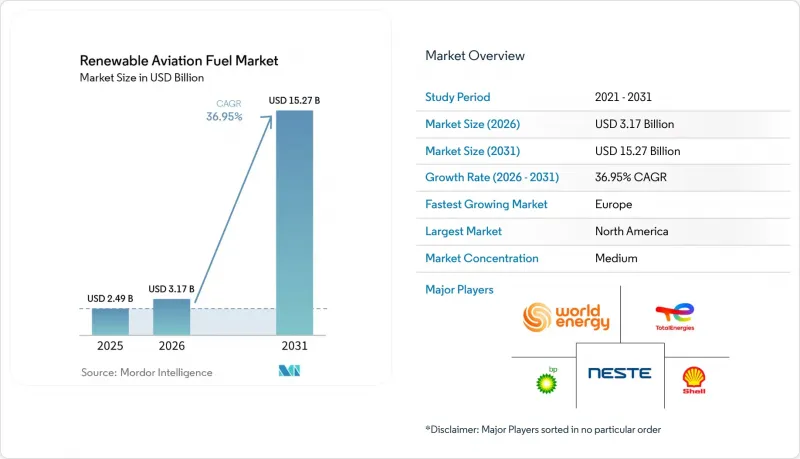
This report is Segmented by Feedstock (Used Cooking Oil and Waste Fats, Industrial CO2 and Green H2, and More), Technology (Hydroprocessed Esters and Fatty Acids, Alcohol-To-Jet, and More), Blending Level (Up To 10% Blend, 10 To 50% Blend, and 50 To 100% Blend), Application (Commercial Airlines, and More), and Geography (North America, Europe, Asia-Pacific, South America, and Middle-East and Africa).
Global Renewable Aviation Fuel Market Trends and Insights
Increased Government Regulations for GHG Emissions
Binding mandates are replacing voluntary frameworks as the principal demand catalyst. The EU's ReFuelEU Aviation regulation compels a 2% SAF blend in 2025, 6% by 2030, and 70% by 2050, with penalties of EUR 95 per ton of CO2-equivalent for non-compliance. The same law carves out a synthetic fuel sub-target of 1.2% by 2030 and 35% by 2050, steering investment toward power-to-liquid pathways. CORSIA's first compliance phase began in 2024, and because each liter of SAF yields 3.5 times more eligible credits than carbon offsets, airlines favor direct blending. Japan's 10% mandate for 2030 and India's phased 1-2% mandates deepen regulatory momentum in Asia, underscoring that statutory blend floors, not feedstock availability, dictate regional uptake.
Airline Net-Zero Emission Commitments
Carrier-level pledges translate into sizable, long-term contracts that de-risk capital. United Airlines agreed to purchase 1.5 billion gallons of SAF over 20 years, including 900 million gallons from Neste. Air France-KLM inked a 10-year deal for 800,000 tons with TotalEnergies, anchoring revenue for the Grandpuits biorefinery. Emirates earmarked USD 200 million annually for SAF procurement, signaling willingness to import from Europe and Asia. These offtakes lock in volume at USD 1.50-2.50 per gallon premiums over spot Jet A-1, satisfying project-finance lenders' revenue-certainty tests.
High Production Cost vs. Conventional Jet Fuel
SAF prices remained 2-5 times higher than Jet A-1 in 2025. HEFA costs USD 3-6 per gallon to produce versus USD 2-3 for petroleum jet, while e-fuels often exceeded USD 8 per gallon before subsidies. The U.S. Section 45Z credit of USD 1.75 per gallon narrows the gap but expires in 2027, clouding long-term economics. Capital intensity amplifies risk; PtL plants require about USD 1 billion for 100,000 tons of annual capacity.
Other drivers and restraints analyzed in the detailed report include:
- Corporate Travel Decarbonization Pressure
- Electro-Fuels (PtL) Technology Breakthroughs
- Feedstock Supply Competition & Constraints
For complete list of drivers and restraints, kindly check the Table Of Contents.
Segment Analysis
Used cooking oil and waste fats accounted for 40.4% of the renewable aviation fuel market share in 2025, reflecting HEFA maturity and entrenched collection networks. Industrial CO2 paired with green hydrogen is forecast to grow at a 59.5% CAGR through 2031, the fastest among all feedstocks, as ReFuelEU's synthetic sub-mandate underwrites offtake. Animal fats remain volume-constrained, while lignocellulosic biomass trails due to capital-intensive gasification-FT processes that only Fulcrum BioEnergy has scaled commercially.
Demand for lipid feedstocks is tightening rapidly. Global UCO imports surged, prompting the European Commission to audit certification chains and consider stricter traceability standards. Vegetable oils face sustainability scrutiny; the EU excluded palm oil-derived HEFA in 2024, redirecting procurement toward lower-yield soybean and rapeseed oils. As lipid ceilings loom, synthetic e-SAF emerges as the only route capable of delivering the 35% blend requirement embedded in EU law by 2050.
HEFA dominated with 69.9% of the renewable aviation fuel market size in 2025, driven by Neste's 1.9 million tons Singapore facility and TotalEnergies' Grandpuits conversion. Yet lipid reliance caps future output at roughly 10 million tons annually. PtL/e-SAF is projected to surge at 55.8% CAGR, aided by falling electrolyzer costs and growing availability of ultralow-cost solar in the Middle East. ATJ and FT-SPK play transitional roles: LanzaJet's Freedom Pines plant reached 10 million gallons in 2025, while Velocys finally obtained ASTM approval for its municipal solid-waste route, unlocking Bayou Fuels construction.
HEFA's brownfield advantage remains strong in the near term; co-processing at petroleum refineries slashes capex by up to 50% relative to greenfield builds. Nevertheless, investors are gravitating toward PtL projects with 15-year offtake agreements as policy certainty improves. Technology licensing has become a strategic choke-point: Honeywell UOP's Ecofining process underpins more than 70% of global HEFA capacity and generated USD 200 million in license fees in 2024.
Complete Report Scope:
- By Feedstock
- Used Cooking Oil and Waste Fats
- Animal Fat
- Vegetable Oils
- Lignocellulosic Biomass
- Industrial CO2 and Green H2
- By Technology
- Hydroprocessed Esters and Fatty Acids (HEFA)
- Fischer-Tropsch SPK (FT-SPK)
- Alcohol-to-Jet (ATJ)
- Synthesised Iso-Paraffinic (SIP)
- Catalytic Hydro-thermolysis Jet (CHJ)
- Power-to-Liquid/e-SAF
- By Blending Level
- Up to 10% Blend
- 10 to 50% Blend
- 50 to 100% Blend
- By Application
- Commercial Airlines
- Defense/Military Aviation
- General and Business Aviation
- By Geography
- North America
- United States
- Canada
- Mexico
- Europe
- United Kingdom
- Germany
- France
- Italy
- Spain
- NORDIC Countries
- Russia
- Rest of Europe
- Asia-Pacific
- China
- India
- Japan
- South Korea
- ASEAN Countries
- Australia and New Zealand
- Rest of Asia-Pacific
- South America
- Brazil
- Argentina
- Chile
- Rest of South America
- Middle East and Africa
- Saudi Arabia
- United Arab Emirates
- South Africa
- Kenya
- Rest of Middle East and Africa
- North America
Geography Analysis
Europe is expected to record a 43.0% CAGR through 2031, surpassing North America despite North America's 42.6% renewable aviation fuel market share in 2025. The EU blended 193,000 tons of SAF in 2024, just 0.6% of jet fuel consumption, yet announced projects would lift capacity to 3.2 million tons by 2030, mainly in the Netherlands, France, and Germany. Airport infrastructure programs in Amsterdam, Paris, and Frankfurt reduce logistics costs and anchor supply.
North America benefits from established HEFA capacity at World Energy's Paramount refinery and generous production credits under the Inflation Reduction Act. Section 45Z offers up to USD 1.75 per gallon but faces renewal risk after 2027, causing some developers to delay investment decisions. Canada introduced a USD 1.1 billion subsidy scheme targeting 10% domestic production by 2030, but feedstock competition from renewable diesel limits immediate growth.
Asia-Pacific is awakening. Singapore's 1% mandate launches in 2026, Japan targets 10% by 2030, and India phases in 1-2% requirements by 2028. China aims for 50,000 tons of output by 2025, but fell short at 30,000 tons due to feedstock scarcity. Australia committed USD 720 million to SAF funding in 2025, targeting 10% blend by 2030. The Middle East positions itself as a PtL hub; Masdar's 200,000 ton Abu Dhabi facility will leverage low-cost solar, and the UAE's Emirates has signed a 15-year offtake agreement.
- Neste Oyj
- TotalEnergies SE
- Shell plc
- BP plc
- Chevron Corporation
- World Energy LLC
- LanzaJet Inc.
- LanzaTech Global Inc.
- Gevo Inc.
- Fulcrum BioEnergy Inc.
- Aemetis Inc.
- Honeywell International Inc. (UOP)
- Red Rock Biofuels LLC
- SG Preston Company
- SkyNRG BV
- Swedish Biofuels AB
- Virent Inc.
- HIF Global
- Alder Fuels
- Twelve Benefit Corporation
- Velocys plc
Additional Benefits:
- The market estimate (ME) sheet in Excel format
- 3 months of analyst support
TABLE OF CONTENTS
1 Introduction
- 1.1 Study Assumptions & Market Definition
- 1.2 Scope of the Study
2 Research Methodology
3 Executive Summary
4 Market Landscape
- 4.1 Market Overview
- 4.2 Market Drivers
- 4.2.1 Increased government regulations for GHG emissions
- 4.2.2 Airline net-zero emission commitments
- 4.2.3 Corporate travel decarbonization pressure
- 4.2.4 Electro-fuels (PtL) technology breakthroughs
- 4.2.5 Regional airport SAF-infrastructure funding
- 4.3 Market Restraints
- 4.3.1 High production cost vs. conventional jet fuel
- 4.3.2 Feedstock supply competition & constraints
- 4.3.3 Volatility in policy-driven credits (RIN/SAFc)
- 4.3.4 Certification & safety-approval delays
- 4.4 Supply Chain Analysis
- 4.5 Regulatory Landscape
- 4.6 Technological Outlook
- 4.7 Porter's Five Forces
- 4.7.1 Bargaining Power of Suppliers
- 4.7.2 Bargaining Power of Buyers
- 4.7.3 Threat of New Entrants
- 4.7.4 Threat of Substitute Products & Services
- 4.7.5 Intensity of Competitive Rivalry
5 Market Size & Growth Forecasts
- 5.1 By Feedstock
- 5.1.1 Used Cooking Oil and Waste Fats
- 5.1.2 Animal Fat
- 5.1.3 Vegetable Oils
- 5.1.4 Lignocellulosic Biomass
- 5.1.5 Industrial CO2 and Green H2
- 5.2 By Technology
- 5.2.1 Hydroprocessed Esters and Fatty Acids (HEFA)
- 5.2.2 Fischer-Tropsch SPK (FT-SPK)
- 5.2.3 Alcohol-to-Jet (ATJ)
- 5.2.4 Synthesised Iso-Paraffinic (SIP)
- 5.2.5 Catalytic Hydro-thermolysis Jet (CHJ)
- 5.2.6 Power-to-Liquid/e-SAF
- 5.3 By Blending Level
- 5.3.1 Up to 10% Blend
- 5.3.2 10 to 50% Blend
- 5.3.3 50 to 100% Blend
- 5.4 By Application
- 5.4.1 Commercial Airlines
- 5.4.2 Defense/Military Aviation
- 5.4.3 General and Business Aviation
- 5.5 By Geography
- 5.5.1 North America
- 5.5.1.1 United States
- 5.5.1.2 Canada
- 5.5.1.3 Mexico
- 5.5.2 Europe
- 5.5.2.1 United Kingdom
- 5.5.2.2 Germany
- 5.5.2.3 France
- 5.5.2.4 Italy
- 5.5.2.5 Spain
- 5.5.2.6 NORDIC Countries
- 5.5.2.7 Russia
- 5.5.2.8 Rest of Europe
- 5.5.3 Asia-Pacific
- 5.5.3.1 China
- 5.5.3.2 India
- 5.5.3.3 Japan
- 5.5.3.4 South Korea
- 5.5.3.5 ASEAN Countries
- 5.5.3.6 Australia and New Zealand
- 5.5.3.7 Rest of Asia-Pacific
- 5.5.4 South America
- 5.5.4.1 Brazil
- 5.5.4.2 Argentina
- 5.5.4.3 Chile
- 5.5.4.4 Rest of South America
- 5.5.5 Middle East and Africa
- 5.5.5.1 Saudi Arabia
- 5.5.5.2 United Arab Emirates
- 5.5.5.3 South Africa
- 5.5.5.4 Kenya
- 5.5.5.5 Rest of Middle East and Africa
- 5.5.1 North America
6 Competitive Landscape
- 6.1 Market Concentration
- 6.2 Strategic Moves (M&A, Partnerships, PPAs)
- 6.3 Market Share Analysis (Market Rank/Share for key companies)
- 6.4 Company Profiles (includes Global level Overview, Market level overview, Core Segments, Financials as available, Strategic Information, Products & Services, and Recent Developments)
- 6.4.1 Neste Oyj
- 6.4.2 TotalEnergies SE
- 6.4.3 Shell plc
- 6.4.4 BP plc
- 6.4.5 Chevron Corporation
- 6.4.6 World Energy LLC
- 6.4.7 LanzaJet Inc.
- 6.4.8 LanzaTech Global Inc.
- 6.4.9 Gevo Inc.
- 6.4.10 Fulcrum BioEnergy Inc.
- 6.4.11 Aemetis Inc.
- 6.4.12 Honeywell International Inc. (UOP)
- 6.4.13 Red Rock Biofuels LLC
- 6.4.14 SG Preston Company
- 6.4.15 SkyNRG BV
- 6.4.16 Swedish Biofuels AB
- 6.4.17 Virent Inc.
- 6.4.18 HIF Global
- 6.4.19 Alder Fuels
- 6.4.20 Twelve Benefit Corporation
- 6.4.21 Velocys plc
7 Market Opportunities & Future Outlook
- 7.1 White-space & Unmet-need Assessment

