PUBLISHER: Mordor Intelligence | PRODUCT CODE: 2122766

PUBLISHER: Mordor Intelligence | PRODUCT CODE: 2122766
Pharmacy Automation - Market Share Analysis, Industry Trends & Statistics, Growth Forecasts (2026 - 2031)
According to Mordor Intelligence, the pharmacy automation market size is projected to expand from USD 7.19 billion in 2025 and USD 7.81 billion in 2026 to USD 11.79 billion by 2031, registering a CAGR of 8.60% between 2026 to 2031.
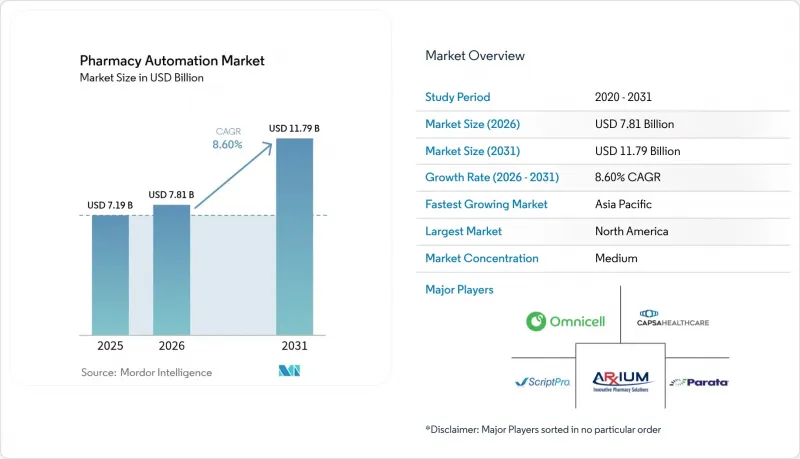
This report is Segmented by Product (Automated Medication Dispensing Systems, and More), End User (Hospital Pharmacies, and More), Deployment Model (Centralised Automation Hubs and Decentralised Point-Of-Care Units), Pharmacy Size (>500 Beds/>250 Stores, and More), and Geography (North America, Europe, Asia-Pacific, and More). The Market Forecasts are Provided in Terms of Value (USD).
Global Pharmacy Automation Market Trends and Insights
Rising Healthcare Expenditure and Digital Transformation Initiatives
Escalating national health budgets are putting pressure on providers to unlock operational savings, and automated pharmacy systems are proving to be one of the few levers that simultaneously cut labor costs, reduce errors, and satisfy information-sharing mandates. A 400-bed academic hospital demonstrated that centralized robotics eliminated 12-18 full-time equivalent roles, resulting in annual savings of USD 1.2-1.8 million. The 21st Century Cures Act obliges hospitals to expose medication data via FHIR interfaces; platforms with native FHIR integration avoid middleware fees and accelerate time-to-value. Cloud hosting further improves visibility across enterprise drug stores, reducing back-order frequency by 30-40% and mitigating expiry losses. Quality-reporting programs now reimburse facilities that submit machine-logged reconciliation metrics, pushing automation beyond the finance department into regulatory strategy.
Growing Focus on Medication Safety and Regulatory Compliance
Medication-error deaths exceed 7,000 annually in the United States, and dispensing mistakes cause roughly one-fifth of incidents. Barcode-verified cabinets and gravimetric compounders eliminate more than 85% of wrong-drug events, a performance now embedded in Joint Commission surveys. In 2024, FDA guidance clarified that hospitals using recognized electronic distribution systems can satisfy the Drug Supply Chain Security Act traceability rules without manual scanning. Europe's Falsified Medicines Directive enforces unique identifiers on every pack, a workload only high-speed automated lines can shoulder. Medical-malpractice insurers in four U.S. states are rewarding robotic installations with 5-10% premium cuts, turning compliance capability into a revenue-protecting asset.
High Upfront Capital and Maintenance Burden
A centralized robotic platform for a 300-bed hospital costs USD 1.5-2.5 million and requires service contracts priced at 12-15% of capital each year, extending the payback to as long as 6 years. Independent pharmacies running under 150 daily scripts struggle because their labor savings seldom equal even one full-time salary. Subscription bundles from vendors such as Parata convert capital into monthly operating fees of USD 3,500-5,000 but still require minimum-volume clauses that expose operators to penalties in low-season months. Component wear adds roughly USD 30,000 in annual upkeep. Rural hospitals outside 150-mile service radii face 48-hour wait times for engineers unless they purchase premium support.
Other drivers and restraints analyzed in the detailed report include:
- Increasing Labor Shortages in the Pharmacy Workforce
- Expansion of Telehealth and E-Pharmacy Channels
- Interoperability Challenges with Legacy IT Systems
For complete list of drivers and restraints, kindly check the Table Of Contents.
Segment Analysis
Robotic sterile compounding systems will grow at a 10.43% CAGR through 2031, faster than any other product category in the pharmacy automation market, driven by oncology regimens that require sub-microgram accuracy. Automated medication dispensing commanded 47.43% revenue share in 2025, illustrating scale penetration but also signaling a maturing installed base. ICU Medical's FDA-cleared IntelliMix supports neonatal parenteral nutrition, opening high-liability use cases where automation is rapidly becoming non-negotiable. The pharmacy automation market size allocated to automated tablet counters remains modest, yet their entry price of USD 15,000-25,000 keeps independents engaged.
Analytics-driven software layers are turning hardware into data platforms that predict stock-order spikes and pre-stage inventory, cutting emergency restock trips by 40%. Automated storage and retrieval systems reduce pick times from eight minutes to under 60 seconds, increasing throughput without proportional staffing. Given that oncology and gene-therapy protocols incur six-figure per-dose costs, closed-system compounders are now bundled into payer risk-management strategies, reinforcing premium-tier growth inside the pharmacy automation market.
Hospital pharmacies absorbed 62.54% of 2025 expenditure, cementing their centrality in the pharmacy automation market, yet their growth is slowing as cabinet refresh cycles taper. In contrast, mail-order and ePharmacies will post an 11.43% CAGR to 2031 as central-fill megahubs replicate Amazon-style throughput. Retail chains are consolidating operations; Walgreens closed 150 U.S. locations in 2024 and channeled volume to automated regional centers.
Long-term-care facilities value dose-packaging robots that cut medication-pass time 30-40%, a labor offset that enables cost recapture despite low reimbursement. The pharmacy automation market share accruing to specialty pharmacies handling biologics is climbing because robotic cold-chain systems assure +-0.5 °C compliance that manual fridges struggle to guarantee.
Complete Report Scope:
- By Product
- Automated Medication Dispensing Systems
- Automated Packaging & Labeling Systems
- Automated Table-top Tablet Counters
- Automated Storage & Retrieval Systems
- Robotic Sterile Compounding Systems
- Pharmacist Workflow & Analytics Software
- By End User
- Hospital Pharmacies (In-patient, Out-patient)
- Retail & Chain Pharmacies
- Mail-order / ePharmacies
- Long-term-care & Specialty Pharmacies
- By Deployment Model
- Centralised Automation Hubs
- Decentralised Point-of-Care Units
- By Pharmacy Size
- >500 beds / >250 stores
- 100-499 beds / 50-249 stores
- <100 beds / Independent stores
- Geography
- North America
- United States
- Canada
- Mexico
- Europe
- Germany
- United Kingdom
- France
- Italy
- Spain
- Rest of Europe
- Asia-Pacific
- China
- Japan
- India
- Australia
- South Korea
- Rest of Asia-Pacific
- Middle East & Africa
- GCC
- South Africa
- Rest of Middle East & Africa
- South America
- Brazil
- Argentina
- Rest of South America
- North America
Geography Analysis
North America contributed 41.56% of 2025 global revenue, anchored by Medicare quality-reporting bonuses that acknowledge automated reconciliation logs as evidence of safe practice. Hospital groups are pushing decentralized cabinets into emergency departments, cutting stat-order cycle times from 45 minutes to under 8. Canada's provinces pilot regional compounding centers supervised remotely, a model that leverages robotics to pool scarce pharmacist labor. Mexico's private hospitals deploy dispensing cabinets to meet Joint Commission International standards, a prerequisite for lucrative medical-tourism contracts. The latest FDA guidance clarified liability boundaries for machine-dispensed doses, unfreezing procurement across U.S. ambulatory surgery centers.
Asia-Pacific will record the fastest growth, with a 9.54% CAGR through 2031. China mandates e-prescription routing for all tertiary hospitals by 2027, an edict that effectively pre-installs demand for central hubs and AI-assisted routing engines. Japan subsidizes up to 50% of robotic compounders serving aging populations, normalizing automation in community hospitals. India's major private chains are differentiating oncology services with robotic sterile compounders, while South Korea pilots reimbursements for pharmacist-led therapy management that presuppose robots handle repetitive dispensing. Australia's reimbursement formula will soon reward operators who keep dispensing error rates below 1%, a threshold nearly impossible to achieve without robotics.
Europe's progress pivots on traceability rules under the Falsified Medicines Directive, which require unit-dose barcoding that manual lines cannot execute economically. Germany's patchwork of more than 400 pharmacy IT systems inflates integration costs and slows uptake. The United Kingdom focuses on regional hubs to address pharmacist shortages, while France is piloting a national track-and-trace database that will be mandatory by 2028. Southern Europe lags due to budget and organizational fragmentation, yet private groups in Spain and Italy are racing to adopt robotic packaging to secure international patient revenue. Early deployments in Gulf Cooperation Council megahospitals hint at future acceleration in the Middle East, whereas high import tariffs and thin reimbursement continue to cap Latin American expansion.
- Accu-Chart Plus Healthcare Systems
- Arxium
- Baxter
- BD (Becton, Dickinson & Co.)
- Capsa Healthcare
- Grifols (LogiFill)
- ICU Medical (IntelliMix)
- Innotech Espana (Rowa)
- Mckesson
- NewIcon Oy
- Omnicell
- Oracle Health (Cerner Rx)
- Parata Systems
- Pearson Medical Technologies
- RxSafe
- ScriptPro
- Swisslog Healthcare
- Talyst Systems (Swisslog)
- TouchPoint Medical
- Yuyama Co. Ltd.
Additional Benefits:
- The market estimate (ME) sheet in Excel format
- 3 months of analyst support
TABLE OF CONTENTS
1 Introduction
- 1.1 Study Assumptions & Market Definition
- 1.2 Scope of the Study
2 Research Methodology
3 Executive Summary
4 Market Landscape
- 4.1 Market Overview
- 4.2 Market Drivers
- 4.2.1 Rising Healthcare Expenditure and Digital Transformation Initiatives
- 4.2.2 Growing Focus on Medication Safety and Regulatory Compliance
- 4.2.3 Increasing Labor Shortages in Pharmacy Workforce
- 4.2.4 Expansion of Telehealth and E-Pharmacy Channels
- 4.2.5 Accelerating Adoption of Artificial Intelligence and Robotics
- 4.2.6 Integration of Cloud-Based Platforms and Software-as-a-Service Models
- 4.3 Market Restraints
- 4.3.1 High Upfront Capital and Maintenance Burden
- 4.3.2 Interoperability Challenges with Legacy IT Systems
- 4.3.3 Data Privacy, Cybersecurity, and Compliance Risks
- 4.3.4 Uncertain Return on Investment for Small and Rural Pharmacies
- 4.4 Regulatory Landscape
- 4.5 Porter's Five Forces Analysis
- 4.5.1 Threat of New Entrants
- 4.5.2 Bargaining Power of Buyers
- 4.5.3 Bargaining Power of Suppliers
- 4.5.4 Threat of Substitutes
- 4.5.5 Competitive Rivalry
5 Market Size & Growth Forecasts (Value, USD)
- 5.1 By Product
- 5.1.1 Automated Medication Dispensing Systems
- 5.1.2 Automated Packaging & Labeling Systems
- 5.1.3 Automated Table-top Tablet Counters
- 5.1.4 Automated Storage & Retrieval Systems
- 5.1.5 Robotic Sterile Compounding Systems
- 5.1.6 Pharmacist Workflow & Analytics Software
- 5.2 By End User
- 5.2.1 Hospital Pharmacies (In-patient, Out-patient)
- 5.2.2 Retail & Chain Pharmacies
- 5.2.3 Mail-order / ePharmacies
- 5.2.4 Long-term-care & Specialty Pharmacies
- 5.3 By Deployment Model
- 5.3.1 Centralised Automation Hubs
- 5.3.2 Decentralised Point-of-Care Units
- 5.4 By Pharmacy Size
- 5.4.1 >500 beds / >250 stores
- 5.4.2 100-499 beds / 50-249 stores
- 5.4.3 <100 beds / Independent stores
- 5.5 Geography
- 5.5.1 North America
- 5.5.1.1 United States
- 5.5.1.2 Canada
- 5.5.1.3 Mexico
- 5.5.2 Europe
- 5.5.2.1 Germany
- 5.5.2.2 United Kingdom
- 5.5.2.3 France
- 5.5.2.4 Italy
- 5.5.2.5 Spain
- 5.5.2.6 Rest of Europe
- 5.5.3 Asia-Pacific
- 5.5.3.1 China
- 5.5.3.2 Japan
- 5.5.3.3 India
- 5.5.3.4 Australia
- 5.5.3.5 South Korea
- 5.5.3.6 Rest of Asia-Pacific
- 5.5.4 Middle East & Africa
- 5.5.4.1 GCC
- 5.5.4.2 South Africa
- 5.5.4.3 Rest of Middle East & Africa
- 5.5.5 South America
- 5.5.5.1 Brazil
- 5.5.5.2 Argentina
- 5.5.5.3 Rest of South America
- 5.5.1 North America
6 Competitive Landscape
- 6.1 Market Concentration
- 6.2 Market Share Analysis
- 6.3 Company Profiles {(Includes Global Level Overview, Market Level Overview, Core Segments, Financials As Available, Strategic Information, Market Rank/Share For Key Companies, Products & Services, And Recent Developments)}
- 6.3.1 Accu-Chart Plus Healthcare Systems
- 6.3.2 Arxium
- 6.3.3 Baxter International Inc.
- 6.3.4 BD (Becton, Dickinson & Co.)
- 6.3.5 Capsa Healthcare
- 6.3.6 Grifols (LogiFill)
- 6.3.7 ICU Medical (IntelliMix)
- 6.3.8 Innotech Espana (Rowa)
- 6.3.9 McKesson Corporation
- 6.3.10 NewIcon Oy
- 6.3.11 Omnicell Inc.
- 6.3.12 Oracle Health (Cerner Rx)
- 6.3.13 Parata Systems LLC
- 6.3.14 Pearson Medical Technologies
- 6.3.15 RxSafe LLC
- 6.3.16 ScriptPro LLC
- 6.3.17 Swisslog Healthcare
- 6.3.18 Talyst Systems (Swisslog)
- 6.3.19 TouchPoint Medical
- 6.3.20 Yuyama Co. Ltd.
7 Market Opportunities & Future Outlook
- 7.1 White-space & Unmet-need Assessment

