PUBLISHER: Mordor Intelligence | PRODUCT CODE: 2123410

PUBLISHER: Mordor Intelligence | PRODUCT CODE: 2123410
Wearable Robots And Exoskeletons - Market Share Analysis, Industry Trends & Statistics, Growth Forecasts (2026 - 2031)
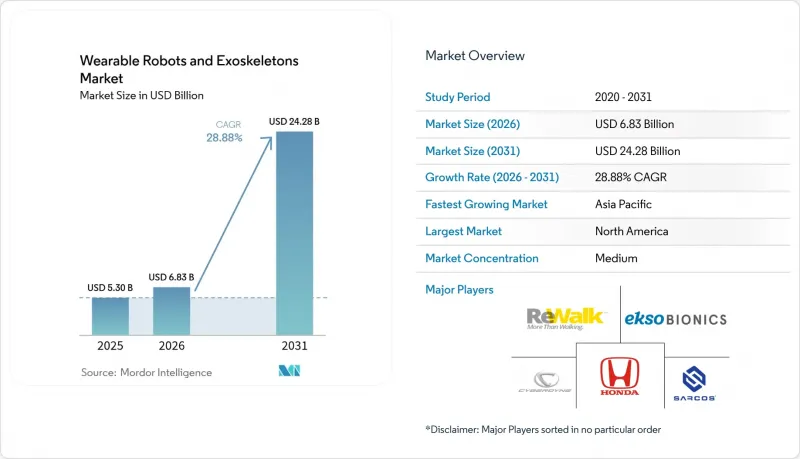
According to Mordor Intelligence, the wearable robots and exoskeletons market size is expected to grow from USD 5.30 billion in 2025 to USD 6.83 billion in 2026 and is forecast to reach USD 24.28 billion by 2031 at 28.88% CAGR over 2026-2031.
This report is Segmented by Type (Powered, and Passive), Component (Hardware Including Sensors, Actuators, and More), Body Part Assisted (Lower Extremity, Upper Extremity, and More), End-User Industry (Healthcare, Industrial and Logistics, and More), Mobility Type (Mobile or Wearable, and Stationary or Tethered), and Geography. The Market Forecasts are Provided in Terms of Value (USD).
Global Wearable Robots And Exoskeletons Market Trends and Insights
Aging-Population Surge in Musculoskeletal Disorders
Stroke prevalence climbs sharply after age 55, and older adults already represent 16% of the world population in 2025. The World Health Organization estimates 1.71 billion disability-adjusted life years from musculoskeletal conditions. Powered gait trainers provide adjustable torque that enables higher-intensity therapy than manual techniques. Japan's reimbursement for assistive-robot rentals, effective April 2024, accelerated Hybrid Assistive Limb adoption in nursing homes, while the U.S. Centers for Medicare and Medicaid Services opened code E1399 for home-use prescriptions. Clinical trials showed a 23% bump in walking speed after 12-week HAL therapy cycles. These signals demonstrate why healthcare remains the anchor of the wearable robots and exoskeletons market.
Rapid Cost Declines in Actuators and Batteries
Brushless DC motor prices slid 18% between 2022 and 2024 as Chinese plants scaled rare-earth-free rotors, and lithium-ion packs for high-discharge wearables fell to USD 137 per kWh. German Bionic embedded a 1.2 kWh pack in the 4.8 kg Apogee ULTRA, securing 12-hour runtime and 300 rental subscriptions within one quarter. Parker Hannifin's compact electro-hydraulic actuator now delivers 150 Nm at one-third the weight of pneumatic peers . These shifts lower the bill of materials, propelling the wearable robots and exoskeletons market toward cost-parity with passive braces.
High Upfront Acquisition and Lifecycle Maintenance Costs
Industrial units list at USD 40,000-80,000, while healthcare systems face USD 77,000 price tags for home-use devices. Annual maintenance adds up to 20% of initial spend, driven by battery and actuator replacements. German Bionic's EUR 250 monthly rental still equates to USD 3,396 per year, straining thin-margin firms . Battery swaps every two years cost USD 2,500-4,000; actuator overhauls run USD 5,000-8,000. These economics temper adoption in price-sensitive regions, limiting the near-term upside of the wearable robots and exoskeletons industry.
Other drivers and restraints analyzed in the detailed report include:
- Mandatory Workplace-Injury Reduction Targets
- Record Defense Budgets for Soldier Augmentation
- Lengthy Multi-Jurisdictional Certification
For complete list of drivers and restraints, kindly check the Table Of Contents.
Segment Analysis
Powered designs captured 66.85% of 2025 revenue and are forecast to expand at 31.2% CAGR through 2031, underscoring their pull across healthcare, defense, and heavy-lifting tasks. The wearable robots and exoskeletons market size attributed to powered units is projected to near USD 16.2 billion by 2031, driven by falling actuator prices and subscription models that smooth capital outlays. German Bionic's rental plan reduces ownership costs 40%, while Lockheed Martin's ONYX field data signal double-digit endurance gains that military buyers value.
Passive solutions held 33.15% share in 2025, steady demand for rugged, battery-free rigs in construction, agriculture, and maintenance. SuitX's IX BACK VOLTON blends passive lumbar support with an optional powered mode, illustrating design convergence as buyers seek flexibility without compromising uptime. Passive exoskeletons remain attractive where charging infrastructure is scarce, yet incremental torque benefits mean powered systems will keep widening their reach across the global wearable robots and exoskeletons market.
Hardware delivered 73.05% of 2025 revenue, but commoditization is eroding margins as sensor and motor prices fall. Sensors accounted for 15% of bill-of-materials cost, while actuators still dominate at 45% but are shedding weight and energy draw. Battery innovation looms; solid-state prototypes promise 50% density gains by 2027. Software revenue is pacing at 32.05% CAGR, and fleet dashboards now underpin recurring-revenue bundles.
Fourier Intelligence's on-device AI tweaks torque in real time, reducing fatigue and differentiating bids in hospital tenders. As a result, software's slice of the wearable robots and exoskeletons market share will widen as data analytics and remote diagnostics cement themselves in every contract.
Complete Report Scope:
- By Type
- Powered Exoskeletons
- Passive Exoskeletons
- By Component
- Hardware
- Sensors
- Actuators
- Power Sources
- Software
- Services
- Hardware
- By Body Part Assisted
- Lower Extremity
- Upper Extremity
- Full Body
- By End-user Industry
- Healthcare
- Industrial and Logistics
- Military and Defense
- Other End-user Industrys (Public Safety, Consumer)
- By Mobility Type
- Mobile / Wearable
- Stationary / Tethered
- By Geography
- North America
- United States
- Canada
- Mexico
- South America
- Brazil
- Argentina
- Rest of South America
- Europe
- Germany
- United Kingdom
- France
- Italy
- Spain
- Russia
- Rest of Europe
- Asia Pacific
- China
- Japan
- India
- South Korea
- Australia
- Rest of Asia Pacific
- Middle East and Africa
- Middle East
- Saudi Arabia
- United Arab Emirates
- Turkey
- Rest of Middle East
- Africa
- South Africa
- Nigeria
- Egypt
- Rest of Africa
- Middle East
- North America
Geography Analysis
North America led with 39.85% revenue in 2025. FDA 510(k) streamlines medical clearances, while USD 12.8 million in FY 2025 Army RDT&E exoskeleton funding signals long-run commitment. VA policy changes removed supervision mandates, boosting veteran access. Canada's WorkSafeBC offers 50% purchase subsidies, and Mexico's automotive belt is piloting passive rigs despite training gaps. These factors keep North America atop the wearable robots and exoskeletons market rankings.
Asia Pacific is the fastest climber at 32.1% CAGR. Japan expanded long-term care insurance to cover assistive-robot rentals. Fourier Intelligence installed 120 exoskeletons in Chinese hospitals by late-2024. Hyundai plans 1,000 X-ble Shoulder units by 2026 as South Korea aligns factory automation with labor-safety mandates. India and Australia are early-stage yet promising due to new funding lines and pilot trials. The region's demographic urgency and reimbursement reforms make it the pivotal growth engine for the wearable robots and exoskeletons market.
Europe held roughly 24.95% of 2025 revenue. MDR lengthens approval cycles to 24 months, benefiting incumbents such as Ottobock and Wandercraft. Germany's accident-insurance funds reimburse 80% of device costs for high-risk trades. The U.K. National Health Service pilot shows a 30% reduction in therapy hours versus conventional rehab, aiding adoption. Regulatory bottlenecks moderate short-term expansion, yet strong worker-safety cultures sustain demand across the wearable robots and exoskeletons market.
- Cyberdyne Inc.
- ReWalk Robotics Ltd.
- Ekso Bionics Holdings Inc.
- Sarcos Technology and Robotics Corporation
- Honda Motor Co., Ltd.
- Myomo Inc.
- Ottobock SE and Co. KGaA
- SuitX Inc. (Ottobock Group)
- Parker Hannifin Corporation
- Bionik Laboratories Corp.
- Wandercraft SAS
- Fourier Intelligence Co., Ltd.
- Skelex B.V.
- Wearable Robotics S.r.l.
- Daiya Industry Co., Ltd.
- Panasonic Holdings Corporation
- Lockheed Martin Corporation
- Hyundai Motor Company
Additional Benefits:
- The market estimate (ME) sheet in Excel format
- 3 months of analyst support
TABLE OF CONTENTS
1 INTRODUCTION
- 1.1 Study Assumptions and Market Definition
- 1.2 Scope of the Study
2 RESEARCH METHODOLOGY
3 EXECUTIVE SUMMARY
4 MARKET LANDSCAPE
- 4.1 Market Overview
- 4.2 Market Drivers
- 4.2.1 Ageing-population led surge in musculoskeletal disorders
- 4.2.2 Rapid cost declines in lightweight actuators and battery packs
- 4.2.3 Mandatory workplace-injury reduction targets in heavy industry
- 4.2.4 Record defence budgets earmarked for soldier-augmentation tech
- 4.2.5 Insurance-reimbursement approvals for in-home neuro-rehab
- 4.2.6 Emerging lease-as-a-service models for exoskeleton fleets
- 4.3 Market Restraints
- 4.3.1 High upfront acquisition and lifecycle maintenance costs
- 4.3.2 Lengthy multi-jurisdictional medical-device certification
- 4.3.3 Limited torque-to-weight ratios for full-shift industrial use
- 4.3.4 User-acceptance barriers due to device discomfort and heat
- 4.4 Industry Value Chain Analysis
- 4.5 Impact of Macroeconomic Factors
- 4.6 Regulatory Landscape
- 4.7 Technological Outlook
- 4.8 Porter's Five Forces Analysis
- 4.8.1 Threat of New Entrants
- 4.8.2 Bargaining Power of Buyers
- 4.8.3 Bargaining Power of Suppliers
- 4.8.4 Threat of Substitute Products
- 4.8.5 Intensity of Competitive Rivalry
5 MARKET SIZE AND GROWTH FORECASTS
- 5.1 By Type
- 5.1.1 Powered Exoskeletons
- 5.1.2 Passive Exoskeletons
- 5.2 By Component
- 5.2.1 Hardware
- 5.2.1.1 Sensors
- 5.2.1.2 Actuators
- 5.2.1.3 Power Sources
- 5.2.2 Software
- 5.2.3 Services
- 5.2.1 Hardware
- 5.3 By Body Part Assisted
- 5.3.1 Lower Extremity
- 5.3.2 Upper Extremity
- 5.3.3 Full Body
- 5.4 By End-user Industry
- 5.4.1 Healthcare
- 5.4.2 Industrial and Logistics
- 5.4.3 Military and Defense
- 5.4.4 Other End-user Industrys (Public Safety, Consumer)
- 5.5 By Mobility Type
- 5.5.1 Mobile / Wearable
- 5.5.2 Stationary / Tethered
- 5.6 By Geography
- 5.6.1 North America
- 5.6.1.1 United States
- 5.6.1.2 Canada
- 5.6.1.3 Mexico
- 5.6.2 South America
- 5.6.2.1 Brazil
- 5.6.2.2 Argentina
- 5.6.2.3 Rest of South America
- 5.6.3 Europe
- 5.6.3.1 Germany
- 5.6.3.2 United Kingdom
- 5.6.3.3 France
- 5.6.3.4 Italy
- 5.6.3.5 Spain
- 5.6.3.6 Russia
- 5.6.3.7 Rest of Europe
- 5.6.4 Asia Pacific
- 5.6.4.1 China
- 5.6.4.2 Japan
- 5.6.4.3 India
- 5.6.4.4 South Korea
- 5.6.4.5 Australia
- 5.6.4.6 Rest of Asia Pacific
- 5.6.5 Middle East and Africa
- 5.6.5.1 Middle East
- 5.6.5.1.1 Saudi Arabia
- 5.6.5.1.2 United Arab Emirates
- 5.6.5.1.3 Turkey
- 5.6.5.1.4 Rest of Middle East
- 5.6.5.2 Africa
- 5.6.5.2.1 South Africa
- 5.6.5.2.2 Nigeria
- 5.6.5.2.3 Egypt
- 5.6.5.2.4 Rest of Africa
- 5.6.5.1 Middle East
- 5.6.1 North America
6 COMPETITIVE LANDSCAPE
- 6.1 Market Concentration
- 6.2 Strategic Moves
- 6.3 Market Share Analysis
- 6.4 Company Profiles (includes Global level Overview, Market level overview, Core Segments, Financials as available, Strategic Information, Market Rank/Share for key companies, Products and Services, and Recent Developments)
- 6.4.1 Cyberdyne Inc.
- 6.4.2 ReWalk Robotics Ltd.
- 6.4.3 Ekso Bionics Holdings Inc.
- 6.4.4 Sarcos Technology and Robotics Corporation
- 6.4.5 Honda Motor Co., Ltd.
- 6.4.6 Myomo Inc.
- 6.4.7 Ottobock SE and Co. KGaA
- 6.4.8 SuitX Inc. (Ottobock Group)
- 6.4.9 Parker Hannifin Corporation
- 6.4.10 Bionik Laboratories Corp.
- 6.4.11 Wandercraft SAS
- 6.4.12 Fourier Intelligence Co., Ltd.
- 6.4.13 Skelex B.V.
- 6.4.14 Wearable Robotics S.r.l.
- 6.4.15 Daiya Industry Co., Ltd.
- 6.4.16 Panasonic Holdings Corporation
- 6.4.17 Lockheed Martin Corporation
- 6.4.18 Hyundai Motor Company
7 MARKET OPPORTUNITIES AND FUTURE OUTLOOK
- 7.1 White-Space and Unmet-Need assessment

