PUBLISHER: Mordor Intelligence | PRODUCT CODE: 2121376

PUBLISHER: Mordor Intelligence | PRODUCT CODE: 2121376
Alpha Emitters - Market Share Analysis, Industry Trends & Statistics, Growth Forecasts (2026 - 2031)
According to Mordor Intelligence, the alpha emitters market size was valued at USD 275.95 million in 2025 and is estimated to grow from USD 322.54 million in 2026 to reach USD 698.98 million by 2031, at a CAGR of 16.73% during the forecast period (2026-2031).
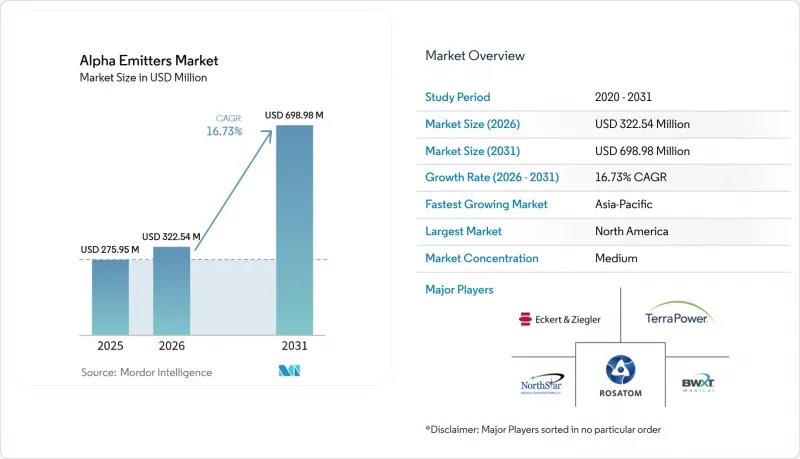
This report is Segmented by Type of Radionuclide (Astatine-211, Radium-223, Actinium-225, and More), Application (Prostate Cancer, Bone Metastasis, Ovarian Cancer, Pancreatic Cancer, Endocrine Tumors, and Other Applications), End User (Hospitals, Academic Medical Centers, and More), and Geography (North America, Europe, Asia-Pacific, and More). The Market Forecasts are Provided in Terms of Value (USD).
Global Alpha Emitters Market Trends and Insights
Escalating Incidence Of Hard-To-Treat Solid Tumors Driving Demand
The Alpha emitters market is linked to the growing need for treatment options in difficult-to-treat solid tumors, particularly where patients no longer respond adequately to earlier systemic therapy. The World Health Organization projected 35 million new cancer cases in 2050, compared with 20 million in 2022, which increases the potential pool of patients with refractory and metastatic disease that may require additional treatment options. Bone-metastatic disease and resistant solid tumors are important because many patients have progressed after chemotherapy, androgen-pathway inhibitors, or other treatments that have already addressed the primary disease. Alpha radiation can produce double-strand DNA damage, which is relevant where tumors have adapted to repair damage from earlier treatment and have become less responsive to conventional approaches. Better first-line prostate cancer treatment can extend survival and leave more patients facing bone micrometastases later in care, which can broaden the clinical window for radium-223. Updated nuclear medicine protocols have encouraged consideration of radionuclide therapy earlier in metastatic castration-resistant prostate cancer management rather than only after every other systemic option has been exhausted.
Superior Tumor-Killing Efficiency Boosting Clinician Confidence
Alpha particles deposit 50 to 230 keV/µm of energy across a 40 to 90 µm path length and have a reported relative biological effectiveness of 3 to 7 compared with conventional radiation. This physical profile supports use in heterogeneous tumors because radiation is delivered over a limited range rather than across a wider area of surrounding tissue. The Alpha emitters market benefits when physicians can consider both controlled evidence and routine-practice experience, especially for agents that require specialized treatment planning. Final PEACE-3 results published in February 2026 showed that radium-223 plus enzalutamide reduced mortality risk by 24% versus enzalutamide alone in patients with metastatic castration-resistant prostate cancer and bone metastases. Median overall survival was 38.2 months with the combination and 32.6 months with enzalutamide alone, with a hazard ratio of 0.76 and p=0.0096, adding a defined clinical result to the treatment discussion. The short radiation path may limit dose to nearby healthy tissue, which can affect toxicity concerns, retreatment considerations, and physician confidence when weighing localized radiation options.
Limited Manufacturing Capacity Creating Supply Bottlenecks
The Alpha emitters market still faces a gap between isotope output and the requirements of expanding clinical programs, even though producers are investing in new capacity. Actinium-225 has a 9.9-day half-life, which leaves limited time for production, quality testing, shipping, and patient administration and makes each step operationally dependent on the last. A disruption at one qualified facility can therefore delay several studies and treatment schedules at the same time because there is limited opportunity to hold replacement inventory. The present supplier base for cGMP-grade actinium-225 remains narrow relative to the number of late-stage programs seeking supply, which creates concentration risk for developers and trial sites. Facility construction alone does not resolve the issue because radiopharmaceutical production requires validation and cGMP qualification before material can support commercial use at consistent quality. Supply pressure may therefore persist into 2027 even as newly announced capacity is built, particularly for programs that need dependable allocations rather than occasional production batches.
Other drivers and restraints analyzed in the detailed report include:
- Strategic Pharmaceutical Investments Accelerating Development
- Expanding Isotope Production Infrastructure Improving Availability
- Specialized Infrastructure Requirements Driving Provider Costs
For complete list of drivers and restraints, kindly check the Table Of Contents.
Segment Analysis
Radium-223 held 61.77% of the Alpha emitters market share in 2025 because it remained the only commercially approved alpha emitter and had an established clinical position. Its position reflects use in metastatic castration-resistant prostate cancer with symptomatic bone metastases, where hospitals already had relevant treatment procedures. PEACE-3 and post-market evidence have added clinical information that can support earlier placement in treatment pathways for appropriate patients. Actinium-225 has attracted substantial developmental investment, with several programs in later-stage evaluation and a growing group of cGMP supply agreements intended to support development. Bismuth-212, bismuth-213, and other radionuclides such as terbium-149 remain mainly in academic, preclinical, or early Phase I work, with short half-lives and distribution needs limiting their immediate commercial role.
Lead-212 is projected to record a 29.57% CAGR from 2026 to 2031, making it the fastest-growing radionuclide category in the Alpha emitters market. Its 10.6-hour half-life supports labeling and clinical delivery, while its decay sequence through bismuth-212 provides sequential alpha and beta emissions intended to concentrate dose at the tumor site. AlphaMedix received FDA Breakthrough Designation in 2024 for gastroenteropancreatic neuroendocrine tumors, and Orano Med expanded its collaboration with Roche in December 2025. Bicycle Therapeutics announced an end-to-end lead-212 supply chain in December 2025 for its BRC platform, which uses peptide-targeting agents for EphA2 and MT1-MMP. The growth of lead-212 increases the importance of thorium-228 generator networks, diversifies supply risk beyond cyclotron or reactor capacity, and could support wider distribution where direct actinium-225 supply is difficult.
Complete Report Scope:
- By Type of Radionuclide
- Astatine-211
- Radium-223
- Actinium-225
- Lead-212
- Bismuth-212
- Other Radionuclides
- By Application
- Prostate Cancer
- Bone Metastasis
- Ovarian Cancer
- Pancreatic Cancer
- Endocrine Tumors
- Other Applications
- By End User
- Hospitals
- Academic Medical Centers
- Other End Users
- By Geography
- North America
- United States
- Canada
- Mexico
- Europe
- Germany
- United Kingdom
- France
- Italy
- Spain
- Rest of Europe
- Asia-Pacific
- China
- Japan
- India
- Australia
- South Korea
- Rest of Asia-Pacific
- Middle East and Africa
- GCC
- South Africa
- Rest of Middle East and Africa
- South America
- Brazil
- Argentina
- Rest of South America
- North America
Geography Analysis
North America held 50.09% of the Alpha emitters market share in 2025, supported by the FDA-approved Xofigo platform, established nuclear medicine centers, and concentrated clinical trial activity. The United States benefits from regulatory pathways for radiopharmaceuticals with demonstrated clinical benefit, while Orano Med's AlphaMedix received FDA Breakthrough Designation in 2024. Canada contributes to supply through its partnership in the Actineer venture. Mexico remains at an earlier stage because nuclear medicine infrastructure is more limited. The presence of actinium-225 producers in Michigan, Indiana, Philadelphia, and Wisconsin gives the region an important supply-chain advantage.
The United States is a major center for commercial isotope supply, with IONETIX, Cardinal Health, TerraPower Isotopes, and SHINE Technologies operating or developing production capacity. SHINE Technologies received a USD 263 million conditional commitment from the US Department of Energy in April 2026 for medical isotope manufacturing infrastructure. Europe held the second-largest geographic position, with Germany and France accounting for much of regional activity through nuclear medicine centers and radiopharmaceutical production. Eckert & Ziegler expanded its supply network through agreements with Actinium Pharmaceuticals, GlyTherix, and SK Biopharmaceuticals during 2024 and 2025. Orano Med is investing EUR 250 million (USD 284.3 million) in its ATEF facility, with EUR 22 million (USD 25 million) of French government support under France 2030, to develop industrial-scale lead-212 precursor production. Middle East and Africa and South America remain smaller contributors because treatment infrastructure and isotope import logistics are less developed.
Asia-Pacific is forecast to grow at an 18.17% CAGR through 2031, making it the fastest-growing regional part of the Alpha emitters market size. Japan has an established alpha therapy research base and accelerated review pathways for novel radiopharmaceuticals. The Alpha-T1 trial at Osaka University evaluated [211At]NaAt in radioiodine-refractory differentiated thyroid cancer and reported tolerability and preliminary efficacy in 11 patients. South Korea's planned domestic actinium-225 production can shorten supply lines and reduce dose costs for developers. China's Healthy China 2030 initiative includes support for advanced oncology modalities and targeted radionuclide therapy. Government-backed isotope localization efforts can reduce import dependence and encourage a domestic alpha therapy ecosystem within the forecast period.
- Actinium Pharmaceutical
- Bayer
- BWXT Medical Ltd
- Cardinal Health
- Eckert & Ziegler
- IONETIX Corporation
- ITM Isotopen Technologien Mnchen SE
- NorthStar Medical Radioisotopes LLC
- Novartis
- NRG
- Nusano
- Orano Med SAS
- SDS Lifesciences Pvt. Ltd
- SHINE Technologies LLC
- State Atomic Energy Corporation (Rosatom)
- TerraPower, LLC
Additional Benefits:
- The market estimate (ME) sheet in Excel format
- 3 months of analyst support
TABLE OF CONTENTS
1 Introduction
- 1.1 Study Assumptions & Market Definition
- 1.2 Scope of the Study
2 Research Methodology
3 Executive Summary
4 Market Landscape
- 4.1 Market Overview
- 4.2 Market Drivers
- 4.2.1 Escalating Incidence of Hard-to-Treat Solid Tumors Driving Demand
- 4.2.2 Superior Tumor-Killing Efficiency Boosting Clinician Confidence
- 4.2.3 Strategic Pharmaceutical Investments Accelerating Development
- 4.2.4 Expanding Isotope Production Infrastructure Improving Availability
- 4.2.5 Evolving Regulatory and Reimbursement Frameworks
- 4.2.6 Shift of Big-Pharma Oncology Pipelines Toward Radionuclide-Drug Conjugates (RDCS)
- 4.3 Market Restraints
- 4.3.1 Limited Manufacturing Capacity Creating Supply Bottlenecks
- 4.3.2 Specialized Infrastructure Requirements Driving Provider Costs
- 4.3.3 Inconsistent Reimbursement Guidelines
- 4.3.4 Limited Long-term Safety Data & Low Physician Familiarity
- 4.4 Supply Chain Analysis
- 4.5 Regulatory Landscape
- 4.6 Technological Outlook
- 4.7 Porter's Five Forces Analysis
- 4.7.1 Bargaining Power of Suppliers
- 4.7.2 Bargaining Power of Buyers
- 4.7.3 Threat of New Entrants
- 4.7.4 Threat of Substitutes
- 4.7.5 Competitive Rivalry
5 Market Size & Growth Forecasts (Value, USD)
- 5.1 By Type of Radionuclide
- 5.1.1 Astatine-211
- 5.1.2 Radium-223
- 5.1.3 Actinium-225
- 5.1.4 Lead-212
- 5.1.5 Bismuth-212
- 5.1.6 Other Radionuclides
- 5.2 By Application
- 5.2.1 Prostate Cancer
- 5.2.2 Bone Metastasis
- 5.2.3 Ovarian Cancer
- 5.2.4 Pancreatic Cancer
- 5.2.5 Endocrine Tumors
- 5.2.6 Other Applications
- 5.3 By End User
- 5.3.1 Hospitals
- 5.3.2 Academic Medical Centers
- 5.3.3 Other End Users
- 5.4 By Geography
- 5.4.1 North America
- 5.4.1.1 United States
- 5.4.1.2 Canada
- 5.4.1.3 Mexico
- 5.4.2 Europe
- 5.4.2.1 Germany
- 5.4.2.2 United Kingdom
- 5.4.2.3 France
- 5.4.2.4 Italy
- 5.4.2.5 Spain
- 5.4.2.6 Rest of Europe
- 5.4.3 Asia-Pacific
- 5.4.3.1 China
- 5.4.3.2 Japan
- 5.4.3.3 India
- 5.4.3.4 Australia
- 5.4.3.5 South Korea
- 5.4.3.6 Rest of Asia-Pacific
- 5.4.4 Middle East and Africa
- 5.4.4.1 GCC
- 5.4.4.2 South Africa
- 5.4.4.3 Rest of Middle East and Africa
- 5.4.5 South America
- 5.4.5.1 Brazil
- 5.4.5.2 Argentina
- 5.4.5.3 Rest of South America
- 5.4.1 North America
6 Competitive Landscape
- 6.1 Market Concentration
- 6.2 Market Share Analysis
- 6.3 Company Profiles (includes Global level Overview, Market level overview, Core Segments, Financials as available, Strategic Information, Market Rank/Share for key companies, Products & Services, Recent Developments)
- 6.3.1 Actinium Pharmaceuticals Inc.
- 6.3.2 Bayer AG
- 6.3.3 BWXT Medical Ltd
- 6.3.4 Cardinal Health Inc.
- 6.3.5 Eckert & Ziegler
- 6.3.6 IONETIX Corporation
- 6.3.7 ITM Isotopen Technologien Mnchen SE
- 6.3.8 NorthStar Medical Radioisotopes LLC
- 6.3.9 Novartis AG (Advanced Accelerator Applications)
- 6.3.10 NRG
- 6.3.11 Nusano
- 6.3.12 Orano Med SAS
- 6.3.13 SDS Lifesciences Pvt. Ltd
- 6.3.14 SHINE Technologies LLC
- 6.3.15 State Atomic Energy Corporation (Rosatom)
- 6.3.16 TerraPower, LLC
7 Market Opportunities & Future Outlook
- 7.1 White-space & Unmet-Need Assessment

