PUBLISHER: Mordor Intelligence | PRODUCT CODE: 2122975

PUBLISHER: Mordor Intelligence | PRODUCT CODE: 2122975
Scuba Diving Equipment - Market Share Analysis, Industry Trends & Statistics, Growth Forecasts (2026 - 2031)
According to Mordor Intelligence, the global scuba diving equipment market size was valued at USD 0.81 billion in 2025 and estimated to grow from USD 0.86 billion in 2026 to reach USD 1.17 billion by 2031, at a CAGR of 6.32% during the forecast period (2026-2031).
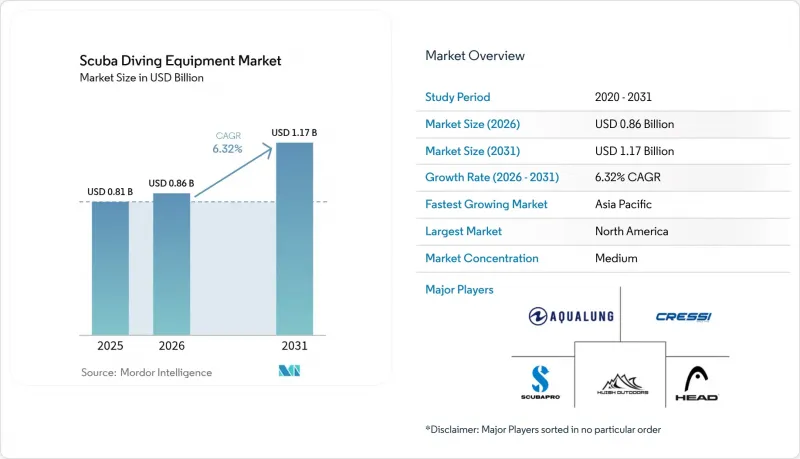
This report is Segmented by Product (Regulators and Rebreathers, Bags and Apparel, Gauges and Dive Computers), Distribution Channel (E-Commerce, Hypermarkets and Supermarkets, Specialty Stores), End-User (Recreational Divers, Professional & Technical Divers, Military & Public Safety Divers), and Geography (North America, and Other). The Market Forecasts are Provided in Terms of Value (USD).
Global Scuba Diving Equipment Market Trends and Insights
Rising Coastal-Tourism Expenditure
Coastal destinations reopened fully in 2024, and spending momentum carried into 2025 as revenge-travel effects kept resort occupancies robust. Government tourism boards in Turkey, Western Australia, and Malta rolled out diver-focused itineraries that bundle training, certification, and equipment purchases, thereby converting leisure travelers into first-time divers. Infrastructure upgrades marinas, hyperbaric facilities, and dive-operator clusters, further lift the spending ceiling. Equipment-rental shortages at emerging sites compel visitors to buy entry-level masks, snorkels, and fins, creating a direct link between tourism arrivals and unit shipments. Destination diversity also matters; locales boasting a mix of coral reefs, wreck dives, and artificial sites record higher basket sizes. Lastly, social-media exposure of pristine waters and megafauna has converted aspirational interest into actual bookings, sealing the demand loop.
Growing Popularity of Underwater Photography & Social-Media Influence
High-definition action cameras and smartphone housings have mainstreamed underwater content creation. Influencers highlight night dives, wreck penetrations, and manta interactions, driving aspirants to replicate the visuals. Divers now look for buoyancy-control devices with accessory-mount points, wide-angle lens adapters, and lighting kits integrated into their primary setup. Camera-driven purchases tend to be higher value and replaced more often as optics and sensor tech evolve. Manufacturers respond with quick-swap light arms, neutral-buoyancy housings, and app-based dive logs that auto-share to Instagram. The net effect is a richer upsell environment, where even casual divers gravitate toward mid-range computers to chronicle depth and GPS tracks. The mini ecosystem around photography, extra batteries, SD cards, and protective cases adds incremental revenue to core equipment sales.
High Upfront Cost of Premium Dive Equipment
Complete entry-level kits run above USD 1,500, an obstacle for casual divers who account for a large share of new certifications. Survey data show technical divers allocate USD 970 annually to equipment, whereas recreational participants manage with USD 252, underscoring price segmentation. Rebreathers, often exceeding USD 8,000, see interest levels around 57% of surveyed divers, yet cost ranks highest among deterrents. Financing options remain limited in emerging economies, complicating adoption for young professionals with competing lifestyle expenses. Rental programs bridge gaps but postpone ownership, thereby flattening upgrade curves. Manufacturers explore modular pricing, allowing staged purchases of first and second stages separately to lower initial outlays and widen the addressable pool.
Other drivers and restraints analyzed in the detailed report include:
- Increasing Adoption of Advanced Dive Computers & Integrated Wearables
- Emergence of Eco-Friendly Dive Gear Materials
- Seasonal Demand Volatility in Temperate Regions
For complete list of drivers and restraints, kindly check the Table Of Contents.
Segment Analysis
Regulators & Rebreathers held the largest slice of the scuba diving equipment market in 2025, accounting for 36.78% of revenue. The segment benefits from mandatory safety roles and consistent replacement intervals. Conversely, Gauges & Dive Computers chart the fastest trajectory at a 6.53% CAGR, propelled by AI functions and smartwatch interoperability. This dynamism introduces short upgrade cycles reminiscent of consumer electronics, lifting overall average selling prices. Limited-edition launches, such as commemorative regulators with ceramic coatings, sustain enthusiasm in a mature category. Meanwhile, Bags & Apparel remain price elastic; direct-to-consumer brands exploit social-media advertising to steal share from legacy players. Product bundling strategies, adding a basic dive computer to regulator packages, function as margin defenders for traditional manufacturers while easing adoption barriers for newcomers.
Complete Report Scope:
- By Product
- Regulators and Rebreathers
- Bags and Apparel
- Gauges and Dive Computers
- By Distribution Channel
- E-commerce
- Hypermarkets and Supermarkets
- Specialty Stores
- By End-User
- Recreational Divers
- Professional & Technical Divers
- Military & Public Safety Divers
- By Geography
- North America
- United States
- Canada
- Mexico
- South America
- Brazil
- Peru
- Chile
- Argentina
- Rest of South America
- Europe
- United Kingdom
- Germany
- France
- Spain
- Italy
- BENELUX (Belgium, Netherlands, Luxembourg)
- NORDICS (Denmark, Finland, Iceland, Norway, Sweden)
- Rest of Europe
- Asia-Pacific
- India
- China
- Japan
- Australia
- South Korea
- South East Asia (Singapore, Malaysia, Thailand, Indonesia, Vietnam, Philippines)
- Rest of Asia-Pacific
- Middle East and Africa
- United Arab Emirates
- Saudi Arabia
- South Africa
- Nigeria
- Rest of Middle East and Africa
- North America
Geography Analysis
North America captured a strong 31.02% share of the 2025 revenue, driven by established certification organizations, diverse dive locations, and high disposable incomes. Key retail hubs in Florida, California, and British Columbia offer integrated services including training, equipment maintenance, and travel booking, enhancing customer loyalty and encouraging premium purchases. The popularity of cold-water diving in the Great Lakes and Pacific Northwest increases demand for specialized gear like drysuits and advanced regulators, boosting average sales value. Additionally, local manufacturing in the U.S. and Canada reduces delivery times, ensuring better product availability. These factors collectively reinforce North America's leading position in the scuba diving equipment market.
Asia-Pacific represents the fastest-growing cluster with a 6.05% CAGR through 2031, an outcome of rising middle-class affluence and aggressive tourism campaigns. Indonesia, the Philippines, and Thailand collectively issue hundreds of thousands of certifications annually, with local governments investing in artificial reefs that add fresh sites and sustain repeat visits. Additionally, Japan records 9.70% dive participation, with interest among non-divers signalling a promising funnel. Lower costs of entry-level equipment, coupled with installment plans, make ownership attainable for a broader audience. Branded training schools have begun franchising models in Vietnam and India, reinforcing certification-driven demand.
Europe shows moderate growth, yet sustainability regulations make it a test bed for eco-friendly innovations. Extended producer responsibility rules reward early movers that integrate recycled materials, enabling price premiums without alienating eco-conscious buyers. Marine-protected-area expansion under the EU Biodiversity Strategy preserves dive site quality while enforcing stricter operator guidelines, boosting sales of low-impact anchors and biodegradable lubricants. Cold-water adventure tourism in Norway and Iceland also spurs demand for heated undergarments and high-performance regulators suited to sub-5 °C environments.
- Aqua Lung International
- Johnson Outdoors (Scubapro)
- Mares (HEAD Sport GmbH)
- Cressi Sub SpA
- Huish Outdoors (Atomic Aquatics, Oceanic, Zeagle, Hollis)
- TUSA (Tabata Co., Ltd.)
- Sherwood Scuba
- Poseidon Diving Systems
- Apeks Marine Equipment
- Seacsub S.p.A.
- Suunto Oy
- Shearwater Research
- Garmin Ltd. (Descent Series)
- Dive Rite
- BARE Sports
- Beuchat International
- OMS (Ocean Management Systems)
- Ocean Reef Group
- Fourth Element
- XS Scuba
Additional Benefits:
- The market estimate (ME) sheet in Excel format
- 3 months of analyst support
TABLE OF CONTENTS
1 Introduction
- 1.1 Study Assumptions & Market Definition
- 1.2 Scope of the Study
2 Research Methodology
3 Executive Summary
4 Market Landscape
- 4.1 Market Overview
- 4.2 Market Drivers
- 4.2.1 Rising coastal-tourism expenditure
- 4.2.2 Expansion of dive training certification programs
- 4.2.3 Growing popularity of underwater photography & social media influence
- 4.2.4 Increasing adoption of advanced dive computers & integrated wearables
- 4.2.5 Emergence of eco-friendly dive gear materials (e.g., recycled ocean plastics)
- 4.2.6 Growth of artificial reef projects boosting local dive sites
- 4.3 Market Restraints
- 4.3.1 High upfront cost of premium dive equipment
- 4.3.2 Seasonal demand volatility in temperate regions
- 4.3.3 Stringent safety regulations increasing certification barriers
- 4.3.4 Environmental concerns over reef degradation limiting dive spots
- 4.4 Value / Supply-Chain Analysis
- 4.5 Regulatory Landscape
- 4.6 Technological Outlook
- 4.7 Porter's Five Forces
- 4.7.1 Bargaining Power of Suppliers
- 4.7.2 Bargaining Power of Buyers
- 4.7.3 Threat of New Entrants
- 4.7.4 Threat of Substitutes
- 4.7.5 Competitive Rivalry
5 Market Size & Growth Forecasts
- 5.1 By Product
- 5.1.1 Regulators and Rebreathers
- 5.1.2 Bags and Apparel
- 5.1.3 Gauges and Dive Computers
- 5.2 By Distribution Channel
- 5.2.1 E-commerce
- 5.2.2 Hypermarkets and Supermarkets
- 5.2.3 Specialty Stores
- 5.3 By End-User
- 5.3.1 Recreational Divers
- 5.3.2 Professional & Technical Divers
- 5.3.3 Military & Public Safety Divers
- 5.4 By Geography
- 5.4.1 North America
- 5.4.1.1 United States
- 5.4.1.2 Canada
- 5.4.1.3 Mexico
- 5.4.2 South America
- 5.4.2.1 Brazil
- 5.4.2.2 Peru
- 5.4.2.3 Chile
- 5.4.2.4 Argentina
- 5.4.2.5 Rest of South America
- 5.4.3 Europe
- 5.4.3.1 United Kingdom
- 5.4.3.2 Germany
- 5.4.3.3 France
- 5.4.3.4 Spain
- 5.4.3.5 Italy
- 5.4.3.6 BENELUX (Belgium, Netherlands, Luxembourg)
- 5.4.3.7 NORDICS (Denmark, Finland, Iceland, Norway, Sweden)
- 5.4.3.8 Rest of Europe
- 5.4.4 Asia-Pacific
- 5.4.4.1 India
- 5.4.4.2 China
- 5.4.4.3 Japan
- 5.4.4.4 Australia
- 5.4.4.5 South Korea
- 5.4.4.6 South East Asia (Singapore, Malaysia, Thailand, Indonesia, Vietnam, Philippines)
- 5.4.4.7 Rest of Asia-Pacific
- 5.4.5 Middle East and Africa
- 5.4.5.1 United Arab Emirates
- 5.4.5.2 Saudi Arabia
- 5.4.5.3 South Africa
- 5.4.5.4 Nigeria
- 5.4.5.5 Rest of Middle East and Africa
- 5.4.1 North America
6 Competitive Landscape
- 6.1 Market Concentration
- 6.2 Strategic Moves
- 6.3 Market Share Analysis
- 6.4 Company Profiles {(includes Global level Overview, Market level overview, Core Segments, Financials as available, Strategic Information, Market Rank/Share for key companies, Products & Services, and Recent Developments)}
- 6.4.1 Aqua Lung International
- 6.4.2 Johnson Outdoors (Scubapro)
- 6.4.3 Mares (HEAD Sport GmbH)
- 6.4.4 Cressi Sub SpA
- 6.4.5 Huish Outdoors (Atomic Aquatics, Oceanic, Zeagle, Hollis)
- 6.4.6 TUSA (Tabata Co., Ltd.)
- 6.4.7 Sherwood Scuba
- 6.4.8 Poseidon Diving Systems
- 6.4.9 Apeks Marine Equipment
- 6.4.10 Seacsub S.p.A.
- 6.4.11 Suunto Oy
- 6.4.12 Shearwater Research
- 6.4.13 Garmin Ltd. (Descent Series)
- 6.4.14 Dive Rite
- 6.4.15 BARE Sports
- 6.4.16 Beuchat International
- 6.4.17 OMS (Ocean Management Systems)
- 6.4.18 Ocean Reef Group
- 6.4.19 Fourth Element
- 6.4.20 XS Scuba
7 Market Opportunities & Future Outlook
- 7.1 Growth of dive-tourism bundles with eco-conservation volunteering packages
- 7.2 Rising demand for modular, upgradable dive computer ecosystems

