PUBLISHER: Mordor Intelligence | PRODUCT CODE: 2122617

PUBLISHER: Mordor Intelligence | PRODUCT CODE: 2122617
Cable Tags - Market Share Analysis, Industry Trends & Statistics, Growth Forecasts (2026 - 2031)
According to Mordor Intelligence, the cable tags market size was valued at USD 1.59 billion in 2025 and is estimated to grow from USD 1.66 billion in 2026 to reach USD 2.06 billion by 2031, at a CAGR of 4.41% during the forecast period (2026-2031).
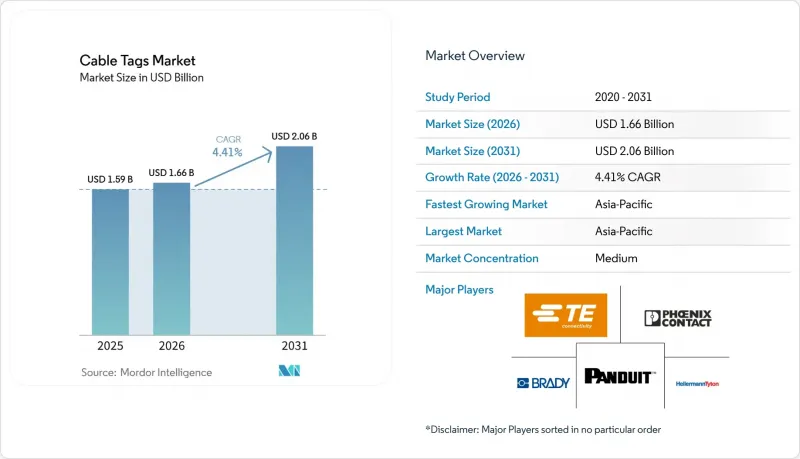
This report is Segmented by Tag Configuration (Self-Laminating, Wrap-Around Tags, and More), Material (Plastic, Metal, Fabric, and More), Print Technology (Thermal Transfer, Pre-Printed, and More), Technology (Conventional, and More), Application (Data Center Cabling, Industrial, and More), End User (IT and Telecom, Construction, and More), and Geography. The Market Forecasts are Provided in Terms of Value (USD).
Global Cable Tags Market Trends and Insights
Data Center and Hyperscale Cabling Expansion
Data centers are a major source of demand for the cable tags market because each facility requires documented identification across patch cords, trunk cables, and distribution links. High-density AI networks use more fiber connections and leave less available space for readable markings. This favors heat-resistant, compact, barcode-readable tags over basic vinyl products, particularly when several cable types must be distinguished in the same rack, tray, or distribution frame. Pre-terminated and factory-labeled cable assemblies move part of the marking process from the job site to specialized production facilities. ANSI/TIA-606-C requires identification at both ends of horizontal and backbone cables. The requirements make documentation a continuing operating need rather than a single project-closeout task, particularly as operators add new connections, replace equipment, and investigate faults in crowded cable environments.
Fiber, 5G and Broadband Network Deployment
Broadband construction and 5G fronthaul deployment create distributed demand across many sites rather than a small number of large facilities. This gives the cable tags market exposure to installation and maintenance activity over longer network build cycles. SCTE-292 specifies physical labels and unique broadband equipment identity codes for network components, including virtual hubs, remote optical line terminals, nodes, and amplifiers. ITU-T L.360, published in May 2025, covers electronic identification technologies for network infrastructure management, including QR codes and NFC-enabled tags linked to management platforms. These standards support a move from handwritten field labels to thermal-printed labels produced with mobile printers. That workflow creates recurring material demand as providers inspect, repair, and expand their networks.
Durability Trade-Offs Across Heat, Chemicals, UV, and Moisture
No single tag substrate performs equally well across indoor panels, offshore sites, solar fields, and chemical-processing facilities. Heat-shrink tags suited to industrial panels can degrade after long ultraviolet exposure. Self-laminating labels that work in data centers may not provide the chemical resistance needed for marine or petrochemical cabling. LAPP's FLEXIMARK Cablelabel Detectable uses halogen-free polyurethane and is designed for metal and X-ray detectability in food and beverage applications. IEC 60445:2021/FprA1:2025 adds requirements relating to conductor identification and color integrity, making resistance to fading an important material criterion. The need for separate materials and product codes across applications limits production scale and raises the qualification burden for manufacturers, since each combination of substrate, adhesive, pigment, and print method must be assessed against a different operating environment.
Other drivers and restraints analyzed in the detailed report include:
- Electrical Infrastructure, Renewable Energy and Grid Modernization
- Industrial Automation and Industry 4.0 Traceability
- Polymer, Adhesive, and Metal Input-Cost Volatility
For complete list of drivers and restraints, kindly check the Table Of Contents.
Segment Analysis
Self-laminating tags held 28.12% of the cable tags market share in 2025. Their printable area and transparent protective layer suit data center and telecommunications work where marks must remain legible after installation. The overlay protects printed information from rubbing, handling, and routine cleaning during commissioning and later maintenance. Installers can print and apply these products on site without waiting for adhesive curing. Heat-shrinkable tags are used on industrial panels and automotive harnesses where a marker must conform to irregular cable shapes under thermal stress.
Flag tags are useful in dense server racks because they display an identifier without covering the cable body. Tie-on tags remain relevant outdoors and in maintenance-heavy settings where workers prefer non-destructive replacement. RFID and smart tags are projected to grow at a 10.22% CAGR through 2031 as utilities and facility operators adopt radio-frequency scanning for inventory. The cable tags industry also uses wrap-around tags in outdoor renewable projects where moisture and ultraviolet exposure can weaken conventional adhesives. These formats reflect different installation conditions rather than interchangeable product choices.
Plastic tags accounted for 54.83% of cable tags market revenue in 2025. Polyester, polyolefin, and vinyl are widely used in data centers, telecom sites, and general electrical installations because they support high-volume purchasing. Their unit cost suits projects with extensive cable runs and frequent replacement needs. Metal tags are forecast to expand at a 7.52% CAGR through 2031. Stainless steel is used in marine, offshore, and renewable applications where polymer degradation creates a lifecycle risk.
Aluminum tags are suited to high-temperature industrial and power-generation environments where plastics can soften. Identimark's E10 stainless-steel labeling system uses laser-etched text and a two-part click-fit mechanism for solar and underground applications. Fabric tags serve aerospace and defense harnesses that cannot use rigid substrates or heavy markers. Paper and composite products remain part of lower-criticality electrical applications where exposure is limited. RoHS 3 and REACH requirements favor suppliers that can document halogen-free and compliant material formulations, while buyers in regulated settings may also request evidence on durability, color stability, chemical resistance, and expected service conditions.
Complete Report Scope:
- By Tag Configuration
- Self-Laminating Tags
- Heat-Shrinkable Tags
- Wrap-Around Tags
- Flag Tags
- Other Tag Configurations
- By Material
- Plastic Tags
- Metal Tags
- Fabric Tags
- Other Materials
- By Marking Process
- Thermal Transfer Marking
- Pre-Printed Marking
- Laser Etching and Embossing
- By Technology
- Conventional Identification Tags
- Barcode and QR-Code Tags
- RFID and NFC Tags
- Sensor-Enabled and Connected Tags
- By Application
- Data Center Cabling
- Telecommunications Networks
- Industrial Control Panels and Factory Automation
- Building Electrical Systems
- Other Applications
- By End User
- IT and Telecom
- Construction
- Power and Utilities
- Manufacturing and OEM Assembly
- Other End Users
- By Geography
- North America
- United States
- Canada
- Mexico
- South America
- Brazil
- Argentina
- Chile
- Rest of South America
- Europe
- Germany
- United Kingdom
- France
- Italy
- Russia
- Rest of Europe
- Asia-Pacific
- China
- India
- Japan
- South Korea
- Rest of Asia-Pacific
- Middle East
- Saudi Arabia
- United Arab Emirates
- Rest of Middle East
- Africa
- South Africa
- Egypt
- Nigeria
- Rest of Africa
- North America
Geography Analysis
Asia-Pacific held 35.32% of the cable tags market share in 2025 and is projected to grow at a 7.25% CAGR through 2031. China's industrial digitalization, India's telecom investment, and Southeast Asia's electronics production create separate sources of demand. Japan's solar sector has used GPS-linked tags to help recover stolen cable assets, illustrating an asset-protection use beyond ordinary marking. These varied drivers make the region's growth base broader than a single infrastructure program and provide several distinct replacement-demand pathways.
North America is a major revenue contributor, supported by hyperscale data center activity and established compliance requirements. The supplied research reported 33% year-over-year inventory growth in major North American data center markets during the first quarter of 2026. Canada's renewable grid investment and Mexico's nearshoring-driven manufacturing expansion add demand outside the data center sector. Europe remains a significant regional market because Germany's industrial automation base, the United Kingdom's broadband programs, and grid investment create demand across several end users. Germany applies DIN EN 62491, its national version of the cable-labeling standard.
South America has a smaller revenue base, but Brazilian automation investment, Chilean solar and mining infrastructure, and Argentine energy modernization support demand for durable cable identifiers. The Middle East benefits from Saudi Arabian infrastructure programs and United Arab Emirates data center development. Africa remains at an earlier stage, where electrification programs support demand but import dependency limits access to specialized materials. European environmental requirements also support interest in halogen-free and recyclable marking materials. These regions provide opportunities where suppliers can balance material durability with practical procurement and technical support.
- TE Connectivity Ltd
- Panduit Corporation
- 3M Company
- HellermannTyton Group PLC
- Legrand SA
- Phoenix Contact GmbH and Co. KG
- ABB Ltd
- Avery Dennison Corporation
- Brother Industries, Ltd.
- Partex Marking Systems AB
- Cembre S.p.A.
- Weidmuller Interface GmbH and Co. KG
- Cablecraft Ltd
- Seton Identification Products
- Brady Corporation
- Silver Fox Limited
- Ziptape Label ID Systems
- Novoflex Marketing Ltd
- Vizinex RFID Inc.
- Marking Services Inc.
- Nelco Products
Additional Benefits:
- The market estimate (ME) sheet in Excel format
- 3 months of analyst support
TABLE OF CONTENTS
1 INTRODUCTION
- 1.1 Study Assumptions and Market Definition
- 1.2 Scope of the Study
2 RESEARCH METHODOLOGY
3 EXECUTIVE SUMMARY
4 MARKET LANDSCAPE
- 4.1 Market Overview
- 4.2 Market Drivers
- 4.2.1 Data Center and Hyperscale Cabling Expansion
- 4.2.2 Fiber, 5G and Broadband Network Deployment
- 4.2.3 Industrial Automation and Industry 4.0 Traceability
- 4.2.4 Electrical Infrastructure, Renewable Energy and Grid Modernization
- 4.2.5 Safety Codes and Lifecycle Documentation Requirements
- 4.2.6 Digital Twin-Ready Cable Identity in High-Density Installations
- 4.3 Market Restraints
- 4.3.1 Durability Trade-Offs Across Heat, Chemicals, UV and Moisture
- 4.3.2 Polymer, Adhesive and Metal Input-Cost Volatility
- 4.3.3 Price Competition in Standardized Marker Formats
- 4.3.4 Fragmented Label Data Standards and Weak SME Adoption
- 4.4 Industry Value Chain Analysis
- 4.5 Regulatory Landscape
- 4.6 Impact of Macroeconomic Factors on the Market
- 4.7 Porter's Five Forces Analysis
- 4.7.1 Threat of New Entrants
- 4.7.2 Bargaining Power of Buyers and Consumers
- 4.7.3 Bargaining Power of Suppliers
- 4.7.4 Threat of Substitute Products
- 4.7.5 Intensity of Competitive Rivalry
5 MARKET SIZE AND GROWTH FORECASTS (VALUE)
- 5.1 By Tag Configuration
- 5.1.1 Self-Laminating Tags
- 5.1.2 Heat-Shrinkable Tags
- 5.1.3 Wrap-Around Tags
- 5.1.4 Flag Tags
- 5.1.5 Other Tag Configurations
- 5.2 By Material
- 5.2.1 Plastic Tags
- 5.2.2 Metal Tags
- 5.2.3 Fabric Tags
- 5.2.4 Other Materials
- 5.3 By Marking Process
- 5.3.1 Thermal Transfer Marking
- 5.3.2 Pre-Printed Marking
- 5.3.3 Laser Etching and Embossing
- 5.4 By Technology
- 5.4.1 Conventional Identification Tags
- 5.4.2 Barcode and QR-Code Tags
- 5.4.3 RFID and NFC Tags
- 5.4.4 Sensor-Enabled and Connected Tags
- 5.5 By Application
- 5.5.1 Data Center Cabling
- 5.5.2 Telecommunications Networks
- 5.5.3 Industrial Control Panels and Factory Automation
- 5.5.4 Building Electrical Systems
- 5.5.5 Other Applications
- 5.6 By End User
- 5.6.1 IT and Telecom
- 5.6.2 Construction
- 5.6.3 Power and Utilities
- 5.6.4 Manufacturing and OEM Assembly
- 5.6.5 Other End Users
- 5.7 By Geography
- 5.7.1 North America
- 5.7.1.1 United States
- 5.7.1.2 Canada
- 5.7.1.3 Mexico
- 5.7.2 South America
- 5.7.2.1 Brazil
- 5.7.2.2 Argentina
- 5.7.2.3 Chile
- 5.7.2.4 Rest of South America
- 5.7.3 Europe
- 5.7.3.1 Germany
- 5.7.3.2 United Kingdom
- 5.7.3.3 France
- 5.7.3.4 Italy
- 5.7.3.5 Russia
- 5.7.3.6 Rest of Europe
- 5.7.4 Asia-Pacific
- 5.7.4.1 China
- 5.7.4.2 India
- 5.7.4.3 Japan
- 5.7.4.4 South Korea
- 5.7.4.5 Rest of Asia-Pacific
- 5.7.5 Middle East
- 5.7.5.1 Saudi Arabia
- 5.7.5.2 United Arab Emirates
- 5.7.5.3 Rest of Middle East
- 5.7.6 Africa
- 5.7.6.1 South Africa
- 5.7.6.2 Egypt
- 5.7.6.3 Nigeria
- 5.7.6.4 Rest of Africa
- 5.7.1 North America
6 COMPETITIVE LANDSCAPE
- 6.1 Market Concentration
- 6.2 Strategic Moves
- 6.3 Market Share Analysis
- 6.4 Company Profiles (includes Global Level Overview, Market Level Overview, Core Segments, Financials as available, Strategic Information, Market Rank/Share, Products and Services, Recent Developments)
- 6.4.1 TE Connectivity Ltd
- 6.4.2 Panduit Corporation
- 6.4.3 3M Company
- 6.4.4 HellermannTyton Group PLC
- 6.4.5 Legrand SA
- 6.4.6 Phoenix Contact GmbH and Co. KG
- 6.4.7 ABB Ltd
- 6.4.8 Avery Dennison Corporation
- 6.4.9 Brother Industries, Ltd.
- 6.4.10 Partex Marking Systems AB
- 6.4.11 Cembre S.p.A.
- 6.4.12 Weidmuller Interface GmbH and Co. KG
- 6.4.13 Cablecraft Ltd
- 6.4.14 Seton Identification Products
- 6.4.15 Brady Corporation
- 6.4.16 Silver Fox Limited
- 6.4.17 Ziptape Label ID Systems
- 6.4.18 Novoflex Marketing Ltd
- 6.4.19 Vizinex RFID Inc.
- 6.4.20 Marking Services Inc.
- 6.4.21 Nelco Products
7 MARKET OPPORTUNITIES AND FUTURE OUTLOOK
- 7.1 White-Space and Unmet-Need Assessment

