
PUBLISHER: Mordor Intelligence | PRODUCT CODE: 1849861

PUBLISHER: Mordor Intelligence | PRODUCT CODE: 1849861
WiGig - Market Share Analysis, Industry Trends & Statistics, Growth Forecasts (2025 - 2030)
The WiGig market size is valued at USD 26.32 billion in 2025 and is forecast to expand to USD 70.45 billion by 2030, translating into a 21.76% CAGR over the period.
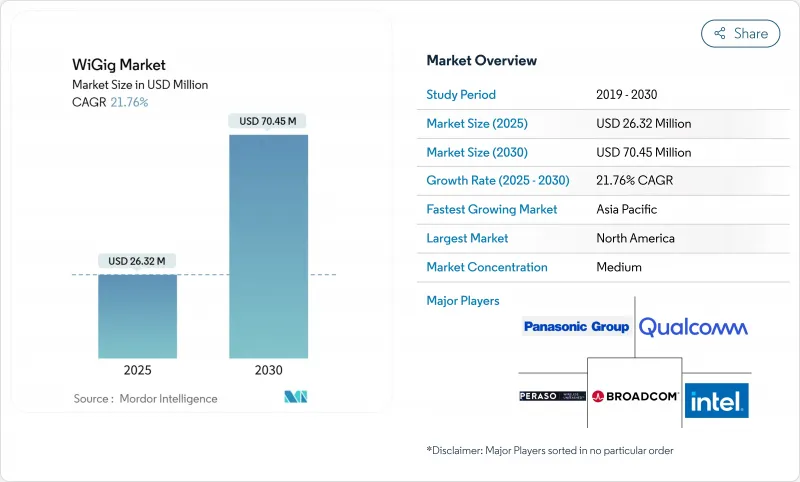
Commercial momentum is shifting from niche wireless-docking hubs toward broad integration in Wi-Fi 7 tri-band access points, premium laptops, and early 6G backhaul trials. Demand for 4K/8K video, AR/VR workloads, and edge-AI traffic is stretching the capacity of the 2.4 GHz and 5/6 GHz bands, making 60 GHz throughput indispensable for latency-sensitive applications. At the same time, semiconductor vendors are simplifying design cycles through system-on-chip solutions that cut power draw while shrinking form factors, a prerequisite for smartphones and ultra-thin notebooks. Finally, geopolitical pressures around gallium supply and diverging regional power-limit rules are prompting OEMs to qualify second-source suppliers and lobby regulators for harmonized 60 GHz frameworks, indicating that policy as well as technology will shape the WiGig market trajectory.
Global WiGig Market Trends and Insights
Surge in 4K/8K and XR streaming demand
Ultra-high-definition content requires sustained 25-100 Mbps per stream, and households now run simultaneous 4K, 8K, and AR tasks. The 60 GHz layer supplies headroom where 2.4 GHz and 5/6 GHz traffic face interference and limited contiguous channel widths. In North America and Japan, pay-TV operators already bundle 8K sports feeds that push legacy Wi-Fi to its limits. Device OEMs therefore embed multi-gigabit radios so that premium televisions, consoles, and headsets can maintain sub-10 ms latencies without tethered links. As XR headsets scale in enterprise training and consumer gaming, dependable untethered throughput becomes a purchasing criterion, directly raising the addressable WiGig market.
Integration of 60 GHz tri-band radios in Wi-Fi 7 APs
Access-point vendors are shipping Wi-Fi 7 chipsets that aggregate 2.4 GHz, 5/6 GHz, and 60 GHz into a single platform. Multi-link operation hands sessions back and forth in real time, letting short-range devices jump to 60 GHz while distant clients remain on lower bands. This architecture reduces cabling costs for dense campuses and unlocks incremental software revenue from network-analytics tools that optimize band steering. European cloud offices deploying 10 Gbps fiber uplinks view tri-band Wi-Gig as a hedge against peak-hour congestion, underscoring how infrastructure integration converts WiGig from a luxury add-on into a baseline checklist item.
Limited range and strict line-of-sight
At 60 GHz, oxygen absorption and wall attenuation curb links to roughly 10 meters, so access points must be installed in every conference room or factory cell. Even glass partitions can halve throughput, and moving people create fading that requires beam-tracking algorithms. Field tests on autonomous vehicles show packet-loss spikes when small obstacles break Fresnel zones, reinforcing that WiGig rollouts need precise site surveys. Such constraints restrict the technology to high-density venues or fixed setups, limiting broader consumer adoption and trimming WiGig market expectations in mass-market home routers.
Other drivers and restraints analyzed in the detailed report include:
- Rising attach-rate of WiGig-enabled laptops and smartphones
- Enterprise need for ultra-fast wireless docking
- Substitution risk from Wi-Fi 6E/7 and 5G mmWave
For complete list of drivers and restraints, kindly check the Table Of Contents.
Segment Analysis
Display devices commanded 46.0% of the WiGig market in 2024, demonstrating how wireless monitors, docking stations, and AR/VR headsets still anchor near-term revenue. The sub-segment benefits from households seeking clutter-free gaming corners and offices migrating to hot-desking layouts. Wireless hubs that host dual 4K screens and SSD-grade peripherals already appear in premium enterprise bundles, showing that design-once, deploy-many efficiencies favor WiGig over USB-C cabling for new builds. AR/VR headset makers rely on 60 GHz to avoid nausea-inducing latency, and upcoming mixed-reality rollouts will further lift unit volumes. Televisions and projectors integrate WiGig for uncompressed 8K streams across a living room, but adoption lags because a single wall can impair reception.
Network infrastructure devices are the fastest-growing slice at 28.40% CAGR, a trajectory driven by Wi-Fi 7 tri-band access points shipping into corporate refresh cycles. Edge-compute nodes inside factories now leverage 60 GHz backhaul to sidestep fiber trenching, reducing installation lead-times by up to 70%. Municipal kiosk vendors experiment with 60 GHz radios for pop-up broadband in dense downtown corridors where digging permits add months to fiber projects. Early metrics show link availability above 99% when clear line-of-sight is maintained, validating that backhaul can be a high-margin adjacency for the WiGig market.
System-on-chip designs held 58.0% share of the WiGig market in 2024 and are projected to grow at 23.0% CAGR through 2030. Unified dies integrate baseband, RF front-end, and power management, cutting board space by up to 30% and extending smartphone battery life. As foundries perfect sub-3 nm nodes, the incremental cost of adding a 60 GHz block falls, accelerating attach rates in mid-tier devices. Qualcomm's latest platforms pack WiGig, 6 GHz Wi-Fi, Bluetooth LE Audio, and 5G radios into one substrate, reducing vendor qualification cycles from quarters to weeks.
Discrete integrated-circuit implementations remain relevant where legacy boards need drop-in modules or where industrial gear demands ruggedized packages. Medical imaging carts, for instance, retrofit 60 GHz cards without redesigning the entire motherboard. Intel's 18A roadmap targets both monolithic and tile-based architectures so that OEMs can mix high-performance CPU cores with specialized radio tiles, underscoring how manufacturing advances keep multiple bill-of-materials paths viable. The interplay between SoC convenience and discrete flexibility should balance innovation risk, supporting continued WiGig market expansion.
The WiGig Market Report is Segmented by Product (Display Devices, Network Infrastructure Devices, and More), Technology (System-On-Chip (SoC) and Integrated Circuit (IC)), Frequency Band (57-66 GHz, 66-71 GHz, and More), Application (Gaming and Multimedia, Enterprise Wireless Docking, and More), End-User Industry (Consumer Electronics, Enterprise and Datacenter, Automotive and Transportation, and More), and Geography.
Geography Analysis
North America accounted for 34.20% of the WiGig market in 2024, owing to early enterprise adoption, CHIPS-Act-funded semiconductor investments, and FCC rules that allow higher EIRP than most regions. Financial-services firms in New York deploy wireless docking to maximize real-estate density, and West-Coast tech campuses use 60 GHz links in agile work pods. Canada mirrors U.S. patterns in banking and media verticals, while Mexico's maquiladora corridor pilots WiGig-based AGV fleets to raise export manufacturing competitiveness.
Asia Pacific is the growth engine with a 23.50% CAGR to 2030. Japan's networking OEMs were the first to certify tri-band Wi-Fi 7 access points that embed WiGig radios; early municipal deployments in Tokyo target stadium concourses ahead of large-scale events.China's consumer-electronics giants build 60 GHz capability into televisions and laptops to differentiate in crowded domestic channels, although export clearance may face geopolitical headwinds tied to gallium supply chains. South Korea bundles WiGig in premium smartphones, leveraging its dense 5G backbone for tri-band offload, while Singapore pilots 60 GHz links in financial district smart lamp-posts, underscoring region-wide digital-transformation momentum.
Europe exhibits heterogeneous progress. Germany and the United Kingdom lead with smart-factory retrofits that rely on deterministic wireless, but Southern Europe's slower capital-spending pulls regional penetration below global averages. ETSI standards harmonize technical parameters, yet power-limit disparities across EU nations raise extra certification work that delays rollouts. The Middle East and Africa remain nascent; Dubai's fintech hubs evaluate WiGig for trading floors, and South-Africa mines test 60 GHz links for real-time drilling analytics. However, capex constraints and terrain challenges temper near-term uptake, leaving considerable headroom for the WiGig market as regional GDP and connectivity initiatives advance.
- Qualcomm Technologies Inc.
- Intel Corporation
- Broadcom Inc.
- Cisco Systems Inc.
- Panasonic Holdings Corp.
- Peraso Technologies Inc.
- Blu Wireless Technology Ltd.
- Tensorcom Inc.
- Fujikura Ltd.
- Sivers Semiconductors AB
- Dell Technologies Inc.
- Lenovo Group Ltd.
- HP Development Company LP
- Samsung Electronics Co. Ltd.
- MediaTek Inc.
- Marvell Technology Inc.
- NXP Semiconductors N.V.
- Analog Devices Inc.
- Keysight Technologies Inc.
- LitePoint (Teradyne Inc.)
- NEC Corporation
- Qualcomm Atheros (subsidiary)
Additional Benefits:
- The market estimate (ME) sheet in Excel format
- 3 months of analyst support
TABLE OF CONTENTS
1 INTRODUCTION
- 1.1 Study Assumptions and Market Definition
- 1.2 Scope of the Study
2 RESEARCH METHODOLOGY
3 EXECUTIVE SUMMARY
4 MARKET LANDSCAPE
- 4.1 Market Overview
- 4.2 Market Drivers
- 4.2.1 Surge in 4K/8K and XR streaming demand
- 4.2.2 Integration of WiGig tri-band radios in Wi-Fi 7 APs
- 4.2.3 Rising attach-rate of WiGig-enabled laptops and smartphones
- 4.2.4 Enterprise need for ultra-fast wireless docking
- 4.2.5 Edge-AI servers adopting 60 GHz back-plane links
- 4.2.6 In-flight cabin connectivity pilots at 60 GHz
- 4.3 Market Restraints
- 4.3.1 Limited range and strict line-of-sight
- 4.3.2 Substitution risk from Wi-Fi 6E/7 and 5G mmWave
- 4.3.3 Thermal design limits in handheld 60 GHz radios
- 4.3.4 Fragmented 60 GHz EIRP regulations
- 4.4 Value Chain Analysis
- 4.5 Regulatory Landscape
- 4.6 Technological Outlook
- 4.7 Porter's Five Forces Analysis
- 4.7.1 Bargaining Power of Suppliers
- 4.7.2 Bargaining Power of Buyers
- 4.7.3 Threat of New Entrants
- 4.7.4 Threat of Substitutes
- 4.7.5 Intensity of Competitive Rivalry
- 4.8 Investment Analysis
5 MARKET SIZE AND GROWTH FORECASTS (VALUE)
- 5.1 By Product
- 5.1.1 Display Devices
- 5.1.1.1 Wireless Docking Stations
- 5.1.1.2 AR/VR Headsets
- 5.1.1.3 Televisions and Projectors
- 5.1.2 Network Infrastructure Devices
- 5.1.2.1 Access Points and Routers
- 5.1.2.2 Backhaul Radios
- 5.1.3 Others
- 5.1.1 Display Devices
- 5.2 By Technology
- 5.2.1 System-on-Chip (SoC)
- 5.2.2 Integrated Circuit (IC)
- 5.3 By Frequency Band
- 5.3.1 57-66 GHz (IEEE 802.11ad)
- 5.3.2 66-71 GHz
- 5.3.3 71-86 GHz (IEEE 802.11ay bonded)
- 5.4 By Application
- 5.4.1 Gaming and Multimedia
- 5.4.2 Enterprise Wireless Docking
- 5.4.3 Networking and Data Transfer
- 5.4.4 In-vehicle Infotainment
- 5.4.5 Smart Manufacturing / IIoT
- 5.5 By End-user Industry
- 5.5.1 Consumer Electronics
- 5.5.2 Enterprise and Datacenter
- 5.5.3 Automotive and Transportation
- 5.5.4 Industrial and Manufacturing
- 5.5.5 Aerospace and Defense
- 5.6 By Geography
- 5.6.1 North America
- 5.6.1.1 United States
- 5.6.1.2 Canada
- 5.6.1.3 Mexico
- 5.6.2 South America
- 5.6.2.1 Brazil
- 5.6.2.2 Argentina
- 5.6.3 Europe
- 5.6.3.1 Germany
- 5.6.3.2 United Kingdom
- 5.6.3.3 France
- 5.6.3.4 Russia
- 5.6.4 Asia Pacific
- 5.6.4.1 China
- 5.6.4.2 India
- 5.6.4.3 Japan
- 5.6.4.4 South Korea
- 5.6.4.5 ASEAN
- 5.6.4.6 Rest of Asia Pacific
- 5.6.5 Middle East
- 5.6.5.1 Saudi Arabia
- 5.6.5.2 United Arab Emirates
- 5.6.5.3 Turkey
- 5.6.5.4 Rest of Middle East
- 5.6.6 Africa
- 5.6.6.1 South Africa
- 5.6.6.2 Nigeria
- 5.6.6.3 Rest of Africa
- 5.6.1 North America
6 COMPETITIVE LANDSCAPE
- 6.1 Market Concentration
- 6.2 Strategic Moves
- 6.3 Market Share Analysis
- 6.4 Company Profiles (includes Global level Overview, Market level overview, Core Segments, Financials as available, Strategic Information, Market Rank/Share for key companies, Products and Services, and Recent Developments)
- 6.4.1 Qualcomm Technologies Inc.
- 6.4.2 Intel Corporation
- 6.4.3 Broadcom Inc.
- 6.4.4 Cisco Systems Inc.
- 6.4.5 Panasonic Holdings Corp.
- 6.4.6 Peraso Technologies Inc.
- 6.4.7 Blu Wireless Technology Ltd.
- 6.4.8 Tensorcom Inc.
- 6.4.9 Fujikura Ltd.
- 6.4.10 Sivers Semiconductors AB
- 6.4.11 Dell Technologies Inc.
- 6.4.12 Lenovo Group Ltd.
- 6.4.13 HP Development Company LP
- 6.4.14 Samsung Electronics Co. Ltd.
- 6.4.15 MediaTek Inc.
- 6.4.16 Marvell Technology Inc.
- 6.4.17 NXP Semiconductors N.V.
- 6.4.18 Analog Devices Inc.
- 6.4.19 Keysight Technologies Inc.
- 6.4.20 LitePoint (Teradyne Inc.)
- 6.4.21 NEC Corporation
- 6.4.22 Qualcomm Atheros (subsidiary)
7 MARKET OPPORTUNITIES AND FUTURE OUTLOOK
- 7.1 White-space and Unmet-need Assessment

