PUBLISHER: Mordor Intelligence | PRODUCT CODE: 2120661

PUBLISHER: Mordor Intelligence | PRODUCT CODE: 2120661
Laboratory Chemicals - Market Share Analysis, Industry Trends & Statistics, Growth Forecasts (2026 - 2031)
According to Mordor Intelligence, the laboratory chemicals market size in 2026 is estimated at USD 30.09 billion, growing from 2025 value of USD 28.87 billion with 2031 projections showing USD 37.03 billion, growing at 4.24% CAGR over 2026-2031.
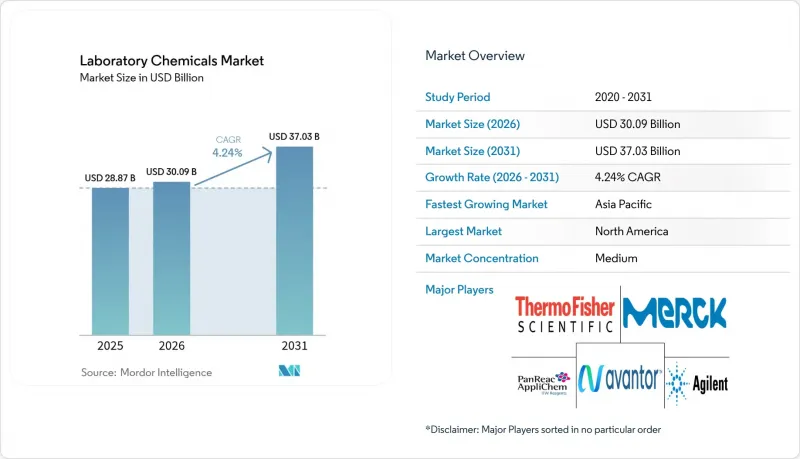
This report is Segmented by Type (Biochemistry, Molecular Biology, Cytokine and Chemokine Testing, Carbohydrate Analysis, Immunochemistry, and Other Types), Application (Academia/Educational, Industrial, Government, and Healthcare/Pharmaceutical), and Geography (Asia-Pacific, North America, Europe, South America, and Middle East and Africa). The Market Forecasts are Provided in Terms of Value (USD).
Global Laboratory Chemicals Market Trends and Insights
Growing R&D Spending in Life-Science and Pharma Sectors
Major drugmakers allocated 15-20% of 2024 revenue to discovery programs, sustaining demand for chromatographic solvents, enzyme substrates, and isotope-labeled standards that underpin precision biology. Universities remain active buyers by leveraging industry alliances and foundation grants that shield research pipelines from public-funding volatility. The expansion of self-driving laboratories, built on robotic liquid handlers and AI-guided experiment design, tilts reagent consumption toward ready-to-use liquid stocks carrying bar-coded metadata. Suppliers able to deliver automation-compatible packaging and digital documentation are seeing elevated order volumes. The trend establishes a flywheel: richer data feeds better algorithms, which in turn heightens throughput and reagent requirements.
Expanding Biopharmaceutical Manufacturing Capacity Worldwide
A greater than 20% jump in global biologics capacity during 2024 opened a sizeable tailwind for process buffers, chromatography resins, and release-testing standards used in GMP environments. Contract development and manufacturing organizations rely on platform processes that multiply reagent needs across clients, cementing a predictable offtake profile. Asia-Pacific captures the lion's share of new bricks-and-mortar investment as competitive cost structures attract multinationals and biosimilar firms alike. Continuous-manufacturing paradigms rooted in quality-by-design frameworks intensify demand for real-time analytical reagents that ensure batch integrity. Suppliers offering validated PAT chemistries are securing multi-year agreements tied to long-term commercial supply.
Volatility in Feedstock Prices for Key Solvents and Acids
Sharp swings in crude-oil and naphtha benchmarks cascade into acetone, acetonitrile, and sulfuric-acid supply, destabilizing budgeting for high-consumption labs. Suppliers risk margin compression as tender-driven customers resist price pass-throughs. Geographic clustering of specialty chemical production in East Asia magnifies exposure when maritime bottlenecks or trade friction arise. Dual-sourcing strategies offset risk but incur qualification costs that stretch timelines and tie up working capital. Academic institutions, already coping with grant uncertainties, feel the pinch most acutely in the near term.
Other drivers and restraints analyzed in the detailed report include:
- Rising Demand for High-Purity Reagents in Environmental and Food Testing
- Digitization and AI-Enabled High-Throughput "Lab-of-the-Future" Initiatives
- Stringent Hazardous-Waste and Chemical-Safety Regulations
For complete list of drivers and restraints, kindly check the Table Of Contents.
Segment Analysis
Biochemistry captured 27.12% of laboratory chemicals market share in 2025, underscoring its pivotal role in enzyme kinetics, metabolomics, and proteome-scale analyses. Proteomics labs routinely consume high-purity buffers, reducing agents, and mass-spectrometry grade solvents that command price premiums. Within this category, the laboratory chemicals market size for healthcare/pharmaceutical reagents is expected to compound at 4.93% CAGR through 2031 as drug manufacturers upscale biologics pipelines.
Molecular-biology reagents trail closely behind, buoyed by CRISPR and next-generation sequencing workflows that require fidelity-centric polymerases and nucleotide mixes. Cell/tissue-culture media are shifting toward serum-free, chemically defined formulations, aligning with regulatory guidance for advanced therapies. Environmental-testing chemicals continue steady uptake as governments widen contaminant-screening mandates. Across these subdomains, suppliers win share by offering data-rich certificates of analysis and flexible batch sizes that minimize customer inventory costs.
Complete Report Scope:
- By Type
- Biochemistry
- Molecular Biology
- Cytokine and Chemokine Testing
- Carbohydrate Analysis
- Immunochemistry
- Cell/Tissue Culture
- Environmental Testing
- Other Types
- By Application
- Academia/Educational
- Industrial
- Government
- Healthcare (Pharmaceutical)
- By Geography
- Asia-Pacific
- China
- India
- Japan
- South Korea
- ASEAN Countries
- Rest of Asia-Pacific
- North America
- United States
- Canada
- Mexico
- Europe
- Germany
- United Kingdom
- France
- Italy
- Russia
- NORDIC Countries
- Rest of Europe
- South America
- Brazil
- Argentina
- Rest of South America
- Middle East and Africa
- Saudi Arabia
- South Africa
- Rest of Middle East and Africa
- Asia-Pacific
Geography Analysis
North America anchored 29.60% of 2025 revenue, fueled by GSK's USD 30 billion and Eli Lilly's USD 5 billion investments in U.S. manufacturing facilities. Federal bodies such as the FDA and EPA sustain consistent reagent requisitions for compliance and research mandates. Canada's specialty-chemicals ecosystem adds regional supply resilience, further entrenching the laboratory chemicals market across the continent.
Asia-Pacific is on course for the most rapid expansion at a 4.66% CAGR. China's push for biotech self-sufficiency spurs heavy procurement of chromatography media, cell-culture supplements, and analytical standards. India leverages its API leadership to source validation reagents domestically while exporting surplus supply worldwide. Japan and South Korea contribute high-end materials science and genomics demand, underpinning a sophisticated buyer base that prizes traceability and automation compatibility. The laboratory chemicals market size in Asia-Pacific thus benefits from both volume and value-added product mixes.
Europe retains a robust foothold underpinned by strict environmental legislation and advanced pharma clusters centered in Germany and Switzerland. Green-chemistry adoption is accelerating as public funding channels reward low-carbon lab operations. Brexit has nudged some ordering hubs from the UK to mainland EU, but trans-Atlantic and intra-European trade flows remain largely intact. Emerging regions such as South America and the Middle East and Africa are increasingly commissioning public-health labs, signaling future incremental uplift even though current shares stay modest.
- Agilent Technologies
- Avantor, Inc.
- BD Biosciences
- Beckman Coulter, Inc.
- Biosynth
- Calibre Scientific
- Carlo Erba Reagents
- FUJIFILM Wako Pure Chemical Corporation
- ITW Reagents Division
- Merck KGaA
- New England Biolabs
- PerkinElmer
- Promega Corporation
- Sartorius AG
- Shanghai Bid Pharmaceutical Technology Co., Ltd.
- Shimadzu Corporation
- Thermo Fisher Scientific Inc.
Additional Benefits:
- The market estimate (ME) sheet in Excel format
- 3 months of analyst support
TABLE OF CONTENTS
1 Introduction
- 1.1 Study Assumptions and Market Definition
- 1.2 Scope of the Study
2 Research Methodology
3 Executive Summary
4 Market Landscape
- 4.1 Market Overview
- 4.2 Market Drivers
- 4.2.1 Growing R&D Spending in Life-Science and Pharma Sectors
- 4.2.2 Expanding Biopharmaceutical Manufacturing Capacity Worldwide
- 4.2.3 Rising Demand for High-Purity Reagents in Environmental and Food Testing
- 4.2.4 Digitization and AI-Enabled High-Throughput "Lab-of-the-Future" Initiatives
- 4.2.5 Shift Toward Sustainable/Green Solvents and Bio-Based Reagents
- 4.3 Market Restraints
- 4.3.1 Volatility in Feedstock Prices for Key Solvents and Acids
- 4.3.2 Stringent Hazardous-Waste and Chemical-Safety Regulations
- 4.3.3 Availability of Functional Substitute Kits and Automation Platforms
- 4.4 Value Chain Analysis
- 4.5 Porter's Five Forces Analysis
- 4.5.1 Bargaining Power of Suppliers
- 4.5.2 Bargaining Power of Buyers
- 4.5.3 Threat of New Entrants
- 4.5.4 Threat of Substitutes
- 4.5.5 Competitive Rivalry
5 Market Size and Growth Forecasts (Value)
- 5.1 By Type
- 5.1.1 Biochemistry
- 5.1.2 Molecular Biology
- 5.1.3 Cytokine and Chemokine Testing
- 5.1.4 Carbohydrate Analysis
- 5.1.5 Immunochemistry
- 5.1.6 Cell/Tissue Culture
- 5.1.7 Environmental Testing
- 5.1.8 Other Types
- 5.2 By Application
- 5.2.1 Academia/Educational
- 5.2.2 Industrial
- 5.2.3 Government
- 5.2.4 Healthcare (Pharmaceutical)
- 5.3 By Geography
- 5.3.1 Asia-Pacific
- 5.3.1.1 China
- 5.3.1.2 India
- 5.3.1.3 Japan
- 5.3.1.4 South Korea
- 5.3.1.5 ASEAN Countries
- 5.3.1.6 Rest of Asia-Pacific
- 5.3.2 North America
- 5.3.2.1 United States
- 5.3.2.2 Canada
- 5.3.2.3 Mexico
- 5.3.3 Europe
- 5.3.3.1 Germany
- 5.3.3.2 United Kingdom
- 5.3.3.3 France
- 5.3.3.4 Italy
- 5.3.3.5 Russia
- 5.3.3.6 NORDIC Countries
- 5.3.3.7 Rest of Europe
- 5.3.4 South America
- 5.3.4.1 Brazil
- 5.3.4.2 Argentina
- 5.3.4.3 Rest of South America
- 5.3.5 Middle East and Africa
- 5.3.5.1 Saudi Arabia
- 5.3.5.2 South Africa
- 5.3.5.3 Rest of Middle East and Africa
- 5.3.1 Asia-Pacific
6 Competitive Landscape
- 6.1 Market Concentration
- 6.2 Strategic Moves
- 6.3 Market Share/ Ranking Analysis
- 6.4 Company Profiles (includes Global level Overview, Market level overview, Core Segments, Financials as available, Strategic Information, Market Rank/Share for key companies, Products and Services, and Recent Developments)
- 6.4.1 Agilent Technologies
- 6.4.2 Avantor, Inc.
- 6.4.3 BD Biosciences
- 6.4.4 Beckman Coulter, Inc.
- 6.4.5 Biosynth
- 6.4.6 Calibre Scientific
- 6.4.7 Carlo Erba Reagents
- 6.4.8 FUJIFILM Wako Pure Chemical Corporation
- 6.4.9 ITW Reagents Division
- 6.4.10 Merck KGaA
- 6.4.11 New England Biolabs
- 6.4.12 PerkinElmer
- 6.4.13 Promega Corporation
- 6.4.14 Sartorius AG
- 6.4.15 Shanghai Bid Pharmaceutical Technology Co., Ltd.
- 6.4.16 Shimadzu Corporation
- 6.4.17 Thermo Fisher Scientific Inc.
7 Market Opportunities and Future Outlook
- 7.1 White-space and Unmet-Need Assessment

