PUBLISHER: Mordor Intelligence | PRODUCT CODE: 2121511

PUBLISHER: Mordor Intelligence | PRODUCT CODE: 2121511
Anti-Corrosion Coatings - Market Share Analysis, Industry Trends & Statistics, Growth Forecasts (2026 - 2031)
According to Mordor Intelligence, the anti-Corrosion coatings market size was valued at USD 24.84 billion in 2025 and is estimated to grow from USD 25.62 billion in 2026 to reach USD 29.87 billion by 2031, at a CAGR of 3.12% during the forecast period (2026-2031).
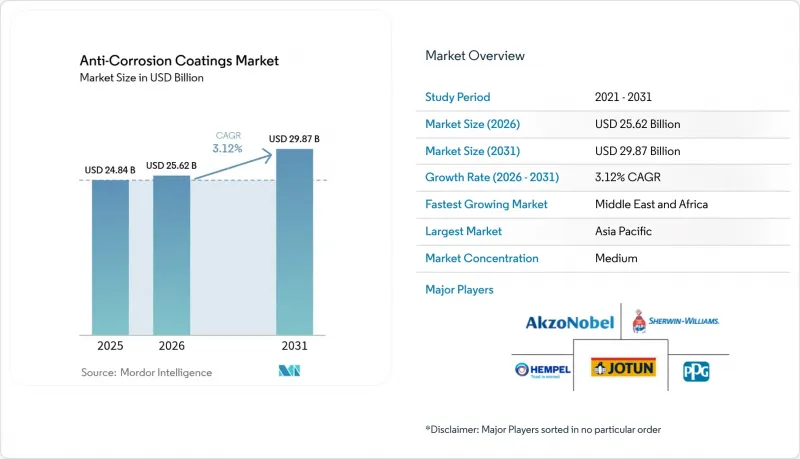
This report is Segmented by Resin Type (Epoxy, Polyester, Polyurethane, and More), Technology (Water-Borne, Solvent-Borne, Powder, and UV-Cured), End-User Industry (Oil and Gas, Marine, Power, Infrastructure, Industrial, Aerospace and Defense, and More), and Geography (Asia-Pacific, North America, Europe, South America, and Middle East and Africa). The Market Forecasts are Provided in Terms of Value (USD).
Global Anti-Corrosion Coatings Market Trends and Insights
Infrastructure-Renewal Super-Cycle in US, European Union and Japan
Bridge, tunnel, and rail assets are aging in lockstep across three mature economies. The United States has earmarked USD 110 billion for roads and bridges; state transportation agencies now require three-coat epoxy-polyurethane systems that meet SSPC-Paint 36 for steel structures. Japan's Ministry of Land, Infrastructure, Transport and Tourism reported in 2025 that 63% of the nation's 730,000 bridges exceed 50 years of age, unlocking JPY 5.3 trillion (USD 35 billion) for corrosion remediation through 2030. Meanwhile, Germany alone is replacing 4,000 Autobahn bridges under an EUR 2.8 billion initiative. These synchronized budgets create a durable floor for the Anti-Corrosion Coatings market, as steel recoating cycles last 15-25 years and specification bodies insist on ISO 12944-C5-M compliance.
Offshore Wind-Farm Coating Boom
Installed offshore-wind capacity reached 75 GW by late 2025, and every monopile, transition piece, and offshore substation demands multi-layer zinc-epoxy-polysiloxane protection. Orsted's 2.9 GW Hornsea Three project requires 25-year service-life coatings approved after 10,000-hour salt-spray testing. On the US side, six Atlantic lease areas auctioned in 2024 will need roughly 180,000 tons of coatings through 2032. Because fewer than 20 global yards hold DNV certification for offshore-wind fabrication, coating specifications are tightly controlled, pushing the Anti-Corrosion Coatings market toward premium chemistries that command 30-40% price premiums.
Global VOC / Isocyanate Exposure Caps Tightening
Directive 2020/1149 compels every European worker handling >0.1% diisocyanate to complete certified training, adding EUR 5,000-15,000 per facility in compliance costs. The European Chemicals Agency will enforce a 6 µg NCO/m3 limit by 2029, roughly 10 times stricter than prior levels. The United States is following with a proposed OSHA 5 µg NCO/m3 limit. These caps penalize solvent polyurethane lines and nudge buyers toward water-borne dispersions, though 4-6 hour dry times hamper throughput in fabrication shops.
Other drivers and restraints analyzed in the detailed report include:
- Offshore Pipeline Life-Extension Spend in Asia-Pacific
- IMO CII Rules Driving More Frequent Hull Recoating
- Epoxy Raw-Material Price Spikes (Bis-A, ECH)
For complete list of drivers and restraints, kindly check the Table Of Contents.
Segment Analysis
Epoxy systems represented 38.98% of the Anti-Corrosion Coatings market share in 2025, underscoring the chemistry's adhesion to steel and compatibility with cathodic-protection schemes. The Anti-Corrosion Coatings market size attributable to epoxy is projected to climb at a steady clip as refiners, pipeline operators, and offshore platforms renew tank linings and splash-zone barriers. Polyurethane demand is rising faster, expanding 3.81% CAGR, because onshore wind towers, solar frames, and facade steel require UV stability and color retention.
Alkyd and polyester resins persist in cost-sensitive niches, yet their growth trails the overall Anti-Corrosion Coatings market. Hybrid epoxy-primer plus polyurethane topcoat systems are blurring category lines, rewarding suppliers that validate cross-link compatibility through accelerated weathering. Self-healing and corrosion-sensing pigments, highlighted by 14 Akzo Nobel patents in 2024-25, point to next-generation chemistries that could elongate maintenance intervals beyond 25 years, strengthening premium positions within the Anti-Corrosion Coatings industry.
Complete Report Scope:
- By Resin Type
- Epoxy
- Alkyds
- Polyester
- Polyurethane
- Vinyl Ester
- Other Resin Types
- By Technology
- Water-borne
- Solvent-borne
- Powder
- UV-cured
- By End-user Industry
- Oil and Gas
- Marine
- Power
- Infrastructure
- Industrial
- Aerospace and Defense
- Transportation
- Other End-user Industries
- By Geography
- Asia-Pacific
- China
- India
- Japan
- South Korea
- ASEAN Countries
- Rest of Asia-Pacific
- North America
- United States
- Canada
- Mexico
- Europe
- Germany
- United Kingdom
- France
- Spain
- Italy
- NORDIC Countries
- Rest of Europe
- South America
- Brazil
- Argentina
- Rest of South America
- Middle-East and Africa
- Saudi Arabia
- United Arab Emirates
- South Africa
- Nigeria
- Rest of Middle-East and Africa
- Asia-Pacific
Geography Analysis
Asia-Pacific generated 46.72% of the Anti-Corrosion Coatings market revenue in 2025, backed by China's eight new refineries totaling 2.4 million b/d and India's coastal pipeline rehabilitation initiatives. The Anti-Corrosion Coatings market size in the region swells further as Southeast Asian operators extend 18,000 km of subsea lines and Japanese authorities funnel JPY 5.3 trillion into bridge lifeline upgrades.
In North America, the USD 110 billion US bridge budget is channeling demand for SSPC-certified three-coat systems, while Canada's oil sands keep high-temperature epoxy-phenolic orders consistent. Europe's 20% share rides on North Sea offshore wind and Autobahn bridge replacements, both specifying ISO 12944-C5-M coatings that drive premium pricing.
The Middle East & Africa is the fastest rising geography at 3.41% CAGR. Saudi Aramco's USD 12 billion Marjan and Berri expansions, ADNOC's sour-gas megaproject, and Gulf desalination plants collectively ensure steady throughput for suppliers able to meet hydrogen-sulfide and brine-exposure criteria. Latin America and South Asia trail but offer episodic surges tied to Petrobras pre-salt maintenance and Indian port construction. This mosaic keeps the Anti-Corrosion Coatings market geographically diversified, limiting overreliance on a single demand hub.
- Akzo Nobel N.V.
- Axalta Coating Systems, LLC
- BASF
- Beckers Group
- Berger Paints India
- Carboline
- Chugoku Marine Paints, Ltd.
- H.B. Fuller Company
- Hempel A/S
- Jotun
- Kansai Paint Co., Ltd.
- Nippon Paint Holdings Co., Ltd.
- PPG Industries, Inc.
- RPM International Inc.
- Sika AG
- Teknos Group
- The Sherwin-Williams Company
- Tikkurila
Additional Benefits:
- The market estimate (ME) sheet in Excel format
- 3 months of analyst support
TABLE OF CONTENTS
1 Introduction
- 1.1 Study Assumptions and Market Definition
- 1.2 Scope of the Study
2 Research Methodology
3 Executive Summary
4 Market Landscape
- 4.1 Market Overview
- 4.2 Market Drivers
- 4.2.1 Infrastructure-renewal super-cycle in US, European Union and Japan
- 4.2.2 Offshore wind-farm coating boom
- 4.2.3 Offshore pipeline life-extension spend in Asia-Pacific
- 4.2.4 IMO CII rules driving more frequent hull recoating
- 4.2.5 CUI-driven specification upgrades at LNG terminals
- 4.3 Market Restraints
- 4.3.1 Global VOC / isocyanate exposure caps tightening
- 4.3.2 Epoxy raw-material price spikes (Bis-A, ECH)
- 4.3.3 Deferred CAPEX in oil-&-gas downturn cycles
- 4.4 Value Chain Analysis
- 4.5 Porter's Five Forces
- 4.5.1 Bargaining Power of Suppliers
- 4.5.2 Bargaining Power of Buyers
- 4.5.3 Threat of New Entrants
- 4.5.4 Threat of Substitutes
- 4.5.5 Degree of Competition
5 Market Size and Growth Forecasts (Value)
- 5.1 By Resin Type
- 5.1.1 Epoxy
- 5.1.2 Alkyds
- 5.1.3 Polyester
- 5.1.4 Polyurethane
- 5.1.5 Vinyl Ester
- 5.1.6 Other Resin Types
- 5.2 By Technology
- 5.2.1 Water-borne
- 5.2.2 Solvent-borne
- 5.2.3 Powder
- 5.2.4 UV-cured
- 5.3 By End-user Industry
- 5.3.1 Oil and Gas
- 5.3.2 Marine
- 5.3.3 Power
- 5.3.4 Infrastructure
- 5.3.5 Industrial
- 5.3.6 Aerospace and Defense
- 5.3.7 Transportation
- 5.3.8 Other End-user Industries
- 5.4 By Geography
- 5.4.1 Asia-Pacific
- 5.4.1.1 China
- 5.4.1.2 India
- 5.4.1.3 Japan
- 5.4.1.4 South Korea
- 5.4.1.5 ASEAN Countries
- 5.4.1.6 Rest of Asia-Pacific
- 5.4.2 North America
- 5.4.2.1 United States
- 5.4.2.2 Canada
- 5.4.2.3 Mexico
- 5.4.3 Europe
- 5.4.3.1 Germany
- 5.4.3.2 United Kingdom
- 5.4.3.3 France
- 5.4.3.4 Spain
- 5.4.3.5 Italy
- 5.4.3.6 NORDIC Countries
- 5.4.3.7 Rest of Europe
- 5.4.4 South America
- 5.4.4.1 Brazil
- 5.4.4.2 Argentina
- 5.4.4.3 Rest of South America
- 5.4.5 Middle-East and Africa
- 5.4.5.1 Saudi Arabia
- 5.4.5.2 United Arab Emirates
- 5.4.5.3 South Africa
- 5.4.5.4 Nigeria
- 5.4.5.5 Rest of Middle-East and Africa
- 5.4.1 Asia-Pacific
6 Competitive Landscape
- 6.1 Market Concentration
- 6.2 Strategic Moves
- 6.3 Market Share(%)/Ranking Analysis
- 6.4 Company Profiles (includes Global Overview, Market Overview, Core Segments, Financials, Strategic Information, Products and Services, Recent Developments)
- 6.4.1 Akzo Nobel N.V.
- 6.4.2 Axalta Coating Systems, LLC
- 6.4.3 BASF
- 6.4.4 Beckers Group
- 6.4.5 Berger Paints India
- 6.4.6 Carboline
- 6.4.7 Chugoku Marine Paints, Ltd.
- 6.4.8 H.B. Fuller Company
- 6.4.9 Hempel A/S
- 6.4.10 Jotun
- 6.4.11 Kansai Paint Co., Ltd.
- 6.4.12 Nippon Paint Holdings Co., Ltd.
- 6.4.13 PPG Industries, Inc.
- 6.4.14 RPM International Inc.
- 6.4.15 Sika AG
- 6.4.16 Teknos Group
- 6.4.17 The Sherwin-Williams Company
- 6.4.18 Tikkurila
7 Market Opportunities and Future Outlook
- 7.1 White-space and Unmet-need Assessment

