PUBLISHER: Mordor Intelligence | PRODUCT CODE: 2121559

PUBLISHER: Mordor Intelligence | PRODUCT CODE: 2121559
3D Concrete Printing - Market Share Analysis, Industry Trends & Statistics, Growth Forecasts (2026 - 2031)
According to Mordor Intelligence, the 3D concrete printing market size is expected to grow from USD 0.71 billion in 2025 to USD 1.49 billion in 2026 and is forecast to reach USD 17.27 billion by 2031 at 63.23% CAGR over 2026-2031.
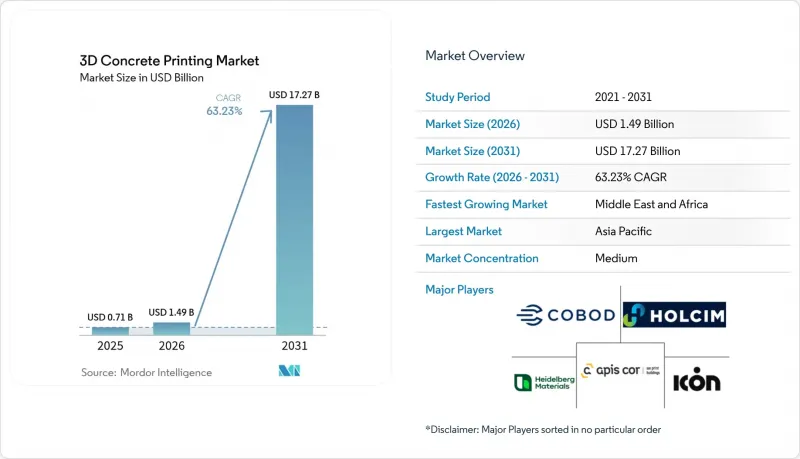
This report is Segmented by Concrete Type (Ready-Mix, High-Performance, Pre-Cast, and Shotcrete), Product Type (Walls, Floors and Roofs, Panels and Lintels, Staircases, and Other Product Types), End-Use Sector (Residential, Commercial, Infrastructure, and Architectural), and Geography (Asia-Pacific, North America, Europe, and More). The Market Forecasts are Provided in Terms of Value (USD).
Global 3D Concrete Printing Market Trends and Insights
Cost- and Time-Efficient Automated Construction
While labor productivity in construction has remained stagnant for decades, additive systems are revolutionizing the industry. These systems not only eliminate the need for formwork but also significantly reduce labor hours and minimize waste. A prime example is ICON's 100-home project at Wolf Ranch in Texas, which showcases a streamlined approach: a two-day wall printing followed by conventional roofing and MEP fit-out. Military assessments echo these economic benefits, demonstrating that four-person teams can set up robust shelters in just 48 hours for expeditionary bases. Such efficiencies are particularly crucial in markets like Japan, which experienced a workforce decline between 2015 and 2025.
Infrastructure Boom and Affordable-Housing Demand in Asia-Pacific
India's ambitious Pradhan Mantri Awas Yojana targets new urban homes by 2030. However, current capacities reveal a shortfall. In Chennai, Tvasta's printed prototype achieved a reduction in build time. By 2027, China is set to require prefabricated components to make up tier-1 residential projects, leading to a surge in bulk orders for factory-printed slabs. Meanwhile, the Asian Development Bank's robust infrastructure pipeline underscores a consistent demand for printed pedestrian bridges and culverts.
High Capital Expenditure for Printers and Ancillaries
Purchasing a COBOD BOD2 gantry, which boasts a 14.6 m span, comes with a significant price tag. However, to fully equip it with essential pumps, mixers, and generators, an additional investment is required. The leasing market for such equipment is limited, and those who do venture into it face a steep interest rate. This is largely due to financiers' lack of depreciation data. Furthermore, in India, duties on imported robotics can accumulate to a hefty percentage, posing a significant challenge in the emerging market.
Other drivers and restraints analyzed in the detailed report include:
- Sustainability Push for Low-Waste/Low-Carbon Building
- Defense and Disaster-Relief Adoption of Printed Shelters
- Non-Standardized Printable-Mix Formulations and Codes
For complete list of drivers and restraints, kindly check the Table Of Contents.
Segment Analysis
Ready-mix secured 99.20% of the 3D concrete printing market in 2025, riding on ubiquitous supply chains and contractor familiarity. Most sites adapt local ready-mix with viscosity-modifying admixtures dosed on site. High-performance concrete, however, is accelerating at a 78.77% CAGR as compressive strengths above 100 MPa enable 50 mm-thick walls that free valuable floor area. ACI studies show that ultra-high-performance formulations cut material volume while meeting identical load ratings. In many low-rise applications, fiber reinforcement has replaced the need for rebar. However, when fiber content exceeds a certain threshold, nozzle clogging becomes an issue, necessitating iterative testing.
The diversification continues: geopolymer mixes activated by sodium silicate offer near-zero embodied carbon but require 60 °C curing, limiting them to factory settings. Pre-cast workflows leverage factory control to print wall panels and floor slabs, minimizing weather delays prevalent in on-site printing. Shotcrete variants are entering tunnel-repair use cases where rapid setting and adhesion matter most. These trends signal a gradual migration from commodity to engineered mixes as second-wave adopters prioritize design freedom and sustainability.
Complete Report Scope:
- By Concrete Type
- Ready-Mix
- High-Performance
- Pre-Cast
- Shotcrete
- By Product Type
- Walls
- Floors and Roofs
- Panels and Lintels
- Staircases
- Other Product Types
- By End-Use Sector
- Residential
- Commercial
- Infrastructure
- Architectural
- By Geography
- Asia-Pacific
- China
- India
- Japan
- South Korea
- ASEAN Countries
- Rest of Asia-Pacific
- North America
- United States
- Canada
- Mexico
- Europe
- Germany
- United Kingdom
- France
- Italy
- NORDIC Countries
- Rest of Europe
- South America
- Brazil
- Argentina
- Rest of South America
- Middle-East and Africa
- GCC Countries
- South Africa
- Rest of Middle-East and Africa
- Asia-Pacific
Geography Analysis
Asia-Pacific maintained 55.54% of global 3D concrete printing market share in 2025. China's push for a prefabrication mandate by 2027 is fueling a surge in factory orders. Meanwhile, WinSun's successful five-story apartment block in Suzhou has validated the feasibility of mid-rise constructions. With an urban housing deficit, India is turning to 3D printing as a cost-effective solution. Japan, grappling with a dwindling labor force, is hastening the adoption of robotic printing, enabling two-person teams to complete detached homes. In 2024, South Korea allocated a substantial amount for public-housing pilot projects. Additionally, the ASEAN region's ongoing infrastructure projects are bolstering the demand for printed culverts and bus shelters.
North America is capitalizing on its early regulatory advantages. The introduction of AC509 and UL 3401 has eliminated uncertainties in permitting, enabling swift approvals from lenders and insurers. In 2024, a significant funding round for ICON facilitated the expansion of its Vulcan printer, catering to residential, military, and commercial sectors. To tackle the challenges of northern climates, Canada has set up a cold-weather test facility in Ottawa, focusing on freeze-thaw durability. In Tabasco, Mexico, INFONAVIT is making strides by printing homes at an impressive rate, achieving rapid build times.
Europe's embrace of 3D concrete printing is largely influenced by stringent carbon policies and a precast industry keen on integrating this new technology. Germany's endorsement of PERI's printed walls has set a precedent, guiding other EU nations. Heidelberg Materials is proactively aligning its clinker-reduced mix with the EU's impending carbon tariffs, set to roll out in 2026. France and the Netherlands are at the forefront, championing major infrastructure initiatives like XtreeE's Paris footbridge, designed to endure heavy traffic. While the UK is making strides in standardization through its Construction Innovation Hub, it's evident that its pace lags behind its continental counterparts.
South America's journey in 3D concrete printing is still in its infancy. Brazil is taking a step forward with a pilot project in Sao Paulo, aiming to produce homes under its social-housing initiative. On the other hand, Argentina grapples with economic challenges; its fluctuating inflation and currency instability have stymied significant capital investments. As a result, most activities are confined to university laboratories, where researchers are delving into experiments with recycled-plastic fibers.
The Middle-East and Africa post the fastest continental growth at a 77.64% CAGR. Saudi Arabia's ROSHN has ambitious plans, targeting printed units by 2030, with a swift production cycle. Dubai is setting the pace with a mandate that a portion of all new constructions must adopt additive techniques by 2030. They've already showcased this commitment with a printed bus shelter, engineered to endure the region's extreme desert conditions and sandstorms. In South Africa, the CSIR is exploring innovative clay-based printable mixes, aiming to address housing challenges in informal settlements.
- Apis Cor
- Balfour Beatty
- Bemore3D
- Black Buffalo 3D Corporation
- COBOD International A/S
- Constructions-3D
- Contour Crafting Corporation
- CyBe Construction
- Heidelberg Materials AG
- HOLCIM
- Hyperion
- ICON Technology Inc.
- Mighty Buildings Inc.(a LUMUS Inc. Brand)
- MUDBOTS 3D CONCRETE PRINTING LLC
- PERI 3D Construction
- Sika AG
- Skanska
- SQ4D LLC
- Vertico
- WASP Srl - Via Castelletto
- XtreeE
- Yingchuang Building Technique (Shanghai) Co. Ltd (WinSun)
Additional Benefits:
- The market estimate (ME) sheet in Excel format
- 3 months of analyst support
TABLE OF CONTENTS
1 Introduction
- 1.1 Study Assumptions and Market Definition
- 1.2 Scope of the Study
2 Research Methodology
3 Executive Summary
4 Market Landscape
- 4.1 Market Overview
- 4.2 Market Drivers
- 4.2.1 Cost- and time-efficient automated construction
- 4.2.2 Infrastructure boom and affordable-housing demand in Asia-Pacific
- 4.2.3 Sustainability push for low-waste / low-carbon building
- 4.2.4 Defense and disaster-relief adoption of printed shelters
- 4.2.5 Regulatory breakthroughs (ICC-ES AC509, UL 3401 ESRs)
- 4.3 Market Restraints
- 4.3.1 High capital expenditure for printers and ancillaries
- 4.3.2 Non-standardized printable-mix formulations and codes
- 4.3.3 Urban-site logistics limits for large gantry systems
- 4.4 Value Chain Analysis
- 4.5 Porter's Five Forces
- 4.5.1 Bargaining Power of Suppliers
- 4.5.2 Bargaining Power of Buyers
- 4.5.3 Threat of New Entrants
- 4.5.4 Threat of Substitutes
- 4.5.5 Degree of Competition
5 Market Size and Growth Forecasts (Value)
- 5.1 By Concrete Type
- 5.1.1 Ready-Mix
- 5.1.2 High-Performance
- 5.1.3 Pre-Cast
- 5.1.4 Shotcrete
- 5.2 By Product Type
- 5.2.1 Walls
- 5.2.2 Floors and Roofs
- 5.2.3 Panels and Lintels
- 5.2.4 Staircases
- 5.2.5 Other Product Types
- 5.3 By End-Use Sector
- 5.3.1 Residential
- 5.3.2 Commercial
- 5.3.3 Infrastructure
- 5.3.4 Architectural
- 5.4 By Geography
- 5.4.1 Asia-Pacific
- 5.4.1.1 China
- 5.4.1.2 India
- 5.4.1.3 Japan
- 5.4.1.4 South Korea
- 5.4.1.5 ASEAN Countries
- 5.4.1.6 Rest of Asia-Pacific
- 5.4.2 North America
- 5.4.2.1 United States
- 5.4.2.2 Canada
- 5.4.2.3 Mexico
- 5.4.3 Europe
- 5.4.3.1 Germany
- 5.4.3.2 United Kingdom
- 5.4.3.3 France
- 5.4.3.4 Italy
- 5.4.3.5 NORDIC Countries
- 5.4.3.6 Rest of Europe
- 5.4.4 South America
- 5.4.4.1 Brazil
- 5.4.4.2 Argentina
- 5.4.4.3 Rest of South America
- 5.4.5 Middle-East and Africa
- 5.4.5.1 GCC Countries
- 5.4.5.2 South Africa
- 5.4.5.3 Rest of Middle-East and Africa
- 5.4.1 Asia-Pacific
6 Competitive Landscape
- 6.1 Market Concentration
- 6.2 Strategic Moves
- 6.3 Market Share(%)/ Ranking Analysis
- 6.4 Company Profiles (includes Global level Overview, Market level overview, Core Segments, Financials as available, Strategic Information, Products and Services, Recent Developments)
- 6.4.1 Apis Cor
- 6.4.2 Balfour Beatty
- 6.4.3 Bemore3D
- 6.4.4 Black Buffalo 3D Corporation
- 6.4.5 COBOD International A/S
- 6.4.6 Constructions-3D
- 6.4.7 Contour Crafting Corporation
- 6.4.8 CyBe Construction
- 6.4.9 Heidelberg Materials AG
- 6.4.10 HOLCIM
- 6.4.11 Hyperion
- 6.4.12 ICON Technology Inc.
- 6.4.13 Mighty Buildings Inc.(a LUMUS Inc. Brand)
- 6.4.14 MUDBOTS 3D CONCRETE PRINTING LLC
- 6.4.15 PERI 3D Construction
- 6.4.16 Sika AG
- 6.4.17 Skanska
- 6.4.18 SQ4D LLC
- 6.4.19 Vertico
- 6.4.20 WASP Srl - Via Castelletto
- 6.4.21 XtreeE
- 6.4.22 Yingchuang Building Technique (Shanghai) Co. Ltd (WinSun)
7 Market Opportunities and Future Outlook
- 7.1 White-space and Unmet-Need Assessment

