PUBLISHER: Mordor Intelligence | PRODUCT CODE: 2123791

PUBLISHER: Mordor Intelligence | PRODUCT CODE: 2123791
Interventional Oncology Devices - Market Share Analysis, Industry Trends & Statistics, Growth Forecasts (2026 - 2031)
According to Mordor Intelligence, the interventional oncology devices market size is expected to grow from USD 2.72 billion in 2025 to USD 3.01 billion in 2026 and is forecast to reach USD 4.78 billion by 2031 at 9.69% CAGR over 2026-2031.
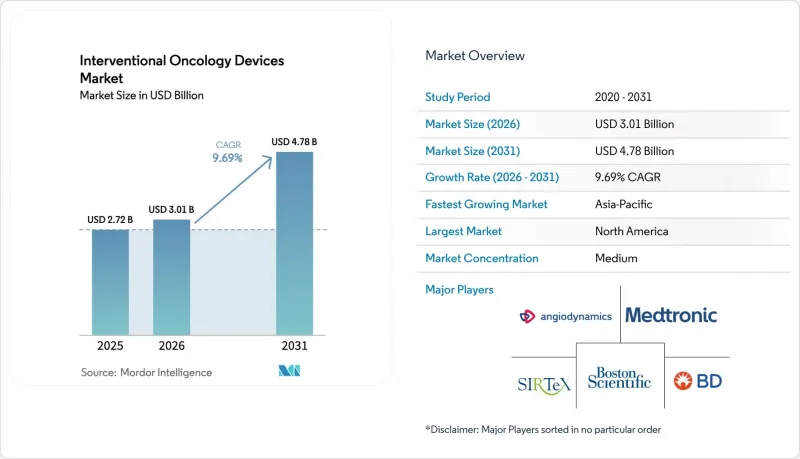
This report is Segmented by Product Type (Ablation Devices, Embolization Devices, and More), Procedure Type (Ablation, Embolization, Combination Therapies), Cancer Type (Liver, and More), End User (Hospitals, Cancer Specialty Centers, and More), and Geography (North America, Europe, Asia-Pacific, Middle East & Africa, South America). The Market Forecasts are Provided in Terms of Value (USD).
Global Interventional Oncology Devices Market Trends and Insights
Rising Prevalence of Cancer Driving Interventional Demand
Global cancer incidence climbed to 20 million new cases in 2024, a 15% rise over 2020, with liver, lung, and kidney tumors prime targets for image-guided therapy, making up 4.2 million diagnoses.The International Atomic Energy Agency estimates a global deficit of 12,000 linear accelerators, prompting oncologists to turn to catheter-based embolization and percutaneous ablation as capacity substitutes. China's 14th Five-Year Plan allocates USD 2.8 billion to establishing 500 cancer centers equipped with cone-beam CT suites by 2027, creating a pipeline that accounts for nearly one-fifth of the Asia-Pacific device shipments. Japan's demographic profile, with 33% of citizens over 65 years, is linked to a 9% yearly increase in hepatocellular carcinoma, a cohort increasingly treated with radioembolization rather than resection. U.S. academic hospitals also report waitlists for external-beam therapy, prompting earlier referrals to interventional oncology clinics and increasing daily ablation throughput by 18%.
Advances in Image-Guided Navigation and Real-Time Fusion
AI navigation compresses pre-procedure planning from 45 minutes to 12 minutes, enabling radiologists to complete six cases daily instead of four. Philips' LumiGuide overlays real-time ultrasound on pre-acquired CT, cutting needle repositioning by 38% in lung biopsies. FDA-cleared LungVision combines bronchoscopic video with 3D maps, reducing peripheral-nodule ablation time by 22 minutes while lowering pneumothorax rates to 4.5%. Early clinical use of Apple Vision Pro at Massachusetts General Hospital projects holographic liver margins into the field of view, slicing positive margins by 19%. These innovations fortify the interventional oncology devices market as navigation evolves from accessory to standard-of-care capital equipment.
High Capital Costs Limiting Adoption in Resource-Constrained Settings
A turnkey interventional oncology suite costs USD 2.8 million, a figure exceeding the annual capital budgets of 78% of public hospitals in India and 65% in Brazil. Microwave generators alone sell for USD 180,000-USD 250,000, while per-case disposables add USD 8,500-four times the median out-of-pocket expenditure in Indonesia and Nigeria. Leasing penetration in Southeast Asia is only 12%, compared to 41% in Western Europe, which delays diffusion by four to six years. Import tariffs of 18%-35% and 90-day lead times further erode utilization, which falls below the 60% breakeven needed for payback.
Other drivers and restraints analyzed in the detailed report include:
- Growing Shift to Outpatient and Ambulatory Settings
- Expansion of Combination Therapy Protocols
- Lack of Standardized Response Criteria and False-Positive Imaging
For complete list of drivers and restraints, kindly check the Table Of Contents.
Segment Analysis
Embolization devices are expected to grow at a 12.29% CAGR, outpacing the interventional oncology devices market, as 30-day drug-eluting beads double tumor control rates in hepatocellular carcinoma. Ablation devices still accounted for a 46.71% share of the interventional oncology devices market in 2025, driven by applications in the liver and lung. Yet, average selling prices have fallen 8% annually since 2023, pressured by low-cost Chinese entrants that price microwave generators 35% below those of incumbents. Irreversible electroporation is gaining traction in pancreatic indications after CPT reimbursement kicked in, resulting in a 77% increase in per-procedure revenue.
Navigation and imaging systems deliver 42% gross margins because proprietary AI algorithms reduce planning time and increase suite throughput, persuading hospitals that perform 200 or more cases annually to accept price tags of USD 350,000. Ancillary disposables mirror case volume but face double-digit price concessions under group-purchasing contracts negotiated by Premier Inc. Embolic microspheres command premium reimbursement, as irinotecan-loaded beads increase the objective response rate in colorectal metastases to 71% compared to 53% for bland embolization.
Combination therapies are on a 13.09% CAGR trajectory, fueled by survival benefits that earned Category 1A guideline status. Ablation held a 49.13% share of the 2025 interventional oncology devices market size, but growth is moderating to 8.2% as penetration plateaus in North America and Western Europe. Embolization procedures leverage Y-90 innovation to achieve a 10.1% CAGR; dosimetry advances now deliver 150 Gray to tumors while sparing parenchyma, thereby extending median survival in unresectable hepatocellular carcinoma from 10.7 to 16.4 months.
Chemoembolization reduces arterial flow by 68%, thereby mitigating the heat sink in vessels adjacent to tumors and enlarging the ablation margins by 1.2 cm. Medtronic's impedance-regulated power control reduces charring and overlap injury, making the regimen feasible in previously risky locations. The FDA breakthrough designation shortens trial timelines and accelerates reimbursement, providing another tailwind.
Complete Report Scope:
- By Product Type
- Ablation Devices
- Thermal Ablation
- Non-thermal Ablation
- Embolization Devices
- Embolic Agents
- Delivery Accessories
- Navigation & Imaging Systems
- Ancillary Disposables
- Ablation Devices
- By Procedure Type
- Ablation
- Embolization
- Combination Therapies
- By Cancer Type
- Liver
- Lung
- Breast
- Kidney
- Prostate
- Bone Metastases
- Pancreatic
- Other Cancers
- By End User
- Hospitals
- Cancer Specialty Centers
- Ambulatory Surgical Settings
- Other End Users
- By Geography
- North America
- United States
- Canada
- Mexico
- Europe
- Germany
- United Kingdom
- France
- Italy
- Spain
- Rest of Europe
- Asia-Pacific
- China
- Japan
- India
- Australia
- South Korea
- Rest of Asia-Pacific
- Middle East & Africa
- GCC
- South Africa
- Rest of Middle East & Africa
- South America
- Brazil
- Argentina
- Rest of South America
- North America
Geography Analysis
North America generated 41.64% of 2025 revenue, supported by a 12% fee-schedule bump on microwave liver ablation to USD 3,847 per case and CMS's 90-day provisional-coverage policy. U.S. penetration is high, 4,200 suites are already equipped with cone-beam CT, so growth slows to 7.8%. Canada's growth rate increased to 9.4% after Ontario and British Columbia added Y-90 radioembolization to public coverage, benefiting 12,000 patients. Mexico's market expands at 11.2% as 18,000 U.S. patients crossed the border for 60% cheaper liver ablation and four-week shorter wait times in 2025.
Asia-Pacific is the growth engine with a 14.08% CAGR. China approved 47 devices for 2024-2025 and earmarked USD 2.8 billion for 500 cancer centers, accounting for 18% of regional shipments. Japan has added cryoablation of bone metastases to its fee schedule at JPY 420,000 (approximately USD 3,200) per procedure, catering to its large elderly population. India grows at the fastest rate of 16.1% under the Ayushman Bharat insurance plan, which now reimburses treatment for 500 million citizens.
Scandinavia offsets some softness by favoring minimally invasive care in value-based procurement tenders. The Middle East & Africa enjoy a 12.6% CAGR, aided by medical tourism hubs in Dubai and Riyadh that subsidize 40% of the costs for GCC nationals. South America advances at 10.9%, led by Brazil's March 2025 reimbursement of microwave ablation under the SUS national health plan.
- AngioDynamics
- Beckton Dickinson
- Boston Scientific
- Cook Group
- Guerbet Group
- HealthTronics
- IceCure Medical
- Johnson & Johnson
- Medtronic
- Merit Medical Systems
- Profound Medical
- Siemens Healthineers
- Sirtex Medical
- Stryker
- Terumo Corp.
- Varian Medical Systems
- Medwaves Inc.
- Mirabilis Medical
- Monteris Medical
- ABK Biomedical Ltd.
Additional Benefits:
- The market estimate (ME) sheet in Excel format
- 3 months of analyst support
TABLE OF CONTENTS
1 Introduction
- 1.1 Study Assumptions & Market Definition
- 1.2 Scope of the Study
2 Research Methodology
3 Executive Summary
4 Market Landscape
- 4.1 Market Overview
- 4.2 Market Drivers
- 4.2.1 Rising Prevalence of Autoimmune Diseases
- 4.2.2 Advances in Immunoassay & Molecular Diagnostics
- 4.2.3 Growing Awareness & Early-Detection Initiatives
- 4.2.4 Expansion of Automated Multiplex Testing Platforms
- 4.2.5 AI-Enabled Pattern Recognition Reducing Turnaround
- 4.2.6 Commutable Reference Materials Speeding Approvals
- 4.3 Market Restraints
- 4.3.1 High Cost of Advanced Diagnostics in LMICs
- 4.3.2 Lack of Standardized Criteria / False Positives
- 4.3.3 Specialty Reagent Supply-Chain Vulnerabilities
- 4.3.4 Heightened Regulatory Scrutiny of Multiplex Assays
- 4.4 Regulatory Landscape
- 4.5 Technological Outlook
- 4.6 Porter's Five Forces Analysis
- 4.6.1 Threat of New Entrants
- 4.6.2 Bargaining Power of Buyers
- 4.6.3 Bargaining Power of Suppliers
- 4.6.4 Threat of Substitutes
- 4.6.5 Competitive Rivalry
5 Market Size & Growth Forecasts
- 5.1 By Product Type
- 5.1.1 Ablation Devices
- 5.1.1.1 Thermal Ablation
- 5.1.1.2 Non-thermal Ablation
- 5.1.2 Embolization Devices
- 5.1.2.1 Embolic Agents
- 5.1.2.2 Delivery Accessories
- 5.1.3 Navigation & Imaging Systems
- 5.1.4 Ancillary Disposables
- 5.1.1 Ablation Devices
- 5.2 By Procedure Type
- 5.2.1 Ablation
- 5.2.2 Embolization
- 5.2.3 Combination Therapies
- 5.3 By Cancer Type
- 5.3.1 Liver
- 5.3.2 Lung
- 5.3.3 Breast
- 5.3.4 Kidney
- 5.3.5 Prostate
- 5.3.6 Bone Metastases
- 5.3.7 Pancreatic
- 5.3.8 Other Cancers
- 5.4 By End User
- 5.4.1 Hospitals
- 5.4.2 Cancer Specialty Centers
- 5.4.3 Ambulatory Surgical Settings
- 5.4.4 Other End Users
- 5.5 By Geography
- 5.5.1 North America
- 5.5.1.1 United States
- 5.5.1.2 Canada
- 5.5.1.3 Mexico
- 5.5.2 Europe
- 5.5.2.1 Germany
- 5.5.2.2 United Kingdom
- 5.5.2.3 France
- 5.5.2.4 Italy
- 5.5.2.5 Spain
- 5.5.2.6 Rest of Europe
- 5.5.3 Asia-Pacific
- 5.5.3.1 China
- 5.5.3.2 Japan
- 5.5.3.3 India
- 5.5.3.4 Australia
- 5.5.3.5 South Korea
- 5.5.3.6 Rest of Asia-Pacific
- 5.5.4 Middle East & Africa
- 5.5.4.1 GCC
- 5.5.4.2 South Africa
- 5.5.4.3 Rest of Middle East & Africa
- 5.5.5 South America
- 5.5.5.1 Brazil
- 5.5.5.2 Argentina
- 5.5.5.3 Rest of South America
- 5.5.1 North America
6 Competitive Landscape
- 6.1 Market Concentration
- 6.2 Market Share Analysis
- 6.3 Company Profiles (includes Global level Overview, Market-level Overview, Core Segments, Financials, Strategic Information, Market Rank/Share, Products & Services, Recent Developments)
- 6.3.1 AngioDynamics
- 6.3.2 Becton, Dickinson & Company
- 6.3.3 Boston Scientific Corporation
- 6.3.4 Cook Medical
- 6.3.5 Guerbet Group
- 6.3.6 HealthTronics Inc.
- 6.3.7 IceCure Medical
- 6.3.8 Johnson & Johnson (Ethicon)
- 6.3.9 Medtronic
- 6.3.10 Merit Medical Systems
- 6.3.11 Profound Medical Corp.
- 6.3.12 Siemens Healthineers
- 6.3.13 Sirtex Medical
- 6.3.14 Stryker Corp.
- 6.3.15 Terumo Corp.
- 6.3.16 Varian Medical Systems
- 6.3.17 Medwaves Inc.
- 6.3.18 Mirabilis Medical
- 6.3.19 Monteris Medical
- 6.3.20 ABK Biomedical Ltd.
7 Market Opportunities & Future Outlook
- 7.1 White-space & Unmet-need Assessment

