PUBLISHER: Mordor Intelligence | PRODUCT CODE: 2124360

PUBLISHER: Mordor Intelligence | PRODUCT CODE: 2124360
Rhamnolipids - Market Share Analysis, Industry Trends & Statistics, Growth Forecasts (2026 - 2031)
According to Mordor Intelligence, the rhamnolipids market size is estimated at 14.15 kilotons in 2026, and is expected to reach 70.97 kilotons by 2031, at a CAGR of 38.06% during the forecast period (2026-2031).
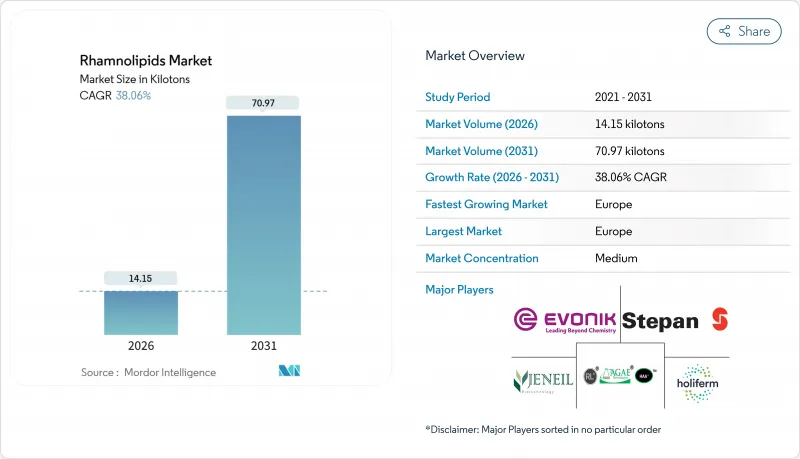
This report is Segmented by Product Type (Mono-Rhamnolipids, Di-Rhamnolipids), Feedstock (Vegetable-Oil Derived, Waste Glycerol/Crude Glycerin, Sugar-Based, Hydrocarbon-Based), Application (Surfactants, Cosmetics, Agriculture, Food, Pharmaceutical, and More), and Geography (Asia-Pacific, North America, Europe, South America, Middle East and Africa). Market Forecasts are Provided in Terms of Volume (tons).
Global Rhamnolipids Market Trends and Insights
Rising Demand for Eco-Friendly Surfactants in Home & Personal Care
Penetration of certified eco-label detergents exceeded 28% in Germany, France, and the United Kingdom during 2025 as millennials and Gen Z consumers prioritized ingredient transparency. Holiferm's partnership with Trichem South illustrates adoption by tier-two detergent brands seeking mildness and sustainability without compromising foam or grease cutting.. Dermatological patch tests confirm rhamnolipids' reduced irritation, supporting deployment in baby-care and sensitive-skin products. Retail price premiums of 15-20% for bio-based micellar waters and shower gels reduce price elasticity, translating directly to volume displacement of sodium lauryl ether sulfate. As private-label and mass brands emulate early movers, the +9.2 percentage-point effect will remain visible through 2029, reinforcing the rhamnolipids market trajectory.
Regulatory Push for Biodegradable, Low-Toxicity Ingredients
The 2024 REACH Annex XIV update added three alkylphenol ethoxylates to Europe's authorization list, effectively phasing them out by 2027. The U.S. EPA's Safer Choice revisions tightened Daphnia magna LC50 requirements above 10 mg/L, spurring formulators to adopt rhamnolipids, which display LC50 values over 100 mg/L and >90% biodegradation within 28 days. Brand reformulations to meet 2026-2027 cut-off dates anchor near-term market growth, though momentum stabilizes post-2028 as compliant formulations gain wide penetration.
Foaming & Downstream-Processing Costs at Industrial Scale
Fermentation foam can exceed reactor capacity by 3-5 times, demanding mechanical breakers or antifoams that complicate purification. AGAE Technologies installed rapid foam-recycling loops and pressure-modulated aeration at its Asian plant to keep yields intact. Downstream operations, solvent extraction, ultrafiltration, and spray drying still account for as much as 50% of the cost of goods, double the citric acid benchmarks. Continuous membrane contactors and in-situ product removal could halve recovery costs by 2028, but the learning curve remains a -6.4 percentage-point drag in the near term.
Other drivers and restraints analyzed in the detailed report include:
- Increasing Usage in Agriculture and Biopesticide Applications
- Adoption of Rhamnolipid Nano-Micelles as Alcohol-Free Hospital Sanitizers
- Safety Concerns Over Endotoxins
For complete list of drivers and restraints, kindly check the Table Of Contents.
Segment Analysis
Mono-rhamnolipids commanded 57.09% volume in 2025, capturing the largest rhamnolipids market share due to water solubility and lower critical micelle concentration. Mono-rhamnolipids' market share is expected to increase at a CAGR of 40.425 during the forecast period (2026-2031). Evonik's pH-controlled fermentation tunes mono-to-di ratios without costly fractionation, trimming production costs 15-18%. Waste glycerol substrates further tilt yields toward mono species, linking raw-material strategy to product mix. Patent filings center on rhamnosyltransferase gene optimization, with AGAE Technologies targeting more than 85% mono purity. Di-rhamnolipids retain a niche for antimicrobial cosmetics and industrial degreasers owing to heightened membrane disruption, but viscosity limits adoption where quick dissolution is critical.
Second-generation blends leveraging both species could emerge as suppliers pursue performance-cost trade-offs. If di-rhamnolipid titers improve through genetic knockouts of competing pathways, formulators may adopt tailored ratios for leave-on skincare and disinfectants, reinforcing product-type diversification within the rhamnolipids market.
Complete Report Scope:
- By Product Type
- Mono-Rhamnolipids
- Di-Rhamnolipids
- By Feedstock
- Vegetable-Oil Derived
- Waste Glycerol / Crude Glycerin
- Sugar-Based
- Hydrocarbon-Based
- By Application
- Surfactants
- Cosmetics
- Agriculture
- Food
- Pharmaceutical
- Other Applications (Enhanced Oil Recovery & Bioremediation, etc.)
- By Geography
- Asia-Pacifc
- China
- India
- Japan
- South Korea
- ASEAN Countries
- Rest of Asia-Pacific
- North America
- United States
- Canada
- Mexico
- Europe
- Germany
- United Kingdom
- France
- Italy
- Russia
- Rest of Europe
- South America
- Brazil
- Argentina
- Rest of South America
- Middle East and Africa
- Saudi Arabia
- South Africa
- Rest of Middle East and Africa
- Asia-Pacifc
Geography Analysis
Europe accounted for 62.76% of the Rhamnolipids market size in 2025 and is set to grow at a 43.76% CAGR through 2031. Germany and France anchor demand, supported by Henkel and Unilever commitments to replace 50% of petrochemical surfactants by 2030. Evonik's Slovakian plant supplies Unilever's global dishwashing liquids, aligning regional supply chains with EU sustainability mandates. Post-Brexit UK regulations shorten review cycles for bio-based ingredients, accelerating market entry and spurring adoption by private-label producers in Italy and Spain.
Asia-Pacific is the fastest-growing region by volume. AGAE Technologies' 1,000-t plant, commissioned in 2025, positions the region as a supply hub amid rising personal-care consumption. China's 2025 Cosmetic Ingredient Safety update allows 2.0% rhamnolipid inclusion in leave-on products, unlocking a potential 10,000 t annual market if 5 % penetration is achieved. Japan authorized rhamnolipids as food emulsifiers at 0.5% in May 2025, pioneering direct food-contact approvals. India emphasizes agriculture, integrating rhamnolipid biopesticides under its National Mission for Sustainable Agriculture.
North America is led by industrial and institutional cleaners certified under EPA's Safer Choice program. Domestic full-scale production remains prospective; AGAE plans a US plant leveraging foam-control learnings from Asia. Canada's modest adoption reflects limited personal-care manufacturing but could surge as exporters seek REACH-compliant formulations. Mexico lags given cheap synthetic imports, though USMCA rules may spur regional biosurfactant production.
- AGAE Technologies, LLC
- BASF SE
- Biotensidon GmbH
- DEGUAN Biosurfactant Supplier
- Evonik Industries AG
- GlycoSurf Inc.
- Holiferm Ltd
- Jeneil Biotech
- Stepan Company
- TensioGreen LLC
Additional Benefits:
- The market estimate (ME) sheet in Excel format
- 3 months of analyst support
TABLE OF CONTENTS
1 Introduction
- 1.1 Study Assumptions & Market Definition
- 1.2 Scope of the Study
2 Research Methodology
3 Executive Summary
4 Market Landscape
- 4.1 Market Overview
- 4.2 Market Drivers
- 4.2.1 Rising demand for eco-friendly surfactants in Home & Personal Care
- 4.2.2 Regulatory push for biodegradable, low-toxicity ingredients
- 4.2.3 Increasing usage in agriculture and biopesticide applications
- 4.2.4 Adoption of rhamnolipid nano-micelles as alcohol-free hospital sanitizers
- 4.2.5 Increasing demand from oil recovery and remediation application
- 4.3 Market Restraints
- 4.3.1 Foaming & downstream-processing costs at industrial scale
- 4.3.2 Safety concerns over endotoxins
- 4.3.3 Vegetable-oil price volatility competing with food supply
- 4.4 Value Chain Analysis
- 4.5 Porter's Five Forces
- 4.5.1 Threat of New Entrants
- 4.5.2 Bargaining Power of Buyers
- 4.5.3 Bargaining Power of Suppliers
- 4.5.4 Threat of Substitutes
- 4.5.5 Degree of Competition
5 Market Size & Growth Forecasts
- 5.1 By Product Type
- 5.1.1 Mono-Rhamnolipids
- 5.1.2 Di-Rhamnolipids
- 5.2 By Feedstock
- 5.2.1 Vegetable-Oil Derived
- 5.2.2 Waste Glycerol / Crude Glycerin
- 5.2.3 Sugar-Based
- 5.2.4 Hydrocarbon-Based
- 5.3 By Application
- 5.3.1 Surfactants
- 5.3.2 Cosmetics
- 5.3.3 Agriculture
- 5.3.4 Food
- 5.3.5 Pharmaceutical
- 5.3.6 Other Applications (Enhanced Oil Recovery & Bioremediation, etc.)
- 5.4 By Geography
- 5.4.1 Asia-Pacifc
- 5.4.1.1 China
- 5.4.1.2 India
- 5.4.1.3 Japan
- 5.4.1.4 South Korea
- 5.4.1.5 ASEAN Countries
- 5.4.1.6 Rest of Asia-Pacific
- 5.4.2 North America
- 5.4.2.1 United States
- 5.4.2.2 Canada
- 5.4.2.3 Mexico
- 5.4.3 Europe
- 5.4.3.1 Germany
- 5.4.3.2 United Kingdom
- 5.4.3.3 France
- 5.4.3.4 Italy
- 5.4.3.5 Russia
- 5.4.3.6 Rest of Europe
- 5.4.4 South America
- 5.4.4.1 Brazil
- 5.4.4.2 Argentina
- 5.4.4.3 Rest of South America
- 5.4.5 Middle East and Africa
- 5.4.5.1 Saudi Arabia
- 5.4.5.2 South Africa
- 5.4.5.3 Rest of Middle East and Africa
- 5.4.1 Asia-Pacifc
6 Competitive Landscape
- 6.1 Market Concentration
- 6.2 Strategic Moves
- 6.3 Market Share(%)/Ranking Analysis
- 6.4 Company Profiles (includes Global level Overview, Market level overview, Core Segments, Financials, Strategic Info, Market Rank/Share, Products & Services, Recent Developments)
- 6.4.1 AGAE Technologies, LLC
- 6.4.2 BASF SE
- 6.4.3 Biotensidon GmbH
- 6.4.4 DEGUAN Biosurfactant Supplier
- 6.4.5 Evonik Industries AG
- 6.4.6 GlycoSurf Inc.
- 6.4.7 Holiferm Ltd
- 6.4.8 Jeneil Biotech
- 6.4.9 Stepan Company
- 6.4.10 TensioGreen LLC
7 Market Opportunities & Future Outlook
- 7.1 White-Space & Unmet-Need Assessment
- 7.2 Rapid Uptake of Glycerin in E-cigarette Liquids in Asia and Middle-East

