PUBLISHER: Mordor Intelligence | PRODUCT CODE: 2187767

PUBLISHER: Mordor Intelligence | PRODUCT CODE: 2187767
GEO Satellite - Market Share Analysis, Industry Trends & Statistics, Growth Forecasts (2026 - 2031)
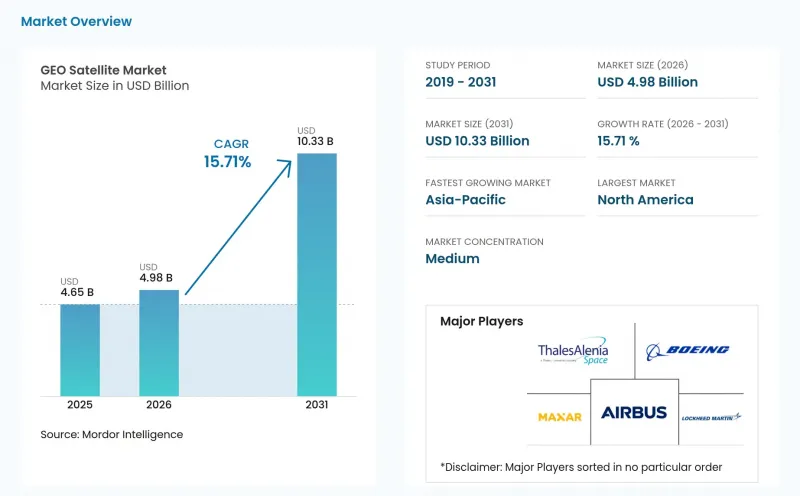
According to Mordor Intelligence, the GEO satellite market size was valued at USD 4.65 billion in 2025, and is projected to grow from USD 4.98 billion in 2026 to USD 10.33 billion by 2031, registering a CAGR of 15.71% between 2026 and 2031.
Global GEO Satellite Market Trends and Insights
Demand for High-Capacity Broadband, Broadcasting, and Backhaul
Demand for broadband, broadcasting, and backhaul services supports the GEO satellite market because these services require wide, stable coverage. Cellular backhaul, maritime links, and in-flight connectivity use a fixed footprint across large service areas. The Broadband Commission stated that global data demand will rise by at least 60% by 2035. Multi-year capacity contracts are already addressing this anticipated need. Broadcast distribution also remains well-suited to GEO because a single transponder can reach millions of receivers simultaneously. In June 2026, NXGSAT and Universidad de Malaga validated a 3GPP-compliant 5G NTN modem through a live GEO payload, showing that existing assets can support terrestrial 5G backhaul. Rural areas across Sub-Saharan Africa, South Asia, and Latin America continue to rely on satellite capacity where terrestrial networks are uneconomic.
Government and Defense Demand for Resilient Wide-Area Connectivity
Government demand supports the GEO satellite market, where secure and persistent coverage is required across a large territory. Defense users value a fixed footprint when national communications need predictable coverage. The US Space Force PTS-G program supports small and agile GEO satellites for protected tactical communications. Viasat received a PTS-G Swarm 1 prime contract within a program carrying a USD 4.00 billion ceiling in June 2026. The European Union (EU) activated GOVSATCOM in January 2026, providing member states with sovereign and encrypted satellite communications. Long-duration public contracts give manufacturers and operators greater visibility than commercial spot capacity. This demand is less exposed to changes in commercial capacity pricing.
Non-GEO Constellation Competition on Latency and Iteration Speed
Non-GEO networks constrain the GEO satellite market by offering lower latency for select connectivity use cases. Their shorter replacement cycles also allow faster upgrades to satellite hardware. Software-defined GEO payloads can adapt coverage and bandwidth, but they cannot change the physical limits of a satellite bus. The FCC's 2026 spectrum-sharing action may change interference protection arrangements between non-GEO and GEO systems. Operators are therefore focusing on defense, maritime, and in-flight services where reliability and coverage matter more than latency. This shift places greater value on guaranteed service quality and specialized network design.
Other drivers and restraints analyzed in the detailed report include:
- High-Throughput and Software-Defined Payload Adoption
- GEO On-Orbit Servicing and Life-Extension Demand
- High Launch, Insurance, and GEO Insertion Costs
For complete list of drivers and restraints, kindly check the Table Of Contents.
Segment Analysis
Communication satellites accounted for 61.63% of the GEO satellite market in 2025. Their position reflects established transponder leases, direct-to-home broadcasting, and cellular backhaul agreements. These contracts continue to support demand even as non-GEO networks expand. Communication payloads also provide the commercial base for many GEO fleet operators. Fixed service areas remain useful where a broad and persistent footprint is needed. This installed service model helps communication satellites remain the revenue anchor of the GEO satellite market.
Earth observation satellites are forecast to grow at a CAGR of 17.71% through 2031. Their growth is linked to the needs of defense surveillance, precision agriculture, and climate monitoring. GEO sensors can continuously monitor the same area, unlike systems that only provide periodic revisits. ESA's Sentinel-4 instrument is hosted on MTG-S1, which was commissioned in 2026 for hourly atmospheric composition observations over Europe and northern Africa. Weather missions also benefit from long public procurement cycles. EUMETSAT's MTG program provides Europe with operational weather observation into the 2040s.
Weather satellites are supported by national meteorological agencies that plan infrastructure over long periods. Their missions are less sensitive to short-term commercial capacity prices. Surveillance and intelligence satellites benefit from requirements for persistent monitoring. These requirements can justify specialized platforms and protected communications. The others category includes navigation augmentation and experimental payloads. Multi-mission architecture makes this smaller category increasingly relevant within the GEO satellite market.
Large satellites accounted for 52.75% of the GEO satellite market share in 2025. Larger buses can carry more transponders and support greater lease revenue. They can also spread fixed launch and insurance expenses across a larger payload. This economic structure keeps large platforms important for high-throughput commercial services. Large systems remain particularly relevant for established operators with broad capacity needs. Their scale supports the GEO satellite market's central revenue model.
Medium-sized GEO satellites are projected to grow at a CAGR of 19.83% through 2031. Operators are accepting lower transponder capacity in return for faster procurement and greater flexibility. ReOrbit and SLI signed a EUR 150 million (USD 168.09 million) agreement in March 2026 for 2 next-generation GEO communication satellites. The agreement used leasing terms to improve access to advanced GEO technology. Medium platforms can therefore bring new operators into the addressable customer base. The US Space Force also supports smaller maneuverable GEO systems through PTS-G.
Small GEO systems support government missions where rapid deployment and maneuverability are important. OHB SE agreed to supply 6 electric propulsion systems for SWISSto12's HummingSat platform. This activity shows that a small-GEO supply chain is forming. Small buses remain limited by available radio-frequency power and antenna aperture at GEO altitude. These limits reduce throughput compared with large satellites. ESA support for deployable reflector work on NEASTAR-1 helps reduce certification risk for first-generation small-GEO operators.
Complete Report Scope:
- By Satellite Type
- Communication Satellites
- Earth Observation Satellites
- Weather Satellites
- Surveillance and Intelligence Satellites
- Others
- By Satellite Mass
- Small
- Medium
- Large
- By Propulsion
- Electric Propulsion
- Chemical Propulsion
- Hybrid Propulsion
- By End User
- Commercial
- Government and Civil
- Military
- By Geography
- North America
- United States
- Canada
- Mexico
- Europe
- United Kingdom
- France
- Germany
- Russia
- Rest of Europe
- Asia-Pacific
- China
- Japan
- India
- Australia
- Rest of Asia-Pacific
- South America
- Brazil
- Rest of South America
- Middle East and Africa
- Middle East
- Saudi Arabia
- United Arab Emirates
- Rest of Middle East
- Africa
- South Africa
- Rest of Africa
- Middle East
- North America
Geography Analysis
North America accounted for 46.77% of the GEO satellite market in 2025. The region benefits from deep capital markets, major satellite integrators, and a mature commercial space base. US licensing changes in July 2026 were intended to accelerate commercial satellite deployment. US Space Force procurement provides sustained visibility into demand through PTS-G, commercial services, and servicing contracts. The USD 4.00 billion PTS-G ceiling supports protected communications programs. Mexico's connectivity gap and Canadian GEO frequency activity add to regional demand.
Asia-Pacific is forecast to expand at a 21.63% CAGR through 2031. Rural, remote, and island populations create continuing demand for coverage beyond terrestrial networks. India, Japan, and China are expanding their national GEO capabilities. Mitsubishi Electric's JAXA-supported digital payload program strengthens Japan's role in next-generation GEO technology. China continues to develop its Zhongxing communication satellite fleet. India is progressing with GSAT replacement plans and commercial satellite broadband activity. South and Southeast Asian connectivity gaps sustain demand across service tiers.
Europe is the third-largest regional position in the GEO satellite market. ESA programs, GOVSATCOM, and IRIS2 support European communications sovereignty. Thales Alenia Space, Airbus Defence and Space, and OHB SE form an established manufacturing base. The EU Space Act was presented in June 2025 to harmonize space activity rules across the union. Demand in the Middle East and Africa is linked to sovereign connectivity mandates and regional broadband footprints. Es'hailSat selected a software-defined platform for a satellite serving Europe, Africa, and the Middle East. South American demand is supported by Brazil's broadband expansion and service needs across rural areas.
- Airbus SE
- The Boeing Company
- Lockheed Martin Corporation
- Northrop Grumman Corporation
- Space Exploration Technologies Corp.
- China Aerospace Science and Technology Corporation
- Thales Alenia Space
- Maxar Technologies Inc.
- Mitsubishi Corporation
- Hispasat S.A.
- Blue Canyon Technologies LLC (RTX Corporation)
- ICEYE Oy
- OHB SE
- GomSpace A/S
- Eutelsat Group
- Planet Labs PBC
- Spire Global, Inc.
- AAC Clyde Space AB
- Indian Space Research Organisation
- Viasat, Inc.
Additional Benefits:
- The market estimate (ME) sheet in Excel format
- 3 months of analyst support
TABLE OF CONTENTS
1 INTRODUCTION
- 1.1 Study Assumptions and Market Definition
- 1.2 Scope of the Study
2 RESEARCH METHODOLOGY
3 EXECUTIVE SUMMARY
4 MARKET LANDSCAPE
- 4.1 Market Drivers
- 4.1.1 Demand for high-capacity broadband, broadcasting, and backhaul
- 4.1.2 Government and defense demand for resilient wide-area connectivity
- 4.1.3 High-throughput and software-defined payload adoption
- 4.1.4 Multi-orbit network integration and GEO network resilience
- 4.1.5 GEO on-orbit servicing and life-extension demand
- 4.1.6 Continuous coverage for weather, disaster, and environmental intelligence
- 4.2 Market Restraints
- 4.2.1 Non-GEO constellation competition on latency and iteration speed
- 4.2.2 High launch, insurance, and GEO insertion costs
- 4.2.3 Spectrum, orbital slot, and licensing complexity
- 4.2.4 Orbital debris, collision risk, and end-of-life compliance
- 4.3 Value Chain Analysis
- 4.4 Regulatory Landscape
- 4.5 Technological Outlook
- 4.6 Porter's Five Forces Analysis
- 4.6.1 Bargaining Power of Suppliers
- 4.6.2 Bargaining Power of Buyers
- 4.6.3 Threat of New Entrants
- 4.6.4 Threat of Substitutes
- 4.6.5 Intensity of Competitive Rivalry
5 MARKET SIZE AND GROWTH FORECASTS (VALUE)
- 5.1 By Satellite Type
- 5.1.1 Communication Satellites
- 5.1.2 Earth Observation Satellites
- 5.1.3 Weather Satellites
- 5.1.4 Surveillance and Intelligence Satellites
- 5.1.5 Others
- 5.2 By Satellite Mass
- 5.2.1 Small
- 5.2.2 Medium
- 5.2.3 Large
- 5.3 By Propulsion
- 5.3.1 Electric Propulsion
- 5.3.2 Chemical Propulsion
- 5.3.3 Hybrid Propulsion
- 5.4 By End User
- 5.4.1 Commercial
- 5.4.2 Government and Civil
- 5.4.3 Military
- 5.5 By Geography
- 5.5.1 North America
- 5.5.1.1 United States
- 5.5.1.2 Canada
- 5.5.1.3 Mexico
- 5.5.2 Europe
- 5.5.2.1 United Kingdom
- 5.5.2.2 France
- 5.5.2.3 Germany
- 5.5.2.4 Russia
- 5.5.2.5 Rest of Europe
- 5.5.3 Asia-Pacific
- 5.5.3.1 China
- 5.5.3.2 Japan
- 5.5.3.3 India
- 5.5.3.4 Australia
- 5.5.3.5 Rest of Asia-Pacific
- 5.5.4 South America
- 5.5.4.1 Brazil
- 5.5.4.2 Rest of South America
- 5.5.5 Middle East and Africa
- 5.5.5.1 Middle East
- 5.5.5.1.1 Saudi Arabia
- 5.5.5.1.2 United Arab Emirates
- 5.5.5.1.3 Rest of Middle East
- 5.5.5.2 Africa
- 5.5.5.2.1 South Africa
- 5.5.5.2.2 Rest of Africa
- 5.5.5.1 Middle East
- 5.5.1 North America
6 COMPETITIVE LANDSCAPE
- 6.1 Strategic Moves
- 6.2 Market Share Analysis
- 6.3 Company Profiles (includes Global level Overview, Market level Overview, Core Segments, Financials, Strategic Information, Market Rank/Share, Products and Services, and Recent Developments)
- 6.3.1 Airbus SE
- 6.3.2 The Boeing Company
- 6.3.3 Lockheed Martin Corporation
- 6.3.4 Northrop Grumman Corporation
- 6.3.5 Space Exploration Technologies Corp.
- 6.3.6 China Aerospace Science and Technology Corporation
- 6.3.7 Thales Alenia Space
- 6.3.8 Maxar Technologies Inc.
- 6.3.9 Mitsubishi Corporation
- 6.3.10 Hispasat S.A.
- 6.3.11 Blue Canyon Technologies LLC (RTX Corporation)
- 6.3.12 ICEYE Oy
- 6.3.13 OHB SE
- 6.3.14 GomSpace A/S
- 6.3.15 Eutelsat Group
- 6.3.16 Planet Labs PBC
- 6.3.17 Spire Global, Inc.
- 6.3.18 AAC Clyde Space AB
- 6.3.19 Indian Space Research Organisation
- 6.3.20 Viasat, Inc.
7 MARKET OPPORTUNITIES AND FUTURE OUTLOOK
- 7.1 White-space and Unmet-need Assessment

