PUBLISHER: Mordor Intelligence | PRODUCT CODE: 2125742

PUBLISHER: Mordor Intelligence | PRODUCT CODE: 2125742
India Wall Decor - Market Share Analysis, Industry Trends & Statistics, Growth Forecasts (2026 - 2031)
According to Mordor Intelligence, the India wall decor market size was valued at USD 8.33 billion in 2025 and estimated to grow from USD 8.61 billion in 2026 to reach USD 10.17 billion by 2031, at a CAGR of 3.38% during the forecast period (2026-2031).
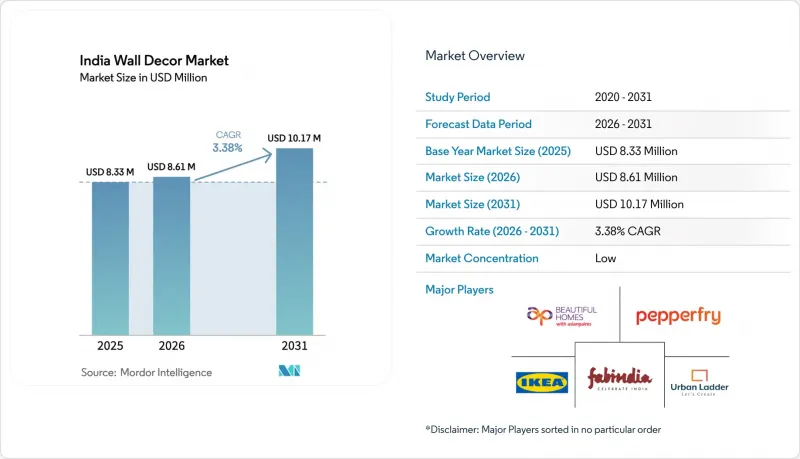
This report is Segmented by Product Type (Shelves, Wallpaper/Stickers, Clocks, Hangings, Frameworks, Mirror Works), Distribution Channel (Wholesalers/Distributors, Hypermarkets/Supermarkets, Specialty Stores, Online Retailers), End Users (Residential, Commercial), and Geography (North India, South India, West India, East India, and Other). The Market Forecasts are Provided in Terms of Value (USD).
India Wall Decor Market Trends and Insights
Rising Disposable Incomes and Residential Real-Estate Boom
Escalating household earnings underpin the India wall decor market by enlarging budgets for aesthetic upgrades. Record housing launches rose 20% year-on-year in 2024, creating fresh blank canvases for decor spending. Luxury micro-markets such as Pune's Baner corridor posted 15% annual price appreciation, signaling sustained appetite for premium wall solutions. Younger homebuyers prioritize design expression, replacing the older durability-only mindset. Developers increasingly bundle branded wallcoverings to differentiate projects and raise ticket sizes. Government incentives for affordable housing add depth at entry-level price points, broadening the addressable base. Renovation cycles now average 10-12 years, turning each new housing cohort into recurring customers sooner than before.
Explosive Growth of E-Commerce and Omnichannel Furniture Retail
Digital platforms expose consumers to thousands of SKUs, fuelling trial and repeat purchase within the India wall decor market. IKEA India secures over 30% of Delhi-NCR orders online, validating the click-first preference among time-pressed urbanites. Influencer-led social commerce drives discovery for niche D2C labels, widening choice beyond dominant national brands. Faster last-mile networks and warehouse automation cut delivery times for bulky panels and mirrors, reducing purchase hesitation. ONDC integration promises lower onboarding costs for artisans, enlarging regional supply diversity. Omnichannel retailers invest in AR visualization tools that let shoppers preview wallpapers at scale, increasing conversion. Traditional wholesalers adopt drop-ship models to remain competitive, blending age-old relationships with new digital efficiencies.
Volatile Input Prices for Timber, Metal, Decor Paper, and Forex
Commodity cycles drive unpredictable swings in raw-material costs, squeezing thin operating margins for wallpaper printers and frame makers. February 2025 BIS orders on MDF and plywood tightened import supply, raising lead times and holding costs for manufacturers reliant on Southeast Asian panels . Currency fluctuations amplify landed-cost volatility for premium printed substrates sourced from Europe. Smaller firms lack hedging mechanisms, forcing ad-hoc price hikes that can erode brand loyalty. Construction inflation of 3-5% compounds installation budgets, delaying nonessential decor projects. Domestic forestry reforms could ease timber pressure, yet short-term uncertainty persists. Industry players prioritize backward integration and FSC-certified sourcing to tame supply risk.
Other drivers and restraints analyzed in the detailed report include:
- Shortening Home-Renovation Cycles Among Urban Millennials
- Premiumization and DIY Wall Decor Demand
- Proliferation of Low-Grade or Counterfeit Products
For complete list of drivers and restraints, kindly check the Table Of Contents.
Segment Analysis
Wallpaper captured 25.08% of the India wall decor market share in 2025, reflecting its design versatility and speed of application. Digitally printed variants are on course for a staggering 18.51% CAGR through 2031 as mass customization aligns with shorter renovation cycles. The India wall decor market registers elevated search traffic for peel-and-stick murals, suggesting consumer appetite for hassle-free makeovers. Modular shelves maintain 21.74% revenue contribution, leveraging compact-home storage demand in urban apartments. Mirror works, holding an 17.62% share, benefit from space amplification trends in luxury housing corridors. Clocks and hangings occupy niche but enduring user segments, fulfilling functional and aesthetic niches. BIS-mandated quality norms are expected to consolidate share toward compliant wallpaper manufacturers, thereby stabilizing price bands over time.
Technology upgrades such as UV-gel printing enhance durability and color fidelity, allowing Indian producers to satisfy both domestic and export orders. Asian Paints leverages its 10.5% market led to introduce theme-based wallcovering collections that pair with paint palettes for coordinated room makeovers. D2C upstarts deploy AI-driven configurators, letting shoppers scale patterns to exact wall dimensions, shrinking the measurement-error margin. Import duties on Chinese decor paper redirect sourcing toward Korea and Germany, diversifying supply risks. Suppliers court architects through virtual sample libraries that expedite specification cycles for commercial fit-outs. Sustainability preferences push demand for PVC-free substrates, with European certifications acting as proof points in marketing communication. Decorative acoustics panels emerge as a high-margin adjacency, tapping the same installer ecosystem.
Complete Report Scope:
- Segmentation by Product Type
- Shelves
- Wallpaper / Stickers
- Clocks
- Hangings
- Frameworks
- Mirror Works
- Segmentation by Distribution Channel
- Wholesalers / Distributors
- Hypermarkets / Supermarkets
- Specialty Stores
- Online Retailers
- Segmentation by End Users
- Residential
- Commercial
- Segmentation by Geography
- North India
- South India
- West India
- East India
- Central India
- North-East India
List of Companies Covered in this Report:
- Asian Paints Ltd
- IKEA India
- Pepperfry
- Urban Ladder
- Fabindia
- Godrej Interio
- Home Centre (India)
- Livspace
- Nilkamal (At Home)
- Flipkart (Home & Living)
- Amazon India (Home Decor)
- India Circus
- eCraftIndia
- WallMantra
- Wallskin
- Artociti
- Chumbak
- IndianShelf
- Nykaa Fashion (Home)
- Raj Handicrafts
Additional Benefits:
- The market estimate (ME) sheet in Excel format
- 3 months of analyst support
TABLE OF CONTENTS
1 Introduction
- 1.1 Study Assumptions & Market Definition
- 1.2 Scope of the Study
2 Research Methodology
3 Executive Summary
4 Market Landscape
- 4.1 Market Overview
- 4.2 Market Drivers
- 4.2.1 Rising disposable incomes & residential real-estate boom
- 4.2.2 Explosive growth of e-commerce and omnichannel furniture retail
- 4.2.3 Shortening home-renovation cycles among urban millennials
- 4.2.4 Premiumisation and demand for custom/DIY wall decor
- 4.2.5 Co-living & co-working footprints driving bulk decorative fit-outs
- 4.2.6 Handicraft-cluster incentives boosting artisanal wall decor supply
- 4.3 Market Restraints
- 4.3.1 Volatile input prices (timber, metal, decor paper, FX)
- 4.3.2 Proliferation of low-grade/counterfeit products in unorganised sector
- 4.3.3 Tightening indoor-air-quality & low-VOC compliance for adhesives/inks
- 4.3.4 Shortage of skilled installers & digital-printing technicians
- 4.4 Value / Supply-Chain Analysis
- 4.5 Regulatory Landscape
- 4.6 Technological Outlook
- 4.7 Porter's Five Forces Analysis
- 4.7.1 Threat of New Entrants
- 4.7.2 Bargaining Power of Suppliers
- 4.7.3 Bargaining Power of Buyers
- 4.7.4 Threat of Substitutes
- 4.7.5 Intensity of Competitive Rivalry
5 Market Size & Growth Forecasts
- 5.1 Segmentation by Product Type
- 5.1.1 Shelves
- 5.1.2 Wallpaper / Stickers
- 5.1.3 Clocks
- 5.1.4 Hangings
- 5.1.5 Frameworks
- 5.1.6 Mirror Works
- 5.2 Segmentation by Distribution Channel
- 5.2.1 Wholesalers / Distributors
- 5.2.2 Hypermarkets / Supermarkets
- 5.2.3 Specialty Stores
- 5.2.4 Online Retailers
- 5.3 Segmentation by End Users
- 5.3.1 Residential
- 5.3.2 Commercial
- 5.4 Segmentation by Geography
- 5.4.1 North India
- 5.4.2 South India
- 5.4.3 West India
- 5.4.4 East India
- 5.4.5 Central India
- 5.4.6 North-East India
6 Competitive Landscape
- 6.1 Market Concentration
- 6.2 Strategic Moves
- 6.3 Market Share Analysis
- 6.4 Company Profiles (includes Global level Overview, Market level overview, Core Segments, Financials as available, Strategic Information, Market Rank/Share, Products & Services, and Recent Developments)
- 6.4.1 Asian Paints Ltd
- 6.4.2 IKEA India
- 6.4.3 Pepperfry
- 6.4.4 Urban Ladder
- 6.4.5 Fabindia
- 6.4.6 Godrej Interio
- 6.4.7 Home Centre (India)
- 6.4.8 Livspace
- 6.4.9 Nilkamal (At Home)
- 6.4.10 Flipkart (Home & Living)
- 6.4.11 Amazon India (Home Decor)
- 6.4.12 India Circus
- 6.4.13 eCraftIndia
- 6.4.14 WallMantra
- 6.4.15 Wallskin
- 6.4.16 Artociti
- 6.4.17 Chumbak
- 6.4.18 IndianShelf
- 6.4.19 Nykaa Fashion (Home)
- 6.4.20 Raj Handicrafts
7 Market Opportunities & Future Outlook
- 7.1 Digitally-printed, made-to-measure wallpaper as an affordable mass-premium upgrade
- 7.2 Eco-friendly wall panels (bamboo, cork, reclaimed coco tiles) targeting green real-estate projects

