
PUBLISHER: Mordor Intelligence | PRODUCT CODE: 1844492

PUBLISHER: Mordor Intelligence | PRODUCT CODE: 1844492
Polymer Nanocomposite - Market Share Analysis, Industry Trends & Statistics, Growth Forecasts (2025 - 2030)
The Polymer Nanocomposite Market size is estimated at USD 13.23 billion in 2025, and is expected to reach USD 27.68 billion by 2030, at a CAGR of 15.91% during the forecast period (2025-2030).
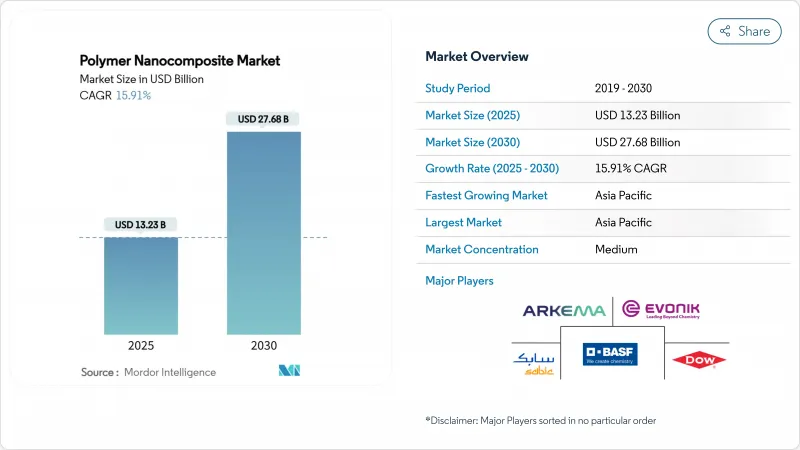
Demand accelerates as nanoscale fillers unlock simultaneous gains in strength, thermal conductivity, and barrier performance, making the material central to lightweight electric-vehicle parts, high-density electronics, and next-generation packaging. Automotive programs anchor near-term volumes, while fast-moving 5G infrastructure and halogen-free flame-retardant regulations broaden the customer base. Cost-down progress in graphene and carbon-nanotube production improves economics, and regional supply chains in Asia-Pacific shorten lead times, sustaining momentum. Investments in recycling-friendly thermoplastic matrices further position the polymer nanocomposites market as a preferred solution for circular-economy goals.
Global Polymer Nanocomposite Market Trends and Insights
Growing Demand for High-Barrier Packaging in Food and Pharma
Polymer nanocomposites lower oxygen transmission below 0.1 cc/m2/day, matching multilayer laminates while cutting film thickness by up to 40%. Antimicrobial metal-oxide nanoparticles extend shelf life, so food processors shift from chemical preservatives to active-packaging formats. Moisture-sensitive pharmaceuticals also benefit, allowing single-layer blister designs that simplify recycling. FDA guidance on nanomaterial risk assessment shortens approval cycles, and line integration eliminates lamination steps, improving throughput and waste ratios.
Lightweighting Targets in Automotive and Mobility Composites
Carbon-fiber-reinforced thermoplastic nanocomposites yield 40% mass savings versus steel and support automated fiber-placement lines, aligning with high-volume e-mobility programs. Recyclability boosts total-life economics, meeting circular mandates. Beyond mass reduction, nanoscale fillers enhance crash energy absorption and damp NVH, enabling thin-wall designs. European OEMs plan 20-25% weight cuts by 2030, catalyzing resin and reinforcement investment.
High Compounding and Dispersion Costs
Uniform distribution of high-aspect-ratio fillers demands twin-screw extruders with intensified shear, adding 200-400% to processing cost versus standard polymers. Functionalization to curb nanotube agglomeration introduces extra steps and licensing fees. Dry-powder and masterbatch routes lower capex but widen supply-chain complexity. Cost pressure limits penetration into price-sensitive packaging and consumer goods until scale economies materialize.
Other drivers and restraints analyzed in the detailed report include:
- Thermal Management Needs in 5G and Power Electronics
- Regulatory Push for Flame-Retardant, Halogen-Free Materials
- Nanotoxicity/EHS Compliance Uncertainty
For complete list of drivers and restraints, kindly check the Table Of Contents.
Segment Analysis
Nanoclay held 38.13% polymer nanocomposites market share in 2024 on the strength of low cost and established film-extrusion know-how. Barrier gains allow 5-7 µm downgauging in snack packaging without compromising shelf life. Carbon nanotubes occupy premium niches where 10^3 S/m conductivity offsets price, while metal-oxide fillers address UV, antimicrobial, and flame-retardant needs. The other-filler category captures 19.44% CAGR as scalable graphene and nanodiamond grades unlock EMI shielding and thermal paths. Combined, these trends suggest widening formulation diversity rather than one-filler dominanc.
The Polymer Nanocomposites Market Report is Segmented by Filler Type (Carbon Nanotube, Metal Oxide, Nanoclay, and More), Polymer Matrix (Thermoplastics, Thermosets, and Bio-Based Polymers), End-User Industry (Automotive, Packaging, Aerospace and Defense, and More), and Geography (Asia-Pacific, North America, Europe, South America, and Middle-East and Africa). The Market Forecasts are Provided in Terms of Value (USD).
Geography Analysis
Asia-Pacific's 40.35% polymer nanocomposites market share in 2024 mirrors deep manufacturing ecosystems and proactive state programs. China's scale in graphene nanotube production compresses cost curves, while India's additive-manufacturing roadmap targets a 5% global stake, stimulating downstream demand. Japan funds cellulose nanofiber pilots that blend sustainability with high modulus, drawing appliance and auto tier-ones.
North America leverages automotive lightweighting legislation and aerospace certification pipelines. The USMCA trade framework eases cross-border supply of compounded pellets, aiding vehicle platforms assembled in Mexico yet sold in the United States. Europe couples stringent EHS rules with circular-economy targets, accelerating halogen-free nanocomposite adoption in building panels and rail interiors. The Middle East and Africa open pockets of demand through green-building codes and petrochemical diversification, while South America's progress hinges on Brazilian packaging converters and nascent EV component lines. Collectively, regional differentiation ensures balanced expansion for the polymer nanocomposites market over the forecast horizon.
- 3D Systems Inc.
- Altana
- Arkema
- AxiPolymer Inc.
- BASF
- Birla Carbon
- Dow
- DuPont
- Evonik Industries AG
- Foster, LLC
- Hybrid Plastics Inc.
- Inframat Corporation
- Mitsubishi Chemical Group Corporation
- Nanocyl SA
- Powdermet Inc.
- RTP Company
- SABIC
- ShayoNano Singapore Private Ltd.
- Solesence
- Sumitomo Chemical Co. Ltd.
- TORAY INDUSTRIES, INC.
Additional Benefits:
- The market estimate (ME) sheet in Excel format
- 3 months of analyst support
TABLE OF CONTENTS
1 Introduction
- 1.1 Study Assumptions and Market Definition
- 1.2 Scope of the Study
2 Research Methodology
3 Executive Summary
4 Market Landscape
- 4.1 Market Overview
- 4.2 Market Drivers
- 4.2.1 Growing Demand for High-Barrier Packaging in Food and Pharma
- 4.2.2 Lightweighting Targets in Automotive and Mobility Composites
- 4.2.3 Thermal Management Needs in 5G and Power Electronics
- 4.2.4 Regulatory Push for Flame-Retardant, Halogen-Free Materials
- 4.2.5 Battery-Housing Materials for Electric Vehicles
- 4.3 Market Restraints
- 4.3.1 High Compounding and Dispersion Costs
- 4.3.2 Nanotoxicity/EHS Compliance Uncertainty
- 4.3.3 Scale-Up Challenges for Graphene and CNT Supply
- 4.4 Value Chain Analysis
- 4.5 Technological Outlook
- 4.6 Porter's Five Forces
- 4.6.1 Bargaining Power of Suppliers
- 4.6.2 Bargaining Power of Buyers
- 4.6.3 Threat of New Entrants
- 4.6.4 Threat of Substitutes
- 4.6.5 Degree of Competition
- 4.7 Patent Analysis
5 Market Size and Growth Forecasts (Value)
- 5.1 By Filler Type
- 5.1.1 Carbon Nanotube
- 5.1.2 Metal Oxide
- 5.1.3 Nanoclay
- 5.1.4 Nanofiber
- 5.1.5 Other Filler Types
- 5.2 By Polymer Matrix
- 5.2.1 Thermoplastics
- 5.2.2 Thermosets
- 5.2.3 Bio-based Polymers
- 5.3 By End-user Industry
- 5.3.1 Automotive
- 5.3.2 Packaging
- 5.3.3 Aerospace and Defense
- 5.3.4 Electrical and Electronics
- 5.3.5 Energy and Storage
- 5.3.6 Other End-user Industries
- 5.4 By Geography
- 5.4.1 Asia-Pacific
- 5.4.1.1 China
- 5.4.1.2 India
- 5.4.1.3 Japan
- 5.4.1.4 South Korea
- 5.4.1.5 ASEAN
- 5.4.1.6 Rest of Asia-Pacific
- 5.4.2 North America
- 5.4.2.1 United States
- 5.4.2.2 Canada
- 5.4.2.3 Mexico
- 5.4.3 Europe
- 5.4.3.1 Germany
- 5.4.3.2 United Kingdom
- 5.4.3.3 France
- 5.4.3.4 Italy
- 5.4.3.5 Spain
- 5.4.3.6 Russia
- 5.4.3.7 Rest of Europe
- 5.4.4 South America
- 5.4.4.1 Brazil
- 5.4.4.2 Argentina
- 5.4.4.3 Rest of South America
- 5.4.5 Middle-East and Africa
- 5.4.5.1 Saudi Arabia
- 5.4.5.2 United Arab Emirates
- 5.4.5.3 South Africa
- 5.4.5.4 Egypt
- 5.4.5.5 Rest of Middle-East and Africa
- 5.4.1 Asia-Pacific
6 Competitive Landscape
- 6.1 Market Concentration
- 6.2 Strategic Moves
- 6.3 Market Share Analysis
- 6.4 Company Profiles (includes Global level Overview, Market level overview, Core Segments, Financials as available, Strategic Information, Market Rank/Share for key companies, Products and Services, and Recent Developments)
- 6.4.1 3D Systems Inc.
- 6.4.2 Altana
- 6.4.3 Arkema
- 6.4.4 AxiPolymer Inc.
- 6.4.5 BASF
- 6.4.6 Birla Carbon
- 6.4.7 Dow
- 6.4.8 DuPont
- 6.4.9 Evonik Industries AG
- 6.4.10 Foster, LLC
- 6.4.11 Hybrid Plastics Inc.
- 6.4.12 Inframat Corporation
- 6.4.13 Mitsubishi Chemical Group Corporation
- 6.4.14 Nanocyl SA
- 6.4.15 Powdermet Inc.
- 6.4.16 RTP Company
- 6.4.17 SABIC
- 6.4.18 ShayoNano Singapore Private Ltd.
- 6.4.19 Solesence
- 6.4.20 Sumitomo Chemical Co. Ltd.
- 6.4.21 TORAY INDUSTRIES, INC.
7 Market Opportunities and Future Outlook
- 7.1 White-space and Unmet-Need Assessment

