PUBLISHER: Mordor Intelligence | PRODUCT CODE: 2120714

PUBLISHER: Mordor Intelligence | PRODUCT CODE: 2120714
Polyimide Films - Market Share Analysis, Industry Trends & Statistics, Growth Forecasts (2026 - 2031)
According to Mordor Intelligence, the polyimide films market size is projected to expand from USD 1.65 billion in 2025 and USD 1.75 billion in 2026 to USD 2.32 billion by 2031, registering a CAGR of 5.81% between 2026 to 2031.
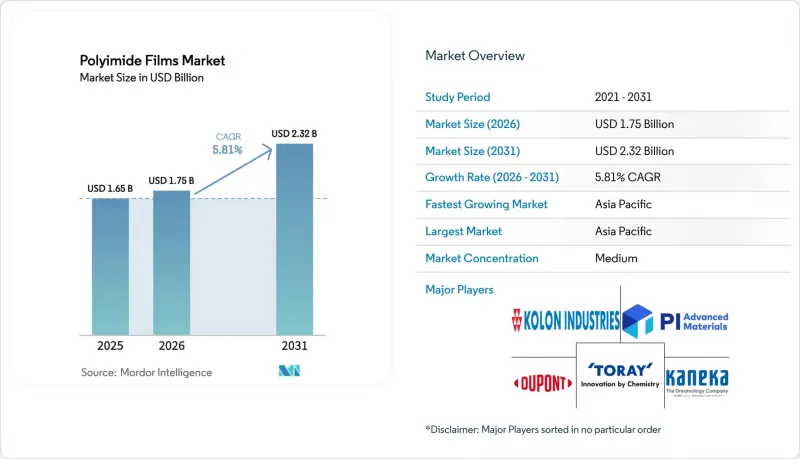
This report is Segmented by Product Type (Conventional Amber, Colorless, Fluorine-Coated, and More), Application (Flexible Printed Circuit Boards (FPCB), Specialty Fabricated Products, and More), End-Use Industry (Electronics, Automotive, Aerospace, and More), and Geography (Asia-Pacific, North America, Europe, South America, and Middle East and Africa). Market Forecasts are Provided in Terms of Value (USD).
Global Polyimide Films Market Trends and Insights
Electronics Miniaturization and Flexible-Display Boom
Colorless polyimide film enables foldable smartphones and rollable televisions because amber grades absorb blue wavelengths and depress OLED luminance by 8% to 12%. Samsung Display and LG Display migrated to colorless substrates in 2024, allowing screen radii below 1.5 mm without cracking. Kolon Industries expanded its Gumi line in 2025 to meet rising panel demand, signaling that colorless materials have shifted from niche prototypes to mass production. BOE is now qualifying the film for under-display cameras that require more than 88% light transmission. As a result, the polyimide film market is fragmenting into optically transparent and thermally robust subsegments, each demanding distinct polymer architectures.
EV High-Voltage Insulation Demand Surge
Battery architectures are moving from 400 V to 800 V platforms, pushing insulation specifications toward dielectric strengths above 200 kV /mm and continuous-use temperatures above 250°C. DuPont Kapton meets these thresholds and is already wrapped around busbars and separators in lithium-ion modules. Oerlikon introduced a plasma-enhanced coating in 2024 that trimmed thermal-runaway propagation by 18%, while Avery Dennison released a UL 94 V-0 compliant tape in 2025 for European automakers. Chinese battery producers are adopting graphite-filled grades to dissipate heat in cell-to-pack designs. Together, these developments draw the polyimide film market further into the EV battery value chain.
Volatile Dianhydride and Diamine Feedstock Pricing
Pyromellitic dianhydride and oxydianiline prices swung 22% through 2024 as Chinese environmental inspections curtailed benzene-derivative output. Film producers exposed to 60-day contract cycles saw margins compress when raw-material spikes outpaced customer repricing. Vertically integrated suppliers such as DuPont and Toray hedge through long-term purchase agreements, but mid-tier players in Taiwan and India endured utilization dips below 70%. This volatility steers R&D toward solvent-free extrusion and aqueous dispersions, yet pilot lines have not matched the mechanical integrity of solvent-cast grades. Consequently, raw-material risk remains a drag on polyimide film market expansion.
Other drivers and restraints analyzed in the detailed report include:
- 5G/6G High-Frequency PCB Adoption
- Space-Sector Lightweight Thermal Shielding Expansion
- VOC-Emission Compliance Cost for Solvent Casting
For complete list of drivers and restraints, kindly check the Table Of Contents.
Segment Analysis
Conventional amber film retained 45.45% share of the polyimide film market size in 2025, buoyed by cost-sensitive motor insulation and tape backings. Colorless grades are forecast to climb at a 6.22% CAGR as display makers demand more than 88% light transmission. Fluorine-coated films appeal to aerospace hydraulics, and graphite-filled variants move into EV battery thermal interfaces where heat flux tops 5 W / m-K. Biaxially stretched grades deliver higher tear resistance, though their 15% price premium restricts uptake to automotive electronics.
Specialty formulations now draw higher margins and insulate producers from commodity price swings. Kolon, Kaneka, and Asahi Kasei are expanding colorless and photosensitive capacity, with the latter investing to double PIMEL PSPI output by 2030. These multiyear bets indicate that premium segments will anchor revenue growth within the polyimide film market.
Complete Report Scope:
- By Product Type
- Conventional (Amber) PI Film
- Colorless PI Film
- Fluorine-Coated PI Film
- Thermally-Conductive/Graphite-Filled PI Film
- Biaxially-Stretched PI Film
- By Application
- Flexible Printed Circuit Boards (FPCB)
- Specialty Fabricated Products
- Pressure Sensitive Tapes
- Wire and Cable
- Motor/Generator
- By End-use Industry
- Electronics
- Automotive
- Aerospace
- Labelling
- Other End-user Industries
- By Geography
- Asia-Pacific
- China
- Japan
- South Korea
- India
- ASEAN Countries
- Rest of Asia-Pacific
- North America
- United States
- Canada
- Mexico
- Europe
- Germany
- United Kingdom
- France
- Italy
- Rest of Europe
- South America
- Brazil
- Argentina
- Rest of South America
- Middle East and Africa
- Saudi Arabia
- South Africa
- Rest of Middle East and Africa
- Asia-Pacific
Geography Analysis
Asia-Pacific accounted for 44.91% of revenue in 2025 and is set to grow at a 6.14% CAGR through 2031, underpinned by electronics assembly, automotive production, and vertically integrated dianhydride supply in China. Japan maintains leadership in colorless and photosensitive grades, supplying Samsung Display, LG Display, and TSMC. South Korea leverages proximity to panel makers for rapid prototyping, while India's production-linked incentive scheme spurs local FPCB demand, although film imports still dominate.
North America held a mid-teens slice of the polyimide film market. DuPont's USD 250 million Circleville expansion in Ohio reinforces domestic supply for aerospace and defense customers who prioritize reliability over cost. The US CHIPS Act funds new packaging fabs in Arizona and New Mexico, pulling photosensitive grades into regional supply chains. Canada and Mexico absorb wire-and-cable volumes linked to wind and EV investments.
Europe contributed a high-teens share, concentrated in Germany, France, and Italy, for automotive and satellite uses. REACH emission limits curb fresh capacity, so many converters import Asian film while focusing on downstream tapes and laminates. South America and the Middle East remain nascent, but Brazil's EV programs and Saudi Arabia's petrochemical diversification hint at future incremental demand for the polyimide film market.
- 3M
- AGC Inc.
- Arakawa Chemical Industries,Ltd.
- DuPont
- I.S.T Corporation
- KANEKA CORPORATION
- Kolon Industries, Inc.
- Mitsui Chemicals, Inc.
- PI Advanced Materials Co., Ltd.
- Saint-Gobain
- Taimide Tech. Inc.
- Teraoka Seisakusho co.,Ltd.
- TORAY INDUSTRIES, INC.
- UBE Corporation
- Von Roll
- Wuhan Imide New Materials Technology Co.,LTD
- Zhejiang Hecheng Smart Electric Co., Ltd.
Additional Benefits:
- The market estimate (ME) sheet in Excel format
- 3 months of analyst support
TABLE OF CONTENTS
1 Introduction
- 1.1 Study Assumptions & Market Definition
- 1.2 Scope of the Study
2 Research Methodology
3 Executive Summary
4 Market Landscape
- 4.1 Market Overview
- 4.2 Market Drivers
- 4.2.1 Electronics miniaturisation and flexible-display boom
- 4.2.2 EV high-voltage insulation demand surge
- 4.2.3 5G/6G high-frequency PCB adoption
- 4.2.4 Space-sector lightweight thermal shielding expansion
- 4.2.5 Additive-manufactured low-k PI for chiplet packaging
- 4.3 Market Restraints
- 4.3.1 Volatile dianhydride and diamine feedstock pricing
- 4.3.2 VOC-emission compliance cost for solvent casting
- 4.3.3 PFAS-linked supply-chain traceability mandates
- 4.4 Value Chain Analysis
- 4.5 Porter's Five Forces
- 4.5.1 Threat of New Entrants
- 4.5.2 Bargaining Power of Suppliers
- 4.5.3 Bargaining Power of Buyers
- 4.5.4 Threat of Substitutes
- 4.5.5 Competitive Rivalry
5 Market Size and Growth Forecasts (Value)
- 5.1 By Product Type
- 5.1.1 Conventional (Amber) PI Film
- 5.1.2 Colorless PI Film
- 5.1.3 Fluorine-Coated PI Film
- 5.1.4 Thermally-Conductive/Graphite-Filled PI Film
- 5.1.5 Biaxially-Stretched PI Film
- 5.2 By Application
- 5.2.1 Flexible Printed Circuit Boards (FPCB)
- 5.2.2 Specialty Fabricated Products
- 5.2.3 Pressure Sensitive Tapes
- 5.2.4 Wire and Cable
- 5.2.5 Motor/Generator
- 5.3 By End-use Industry
- 5.3.1 Electronics
- 5.3.2 Automotive
- 5.3.3 Aerospace
- 5.3.4 Labelling
- 5.3.5 Other End-user Industries
- 5.4 By Geography
- 5.4.1 Asia-Pacific
- 5.4.1.1 China
- 5.4.1.2 Japan
- 5.4.1.3 South Korea
- 5.4.1.4 India
- 5.4.1.5 ASEAN Countries
- 5.4.1.6 Rest of Asia-Pacific
- 5.4.2 North America
- 5.4.2.1 United States
- 5.4.2.2 Canada
- 5.4.2.3 Mexico
- 5.4.3 Europe
- 5.4.3.1 Germany
- 5.4.3.2 United Kingdom
- 5.4.3.3 France
- 5.4.3.4 Italy
- 5.4.3.5 Rest of Europe
- 5.4.4 South America
- 5.4.4.1 Brazil
- 5.4.4.2 Argentina
- 5.4.4.3 Rest of South America
- 5.4.5 Middle East and Africa
- 5.4.5.1 Saudi Arabia
- 5.4.5.2 South Africa
- 5.4.5.3 Rest of Middle East and Africa
- 5.4.1 Asia-Pacific
6 Competitive Landscape
- 6.1 Market Concentration
- 6.2 Strategic Moves (Mergers and Acquisitions, JVs, Capacity Adds)
- 6.3 Market Share(%)/Ranking Analysis
- 6.4 Company Profiles {(includes Global level Overview, Market level overview, Core Segments, Financials as available, Strategic Information, Products and Services, Recent Developments)}
- 6.4.1 3M
- 6.4.2 AGC Inc.
- 6.4.3 Arakawa Chemical Industries,Ltd.
- 6.4.4 DuPont
- 6.4.5 I.S.T Corporation
- 6.4.6 KANEKA CORPORATION
- 6.4.7 Kolon Industries, Inc.
- 6.4.8 Mitsui Chemicals, Inc.
- 6.4.9 PI Advanced Materials Co., Ltd.
- 6.4.10 Saint-Gobain
- 6.4.11 Taimide Tech. Inc.
- 6.4.12 Teraoka Seisakusho co.,Ltd.
- 6.4.13 TORAY INDUSTRIES, INC.
- 6.4.14 UBE Corporation
- 6.4.15 Von Roll
- 6.4.16 Wuhan Imide New Materials Technology Co.,LTD
- 6.4.17 Zhejiang Hecheng Smart Electric Co., Ltd.
7 Market Opportunities and Future Outlook
- 7.1 White-space and Unmet-need Assessment
- 7.2 Increased Research and Development in aerospace and space tech

