
PUBLISHER: Mordor Intelligence | PRODUCT CODE: 1910499

PUBLISHER: Mordor Intelligence | PRODUCT CODE: 1910499
Prebiotic Ingredients - Market Share Analysis, Industry Trends & Statistics, Growth Forecasts (2026 - 2031)
The prebiotic ingredients market was valued at USD 7.79 billion in 2025 and estimated to grow from USD 8.54 billion in 2026 to reach USD 13.49 billion by 2031, at a CAGR of 9.60% during the forecast period (2026-2031).
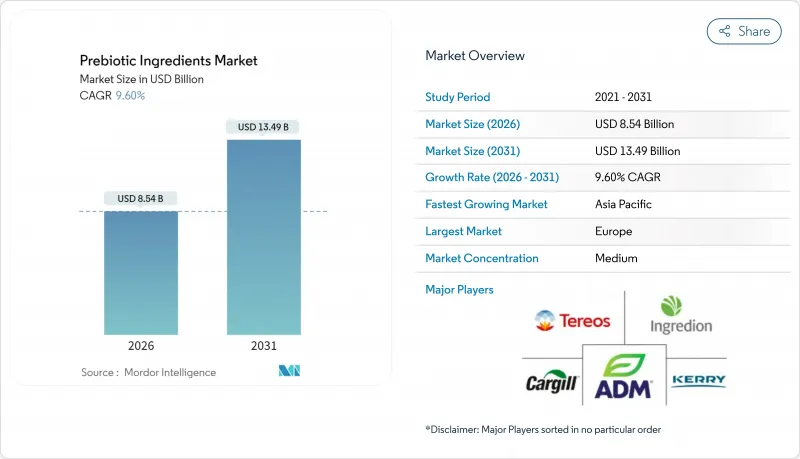
The prebiotic ingredients market is expanding due to growing recognition of gut health's role in overall wellness. These ingredients are increasingly used in functional foods, dietary supplements, and animal nutrition products. Consumer awareness of digestive health benefits and scientific research supporting prebiotic efficacy contribute to market growth. The incorporation of prebiotics in functional foods enhances their nutritional value and health-promoting properties. Additionally, manufacturers are increasingly using galactooligosaccharides (GOS) in infant formula due to their beneficial effects on infant gut microbiota development and immune system function. The versatility of prebiotic ingredients across different food applications and their proven health benefits continue to strengthen market demand.
Global Prebiotic Ingredients Market Trends and Insights
Growth in functional food and beverage products
The functional food and beverage market is driving the growth of prebiotic ingredients. Consumer awareness has increased significantly over the past decade, with 41% of consumers linking 'biotics' to digestive health benefits. This shift in consumer understanding has influenced product development and market strategies across the food and beverage industry. The trend is evident in new product offerings, such as MOJU's prebiotic shot, which contains green banana, golden kiwi, baobab, and chicory root inulin. These ingredients were specifically selected for their complementary prebiotic properties and digestive health benefits. The increasing demand for products with multiple health benefits has expanded opportunities for prebiotic ingredients that improve both nutritional value and sensory characteristics. Manufacturers are responding by incorporating prebiotics into a wider range of products, from dairy alternatives to snack foods, creating a more diverse market landscape.
Expansion of dietary supplements
The growth of the dietary supplements market has increased demand for prebiotic ingredients, as consumers seek products that support gut health. The rising interest in synbiotics, which combine prebiotics and probiotics, demonstrates this trend. These combinations offer enhanced benefits by providing both the beneficial bacteria and the compounds that help them thrive in the digestive system. According to Comet's 2025 trend predictions report, 76% of consumers understand the connection between gut health and overall wellness, reflecting increased awareness of microbiome science. This understanding has driven research and development in the field, leading to significant advancements in prebiotic formulations. Supplement manufacturers have responded by developing specialized prebiotic products that address various health concerns beyond digestion, including immune function, mental health, and metabolic health. The market has also seen an increase in personalized supplement options, allowing consumers to choose products tailored to their specific gut health needs.
High Processing Cost Associated with Prebiotics: Economic Barriers Limit Market Penetration
The high processing costs associated with prebiotic ingredients remain a significant market restraint, particularly affecting price-sensitive segments and emerging markets. Production of high-quality prebiotics like fructooligosaccharides (FOS) and galactooligosaccharides (GOS) requires sophisticated enzymatic processes and purification techniques that substantially increase manufacturing expenses. A 2024 study in ScienceDirect highlights that while cellooligosaccharides (COS) offer promising prebiotic potential, challenges in large-scale production and cost-effectiveness continue to limit their commercial viability. These economic barriers have restricted market penetration in price-sensitive applications and regions, with manufacturers exploring alternative production methods to reduce costs. Recent innovations in extraction technologies, including high hydrostatic pressure and ultrasound-assisted extraction, show promise for improving efficiency, though implementation costs remain high for smaller producers.
Other drivers and restraints analyzed in the detailed report include:
- Rising demand for natural and plant-based ingredients
- Increase in lifestyle diseases: prebiotics emerge as metabolic health allies
- Low Consumer Awareness in Developing Markets: Education Gap Slows Adoption
For complete list of drivers and restraints, kindly check the Table Of Contents.
Segment Analysis
The prebiotic ingredients market by type presents a complex landscape where the inulin category currently holds the largest share at 33.76% in 2025, while galacto-oligosaccharides (GOS) demonstrate the strongest growth trajectory at 11.54% CAGR through 2031. Inulin aligns seamlessly with the clean label movement, where consumers prioritize natural and minimally processed ingredients. Sourced from plants, inulin is frequently promoted as a "natural" or "organic" choice, resonating with consumers who prioritize transparency and sustainability. Furthermore, inulin can substitute for artificial additives, such as fats or sugars, making it a prime candidate for "clean" and "wholesome" food products. Its versatility spans a multitude of products-including yogurt, cheese, bread, cookies, cereals, snacks, and beverages-rendering it highly appealing to food manufacturers. Beyond its recognized prebiotic advantages, inulin enhances texture, substitutes for fat, and curtails sugar content, empowering companies to craft healthier yet flavorful food options. This multifunctionality adeptly addresses both health and sensory preferences.
The rapid growth of GOS is driven by its exceptional prebiotic efficacy and applications in infant nutrition, where it mimics human milk oligosaccharides. A comparative analysis published in FEMS Microbiology Ecology (2023) demonstrated that GOS significantly increases Bifidobacterium populations and exhibits superior digestive tract survival compared to other prebiotics. Mannan-oligosaccharides (MOS), though holding a smaller market share, show promising growth in animal nutrition applications, particularly in poultry and aquaculture feeds, where they enhance immune function and pathogen resistance.
The prebiotic ingredients market by source is dominated by plant-based ingredients, which account for 69.88% of the market in 2025, and is likely to show the fastest growth at 10.62% CAGR through 2031. The plant-based segment's dominance reflects both consumer preference for natural ingredients and the abundant availability of plant sources rich in prebiotic compounds. Chicory root remains the primary commercial source for inulin production, though diversification is occurring with Jerusalem artichoke, agave, and various fruit and vegetable by-products gaining market share.
As plant-based and vegan lifestyles gain traction worldwide, the appetite for plant-derived ingredients surges. Adherents of these diets increasingly favor plant-sourced prebiotics, steering clear of animal-derived options, such as certain GOS from dairy. These plant-based prebiotics resonate with ethical, environmental, and health-centric dietary choices, seamlessly integrating into vegan-friendly offerings like plant-based yogurts, smoothies, and snacks. A 2024 study published in Science Direct highlights the potential of Indonesian exotic fruit seeds as novel sources of prebiotic carbohydrates, indicating ongoing innovation in sustainable sourcing. The diversification of sources reflects the market's maturation and increasing sophistication, with manufacturers developing proprietary prebiotic ingredients to establish competitive advantages in specific applications.
The Prebiotic Ingredients Market Report is Segmented by Type (Inulin, Fructooligosaccharide (FOS), and More), Source, (Plant-Based Source and More), Form (Powder, Liquid), Application (Functional Food and Beverage, Infant Formula and Baby Food, and More), and Geography (North America, Europe, Asia-Pacific, and More). The Market Forecasts are Provided in Terms of Value (USD).
Geography Analysis
Europe leads the global prebiotic ingredients market with a 31.10% share in 2025, driven by advanced regulatory frameworks and sophisticated consumer awareness of gut health benefits. The region's dominance is reinforced by its strong food innovation ecosystem and the presence of major ingredient manufacturers like BENEO and Tereos. The prevalence of lifestyle diseases has been a significant driver, with the Public Health England reporting that 3,579,075 people in England and Wales were registered with diabetes. These health concerns have accelerated demand for functional foods incorporating prebiotics, particularly in dairy products and bakery items.
Asia-Pacific demonstrates the most vigorous growth at 11.12% CAGR, propelled by increasing health consciousness, rising disposable incomes, and expanding middle-class populations. Countries like China, Japan, and India lead regional consumption, though emerging economies such as Vietnam, Indonesia, and Thailand are experiencing significant growth in dietary supplements containing prebiotics.
The rise in consumer awareness about gut health, supported by online retail growth and social media influence, has transformed prebiotic fiber from a specialty ingredient to an essential component in health-focused products across the region. North America maintains a substantial market share, characterized by high consumer awareness and premium product positioning, while Latin America and the Middle East and Africa regions present emerging opportunities driven by increasing health consciousness and expanding food processing sectors.
- Tereos S.A.
- Ingredion Incorporated
- Archer Daniels Midland Company
- Cargill Incorporated
- International Flavors & Fragrances Inc.
- Cosun Beet Company (Sensus B.V.)
- Kerry Group plc
- Cosucra Groupe Warcoing S.A.
- Roquette Freres S.A.
- Samyang Corporation
- Clasado Biosciences Ltd.
- AIDP Inc.
- Chr. Hansen A/S
- DSM-firmenich
- Sudzucker Group
- Royal FrieslandCampina N.V.
- Nexira A/S
- Bunge Limited
- Prenexus Health
- Beghin Meiji S.A.
Additional Benefits:
- The market estimate (ME) sheet in Excel format
- 3 months of analyst support
TABLE OF CONTENTS
1 INTRODUCTION
- 1.1 Study Assumptions & Market Definition
- 1.2 Scope of the Study
2 RESEARCH METHODOLOGY
3 EXECUTIVE SUMMARY
4 MARKET LANDSCAPE
- 4.1 Market Overview
- 4.2 Market Drivers
- 4.2.1 Expansion of Dietary Supplements Market
- 4.2.2 Rising Demand for Natural and Plant- Based Ingredients
- 4.2.3 Increase Incidences of Lifestyle Diseases
- 4.2.4 Increase in Lifestyle Diseases
- 4.2.5 Emergence of Clean-Label Prebiotic Cosmetic Lines in South-East Asia
- 4.2.6 Rapid Adoption of Chicory-Derived Inulin
- 4.3 Market Restraints
- 4.3.1 High Processing Cost Associated with Prebiotics
- 4.3.2 Low Consumer Awarness in Developing Market
- 4.3.3 Taste & Texture Challenges in High-Dosage Bakery Applications
- 4.3.4 Stringent Labeling Regulations on Digestive Claims in Japan
- 4.4 Supply Chain Analysis
- 4.5 Regulatory Outlook
- 4.6 Porter's Five Forces
- 4.6.1 Threat of New Entrants
- 4.6.2 Bargaining Power of Buyers/Consumers
- 4.6.3 Bargaining Power of Suppliers
- 4.6.4 Threat of Substitute Products
- 4.6.5 Intensity of Competitive Rivalry
5 MARKET SIZE AND GROWTH FORECAST
- 5.1 By Type
- 5.1.1 Inulin
- 5.1.2 Fructo-oligosaccharides (FOS)
- 5.1.3 Galacto-oligosaccharides (GOS)
- 5.1.4 Mannan-oligosaccharides (MOS)
- 5.1.5 Others
- 5.2 By Source
- 5.2.1 Plant-Based Source
- 5.2.2 Dairy-Based Source
- 5.2.3 Others
- 5.3 By Form
- 5.3.1 Powder
- 5.3.2 Liquid
- 5.4 By Application
- 5.4.1 Functional Food and Beverage
- 5.4.2 Infant Formula and Baby Food
- 5.4.3 Dietary Supplements
- 5.4.4 Animal Feed
- 5.4.5 Pet Food
- 5.5 By Geography
- 5.5.1 North America
- 5.5.1.1 United States
- 5.5.1.2 Canada
- 5.5.1.3 Mexico
- 5.5.1.4 Rest of North America
- 5.5.2 Europe
- 5.5.2.1 United Kingdom
- 5.5.2.2 Germany
- 5.5.2.3 Spain
- 5.5.2.4 France
- 5.5.2.5 Italy
- 5.5.2.6 Russia
- 5.5.2.7 Rest of Europe
- 5.5.3 Asia-Pacific
- 5.5.3.1 China
- 5.5.3.2 India
- 5.5.3.3 Japan
- 5.5.3.4 Australia
- 5.5.3.5 Rest of Asia Pacific
- 5.5.4 South America
- 5.5.4.1 Brazil
- 5.5.4.2 Argentina
- 5.5.4.3 Rest of South America
- 5.5.5 Middle East & Africa
- 5.5.5.1 Saudi Arabia
- 5.5.5.2 South Africa
- 5.5.5.3 Rest of Middle East & Africa
- 5.5.1 North America
6 COMPETITIVE LANDSCAPE
- 6.1 Market Concentration
- 6.2 Strategic Moves
- 6.3 Market Ranking Analysis
- 6.4 Company Profiles (includes Global-level Overview, Market-level Overview, Core Segments, Financials (if available), Strategic Information, Market Rank/Share, Products & Services, Recent Developments)
- 6.4.1 Tereos S.A.
- 6.4.2 Ingredion Incorporated
- 6.4.3 Archer Daniels Midland Company
- 6.4.4 Cargill Incorporated
- 6.4.5 International Flavors & Fragrances Inc.
- 6.4.6 Cosun Beet Company (Sensus B.V.)
- 6.4.7 Kerry Group plc
- 6.4.8 Cosucra Groupe Warcoing S.A.
- 6.4.9 Roquette Freres S.A.
- 6.4.10 Samyang Corporation
- 6.4.11 Clasado Biosciences Ltd.
- 6.4.12 AIDP Inc.
- 6.4.13 Chr. Hansen A/S
- 6.4.14 DSM-firmenich
- 6.4.15 Sudzucker Group
- 6.4.16 Royal FrieslandCampina N.V.
- 6.4.17 Nexira A/S
- 6.4.18 Bunge Limited
- 6.4.19 Prenexus Health
- 6.4.20 Beghin Meiji S.A.
7 MARKET OPPORTUNITIES AND FUTURE OUTLOOK

