
PUBLISHER: Mordor Intelligence | PRODUCT CODE: 1851067

PUBLISHER: Mordor Intelligence | PRODUCT CODE: 1851067
Plastic Furniture - Market Share Analysis, Industry Trends & Statistics, Growth Forecasts (2025 - 2030)
The Plastic Furniture Market size is estimated at USD 16.80 billion in 2025, and is expected to reach USD 21 billion by 2030, at a CAGR of 4.56% during the forecast period (2025-2030).
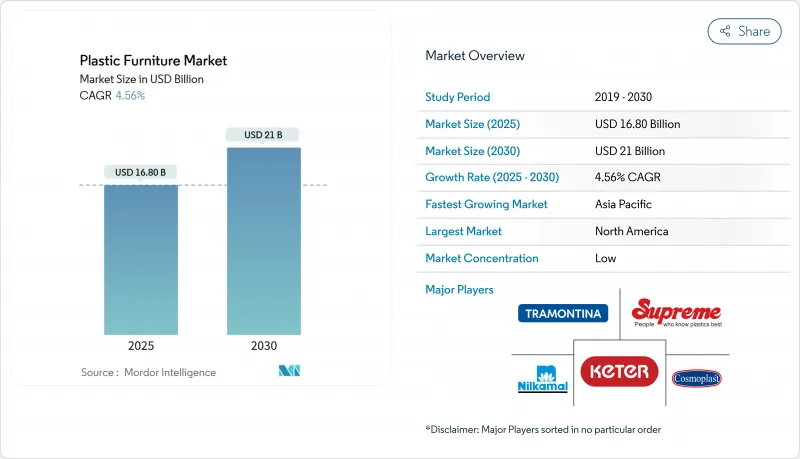
Solid demand stems from rapid urbanization, rising outdoor living investments, and the cost advantages of flat-pack designs that travel well through e-commerce channels. Manufacturers are widening their range with recycled and specialty polymers to stay ahead of tightening sustainability regulations. Product innovation now centers on modular, space-saving furniture that appeals to apartment dwellers, while UV-stabilized and glass-reinforced composites extend use into harsher climates and premium indoor settings. Competitive intensity is growing as direct-to-consumer (DTC) entrants absorb retail margins and incumbents fund circular-economy initiatives to secure post-consumer plastic feedstock.
Global Plastic Furniture Market Trends and Insights
Rapid Urbanization Drives Space-Saving Solutions
Rapid urbanization is shrinking living space in many cities, especially across the Asia-Pacific region. Currently, India's urban population stands at approximately 410 million, accounting for 32% of the nation's total. Projections indicate this figure will surge to 814 million, constituting 50% of the population, by 2050 . As apartments become smaller, residents gravitate toward furniture that serves more than one purpose-pieces that fold, stack, or hide storage inside. Designers are responding with modular plastic units that help households reclaim every inch of floor area. By 2030, when 60% of the world's population is expected to live in urban settings, adaptable furniture will likely be a standard feature in compact homes.
Outdoor Living Spaces Expand Applications
More households and businesses now treat patios, rooftops, and hotel decks as everyday living areas. Plastic furniture suits these settings because it shrugs off rain, sun, and salt while asking little of owners beyond an occasional wipe-down. Designers highlight recycled plastics in their 2025 collections, pairing modular layouts that can move or grow with changing needs. Many new pieces even hide smart touches such as built-in speakers or USB ports, turning an ordinary lounge chair into a mini-entertainment hub. Warm climates keep outdoor areas in use all year, so factories can plan steadier production instead of racing to meet a single summer spike.
Microplastic Regulations Create Compliance Challenges
Scientists now trace tiny plastic particles in rivers back to the slow breakdown of outdoor chairs and tables. A 2024 report from the International Joint Commission singled out furniture as an overlooked contributor International Joint Commission. Policymakers in Brussels and Washington respond with proposals that would force manufacturers to test, label, and sometimes redesign products. Meeting these rules means extra lab work and new coatings, costs that weigh heaviest on small producers .
Other drivers and restraints analyzed in the detailed report include:
- Eco-Friendly Materials Transform Product Development
- Direct-to-Consumer Models Reshape Distribution Economics
- Material Performance Limitations Constrain Expansion
For complete list of drivers and restraints, kindly check the Table Of Contents.
Segment Analysis
Chairs retained 40% of the plastic furniture market share in 2024 by serving residential, hospitality, and institutional needs with ergonomic updates that satisfy office-health guidelines. The segment's stable costs and broad style palette support steady volume growth. Meanwhile, cabinets headline the fastest expansion at a 5.2% CAGR to 2030, as city dwellers seek modular storage to counter shrinking closets.
Tables, stools, and sofas continue to round out portfolios, but momentum clearly tilts toward space-saving storage lines. Vitra's switch to recycled polypropylene in its iconic shell chair cut product carbon intensity by more than 50%, inspiring rival brands to re-engineer legacy SKUs around reclaimed feedstock.
Recent material breakthroughs help broaden product scope. Glass-fiber infusions lift load capacity, enabling three-seat plastic couches that meet residential durability norms. Gas-assisted molding yields sculptural coffee tables with seamless cores, blurring functional and aesthetic boundaries. These shifts re-position plastic from strictly utilitarian to design-forward, moving the plastic furniture market toward higher price-point opportunities.
Residential buyers controlled 60% of 2024 sales thanks to cost, color variety, and low upkeep. Outdoor decks, balconies, and small dining corners remain prime destinations for synthetic materials that shrug off rain and sun. The commercial segment is forecast to post a 5.5% CAGR through 2030, driven by hotels and quick-service restaurants that value stackability and antibacterial coatings.
Offices, hotels, and schools are rethinking how they use space, so they now want furniture that moves and adapts as quickly as their floor plans. Lightweight plastic panels and clip-together seating let a conference room flip into a training hall before lunch. Buyers also look for greener inputs, ergonomic shapes, and built-in tech such as cable ports. Hotels have turned to plastic sets for pool decks and budget guest rooms because they wash clean with a hose and resist salt or sun fade. Schools follow the same logic: stackable chairs survive daily knocks and wipe down in minutes, keeping maintenance costs low.
The Plastic Furniture Market is Segmented by Product (Chairs, Tables, Stools, Cabinets, Sofas, Shelves, and More), by End User (Residential, and Commercial), by Price Range (Economy, Mid-Range, and Premium), by Distribution Channel (B2C/Retail, and B2B/Project), and Geography (North America, Europe, Asia-Pacific, South America, Middle-East and Africa). The Market Forecasts are Provided in Terms of Value (USD).
Geography Analysis
North America anchored 35% of global revenue in 2024, sustained by robust consumer spending, a mature DIY culture, and growing interest in recycled resin products. United States homeowners drive spring-season spikes as landscaping projects fold patio upgrades into mortgage refinancing budgets. Canada follows a seasonal rhythm, while Mexico emerges as a growth pocket on the back of rising homeownership and mall expansions that stock affordable plastic SKUs. Environmental regulation is tightening, with several U.S. states debating minimum recycled content mandates, pushing producers toward closed-loop resin contracts.
Asia-Pacific represents the fastest trajectory, advancing at a 6.0% CAGR from 2025-2030. China champions supply depth and rising domestic demand for cost-efficient decor. India trails closely, buoyed by a growing middle class that favors versatile furniture for compact flats. Southeast Asia's dual-speed picture shows Singapore and Malaysia leaning premium, whereas Indonesia and Vietnam pack volume in the economy tier. Tropical climates enable year-round patio usage, smoothing seasonal swings and offering continuous shelf velocity for outdoor sets, thereby enlarging the plastic furniture market.
Europe balances premium design with stringent eco rules. The United Kingdom and Germany spearhead recycled-plastic certification, while Spain and Italy emphasize alfresco dining sets to suit Mediterranean lifestyles. Eastern Europe supplies incremental upside as incomes swell and e-commerce infrastructure matures. Rethink Plastic Alliance notes that 64% of European furniture buyers now request transparent lifecycle disclosures, making environmental footprints a central brand metric. Digital channels grow twice as fast as brick-and-mortar for plastic furniture, capitalizing on efficient parcel networks and consumer confidence in return policies.
- Keter Group
- Nilkamal Ltd
- Cello World
- Avro India Ltd
- Supreme Industries
- Ashley Furniture Industries
- Walmart Inc. (Mainstays)
- ScanCom International A/S
- Cosmoplast Industrial Co. LLC
- Grosfillex SAS
- Poly-Wood LLC
- C.R. Plastic Products Inc.
- Herman Miller Inc. (MillerKnoll)
- Palram Industries Ltd
- Tramontina S.A.
- Rubbermaid Commercial Products LLC
- Step2 Company LLC
- Qingdao Huanghai Furniture Co., Ltd
- Resol Group
- IKEA
- UMA Plastics Limited
- Vitra International AG
Additional Benefits:
- The market estimate (ME) sheet in Excel format
- 3 months of analyst support
TABLE OF CONTENTS
1 Introduction
- 1.1 Study Assumptions & Market Definition
- 1.2 Scope of the Study
2 Research Methodology
3 Executive Summary
4 Market Landscape
- 4.1 Market Overview
- 4.2 Market Drivers
- 4.2.1 Rapid Urbanization is Driving Demand for Space-Saving Modular Plastic Furniture
- 4.2.2 Growth in Outdoor & Garden Furniture Demand
- 4.2.3 Growing Demand for Eco-Friendly and Recycled Plastic Furniture
- 4.2.4 Low Manufacturing Costs and Price Accessibility Expanding Consumer Reach
- 4.2.5 E-commerce-Led Direct-to-Consumer Brands Slashing Distribution Costs for Flat-Pack Plastics
- 4.3 Market Restraints
- 4.3.1 Micro-plastic Emission Concerns Prompting Strict Product Standards
- 4.3.2 Low Heat-Resistance Limiting Penetration in Premium Indoor Segments
- 4.3.3 Competition from Alternative Materials
- 4.4 Industry Value Chain Analysis
- 4.5 Porter's Five Forces Analysis
- 4.5.1 Threat of New Entrants
- 4.5.2 Bargaining Power of Suppliers
- 4.5.3 Bargaining Power of Buyers
- 4.5.4 Threat of Substitutes
- 4.5.5 Competitive Rivalry
- 4.6 Insights into the Latest Trends and Innovations in the Market
- 4.7 Insights on Recent Developments (New Product Launches, Strategic Initiatives, Investments, Partnerships, JVs, Expansion, M&As, etc.) in the Market
5 Market Size & Growth Forecasts (Value, USD)
- 5.1 By Product
- 5.1.1 Chairs
- 5.1.2 Tables
- 5.1.3 Stools
- 5.1.4 Cabinets
- 5.1.5 Sofas
- 5.1.6 Shelves
- 5.1.7 Other Products
- 5.2 By End User
- 5.2.1 Residential
- 5.2.2 Commercial
- 5.3 By Price Range
- 5.3.1 Economy
- 5.3.2 Mid-Range
- 5.3.3 Premium
- 5.4 By Distribution Channel
- 5.4.1 B2C/Retail
- 5.4.1.1 Home Centers
- 5.4.1.2 Specialty Furniture Stores
- 5.4.1.3 Online
- 5.4.1.4 Other Distribution Channels
- 5.4.2 B2B /Project
- 5.4.1 B2C/Retail
- 5.5 By Geography
- 5.5.1 North America
- 5.5.1.1 Canada
- 5.5.1.2 United States
- 5.5.1.3 Mexico
- 5.5.2 South America
- 5.5.2.1 Brazil
- 5.5.2.2 Peru
- 5.5.2.3 Chile
- 5.5.2.4 Argentina
- 5.5.2.5 Rest of South America
- 5.5.3 Europe
- 5.5.3.1 United Kingdom
- 5.5.3.2 Germany
- 5.5.3.3 France
- 5.5.3.4 Spain
- 5.5.3.5 Italy
- 5.5.3.6 BENELUX (Belgium, Netherlands, and Luxembourg)
- 5.5.3.7 NORDICS (Denmark, Finland, Iceland, Norway, and Sweden)
- 5.5.3.8 Rest of Europe
- 5.5.4 Asia-Pacific
- 5.5.4.1 India
- 5.5.4.2 China
- 5.5.4.3 Japan
- 5.5.4.4 Australia
- 5.5.4.5 South Korea
- 5.5.4.6 South East Asia (Singapore, Malaysia, Thailand, Indonesia, Vietnam, and Philippines)
- 5.5.4.7 Rest of Asia-Pacific
- 5.5.5 Middle East And Africa
- 5.5.5.1 United Arab of Emirates
- 5.5.5.2 Saudi Arabia
- 5.5.5.3 South Africa
- 5.5.5.4 Nigeria
- 5.5.5.5 Rest of Middle East And Africa
- 5.5.1 North America
6 Competitive Landscape
- 6.1 Market Concentration
- 6.2 Strategic Moves
- 6.3 Market Share Analysis
- 6.4 Company Profiles (includes Global-level Overview, Market-level Overview, Core Segments, Financials as available, Strategic Information, Market Rank/Share for key companies, Products & Services, and Recent Developments)
- 6.4.1 Keter Group
- 6.4.2 Nilkamal Ltd
- 6.4.3 Cello World
- 6.4.4 Avro India Ltd
- 6.4.5 Supreme Industries
- 6.4.6 Ashley Furniture Industries
- 6.4.7 Walmart Inc. (Mainstays)
- 6.4.8 ScanCom International A/S
- 6.4.9 Cosmoplast Industrial Co. LLC
- 6.4.10 Grosfillex SAS
- 6.4.11 Poly-Wood LLC
- 6.4.12 C.R. Plastic Products Inc.
- 6.4.13 Herman Miller Inc. (MillerKnoll)
- 6.4.14 Palram Industries Ltd
- 6.4.15 Tramontina S.A.
- 6.4.16 Rubbermaid Commercial Products LLC
- 6.4.17 Step2 Company LLC
- 6.4.18 Qingdao Huanghai Furniture Co., Ltd
- 6.4.19 Resol Group
- 6.4.20 IKEA
- 6.4.21 UMA Plastics Limited
- 6.4.22 Vitra International AG
7 Market Opportunities & Future Outlook
- 7.1 Advancements in Sustainable and Recycled Materials
- 7.2 Focus on Modular and Space-Saving Designs

